



Abstract
Many children in Canada and the United States experience poor-quality child care on a regular basis. Under the rubric of “parent choice,” governments continue to permit a variety of licensed care providers (centers and homes) as well as unlicensed home child care providers. Research suggests, however, that parents are not well-informed consumers about child care services, unaware of even the basic characteristics of their child’s care. In this study, we provide findings from a latent profile analysis based on a conjoint survey conducted in Toronto, Canada to better understand the factors that influence parents’ decisions in selecting child care services. Based on responses from over 700 parents, we identify five classes of parents that reflect a range of preferences in selecting child care. However, most groups show a strong preference for licensed early childhood education and care (ECEC) options. Limitations of this study and implications for policy are discussed.
Keywords
Introduction
When looking for early childhood education and care (ECEC) services, parents are faced with a range of options that may influence their decision: how close is care to their home or work? How expensive is care? How warm and loving are the caregivers? Is the care regulated by their city, state, or province? As parents make trade-offs between different features of ECEC, they make decisions about which attributes are most important to them. However, researchers have little understanding of which of these trade-offs matter more for parents making decisions about ECEC. Empirically, we know that parents are placing their children in ECEC services that vary considerably in terms of their regulatory oversight and the relative quality of care being provided to children. Yet, it is challenging to examine the factors that parents ultimately weigh, and how they weigh them, when they go about making their ECEC decisions. In this article, we use conjoint survey methodology followed by latent profile analysis to study parents’ preferences and decisions.
In general, studies that report stated preferences for child care may not accurately capture parents’ true preferences. As a Trust for Learning (2017) report documents, survey research reveals that parents, in general, want to do a good job in parenting, and they rightly believe that children’s experience in the early years has a lasting impact; nonetheless, early childhood development as a whole is “not well understood in practice” (Trust for Learning, 2017, p. 3). Past efforts to survey parents reveal that they often misreport what services they use, particularly around whether the care they send their children to is licensed (Varmuza et al., 2019). Parents may place high value on quality early years programs, but research has shown that there are large gaps in their familiarity with their child’s program including knowing their child’s teacher’s educational background (Howe et al., 2013). It is also difficult to ask parents to think outside of their current choice of care (status quo bias) in responses to questions about their ECEC services. Meanwhile, different groups of parents may want different things for their child’s care arrangements.
The goal of this article is to advance our understanding of parent decision making in ECEC. To do so, we apply a quasi-behavioral conjoint survey to examine the implicit and explicit factors parents weigh in making ECEC decisions. What do parents really want for themselves and their children in terms of ECEC services? What do they understand about the ECEC services that are available to them? What trade-offs do parents make when presented with factors related to cost, accessibility, quality, and risk under constrained decision settings that mimic real-world decision contexts? Beyond that, we aim to think through the implications of parents’ preferences and decision-making models as revealed through their choices for ECEC and how parents experience the ECEC “system.”
This article presents the results of a conjoint survey combined with latent profile analysis to gain better insight into how parents make ECEC decisions. Conjoint analysis allows researchers to probe decision behaviors in simulated choice settings, which helps reveal the true weight and importance placed on various factors. By pairing this survey method with latent profile analysis, we are able to group respondents based on what they reveal—through their simulated decisions—to be important in their ECEC choices. Based on the responses from 724 parents, we identify five profiles of parent decision-making that reflect a range of preferences in selecting ECEC. Based on the nature of the revealed preferences combined with demographic characteristics, we descriptively label the five groups of parents as: (1) Constrained Conscientious Consumers; (2) the Making it Work Parents; (3) the Cozy Care Parents; (4) the Center Centric Parents; and (5) the Quality Conscious Consumers. While most of these groups of parents—with the exception of Constrained Conscientious Consumers—have a similar socio-demographic profile, they have quite different ECEC preferences. And, across the board, all groups show a preference for licensed care.
Results from this study provide meaningful insights into parents’ understanding of ECEC services and their preference rankings in constrained choice scenarios. This information can help inform policy making around ECEC services and particularly in ensuring that governments assist parents in finding the forms of care parents want.
Background: Parents as Consumers of Care Services
Throughout the United States and Canada, ECEC is regulated at the subnational (state or provincial) level. In most jurisdictions, governments have adopted policy frameworks that allow for some portion of the sector to remain largely unregulated with few mechanisms to enforce the provision of high-quality ECEC. Forty-two US states and all Canadian provinces allow for the provision of child care services through unlicensed child care service providers (in Canada, these providers are limited to home-based care; while in some US states, some child care centers are also exempt from licensing). Unlicensed child care providers are non-relative carers who provide paid care services in their own home or place of business (and are thus distinguished from relative care or care by a nanny). In the province of Ontario, where this study takes place, this type of non-relative care is referred to as “unlicensed home child care.” Given the presence of unlicensed care throughout state and provincial jurisdictions, the relative quality of ECEC and the relative safety of children in care can vary considerably (Wrigley & Dreby, 2005).
The myriad factors that go into parents’ ECEC decision making are not well understood and very little is known about how parents weigh the various factors that affect ECEC decision making (Gamble et al., 2009). Empirically, we know that parents will place children in seemingly suboptimal care environments. Many children end up in ECEC that is mediocre at best according to quality standards (Cryer & Phillipsen, 1997; Helburn, 1995; Kamerman & Gatenio-Gabel, 2007; Peisner-Feinberg et al., 1999). Parents also opt for unlicensed ECEC, which studies have shown tend to be (on average) lower quality than licensed services (Bassok et al., 2016). Despite the fact that parents, on average, report very high levels of satisfaction with their children’s ECEC services, research demonstrates that parents’ reported assessments of provider quality are very positively skewed (Bassok et al., 2017; Barros & Leal, 2015; Grammatikopoulos et al., 2014; Zellman & Perlman, 2006) and do not map onto independently conducted measures of quality (such as Early Childhood Environment Rating Scale—ECERS—ratings; Cryer & Burchinal, 1997; Cryer et al., 2002; Perlman et al., in preparation). Meanwhile, Howe et al. (2013) find that parents cannot accurately identify the level of education of their child’s caregiver(s).
A number of factors may explain why parents are not able to accurately report on or assess their child’s ECEC services. First and foremost, it may not be realistic to expect parents to undertake a comprehensive analysis of the quality of care. While parents are the purchasers of ECEC services, and as such make key decisions in selecting and paying for ECEC services, their children are the care recipients (Blank, 2000). This means that parents do not experience the care first-hand, and research finds that parents spend very little time at their child’s provider. For example, one study found parents spend an average of 63 seconds dropping their child off at their ECEC center in the morning (Perlman & Fletcher, 2012).
Quality is a multidimensional construct that draws together features such as the type of educational programming, the warmth of the care providers, the extent to which they provide a linguistically rich environment, the amount of play based and outdoor activity, the quality and educational nature of available toys, and provider engagement in activities (Burchinal, 2018). Furthermore, the quality of educator/child interactions—a key aspect of the overall quality of the care—is especially difficult to observe and quantify (Pauker et al., 2018). Even parents who do spend time in their child’s program find it difficult to accurately assess how these interactions translate into overall quality. Structural features of the care environment—such as the brightness or cleanliness of the room, or the age-appropriateness of toys—are relatively easier to observe but may have fewer overall implications for the actual quality of the care being received by a child (Perlman et al., 2016).
Logistical constraints also factor into parent decision making, and parents may be limited in their search to centers and homes that are within walking distance or accessible by public transportation, not to mention places they can afford. Shortages in licensed care provision have been documented throughout Canada and the United States, including research on ECEC “deserts” (Hertzman, 2004; Malik & Hamm, 2017; Prentice, 2007) which map the communities where parents are lacking access to licensed or registered ECEC options. Operating hours at child centers and even home child care providers rarely conform to shift work, evening, or weekend hours. Thus, even in instances where providers have been found to be violating minimum regulations, parents may have few alternatives but to continue to use the provider even when informed the care is suboptimal (Monsebraaten et al., 2013).
Furthermore, behavioral science research reveals that when faced with time and information constraints, people key in on some aspects of a choice set and ignore others. Parents may begin their search for ECEC with relatively fixed preferences but when faced with limited time, budget, or available spaces, they may use heuristics as ways of filtering out some information and attending to others such as risk (Kasperson et al., 1988; Slovic and Peters, 2006). And in constrained decision contexts, they may act first and rationalize choices after the fact, leading many to satisfice, not optimize their choices (Simon, 1957). Such decision processes could also account for the reported high levels of parent satisfaction, as it is very difficult for parents to acknowledge a “wrong” choice (because of motivated reasoning and confirmation bias) (Baekgaard et al., 2017; Kahan, 2013; Kunda, 1990).
Survey research and recent work using factor analysis suggest that parents have broadly similar attitudes regarding care that hold across racial and income lines, generally favoring warm and responsive caregivers in a licensed environment (Shlay, 2010; Shlay et al., 2005). In reality, parents usually have to make tradeoffs, weighing constraints of time, affordability, access, and quality considerations (Huff and Cotte, 2013) that may be difficult for them to reveal with candor. Even when faced with severe budgetary and time constraints, for example, it is not easy for parents to admit to choosing a location that looks “dingy” and where the provider is not as warm and nurturing, but the care is close to home and affordable. Decisions made in constrained circumstances may be very different from their desired and stated preferences. Traditional interview and survey techniques, therefore, may not accurately reveal parental values and preferences.
Research Design: Study Parents’ Preferences and Decision-Making Processes
To overcome these methodological challenges, we employed conjoint analysis to help determine what factors parents weigh more heavily than others when making ECEC decisions. Conjoint analysis is a quasi-behavioral survey methodology that asks survey participants to make decisions based on realistic scenarios. It is particularly useful in modeling decision making behavior when “a decision maker has to deal with options that simultaneously vary across two or more attributes” (Green et al., 2001). The objective of conjoint analysis is to determine the factors that are most influential in determining consumer decision making. This is achieved by creating a controlled set of options (in this case, options for ECEC providers) and analyzing how participants make decisions.
To date, only a small number of research studies bring together insights from behavioral science with research on parent decision making around ECEC (e.g., Busemeyer & Goerres, 2017). Leslie et al. (2000) pioneered the use of conjoint methods to study parental preferences for child care, showcasing the potential utility of this approach for understanding parent decision-making. Leslie et al. recruited 235 parents in the United States through a child care referral service, limiting their sample to parents looking for child care. The researchers utilized a vignette-style approach that asked participants to review and rank various child care options in terms of likelihood of enrolling their child. Building on this approach, Rose and Elicker’s (2008) study recruited 355 mothers and engaged them in a conjoint survey of parental preferences. In this study, mothers were recruited from their workplaces and educational environments, with the authors noting some potential implications for the results. Given their attachment to the labor force and/or educational institutions, mothers recruited into this study were likely to have already placed their children into care arrangements, which may have influenced the preferences noted in the study.
Both studies highlighted the potential utility of conjoint approaches for better understanding parents’ preferences. Leslie et al. (2000) found that parental preferences for care varied based on parents’ demographic profiles. Single mothers were most cost-attentive, married mothers more attentive to child/staff ratios, and married fathers equally attentive to cost, convenience, child/staff ratios, and hours of operation. Meanwhile, mothers in the Rose and Elicker study were most attentive to caregiver characteristics such as warmth, education level, and the use of a play-based curriculum. Both studies noted differences in parental preferences across income and education levels, a finding similarly noted in a recent Canadian study (Lin & Dunnett, 2018).
In this study, we rely on a different variant of conjoint design—the choice-based conjoint design. In the type of design, respondents are simultaneously presented with two or more options that randomly vary with respect to the attributes presented—such as the cost of care, its distance from home or work, and the quality of care—as well as the levels of those attributes (e.g., a 5-minute walk to work or a 20-minute walk to work). Based on these randomly composed scenarios, participants are asked to choose the option they prefer (Hainmueller et al., 2014). Choice-based conjoint designs, compared to both vignette approaches and regular survey techniques, set up more complex and information-rich environments, making them closer to “real-life” decisions and helping us better understand the relative importance of different factors on ECEC choices (e.g., which seems to matter more to parents: distance, cost, or quality?). Additionally, choice-based conjoint analysis can assist researchers in dampening the effects of social desirability bias. Because participants are asked to weigh several attributes simultaneously across several different options, the information-rich environment undermines their ability to hide implicit preferences or socially undesirable prejudices.
To probe the results of our conjoint analysis, we used latent profile analysis. Whereas past studies probed parent preferences and decisions based on similar demographic characteristics to probe implications for preferences, the latent profile analysis uses the choice preferences as the starting point. Latent profile analysis enables us to determine whether there are particular subgroups or clusters of ECEC preferences—whether there is heterogeneity in the trade-offs that parents make when making ECEC decisions; we then explore whether these groups differ in terms of the sociodemographic characteristics of the parents.
Methods
The Conjoint Analysis Instrument Design
To set up the conjoint analysis, we developed the following list of core attributes of care: (1) quality considerations such as type of care (licensing regime), physical space, caregiver training, and caregiver interactions; and (2) logistical constraints such as cost, location, flexibility, and full/part-time care. We identified these attributes of care through an extensive literature review, informal interviews with parents, and pilot testing of the survey with parents accessing ECEC services at the City of Toronto Department of Children’s Services. We developed levels that were clearly stated, lacking abstraction, and reflective of the trade-offs that parents face in choosing ECEC (refer to Table 1). Our study differs from past research in removing some important baseline assumptions for parents about the quality and/or safety of the care environments they are considering. Both the Rose and Elicker (2008) and Leslie et al. (2000) studies informed parents that the child care environments were licensed by the state and had basic safety standards (e.g., were clean and safe, staff training, etc.). However, in constrained child care markets throughout North America, parents often also consider unlicensed care providers which do not undergo rigorous quality inspections or require basic staff training.
Conjoint Design.
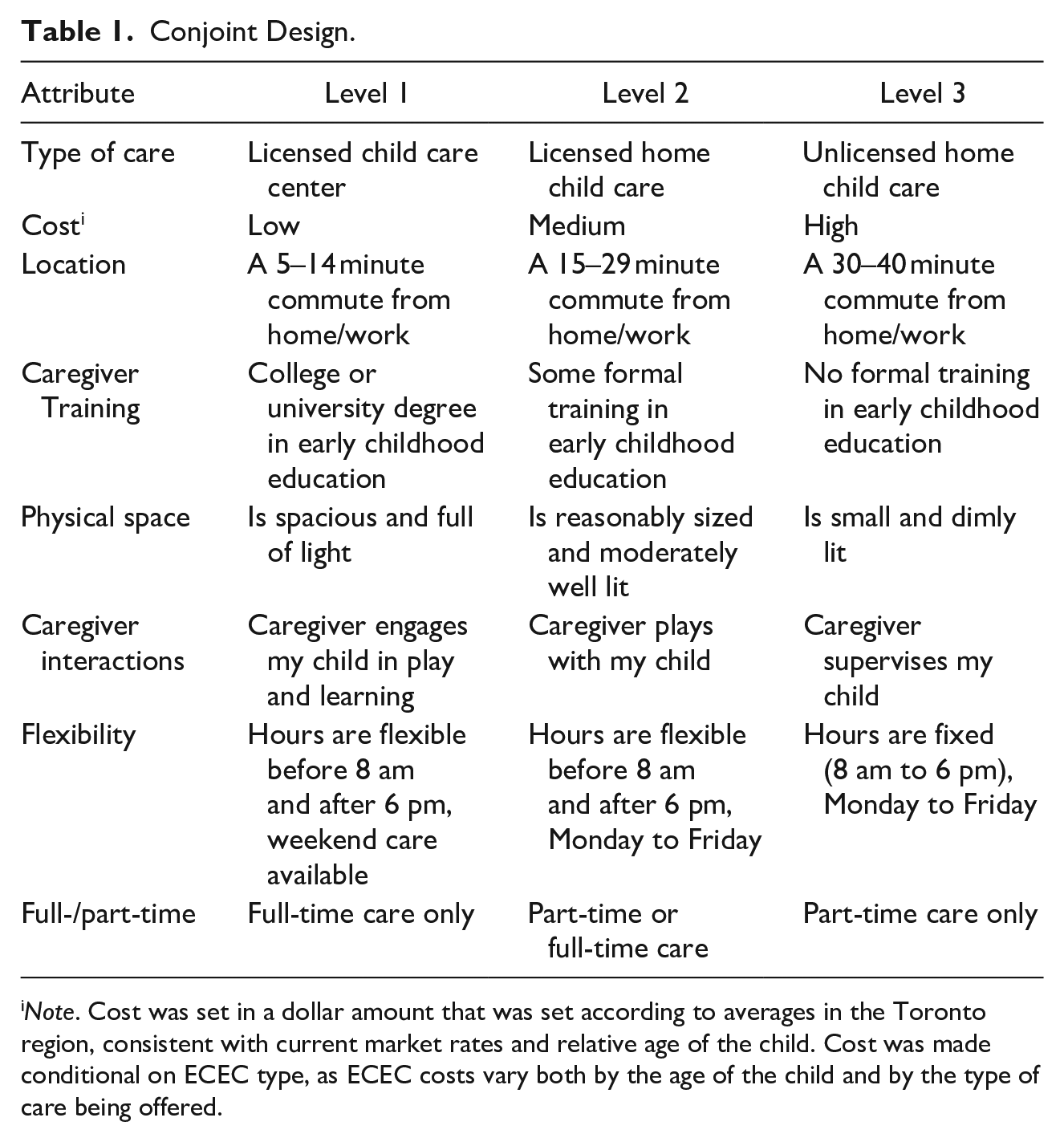
Note. Cost was set in a dollar amount that was set according to averages in the Toronto region, consistent with current market rates and relative age of the child. Cost was made conditional on ECEC type, as ECEC costs vary both by the age of the child and by the type of care being offered.
Unlike conjoint designs which ask participants to rate the likelihood they would use a service, or to rank the appeal of a particular care provider following a vignette (Rose & Elicker, 2008), choice-based conjoint designs present survey participants with two or more options that vary across several attributes. In our design, we asked respondents to imagine that they were currently on several waitlists for child care and that three providers had contacted them with an opening for their child.
Through a series of 12 different choice exercises, we asked parents to choose between the different ECEC providers presented to them, weighing the trade-offs between options. To avoid overburdening respondents, each care provider was defined by a total of five attributes generated from the eight attributes listed above in Table 1. Parents were also given the option of choosing “none,” although doing so would “risk” the possibility that they would not be able to secure ECEC (refer to Appendix A for an example of a choice set provided to participants). This method enabled us to essentially place parents into a simulated ECEC market—allowing us to explore the decisions parents make and the tradeoffs they employ in doing so. In designing the set-up in this way, we aimed to replicate the constraints that many parents face within the child care market. Following the conjoint exercise, participants were asked to complete several additional survey questions regarding their demographic information as well as questions related to the types of ECEC they have used in the past.
Data Collection and Sample
This study surveyed parents in the City of Toronto in Ontario, Canada. Toronto is the largest city in Canada, with a population of approximately three million. The city itself is diverse and multicultural—51.5% of the population in the City of Toronto is a visible minority, while 51.2% of the city population was born outside of Canada (City of Toronto, 2020). Parents in the City of Toronto face considerable challenges in finding and securing care. The cost of ECEC is the highest in the country, waitlists for both public subsidies and ECEC services are long, and licensed child care spaces are hard to come by. Parents can choose between a variety of child care options including center-based care (licensed by provincial governments), and home child care. In Ontario, home child care providers can be licensed if they are affiliated with a home child care agency. Home child care providers can also operate legally without a license so long as they comply with a few minimal requirements, though oversight is generally complaint-based (Government of Ontario, 2019).
The survey of parents was conducted using Sawtooth Software, an online survey tool for conjoint design. Participants were recruited into the survey in two ways. The survey itself was hosted online on the City of Toronto children’s services division website, which is a resource commonly used by parents looking for information about their ECEC options. The City of Toronto also assisted in recruitment, distributing information about the survey through its social media (Twitter), directing parents to the online survey link on through its website, and through an email to parent clients at City of Toronto ECEC centers. The research team also directly recruited parents of young children at EarlyON parent resource centers in priority and low-income neighborhoods in Toronto and asked parents to complete the survey on a tablet provided by the research team. In recruiting parents in this way, the aim was to capture parents of young children from a cross-section of those currently utilizing care as well as those looking for care.
In Ontario, full-day formal schooling starts the year the child turns four. Given the very different ECEC needs of parents whose children are not yet in school, only parents who reported having a child under the age of four were eligible to participate (participants were asked to respond to the survey in relation to their youngest child). Eight hundred and eleven participants completed at least 9 of the 12 conjoint exercises, the minimum cut-off for inclusion in the final sample; incomplete responses were retained to enhance the specificity of the estimates of the part-worth utilities. The data were cleaned in order to maximize the precision of utility model estimations for individual participants. Participants were removed from the final sample based on several metrics indicating respondent fatigue, 1 resulting in a final sample size of 724.
Data Analysis
Conjoint utilities
Conjoint analysis asks participants to make decisions between randomly generated discrete choice sets. In each decision, participants make trade-offs between the options they see in front of them, based on internalized preferences for some attributes and internalized disinterest or dislike toward others. Aggregated, these decisions allow us to estimate the utility model for each individual participant. Based on respondent decisions to the choice, conjoint analysis enables the estimation of part-worth utilities using a Hierarchical Bayesian (HB) estimator. Part-worth utilities represent the responsiveness of a participant to the levels within an attribute of ECEC (in this case). For example, a respondent who cares a lot about ECEC provider training will consistently select options in which the ECEC provider has college/university education and void options in which the educator has low levels of education.
Latent profile analysis
Instead of aggregating individual utilities across the full survey population or relying on demographic profiles to assess differences in decision profiles, we utilized Latent Profile Analysis to explore differences in parent decision models. The latent profile analysis grouped the most similar respondents with respect to their decision profiles. This approach enabled us to examine the hypothesis that respondents with similar (homogenous) demographic or socioeconomic backgrounds may not, in fact, have homogenous preferences.
Analysis of association between latent profiles and demographic characteristics of the sample
In order to investigate the underlying population demographics of the latent profile groups, we conducted a one-way ANOVA to examine associations between the latent profile groups and characteristics such as race, income, work schedule, educational attainment, subsidy eligibility, and self-reported familiarity (on a 0–10 scale) with the ECEC system. Statistically significant results were reported as a function of differences between groups.
Missing data
Of our 724 participants, a small number (N = 39) had complete conjoint data but were missing a large proportion (over 30%) of responses to the other survey items. In some cases, missing data are a function of participant drop-off, while in others, it is a function of participants preferring not to answer a question. Latent profile analyses produced the same five-group solution when we ran them with and without these participants. Furthermore, these participants were distributed proportionally across the five groups. Another 85 participants were missing responses for a small number of items. To maximize the size and representativeness of the sample, the results presented in this article include the responses for the full sample. Where appropriate, we have included the total number of participants who responded to a question.
Results
Demographics of the Sample
Table 2 provides the demographic characteristics of participants. We present the sample size for each question, reflecting the non-trivial dropout rate across the survey questions.
Respondent Demographics (N = 724).
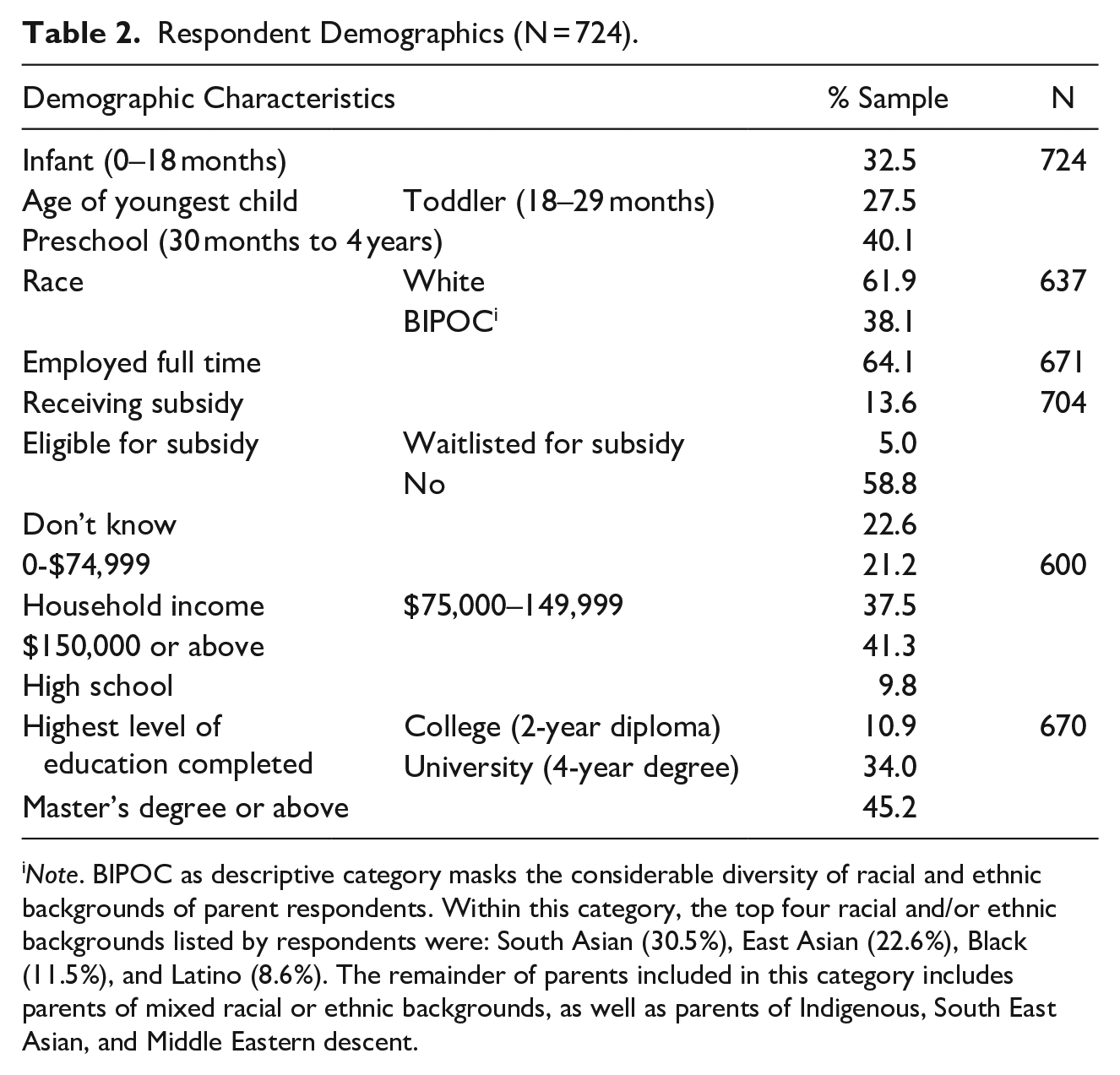
Note. BIPOC as descriptive category masks the considerable diversity of racial and ethnic backgrounds of parent respondents. Within this category, the top four racial and/or ethnic backgrounds listed by respondents were: South Asian (30.5%), East Asian (22.6%), Black (11.5%), and Latino (8.6%). The remainder of parents included in this category includes parents of mixed racial or ethnic backgrounds, as well as parents of Indigenous, South East Asian, and Middle Eastern descent.
As can be seen in Table 2, the study sample is highly educated, and it skews white relative to the City of Toronto population (City of Toronto, 2020). Our sample income is in line with the two-parent households with children under the age of 18 years in the City of Toronto (the median income for two-parent economic households is just over $102,000 per year, based on the 2016 census). Based on this income data, the percentage of parents reporting that they are eligible for a child care subsidy appears low; however, subsidy eligibility in Ontario is based on a mix of both family income and attachment to the labor force (and/or educational attainment). Moreover, of those we have income data on, nearly 45% of those reporting that they “Don’t Know” their eligibility status have incomes below the median income, which may suggest that informational barriers—rather than income—are impacting subsidy uptake (data not shown; Davidson et al., 2020).
The study findings are presented in two parts. First, we present the average utility scores reported to each attribute level for ECEC decisions. Second, we present the findings based on a latent profile model and explore demographic differences between latent profile groups.
Average Utility Scores Across Parent Participants
Based on the calculation of individual utility models for ECEC scenarios, we can observe identifiable parental preferences within the sampled population in response to the different attributes of ECEC present in the conjoint exercises (refer to Table 3). Individual preferences have been zero-centered and averaged across the entire survey sample. The negative to positive spread is a function of arbitrary additive scaling within each attribute. While “caregiver supervises my child” receives a negative utility value, this is not to say that this was necessarily an unattractive option. The negative utility value indicates that all else being equal, parents are more likely to choose or favor options of “plays with my child” and “engages my child in play and learning.” In reviewing the scores, the relative distance between attribute levels (or the spread between negative and positive scores) is of interest. The wider the spread around zero between attribute levels, the larger the influence of that attribute on parent choice. For example, the large spread (of 143.32) between the attribute levels on type of care indicates that, on average, parents have a clear preference for licensed center care relative to unlicensed home child care. By comparison, while parents prefer some flexibility in their care arrangements, the relatively small spread (of 16.27) between fixed and flexible hours suggests that parental decisions are not being driven nearly so intensely by this attribute of care.
Average Utilities by Care Attributes and Levels.
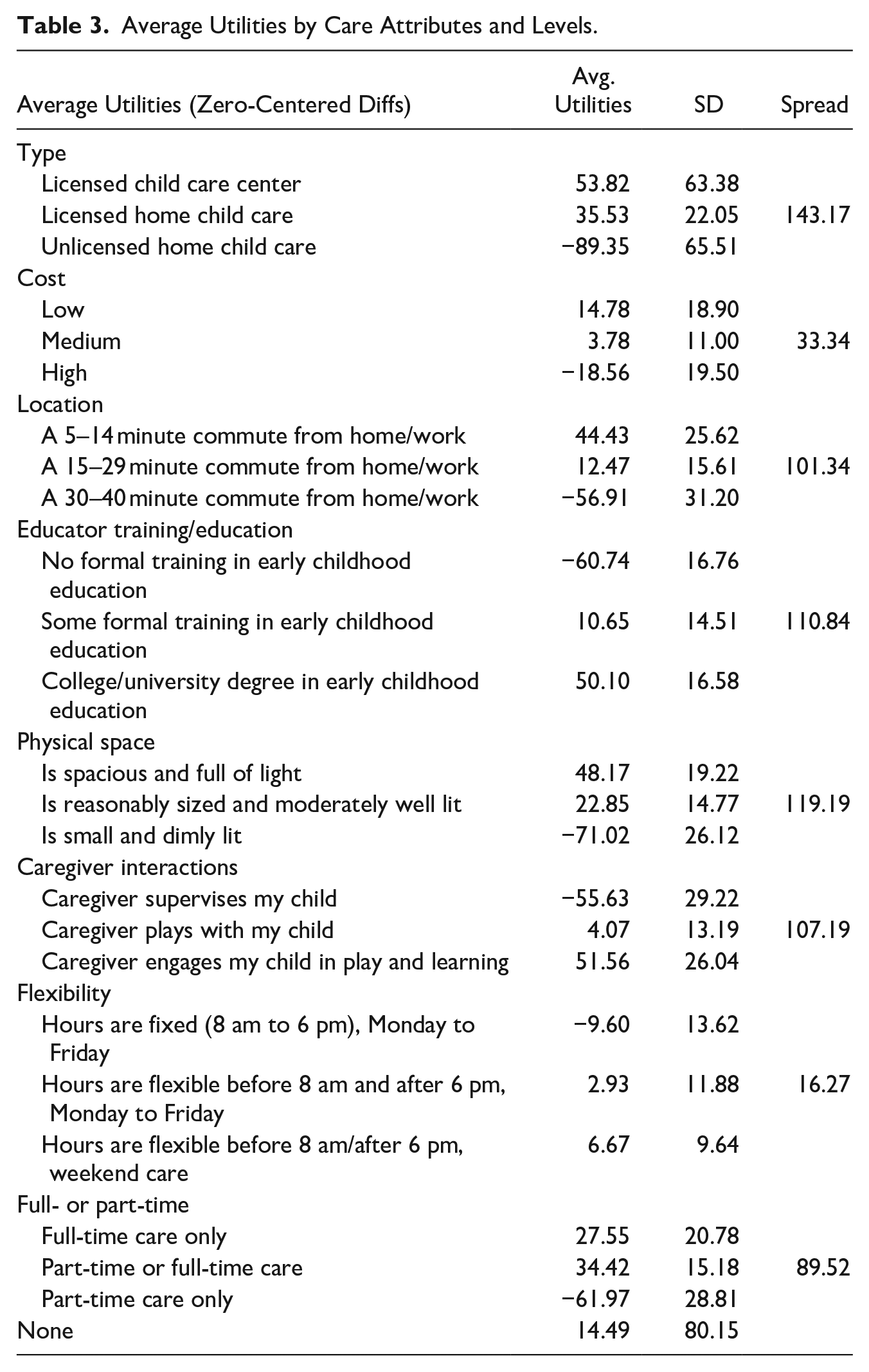
In addition to the type of care, other features of ECEC that appear to shape parent decision making are quality considerations and, in particular, the physical space, the education of the care provider, and the quality of caregiver engagement with children. Meanwhile, only two of the logistical factors, location of the care and part-time availability, appear to rank highly for parents.
While the utilities presented above suggest common preferences across parents, we expected that the average scores mask important differences in parental preferences. Basic demographic differences such as race, subsidy status, or education did not translate into notable differences across utility scores. While lower-income parents (those making less than the median household income in Toronto), differed slightly in preferring home care that is less expensive (data not shown), there were no notable differences related to other attributes of care. Nonetheless, it is overly simplistic to assume that parents will have homogenous preferences for care. As such, we conducted a latent profile analysis of parent utility scores to investigate underlying patterns in parent decision-making.
Latent Profile Analysis
To capture parents’ preferences as consumers of ECEC services more accurately we employed a latent profile analysis to test whether there are subgroups of participants who had similar patterns in their preferences for care. Latent profile analysis classifies individuals into most similar groups based on their pattern of answering a set of categorical variables. The latent profile analysis estimates a conditional probability for group membership and assigns parents to those groups accordingly. The conditional membership probability measures the relative likelihood that an individual belongs to one group, given their answers or given the patterns of behavior they exhibit in the survey tool. In this case, the latent profile analysis relies on the individual utility profiles created based on the conjoint analysis to probabilistically place an individual in one of several latent groups. Rather than rely on visible points of differentiation within a population (such as income or race, and under the assumption that these characteristics will shape preferences or behavior), latent profile analysis relies on invisible or unobservable variables—in this case, patterns of decision-making behavior. Moreover, the latent profile analysis enables an individual—rather than variable—centered approach. In our analysis, individuals are grouped together based on the preferences they reveal through the conjoint analysis (rather than combining variables as in factor analysis).
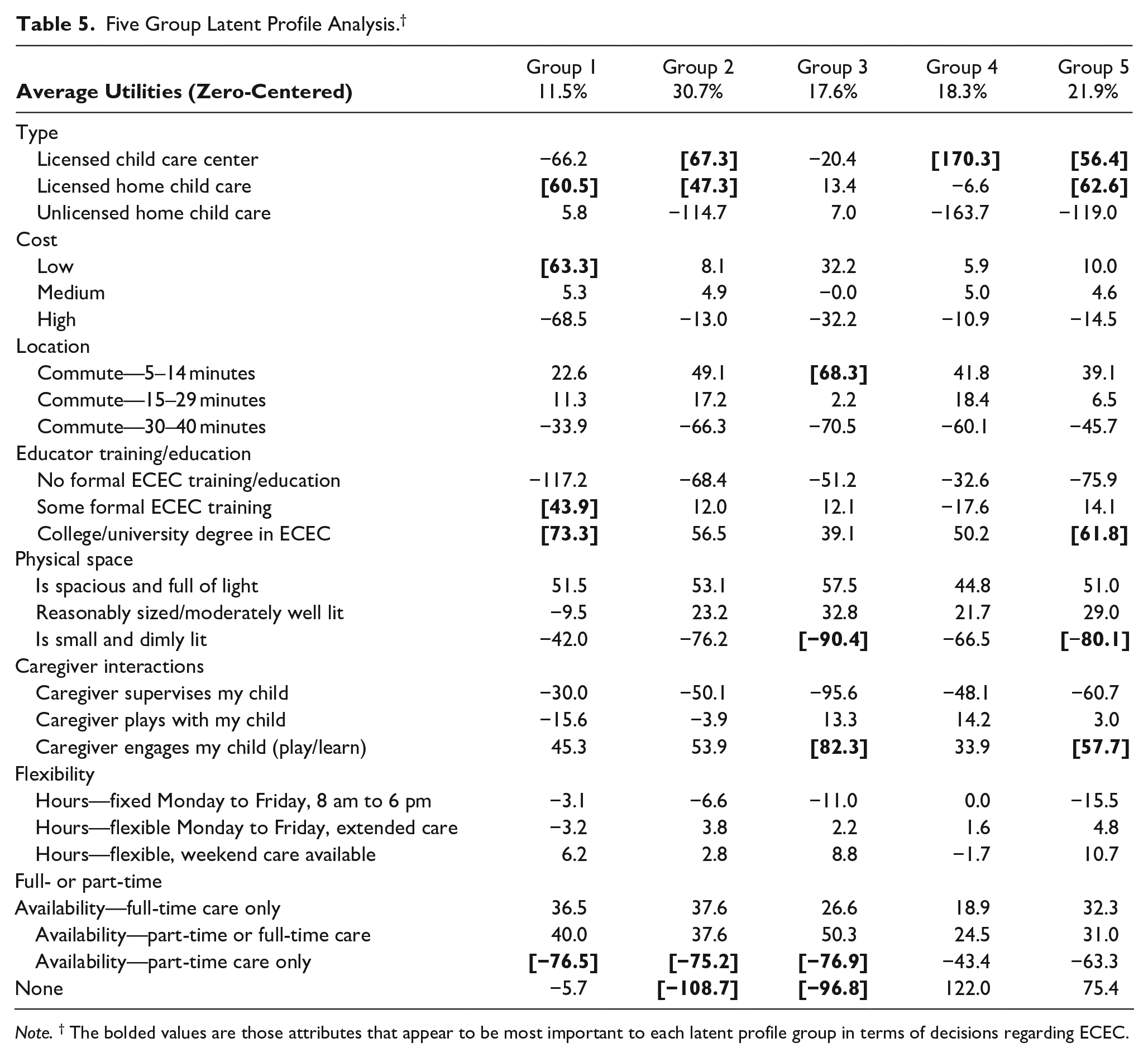
Table 4 shows the model fit statistics. The relevant fit statistics (i.e., the AIC, BIC, and relative chi-square) all point to a five-group model. The five-group analysis revealed the following parent profiles. Group 2 was the largest and made up 30.7% of the survey sample (N = 222). Group 1 was the smallest with 11.5% of the sample (N = 83). The full latent profile is specified below in Table 5.
Fit Indices for 2–5 Group Models.†.
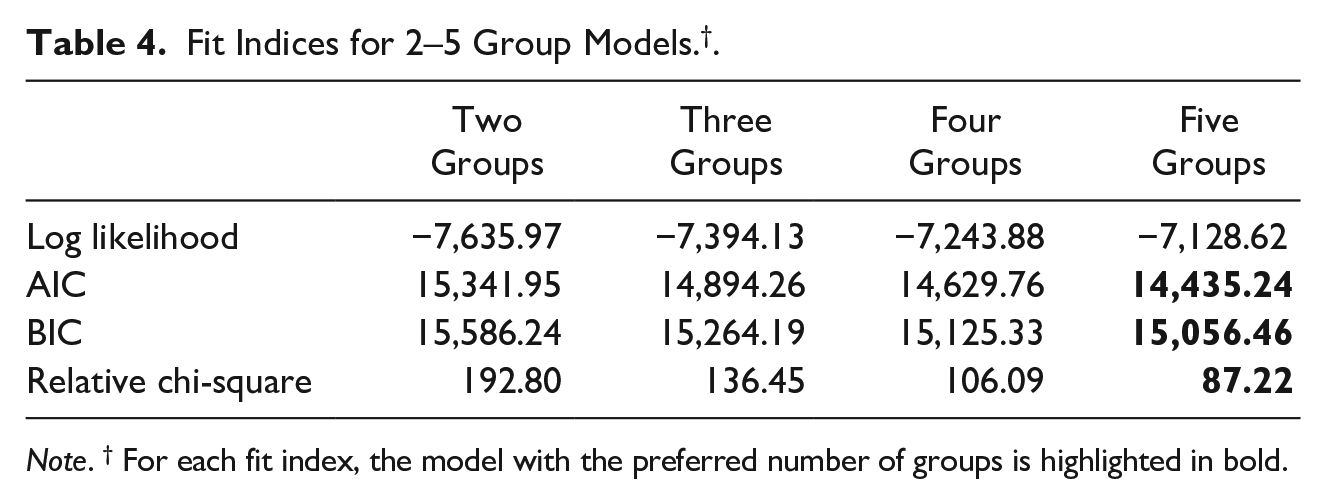
Note. † For each fit index, the model with the preferred number of groups is highlighted in bold.
Five Group Latent Profile Analysis.†
Note. † The bolded values are those attributes that appear to be most important to each latent profile group in terms of decisions regarding ECEC.
The latent profile analysis shown in Table 5 reveals clear differences between groups in the factors that shape parent decision-making in selecting ECEC services. For Groups 2 and 5, for example, there is little functional difference between licensed center care and licensed home care—both are preferable to unlicensed home child care; meanwhile for Group 4, center care is far and away from the clear (and only) option when it comes to the type of ECEC care. For Group 1, the training of the care provider matters considerably, while for Group 3, the quality of caregiver interactions (caregiver engages my child in play and learning) is a dominant feature of decision making.
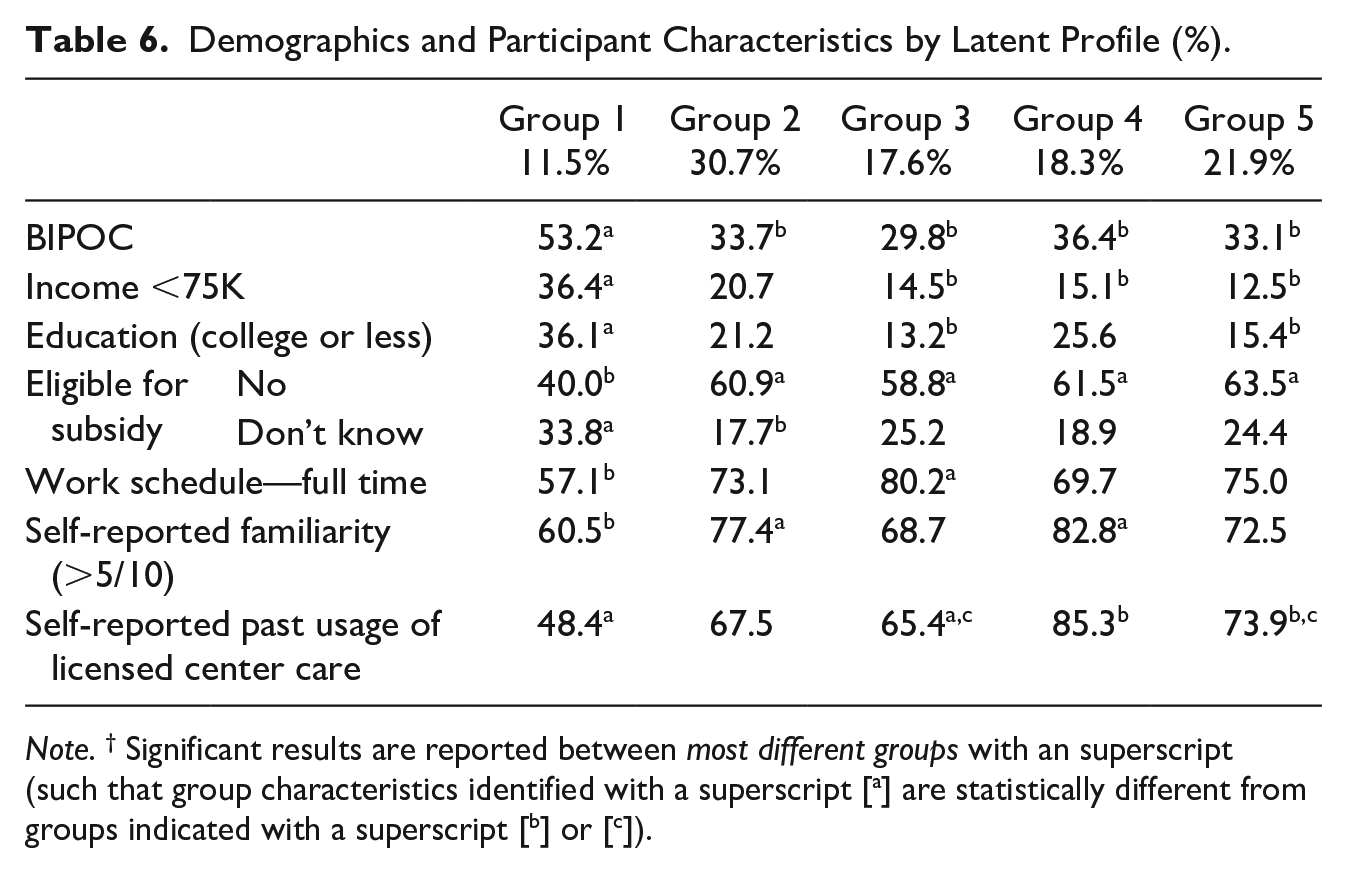
We conducted a one-way ANOVA to explore whether there are any meaningful differences among the parents in our five groups. We used a combination of demographic information as well as responses to survey questions. We found no differences between the parent preferences based on the age of their child, or the number of children they had (data not shown) but, as we can see in Table 6 below, several important characteristics differentiate the populations of parents in each of the decision profiles.
Demographics and Participant Characteristics by Latent Profile (%).
Note. † Significant results are reported between most different groups with an superscript (such that group characteristics identified with a superscript [a] are statistically different from groups indicated with a superscript [b] or [c]).
Group 1 parents were the most distinct from the other four groups, in terms of demographic characteristics. They were more likely to be Black, Indigenous, or People of Color (BIPOC), of lower income, and have lower educational attainment. In terms of familiarity with the ECEC system, they were significantly more likely to be unaware of their subsidy eligibility and their self-reported familiarity with the child care system was significantly lower (relative to Groups 2 and 4). While the other four groups are broadly similar, there are important differences embedded in the groups, Groups 3 through 5 were the highest income, while Groups 2 and 4 were more likely to rank themselves more than a 5/10 on familiarity with the child care system. Meanwhile, Group 3 was the most likely to be engaged in full-time work.
Decision Typologies of Parents
We combined the latent profile preference models with the corresponding demographic information to develop interpretive typologies of parent decision-making. We generated five decision profiles and assigned labels to each group to highlight the choice dynamics:
Discussion
This study highlights clear differences in parental preferences and parental decision making when it comes to ECEC. Relying on a combination of demographic characteristics and preference models we typologized five profiles of decision-making in our sample of parents in the City of Toronto. Based on these decision models, we can investigate what the decision profiles tell us about parent decision-making when it comes to the ECEC systems more broadly.
First, there is a clear mismatch between consumer preferences and the regulatory environment. Whereas the regulatory environment in Canada (and indeed in much of the United States) advances a mixed model of care that includes unlicensed ECEC arrangements under the argument of parental choice and access (White et al., 2017), parents indicate a broad preference for licensed ECEC settings for their children. The latent profile analysis reinforces this finding; even as we note differences in parental priorities, all five groups maintain a preference for licensing—either in home or in centers—over unlicensed care (although type of care is not a driving feature for Cozy Care parents). It may be the case that licensing is operating as a stand-in for quality or safety but, regardless of the heuristic, parents appear to care about the regulatory framework under which ECEC providers operate. This is true even for parents who face greater constraints in terms of time, economic resources, or self-report as less familiar with the ECEC system.
Beyond this finding, the latent profiles of diverge considerably both on preference profiles and demographic characteristics. The Center Centric and the Quality Conscious parents show several important demographic characteristics. Families in these latent profile groups tend to be of higher income, rate their familiarity with the ECEC relatively high, and are attuned to the type of care, so much so that the Center Centric parents appear to focus on that feature of care only. Perhaps more important for our understanding of parent experiences is the relative willingness/capacity for parents to opt-out of the options in front of them. Both of these parent groups are more likely to say “None of the Above” in the conjoint exercise—presumably in response to finding the simulated scenario to be unsuitable for their child and family. This suggests that these parent groups have the resources to wait for preferred options or can remove themselves from the workforce until the “right” ECEC situation becomes available.
The Cozy Care group is demographically similar to the Center Centric and Quality Conscious Consumers groups. They are more likely to be white, have higher family incomes, and be highly educated. Yet, despite these commonalities, they have very distinct and disparate preferences. The Cozy Care group appears to hold a much clearer preference for the nature of caregiver–child interactions, and many hold an additional preference toward home care (or home-like environments). It is important to highlight that similar preference for home-based care between the Cozy Care parents and the Constrained parents appears to be motivated by very different background conditions. While the Cozy Care parents may be linking home care environments to personal values and the importance of a caring environment that “feels like home,” the Constrained parents are likely open to home care for pragmatic reasons such as cost that likely force them to settle for options that may not be their first choice.
The typologies presented above highlight a diversity of parental decision making about ECEC services, and showcase different logistical, constraint-oriented, and preference-based factors that shape how parents make decisions about ECEC. Parents’ self-reported past usage of licensed child care centers largely corresponds with the preferences indicated in the latent profiles, suggesting at least some relationship between preferences and parental decisions in the real child care marketplace. However, a high proportion of incompletes (over 40% of respondents did not answer the question), limits a full understanding of the relationship between past usage and quasi-behavioral decisions. Additionally, we would expect that many parents who have no prior experience with child care (for example, are considering child care for their first child) would nonetheless have embedded preferences.
While our study presents novel insights, there are a number of limitations that may be influencing the results presented here. The sampling technique relied on a convenience sample of parents; nonetheless, the method of gathering survey respondents was similar to past studies which also relied on non-random samples of parents (e.g., Leslie et al., 2000; Rose & Elicker, 2008). Parents who engaged with and subsequently completed the survey were more likely to have higher incomes than the general population of Toronto parents (those with at least one child age 18 years and under), they were also more likely to be more highly educated than the general population. Additionally, the conjoint survey scenarios were challenging, and some participants simply stopped participating. As such, we faced issues of missing data with respect to demographic and survey questions. Future research should engage in a more robust sampling technique to counteract some of these data gaps. This research, moreover, would be strengthened by pairing the quasi-behavioral results with behavioral data to validate the results, presenting new opportunities for more research using this type of approach to study parent decision models.
Conclusion
Our study has explored the complex interaction of parental preferences in the fact of constrained choices, simulating how parents navigate decision making in the ECEC “marketplace.” We utilized conjoint analysis to probe decision behaviors, helping to reveal the importance parents placed on a variety of factors that shape ECEC options. By pairing the conjoint analysis with latent profile analysis, we were able to group respondents based on most similar revealed preferences, categorizing parents according to their decision profiles rather than relying on socioeconomic or demographic data to characterize differences in choice profiles.
Within our sample of parents in the City of Toronto, we find distinct and markedly different profiles of ECEC preferences. The parent decision profiles identified in this study elucidate several important dynamics for policy makers. This study reveals how current public policy design features have profoundly misjudged parent preferences. In keeping parts of the ECEC system unregulated in the province of Ontario (and elsewhere), policymakers appear to believe that “parent choice” and “parent access” should be important features of the child care market (White et al., 2017). However, amongst our survey sample we found that quality indicators including the nature of caregiver interactions and the educational backgrounds of providers were consistently important, and so too was licensing (which remained true for the most economically constrained parent group in the latent profile model). Indeed, our research suggests that the existing ECEC policy framework dominant throughout much of Canada and the United States results in important gaps between what parents want and what parents can get.
While most parents in this survey demonstrate a preference for licensed ECEC, licensed care remains difficult to find, afford, and access for many parents. Recent studies have highlighted the prevalence and persistence of “child care deserts” where parents face limited access to regulated care (Malik & Hamm, 2017; Macdonald, 2018; Prentice, 2007). In the absence of regulated or center-based care, parents will satisfice into other available options. This decision profile was most prevalent in the Constrained Conscientious Consumer group, as well as the Making it Work parents—both of whom favor licensed care but may be pushed into other options due to their relative need to find and secure care. Both groups appeared to be constrained by cost and were less likely to opt out of the options presented to them through the use of the “None” option. As such, these parents and their children are likely to be the least well served by the existing ECEC system. These parents are vulnerable; they face the prospect of insufficient options, which may, in turn, exacerbate issues with ECEC affordability or may impact their ability to engage in full-time employment. Meanwhile, their children are vulnerable; they may end up in lower-quality care if their parents are forced to take whatever option is available to them. Other work has shown that supply-side constraints tend to limit the uptake of ECEC, particularly for children from lower socioeconomic backgrounds (Pavolini & Van Lecker, 2018), a result that appears to be supported by the quasi-behavioral decisions of the parents in our study.
While access to licensed ECEC matters for parents, some—such as the Center Centric parents—may be relying almost entirely on the institutional environment as a stand-in indicator for quality. This is not necessarily unreasonable; in Canada, no centers can operate without a license, they face regular inspections from multiple regulatory authorities, and there is multiple staff interacting with children. Despite this, quality can vary considerably between centers (Bassok et al., 2016). Even when comparing licensed options, parents can still lack information and access to thorough, independent quality indicators (Shpancer et al., 2002).
Ironically, those parents who can opt out of the ECEC market may be the best served by the existing framework. The Quality Care parents, for example, are highly attuned to education level, and more flexible to the type of care arrangement they would take. But they are also more likely than others to step out of the ECEC market if they do not see an option that matches their preferences. Similarly, while the Cozy Care parents prefer home care arrangements, and appear to trust their own assessments of quality with a focus on care interactions, these parents are also more likely to opt out of care if their preferred option is not available. However, there are distributional implications associated with these preferences. These parents tend to be in higher-income households, and their decision for “no care” may simply reflect an ability to secure alternative arrangements (either by staying home themselves or by purchasing in-home care).
The preferences for ECEC revealed by parents in this study reinforce the message that the ECEC “market” is continuing to fail both the purchasers of care (the parents) and the consumers of the care itself (the children). In ECEC environments where care is limited, expensive, and variable in quality, parents will necessarily have to make decisions that sacrifice important features of care. The type of feature they are willing to trade-off, however, depends on their personal values, their knowledge of the ECEC market, their relative need for ECEC, and the logistical features of their day to day life (Peyton et al., 2001). There is much left unknown about how the relative availability of quality care shapes parents’ perceptions of access and choice, how that may shape their preferences or willingness to make tradeoffs. Further research that compares parent preferences in jurisdictions with stronger legislative and regulatory frameworks around ECEC, or in those which have a preponderance of ECEC deserts, may reveal very different choices and preferences. These insights are possible with the application of the combination of the conjoint survey followed by the latent profile analysis using a person-focused approach to understanding parent preferences. They illustrate the utility of this approach for developmental psychologists and social scientists more broadly.
Footnotes
Appendix
Acknowledgements
The authors would like to acknowledge the thoughtful comments of Pankaj Aggarwal, June Cotte, and Tanjim Hossain on earlier phases of this research, as well as the research assistance of Sumayya Saleem and to the data collection efforts of our work study students: Caitlin Lynch-Staunton, Hillary Scott, Ava Persadmehr, and Sajee Maheswaran. We are grateful as well to the students in Rotman School of Management 2506 for their assistance on the project: Gowtham Ramachandran, Neil Kalita, Revathi Kolagani, Matthew Solda, Chawin Vajanopath, and Desmond Yeo. We would also like to thank Maren Katz for her consistent contributions as this project evolved. We gratefully acknowledge the support of the City of Toronto.
Declaration of Conflicting Interests
The author(s) declared no potential conflicts of interest with respect to the research, authorship, and/or publication of this article.
Funding
The author(s) disclosed receipt of the following financial support for the research, authorship, and/or publication of this article: This research is supported by a McCain Foundation research grant.
