




Abstract
This contribution provides an investigation of first-time parents’ experiences and strategies in dealing with ambivalence—i.e., the simultaneous presence of contradictory emotions—regarding grandparental involvement during the transition to parenthood. The study is based on qualitative longitudinal case studies comprising in-depth individual interviews with 11 Austrian couples of first-time mothers and fathers prebirth, and six months and two years after childbirth (n = 66 interviews). Parents reported ambivalent feelings toward grandparental involvement during all stages of the transition process. We identified three parental strategies for dealing with ambivalence: inclusion, delimitation, and exclusion. Intracouple dynamics are shown to be the key aspect in the variation of these strategies over time. These dynamics are captured in three longitudinal patterns: parallel, divergent, and convergent paths. Overall, the study points to the complexity and fluidity of intergenerational relationships and demonstrates the challenges of negotiating ambivalence within couples and families during the transition to first-time parenthood.
Keywords
Introduction
Childbirth extends families and changes the relationships between parents and grandparents, who frequently support their adult children by caring for their grandchildren (Arránz Becker & Steinbach, 2012; Leopold & Skopek, 2015). While grandparental involvement in childcare may be seen as a welcome source of support by the middle generation, it may also be connected with negative feelings of strain or dependency. Such tensions are theoretically captured by the concept of family ambivalence—i.e., the simultaneous presence of contradictory emotions—which has been shown to be useful for exploring intergenerational ties (Connidis, 2015; Lüscher, 2004; Lüscher & Pillemer, 1998). Major family transitions, such as the transition to parenthood, are crucial for experiences of ambivalence, as they alter the previous balance in relationships, and make ambivalent feelings more evident.
Previous studies on intergenerational ambivalence have often focused on the perspectives of the older generation vis-à-vis their adult children, which were mostly analyzed by means of quantitative cross-sectional study designs (e.g., Girardin et al., 2018; Lüscher & Lettke, 2004; Neuberger & Haberkern, 2014; Pillemer & Suitor, 2002; Pillemer et al., 2007, 2012). Some quantitative studies also included the perspectives of the middle generation (e.g., Ferring et al., 2009; Fingerman et al., 2020; Gilligan et al., 2015a; Willson et al., 2003). Only a few studies on ambivalent intergenerational relationships have been based on qualitative research (Breheny et al., 2013; Hebblethwaite, 2015; Mason et al., 2007; May et al., 2012). To date, we are not aware of any studies that have conducted a longitudinal qualitative analysis of the relationships between (expectant) parents and grandparents before and after the transition to parenthood from the parents’ perspectives.
The study at hand provides an in-depth investigation of the parents’ perspectives on grandparental involvement, related feelings of ambivalence during the transition to first-time parenthood, and the strategies parents have developed for dealing with their feelings of ambivalence over time. The qualitative longitudinal and multiple-perspective data contain three waves of interviews (prebirth, and six months and two years postbirth) with first-time mothers and fathers (11 couples, n = 66 interviews). Our objective is to answer the following research questions: How do first-time parents experience grandparental involvement during the transition to parenthood, what aspects of ambivalence are inherent in their accounts, and what strategies do parents develop in dealing with ambivalence over time? Our results show that parents experience ambivalent feelings toward grandparental involvement during all stages of the transition process. We found three parental strategies for dealing with ambivalence (inclusion, delimitation, exclusion). Intracouple dynamics turned out to be a key aspect in the variation in these strategies over time (parallel, divergent, and convergent paths). The findings of this study demonstrate the complexity of the transition to first-time parenthood, and the challenges couples face in negotiating their ambivalent feelings during this transition.
Grandparental Involvement and Intergenerational Ambivalence
There are various ways in which grandparents are involved in their children’s and grandchildren’s lives. Many grandparents play key roles in the lives of their adult children, as they often serve as important sources of instrumental, emotional, and financial support. Many grandparents frequently provide childcare for their grandchildren, which can facilitate the labor force participation of their female children(-in-law) in particular (Arber & Timonen, 2012; Bordone et al., 2017; Leopold & Skopek, 2015). The intensity of the childcare grandparents provide ranges from an occasional to a regular and time-consuming level of involvement. Grandparents are more likely to provide larger amounts of childcare if their relationship with their children is emotionally satisfying, if they are married, if they have a lower number of grandchildren, and if they live in close geographical proximity to their children and grandchildren (Aassve et al., 2012, 2020; Arránz Becker & Steinbach, 2012; Jappens & van Bavel, 2016). Apart from such family-related factors, patterns of grandparental involvement are subject to cultural norms that govern intergenerational relationships, such as reciprocity or support (Finch & Mason, 1993; Neuberger & Haberkern, 2014). Furthermore, grandparental involvement is shaped by structural factors, i.e., the level tends to be higher in settings where female labor force participation is low, welfare state policies provide inadequate formal childcare services, and public investments in childcare infrastructures are meager (Adam et al., 2014; Bordone et al., 2017; Jappens & van Bavel, 2012). Overall, grandmothers, especially maternal grandmothers, provide larger shares of grandchild care than grandfathers (Barnett et al., 2010; Fingerman et al., 2020).
From the parents’ perspective, grandparents are frequently considered a major source of caregiving (Adam et al., 2014; Arber & Timonen, 2012; Arránz Becker & Steinbach, 2012). The middle generation often acts as a “relational bridge” (Monserud, 2008) between grandparents and grandchildren by facilitating and powerfully influencing the mode and the frequency of contact. Mothers, who are typically the primary caregivers, might act as gatekeepers, by, for example, expressing a preference for their own mother’s involvement rather than their mother-in-law’s (Marx et al., 2011). Qualitative studies have shown that decisions about grandparental involvement in childcare are based on complex negotiations that touch upon questions of obligation, duty, and reciprocity; and thus increase the complexity of family relationships (Finch & Mason, 1993; Hansen, 2004; May et al., 2012; Villar et al., 2012).
Investigations into intergenerational relationships have been dominated by two major approaches, focusing either on intergenerational solidarity or conflict (Connidis & McMullin, 2002; van Gaalen & Dykstra, 2006). Research has found evidence to support both paradigmatic concepts and has shown that intergenerational family relationships may evoke feelings of ambivalence, i.e., the simultaneous presence of both positive and negative feelings, thoughts, wishes, or intentions, and that this ambivalence is due in part to conflicting expectations about how individuals should act that are temporarily or permanently irreconcilable. The theoretical concept of intergenerational ambivalence relates to contradictions in relationships between parents and their adult offspring and has both structural and subjective dimensions. It was developed by Kurt Lüscher and Karl Pillemer (1998), and has subsequently been intensively discussed and expanded (Bengtson et al., 2002; Connidis, 2015; Connidis & McMullin, 2002; Lendon et al., 2014; Lüscher, 2002, 2004; Pillemer & Lüscher, 2004).
Ambivalence is considered to be embedded in the processes of thinking, feeling, doing, relating, and organizing, and not as a formal opposition of polarized emotions. Ambivalence is not necessarily negative, but rather represents a challenge that an individual is called upon to respond to (Lüscher, 2002). Ambivalent dynamics imply opposing courses of action that can be taken, and diverse strategies that can be developed in order to resolve them. How ambivalence is dealt with is connected to the agency of the partners within an intergenerational relationship (Lüscher, 2004). Because ambivalence within family ties is fluid and changes throughout an individual’s life course, it is strongly dependent on but different from the social-structural positions, structural conditions, and relations that the individual deals with in his/her daily life, like class, age, gender, or family roles (Connidis & McMullin, 2002).
Numerous studies have indicated that ambivalent feelings between parents and their adult children are common, particularly when the adult children have their own children (Barnett et al., 2012; Ferring et al., 2009; Fingerman et al., 2020). Ambivalence in these relationships appears to be fueled by a specific form of oscillation between dependency and autonomy among parents and grandparents, which results in tensions between involvement and interference (Connidis, 2015; Fingerman et al., 2004; Lüscher, 2002). Many studies have focused on grandparents’ feelings of ambivalence (e.g., Girardin et al., 2018; Lüscher & Lettke, 2004; Neuberger & Haberkern, 2014; Pillemer & Suitor, 2002; Pillemer et al., 2007, 2012), while some have also included the parents’ perspectives (e.g., Ferring et al., 2009; Fingerman et al., 2020; Gilligan et al., 2015a; Willson et al., 2003). These studies have shown that feelings of ambivalence are perceived as stressful and can have a negative impact on relationship quality, as well as detrimental consequences for the psychological well-being of both grandparents and adult children. Most studies on intergenerational relations and ambivalence have been based on cross-sectional quantitative surveys. The small number of studies that relied on qualitative data reported that family members tend to engage in complex negotiations of family boundaries, norms, values, and rules, as well as of roles, expectations, and relations (Breheny et al., 2013; Gilligan et al., 2015b; Mason et al., 2007; May et al., 2012). Differences in practices and opinions regarding children’s education and upbringing tend to amplify the potential for relational tensions and conflicts. For example, parents and grandparents may disagree about children’s nutrition or family leisure activities (Adam et al., 2014; Hebblethwaite, 2015). Furthermore, value dissimilarity between the generations and divergent definitions of “appropriate” childcare may lead to estrangement (Gilligan et al., 2015b).
Despite these essential findings, only selected aspects of grandparental involvement and related ambivalence have been investigated comprehensively. In this study, we seek to expand the existing knowledge of these issues by focusing on parents’ accounts of grandparental involvement at the point of transition to parenthood. The study is a qualitative longitudinal investigation that is intended to shed light on how first-time parental couples experience grandparental involvement and deal with the accompanying ambivalence over time.
Data and Methods
The study was conducted in Austria and is based on longitudinal accounts from both parents in a family that were collected by means of qualitative in-depth individual interviews with first-time mothers and fathers at three points in time: prebirth (last trimester of pregnancy), six months after childbirth, and two years after childbirth (n = 66 interviews, 11 couples). As a conservative welfare state, Austria encourages parents to stay home and care for their infants through policies that provide long parental leaves, and normative views that support female carers (Schadler et al., 2017; Schmidt et al., 2019; Berghammer & Schmidt, 2019; Steiber & Haas, 2010). Most Austrian parents (62%) opt to take 24–36 months of paid leave, most of which is taken only by mothers (87% on average) (BKA, 2018). Although public childcare is available in Austria, it is mainly provided for children over age 3 (Statistics Austria, 2018). Moreover, although full-time institutional care is available at a relatively low cost in Vienna, the site of data collection, most parents prefer to use external childcare on a part-time basis, supplemented with family care (Baierl & Kaindl, 2017). This mixture of cultural, structural, political, and normative factors entails particularly high levels of grandparental involvement in childcare in Austria, with more than 40% of Austrian parents relying on grandparents as the main providers of childcare for their children below the age of six (Binder-Hammer & Buber-Ennser, forthcoming; Jappens & van Bavel, 2012). Overall, 15% of Austrian grandparents care for their grandchildren daily, 36% on a weekly basis, and 12% support more than one adult child with childcare weekly (Aassve et al., 2012; Dykstra et al., 2016).
Data Collection and Sample Characteristics
The respondents were recruited through prenatal classes, through flyers at information and advice centers for pregnant women, fathers-to-be, and parents, as well as in gynecological practices. The participants were selected based on criteria of diversity and the respondents included in the sample were heterogeneous in terms of their relevant characteristics (e.g., age, educational level, union status, geographical distance to grandparental home[s], grandparents’ union and occupational status). The respondents’ ages ranged from 25 to 42 years and their educational attainment levels ranged from secondary education (International Standard Classification of Education [ISCED] level 3) to tertiary education (ISCED levels 5–8). All of the couples in the sample were living in Vienna. Of the grandparents, 12 sets were living in Vienna, six sets were living in another Austrian province that was within several hours’ drive and three were living in another European country. In one case, one set of grandparents were no longer alive. All of the couples were expecting their first child. For 15 of the sets of grandparents, this was their first grandchild, while six of the sets of grandparents already had grandchildren. Around half of the grandparents in the sample were retired, while the other half were still employed. For an overview of the sample characteristics, see Table 1.
Sample Characteristics.
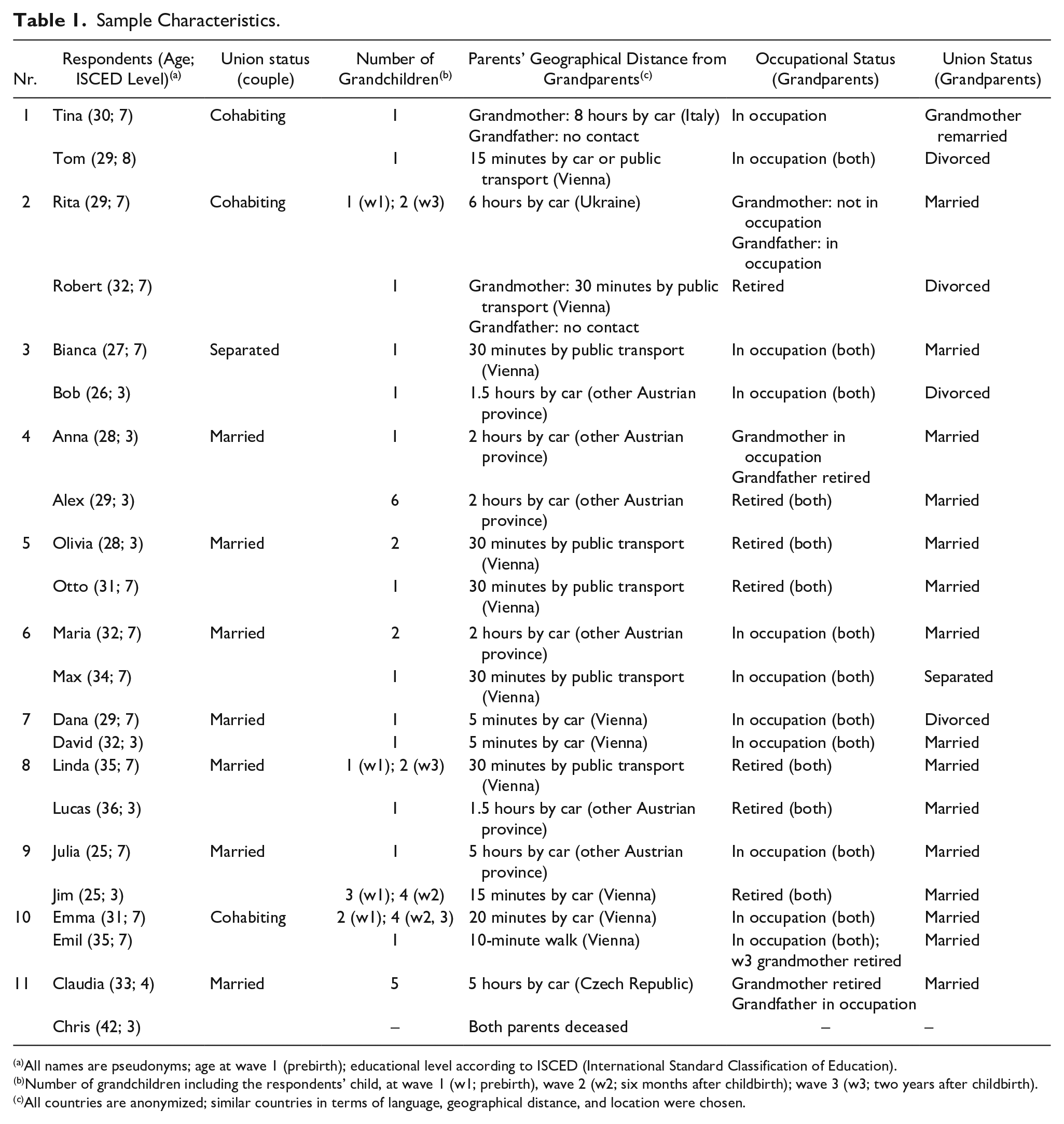
All names are pseudonyms; age at wave 1 (prebirth); educational level according to ISCED (International Standard Classification of Education).
Number of grandchildren including the respondents’ child, at wave 1 (w1; prebirth), wave 2 (w2; six months after childbirth); wave 3 (w3; two years after childbirth).
All countries are anonymized; similar countries in terms of language, geographical distance, and location were chosen.
We used problem-centered interviews (Witzel, 2000) that were conducted face-to-face by the authors. In an attempt to focus on the respondents’ individual relevance structures, the interviews were conducted on a one-to-one basis, and thus with each partner separately. All of the interviews started with an open question designed to prompt an initial narration in which the respondent was asked either about the history of the relationship and the pregnancy (wave 1), or about developments since the last interview (waves 2 and 3). After the initial narration had been provided, we asked questions that referred to this narration. Subsequently, we asked preformulated questions collected in the interview guideline that covered different topics, such as the announcement of the pregnancy, plans for parental leave and childcare (prebirth); daily routines and time management, organization of and experiences with childcare (six months after childbirth); and family relationships, the involvement of family members with childcare, and normative attitudes on parenting (two years after childbirth). The duration of the interviews ranged from 45 to 100 minutes, depending on the respondents’ communicative and narrative styles.
Data Analysis
All interviews were transcribed verbatim (around 1,600 densely written pages of transcripts). The first step of data analysis involved repeated reading and a thematic analysis of each interview, which resulted in the identification of all text passages that involved literal or indirect references to grandparents or intergenerational relations. Overall, more than 500 text passages were identified, ranging from a few words to several paragraphs or pages in length. For the subsequent case-specific analysis, elements of a grounded theory approach (Corbin & Strauss, 2008) and sequential analysis (Froschauer & Lueger, 2003), which is based on a hermeneutic approach, were employed. The data were first analyzed on a case-specific level (individual, couple), both cross-sectionally and longitudinally. One couple represented one case, with six interviews being conducted over three waves of data collection for each case. For all of the identified text passages, each unit of analysis (i.e., several words or lines) was analyzed in-depth using the following aspects and exemplary questions: (a) Paraphrase of the content: How can the unit of analysis be summed up? (b) Conditions: Which contextual preconditions lead to this statement? (c) Interactions and roles: Which interactions take place between the acting persons, organizations, things, etc.? Who are the interactional partners, and what are their tasks and roles? (d) Intentions and functions: Which intentions inspire the respondent to verbalize this statement? What does the respondent want to emphasize? (e) Strategies: Which strategies does the respondent choose to present? (f) Consequences: What are the consequences of the presented strategies? (g) Options to continue.
After this in-depth analysis, the results were fed back to the overall case context. Detailed case reconstructions on the couple level were produced for every case, which resulted in assumptions that were constantly verified during the ongoing analysis and accompanied by constant memo writing. We then compared the case reconstructions cross-sectionally and longitudinally, analyzing the cases for similarities and differences, using constant comparison, and identifying collective themes. This process ultimately revealed the parents’ strategies for dealing with ambivalence, and how these strategies developed over time.
Results
Grandparental involvement in pregnancy and child-related issues was mentioned in every interview, and notions of ambivalence (in various areas and at different points in time) turned out to be a key issue in every case. Therefore, this issue was analyzed in detail, relying on the empirical data and taking into account the theoretical concept of family ambivalence. In the following, we first show how the respondents constructed ambivalence, and which areas were connected with ambivalence. Second, we analyze the strategies they employed in dealing with ambivalent feelings (inclusion, delimitation, and exclusion) and demonstrate how the couples’ strategies evolved over time (parallel, divergent, and convergent patterns).
Grandparental Involvement and Parents’ Experiences of Ambivalence
Ambivalence was a key issue in the respondents’ narrations about the grandparents’ roles. It was strongly connected to grandparental involvement, which respondents estimated as problematic or inappropriate in its extent or its nature, and which was associated with feelings of disappointment, worries, or strain. During pregnancy, narrations about ambivalence often comprised, for example, accounts about the (desired) support versus concerns about (anticipated) dependency; pleasure, relief, or disappointment related to the prospective grandparents’ reactions to the announcement of the pregnancy; or concerns about a potential competition among different sets of grandparents. Six months after the birth, the respondents’ ambivalent feelings were fueled by the grandparents’ involvement in the early days of parenthood (e.g., visits at the hospital, involvement in choosing a name for the baby); and in practical issues, like buying baby equipment, feeding, dressing, or carrying the baby. Two years after the birth, ambivalence involved issues such as grandparental versus institutional care or the prioritization of parental or grandparental needs. The respondents constructed grandparental involvement in a comprehensive manner, including manifold aspects and reminding of the systematic differentiation of cognitive, behavioral, and affective involvement that Palkovitz (1997) developed for father involvement. These areas comprise the cognitive (reasoning, planning, evaluating, monitoring), behavioral (observable activities, social interactions), and affective (emotions, feelings, affection) domains, which are interrelated and interactive. Ambivalence emerged when grandparental involvement in one or more of these domains did not comply with the respondents’ wishes and expectations. The related situations were manifold, and ambivalence occurred during all waves of data collection.
In the cognitive area, ambivalence was strongly related to the diverging views of (expectant) parents and grandparents, for example regarding concepts and convictions about pregnancy, education, childcare, nutrition, or other fundamental aspects of bringing up children. Ambivalence occurred when grandparents questioned parents’ roles or attitudes. In particular, the responding parents struggled with the grandparents’ critical judgements of their pedagogical and parental skills, and experienced discomfort when they realized that grandparental involvement would entail being dependent on them, despite these inherent conflicts.
In the behavioral domain, parents’ feelings of ambivalence were typically connected to the grandparents’ contact with their new-born child, accompanied by aspects of power and boundaries, and about the question to whom the competence to set conditions was ascribed: who determined when, how, where, and under which circumstances grandparental involvement took place. One typically mentioned opportunity to fuel ambivalent feelings was the grandparents’ first visit after delivery at the hospital. It was often reported that the grandparents failed to respect the boundaries regarding appropriate timing of such visits that had been set by the new parents for this particularly sensitive period. Against other agreements, the grandparents made earlier, longer, or more frequent visits than had been previously agreed.
Ambivalence related to the affective level involved disappointment with emotional aspects of the relationships between the grandparents, the respondents, and the children (e.g., when grandparental involvement in childcare contributed to a sense of competition); or to the character of the grandparents’ involvement, which was welcomed but not deemed sufficiently comprehensive. Several respondents felt that although the grandparents provided intensive cognitive and behavioral support, they were not involved on an emotional level, which elicited feelings of ambivalence and disappointment. For example, some respondents said they had the impression that the (expectant) grandparents offered to provide childcare out of a feeling of obligation, instead of out of emotional dedication to their grandchild.
Summing up, ambivalence was expressed in connection with unmet parental expectations in one or more interrelated dimensions of involvement (cognitive, behavioral, affective), and was discernible during all stages of the transition process covered by this study. Before the birth and six months afterwards, not a single couple unanimously reported being satisfied with the form and the extent of grandparental involvement. Two years after birth, some respondents did report that they had achieved a satisfying mode of grandparental involvement and that their ambivalent feelings were starting to fade. This shift was related to the fact that ambivalent feelings became effective for action: the respondents developed strategies for dealing with ambivalences. These strategies were developed by both partners in an interdependent way and will be presented on the couple level in the following section.
Dealing with Ambivalence: Employed Strategies
Strategies are typically outlined as actions and interactions for dealing with ambivalent feelings. They are constructed as “purposeful, goal-oriented, done for some reason—in response to or to manage a phenomenon” (Strauss & Corbin, 1990, p. 104). According to the concept of family adaptive strategies (Hill, 1970; Moen & Wethington, 1992), strategies are closely related to the processes through which family members actively and interdependently construct and modify meanings, roles, resources, and relationships. The aim of such strategies is not to eliminate ambivalence, but rather to integrate it into everyday life.
Our detailed analysis identified three distinct strategies that were employed by the respondents and that can be described as follows: (a) Inclusion refers to a strategy in which the respondents encouraged the grandparents to become involved in their family life and childcare matters; and/or they accepted the grandparents’ offers of support, even if they had mixed feelings about doing so. The respondents who used this strategy involved the (expectant) grandparents by inviting them to be part of important moments (e.g., ultrasound scans, baby parties), asking for their opinions regarding pregnancy and baby-related issues, making plans for their involvement in childcare, or welcoming help they offered when the baby was born. (b) Delimitation is a strategy in which the respondents actively drew boundaries between themselves and their parents in order to limit grandparental involvement and create distance between the generations. The respondents who employed this strategy attempted to deal with their feelings of ambivalence by trying to reduce the grandparents’ interference, questioning or rejecting their advice, or withholding information from them (e.g., regarding the expected delivery date or the beginning of labor), even though these respondents also expressed positive feelings about the grandparents’ involvement. (c) Exclusion is a strategy in which the respondents excluded their parents from their family and/or did not allow the grandparents to play a role, while generally acknowledging the importance of grandparents in their grandchildren’s lives. The respondents who employed this strategy tried to minimize or prevent contact between the generations and depreciated the grandparents’ abilities and activities.
All of these strategies involved redefinitions and adaptations between planned and effectuated extents of grandparental involvement. To deal with their ambivalent feelings, the respondents modified their expectations of the grandparents and their roles over time. Such adaptations were generally made by an individual respondent or couple and were not necessarily negotiated with the grandparents. Examples of how these strategies evolved on a couple level will be provided in the next section.
Couples Negotiating Strategies over Time
The complexity of parents’ strategies for dealing with their feelings of ambivalence became evident when we investigated these efforts longitudinally and on a couple level. The employed strategies changed and evolved over time, were interdependently negotiated, and were not necessarily consistently applied by both partners. We found three distinctive longitudinal patterns for how couples dealt with ambivalence concerning grandparental involvement over time: parallel, diverging, and converging paths (summarized in Table 2). In the following, we concentrate on three typical cases that illustrate a specific pattern that was found in other couples as well.
Couples’ Strategies over Time.
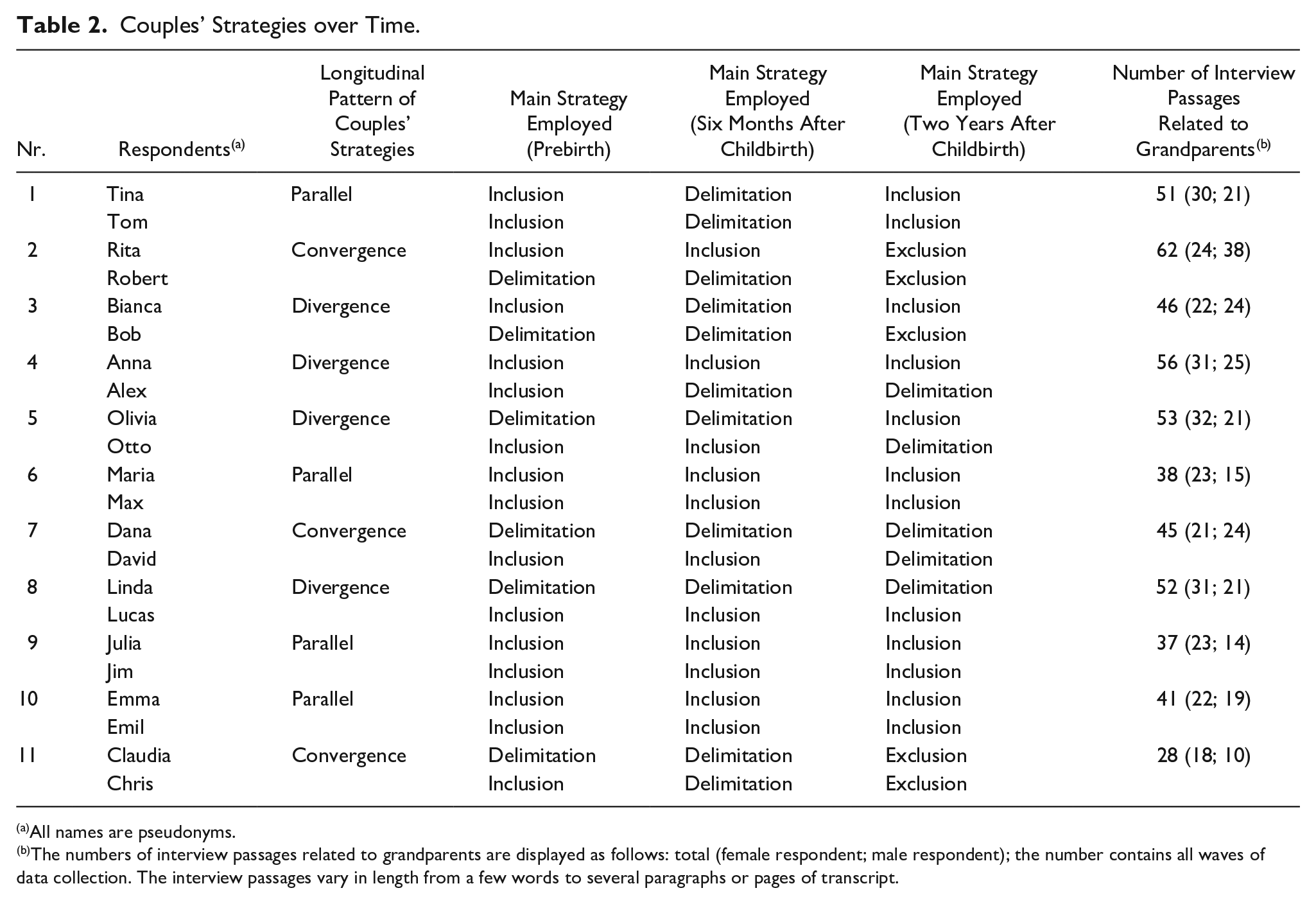
All names are pseudonyms.
The numbers of interview passages related to grandparents are displayed as follows: total (female respondent; male respondent); the number contains all waves of data collection. The interview passages vary in length from a few words to several paragraphs or pages of transcript.
Tina and Tom: a parallel path
Some couples’ strategies evolved along a parallel path over the entire transition period, i.e., both partners employed the same strategies over time, usually based on commonly adapted definitions of grandparental care. This pattern was observed in four couples (1, 6, 9, 10) and is illustrated by the example of Tina and Tom (couple 1). When they announced the pregnancy to their parents, both Tina and Tom made clear that they were looking forward to their parents’ active involvement in childcare. They described all of the grandparents-to-be as highly committed to their upcoming roles and tasks. Tom emphasized that the conditions were ideal for involving the grandparents in care, as his and Tina’s child was the first grandchild for all of the grandparents, and all of the grandparents had expressed happiness about the pregnancy and eagerness to care for their grandchild. Tom’s parents were living in the vicinity (15 minutes by car or public transport) and were available every afternoon, while Tina’s mother, who lived in a neighboring country (eight hours by car), said she would be willing to spend longer periods of time caring for her grandchild. Tina and Tom consistently constructed grandparental care as a major source of support for themselves as parents, said that they expected the grandparents to be involved in care several afternoons per week, and indicated that they were delighted to include all of the grandparents in their family.
Six months after the childbirth, the couple’s great expectations had been transformed into serious reservations. Like the other respondents, Tina and Tom agreed that the grandparents had the right to see their grandchild soon after birth but found that such visits conflicted with their desire to spend time together as a “new” family. In an attempt to deal with this contradiction, Tina and Tom used strategies of delimitation, and explicitly asked their parents not to come to the hospital on the day of delivery. However, their parents did not respect this request, prioritized their own wishes, and visited immediately after the birth, which was described by Tom as “inconvenient” and by Tina as “a real burden.” Thus, as the couple’s beliefs about grandparental wishes and rights collided with their own needs and requirements, these early visits elicited ambivalent feelings. As Tina put it:“My mother came on the same day [the day of delivery], and also my partner’s parents. In fact, I felt it was too much, but at the same time, I understood of course and I was happy about their interest [in our child].”
Six months after the childbirth, Tina and Tom no longer constructed grandparental involvement as supportive, but as “a blessing and a curse” (Tom), which activated delimitation strategies, and the attempt to reduce grandparental involvement. The grandparents’ roles were transformed from being major caregivers (as envisaged before the delivery) to being visitors. Both partners redefined grandparental care as a concession made by the middle generation in an attempt to make the grandparents happy by facilitating their contact with their grandchild, who was, in turn, constructed as the care receiver:“My parents want to be involved. Actually, we are eager to make sure that it’s not too much, because it’s not only help, it can also be a burden. But of course they’re happy to see their granddaughter.” (Tom)
Two years after the birth, strategies of inclusion were again being employed. Tom’s parents were now looking after their grandchild one afternoon a week, which supported Tina and Tom in their working lives, but was a much lower level of involvement than they had envisioned during the pregnancy. Tina’s mother occasionally visited her grandchild during holidays. Grandparental care was now constructed as a sacrifice by the grandparents that required gratitude and entailed dependency for the care receivers—i.e., Tina and Tom. Tina emphasized that the ability of both partners to work full-time was facilitated by her parents-in-law: “Thanks to the help of his parents, we both can work for 40 hours.” But Tom observed that a higher-level grandparental involvement appeared unlikely: “From their point of view, it’s goodwill that they sacrifice an afternoon a week. I wouldn’t dare insist on two afternoons.” Overall, this example reflects how the partners’ ambivalent feelings changed, and how fluid and mutable their strategies were over time. However, these strategies evolved consistently among the two partners and illustrate their struggles to negotiate a form of grandparental involvement that was acceptable for all parties concerned.
Anna and Alex: divergence
In contrast, other couples’ strategies differed over the entire research period or diverged over time (couples 3, 4, 5, 8), as the case of Anna and Alex (couple 4) demonstrates. Before their child was born, both partners experienced ambivalent feelings in relation to their anticipated dependency on comprehensive grandparental involvement in the behavioral domain. Although the grandparents lived relatively far away (two hours by car), both partners employed strategies of inclusion, and fully integrated the grandparents into their childcare plans.
Six months after the delivery, the couple’s strategies diverged. Immediately after the birth, the maternal grandparents were highly involved and came to see their grandson on the day of delivery. The paternal grandparents followed two days later, which both Anna and Alex explained by referring to the fact that their son was her parents’ first grandchild, and his parents’ sixth grandchild. However, after the birth, both sets of grandparents were less involved than the couple had been planned. Although the maternal grandparents had initially visited the couple several times (e.g., in order to help with doctors’ appointments), six months after the birth, Anna and Alex usually had to travel when they wanted to see Anna’s parents, which no longer allowed for the grandparents’ behavioral involvement. Both Alex and Anna reported having ambivalent feelings because they felt they needed the grandparents’ support and experienced a degree of dependency: “We won’t have a lot of other options, because of work. But I think they want it, too. [. . .] And they shouldn’t be strangers to our child” (Alex). Anna, who was the main carer and was staying home with the child, reported having ambivalent feelings about not receiving the level of grandparental support she had hoped for—not just for her baby, but for herself.
The couples’ strategies clearly diverged six months after birth. Alex employed strategies of delimitation, attributing his ambivalent feelings to the grandparents’ abilities. For example, he emphasized that his father-in-law could not be considered an adequate provider of childcare, because “he makes nonsense and isn’t reliable.” Alex’s mother had severe health problems that prevented her from providing care, and his father was not mentioned as a potential carer by either partner. Only the maternal grandmother was considered to be an ideal candidate for providing childcare, as she was “completely crazy” (Alex) about her grandson. However, she could not assume this responsibility, as she was still working. In contrast to her partner, Anna continued to pursue strategies of inclusion. She reported inviting the grandparents to visit their home, regarding all of the grandparents as potential carers, and believing that they “want the best for my child.” (Anna)
Two years after the birth, things had changed substantially. At the age of 19 months, their son refused to start attending kindergarten, which Anna described as “the most extreme experience.” The family had moved to a place in the countryside that was close to the homes of both sets of grandparents. Anna said she felt threatened by the prospect of having to quit her job because she could not find an acceptable childcare solution, instead of returning to her previous workplace as planned. Both partners reported having ambivalent feelings, which again translated into pursuing different strategies. Anna decided to ask for substantial help and to have the grandparents serve as the main carers. She actively pursued a strategy of inclusion, which was fueled by the necessity to find a childcare solution: My return to work was extremely difficult. Absolutely difficult. [. . .] We were really desperate. And then I said, okay, let’s try it with the family despite everything, and then we held a council of war, so to speak. So I drummed up the whole family, and then I said, “Okay, either we handle this and try to work together and everybody helps. Or I can’t start working”. So for me, this was an either-or decision. (Anna, two years after the childbirth)
Despite Alex’s ambivalent feelings with regard to the suitability of the grandparents as carers, Anna’s father was now considered a competent person and was responsible for the child two days a week. Anna’s mother acted as a caregiver once a week, and Alex’s parents looked after the child twice a week. Although the grandparents’ involvement was initially involuntary, it “works out great” for Anna. Over time, Alex did not give up or modify his reservations, but accepted Anna’s decision to involve the grandparents and become heavily dependent on them. He now regarded the grandparents’ involvement as a burden for the couple in terms of time and physical demands. Alex increasingly withdrew from all of the organizational tasks regarding childcare, but still pursued strategies of delimitation, and continued to draw boundaries. In sum, this example illustrates how ambivalence and related strategies can be interdependently negotiated and yet diverge over time: while Anna continued to use inclusive strategies, Alex refused to adopt similar strategies and continued to pursue strategies of delimitation—which was, in turn, only feasible because Anna pursued strategies of inclusion and assumed the responsibility for organizing the couple’s childcare arrangements.
Rita and Robert: convergence
Although the strategies of some couples diverged over the course of our study, the strategies of other couples converged over time. This latter pattern was observed in couples 2, 7, and 11, and is exemplified by the case of Rita and Robert (couple 2). Before the birth, Robert expressed mixed feelings about the maternal grandmother’s involvement. His own mother, who lived in the vicinity (30 minutes by public transport), was only marginally involved in baby-related issues, while his mother-in-law, who lived in another country (Ukraine, 7 hours by car), was intensively engaged in the cognitive, affective, and behavioral domains during the pregnancy. She spent a lot of time with the mother-to-be, giving advice on health issues, baby equipment, and baby care. Although Rita later revealed that she experienced intensively ambivalent feelings, she acted inclusively. She invited her mother to stay with her and Robert and emphasized before the childbirth that she saw her mother’s involvement as helpful. Robert, on one hand, said he appreciated his mother-in-law’s comprehensive support and constructed it as assistance for his wife. On the other hand, he questioned her powerful position within the family and developed strategies of delimitation in an attempt to keep Rita’s mother at a distance, which became evident in several sarcastic comments. For example, he recounted grudgingly accepting the grandmother’s wishes regarding the baby’s name: “The name is a mixture now, with the aim to eternalize the dearest, dearest grandmother. Which of course shows who actually has the say here.”
Six months after the childbirth, both partners’ strategies as well as the grandmother’s involvement were ongoing. Rita’s mother was present when the labor started, accompanied her daughter to the hospital, was the first visitor immediately after birth, and accompanied Rita and her new-born baby home from hospital. Although other couples saw this as a crucial moment of family formation, Robert did not consider his presence to be necessary. He continued to employ strategies of delimitation and conceded comprehensive competences to the grandmother, which enabled him to withdraw from family activities and to prioritize his job.
Interviewer: “So, how was coming home? How was everyday life then?”
Well, so, all the time, because she was accompanied by the grandmother, that is, her mother, um, that made the whole thing rather easy, um, coming home, the grandmother did it with her, because, um, I really had to be at the office, I mean it was important to me to be there [at the hospital] in the night [when the child was born], but not picking her up, so I thought, with the taxi and Grandmom, and the taxi gets full quickly with the bag and and and two people plus a child, so, um, all of that went well. (Robert, six months after the childbirth)
By drawing these boundaries, Robert gained freedom for his work and simultaneously resigned from his family life. The maternal grandmother spent considerable amounts of time with the family, living with them for several weeks at each visit. Rita continued to accept her mother’s comprehensive involvement. Robert valued the periods of comprehensive support provided by his mother-in-law, but also expressed his pleasure when she returned to Ukraine. His strategy was to set clear boundaries between himself and the grandmother and to spend long hours at the office. Although he accepted and benefited from the grandmother’s high degree of involvement, he was more ambivalent about her powerful position within the family:
Who’s really there for us? It’s Rita’s mother who really does things. All others are persons who drop in once in a blue moon, but otherwise are not present in our lives. [. . .] My mother-in-law usually comes for three months or so. Twenty-four-hour care is quite a relief, even if it stops after three months, but then that’s often of mutual interest, to get some everyday life. [. . .] I mean, grandmothers in particular always know everything better and try to take over everything and to dictate the rhythm for everybody else, they are hard as nails in their attitudes and won’t accept a different opinion. (Robert, six months after the childbirth)
Rita was convinced that her mother would support her with childcare upon her return to the workplace (arranged for 20 months after the birth) and planned her career accordingly. However, at wave 3, two years after the childbirth, there was a surprise: contact with Rita’s mother had been disrupted, and she was no longer involved in any childcare tasks. In addition to having another grandchild in Ukraine who demanded her resources, both Rita and Robert were now pursuing strategies of exclusion and were no longer willing to include the grandmother in their family life. This shift was accompanied by a depreciation of Rita’s mother’s previously stated merits. Robert described his mother-in-law as being “not there when you really need it,” and the kindergarten as being “de facto the only institution that really helps.” Rita expressed strong feelings of ambivalence and considered herself as living without any bonds to her family of origin:
When [daughter] was a little baby, my mother was with us very often. On the one hand, she helped, on the other hand, she did it the way she thought was good. That made me angry. So it’s better she’s not here anymore. [. . .] But when you don’t have a family, childcare is complicated and life is really hard. (Rita, two years after the childbirth)
Overall, this example illustrates how the different strategies the partners adopted were jointly modified in response to changes in the framework conditions and to the couples’ common reinterpretation of a situation.
Summing up, we found a complex interdependence of constructions of ambivalence, strategies for dealing with ambivalence, and intracouple negotiations of these strategies over time. Different strategies were employed at different points in time and were negotiated differently among the parental couples in our sample. Table 2 gives a detailed overview of how the couples’ strategies evolved over time.
Conclusion
In our qualitative longitudinal study on the transition to first-time parenthood, feelings of ambivalence (i.e., experiencing polarized emotions simultaneously) were inherent in all the parents’ narrations about grandparental involvement. To deal with this ambivalence, couples employed three strategies: inclusion (inviting the grandparents to become more involved), delimitation (establishing clear boundaries to create a balance between involvement and distance), and exclusion (minimization of contact with the grandparents). Our longitudinal analysis showed that the respondents switched between strategies over time. We also found that on the couple level, strategies were intensively interwoven. The two partners did not always employ the same strategy, but instead followed parallel, converging, or diverging paths.
Previous studies have shown that parents and grandparents experience ambivalence when there are disagreements about how children should be cared for, and that such disagreements tend to be common in parent–grandparent relationships (Barnett et al., 2012; Ferring et al., 2009; Fingerman et al., 2020). We can add to this literature by providing evidence that these feelings of ambivalence can shift during a rather short period of time (two years), and that they are highly interdependent with structural and contextual influences, such as the availability of childcare, constructions of grandparental roles, or normative views regarding (institutional) childcare. Within these contexts, couples constantly renegotiate their strategies for dealing with their ambivalent feelings and try to find precarious balances between their own wishes and needs and the grandparents’ actions and behaviors. Therefore, the couples’ strategies change and evolve over time. The theoretical concept of intergenerational ambivalence suggests that such strategies are negotiated and highly fluid (Connidis, 2015; Connidis & McMullin, 2002; Lendon et al., 2014; Lüscher, 2002, 2004; Lüscher & Pillemer, 1998). However, longitudinal qualitative data that provide empirical evidence of the fluidity of ambivalence during the transition to first-time parenthood was previously missing.
By adopting a longitudinal approach and considering both parents’ perspectives, this study has demonstrated that the strategies the partners pursued were not necessarily consistent. At least one partner from every couple in the sample departed from the strategy of inclusion, which was typical for the prebirth phase. Previous research has shown that the more positive the intergenerational relationship is, the higher the level of the grandparents’ involvement (Aassve et al., 2012; Arránz Becker & Steinbach, 2012; Jappens & van Bavel, 2016). Our study clearly indicates that when the grandparents have a high level of involvement, the parents often experience ambivalence, as they feel forced to engage in a complex process of balancing autonomy and dependence. We also found that when couples employed different strategies over time, this made both their couple dynamic and their relationship to the grandparents more complex. Amplifying existing evidence (Arber & Timonen, 2012; Hansen, 2004; Villar et al., 2012), we showed how relations in the extended family system were orchestrated by parents in building or controlling bridges between generations (Marx et al., 2011; Monserud, 2008), and that these relations were further ramified when the two partners employed different strategies.
In line with existing research, the dynamics analyzed in this study turned out to be strongly related to traditional gender roles and women’s normative connections with care issues (Barnett et al., 2012; Ferring et al., 2009). The lack of availability of day-care or a desire to return to the labor force often increased the mother’s dependency on the grandparents and fueled her feelings of ambivalence. Such findings also emphasize that ambivalences are always embedded in social structures and gendered cultural norms. As other options for childcare exist in Austria—e.g., taking a long parental leave, one parent dropping out of the labor force, using institutional childcare—there is no clear normative standard about the extent and the type of childcare that grandparents should provide. Therefore, research that investigates the different levels of grandparental involvement, and the factors that influence these levels, has to consider the respective country’s cultural and structural context.
This study also opens space for further investigations. Parents may experience more or less ambivalence about family ties and expectations of grandparental care at different points over the life course. Therefore, it would be promising to include more points in time over a longer period, as doing so could paint an even more comprehensive picture. Furthermore, the inclusion of the grandparents’ perspectives would provide us with deeper insights. Similarly, the grandchildren’s perspectives should also be included, as they can give competent information about their experiences with grandparental care over different life stages. In addition, future studies may want to explore other family transitions and their impact on intergenerational ties, grandparental involvement, and family ambivalence, such as the transition to a two-child family or a stepfamily. Ambivalence is “an underlying feature of family life” and thus represents “an ongoing challenge that is never fully met” (Connidis, 2015, p. 89). This study demonstrated the complexity of such challenges and negotiations with a particular focus on the transition to first-time parenthood. Our use of a multiple-perspective longitudinal approach and a rich database enabled us to make ambivalence and its complexity perceptible and to explain couple dynamics.
Footnotes
Declaration of Conflicting Interests
The authors declared no potential conflicts of interest with respect to the research, authorship, and/or publication of this article.
Funding
The authors disclosed receipt of the following financial support for the research, authorship, and/or publication of this article: This work was supported by the European Union, 7th Framework Programme (320116) and by the University Jubilee Foundation, City of Vienna (H-284605/2015).
