




Abstract
This cross-sectional study on Ghanaian adolescents examined the direct and indirect associations of food insecurity, parent–adolescent relationship, and adolescent future orientation. We used structural equation modeling to examine reliability and validity of our latent constructs and our hypothesized direct and indirect relationships. Results indicated adequate fit of our measurement and structural models with the data. Results also showed a significant direct and indirect effect of food insecurity. Food insecurity was directly associated with parental connection, orientation toward success, and uncertainty about the future. Food insecurity was also indirectly associated with orientation toward success and uncertainty about the future, via parental connection. Further, higher levels of parental connection were directly associated with higher levels of orientation toward success and with lower levels of uncertainty about the future. Understanding the direct and indirect effect of food insecurity is important for the design of appropriate interventions that promote holistic and positive adolescent development.
Adolescent–parent relationship (APR), which includes open and truthful communication between adolescents and parents, a warm and affectionate relationship, parental support and guidance, and parental monitoring, remains a critical topic due to its role in adolescent development. Evidence suggests a desirable effect of APR on a wide range of outcomes such as better mental health (van Eijck et al., 2012), reduction in risky sexual behaviors (Sun et al., 2019), and healthy interpersonal relationships (Kaufman-Parks et al., 2018). Similarly, in Ghana, the quality of APR has been shown to be predictive of better mental health, psychosocial functioning, and school engagement among adolescents (Marbell & Grolnick, 2013; Marbell-Pierre et al., 2019).
Food insecurity, defined as lack of access to adequate and nutritious food at all times (Food and Agriculture Organization, 1996), remains an important public health issue with substantial consequences on adolescent development. Among adolescents, food insecurity is associated with emotional and behavioral disorders (Melchior et al., 2012; Shankar et al., 2017), sexual risk taking and victimization (Masa et al., 2019), and higher risk of emotional and physical abuse (Meinck et al., 2015). Furthermore, adolescents are more likely to experience food insecurity than adults in sub-Saharan Africa (Amarnani et al., 2017).
Despite the growing number of studies linking APR and food insecurity with adverse outcomes, we know little about the direct association of food insecurity on parenting characteristics, including APR in low- and middle-income countries (LMICs). Prior studies on food security and parental characteristics focus primarily on the effect of food insecurity on parenting practices related to food consumption in high-income countries (Bauer et al., 2015; Conlon et al., 2015). Moreover, fewer studies have examined the relationship between food insecurity and quality of APR. Nonetheless, these few studies in North America suggest a negative association between food insecurity and positive parenting practices (Ashiabi & O’Neal, 2007; Zaslow et al., 2009). However, measurement issues weaken generalizability of research on food insecurity and APR from high-income to LMICs. Construct validity of food security measures may result from differences in social safety net arrangements in high and low-resource countries. For example, in contrast to institutional mechanisms in the United States (e.g., government food assistance programs and food banks), many low-resource countries lack similar social safety nets. In turn, intensity of food deprivation tends to be worse in low-resource than high-resource countries (Global Food Security Index, 2017). Moreover, research on food insecurity and APR are even fewer in LMICs. We are aware of two similar studies in sub-Saharan Africa (Meinck et al., 2015; Nanama & Frongillo, 2012). However, neither study directly examined the association of food insecurity with APR.
In addition to a direct association of food insecurity with APR, investigating the (a) direct relationship between APR and adolescent future orientation and (b) APR’s potential mediating role in the association between food insecurity and adolescent outcomes has implications for designing programs to enhance adolescent welfare. First, APR is critical to adolescent development. A wide body of research supports positive, direct association between parenting practices and a range of adolescent outcomes (Racz & McMahon, 2011; Sieving et al., 2017; Yap & Jorm, 2015). However, despite established connections between APR and adolescent outcomes, there is paucity of empirical evidence on the association of APR and future orientation, defined as the tendency to engage in future thinking (Seginer, 2009). Prior research suggests that future orientation is an important precursor of adolescent behaviors (Cascio et al., 2016; Hamilton et al., 2015) such as safer sexual practices (Bryan et al., 2006) and lower incidence of behavioral misconduct (Chen & Vazsonyi, 2013) and violent behaviors (Stoddard et al., 2011).
Second, an emerging body of research indicates that APR is a mechanism through which food insecurity affects adolescent health and well-being (Belsky et al., 2010; Huang et al., 2010). In contrast with food-secure parents, food-insecure parents are more likely to have suboptimal parenting behaviors and practices, which in turn, negatively influence their children’s development (Ashiabi & O’Neal, 2007; Knowles et al., 2016). In many cases, APR is worsened by stress and poor mental health functioning of parents due to food insecurity (Ashiabi & O’Neal, 2007; Huang et al., 2010). Theoretical work on resource dilution (Strohschein et al., 2008) and conservation of resources (Hobfoll, 1989) assert the influence of finite resources (e.g., food) on parenting, stress, and ability to plan for the future. For example, depletion or absence of resources deprives parents of their ability to address the needs of their families. In turn, this inability heightens levels of stress and negatively affects the quality of APR (Ashiabi & O’Neal, 2007; Huang et al., 2010). APR, characterized by lack of affection and care may compel adolescents to disconnect from their parents, which may negatively affect adolescents’ emotional well-being and psychosocial functioning including their ability to engage in future thinking (Ahlin & Lobo Antunes, 2015; Ryan & Lynch, 1989). It is also plausible that young people who are experiencing food insecurity may prioritize the now and lose sight of the future. However, limited evidence exists to support the intervening role of APR on the association between food insecurity and adolescent welfare in LMICs.
The current study examined the following: (a) direct relationship of food insecurity with APR, (b) direct relationship between APR and adolescent future orientation, and (c) indirect association between food insecurity and adolescent future orientation via APR (or its mediating role) in a sample of Ghanaian adolescents. Our current study built on a previous study in which we examined only the direct association of food insecurity with future orientation of youth (aged 12–28) and their parents. In contrast, the current study, in addition to its focus on adolescents 12–19 years old, investigated a possible indirect relationship between food insecurity and adolescent future orientation via APR. An equally important contribution of the current study is its examination of the direct associations between food insecurity and APR, and between APR and adolescent future orientation. Additionally, little is known about the relationship of food security with APR in low-resource countries, and the relationship of APR with adolescent future orientation in both high and low-resource countries. Based on empirical and theoretical evidence, we hypothesized an inverse association between food insecurity and APR, and a positive association between APR and adolescent future orientation. We also hypothesized a negative, indirect association of food insecurity with adolescent future orientation via APR. Consistent with results from our previous study, we hypothesized food insecurity to be associated with lower levels of adolescent future orientation.
Methods
Participants
The current study used a cross-sectional design and data from a youth financial inclusion project in Ghana. We analyzed a subset of the follow-up data because one of our key variables, food insecurity, was only measured at posttest. We limited our sample to adolescents between the ages of 12 and 19 (N = 2,201). Study protocol was approved by the Institutional Review Boards at the University of North Carolina at Chapel Hill and the University of Ghana. Local research staff met with prospective participants (and a parent or an adult guardian, if participant was a minor) to explain the project. Recruitment occurred at schools. Informed consent (and assent for those under 18 years old at the time of data collection) was obtained from all study participants. For minor participants, we first obtained consent from a parent or an adult guardian. After receiving an adult informed consent, we obtained the assent of the youth.
Procedure
The study occurred in eight of 10 administrative regions of Ghana: Ashanti, Brong-Ahafo, Central, Eastern, Greater Accra, Northern, Volta, and Western. These eight regions account for more than 90% of the country’s population. In 2010, close to a quarter of all Ghanaians were between 10 and 19 years old (Ghana Statistical Service, 2014). Given the original study’s focus on low-income youth, 100 public schools representing 100 different communities were randomly selected from an eligible pool of 581 public schools. The 581 schools were identified by using the catchment area of the financial service provider in the original financial inclusion project. On average, there were 26 students per school (range: 12–40).
Data were collected in 2014 using an interviewer-administered questionnaire. The questionnaire included information on adolescents’ demographic, educational, health, and financial characteristics, including parent–adolescent relationship. Household socioeconomic variables, including food security and asset ownership, were also included in the questionnaire. Prior to data collection, all measures were cognitively tested and piloted to ensure age, cultural, and linguistic appropriateness. Adolescents completed the questionnaires.
Measures
Food security
We measured food security, defined in this study as access to inadequate food using an adaptation of the household food insecurity access scale (HFIAS; Coates et al., 2007). HFIAS had been validated with various populations in sub-Saharan Africa (Frongillo & Nanama, 2006; Knueppel et al., 2010). HFIAS consists of nine items that ask respondents the frequency of experiencing different conditions and degrees of food insecurity within the past 30 days. Response options for the nine items range from 0 (never) to 3 (often). A higher HFIAS score indicates greater household food insecurity. For descriptive purpose, we also created a categorical measure of the different degrees of food insecurity. This categorical measure classified households as food secure and mild, moderately, and severely food insecure (Coates et al., 2007). Table 1 lists the items that comprise the study’s key constructs and their composite reliability.
Confirmatory Factor Analysis Results with Standardized and Unstandardized Coefficients (N = 2,201).
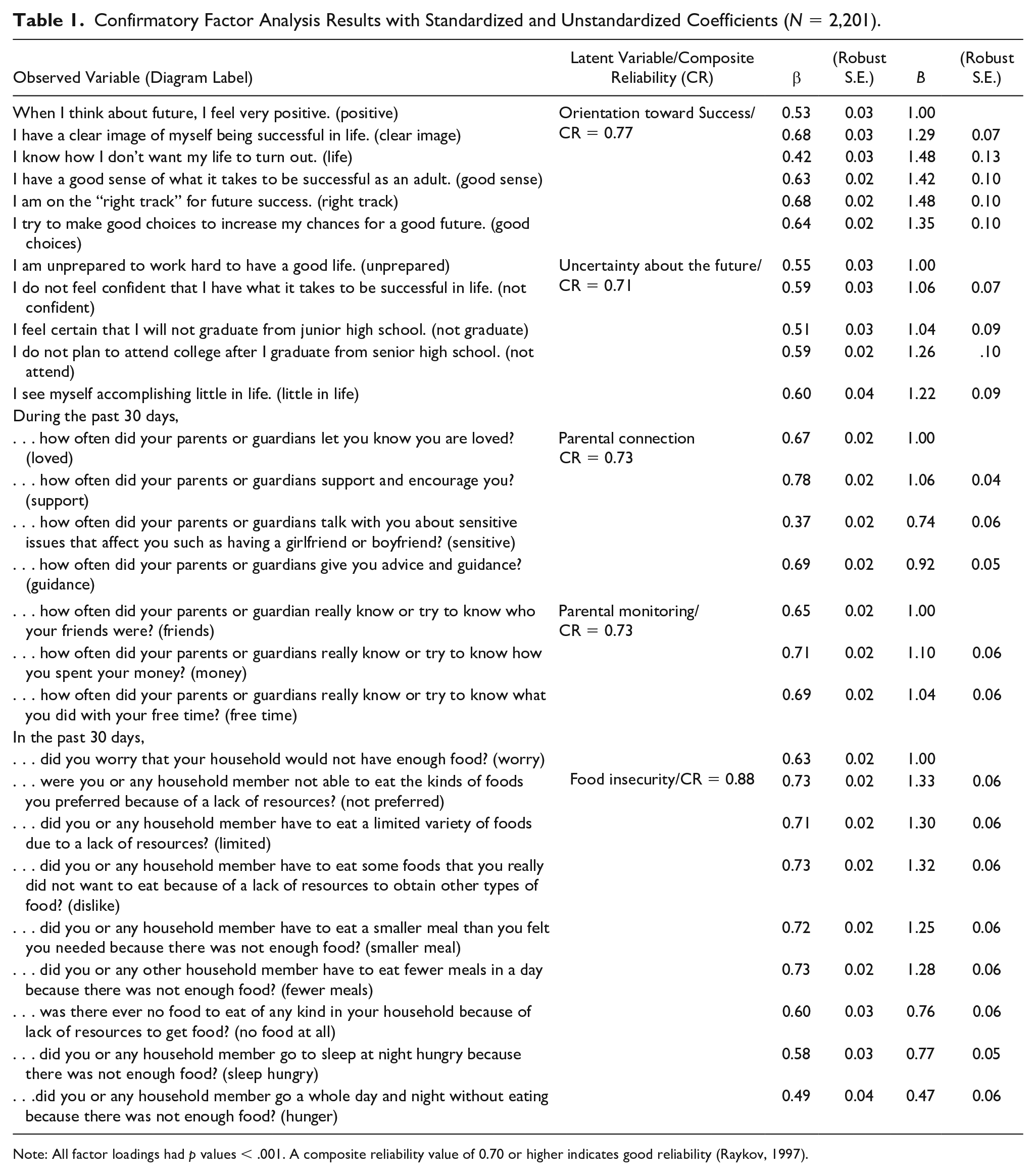
Note: All factor loadings had p values < .001. A composite reliability value of 0.70 or higher indicates good reliability (Raykov, 1997).
Adolescent–parent relationship
We measured APR defined in this study as characteristics and frequency of parent and child interaction, using questions from the global school-based student health survey (WHO and U.S. Centers for Disease Control, n.d.). We used two dimensions of APR: parental connection and parental monitoring (Skinner et al., 2005). First, parental connection referred to the occurrence of parent-adolescent interaction that focuses on expression of love, affection, and care within a 30-day period. Parental connection was measured using a four-item, 5-point Likert type scale ranging from 1 (never) to 5 (always). Higher scores on the parental connection scale indicate a warm and affectionate relationship. Second, parental monitoring described how often parents check adolescents’ activities within a 30-day period. Parental monitoring was measured with a three-item, 5-point Likert type scale ranging from 1 (never) to 5 (always). Higher scores on the parental monitoring scale indicate more frequent parental supervision.
Adolescent future orientation
We measured future orientation using items from the School Success Profile (SSP) survey (Bowen et al., 2005). Youth were asked about their attitudes toward the future, images of future selves, confidence about their future, and aspirations in life. We used two distinct dimensions of future orientation: orientation toward success and uncertainty about the future. These dimensions were based on previous factor analysis results of the SSP survey in a sample of Ghanaian junior high school students (Masa et al., 2019). Orientation toward success was assessed using six items from the SSP survey, whereas uncertainty about the future was assessed using five items from the same survey. Items were measured using an 11-point, Likert-type scale ranging from 0 (strongly disagree) to 10 (strongly agree). Higher scores on the orientation toward success subscale and lower scores on the uncertainty about the future subscale suggest higher levels of future orientation.
Covariates
We included the following covariates in our structural equation model: adolescent age (in years), adolescent gender (male or female), asset ownership, and parents’ employment status (informal/not receiving regular salary/wage or formal/receiving regular salary or wage). Asset ownership included three types of assets: transportation, livestock, and household possessions. Transportation assets included bicycles, motorcycles, canoe or boat, and other vehicles (e.g., cars and trucks). Livestock consisted of chickens, pigs, goats, cattle, donkeys, and sheep. Household possessions comprised of radio, electric or gas stove, kerosene stove, electric iron, box iron, refrigerator, television, cellular phone, and land phone. Transportation, livestock, and household possessions were measured using an index for each asset type (Filmer & Scott, 2012). We calculated an overall asset ownership index by summing the values for the three types of asset indices—transportation, livestock, and household possessions. Higher index values indicated more ownership of assets. All covariates were treated as observed variables.
Data Analyses
Our analysis comprised two steps. First, we estimated a measurement model and evaluated its fit using confirmatory factor analysis (CFA). We used CFA to confirm the factor structure of the study’s adapted measures, to determine if the adapted measures perform adequately in a sample consisting of Ghanaian adolescents, and to determine whether the hypothesized factor structure adequately represented the relationship that exist in the data before estimating the structural model. The value of establishing measurement model adequacy prior to analysis of the structural model is widely considered a best practice (Anderson & Gerbing, 1988; Bollen, 2000). We used maximum likelihood with missing values as our estimation method for both measurement and structural models. Our analytical sample included 367 cases with missing values. We used the following indices to evaluate model fit: root mean square error of approximation (RMSEA), comparative fit index (CFI), and Tucker–Lewis index (TLI).
Our measurement model comprised three latent constructs (food insecurity, APR, and adolescent future orientation). These latent constructs and their factor structure were defined based on theoretical and empirical evidence, as outlined in the introduction and measures section. Food insecurity was a one-factor scale with nine items. APR included two dimensions or latent factors: parental connection and parental monitoring. Adolescent future orientation comprised two latent factors: orientation toward success and uncertainty about the future. The number of items hypothesized to load on each latent factor was discussed in the measures section. Figure 1 illustrates our measurement model with the five latent variables. Table 1 lists the latent variables and observed items associated with each latent variable.
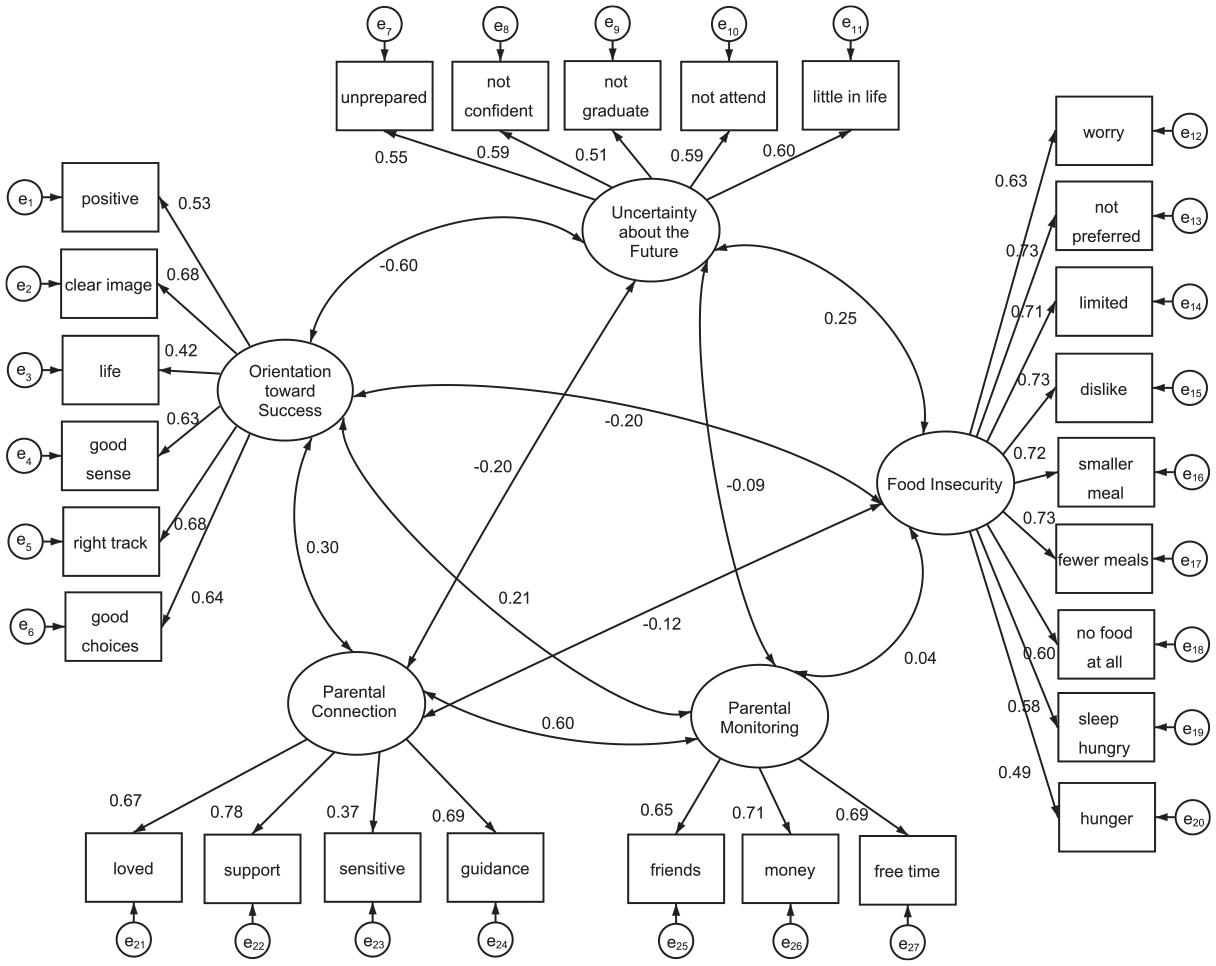
Confirmatory factor analysis model of five correlated latent variables. Circles represent latent variables and rectangles represent observed items. All factor loadings had p values <.001. All covariances had p values <.001, except covariation between parental monitoring and uncertainty about the future (p = .03) and covariation between parental monitoring and food insecurity (p = .22).
Second, after the measurement model was assessed to be adequate, we specified our structural model, which included directional relationships, based on theoretical and empirical evidence. The structural model allowed the testing of the study hypotheses, including direct and indirect associations. Figure 2 displays a visual representation of our recursive, structural model, including (a) covariance between and among observed and latent variables and (b) hypothesized directional relationship between and among observed and latent variables. Endogenous variables included orientation toward success and uncertainty about the future. Endogenous mediator variables included parental connection and parental monitoring. Exogenous variables included food insecurity, adolescent age and gender, parent’s employment status, and asset ownership. After specification and identification, we estimated the structural model and evaluated its fit. We assessed structural model fit using the same fit indices used in the evaluation of the measurement model’s fit (RMSEA, CFI, and TLI; Kline, 2016). As indicators of good fit, we used a CFI and TLI of .95 (or higher) and RMSEA point estimate of .06 (or lower) and upper confidence interval of .06 or (lower) (Hu & Bentler, 1999; MacCallum et al., 1996). Given a lack of consensus pertaining to goodness-of-fit indices and recommended cutoff values for assessing fit (e.g., Chen et al., 2008; Fan & Sivo, 2005), we used these cutoff values taking into account the limitations noted in the literature (Lai & Green, 2016; Marsh et al., 2004).
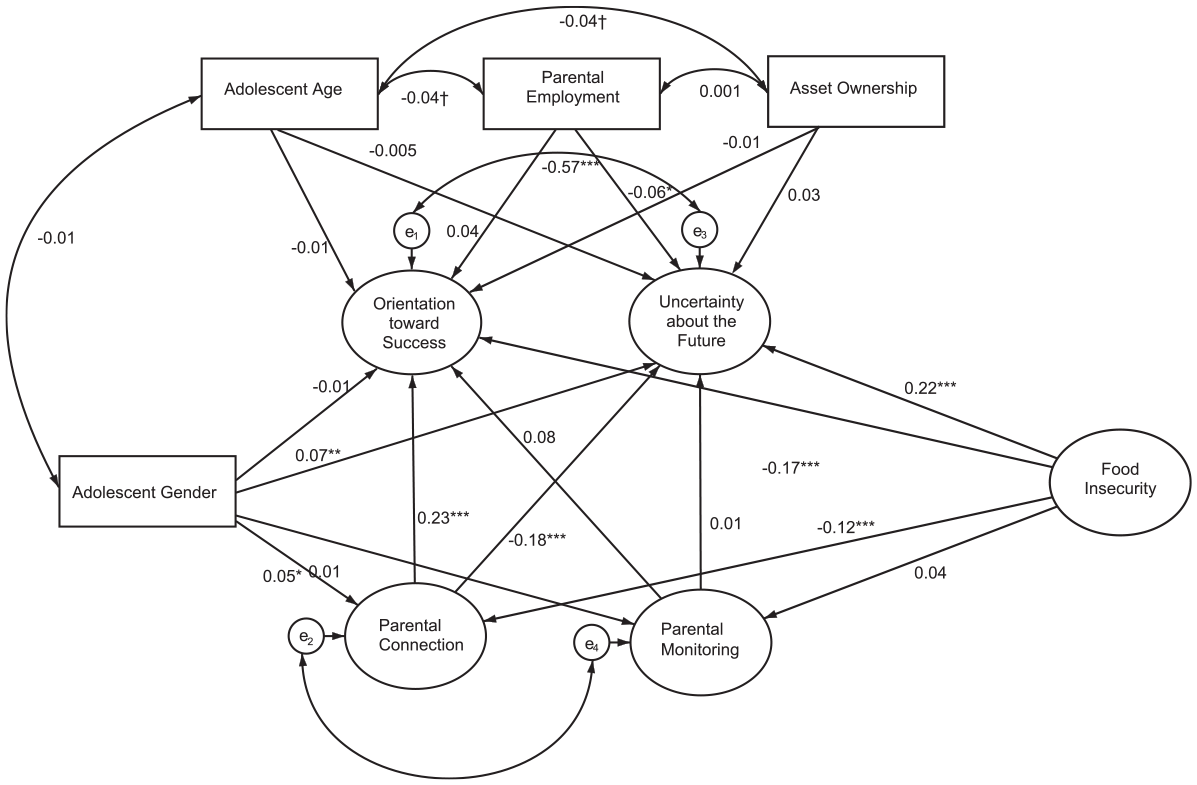
General structural equation model of our hypothesized directional relationships among food insecurity, adolescent–parent relationship, and adolescent future orientation. Circles represent latent variables and rectangles represent observed covariates. Not depicted: covariance between gender and employment (–0.01), and covariance between gender and asset ownership (–0.04†).
Prior to model estimation, we performed diagnostic tests to check for violations of multivariable statistical assumptions. Results indicated no evidence of nonnormality, nonlinearity, multicollinearity, and influential data. We re-estimated the measurement and structural models using cluster robust standard error to consider potential nonindependence of data due to clustering of adolescents within schools. All analyses were conducted using Stata 15 (StataCorp, 2017). All data are publicly available through https://doi.org/10.15139/S3/USI7JX.
Results
Sample Characteristics
Fifty-two percent of the sample were adolescent girls. Mean age was 17 (range: 15–19). Eighty-eight percent of parents were informally employed (i.e., not receiving regular salaries or wages). Overall, adolescents reported high levels (i.e., mean scores were above the median of possible scores) of parental connection (Mparentalconnection = 14.55, range: 4–20) and parental monitoring (Mparentalmonitoring = 9.11, range: 3–15). Food insecurity was prevalent, with 68% of adolescents reported being food insecure. Among food-insecure adolescents, 50% were severely food insecure, 35% moderately food insecure, and 15% mildly food insecure. Adolescents also reported high levels of future orientation (Morientation toward success = 53.02, range: 0–61; and Muncertainty of the future = 7.77, range: 0–51).
Measurement Results
Results indicated good fit between our measurement model and observed data (χ2 [314, N = 2,201] = 1733.89, p < .001, RMSEA = .045 [90% CI, .043, .047], CFI = .92, TLI = .91). Standardized parameter estimates are provided in Figure 1; unstandardized estimates are shown in Table 1. All factor loadings were statistically significant (p < .001). The percentages of variance (or R2 values) in each observed item that is explained by the measurement model ranged from .17 to .59. We did not conduct post hoc modifications because of the adequate fit between the data and our measurement model.
Structural Results
Our hypothesized structural model is described graphically in Figure 2; structural model results are shown in Table 2. Results indicated adequate fit of our structural equation model (χ2 [412, N = 2,201] = 1981.78, p < .001, RMSEA = .042 [90% CI, .040, .043], CFI = .91, TLI = .90). We did not conduct post hoc modifications because of the adequate fit between the data and the model.
Direct, Indirect, and Total Effects of Food Insecurity Based on Structural Equation Modeling Results a (N = 2,201).
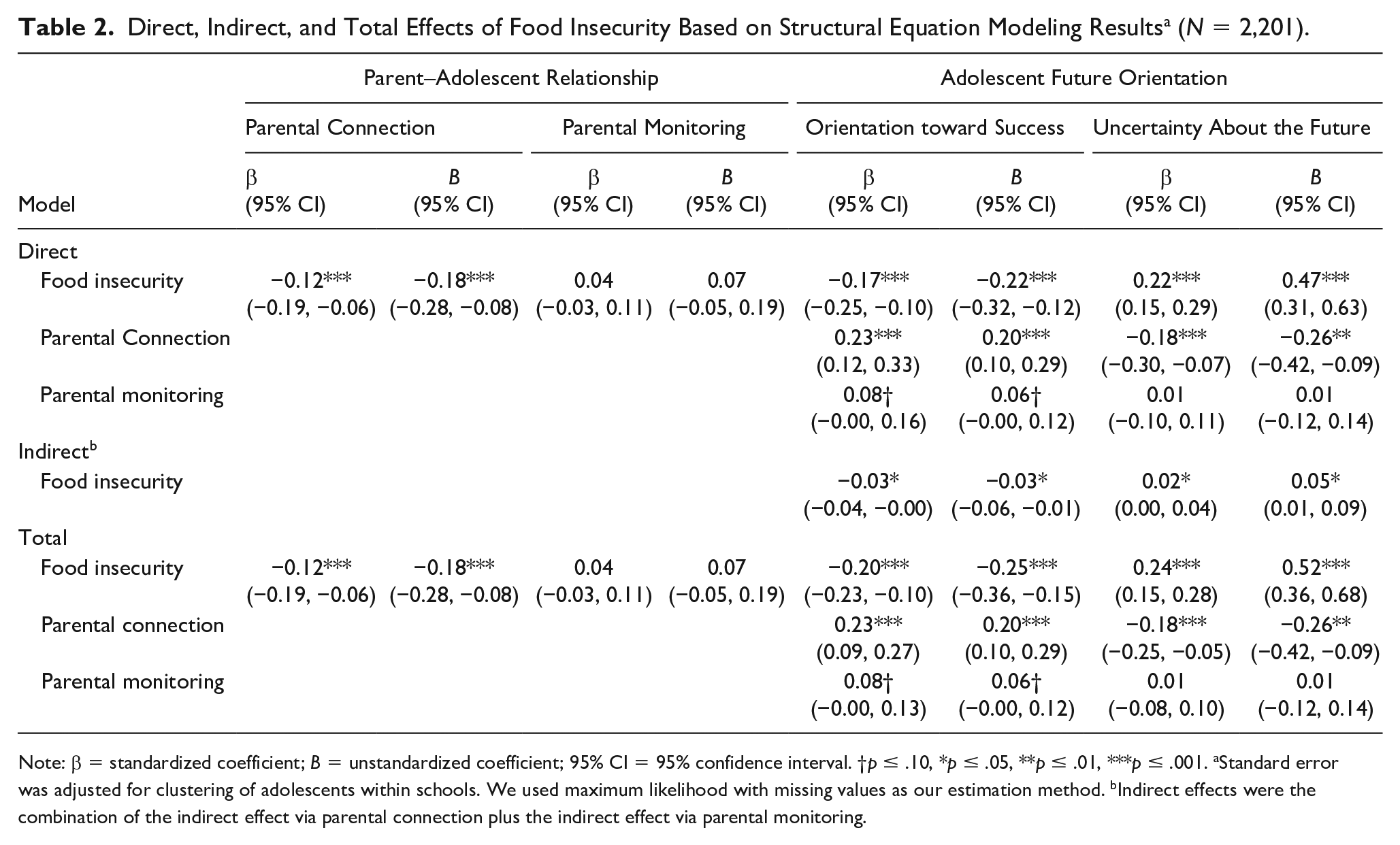
Note: β = standardized coefficient; B = unstandardized coefficient; 95% CI = 95% confidence interval. †p ≤ .10, *p ≤ .05, **p ≤ .01, ***p ≤ .001. aStandard error was adjusted for clustering of adolescents within schools. We used maximum likelihood with missing values as our estimation method. bIndirect effects were the combination of the indirect effect via parental connection plus the indirect effect via parental monitoring.
Direct effects
Food insecurity and adolescent–parent relationship
Food insecurity was significantly and negatively associated with parental connection (β= −0.12). Adolescents who experienced food insecurity scored lower on the parental connection scale compared with their peers who did not experience food insecurity. Although food insecurity was positively associated with parental monitoring, the direct relationship was not statistically significant (β = 0.04, p = .29).
Adolescent–parent relationship and adolescent future orientation
Parental connection was significantly associated with adolescent future orientation. Higher levels of parental connection were directly associated with higher levels of orientation toward success (β = 0.23, p < .001) and lower levels of uncertainty about the future (β = −0.18, p < .001). Adolescents who reported a warm and affectionate relationship with their parents scored higher on the orientation toward success scale compared with their peers who reported a less affectionate relationship with their parents.
Food insecurity and adolescent future orientation
Food insecurity was significantly associated with adolescent future orientation. Higher levels of food insecurity were associated with lower orientation toward success (β = −0.17, p < .001). Similarly, higher levels of food insecurity were associated with higher uncertainty about the future (β = 0.22, p < .001). These results were consistent with findings from our previous study that examined the direct association of food insecurity and future orientation of youth and their parents.
Indirect effects
Food insecurity, adolescent–parent relationship, and adolescent future orientation
Our results indicated that food insecurity had an indirect negative effect on adolescents’ orientation toward success via APR (β = −0.03, p = .04). Similarly, food insecurity had an indirect positive effect on adolescents’ uncertainty about the future via APR (β = 0.02, p = .021). These results indicated that food insecurity was associated with low levels of future orientation among adolescents in our study, and this association might be explained by the indirect influence of APR. Further, the indirect effect associated with each domain of adolescent future orientation was the combination of the indirect via parental connection and the indirect via parental monitoring. We conducted post hoc calculations to determine indirect effects associated with each dimension of parent–adolescent relationship. For orientation toward success, the indirect standardized coefficient via parental connection was −0.03 (B = −0.036) and the indirect via parental monitoring was 0.003 (B = 0.004). For uncertainty about the future, the indirect standardized coefficient via parental connection was 0.022 (B = 0.047) and the indirect via parental monitoring was 0.0004 (B = 0.0008). These results showed a larger indirect effect of parental connection than parental monitoring on adolescent future orientation.
Discussion
Our findings suggest a direct relationship of food insecurity with parental connection, as well as a direct and indirect relationship with adolescent future orientation. First, our results indicate that food insecurity is associated with weaker parental connection in our sample of Ghanaian adolescents. This direct association between food insecurity and weaker parental connection broadens our knowledge of the potential consequences of limited food access, beyond physiological and other health related outcomes. Although few studies have examined the direct association between food security and APR in low-resource settings, our findings are consistent with previous theoretical and empirical studies. Theoretical work on resource dilution (Strohschein et al., 2008) and conservation of resources (Hobfoll, 1989) asserts the influence of finite resources (e.g., food) on parenting and stress. For example, depletion or absence of resources may deprive parents of their ability to address the needs of their families. Empirical evidence has shown that access to tangible resources, such as income or assets, has been identified as an important predictor of positive parenting (Davis-Kean, 2005; Shonkoff & Phillips, 2000). Access to adequate resources may foster household stability and may lessen household stress (Hobfoll & Lilly, 1993; Sherraden, 1991). In turn, stability and low levels of stress may create a home environment that fosters positive adolescent–parent connection, characterized by parental warmth, supportive parenting, and low levels of intrahousehold conflict and mistrust. Conversely, inability to access adequate food has been shown to be related with heightened levels of stress and negatively associated with the quality of APR (Ashiabi & O’Neal, 2007; Huang et al., 2010). When parents cannot satisfy the needs of their families, they may experience stress and anxiety. The compounded effect of stress, anxiety, and inability to satisfy family needs may result in reduced energy and time to express affection and love and to provide guidance and care toward their children.
Second, our findings provide one of the first empirical evidence about the indirect association of food insecurity with adolescent future orientation, via APR. In a previous study, we found a direct association between food insecurity and future orientation in a larger and older sample of Ghanaian youth and their parents. In the current study, we found that adolescents who reported being food insecure had lower orientation toward success and higher uncertainty about the future. These identical results indicate a robust association between food insecurity and future orientation regardless of age and household member status. We refer interested readers to Masa et al. (2018) for more detailed discussion and explanation of the observed direct relationship between food insecurity and future orientation. Moreover, the significant and inverse association of food insecurity with youth and parental future orientation prompted us to investigate whether the direct relationship of food insecurity with adolescent future orientation could be explained by a third variable related to parenting, as illustrated in previous studies in the United States (e.g., Huang et al., 2010). Our results suggest a potential pathway through parental connection. In other words, parental connection could be a mechanism that explains the observed relationship between food insecurity and adolescent future orientation. Although a direct relationship between food insecurity and adolescent future orientation remains, identification of an indirect relationship via parental connection may better inform programs that buffer the effect of food insecurity on various outcomes, including young people’s ability to think about their future.
In addition to an indirect pathway, parental connection has a direct and positive association with future orientation. We found that greater parental connection was associated with higher orientation toward success and lower uncertainty about the future. These results suggest that parents who frequently display affection and care toward their adolescent children may inspire the latter to engage in future thinking or to create images of their possible selves. It is plausible that adolescents recognize their connection with their parents as security and safety measures necessary to plan for their future (Shaw & Dallos, 2005). Greater parental connection may also reinforce the importance of parents as role models for their children (Ahlin & Lobo Antunes, 2015; Wight & Fullerton, 2013). Greater parental connection may allow parents to provide future-oriented advices and tangible examples of goal-directed behaviors, which in turn, may influence their children’s decisions.
Furthermore, the positive association of parental connection is consistent with theoretical and empirical work on adolescent–parent attachment (Allen et al., 2002) and application of attachment theory in adolescence (de Minzi, 2006). Although parental connection manifests differently in childhood and adolescence, adolescent-parent attachment remains important to adolescents’ healthy transition to adulthood (Ryan & Lynch, 1989). As our findings illustrate, parental connection that emphasizes parents’ ability to provide support and guidance and to thoughtfully discuss issues associated with peer and romantic relationships may provide a secure and favorable adolescent–parent connection. Evidence also shows that a secure and favorable adolescent–parent connection is associated with positive peer relationships (Shaw & Dallos, 2005), less engagement in high risk behaviors (Marsh et al., 2003), and fewer mental health problems (Brumariu & Kerns, 2010). We add our findings to the list of positive outcomes by showing an association of parental connection with adolescents’ orientation toward success and uncertainty about the future and that parental connection may be a pathway that explains the effect of food insecurity on adolescent future orientation.
However, we did not find a direct association of parental monitoring with adolescent future orientation or an indirect effect of food insecurity through parental monitoring. The lack of direct and indirect association via parental monitoring may not be surprising. A favorable APR is characterized by parents’ ability to support and guide their adolescent children as the latter develop new interpersonal relationships and spend more time with their peers. In contrast, parental monitoring, illustrated by frequent supervision of how adolescents and their friends use their time and money may be viewed as a sign of parental mistrust or disapproval of adolescents’ autonomy (Kakihara & Tilton-Weaver, 2009). Moreover, our results contradict previous studies that have found parental monitoring as a protective factor against adolescents’ risk behaviors (DiClemente et al., 2001; Li et al., 2000). Our inconsistent findings might be attributed to our adaptation of parental monitoring items, which combined parental knowledge and actual parental monitoring of adolescent activities. Some researchers have emphasized the distinction between parental monitoring and parental knowledge given their opposing effects on adolescent outcomes (Kerr & Stattin, 2000; Stattin & Kerr, 2000). It is also plausible that parental monitoring is perceived differently by Ghanaian adolescents compared to their counterparts in Western countries. For example, Ghanaian adolescents view infrequent parental monitoring as lack of parental interest rather than a sign of parental mistrust or disapproval of adolescents’ autonomy (Marbell & Grolnick, 2013). Thus, parental monitoring when viewed as an indicator of parental interest may act as a protective factor against adverse outcomes.
Strengths of this study include the following: (a) a large sample of adolescents from a low-resource country, (b) use of adolescents as respondents, a practice that departs from previous research studies, which rely mostly on parents’ accounts of their own parenting behaviors and food insecurity experience (Fram et al., 2011), (c) validated scales that had been previously used in Ghana and similar settings, and (d) one of the first studies to examine an indirect effect of food insecurity, via parental connection, with adolescent future orientation using SEM.
Limitations
A cautious interpretation of the findings is recommended because of study limitations. First, our sample, though large, may not be representative of all adolescents in Ghana. Findings should be interpreted considering the original project’s sampling design and focus on low-income families. Second, we tested a mediation model in a cross-sectional sample. Cross-sectional data provide weak evidence of causal relationship. Lack of temporal order does not eliminate reverse causality and may alter true direction of relationship. Our tests of direct and indirect associations should not be interpreted to indicate causal relationships. However, we used prior theoretical and empirical evidence to support our hypothesized direct and indirect associations. Third, although RMSEA point estimates indicated good fit of our measurement and structural models, CFI and TLI estimates were below the cutoff values associated with good fit. Based on the three fit indices, our measurement and structural models demonstrated adequate fit with observed data. Fourth, our measures may not fully capture various dimensions of our study variables. For example, we only measured the connection and monitoring component of APR. Our findings do not tell us about other aspects of APR, including trajectory over time and parents’ involvement in their children’s education. Last, key measures (food insecurity, APR, and future orientation) used in our analysis were self-reported by adolescents, which may influence reliability of data. Future research should address our study’s limitations.
Our study findings extend what we know about the consequences of food insecurity on adolescent and family welfare. The combined costs associated with food insecurity, weaker parental connection, and inability to engage in future thinking may exacerbate conditions and vulnerabilities that adolescents and their families experience in their daily lives. The compounded effects may be particularly harmful to adolescents, who are beginning to develop their own identity and autonomy, to engage in sexual relationships, and to form future aspirations and life goals.
Footnotes
Acknowledgements
The authors thank the YouthSave research participants for their time and involvement in the project, headmasters and teachers in the project schools for allowing their institutions to be part of the research. We also thank the field interviewers at the Institute of Statistical, Social and Economic Research at the University of Ghana for their data collection support. The authors also thank Susan White at the University of North Carolina at Chapel Hill for her editorial assistance.
Declaration of Conflicting Interests
The authors declared no potential conflicts of interest with respect to the research, authorship, and/or publication of this article.
Funding
The authors disclosed receipt of the following financial support for the research, authorship, and/or publication of this article: This study was funded by the MasterCard Foundation (Grant number 5-45212).
