




Abstract
Balancing work and family may be particularly challenging for parents of seriously ill children. This Swedish registry-based study, including 2,788 parents of children with cancer and a matched reference cohort of 27,110 parents, used regression models to analyze the division of childcare, measured as use of temporary parental leave (TPL), and how it relates to income division within couples and change in income over time. The results show that the number of days on TPL increased significantly following a child’s cancer diagnosis, particularly among mothers. Fathers’ share of the couple’s total income was not found to be a strong predictor of the division of TPL, and no association was found between TPL and income development. The study highlights the considerable time needed to care for a seriously ill child, unevenly distributed between mothers and fathers, and suggests that factors other than economic resources may influence the division of childcare responsibility.
Introduction
The division of responsibilities for childcare and work is an important issue for many parents, and part of the rationale behind the division is often considered a result of the financial situation of the household. Having a child with a serious illness can make the division of childcare and paid work even more complicated, as parents are often required to take considerable time off from work in order to care for the ill child. Still, the division of childcare in families with a child with a serious illness needs further research to understand the social and financial implications of childhood disease on mothers and fathers. In this study, we wanted to explore work-life balance in families of seriously ill children and how a serious illness affects mothers’ and fathers’ time devoted to caring for the ill child. With this aim, we investigated the incidence and extent of childcare leave among parents of children with cancer in Sweden compared to a matched reference cohort. Of particular interest was determining the division of childcare between mothers and fathers, what factors might influence the division, and how this might be associated with income development, measured as change in income over time.
Background
Division of Childcare between Mothers and Fathers
Recent decades have seen an increase in men’s involvement in household work and childcare (Hook, 2006), alongside an increase in labor market participation among women (Kenworthy, 2008). However, there still remains an uneven distribution of unpaid work in households (Craig & Mullan, 2010; Hook, 2006), which time alone is unlikely to even out (Hook, 2006). When it comes to the division of childcare among parents in Sweden, several socioeconomic characteristics, such as income and education, are associated with the likelihood of equal sharing of childcare (Duvander & Viklund, 2014; Swedish Social Insurance Agency, 2013), but these are not sufficient to explain the entire picture (Swedish Social Insurance Agency, 2013).
Theories regarding the economic situation of the family have been proposed to explain the division of childcare and other household tasks. The theoretical perspective of relative resources suggests that members of a family use their individual resources, such as income and education, as bargaining power. The parent with more resources has a higher degree of independence and thus has an advantage when negotiating the division of household tasks (Lundberg & Pollak, 1996). The theory of relative resources has gained some support in empirical studies on parents in the general population. For example, an increase in women’s relative resources in terms of income, employment, or education has been found to be associated with an increase in likelihood of equal sharing of household tasks (Evertsson & Nermo, 2004, 2007; Raley et al., 2012) and to some extent of childcare (Amilon, 2007; Boye, 2015a; Nitsche & Grunow, 2018; Raley et al., 2012), although the association appear to be less evident for childcare than housework. It is not known whether parents of children with a serious illness show the same pattern as well.
Although individual and relative resources may matter, gender norms and other cultural factors have also been suggested to have an impact on the division of childcare (Amilon, 2007; Nitsche & Grunow, 2018; Raley et al., 2012; Swedish Social Insurance Agency, 2013). Gender theoretical perspectives, which are partly interwoven with the aforementioned perspectives, are also important in illuminating the organizing principles that divide childcare within couples. Women and men “do gender” in the routine, everyday practices of childcare and household responsibilities in a way that these practices begin to seem inevitable and natural in the specific context in which they are performed (West & Zimmerman, 1987). Mothers’ primary caregiving responsibilities or fathers’ primary presence in the labor market, for instance, may hence be seen as expressions of prevailing gender norms and structures that are formed by repeated, everyday interactions with others (Lammi-Taskula, 2008). Nevertheless, the ways in which gender is “done” can also be renegotiated and shifted toward new ways of performing masculinities and femininities, meaning that these are changeable across time and space, allowing for new ideals and gendered practices on parenting to emerge (Connell, 1995).
The present study is conducted in Sweden, which is an interesting context to study the division of childcare within different-sex couples due to its pronounced gender equality ideologies. Sweden consistently ranks at the top of numerous gender equality measurements such as the Global Gender Gap Index assessed by the World Economic Forum (Hausmann et al., 2013). An equal and shared parenthood is facilitated by the parental leave model in Sweden as well as by increasing expectations for both parents to be fully present in their children’s lives. Indeed, an articulated gender equality strategy is linked to a more equal division of housework and childcare (Evertsson, 2014b), and eligibility to parental leave for fathers have been found to decrease the uneven division of unpaid work (Hook, 2006). Nevertheless, despite general consensus about the importance of achieving full gender equality in Sweden, traditional gender practices in relation to housework and caregiving responsibilities remain (Magnusson, 2005; Swedish Social Insurance Agency, 2013).
Consequences of Parenthood on Work Situation
Parenthood has been found to be associated with an increased gender division of labor (Craig & Mullan, 2010). Different effects of parenthood on labor market positions have been identified for men and women in Sweden, suggesting there to be a fatherhood premium but no motherhood premium (Bygren & Gähler, 2012; Magnusson & Nermo, 2017). Childcare policies vary across high-income countries, with great differences in whether fathers have access to parental leave at all and, if so, to what extent (Ray et al., 2010). What is often considered family-friendly policies, such as a lengthy parental leave, have been found to have adverse effects on women’s work situation (Aisenbrey et al., 2009; Mandel & Semyonov, 2005). The negative impact of family-friendly policies on gender equality in the labor market could be seen as a result of statistical discrimination (Phelps, 1972), that is, employers may discriminate against female employees based on the assumption that if they have children, they will be absent from work for a long period of time in order to care for them (Thoursie, 2005). This in turn can have self-increasing effects, where fewer investments in female employees affect their incentives to take longer maternal leaves (Thoursie, 2005).
However, the negative wage effects of work absence due to childcare have been found to be greater for fathers than for mothers (Boye, 2015b; Thoursie, 2005). This has been suggested to be caused by signaling effects, that is, being absent from work to care for a child is seen more as a signal of low work motivation and low commitment among fathers than among mothers (Boye, 2015b; Thoursie, 2005). In other words, women may be discriminated against based on the assumption that they take more family responsibility, whereas men may be penalized if they against expectations do take a larger share of the responsibilities (Thoursie, 2005).
Parents of Children with Cancer in Sweden
The present study aims to move the focus to parents of children with a serious illness for whom childcare may constitute an even more significant part of everyday life, exemplified by studying parents of children with cancer in Sweden. Approximately 300 children are diagnosed with cancer each year in Sweden. Although the five-year survival rate is around 80%, cancer is still one of the leading causes of death among Swedish children (National Board of Health and Welfare, 2018). The diagnosis and treatment create a demanding and stressful situation for the entire family that may last long after the end of treatment (Gibbins et al., 2012). The treatment often includes surgery, chemotherapy, radiation therapy, or a combination of these modalities. The length of treatment typically varies from several months to several years, depending on the type of cancer. For the most common childhood cancer, acute lymphoblastic leukemia, the treatment is two to three years (National Board of Health and Welfare, 2018). After active treatment, the child often needs follow-up care, such as physical examinations and medical tests, for months or years ahead. Survivors of childhood cancer are at risk for a range of adverse late effects that can occur for years after the end of treatment, including psychological problems, cardiopulmonary problems, musculoskeletal problems, endocrine disorders, and neurocognitive problems (Oeffinger et al., 2006). As informal caregivers, parents of children with cancer often have to reduce their working hours in order to be able to care for their child (Gibbins et al., 2012; Hovén et al., 2013; Lindahl Norberg et al., 2017; Mader et al., 2016; Pelletier & Bona, 2015, Roser et al., 2019).
Parents in Sweden may apply for temporary parental leave (TPL) in order to care for an ill child, and will be reimbursed with temporary parental benefit provided by the state. For most, temporary parental benefit is limited to 120 days per child and year until the child is 12 years old, and can be divided between the parents as preferred. Since 2005, parents of a seriously ill child have been able to receive temporary parental benefit for an unlimited number of days for a child up to the age of 18 years. TPL can be granted in five different levels: 100, 75, 50, 25 and 12.5% of a full workday. The amount reimbursed from temporary parental benefit is based on income from current, or in some cases previous, employment, up to an income ceiling (Social Insurance Code, 2010).
As the Swedish welfare system enables parents of seriously ill children to be reimbursed for time spent caring for the ill child, one can expect the extent of childcare leave to increase when a child is diagnosed with cancer. Indeed, it has been shown that childcare-related benefits increase after a child’s cancer diagnosis among Swedish parents (Hiyoshi et al., 2018). Whether that also causes particularly severe consequences in terms of wage development or career opportunities among parents of children with cancer should be addressed. Additionally, presence at work may not only be of importance for wage development and career opportunities but also may have psychological benefits, such as a welcome break from childcare, companionship with colleagues, and opportunity for self-fulfillment (Lewis et al., 2000).
During the years studied, general population statistics show that Swedish mothers used approximately three-quarters of the total number of reimbursed parental benefit days and two-thirds of total reimbursed temporary parental benefit days (Statistics Sweden, 2018). As TPL has been found to be shared more equally when the total number of days with TPL increases (Amilon, 2007), the pattern of division of childcare among parents of children with a serious illness might differ from the pattern in the general population, as the TPL rate is expected to increase. At the same time, parenting a child with a serious illness has been found to cement traditional gender norms, with mothers taking on the primary caregiving role and fathers the primary provider role (Chesler & Parry, 2001; Clarke et al., 2009; Gibbins et al., 2012; Lewis et al., 2000; Mader et al., 2016; Pelchat et al., 2007). This suggests the possibility of reduced sharing of childcare among parents of children with a serious illness.
Importantly, previous studies have consistently emphasized the financial burden that a child’s cancer entails (Pelletier & Bona, 2015; Roser et al., 2019), which may move far beyond the expected cost of raising a child. Therefore, economic factors may be of even greater importance in explaining the division of childcare among parents of children who are not seriously ill, with the possibility of relative resources being a more influential factor than has been found in studies on the general population. However, little is known of how the dynamics of work and childcare related to relative resources are affected when a child is seriously ill. A study from the United Kingdom on parents with disabled children concluded that a combination of economic and ideological factors had an impact on the division of work and childcare, with many decisions being influenced by gender-related factors, and discussed whether it was particularly difficult for parents of disabled children to challenge gendered expectations due to a strong ideology of mothers as carers of sick children (Lewis et al., 2000). Similar to the parents of disabled children in the United Kingdom study, parents of children with other serious illnesses may experience caregiving as more manifest in everyday life, and the gendered expectations could be particularly difficult also for these parents. Still, further research is warranted in order to understand the impact of a child’s serious illness on the division of work and childcare among parents, and to the best of our knowledge, no previous studies have investigated how childcare is divided between mothers and fathers of children with cancer, and what factors influence the division.
Research Questions
In this study, we used national registry data to analyze the use and division of childcare among Swedish parents of children with cancer and a matched reference cohort by addressing the following research questions: (a) Do mothers and fathers of children with cancer divide childcare leave equally before and/or after the child’s diagnosis, and does the division differ from parents in the general population? (b) Is there an association between the division of income and the division of childcare leave within parental couples of children with cancer? (c) Is there an association between extent of childcare leave and income development among parents of children with cancer?
Methods
Sample
The Swedish Childhood Cancer Registry was used to identify all children (≤18 years old) diagnosed with a primary cancer diagnosis from 2004 to 2009 (n=1,918). Using the children’s personal identification number, Statistics Sweden identified their parents (hereafter also referred to as exposed parents). Nineteen children who did not have complete child or parental information were excluded. In total, 3,626 parents of children with cancer were identified.
A matched general population parent cohort (n=34,874, hereafter also referred to as unexposed parents) was identified by Statistics Sweden. The parents were individually matched based on the child’s year of birth and the following factors evaluated two years before diagnosis (i.e., when the child’s cancer had most likely not yet had an impact on the family): county of residence, parental age, number of children living at home, family disposable income, and family status (mother and father living together, single custody, joint custody but not living together, and other).
As the focus of this study is on how childcare is divided within couples, only parents living together and with shared custody of the child were included in the final analyses. The final study cohort consisted of 2,788 exposed parents and 27,110 unexposed parents. Only different-sex parental couples were represented in the sample. Bereaved parents and their matched unexposed parents were excluded from the analyses at the year of loss in all statistical models. In total, 356 parents of children with cancer were excluded for this reason. The sociodemographic characteristics of the study sample at baseline (i.e., one year before diagnosis) are given in Table 1.
Sociodemographic Characteristics of the Study Sample at Baseline, One Year Before Year of Diagnosis.
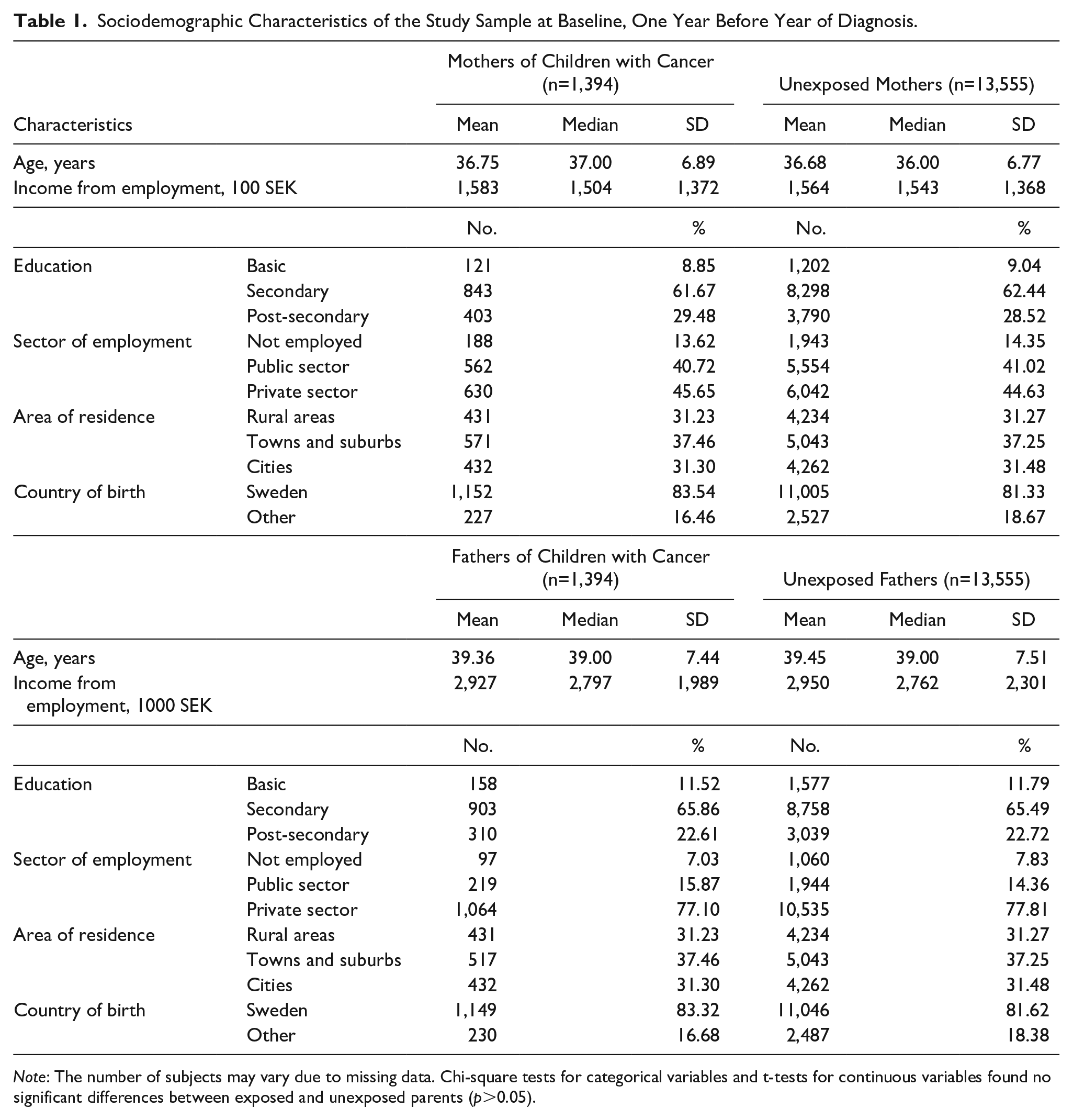
Note: The number of subjects may vary due to missing data. Chi-square tests for categorical variables and t-tests for continuous variables found no significant differences between exposed and unexposed parents (p>0.05).
Measures
Childcare leave was measured as days on TPL. Annual individual data on parents’ TPL, income, and other sociodemographic information were retrieved from the Longitudinal Integration Database for Health Insurance and Labor Market Studies for the years 1990–2011, provided by Statistics Sweden. The children’s medical data were retrieved from the Swedish Childhood Cancer Registry.
Independent and dependent variables
The number of days with TPL, measured as number of days with temporary parental benefit each year, was first estimated for mothers and fathers separately and compared between exposed and unexposed parents, from one year before diagnosis to seven years after. For research question 1, the number of days with TPL was then compared between mothers and fathers, for exposed and unexposed parents separately, from one year before diagnosis to seven years after.
For research question 2, the independent variable was fathers’ share of income. Income was measured as income from employment and employment-related benefits. The fathers’ share of income was measured as the income of the father divided by the total income of the parental couple at baseline. The dependent variable for research question 2 was the fathers’ share of TPL, measured as the number of TPL days for the father divided by the total number of TPL days for the parental couple at year of diagnosis, one year after, and two years after.
For research question 3, the dependent variable was income development, measured as a quotient between a parent’s income seven years after diagnosis and baseline income. The independent variable for research question 3 was the accumulated number of days with TPL, measured as the total number of days with TPL from the year of diagnosis to six years after diagnosis, that is, during the years preceding the year when the dependent variable was measured.
Covariates
Based on previous findings on factors that influence the sharing of TPL in Sweden (Amilon, 2007), all analyses were adjusted for the following covariates, measured at baseline: number of children aged 0 years–6 (0/1/≥2); employment sector (not employed/public sector/private sector); age; and education (basic/secondary/post-secondary). When analyzing the number of days of TPL, calendar year <2005 or ≥2005 was included in the analyses to control for changes in the social insurance law regarding TPL the year 2005 (Swedish Social Insurance Agency, 2015). As previous studies have found that a child’s disease affects parents’ employment (Lindahl Norberg et al., 2017) and sick leave (Hjelmstedt et al., 2017), which may also be associated with the likelihood of TPL, sensitivity analyses were conducted adjusting for the time-varying variables employment sector and days with sickness benefit.
As the total number of days with TPL has been found to be associated with the division of TPL (Amilon, 2007), the parental couple’s total number of TPL days was adjusted for in analyses to answer research question 2. As we believe that the source of one’s income (employment, parental benefits, sickness benefits, etc.) may influence both the bargaining power and the likelihood of TPL, as well as account for some of the effect of the income ceiling in the insurance scheme, income source (employment-based share of total income) is adjusted for in analyses to answer research question 2 and 3. For research question 3, we also adjusted for total number of days with parental and sickness benefit, as previous studies have found both parental leave (Evertsson, 2014a) and sick leave (Hansen, 2000) are associated with future income.
Statistical Analysis
Sociodemographic characteristics between parents of children with cancer and the matched unexposed parents were compared at baseline using Chi-square tests and t-tests to ensure equivalence between groups. Negative binomial regression analyses were used to analyze the annual number of days of TPL for mothers and fathers separately and then combined, for comparative purposes. Cluster robust standard errors were used, taking into account the dependence within matched groups and within subjects and groups over time. All negative binomial regression models were fitted using the function glm.nb in the MASS package in R.
Beta regression analyses, with a logit link for the mean, were used for research question 2. The association between the father’s share of a couple’s baseline income and the father’s share of a couple’s TPL was analyzed separately for exposed and unexposed parents for the year of diagnosis, and one and two years after diagnosis, respectively, combining exposed and unexposed parents only when comparing them. In order to fit models, father’s TPL shares taking the value zero or one hundred percent, were transformed using the formula (x(N-1)+1/2)/N, where N is the sample size, and x is the father’s share of TPL (Smithson & Verkuilen, 2006). Couples where one or both of the parents had no income or were unemployed, or where both had no TPL, were excluded (see Figure 2 for n). All beta regression models were fitted using the function betareg in the betareg package in R (Cribari-Neto & Zeileis, 2010). In all beta and negative binomial regression models, the linearity assumption of continuous variables was tested using restricted cubic splines with three knots (using the function rcs in the rms package in R).
For research question 3, the association between accumulated TPL and income development was analyzed using robust linear regression, limiting the influence of outliers. The association was analyzed for exposed and unexposed parents separately, and for mothers and fathers separately, combining them only when comparing them. Only parents with employment and income were included (see Table 4 for n). All robust linear regression models were fitted using the function rlm in the MASS package in R.
Ethical Considerations
This study was approved by the regional Ethical Review Board in Stockholm, Sweden (2011/804-31/5; 2013/757-32).
Results
No differences between parents of children with cancer and unexposed parents were found at baseline for age, income from employment, education, sector of employment, area of residence, and country of birth (p>0.05; Table 1).
The extent of TPL among parents increased dramatically when a child was diagnosed with cancer, with even higher ratios when adjusted for covariates (Table 2; Figure 1A-B). The year after the year of the child’s diagnosis, mothers and fathers of children with cancer had TPL for on average 48.3 days and 32.2 days, respectively, compared to 3.3 dats and 2.6 days, respectively, among unexposed mothers and fathers (Figure 1A-B). The rates remained significantly higher than unexposed parents’ up to five years post-diagnosis among mothers and six years among fathers (Table 2; Figure 1A-B). Sensitivity analyses adjusting for sector of employment and days on sickness benefit as time-varying variables resulted in a similar pattern (data not shown).
Incidence Rate Ratios (IRR) and 95% Confidence Intervals (CI) for Mean Number of Days on Temporary Parental Leave (TPL) among Parents of Children with Cancer (n=2,788) Compared to Unexposed Parents (n=27,110).
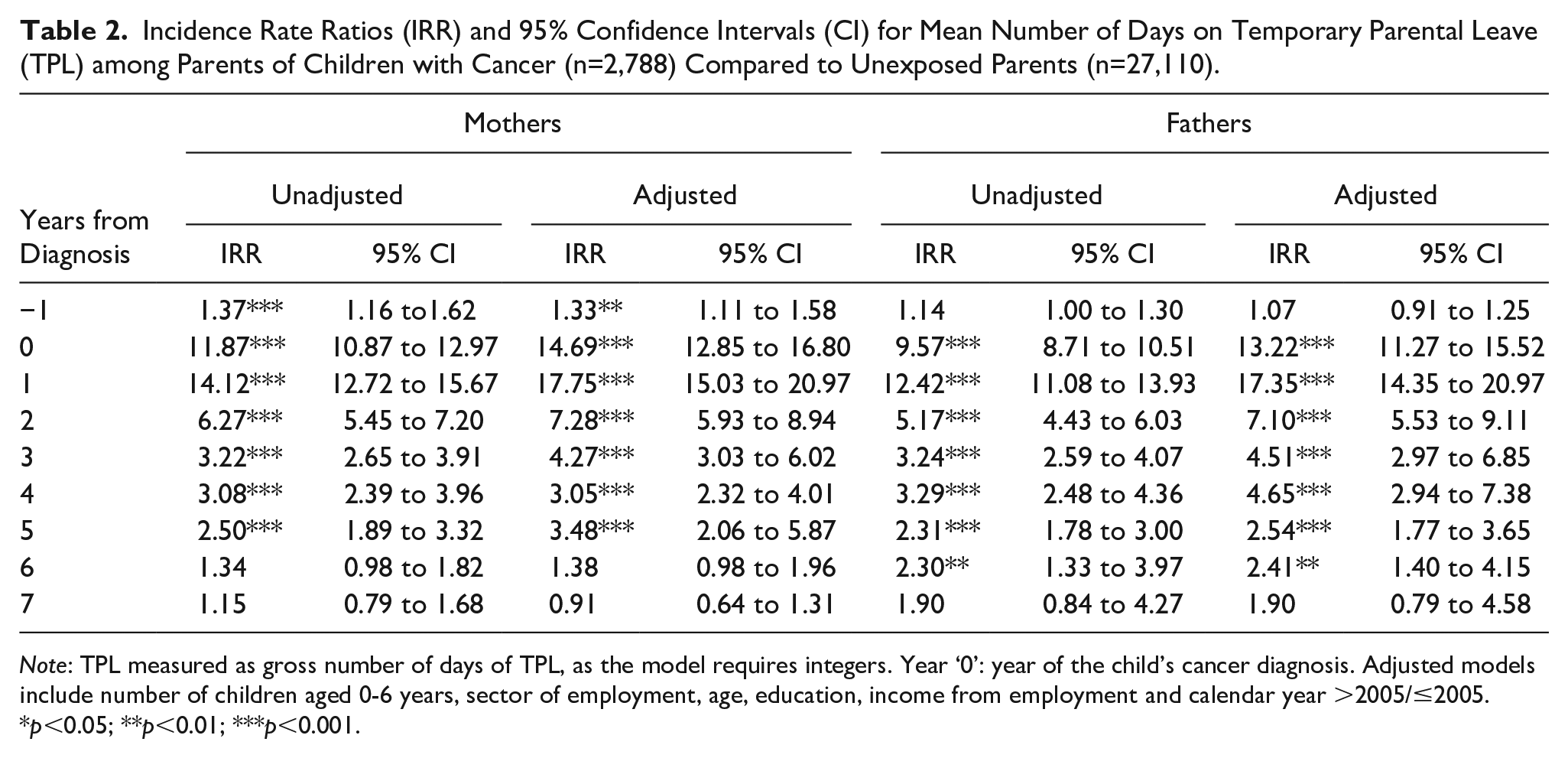
Note: TPL measured as gross number of days of TPL, as the model requires integers. Year ‘0’: year of the child’s cancer diagnosis. Adjusted models include number of children aged 0-6 years, sector of employment, age, education, income from employment and calendar year >2005/≤2005. *p<0.05; **p<0.01; ***p<0.001.
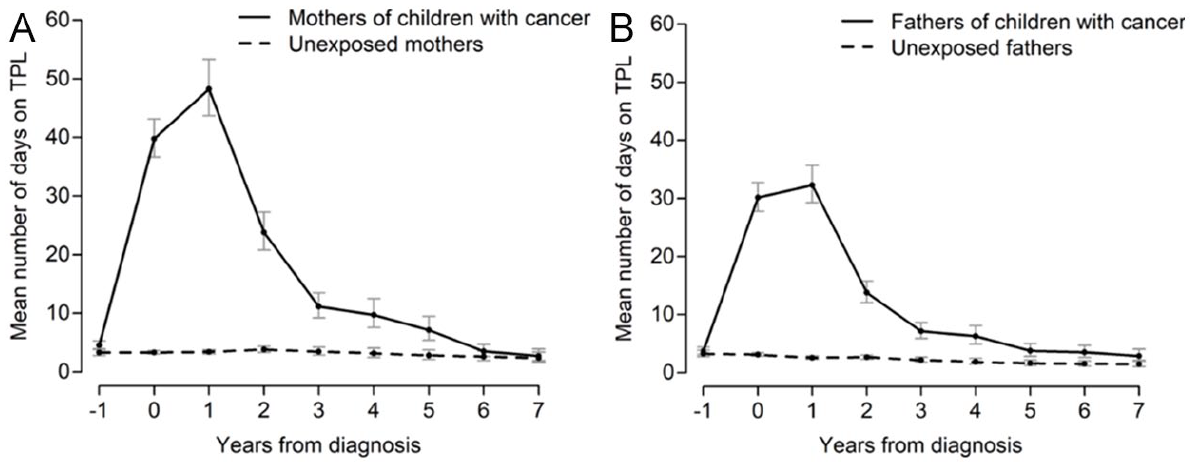
Mean number of days on temporary parental leave (TPL), including 95% confidence intervals, for mothers (A) and fathers (B).
Differences between Mothers and Fathers
Mothers of children with cancer had significantly more TPL days compared with unexposed mothers the year before the child’s diagnosis (Table 2). Additional analyses were conducted, showing mothers of children with cancer had significantly more TPL days than unexposed mothers two years before diagnosis also (IRR 1.15; p=0.02), but not three years before (IRR 1.08; p=0.20). No differences to unexposed fathers were found for the years before diagnosis among fathers of children with cancer (Table 2).
Among parents of children with cancer, mothers were found to have more TPL days than fathers from the year before diagnosis to five years after diagnosis (Table 3). When adjusted for covariates, the ratios decreased and were no longer statistically significant for some years (Table 3). When adjusted for covariates, the gender gap in number of days on TPL was significantly larger among parents of children with cancer than in the unexposed group the year before diagnosis, but was smaller at four and six years post diagnosis (Table 3).
Incidence Rate Ratios (IRR) and 95% Confidence Intervals (CI) for Mean Number of Days on Temporary Parental Leave (TPL) Among Mothers Compared to Fathers, and Test for Difference in the Ratios Between Parents of Children with Cancer (n=2,788) and Unexposed Parents (n=27,110).
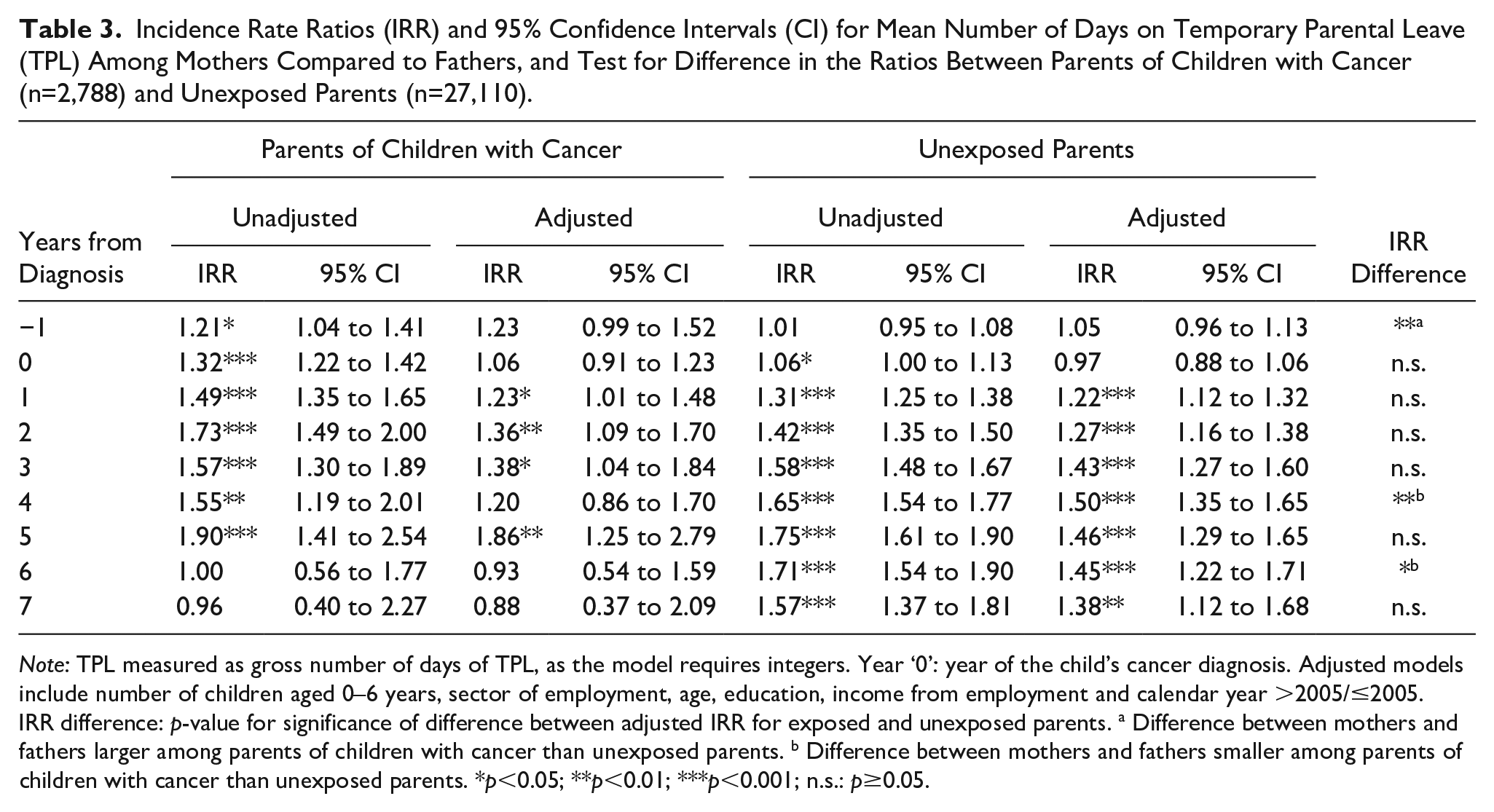
Note: TPL measured as gross number of days of TPL, as the model requires integers. Year ‘0’: year of the child’s cancer diagnosis. Adjusted models include number of children aged 0–6 years, sector of employment, age, education, income from employment and calendar year >2005/≤2005. IRR difference: p-value for significance of difference between adjusted IRR for exposed and unexposed parents. a Difference between mothers and fathers larger among parents of children with cancer than unexposed parents. b Difference between mothers and fathers smaller among parents of children with cancer than unexposed parents. *p<0.05; **p<0.01; ***p<0.001; n.s.: p≥0.05.
Income and Division of Temporary Parental Leave
At the year of diagnosis, a weak but statistically significant non-linear association was found among parents of children with cancer between fathers’ share of baseline income and fathers’ share of TPL (p=0.048; Figure 2A). The association was inverse for fathers with low income compared to mothers but positive for those with high income compared to mothers (Figure 2A). No statistically significant association was found the subsequent years (p>0.1; Figure 2B-C).
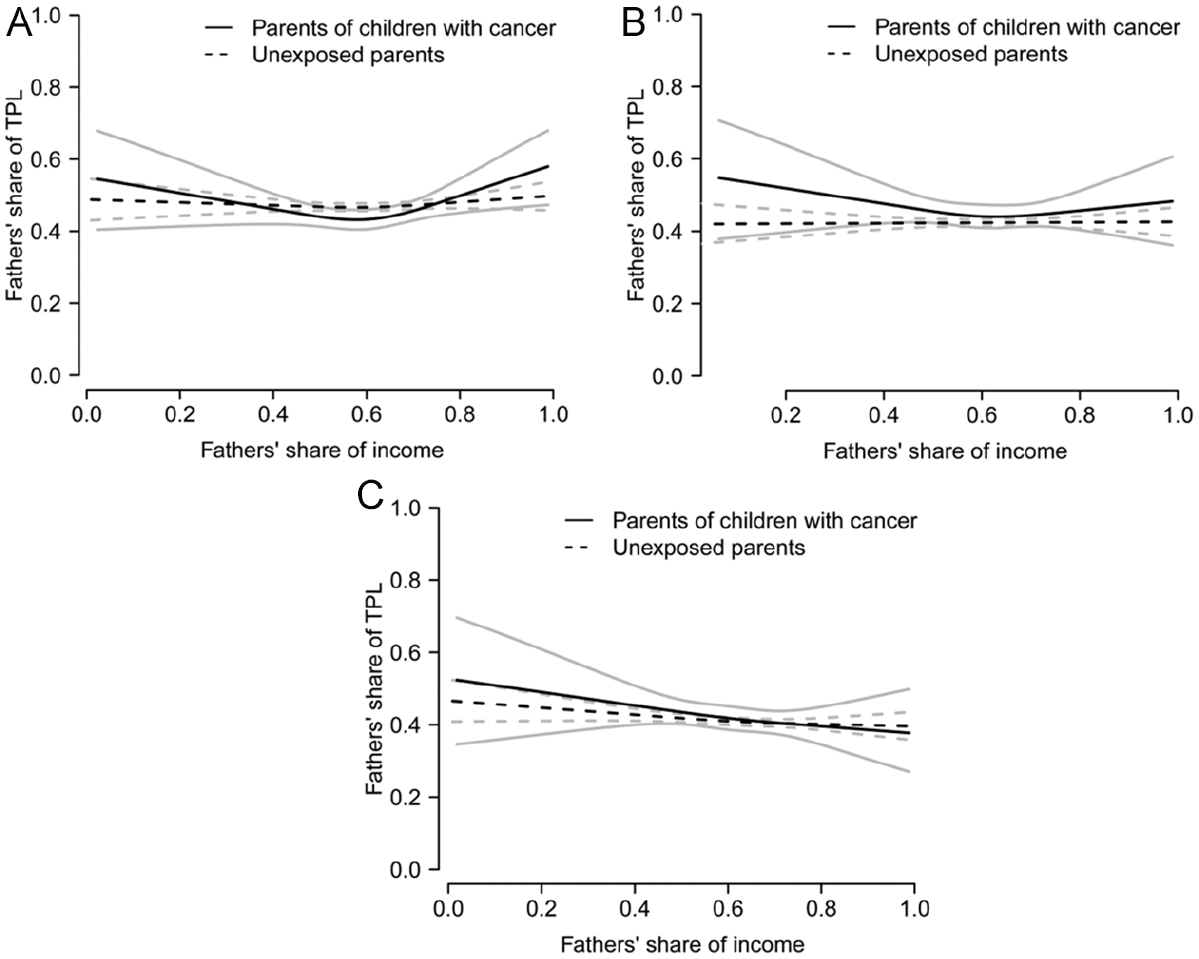
Association between fathers’ share of baseline income and fathers’ share of temporary parental leave (TPL), including 95% confidence intervals, the year of diagnosis (A), one year after diagnosis (B) and two years after diagnosis (C).
Among the unexposed parents, a weak but statistically significant inverse linear association was found between fathers’ share of baseline income and fathers’ share of TPL two years after diagnosis (p=0.046; Figure 2C). When comparing the association between fathers’ share of income and fathers’ share of TPL between parents of children with cancer and unexposed parents, no significant differences were found (p>0.1).
Temporary Parental Leave and Income Development
Among parents of children with cancer, no association was found between accumulated TPL and income development (Table 4). An inverse association was found between accumulated TPL and income development for unexposed mothers and fathers, respectively, when adjusting for covariates (Table 4).
Association between Accumulated Temporary Parental Leave (TPL), Measured in Hundreds, and Income Development.
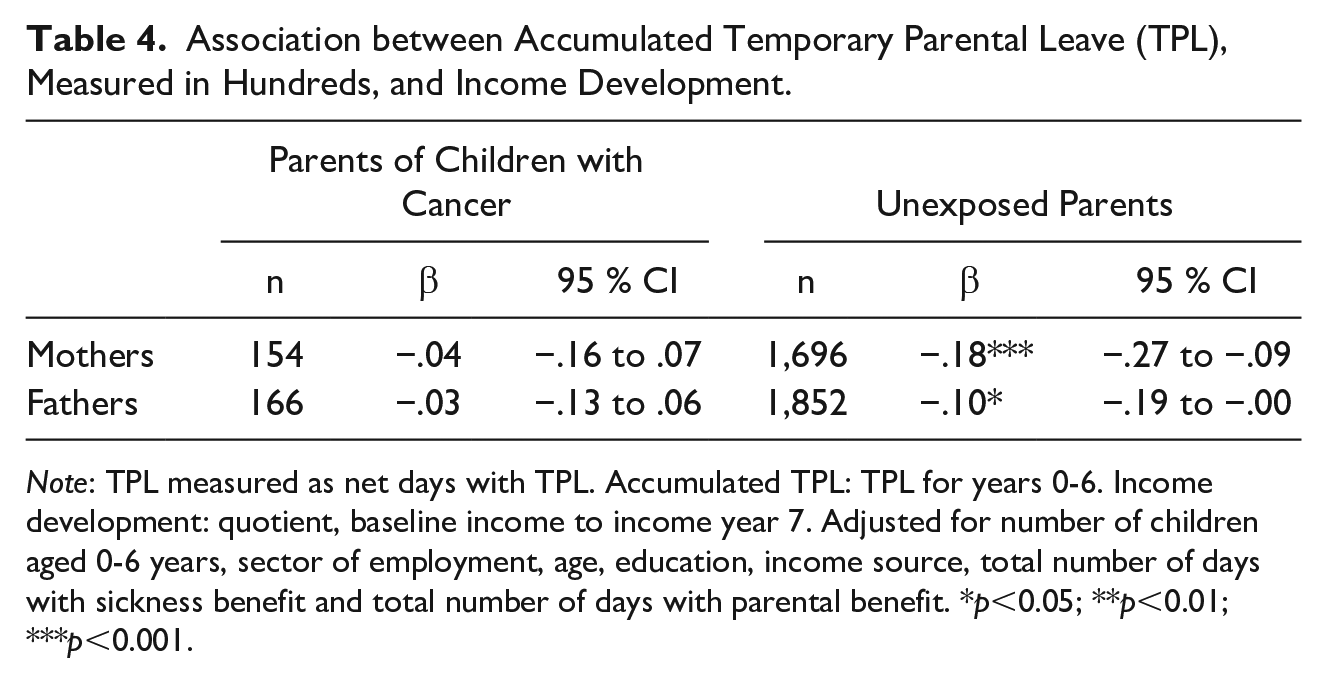
Note: TPL measured as net days with TPL. Accumulated TPL: TPL for years 0-6. Income development: quotient, baseline income to income year 7. Adjusted for number of children aged 0-6 years, sector of employment, age, education, income source, total number of days with sickness benefit and total number of days with parental benefit. *p<0.05; **p<0.01; ***p<0.001.
When comparing the association between accumulated TPL and income development between parents of children with cancer and unexposed parents, a significant difference was found among mothers (p=0.03; Table 4) but not fathers (p>0.1; Table 4).
Discussion
In this study, we investigated the use and division of childcare leave among parents with a serious illness, exemplified by childhood cancer, and whether the pattern differed from a cohort of parents from the general population. The extent of childcare leave among parents increased dramatically after a child’s cancer diagnosis, which was expected, given that TPL is intended to help parents who are required to be absent from work to care for an ill child. Considering the substantial number of days that parents of children with cancer were absent from work due to childcare compared to unexposed parents, and the long period of time after diagnosis that the increase was still statistically significant, it is relevant to highlight the potential consequences of this, as well as whether mothers and fathers are affected differently.
As in the unexposed group, mothers of children with cancer were, overall, found to take childcare for significantly more days than fathers. Our results further showed that they took childcare for significantly more days than mothers in the unexposed group the two years before diagnosis, although not to the same extent as after the diagnosis. As the symptoms may affect the child’s well-being prior to diagnosis (Dang-Tan & Franco, 2007), it is not surprising that parents need to increase their time spent on childcare even before the cancer diagnosis. However, the same was not found among fathers of children with cancer, and the gender gap was thus larger among parents of children with cancer than among unexposed parents the year before diagnosis.
Around the time of diagnosis, however, no significant difference was found between mothers and fathers of children with cancer after adjusting for covariates. This could be interpreted as childcare being more of a mother’s responsibility when the situation is seemingly “normal” (Cowdery & Knudson-Martin, 2005), whereas the diagnosis of a serious illness may change the dynamics of childcare responsibility and legitimize substantial work absence among fathers as well. We hypothesize that a crisis situation allows for “doing gender” differently (Connell, 1995), but that traditional ways of “doing” fatherhood and motherhood are “redone” once the situation stabilizes.
During the years following the child’s diagnosis, the gender difference was reduced after adjustment for covariates, indicating that other factors than being a mother or a father influence the use of childcare leave. One of the covariates was income from employment, thus suggesting that income has an impact on the use of childcare leave. However, our results do not suggest income division within couples being a strong predictor of the division of childcare within parental couples of children with cancer, as the associations found were few and modest. These results do not give much support for the theory of relative resources on the division of childcare among parents of seriously ill children, thus deviating from studies on parents in the general Swedish population (Amilon, 2007; Boye, 2015a). Our results suggest that other gender-related factors may be influential in explaining the unequal division found between mothers and fathers of seriously ill children, which have been indicated in previous studies on parents in the general population as well (Amilon, 2007; Nitsche & Grunow, 2018; Raley et al., 2012). Although not tested in this study, we hypothesize that gender norms may be influential in the division of care for seriously ill children, which has also been suggested in previous research (Gibbins et al., 2012; Pelchat et al., 2007). Mothers’ primary caregiving responsibility within couples with seriously ill children, regardless of income relations, could be seen as a manifestation of “doing gender” (West & Zimmerman, 1987) and of prevailing gender norms and structures (Lammi-Taskula, 2008). Whether these norms limit mothers’ income and employment situation (Lindahl Norberg et al., 2017) and their ability of engaging in life outside of childcare (Lewis et al., 2000), and limit fathers’ ability to engage in the care of the child (Chesler & Parry, 2001), should not be neglected. Future studies could benefit from exploring the influence and interaction of traditional as well as changing gender norms on the division of childcare among parents of seriously ill children.
Whether childcare can be considered a household task like any other, that the parent with a relative advantage would prefer not to do, could, however, be questioned (Sullivan, 2013). Women and men have been found to rate caring for a child high, whereas household tasks are among the least preferred activities (Flood & Gråsjö, 1997; Sullivan, 2013). Having a high income has also been found to be positively related to mothers’ time spent on childcare (Raley et al., 2012), suggesting that more resources might not necessarily mean less time spent on childcare. As our results do not suggest income relations within couples to have a large impact on the division of childcare among Swedish parents of seriously ill children, in either direction, the incentives for caring for a seriously ill child might be dependent on more factors than merely financial ones.
Among the unexposed parents, we found an inverse association between accumulated days on childcare leave and income development. One could speculate the inverse association to be a result of signaling effects, that is, employers perceiving parents who are absent due to childcare leave to have low work commitment. However, in contrast to previous research (Boye, 2015b), we did not find fathers to be affected to a larger extent than mothers. One possible confounder in this association, that we were not able to take into account, is the preferences of the parents regarding work and family time. Interestingly, we found no association between childcare and income development among parents of children with cancer. Although speculative, our results suggest that being on childcare could be seen as less of a signal of low work commitment when a child is seriously ill than when a child is not. This could be further studied in future studies. Additionally, our results could be studied in relation to caring for children with medical disabilities or diseases other than cancer, for which the need of care might not be as obvious to others, such as employers.
This study took place in Sweden, and the national policy context should not be neglected (Sullivan, 2013). The generalizability of the study is indeed influenced by Sweden’s generous care leave policies, and comparisons with other countries should be made with that in mind. In Sweden, TPL can be divided between parents as preferred, but the parental leave provided after a child’s birth is partly reserved exclusively for each parent. This may create a certain culture of childcare, with fathers being more involved and childcare being less of a gendered task than in other societies with far less generous parental leave policies, or where fathers are not eligible for parental leave. The reserved parental leave in Sweden has been found to have some effect of more gender-equal sharing (Duvander & Johansson, 2019), and reserved parental leave for parents have been found to increase equal sharing of unpaid work (Raley et al., 2012). The extensive Swedish parental leave might, however, have an adverse effect on women’s work situation (Aisenbrey et al., 2009; Mandel & Semyonov, 2005) and may thus impact the division of resources within couples. Either way, national context should be considered when comparing to other studies or generalizing the results to a larger setting.
Strengths and Limitations
By using a closely, individually matched reference cohort of unexposed parents, we were able to take into account pre-existing characteristics that might have influenced the outcome. The study is further strengthened by the use of comprehensive and reliable registry data, thereby not risking recall bias and limiting the risk of differential information bias.
In this study, income was measured as annual income from employment and employment-related benefits. Our definition of income is therefore not equal to wage. We could have chosen to only look at income from employment, but in doing so, we would have risked misinterpreting the results, as a low income from employment does not necessarily mean low wage (due to, e.g., parental leave a particular year). However, we still believe that the source of one’s income might influence the bargaining power within a couple. Additionally, if one has income from parental or sick leave, the income will be restricted to the income ceiling in the insurance scheme. For these reasons, we have adjusted for the source of one’s income. However, our measure of income needs to be taken into account when comparing to other studies that used wage as measure.
Being employed is not a prerequisite for receiving temporary parental benefit, but may influence the ability to fulfill the income criterion and potentially also the incentives to apply for benefits. Employment was thus accounted for in analyses, either as covariate or as an inclusion criterion.
That the extent of childcare leave among mothers of children with cancer was higher than among mothers in the unexposed group before diagnosis is an interesting finding. It is however also methodologically troublesome, as the outcome should preferably not differ between the two cohorts before the event of the child’s diagnosis, even if the difference was modest. If we had attempted to find a cohort of mothers who did not differ in terms of childcare leave before diagnosis, we would have risked ending up with a reference cohort of parents with children with other serious illnesses, and not one that represented the general population. Instead, we chose to use a cohort that was matched based on other sociodemographic characteristics. It should be noted also that we only know that the children of the unexposed parents’ children do not have cancer, we do not know whether they have any other illnesses.
In the cohort of parents of children with cancer, only different-sex parental couples were represented. Studying these outcomes in same-sex parental couples would be of interest in future studies, as both relative resources and gender norms might influence the division of childcare differently in same-sex couples (Evertsson & Boye, 2018).
The study does not take into account the heterogeneous nature of childhood cancer, and may also have lost some of the cases with most severely ill children as bereaved parents were excluded from analyses at the year of loss. Future studies could benefit from including different disease- and treatment related factors in the analysis, as the duration and intensity of the required care can be expected to differ. Future studies should furthermore investigate these issues in other pediatric serious illnesses.
Conclusions
The results of this Swedish registry-based study showed that the extent of childcare leave among parents increased after a child’s cancer diagnosis and remained significantly higher than in the unexposed group several years post diagnosis. Mothers were overall on childcare leave for more days than fathers, and the gender gap was significantly larger among parents of children with cancer than among the unexposed parents the year before diagnosis. We did not find a substantial association between the division of income and the division of childcare leave within parental couples of children with cancer, or an association between accumulated use of childcare leave and income development among parents of children with cancer.
The study highlights the need for parents to take time to care for a seriously ill child, even for a long period of time after diagnosis, and points to the uneven distribution of childcare between mothers and fathers. Although we did not find an impact of childcare leave on income development, the extensive disruptions in professional work can have far-reaching effects on retirement pensions and well-being. These results should be taken into consideration by those who are intended to support the parents when a child is seriously ill, such as employers, government agencies, and health care personnel. As we found that the gender gap compared to the unexposed parents were larger before diagnosis, but smaller a few years after, it can be questioned whether the responsibility for childcare is seen differently before and after the diagnosis of a serious disease. The results also indicate that the responsibility of caring for a seriously ill child does not depend entirely on the economic situation, and suggests future studies to include culture and gender norms in the analysis in order to grasp the rationale behind division of childcare for seriously ill children.
Footnotes
Declaration of Conflicting Interests
The author(s) declared no potential conflicts of interest with respect to the research, authorship, and/or publication of this article.
Funding
The author(s) disclosed receipt of the following financial support for the research, authorship, and/or publication of this article: This work was supported by the Swedish Childhood Cancer Foundation [grant numbers PROJ10/048, TJ2011-0026] and Karolinska Institutet [KID-grant number 2-3591/2014].
