



Abstract
This article investigated the relationship between religiosity and intergenerational solidarity in Germany, with a focus on differences between eastern and western regions that have maintained unique religious profiles that trace back to before unification. Based on data from Wave 6 (2013-2014) of the German Family Panel (pairfam), 8,637 reports from 4,622 adult children about their relationships with mothers and fathers were analyzed. Using an index comprising four dimensions of the intergenerational solidarity model (distance, contact, closeness, and support), hierarchical linear regression demonstrated general support for the hypothesis that having a religious denomination is positively associated with the strength of intergenerational relations in Germany. However, this positive association is stronger in the more religious western part of Germany than in the highly secularized eastern part. These results emphasize the importance of taking social context and political history into account when studying core institutions of religion and families.
Keywords
Introduction
Similar to almost all Western nations, Germany is an aging society due to its declining fertility rate and increased life expectancy (Grünheid & Scharein, 2011). These demographic changes raise the question of whether intergenerational care arrangements will be sufficient to meet the needs of a growing older population. Germany lies between the “extremes” of a defamilized Northern Europe and a hyperfamilized Southern Europe in terms of many aspects of intergenerational relationships, such as exchanges of support (Brandt, Haberkern, & Szydlik, 2009), geographic proxmity, and contact between parents and their adult children (Hank, 2007). Consequently, Germany represents a useful midrange national case for investigating familial processes related to aging.
Germany has the added feature of representing two distinctive regions that, due to unique historical forces, has resulted in stronger intergenerational relations in the east than in the west (Arránz Becker & Steinbach, 2012; Szydlik, 2008). For those who lived in the German Democratic Republic (GDR), now constituting the eastern part of Germany, family members stood as a counterweight to the Communist regime to deal with shortages and political oppression, whereas in the democratic Federal Republic of Germany (FRG), constituting the western part of German, family members were not so positioned (Szydlik, 1996).
Religiosity forms another distinction between eastern and western Germany, with religion politically suppressed in the GDR but allowed to flourish in the FRG. Perhaps paradoxically, strong family bonds in the east were accompanied by weak religious practice and identification. This pattern stands in contradiction to many family studies, mostly done in the United States, demonstrating that religiosity has a positive influence on the quality of intergenerational relationships (King, 2010; King, Ledwell, & Pearce-Morris, 2013; Pearce & Axinn, 1998; Sechrist, Suitor, Vargas, & Pillemer, 2011; Stokes & Regnerus, 2009). Similar results from European studies have shown that religiosity strengthens filial norms and behavior (Gans, Silverstein, & Lowenstein, 2009), enhances emotional closeness (Szydlik, 1996), and increases face-to-face contact between parents and their adult children (Kalmijn & Dykstra, 2006; Steinbach, 2013). Taken together, these findings suggest that religiosity, it its various forms, is a robust predictor of positive aspects of intergenerational relations in the later years. We suggest that there are variations in the way religion influences family relationships based on regional culture and political history (Szydlik, 2012). For instance, in eastern Germany, strong family ties were likely more a reaction to political than to religious forces. This article focuses explicitly on the impact of religion on intergenerational relationships in Germany with an emphasis on differences between eastern and western regions.
Germany serves as a useful context within which to make internal comparisons, as its eastern and western regions are still strongly divided regarding the significance of religion in daily life (e.g., Pickel & Sammet, 2011). This distinction traces back to the period between 1950 and 1990, when the country was divided into two nations: the communist GDR of the east and the liberal FRG of the west. The GDR regime was successful in suppressing religious institutions and practice by punishing church members and replacing religious ceremonies with socialistic ones, while in the FRG religion was mostly free of government interference. Following reunification in 1990, the new federal states in eastern Germany largely retained their relatively strong secular character (Gladkich, 2011; Lois, 2011; Pickel, 2011b). Thus, Germany provides the opportunity to apply something of quasi-experimental design where comparisons can be made across two different cultural and religious climates within one political system in a single nation.
In this study, we employed data from the German Family Panel (pairfam) to address two research questions: (1) Does identification with a religious denomination strengthen intergenerational solidarity between adult children and their parents? (2) Does identification with a religious denomination strengthen intergenerational solidarity to the same degree in eastern and in western regions of Germany? Evidence that religion has a positive impact on family relations derives from studies that show that religious affiliation, belief, and practice are related to a more positive early family climate and better child adjustment (Bartkowski, Xu, & Levin, 2008; Ellison & Xu, 2014; Mahoney, 2010; Mahoney, Pargament, Tarakeshwar, & Swank, 2001). Later in the life course, relations between parents and adult children appear to benefit from the positive family climate established in early childhood and adolescence by religious involvement (Gans et al., 2009; King, 2010; King et al., 2013; Myers, 2004). It is an open question as to whether the same holds true for families in Germany, particularly for families in the eastern part of the country where religion is relevant only for a minority of the population.
Background
Religiosity and Intergenerational Solidarity
A large body of research shows that religiosity—mostly represented by service attendance—influences a variety of partnership and family behaviors (for an overview, see, e.g., Ellison & Xu, 2014; Mahoney, 2010; Mahoney et al., 2001; Wilcox, 2002). The importance of religion, often referred to as religious salience, has been found to be an important factor in strengthening the quality of ties between adult children and their aging mothers and fathers (King, 2010; King et al., 2013; Pearce & Axinn, 1998). Other studies have found that intergenerational support to older parents is greater and norms of filial responsibility are stronger among adult children with a religious orientation compared with those without such an orientation (Gans et al., 2009; Myers, 2004; Tosi & Oncini, 2018). In multinational research on this topic, Gans et al. (2009) found in each of five European countries, older people who were most religious were least likely to be socially independent of their adult children, consistent with the hypothesis that religiosity leads to greater intergenerational integration.
To conceptualize and assess the strength of intergenerational ties in the current investigation, we rely on the intergenerational solidarity paradigm (Bengtson, 2001). Based on theories from social psychology, the solidarity paradigm codified the following principal dimensions to represent cohesion between generations (Bengtson & Roberts, 1991): (1) structure (opportunity for interactions, such as geographic distance), (2) association (frequency and pattern of contact), (3) affect (feelings of emotional closeness, affirmation, and intimacy), (4) consensus (extent of agreement in attitudes and values), (5) function (exchanges of emotional, instrumental, and financial support), and (6) norms (strength of filial obligation). This multidimensional model has guided much of the research studying adult intergenerational relationships (e.g., Fingerman, Sechrist, & Birditt, 2013; Kalmijn, 2014; Swartz, 2009; Zarit & Eggebeen, 2002).
There are several reasons discussed in the literature why religion would be expected to have a positive influence on intergenerational solidarity (Ellison & Xu, 2014; Gans et al., 2009; King et al., 2013; Mahoney, 2010; Myers, 2004). First, virtually all religions in the world promote the importance, even the sanctity, of positive family relationships. For example, the Old Testament dictates the filial duty to honor one’s parents. In addition, religious teachings and values generally support the idea that addressing the needs of others, especially the most vulnerable members of the family and society, should be a moral concern. Hence, the desire for close ties between adult generations can be expected to be stronger among those with a religious orientation.
Second, religious institutions encourage positive familial interaction both in public and private spheres. In the public sphere, religious institutions provide social and physical space for public congregation, such as religious services and family retreats that may bring family members closer together. These communal activities are opportunities for families to spend time together, facilitating family bonding. In the private sphere, celebrating holidays, as well as various religious ceremonies and rituals in the home, provide meaningful experiences that strengthen intergenerational connections.
Third, religious individuals are often embedded in social networks with others who share similar norms and values, for example, regarding the importance of family relationships. This can reinforce family-oriented behaviors, and even serve as a mechanism of social control for motivating individuals to act in socially desirable ways, including assisting and maintaining contact with older parents.
Religiosity and the National Context of Germany
Religiosity is a multidimensional construct, most often represented in the literature as doctrinal beliefs, service attendance, and/or denominational affiliation (e.g., Arránz Becker, Lois, & Steinbach, 2014; Ellison & Xu, 2014; Mahoney, 2010). Furthermore, these representations may not completely overlap. For example, affiliation with a particular religion may only be loosely tied to one’s adherence to that religion’s beliefs and practices. Similarly, frequency of service attendance is often used as an indicator of religiosity because it requires the expenditure of time and energy (and may involve financial contributions as well) but is not synonymous with personal beliefs and private religious practices. Which of these aspects of religion is more or less consequential for maintaining intergenerational solidarity is little known. We argue that social context needs to be considered when evaluating the underlying strengths and weaknesses of each component for assessing how religiosity may influence intergenerational relations.
Available research showing that religion and family are tightly linked institutions rests primarily on U.S. data. However, the relatively strong religiosity observed in the United States represents something of an outlier compared with Europe that “has been heavily influenced by secularization—manifested by diminished public role of religious institutions and values and in many settings by reduced individual religious commitment and belief” (Ellison & Xu, 2014, p. 278). By comparison, Germans place less importance on religion in their everyday lives and claim to be less religious, but, as we will argue, there is a significant divide within Germany on this issue.
We consider religious denomination to be a particularly strong representation of religious identity in our analysis, as church membership is an officially recognized and taxable status in Germany and registered in official documents such as birth certificates and marriage licenses (Pickel, 2011a). In addition, church members are required to pay a church tax (9% of taxable income) that is jointly collected by the federal state along with income taxes. Not only are religious congregants overwhelmingly registered as members of their respective religious institutions but also the participation of nonmembers in any kind of religious activity is very rare (Pickel, 2000). Thus, identification with a denomination in Germany represents a commitment beyond what a similar identification would indicate in the United States.
As mentioned earlier, there are significant variations between Germans in eastern and western regions regarding religion (Pickel, 2016): The large majority (85%) of western Germans report a religious denomination, compared with only 25% of eastern Germans. Indeed, the east German population has a lower rate of church affiliation than any European country (Pickel, 2011a). More than 25 years after the unification of the GDR and the FRG, both parts of the country are still deeply divided on this issue (e.g., Gladkich, 2011; Lois, 2011; O. Müller, Pollack, & Pickel, 2013; Pickel, 2010, 2011a; Pollack & Pickel, 2007).
The reason for this division lies in the different political systems and religious cultures that emerged in the GDR and the FRG between 1950 and 1990 that have persisted into the present. Whereas the dominant religions had been able to inhibit secularization in western Germany, secularization was enforced by the Communist GDR government—accelerated after 1990 by a “nondenomination culture” (Pickel, 2000). For example, the GDR introduced civil ceremonies such as “youth consecration” (Jugendweihe) that replaced religious confirmation ceremonies, something that is still done by the majority of eastern German adolescents (Döhnert, 2000). Secularism has been internalized by eastern Germans as part of their identity, and it is transmitted from one generation to another (Pickel, 2013).
Political repression of religion and religiosity took also place in other former communist countries, but unlike in those countries, religiosity in the eastern part of Germany did not revitalize (Froese & Pfaff, 2009; Meulemann, 2009; Zrinšak & Nikodem, 2009). There were reasons other than religious suppression by the socialist regime why eastern Germany continues to have weaker religiosity than western Germany (Froese & Pfaff, 2005; Pickel, 2011b). Eastern Germany has historically been predominantly Protestant, with an emergent culture that emphasizes individualism over collectivism (Durkheim, 1897/1951). This denominational difference with the west (which contains proportionately more Catholics) is cited as partially responsible for the weaker coercive power of religion in the east.
Hypotheses
Given multinational evidence that religiosity has a positive influence on family relationships, combined with the unique importance of claiming a denomination within the German social system, we hypothesize (Hypothesis 1) that adult children who have a religious denomination will have stronger ties with their parents than adult children without a denomination. Regarding regional differences with respect to the influence of religion on intergenerational solidarity, our expectations vary depending on the meaning of religious denomination in the east and west. If eastern Germans with a denomination are a select minority of “survivors,” that is, adherents who maintained their religious identity in spite of the repressive policies of the GDR, we hypothesize (Hypothesis 2a) that having a religious denomination will be more important for intergenerational solidarity in the eastern part of Germany than in the western part. However, it may be the case that due to the strong secular culture of the east, religion has a different meaning each part of Germany. That is, it is conceivable that eastern Germans with a denomination are not as demonstrably religious as are western Germans with a denomination. Thus, we propose an alternative hypothesize (Hypothesis 2b) that having a religious denomination will be less important for intergenerational solidarity in the eastern part of Germany than in the western part.
Method
Sample
Analyses were based on data from the German Family Panel (http://www.pairfam.de/en/), release 7.0 (Brüderl, Hank, et al., 2016). A detailed description of the study can be found in Huinink et al. (2011). The German Family Panel (otherwise known as pairfam) is funded as a long-term project by the German Research Foundation. Data are nationally representative for three cohorts, born 1971 to 1973, 1981 to 1983, and 1991 to 1993. More than 12,000 baseline interviews (with primary or anchor respondents and their family members) were conducted in Wave 1 (2008-2009), followed by annual reinterviews. Attrition in Wave 2 was relatively high (23%) but stabilized at about 10% in subsequent waves (see B. Müller & Castiglioni, 2015, for details). Although education is an important predictor of survey participation, there is no indication that couples or parents were overrepresented, reducing concern about sample selection due to family factors.
Our analysis is based on pairfam’s Wave 6 (2013-2014), which was chosen for its fully integrated eastern German supplemental sample (DemoDiff; Kreyenfeld, Huinink, Trappe, & Walke, 2012), the fact that the youngest birth cohort (1991-1993) had entered adulthood by this wave, and the inclusion of a module collecting information on relationships with stepparents as well as parents as well as a set of questions regarding religion and religiosity.
Of 6,574 anchor respondents at Wave 6, 6,094 had at least one living parent or stepparent, yielding a total of 12,895 relationships with mothers and fathers. Excluding respondents with missing values on any of our measures (see below) resulted in 5,661 respondents who reported about relationships with 10,516 parents and/or stepparents. We dropped relationships in which there was no contact with the parent or stepparent (about 6% of the sample), because information on emotional closeness and exchange of support was only collected if any contact was reported. Finally, we limited the sample to native-born Germans and excluded members of religions other than Roman Catholic (subsequently referred to as Catholic) and Lutheran Protestant (subsequently referred to as Protestant), the latter being the most common denomination in Germany.
We deleted 7% of cases with missing values on study variables. Available case analysis with listwise deletion is cited as a reasonable alternative when only a small portion of the sample has missing data (Schafer, 1999). The final analytic sample consisted of 4,622 adult children reporting about 8,637 relationships. Given the nested nature of the data, we estimated a two-level random intercept hierarchical linear models (Gelman & Hill, 2006: Part 2A).
Measures
Measures of intergenerational relations in pairfam included five dimensions of the intergenerational solidarity paradigm: structure (geographic distance), association (frequency of contact), affection (emotional closeness), and function (providing and receiving support). Geographic distance was measured by travel time to parent/stepparent on a normal day by the usual means of transportation: live in the same household (0), live in the same apartment building (1), less than 10 minutes (2), 10 to 30 minutes (3), 30 minutes to 1 hour (4), 1 to 3 hours (5), and hours or more (6). Frequency of contact was represented by the total amount of visits, letters, and phone calls with parents/stepparents in the past 12 months: never (excluded from the analysis), less often than several times per year (1), several times per year (2), 1 to 3 times per month (3), once per week (4), several times per week (5), and daily (6). Emotional closeness was assessed by how emotionally close they felt to each parents/stepparents: not at all close (1), less close than average (2), about average (3), closer than average (4), and very close (5). Providing support and receiving support were indicated as frequency of providing and receiving emotional, instrumental, and financial support in the past 12 months: never (1), seldom (2), sometimes (3), often (4), and very often (5). Two variables were constructed by summing the three items, one for providing support (α = .68) and one for receiving support (α = .74).
The dependent variable for this analysis was the z standardized factor score derived from a factor analysis of the five solidarity variables. A one-factor solution produced satisfactory loadings and reliability (α = .77). This factor score served as an index of intergenerational solidarity ranging from about −2 to about +2 with a mean of 0.
Variables assessing religion were represented by denomination, attendance, and perceived importance of God. Denomination was considered with two dichotomous variables: Catholic (1) and Protestant (1), with those claiming no religious denomination as the reference group. Attendance was measured as frequency of attendance at religious services in the past 12 months: never (0), less often than several times per year (1), several times a year (2), 1 to 3 times per month (3), once per week (4), and several times per week (5). Perceived importance of God was evaluated on an 11-point scale rating “the importance of God in life,” with response options ranging from not important at all (0) to very important (10).
To indicate geographic region, we constructed a dichotomous variable based on location of respondents at the time of the survey: eastern Germany (1) versus western Germany (0) (Brüderl, Hajek, et al., 2016).
In addition, we controlled for a set of sociodemographic characteristics that previous research suggests are important predictors of various elements of intergenerational solidarity (e.g., Gans et al., 2009; King et al., 2013). These included age indicated by two dichotomous cohort variables: 1971 to 1973 cohort (1) and 1981to 1983 cohort (1), with 1991 to 1993 cohort as the reference category; level of education indicated by two dichotomous variables: medium (International Standard Classification of Education [ISCED] 4-6) (1) and high (ISCED 7-8) (1), with low (ISCED 0-3) as the reference category; partnership status: has partner (1) versus has no partner (0); parental status: has at least one child (1) versus has no child (0); and siblings: has at least one sibling (1) versus has no sibling (0). Because studies suggest that family solidarity is partially dependent on filial norms, we created an additive scale based on strength of agreement with the following three statements concerning filial responsibility: (1) Grandparents should contribute to the economic security of grandchildren, (2) Children should arrange their work to care for their sick parents, and (3) Adult children should be able to live with their parents. Each item was scored from 1 to 5 ranging from completely disagree (1) to completely agree (5). The reliability of the items comprising the scale was .55.
Finally, we considered the following characteristics of parents and stepparents: age (in years), level of education: medium (ISCED 4-6) (1) and high (ISCED 7-8) (1), with low (ISCED 0-3) as the reference category; partnership status as the following: has partner (1) versus no partner (0), and parental status: biological parent (1) versus stepparent (0). Gender was represented by three dichotomous variables at the dyad level incorporating both generations: (step)mother–(step)son (1), (step)father–(step)daughter (1), and (step)father–(step)son (1), with (step)mother–(step)daughter as the reference category. Table 1 shows the descriptive statistics for variables considered in our analysis.
Descriptive Sample Statistics: Percentages or Means (Standard Errors).
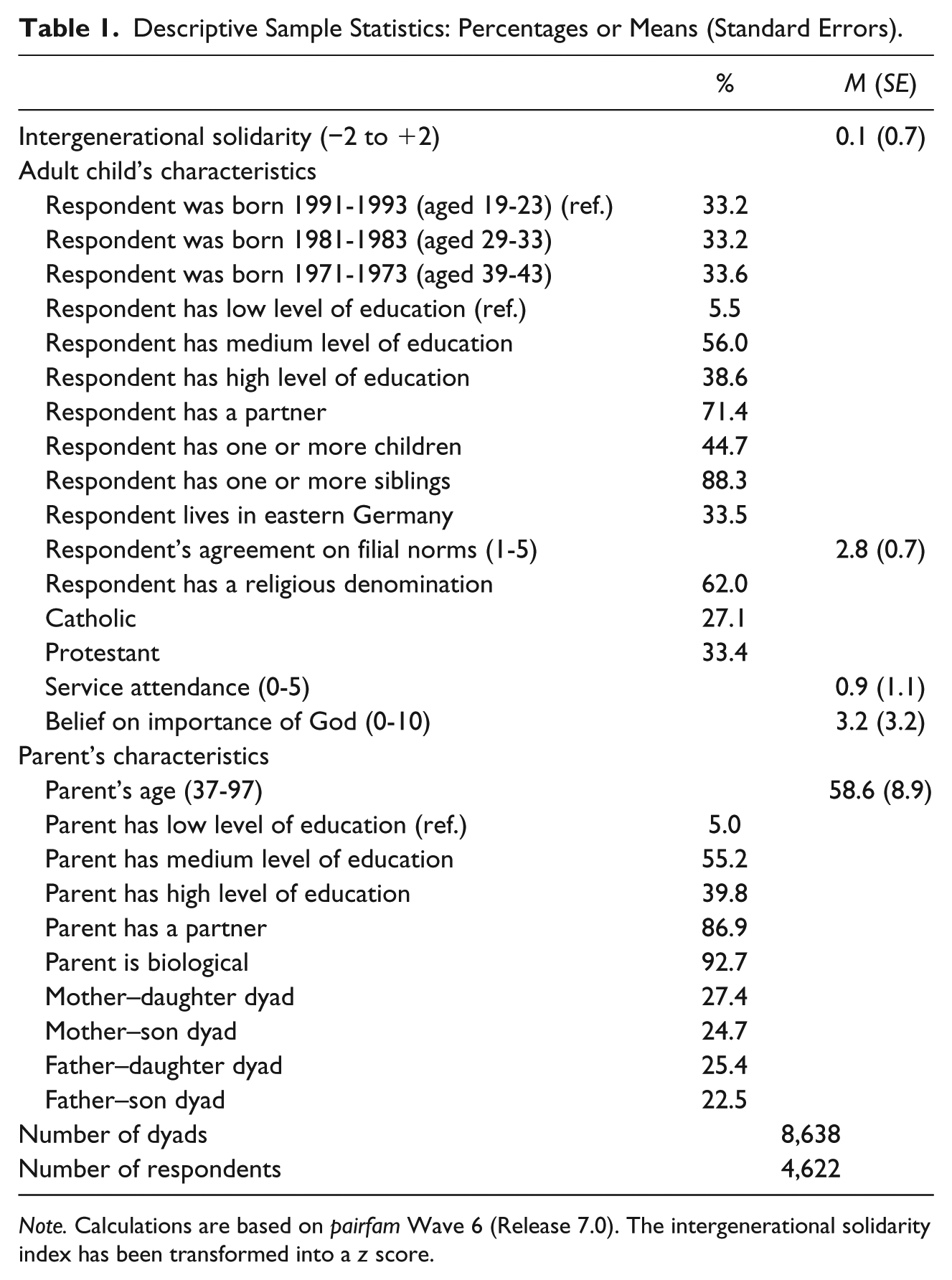
Note. Calculations are based on pairfam Wave 6 (Release 7.0). The intergenerational solidarity index has been transformed into a z score.
Results
We estimated a main-effects equation to test our first hypothesis that religion exerts an independent effect on intergenerational solidarity (Table 2). Consistent with our hypothesis, the first model shows that having a Catholic or Protestant religious denomination was positively associated with intergenerational solidarity, with a somewhat stronger effect among Catholics.
Hierarchical Linear Regression Results for Intergenerational Solidarity.
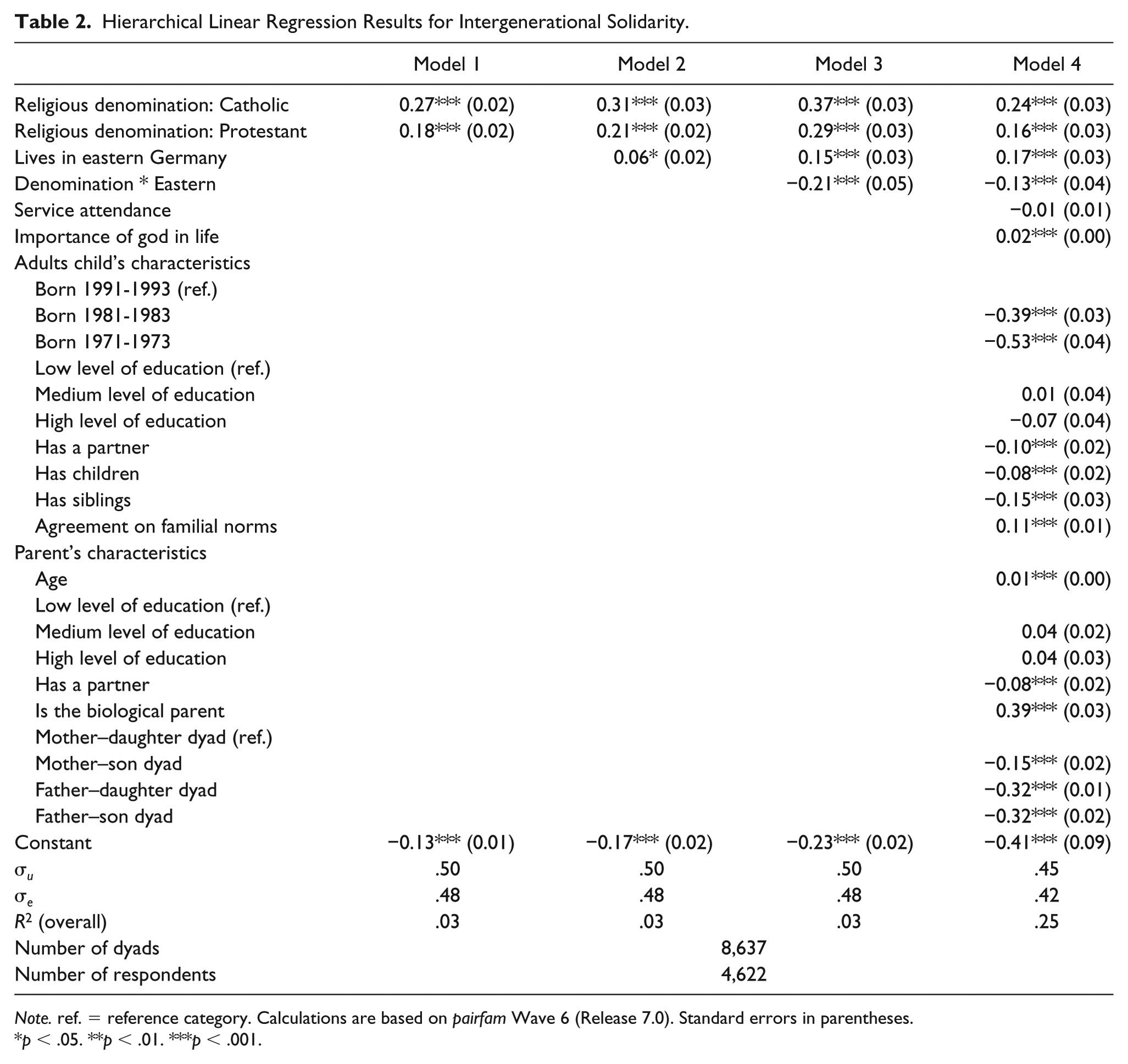
Note. ref. = reference category. Calculations are based on pairfam Wave 6 (Release 7.0). Standard errors in parentheses.
p < .05. **p < .01. ***p < .001.
In the second model, we introduced region as another independent variable to test our second hypothesis. We found no statistically significant difference in the strength of intergenerational solidarity between the eastern and the western parts of Germany. In the third model, we tested whether religion had the same influence on solidarity in eastern and western regions of Germany by including an interaction between denomination and region. This interaction term was statistically significant suggesting that the influence differed by region. For an easier understanding of the results, Figure 1 shows a plot of predicted values based on the interaction and main effect coefficients adjusted for covariates.
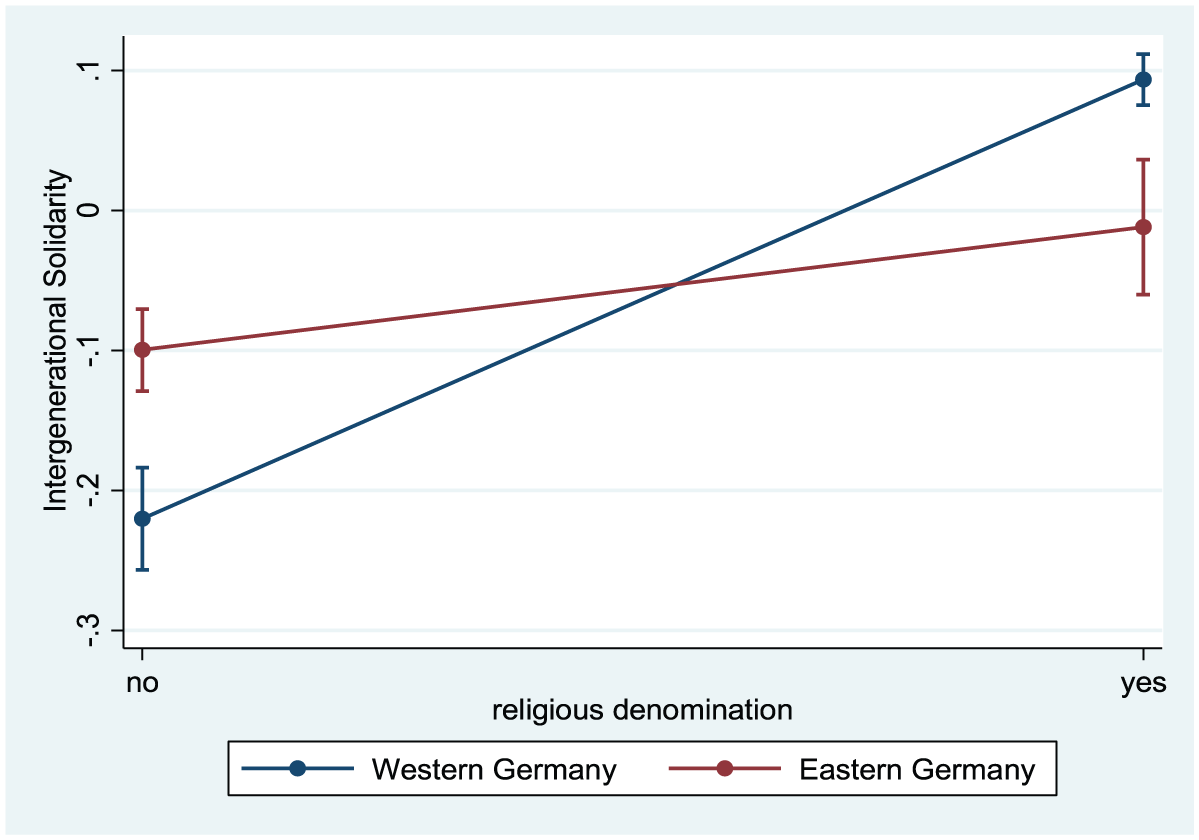
Interaction between denomination (no/yes) and region (Eastern Germany/Western Germany) in predicting intergenerational solidarity (with 95% confidence intervals).
We see from the figure that the slope for eastern Germans is statistically flat, whereas for western Germans there is a positive relationship between having a religious denomination and intergenerational solidarity. However, the interaction on which we base this conclusion is disordinal, that is, exhibiting a cross-over, such that religious affiliates in the west reported stronger solidarity than those in the east. Conversely, nonaffiliated Germans in the west reported weaker solidarity that those in the east.
Model 4 shows that the effects of religious denomination diminish somewhat but remain significant when other religion variables and sociodemographic characteristics are added to the equation. The perceived importance of God but not frequency of attendance at religious services, positively predicted intergenerational solidarity. Coefficients for control variables were mostly in line with other studies of intergenerational relationships (Kalmijn, 2014; Swartz, 2009; Zarit & Eggebeen, 2002). Older children (aged 29-33 and 39-43 years) had weaker solidarity with their (step)parents than younger children (aged 19-23) that likely represents greater time constraints of being parents themselves. Intergenerational solidarity was stronger among older (step)parents, which may be the result of growing need for assistance. Respondents with partners, children, and siblings had weaker solidarity with their (step)parents compared with their counterparts, possibly the result of increased competition for available time to devote to family members. Solidarity was stronger with unpartnered (step)parents than it was with the partnered, potentially a response to social vulnerability of the widowed and divorced. We found that solidarity was stronger with biological parents than with stepparents, a finding consistent with findings in the literature showing that children have greater life-time exposure to biological parents than to stepparents. Consistent with expectations, we also found mother–daughter dyads had stronger solidarity than dyads consisting of other gender combinations. In most western nations, solidarity is stronger through the female line of descent in the family. As expected, stronger agreement with traditional filial norms predicted stronger intergenerational solidarity.
Discussion and Conclusion
Empirical evidence, from research conducted mostly in the United States has generally found that religion has a positive impact on intergenerational family relations (e.g., King, 2010; King et al., 2013; Mahoney, 2010; Myers, 2004). We sought to test this proposition in Germany and capitalize on its east–west political and cultural division to examine how context modified the role religion plays in how intergenerational relationships are maintained.
Specifically, we used German data to answer the question whether the positive association between religion and intergenerational relations could also be found in a society more secularized than the United States. The German example seems well-suited, because the pattern of religion and intergenerational relationships lies between the extremes of the Western European continuum of family ties, which are typically weaker in the Nordic countries and stronger in the Mediterranean countries (e.g., Hank, 2009; Saraceno, 2008). Furthermore, even 25 years after reunification, eastern and western Germany are akin to two societies with regard to many social conditions, including intergenerational relations (Szydlik, 1996, 2008) and religion (Pickel & Sammet, 2011).
While in western Germany a majority of the population affiliates with a religious denomination, the eastern part manifests a “nondenomination culture” that emerged through the societal secularization autocratically imposed by the GDR regime. Political suppression of religion created a nondenominational culture in the east, reinforced by persistent normative expectations in the public sphere. Regarding religious praxis, Germans in the west profess greater religiousness and have greater trust in the institution of the church compared with Germans in the east (Pickel, 2011a). Thus, the present study extends our understanding of contextual variation in the role that religion plays in how intergenerational relationships develop across two subpopulations of the same nation—where one subpopulation is religiously similar to most other western European societies and the other is highly secularized.
The results supported our first hypothesis that affiliation with a religion would be associated with stronger solidarity in child–parent relationships. However, the magnitude of the religion–solidarity relationship varied across the two sectors of the nation, with a stronger impact in the west than in the east, confirming Hypothesis 2b concerning the weak religious culture that pervades the east. However, the disordinal interaction between region and religious denomination points to possible regional differences in the salience of religion (and its absence) as a force guiding interpersonal relations. This salience is more manifest in the west than in the east, where a uniform secular culture has desensitized the contribution of religion among the nominally affiliated, whose overall religious integration may be weak. Our findings strongly suggest that the impact of personal religious identification on intergenerational relationships is weaker within a more secularized context.
There are several limitations to this investigation that deserve mentioning. First, we have focused on the two dominant Christian religions and omitted other religions, particularly that practiced by the growing Muslim population in Germany. However, the number of cases in the sample with non-Christian affiliations was too small to analyze. Nevertheless, focusing on Christian religions provides some comparability with the large number of studies on this topic worldwide.
Second, we recognize that our measures of religious belief, practice, and identification provide a relatively simple specification of religiosity. Nevertheless, by including religious behavior (attendance) and belief (importance of God), along with affiliation (denomination) we were able to represent several important aspects of religious orientation. Furthermore, our focus on religious denomination is unique in that church membership in Germany confers specific rights and responsibilities, making it a more important marker of religious commitment than would be the case in the United States.
Third, our analysis was cross-sectional in design, making it difficult to establish causal direction in the relationships observed. We acknowledge that part of the positive influence of religion may be due to the selection of families with harmonious relationships into religious practice. That is, families with stable marriages, lower divorce rates, and child-focused parenting styles may be more likely to gravitate toward religious involvement (Mahoney, 2010). Longitudinal designs will be necessary to answer this question. In addition, it would be fruitful to continue to study these children to determine whether secularization reduces intergenerational care provision as parents age into later life.
Fourth, we were not able to consider the religion of parents as well as their children’s religious divergence from them. Religious concordance and discordance matters a great deal for relations within the family (Curtis & Ellison, 2002; Pearce & Haynie, 2004; Vaaler, Ellison, & Powers, 2009), including those across generations (Hwang, Silverstein, & Brown, 2018; Stokes & Regnerus, 2009). One possible alternative explanation for our results is that intergenerational religious discordance negates solidarity among secular children with religious parents, a combination that would be more common in the west than in the east.
In sum, our results showed that religion had a positive impact on intergenerational relations in Germany but that impact varies depending of level of secularization in the wider culture. When religion is suppressed and takes on a diminished institutional presence in society, intergenerational family relationships—and one can argue other social relations as well—are less influenced by affiliation with (in this case, majority) religious denominations and the pro-family doctrines they prescribe. Paradoxically, within the more diversified religious culture of western Germany, having a religious affiliation exerted a greater positive influence on intergenerational solidarity than that found in the more consistently secular east; furthermore, the absence of an affiliation produced a greater negative impact on solidarity in the west than in the east.
Given the mitigating role played by regional context in this German example, we suggest that future research investigate whether increasing secularization, a trend evident both in Europe and the United States, will cause religion to become less relevant to contemporary family life. On the other hand, others have proposed that secularity is demographically self-limiting due to religious-based differentials in fertility rates and immigration. In Germany, this is manifest by greater childless rates in the west than in the east, and immigration from predominantly Muslim nations—paralleling Catholic/Hispanic immigration in the United States—that has altered the national religious profile. Whether secularization has peaked, increases, or, less commonly predicted, declines, Germany will continue to be a prime example of how contextual variation in religious life can elucidate our understanding of intergenerational family dynamics in a society experiencing rapid population aging.
Footnotes
Declaration of Conflicting Interests
The author(s) declared no potential conflicts of interest with respect to the research, authorship, and/or publication of this article.
Funding
The author(s) received no financial support for the research, authorship, and/or publication of this article.
