



Abstract
Intergenerational continuity in family behaviors partly results from socialization processes in the parental home. However, socialization is a multidimensional process. This article tests hypotheses about the relative importance of value transmission and modeling in explaining expectations of adolescence concerning the timing of leaving home, and entry into cohabitation, marriage, and parenthood. Structural equation modeling on multiactor data from over 1,000 parent–adolescent child couples in the Netherlands is used to test hypotheses. Results suggest that, in general, both value transmission and modeling are important predictors of adolescents’ expectations concerning the timing of major family events. Moreover, no differences between mothers and fathers and between boys and girls are observed in the strength of the intergenerational relationships studied.
Introduction
Intergenerational continuity exists in the occurrence and timing of key family life events, like cohabitation (Smock, Manning, & Dorius, 2013), marriage and divorce (Wolfinger, 2000), and fertility (Murphy & Knudsen, 2002). In addition, demographic trajectories as a whole also show intergenerational resemblance (Fasang & Raab, 2014; Liefbroer & Elzinga, 2012). Intergenerational continuity implies that children are more likely to experience events or experience them relatively early or late if their parents did so as well.
Parental socialization processes are often mentioned to explain this resemblance (Amato, 1996; Grusec, Goodnow, & Kuczynski, 2000). Children are assumed to resemble their parents’ behaviors because they embrace the same set of values, attitudes, and expectations as their parents do. Studies on family formation attitudes (Axinn & Thornton, 1993), attitudes regarding fertility (Musick, 2002), attitudes toward divorce (Amato, 1996), and gender attitudes (Cunningham, 2001) support this idea. The term “values” is used to represent a diffuse set of standards, ideals, and goals. However, socialization is a multifaceted process, as parents can influence their children in various ways. In this article, we distinguish between two types of mechanisms that allow for socialization effects to occur. On the one hand, value transmission emphasizes that children develop attitudes and expectations that are aligned to those of their parents (Acock & Bengtson, 1980; Copen & Silverstein, 2008; Miller & Glass, 1989; Roest, Dubas, & Gerris, 2012). On the other hand, parents’ influence could also be less intentional and result from modeling (Starrels & Holm, 2000). For instance, children could develop ideas that it is acceptable to have children early or to experience a divorce based on knowledge of their parents’ own behavior in these regards, irrespective of their parents’ attitudes.
Starrels and Holm (2000) has been the only study thus far that tried to simultaneously assess the relative importance of these two mechanisms (value transmission and modeling). In a study on the expectations of mothers and their adolescent children, they showed that, with regard to marriage and parenthood timing, the influence of value transmission was stronger than that of modeling. However, their study was limited to mothers, whereas it is also relevant to examine the relative importance of value socialization and modeling among fathers and their children. In addition, in the past decades, the transition to adulthood has become more protracted and diverse (Billari & Liefbroer, 2010). More young adults experience spells of living independent and unmarried cohabitation. As a result, it is important to examine the role of value socialization and modeling not only for marriage and parenthood timing but also for a range of key family events. Therefore, the main focus of this study is to examine how adolescents’ expected timing of key family events depends on parental expectations concerning their children’s timing of life course events on the one hand (value transmission), and on parents’ actual behaviors (modeling) on the other. In comparison with Starrels and Holm’s (2000) pioneering study, we examine a broader array of life course expectations, including leaving home and cohabitation. In addition, we are not only studying this process for mothers but also for fathers. This allows us to put gender more central in our analysis, as we will compare the importance of value transmission and modeling between fathers and mothers, sons and daughters, and across parent–child dyads. Finally, we account for the fact that parents’ expectations about their children’s timing of family events itself may partly result from their own behaviors in this domain. In sum, the central question of this article is to explore and disentangle the effects of two forms of parental socialization, value transmission and modeling, with respect to adolescents’ expected timing of leaving the parental home, cohabitation, marriage, and entry into parenthood.
We examine these processes during adolescence, focusing on adolescents’ expectations about the timing of life course events. We have two reasons for studying future expectations. Adolescents’ expectations are found to be good indicators of their subsequent actual life decisions (Bozick, Alexander, Entwisle, Dauber, & Kerr, 2010; Rimkute, Hirvonen, Tolvanen, Aunola, & Nurmi, 2012; Trent & Crowder, 1997). More important, though, is that the actual choices that young adults make often are a mix of expectations and aspirations on the one hand and available opportunities on the other (Kalmijn, Liefbroer, Van Poppel, & Van Solinge, 2006). By focusing on the expectations of adolescents, we obtain a clearer picture of the role of parental socialization, relatively independent of the “opportunity structure” they face. Obviously, we still control for intergenerational transmission of opportunities and status inheritance, as these are important factors when it comes to formulating expectations about the future (i.e., already Sewell, Haller, & Portes, 1969). Figure 1 depicts our conceptual model. The bold (modeling) and dashed (value transmission) arrows are of key interest, while controlling for other family background characteristics and adolescents’ own education.
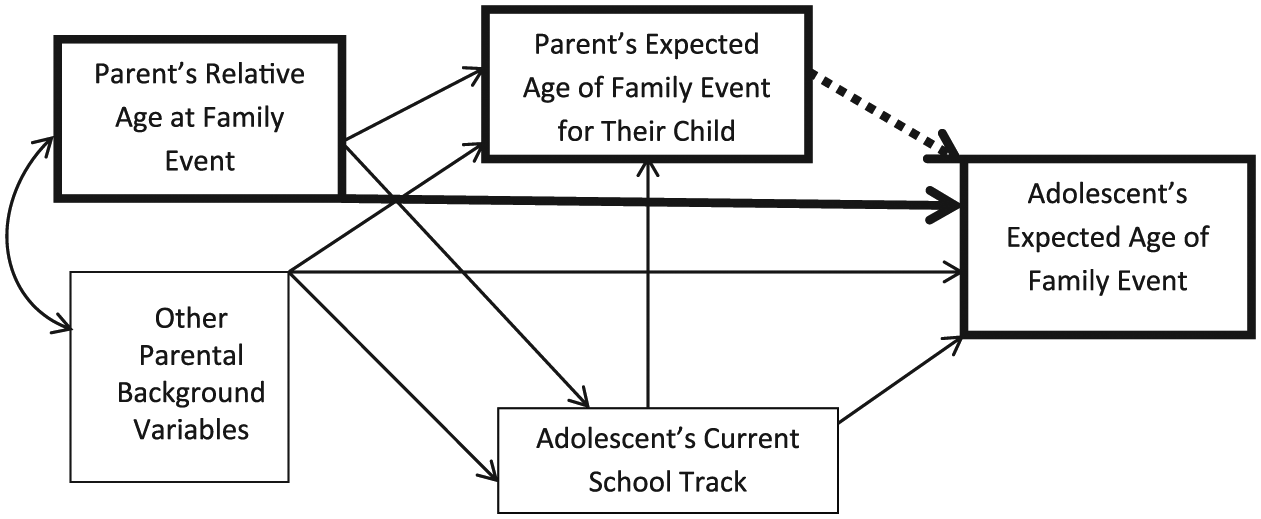
Theoretical model: Factors influencing adolescents’ expectations about the timing of family events.
Background and Hypotheses
Parents socialize their children in multiple ways. In the literature, two components of socialization are distinguished: value transmission (Acock & Bengtson, 1980; Copen & Silverstein, 2008; Miller & Glass, 1989; Vollebergh, Iedema, & Raaijmakers, 2001) and modeling (Cohen, 1987). Value transmission is the direct transmission of preferences, attitudes, and values from parents to their children. Research on the intergenerational transmission of values has consistently confirmed its effectiveness: social values of children are strongly associated with those of their parents (Copen & Silverstein, 2008; Vollebergh et al., 2001). With respect to the timing of family events, the process of value transmission implies that parents, during the socialization process, will convey to their children the family trajectories that they prefer for them and this way strongly influence their children’s view on family formation and parenthood and the best time for these events to happen.
The second process by which family trajectories of parents and children are likely to be similar, is modeling, in which parents act as role models for their children. The basic idea is that children know about their parents’ own family trajectories and take these into consideration in charting their own future life course. Modeling is not so much the result of active attempts of parents to influence the attitudes and behaviors of their children, but rather the outcome of more subconscious processes of imitation (Mischel, 1966). Children perceive their parents as the norm and their behavior as normal, which may lead to “natural” replication of their behavior. Imitation as a learning strategy is especially important in early childhood, as is stressed by several socialization theories (Tillmann, 2004). These “imitations” (or modeling behavior) start at a young age, but can influence a person’s attitudes and behavior for a lifetime. Concerning the timing of family events, the idea is that children have observed or learned about the ages their parents experienced major demographic events of family formation and parenthood, and have internalized their parents’ family trajectory as a template for their own future life.
Although several studies on family formation and parenthood have examined the role of the parents, not many have focused on the timing of demographic events. Snyder, Velasquez, Clark, and Means-Christensen (1997) found that parents’ marital role attitudes typically play a central role in shaping their adult children’s views about marriage, including the best time for it to happen as well as their adult children’s perceptions of personal readiness for marriage (Larson, 1988; Snyder et al., 1997). Barber (2001) found that mothers who experienced early first births are likely to form more positive attitudes toward early childbearing as a result, and that they transmit those attitudes to their children through socialization processes, which in turn may lead to earlier childbearing (Barber, 2001; Steenhof & Liefbroer, 2008).
Starrels and Holm (2000) have been the sole study to date that tried to estimate the relative influence of value transmission and modeling by examining adolescents’ plans for family formation (marriage and parenthood) and the congruence between their plans and their mothers’ expectations and behaviors within these spheres. They examined the planned timing of family formation of adolescents between the ages of 11 and 16 years by asking them how likely they thought it was that they would be married, and have children at age 24. To measure value transmission and modeling, they asked the mother about her expectations for their child at age 24, and about her own actual age of marriage and first birth.
The study concluded that the influence of value transmission was stronger than that of modeling. For daughters, plans for both the timing of marriage and parenthood were related to mothers’ expectations (value transmission), but not to mother’s age at first marriage or first birth (modeling; Starrels & Holm, 2000, p. 426). There were hardly any gender differences between boys and girls: mother–daughter and mother–son congruence in these expectations turned out to be quite similar. They also found that the congruence was stronger for marriage than for parenthood for both sons and daughters, suggesting this is because the transition to marriage is more under an individual’s control than is the transition to parenthood.
Building on and extending the study by Starrels and Holm (2000), we formulate several hypotheses. First, we expect that parents influence their adolescent children’s expectations about the timing of four major family events, both directly, through value transmission by expressing their preferred demographic trajectory to their children, and, indirectly, through modeling by which they act as a role model. Although we expect both pathways to be important, we also expect that among adolescents the influence of value transmission will be stronger than that of modeling. During adolescence, value transmission may be strong, as parents and children may actively engage in conversations about future life planning. At the same time, modeling may be less important because the occurrence and timing of family events has changed dramatically over recent decades (Billari & Liefbroer, 2010). As a result, the actual behavioral patterns of parents seems less relevant for their children’s behavior in radically changed circumstances.
As stated above, Starrels and Holm (2000) examined mother’s influence only. One important question is whether the influence differs between fathers and mothers. In the traditional male breadwinner model, men specialized in paid labor, whereas women specialized in housework (Becker, 1981). As a result, women spent more time socializing their children, leading to the expectation that their example and expectations matter more. In addition, traditional views on spheres-of-interest differences between men and women suggest that mothers may be more inclined to focus on their children’s orientations in the family domain, whereas fathers focus on orientations in the work domain (e.g., Moshe, 2014). Both arguments suggest that mothers might have a stronger influence on their children’s expectations about the timing of family events than fathers. In recent decades, theoretical understandings of gender relationships have shifted, as have actual gender relationships. Theoretically, it has been emphasized that such gender differences are socially constructed (e.g., Deutsch, 2007), and thus open to change. Empirically, female labor force participation has increased over the past decades, as has fathers’ time spent with children (Sayer, 2005; Sayer, Bianchi, & Robinson, 2004). However, mothers still spend more time with their children (Sayer et al., 2004). In the Netherlands, men were still the primary breadwinner in the late 90s of the previous century, while women had no or a part-time job and mainly cared for the children (Breedveld, 2000). Because children are more “exposed” to their mothers in the Dutch context, we hypothesize that children are more strongly influenced by mothers than by fathers.
We not only make a distinction between fathers and mothers but also between sons and daughters. Some differences between sons and daughters can be expected, as girls are usually more organized, obedient, quiet, and calm than boys (Carvalho, 2015), and might therefore be more susceptible to parental influence. Opposite to this reasoning is that the values of gender egalitarianism diffused rapidly (Cotter, Hermsen, & Vanneman, 2011), and girls may have shaken off their obedient role. In line with this, Starrels and Holm (2000) found that mothers’ influence on boys and girls was quite similar. Thus, it is unclear whether parents’ influence on their children’s expected timing of family life events differs for sons and daughters. In this study, we will therefore again test the following hypothesis:
The traditional gender role model of socialization stresses that value transmission is most effective within the same sex: fathers have the strongest influence on their sons, and mothers have most influence on their daughters (Acock & Bengtson, 1980; Aldous & Hill, 1965; Vollebergh et al., 2001). Moreover, adolescents appear to identify more with their same-sex parent than with their opposite-sex parent (Starrels & Holm, 2000). Empirical studies examining the role of gender in value similarity have found mixed results, though. Some studies report more value similarities for same-sex compared with opposite-sex parent–child dyads (Boehnke, Ittel, & Baier, 2002), whereas others found no effect of gender (Boehnke, 2001; Whitbeck & Gecas, 1988) or only found same-sex similarities for father–son relations (Kulik, 2002). In our study, we will again test if the parents have a stronger influence on their children of the same sex than on children of the opposite sex:
The Dutch Context
This study is conducted in the Netherlands, a European country with a relatively strong welfare state and an educational system that channels children into different educational tracks at the start of secondary education (age 12 years). In demographic terms, the Netherlands is characterized by relatively early home leaving and entry into a partnership, but by late marriage and entry into parenthood. The timing of marriage and parenthood in particular has been strongly postponed across recent cohorts. Billari and Liefbroer (2010) use the 2006 European Social Survey to estimate the median age at which these family events occurred among different cohorts and across European countries. Among Dutch women, the median age at leaving home was 20.3 years among the 1950-1959 birth cohort (roughly the birth cohorts of the parents of these adolescents), and 20.1 years among the 1970-1979 cohort. Median age at entry into a first union was 22.1 years for women born 1950-1959 and 22.3 years for women born 1970-1979. For marriage and parenthood, a strong increase in median age was observed across these cohorts. Median age at first marriage increased from 22.7 to 32.5 years, whereas median age at entry into parenthood increased from 26.6 to 29.9 years.
Method
Data
To test our hypotheses, we use data that were collected in the Netherlands in 2005 and 2006 as part of the research project “Youth and Culture” (Ganzeboom, Nagel, & Liefbroer, 2005-2006). Both secondary school students and one of their parents provided information on the life course expectations and ambitions of the students. Data collection among students took place in 60 secondary schools in 14 municipalities that were selected to provide a good variation in terms of size and regional distribution. In line with the tracked nature of the Dutch educational system, the sample includes schools that offer one or more of the three main tracks of secondary education in the Netherlands 1 that are hierarchically ordered: prevocational (voorbereidend middelbaar beroepsonderwijs [VMBO], 4 years); senior general (hoger algemeen voortgezet onderwijs [HAVO], 5 years); and preuniversity (voorbereidend wetenschappelijk onderwijs [VWO], 6 years) education. Within each school, a stratified random sample of classes was drawn, with only one class per unique educational track by grade-year combination (for VMBO 2 : Grades 3-4, for HAVO: Grades 3-5; for VWO: Grades 3-5). In the end, 1,544 secondary school students (49% males and 51% females) aged 14 to 17 years (34% VMBO, 34% HAVO, 33% VWO) 3 filled out the questionnaire about plans for the future. The response was 87% at the school level and 77% at the class level. Selective nonresponse at the student level can be assumed to be small as questionnaires were filled out during classes and hardly any individual refusals were observed.
In January 2006, the parents of the students were sent a postal questionnaire on their child’s plans for the future. For two-parent families, we randomly approached one of the parents; for one-parent families, the parent with whom the student in question was living was selected. Questionnaires were returned by 1,001 parents (40% fathers, 60% mothers). Nonresponding parents had a slightly lower level of education than responding parents, based on the information provided by their adolescent child.
Measures
Dependent Variable: Timing Expectations of Adolescents
Adolescents were asked if they expected to witness four key family life course transitions (leaving home, starting to live together with a partner, marriage, and parenthood) for themselves. Only a small percentage of respondents did not expect to witness these events (3.8 for leaving home, 9.4 for living with a partner, 10.3 for getting married, and 10.9 for having children). Next, those who expected to experience these events were asked about the expected age of leaving the parental home, cohabitation, marriage, and getting children. This resulted in four expected timing variables of adolescents who expect to witness these transitions. Adolescents who did not expect to cohabit, but did expect to marry, were given the expected age of marrying as the timing of cohabitation.
Examining Value Transmission: Timing Expectations of Parents
To examine the extent to which value transmission occurs, the timing expectations of adolescents will be compared with those of their parents. Parents were asked about their expectations about their child’s timing of family events using the same type of questions as were posed to their child. Thus, this information is available for either the father or the mother of the adolescent. The same procedures were used as for adolescents’ expectations. The expected ages of experiencing all four family life events for both adolescents and parents are presented in Table 1.
Descriptive Statistics for All Variables Represented in Figure 1.
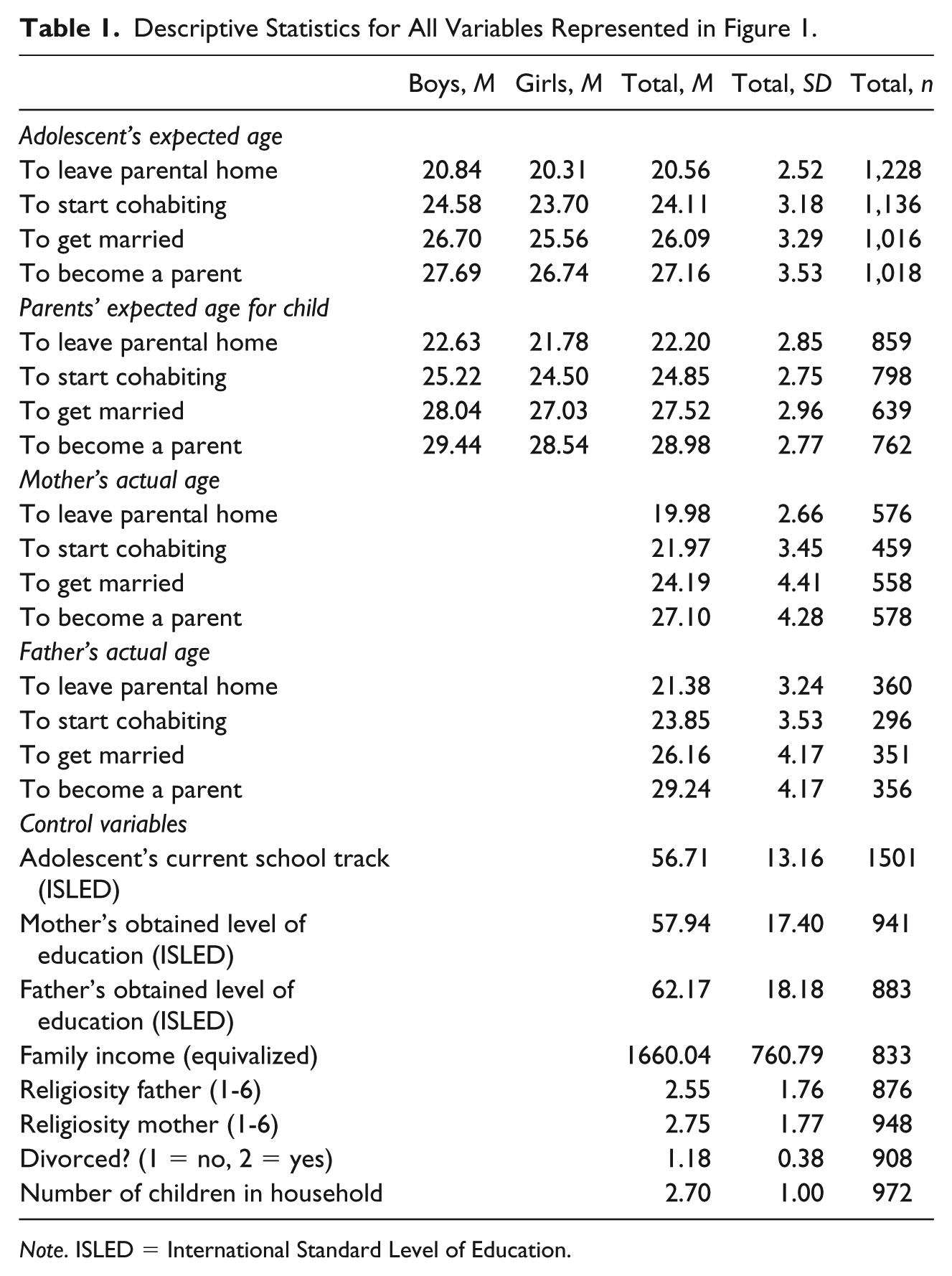
Note. ISLED = International Standard Level of Education.
Examining Modeling: Actual Timing of Parents
To examine the role to which modeling occurs, the timing expectations of children will be related to the actual timing of family events among parents. Because the questionnaire was filled out by one of the parents, we only have information on the actual age of leaving the parental home, cohabiting, marrying, and entry into parenthood of one of the parents. The actual ages at which fathers and mothers of our respondents experienced these events is displayed in Table 1. Fathers experienced most events at a later age than mothers. To create a variable for parents’ actual timing of events that is comparable between fathers and mothers, actual timing was standardized, for fathers and mothers separately. As a result, each parent gets a score relative to the mean age of his or her gender. After standardization, the variables for mothers and fathers are merged, creating one actual timing variable for fathers and mothers, that positions the timing of the parent’s family behavior relative to that of other parents.
Confounding Variables
A number of family characteristics that may act as confounders as they may be related to both parents’ behavior and expectations and to their adolescent children’s expectations concerning the timing of key family events, are included as control variables in our models. First, parents’ religiosity is included as religious parents value marriage and parenthood more strongly than nonreligious ones. As a result, parents’ religiosity, it could be negatively related to the (expected) timing of events like marriage and parenthood (De Valk & Liefbroer, 2007; Uecker & Stokes, 2008). It is calculated as the mean score of mothers and fathers to the question: “How often did you attend a religious service in the past 12 months? And your partner?” The answer categories were 1 = “did not attend,” 2 = “one time,” 3 = “2-4 times,” 4 = “4-11 times,” 5 = “1-3 per month,” 6 = “4 or more times per month.” Parental divorce is expected to lead to later expected timing of far-reaching commitments like marriage and parenthood (Erola, Härkönen, & Dronkers, 2012). It was measured by asking: “Are you divorced or separated? In which year?” The dichotomous divorce variable only takes divorce or separating into account if it took place after the birth of their child. The number of siblings in the parental home is included as it is expected to lead to accelerated timing preferences, as resources in the parental home are more scarce and ideals for family life stronger (Barber, 2000). It was measured by asking the parent to list their children, their birthdates and if the child still lived at home. Only children that still lived at home were included in the number of children. As the timing of most family events is stratified, we expect that parents’ income and level of education are associated with their own and children’s timing expectations (De Valk & Liefbroer, 2007). Family income was measured by combining income information on both parents. For each parent, income was asked on a scale with 16 income brackets, ranging from 1 indicating “no income,” to 16, indicating “a net income of more than €5,000 per month.” The mean score of the income bracket, the parent was in, was used to calculate the parent’s income. If parents had a monthly income of €5,000 or more, their income was arbitrarily set to €5,500. Next, the joint income of both parents was calculated through summation. Subsequently, equivalence factors were applied to standardize the family income (Sierman, Teeffelen, & Urlings, 2004). This allows for a better comparison between incomes of households of different size and composition. The educational level of both parents was measured on a scale with nine levels (no education, primary school, lower vocational education, lower general secondary education, intermediate vocational education, higher general secondary education, preuniversity education, higher professional education, and university). Subsequently, these levels were recoded into International Standard Level of Education (ISLED) codes (no education = 19.1 through university = 84.7; Schröder & Ganzeboom, 2014). ISLED is an empirically obtained, internationally comparable interval scale for educational level, the value of which can theoretically vary between 0 and 100. Finally, the educational levels of the parents were averaged to obtain a family code. If information on just one of the parents was available, that ISLED score was used to represent the educational level of the family or origin. Finally, we included adolescents’ current school track in the model as both parents’ and adolescents’ own expectations about the timing of family transitions are probably at least partially geared to their educational circumstances. Given the stratified nature of the Dutch secondary school system, we expect that parents of children in more advanced educational tracks expect their children to experience family transitions at a later age. The current (secondary) school track of the adolescent was recoded into ISLED codes by the same procedure outlined above for parents’ level of education.
Analytical Strategy
To test our hypotheses, structural equations modeling was used. We have three main reasons for opting for structural equations modeling. First, it allows the simultaneous estimation of all the relationships depicted in Figure 1. This facilitates testing Hypothesis 1. Second, it allows an elegant test of group differences. This facilitates testing the other hypotheses on differences in the process between mothers and fathers, sons and daughters, and parent–child dyads. Third, it allows using the full maximum likelihood method (see below) that makes optimal use of all available data. Separate models were estimated for each of the four timing expectations of the adolescents. In the models, the focus of interest is on the effects of parents’ relative age (modeling) and their expected timing for their adolescent child (value transmission) on the expected timing of the adolescent, controlling for other potentially relevant parental home variables, as well as the adolescent’s current educational track. To compare their relative importance, all variables in the models were standardized. For each family event, we estimated a base model in which we did not distinguish between gender of the influencer (fathers and mothers) or gender of the influenced (boys and girls). Next, three multiple-group analyses were performed. In a first two-group model, we tested whether our effects of interest differed by the gender of the parent. In another two-group model, we tested whether effects differed by the gender of the adolescent. Finally, in a four-group model, we tested whether effects differed by parent–child gender combination (father–son, mother–son, father–daughter, mother–daughter). In these multiple-group models, all parameters were constrained to be equal among groups, with the exception of the effects of value transmission and modeling. To test if the value transmission and modeling influences differed between fathers and mothers or between boys and girls, Wald tests were executed. Nonresponse in the data was handled by using the “full information maximum likelihood” method in Mplus (Muthén & Muthén, 2004). This method uses all available information in the data (also partially complete data), which leads to more precise parameter estimates and a reduction of bias as compared with methods based on listwise deletion (Enders & Bandalos, 2001). A cluster correction was applied to account for clustering of observations within school classes.
Results
Descriptive Findings
In Table 1, descriptive statistics on all dependent and independent variables are presented. Number of respondents vary because fewer parents than adolescents filled out the questionnaire, different numbers of fathers and mothers responded, and because of differential item nonresponse. Adolescent boys and girls clearly differed in their expected timing of family events (all comparisons are statistically significant at p < .05). Girls expected to experience cohabitation, marriage, and children on average 1 year earlier than boys. The same was true for parental expectations for their sons and daughters. On average, parents expected their daughters to experience these transitions earlier than their sons. Another interesting descriptive finding is that parents expected their children to experience these demographic transitions later in life than the children did themselves (again, all comparisons statistically significant at p < .05). For example, parents expected marriage and parenthood, for boys and girls, to take place about one year later than their offspring expected them. At the same time, both parents and adolescents expected to experience family transitions well below the actual age at which, according to official statistics, these events are experienced nowadays; in the Netherlands, people marry and have children at around 30 years of age. Further analyses, not the table, pointed out that, as expected, mothers experienced these transitions earlier in life than fathers. Furthermore, mothers expected their children to experience these demographic transitions later in life than they experienced these transitions themselves. For fathers, the same pattern held, with the exception of the transition to fatherhood. Another noteworthy point, in relation to adolescent expectations and parents’ actual age, is that boys and girls wanted to cohabit and marry later than their parents did, but not as late as their parents expected them to do. In sum, adolescents expected to experience these family events usually somewhere in between the age at which their parents experienced these events and the age at which their parents expected them to experience these events.
The Role of Value Transmission and Modeling
Our main research question is to examine the relative importance of value transmission and modeling. Table 2 shows the standardized coefficients and their significances of our base models with no differentiation between parental or adolescent gender. A first key finding is that all four adolescent timing expectations were influenced by both value transmission and modeling, as all the effects of interest differ statistically significantly from zero (albeit the effect of modeling on the expected timing of leaving home was only statistically significant at the p < .10 level). Thus, children’s expectations concerning the timing of all major family decisions in young adulthood were associated with their parent’s own decisions about the timing of these transitions and with their parents’ expectations about the timing of these transitions in the lives of their children. Additional Wald tests show that for all demographic events no statistically significant differences were found in the relative strength of value transmission and modeling, except in the case of the timing of leaving home (Wald test = 17.16, p < .01). Children’s expectations about the timing of leaving the parental home were more strongly influenced by value transmission than by modeling. Relating this outcome to our first hypothesis, one can conclude that role of value transmission is not larger than that of modeling in relation to the timing of cohabitation, marriage, and having children, but that value transmission is only more important in the case of leaving home. Hypothesis 1 should therefore be largely rejected. Some additional findings on determinants of children’s expectations are worth mentioning. The results in Table 2 show that children’s expected timing of cohabitation, marriage, and fertility was related to their educational track, with adolescents in higher tracks to postpone these events. The more religious parents were, the earlier their children expected to marry, while having divorced parents led to a later expected marriage timing. Finally, children from higher educated parents were more likely to expect to postpone having children.
Standardized Effects on Adolescents’ and Parental Timing Expectations Based on the Model Represented in Figure 1.
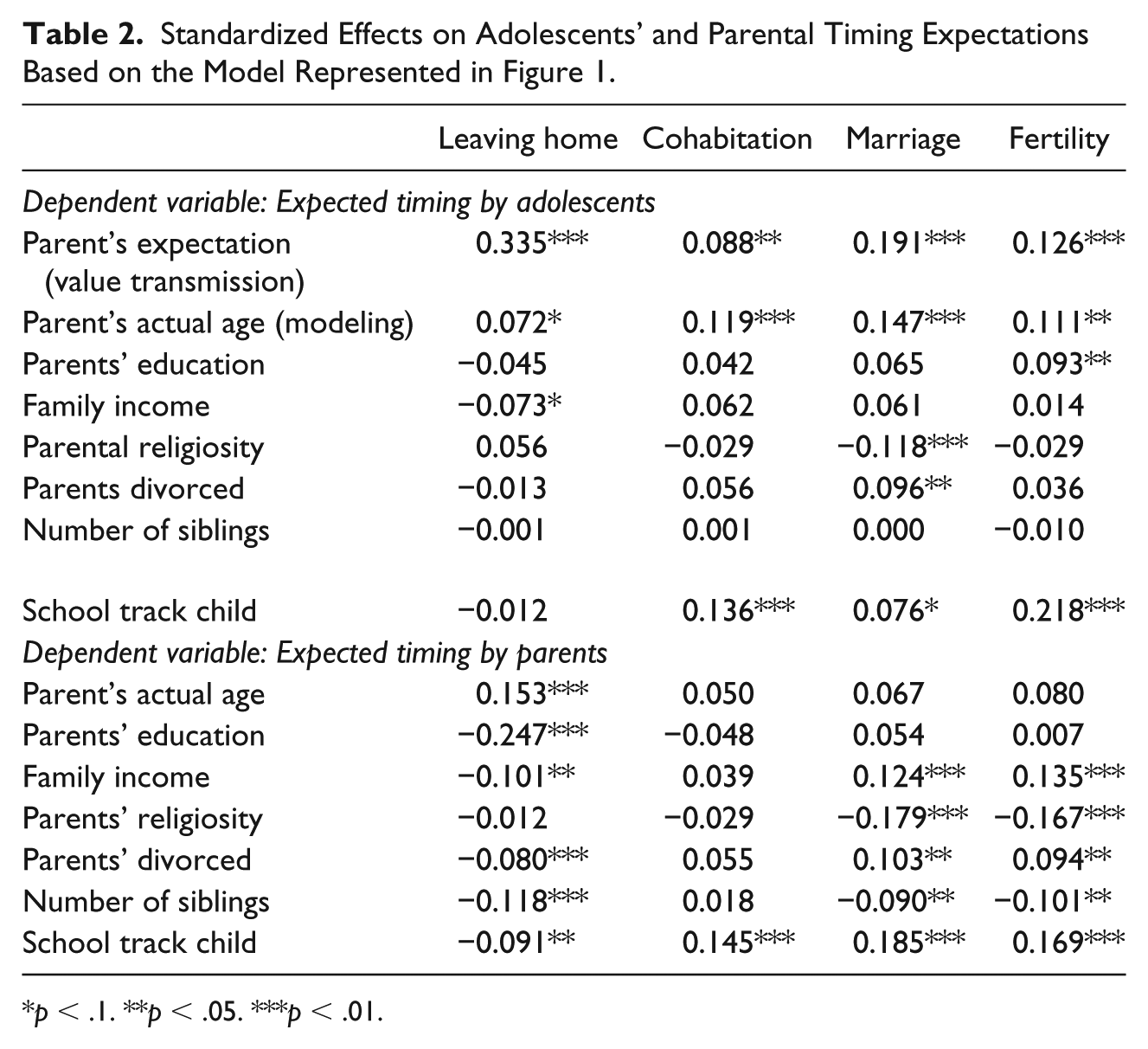
p < .1. **p < .05. ***p < .01.
Parental expectations turned out to be an important correlate of children’s expectations. This leads to the question which factors influenced parents’ expectations. Remarkably, little association between parents’ own timing of these family events and their expectations for their children was found, with the exception of the timing of leaving home. Parents who left home early themselves, expected their children to do so too. Parents’ expectations concerning their children’s age at leaving home were also negatively associated with their level of education, their income, and the educational track of their child. Thus, parents with a higher social class background expected their children to leave home earlier. Being divorced, having many children and a lower income were also related to expecting your children to leave earlier. Parents’ expectations concerning the age at which their child enters cohabitation was only related to the educational track of the adolescent, with parents whose child is at a higher secondary educational track expecting postponement of cohabitation. Results on the correlates of parental expectations concerning marriage and parenthood had the same structure. First, the child’s own education was important, with parents of more highly educated children expecting their children to postpone marriage and parenthood. Another important factor was religiosity, with parents who were more religious expecting earlier transitions into marriage and fertility by their offspring. The same holds for the number of siblings: the larger the family, the earlier parents expect their children to experience marriage and parenthood. Finally, higher family income and being divorced led parents to expect later family life transitions for their children.
Our second hypothesis stated that the influence of value transmission and modeling was stronger for mothers than for fathers. To test this hypothesis, we reran our four base models with a father–mother grouping variable and tested whether value transmission and modeling influences on adolescents differed by the sex of the parent. The results (full results available on request from the corresponding author) showed no differences between mothers and fathers, with one exception. Mothers’ modeling effect on entry into parenthood (b = 0.19, p < .01) was significantly larger than that of fathers (b = −0.02, ns; Wald test = 4.63, p = .03). Thus, Hypothesis 2 should largely be rejected.
To test our third hypothesis, we reran our four base models with an adolescent male–female grouping variable and tested whether value transmission and modeling influences differed by gender of the adolescent. We expected that parents’ value transmission and modeling influence would be stronger on female adolescents’ expected timing of major family events than on that of male adolescents. Our results (full results available on request from the corresponding author) show that only in the case of fertility timing, female adolescents (b = 0.22, p < .01) were significantly more influenced by parental value transmission than male adolescents (b = 0.01, ns; Wald test = 7.62, p < .01). Modeling influence did not significantly differ between male and female adolescents in any of the four models on the expected timing of demographic events. Again, we should conclude that this hypothesis should largely be rejected.
Our last hypothesis stated that fathers’ value transmission and modeling influence is stronger for boys and mothers’ value transmission and modeling influence is stronger for girls. To test our fourth hypothesis, we reran our four base models with a father–son, father–daughter, mother–son, and mother–daughter grouping variable. The results (full results available on request from the corresponding author) showed no significant differences between same-sex parent–child dyads and different-sex parent–child dyads. Thus, our last hypothesis should be rejected.
Conclusion and Discussion
Intergenerational transmission of the timing of family formation is a well-established fact, usually attributed to parental socialization and status inheritance. Within this literature, less emphasis is put on the socialization process itself. We added to this literature by distinguishing between two ways in which socialization could operate, one based on more conscious processes of value transmission and one on more unreflected processes of modeling. By studying how adolescents’ timing expectations about four major family events were related to actual parental behavior (modeling) and parents’ expectations (value transmission), two key parental processes by which parents can influence their children’s timing of major family events in the transition to adulthood could be disentangled.
We expected that the effects of value transmission would be larger than those of modeling (Hypothesis 1), mainly because we expected parents during adolescence to engage in discussing the future life options with their children (Beck & Beck-Gernsheim, 2002; Giddens, 1991). However, and in contrast to findings from Starrels and Holm (2000), this seemed not to be the case, as both parents’ actual behavior and their expectations were just as important in predicting adolescents’ own expectations about the timing of cohabitation, marriage, and parenthood. That our results differ from those found by Starrels and Holm (2000) could be due to methodological differences, as they used a categorical dependent variable (experiencing the family life event at age 24), whereas we used a continuous one (expected age at each family life event). A more substantive explanation for our findings could be that expectations about family events in young adulthood are not yet communicated so strongly between parents and children at this life course stage, but increase their saliency as a relevant topic of conversation between parents and children as these children enter young adulthood. At the same time, adolescents will probably be aware of their parents’ own decisions with regard to the timing of family life events, and may either consciously or unconsciously orient themselves to these decisions. Only in the case of leaving home is value transmission clearly more important than modeling. The explanation could be that for adolescents, aged 14 to 17 years, this transition is going to happen in the near future and is discussed more often with their parents, so that there is a much stronger alignment in their expectations.
We also examined if the effect of value transmission and modeling differed by gender, both of the parent (Hypothesis 2) or the adolescent (Hypothesis 3). The general conclusion is that it does not. The idea that mothers are the primary socializing agents within the family (Chodorow, 1999) does not hold. The same conclusion could be drawn with regard to the reasoning that girls are more susceptible to socialization than boys (Carvalho, 2015); they are not. Broadly speaking, fathers are just as important as mothers and boys are just as strongly influenced by their parents as girls. The exceptions only occur in the case of fertility timing, where mother’s actual age of giving birth to her first child influences boys and girls more than father’s timing of entry into parenthood. A possible explanation could be that mothers are more important and involved during early childhood, with their children internalizing her fertility timetable as the norm and plan to reproduce this timetable in later life. The other exception is that girls in the case of fertility timing are more influenced by the expectations of their parents than boys. The reason for this could be that fertility planning is mainly viewed as a woman’s issue, rather than as being equally relevant for boys and girls, which may cause parents to invest more in actively trying to influence their daughters. It could also be the case that girls are more sensitive to their parents’ values and expectations in this regard than boys. Our last model distinguished between same-sex parent–child dyads and opposite-sex dyads. In accordance to findings from Starrels and Holm (2000), mother–daughter and mother–son influences were quite similar, with the addition that our study shows that the same holds for fathers. Contrary to other research on parent–child value alignment (Roest, 2009), we found no significant results. Mothers do not influence girls more strongly and fathers do not influence boys more strongly, than mothers do boys and fathers do girls, if it comes to the expected timing of demographic transitions. A possible explanation could be that these transitions affect the whole family, in composition and other ways. Because of this, the family as a whole influences these timing expectations, with no distinction between fathers, mothers, sons, and daughters. Apart from the timing of fertility, the influence on the expected timing of the demographic transitions appears to be gender-neutral. This general conclusion needs to be qualified in two ways. First, attitudes within couples usually become aligned over time (Kalmijn, 2005). If so, the expectations of fathers and mothers about key demographic events probably are often quite similar. As a result, it would not matter so much which parent is studied. Differential effects for fathers and mothers are only likely, if they differ in their expectations. In this study, we only had information on one of the parents. A within-couple perspective would be necessary to make stronger claims about differential effects of fathers and mothers. Second, the lack of gender differences might be linked to the specific expectations examined in this study. For other expectations and attitudes, gender remains a very relevant difference. For instance, Roest (2009) found that attitudes and values that could be more clearly linked to masculinity and femininity, like occupational prestige or nurturing, were more likely to be transmitted in same-sex dyads.
While parents’ actual behavior in relation to cohabitation, marriage and parenthood correlates with their children’s expectations, parents’ own behavior is not related to their expectations for their children. It seems that parents do not want the same for their children as they experienced themselves. Probably parents take into account the circumstances of their children, especially the child’s educational track, and alter their expectations on this basis.
We would like to point out a few methodological limitations and challenges. First, we did not examine how active the parental expectations were “socialized,” nor did we examine their importance. For instance, no information was available on the saliency of these different family events and on how often they were discussed between parents and their adolescent children. In future research, additional questions on the importance of values and on the frequency of parent–child discussions about future life planning, preferably within a longitudinal survey design should address this. Second, information was only available on either the father or the mother of an adolescent. Some selectivity could result from this, as it could be the more involved parent that answered the questionnaire. If so, involved mothers were compared with involved fathers rather than mothers in general to fathers in general. If involvement is related to how much interest children take in their parents’ expectations and role modeling behavior, this could have reduced the likelihood of finding gender differences. Third, this study assumed that parents influence the timing expectations of their children. In reality, this influence will to some extent be bidirectional (Glass, Bengtson, & Dunham, 1986). However, prior research has shown that the effect of parents on children usually is stronger than the other way around (Rodríguez-García & Wagner, 2009; Roest, 2009). In an additional model (results not shown), results did not change if we defined the relationship between parents’ and children’s expectations as correlational rather than causal. Furthermore, the strength of modeling remained the same if we dropped parents’ expectation from the model altogether. However, panel research in which both parents and children are followed longitudinally is important to examine in more detail the potentially bidirectional influence of parents’ and children’s expectations. Fourth, we did not examine which factors moderate the relationship between parents’ expectations and behaviors on the one hand and children’s expectations on the other. One interesting factor would be the quality of the relationship between parents and children (Grusec & Goodnow, 1994), as children may be expected to take parents more seriously as a role model and heed their advice more if they have a warm and supportive relationship. Finally, we did not examine to what extent adolescents’ timing expectations are realized. This was not possible with the cross-sectional data set at hand. In future research, it would be interesting to use panel data to examine up to what age and to what extent parental behavior and parental expectations keep affecting the adolescent’s timing expectations, long after they have left their parental home. Moreover, a longitudinal study allows the examination of the extent to which the expectations have been realized and which of the two, modeling or value transmission, is more important in that respect.
Footnotes
Declaration of Conflicting Interests
The author(s) declared no potential conflicts of interest with respect to the research, authorship, and/or publication of this article.
Funding
The author(s) disclosed receipt of the following financial support for the research, authorship, and/or publication of this article: Work on this article has been funded by a grant to the project “The Influence of Family and School on Future Life Plans of Adolescents” from the Netherlands Organisation for Scientific Research (NWO; projectnr 400-09-116). Liefbroer also acknowledges support from the European Research Council under the European Union’s Seventh Framework Programme (FP/2007-2013)/ERC Grant Agreement No. 324178.