




Abstract
The COVID-19 pandemic presented a rare opportunity to investigate the factors influencing citizens’ trust in political institutions in a context of crisis. Grounded in the trust-as-evaluation model and the distinction between specific and diffuse political support, we analysed a 3-wave longitudinal dataset (n = 543) from the Finnish population (2019–2021) to assess how satisfaction with the government’s COVID-19 policy influenced political trust and under what conditions. We focused on the moderating role of internal political efficacy. Results showed that trust became more evaluative over time, confirming the temporal link between policy satisfaction and trust. Internal efficacy was found to moderate this effect: individuals with very low or very high efficacy demonstrated minimal shifts in trust, whereas those with moderate or high efficacy exhibited changes in trust tied to their perception of government performance. These findings emphasize the importance of effective policies and political engagement in maintaining trust during prolonged crises.
Keywords
Introduction
Political trust proved crucial for effective pandemic management during COVID-19. Countries with higher trust implemented restrictions and health measures more swiftly, reducing mortality (Elgar et al., 2020; Zaki et al., 2022). Trust also helped counter conspiracy theories, foster adherence to public health policies and boost vaccination rates (Devine et al., 2024). Trust is thus not only a normative cornerstone of democratic governance but also a practical resource for crisis management: when trust is high, governments act decisively and citizens comply; when it erodes, institutions face resistance, polarization and weakened legitimacy. Understanding how trust is built, sustained or lost during prolonged crises is therefore a central problem for both political science and public policy.
Several studies have examined shifts in political trust and their effects during the pandemic (Devine et al., 2024; Esaiasson et al., 2021; Johansson et al., 2021; Kestilä-Kekkonen et al., 2022; Kritzinger et al., 2021; Oude Groeniger et al., 2021). Prior research also links policy satisfaction to trust during public health crisis (Belchior and Teixeira, 2023). Yet key questions remain about whether trust changes reflect satisfaction with government actions under crisis conditions. Prior work shows that trust often depends on citizens’ evaluations of government performance (Citrin and Stoker, 2018; Kumlin, 2004; Van der Meer and Hakhverdian, 2017), but less is known about how this mechanism evolves during extraordinary crises. Perceptions of efficacy, transparency and effectiveness of political institutions may sustain trust, whereas dissatisfaction risks eroding not only support for the government but also the broader legitimacy and stability of democratic institutions (Easton, 1975).
A further challenge concerns citizens’ ability to make sense of government performance during a pandemic. The COVID-19 crisis involved complex, multi-level governance, with responsibilities shared and often blurred across tiers of authority, making it hard for citizens to evaluate institutions (De Blok et al., 2022; Hobolt and Tilley, 2014). In this setting, internal political efficacy – that is, individuals’ sense of understanding and competence concerning political issues (Niemi et al., 1991) – may have played a crucial role in shaping how policy satisfaction translated into broader trust, a mechanism previous trust research has examined to only a limited extent.
Against this backdrop, this study has two objectives. First, using longitudinal data, we examine whether the well-documented link between government satisfaction and political trust extends to a global pandemic. Second, we assess whether internal political efficacy moderates this relationship by strengthening or weakening the connection between government evaluations and trust. Accordingly, we pose the following research questions.
To address the research questions, we use longitudinal survey data collected in Finland before the COVID-19 pandemic (spring 2019) and during two pandemic phases (spring 2020 and late 2021). Employing the random-effects within-between (REWB) framework (Bell et al., 2019), this dataset enables us to track changes in political trust over time in relation to satisfaction with the government’s COVID-19 policies while assessing how respondents’ internal political efficacy moderates this relationship. Before the empirical analysis, we review theory and prior research on how satisfaction with policy measures relates to political trust. We then outline why internal political efficacy may be a key moderator shaping how satisfaction translates into trust. Finally, we describe the research context, highlighting studies of political trust during the pandemic and the course of the pandemic and its political management in Finland.
This study contributes to the field in three ways. First, it advances research on political trust by offering longitudinal evidence of how trust evolves during a prolonged crisis. Unlike most cross-sectional studies, our data capture within-individual changes across stages of the COVID-19 pandemic. Second, we extend the trust-as-evaluation model by testing whether government policy satisfaction not only predicts trust but becomes a stronger determinant under crisis conditions. Third, we highlight the moderating role of internal political efficacy, showing how citizens’ perceived political competence shapes the translation of policy evaluations into broader trust. Together, these contributions clarify the mechanisms through which democratic resilience is maintained or strained when governments confront extraordinary crises such as the COVID-19 pandemic.
Theoretical background
Political trust as a result of policy performance and satisfaction
Political trust refers to citizens’ affective attachment to, and evaluative judgement of, political institutions and their representatives, which can be considered a comprehensive assessment of all political actors within the system and an expectation that they will adhere to its norms in the future (Hooghe, 2011). Political trust supports democratic governance by fostering institutional effectiveness and cooperation while reducing transaction costs (Hetherington, 1998). Importantly, it is both relational and conditional, granted selectively to particular actors and policy domains (Levi and Stoker, 2000).
A long-standing debate asks whether individual political trust is a culturally embedded, stable trait or a malleable response to policies and institutional performance (Devine and Valgarðsson, 2024). Easton’s (1975) distinction between specific and diffuse support offers a useful lens: specific support reflects evaluations of leaders and policies, whereas diffuse support denotes enduring confidence in the political system and its norms. In crises, satisfaction with government reflects specific, tangible outcomes, whereas political trust concerns the broader legitimacy of institutions to manage unexpected challenges. The relationship is reciprocal; higher satisfaction can boost trust, and greater trust can increase satisfaction with government actions (Hetherington, 1998; Weber et al., 2017).
One aspect of political trust is evaluating how government bodies, parties and leaders perform relative to democratic norms and expectations (Citrin and Stoker, 2018). Evaluation can target input-oriented democratic procedures, such as representation and electoral accountability, or institutional outputs such as macroeconomic performance (Mishler and Rose, 2001; Torcal, 2014). Objective indicators such as gross domestic product (GDP) growth, unemployment, inflation and fiscal balance are important, but their impact depends on citizens’ subjective values and perceptions (Van der Meer, 2017). As Van der Meer and Hakhverdian (2017) show, the weight of performance versus procedural quality varies with what citizens prioritize and how accurately they perceive government actions. In routine times, diverse issues compete for attention, producing heterogeneous bases of trust; during national crises, these foundations tend to narrow and unify around effective problem-solving (De Blok, 2024).
Empirical evidence shows that satisfaction with government performance is a key determinant of political trust. Perceptions of competence, fairness and responsiveness foster trust, whereas perceived failures erode it (Citrin and Stoker, 2018; Van der Meer and Hakhverdian, 2017). Satisfaction in specific policy areas – welfare, economic management, crisis response – can spill over into diffuse trust in institutions such as parliaments, parties and politicians (Christensen and Lægreid, 2005; Stroppe, 2023). During the early months of COVID-19, perceptions of government policy performance likewise proved a central driver of political trust (Belchior and Teixeira, 2023).
Taken together, these findings suggest that political trust is not fixed but responsive to citizens’ evaluations of performance. We build on this work by using longitudinal, individual-level data to examine how changing satisfaction with governmental COVID-19 policies translates into shifts in political trust over time, thereby extending performance-based trust theory beyond cross-sectional analyses and beyond the pandemic’s initial phase.
Role of internal political efficacy in the relationship between policy satisfaction and political trust
We propose that citizens’ capacity to critically evaluate government actions shapes how strongly satisfaction with government performance translates into trust. Yet not all citizens are equally equipped: some have greater cognitive resources and confidence to interpret government actions, whereas others lack the ability to evaluate performance systematically (Van der Meer and Hakhverdian, 2017). We capture these differences through internal political efficacy, or individuals’ belief in their ability to understand and influence political processes. This differs from external political efficacy, which reflects the perception that decision-makers are responsive. Internal efficacy depends on personal skills and political knowledge, whereas external efficacy is shaped by structural features of the political system that enable or constrain citizens’ influence (Caprara et al., 2009).
To conceptualize the moderating role of internal efficacy, we draw on Zaller’s (1992) framework of public-opinion formation. Zaller argues that new policy information interacts with citizens’ predispositions and is filtered through cognitive and affective processes that shape political attitudes. In the COVID-19 context, government measures such as lockdowns or vaccination campaigns constitute incoming information (cognition). Citizens’ evaluations of these measures generate affect (i.e. satisfaction) when policies appear competent or dissatisfaction when they appear ineffective, which then bridges cognition and political trust.
Zaller (1992: 41–43) further shows that the strength of information effects depends on political awareness. People with low awareness often fail to register or integrate political information, whereas those with very high awareness interpret it through entrenched predispositions, making them resistant to attitude change. Consequently, individuals with moderate to high awareness are most likely to adjust their political preferences when new messages resonate with them. These people are attentive enough to notice competing appeals, but not so much that they are fixed in their views.
Applying this logic to internal political efficacy suggests a conditional, possibly curvilinear moderating effect. Citizens with very low efficacy may lack the resources to form cognitive judgements about the government’s COVID-19 performance and thus show little change in trust, regardless of policy satisfaction. Those with very high efficacy may process information through anchored predispositions, dampening the influence of short-term evaluations. By contrast, individuals with moderate or moderately high efficacy are willing and able to evaluate government actions in context, making their trust most responsive to satisfaction or dissatisfaction with pandemic policies. In this way, efficacy shapes how cognition becomes affect and ultimately influences political trust.
Building on these ideas, we argue that citizens with higher internal political efficacy are more likely to distinguish specific policy actions from broader institutional frameworks (Hooghe and Marien, 2013). They can process new policy information in ways that separate short-term dissatisfaction from long-term institutional trust, consistent with findings that politically knowledgeable and efficacious citizens contextualize policy failures without losing faith in the system (Galston, 2001). In contrast, those with lower internal efficacy may lack the interest or cognitive resources to filter information (Kestilä-Kekkonen et al., 2022), so their satisfaction or dissatisfaction may not translate into changes in political trust.
Although internal political efficacy helps individuals separate specific policy dissatisfaction from broader political trust, it does not necessarily increase trust overall. Politically competent citizens may also hold governments more accountable and be more critical of perceived mismanagement (Rico et al., 2020). Therefore, high political efficacy is not a uniform buffer against trust erosion; rather, it enables more informed, rational assessments of political performance. A key factor is whether politically efficacious citizens view government actions as legitimate and justified. When policies meet their expectations for good governance, trust may remain stable or even rise. However, if policies seem incompetent or inconsistent, these citizens can be more disappointed and more critical than those less able to evaluate such failures (Hobolt and Tilley, 2014).
Finally, the link between policy evaluations and institutional trust depends on how strongly citizens hold institutions responsible for particular issues (De Blok et al., 2022; Hobolt and Tilley, 2014). A recent study of trust during COVID-19 shows that trust in government closely tracked perceptions of its crisis response (Rieger and Wang, 2022). Other research finds that high political efficacy can heighten negative emotional reactions and foster populist attitudes (Rico et al., 2020). In this context, a pivotal factor is citizens’ ability to distinguish a crisis and its management from the broader performance of the institutional framework (De Blok et al., 2022).
Overall, these insights suggest that the impact of internal political efficacy is not linear. Its effects must be considered across various levels of efficacy and stages of crisis. Integrating our approach with Zaller’s model, we expect that individuals with very low political efficacy may lack the capacity to discern and evaluate institutional performance, leading to minimal fluctuations in trust. Conversely, those with very high efficacy may also show a buffering effect, with trust levels less influenced by government performance during a crisis.
COVID-19: an exceptional period to evaluate institutions?
The COVID-19 era brought profound uncertainty and a ‘rally-around-the-flag’ surge in trust towards political authorities, observed across many countries (Esaiasson et al., 2021; Johansson et al., 2021; Kritzinger et al., 2021). While general support for institutions spiked early in the pandemic (Oude Groeniger et al., 2021), it subsequently declined as the crisis became normalized, traditional cleavages re-emerged, and satisfaction with government measures diminished (Johansson et al., 2021; Kritzinger et al., 2021).
Rally effects challenge conventional drivers of political trust, such as economic satisfaction or generalized social trust. Crises evoke anxiety and fear, prompting citizens to seek cognitive security in political institutions (Van der Meer et al., 2023) and to extend emotional support to national symbols, including political institutions (Hetherington and Nelson, 2003). External crises can also shift attention away from domestic politics and temporarily dampen polarization (Hetherington and Rudolph, 2015). Yet the magnitude of the rally effect varies with citizens’ confidence in their democratic institutions’ ability to manage the crisis (Erhardt et al., 2023).
Evaluating government performance during COVID-19 was complex. In such socio-ecological crises, attribution of responsibility becomes blurred (Arceneaux and Stein, 2006). Citizens’ expectations of government action also differed (for instance, regarding the strictness of restrictions), and perceptions of performance were often shaped by ideological orientations rather than objective outcomes (Nielsen and Lindvall, 2021). As the economic consequences worsened, citizens increasingly held governments responsible for outcomes beyond their control. These conditions underscore the importance of political efficacy: When responsibilities are diffuse and outcomes contested, efficacy can shape how individuals process performance information and translate it into political trust.
Research context: pandemic times in a country of high political trust
This study examines two phases reflecting Finland’s evolving pandemic management. In 2020, stringent restrictions under the Emergency Law twice closed many public spaces, keeping infection rates relatively low but requiring unprecedented state intervention in daily life. By late 2021, the Delta variant (identified internationally in mid-2021) and the highly transmissible Omicron variant (first detected globally in late 2021) drove case numbers sharply upward. Instead of reinstating full lockdowns, the government prioritized keeping society open, promoting vaccination and applying targeted limits on gatherings.
Finland entered the pandemic with a strong baseline of political trust. Trust in national institutions rose notably during the first year (Kestilä-Kekkonen et al., 2022), and research shows that national trust strongly reinforces local trust, more so in Finland than in most other Nordic countries (Baldersheim et al., 2024). Political-party polls also reflected a ‘rally-around-the-flag’ effect: support for the ruling Social Democratic Party (SDP) surged in spring 2020, then gradually shifted as the crisis persisted, with the opposing National Coalition Party (NCP) gaining ground by late 2021. The SDP-led coalition remained in power until the 2023 elections, after which the NCP became the largest party and formed a right-leaning government with the Finns Party, Christian Democrats and Swedish People’s Party.
Although the pandemic no longer dominated electoral debate, it remained salient, particularly in discussions of economic policy. Public investment and business subsidies, deployed to offset the pandemic’s economic fallout, drove a notable rise in national debt, a key issue in the run-up to the 2023 parliamentary elections. The crisis had effectively shifted from a public-health emergency to an economic challenge, a framing that continues to shape policy responses (Godenhjelm, 2024). This transition also influenced evaluation of the government’s pandemic performance. As Hetherington and Rudolph (2015) observe, economic downturns erode public satisfaction with government more strongly than recoveries improve it, because negative shocks weigh more heavily on citizens.
Materials and methods
Participants
This study relies on a unique longitudinal survey called Digital Age in Finland, which tracked the same group of participants from 2019 to 2021. The initial survey (T0) was conducted in December 2017 with 3724 Finnish individuals (Koivula et al. 2020). For the follow-up surveys, the second phase (T1) took place in spring 2019 with 1134 respondents (a response rate of 30.5% of T1 respondents). The next phase (T2) occurred during the first wave of the COVID-19 pandemic in May–June 2020, involving 735 respondents (a response rate of 64.8% of T1 respondents). The final phase (T3) was conducted in December 2021 with 543 respondents (73.9% of T3 respondents).
This study focuses on the 543 participants who completed the follow-up surveys T1–T3, resulting in 1629 observations. The demographic characteristics of the participants showed good representativeness in terms of age (mean = 48.1, SD = 15.5) and gender distribution (52.8% males). However, the data exhibited a skew towards highly educated individuals with college or university degrees (48.3%) and pensioners (32.4%). Concerning attrition, a notable number of participants discontinued their participation in the surveys across multiple rounds, introducing variability into the representativeness of the data. We provide a detailed analysis of this attrition in the Appendix, with a particular focus on gender, age, education and party affiliation distributions at various measurement points.
Overall, sample composition remained broadly stable across waves (Table A1), though some shifts occurred. The age distribution gradually normalized as the early overrepresentation of 1950s birth cohorts declined. Gender and party affiliation distributions stayed largely unchanged. The main change was educational: respondents with a lower level of education were more likely to drop out, increasing the share with bachelor’s or master’s degrees. Because our analyses focus on within-person change in trust, these modest patterns of attrition are unlikely to bias the estimated relationships (Gustavson et al., 2012)
Prior to participation, participants were informed about the content of the study. The survey explicitly sought consent to collect sensitive information, including political affiliation and health-related data concerning COVID-19. Participants were informed that their data would be used solely for research purposes, and a separate privacy notice was provided to ensure data management transparency. The maintenance of the longitudinal survey relied on participants’ consent to participate in subsequent surveys and store their contact information for future communication purposes.
Measures
The primary objective of our research is to assess respondents’ trust in representative institutions and actors. To achieve this, we formed a ‘political trust’ measure by combining trust in parliament, politicians and political parties. At various stages of the survey, consistency was maintained in the wording of the question, which asked participants to rate their level of trust on a 5-point scale ranging from ‘not at all trustworthy’ (1) to ‘very trustworthy’ (5). The internal consistency of the items was 0.87 by pooled Cronbach’s alpha. Throughout our analysis, we treated political trust as a continuous and time-varying variable, allowing for the examination of changes in political trust over the course of the study.
Respondents’ satisfaction with the Finnish government’s COVID-19 activities was measured with a single item drawn from a list of institutions: ‘How satisfied are you with the actions of the following actors in Finland during the COVID-19 pandemic—Government?’ Responses were recorded on a 0–10 scale; 0 indicated ‘extremely dissatisfied’ and 10 indicated ‘extremely satisfied’. Although previous studies have often used multi-item scales to assess government performance during the pandemic, studies examining the relationship between government performance and political trust have often used single-item scales (e.g. Torcal, 2014).
Internal political efficacy served as a moderating factor. The classic measure, phrased as ‘Sometimes politics seems so complicated that I can’t really understand what’s going on’, has remained largely unchanged across international surveys. We adopted a similar focus on perceived understanding but used a single-item scale: ‘On a scale from 0 to 10, how would you rate your understanding of political issues?’ (0 = very poor, 10 = very good). This approach aligns with that of Gil de Zúñiga et al. (2017), who employed a comparable item in a longitudinal design.
To compare respondents with varying levels of efficacy, we calculated each person’s mean efficacy score across all survey waves and then divided the distribution into five percentile-based categories. The lowest 10% (scores 0–5.75) formed the Very low group (Group 1) and the highest 10% (9.25–10.0) the Very high group (Group 5). The next 15% were classified as Low (5.76–6.74; Group 2) and another 15% as High (8.75–9.24; Group 4). The middle 50% (6.75–8.74) comprised the Average group (Group 3). We also performed multiple sensitivity analyses by considering quintiles and deciles of the original scale.
Control variables include political interest, education and party preference. Political interest (0–10 scale; 0 = very little, 10 = very high) is controlled because it is strongly associated with internal political efficacy (Niemi et al., 1991), ensuring that the moderating role of efficacy on political trust reflects perceived competence rather than general political engagement. Education, coded as high (1) for respondents with a bachelor’s or master’s degree and low (0) otherwise, is included because it shapes both efficacy and trust by providing cognitive resources for understanding and evaluating politics (Hooghe et al. 2012; Oser et al., 2023). Party preference distinguishes respondents supporting governing versus opposition parties, with a separate category for those with no preference or minor-party support (recorded before the 2019 elections, the outcome of which determined the government throughout the study period). Since political trust varies systematically with partisan alignment, controlling for these variables isolates the distinct moderating effect of internal political efficacy from political motivation, structural resources, and partisan bias. The descriptive statistics of variables are shown in Table 1.
Descriptive statistics for the variables in use.
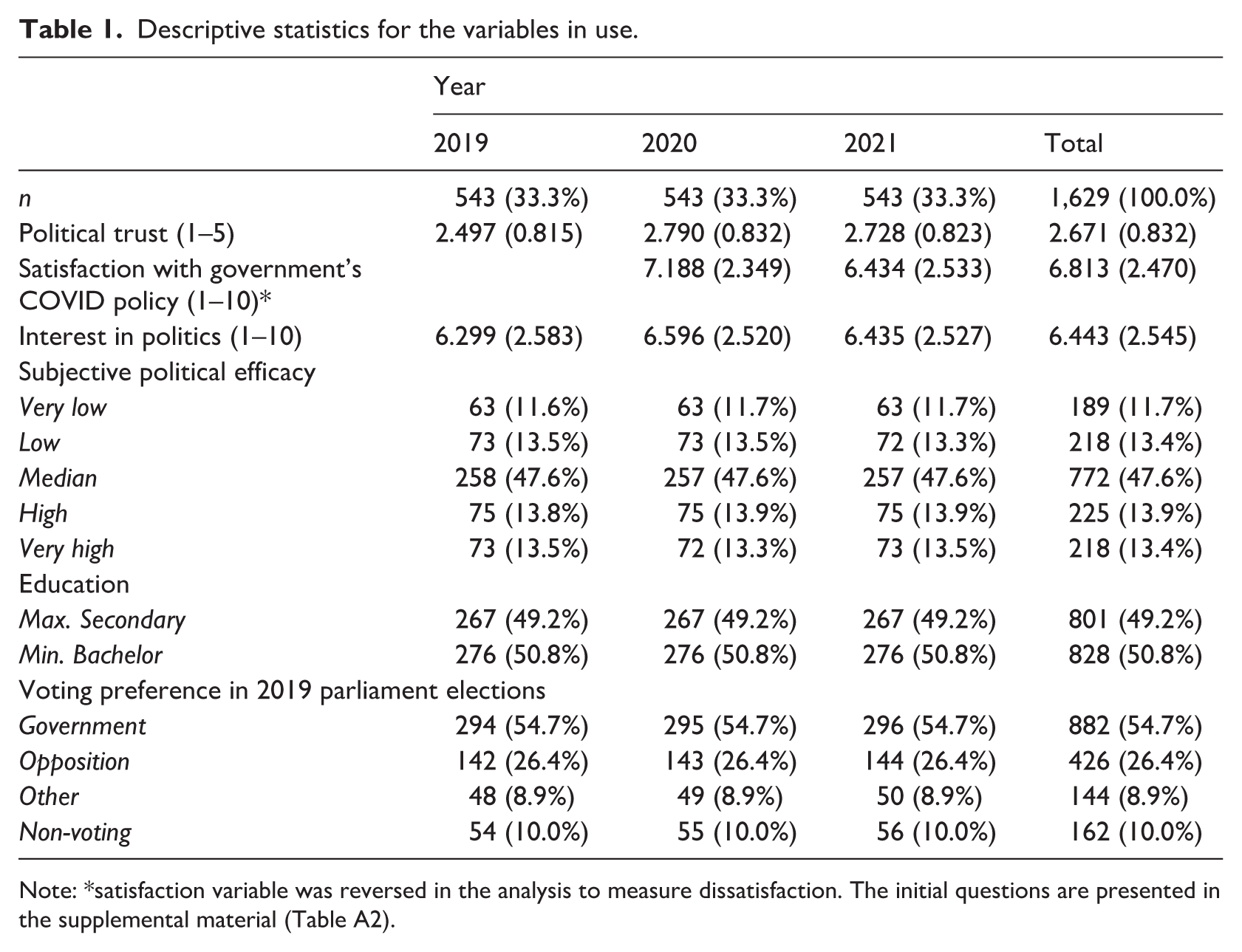
Note: *satisfaction variable was reversed in the analysis to measure dissatisfaction. The initial questions are presented in the supplemental material (Table A2).
Analysis procedure
We employed a REWB framework that combines the advantages of fixed- and random-effects models (Bell et al., 2019). All models account for clustering at the respondent level and include random intercepts. The analyses test whether satisfaction with government performance is associated with changes in political trust and estimate how this relationship varies across levels of internal political efficacy. The longitudinal design strengthens our ability to assess temporal ordering (i.e. whether shifts in satisfaction predict subsequent changes in political trust) beyond simple cross-sectional correlations. The analyses were conducted using Stata 18 software and mixed command. The main results were plotted using the coefplot command.
First, we analysed changes between T1 and T2 in how the effect of COVID-19 on political trust is linked to respondents’ satisfaction with the government’s COVID-19 policy and the moderating role of political efficacy. Temporal change was modelled with a wave variable capturing within-respondent changes in trust across survey points (Level 1). Satisfaction with government actions, measured only at T2, was treated as a between-respondent variable (Level 2). We then tested whether the effect of survey wave varies by satisfaction through an interaction analysis, in which measurement year varies by individual whereas satisfaction and political efficacy distinguish respondents. Our model is specified as follows:

where
Second, we modelled changes in political trust between T2 and T3 as a function of government satisfaction within and between individuals during the pandemic years 2020–2021. The model includes two satisfaction measures: respondent-specific means (between), capturing stable differences across individuals, and respondent-specific deviations from those means (within), capturing time-varying changes relative to each person’s baseline. To test the moderating role of political efficacy, we conducted a cross-level interaction analysis, treating satisfaction as the Level-1 (within) variable and efficacy as the Level-2 (between) variable. The model is specified as follows:

Here,
Results
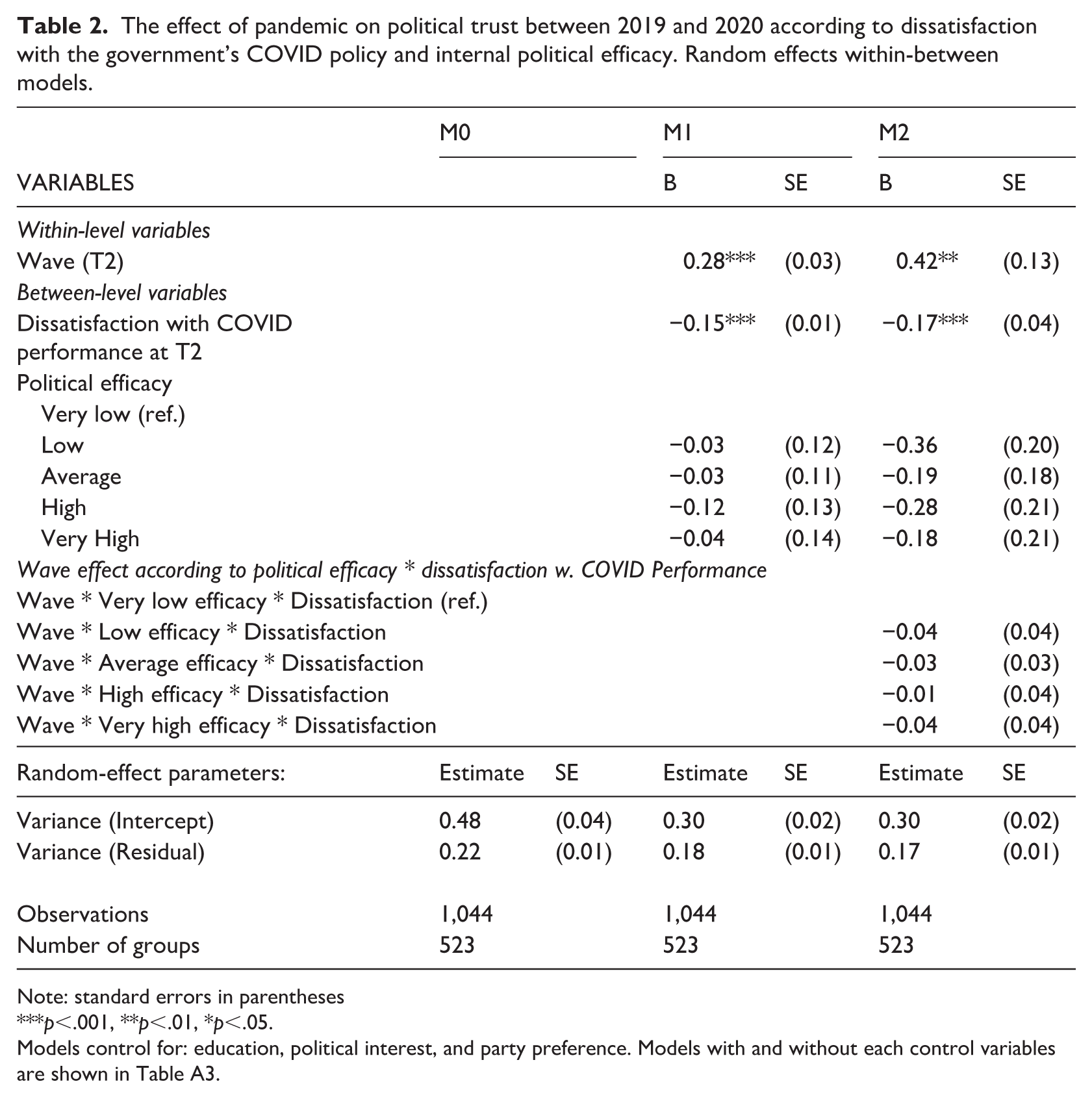
We analysed our research questions across various pandemic phases. First, we examined how dissatisfaction measured at T2 (2020) predicted trust fluctuations between 2019 and 2020. Table 2 presents the models: the null model reports the random-effect variance components, showing that individual-level variance accounts for 68.5% of the total. Therefore, most variance in political trust during 2019–2020 reflects time-invariant factors, but over 30% remains attributable to individual-level changes.
The effect of pandemic on political trust between 2019 and 2020 according to dissatisfaction with the government’s COVID policy and internal political efficacy. Random effects within-between models.
Note: standard errors in parentheses
p<.001, **p<.01, *p<.05.
Models control for: education, political interest, and party preference. Models with and without each control variables are shown in Table A3.
Addressing our first research question, the second model added political efficacy and satisfaction with the government’s COVID policy, along with the wave variable capturing within-individual changes in trust. Results show a general rise in trust overall. The models indicate that from the pandemic’s outset, respondents dissatisfied with the government’s COVID policy did not exhibit this increase; instead, their dissatisfaction predicted lower trust. Political efficacy was not significantly associated with political trust.
To clarify our second research question, we incorporated cross-level interaction terms to examine whether the relationships among dissatisfaction, political efficacy and trust vary across time points. The results indicate no significant interactions among wave, dissatisfaction and political efficacy. The result suggests that the effect of dissatisfaction on increased trust remains consistent regardless of individuals’ levels of political efficacy at the beginning stage of the pandemic. However, accounting for these interactions makes the effect of wave (T2) more pronounced in the second model (B = 0.42, p < .001). This suggests that the overall impact of the pandemic on trust may have previously masked individual-level differences. By including interactions, it becomes clearer that although dissatisfaction influences trust similarly across efficacy levels, the broader context of the pandemic (wave T2) plays a significant role in shaping trust dynamics.
Next, we analyse how political trust changed during the pandemic years by separating within-person fluctuations from between-person differences in dissatisfaction with the government’s COVID-19 policies. This decomposition shows whether trust rises or falls when individuals become more dissatisfied than their average while also capturing overall differences across respondents. We then test whether these associations vary by internal political efficacy to see if citizens with different levels of political competence respond differently to government performance.
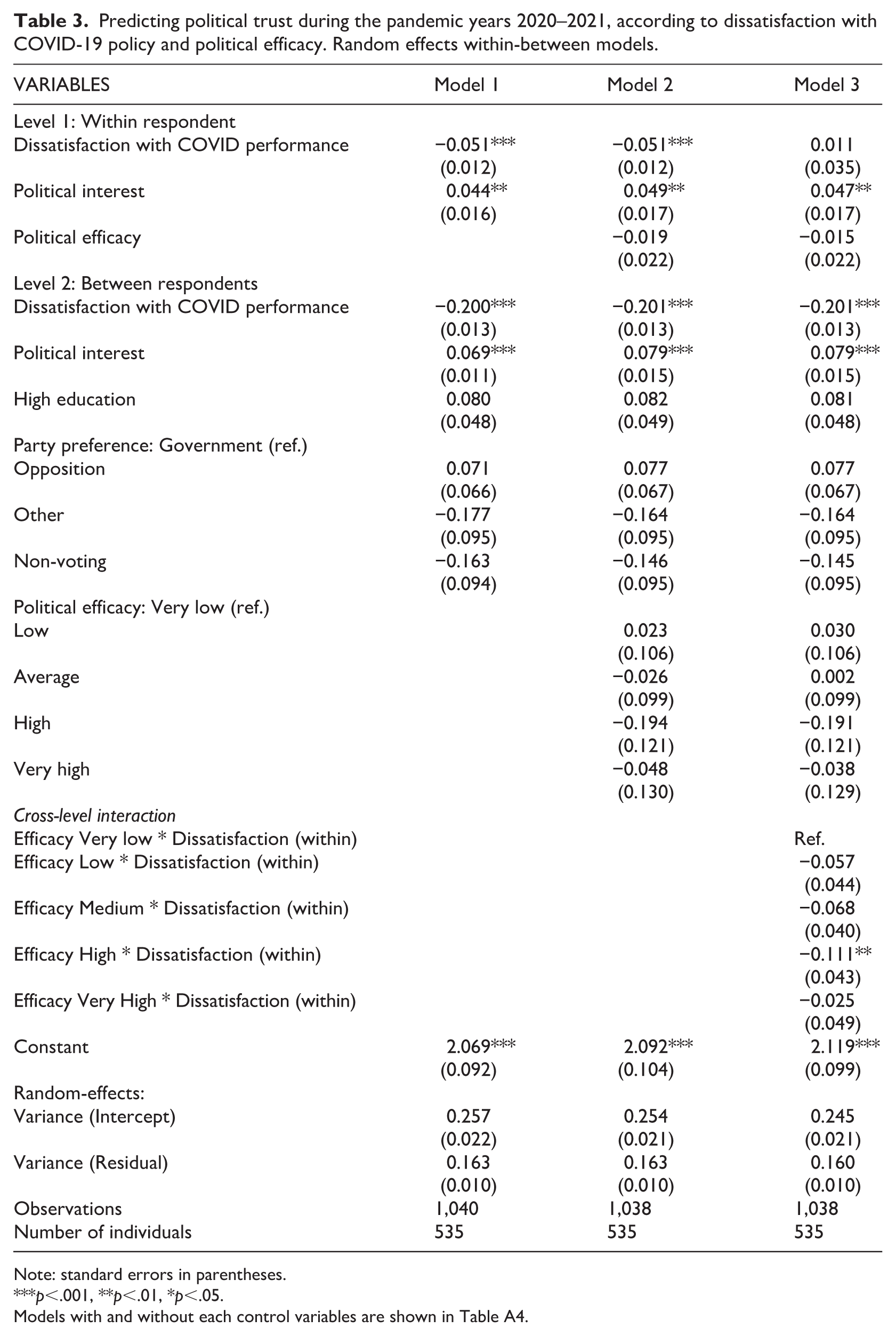
In order to respond to our first research question, we analysed how within- and between-individual-level changes in dissatisfaction predicted changes in political trust during the pandemic years. The first model in Table 3 demonstrates a within-level effect, revealing a decrease in political trust as respondents’ dissatisfaction with government COVID-19 policies increased throughout the pandemic. Additionally, the between-level effect shows a correlation between the decline in political trust and the average level of dissatisfaction with government COVID-19 policies.
Predicting political trust during the pandemic years 2020–2021, according to dissatisfaction with COVID-19 policy and political efficacy. Random effects within-between models.
Note: standard errors in parentheses.
p<.001, **p<.01, *p<.05.
Models with and without each control variables are shown in Table A4.
To expand our analysis to respond to the second research question, we analysed the interaction between political efficacy and dissatisfaction during the pandemic years. The second model in Table 3 indicates that the impact of dissatisfaction is contingent upon respondents’ political efficacy. This interaction effect indicates a stronger decrease in political trust in response to dissatisfaction when political efficacy is high (score of 4 on the 5-point scale). Notably, the within-level effect of dissatisfaction does not achieve significance when political efficacy is extremely high (score of 5 on the 5-point scale).
Next, we closely examine this moderating effect by displaying the marginal effects of dissatisfaction for various levels of efficacy. The results are depicted in Figure 1. The findings demonstrate that dissatisfaction directly reflects trust among respondents with medium or high internal political efficacy (score of 3 or 4 on the 5-point scale). Conversely, the association between dissatisfaction and trust remains relatively stable when the respondent’s efficacy is very low (1) or very high (5).
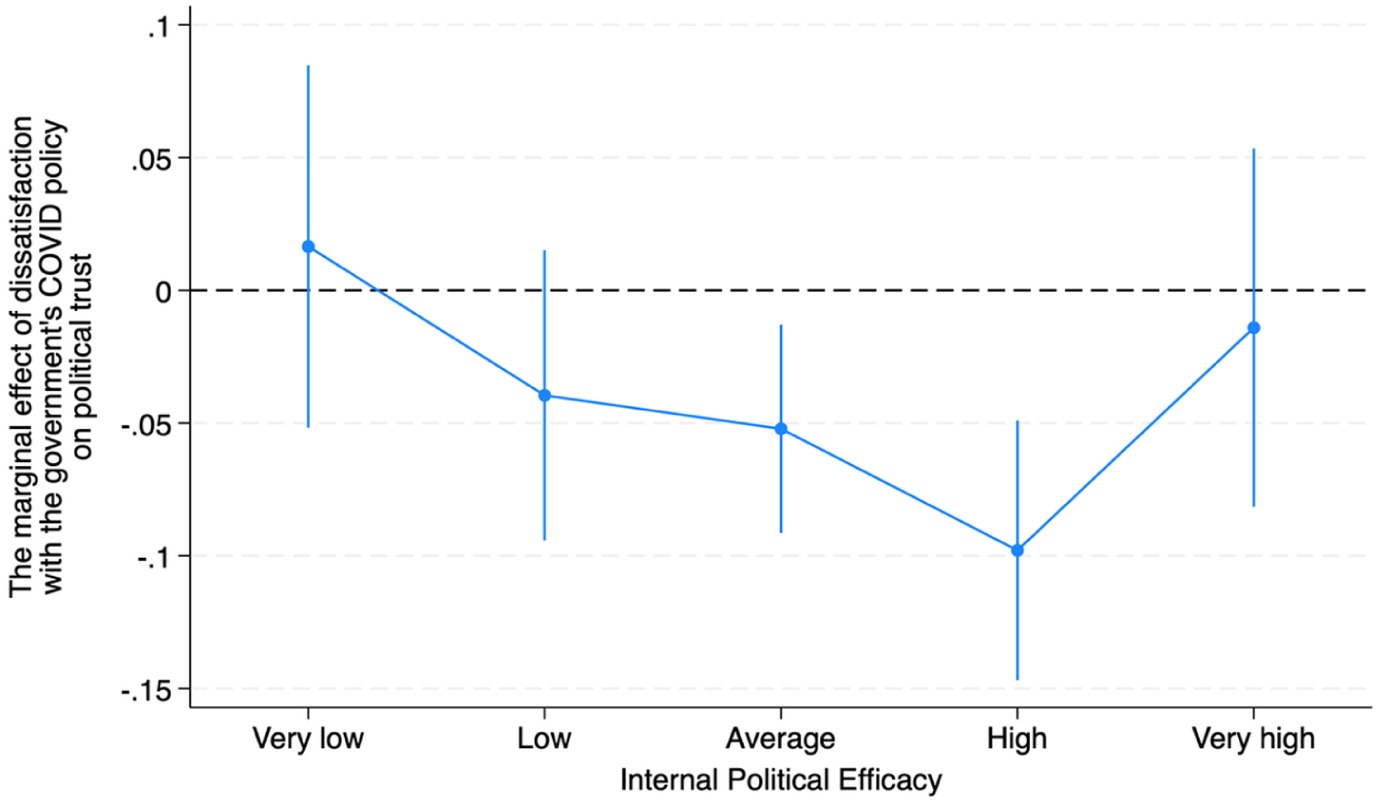
The effect of dissatisfaction with the government’s COVID policy on political trust according to level of political efficacy.
Robustness analysis
As noted in the study design, subjective political efficacy was categorized according to percentiles. To account for potential misinterpretation, we conducted additional analyses using quintiles and deciles instead of percentiles. According to the results, the main patterns of associations remained consistent across these categorizations of internal political efficacy, suggesting that the findings are robust to the choice of cut-off points.
To address the potential bias related to the skewed distribution of education groups, we conducted an additional sensitivity check. Specifically, we estimated a third-order interaction among government satisfaction, internal political efficacy and education when predicting changes in political trust. In particular, we compared highly educated respondents with those without a higher education qualification. The overall pattern was similar, but a closer look indicated some educational differences in how efficacy moderates the link between dissatisfaction and trust. Among highly educated respondents, significant effects emerged more clearly at efficacy level 4 (B = –.114, p < .001), whereas no other statistically significant differences were observed.
Finally, we re-estimated all models without control variables and then added each control sequentially. Starting from the baseline model, which included the key independent variables wave, internal political efficacy, dissatisfaction and their interaction, we introduced controls stepwise. The results in Tables A3 and A4 indicate that the inclusion of education and party preference produced no meaningful changes in the coefficients. Introducing political interest reduced the effect of political efficacy on political trust in both model specifications. However, this adjustment did not affect the observed moderation effect of political efficacy during the pandemic years (Table 3, Figure 1). We also tested an interaction term between political interest and dissatisfaction, but it did not yield a significant result or alter the original moderation effect.
Discussion
We conducted an original longitudinal study to examine how citizens’ satisfaction with the Finnish government’s COVID-19 policies relates to political trust and how this link is moderated by internal political efficacy. Building on the trust-as-evaluation framework (Haugsgjerd and Kumlin, 2020; Mishler and Rose, 2001; Van der Meer, 2017), we argued that institutional trust develops in response to perceived policy success. Because the COVID-19 pandemic created an unusually complex and evolving policy environment, it also offered a critical test of how efficacy shapes trust dynamics during crises.
Addressing our first research question, we found that dissatisfaction with government pandemic policies consistently predicted lower political trust. Even during the early ‘rally-around-the-flag’ phase of high overall trust, citizens dissatisfied with the government’s COVID response showed a smaller increase in trust. Within-person analyses during the pandemic years further indicated that changes in dissatisfaction over time were directly linked to changes in trust, underscoring the importance of dynamic policy evaluations.
These results reinforce Easton’s (1975) distinction between specific and diffuse support. Evaluations of the government’s crisis policies (specific support) can spill over into broader institutional trust, or diffuse support. Similar spill-overs occur when satisfaction with administrative performance shapes confidence in the political system (e.g. Christensen and Lægreid, 2005; Stroppe, 2023). Our findings also extend those of Belchior and Teixeira (2023), showing that the performance–trust link persisted well beyond the initial ‘rally-around-the-flag’ surge. In Finland, negative judgements of pandemic management were associated with weakened trust not only in the cabinet but in the political system more broadly.
Turning to the second research question, we examined whether internal political efficacy moderates the link between satisfaction with the government’s COVID-19 policies and political trust. Drawing on Zaller’s (1992) theory of political awareness, we anticipated a curvilinear effect: citizens with moderate to moderately high efficacy would be most responsive to government performance, whereas those with very low or very high efficacy would show minimal trust change. Our longitudinal analysis confirmed this pattern: the dissatisfaction–trust relationship followed inverted U-shaped form, with trust varying most among respondents with average or slightly above-average efficacy but remaining stable at both extremes.
These findings suggest that crises may place substantial cognitive demands on citizens. Accurately evaluating government performance requires understanding both the division of responsibilities across government levels and the exceptional nature of emergency measures (De Blok, 2024; De Blok et al., 2022). Citizens with very high efficacy may recognize that crisis actions are exceptional and need not spill over to judgements of other institutions, whereas those with very low efficacy may lack the cognitive resources to assess performance critically, leading to unquestioning or disengaged trust (Galston, 2001; Kestilä-Kekkonen et al., 2022). By contrast, individuals with moderate efficacy are attentive enough to register successes or failures but not so anchored in predispositions that they dismiss new information (Zaller, 1992), making their trust most responsive to changes in satisfaction.
Our findings highlight a tension between short-term evaluations of government performance and long-term trust in democratic institutions. As Easton (1975) notes, democracies depend on diffuse support to sustain trust even when citizens disapprove of their leaders. Yet negative performance evaluations can undermine confidence in the entire system, and repeated failures may erode this support even in high-trust societies. Although a critical public is vital for democratic accountability, we show that this evaluation–trust link is uneven: citizens’ perceptions of their own political knowledge and understanding shape how dissatisfaction translates into political trust.
We acknowledge several limitations. First, political efficacy was measured with a single self-reported item, which may have introduced bias. Future research should include multiple indicators or objective knowledge tests to distinguish perceived competence from actual understanding and clarify how information processing shapes trust during crises. Second, the limited number of pandemic time points constrains our ability to establish causal relationships between efficacy, government satisfaction and trust; a longer panel would provide a clearer temporal picture. Third, the sample’s skewed educational distribution may underrepresent certain efficacy levels, limiting the observed variation. Future research would benefit from larger datasets with a more even distribution of educational backgrounds, ensuring a more robust assessment of these dynamics. Finally, cultural and institutional contexts may affect the generalizability of our findings, underscoring the need for comparable studies in other political settings.
Overall, our study reveals the complex relationship between government satisfaction, political trust and political efficacy during crises. Initially, we observed increased trust in political institutions, even among sceptics of government responses to the pandemic. However, longitudinal analysis revealed fluctuations in trust as dissatisfaction with government actions evolved. Crucially, internal political efficacy emerged as a key moderator: very high or very low efficacy tended to stabilize trust regardless of satisfaction, whereas moderate efficacy made trust more sensitive to government performance.
Supplemental Material
sj-docx-1-ips-10.1177_01925121251406732 – Supplemental material for Internal efficacy and political trust: Evaluating political institutions through pandemic crisis policy
Supplemental material, sj-docx-1-ips-10.1177_01925121251406732 for Internal efficacy and political trust: Evaluating political institutions through pandemic crisis policy by Aki Koivula and Elina Kestilä-Kekkonen in International Political Science Review
Supplemental Material
sj-zip-2-ips-10.1177_01925121251406732 – Supplemental material for Internal efficacy and political trust: Evaluating political institutions through pandemic crisis policy
Supplemental material, sj-zip-2-ips-10.1177_01925121251406732 for Internal efficacy and political trust: Evaluating political institutions through pandemic crisis policy by Aki Koivula and Elina Kestilä-Kekkonen in International Political Science Review
Footnotes
Acknowledgements
The authors thank the editor and four anonymous reviewers for their constructive comments that have improved the article in several ways. Special thanks to BSocSc Topias Favorin for research assistance.
Funding
The authors disclosed receipt of the following financial support for the research, authorship and/or publication of this article: This work was funded by the Research Council of Finland (decision numbers: 345546 and 323608) and by the Helsingin Sanomat Foundation (grant 10/2021).

Supplemental material
Supplemental material for this article is available online.