




Abstract
Drawing from an original survey quasi-experiment presenting respondents with fictional candidate slates varying in ethnic composition, this study examines the impact of racialized affinity on preferences for where to run for office. Prior research shows that racialized candidates typically run in districts with a high in-group ethnic population, and prior in-group candidates or elected officials. But these findings are largely based on observed outcomes, making it difficult to disentangle aspirant preferences from those of party gatekeepers. We demonstrate, at the individual level, that racialized persons in Canada express significantly stronger preferences for running in contexts with in-group candidates, and that this preference is stronger with more such candidates, though not consistently. Our study contributes to the scant literature on race and candidate recruitment in Canada, and to a broader understanding of how minority presence activates electoral engagement.
Introduction
When racialized minority individuals think about running for office, does the racial composition of the existing candidates influence where to run? Specifically, do racialized individuals prefer to run in districts with other in-group candidates? These questions are important because of their implications for addressing racialized underrepresentation in Canada and elsewhere. In the 2021 Canadian election, 15.7% of elected Members of Parliament (MPs) and 21.7% of candidates for the four largest political parties were of racialized background (Black and Griffith, 2022), below the population share of 26.5% indicated in the 2021 census. 1 This share is expected to increase to more than 40% in less than 20 years (Statistics Canada, 2022). For minority representation to improve, the legislative recruitment process needs to more effectively produce racialized winners. Tolley’s (2023) analysis of ethnically diverse districts shows that representational drop-off largely occurs at the aspirant-to-candidate and candidate-to-legislator stages, rather than there being a lack of racialized individuals aspiring to take office in the first place. Moreover, when racialized individuals do run for office, it is often in contexts of other in-group aspirants and candidates (Tolley, 2019, 2023).
This evidence suggests that within these communities shared racial and ethnic identities can boost political engagement and potential office-seeking, whether through encouragement within social networks, the effect of role models, or the signaling of an inclusive and supportive electoral environment. However, the downside of strong preferences for in-group contexts is that racialized representation will largely be limited to those contexts, which are neither numerous enough nor geographically well distributed to efficiently translate racialized individuals’ electoral aspirations into equitable legislative representation. Simply put, significant improvement in racialized minority representation will require strengthening efforts in racialized legislative recruitment outside predominantly racialized minority contexts. 2
We return to these implications after empirically assessing two fundamental questions. First, when asked to consider running for office, do racialized individuals express stronger preferences for contexts with in-group candidates? Our baseline affinity expectation is that racialized individuals do prefer electoral districts with in-group candidates compared to districts without such candidates. Second, to the extent that such a preference exists, does it strengthen when more in-group candidates are presented? Our increasing affinity expectation infers that the preference is not only for in-group candidates but also for more in-group candidates.
Our study investigates these questions with data from a survey experiment that oversampled racialized respondents and presented them with comparisons between two districts with candidate slates of varying diversity, then probed their preferences in terms of where they would choose to be a candidate, should they ever run for office. The findings supported our baseline and increasing affinity expectations: racialized individuals expressed strong preferences for running in contexts with in-group candidates and stronger preferences to run with two or three in-group candidates present compared to only one. Consequently, our results both encouraged and challenged the role of racial and ethnic identities in representation: they showed the importance of continuing to foster political engagement within predominantly racialized communities but also the potential limits of such an approach.
Racialized minorities and running for office
We situated our study within the literature on racialized minority aspirants for office and factors that determine where and when they emerge as candidates. This work was organized around two related conceptual frames: nascent political ambition and supply-demand theories of candidate emergence. Theories of nascent political ambition seek to explain ‘the embryonic or potential interest in office-seeking that precedes the actual decision to enter a specific political contest’ (Fox and Lawless, 2005: 643). Importantly, for women and racialized minorities, political ambition is strongly shaped by contextual and strategic considerations, as well as by minority status itself.
In terms of minority status, some research has found that women and members of marginalized racial groups express lower self-perceptions about their qualifications, and that these ‘crippling’ psychological barriers in turn reduce their nascent ambition for office (Reny and Shah, 2018: 1054). For example, Fox and Lawless (2005) found strong evidence that minority status—being a woman and being Black (though not Latino)—depressed nascent political ambition and linked this in part to lower self-perceptions of qualifications. Yet more recent research contests the presumption that marginalized groups suffer a psychological deficiency and instead argues that women’s and racialized minorities’ political ambition and willingness to run are contextually embedded (e.g., Acquarone, 2024; Wylie, 2020). Carroll and Sanbonmatsu’s (2013) relationally embedded model of female candidate emergence emphasizes how external encouragement and support (from parties, organizations and family) drive women’s decision to run. Likewise, Piscopo argues that ‘women do not innately have less confidence and less ambition; instead, they respond rationally to actual and perceived constraints’ (Piscopo, 2018: 2). Looking at aspirations to run among racialized minorities (including minority women), research shows that the salience of marginalization and identity within electoral contexts influences group members’ political ambition and interest in running for office. Acquarone (2024) shows experimentally, while Wylie (2020) found observationally, that increased awareness of marginalization can significantly boost candidate supply from underrepresented groups.
Strategic considerations concern an individual’s assessment of how likely they are to succeed if they run. This involves self-perceptions of their quality as candidates, the resources available to them, as well as the political opportunity structure, including whether or not they reside in a district with a winnable seat (Maestas et al., 2006). In the United States, where racial identity is highly salient for political choice, racialized minorities’ voter strength in the district weighs heavily in such strategic choices. But contextual considerations go beyond purely strategic calculations of ‘winnability’ and include whether an aspirant feels they would be supported and have a positive experience as a candidate. For example, studies on electoral reform suggest that women and minorities are less deterred by list-based electoral systems as these are more collaborative, less personalist, and also less expensive than single-member district competitions (Barker and Crawley, 2024; John et al., 2018). A related consideration for historically excluded groups is whether one has role models who have smoothed the road behind them (Campbell and Wolbrecht, 2006; Foos and Gilardi, 2020); or if one is running in the presence of others facing similar circumstances or experiences (Bonneau and Kanthak, 2020). These contextual conditions provide reassurance by signaling that the political system is open, inclusive, and receptive to diverse leadership. Focusing on Black local candidates and respondents in Louisiana, Shah (2014) discovered that prior Black candidacies had a large positive effect on Black respondents’ decision to run. Reny and Shah’s (2018) survey of racialized immigrants taking leadership training programs concluded that racial and ethnic ‘otherness’ depresses political ambition more than structural resource deficits. Participants consistently blamed the continuing presence of a racial hierarchy, lack of belonging, and fears that their race, ethnicity, or immigrant status would be negatively received by voters.
Nascent political ambition is an important first step toward minority representation because racialized individuals need to be interested in taking office to proceed in the candidate emergence process. Once interested, their success is conditioned by both supply- and demand-side factors, that is, explanations of where and when racialized candidates put themselves forward for office, and the attitudes of both voters and party elites that impact the choices and chances of minority candidates emerging. Demand-side factors related to voter bias and party gatekeeping have been especially prominent in explanations of why minority candidates in the United States have difficulty winning outside of majority-minority districts. Yet despite their conceptual distinctiveness, supply and demand dynamics are empirically intertwined. The fact that Black and Latino candidates are rarely elected in white districts is partly driven by candidates’ self-selection bias away from those districts, based on perceptions that white voters will not support them (Gonzalez Juenke and Shah, 2015; Shah, 2014).
Outside of the United States, it is less clear that supply- and demand-side dynamics are driven by racial animus among white voters toward minority candidates. Such effects are highly contingent on study context and moderated by other electoral factors such as partisanship. In Canada, Black and Erickson (2006), drawing on observational data, found no evidence of a direct electoral penalty for minority candidates. However, in an experimental study, Besco (2020) found a partisan ‘friendly-fire’ effect, where white voters of right- but not left-wing parties showed bias against racial minority candidates of their own party. Studies examining Jagmeet Singh, the first racialized leader of a major Canadian party (the New Democratic Party), suggest that racial animus may drive lower party support among some voters (Hale, 2023; Polacko and Harell, 2023), though Bouchard (2022) argues that any racial penalty was localized to the province of Quebec. Overall, these studies suggest only modest voter animus toward racialized candidates in Canada. Related research shows that affinity voting effects are also modest, and generally overridden by partisan preferences (Bird et al., 2016).
A second important demand-side perspective concerns the role of party elites and candidate selectors. Political party elites are widely recognized as important gatekeepers in the election of aspiring candidates. Party recruitment and selection practices determine not only who is a candidate, but also the viability of their candidacy (Fraga et al., 2020; Lapointe et al., 2024; Tolley, 2019). While initially viewed as obstacles to diverse candidate recruitment, mainstream parties have increasingly paid attention to ethnicity in selecting candidates—especially as the demographics of the voting population have shifted (Bird et al., 2011; Farrer and Zingher, 2018). In Canada, vote seeking incentives have led all federal parties to become strongly invested in running diverse candidates, however such candidates are disproportionately funneled into single-member districts with a high co-ethnic population. In the 2021 federal election, only 32 racialized candidates ran in districts below the median racialized population share, and only three won. 3 While Canada demonstrates high levels of candidate diversity by international standards, the fact that candidates are packed into fewer ridings nonetheless puts many of them in electorally vulnerable positions.
Most of the studies reviewed above report aggregate rather than individual-level outcomes. The core finding that minority candidates are significantly more likely to run in predominantly minority districts is deduced from observations of where candidates emerge, not direct data on candidate preferences. Such data makes it difficult to tease apart supply- from demand-side effects. Thus, we are left with little sense of the role that aspirant self-selection plays in these dynamics. Our study helps fill this gap by applying a quasi-experiment wherein Canadian citizens are asked to think about what type of district they would consider running in based on the ethnic composition of the candidates running in the riding. This study allows us to elucidate at the individual level, and separate from party selection strategies, the effect of the presence of other racialized in-group members on self-selection into certain kinds of electoral districts.
We test this by presenting survey respondents with five comparisons between pairs of adjacent districts, one with varying slates of co-ethnic candidates, the other non-diverse (all-white candidates), and asking, for each comparison, in which district they would prefer to run. Our expectation is that individuals will express positive preferences for districts with candidates of shared salient ethnocultural identities. Our first hypothesis, then, is the baseline affinity expectation:
(H1) Racialized individuals express greater preference in running for office in districts with co-ethnic candidates, relative to districts with no co-ethnic candidates.
We also posit that the activation of co-ethnic affinity—if driven by the presence of other candidates with shared ethnocultural identities—should be strongest when more in-group members are present, as compared to fewer. The stronger the presence of co-ethnic candidates, the stronger the signal that the local context is ethnically inclusive, and that racialized individuals will be welcome as candidates. Thus, we posit an increasing affinity expectation:
(H2) Racialized individuals express greater preference in running for office in districts with more co-ethnic candidates, relative to fewer co-ethnic candidates.
These hypotheses are not about winnability but rather about ‘relationally embedded’ risk assessment (Carroll and Sanbonmatsu, 2013; Wylie, 2020). Consistent with work on candidate emergence among members of marginalized groups, our experimental treatment provides cues as to whether an individual would feel supported and empowered as a candidate in a particular context. These cues should in turn shape choices about where to run. This theoretical specification aligns especially with H2 insofar as we expect increasing homophily of candidates to increase their likelihood of choosing such a district. Alternatively, from the perspective of winnability, it is less clear where a racialized individual would choose to run. They might surmise their chances of electoral success are higher where there is a full slate of co-ethnic candidates; or they might choose the least ethnically homogenous district to better distinguish themselves against other candidates. We did not test these alternative mechanisms but simply note that relational considerations are consistent with choosing to run in a district based on homophily, whereas strategic decisions about the best prospects for getting elected may or may not line up with homophily. These two hypotheses capture our core expectations for the relationship between racialized status and preferences on running for office.
Running for office and Racialized representation in Canada
We assess these hypotheses within the Canadian context, which is important for three reasons. First, candidates emerge within a single-member electoral system in which they are selected by local party associations rather than open primaries. Canadian political parties are also organizationally weak and thus have less capacity than parties in many other democracies to effectively channel citizens into politics. They also have weak social ties relative to parties elsewhere (Cross and Young, 2013). The consequence of these features is that most aspirants for office in Canada volunteer themselves, placing the burden of entering the candidate pipeline on individuals, rather than institutional actors.
The second important aspect of the Canadian context is the demographics and politics of racial diversity. Overall, one-quarter of Canadians were classed as ‘visible minorities’ in 2021 (Statistics Canada, 2022). Currently, South Asians represent the largest group at 7.1% of the Canadian population, followed by those identifying as Chinese at 4.7%, and Black at 4.3%. However, Canada’s growing ethnic diversity is weakly reflected in political representation, though this has improved over time. The 2021 federal election saw 234 major-party candidates of racialized minority background, constituting 17.4% of all candidates 4 (Johnson et al., 2021). This declines to 15.7% of sitting MPs who are racialized, while breakdown by ethnicity reveals significant variation: 8.2% and 7.4% of candidates and MPs, respectively, were South Asian, 5.7% of candidates but only 2.7% of MPs were Black, and 2.3% of candidates and 2.7% of MPs were Chinese. The racialized candidate-to-legislator success rate (share of candidates successfully elected) was 21.4% in 2021, similar to 2019 (20.9%) but lower than the two previous elections (29.3% in 2015 and 27.0% in 2011). This is significantly lower than the success rate for white candidates (for example, 31.3% in 2019).
As Tolley (2023) demonstrated, the lower success rate of racialized minority candidates is partly because they disproportionately run in districts with high racialized minority populations, such that they are often competing for a single legislative seat. Yet racialized candidates outside of these districts are even less successful. These patterns were evident in the 2021 federal election. Figure 1 shows the average visible minority population share across districts grouped by the number of racialized candidates running (0–4); the number of districts is presented in brackets. In the 187 districts with no racialized candidates, the average racialized population share was 13%, by far the lowest. The 32 districts with two racialized candidates averaged 47%, while the 18 districts with three racialized candidates reached a racialized population average of 70%. Figure 2 displays the corresponding total number of racialized minority candidates and number of winning candidates. Of the 96 racialized candidates who were the only such candidates in their district, only 15 were elected (15.6%). In the 32 districts where two racialized candidates were competing, 13 were elected (20.3% of candidates and 40.6% of districts). In the 18 districts where three racialized candidates ran, all but one elected a racialized candidate (31.5% of candidates and 94.4% of districts). All districts with four major-party racialized candidates necessarily elected a racialized candidate, but this translated to only a 25% candidate success rate. These numbers clearly show that racialized candidates are significantly more likely to run and win in districts with large minority populations. This pattern both enables minority representation and constrains its increase. Canada’s federal redistricting process does not entirely mitigate the political effects of urban minority concentration, as the representation formula overrepresents the least populated provinces where relatively few racialized persons live (Pal and Choudhry, 2014).
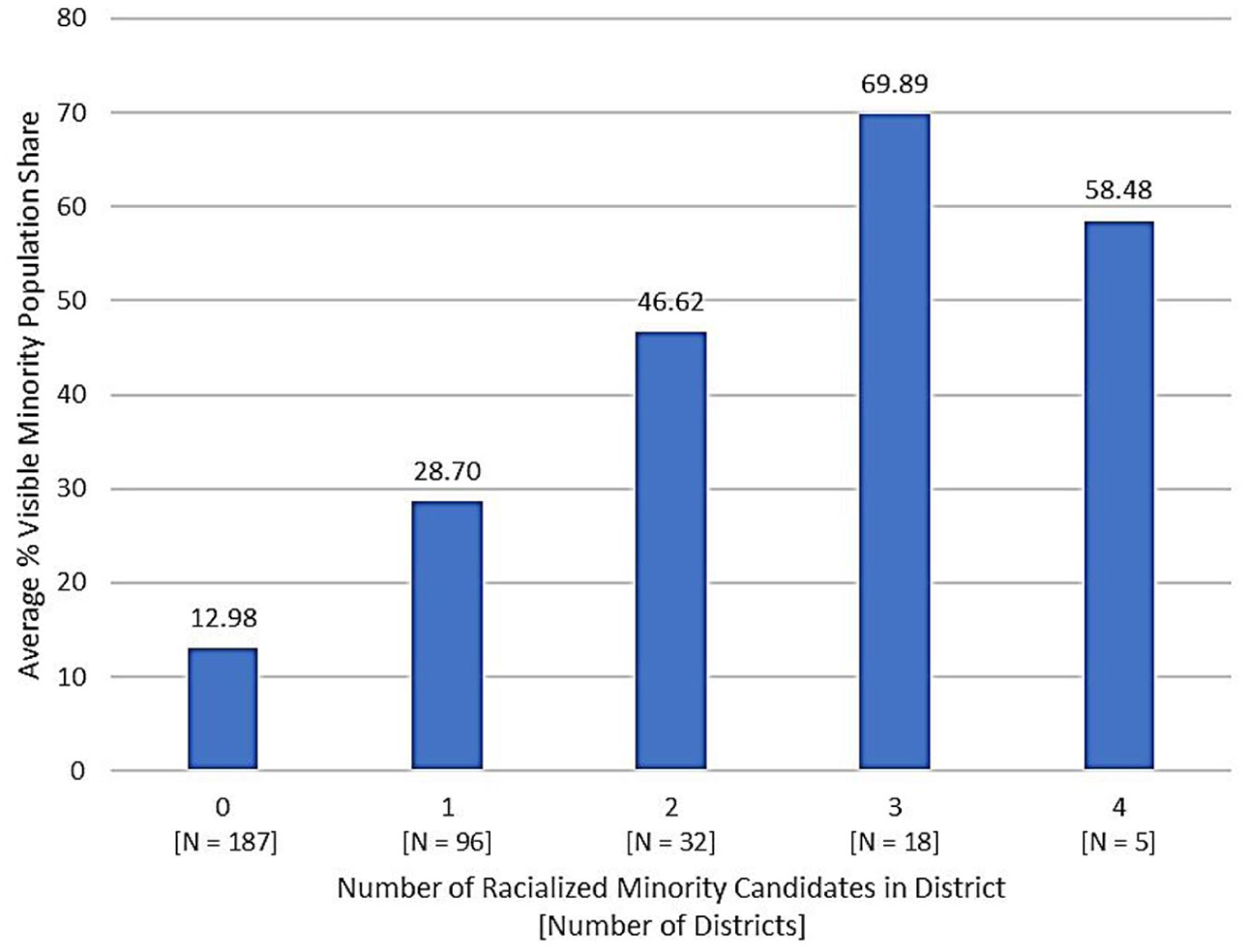
Average visible minority population share by number of racialized candidates, by district.
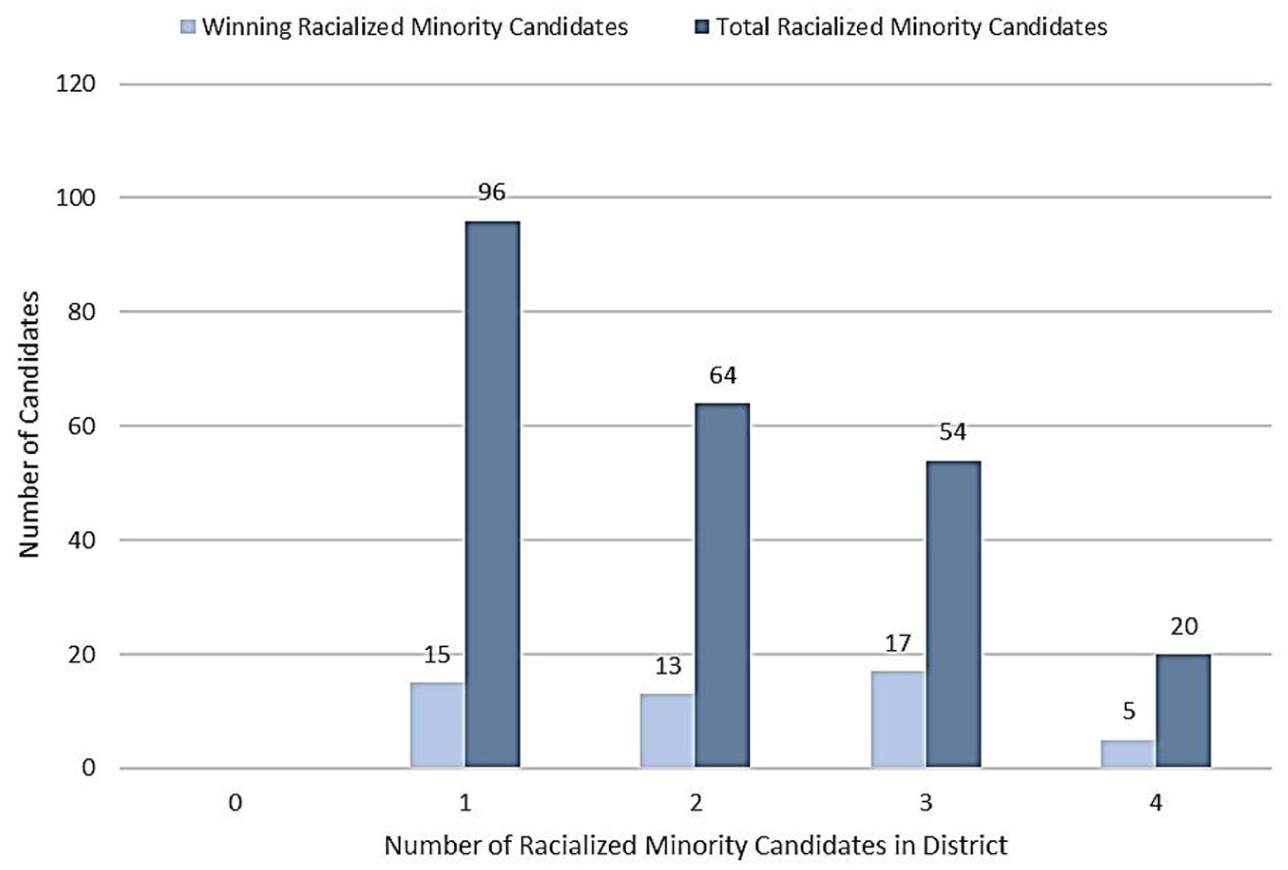
Number of winning and total candidates by number of racialized candidates, by district.
A final consideration is that Canada is exceptional among OECD (Organization for Economic Cooperation and Development) countries in terms of having public and cross-partisan consensus in support of immigration and multiculturalism (Banting, 2010). Despite pockets of nativism and political impulses that test this consensus (Kymlicka, 2021), the Canadian party system has largely avoided the fractionalization over race, immigration, and multiculturalism that we see elsewhere. Especially striking is that there is no strong or consistent alignment between racial identity and partisanship. Rather, mainstream conservative, centrist, and left parties in Canada are equally keen to leverage the voting power of immigrants and minorities through strategic outreach, and to highlight the presence of racial minority members in caucus and on their candidate slates (Tolley, 2017). The result is that, at least in highly competitive urban districts, no one party, to the exclusion of others, has a reputation for representing minority group interests or running minority candidates. This aspect was important for our experimental design, as the presence of one or more racialized candidates is highly independent of the partisan leaning of the district.
Data and methods
We assessed our hypotheses using data from an original online survey, fielded in March–May 2023 (N = 4950). We aimed to oversample racialized Canadians using postal codes to target forward sortation areas of high ethnic concentration, focusing on the three largest minority groups: Black, Chinese, and South Asian. This resulted in 231 respondents (5.1%) who self-identified as exclusively Black, 526 who identified as exclusively Chinese (11.7%), 446 who identified as exclusively South Asian (9.9%), and 2753 who identified as white (61.1%). 5 The survey allowed selecting multiple ethnicities, but our analysis excluded respondents who did so because of the ambiguity of assigning co-ethnic candidates.
The survey included a module presenting respondents with five randomly ordered comparisons between two hypothetical electoral districts, each with three fictional candidates representing Canada’s main political parties (Liberal Party, Conservative Party, and New Democratic Party). An example is provided in Appendix Figure A1. The districts differed only in their candidate slates—one district always had three white candidates while the other varied in candidate diversity—and no other information about the districts was provided. 6 Respondents were explicitly told to think of these as fictional districts in the premodule introductory screen, to consider the candidate slates holistically, rather than attaching importance to specific candidates, and to base their responses only on the information provided. 7 This design was intended to capture levels of baseline affinity since respondents were deciding between hypothetical districts primarily based on candidate diversity, minimizing the influence of exogenous contextual factors. The diverse slates presented to each respondent depended on their self-selected identity. Table 1 gives the assignment of district comparisons.
Diverse candidate slate conditions for each self-identified ethnic group.
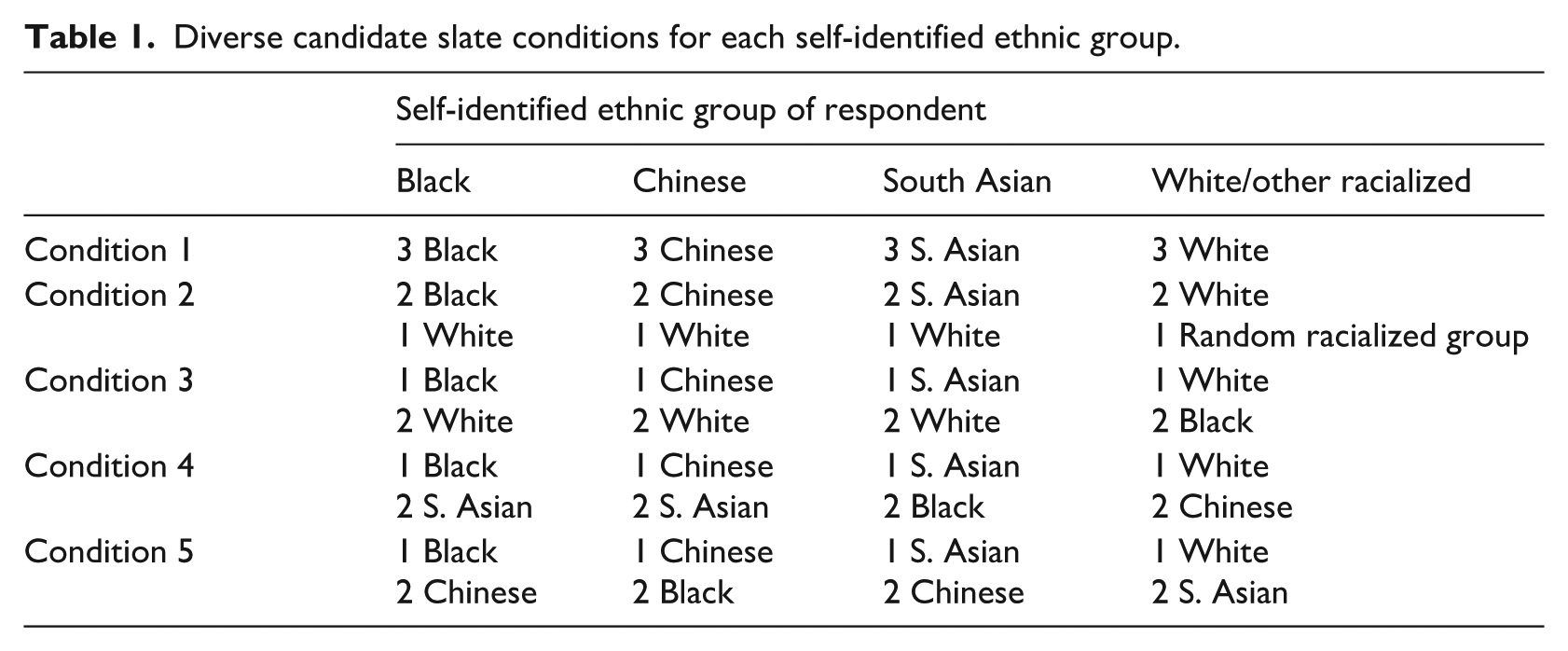
Among other questions probing political engagement, we asked: ‘If you were to consider running for federal election at some point in the future, which of these two ridings would you be most interested in?’ 8 Responses were registered on an 11-point scale with a zero midpoint: scores below zero indicated a preference for the all-white riding, while scores above zero indicated a preference for the comparator diverse riding. Some 647 respondents (84% of whom were white) answered 0 for all five scenarios; we excluded these from our analysis because their response pattern suggested disengagement with the experiment. (Testing the same model with all respondents included (Table A2) had no substantive effect on the results.) For racialized individuals, positive scores measured in-group affinity in the choice of where to run for office, while negative scores implied disaffinity, preferring to run in homogenous white contexts when presented with diverse alternatives. For white respondents, positive scores measured disaffinity in the sense that the respondent’s interest in running for office was activated more by ethnically diverse districts relative to homogenous white districts; negative scores indicated affinity. We refer to our running for office measure as RFO preference in the rest of the study.
Figure 3 shows the response distribution for each group in the dataset and aggregated responses. Overall, 26% of responses were negative (indicating a preference for the white district), 40% positive (preference for the diverse district), and 34% expressed no preference. However, this distribution varied significantly by group. White respondents were far more likely to express no preference (38%) and much less likely to express a positive preference relative to other groups. Black respondents were most likely to express a positive preference (60%) and the least likely to express no preference; Chinese and South Asian respondents also expressed fairly strong preferences for more diverse districts (53% and 54%, respectively). The net positive was highest for Black responses (+36%), but Chinese (+31%) and South Asian (+30%) groups also demonstrated evident affinity attitudes. White respondents, at 8% net positive, also demonstrated an overall preference for the more diverse context, but clearly less than others. On average, racialized respondents expressed more positive preferences, 1.22 on the −5 to +5 scale versus 0.30 for white respondents. Black respondents had the highest average (1.53), followed by South Asian (1.21) and Chinese (1.10) respondents.
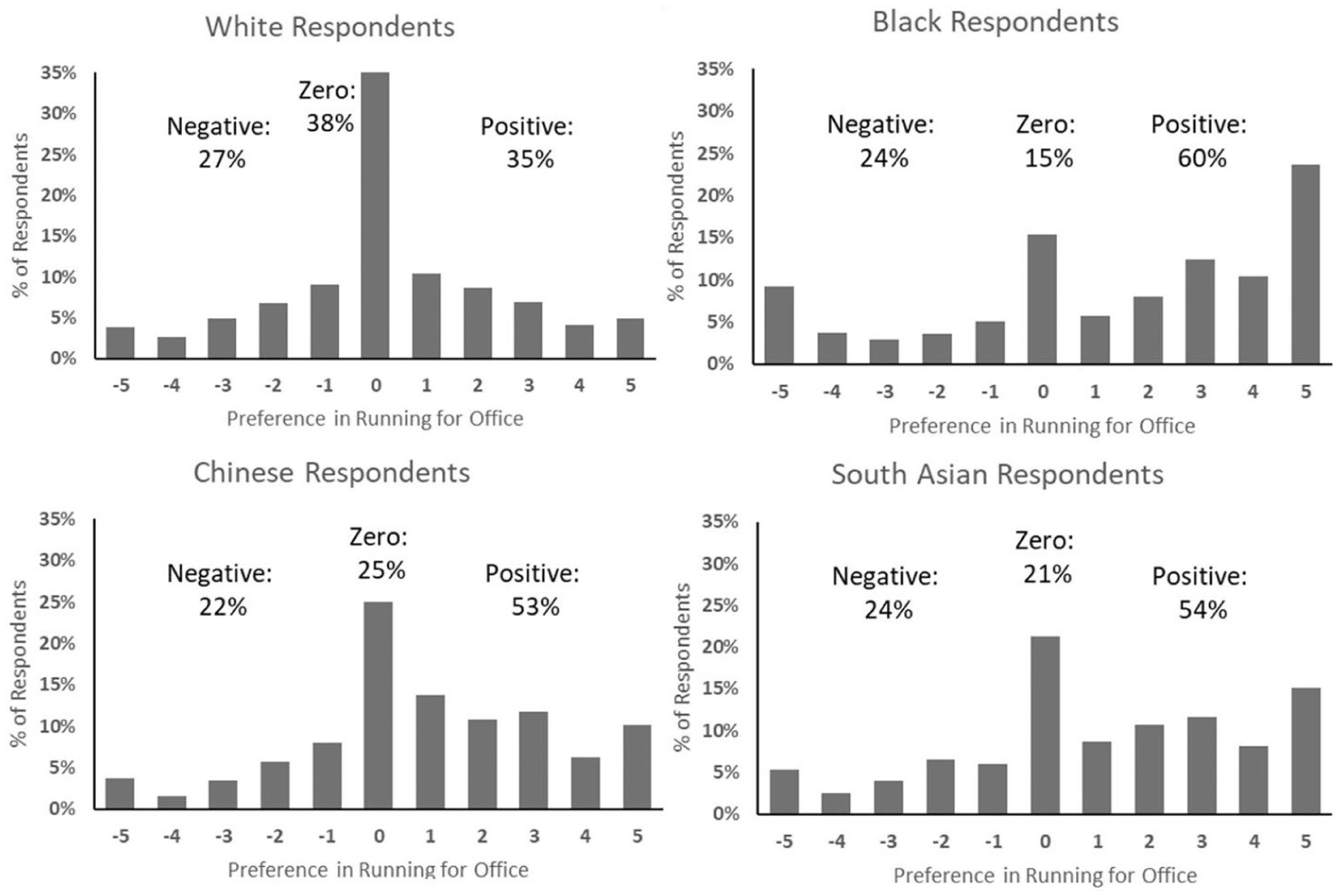
Distribution of responses to preference in running for office.
Given our interest in the effects of varying diversity in candidate slates, Figure 4 shows the average RFO preference across the conditions (listed in Table 1). For racialized respondents, the two conditions with one co-ethnic and two racialized candidates (Conditions 4 and 5) were collapsed to simplify comparison. Our first hypothesis, the baseline affinity expectation that racialized respondents would express a stronger preference for the more diverse district, was clearly supported across all conditions, with the average preference being strongly positive in all cases. White respondents also expressed a slight preference for the more diverse district—fittingly, when comparing identically diverse slates of three white candidates.
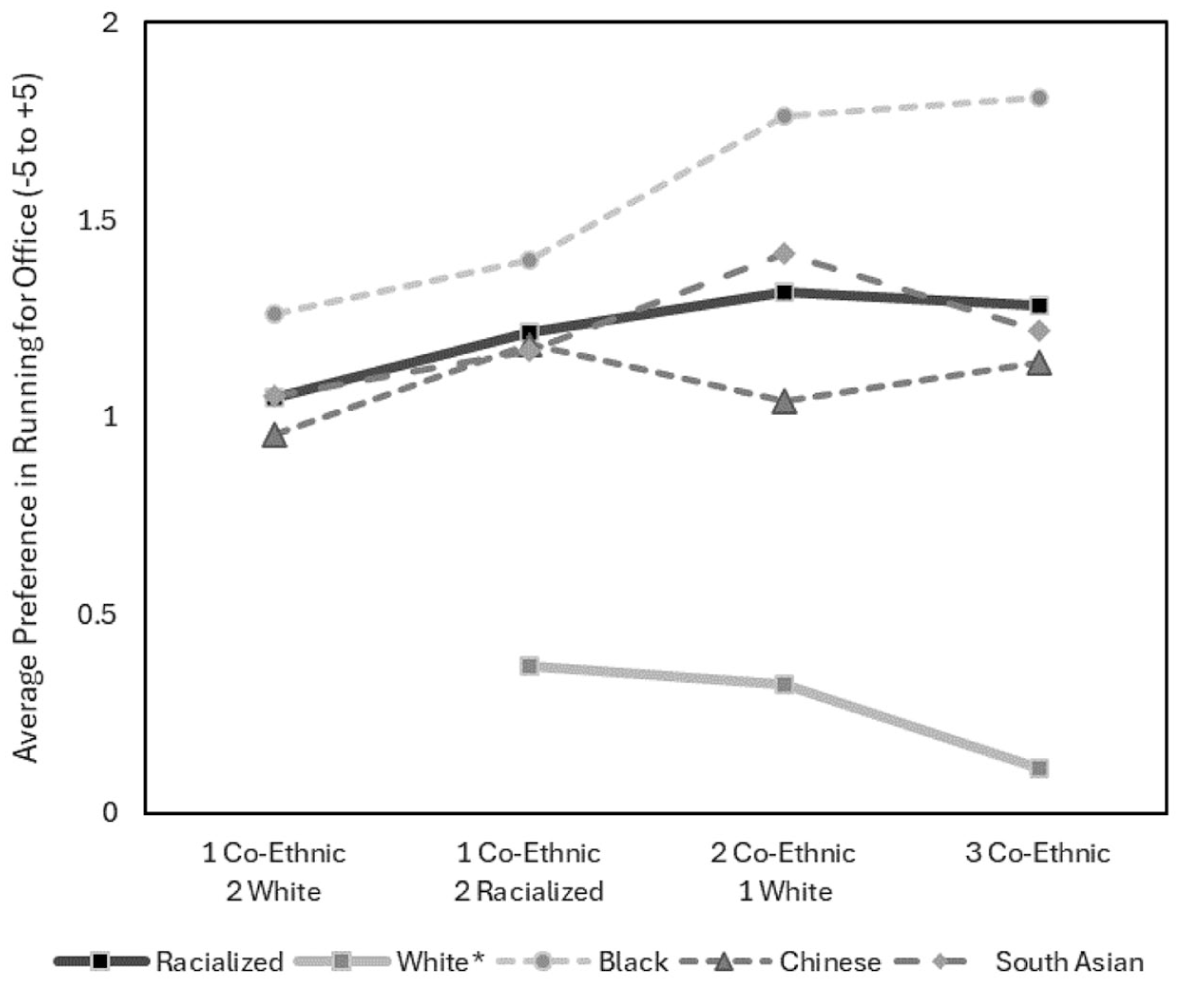
Average preference in running for office, by diverse candidate slate condition.
Our second hypothesis posits that RFO preference strengthens as more affinity candidates are presented. Figure 4 presents a complex picture but broad support for this claim. Racialized respondents expressed the weakest preference (1.05) in running for office in the least diverse scenario of one co-ethnic and two white candidates versus the all-white slate. This increased to 1.22 for the district with one co-ethnic candidate and two candidates of another racialized group, and to 1.32 for the district with two co-ethnic and one white candidate, declining slightly for three co-ethnic candidates (1.29). The expected pattern was strongly corroborated for Black respondents: the average RFO preference in the first, least diverse scenario was 1.26, increasing as scenario diversity increases to 1.40, 1.76, then 1.81 in the most diverse comparison between, three Black candidates and the all-white slate. The results for Chinese and South Asian respondents, however, diverged from expectations. For Chinese, the co-ethnic affinity effect was strongest in the one Chinese/two other racialized candidates scenario, and declined when two and three Chinese candidates were presented. For South Asian respondents, the average preference for South Asian candidate slates increased up to two South Asian candidates, then declined by almost 0.2 points for three such candidates. These results suggested significant differences among racialized groups, in baseline co-ethnic affinity and in the effects of an increasing presence of co-ethnic candidates in comparison to an all-white slate.
These descriptive results do not account for other factors impacting RFO preference. In the next section, we analyze regression models that included respondent gender, age, education, political interest, political efficacy, party identification, and strength of ethnic group identity as control variables. Gender, age, education, and party identification were self-reported categorical variables. Political interest was measured on a 0–10 scale, where zero indicated ‘no interest at all’ and 10 ‘a great deal of interest’. Efficacy was an aggregate index constructed from Likert-scale responses to three standard statements: ‘Sometimes politics and government seem so complicated that a person like me can’t really understand what’s going on’, ‘People like me don’t have any say about what the government does’, and ‘The government does not care about what people like me think’, and ranged from 1 to 4. The aggregated score was reverse-coded so that higher values indicated stronger efficacy. Strength of ethnic group identity was measured by asking ‘how important’ the respondent’s ethnicity was to them, with response options ‘not at all important’, ‘not very important’, ‘fairly important’, or ‘very important’, again with scores ranging from 1 to 4, with higher values indicating ethnic group identity as being of greater importance.
Regarding partisanship, the treatment conditions always included a candidate from each of the three main parties (Conservative, Liberal, New Democratic Party), with each candidate’s party label randomly assigned. Likewise, the gender/name of individual candidates was randomly assigned. This was intended to ensure a more realistic scenario for participants, however the randomized combination and sequence of each candidate’s racial, partisan, and gender identity were not captured in our database. Hence, we did not examine the interaction effects of respondent and candidate partisanship (or gender) in this study, though we do investigate this in other parts of our research program.
The repeated-measures nature of the dependent variable—the run-for-office question asked of each respondent five times, in five different conditions—suggested the need for multilevel models, with the five Level-1 conditions clustered within each Level-2 respondent. The intra-class correlation coefficient (ICC) was used to determine the extent to which clustering mattered and was calculated as the ratio of the between-respondent variance to the total variance, with 0 indicating no clustering and 1 indicating full clustering. 9 The ICC here was 0.32, which was moderately high and implied the need for a multilevel structure to be modeled. We thus run models with fixed effects for the Level-1 conditions and Level-2 respondent characteristics as well as with random intercepts at the respondent level. The main model estimates are presented in Appendix Table A1: we present visual summaries in the next section.
Results
In this section we assess our hypotheses of baseline affinity and increasing affinity. To reiterate, H1 posits that racialized individuals should express a stronger preference for districts with co-ethnic candidates relative to districts with no co-ethnic candidates. This baseline affinity hypothesis was strongly supported by the model estimates shown in Figure 5: the coefficient on racialized respondents’ preference, as compared to white respondents’ preference, was positive, substantively large, and statistically significant (b = 0.92, p < 0.001). Indeed, an individual’s racialized status generated the largest standardized effect size in this model, increasing the preference for a diverse candidate context by one-third of a standard deviation.
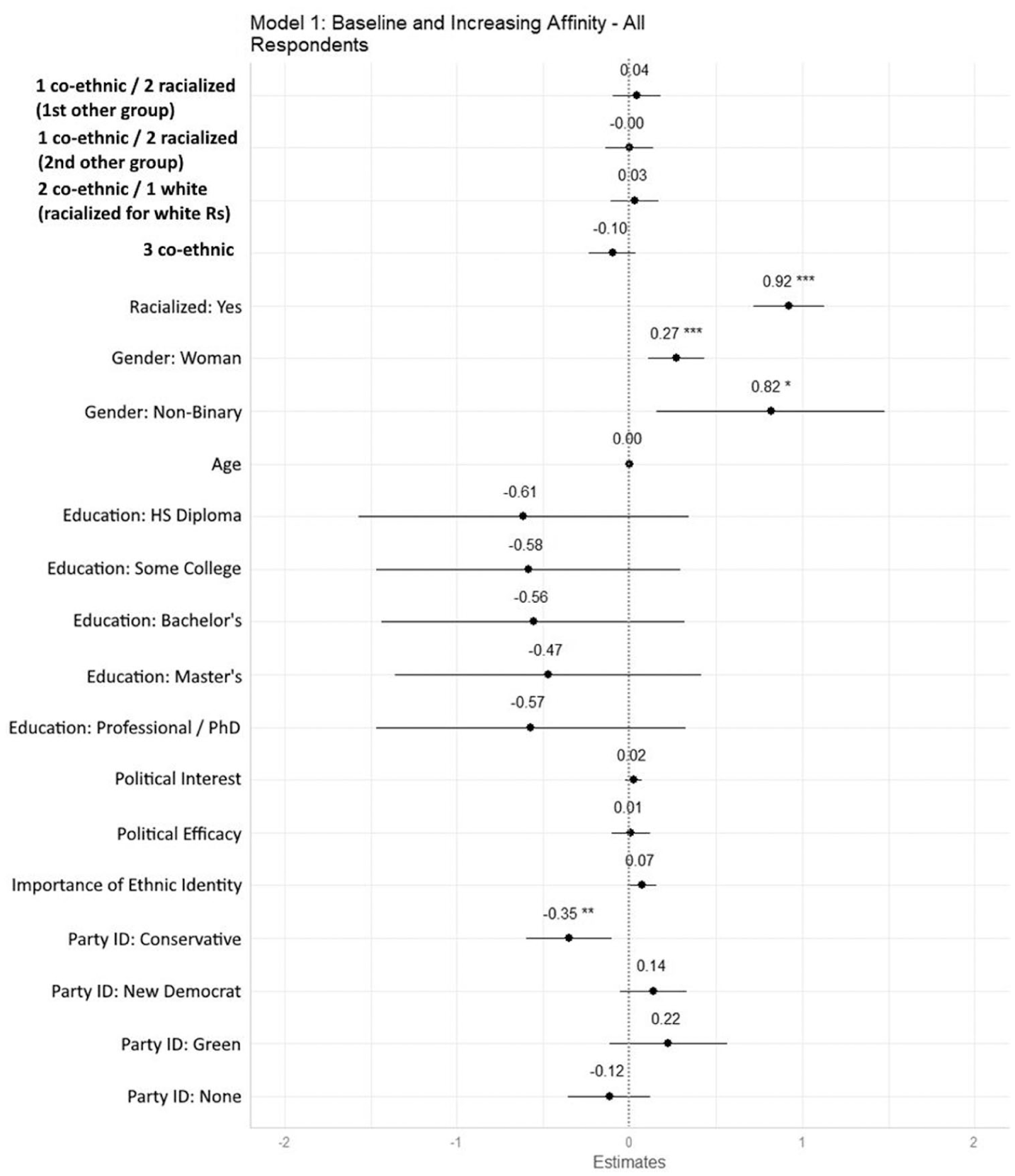
Estimates of fixed effects on the preference for a diverse district in running for office, all respondents.
H2 posits that racialized individuals should express stronger preference for districts as the number of co-ethnic candidates in a district increases: this was our increasing affinity expectation. In terms of the models, this claim would be demonstrated if the fixed effects on condition were statistically significant, positive, and increasing as we moved from the baseline condition, in which a district with one co-ethnic candidate and two white candidates was presented, through increasingly diverse conditions, with the three co-ethnic candidate condition (Condition 1) showing the largest effect. When we modeled this for all respondents (Figure 5), we saw no effect. However, this attenuation of effect was unsurprising given the inclusion of white respondents, who, as described above, were close to zero, on average for this aspect. To directly assess racialized affinity effects rather than general affinity for diverse candidate slates, we estimated a model including an interaction effect between racialized status and the district conditions. Conditions 4 and 5, both with one co-ethnic candidate and two non-co-ethnic, but racialized, candidates, had no significant effect when interacted with racialized status; however, Condition 2, with two co-ethnic candidates, and Condition 1, with three co-ethnic candidates were statistically significant (b = 0.33, p < 0.05; b = 0.48, p < 0.01). This comparison of preference between non-racialized and racialized respondents as a function of district conditions is visualized in Figure 6, which shows that for racialized respondents, increasing co-ethnic diversity in candidate slates was associated with an increased RFO preference, whereas there was no such pattern for white respondents.
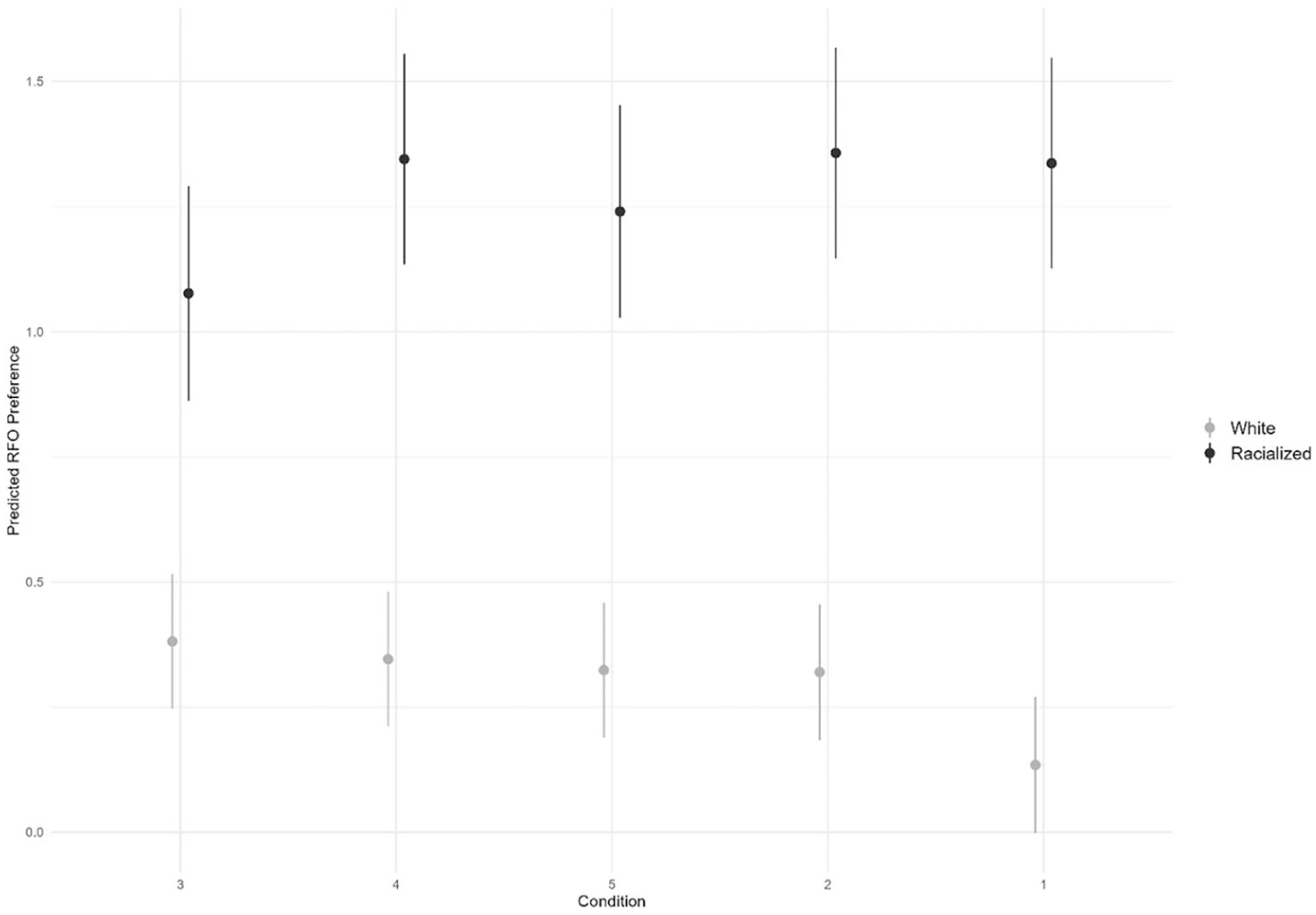
Predicted preference for running for office, by diverse candidate slate condition and racialized status.
We also estimated a model without white respondents and only racialized respondents who were Black, South Asian, or Chinese. These results are shown in Figure 7 and corroborated the partial support for the expectation of increasing affinity we found above. There was no significant difference in preference between the baseline condition (one co-ethnic, two white candidates) and Conditions 4 and 5 where one co-ethnic and two non-co-ethnic, but racialized, candidates were shown (e.g., a Black respondent shown one Black and two Chinese candidates). This might suggest the absence of a general rainbow coalition effect: the idea that racialized voters would favor racialized candidates with whom they do not share the same ethnic identity (cf. Besco, 2015). However, when presented with two and three co-ethnic candidates, racialized respondents’ positive preference increased. These effects were statistically significant relative to the baseline (b = 0.26, p < 0.05; b = 0.24, p < 0.01, respectively), though only moderately large—an increase of about one-tenth of a standard deviation. The difference between the conditions where two and three candidates were presented was not statistically significant. We therefore concluded that there was a small but meaningful impact on respondents’ RFO preference and in relation to increasing the number of candidates with whom they share ethnic identities, but the impact did not necessarily continue to increase in line with the number of such candidates. This raises the question whether homophily and role-model effects might be overridden by strategic considerations about winnability in certain electoral contexts 10 —A question for future research.
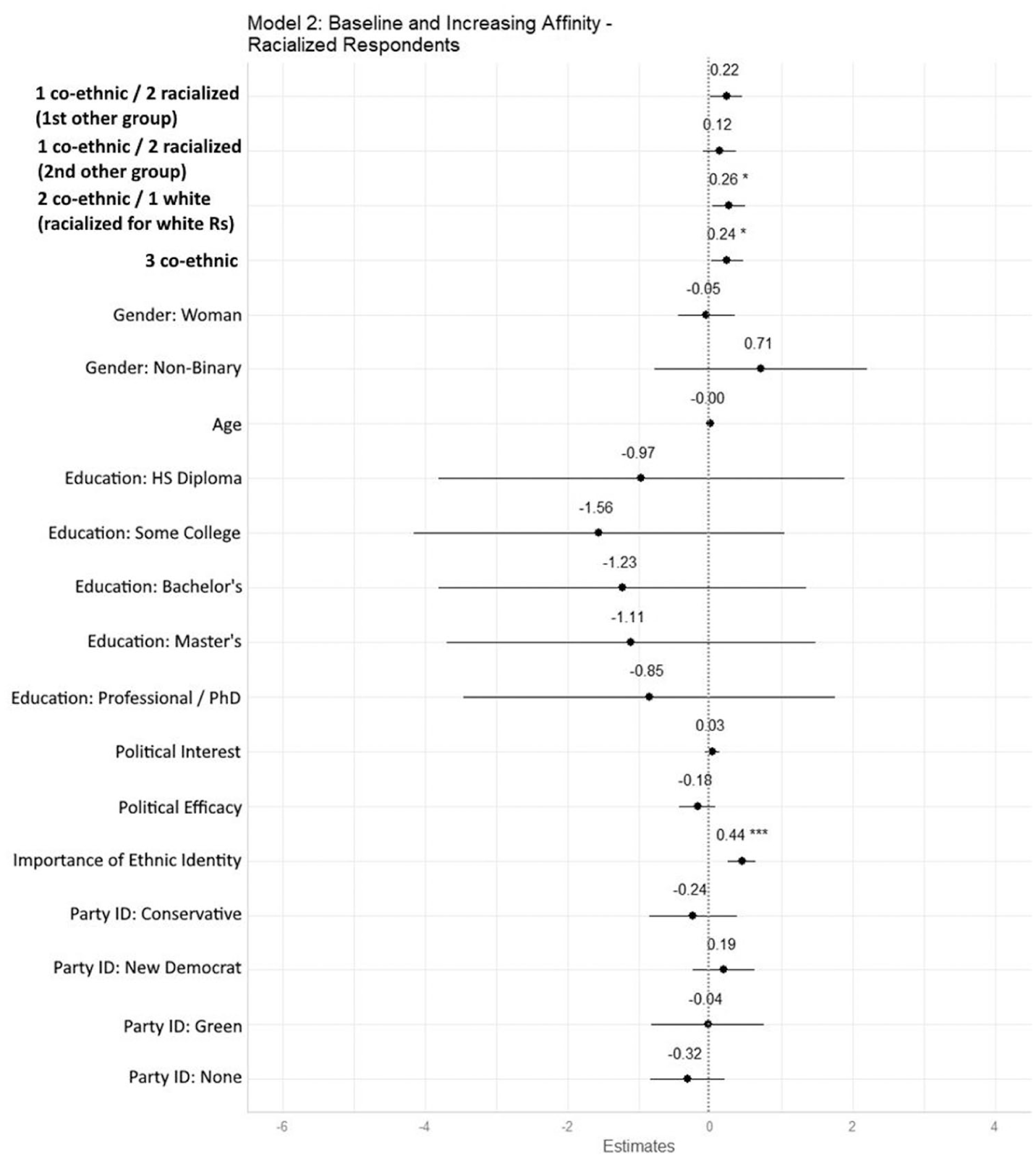
Estimates of fixed effects on preference for diverse district in running for office, racialized respondents.
The preceding results demonstrated the presence of racialized affinity effects on RFO preferences. We also identified the effects of other variables in the models. Most significant were the effects of respondent gender and party identification—specifically Conservative. Women and non-binary individuals were consistently shown to be more positive toward diverse candidate slates. Curiously, the gender association disappeared when white respondents were excluded, suggesting this effect was largely driven by white women and non-binary individuals. Conservative party identifiers were significantly more negative toward diverse candidate slates compared to the model baseline Liberal Party identifiers, whereas no other party identification was significantly different from baseline (People’s Party of Canada identifiers were also consistently negative, but their small numbers produced very large standard errors). These findings on gender and party identification were not surprising and support what we know generally about attitudes toward racial diversity in Canada: men and those who identify with more ideologically conservative parties are less likely to have pro-diversity views than others (Bilodeau et al., 2012).
Discussion and conclusion
Racialized representation is important, nowhere more so than in the Canadian context where strong and increasing population diversity, robust immigration levels, and official state policies recognizing multiculturalism have become core national characteristics. Yet, racialized minorities continue to be underrepresented in Canadian politics at all levels of government. This underrepresentation is driven by factors at all stages of the candidate emergence process, from individuals expressing interest in running for office, to the selection and filtering by party gatekeepers, to successfully being elected as legislators. Yet the expression ‘you can’t be what you can’t see’ tells us that representation begins with seeing ourselves represented, which gives us a sense of value and belonging.
Our study focused on the question of candidate supply, and specifically on the context and conditions under which racialized individuals would prefer to run for office. We know from previous work that racialized individuals are much more likely to be placed as candidates in districts with a high minority population share and prior minority candidates and elected officials. Yet research in Canada has not gone far enough to disentangle how much of this is due to the strategies of party selectors, versus affinity preferences of the aspirants themselves. Our study offers a preliminary contribution to that question, by shifting the focus to supply-side bias, and examining individual-level preferences using a survey quasi-experiment. We examined two questions. First, when asked to consider running for office, do racialized individuals express stronger preferences for districts with co-ethnic candidates? Second, is this effect strengthened when more co-ethnic candidates are presented? We found very strong support for the first question: racialized individuals expressed significantly stronger preferences for contexts with co-ethnic candidates when considering running for office. For the second question, we found that racialized individuals did express a stronger preference for more co-ethnic candidates, but not one that necessarily increased linearly: two or three co-ethnic candidates were significantly preferred to one, but the effects of two and three candidates were identical. We suggest that future research should investigate the mechanisms underlying these findings. Specifically, we do not yet fully understand the extent to which these patterns of candidate self-selection are rooted in relational considerations involving role models and homophily, or in more strategic calculations of winnability.
As noted above, our finding that both baseline and increasing affinities were present in racialized Canadians’ preferences about where to run for office has both positive and negative dimensions. The fact that racialized individuals strongly preferred diverse districts means that predominantly ethnic communities could effectively translate ethnic presence into representation. This supports prior research findings that ethnic density does not inherently undermine political integration but rather can foster democratic engagement and inclusion (Bloemraad, 2006). However, these preferences also suggest challenges in motivating racialized individuals to run (and win) in contexts outside predominantly minority districts, which is essential to achieve equitable representation overall. Only three racialized candidates successfully did so in Canada’s 2021 federal election: one, Michael Chong, was a long-time incumbent, and a second, Leslyn Lewis, had been elected provincially and was a high-profile candidate for the Conservative leadership in 2020. Another aspect of this challenge is the role of parties, given that minority candidates are still more likely to be sacrificial lambs nominated to districts their party is unlikely to win (Lapointe et al., 2024). Further, the growing urban–rural divide in Canada (Armstrong et al., 2022) raises concerns that racialized candidates of all parties may be dissuaded from running outside of large multicultural cities and suburbs. The other important regional divide concerns Quebec, where public support for religious neutrality can drive choices about the kinds of racial and religious minorities who emerge as candidates.
Our study contributes to understanding the causes of visible minority underrepresentation in Canada by demonstrating that when prompted to think about running for office, racialized minorities generally preferred contexts in which they shared ethnic identities with the existing candidates. Our quasi-experimental research design allowed us to focus on these self-selection choices, and how they may be shaped by role models and candidate homophily. However, we note three important limitations of the study that merit further research. First, we recognize that the prospect of running for office is relatively hypothetical for most individuals in the general public, and few individuals have even ‘nascent’ political ambition. The preferences they expressed when prompted to consider the prospect were thus somewhat artificial. However, these preferences still revealed perceptions about the contexts in which racialized and other individuals would feel most comfortable engaging in a core democratic right and privilege, and about the accessibility of political roles. Moreover, while, certainly, most people do not run for office, those who do are selected from the general public in models of candidate selection (e.g., Tolley, 2023), which considers anyone meeting eligibility requirements to be ‘eligible’. Finally, as noted earlier, we ran models and found similar results for a subset of only the most politically interested respondents, assuming that they would be most likely to consider running for office.
Second, although we went to great effort to oversample among Blacks, Chinese, and South Asians, the final sample size for each group was too small to obtain precise estimates of the variation among groups: we tested for differences, but the results were inconclusive. Research in Canada and elsewhere tells us that the experiences, values, and attitudes of different ethnocultural groups can vary tremendously. Exploring this variation is important in building our scholarly understanding, but also for real-world efforts to strengthen political inclusion and engagement. Thus, future work should consider how to reach and engage racialized respondents more effectively, for example by implementing multilingual surveys (see Barreto et al., 2018). Larger sample sizes of diverse groups would also facilitate intersectional analyses of how RFO preferences differs across identity subgroups, including women of color (e.g., Holman and Schneider, 2018).
Third, we recognize that the assessment of RFO preferences in this study was limited to candidate diversity. This was intentional, but it constrained our ability to consider other contextual supply- and demand-side factors in explaining racialized candidate emergence. One area to probe more closely will be the personal and contextual dimensions of political ambition, especially in the understudied Canadian case. These efforts should start with robust data collection on what inspires racialized (also Indigenous) individuals to consider running for office, examining covariates of ambition identified by prior research such as a politicized upbringing and the emotive power of perceived racial injustice. There has been some qualitative research that inspires further research on these issues in Canada (Wagner, 2025). Despite these limitations, our study strengthens the case for racialized affinity and the presence or absence of shared identities as important factors in relation to where and when racialized minority individuals emerge as candidates.
Supplemental Material
sj-docx-1-ips-10.1177_01925121251399863 – Supplemental material for Where to run? Racialized minority affinities for in-group candidate districts in Canada
Supplemental material, sj-docx-1-ips-10.1177_01925121251399863 for Where to run? Racialized minority affinities for in-group candidate districts in Canada by Kenny William Ie, Karen Bird, Joanna Everitt, Angelia Wagner and Mireille Lalancette in International Political Science Review
Footnotes
Acknowledgements
The authors acknowledge and thank the editor and anonymous reviewers for their insight and helpful comments during the revision of this manuscript.
Funding
The authors disclosed receipt of the following financial support for the research, authorship, and/or publication of this article: This study was funded by the Social Sciences and Humanities Research Council of Canada under the Insight Grant (435-2021-0346) and the Future of Canada project at McMaster University.

Supplemental material
Supplemental material for this article is available online.
Notes
Author biographies
References
Supplementary Material
Please find the following supplemental material available below.
For Open Access articles published under a Creative Commons License, all supplemental material carries the same license as the article it is associated with.
For non-Open Access articles published, all supplemental material carries a non-exclusive license, and permission requests for re-use of supplemental material or any part of supplemental material shall be sent directly to the copyright owner as specified in the copyright notice associated with the article.
