




Abstract
Although a large literature investigates cross-national differences in party mobilization, little is known about cross-national gender differences in electoral campaign contacts. Using the Comparative Study of Electoral System Module 4, which includes data from 2011 to 2016 and 32 countries, I find gendered patterns in reported contacts across different activities performed by campaigns. I test two potential explanation for these variations: electoral systems and women’s political participation. First, I find that women’s likelihood of reported contacts increases to a greater extent than men’s when electoral systems provide incentives for campaigns to increase their contact rates, decreasing and even reversing gender gaps. Second, I find limited support regarding the impact of the percentage of women in legislatures on gender differences in reported electoral campaign contacts.
Keywords
Introduction
The importance of electoral campaign contacts for voter turnout is consistently emphasized in the political science literature. To put it simply, citizens are more likely to turn out to vote if political parties and candidates encourage them to do so (Garcia-Bedolla and Michelson, 2012; Gerber and Green, 2000; Green and Gerber, 2008; Rosenstone and Hansen, 1993; Verba et al., 1995). Comparative studies highlight the role of electoral systems in fostering cross-national variations in contact rates (Karp, 2012; Karp et al., 2008; Rainey, 2015). Yet this literature rarely discusses cross-national differences in contact rates between women and men. This is puzzling in light of the recent findings on gender, political parties and electoral systems. 1 On the one hand, in many democracies, women are more likely to turn out than men, which might indicate that political parties and candidates are more likely to mobilize the former than the latter (Kittilson and Schwindt-Bayer, 2012). On the other hand, studies show that political parties are more responsive to men’s policy preferences than women’s (Homola, 2019), signalling that parties and candidates view men as their likely supporters. Consequently, cross-national differences should occur; yet there is little investigation into these and their explanations.
This paper proposes to fill this gap. I define electoral campaign contacts as activities engaged in by political parties and candidates where they reach out to voters through various means. 2 I find that although for some countries men report greater contact rates than women, the gap is reversed for other countries. I argue that two explanations may account for these cross-national gender differences in reported campaign contacts. First, electoral systems that provide incentives for campaigns to engage in higher levels of contacts should be associated with more equal contact rates for women and men. When campaigns need to engage in additional contacts to win seats, their efforts might target large demographically identified groups such as women, closing the gap with men’s likelihood of reporting contacts. Second, electoral campaigns might contact women and men more equally in countries where women have achieved greater equality in political participation. When women are more active in public life, they might challenge political actors’ traditional conceptions of who voters might be, leading to more equal rates of contact.
Using the Comparative Study of Electoral Systems (CSES) Module 4, which includes data from 2011 to 2016 and 32 countries, I show that women’s likelihood of reporting contacts is higher when electoral systems provide incentives for campaigns to increase their contact efforts, decreasing and even reversing the gap with men’s reported contact rates. I find limited support for the women’s political participation explanation; the presence of women in legislatures has little impact on gender differences in reported contacts.
Alternatively, when electoral systems provide campaigns incentives to increase their contact efforts, women could report greater contact rates not because campaigns actively pursue them, but because women are more likely to spend time on housework then men. Despite progress in achieving gender equality, traditional gender roles dictate that women ought to organize their family’s home life. Women might be more likely to answer phone calls, get the mail and be at home than men. Consequently, when campaigns engage in strategies such as door-to-door canvassing, mailing leaflets and calling voters, they might be more likely to reach women than men. I examine gendered patterns of cross-national differences for different types of contact. I find that indeed, when electoral systems provide greater incentives to mobilize voters, more women than men report contacts that coincide with housework such as being at home, getting the mail and answering the phone. There is no gendered impact for other contact types, including by text, email and social media.
These results contribute, first, to the literature on party mobilization by adding that contact incentives provided by electoral systems do not influence every group similarly. Although there is an important literature on the role of electoral systems in shaping mobilization, little is known about how these incentives influence political parties’ mobilization strategies of different groups. I show that women’s and men’s probabilities of reporting campaign contacts are affected differently by electoral systems. I extend the literature on the gendered effects of electoral systems by focusing on campaign strategies, mainly whom they contact. Second, by focusing on types of contact, I provide evidence that traditional gender roles might explain women’s greater likelihood of reporting contacts when campaigns have incentives to increase their efforts. Although campaigns might not specifically decide to target women, their actions nevertheless have the consequence of bringing women into the political process. This highlights an additional avenue through which electoral systems and political actors can increase women’s electoral participation.
Explaining electoral campaign contacts in a cross-national setting
Previous cross-national investigations find important differences in the extent to which electoral campaigns contact citizens (Karp et al., 2008). Three sets of variables have been investigated to understand why citizens in some countries are more likely than those in other countries to report being contacted by campaigns: the electoral system, the party system and the political system (Dalton et al., 2011).
First, cross-national investigations of campaign contacts emphasize how electoral systems foster high-salience elections (Karp, 2012; Karp et al., 2008; Rainey, 2015). Rainey (2015) argues that districts employing winner-takes-all rules create a larger prize than multi-member districts do. This situation leads political parties to engage in greater mobilization efforts since the reward for winning is greater than it would otherwise be if seats were distributed proportionally to votes. As political parties increase their mobilization efforts, more citizens should be directly contacted (Karp et al., 2008). There are more incentives for political parties and candidates to mobilize a few extra voters under single-member districts (SMD), but only if the election is competitive (Cox, 1999). Contacting these few extra voters under multi-members districts may not result in a large change in the number of seats the party wins even if the election is competitive; thus, contact efforts by political parties and candidates should be lower under multi-member districts than in competitive SMD elections. Furthermore, under SMD, it is easier for candidates to develop a personal vote as each party only fields one candidate. Voters can more easily identify their representative, which can lower the cost of engaging in mobilization for candidates (Karp et al., 2008). Plurality electoral systems where the candidate receiving the most votes is elected are also associated with greater campaign contacts. Plurality systems tend to have lower turnout levels, meaning that higher contact levels have a greater potential to influence the outcome of the election (Karp et al., 2008). Under these circumstances, parties and candidates may get a bigger reward – winning the seat – by engaging in mobilization.
The second set of factors influencing cross-national differences in campaign contacts is the party system. The degree of proportionality of the electoral system – that is, the relationship between parties’ shares of the votes and shares of the seats – is a key factor in understanding contact levels (Cox, 1999; Karp et al., 2008). Briefly, in proportional representation (PR) systems, since citizen preferences are better translated into seats, parties have incentives to contact voters evenly across the country. In contrast, in plurality and majoritarian systems, preferences are not translated into seats proportionally; thus, parties focus their contact efforts only where they believe they can gain seats, leading to overall lower levels of contact.
Third, Karp and Banducci (2007) find differences in campaign contact rates between established and new democracies. They argue that political parties in new democracies have fewer resources, are less organized and are less experienced in mobilization. These factors likely make engaging in contact efforts costly. Alternatively, countries with higher socioeconomic development experience higher levels of campaign contacts (Dalton et al., 2011).
Studies of individual-level factors associated with campaign contacts find that political parties reach out to voters who have a high propensity for turning out (Karp et al., 2008). There is evidence that women are less likely than men to report being contacted by parties and that cross-national differences occur. In an investigation of 32 countries, Magalhães et al. (2020) find that women are significantly less likely than men to report contacts face-to-face, by text, by email and by social network, whereas they are more likely to report contacts by mail and phone than men. Abrajano et al. (2020) find that political parties in California are more likely to target women than men.
Module 4 of the CSES includes a series of question asking respondents whether they were contacted by a party or a candidate in the last election and, if yes, whether the contact was face-to-face, by phone, by mail, by email, by text and/or by web or social network. Figure 1 illustrates the gender gap in any type of contact measured as the difference between the percentage of women reporting a contact by a party or candidate, and the percentage of men reporting the same. Figures illustrating the gender gap for other types of contact are included in the Appendix (Figures A1 to A6). As Figure 1 shows, the largest negative gap is in Germany where 58% of men reported a contact compared to 47% of women – a gender gap of 11 percentage points. At the other end, Israel has the largest positive gender gap where 47% of men compared to 56% of women reported being contacted – a 9 percentage points gap. Between these two poles, many countries experience little gender difference; Brazil, Mexico and Austria all have a gender gap near zero, for instance. Another gendered pattern in reported contact rates emerges when types are considered (Figures A1 to A6). More countries exhibit positive gender gaps when the type of contact coincides with traditional household work such as phone and mail. But again, cross-national variations occur. Finally, I find little cross-national difference in gender gaps for newer forms of campaign contacts, including text message, email and social network or web.
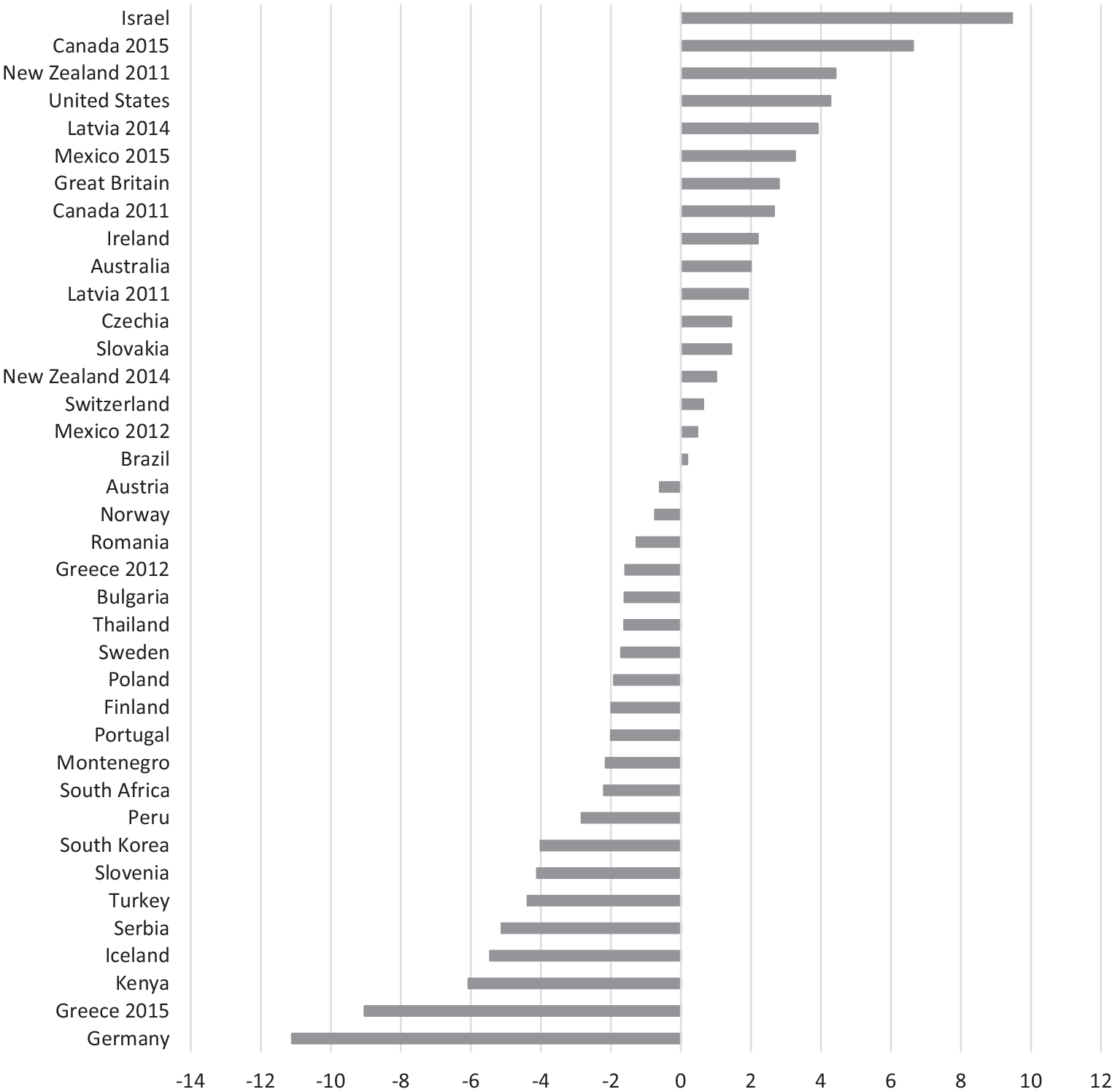
Gender gaps in electoral campaign contacts.
Gender, electoral systems and campaign contacts
Electoral campaigns contact citizens with a high propensity for turning out, such as previous voters, urban voters, and members of unions (Karp et al., 2008). Figure 1 and Figures A1 to A6 indicate that in some countries, campaigns might view men as a high-turnout group as their reported contact rates are higher than for women. This is in spite of recent studies demonstrating either no significant gender difference in turnout or women having a higher turnout rate than men (Stockemer and Sundstrom, 2023). 3 However, campaigns might view men as more likely to be voters and supporters since they are more politically active (Beauregard, 2014; Kittilson and Schwindt-Bayer, 2012); having higher levels of political interest and knowledge (Kittilson and Schwindt-Bayer, 2012); and more likely to engage in political discussions (Nir and McClurg, 2015) than women in many countries. This greater political participation and engagement of men when compared to women might decrease the cost associated with contacts.
Yet cross-national differences occur in the size and direction of gender gaps. I argue that electoral rules and women’s political participation might contribute to explaining these differences. First, contact is contingent on the electoral context – that is, the incentive structure provided by electoral systems (Arceneaux and Nickerson, 2009). High-salience elections result in more citizens aware of and interested in the outcome, creating incentives for political parties and candidates to mobilize low-propensity voters. These voters might be more receptive to contact efforts in high-salience elections since they are more likely to have an interest in the outcome. This creates incentives for campaigns to increase their contact efforts. In low-salience elections, contact efforts targeted toward low-propensity voters are less likely to be successful and, consequently, campaigns might decide to focus on high-propensity voters.
Kittilson and Schwindt-Bayer (2012) argue that women constitute an ‘undertapped market’ in politics. Women have not realized their full political potential since men are more likely to be represented in politics, to be selected as political leaders and to participate in various electoral activities. Consequently, Kittilson and Schwindt-Bayer argue that ‘women are an especially rich target for parties seeking to expand their bases of support’ (2012: 19). As such, I hypothesize that electoral campaigns target women to a greater extent when they have the incentives to increase contact efforts. If campaigns are more likely to contact voters under highly competitive elections that occur under plurality electoral systems (Karp et al., 2008), they may be more likely to reach out to this ‘undertapped market’, leading to higher reported contact rates for women and smaller gender gaps.
Other aspects of plurality systems are also conducive to increased contact rates for women, such as SMD and lower voter turnout. As discussed above, if voters can more easily identify their representative and other candidates running for office under SMD, the cost of engaging in mobilization is lower for campaigns, which increases overall contact rates. Similarly, when turnout is low, campaigns can obtain a bigger reward by engaging in increased contact efforts since the number of votes needed to win is lower than it might otherwise be. Again, because women constitute an ‘undertapped’ political market, they might report greater contact rates than men when these conditions are met. If campaigns increase their contact efforts, it is a better allocation of resources to focus on larger demographically identifiable groups such as women. Thus, under plurality systems, increased competitiveness, SMD and lower voter turnout should lead to higher likelihoods of reported contacts for women and men, but the impact should be stronger for women, decreasing gender gaps.
H1: Plurality electoral systems should be associated with a higher likelihood of reporting electoral campaign contacts for women than for men, decreasing gender gaps.
Furthermore, the proportionality of electoral systems is associated with varying contact rates (Cox, 1999; Karp et al., 2008). When votes are better translated into seats, political parties have incentives to mobilize evenly across the country as opposed to only where they are certain to win seats. Kittilson and Schwindt-Bayer (2012) refer to PR systems as more inclusive since political parties have greater incentives to mobilize social groups that are easily identifiable at the national level, because every additional vote obtained by parties can have an impact on the number of seats won. Since women have long been excluded from the political system and still engage and participate at lower rates than men, their political potential is undertapped. Kittilson and Schwindt-Bayer (2012) argue that under PR, political parties are likely to mobilize women to obtain their support, resulting in higher levels of political participation and engagement. Consequently, this increased mobilization of women should lead to higher reported contact rates for women. Indeed, Teele (2023) finds that the introduction of PR in Norway increased the competition for votes and decreased the gender gap in voter turnout, especially in previously uncompetitive districts. The increased contact efforts under PR should lead to higher reported contact rates for women and men, but the impact should be higher for women, resulting in smaller gender gaps.
H2: More proportional electoral systems should be associated with a higher likelihood of reporting campaign contacts for women than for men, decreasing gender gaps.
Alternatively, when campaigns engage in contact efforts, they might reach women to a greater extent not on purpose, but because of the types of contact employed. Women might be more likely to be targeted because of traditional gender roles that lead them to spend more time than men on housework. Women might be more likely to engage in activities such as answering the phone or getting the mail, resulting in them receiving communications from political parties and candidates. As such, the link between increased campaign contact efforts and smaller gender gaps is not that campaigns actively decide to target women as an ‘undertapped’ group. Traditional gender roles could better explain higher reported contact rates for women and smaller gender gaps when campaigns engage in greater contact efforts. With CSES survey data, it is difficult to determine which of these two possibilities can account for women’s higher reported rates of contact when electoral systems provide incentives to increase contact activities. However, it is possible to expect higher reported contacts for women for types that coincide with housework if indeed campaigns accidently reach women when they increase their contact efforts. In other words, I expect increases in women’s likelihood of reported contacts to be greater than men’s for face-to-face, mail and phone contacts. On the other hand, if campaigns specifically decide to target women when they have incentives to increase their contact activities, the impact on women’s reported contact rates and gender gaps should occur for all types.
H3A: Gendered impact of campaign contacts and smaller gender gaps following incentives to increase efforts should occur for all types of contact.
H3B: Gendered impact of campaign contacts and smaller gender gaps following incentives to increase efforts should occur for types of contact that coincide with housework.
Finally, political parties and candidates might be more inclined to reach out to women to a greater extent in countries where women participate in political life at similar levels to men. The presence of women inside political parties can push political parties to increase their efforts to represent women’s interests. Looking at party platforms, Kittilson (2011) shows that the percentage of women Members of Parliament (MPs) in a party delegation is associated with greater attention to social justice issues, while Green and O’Brien (2016) demonstrate that the percentage of women MPs is associated with more left-wing party platforms. Consequently, it is possible that elected women might directly target women in their (re-)election campaigns and use their position within their parties to advocate for greater campaign contacts directed to women, leading to increases in women’s likelihood of reported contacts by campaigns that is greater than men’s, resulting in smaller gender gaps.
H4: A higher percentage of women elected in legislatures should be associated with a higher likelihood of reported campaign contacts for women than for men, decreasing gender gaps.
Data and method
Module 4 of the CSES is employed to assess explanations for cross-national differences in gender gaps in reported campaign contacts. Module 4 includes data from 2011 to 2016 and comprises post-election surveys from 32 countries. The dataset is well suited since it includes questions asking whether respondents have been contacted by a party or a candidate in the last election and, if they answered yes, whether they were contacted face-to-face, by phone, by mail, by email, by text and/or by social networks. 4
Using these questions as dependent variables follows previous investigations of party mobilization and party contact where respondents reporting contacts are coded ‘1’ and others ‘0’. Each type of contact is analysed separately and is coded ‘1’ for contact reported and ‘0’ for no contact. Since I cannot distinguish between contacts made by a candidate or a party, I focus on campaign contacts as the dependent variable. Contacts can be viewed as a first step towards mobilization – that is, parties and candidates successfully convince respondents to turn out to vote and support them. The questions included in the CSES cannot test whether the reported contacts by political parties and candidates have been successful in mobilizing respondents. As such, the analyses below focus on reported contacts only. When parties and candidates increase their mobilization efforts in response to incentives provided by electoral systems and/or the political participation of women, we should observe an increase in the number of contacts reported by citizens. However, since the questions used rely on recall efforts by survey respondents, it is possible that campaign contacts are over-reported (Karp et al., 2008) and that over-reporting is more common among men than women, as it is for voter turnout (Stockemer and Sundstrom, 2023). Control variables described below are used to minimize this possibility. Furthermore, the desirability bias for contacts might be weaker, as being contacted by a political party or candidate is not as socially desirable as voting, decreasing the likelihood that men and women would indicate being contacted when they have not.
I include all countries in the CSES for which the core dependent and independent variables are available. This means that for some countries two election surveys are included. The main independent variable of interest is gender where ‘1’ is used for women and ‘0’ for men. Additional independent variables include plurality electoral systems and the level of disproportionality. For plurality electoral systems, countries where most seats are determined employing a winner-takes-all rule or plurality are coded ‘1’ and those who do not are assigned ‘0’. 5 The Database of Political Institutions (Cruz et al., 2018) is used to code this indicator. Gallagher’s least squares index of disproportionality, which measures the difference between the percentage of votes political parties earned and their percentage of seats in the lower or only chamber of the national legislature, is used to measure the level of disproportionality (Gallagher, 1991; Gallagher and Mitchell, 2005). 6 The index varies between ‘0’ and ‘100’ where ‘0’ represents a perfect concordance between votes and seats and ‘100’ means a complete distortion between votes and seats. Data are obtained from Gallagher and Mitchell (2005). 7 The impact of women’s political participation on gender differences in reported contacts is assessed by including the percentage of women elected in legislatures as an independent variable. The percentage of women elected in the lower or only chamber of the legislature in the election previous to the one included in the CSES is used; data originate from the Inter-Parliamentary Union.
Interaction terms between gender and each indicator of electoral systems and women’s political participation test whether these explanations account for gender differences in reported campaign contacts. Multilevel logistic regressions with a random intercept and a random slope for the gender variable (Heisig and Schaeffer, 2019) assess the hypotheses elaborated above. 8
Control variables at the country and the individual level are included in the statistical analyses to assess the influence of other factors that might impact gender differences in reported contacts. The effective number of political parties (ENPP) index designed by Laakso and Taagepera (1979) aims at capturing the number of meaningful parties in a system. It calculates the number of parties weighted by party size – that is, the percentage of votes each party has received in the election. The ENPP is provided by the CSES. Increased number of reported contacts might occur when more parties compete for votes (Karp, 2012). 9 The CSES also provides each country’s gross domestic product (GDP) per capita. I transform this measure by taking the log of the GDP per capita. Political parties and candidates in countries with higher GDP per capita might have more resources devoted to electoral campaigns, leading to higher reported contact rates (Dalton et al., 2011). 10 The CSES includes data on compulsory voting (CV), where countries employing CV are coded ‘1’ and otherwise ‘0’. Previous studies emphasize that CV creates strong incentives for political parties to reach out to all citizens (Keaney and Rogers, 2006; Lijphart, 1997). Whether each country has a parliamentary (0) or presidential regime (1) is added since regime type can affect levels of party mobilization. Countries with a presidential regime conduct two separate elections, one for president and one for the legislature, which can boost parties’ opportunities to contact citizens (Blais, 2000). Data originate from the CSES. 11 Finally, individual-level controls include education level, marital status, age, union membership and partisanship. 12 Previous turnout is excluded from the analyses since it tends to be over-reported in surveys due to the desirability bias toward voting.
Findings
Table 1 lists results for the interaction terms assessing the gendered impact of electoral systems and women’s political participation on reported campaign contacts for all types. The table only includes results related to the hypotheses; Table A4 in the Appendix presents the full results with control variables. The interaction terms between gender and the main independent variables assess whether women and men have different likelihoods of reported contacts under different conditions. Starting with H1 concerning the impact of plurality electoral rules on gender differences in reported contacts, the interaction term is significant at the p < .05 level for any contact, face-to-face, mail and phone contacts. This indicates that the impact of plurality on women’s likelihood of reporting contacts is significantly different from the impact on men’s likelihood. To better understand results of the interaction terms in Table 1, post-estimation effects are graphed since the interpretation of the interaction terms and their sign is not always straightforward (Kam and Franzese, 2007). Figure 2 illustrates the marginal effects of gender – that is, the gender gap – in reported contacts for plurality and non-plurality countries when all control variables are held at their mean for types of contact with significant interaction terms. 13
Gender differences in campaign contacts.
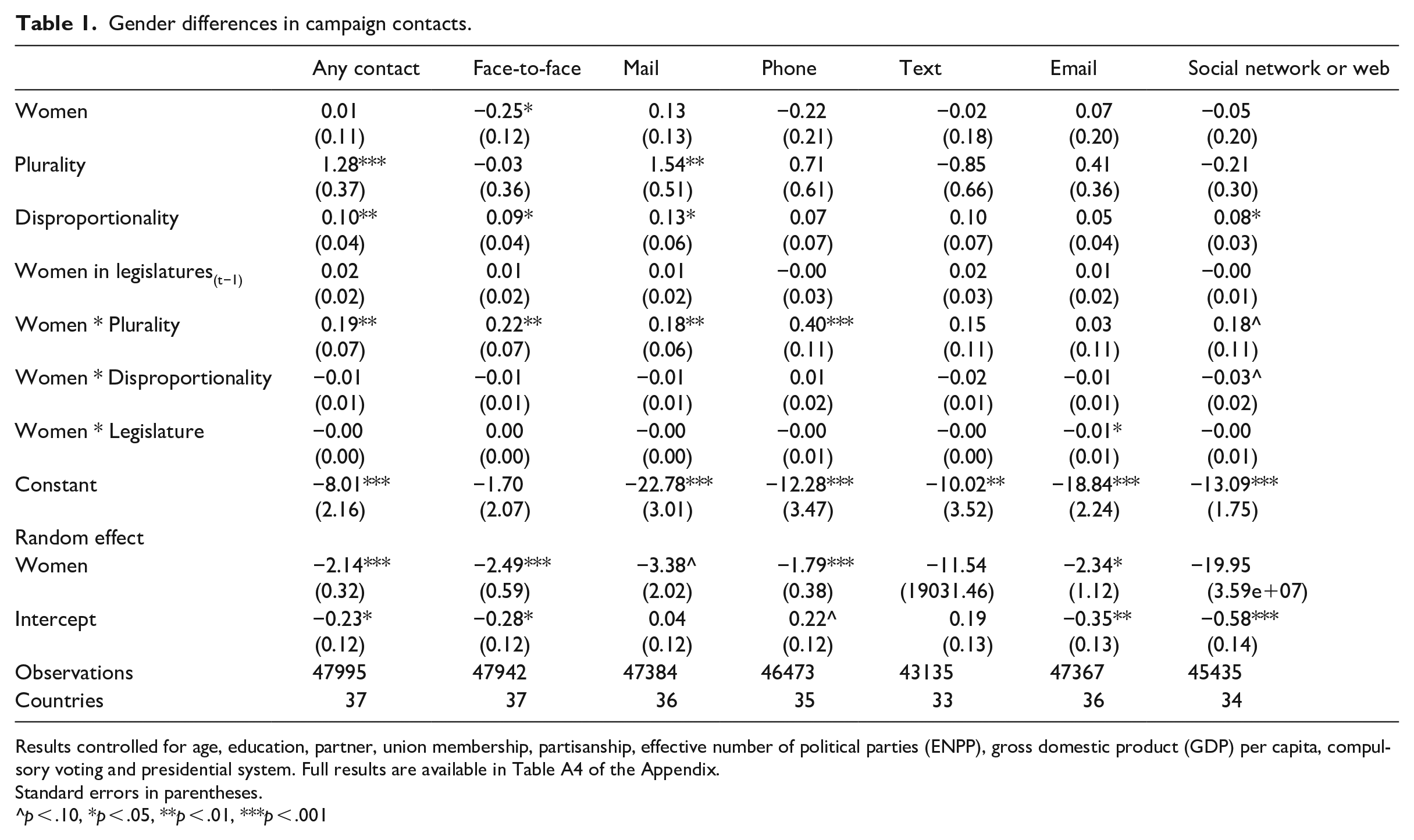
Results controlled for age, education, partner, union membership, partisanship, effective number of political parties (ENPP), gross domestic product (GDP) per capita, compulsory voting and presidential system. Full results are available in Table A4 of the Appendix.
Standard errors in parentheses.
p < .10, *p < .05, **p < .01, ***p < .001
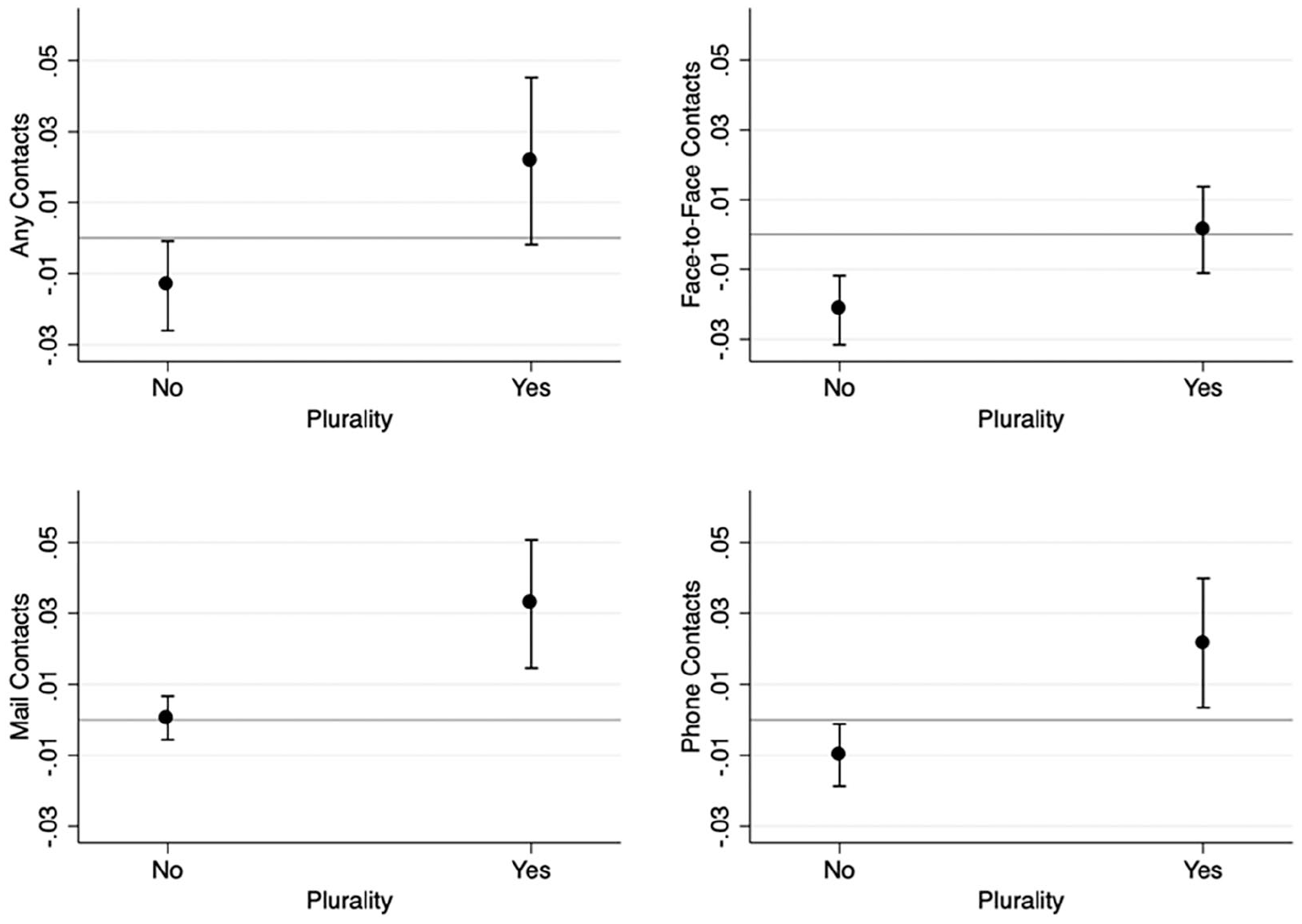
Plurality systems and gender gaps in campaign contacts.
For any, face-to-face and phone contacts, Figure 2 shows that in countries without plurality systems, there is a significant gender gap (the 95% confidence interval does not include zero) where men are more likely than women to report contacts. Under plurality systems for any and face-to-face contacts, the gender gap is no longer significant, meaning women and men are as likely to report contacts. For phone contacts, the gender gap under plurality systems is significant, with women being more likely to report contacts than men, indicating a reversed gender gap. For mail contacts, there is no significant gender gap under non-plurality systems, whereas the gender gap is positive and significant under plurality. Overall, Figure 2 provides evidence supporting H1, stipulating that political parties and candidates are more likely to contact women under plurality electoral systems because there is greater competition for votes. Strikingly, for phone and mail contacts, women are significantly more likely to report contacts than men under plurality systems. This provides support for H3B which hypothesizes that women are contacted to a greater extent under more competitive electoral systems, not because political parties specifically target them, but because women are performing more housework. However, this evidence is limited as direct observations on campaigns’ strategic decisions are not available in the dataset used for this investigation.
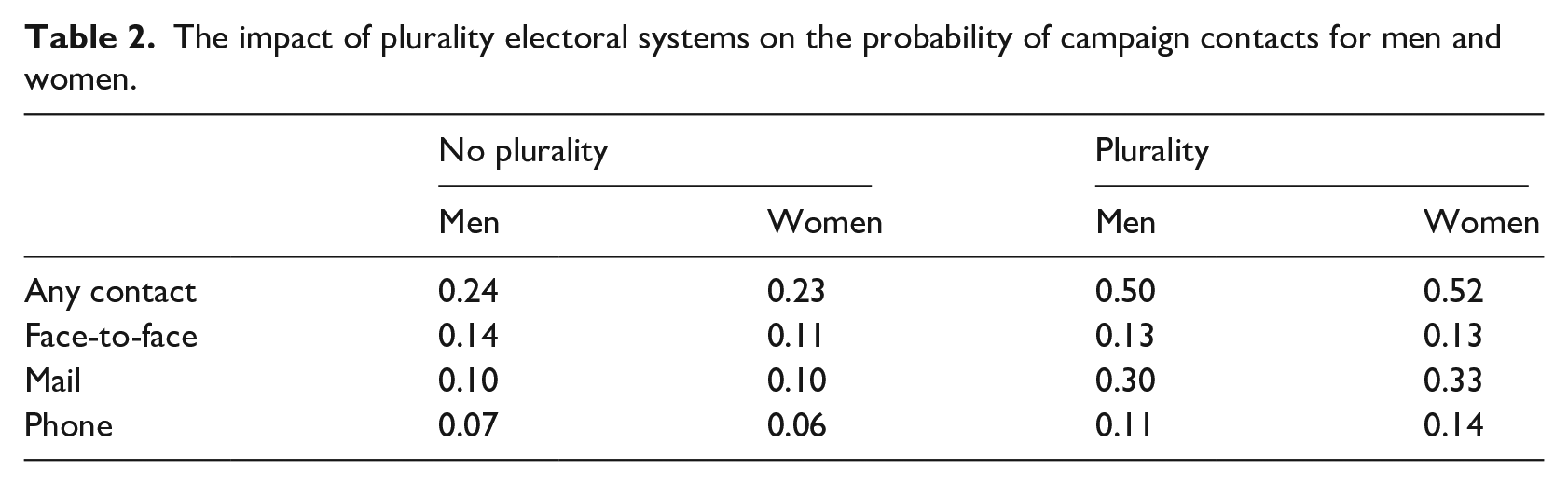
To better illustrate the substantive impact of plurality electoral systems on likelihoods of reported contacts for women and men, I calculate the probability of contact for respondents in countries without and with plurality systems while holding all control variables at their mean. Table 2 provides these probabilities. Looking at the probability of reporting any contacts, in countries without plurality systems, women have a slightly lower probability than men (0.23 and 0.24 respectively). Women and men have higher probabilities of reporting contacts in countries with plurality rules, but women’s probability increase to a greater extent than men’s (0.50 for men and 0.52 for women). For face-to-face and phone contacts, Table 2 similarly shows that men have a somewhat higher probability of reporting contacts than women in countries without plurality. There is little increase in the probability of reporting contacts face-to-face or by phone under plurality for men, but there is a larger increase for women, closing the gap with men’s probability for face-to-face contacts (0.13 for both) and reversing the gender gap for phone contacts (0.14 for women and 0.11 for men). For mail contacts, there is no difference between men’s and women’s probabilities of reporting contacts under plurality systems (0.10 for both), while women have a higher probability than men in plurality systems (0.33 and 0.30 respectively). Overall, these probabilities indicate that plurality electoral systems increase reported contact rates for women and men for some types of contact and this increase is larger for women, supporting H1.
The impact of plurality electoral systems on the probability of campaign contacts for men and women.
Next, Table 1 shows there is no support for H2 on the gendered impact of levels of disproportionality on reported campaign contacts. None of the interaction terms between gender and disproportionality are significant for any types of contact. As for results for H4 on the impact of women in legislatures, Table 1 provides little support for this hypothesis. Only one interaction term reaches the p < .05 level of significance – email contacts.
As for plurality electoral systems, to better understand the gendered impact of the percentage of women in legislatures on the likelihood of reporting contacts by email, I graph the marginal effects of gender for various levels of women’s representation in legislatures. Figure 3 illustrates that when the percentage of women elected in the legislature is below 20%, there is no significant gender gap in the likelihood of reporting email contacts as the 95% confidence interval includes zero. When the percentage of women is above 20%, gender differences are significant and negative, meaning that men are more likely to report contacts by email than women. This result is contradictory to H4, stipulating that women ought to report contacts to a greater extent when women’s representation is higher, leading to smaller gender gaps.
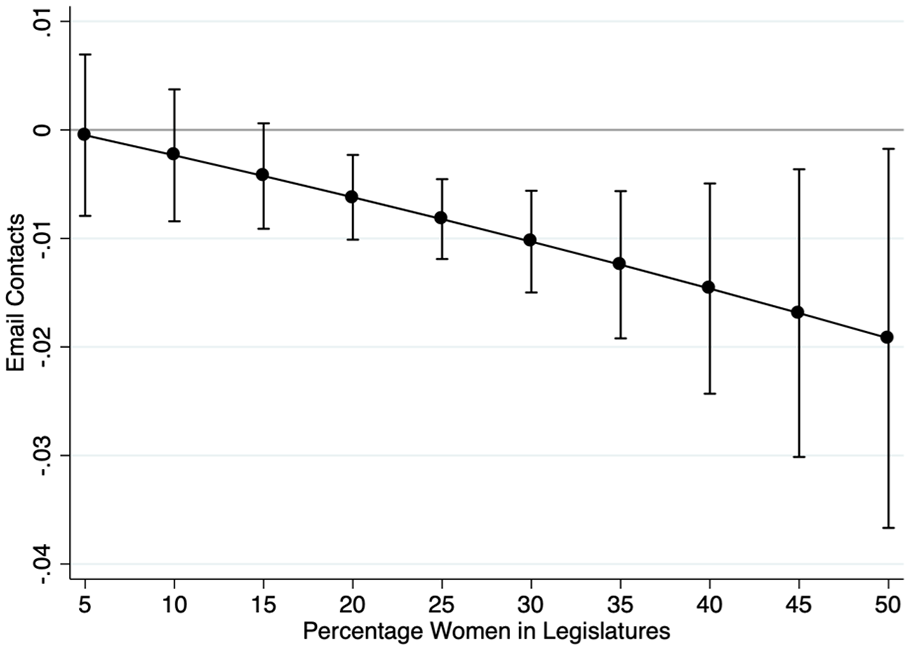
Percentage of women in legislatures and gender gaps in campaign contacts.
Nevertheless, I calculate the probability of reporting email contacts for women and men for various percentages of women in legislatures when control variables are held at their mean. Results are listed in Table 3 and show that both women and men have a small probability of reporting email contacts across percentages of elected women. For instance, the probability of reporting contacts for women and men when the percentage of women in 20% is 0.03. At 50% of elected women, men’s probability increases to 0.05 whereas women’s probability remains unchanged. Again, these results do not support H4, stating that the increase in the probability of reported contacts should be greater for women than it is for men, decreasing gender gaps. Since this is the only significant result in Table 1, it is likely is due to chance and there is no gendered influence of elected women on reported campaign contacts.
The impact of women in legislatures on the probability of email contacts for men and women.

In sum, plurality electoral systems contribute to some extent in understanding gender differences in reported campaign contacts, supporting H1. I find no support for H2 on the gendered influence of levels of disproportionality and H4 on the gendered impact of women’s political participation. Looking at types of contact, I find some support for H3B, especially for plurality electoral systems, stipulating that higher reported contact rates for women occur not because parties and candidates specifically reach out to them, but because they employ types of contact that are associated with women’s traditional gender roles. Finally, I find little significant result for reported text, email and social media/web contacts. This is expected since I find small gender differences in Figures A4, A5 and A6.
Conclusion
This paper investigates cross-national differences in how political parties and candidates contact women and men. Institutional factors can help explain these cross-national patterns. I present evidence that when electoral campaigns have incentives to engage in greater contact activities, women’s likelihood of reporting contacts is impacted to a greater extent than men’s, decreasing and even reversing gender gaps. I test two potential explanations for these findings. First, when there is greater competition for seats, political parties and candidates have incentives to reach outside their traditional electorate to broaden their support. Since women are a large, easily identifiable group, campaigns might be more inclined to target them, despite their traditional lower levels of political participation and engagement, to gain a competitive advantage. Second, when there is greater electoral competition, political parties and candidates engage in greater contact efforts and, depending on the types used, women might be more likely to be targeted. Women perform more household work than men, meaning they are more likely to answer the phone or get the mail, leading to higher reported contact rates. Although my evidence is limited, some of the findings presented here on mail and phone contacts provide support for the second explanation.
These findings raise important questions on the consequences of campaign contacts for gender differences in political participation and engagement. If, under some circumstances, women are contacted to similar or greater levels than men, are they more inclined to participate in political activities? Can all contacts be successful in increasing political participation and influencing gender gaps? On the one hand, there is evidence that contacts increase turnout. Under the right circumstances, phone (Abrajano et al., 2020), mail (Fortier-Chouinard et al., 2023) and face-to-face contacts (Bhatti et al., 2019) increase the likelihood of turning out to vote. Thus, if women are more likely to be contacted under favourable electoral systems, this might provide a possible explanation for women’s higher likelihood of turnout then men (Stockemer and Sundstrom, 2023). Furthermore, this increased targeting of women might translate into smaller gender differences for other political activities. Previous studies find spillover effects of contacts on other campaign activities and political persuasion – activities where women tend to be less active than men (McClurg, 2004; Rosenstone and Hansen, 1993). Finally, campaign contacts could increase women’s levels of political engagement to a greater extent than men’s, decreasing gender gaps. Direct contacts by political parties or candidates might signal to women that they are welcomed into the political sphere, increasing their levels of efficacy and interest in politics. The effect might be stronger for women since they have traditionally been excluded from the political system.
On the other hand, Neuenschwander and Foos (2021) do not find any impact of contacts on campaign activities and political persuasion for party members and sympathizers. They also find no impact of contacts on feelings of appreciation by political parties. Consequently, although campaign contacts might explain smaller gender gaps in voter turnout and women having higher turnout than men, there might not be additional consequences for gender differences in political participation and political engagement. Political participation other than turning out to vote might require greater access to other resources such as time, money and communication skills (Verba et al., 1995). Campaign contacts might not be sufficient for women to overcome their lower levels of political resources when compared to men, explaining why men have higher levels of participation despite similar levels of contact. Further investigations are needed into gendered patterns of campaign contacts to better assess the consequences on gender differences in political participation and political engagement.
Supplemental Material
sj-docx-1-ips-10.1177_01925121241248450 – Supplemental material for Are men and women contacted differently by electoral campaigns? A cross-national examination of gender gaps
Supplemental material, sj-docx-1-ips-10.1177_01925121241248450 for Are men and women contacted differently by electoral campaigns? A cross-national examination of gender gaps by Katrine Beauregard in International Political Science Review
Supplemental Material
sj-txt-2-ips-10.1177_01925121241248450 – Supplemental material for Are men and women contacted differently by electoral campaigns? A cross-national examination of gender gaps
Supplemental material, sj-txt-2-ips-10.1177_01925121241248450 for Are men and women contacted differently by electoral campaigns? A cross-national examination of gender gaps by Katrine Beauregard in International Political Science Review
Supplemental Material
sj-txt-3-ips-10.1177_01925121241248450 – Supplemental material for Are men and women contacted differently by electoral campaigns? A cross-national examination of gender gaps
Supplemental material, sj-txt-3-ips-10.1177_01925121241248450 for Are men and women contacted differently by electoral campaigns? A cross-national examination of gender gaps by Katrine Beauregard in International Political Science Review
Supplemental Material
sj-txt-4-ips-10.1177_01925121241248450 – Supplemental material for Are men and women contacted differently by electoral campaigns? A cross-national examination of gender gaps
Supplemental material, sj-txt-4-ips-10.1177_01925121241248450 for Are men and women contacted differently by electoral campaigns? A cross-national examination of gender gaps by Katrine Beauregard in International Political Science Review
Supplemental Material
sj-txt-5-ips-10.1177_01925121241248450 – Supplemental material for Are men and women contacted differently by electoral campaigns? A cross-national examination of gender gaps
Supplemental material, sj-txt-5-ips-10.1177_01925121241248450 for Are men and women contacted differently by electoral campaigns? A cross-national examination of gender gaps by Katrine Beauregard in International Political Science Review
Supplemental Material
sj-txt-6-ips-10.1177_01925121241248450 – Supplemental material for Are men and women contacted differently by electoral campaigns? A cross-national examination of gender gaps
Supplemental material, sj-txt-6-ips-10.1177_01925121241248450 for Are men and women contacted differently by electoral campaigns? A cross-national examination of gender gaps by Katrine Beauregard in International Political Science Review
Supplemental Material
sj-txt-7-ips-10.1177_01925121241248450 – Supplemental material for Are men and women contacted differently by electoral campaigns? A cross-national examination of gender gaps
Supplemental material, sj-txt-7-ips-10.1177_01925121241248450 for Are men and women contacted differently by electoral campaigns? A cross-national examination of gender gaps by Katrine Beauregard in International Political Science Review
Footnotes
Acknowledgements
The author would like to thank Shawn Treier and the two anonymous reviewers for their helpful comments.
Funding
The author disclosed receipt of the following financial support for the research, authorship, and/or publication of this article: This work was supported by the Australian Research Council Discovery for Early Research Award (DE200101144).

Supplemental material
Supplemental material for this article is available online.
Notes
Author biography
References
Supplementary Material
Please find the following supplemental material available below.
For Open Access articles published under a Creative Commons License, all supplemental material carries the same license as the article it is associated with.
For non-Open Access articles published, all supplemental material carries a non-exclusive license, and permission requests for re-use of supplemental material or any part of supplemental material shall be sent directly to the copyright owner as specified in the copyright notice associated with the article.
