



Abstract
When municipalities merge, they grow and, at the same time, experience a comprehensive reform process, both of which may affect political trust. We explore whether and how the large-scale municipal amalgamation reforms in Norway in the 2010s affected citizens’ trust in local and national elected officials and assemblies. We examine the effects of both changes in size and reform processes using survey data on trust in local and national political officials and assemblies before, and at the time, of the merger. In contrast to studies conducted in Denmark, we do not find evidence that the Norwegian Local Government Reform had significant negative effects on political trust. We argue that this difference between Denmark and Norway can be explained by differences in how the two reform processes were implemented.
Introduction
Local government mergers involve two simultaneous but completely different processes. First, the process of merging involves a comprehensive reorganisation of local government institutions. Second, in merging, the sizes of the municipalities increase, in terms of both area and population. Both factors can influence how citizens view their local government and democracy, particularly whether they choose to trust elected officials and decision-making bodies to act in their best interests. These potentially detrimental consequences are important to consider before deciding on local government reforms, but, because the two processes occur simultaneously, differentiating their impact poses a challenge.
We argue that this difference is important and propose a novel approach to deciphering these interrelated effects by comparing the effects of reform on trust in national and local political actors. Because national politicians are often instrumental in implementing local government reforms but only local representation is affected by the change in size, this setup enables us to differentiate between the two types of effects. Examining a recent large-scale local government reform in Norway, we find no impact on trust in either category. We explain this lack of effect by the high degree of bottom-up involvement in the Norwegian reform and argue that the negative effect on trust associated with municipal mergers may be alleviated by comprehensive democratic participation at the local level.
With many local governments being merged, the adverse effects of making municipalities larger through reforms has received considerable attention (see e.g. Bhatti and Hansen, 2019; Lassen and Serritzlew, 2011; Swianiewicz et al., 2022). Among other consequences, reform has been found to have a negative effect on citizens’ trust in politicians (Hansen, 2013). However, the causal mechanisms connecting mergers to trust are not satisfactorily understood. Do mergers affect trust because municipalities grow, or is it the process of reform itself that drives this effect? In this article, we examine the relationships between size, reform and trust by comparing the effect of reform on trust in local and national political institutions. The case we study is the Norwegian Local Government Reform, a consolidation reform implemented between 2014 and 2020.
The optimal size of polities has been a recurring issue in political thought since Plato. In political science, this debate has particularly focused on the size of local government units (see e.g. Dahl and Tufte, 1973; Denters et al., 2014). The debate on optimal size concerns a wide array of issues, such as economic efficiency, service quality, democratic efficacy and representation (Tavares, 2018). However, as Denters et al. (2014: 5) point out, with reference to Aristotle, contemporary debates on municipal size tend to focus on two sets of criteria. First, there is substantive output: the capability to produce goods and services. Second, there is the democratic quality of political procedures: citizens’ opportunity to assess their elected representatives and participate in political decision-making. As described by Dahl and Tufte (1973), there may be a trade-off between substantive and procedural values and, accordingly, no agreement on the optimal municipal size. Several empirical studies have found such trade-offs (Tavares, 2018). The trend in many countries has nevertheless been towards larger units, with the number of local government units in Europe having declined by around 5% since the turn of the millennium (Swianiewicz et al., 2022: 2).
The literature on the effects of reforms extensively leverages quasi-experimental research designs, which are considered to be better than cross-sectional approaches (Gendźwiłł et al., 2021). However, although the very process of contentious merger reform has been found to negatively affect trust (Stein et al., 2023), and different types of merger reforms have been found to have distinct effects on voter turnout (Bolgherini and Paparo, 2023), the question of how to separate the effect of size from the effect of the reform process has not received sufficient attention in the literature.
In the first sections of this article, we review the literature on municipal size and political trust and discuss how merger processes can affect local and national political trust. We then present the case of Norway, before we turn to a description of our data, methods and analysis. The final two sections discuss and summarise our findings.
Size and political trust
Political trust can be understood as citizens’ belief that political actors and institutions will look after their interests in political decision-making, even when unsupervised (see e.g. Newton, 2007; Van der Meer, 2017). A high level of trust is regarded as an indicator of good democratic health, and low or declining levels of political trust are regarded as a sign of democratic unhealth. Like any other form of trust, political trust is relational, which means that it describes a relationship between the subjects who trust (i.e. citizens) and the objects that trust is bestowed upon – political actors or institutions (see Hardin, 1999). Importantly, political trust involves risk and vulnerability on the part of the subject who trusts: citizens grant discretionary powers over the use of collective goods to their elected representatives, without a guarantee that the trust will be honoured; therefore, these citizens know that they are vulnerable to harm (see e.g. Fisher et al., 2010: 163; Rousseau et al., 1998; Van de Walle and Six, 2014; Van der Meer, 2017).
In the extensive literature on trust in political actors and institutions, a distinction is made between diffuse and specific political trust (Easton, 1965; Tomankova, 2019). Diffuse political trust is based on a general positive expectation of political actors’ intentions and behaviour (Hetherington, 1998: 792); it is a belief or feeling that the political system is trustworthy and that one can therefore safely leave important decisions to the system (Rousseau et al., 1998: 385). As such, diffuse trust is not directly affected by the actions of political actors. In contrast, specific political trust is the result of concrete assessments of how the political system works, what results the system produces and how political actors behave (Hardin, 2002). These two forms of trust are believed to coexist, which means that political trust has both a dispositional component and an evaluative component (Tomankova, 2019: 169). Political trust may therefore be understood as a product of a person’s tendency to trust, which is relatively stable, and a person’s experiences with the political system and political actors, which can be more variable.
Turning to the specific, evaluative component of trust, people assess whether to trust political actors and institutions for different reasons. Mayer et al. (1995) distinguish between three bases on which people make their trust assessments: actors are judged as trustworthy if they are perceived as able, benevolent and high in integrity, which means that the trustee adheres to a set of principles that the trustor finds acceptable (e.g. complies with agreed-upon democratic rules). Van der Meer (2017) suggests that political trust is based on an assessment of competence, predictability, intrinsic commitment (the trustee will act in the interest of the trustor because their internal values dictate that they do) and extrinsic commitment (because they are supervised). Finally, Denters et al. (2014) add responsiveness as an important factor in assessing political trust.
In line with Denters et al. (2014), we believe that the assessment of political actors’ integrity, competence and responsiveness will be particularly challenged by changes in municipal size, which are an outcome of merger processes. Denters et al. (2014) argue that, on the one hand, citizens in small political units may be less confident about the integrity of their elected representatives because nepotism and favouritism are more likely in small municipalities, whereas larger municipalities have more professional and transparent administrations. Likewise, citizens in small units may have less confidence in the competence of their representatives because the pool of qualified candidates is larger in large municipalities. On the other hand, citizens in small municipalities are likely to have more confidence in the responsiveness of their politicians because the number of citizens per representative is lower, making communication between citizens and politicians easier. In their analyses, Denters et al. (2014: 183) find negative effects on the part of size on political trust in Switzerland and Norway but no significant effects in Denmark and the Netherlands.
Reform and political trust
Citizens in merged municipalities experience two changes: they become part of a larger political unit, and they experience a merger process. If the process is considered good, this could have a positive effect on citizens’ political trust, whereas a bad process could have a negative effect. The first question is then as follows: what kind of municipal merger processes can be expected to affect trust negatively?
Our starting point is Baldersheim and Rose’s (2010) typology of local government reforms, which is based on two dimensions: whether they are comprehensive or incremental and the degree to which local preferences are accommodated. The process of local government mergers and the conflict patterns that merger reforms create are nested in the institutional context of change (Swianiewicz et al., 2022). Building on the typology of Baldersheim and Rose (2010), Steiner et al. (2016) posit that comprehensive top-down reforms are more likely to cause conflicts, whereas resistance to amalgamation may be reduced if the reforms are introduced incrementally and in a bottom-up manner. Accordingly, we can expect comprehensive top-down reforms to be the type of reform that is most harmful for political trust. Denmark – the country in which the effects of municipal amalgamation have been most thoroughly studied – belongs to this category. According to Mouritzen (2010: 39), the Danish amalgamation process was a ‘comprehensive, top-down, elitist non-voluntary reform’. An example of the opposite strategy is that adopted in Switzerland, where mergers are voluntary, bottom-up processes that must be approved in local referendums. Interestingly, studies from Switzerland find no effect on the part of municipal mergers on citizens’ political trust (Hegewald and Strebel, 2023). In Japan, where mergers in the early 2000s were voluntary but highly incentivised, Yamada and Arai (2021) found that voters from small municipalities had a less favourable impression of local politicians after the merger as compared to before the merger. Although few studies on amalgamation reforms have explored the consequences for political trust, several studies have explored the effects on voter turnout and interest in political participation, which appear to have decreased in countries such as Portugal (Rodrigues and Tavares, 2020), Austria (Koch and Rochat, 2017), Finland (Heinisch et al., 2018) and Israel (Zedaan, 2017).
Hansen (2013) used the municipal mergers in Denmark as a quasi-experiment, estimating the causal effect of size by comparing the development of political trust in merged and unmerged municipalities. However, the merged municipalities had experienced both a change in size and a contentious reform process. Both factors may affect political trust. The question is then as follows: how can the effect of the process be separated from the effect of size as such? Hansen’s (2013: 50) solution was to separate the merger partners based on whether they made up a small or a large part of the new municipality. He expected that, if changes in trust were driven by the merger process, the change would be different in merged and unmerged municipalities but similar in the junior and senior partners of mergers. If, on the other hand, changes were driven by changes in population size, the junior partners would differ from both the senior partners and unmerged municipalities. The results were consistent with the latter pattern. Changes in municipal size affected local political trust negatively. Residing in a junior-partner municipality was associated with a strongly significant decline in trust as compared with unmerged municipalities. The difference between unmerged units and senior partners was much smaller and statistically insignificant.
Following Hansen (2013), we examine changes in political trust in unmerged municipalities and senior and junior merger partners. Accordingly, our first hypothesis is the equivalent of the hypothesis tested (confirmed) by Hansen (2013) using data from the Danish merger reform: that an increase in local government size through a merger causes a decrease in trust in local politicians:
H1a:
Relatedly, as explained by Hansen (2013), we expect the clearest effect to occur in municipalities where the change in size is large – that is, in junior merger partners:
H1b:
However, differentiating between junior and senior partners is not sufficient to separate the effects of a change in size and the effects of the reform process. As Steiner et al. (2016: 34) point out, conflicts between large and small municipalities occur frequently in merger processes, in which the junior partners risk losing status and power. Take as an example the Norwegian city of Sandnes (more than 77,000 inhabitants), which was merged with the rural municipality Forsand (about 1200 inhabitants). In line with Hansen’s argument, the people of Forsand experienced a huge change of population size, whereas the inhabitants of Sandnes hardly noticed the difference. However, the impact of the process may also differ between these two merger partners. Nominally, both went through the same merger process, with political decision-making within each municipality followed by a reorganisation when the merger was implemented. However, there is reason to believe that the citizens of Sandnes were quite indifferent to this process. It would affect neither their local council representation nor their local service provision to any great extent. In contrast, the process would probably be much more consequential in Forsand, which would become the utmost periphery of the newly merged municipality. If the merger process was handled badly, this could have led to a serious drop in political trust in Forsand but may not have been noticed in Sandnes.
We therefore propose an alternative way to separate the effects of size and process: differentiating between changes in trust in local and national politicians. Changes in municipal population size should not affect trust in national politicians, because the size of the nation remains unchanged. However, provided that national authorities play a role in amalgamations, trust in national politicians could be affected by the merger process. Therefore, if the reform has a negative effect on trust in local government but not national government, this would constitute strong evidence for a causal effect on the part of size on political trust. Conversely, if a negative effect on trust is driven by reform effects, rather than size effects, we expect the decrease in trust to be greater for national politicians than local politicians:
H2a:
H2b:
These arguments and hypotheses hinge on the type of reform process. In a top-down merger reform, we assume that citizens will regard national politicians as at least partly responsible for the process. Politicians at the national level should, consequently, gain or lose trust depending on how the citizens perceive the amalgamation process. Our hypotheses will not apply to a purely bottom-up reform, in which only local politicians will be blamed.
The case of Norway
Although Norway is generally regarded as a high-trust society, there are variations in the level of trust across time, between groups and between institutions. The Norwegian Local Election Studies (NLES) have shown that trust in local political actors and institutions is somewhat higher than trust in the corresponding actors and institutions at the national level. The year 2011 stands out as an exception, with higher political trust than that measured in any other round. Moreover, trust in national political actors was equally high or higher than trust in their local counterparts, as shown in Figure 1. The reason for 2011’s exceptionalism is presumably the terrorist attacks of 22 July 2011, just two months before the election, which created a rally-round-the-flag effect. The development from 2011 to 2019 signalled a return to normalcy. Trust in politicians, especially trust in national politicians, declined. Moreover, trust in national politicians declined more in small municipalities than in large ones (Saglie and Segaard, 2020: 102–105).
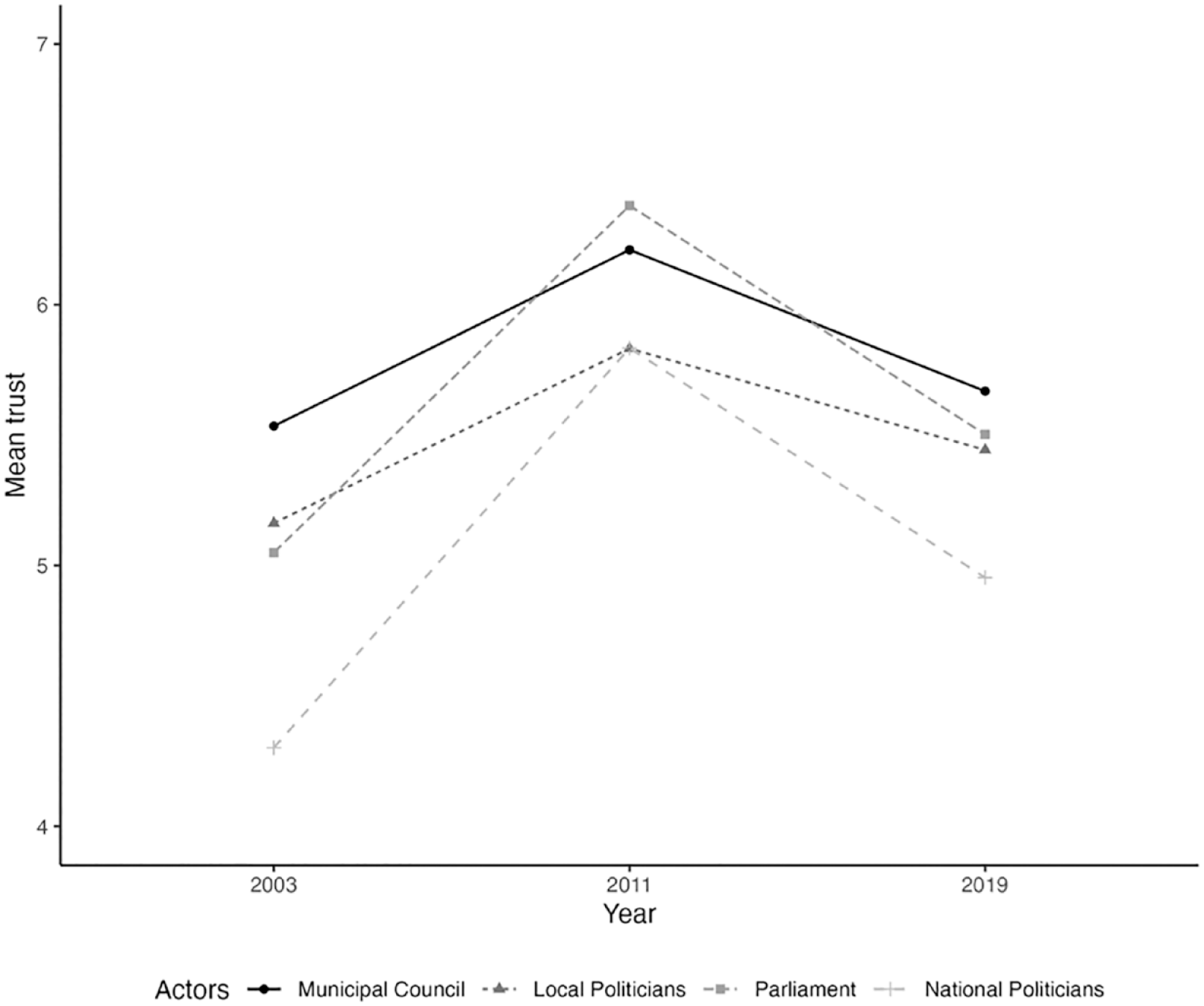
Trust in political bodies and actors in Norway in 2003, 2011 and 2019.
Norway has a two-tiered system of sub-national government, with municipalities (local governments) being nested in counties (regional governments). Both are governed by councils elected every four years. Local governments have extensive responsibilities, including preschool, primary and secondary education; elder care; infrastructure; housing; and parts of the social care and health care sectors. Given that the existing local government structure had been established in the 1960s, it had long been viewed as important to redraw borders and reduce the number of municipalities. With mergers being based solely on local consent, only a tiny number of municipalities chose to merge, and, despite increases in tasks, responsibilities and urbanisation, the number of municipalities remained stable, decreasing from 454 in 1967 to 428 in 2016 (Ministry of Local Government and Modernisation, 2016).
The Norwegian Local Government Reform included both top-down and bottom-up elements and involved national and local political actors (Folkestad et al., 2021; Klausen et al., 2021; Saglie, 2020). The process was initiated from above. The Solberg government, consisting of the Conservative Party and the right-wing Progress Party and supported by a parliamentary majority including the Liberal and Christian Democratic parties, which took office in 2013, had a comprehensive municipal amalgamation reform among its main priorities.
The reform included a substantial bottom-up element in that each amalgamation should be locally anchored and the municipalities themselves should seek and find partners. As part of the reform, local governments were required to assess potential merger alternatives. In many cases, the local political processes involved local referendums and/or other means of consulting the citizens, with 213 municipalities conducting a total of 221 referendums (Folkestad et al., 2021). The top-down approach returned when the final decisions on mergers were made, but local decisions still played a role. In total, 153 local government councils voted to merge, of which 94 made mutually positive decisions with their proposed merger partners (Ministry of Local Government and Modernisation, 2016).
Parliament decided on the amalgamations in June 2017, agreeing with the municipalities’ decisions in most cases. Nevertheless, eight municipal mergers took place despite opposition from one or more of the affected municipalities. The Norwegian reform was described as a ‘wind gust’ type, leading to profound changes in a short timespan but involving only a moderate reduction in the number of local government units (Swianiewicz et al., 2022). The number of municipalities was reduced from 428 to 356 (i.e. by 17%). However, the voluntary element of the reform meant that many small municipalities remained unmerged. The municipal councils for the merged and unmerged municipalities were elected in the September 2019 local elections, and the mergers, with a few exceptions, went into effect on 1 January 2020.
The reform was salient to a substantial share of citizens. When asked how important municipal amalgamation was for their vote in the 2019 elections, 15% answered ‘very important’, 24% answered ‘somewhat important’, 31% answered ‘less important’ and 29% answered ‘not important’. 1 In that year’s elections, the Centre Party achieved a significant upswing in peripheral areas by mobilising based on peripheral protests against this and concurrent national government reforms (Stein et al., 2021). Among the 221 referendums held about local government mergers, the mean turnout was 48.8%, 11 percentage points lower than in the 2015 local elections. Turnout was higher in municipalities with a lower number of inhabitants and where opposition to reform was greater (Klausen, 2017). The coalition government of Labour and the Centre Party, which entered office after the 2021 general elections, included a partial reversal of the local government reform in their government platform. We therefore expect that citizens were highly aware of the reform, especially those residing in the affected municipalities.
Comparisons of the Norwegian and Danish reforms (Houlberg and Klausen, 2021; Vabo et al., 2023) have highlighted differences with regard to Baldersheim and Rose’s (2010) two dimensions. The Danish reform was more comprehensive, reducing the number of municipalities by 64%, as compared to 17% in Norway. The Norwegian reform was also significantly less top-down, as the Norwegian government was more reluctant to use authority-based tools. On the other hand, the Norwegian reform was clearly more top-down and more comprehensive than the municipal mergers in Switzerland. Thus, the Norwegian reform does not fit neatly into any of the four ideal types of Baldersheim and Rose’s (2010) framework, and its mixed character makes it difficult to predict the outcome of our analyses.
Data
The NLES are a series of surveys that have been carried out after each local election since 1995 (Institute for Social Research et al., 2022). The surveys use a disproportionally stratified sample in which citizens of small municipalities are overrepresented. We use data from the 2003, 2011 and 2019 rounds of the NLES. Respondents were asked to indicate their levels of trust in various political institutions and actors on a scale from 0 to 10, on which 0 equates to ‘no trust’ and 10 to ‘very high trust’. To compare local and national political actors and to add robustness to our analysis, we have included variables for trust in ‘the municipal council’, ‘local politicians’, ‘the Parliament’ and ‘national politicians’. 2
The 2019 survey was carried out by Statistics Norway (SSB) based on a representative sample of 10,000 voters drawn from the national registry (overall response rate is 41.2%). A mixed design with both telephone interviews and a web-based questionnaire was used. The 2011 survey round was conducted via telephone interviews with follow-up postal/online questionnaires. A sample of 5004 adults was drawn from the national registry, and the survey achieved a response rate of 35.4% for the telephone interviews, of which 60.2% answered a supplementary questionnaire (Institute for Social Research et al., 2022). The 2003 survey round was also carried out by SSB, with a sample of 4005 respondents drawn partially from the gross sample for the 1999 survey round and partially from the national registry. The survey was conducted with telephone interviews and postal questionnaires, achieving an overall response rate of 69.1% (Institute for Social Research et al., 2022). Data from the 2007 round include an un-correctable error for all trust variables, whereas the 1995, 1999 and 2015 rounds did not include these at all. Therefore, data from these rounds are not used.
The timing of these surveys imposes a limitation on our study. Our most recent survey was conducted in September–December 2019, after the decisions on municipal amalgamations were made in 2017 but before the mergers were implemented on 1 January 2020. The respondents had experienced the political decision-making process at both the national and local levels, they knew how the merged municipality would be organised and they had presumably formed expectations about how the merger would affect their lives. Crucially, they had participated in elections to the municipal councils, as they would be organised after the reform. However, these respondents did not have any first-hand experience of how the merged municipalities would work. We do not know, therefore, whether the survey participants’ reported their trust in the old council, which managed the merger process, or the newly elected council, which was tasked with implementing the reform. The trust assessment may therefore be both evaluative, anticipatory or a mix of the two. There was also substantial overlap in representatives between the old and new councils.
Some observations could not be included in the analysis. Respondents in the age group that reached voting age between the pre- and post-treatment periods could not have been sampled in the pre-treatment round and have been removed to prevent any cohort effects from affecting the estimates (see Lassen and Serritzlew, 2011). Furthermore, we exclude observations on residents in three municipalities that were split up and divided between several municipalities as part of the reform, meaning that it is not possible to match the respondents to the municipalities. Citizens may also move between municipalities of different sizes based on preferences for certain jurisdiction sizes. To alleviate this, we remove all observations of respondents who reported that they had moved between municipalities after 2011 from the post-reform sample. Finally, we remove all respondents living in the 12 municipalities that were merged in the 2003–2016 period.
Methods
We examine the effect of the Local Government Reform on political trust via two competing causal mechanisms. The first mechanism (Hypotheses 1a and b) describes a negative relationship between size and trust, which makes us expect that the size increase following the mergers will cause a decline in trust in merged municipalities as compared to unaffected ones. The other mechanism (Hypotheses 2a and b) describes a negative relationship between mergers and political trust, in which the same decline in trust is caused not by an increase in size but, rather, by experiencing the political process leading up to the merger itself (see Stein et al., 2023). To test these hypotheses, we compare changes in trust between national and local political actors before and after the reform.
To differentiate between municipalities incorporating a smaller neighbour and municipalities becoming amalgamated with far larger ones, we code municipalities as junior or senior partners based on their population share in the amalgamated municipality. For the variable junior, municipalities that had a population of less than 40% of the population of the amalgamated municipality are coded as 1, and the remainder as 0. For the variable senior, we code municipalities that had a pre-reform population greater than 60% of that of the amalgamated municipality as 1, and the remainder as 0. Using these criteria, of the 116 merged municipalities included in our data, 65 are classified as junior partners, 39 as senior partners and 10 as merged but neither junior nor senior (these are included in the control group for analyses distinguishing between junior and senior municipalities). The 311 non-merged municipalities are always included in the control group.
The fundamental problem of causal inference is that it is impossible to observe both the outcome after treatment and the outcome after non-treatment for the same unit (Holland, 1986). The potential outcomes framework (see Rubin, 1977) considers the average treatment effect on the treated (ATT) as the average difference in potential outcomes between receiving and not receiving treatment for the treatment group. In observational studies, the non-random selection to treatment and control groups could bias estimates. Under the relaxed assumption that any shocks in the post-treatment period affect treated and untreated units equally and that unobserved variables do not vary across time, the difference-in-differences (DiD) estimator remains an unbiased estimator of the ATT (Ryan et al., 2019).
In our case, selection of the treatment and control groups was not random, as residents could influence the decision to merge through local and national elections and referendums. However, as Lassen and Serritzlew (2011) argue with reference to the Danish Structure Reform, there is a near-zero likelihood that any individual resident would be able to influence the decision for their municipality to merge or not.
To estimate the effect of change in jurisdiction size on political trust, consider a vector of respondents i residing in municipalities j surveyed at times t. With Y denoting our outcome of interest, a simple DiD model takes the following form:

The variable after has a value of 0 for the pre-intervention period and 1 for the post-intervention period. The variable reform has the value 0 if municipality j was not affected by the reform and 1 if it was.

The assumption of time-invariant unobserved covariates is commonly operationalised as a parallel-trends assumption, verifying that the treatment and control groups follow similar trends before treatment. Figure 2 plots group trends for four trust indicators for the non-reformed, junior-partner and senior-partner groups. The plot reveals that the three treatment groups broadly follow similar trends regarding trust in both local and national political actors. The mean trust based on all indicators and for all treatment groups increased from 2003 to 2011 and declined in 2019. Considering trust in municipal councils, the 2011 increase in mean trust is greater in senior-partner municipalities than in junior-partner municipalities and smallest in unaffected municipalities. The decline in trust in 2019 is also smallest in unaffected municipalities and greatest in junior-partner municipalities. Considering all four indicators, the substantial variation in pre-treatment trends prevents us from invoking the parallel-trends assumption (see also Figure A3 in the online Appendix).
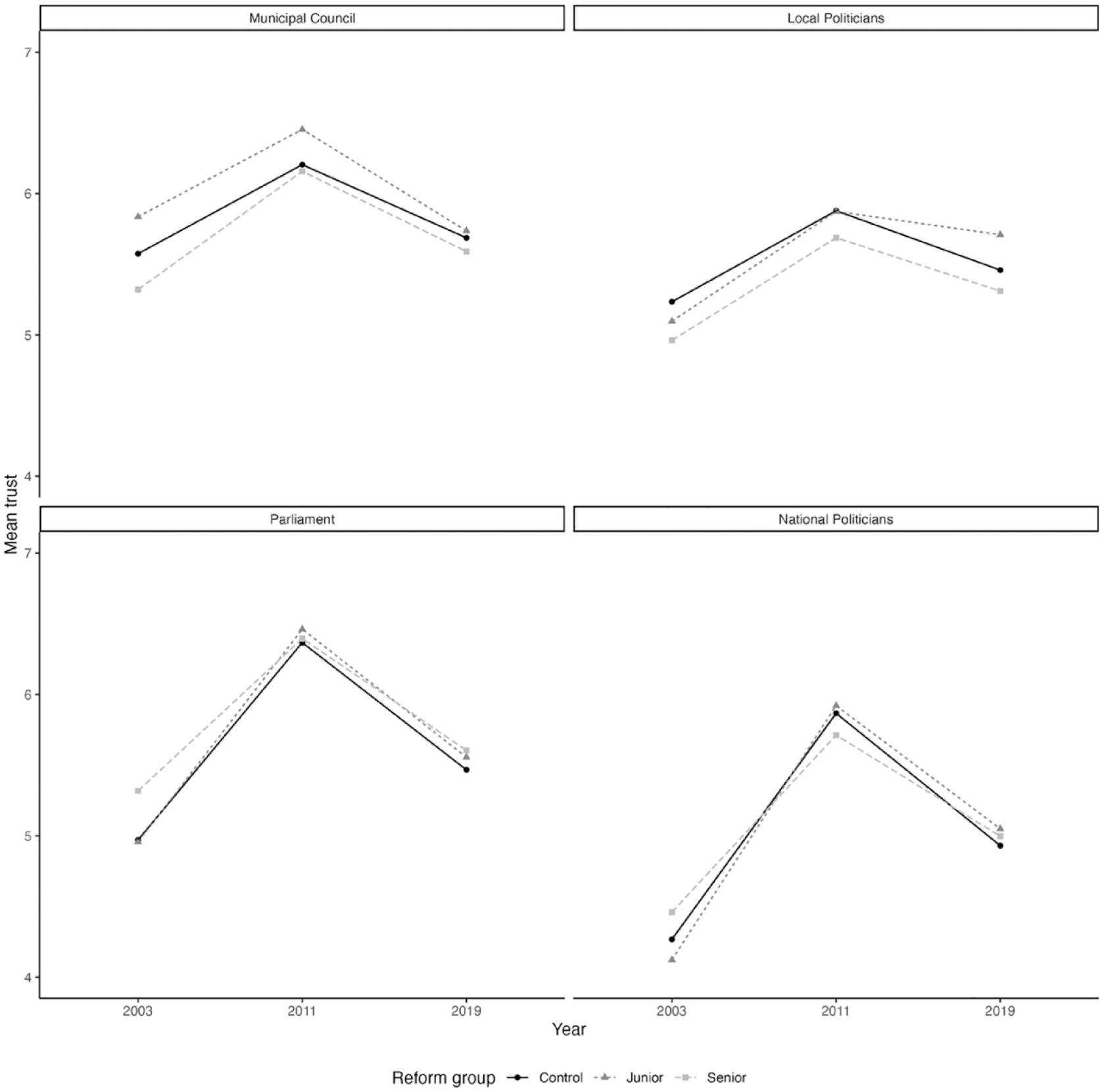
Trend in group means for trust in municipal councils, local politicians, Parliament and national politicians by reform status.
Another option for estimating treatment effects on repeated cross-sectional data is to aggregate observations at the unit-year level (see e.g. Stein et al., 2023). This has the desirable consequence that measurements are made for the same unit in the pre- and post-treatment periods. A drawback of this approach is a high number of missing values, which is an effect of many municipalities having few inhabitants. We estimate models using aggregated data from Statistics Norway, including municipality-level controls for median household income, population and centrality (i.e. how urban or rural municipalities are), in addition to the municipality-year means of the survey data. 3
Examining the performance of treatment effect estimators under conditions in which the parallel-trends assumption is violated, Ryan et al. (2019) find that propensity score matching (PSM) achieves superior performance as compared to other commonly used estimators. However, the use of propensity scores for matching has been criticized as inefficient and potentially increasing, not reducing, the imbalance between the treatment and control groups (King and Nielsen, 2019). Therefore, we combine this with an alternative matching procedure, Mahalanobis’s distance matching, which measures the differences between units based on observed covariates and matches the closest observations within a set calliper. For the matching procedure and associated estimation of treatment effects, we use the PanelMatch package (Kim et al., 2022).
Results
In this section, we present the results of our analysis, first individual-level DiD models and then time-series cross-sectional models estimated with matched data. The results for propensity-score-weighted DiD models using individual-level data and robustness tests are reported in the online Appendix.
We first run a set of simple models using trust in municipal councils, Parliament, local politicians and national politicians as the dependent variables. In all the models, we include controls for age, sex, education, income and employment status. In a second set, we also include a dummy variable for being opposed to municipal amalgamations. 4 The models are estimated with year-fixed effects, observations weighted for sample stratification and robust errors clustered at the municipal level. None of the models show any significant treatment effect (see Table 1). We do, however, see a negative effect of anti-merger views on trust in Parliament and national politicians, which may indicate that the procedural aspect of municipal amalgamation has an impact on political trust.
Regression model outputs.
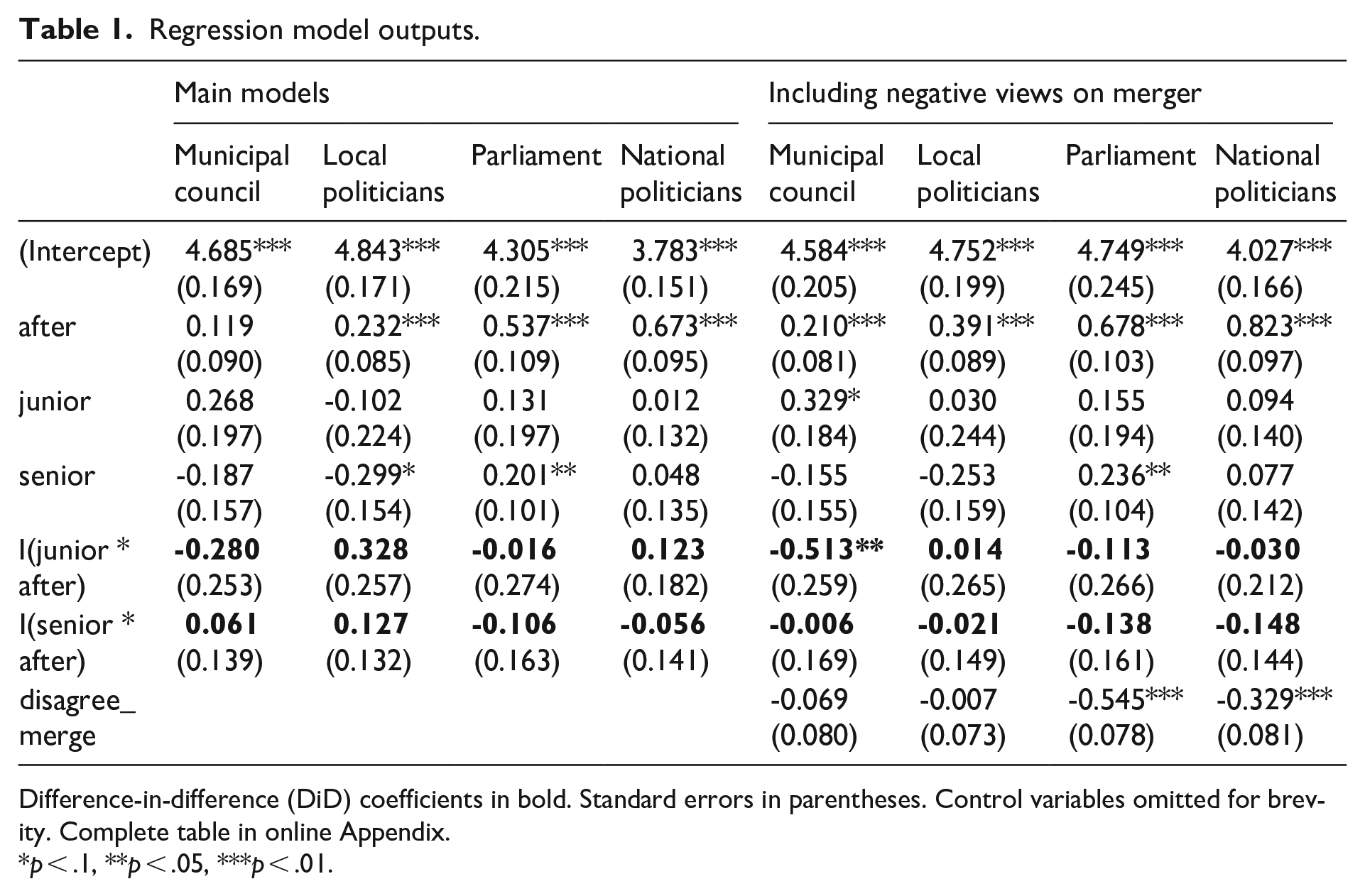
Difference-in-difference (DiD) coefficients in bold. Standard errors in parentheses. Control variables omitted for brevity. Complete table in online Appendix.
p < .1, **p < .05, ***p < .01.
To address the inconsistent pre-treatment trend, we estimate aggregated models with propensity score and Mahalanobis’s distance matching. Standard errors (SEs) are calculated by bootstrapping, using 1000 iterations. When only junior-partner municipalities are included in the treated group, the point estimate of the reform effect on trust in local politicians is 0.62, with an SE of 0.70, using PSM. With all merged municipalities included in the treated group, the point estimate is 0.44, with an SE of 0.50. The results are substantially equivalent when Mahalanobis’s distance matching is used (see Figure 3).
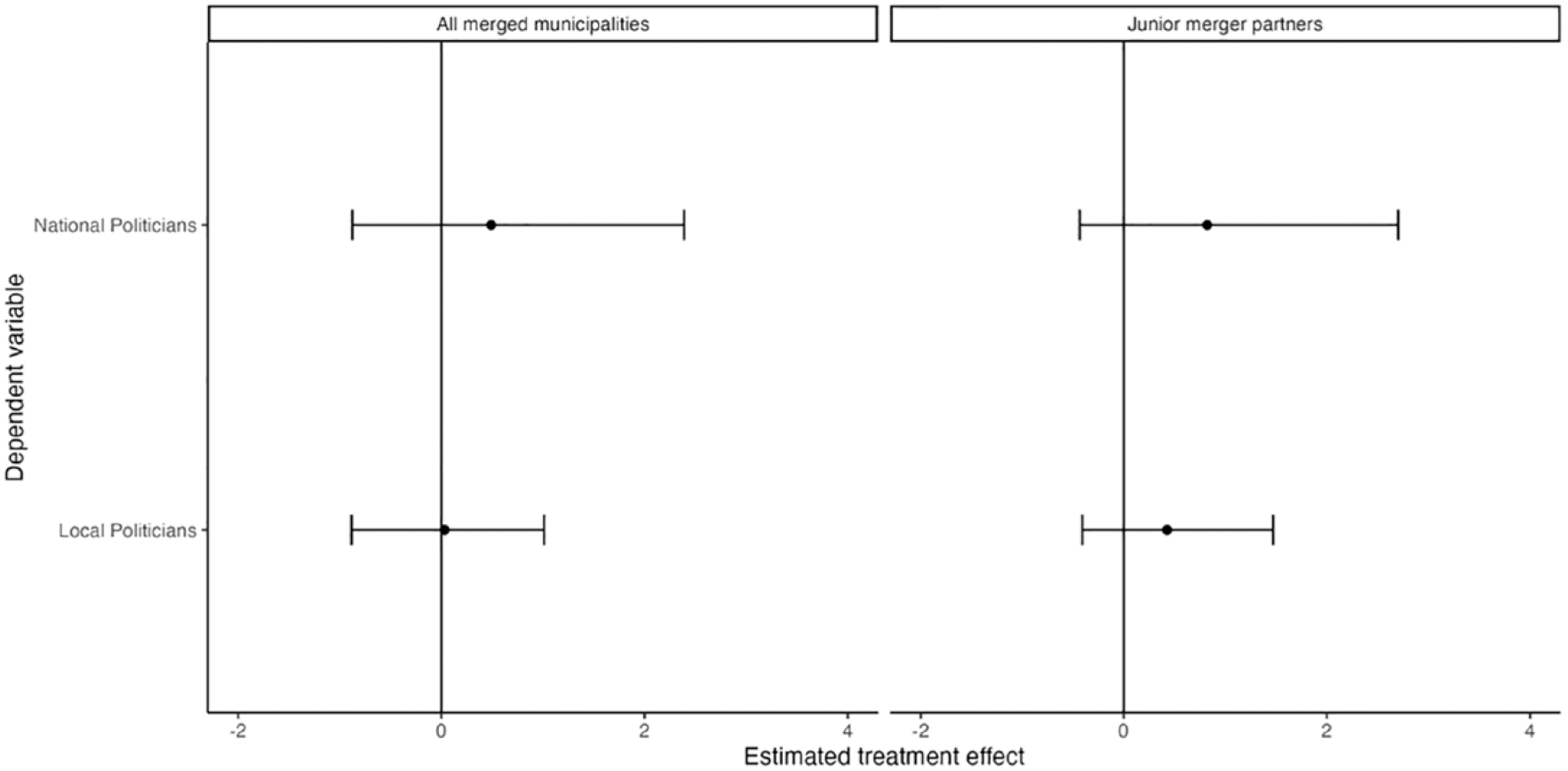
Estimated treatment effects of merger on trust in local and national politicians (Mahalanobis’s distance matching).
Considering the effect of the reform on trust in national politicians, we observe broadly similar results. Using PSM and including only junior-partner municipalities in the treatment group, the point estimate of the effect of reform on trust in national politicians is 0.94, with an SE of 0.99. When all merged municipalities are included in the reform group, the estimated effect is 0.93 (SE: 1.10) using PSM (see also Figure 3). None of the estimates are significant at the 5% level of significance, in contrast to our expectations outlined in Hypotheses 1a and 1b. There are also no significant differences between the effect estimates for trust in local and national politicians, contrary to the expectations outlined in hypotheses 2a and 2b.
Discussion
Our analysis does not support the hypothesis that the increase in polity size caused by the Local Government Reform had negative effects on political trust. This finding is robust across several model specifications, matching methods and estimators. In our review of earlier studies, we pointed out the difficulty of separating the effect of a change in size from the effect of the reform process. Although the quasi-experimental design leveraged in the Danish studies is a large improvement over earlier cross-sectional approaches, the non-random group assignment still represents a challenge in drawing causal inferences. Furthermore, it is difficult to sufficiently separate the effects of reform and size increase as they occur simultaneously.
We expected the reform to have a negative effect on trust, especially in junior merger partners, in line with earlier studies from Denmark. Unlike the Danish studies, we expected the decrease in trust to be stronger for national politicians. However, the mixed top-down/bottom-up character of the Norwegian reform made these expectations tentative. If the reform was seen as more bottom up in nature – closer to the Swiss case – there would be less reason to expect any negative effects at all.
Our results suggest that the Norwegian amalgamation reform was perceived differently from the Danish case, leading to different outcomes regarding political trust. This, in turn, leads us to conclude that the reform process, not only the change in size, is important in understanding the effects of municipal amalgamation on political trust. The reforms were implemented differently in the two countries, with potentially different consequences for political trust. The Danish Structure Reform was mainly a top-down process, whereas the Norwegian reform had a substantial bottom-up element in that it included 221 referendums on municipal amalgamation. In 86% of cases, the municipal councils chose to follow the outcome of the referendums (Folkestad et al., 2021). This could have served to dampen any potential negative effects the reform may otherwise have produced. Although the final decisions on amalgamation were made by Parliament and the threat of forced mergers clearly existed, only a few municipalities were actually merged against the will of their municipal councils.
In other words, the citizens in Norwegian municipalities may, to a greater extent, have felt that their voices had been heard and, in most cases, that local public opinion had an impact. The large number of referendums, the respect for referendum results shown by the local councils in most cases and Parliament’s reluctance to amalgamate municipalities against their will could have served to demonstrate government responsiveness and thus maintain or even strengthen political trust.
A procedural explanation is also partially corroborated by our data in that we find the estimates for the effect of reform on trust to be different for local and national elected assemblies. Furthermore, the positive correlation between pro-merger views and trust in Parliament – although not constituting a robust finding – supports the proposition that decision-making in local government reform matters for political trust.
This argument fits nicely with a recent study showing that the negative effects of the Danish reform on local democracy have declined over time. Twenty years after the reform, these effects had generally evaporated (Pedersen et al., 2022). If the effects are transitory, they must necessarily be caused by the process rather than by size as such. Although our findings suggest that the amalgamation process did not inspire distrust, the stability in trust levels from 2003 to 2019 could also imply that political trust was not greatly affected by political processes. In other words, the null finding may indicate that the diffuse component of political trust in Norway is relatively strong, making trust levels somewhat resistant to the actions of political actors. Diffuse trust – a general belief that the political system is trustworthy – is likely a function of stable institutional and cultural structures, which protect against the negative and positive effects of short-term political processes. There will be limits to what the diffuse component of trust can weather without crumbling, but the stability in trust levels throughout the amalgamation process suggests that this process was not sufficiently upsetting to challenge those limits.
Our study has a few important limitations. First, our post-reform sample was collected before the reform had fully entered into effect. Although the municipal structure had been decided and voters had elected post-reform municipal councils, residents had not acquired any first-hand experiences with the post-reform territorial structure. This would naturally limit their exposure to any negative political effects of the change in jurisdiction size. It is possible that potential negative effects of size, as such, require more time to develop and be perceived by citizens. This objection can only be countered with new survey data, collected well after the implementation of the merger.
Additionally, the substantial bottom-up aspect of the reform weakens the exogeneity assumption that underpins our quasi-experimental design. The fact that we rely on repeated cross-sectional data, rather than a true panel, and that observations have been made over a long timespan adds potential sources of bias. Lastly, our second pre-reform sample was collected in 2011, which was an exceptional year in terms of political trust in Norway. The 22 July terrorist attacks constitute another exogenous shock to the political system, which caused an abnormal trend in political trust. Because we have no subsequent pre-reform observations, the effect of this shock could also have affected our results.
Conclusion
This article investigated the effect of a substantial local government amalgamation reform. In contrast to similar studies from neighbouring Denmark, we did not find evidence to support the supposition that increases in municipality size, as caused by the reform, caused a decline in citizens’ trust in local politicians. We have pointed to differences in reform design and implementation as the likely explanation for this difference. This may call into question the practice of invoking large-scale government reforms as exogenous sources of variation in government size. Still, further work is required to fully explain the relationship between reform, size and trust. Future studies on the impacts of size and reform on trust and other outcomes should aim to incorporate systematic comparisons of reform-specific variables within and between countries.
Moreover, as compared to findings from Denmark, our null findings suggest that the process that takes place before amalgamation may affect political trust and, consequently, that it matters how a political process is carried out, communicated and experienced. If the process leading to change is perceived as good and legitimate, politicians can afford to initiate large changes without damaging political trust, even when citizens strongly oppose the result of the process, as was the case in the Norwegian amalgamation reform. Although our study is not suited to assess the relative importance of input versus output legitimacy, our findings support the notion that input legitimacy is important for political trust. However, the survey was conducted at a time when the output of the amalgamation was only anticipated and not yet experienced. A task for future research is to ascertain the trust effect of actually living in a large municipality.
Research Data
sj-csv-3-ips-10.1177_01925121231216426 – Supplemental material for Does municipal amalgamation affect trust in local politicians? The case of Norway
sj-csv-3-ips-10.1177_01925121231216426 for Does municipal amalgamation affect trust in local politicians? The case of Norway by Øystein Solvang, Jo Saglie and Marte Winsvold in International Political Science Review
Supplemental Material
sj-docx-1-ips-10.1177_01925121231216426 – Supplemental material for Does municipal amalgamation affect trust in local politicians? The case of Norway
Supplemental material, sj-docx-1-ips-10.1177_01925121231216426 for Does municipal amalgamation affect trust in local politicians? The case of Norway by Øystein Solvang, Jo Saglie and Marte Winsvold in International Political Science Review
Research Data
sj-txt-2-ips-10.1177_01925121231216426 – Supplemental material for Does municipal amalgamation affect trust in local politicians? The case of Norway
sj-txt-2-ips-10.1177_01925121231216426 for Does municipal amalgamation affect trust in local politicians? The case of Norway by Øystein Solvang, Jo Saglie and Marte Winsvold in International Political Science Review
Footnotes
Acknowledgements
The authors would like to thank the participants of the National Political Science Conference Comparative Politics Group 2 (Oslo, June 2022) and the ECPR General Conference Panel on Territorial Reforms of Local Governments (Innsbruck, August 2022), Hilde Bjørnå, Troy S. Broderstad, Jonas Stein, Sigbjørn Svalestuen and four anonymous reviewers for valuable comments.
Funding
The authors disclosed receipt of the following financial support for the research, authorship and/or publication of this article: This work was supported by the Norwegian Research Council (grant number 294597).

Supplemental material
Supplemental material for this article is available online.
Notes
Author biographies
References
Supplementary Material
Please find the following supplemental material available below.
For Open Access articles published under a Creative Commons License, all supplemental material carries the same license as the article it is associated with.
For non-Open Access articles published, all supplemental material carries a non-exclusive license, and permission requests for re-use of supplemental material or any part of supplemental material shall be sent directly to the copyright owner as specified in the copyright notice associated with the article.
