



Abstract
Tensions are on the rise in the Eastern Mediterranean, calling for a careful understanding of the motivations behind the foreign policies of small and large states in the region. This article explores the motivations behind the Republic of Cyprus and Turkey’s foreign policies and their implications for conflict dynamics, illustrating the complex relationship between soft balancing and the prospects for conflict resolution, considering the spatial dynamics of multi-party conflicts. It argues that the Republic of Cyprus’ and Turkey’s changing responses influenced the very conflict itself, by pulling in more actors and thereby expanding its spatial scope. This topic has implications for the study of frozen conflicts, transatlantic security, and peace and stability in the Eastern Mediterranean region and beyond.
Introduction
Ever since the discovery of offshore oil and gas in Cyprus, Egypt, and Israel, the subsequent regional geostrategic competition for natural resources led to increased tensions in the Eastern Mediterranean, which is home to Europe’s longest frozen conflict 1 —Cyprus (Economist, 2021). Since 2012, Turkey has intermittently engaged in hydrocarbon explorations, causing heavy criticism from Greece, the Republic of Cyprus (RoC), the United Arab Emirates, Israel, and Egypt for its ‘gunboat diplomacy’ 2 in the disputed maritime boundaries and Exclusive Economic Zones (EEZ) (Hellenic Republic Ministry of Foreign Affairs, 2021). The naval incident in summer 2020 between Turkey and France off the coast of Libya and skirmishes between Turkish and Greek militaries are cases in point, highlighting the volatility of regional peace and stability. This situation calls for a careful understanding of the foreign policy motivations of regional powers and their responses to the frozen conflict in Cyprus (Mortimer and Chadwick, 2019).
This topic has important theoretical implications. The classification of a conflict as a frozen conflict often misleads policymakers and academics into having false expectations that such conflicts are static. This article shows that despite its frozen conflict status, the dynamics of the Cyprus conflict have changed drastically as a result of the changes in the RoC’s and Turkey’s policies over time. Ever since 2020, Turkey has been supporting a two-state solution in Cyprus, opposing the bizonal bicommunal federation, whereas about 70.8% of Greek Cypriots (GCs) were against a two-state solution (Psaltis et al., 2020). Against the background of Turkey’s increasingly militarized foreign policy and the strains in its relations with the West and Eastern Mediterranean countries, the RoC has been involved in enhanced regional cooperation and countervailing alliances since 2016.
This article analyzes how the changing responses of the main conflict actors—the RoC and Turkey—impact the long-standing frozen conflict in Cyprus. It explores the motivations behind the RoC’s and Turkey’s foreign policies and their implications for conflict dynamics, illustrating the complex relationship between soft balancing and the prospects for conflict resolution, considering the spatial dynamics of multi-party conflicts. It attracts attention to how the major participants in the conflict interact with other actors to reshape the conflict in their favor. It elucidates that the North Atlantic Treaty Organization (NATO)–European Union (EU) security relationship and the dynamics of the Cyprus conflict have become closely intertwined over time. The analysis illustrates that the shifting policies of the RoC and Turkey change the very character of the conflict, as they pull in more actors including from external territories, expanding both the multi-actor character and the spatial scope of the conflict. It concludes by discussing the implications of the findings for the study of frozen conflicts and the prospects for peace.
Cyprus: the frozen conflict
The conflict on the island dates to inter-ethnic clashes in 1963, when the constitutional system and the delicate balance between the GC and Turkish Cypriot (TC) communities formed during the island’s 1960 independence from the United Kingdom broke down, instigated by President Makarios’ attempt to unilaterally alter the constitution and the TCs’ consequent withdrawal from the government. Following 1963, the two communities became more polarized. Since 1964, a United Nations (UN) peacekeeping force has been stationed on the island and remains active to this date.
In 1974, a Greek-led coup d’état resulted in the overthrow of President Makarios. Using its rights under the Treaty of Guarantee, Turkey intervened militarily. Turkey retains 30,000–40,000 troops in Cyprus (Hadjicostis, 2021). The TCs unilaterally declared independence in 1983 under the name Turkish Republic of Northern Cyprus (TRNC), recognized only by Turkey. Although the RoC is the internationally recognized government, Cyprus remains a de facto divided island, politically and geographically. 3
Turkey, an EU candidate country, is considered to occupy Cyprus, an EU member. The presence of Turkish soldiers on the island poses an important security concern for the RoC (Interviewees #7, #8, #15, and #12). The RoC perceives Turkey as an ‘overwhelming military power’ and threat (Interviewee #1). Turkey neither grants formal diplomatic recognition nor normalizes its bilateral relations with the RoC. The RoC’s threat perception has significantly increased ever since Turkey adopted a more active and militarized regional foreign policy.
Despite the promises from the EU, Turkey has been excluded from the European Defence Agency (EDA) Associate Membership. Turkey’s threat perception has similarly increased because of its exclusion from the regional frameworks since the mid-2010s. To illustrate, the 2019 initiative to create the East Mediterranean Gas Forum (EMGF) significantly contributed to Turkey’s threat perceptions from the countries in its immediate neighborhood, including the RoC. The additional alliances that the RoC and other regional actors entered have similarly contributed to the perception of threat and diplomatic isolation.
The responses of the RoC and Turkey to the frozen conflict have changed considerably since the 2010s. 4 Such changes have influenced the conflict dynamics and increased the number of actors involved in it and the spatial scope of this conflict’s security repercussions. These go beyond the island and affect the Mediterranean, Europe, and the transatlantic region.
Even though the EU and NATO conduct operations side by side, such as in Somalia, the Mediterranean, and the Turkish-Syrian border, the Turkish and Cypriot vetoes hinder NATO–EU coordination (Dursun-Özkanca, 2017, 2019). On the one hand, Turkey vetoes the RoC’s participation in European Security and Defence Policy (ESDP) and its successor Common Security and Defence Policy (CSDP) operations containing NATO intelligence and resources (since the RoC did not sign a bilateral agreement with NATO on protecting classified information) and threatens to veto RoC’s Partnership for Peace (PfP) 5 membership. On the other hand, the RoC vetoes Turkey’s EDA association and ‘refuses to allow Turkey to engage in the overall development of ESDP [and its successor CSDP] to an extent commensurate with Turkey’s military weight and strategic importance to Europe and transatlantic alliance’ (Official Journal of the EU, 2010: E/75), including its involvement in Permanent Structured Cooperation (PESCO) projects. The double vetoes impose real costs for the EU and NATO at a time when western strategic interests require enhanced inter-institutional cooperation against the Russian invasion of Ukraine. Despite the relevance of this topic for theoretical and policy purposes, academics have not paid due attention to these changing responses to this frozen conflict and their consequences for security in Europe and beyond. 6
Methodology
Drawing on over 40 semi-structured elite interviews 7 conducted with academics, policymakers, EU and NATO officials, and officials who work at non-governmental organizations (NGOs) that specialize in international and regional peace and security, as well as diplomats in Turkey, Greece, Cyprus, Serbia, Germany, and the United States from 2011 to 2021, this article offers an in-depth analysis of the impact of the changing foreign policies of the RoC and Turkey on conflict dynamics. A snowball sampling technique was used to identify interviewees who specialize in the Cyprus conflict and the broader Eastern Mediterranean region. The interviewees were asked open-ended questions on the interests of the major actors in the region, the Cyprus problem, and the energy policies of the major regional actors. To protect researcher–interviewee trust, which is crucial in collecting high-quality data, this article anonymized the interviewee names in a fashion similar to comparable studies in the literature. 8
To account for potential discrepancies between the rhetoric and the actions of the elites, this research triangulates evidence. Therefore, this analysis utilizes semi-structured elite interviews, process-tracing methodology and triangulation process, and cross-references between primary sources, such as semi-structured interviews and foreign policy documentary sources each country published (Checkel, 2008). 9 It further uses a qualitative content analysis of the RoC’s and Turkey’s foreign policy statements to examine the trajectory of their official policies.
This article is one of the few soft-balancing studies that use elite interviews as data. 10 It uncovers a novel motivation behind soft balancing—resolving conflicts in favor of one’s national interests. It illustrates the complex relationship between soft balancing and the prospects for conflict resolution in the context of the changing multi-actor character and the changing spatial scope of this conflict, in line with the other contributions to this Special Issue (see especially Idler and Tkacova, 2023; Nogales and Oldiges, 2023). It concludes by discussing the potential impact of changes in actor constellations.
The changing responses to the Cyprus conflict
The RoC’s response: the role of EU membership
The RoC’s EU membership had important repercussions for the Cyprus conflict as the country used it to balance its asymmetrical relationship with Turkey, a large military power. Despite its small size and limited military power, as an EU member holding veto power over EU enlargement, the RoC enjoys significant leverage vis-à-vis Turkey. It takes advantage of its EU membership to pressurize Turkey and pursue its national priorities of solving the Cyprus conflict and recognition of the RoC by Turkey (Interviewees #7, #8, #15, and #16).
The RoC applied for EU membership in 1990 and became a candidate in 1995, due to diplomatic pressure from Greece as a quid pro quo for Athens agreeing to the EU–Turkey Customs Union Agreement (CUA). Greece was instrumental in the RoC’s EU accession, as it threatened to block the EU’s eastern enlargement altogether, should Cyprus not be admitted into the EU (Suvarierol, 2003). Shortly before the RoC’s EU accession, the parties on the island came close to resolving the conflict in April 2004. Then UN Secretary-General Kofi Annan presented the TC and GC communities, as well as the governments of the guarantor states of Greece, Turkey, and the United Kingdom, with a solution plan—the Annan Plan—on 11 November 2002, followed by multiple revised drafts. On 24 April 2004, the two communities voted simultaneously on the Plan: TCs voted 64.9% to 35.1% in favor, whereas GCs voted 75.8% to 24.2% against it (Black and Smith, 2004).
The RoC became an EU member without resolving the conflict, which significantly reduced the GC leadership’s incentives to solve it (Dursun-Özkanca and Christou, 2012). By admitting Cyprus, the EU internalized the Cyprus conflict and reduced the ‘credibility of conditionality for all sides of the dispute’ (Kyris, 2013: 6). Following the GC community’s rejection of the Annan Plan, the EU promised to lift the trade embargo against the northern part of the island and allocate financial aid to TCs to reward them for their willingness to approve the Plan. Whereas the EU granted some opportunities to the TCs to sell their products in international markets (Dursun-Özkanca, 2017; Interviewee #14), the north still has a sizable lag in economic development (Trade.gov, 2021; Interviewee #8).
Nogales and Oldiges (2023) in this Special Issue argue that income inequalities across and within states influence conflict. Although the RoC became fully integrated into the EU’s common market and is a Eurozone member, since only Turkey recognizes the TRNC, the latter remained economically isolated (Trade.gov, 2021). TC producers face significant hurdles due to the unfeasibility of ‘direct international trade through Ercan Airport or Famagusta Port in the northern part of the island’ (Dursun-Özkanca, 2017: 904). 11 A TC academic interviewee attracted attention to the impractical nature of the proposed arrangements for many TC producers (Interviewee #21). The economic inequality between the parties in the Cyprus conflict leads to a variation in the incentive structures of these parties, making negotiated settlement of the conflict difficult, as maintaining the status quo is less costly to the RoC (Dursun-Özkanca and Christou, 2012).
Turkey’s response: the Additional Protocol non-implementation
Analyzing Turkey’s response to the Cyprus conflict demonstrates the key role of Turkey’s non-implementation of the Additional Protocol and non-recognition of the RoC for the region’s wider security landscape. Even though Turkey signed the Additional Protocol in 2005 and agreed to extend the Ankara Agreement to the new EU members admitted in 2004 (including the RoC), 12 it refuses to ratify it (Dursun-Özkanca, 2017, 2019). As put by a Turkish policymaker (Interviewee #3), Turkey has sensitivities that ‘direct negotiations’ with the RoC might ‘amount to official recognition.’
In the early 2000s, Turkey was adamant about its will to solve the decades-long Cyprus conflict. Accordingly, from 2002 to 2004, the Justice and Development Party (AKP) government pursued a ‘proactive’ policy (Interviewee #1). After the GCs rejected the Annan Plan, this stance waned. Nevertheless, Turkey continues to advocate for TC rights (Interviewee #40). It demands that unless the RoC opens the ports/airports, allows direct trade with the north (Interviewees #3 and #11), and removes its economic isolation of the TRNC (Interviewee #5), Turkish airports/ports would remain inaccessible to vessels and planes from Cyprus (Dursun-Özkanca, 2017, 2019). Despite the EU’s attempts, the ports/airports issue remains unresolved (Interviewee #1). Several GC interviewees underlined that Turkey is legally obliged to implement the Additional Protocol (Interviewees #12 and #14) and characterized lack of implementation as ‘arrogance’ on Turkey’s part (Interviewee #14).
Due to the RoC’s diplomatic pressures on the EU, the Ankara Protocol’s implementation was later included in Turkey’s EU accession negotiation framework, even though it was not in the original framework. This hinders Turkey’s EU accession prospects, as the European Council declared that no chapter would be closed until Turkey applies the Additional Protocol to the RoC. The European Commission’s annual Progress Reports on Turkey regularly criticize Turkey for the lack of normalization in its relations with the RoC. 13 Nevertheless, as a GC academic (Interviewee #7) notes, the Additional Protocol issue is not the central issue here; the issue is rather the diplomatic recognition. As another GC academic (Interviewee #8) adds, ‘If Turkey would implement the Additional Protocol, it would mean the recognition of the Republic of Cyprus as the sole authority on the island.’
Turkish authorities are cognizant that concessions given to the RoC on the Additional Protocol may not automatically translate into Turkey’s EU membership. Even if this bottleneck was overcome, there might be others, as all EU members hold veto power on EU enlargement (Interviewee #21). According to a Turkish Member of Parliament (MEP) (Interviewee #4), ‘The opening of ports and airports by Turkey is possible’ if the RoC stops ‘unilaterally freezing the six chapters in Turkey’s accession negotiations.’ In the words of another Turkish interviewee (Interviewee #6): There is a vicious cycle . . . The EU says that within the Ankara Protocol, you should open up ports and airports to the Republic of Cyprus; and Turkey says that you accepted Cyprus into the EU without a diplomatic solution, [so] how can Turkey be expected to unilaterally implement the Additional Protocol, without the solution of the Cyprus problem[?]
Moreover, Turkey’s incentives for making a concession on ports/airports were lower in 2022, as Turkey’s EU accession negotiations are frozen.
Turkey’s threats to veto a possible PfP membership of the RoC
Even though Turkey traditionally supports NATO expansion, it threatens to veto a possible RoC application for PfP (Dursun-Özkanca, 2019). Turkey’s threat to veto a possible RoC PfP membership adds complexity to the conflict dynamics, by bringing NATO into the conflict and expanding its scope. Once the RoC becomes a PfP member, ‘it would no longer be classified as a country without a security agreement with NATO,’ making it difficult for Turkey to ‘prevent Cyprus’ involvement in NATO–EU coordination meetings’ (Interviewee #2).
Although the RoC could have benefited from NATO membership by receiving additional security guarantees from the Alliance (Interviewee #11), it has traditionally approached NATO with skepticism due to its Cold War-era non-aligned legacy. Some note that the GC community is becoming more prone to support NATO membership (Interviewee #17). A GC academic (Interviewee #13) noted that the RoC’s PfP application ‘is only a matter of time.’ Nevertheless, as another interviewee (Interviewee #8) noted, ‘Cyprus will not become a member of NATO anytime soon, because of the very old-thinking of the Cypriots that we should not become any more militaristic than we already are because of the division of the island.’ Its potential PfP/NATO membership is a politically divisive issue (Interviewee #9) and not ‘visible in the public domain’ (Interviewee #7). The RoC refused to sign the PfP agreement in 2011 (Financial Mirror, 2011). GC leaders were also concerned about Turkey’s possible demands ‘in exchange for removing its veto’ (Interviewee #8). The RoC government under President Anastasiades’ leadership has not applied for PfP either. As then Foreign Minister and now newly-elected President Christodoulides announced, the RoC remained satisfied with the EU’s security guarantees (National Herald, 2018).
The RoC’s post-2016 response to the Cyprus conflict—soft balancing
This section encapsulates the RoC’s post-2016 response to the Cyprus conflict and argues that the RoC’s primary response to the unresolved conflict is soft balancing against Turkey. It further argues that this policy has led to an increase in the number of actors involved in the conflict and the expansion of its spatial scope. As Idler and Tkacova (2023) note, extant scholarship hardly considers the involvement of new conflict actors in conflict settings. This analysis illustrates how soft balancing has pulled an increasing number of actors into the frozen conflict.
Hard balancing typically involves using military capabilities and creating or maintaining formal alliances, whereas soft balancing is exercised through using diplomacy, international organizations, and economic statecraft (Dursun-Özkanca, 2017, 2019; Paul, 2005; Saltzman, 2012; Whitaker, 2010). Soft balancing is particularly successful in power asymmetries (Kelley, 2005). It draws on threat perceptions and economic interdependence (Whitaker, 2010). Although economic interdependence does not apply to this case, power disparity and threat perceptions are instrumental in shaping the two parties’ response to conflict dynamics. In the words of a GC interviewee, ‘The only security threat’ for the RoC is Turkey (Interviewee #10). The RoC utilizes several soft-balancing statecraft tools outlined below to level the playing field against Turkey.
Strategic non-cooperation
Strategic non-cooperation occurs when a weaker state seeks to increase future leverage vis-à-vis a stronger state by rejecting inequitable cooperation to avoid being stuck in an asymmetric bargaining relationship (Kelley, 2005). The RoC blocks Turkey’s EDA Associate Membership and opposes the proposals for integrating it into EU security mission decision-making (Dursun-Özkanca, 2017, 2019) and PESCO projects. Through strategic non-cooperation—that is, not letting the EU further collaborate with NATO—the RoC seeks to restore the balance to its advantage and increase its leverage vis-à-vis Turkey.
The Cyprus conflict and the impasse in transatlantic relations are entwined (Interviewee #14). As a GC interviewee (Interviewee #18) puts it, ‘people [in the RoC] that support the application to PfP in Cyprus—especially the hardliners—think that PfP application can be used to ‘block Turkey and play a geopolitical game against Turkey.’ As another GC interviewee (Interviewee #8) notes, ‘The number one goal of Cypriot foreign policy is to be recognized by Turkey.’ However, the official Turkish position on this question is drastically different, as it holds that for the PfP application of the RoC to be considered, first and foremost, the Cyprus problem would need to be resolved (Dursun-Özkanca, 2017, 2019; Interviewee #23).
The RoC uses its veto over Turkey’s EDA Associate Membership, blocks Turkey’s inclusion in PESCO projects, and influences the EU to not cooperate with Turkey and NATO. In strategic non-cooperation, the weaker country typically incurs costs to signal its determination to pursue a more equitable relationship with a stronger country. In this case, however, rather than incurring actual costs, the RoC simply shifts the costs of strategic non-cooperation to the EU and NATO. It allows the RoC to prolong this policy.
Entangling diplomacy
Entangling diplomacy refers to using the rules and procedures of international institutions to influence the counterpart’s foreign policy. 14 It occurs when states seek to restructure an asymmetrical situation by constraining the alternatives of stronger states (Dursun-Özkanca, 2017, 2019; Kelley, 2005). The RoC uses entangling diplomacy and takes advantage of the EU’s formal procedures to influence Turkey’s policies in its favor, especially regarding conflict resolution. Attesting to the use of entangling diplomacy, a GC official (Interviewee #17) noted that any step by the RoC to situate itself at the center of EU security infrastructures is taken ‘with Turkey in mind.’ The RoC’s main strategic goal is ‘to use EU participation to settle the Cyprus problem,’ or at least to achieve diplomatic recognition by Turkey (Interviewee #19). This constitutes ‘hostage-taking’ behavior (Hofmann, 2019).
The RoC’s entangling diplomacy seeks to achieve outcomes congruent with the country’s strategic interests while mitigating power asymmetries with Turkey. In other words, the RoC takes advantage of its EU membership and veto power to put pressure on Turkey and pursue its national agenda. In December 2009, the RoC unilaterally blocked six accession negotiation chapters of Turkey (Interviewee #14). This is one way of compensating for the asymmetrical relationship the RoC has with Turkey. The EU Progress Reports on Turkey regularly warn that no further progress can be made in Turkey’s EU accession negotiations as long as the Cyprus conflict remains unresolved, and Turkey fails to implement the Additional Protocol. Turkish authorities consistently criticize the EU, noting that it ‘unfairly brings the Cyprus issue’ to the accession negotiations and ‘overshadows [its] credibility’ (Turkish Directorate for EU Affairs, 2019).
Issue-linkage bargaining
Although the RoC officially supports transatlantic security cooperation, as one GC diplomat (Interviewee #15) adds, this support is ‘not unconditional.’ As another GC diplomat (Interviewee #16) elaborates, the ‘denial of the legal existence of the Republic of Cyprus’ creates such a framework, which ‘makes transatlantic cooperation impossible.’ In issue-linkage bargaining, the country aims to increase the probability of reaching a negotiated agreement and seeks to motivate its counterpart to remain committed to the agreement by simultaneously discussing two or more issues for joint settlement (Poast, 2013). The RoC highlights the importance of the resolution of the Cyprus conflict not only for greenlighting the EU–NATO security exchange but also for Turkey’s potential EU accession.
With its EU membership, the RoC strengthened its bargaining power vis-à-vis Turkey. This situation generated further problems in EU–Turkey relations. Through its veto, the RoC puts pressure on Turkey for implementing the Additional Protocol. Illustrating the RoC’s issue-linkage bargaining, a senior RoC Ministry of Foreign Affairs official (Interviewee #15) expressed that without the resolution of the Cyprus conflict, Turkey cannot enter the EU. Many GC diplomats also underlined that, for transatlantic security cooperation to be achieved, Turkey must, first and foremost, ‘respect the sovereignty’ of the RoC (Interviewee #13) and the autonomy of EU decision-making (Interviewees #15 and #14). A Turkish interviewee (Interviewee #24) disagreed with the RoC’s issue-linkage bargaining policy, noting that ‘it is not right to tangle the Cyprus problem with Turkey’s accession negotiations, as these are two separate issues.’
Inter-institutional balancing
Inter-institutional balancing occurs when a state promotes an institution to challenge and dilute the influence of a counterpart institution (He, 2015). One type of inter-institutional balancing is exclusive institutional balancing, where a state excludes a target state from an institution and relies on the institution to pressurize the target state (He, 2015). Even though Turkey wants greater involvement in the CSDP decision-making process, defense procurement initiatives, and PESCO projects (Brzozowski, 2021), according to the official RoC perspective, affirmed by the EU in 2020, no non-EU member country may receive ‘preferential treatment in CSDP’ (Interviewee #14; Sprenger, 2020). To level the playing field against Turkey, the RoC uses its EU membership for excluding Turkey from the EU CSDP (Interviewee #22) and PESCO (Cyprus Mail, 2018). By projecting its security/foreign policy issues into the EU and seeking to advance CSDP at the expense of NATO, the RoC engages in inter-institutional balancing against NATO, to increase its diplomatic leverage against Turkey.
There is a technical-legal explanation for the ongoing Cypriot veto against the Turkish association with the EDA/PESCO. A GC diplomat official (Interviewee #14) noted that the EDA membership is only open to EU members, and to become an EDA Associate Member, countries need to sign a security of information agreement with the EU. Another GC interviewee (Interviewee #9) noted that for the RoC, the withdrawal of its veto is not a legal obligation, but for Turkey, the implementation of the Additional Protocol is.
This foreign policy reflects the strategic need of the RoC to protect its national interests against the perception of a growing security threat from Turkey (Zachariades and Petrikkos, 2020). It also enables the RoC to resolve the Cyprus conflict in line with its national interests, while using it as a bargaining chip against a potential Turkish veto over PfP membership. RoC’s veto conforms to the exclusive institutional balancing concept à la He (2015), as the RoC relies on the EU for pressuring Turkey to change its behavior in a way that is favorable to the RoC’s foreign policy objectives.
Changing actor constellations in the Cyprus conflict
The RoC’s and Turkey’s changing responses to the Cyprus conflict have influenced the type and number of actors with a stake in the conflict, and thereby its spatial scope. These responses changed the conflict dynamics by pulling more states and organizations into the conflict. Turkey is a member of NATO, but not of the EU, whereas the RoC is a member of the EU, but not of NATO. Vetoes by both countries hinder the non-member institution from taking further steps to improve coordination with the counterpart institution. In that sense, the RoC’s and Turkey’s changing responses pulled the EU and NATO into the conflict.
Since the mid-2010s, the RoC has entered countervailing alliances with numerous regional actors, both within and outside the EU, to bolster its security guarantees against Turkey’s increasingly militarized foreign policy. By collaborating with Egypt, Greece, and Israel, Cyprus became integrated into ‘an emerging network of cooperation and security architecture’ in the Eastern Mediterranean (Tziarras, 2021). The trilateral agreements between Cyprus, Greece, and Israel and Cyprus, Greece, and Egypt constitute soft balancing (Tziampiris, 2015). The RoC’s enhanced regional cooperation and countervailing alliances emanate from the regional perception of a rising threat coming from Turkey (Tziampiris, 2015; Tziarras, 2021).
The discovery of natural resources enhanced cooperation between the RoC and other countries in the region, such as Greece and Israel. The RoC improved its relations with Middle Eastern countries, such as Egypt, Israel, Jordan, and Lebanon (Christodoulides, 2020), seeking to expand their cooperation in security, economy, and tourism. As then Foreign Minister Christodoulides (2020: 2–3) acknowledged, the ‘transitioning’ of RoC foreign policy ‘from introversion to extroversion’ amplifies the RoC’s geopolitical significance and is projected to have ‘a beneficial ripple effect’ on the island’s reunification efforts. This effectively illustrates how the RoC’s soft-balancing policy increases the number of stakeholders in conflict resolution.
The creation of the EMGF in 2019 and its transition into a formal international organization in 2020 are instrumental in the RoC’s soft balancing through countervailing alliances. Egypt, Greece, Cyprus, Israel, Jordan, Palestinian Authority, Italy, and France serve as EMGF members, with the US, the World Bank Group, and the EU serving as observers. If the conflict were to be resolved, it would have made EMGF’s primary goal of building a gas pipeline connecting the newly discovered gas resources to European markets more feasible, as the Turkish hydrocarbon explorations in the region have a spoiler effect on the EMGF. Finally, the thaw in US–RoC relations reversed the decades-old US arms embargo against the RoC (Efstatiou, 2019) and added the US to the list of countries with which the RoC established better ties.
The RoC’s countervailing alliances contribute to Turkey’s anxieties regarding its increased regional isolation (Interviewee #39). Therefore, although the RoC’s soft balancing increases the number of actors involved in the conflict and expands the conflict’s spatial dimension, it simultaneously decreases the likelihood of conflict resolution by amplifying the security dilemma between the RoC and Turkey.
Discussion: implications for conflict dynamics?
Changing responses to the conflict: implications at the regional level
One interviewee (Interviewee #7) emphasized that ‘the very old-fashioned mentality’ of ‘northern and southern Cyprus’ ‘that talking is recognizing . . . is causing inertia in negotiations.’ The lack of communication, combined with a significant change in the official position of Turkey and the TC leadership from a bi-communal and bi-zonal federation to a two-state solution (Amiel, 2021) since 2020 add to a deepening security dilemma. In the October 2020 elections, a new TC leader, Tatar, who supports a two-state solution in Cyprus, was elected (Interviewee #41). As the former RoC Minister of Foreign Affairs Kozakou-Marcoullis (2020: 19) underlines, Tatar’s election, ‘coupled with the fact that the intercommunal negotiations have remained stalled since their collapse in Crans Montana in July 2017,’ negatively influenced the prospects for UN-sponsored negotiations. The increased threat perceptions, emanating from Turkey’s increased regional hydrocarbon explorations, the opening of the fenced area of Famagusta/Varosha, and support for a two-state solution led to the sentiment that ‘Cyprus appears not to have the means to stop Turkey’ (Tzionis, 2020: 26).
In comparison with Turkey’s ‘overwhelming power’ (Interviewee #13), the RoC’s power is ‘minuscule’ (Interviewee #22). The asymmetrical relationship between Turkey and the RoC led the RoC to switch to a soft-balancing policy for mitigating the military imbalance. The RoC views its EU membership as a means for bolstering its security (Interviewees #17 and #22), and uses ‘Turkey’s EU accession process . . . as leverage over Ankara,’ reflecting the GC public opinion that the veto power allows for taking ‘revenge on Turkey for its invasion’ (Ker-Lindsay, 2007: 75–77). It wants to prevent Turkey’s EU membership as long as the Cyprus conflict remains unresolved and sees PESCO as an opportunity to maintain an ambitious foreign policy (Efstatiou, 2019). Confirming this, one interviewee (Interviewee #19) notes: The problem for Cyprus is its size, and the ability to effectively contribute to be an effective partner in [CSDP] . . . Symbolically, [the RoC] is very much into this . . .. This is a way of showing that they are there. This is not NATO . . . This is where the EU can be used as a defense mechanism . . . against non-EU members, i.e. Turkey.
Others confirm that security concerns were the main reason why the RoC has become an EU member in the first place (Interviewees #17 and #20). Due to its distrust that Turkey has continuing ambitions regarding the island, the RoC does not want Turkey’s integration into the CSDP (Interviewee #22), and, more recently, PESCO (Cyprus Mail, 2018). The RoC lobbied for strict preconditions for third-party participation in PESCO projects, including ‘prior completion of a Security Intelligence Exchange of Classified Information of these States with the EU and a technical arrangement’ with the EDA (Athanasiou, 2018), which would ensure Turkey’s exclusion from PESCO projects (Maulny and Di Bernardini, 2019). In November 2020, the EU adopted PESCO third-party participation conditions, reflecting the RoC’s preferences, emphasizing shared values, ‘good, neighborly relations’ with EU members, and the need to have a security of information agreement (Sprenger, 2020). As such, Turkey is not an eligible PESCO third party.
The RoC foreign policy reflects the strategic recognition of the need to better position itself in the region against Turkey’s increasingly ambitious and proactive foreign policy in the Eastern Mediterranean. The RoC seeks to have diplomatic recognition from Turkey and the removal of Turkish soldiers from the northern part of the island (Interviewee #15). As a GC interviewee (Interviewee #10) argued, ‘It is all about scoring points in the Cyprus problem and making each other’s lives difficult . . . So, the [RoC] is doing everything it can to gain leverage in the negotiations on the Cyprus question.’ Another interviewee (Interviewee #18) concurred that the RoC should be expected to sustain its veto for Turkey’s association with the EDA (and PESCO), ‘unless there is some progress in the negotiations and it could get something in return.’ There is an overwhelming sentiment among the GC interviewees that blocking Turkish Associate Membership in EDA helps ‘Cyprus gain leverage internationally’ (Interviewee #18) and may help reverse the balance of power in favor of the RoC, as illustrated in the case of the exclusion of Turkey from PESCO projects. The increased leverage in turn helps put pressure on Turkey to make concessions on important issues, such as diplomatic recognition.
Changing responses to the conflict: implications at the global level
Understanding the role of conflict’s spatial dynamics and how the actors involved in the conflict change over time helps us better shape policy responses to resolve such conflicts (see Idler and Tkacova, 2023, in this Special Issue). Turkey and the RoC pursue a ‘tit-for-tat strategy’ on transatlantic security exchange (Interviewee #8). Without the resolution of the Cyprus conflict, neither a well-functioning NATO–EU security coordination (Interviewees #2 and #27) nor an end to the RoC’s soft-balancing foreign policy vis-à-vis Turkey are realistic outcomes. Solving the conflict is ‘a pre-condition’ for NATO–EU cooperation, which ‘would allow formal NAC-PSC meetings’ to discuss ‘a broader range of issues’ through a ‘more frequent exchange of information at the institutional level’ (Interviewee #38).
The EU and NATO devised creative methods, including informal briefings on issues of common interest to operate side-by-side in the field, regular staff-to-staff contacts (Interviewees #5 and #47), and cross-invitation of the EU High Representative to the North Atlantic Council and the NATO Secretary-General to the Political and Security Committee (European Council, 2009: 2). Due to their informal status, these meetings lack the mandate to take formal decisions. With the signature of a Joint Declaration at the 2016 NATO Warsaw Summit, the EU–NATO coordination somewhat improved, especially on hybrid operations (Interviewee #37). Nevertheless, this strategic partnership has not reached its full potential (NATO, 2021; Interviewees #28, #29, #30, and #37). Duplication remains a serious risk (Interviewee #29). As a NATO official interviewee (Interviewee #38) acknowledges, the political problems that have impeded the full potential of EU–NATO cooperation are not likely to disappear soon.
The Cyprus conflict has periodically ascended on the international agenda since 2011. The UN-sponsored but Cypriot-owned and Cypriot-led unification negotiations in Crans Montana in 2017 were unsuccessful. Although some interviewees were optimistic about the conflict resolution prospects (Interviewees #31, #32, and #34), others warned against being ‘overly optimistic,’ underlining the potential spoiler role of Russia (Interviewee #33), or the long track record of unsuccessful negotiation rounds (Interviewee #35). Due to pressures from the EU and NATO, there has been renewed interest from the UN to restart conflict resolution negotiations (Gorvett, 2019). In 2021, the UN attempted to resuscitate the peace negotiations, but to no avail, as the two communities announced that ‘they had nothing to discuss’ (Economist, 2021).
The solution to the Cyprus problem cannot be delayed forever, as ‘the stakes are getting higher’ (Interviewee #18) due to the ‘securitization of the Cyprus problem’ and its external security-related repercussions (Interviewee #19). This becomes evident with hydrocarbon explorations creating new regional tensions. The GCs want the EU to be ‘actively involved in the peace process,’ whereas Turkey holds that the EU should not be actively involved since it is not an impartial actor (Amiel, 2021). Given the stalemate in EU–Turkey relations, ‘Turkey may adopt a less constructive stance’ (Interviewee #38) and pursue increasingly hostile policies on Cyprus (Interviewee #40). Illustrating this, in November 2022, Turkey moved to request observer status for the TRNC in the Organization of Turkic States, causing harsh criticism from the EU (EU External Action Service, 2022). The increasing use of soft balancing deepens the security dilemma between Turkey and the RoC and causes concerns regarding the thawing of the frozen conflict.
Conclusion
This article shows that the shifting foreign policy responses of Turkey and the RoC influence the conflict dynamics in Cyprus, changing the actor constellation and the spatial scope of the conflict. Turkey has increasingly engaged in a militarized foreign policy, adding to the RoC’s security concerns. The RoC recognized the need to better position itself against Turkey’s increasingly ambitious and proactive foreign policy in the region (Interviewee #18). This article highlights a new use for soft balancing that has not been previously identified in the literature—resolving conflicts to the actor’s national advantage. Soft balancing allows for the RoC to expand the number of stakeholders in the Cyprus conflict and increase pressure on Turkey for achieving diplomatic recognition (Interviewee #15), extending the CUA to the RoC, and resolving the Cyprus conflict in line with the RoC’s interests (Interviewee #11). Furthermore, this article shows that the study of frozen conflicts may benefit from incorporating soft-balancing analysis to determine how changes in conflict dynamics influence the prospects for the thawing of conflict. Thus, it demonstrates the theoretical implications of analyzing the changing policies of the conflict parties for a better understanding of the shifting dynamics of frozen conflicts.
The methodological approach in this article underlines the importance of interviews in understanding how motivations influence changing responses to the conflict. All GC interviewees concurred that blocking Turkey’s EDA Associate Membership and PESCO participation may help reverse the balance of power in the RoC’s favor. This is a relatively cheap strategy, as the real costs are shifted to the institutions, rather than incurred at the state level. Furthermore, the RoC has no political will for NATO membership, making the RoC’s soft balancing even more cost-effective. Even if Turkey removes its veto over the NATO–EU security exchange and implements the Additional Protocol, its EU accession or EDA Associate Membership ‘are not guaranteed outcomes’ (Dursun-Özkanca, 2017: 904). Thus, it is not strategic for Turkey to remove its EU–NATO security exchange blockage unless the Cyprus conflict is resolved and there is a set date for Turkey’s EU accession (Interviewees #25 and #36).
This article concludes that soft balancing influences conflict dynamics and increases the number of actors involved in the conflict, expands its spatial scope, and has consequences for security in Europe and beyond. The analysis highlights the importance of the considerable power disparity between Turkey and the RoC and illustrates how small states may attempt to compensate for the power differential by using soft-balancing tools. The RoC’s soft balancing and attempts to increase the number of stakeholders in the conflict do not contribute to greater security provision or conflict resolution. In contrast, including new actors in the conflict intensifies Turkey’s threat perceptions and leads to a vicious cycle of tensions and threats, making Europe’s longest frozen conflict more intractable. As one interviewee (Interviewee #26) holds, ‘The worst-case scenario for conflict resolution is when one country is in and another one is out of the international institution.’ The adoption of soft-balancing tools by parties has negative repercussions on the prospects for peaceful conflict resolution and causes concerns regarding the thawing of this frozen conflict.
One can still identify policy recommendations that may help pave the way toward improving the situation. The Euro-Atlantic organizations can create ‘a win-win situation, where Cyprus can get into the PfP, and Turkey can get into the EDA’ (Interviewee #9). As one interviewee (Interviewee #8) concurred, ‘If Turkey says Cyprus can join the PfP programme,’ then the RoC can lift its veto on Turkey’s EDA association. Another interviewee (Interviewee #9) maintained that if Turkey decides to implement the Additional Protocol, it would ‘put a lot of pressure’ on the RoC to ‘engage in direct trade with the Turkish Cypriots,’ and would make it very difficult for the GCs to shift the blame to Turkey. Through such steps, parties may find additional venues to communicate and resolve differences. However, the lack of official communication between the RoC and Turkey creates ‘distorted communication’ (Interviewee #17), as these parties do not ‘understand each other’ (Interviewee #1).
As the hopes for conflict resolution wither away, all parties should refrain from provocative actions that may further increase the insecurities of the actors involved. To avoid exacerbating the security dilemma, it is sensible to include Turkey in the EMGF, especially during a time when Europe needs alternative energy supplies. The EU and the United States should put diplomatic pressure on Turkey, Greece, TCs, and GCs to engage in a dialogue. Instead of the discussion of ‘technical and top-down criteria,’ ‘bottom-up solutions should be sought’ in inter-communal talks (Psaltis et al., 2020: 150). The EU should incentivize the GCs to reach a negotiated compromise with TCs since the GCs are the party with the least incentive to compromise. It should motivate Turkey to pursue a more conciliatory attitude toward conflict resolution. However, given the stalemate in Turkey’s accession process, it is not realistic to expect the EU to have much leverage on Turkey.
Footnotes
Appendix
Table of interviews.
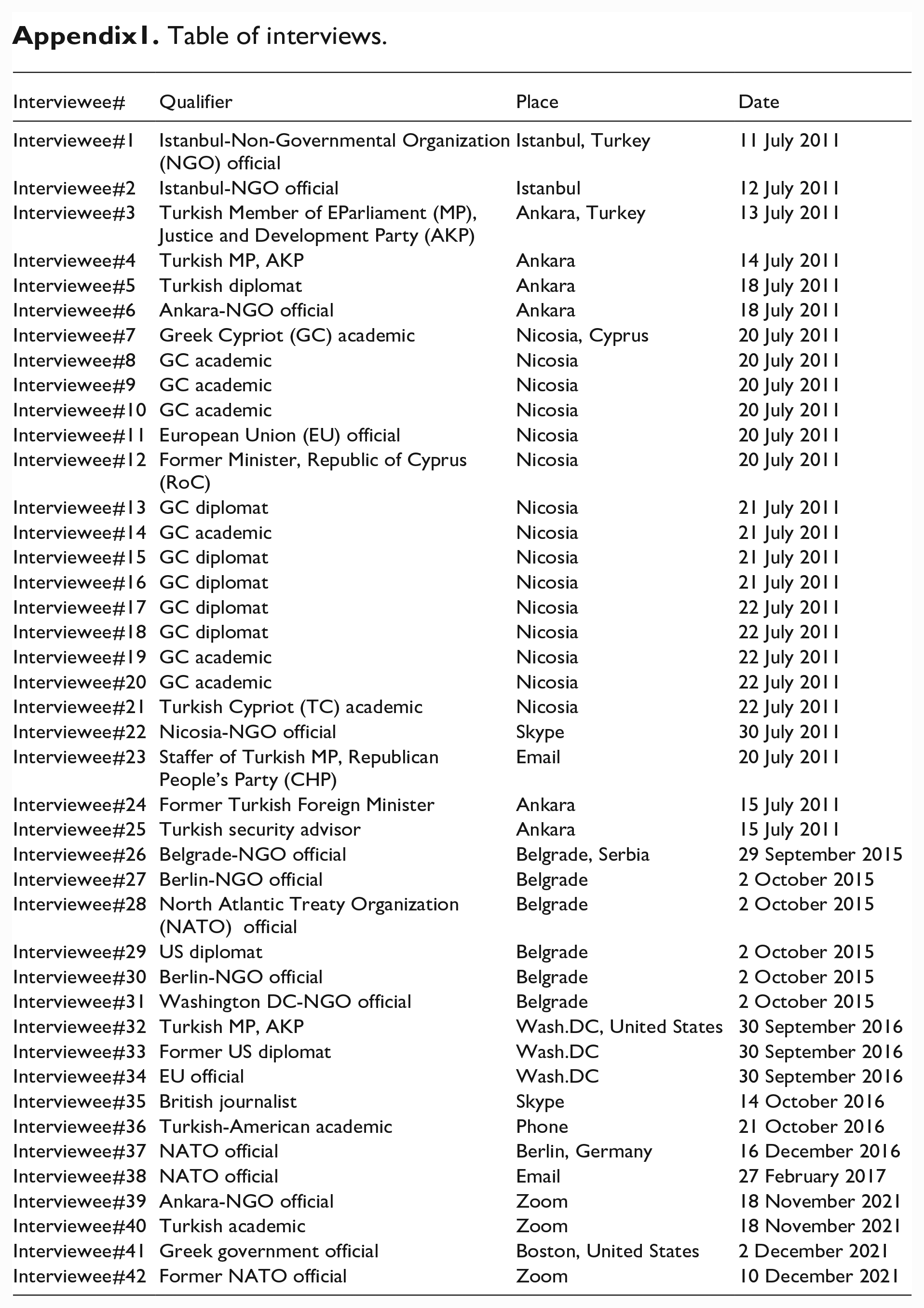
| Interviewee# | Qualifier | Place | Date |
|---|---|---|---|
| Interviewee#1 | Istanbul-Non-Governmental Organization (NGO) official | Istanbul, Turkey | 11 July 2011 |
| Interviewee#2 | Istanbul-NGO official | Istanbul | 12 July 2011 |
| Interviewee#3 | Turkish Member of EParliament (MP), Justice and Development Party (AKP) | Ankara, Turkey | 13 July 2011 |
| Interviewee#4 | Turkish MP, AKP | Ankara | 14 July 2011 |
| Interviewee#5 | Turkish diplomat | Ankara | 18 July 2011 |
| Interviewee#6 | Ankara-NGO official | Ankara | 18 July 2011 |
| Interviewee#7 | Greek Cypriot (GC) academic | Nicosia, Cyprus | 20 July 2011 |
| Interviewee#8 | GC academic | Nicosia | 20 July 2011 |
| Interviewee#9 | GC academic | Nicosia | 20 July 2011 |
| Interviewee#10 | GC academic | Nicosia | 20 July 2011 |
| Interviewee#11 | European Union (EU) official | Nicosia | 20 July 2011 |
| Interviewee#12 | Former Minister, Republic of Cyprus (RoC) | Nicosia | 20 July 2011 |
| Interviewee#13 | GC diplomat | Nicosia | 21 July 2011 |
| Interviewee#14 | GC academic | Nicosia | 21 July 2011 |
| Interviewee#15 | GC diplomat | Nicosia | 21 July 2011 |
| Interviewee#16 | GC diplomat | Nicosia | 21 July 2011 |
| Interviewee#17 | GC diplomat | Nicosia | 22 July 2011 |
| Interviewee#18 | GC diplomat | Nicosia | 22 July 2011 |
| Interviewee#19 | GC academic | Nicosia | 22 July 2011 |
| Interviewee#20 | GC academic | Nicosia | 22 July 2011 |
| Interviewee#21 | Turkish Cypriot (TC) academic | Nicosia | 22 July 2011 |
| Interviewee#22 | Nicosia-NGO official | Skype | 30 July 2011 |
| Interviewee#23 | Staffer of Turkish MP, Republican People’s Party (CHP) | 20 July 2011 | |
| Interviewee#24 | Former Turkish Foreign Minister | Ankara | 15 July 2011 |
| Interviewee#25 | Turkish security advisor | Ankara | 15 July 2011 |
| Interviewee#26 | Belgrade-NGO official | Belgrade, Serbia | 29 September 2015 |
| Interviewee#27 | Berlin-NGO official | Belgrade | 2 October 2015 |
| Interviewee#28 | North Atlantic Treaty Organization (NATO) official | Belgrade | 2 October 2015 |
| Interviewee#29 | US diplomat | Belgrade | 2 October 2015 |
| Interviewee#30 | Berlin-NGO official | Belgrade | 2 October 2015 |
| Interviewee#31 | Washington DC-NGO official | Belgrade | 2 October 2015 |
| Interviewee#32 | Turkish MP, AKP | Wash.DC, United States | 30 September 2016 |
| Interviewee#33 | Former US diplomat | Wash.DC | 30 September 2016 |
| Interviewee#34 | EU official | Wash.DC | 30 September 2016 |
| Interviewee#35 | British journalist | Skype | 14 October 2016 |
| Interviewee#36 | Turkish-American academic | Phone | 21 October 2016 |
| Interviewee#37 | NATO official | Berlin, Germany | 16 December 2016 |
| Interviewee#38 | NATO official | 27 February 2017 | |
| Interviewee#39 | Ankara-NGO official | Zoom | 18 November 2021 |
| Interviewee#40 | Turkish academic | Zoom | 18 November 2021 |
| Interviewee#41 | Greek government official | Boston, United States | 2 December 2021 |
| Interviewee#42 | Former NATO official | Zoom | 10 December 2021 |
Acknowledgements
The author thanks Wayne Selcher, Annette Idler, and two anonymous reviewers for their feedback, and Mercedes Sapuppo for literature review assistance.
Funding
The author disclosed receipt of the following financial support for the research, authorship, and/or publication of this article: This article was written during the author’s sabbatical at Harvard University, made possible through the American Political Science Association (APSA) Spring Centennial Center Research Grant, the Center for Global Understanding and Peacemaking Grant, and the two faculty grants from Elizabethtown College.
