




Abstract
Why is politics dominated by wealthy men, and how do gendered and class barriers to running for office intersect? This article addresses these questions using the UK as a case study. Drawing on interview data, I highlight the formal and informal institutions that shape the class and glass ceilings in electoral politics. I identify how the high personal costs of running for office, especially in relation to candidates’ time, present a barrier to those without significant financial resources. These costs are gendered, as women typically have less time and money than men. These resource barriers are compounded by additional gendered obstacles including discrimination, abuse and gendered family roles. I find that the intersection of the class and glass ceilings creates cumulative barriers that are particularly prohibitive for working-class women. The findings extend our understanding of class and gender gaps within politics and, crucially, the intersection between them.
Introduction
The best way to make a small fortune from politics is to start with a large one.
1
Politics has long been dominated by privileged men. Despite recent efforts to reduce gender gaps, women remain underrepresented in nearly all political arenas (Paxton et al., 2020). Meanwhile, the wealth gap in politics remains stark (Carnes and Lupu, 2016). While women entering politics have helped to increase diversity in a number of ways (Barnes and Holman, 2020), they often come from the same affluent backgrounds as their male counterparts. This has led to accusations that gender quotas have simply replaced elite men with elite women (Childs, 2015; Williams and Paun, 2011). Yet social class plays an important role in representation, with working-class legislators across the political spectrum being more responsive to the needs of working-class voters (Barnes and Saxton, 2019; Carnes, 2013; Hemingway, 2020). Likewise, there is an association between the descriptive, substantive and symbolic representation of women (Childs, 2008; Wängnerud, 2009). Barnes et al. (2021) find that working-class women have interests that are distinct from both working-class men and middle-class women. Hence, the deficit of working-class women within politics has important representational consequences (Joshi and Och, 2014). There is an imperative to improve the representation of both women and the working class, and to consider more fully the intersection between them.
We know from existing scholarship that there are entry barriers to politics for prospective candidates. These include the significant costs of running for office. Carnes (2018) finds that class is not a barrier to fundraising; however, women may face additional challenges in raising funds for their campaigns (Applegate and Ohman, forthcoming; Barber et al., 2016; Feo et al., forthcoming). Alongside the costs met by fundraising are the personal costs borne by candidates themselves. Getting any political campaign off the ground requires significant investment of time and money, with no guarantee of a return on this investment. These individual costs provide a powerful explanation for why affluent men dominate politics. Carnes (2018) finds that working-class candidates cannot afford to reduce their working hours to make the time commitment required to run for office, and Culhane and Olchawski (2018) identified costs as one of many barriers for women. Hence, working-class candidates face a class ceiling, and female candidates face a glass ceiling. The puzzle that remains is how these two ceilings intersect: what are their cumulative impacts and how do these benefit wealthy men and exclude working-class women?
This article sheds new light on this puzzle. I use the UK parliament as a case study to illuminate the entry costs to running for office, their class and gendered effects, and how these intersect. Like numerous other countries, the UK places significant emphasis on individual election candidates and entails high (and increasing) personal costs of running for office (Muriaas et al., 2020; O’Grady, 2019). A narrowing gender gap in parliament sits alongside a class gap that is stark and widening. I draw on interviews with parliamentary candidates and champions of women’s representation within the leading political parties. I find that the resource-based barriers to running for office are higher for working-class women due to gender inequalities in both paid and unpaid labour, meaning that women typically have less time and less money than men. Women also have to contend with discriminatory behaviour by parties (Norris and Lovenduski, 1995), gendered abuse towards female candidates (Krook, 2017) and gendered social expectations that make it harder for women to combine politics with a family life (Teele et al., 2018). The cumulative impact of these barriers makes politics particularly inaccessible to working-class women.
I also illustrate the impact of both formal and informal rules. Snap elections in 2017 and 2019 allow us to observe how variation in an important institutional variable – the length of the election campaign – had a major impact on candidates. Short elections significantly decreased personal costs for candidates and made elections accessible to a more diverse range of candidates, but the political costs of snap elections have reinforced parties’ preferences for a long electoral cycle. Meanwhile, informal rules, including the stigma of asking for help, increase the financial and personal costs of running for office, especially for women (cf. Lowndes, 2020).
Running for office in the UK
Elections to the UK parliament are characterised by a majoritarian electoral system. Single member districts, which emphasise individual candidates, are unfavourable to women and impose greater personal costs on candidates (Muriaas et al., 2020). These institutional features mean that running for office requires significant personal investment, leading to substantial biases in the composition of parliament. Hence, the UK is an ideal case study for exploring the class and gendered impact of high individual running costs. While there is limited comparative data, as personal costs are rarely quantified, a UK study estimated that the personal cost of winning a parliamentary election was £61,482 in 2020 terms, with nearly half this amount resulting from lost income (Dale, 2006). This is double the median annual salary in the UK (£30,420; Office for National Statistics, 2019). I consider here the key institutional features of parliamentary elections in the UK, and their representational consequences.
Selection by a political party is a critical first step towards getting elected. The focus here is on the two main parties of government: Labour (centre-left) and Conservatives (centre-right). Selection by the Conservatives consists of an initial approval stage by a national Parliamentary Assessment Board (PAB), followed by selection by members within the constituency. Labour has no equivalent of the PAB, and candidate selection is usually the preserve of local members, following a campaign by aspirant candidates. Primaries are seldom used and not considered here.
Obtaining a party nomination can be complex and expensive, as considered in the following, with costs shaped by the winnability of a seat. Safe seats are highly coveted but often occupied by sitting MPs; 2 obtaining a safe seat usually requires insider knowledge of a forthcoming retirement by the incumbent, allowing the insider to start ‘working’ the seat ahead of their rivals to secure the nomination. A brutal selection process is typically followed by a less strenuous election. Conversely, unwinnable seats are the easiest for obtaining a party nomination, but with no prospect of holding office. Marginal seats are the toughest; their potential winnability means they are fiercely contested at both the selection and the election stages, and candidates have to go all-out, but with no guarantee of winning. Despite the high-investment, high-risk nature of these seats, many would-be MPs are forced down this route, as opportunities to stand in safe seats are limited.
Until the point of selection, there is no financial support available to candidates. Thereafter, the party funds official campaign expenses, which are regulated and include campaign materials, staff costs and advertising, but not the candidate’s personal expenses. Political parties do not receive state funding for election campaigns; this institutional variable means that parties are more likely to expect candidates to bring in resources than they are to offer candidates financial support (Feo et al., forthcoming). Candidates are expected to contribute to fundraising and are not compensated for their time. Official campaign expenses are subject to spending limits, although these do not apply to hidden personal costs faced by candidates.
Following the selection stage come the ‘long campaign’ (the period from selection until the election is officially called) and then the ‘short campaign’ (from when an election is called until polling day, typically four to seven weeks). Candidates accrue costs throughout the long campaign but receive little to no party support until the short campaign, so the duration of the long campaign is a key institutional variable affecting the affordability of running for office. Parties have experimented with selecting candidates in marginal seats several years ahead of the election, to give candidates more time to embed themselves, raise their profile and galvanise support. The wisdom of early selections is contested; Johnston and Pattie (2014) indicate possible electoral benefits, while Bailey (2015) argues the impact on the election outcome is minimal to non-existent, while the impact on candidates is very high. Parties were therefore encouraged to scrap early selections (Bailey, 2015).
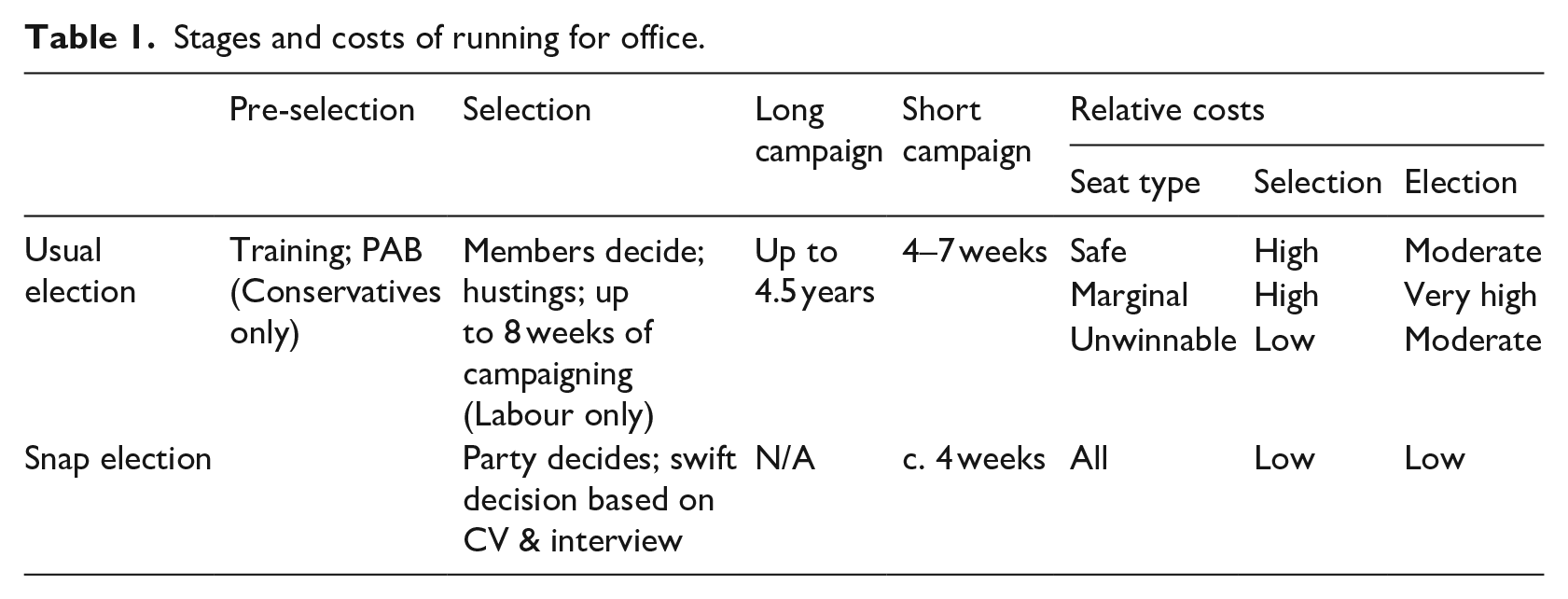
The impact of campaign length has recently been highlighted. The election cycle is usually five years, but in 2017 a ‘snap’ election was called just two years into the cycle. A second snap election was called in December 2019 due to gridlock over Brexit. The snap elections have both disrupted and reinforced a tendency towards an extended long campaign. In 2017, seats that had not selected early were forced to select candidates in great haste using an accelerated selection process managed by central parties, to the chagrin of local members. Candidates were often selected based on just a CV and short interview, in a process that lacked transparency and excluded party members, for whom candidate selection was a rare perk of membership. The reduced costs of running in a snap election are highlighted in Table 1. The 2017 election therefore afforded an opportunity to run for those for whom the cost of a normal election was prohibitive. However, keen to avoid any more hasty decisions and disgruntled members, parties commenced the next round of selections almost immediately after the 2017 election. Consequently, the 2019 snap election offered fewer opportunities for a fast-tracked campaign, although candidates did benefit unexpectedly from a shorter electoral cycle. The snap elections demonstrated the benefits for diversity of reducing the campaign time; ironically, however, they also reinforced the perceived need for early selections (Perraudin and Proctor, 2019). Hence, candidates are now expected to commit to a long campaign of four to five years. This trend has ‘made it harder for working-class candidates. Candidates have to campaign for longer and give up work earlier, which. . .is only good for professional politicians and rich people’ (Crewe, 2015: 39).
Stages and costs of running for office.
The need for greater diversity in the UK political class remains pressing. Despite some recent improvements, the UK parliament remains overpopulated by privileged white men. The proportion of women has gradually increased to 34% thanks to various (often contested) measures within political parties including All-Women Shortlists (Labour) and a national ‘A-list’ of approved candidates to promote women (Conservatives). These measures have been most successful in Labour, which has now achieved gender parity within parliament, while progress by other major parties has been slower. Ethnic diversity has gradually increased to 65 non-white MPs (10%, compared with 14% population-wide (BBC, 2019)).
While precise data on MPs’ wealth is unavailable, certain indicators demonstrate the ongoing class gap between MPs and the wider population. The proportion of MPs who attended the elite universities of Oxford or Cambridge, while declining, is still 21% (the figure for the general population is below 1%) (BBC, 2019). In addition, 27% of MPs attended fee-paying schools – nearly four times the proportion in the wider population (BBC, 2019). Meanwhile, certain occupational backgrounds dominate parliament, with most politicians coming from professional, political or business careers (Audickas and Cracknell, 2020). Business remains the premier path into parliament for Conservative MPs, followed by a political background, while nearly half of all Labour MPs came from political backgrounds compared with barely 5% from business. Alongside ideological differences, these gaps can be explained by each party’s approach to managing the cost of elections: Conservative MPs often come from high-income professions that enable them to afford the cost of campaigning, while Labour MPs more often come from political backgrounds that provide the flexibility to work around political commitments. The proportion of MPs from manual occupations has declined from 15.8% in 1979 to just 1% in 2017 (Audickas and Cracknell, 2020: 15), a proportion similar to the United States and lower than Asia (Carnes, 2018; Joshi and Och, 2014). While some of this decline follows broader labour force trends, it also reflects ongoing large gaps between the population and their representatives, fuelled by the prohibitive cost of elections.
Data and methods
This article draws on 30 semi-structured interviews, conducted between September 2017 and April 2018. Most of the interviews are with candidates who ran for parliament in 2015 and/or 2017 as the Labour or Conservative nominee. Ten interviewees won their elections and 17 lost. 3 I also interviewed several champions of women’s representation within their parties: Baroness Jenkin, co-founder and co-chair of Women2Win, an organisation created to boost the number of female Conservative MPs; Nan Sloane from the Labour Women’s Network; and Barbara Follett, founder of EMILY’s list within the UK.
The interviews were conducted using snowball sampling, especially within Labour. For both parties, a few candidates who had previously spoken publicly on the topic were also approached. For the Conservatives, Women2Win very kindly encouraged their members to take part in the study. I received more snowball recommendations for women than men, and the response rate to interview requests was also higher amongst women, resulting in a sample that is unrepresentative of the gender balance within parliament. I interviewed 25 women (16 Labour, 8 Conservative, one from a smaller party), and 5 men (1 Labour, 4 Conservative). While certain limitations are imposed by the skewed sample – for example, the limited insights from men, especially within Labour – the interviews still provide very rich and insightful data about the process of standing for parliament and the various obstacles faced along the way. A clear picture emerged of the costs, both financial and personal, of running for office, and how these might be gendered. The sample included five ethnic minority candidates and ample variance in terms of social background, age, LGBT status and physical ability. This diversity allows for a more intersectional understanding of the class and gender barriers to running for office.
A rich man’s world
This section maps out in detail the stages – and their relative costs – outlined in Table 1, demonstrating how they create a class ceiling in the UK. The pre-selection stage can entail costly training programmes (Dale, 2006). For prospective Conservative candidates, approval by the PAB also entails a £250 fee plus travel for a full day of interviews and assessment. Many candidates do not pass at the first attempt and must repeat this process.
The next stage is candidate selection within a constituency. This is not a light undertaking; Women2Win caution that ‘becoming an MP is a full-time commitment’ and ‘new candidates will most likely have to fight in multiple constituencies’ before winning a selection. 4 The process can be particularly arduous within Labour, where selections can require up to eight weeks’ campaigning (Bailey, 2015).
Deciding where to stand is complex and has cost implications. Prospective candidates might consider all constituencies, or only those where they have a connection. Considering the full range opens up more possibilities, including target and retirement seats that might be unavailable in the candidate’s preferred areas. However, this strategy also carries significant risks. Some interviewees went for broke and invested all their effort in a specific constituency, because they believed it was winnable at the next election or had received insider information that the sitting MP planned to retire. This strategy involved relocating to the constituency well ahead of the selection process to forge networks, obtain a head start in the selection campaign and establish ‘local’ credentials. Given that there is no guarantee of being selected, never mind elected, these candidates took a big gamble in order to accrue a significant advantage over those joining the race later. For those who do not concentrate on a single constituency, there are two alternative risks: taking part in endless selections, only to be beaten each time by someone already more established in the constituency; and not knowing where you might end up. Some candidates won unexpectedly in constituencies they knew little about, and found themselves having to relocate their lives at short notice to an unfamiliar location. This underscores the need to do ‘reconnaissance work’, namely getting to know the constituency prior to the selection, which incurs time and travel costs.
Conversely, some candidates stuck to constituencies where they already had an established connection. Doing so reduced certain costs; for example, if they lived there, they did not have to invest resources in travel, research and network-building. Others commuted back to a constituency where they had previously lived, usually staying with local family and friends. Even though being ‘local’ did not guarantee victory, nearly all candidates spoke about the importance of having some kind of local connection, however tenuous (‘my father worked there’, ‘my father-in-law lives there’). Studies indicate that the electorate do prefer a ‘local’ candidate (Arzheimer and Evans, 2012; Campbell and Cowley, 2014). Staying local was not always just a political choice; one candidate explained that moving ‘was not possible for me because of my children. . .all my support networks are here. . .I could cope with three days a week in London, but not moving to a different constituency’.
Whatever their strategy, all candidates faced certain selection costs such as leaflets, phone calls and travel costs. Leaflets were mentioned more frequently by Labour candidates, who felt pressured to spend money on expensive materials and professional photographs. One candidate explained, ‘the other candidates didn’t spend as much, and their campaigns looked less professional, which made the difference’, arguing that if you decide to invest in running for office then you need to go all the way. Another concurred, arguing that ‘you need to be able to afford to take the risk because if you wait until you are shortlisted before investing, it will be too late’. However, the cost of this investment gave those with more money an advantage, which the candidate acknowledged, stating that the process was ‘totally non-inclusive and stacked against those [without] resources’. One candidate, who self-defined as working-class, noted how other candidates ‘had professional photographs, professional clothes etc., all of which costs a lot of money which I didn’t have. The party does nothing to help so it is a dishonesty that anyone can do it – people in most jobs and without independent wealth cannot do it.’ 5
Money played an even more direct role in Conservative selections. One candidate explained that ‘most associations are broke, hence the preference for candidates with more money’. Another was asked ‘how much money I had saved – did I have £20,000?’, even though the seat in question was unwinnable and she had been selected only four weeks before polling day, in the 2017 snap election. A third candidate described how part of her appeal to the party was her ability to bring her own money to the campaign, without draining any of the local association’s resources. Hence, for selection to both major parties, money confers a significant advantage.
Once selected, candidates incur many costs throughout the long campaign. For those not already resident in the constituency, these include travel and/or relocation costs. Candidates are expected to campaign actively within the constituency, buy drinks for volunteers and participate in fundraising events. The relentless demands and the insidious, cumulative costs can drain a candidate’s resources and morale (Dale, 2006; Webber, 2013).
However, the most significant cost of the long campaign is time. Some candidates referred to this as an ‘opportunity cost’, highlighting how their political ambitions resulted in failure to climb the career ladder, lost business opportunities, or even abandoning their careers altogether and switching jobs. In addition, nearly all candidates referred to lost income due to needing to reduce their working hours. Many were expected to campaign part-time or even full-time, necessitating huge sacrifices for their professional and personal lives. One candidate remarked wearily that ‘everyone wants a piece of you’; another described the huge investment of time she had made, only to face repeated criticism from the party for not doing more.
For those with high incomes, the net loss from reducing their working hours was greater, but more easily manageable, while those on low incomes found it particularly difficult to forgo part of their salaries. Candidates were also expected to campaign for the party in by-elections and pay to attend party conference. Many candidates also cited the strain on their family lives, relationships and friendships, plus the impact on their health and wellbeing of having to invest so much of themselves in the campaign.
The lengthier the long campaign, the greater the cost, hence why early selections are problematic for candidates. This is particularly well illustrated by the difference between candidates who stood in 2015 versus 2017. For some 2017 candidates, costs were minimal. Many of them were only candidates for the short campaign, and were able to cover this time period using annual leave, sometimes combined with short periods of unpaid leave. Conversely, candidates who had to campaign for years spoke of much greater financial difficulties. One described having set the family’s finances back by a decade. With outgoings exceeding income, candidates depleted their savings and often got into debt.
During the short campaign, candidates are usually expected to commit themselves full time to the campaign, with all the associated costs that this involves. This final sprint is more easily achieved when it does not come at the end of a marathon. Some candidates who had run previously chose not to do so in 2017, having exhausted their resources. However, for those who ran for the first time in 2017, several commented that they had done so only because it was a relatively low-cost, low-risk campaign. They could afford the short-term disruption to their careers and personal lives, and the brief campaign naturally limited the amount of financial investment required. However, some of these candidates had chosen not to stand again when their parties began selecting for the next election, arguing that they lacked the resources to cope with several years of campaigning. 6 One said, ‘they are selecting too early; I would have to go part-time, move and all the rest, and it’s too much when it’s for four or five years – if the selection had been closer to the election I would have gone for it, but the scale of life commitment is too great and I want to have a family.’ 7 The unexpected nature of the 2017 election did, however, provoke other costs such as cancelling holidays without refunds, with two candidates sacrificing their honeymoons. Not all candidates were able to drop everything at a moment’s notice, especially if they lacked support from their employers and/or families.
Whether facing drawn-out or short, sudden campaigns, candidates need a huge amount of flexibility to enable them to juggle politics with their professional and family responsibilities. This explains why so many candidates come from political, professional and business backgrounds that are easier to juggle with a political career. However, flexibility is a luxury that not all candidates could afford. One female candidate stated that ‘when you need to pursue a career without independent wealth to fall back on, it’s hard to interrupt that career. So those who can tend to be those with independent wealth, big business, old money etc. who can afford to take a break from earning.’ Another concurred, stating that ‘it’s difficult to get off the corporate ladder when you’re doing well’ and ‘it’s only been in the last five years that I felt well off enough to consider [running for office]’. This candidate regretted that she could not afford to do so sooner, fearing she may have left it too late.
The cost of campaigns is felt particularly keenly by the many candidates who lose, especially if they invested everything they had. The high cost of running for office is sometimes justified as an investment with a high pay-off, namely a well-paid job as an MP. However, candidates still incur significant costs even in unwinnable seats, and in marginal seats where they fight hard and lose, the costs can feel especially hard to bear. Norris and Lovenduski (1995) give examples of candidates who found the costs prohibitive and had to withdraw; another noted that ‘[it’s] very expensive and some people do find it a terrible strain, and then. . .they don’t win the damn seat at the end of it’ (pp. 146–147). With the 2015 and 2017 election outcomes going against the forecasts, some candidates gambled everything they had on a win, only to lose. One defeated candidate was the clear favourite to win, hence his employer was not expecting him to return to work. Others found themselves in debt, with their careers in tatters, and nothing to show for it at the end. Without independent wealth to fall back upon, a loss can induce real hardship. One candidate stated, ‘I know many people who were unable to stand because of costs, but I know of many more who decided to stand, didn’t win, and subsequently faced serious financial trouble.’
A rich man’s world
There is clearly a class ceiling, with wealthy candidates better able to afford the costs and risks of running for office. Here, I demonstrate that the class ceiling is gendered, as the key resources required – time and money – are often more scarce for women than men. The costs of running may also be higher for women (or with a lower return) due to gender inequities in the selection process. When we consider this alongside non-financial gendered costs, we see how the class and glass ceilings have a cumulative effect: the greater the costs, the more easily they outweigh the potential benefits and act as a deterrent.
There is a gender resource gap, with women on average earning less than men (Francis-Devine, 2020) and doing a much higher proportion of unpaid labour (Charmes, 2019). Being both cash poor and time poor is a double whammy; women can less easily afford to sacrifice earnings and/or outsource their unpaid labour. Bailey (2015) found that 49% of Labour women candidates ‘couldn’t afford what they needed for their campaign’, compared with only 27% of men, and significantly fewer women than men were able to take sufficient time off work to campaign (p. 12). Likewise, one candidate noted that ‘it was mostly women candidates who were struggling’ financially, referencing the gender resource gap.
Starting with fewer resources is an even bigger disadvantage when compounded by sexism and discrimination in the selection process (Ashe, 2017; Shepherd-Robinson and Lovenduski, 2002). Some candidates mentioned such difficulties; for example, one described an all-women shortlist (not intentionally an AWS) where a man was parachuted in after the deadline. Even though the women were very high calibre, and the man showed little interest in the seat, the association delayed the selection so that he could take part, after which ‘it felt like we were talking to an empty room because [the women] had lost [the selection] the moment the man appeared’. If women are less likely than men to be selected in safe seats, then they may have to campaign longer and at greater expense to win a selection, and then end up in marginal seats requiring huge personal investment. This helps explain why more women end up in serious financial difficulty by the end of the process, especially as marginal seats carry a high risk of an unsuccessful outcome. Risk was mentioned repeatedly in interviews, with candidates describing the necessity of taking a risk and making a big personal investment despite the uncertain outcome. Risk-taking is gendered and classed; Carnes (2018) found that poorer candidates are more risk-averse as they lack a safety net to fall back upon if their campaigns are unsuccessful. Women are socialised to be less comfortable than men with risk-taking, and one leader of a women’s network claimed that male candidates take more risks. Women with dependents were particularly uncomfortable with the impact of risk-taking on those who relied on them financially. One spoke of her guilt about the prospect of losing, saying ‘it was sometimes very hard and I suffered from anxiety, because I feared risking my family and their security for the sake of my ego’. She added that she felt this guilt was very gendered and expressed doubt that men felt the same guilt.
A non-financial cost borne by women is sexist abuse, which is used worldwide as a means of silencing and excluding women (Bardall et al., 2020). Inappropriate comments came from within political parties (cf. Bailey, 2015; Shepherd and Lovenduski, 2002); for example, one woman was asked multiple times what she would do if she entered a relationship. Women also found themselves repeatedly exposed to abuse from the public. One woman described being abused, sworn at, harassed in person and online. This was a source of constant anxiety, especially as it also affected her children. Another candidate described how a male candidate received praise while she was abused for discussing the same issue on Twitter. A third candidate received a very detailed rape/death threat, forcing her to curtail certain campaign activities on police advice. She explained that ‘it really hit home when Jo Cox died’. 8 There was widespread acknowledgement that women and other marginalised groups, including ethnic minority and LGBTQ candidates, were particularly vulnerable to trolling (Culhane and Olchawski, 2018). The impact of this violence weighs heavily on those who run, while deterring others from entering the fray (Krook, 2017).
Finally, the costs for family life are gendered. This is an area ripe for further exploration, given the small sample of men within this study. Male interviewees made revealing comments about how their political ambitions impacted their families. One said that his ‘wife was devastated. . .but she came around’. Another said that even if his children had been younger, he would have run for office, while describing rather casually the impact that his career had on his wife. Another discussed how his career has entailed huge sacrifices for his family, including forcing his wife to give up her own career. A female candidate, describing candidates who won selections unexpectedly, noted that ‘men do not need to check with their wives before saying yes, but women do need to check with their husbands’.
The gendered costs of campaigns were felt particularly acutely by candidates who were mothers (cf. Bernhard et al., 2021). As women still undertake a disproportionate share of care-giving, the need to outsource childcare represented an additional financial burden for female candidates. Parties were unwilling to provide support with childcare costs, even preventing one woman from claiming childcare costs to which she was entitled as a local councillor. Two candidates (from different parties) also faced outright pregnancy discrimination. Many candidates described disparaging and discriminatory treatment of mothers, and parties’ refusal to accommodate caring responsibilities. These difficulties were compounded for single mothers, who were often told not to run, or who did so with devastating consequence, while the only women who had juggled single parenthood with elected office were those who could delegate care-giving back to their own mothers (thus replicating the male model of using women’s unpaid labour (Campbell and Childs, 2014)). Even women without children saw motherhood as a gendered barrier, either opting not to have children (which itself can provoke a backlash in politics (Teele et al., 2018)), or opting to take a break from politics to start a family. Those with children spoke of their guilt about the impact on their families, citing absence, financial impacts and the fear of ‘putting their family in the firing line’. All this helps explain why significantly fewer female than male MPs have dependent children (Campbell and Childs, 2014).
Does party make a difference?
As elsewhere, women are better supported and represented in left-leaning parties in the UK (Buckley and Mariani, forthcoming). Yet experiences of discrimination were strikingly similar within both parties. Consider the experiences of two ethnic minority women with children. One said that her party ‘talks about diversity and are searching for diverse candidates but don’t support them enough so then they fall away’, adding that despite her popular appeal due to her ‘understanding of life and reality outside the Westminster bubble’, local party gatekeepers do not like diversity and do not support ‘someone like me’. The other woman accused her party of being hierarchical and elitist, saying it ‘pretends to be inclusive, but this is dishonest. . .on paper I’m everything that the party should be representing, but in practice it’s everything but’. Although those remarks are almost interchangeable, one woman was Conservative, one was Labour.
However, party did affect attitudes towards the costs and benefits of election. Within the Conservative party there is ‘an expectation that you are coming from wealth’, and for most Conservative politicians, an MP’s salary (£81,392) represents a pay cut (Hardman, 2014). Hence money is not considered central to the equation, as it is assumed that candidates have it and can afford to sacrifice it to the political cause. Some interviewees did indeed have ample money, but for those who did not, the expectation of wealth and lack of financial support presented (potentially gendered) challenges. Conversely, for many Labour candidates an MP’s salary represented a significant pay rise, and was therefore viewed as compensation for the investment made upfront. However, for those who did not get elected there was no such recompense, and for those who lacked the resources to pay the election costs upfront, the end reward lay too far out of reach.
Why has no solution been found?
We have seen that a class ceiling intersects with and exacerbates the glass ceiling. While the problem is clear, the solution is elusive. General measures aimed at making elections more affordable for everyone, and targeted measures to make elections more affordable for women, have both proven problematic. Changes to formal rules have been difficult to achieve because they contradict important informal rules to which candidates must adhere.
Introducing financial support for candidates hits multiple political barriers. Parties prefer not to invest money in supporting candidates’ personal costs, as this would leave fewer resources for contesting elections. Knowing this, candidates do not feel comfortable asking, as it is stigmatising to take money from their parties. Candidates described the fear of being seen as a failure or burden, while Baroness Jenkin said ‘women just manage, they do not want to ask for help’. This feeling is compounded by public attitudes towards candidates. The political class are regarded with suspicion and disdain in the UK, with a widespread expenses scandal in 2009 perpetuating the assumption that politicians have their noses in the trough (VanHeerde-Hudson, 2014). Many consider it inappropriate to reimburse privately incurred expenses from the public purse (Dale, 2006). As candidates do not like to admit publicly to their own hardship, it remains invisible to the public (Carnes and Lupu, Forthcoming). Some specific costs, such as travel to the constituency, are concealed deliberately as candidates prefer not to admit they are not ‘local’. Other costs, such as hair-styling and clothes, might seem frivolous to the public, yet they are essential to maintaining the professional appearance expected by voters, especially for women, who face more scrutiny of their appearance (Bailey, 2015).
Some costs might be more acceptable to the public, but relieving these costs would again present political difficulties. The first is time: candidates in marginal seats have a campaign manager working for them on the party payroll, but candidates receive no compensation for their own time. However, it would change the dynamic between party and candidate if candidates became employees of the party. It would remove candidates’ independence and increase perceptions that they were just the party’s mouthpiece. Hence, even if parties could afford to pay their candidates, the change to candidates’ legal status would not be politically acceptable.
Second, parties could meet childcare costs. The Women’s Equality Party 9 is the first party in the UK to cover candidates’ childcare costs; others could follow suit. However, resource constraints mean these costs would likely be met only during the short campaign, which is too little, too late. In addition, this risks disincentivising parties to select candidates with caring responsibilities due to the additional costs invoked.
A key barrier to supporting candidates financially is the prevailing attitude that politics is tough and candidates need to be resourceful and resilient (Webber, 2013). Some interviewees described the challenges of the campaign as necessary preparation for the challenging life of an MP. There was also an expectation that candidates should find their own solutions to financial difficulties, such as raising their own funds, recruiting volunteers and staying with party members in the constituency rather than paying for accommodation. There is some truth to this, but also some important caveats. One candidate received a donation of £5000 from a family friend to cover her personal costs. But the party insisted the money be given to them; when the donor refused, the party let the donation be retracted rather than given to the candidate. Many of the costs incurred by candidates, while necessary and unavoidable, are not seen as legitimate uses of money raised through fundraising. Moreover, while it is important to mobilise volunteers, one candidate experienced gendered discrimination where party members withdrew their labour after she got pregnant, leaving her to campaign alone. Similarly, staying with party members is fine for some candidates, but more complicated for those with caring responsibilities or disabilities and/or for women who feel vulnerable sleeping in the home of a male volunteer.
The other ways to alleviate campaign costs are not politically viable in the current UK context. These include electoral reform, to reduce the emphasis on individual candidates, which neither major party supports; increased state financing of political parties, which is opposed by public opinion (VanHeerde-Hudson and Fisher, 2013); and reducing the time between selection and election, which holds little traction now that snap elections have reinforced the need for early selections. The struggles of candidates are a lower priority for parties than appeasing members and voters, and as long as these latter groups remain indifferent to candidates’ plight, there is no prospect of serious reform.
Furthermore, measures targeted directly at women have made little impact. The UK version of EMILY’s list was controversial and short-lived. Women2Win provide money to candidates in hardship, but the modest sums available are a drop in the ocean of campaign expenditure. (This makes them no less appreciated by candidates, who argued that it gave them a psychological boost to receive investment in their campaign, and helped pay for things at critical junctures.) This is the closest the UK has come to gendered electoral financing (see Muriaas et al., forthcoming).
Conclusion
While every country has its own institutions and rules, the over-representation of wealthy men and underrepresentation of women and working-class citizens is a global phenomenon with significant consequences. Here I outline three important lessons from the UK case study with widespread applicability that help us understand this broader phenomenon.
First, the personal costs of running, while relatively understudied compared to other aspects of campaign finance, can be the most important barrier for candidates without significant resources at their disposal. Of the resources needed to run, the most important was time. People who cannot afford to reduce their earnings and/or outsource their unpaid labour cannot afford to run for office. This is a class issue that is compounded by gendered resource gaps.
Second, we must consider the cumulative effect of barriers to running for office. Any of the costs outlined in this article (time, money, discrimination, abuse, impact on family life) might be sufficient to deter a candidate from running. But one cost in isolation is easier to overcome. As barriers cumulate, the costs quickly outweigh the benefits and become prohibitive. Thus, when considering intersectionality, we should be mindful of the impact of cumulative obstacles on the decisions to run and consequences of running. Future research should also consider other intersections. Evidence arose from this study that race, LGBTQ status and disability all had additional impacts that contributed to the cumulative barrier effect. These areas are ripe for further exploration.
Third, we see clearly that institutions do matter. In the UK, a simple change to one formal institution – eliminating the long campaign – made a substantial difference to candidates’ ability to run for office. But we also saw that informal institutions can be very important. In the UK, the key informal rules that uphold the class and glass ceilings are the ones that stigmatise asking for help. These rules favour privileged men and penalise working-class and female candidates. Studies in other countries should seek to identify the key rules that shape and uphold the status quo.
Footnotes
Acknowledgements
Many thanks to Fiona Buckley, Sarah Childs, Baroness Jenkin, Mack Mariani, Ragnhild Muriaas, Cat Smith, Vibeke Wang, Women2Win and all interviewees.
Funding
The author disclosed receipt of the following financial support for the research, authorship, and/or publication of this article: Norwegian Research Council, Grant No. 250669/F10.
