




Abstract
Central to the debate of what constitutes tolerance has been what is tolerable—and who is tolerant. While the existing literature has engaged with the role of religion in tolerance, there is almost no empirical work on individuals without religion. Not surprisingly, theory relevant to this question is largely absent in the current literature. Therefore, using extensive work in political theory, we derive the notion that the non-religious and atheists will show greater tolerance given a stronger adherence to the value of pluralism. We merge this theory with the modern empirical literature and use four waves of the World Values Survey (waves 3, 4, 5, and 6) to provide a substantive test using a novel measure of tolerance as a crucial individual value. We find that the value of pluralism does distinguish tolerance levels among the self-identified non-religious, although less so for atheists.
L’enfer, c’est les autres.
Jean-Paul Sartre (1944, Huis Clos)
Introduction
What drives individuals’ levels of tolerance? The modern empirical literature suggests that individuals’ levels of tolerance are driven by generic normative democratic values and individual democratic activity or are explained by the dynamics of national ethnic competition. We argue that in this literature, a specific and increasingly salient dimension has escaped serious study. Those unaligned with a form of religion constitute a consequential and increasing segment of the world’s population, yet the only inclusions of the non-religious and atheistic in the study of tolerance have been as objects to be tolerated. This ignores not only a growing global demographic but also the contributions of atheist—and otherwise non-religious—thinkers to the development of a modern conception of political toleration as an important principle at the root of modern democracy. Atheist political theorists have highlighted plurality, higher levels of in-group diversity, and openness to other groups as productive of a tolerant attitude in atheist individuals. Drawing from this literature, we assert that atheistic and non-religious tolerance is driven by an adherence to the value of pluralism and provide a comprehensive and rigorous empirical examination of these insights from political theory.
We begin with a discussion of both the theoretical and empirical literature on tolerance and discuss the relationship between atheism and toleration in political thought. Using four waves of the World Values Survey (WVS) (waves 3, 4, 5, and 6), we examine the empirical literature and provide an empirical test of the relationship between tolerance, atheism, and pluralism. We introduce a novel measure of tolerance that treats tolerance as a crucial individual value and find that pluralism and religious self-identification interact such that, as reported adherence to pluralism increases, tolerance levels increase for all, but most prominently for the non-religious and, to some extent, atheists.
The contribution of this study is threefold. One, given that the modern edifice of tolerance research is based on work that originally included atheists as one of the least-liked groups, we have re-oriented all religious identifications as potential determinants of tolerance rather than select holders of ‘objectionable ideas and activities’ that must be tolerated. Two, we introduce a new measure for tolerance that allows us to update the study of tolerance with a large-N, cross-national investigation that broadens the number (and variety) of countries under investigation. Three, we demonstrate the utility of merging insights from political theory with the rigorous methods of quantitative comparative analysis.
Theory: atheistic tolerance
To understand how toleration has been central to atheism since its modern inception, a short historical detour is warranted. Political toleration has been a debated principle since (at the very least) the 17th century—and political practices of tolerance have a much older history. Its initial formulation, current meaning, definition, normative implications, applicability, and limits continue to be discussed. However, we note that these separate areas of the study of politics do not consistently get communicated across the discipline.
The historical study of toleration often begins with Locke’s (1689) A Letter Concerning Toleration. However, Bartolomé de Las Casas’ account of the Spanish conquistadors in central America started a debate about political toleration in Catholic Europe in the 16th century (Lecler, 1955). In the literature on the history of political thought, there is growing interest in the works on toleration from the 16th century onwards, and for reading a greater breadth of 17th- and 18th-century thinkers on toleration. In addition to Locke, special attention has been paid to Spinoza, Bayle, Pufendorf, Leibniz, Hume, Voltaire, and d’Holbach, to name just a few. Crucially for us here, most of these thinkers with the exception of Locke and Pufendorf were highly unorthodox religious thinkers—if not outright atheists (Israel, 2002).
In contemporary political theory, Galeotti (1993: 587) identifies the ‘liberal’ model of toleration where ‘each person should be left free to follow her ideals and style of life as long as she does not harm anyone else.’ This model, she argues, is severely limited when it comes to a political principle of toleration because it is too closely associated with a specific moral argument about toleration as a social virtue. Toleration as a social virtue rests on the valuing of individual conscience and autonomy in liberal political theory, an argument that has been problematized by (so-called) communitarian thinkers because it presupposes a private/public distinction. For Galeotti (1993: 588), what matters for political toleration is not a moral disapproval presupposed by the social argument for toleration, but rather ‘the very fact of pluralism.’ Galeotti (1993: 588) therefore proposes that political toleration is best described as a ‘virtue of the political order that allows for the peaceful coexistence of differences that do not spontaneously combine in harmony.’ Conflict between various individuals and groups, in other words, cannot be resolved at the political level by an appeal to the contested worth of individual autonomy over other values. Thus, political toleration is not best expressed with reference to moral worth (be it with a reference to autonomy) but rather with reference to political institutions and participation in the political process to decide on the best means to reconcile differences for peaceful coexistence.
How does individual religious identification then square with this framework? The question of political toleration comes from the fact that there is a pluralism of belief rather than from an argument about the moral worth of persons to be tolerated. This pluralism is two-fold: on the one hand, it is a fact (the fact of pluralism): historically in the religiously divided Europe of the early modern period, as in most advanced industrial democracies, there are multiple groups that claim ultimate religious truth without an obvious way to demarcate their incommensurable claims. On the other hand, there is an embracing of this fact (rather than an attempt to overturn the situation), which then turns pluralism into a political value (the value of pluralism). This latter pluralism posits that there is value in diversity, that one person’s (or one group’s) claim to ultimate meaning should be left to their own choice without undue interference by other groups or by political authorities.
Paul-Henri Thiry, baron d’Holbach, was the first self-avowed atheist to propose a thorough theory of toleration. He argued in his 1773 work Politique Naturelle that it would be a ‘tyranny’ to oppress the opinions of citizens, that a state needs to strike a balance between different religions, and that individuals should remain free to exercise their own judgment (D’Holbach, 2001: 491–492). In other words, Holbach uses a skeptical and pluralist argument in favor of toleration. Skepticism opens the way for toleration inasmuch as the skeptic puts into question all truth-claims—making intolerance of other beliefs unjustifiable. Contemporary atheist and non-religious political theorists Connolly (2005: 4) and Rorty (1999) have made similar points about the link between atheism (or non-theism) and toleration. Similar motivations are to be found between atheists and other non-religious persons in skepticism, providing a direct link between atheism (nontheism) and toleration (Bernstein, 1987: 542; Connolly, 1999: 8, 2005: 130).
There is already evidence to suggest that atheists are a diverse group, both theoretically and empirically (Ysseldyk et al., 2010). The value of skepticism directly informs the pluralist conception of toleration: one can both assert a truth-claim (‘there is no god’), and be open to others disagreeing with this truth-claim and putting their own forward (‘we cannot know whether there is a god or not,’ or ‘there is a god’). In the absence of rational consensus on these issues, in the presence of the fact of pluralism, Holbach and other atheists promoted the valuing of pluralism as a source of intellectual wealth and as an argument in favor of toleration. The theoretical literature on atheism thus points to one important conclusion: valuing pluralism is an important source of tolerance, as evidenced by 18th-century atheists and unorthodox thinkers who advocated for increased toleration at the political level. Valuing pluralism implies a tolerance of others’ opinions and beliefs, even when one fundamentally disagrees with them on important questions.
Specific empirical studies on tolerance of atheists focus on a number of questions which include moral, social, and political tolerance of atheists as one of the least-liked groups in society. Whitt and Nelsen (1975) use a survey question about tolerance of atheists within groups with different theological beliefs, but the question asked is a moral one rather than a political one (‘someone who doesn’t believe in God can be a good American, or not’). Recent surveys on public opinion continue this trend; for example, Shafer and Shaw (2009) use questions of moral approbation (whether one’s opinion of atheists goes from very favorable to very unfavorable), social tolerance (whether you would like to have an atheist neighbor), and political participation (whether you would vote for an atheist political candidate, whether atheists should be allowed to teach college or university, whether they should have their book in a public library). McCutcheon’s (1985) study, which includes atheists among the least-liked groups in the United States, is much more focused on political tolerance. His three criteria for political tolerance (giving a speech in your community, teaching college or university, having their book in a public library) are much better indicators of what we seek to address here than questions of moral worth of atheists, since they specifically ask about the ability of a particular group to express their ideas in public and thus participate in the political process.
Tolerance of atheists in the United States is extremely low. While Gibson (2008: 102, table 4) shows that the Ku Klux Klan and Nazis rank higher than atheists as ‘least-liked’ groups, political intolerance of atheists is high (similar to that for radical Muslim and US communists), effectively splitting the American public in half (2008: 104, table 6). In direct comparison to religious groups, however, such as fundamentalists, Muslims, Hindus, Jews, Catholics, and Christians, atheists are by far the most despised (Yancey, 2010). As Karpov (2002) shows, there is strong evidence to suggest that these findings are not specific to the United States and that they apply similarly to other cases—in his case Poland. On the other hand, a study of atheists in Canada has also revealed that atheists ‘share a cluster of liberal and Enlightenment ideals that includes personal liberty, individualism, and an absolutist view of free expression’ (Simmons, 2019). Atheists may thus be more attached to the values of democracy than their religious counterparts and have higher levels of tolerance as a consequence. Yet, as Ysseldyk et al. (2010: 65) point out, ‘few researchers have examined the social identification of atheism.’ Even in China, where anti-religious education is part of the curriculum, a study has found that high levels of education actually positively improve people’s empathy toward others’ religious beliefs (Wang and Froese, 2020). In all of these cases, the United States, Poland, Canada, and China, there is evidence that atheists have high levels of tolerance toward religious groups. There is no evidence, to our knowledge, pointing to the contrary: that the non-religious and atheists are more intolerant of others than the religious are.
In a follow-up study, Ysseldyk et al. (2012) look specifically at (ir)religious toleration and out-group tolerance. In two studies, one in Britain and one in Canada, they conclude that irreligious identification plays a role in attenuating hostility toward members of religious groups. One potential limitation of their analysis is the ‘feeling thermometer,’ which does not measure toleration per se (let alone political toleration), but warmth toward other (ir)religious groups. At the same time, their study supports our theory about the central role of the value of pluralism for toleration cited above, as they argue that irreligiosity has a specific impact on tolerance because of its lack of epistemological and ontological certainty. It is not inconsistent to find that non-religious/atheists express less warmth toward other religious groups whilst simultaneously being tolerant toward them. There is considerable scope to look at toleration among the non-religious, to test whether the findings of Ysseldyk et al. can be applied to toleration more widely. There is also considerable evidence to suggest that atheists embrace certain values, such as pluralism, that can raise their toleration of religious groups. This remains to be tested at a cross-national, large-N level, however, to demonstrate more than anecdotal evidence.
Religious toleration
What makes this particular conception of atheist tolerance, based on the value of pluralism, different from religious toleration? The identity theories of social psychology have long included individuals’ self-concept, which originates from not only membership of a social group(s) but also the significance of that membership (Tajfel and Turner, 1986). That is, identity is relational and one way this is maintained is through positive comparisons with out-groups. Even in the absence of conflict or competition, higher-functioning cultures tend to cultivate higher in-group strengths based on generalized trust and sanction/reward that frame social cooperation (and internal dependence, see Putnam, 1993). Therefore, one could easily argue that religious identification, originating from membership of a specifically minded group, reinforces in-group identification through shared identities, core liturgies, and common rituals. In contrast, those identifying as non-religious/atheist have less to bind them in common and thus manifest lower in-group identification. The non-religious, sharing little in common apart from a negative belief, are more likely to have weak in-group ties and value pluralism as a result. A recent study of atheist and Christian groups, though not representative due to its small sample size, has suggested that this is the case, with Christians showing much more cohesiveness in their identity than atheists (Doyle, 2019).
Measuring weak in-group identity—that is, the absence or incoherency of group attachment—poses both a conceptual and operational challenge. This approach perhaps provides a clearer explanation for religious—rather than non-religious and atheistic—tolerance. In contrast to trying to derive an indirect theoretical mechanism from the role of religion in tolerance, we identify and derive from the existing—if largely—philosophical literature that atheists and the non-religious place a greater emphasis on pluralism and this in turn provides a potential theoretical mechanism for greater tolerance.
Democratic toleration in the literature
Where do atheists and the non-religious fit in the larger literature on toleration? Since Duch and Gibson’s (1992) cross-national examination of political tolerance in several advanced industrial democracies, the most comprehensive empirical test thus far of political tolerance is Peffley and Rohrschneider (2003). They argue that individuals’ ‘exposure to the rough-and-tumble of democratic politics should enhance political tolerance’ (2003: 243). Like many before them (Marcus et al., 1995), they come away with empirical support for the notion that individuals’ generic support for democracy and democratic principles is higher than the actual political tolerance of specific, named groups. Their contribution at the individual level is that those who use civil liberties demonstrate higher levels of political tolerance. This individual-level finding works well in the 17 countries included in their study, leading us to conclude that in our analysis of tolerance as well, we should find that democratic activism attenuates the effects of atheist and non-religious tolerance.
Peffley and Rohrschneider (2003) focus on individuals’ value orientations and political practices as they relate to democracy, or at least political plurality. Their ‘Value Free Speech’ variable is highly appropriate to tapping ideological support for free expression as a value versus the actual case of the dependent variable. Several authors have used the concept of democratic learning to explain the effect of democratic government on individual political judgments (Marquart-Pyatt and Paxton, 2007). Their preferred terminology of individuals’ ‘democratic activism’ might also be termed ‘political participation,’ as the indicators used are the same as studies of political participation in related literatures (cf. Finkel and Muller, 1998; Rohrschneider, 1999). We will treat democratic activism and political participation as conceptually synonymous for the purpose of our study.
Individuals’ preferences for democratic ideals such as underpinning notions of egalitarianism and self-restrained respect for full participation are likely to impose on evaluating actual cases of political tolerance (see Sullivan et al., 1982). They also include a variable called ‘conformity’ meant to capture psychological predispositions such as predisposition for authoritarianism (as in Adorno et al., 1950), ideological intransigence, and self-esteem (citing Sullivan et al., 1982). This value construct is meant to reflect ‘a desire for an orderly and structured world where others conform to rules and authority’ (Peffley and Rohrschneider, 2003: 249). There are limitations to their operationalization, though, as encouraging children to learn ‘good manners’ may be exaggerated as an indicator of a reactionary mindset toward developing authoritarian views. In any case, this hypothesized value is likely to indicate some deep psychological structures of intolerance toward others which challenge the status quo.
Perceived threats can be related to intolerance (Gibson, 2006). One should be careful, however, not to conflate in-group prejudice with intolerance. Gibson (2007) acknowledges that there is an overlap between intolerance and in-group prejudice, although they are conceptually distinct. Inasmuch as one may feel threatened in any real or perceived manner, intolerance is a likely manifest but need not follow from the threat itself. Hinckley (2010: 189) shows that in non-Western democracies, the tolerance-attenuating effect of ‘political activism,’ while effective, is mitigated by individuals’ ‘psychological dogmatism.’ Those who are ‘psychologically open to disagreement’ (Hinckley, 2010: 202) are thus more likely to perceive threats to their in-group not as existential threats, but as sites of political contestation. The democratic learning hypothesis is upset by predisposition of some to see political contests as moral contests (Gibson, 2002; Gibson and Gouws, 2003; Sullivan et al., 1982). Hinckley (2010) demonstrates that this effect is not merely offsetting but is even able to atrophy individuals’ levels of tolerance over time (at least in the Russian case). We can thus expect that those exhibiting psychological dogmatism, or in other words, those who do not value pluralism but tend toward moral monism, would have lower propensity toward toleration. Those who value pluralism, on the other hand, would have lower levels of psychological dogmatism, leading to a rise in toleration in these individuals.
In the model presented in Peffley and Rohrschneider (2003), the ‘control variables’ are age, gender, ideology, and education. For contests of remotely ‘moral’ or ‘ethical’ issues, these controls are likely to only passively identify salient social cleavages (cf. Dalton and Wattenberg, 2000; Inglehart, 1997). Peffley and Rohrschneider’s model is weighted toward their theorized finding by ignoring both salient social cleavages that may mediate any ability for individuals to be ‘democratically active,’ as well as the aforementioned and possibly meaningful sub-national social cleavages: the composition of society is ignored, along with resultant relations between individuals. By looking at atheists and the non-religious, we propose to look into one of these groups’ toleration versus that of the religious.
The above discussion leads us to the following set of hypotheses:
These two hypotheses are prompted by the theoretical insights, along with empirical evidence found in specific studies. If theorists are correct that atheists value pluralism more than their religious fellow citizens, we can expect to find differences in tolerance as a result. The purpose of our article is to establish whether there is a wider trend, using data we have available to that effect.
Methodology
To investigate atheistic tolerance, we use the World Values Survey (WVS). We do so as this facilitates operationalizing the key variables consistent with the literature and offers a wide cross-national approach. In doing so, we are able to retain waves 3, 4, 5, and 6, which, after cleaning, preparing, and harmonizing the data, represent 146,400 individual-level observations in 81 countries over the period 1995–2016. 1
The most common dependent variable to study political tolerance is the response to the question about a ‘least-liked’ group. Survey respondents are asked to name the group they find most threatening, after which they are questioned as to whether this group should have the right to participate politically, not only in terms of elections but also to disseminate their platform of ideas (Gibson, 1992, 1998, 2006; Peffley and Rohrschneider, 2003; Sullivan et al., 1982). This question captures an individual’s willingness to extend the rights of political and social citizenship to members of other groups. Methodologically, this has been argued to be the preferred method to determine the level of tolerance in individual responses (Gibson, 1992, 2006).
However, the 1994–1999 WVS represent the last time that a large mass survey included the ‘least-liked’ questions. These data are more than 20 years old and there is no updated conceptual or operational equivalent in the later waves of the WVS. 2 While affecting the ability to continue and expand the existing study, the emergent literature also notes that the main problem is that the least-liked group is often either a marginal social presence and not likely to run for office, teach in schools, or even be able to effectively organize large events (i.e. it is a hypothetical; Gibson, 2007); represents only one of many intolerable groups unnamed by the respondents (see also Gibson and Gouws, 2003); or is the only group to produce such revulsion to political inclusion (see Gibson and Duch, 1993). 3 Mondak and Sanders (2003) have already empirically demonstrated the diminishing utility of adhering to the pre-selected groups (i.e. communists, homosexuals, inter alia) and while Peffley and Rohrschneider (2003) rightly exclude criminals from their analysis (as a group that is not likely to be politically active as a group), would members of the other groups they do include identify themselves as members of those ‘least liked’ groups? 4 The problem is whether members of both the ‘least liked’ groups, and the group from which the ‘least like’ claim is made, constitute substantive and thus competing groups in society. In other words, the discontinuing of the ‘least-liked’ approach offers an opportunity to update the measure of tolerance from responses to overtly hypothetical situations of over- or under-represented groups in society.
We therefore propose a novel approach in order to update and encourage large, cross-national tolerance research. We do not intend to replace or continue the least-liked approach but rather offer a novel operationalization for the concept of tolerance as a crucial individual value. We ask about tolerance as an important value to have—as well as to impart to others. Respondents in the WVS series are asked to choose (up to five) qualities from a list which are especially important that children learn at home. The list includes good manners; independence; hard work; feeling of responsibility; imagination; tolerance and respect for other people; thrift saving money and things; determination/perseverance; religious faith; unselfishness; and obedience. We code this as a dichotomous variable in which mentioning teaching children ‘tolerance and respect for other people’ in the list of qualities is ‘1,’ and not mentioning it is ‘0.’ In the sample here, 69.6% of respondents include teaching tolerance as especially important for children. We note that this is additionally important as the distribution of the ‘least-liked’ approach is very often heavily skewed toward intolerance.
Including tolerance as a key quality for children to learn evidences placing strong importance on the value of tolerance. This original conceptual approach asserts that individuals’ orientations to tolerance are very likely captured, as a crucial individual value, by the importance of passing it to the next generation. Thus, if we are interested in tolerance as an individual value, our approach may provide a conceptual as well as operational improvement to relying on responses to hypothetical situations of over- or under-represented groups in society.
For the key variable of interest—religious identification—there are a number of questions available in the WVS. We identified five direct indicators of an individuals’ identification as a religious or non-religious/atheistic person: the frequency of attending religious services, a question on the importance of religion in one’s life, a question on the importance of God in one’s life, the belief in God, and self-identification as a religious, non-religious, or atheistic person. These all move together in both highly coordinated and expected ways. 5
Attendance at religious services and placing a high level of importance on the role of religion and God in one’s life are both highly correlated with being ‘religious’ (versus non-religious and atheistic). While there are (very few) non-religious and atheists that appear to attend religious services and think of religion as important, these are diminishingly small percentages compared to those that do neither. As a direct indicator of the central tenet of all religious people, the question ‘Do you believe there is a god?’ corresponds highly with religious self-identification. While there are a few atheists who say they believe there is a god, there is a similarly small percentage of religious identifiers who say just the opposite. Combined, these two groups constitute less than 2% of all observations in each wave and can be assumed to be either entry mistakes or resolvable in the minds of the respondents. 6 In either scenario, they are negligible to the outcome of the analysis as their inclusion and exclusion produces the same results.
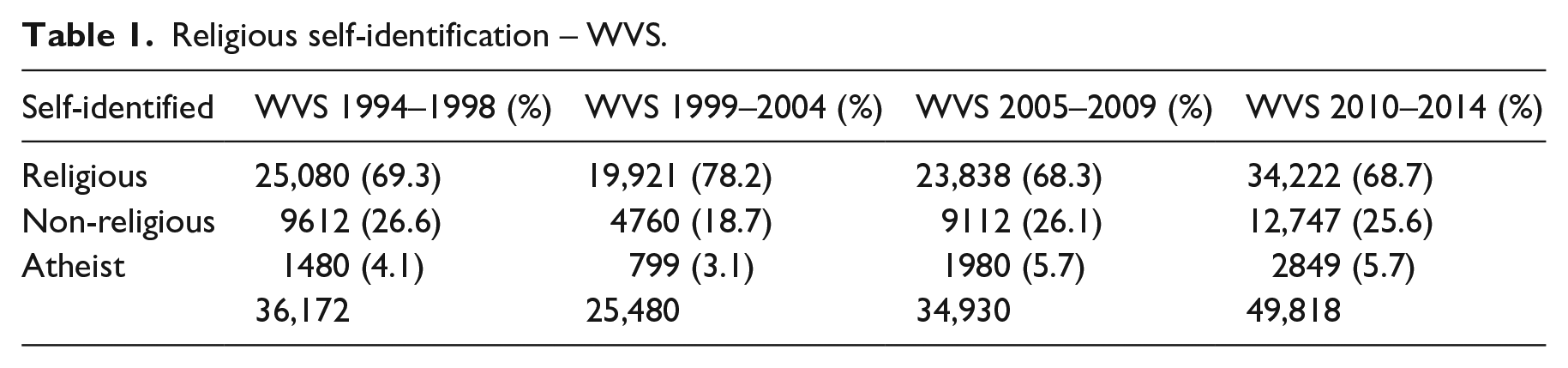
We assert that the most consistent identifier was the religious self-identification trifurcating those who identify as non-religious, as atheistic, or as religious as it (a) respects the individual to best know the correct religious identification; (b) captures the consistency in atheistic and religious identification (based on cross-tabulation); and finally (c) sidesteps unnecessary affiliation issues. 7 For this latter albeit tertiary issue, given the lack of discussion in the literature about the need to distinguish a non-Muslim from a non-Christian from a non-Taoist among the non-religious and atheistic, we ignore the type, beliefs, and strength of respondents’ religiosity, as these are elements of religious attachment, not non-religiousness or atheism, the focus of this analysis. Given this, in Table 1 we can see the distribution of respondents’ religious self-identification across the four waves. The distribution of self-identified religious, non-religious, and atheists is roughly two-thirds, one-quarter, and 5%, respectively. The only anomaly is wave 4 (1999–2004) in which a slight surge in religious self-identification appears. 8
Religious self-identification – WVS.
Overall, comparing the different religious self-identifications, we find that the self-identified ‘religious persons’ reports a mean measure of teaching tolerance (ranging from 0 to 1) of 0.68, SD 0.47; ‘non-religious person’: 0.68, SD 0.47; and ‘atheist’: 0.68, SD 0.47. There is no statistically significant difference between these groups.
The value of pluralism, according to Eck (2007), is not merely the presence of diversity but engaging it as well as aiming to see across ‘lines of difference.’ It is the process of individual engagement with a broader world, and in turn higher self-actualization. The process of modernization has been argued to reach a further stage, post-modernization, which coincides with just such a change in value priorities (Inglehart, 1990, 1997). Inglehart has argued that most nations have modernized from steady-state economies based on religious and communal values to secondary societies in which economic growth becomes the dominant societal goal and a state defined by the rational-legal authority. The third and subsequent stage—post-modernization—includes the transformation to a society in which more importance is given to maximizing individual well-being and a de-emphasis of authority. The processes of modernization and post-modernization cultivate a shift in value priorities—transforming the basic norms of government, work, religion, family, and sexual behavior—with an ultimate emphasis on participation, self-expression and actualization, and quality of life issues. These value priorities differ from previous stages of national development in which traditional authority (pre-modernization) and individual achievement motivation (pre-post-modernization) are the dominant societal values. Thus, as an individual prioritizes ‘post-materialist’ values, that individual is expressing a greater affiliation with pluralistic values. Therefore, to measure pluralist values, we use the 12-item materialism and post-materialism index and interact this index with respondents’ religious self-identification.
We estimate the model by replicating Peffley and Rohrschneider’s (2003) model—built upon the empirical work of Duch and Gibson (1992) and Marcus et al. (1995) 9 —using the three most recent waves of the WVS. We therefore included individuals’ level of ‘democratic activism,’ political interest, ‘conformity,’ adherence to democratic ideals, value of free speech, and the socio-demographic variables of gender, age, education, subjective social class, and ideology. We also include a country-level variable, GDP per capita (attached to the year of the survey). We use a two-level binomial logit model, with individuals within countries. 10 A complete description of variable operationalizations and transformations, as well as countries, can be found in the online Measurement Appendix.
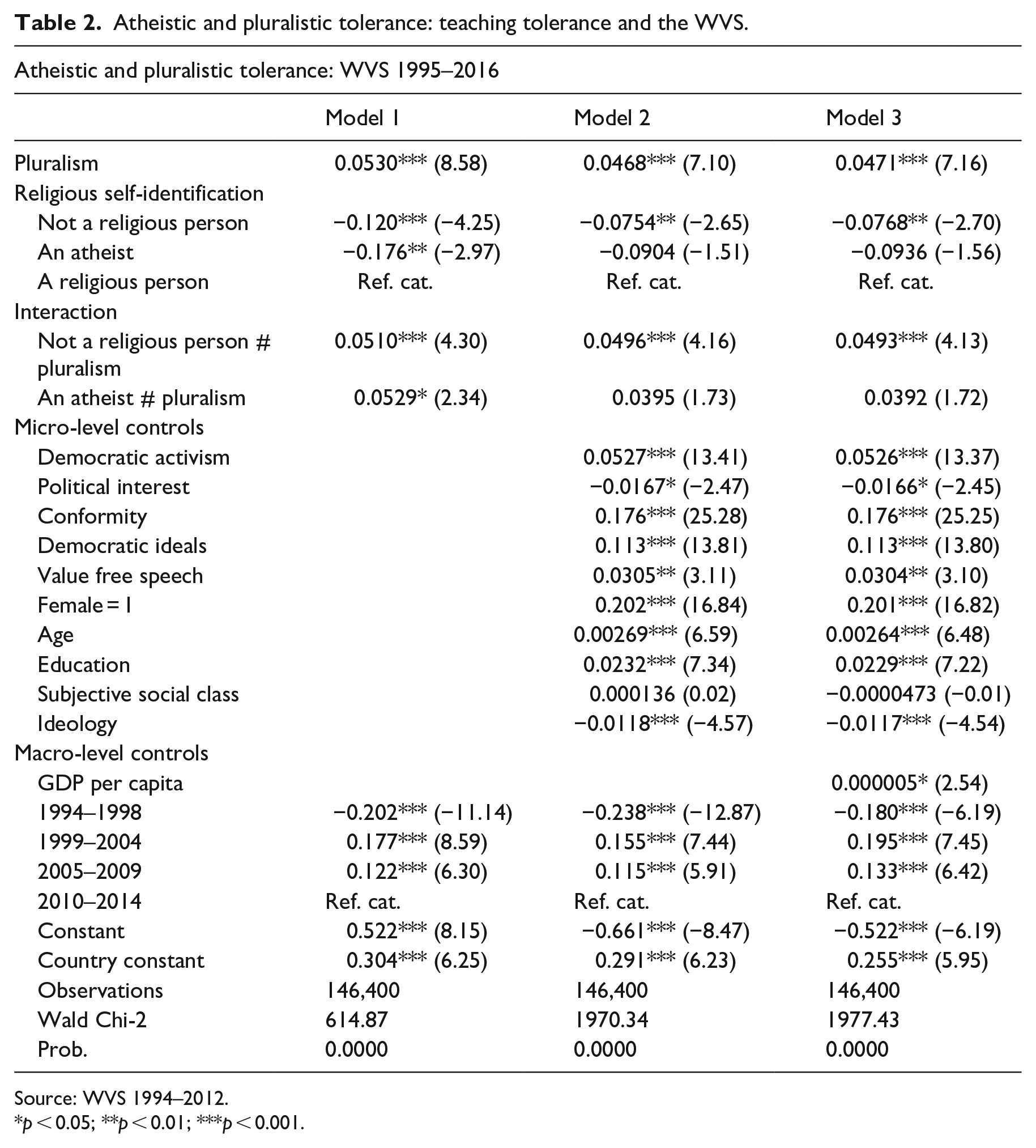
Table 2 includes the output for a full specified model for tolerance, including religious self-identification and pluralism across all three waves. Model 1 includes only the variables of interest here, namely, measures of religious self-identification and pluralism, Model 2 adds the micro-level controls, and Model 3 adds the macro-level controls.
Atheistic and pluralistic tolerance: teaching tolerance and the WVS.
Source: WVS 1994–2012.
p < 0.05; **p < 0.01; ***p < 0.001.
First, the value of pluralism is statistically significant and positive across all waves. Second, while both the self-identified non-religious and atheists are statistically significant (and negative) in Model 1, only the self-identified non-religious remain significant in the full models (2 and 3). Third, however, interacted with pluralism, the non-religious quickly become more tolerant with increased pluralism. While the non-religious show an initial lower relative level of tolerance than religious identifiers, the non-religious self-identifiers who hold higher pluralist values soon match or exceed their tolerance levels. We note that we see the same interactive effect for atheists although at a lower level of statistical significance (p ⩽ 0.08). Figure 1 presents the marginal effects of this interaction on tolerance.
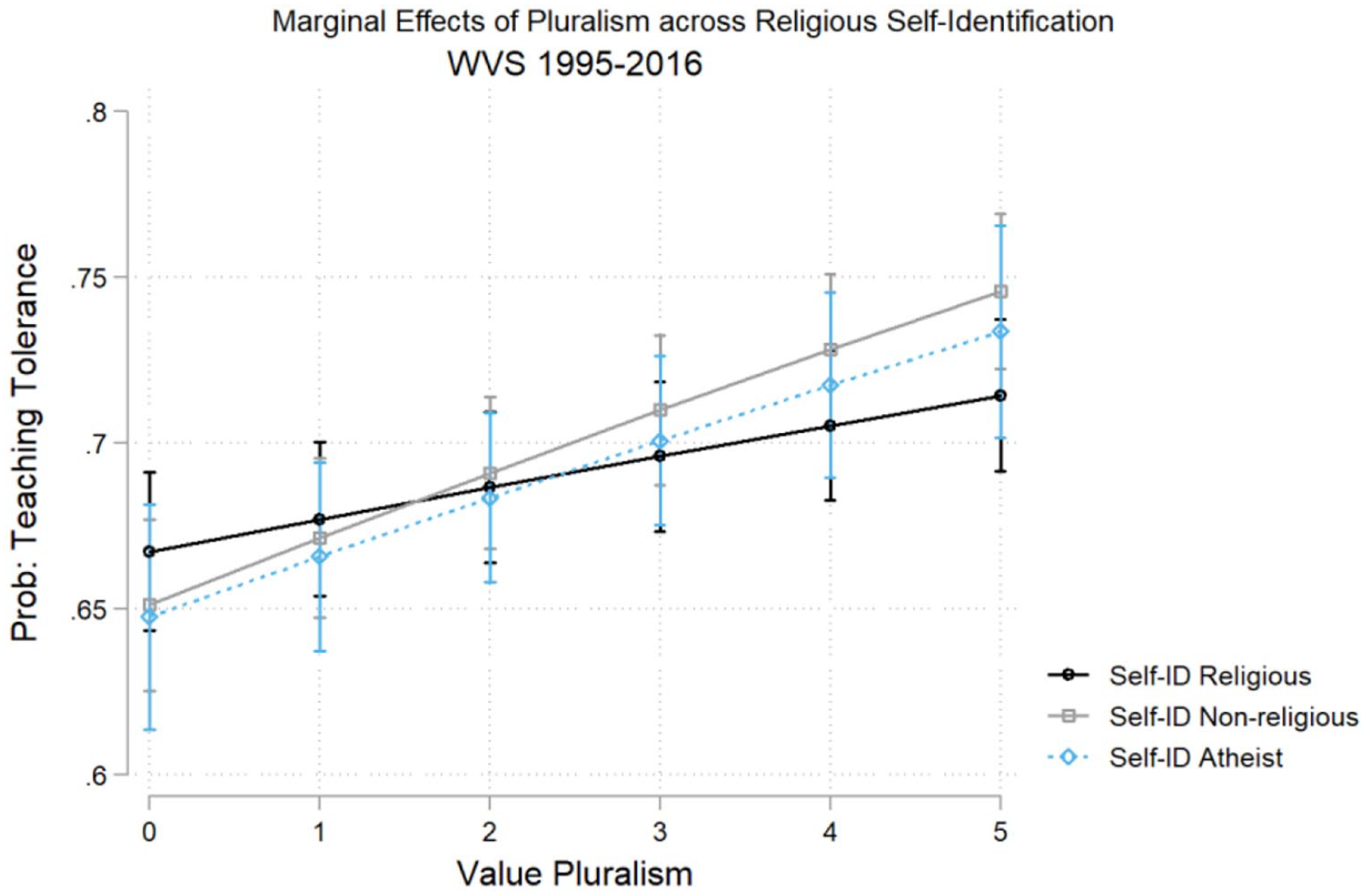
Marginal effects of pluralism across religious self-identification: WVS 1995–2016.
In both the fully specific micro-model (Model 2) and fully specified micro- and macro- model (Model 3), the control variables perform more or less as expected. While the positive effect of being female and the negative effect of ideology on tolerance are provocative, we do not take these up here for consideration of space. What we do find is that, in a fully specified model of tolerance over four waves of the WVS, non-religious (and to some extent, atheistic) tolerance appears to be responsive to individuals’ adherence to the value of pluralism. Simply, the non-religious—and again, to a lesser extent, atheists—become significantly more tolerant with greater pluralistic values.
These findings support Hypothesis 1 in which atheists and/or non-religious who place higher value on pluralism are more tolerant than those atheists and non-religious who do not. Those religious identifiers clearly show higher tolerance levels at higher pluralism values (Figure 1). We also find qualified support for Hypothesis 2 in which pluralism exerts a more substantive effect on the tolerance levels of the atheists/non-religious than for those who identify as religious. That is, although not the focus of this analysis, there is a similar—if weaker—pattern for those who self-identify as religious; namely, those who self-identify as religious and express higher support for pluralistic values show higher tolerance levels than those who do not have high pluralism values.
This analysis offers a very preliminary operational template for measuring tolerance in order to exploit large-N, cross-national data. In light of the available literature and evidence, there is preliminary evidence that atheistic and non-religious tolerance is related to some extent to individual adherence to the value of pluralism. This provides a ‘departure point’ for subsequent analyses interested in the greater and necessary theoretical and methodological precision. Our goal has been to cultivate more recent and cross-national studies of tolerance so as to invite greater study of not only atheistic tolerance but other novel approaches as well.
Discussion
Mueller (1988) shows that there is a much higher percentage of people who agree with the principle of toleration (‘I believe in free speech. . .’) rather than with a specific tolerant attitude toward atheists (‘I would allow a person to make a speech against churches and religion’). In other words, there very likely exists a broader discrepancy between arguments for toleration and specific tolerance, which this research has aimed to confront. Drawing from broader political theory and the empirical literature, we find that the tolerance of the non-religious and, to some extent, atheists is largely driven by adherence to the value of pluralism. Higher values of pluralism differentiate not only tolerance levels among the non-religious and atheists but, albeit to a lesser extent, also tolerance levels between them and those who identify as religious.
There are a multitude of limitations to this study. There are undoubtedly deep and important variations not captured here (e.g. doubtful atheists/religious people, agnostics, inter alia) and the questions used here require a somewhat stringent—and obviously self-aware—religious self-identification. These however represent potentially fruitful avenues for future research as they spill over the edges of our investigation. In addition, there may also be other plausible theoretical, and potentially causal, mechanisms. For example, there may be more broadly related psychological traits (such as, in the Big Five framework, Goldberg, 1993) that are shared among the atheistic and tolerant, underpinning this relationship. While certainly possible, there is no clear theoretical alternative in the extant literature to the coherent—albeit long untested—literature of the argument presented here. Finally, one might ask whether these findings are affected by our updated conceptualization and operationalization of tolerance. We acknowledge that updating the concept as well as the operationalization of tolerance requires a great deal more work than we have proposed here, such as related concepts such as indifference and whether passive social or political acceptance is sufficient to warrant the broader claim of tolerance. These are important questions that require more research. However, in the absence of continuing ‘least-liked questions,’ as well as the avoidable conceptual and operational limitations, we need to make efforts such as this one so that investigations do not retreat into a uncomfortable compilation of case studies or drunken search under the streetlight for the keys of tolerance.
To be clear, we are not interested in whether atheists are more or less tolerant than the religious, but rather in what might drive the non-religious and atheists to be tolerant. As empirical studies on tolerance have generally included atheists merely as one of the least-liked groups rather than a focus of investigation, this study confronts this bias and assesses whether non-religiosity is a contributor to or detractor of individuals’ levels of tolerance. In this sense, this study opens the way for many more to deepen our understanding of the links between religious belief (or lack thereof) and toleration.
Evidence exists that religion and the requirements of democratic societies merge, often in surprising ways: for example, normative support for democracy as an ideal is generally higher among Muslim respondents than Eastern Orthodox respondents (Hofmann, 2004). Given the positive performance seen here of the longevity of democracy in promoting higher tolerance (Peffley and Rohrschneider, 2003), further questions emerge. What is the role that pluralism plays in some religious communities in promoting tolerance? What is the mechanism linking the value of pluralism and political tolerance? What do we gain by differentiating various groups of atheists and non-religious presently largely treated together in this study (atheists, agnostics, non-believers, non-religious, apostates, etc.)? Even more broadly, what type of tolerance is necessary for democratic society to function? How does our investigation of tolerance shape what we discover? Is tolerance active or passive in democratic society? What type of (other) religious identities are relevant (i.e. agnostic, spiritual, polytheistic, Quaker, etc.)? At the same time, our analysis prompts interest in related concepts such as ‘indifference’ in which passive social or political acceptance may be sufficient to warrant the broader claim of tolerance.
Given the rising importance of the issues of religion and atheism in modern politics, we have tried to address this limitation in the context of the political science literature. Political science has focused on individual attributes that relate to democratic political culture but have provided little differentiation among the varieties of non-religiosity. Such work may eventually require us to disentangle the origins of individuals’ moral orientations from the thicket of religious nurture, culture, and individual determination. Here, we argue that the tolerance of atheists and the religiously committed are explained by different mechanisms; and specifically here, the attribute of pluralism. We do not argue that pluralism is an exclusive attribute of atheists—the empirical output shows that pluralism increases the levels of tolerance for the members of religious traditions as well—however, we see atheists’ stronger responsiveness to pluralism as a potential explanation for their tolerance.
Conclusion
Spinoza suggests that the reason why one would tolerate ‘vices’ that are contrary to one’s own conception of the good is not only that such vices ‘cannot be prohibited by legal enactment’ but also that they stem from the ‘freedom to philosophize’ (libertas philosophandi), which itself is a way of augmenting the power to think and to act. (Tønder, 2013: 695)
Political tolerance is thus articulated, in the early modern era, as an empowering virtue in a democratic citizenry. Atheists and the non-religious have historically and theoretically been the vanguard of those arguing for the freedom to philosophize—not merely for themselves, but all equally in society. By valuing pluralism, they have constructed a worldview where one’s religious beliefs, or lack thereof, are equally tolerated by all in a democratic polity. Atheists and the non-religious have here been shown to exhibit high levels of valuing pluralism, and therefore high levels of tolerance in society. This expresses a central role for atheists and the non-religious in establishing support for democratic values and pluralism in particular.
Supplemental Material
sj-docx-1-qhr-10.1177_01925121211034148 – Supplemental material for The tolerance of the despised: Atheists, the non-religious, and the value of pluralism
Supplemental material, sj-docx-1-qhr-10.1177_01925121211034148 for The tolerance of the despised: Atheists, the non-religious, and the value of pluralism by Charles Devellennes and Paul Matthew Loveless in International Political Science Review
Footnotes
Acknowledgements
The authors would like to thank the editors and the anonymous reviewers for their comments on an earlier version of the manuscript. Any errors are the responsibility of the authors.
Funding
The author(s) received no financial support for the research, authorship, and/or publication of this article.

Supplemental material
Supplemental material for this article is available online.
Notes
Author biographies
References
Supplementary Material
Please find the following supplemental material available below.
For Open Access articles published under a Creative Commons License, all supplemental material carries the same license as the article it is associated with.
For non-Open Access articles published, all supplemental material carries a non-exclusive license, and permission requests for re-use of supplemental material or any part of supplemental material shall be sent directly to the copyright owner as specified in the copyright notice associated with the article.
