




Abstract
What makes humour an honest and a direct communication tool for people? How do social networking and digital media transmit user-generated political and humorous content? Our research argues that the way in which humour is deployed through digital media during protest action allows protestors to assert humanity and sincerity against dehumanising political manipulation frameworks. Humorous content, to this extent, enables and is indicative of independent thinking and creativity. It causes contemplation, confronts the hegemonic power of the oppressor, and challenges fear and apathy. In order to conduct this research, we collected and analysed tweets shared during the Gezi Park protests. Gezi Parkı was chosen as the keyword since it was an unstructured and neutral term. Among millions of visual images shared during the protests, we concentrate on those that depict humour both in photography and video formats.
Introduction
What makes humour an honest and a direct communication tool for people? How do social networking and digital media transmit user-generated political and humorous content (Pearce and Hajizada, 2014: 70) so that protestors parody and satire politicians and their politics (Häkkinen and Leppänen, 2013)? Humour is ubiquitous on social media from memes to satire (Highfield, 2016). Our research argues that the way that humour is deployed through digital media during protest action allows protestors to assert humanity and sincerity against dehumanising political manipulation frameworks. Humorous content, to this extent, enables and is indicative of independent thinking and creativity. It causes contemplation, confronts the hegemonic power of the oppressor, and challenges fear and apathy (Pearce and Hajizada, 2014: 73). But it is unclear how the average protestor builds collective consciousness and awareness of protest action as they embed humour aesthetically and with everyday references in their activism.
Laughter, whether it is satirical, humorous, absurd or otherwise (Gérin, 2018: 4), is a political expression and, sometimes, an act of dissidence. With laughter, people acknowledge that the world is chaotic and devoid of order, truth and meaning (Kammas, 2008: 216). We argue that people often turn to humour when ‘real world’ events and developments are so ludicrous that the only way to acknowledge them is through exposing their insanity and absurdity. Therefore, we understand absurdity to be a particular manifestation of humour. Earlier research noted the discursive and artistic qualities of humour along with its transformative potential (Daǧtaş, 2016; Yanik, 2014); how humorous language of the protesters through graffiti was a resource to identify the actors of the movement and enable them to cope with oppression (Morva, 2016); and how, through humour, protestors reacted to the disproportionate violence by positioning themselves as more civilised and able (Görkem, 2015). Therefore, the aesthetic elements of humour, expressed through illustrative and video content, enables activists to reach wider audiences, including the politically disinterested (Pearce and Hajizada, 2014: 74). We understand the aesthetics of protest as performative and communicative, namely the visual, material, textual and performative elements of protest, such as images, symbols, graffiti, clothes, colour, art but also humour, slogans, satire and the choreography of protest in public spaces (McGarry et al., 2019). The performative and communicative qualities (McGarry et al., 2020) of humour and absurdity, thereafter, stimulate protest, displace the highly ideological alternative-truth of political authoritarianism, and as a result de-capacitate the ideological machinery. Aesthetics of protest have the capacity to be easily captured and shared in visual culture and shared across networks, meaning they ‘speak’ across material and digital spaces. Eventually, as protestors expose how the existing power regimes lose touch with reality, they themselves capture the capacity to influence the reality effectively. As we follow the aesthetics of humorous content circulation and metaphors, we can capture how protestors make this reality. In this article, we concentrate on the circulation of the pepper gas and gas spray mask as metaphors in humorous content during the Gezi Park protests. In our selected content, the circulation of the gas as a metaphor touches on issues of solidarity and gender, but also implies that personal safety becomes less important in comparison with lofty, higher goals of activism. In the end, pepper gas – otherwise a tool for dissipating protest – could embolden protest to face repressive political authority.
Pepper gas became a moniker for violence and repression during the Gezi Park protest in Istanbul in 2013. These protests initially started on 27 May 2013 as a reaction to plans to reconstruct military barracks and build a new shopping mall in Gezi Park in the centre of Istanbul. The initial aim was to stop the bulldozers and demolition machines entering the Gezi Park, although the protest was also a reaction to neoliberal governance and an authoritarian social political engineering implemented by the ruling Justice and Development Party (AKP). Eleven people were killed during the protests and many thousand were injured. It was estimated by the Turkish Interior Ministry that at least 2.5 million people participated in the protests (House Committee on Foreign Affairs, 2013), making it one of the most significant uprisings in Turkish history. Groups representing a variety of causes, including environmentalists, feminists, Kemalists, socialists, communists, anti-capitalist Islamists, pro-Alevi, pro-LGBT, pro-Kurdish rights and football fan groups based themselves in different sections of the park and the square (Atayurt, 2013). The Gezi protestors had various political orientations (Romain Örs and Turan, 2014) and motivations (Atak, 2013), but they all stood and resisted together (Akcali, 2018). The public buildings, statues, trees and walls were decorated with banners, posters, graffiti, images, slogans, and flags, which reflected the multiplicity of the protesters (Romain Örs, 2014). The police liberally used pepper gas canons, canisters and sprays in order to suppress the protest, disperse the protestors, who had gathered at Gezi Park, and sometimes as a weapon to fatally wound protestors as well.
Argument
Despite the police using pepper gas to dissipate the crowds, at Gezi Park the protestors appropriated gas as a metaphor through humour, ascribed a secondary meaning to it using aesthetics and employed it to build audiences using everyday references. Digital media became a space for circulating the pepper gas and gas spray mask as metaphors. We look at this space to answer the question how humour and its aesthetic interpretations embodied and enabled protest.
First, our argument originates from the legacy that the East European dissidents against communism left regarding aesthetics as an expression of dissidence and protest. As such, our article revisits theory of dissidence in Eastern Europe two decades after the transition to democracy and shows that its most essential tenet, that is to quote Václav Havel, a search for living in truth is still valid for various social movements active in neo-authoritarian contexts. While the communist Eastern Europe and the current political regime in Turkey can be comparable considering police violence against peaceful protestors, our paper also touches on how security apparatus is central for authoritarian political regimes irrespective of their ideological colour. Kemp-Welch (2014: 122) showed in Hungary how passive resistance to the aesthetic demands of ‘Socialist Realism’ was treated as a political resistance by the regime. Yet, their open hostility resulted in initially apolitical artists grouping together and step-by-step becoming more politicised. Reflecting on absurdity, the Hungarian artist Tót commented that they lived in an absurd world, in which it was only possible to react with absurdity (Kemp-Welch, 2014: 155). Similar to pepper gas, which is otherwise a moniker of repression, the Hungarian artist Sándor Pinczehelyi adopted a sickle and hammer in his work with the same title ‘Sickle and Hammer’ (1973) and presented these ideologically loaded tools as just objects like any others, except somehow outdated and ridiculous. In effect Pinczehelyi’s piece demonstrated a conscious and complete identification of the secondary discourse with the ideological discourse, thus paradoxically revealing the inconsistencies of the latter, the voids in its purportedly impregnable discursive armour and especially its ideological nature. Such works were immediately legible jokes, shared among a community of friends. By abolishing the distinction between ‘underground language’ and ‘official language’, and fusing the two into an ironic series of declarations that can be read as conformist or dissident simultaneously, another Hungarian artist László Beke called into question potential of art as a vehicle for critique (Kemp-Welch, 2014: 174). In Turkey as well, the artist Erinç Seymen, in reference to Turkish nationalism and its masculine and mutually pleasing essence, illustrated a picture of two men enjoying a double-edged dildo printed over a flag (Çakırlar, 2016) reflecting on the central essence of the flag to the nationalists.
We recognise that the protestors at Gezi Park were neither artists nor dissidents. However, similar to them they appealed to aesthetic expression with everyday references in order to become more expressive and generate audiences for their activism. This is how they appropriated pepper gas, detaching it from its weapon quality but instead embraced it as a trigger to protest. Pepper gas was not the motivator of the Gezi protests but helps to explain what sustained or nourished the protests after it began. As protestors saw how pepper gas was being deployed indiscriminately by the authorities, pepper gas came to symbolise the excessive force of the state, indeed, that the government was actively attempting to silence the voice of the people. This was realised in one of the most widely circulated images of the Gezi protest on social media, the ‘lady in red’ (see Figure 1) that shows a random non-violent woman in a red dress being sprayed with pepper gas at close range by a policeman. This image came to symbolise arbitrary police violence as well as gendered violence by the Turkish state that galvanised even apolitical people to join the protests. In reflection, we state that the dissidence against authoritarian repression in both Turkey and communist Eastern Europe is comparable insomuch as the dissidents in both turned to creative media and outputs to seek audiences and affect those who may otherwise remain apolitical.
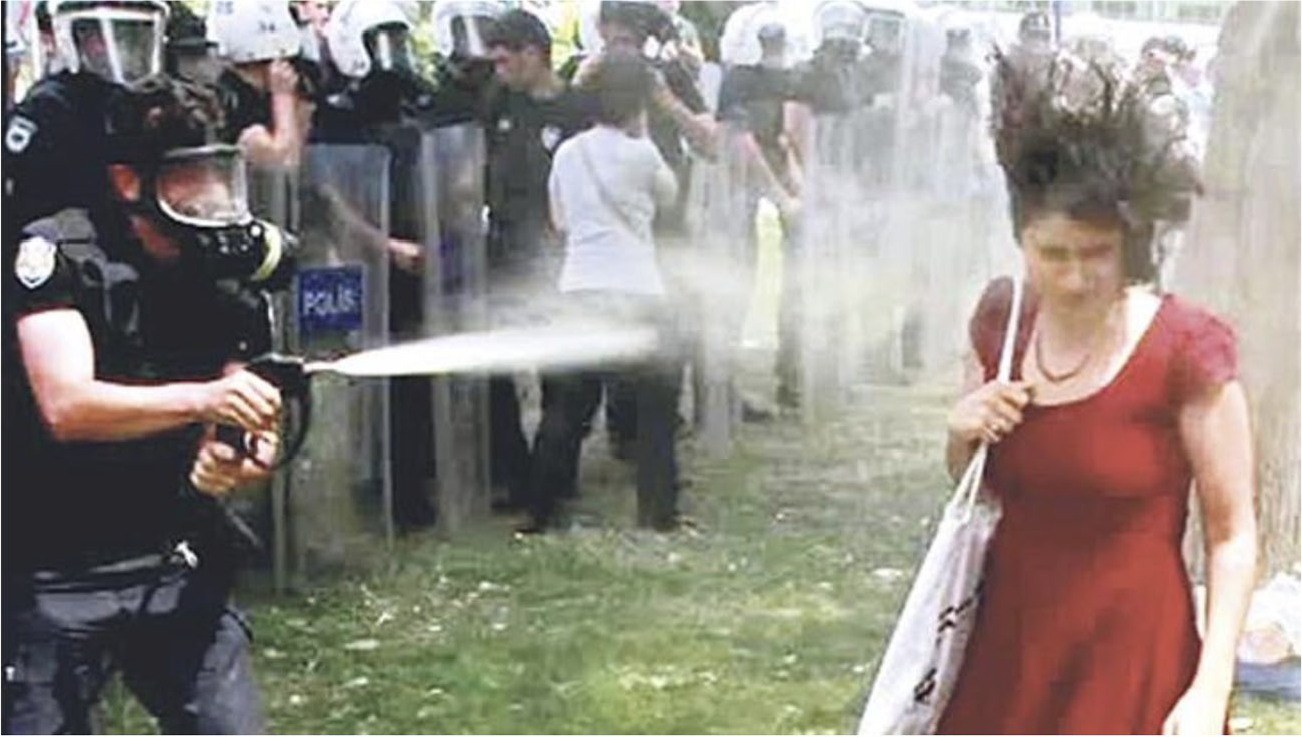
Woman in red.
Second, we explore textual and visual representations of humour in digital media considering the networks, mobilisation and solidarity, and the strategic space it provides to build and communicate collective meaning (Castells, 2012). Humour has been used by protestors to help communicate their ideas with visual culture research demonstrating that humour helps to subvert or ‘jam’ mainstream narratives of protestors, which construct them as deviant trouble-makers (McGarry et al., 2020). The role and significance of visual culture to social movements has been gaining traction among researchers as well as activists (Memou, 2013), exploring the power of particular images for social movements (Olesen, 2017) and how images help protestors communicate their ideas on social media (McGarry et al., 2019). Mirzoeff (2015) has shown how images are increasingly harnessed by social movements to challenge authorities, specifically by undermining claims by elites, ascribing truth to events and facilitating the articulation of dissent ‘from below’. Social movement studies have generally tended to elevate structural conditions to the detriment of understanding agency and how protestors articulate their demands and identities through protest action. We argue that humour, expressed through visual culture, is more than merely a resource or an action repertoire (Tilly 1986) that protestors deploy to further their interests but allow protestors to articulate their voices, to shape prevalent narratives and understandings.
In this respect, the use of visual culture and humour serves a dual function, namely, it is an attempt to change the cultural script by asserting the protestor’s understanding of truth, whilst being part of a strategic toolkit for protestors. The importance of digital media in order to generate collective movements and enhance identities has been much accounted for (Bennett and Segerberg, 2013; Gerbaudo, 2014; Mattoni and Treré, 2014; McGarry and Jasper, 2015; Treré 2019). Recently, research has explored the use of humour on social media including the use of memes (Vickery 2014; Kalkina, 2020) and gifs (Dean, 2019) that uncover the use of visual culture as a tool for interpersonal communication across digital platforms, though such studies are relatively silent on issues of community-building. We understand digital media – particularly connective media platforms – are prone to be divisive across communities if they facilitate and strengthen communal rather than social connections (Marlowe et al., 2017: 88). However, we raise how digital media can help to bridge social interactions across groups that differ based on their ethnicity, class, religion, sexuality or age, and generate social identity formations that can be both diverse and socially cohesive (Marlowe et al., 2017) in protest environments. The selection of the Gezi Park protests, in this context, is particular, considering the diversity among protestors (Konda, 2014).
Methodology: collecting and analysing the aesthetics of humour protest
In order to conduct this research, we collected and analysed tweets shared during the Gezi Park protests. The Twitter API was queried using the Gezi Parkı keyword, as it would be written in Turkish. The time period defined for this query was between 27 May and 30 June 2013 as this was the time period wherein Gezi Parkı was a regularly trending topic on Twitter and Gezi Park was occupied. Gezi Parkı was chosen as the keyword since it was an unstructured and neutral term, unlike hashtags such as #occupygezi or #direngezipark that located the tweeter’s political leaning, included information concerning the park itself and was used in tweets by both pro- and anti-Gezi activists. Our quantitative research on Gezi Park protests has attempted to capture the role that social media plays in initiating, promoting and spreading political participation (SMaPP, 2013). Varnali and Gorgulu (2015) revealed the most common use of Twitter during the Gezi protests was retweeting tweets with a political content, and argued that online participation was at community level rather than individual level. Moreover, the deafening silence of the mainstream media in Turkey during the protests meant that people often looked to social media for information.
Among millions of visual images shared and consumed during the protests, we concentrate on those that depict humour in both photography and video formats. In order, we take a note of van Dijk’s (2008: 72) argument that filmed memories are convergences of mental projections and technological scripts, privileging the body as an information-filtering agent, and studying memory construction at the junction of body and technology. Considering how digital media circulate filmic constructions of memory as concurrently embodied mental projections, enabled by media technologies and embedded in cultural forms (van Dijk, 2008: 72), we assume that photography and video formats provide ample resources to explore how protestors build audiences. This approach allows us to demonstrate how protestors communicate messages through visual images. It also enables us to explore how protest communication on social media uncovers everyday moments, practices, and rituals of protest, which are usually hidden or invisible.
Our data collection was undertaken by a social media monitoring agency in December 2016 and January 2017 that compiled the data into large spreadsheets. The spreadsheets were later converted into comma-separated value (csv) format. Once the data was reformatted, the spreadsheets were broken down into smaller, more accessible files. Data retrieval operations were performed on these files using Bash, PHP and Python, three programming languages. To collect images, Bash was used to download the tweets from the Twitter API. Once collected, the images embedded within the downloaded tweets were extracted using a purpose-built PHP script. Duplicates were eliminated leaving 714 images that were subsequently coded. The images that were related to the Gezi Park protest and were still accessible (many people deleted their Twitter accounts for fear of government surveillance) were downloaded.
Later they were imported into Nvivo for qualitative data analysis. The computer software was used to systematically code and analyse the raw data and to develop and integrate the emerging analytic categories and themes. The first stage of open coding was carried out on 100 images by the research team working together to generate descriptive and summative codes for the visual images and agree on the most salient categories and codes. One researcher then coded the remaining 614 images in January–March 2017 and discussed any newly created codes with the rest of the research team. The project team sought to reach consensus during the process of coding and agreed on the creation of each code, developing a list of codes that were attributed to each image. Codes determined: where the image was taken (i.e. location); the object of the visual image (documentary, poster, cartoon, screenshot); the actors involved (football fans, Kurds, police, etc.); the side (pro-government or anti-government); evocation (affect, demand, humour); written message (banner, graffiti, etc.); language (Turkish, English, other); confrontation (peaceful or violent); composition (crowd, nature, buildings, etc.); and iconography (standing man, woman in red, AKM, flag, penguin etc.). Our codes are listed in Table 1.
Codes.
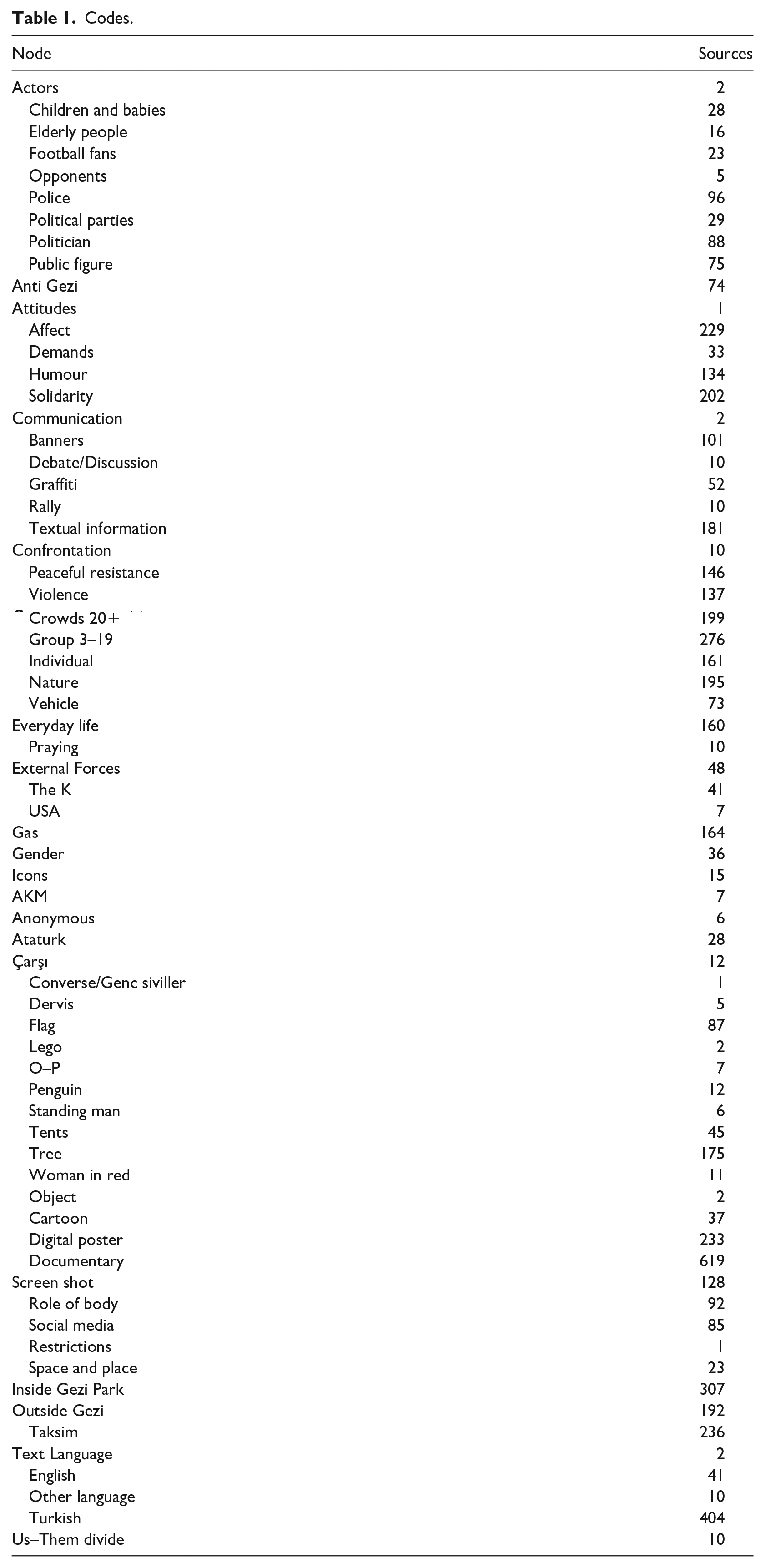
Each image had typically 6–12 codes attributed to it. We randomly selected 100 images to verify and collectively agree on the accuracy of the coding. We used written memos to interpret both what was obvious in the image and the subtext or what was not obvious/what was hidden, which served to guide the ‘naming’ of codes. Several members of the team are Turkish and understand Turkish humour therefore those researchers led the humour and absurdity analysis. Writing memos alongside the images on Nvivo during the coding helped move the analysis from content reflection to content interpretation, and facilitated the process of raising focused codes to conceptual categories, and it also enabled communication among the project team. The code of ‘humour’ emerged with 134 images out of 714 possessing a humorous content whilst 164 images were coded as they showed gas, a gas mask or referred to gas. We understand absurdity to be a particular form of humour and noted any absurdist content in the memos. In this article, we have selected seven images for further discussion on humour, gas/gasmask or a combination of the two that allow us to communicate our argument.
Dissidence, community-building and the Gezi Park protests
The Hungarian dissident artist Tamás Szentjóby described the potential of arts to construct a parallel situation as both the elimination of the status quo and the beginning of a new history. He qualified this process as ‘the happening’. As Kemp-Welch (2014: 110) reflects, ‘the Happening seemed to provide a zone of freedom, avoiding compromised official circuits and flying in the face of the rituals of official culture and the forms of artist/spectator relations they demanded’. Szentjóby recounts, ‘at the edge of convention, the individual recognises his own position between the absurdity of the historical past and the possible happening-future. He recognises, in other words, the autonomy of the individual. His will is that he himself can determine his own free will’ (Kemp-Welch, 2014: 110). This made the artist-activist an anti-hero, as Tót explains, ‘fear saved me from becoming a hero. Later, there was no reason to be afraid, so I realised these actions in the streets to tell the people something’ (Bordács et al., 2003 in Kemp-Welch, 2014: 182).
The search for truth also strengthened dissidence of the ordinary citizen. While discussing the situation of the Czechoslovak dissidence under what he calls post-totalitarianism, Václav Havel (1976) pointed at the power of the powerless to show that precarious content of the most prevalent official propaganda. Music provided space for the search for truth in Czechoslovak dissidence. Against the sterile puritanism of the post-totalitarian establishment in communist Czechoslovakia, it was a rock group called the Plastic People of the Universe and their trial by the Communist authority that showed the power of unknown young people who wanted no more than to be able to live within the truth, to play the music that they enjoyed, to sing songs that were relevant to their lives and to live in dignity and partnership. ‘The trial of the Plastic People of the Universe’ is a misnomer that evolved from Havel’s own efforts to frame it as a contest between the metaphysical innocence and purity of the underground, on the one hand, and the calculating corruption of the regime, on the other (Bolton, 2018: 262; Kemp-Welch, 2014).
Havel’s reflections also proved that political oppression can be overcome without violence. According to Havel, to live within the truth, as opposed to living a lie, means that one is committed to an authenticity that must be all encompassing in order to be genuine. Havel not only believed but also demonstrated that by struggling with the absurd, which was what the communist regime has become, one can create its opposite (Kammas, 2008: 216, 222–223). Havel pointed at the people who assumed the existential responsibility for their own truth and were willing to pay a high price for it. Havel observed that an ‘improvised community’ came into being as a result of the trial – a community of people who were not only more considerate, communicative and trusting towards each other, but were also in a strange way democratic. He argued that the emergence of a democratic community can spring from the decision to act openly and trustingly, regardless of the consequences (Havel, 1976 in Kemp-Welch, 2014: 189).
By appealing to the truth generation value of absurdity, the individual realises the civic impact of demonstrating the falsity of the authoritarian system and its incapacity to live up to the truth of its ideals (Kammas, 2008: 233). Thereon, the dominant ideology loses what could have been its influence on people. Thanks to the strength that humour avails them, people manage to break out from ‘I am afraid and therefore am unquestionably obedient’ motto of authoritarianism. Humour can be the tool to befool docility, quash sterility and promote activism. It has a transformative impact through its expression. It is not just performance and communication, but also transforms its audiences through enactment.
Yet, humour and/or aesthetics do not become manifest in authoritarian/neo-authoritarian contexts in order to appeal and affect apolitical people with a human face to react against the absurdity of repressive politics. Teune reflected on Spassguerilla to explore how a small group within a German student movement of the 1960s expressed its critique of society in humorous protests calling for a non-materialist, individualist and libertarian change (Teune, 2007: 115). Moreover, in the USA, the Bread and Puppet Theatre of Peter Schumann ‘was deeply involved with the civil rights and anti-war protest movements and is marked by their political moralism in two important respects: its concern with domestic issues, the home front, and its primitivism of technique and morality’ using a religious vision depicting themes such as redemption and resurrection and employing Uncle Sam as a metaphor (Goldensohn, 1977: 72–73). Memou (2019: 8–9) showed that the Atelier Populaire manifested during May 1968 informed the formulation of new demands, new forms of resistance and practices of opposition and demonstrated the solidarity among a plethora of social groups including workers, migrants and professionals with references to direct democracy and the networks of communication with other struggles around the globe. Furthermore, what brings these expressive media as a genre of social activism is not necessarily their common demands but their essence in utilising aesthetics to manifest their activism.
Reflecting on earlier activism and movements, in our paper we follow humour as a facilitator. It dresses up a message, argument or idea in different clothing but the substance of the message, argument or idea stays the same. Humour facilitates its communication and resonance from and to different audiences. Humour has the potential to make communication easier (e.g. allowing taboo topics to be tackled or powerful people or institutions to be criticised) and for the message to resonate more strongly, allowing ideas to stick. Demjén (2014) indicates that humour is a coping mechanism with discursive, interpersonal and psychological essence. The social management function of humour allows speakers to establish common ground, garner ingratiation and demonstrate cleverness. As a broad term, humour then refers to anything that people say or do that is considered funny and tends to make the other laugh. The mental processes that go into both creating and perceiving such an amusing stimulus as well as the affective response in the enjoyment of it also relate to humour. At protests, as Abaza (2014: 171) states, creativity would flourish, be it in the way text messages and jokes are displayed, paraphernalia and gadgets are colourfully arranged with many forms such as cartoons, videos and puppets (Abaza, 2014; Pearce and Hajizada, 2014). Humour then emerges in interaction during the course of protest (Demjén, 2014).
Humour positively influences social and group processes (Vrticka et al., 2013), and appeals to emotions. Emotion is not incidental to activism and activists dedicate time and energy to emotion management (Juris, 2008: 65), work to build affective attachments, convey particular emotional states, or evoke certain emotions with the goal of motivating and sustaining action (Gould, 2001 in Juris, 2008: 65). Previous research (Ritchie, 2009: 251) has shown that the humour and playfulness of metaphorical language may supply some of the cognitive effects, independent of any possible changes to the hearer’s understanding of the topic (Ritchie, 2009: 251). Gibbs and Tendahl (2006 in Ritchie, 2009: 258) comment that using metaphors increases memory retention. All these contribute to the interpersonal, but also psychological, effects of in-group bonding, as does simply ‘laughing together’ (Demjén, 2014; Fraley and Aron, 2004). Furthermore, colloquialisms, phrases and expressions, what Olszewska (2005) called the ‘New Speech’ in the dissident Polish poet Baranczak’s work, can also represent socio-political and cultural situations within authoritarian contexts. The principal aim of Baranczak’s poetry was to speak the ‘truth’ about the political and social reality of the time. This new poetical expression incorporated exposing the language of propaganda by means of dissecting its structures, employing the linguistic concrete and situating the poem in the socio-political reality. In this kind of poetry, the official language was countered with irony and popular catchphrases, and used in order to draw the reader’s attention to the fact that the language of propaganda is devoid of meaning (Olszewska, 2005: 18–22). Therefore, metaphors, colloquialisms, phrases and expression composed the essence of ‘carnivalistic laughter’ as Bakhtin (1984 in Häkkinen and Leppänen, 2013) indicated earlier. The truth that such carnivalistic laughter provides rebuked the authoritarian regimes from fostering their own truths. We present two instances (see Figures 2 and 3) how the activists reflected on common knowledge, planted metaphors, played with language and overall used humour to build audiences in support of their platforms during the Gezi Park protests.
Figure 2 shows a criticism of the pro-government tone in the media during the Gezi protests. The caricaturist depicts Erdoğan as the Snow White and the Turkish TV station owners as the Seven Dwarfs Erdoğan (in reference to pro-government TV stations): Sleepy ATV, Dopey CNN, Censorious TRT, Renegade NTV, Playful SAMANYOLU, Grumpy BEYAZ TV, Happy STAR, you are all very sweet! 7 dwarfs (in reference to the TV station owners): We’d all die for you!
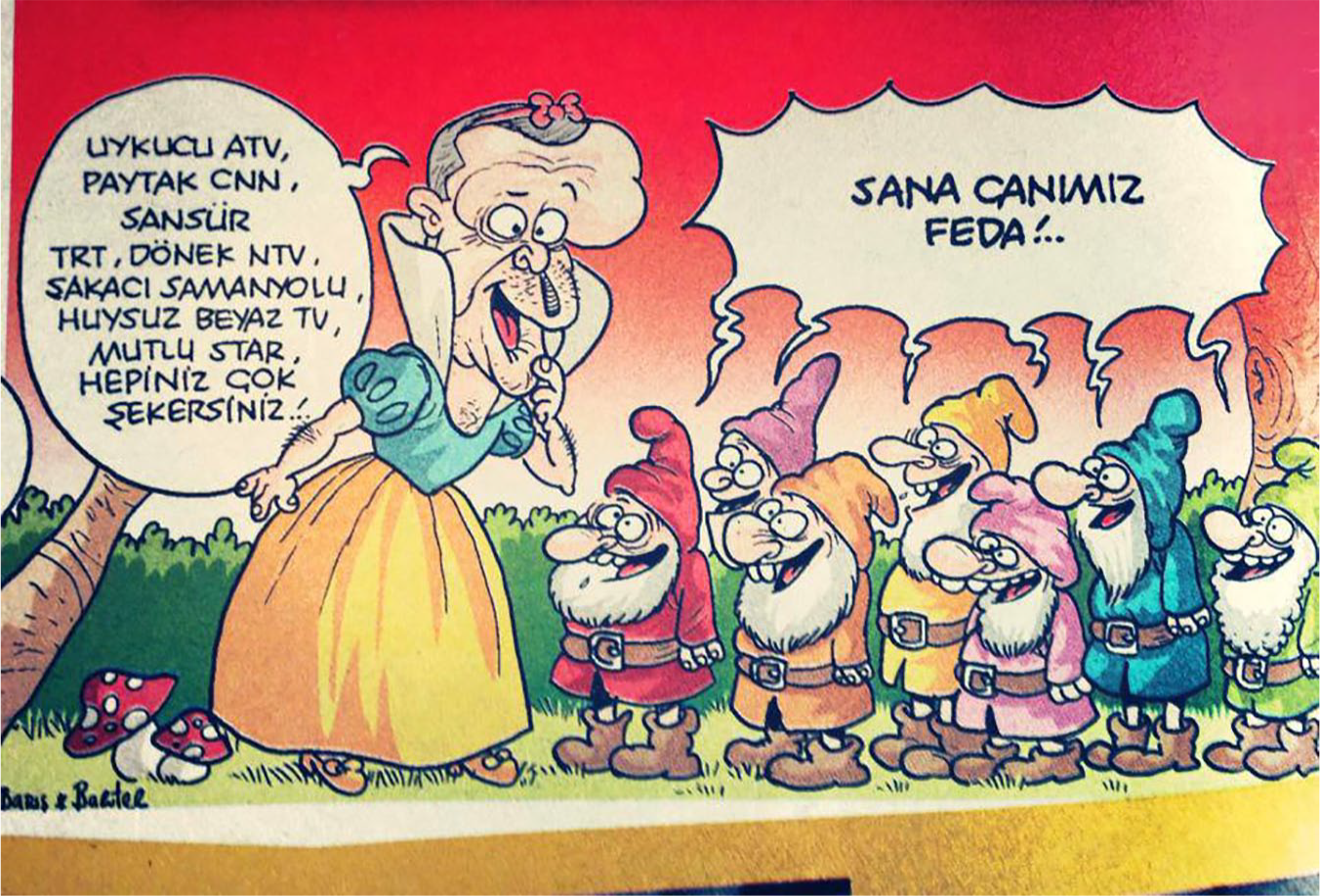
Erdoğan and the seven dwarfs.
Figure 3 depicts three people from the public with the first two being vocal supporters of AKP and anti-Gezi Park protestors and the third simply a passer-by. The dialogue is a criticism on how the government provided free public transportation for its supporters in order to boost the visibility of the pro-government rallies held in Istanbul during the Gezi Park protests. It also refers to AKP’s using in-kind assistance such as coal, wood or food items in order to co-opt supporters. The caricature is named AK Taban – the bedrock of AKP – in reference to AKP constituency.
1st dialogue: Show us the way! Let’s Quash Taksim! Bro, can we have a free ride with the bus on the way back? 2nd dialogue: Sure thing! All those buses were not organised in vain. Moreover, the subway hours have been extended until 4 a.m. But wait! The real news is that we are each going to receive 5 kilograms of coal free for winter! 3rd dialogue: Show us the way! Let’s Quash Taksim! Tell us bury them and we will bury them!
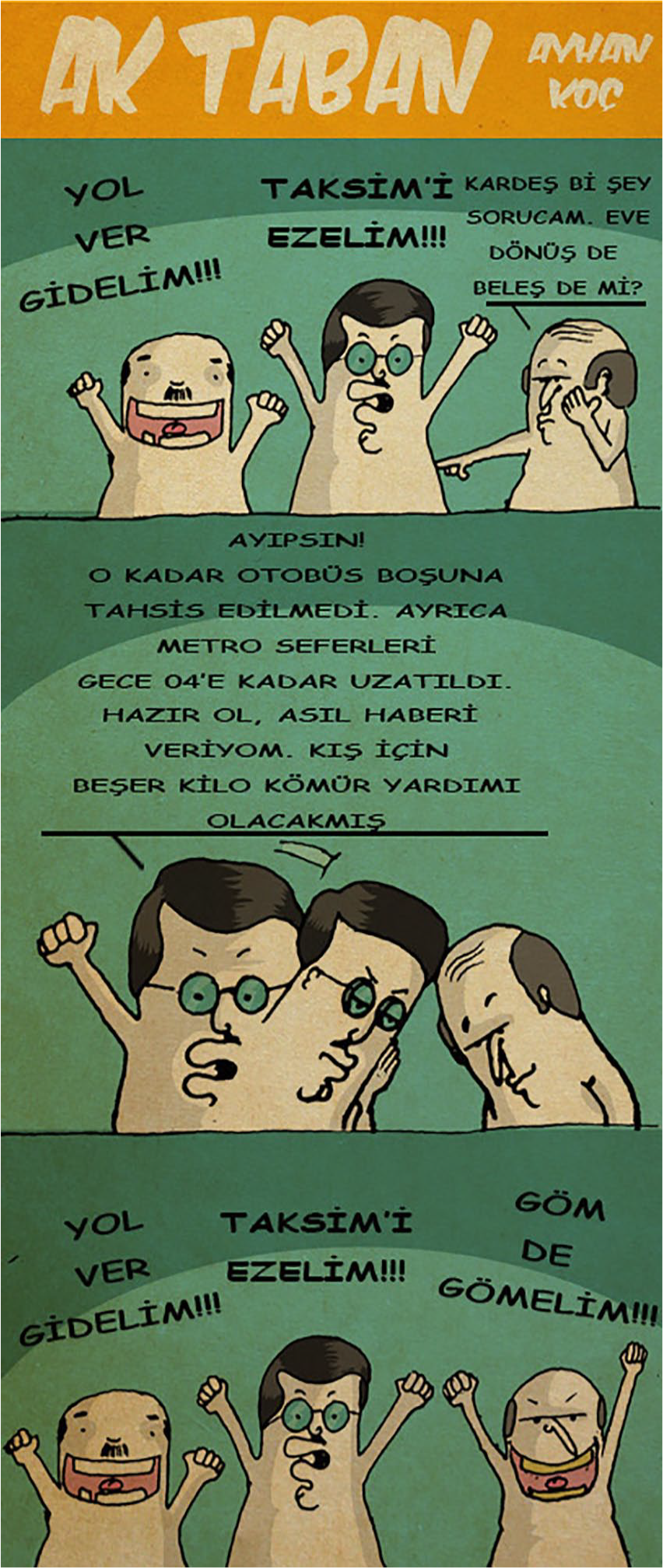
AK Taban.
Figures 2 and 3 both mock Erdoğan’s supporters as blindly supporting him and for having the wrong interests (prioritising material goods such as coal over post-material goods such as freedom and rights). The images build a sense of belonging and help foster community-building as protestors delineate a clear sense of ‘them’ (uncritical, stupid Erdoğan supporters) and ‘us’. Interestingly, the images do not reflect on what protestors stand for but perform a sense of collective identity by determining what they are not.
Gaining digital visibility by appropriating the pepper gas from the police
As we introduced previously and showed with two images widely shared during the Gezi Park protests, irony seeks to increase social solidarity (Ritchie, 2005: 284). In order to get the joke and understand the irony, however, the hearer must have access to the same or similar background knowledge and assumptions as the speaker. By using irony or humour, the speaker affirms a belief that a common ground exists and includes the necessary knowledge, attitudes, and assumptions; by understanding and accepting the irony, the hearer also affirms the existence of the necessary common ground (Ritchie, 2005: 285). In order, our article traces the circulation of pepper gas and sometimes as pepper gas spray mask as metaphors to present, first, how protestors’ voices became ubiquitous using the digital media, and second, how reflecting on the gas metaphor generated the common ground of activism. In our selected images and videos we next illustrate how using the pepper gas parodies attack the claims of the political authority, play with it and re-evaluate its truthfulness (Häkkinen and Leppänen, 2013: 4). In Figures 4 and 5, we present how the protestors adopted the pepper gas spray mask, associated everyday connotations to it using aesthetics, and how in the end the mask became a ubiquitous metaphor for depiction of the absurdity of police oppression. We propose that the circulation of this metaphor through humour strengthened the protestors rather that dissipating them as pepper gas spray otherwise would. This paradox is significant because digital media allowed the brutal reality of the deployment of pepper gas to be widely known and understood. While the government controlled mainstream news outlets, currents of dissent grew as Twitter and Facebook facilitated a better knowledge of what was happening in Gezi Park to the wider public.
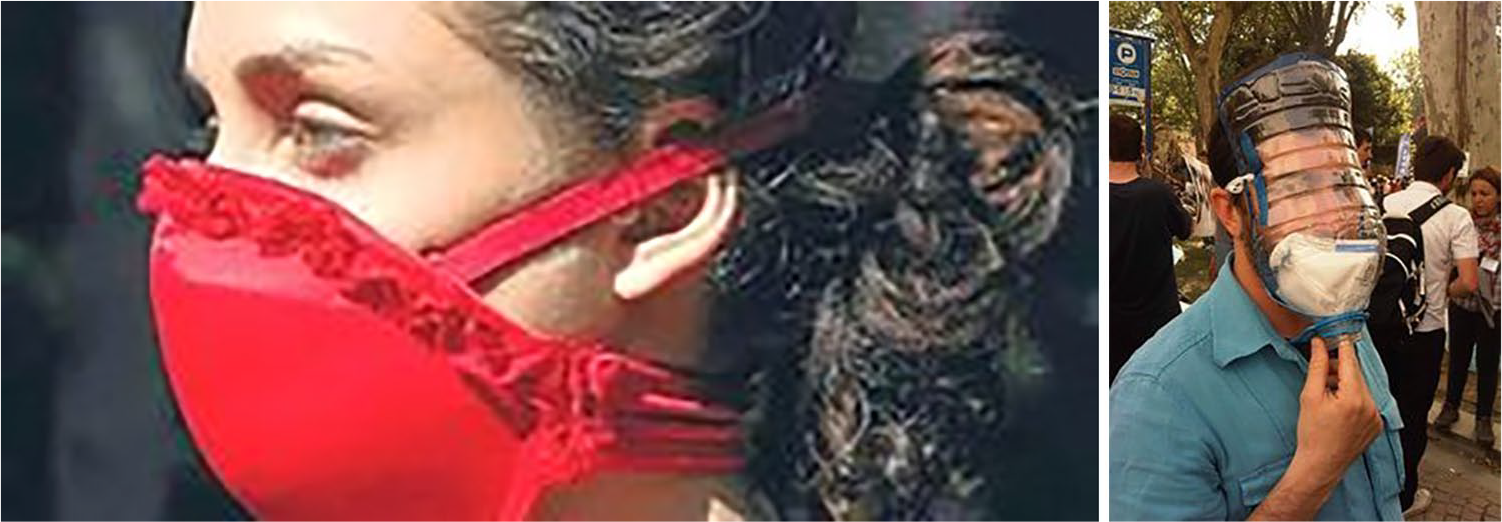
The pepper gas spray mask in the everyday of Gezi Park protest.
Mashups could be seen as a particular continuation and variation of carnival, as defined by Bakhtin (1984: 9–12), as a temporary liberation from the prevailing truth in which societal hierarchies can be suspended and turned inside-out. Like the medieval carnival, therefore, mashups constitute a special type of comic communication, which is temporarily freed from the norms and etiquette normally in place. In Figures 4 and 5, we see how the protestors associated their invented pepper gas spray mask with everyday objects: a red bra and a water bottle – an essential item for every Turkish household, given the lower quality of tap water in the country. The depiction of a red bra is also particularly important here, showing the gendered aspect of protest as the bra represents a feminine item within activism that stands up against the masculine oppression by the authoritarian state in Turkey. These images also depict how the folk culture and the language of ordinary people challenge, question, and seek to destabilise the official discourse of those in power. The mediatisation of images allows subordinated people ‘to speak’ horizontally with one another by sharing their ideas as well as vertically to the government by questioning the authority of the state to use violence. Referring to Bakhtin (1984), we take this as another parallel between the medieval and digital carnival. In this carnival while the pepper gas spray mask became associated with everyday items aesthetically and humorously, the protestors adopted pepper gas as a metaphor of resistance. Therefore, the pepper gas did not pacify but instead bolstered activism. Figure 6 shows the humorous content of such resistance.
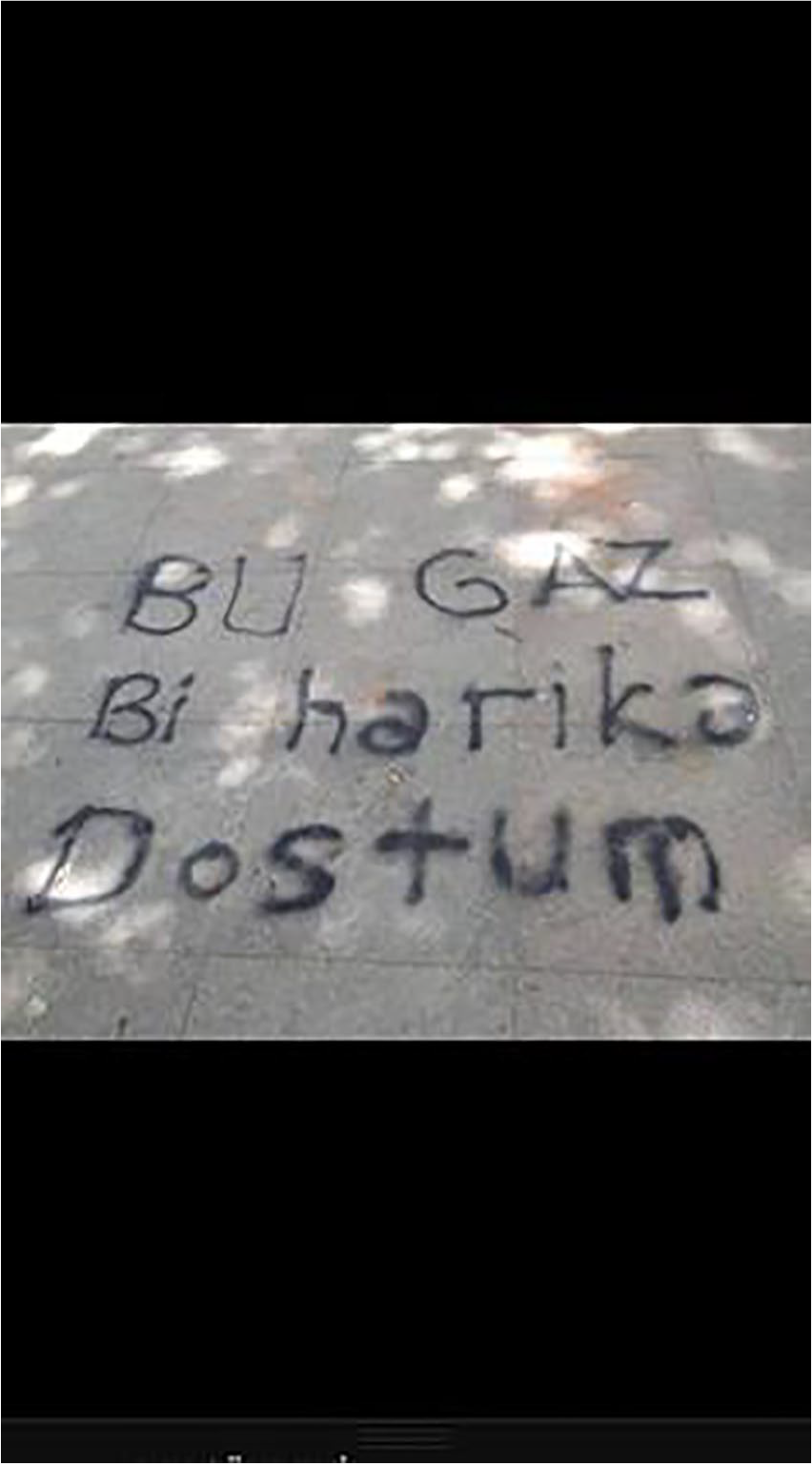
Mate, this gas is amazing!
Inevitably, there is also a theatrical essence of such expressive humour. Figure 7 below shows six screenshots from the YouTube video entitled Gaz var mı, Gaz? (Gas? Is there any Gas?) (https://www.youtube.com/watch?v=0GIGHUkGUVQ) and our translation of the monologue by the activist in red sweatshirt with the silent police officer: 1. Officer, Gas? Is there any gas? 2. I adore pepper gas as I adore pain 3. Getting on the TOMA (referencing the police anti-riot vehicles with water cannon) and going through the pure white gas clouds, we came here screaming GAS. 4. I had a look at Twitter. There were a few chaps protesting at Taksim Gezi Park. I had hopes of some action but the vibe is affectionate. 5. I came as soon as you threw the gas bombs over the crowds. First, I got carried away at home. Later, I caught the fire in person at the Park when I encountered the gas. 6. That pepper gas I breathed with the chaps at the park more and more, more and more. That I adored so much and more. I love pepper gas and water cannons, Officer!
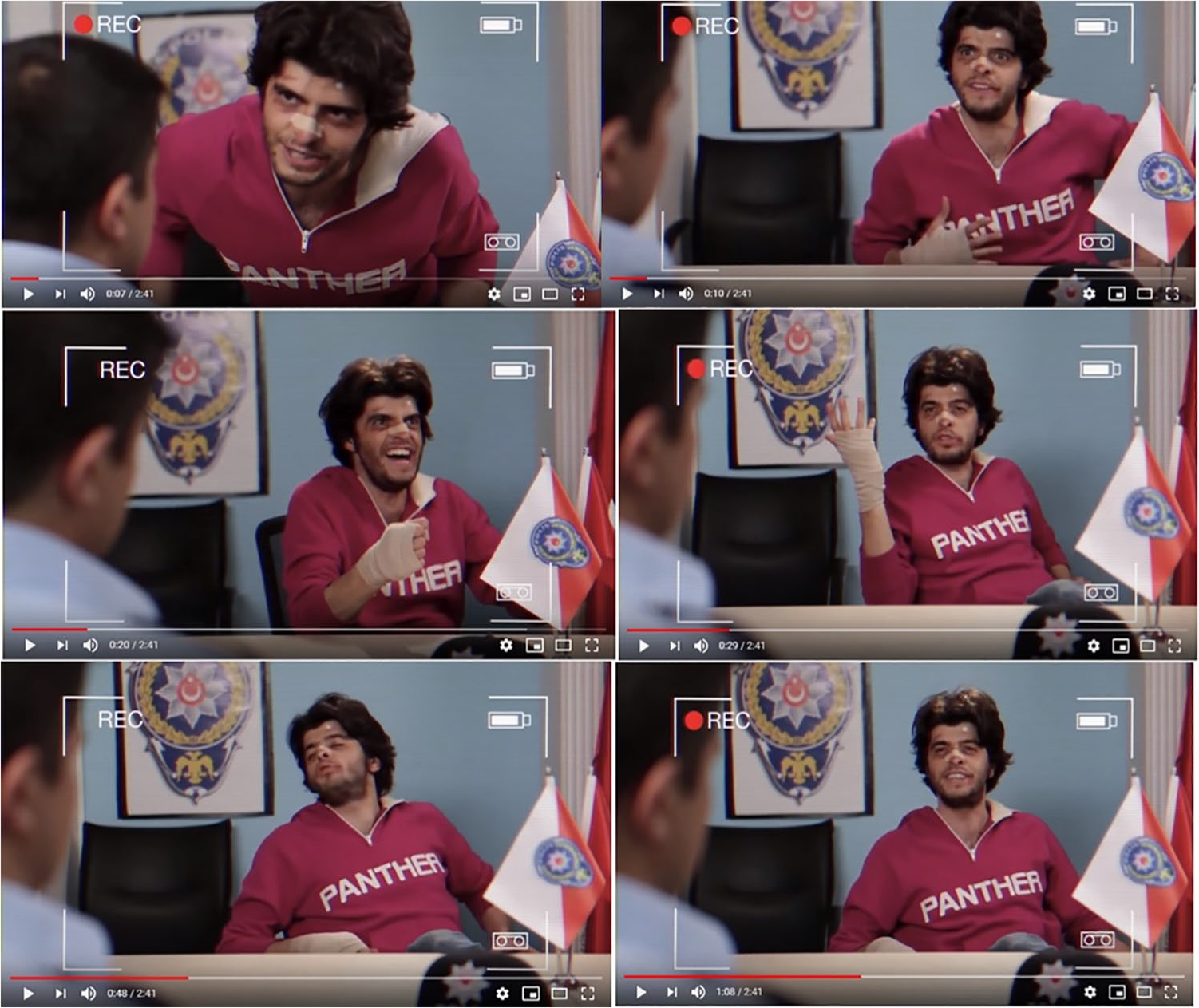
Gaz var mı, Gaz?
Looking at how this video evolves, one can also reflect on the theatre of absurd. In communist Czechoslovakia, the dissident Jíři Kovanda’s ‘invisible theatre’ incorporated three or four simple movements (Kemp-Welch, 2014: 201). Kovanda stated ‘it was not important what I did, but rather the fact that it was not distinguishable from everyday life’ (Kovanda, n.d. in Kemp-Welch, 2014: 201). As the Slovene art historian Igor Zabel also pointed out, ‘even small all but visible interventions like Kovanda’s could represent a disturbance in the order of things and thus an unidentified but clear threat to the understanding that the status quo was natural’ (2005 in Kemp-Welch, 2014: 222). Interrogation at the police station in that sense has an everyday quality to it within the Turkish humour as this parody refers. This is what contextualises this video in the theatre of absurd. Turkish humour is replete with references to people finding themselves in situations at police stations following raucousness after a night out drinking alcohol or domestic violence. To being at a police station and its everyday quality – characterised by humour in this video, the activist introduces the pepper gas and presents it as a disturbance to the order of things. As in the earlier instances, rather than pacifying the activists, thereby, the pepper gas has activated him. After he saw the commotion at Gezi Park on Twitter and how the protestors were gassed, he says, he rushed to Gezi Park asking to be gassed. He adores gas and he is aware that his adoration metaphorically presents a threat to the status quo. In a nutshell, his simple movements of everyday gestures enrich his experience of the pepper gas and his protest as a result.
Siling Li (2017) presents how spoof videos in China operate to perform the ‘right to know and speak’ and the ‘right to laugh’. The rights are not exerted through linguistic rationalism or organised protest, but through affective and playful dimension of public communication (Siling Li, 2017: 191). Spoofs provide a good example to understand this emergent form of political participation that is collapsing the boundary between entertainment, politics and popular culture. Therefore, alongside photography, videos also challenge not only the politicians or the regime that they take as their target, but also eventually the regime of truth in Foucauldian sense (Häkkinen and Leppänen, 2013) that politicians draw on. Hutcheon (2000) noted the importance of politically explicit culture jamming in content as well as multi-voiced mashup or remix videos. In addition to being critical, these often have a strong emphasis on comic entertainment. The previous selected images indicate both entertainment and absurdity, but serve to laugh in the authorities’ face. Overall, with the way the activists refer to images of pepper gas they depict an engagement of Gezi Park protestors with language and politics, identity and responsibility, and pursuing living in truth – and therefore not being vulnerable and passive even when they inhale the pepper gas. This was how the protestors appropriated the gas metaphor through humour, associated secondary meaning to it using aesthetics, and employed it to build audiences using everyday references. This shows the importance of aesthetics as an expression of dissidence and protest as well as the textual and visual representation of humour in digital media to consolidate strategic spaces of dissidence.
Conclusion
Looking at Gezi Park protests and how the protestors embraced pepper gas through humour and used it to mobilise and activate dissidence using digital media, in this article we showed how the protestors’ voice became ubiquitous. That voice sought to communicate and engage with other protestors. As a result, we show that humour operates as an honest and direct communication tool for protestors. It also came out as an assertion of humanity against the dehumanising framework of political manipulation and authoritarianism. During the Gezi Park protests, humour cultivated and encouraged independent thinking and creativity, which had inevitably retreated to the trenches of deep privacy under authoritarianism. This proliferated on social media platforms that used humour and absurdity to undermine the government and allowed protestors to communicate directly with one another speaking a visual and textual language, which protestors understood. This is important in the context of the Gezi Park protests, which was an especially heterogeneous mobilisation bringing together Kurds, Alevi, anti-capitalist Muslims, women, football fans and LGBTI groups, among others. Humour cut across linguistic, religious and socio-cultural cleavages, as well as ideological terrain and enabled protestors to find common cause with one another.
Whilst the protests ultimately aimed at undermining and challenging the policies of the government, digital media acted as a space to nurture and develop critical ideas and thinking vis-à-vis the government. It complemented rather than replaced the mobilisation in the material space of Gezi Park, where the pepper gas has a visceral physical impact on protestors who came into contact with it. Therefore, in the face of the absurd becoming the truth under authoritarianism, the protestors embraced an element of it, that is, the pepper gas, to activate protest with everyday references. In this effort, they have also exposed the incapacity of the authoritarian system to stand for the truth. At the end, as the political regime lost touch with reality, it also lost the capacity to influence reality effectively. This was thanks to the improved media access to blur conventional boundaries between media producers and consumers, and afforded a tool of self-expression, civic engagement and political participation to those otherwise invisible and voiceless.
There is a long history of humour as dissent against authoritarianism from dissidents under communist regimes in central and eastern Europe to Turkey today. The paper reflects on the legacy of East European dissidence and how their ideas about activism are still relevant to understand the new social movements in neo-authoritarian contexts. As authoritarianism spreads across the world today, from Hungary to Philippines to Brazil, we can expect to see the deployment of absurdity and humour to challenge repressive practices and for protestors to assert claims of truthfulness and humanity in the face of authoritarianism. Digital media and affect have changed the game in terms of providing an additional space for humour as dissent to flourish. Digital media is more than a space to facilitate communication and allows diverse voices to be heard and for claims of truth to be asserted. Our research has shown that humour has a transformative impact through its expression: it transforms its audiences through enactment.
Supplemental Material
sj-docx-1-ips-10.1177_0192512120971151 – Supplemental material for Looking for truth in absurdity: Humour as community-building and dissidence against authoritarianism
Supplemental material, sj-docx-1-ips-10.1177_0192512120971151 for Looking for truth in absurdity: Humour as community-building and dissidence against authoritarianism by Umut Korkut, Aidan McGarry, Itir Erhart, Hande Eslen-Ziya and Olu Jenzen in International Political Science Review
Footnotes
Acknowledgements
We would like to thank Catherine Moriarty, Derya Güçdemir and Emel Ackali for their help and support.
Funding
The authors disclosed receipt of the following financial support for the research, authorship, and/or publication of this article: We would like to thank the Arts and Humanities Research Council (AHRC) for their support in funding the ‘Aesthetics of Protest: Visual Culture and Communication in Turkey’ (AH/N004779/1) project.

Supplemental material
Supplemental material for this article is available online.
Author biographies
References
Supplementary Material
Please find the following supplemental material available below.
For Open Access articles published under a Creative Commons License, all supplemental material carries the same license as the article it is associated with.
For non-Open Access articles published, all supplemental material carries a non-exclusive license, and permission requests for re-use of supplemental material or any part of supplemental material shall be sent directly to the copyright owner as specified in the copyright notice associated with the article.
