




Abstract
Political consumerism refers to citizens’ use of boycotting and buycotting as they seek to influence political outcomes within the marketplace rather than through more traditional routes such as voting. However, given the pressure that neoliberalist forces exert on the marketplace, the lack of literature problematising the relationship between political consumerism and neoliberalism is somewhat surprising. Addressing this gap, we examine how neoliberalism impacts youth political consumerism in the UK and Greece. Focus-group findings suggest the existence of two inter-connected effects. Firstly, we detect a neoliberal ‘push effect’ away from electoral politics. Secondly, we discern a parallel ‘pull effect’ as young people seek the ‘political’ within the marketplace. In Greece, youth political consumerism seems to result primarily from distrust of institutional political actors. In contrast, young political consumers in the UK appear to be principally driven by confidence in the capacity of the market to respond to their pressing needs.
Introduction
In recent years, scholars have observed a considerable expansion in the range of methods used by citizens as they seek to influence the course of political change and outcomes. One particular approach which is becoming increasingly popular – especially among young people – is political consumerism. This form of political action focuses on the market as a place where political, ethical and environmental matters are contested. Political consumers may refuse to buy (boycott), or conversely will deliberately purchase (buycott), products or services with the aim of altering ethically, environmentally or politically objectionable institutional or market practices. Political consumerism has thus been described as a form of economic voting which uses the market as an arena of political expression, so that behaviours previously conceptualised as non-political, such as everyday consumption, are imbued with political meaning (Stolle and Micheletti, 2013).
Several factors have been identified to explain the emergence of political consumerism. Political sociologists have claimed that it is associated with the onset of lifestyle politics (Copeland and Boulianne, 2020), cosmopolitanism (Sloam and Henn, 2018), and the rise of postmaterialist values (Copeland, 2014; Stolle and Micheletti, 2013). Elsewhere, consumer studies scholars have drawn upon the socio-cognitive theory of planned behaviour to investigate the effect of attitudes, subjective norms and perceived behavioural controls in shaping political consumers’ intentions and behaviour (Bray et al., 2011). However, despite the advancement of boycott campaigns in western democracies, the study of the contextual and individual motivations of political consumers remains inconclusive.
One relatively under-examined aspect of contemporary life impacting political consumerism, is the spread of neoliberalism. Harvey (2007: 1) defines neoliberalism as a form of governmentality, 1 where there is the intention to construct a system of politics in which people come to be attuned to the primacy, inevitability and benefits that follow when the market guides social life. Harvey argues that: ‘Neoliberalism has become a hegemonic discourse with pervasive effects on ways of thought and political-economic practices to the point where it is now part of the commonsense way we interpret, live in, and understand the world’. Echoing this position, prominent feminist scholar and activist Brown (2015: 1) connects political disengagement with the ‘undoing of the demos’ as a consequence of the expansion of neoliberalism. However, there has been significantly less attention paid to the existence or not of any specific connection between neoliberalism and political consumerism. Given the centrality that political consumers bestow on the market as a political domain, and given the pressure that neoliberalism exerts on the marketplace, this is somewhat surprising. This article therefore addresses the gap by examining political consumerism within a neoliberal economic context.
Previous research on the subject (Kyroglou and Henn, 2017) has distinguished between two antithetical but inter-connected effects. Initially, the neoliberal critique of democracy accentuates a ‘push’ effect on young people away from electoral politics and into the commercial domain. However, a combination of trust in the market environment, the availability of information with regards to standards of production and the wide availability of products and prices call attention to the presence of a parallel ‘pull’ effect into the neoliberal market as a field of youth political engagement.
This article will explore the factors that influence young citizens’ decisions to engage in political consumerism in Greece and the UK. These two countries were selected because they present considerable differences in the practices of political consumers, as a result of the neoliberal approaches to state intervention in each. Our findings suggest that young people, having internalised the neoliberal critique of democracy, are being ‘pushed out’ of electoral politics. This is because they perceive politicians not only as unable to manage the technocratic economism of neoliberal doctrine, but also because they are considered to be inherently selfish and untrustworthy. Similarly, we find that young people are primarily ‘pulled into’ the marketplace as an alternative arena for political participation, and for a number of related reasons. In particular, they invest a high degree of trust in the capacity and the power of the market to respond to their political needs and aspirations. They also have confidence in their own abilities as political consumers to trace information about the (ethical) production processes behind their products of choice.
Evidence from four focus groups conducted in the UK and Greece is provided in support of the argument that the existence of an internalised neoliberal governmentality serves simultaneously to impede youth electoral participation (Brown, 2015), but also to motivate increased political consumerism (Kyroglou and Henn, 2017). The article presents therefore an original contribution to knowledge by introducing a neoliberal-derived cleavage which has not previously been examined in the study of youth political consumerism.
Political consumerism
Evidence suggests that in many contemporary advanced liberal democracies, young people are becoming increasingly focused on issue-based politics (Sloam and Henn, 2018), and attracted to a wide variety of non-institutional, ‘lifestyle’ and ‘self-expressive’ forms of political action with which to address their concerns and aspirations (Copeland and Boulianne, 2020; Theocharis and van Deth, 2018). For instance, both Greece and the UK have recently witnessed a big surge in young people’s involvement in non-institutional forms of political participation as a response to their growing dissatisfaction with neoliberal-inspired austerity measures that have been imposed at national and European levels (Lekakis and Forno, 2017; Sloam and Henn, 2018). In both countries, young people have taken part in a range of public acts such as demonstrations, flashmobs and urban interventions, as well as more localised acts of political consumerism. The latter have taken the form of deliberative alternative economic experiments, such as ‘Buy local’ campaigns, which in some contexts may be supported by the development of local exchange trading systems (LETS) and of alternative currencies (Kioupkiolis and Pechtelidis, 2018).
These types of political action are often conducted by young people who are dissatisfied with institutional and electorally focused politics (Kioupkiolis and Pechtelidis, 2018), are highly critical of politicians and the party-based political system (Sloam, 2014) and feel disillusioned by the lack of impact their voice has in the mainstream political arena (Henn and Oldfield, 2016). These young citizens will therefore choose to participate on their own terms, through aspects of their identity they feel most comfortable to express, in political projects exclusively of their own choice (Marsh and Akram, 2015) or even through the act of non-participation itself as a political statement (Fergusson, 2013).
Given this breadth of youth political engagement preferences, such activities are not only problematic in terms of their conceptualisation (Pontes et al., 2018), but they are often difficult even to identify (Theocharis and van Deth, 2018). The problems of identification and conceptualisation are also evident in the study of political consumerism. This makes any evaluation of the impact and the meaning of political consumerism difficult to trace. Nonetheless, political consumerism has recently gained prominence not only as an academic field of study, but also as an alternative form of political participation that seems to have particular appeal for young people (Stolle et al., 2010).
Political consumerism is mainly expressed by two types of activities: whereas ‘boycotts punish companies for undesirable behaviour, buycotts (i.e. reverse boycotts) reward companies for desirable behaviour (. . .) [with] the goal of changing objectionable market practices, and create[ing] incentives for companies to improve their business practices’ (Copeland, 2014: 261). Lekakis and Forno (2017: 7) report the widespread tendency among young people to boycott big corporations, such as Coca Cola, McDonald’s or Nestlé, and conversely to buycott on the basis of green consumerism or local and direct trade. But political consumerism includes also several other instances beyond strictly buycotting and boycotting. Examples include solidarity-based exchanges, consumer-producer cooperatives, barter networks, urban gardening or local savings groups (Lekakis and Forno, 2017: 5). Even though boycotts and buycotts may lead to contrasting business outcomes, the literature on political consumerism has often examined them as equivalent, both on theoretical and empirical grounds.
Across Europe, political consumerism remains a key method of political action even after the outbreak of the global financial crisis. Latest figures for the value of all ethically based purchases in the UK recorded an 8.5% growth during 2015 to £38 billion of overall value, with consumers’ ethical spending in their local community expanding by 11.7% (Triodos, 2018). These figures exhibit a continuous growth trend for the thirteenth consecutive year, reflecting an enduring appeal of political consumerism, despite the outbreak of the financial crisis.
However, there is notable cross-country variation in political consumerism across Europe. This is particularly evident when comparing trends in the UK and in Greece. Koos (2012: 46) examines the 2002 European Social Survey (ESS), and notes that while in Greece only 8% of respondents engaged in buycotts, the corresponding figures in the UK were considerably higher at 38%. Greece was the only European country examined in the 2002 ESS where negative consumerism (boycotts) outweighed positive consumerism (buycotts) – although in terms of both boycotts and buycotts, Greece remains consistently at the bottom of the distribution across Europe (Stolle and Micheletti, 2013: 50). Examination of different rounds of the ESS consistently confirms lower market-based participation in Greece than in the UK across time, with Greece being consistently more prone to boycotts than buycotts. Conversely, in 2004 about 38% of people in the UK had deliberately boycotted or buycotted products, with this figure remaining stable until 2014. Distinguishing between boycotting and buycotting reveals that positive consumerism in the UK is on the rise, with buycotting being far more common than boycotting (Slade and Hobbs, 2015: 3). Ward and de Vreese (2011) suggest that this may in part be because many large-scale campaigns have shifted towards supporting accreditation schemes like Fairtrade, and away from the use of boycotts as a campaigning tool. As a result, corporations are responding to the increasing ethical consumption trends by developing corporate social responsibility (CSR) schemes which seek to monetise the rising demand for political agency and moral responsibility of the production process (Soulas and Clark, 2013).
Even though this evidence demonstrates a huge cross-country variation of market-based political engagement across Europe, it also indicates there is a difference in the orientation of political consumerism. Lekakis and Forno (2017) report that political consumerism in the south of Europe tends to demonstrate a more collective rather than individualistic orientation and is generally more rooted in local communities.
Scholars of late modernity claim that the perceived growth of political consumerist practices reflects a general shift towards lifestyle participation (Giddens, 1991), and postmaterialist value orientations (Inglehart, 1990). A recently emerging subset of literature considers the value of studying consumer organisations and the existence of opportunity structures (Koos, 2012) as a way of interpreting market-based activism. In particular, Zorell (2019) identifies three motivating factors which influence the decisions of political consumers. Firstly, their understanding of the duties and responsibilities associated with the state, companies and citizens. Secondly, consumers’ trust in CSR schemes and in labelled and non-labelled products. Finally, their access to political consumption alternatives in the market.
Drawing on the postmaterialist literature (Inglehart, 1990), we assume that the perceived rise of political consumerism may be interpreted as a result of the prevalent economic conditions during young people’s socialisation. Although recent academic research links youth political disengagement to the expansion of neoliberal policies (Allsop et al., 2018), there has been significantly less attention paid to the effects of neoliberalism on political consumerism. Given the inherent susceptibility of the practice of political consumerism to the spread of neoliberalism, the lack of literature problematising this relationship is somewhat surprising. The section that follows will discuss the connections between neoliberalism, youth political (dis)engagement and political consumerism.
Neoliberalism, youth political (dis)engagement and political consumerism
Byrne (2017) has previously discussed neoliberalism in three key ways: as a hegemonic ideological project in Gramscian terms; as a mode of regulation; and also as a form of governmentality in Foucauldian terms. Neoliberalism in this article is being defined as the latter. For Foucault, government is not static and encompasses not only the traditional political sphere linked to state institutions, but also that which operates at the community level, including the government of the self. Governmentality thus defines a configuration of power which comprises two defining elements: first, it primarily targets the people, ‘aiming to produce a happy and well-ordered society of workers and consumers’ (Byrne, 2017: 348) and secondly it dictates ‘political economy’ as the guiding framework to achieve these aims. That is, society should be remodelled following the principles of the market. In this way, neoliberal governmentality becomes an internalised ‘form of surveillance and control as attentive as that of the head of a family over his household and his goods’ (Byrne, 2017: 349). Whereas the state should therefore paternalistically safeguard its operation according to market principles for the wellbeing of its citizens, the actual responsibility for citizens’ education, health and social security has been displaced to individuals. As such, neoliberal governmentality, in a process that has been described as ‘creative destruction’ (Harvey, 2007: 1), has accelerated an unequivocal paradigm shift from the power of the people to that of the market – and consequently, a shift from the agency of citizens to that of consumers (Kyroglou and Henn, 2017).
Moreover, the neoliberal discourse on social exclusion has been fundamentally associated with the discourse of personal accountability (Fergusson, 2013). The resulting discursive dominance of non-participation as disengagement, rather than as social exclusion, heralds a critical paradigm shift in the ways in which individual agency is perceived by young people. It anticipates a positively radical move away from locating non-participation in exclusionary institutional failures, and implies the existence of self-exclusionary performance failures by individuals. The conceptualisation of young people as products of their social and economic environments, which the government is responsible for improving, has given way to an inbound conceptualisation which describes them as the ‘individualised authors of their own (mis)fortunes in given environments which will improve only at the initiative of their inhabitants’ (Fergusson, 2013: 20).
Political consumerism is therefore practised by young people simultaneously as an outcome of this neoliberal governmentality, but also as an oppositional reaction to it, combining individualistic and collective approaches to resolving ethical and political concerns (Micheletti and Stolle, 2012). Previous research (Kyroglou and Henn, 2017) on the subject identifies two separate but complementary theoretical explanations for the decline in young people’s participation in traditional politics and a simultaneous rise in their political consumerist behaviours. They claim that either young people are ‘pushed out’ from electoral politics because the latter limits the expression of their increasingly individualised claims, or that having internalised the tenets of neoliberal marketisation, they are ‘pulled’ into the marketplace as an alternative arena for political participation. In this article we report findings from focus groups with young people conducted in the UK and Greece to trace how these neoliberal ‘push’ and ‘pull’ factors impact their motivation to engage in political consumer actions.
Factors influencing political consumption decisions
Previous research has identified three separate ways through which the neoliberal governmentality, reinforced by the continuous marketisation of previously non-market social provinces, inhibits young people’s participation, pushing them away from formal politics. Firstly, the neoliberal emphasis on the importance of purely economic interventions over democratic deliberation has reduced the capability of political actors to respond effectively to citizens’ demands (Brown, 2015). Secondly, the neoliberal critique of democracy (Buchanan, 1978) has left ordinary citizens increasingly suspicious of the motives of politicians (Hay, 2007). Thirdly, the reach and influence of the neoliberal agenda has permeated people’s subjective understanding of citizenship (Byrne, 2017), hindering both young people’s capacity and their motivation to engage with electoral politics.
Political efficacy has played a pivotal role in the study of youth political engagement (Amnå et al., 2004) and political consumerism (Stolle and Micheletti, 2013) respectively. Amnå et al. (2004) define internal political efficacy (IPE) as the subjective individual ability to understand and to shape political matters. Similarly, they define external political efficacy (EPE) as the individual’s confidence that decision makers will consider and attend to their individualised claims. In this article we further subdivide EPE in terms of the perceived inability of politicians to respond to the claims of their young constituents within a neoliberal economic environment; and in their inherent unwillingness to do so, as the neoliberal critique of democracy (Buchanan, 1978) suggests. Three push factors will therefore be interpreted in terms of these varying dimensions of political efficacy.
Conversely, the perception that the consumer is able to influence both the production process and the prices of products, coupled with the availability of alternative products and of product-related information (Bray et al., 2011), call attention to the existence of a parallel ‘pull’ effect into the market as a field of political participation. Our findings suggest that this ‘pull effect’ may be the result of the higher perceived consumer effectiveness (PCE) of the participants from the UK. Within the field of consumer studies, Kollmuss and Agyeman (2002) define the PCE as the extent to which people have confidence in their individual consumer behaviour as a means of solving environmental issues. They suggest that it is a critical factor in explaining environmentally friendly consumer behaviour.
The similarities of the PCE to IPE are striking, even though they derive from different academic disciplines. Their primary difference, however, is that whereas IPE refers to the conviction that individual political action can have a significant impact upon political outcomes, PCE captures the belief that individual consumer action can have a significant impact upon ethically desirable market outcomes.
Our findings suggest contrasting experiences among the focus-group participants in Greece and the UK with respect to the ongoing debate on whether (a) political consumerism is crowding out participation in electorally focused politics, or (b) whether the expansion of political activism within the marketplace affords young people increased opportunities to engage in political action beyond the electoral arena (Gotlieb and Wells, 2012). The increasing politicisation of the market under neoliberalism (Lekakis, 2013), and the convergence of the previously distant notions of the citizen and the consumer (Kyroglou and Henn, 2017), are both acting as driving forces of political consumerism, one ‘pulling’ and one ‘pushing’ young people to engage politically within the market. Thematic analysis of the focus groups confirms the interplay of six such ‘push’ and ‘pull’ factors, including important differences observed in Greece and the UK. These factors consist of:
a) Inability of political actors (EPE); b) Untrustworthiness of political actors (EPE); c) Internal political efficacy (IPE).
a) Perceived consumer effectiveness (PCE); b) Availability of products in the market; c) Availability of product-related information.
Each of these six factors will be explored following discussion of the methodology below.
Methodology
Research on youth political participation has often acknowledged a difference between researchers’ and young people’s understandings of politics (Henn and Foard, 2014). Consequently, closed-ended survey questions, which ask about people’s participation, interest and trust in politics, are likely to result in a distorted representation of their engagement levels. Conversely, research that introduces politics in general terms and relates it to young people’s own attitudes and experiences may yield significantly different findings. For example, a mixed-methods study of young people’s political engagement in Britain (Henn et al., 2002), disclosed that participants held strong opinions when asked in focus groups about political issues that concerned them, despite connected survey responses conveying an overwhelming disillusionment with formal party politics.
With this in mind, we took the position that focus-group discussions were the most appropriate method for gaining insights concerning young people’s motivations for, and patterns of, political consumerism. Focus groups allow participants to talk openly about the topic under examination in terms of their own frames of reference and have been previously employed elsewhere to study both consumer motivations (Bray et al., 2011), as well as youth political engagement (Pontes et al., 2018) with similar numbers of participants and research designs to ours.
We followed the recommendations of Henn et al. (2009) that small groups are usually preferred to minimise potential social-desirability bias effects, especially in cases where some people may feel reticent in large groups to challenge opinions which are at variance with their own. We assembled two focus groups in Greece and also two in the UK, each ranging in size from four to six young political consumers, aged 18–26 years. The participants had no previous knowledge of the topic of neoliberalism, and for this reason we excluded students of political and social sciences.
Previous research (Hopkins and Williamson, 2012) has examined the links between neighbourhood design and preferred political participation modes. In order to minimise these effects, the focus groups in Greece were conducted both in the capital city of Athens and the rural town of Epidavros, to ensure representation from both urban and rural populations. Likewise, the UK focus groups took place in Nottingham, a large city in central England, and participants included young people from a mixed socio-economic background, distinguishing between inner-city (socio-economically deprived) cohorts and outer-city (socio-economically advantaged) cohorts. However, there has been no attempt to compare insights according to residency, class or gender.
We arranged the focus groups so that a gender balance was achieved. Although Kitzinger (2007) contends that focus groups are particularly conducive to feminist studies, allowing access to the interactional context of women’s lives, we conducted mixed-gender focus groups. The intention was to capture how young people interacted in mixed groups when discussing their political consumerist motivations and how they responded to disagreements. The interactive dynamic of the mixed focus groups was a critical element shaping our selection of participants. The moderator and the assistant moderator used certain tactics to mitigate the danger of ‘dominant talkers’ – an issue that is particularly gender- and class-sensitive in focus groups (Henn et al., 2009). These included tactfully asking participants to curtail their contribution, or by noting how they expressed certain points and how others reacted to these – including gestures, posture or facial expressions – to ensure, as far as was possible, that all voices were encouraged, heard and amplified.
Our research approach utilised elements of grounded theory, whereby ‘theory emerges from the data’ (Henn et al., 2009: 184) through an iterative process. We introduced the general topic of political consumers’ motivations but offered participants opportunities to shape the course of key aspects of the discussion; having conducted the focus groups, we then coded their transcriptions thematically, searching for patterns and relationships in the data. We subsequently turned to theory in order to explain these patterns. Previous work on the subject (Bray et al., 2011; Hay, 2007; Kyroglou and Henn, 2017) did in part inform our thinking about which key themes to address, while we were open to data-driven understandings emerging from the discussions.
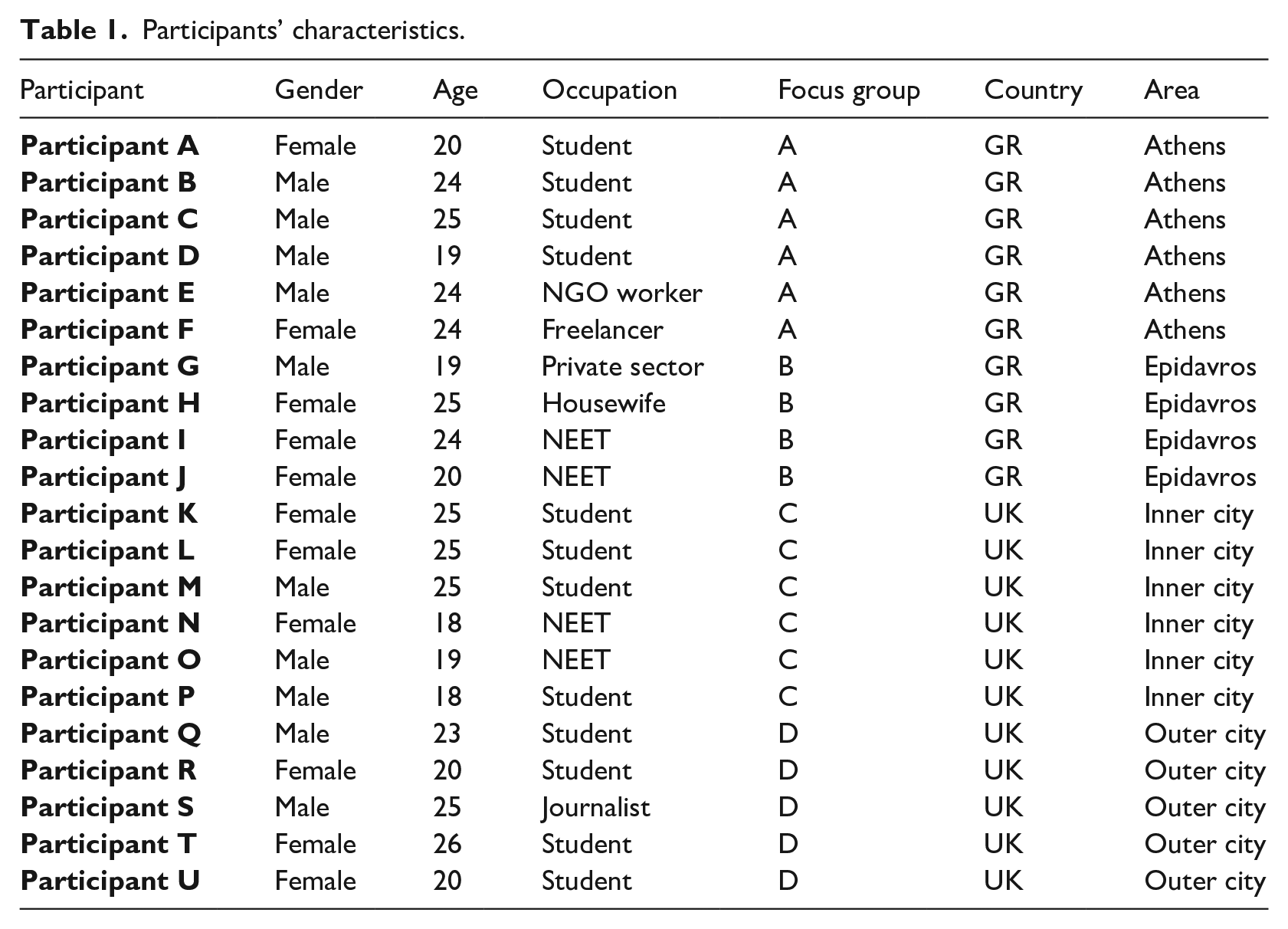
Our aim was to reveal important insights concerning the dynamics of young peoples’ engagement in political consumerist activities within a broad political, spatial and social context in both countries. Given the exploratory nature of the research and the sample size, we do not make any claims concerning the generalisability of our findings. Instead, our intention was to enhance existing academic knowledge in the field by accessing the young participants’ own understandings and frames of reference on the topic of political consumerism; these insights would not otherwise have been possible to acquire by a survey-based study involving a large number of participants. Table 1 presents the participants’ characteristics from both countries in terms of gender, age, occupation 2 and residency.
Participants’ characteristics.
Neoliberal ‘push’ factors
The focus groups revealed three neoliberal ‘push’ factors that influence young people’s withdrawal from formal electoral politics but which at the same time pull them towards non-institutional forms of political participation, including different forms of political consumerism. The first of these is a widely shared perception among the participants from both countries that politicians and political parties are under-serving their constituencies.
Previous research on the subject (Brown, 2015) emphasises the pervasive influence of neoliberalism that has significantly weakened the responsive power of traditional political institutions in many advanced liberal democracies. Consequently, political leaders are often obliged to concede to technocratic solutions when addressing economic and social problems. The recent imposition of austerity measures, despite the opposing popular mandate in several European countries, illustrates what Habermas has referred to as the dismantling of democracy within the EU (Diez, 2011) and the disenfranchising of citizens – particularly the young (Hart and Henn, 2017).
During the first focus group in Greece, participants returned repeatedly to the failure of the SYRIZA–ANEL coalition to capitalise on their victory in the July 2015 referendum and to deliver on their promise to alleviate austerity measures. This was viewed as a matter of critical concern, fuelling young people’s conviction that ‘politicians are unable to influence political outcomes, even if they were willing to do so’.
3
Participants consistently used phrases such as ‘their hands are tied’, especially when the discussion focused on EU politics:
Participants from the UK seemed to share these views, as typified by Participant S:
These critical perspectives reflect a common perception held by the young focus-group participants that politicians are not only unable to influence political outcomes within a technocratic neoliberal economic environment, but that they are also considered predominantly ‘self-serving elitists’ – and as such, inherently untrustworthy. Such views are consistent with the neoliberal critique of democracy (Buchanan, 1978), suggesting a principal-agent problem in that politicians often govern to advance their personal concerns ahead of the interests of their constituencies – leaving them especially unresponsive to the demands of young people. As a consequence, young people are likely to feel little value in voting while their interests continue to be under-represented in the mainstream political arena (Hart and Henn, 2017).
The discussion during the first Greek focus group centred on the twinned problems of nepotism in the parliament since the restoration of democracy in 1974 and the generalised doubt that any young person could succeed in running for office and competing with the established political elite. Young people in both countries expressed their disillusionment with electoral politics, even though: (a) the majority of participants still intended to vote and acknowledged the importance of voting (Furlong and Cartmel, 2011); (b) they exhibited a deep awareness of political issues (O’Toole and Gale, 2010); and (c) they were committed supporters of democracy in principle (Henn and Foard, 2014).
When asked whether they felt particularly disillusioned by democracy in principle, the UK focus group participants tended to agree with the statement of one contributor that:
Similar positions were expressed during the focus groups in Greece:
Such views suggest that it is only when they feel their voice is being heard and that their interests are represented in the dominant political agenda, that young people will feel positively predisposed towards electoral politics. Only Participant O from the UK focus groups expressed his concern about democracy in principle (‘Democracy scares me!’), on the grounds that ‘it disconnects people in power from ordinary people’; however, this participant added that he still intended to vote as this was the minimum he could do to make his voice heard. However, unlike their counterparts in the UK, the focus-group participants in Greece held more mixed views on this question. For instance, Participant E seemed to be indifferent to the question of whether to vote or not, while Participants F and H were adamant in their intention to abstain at future elections, and justified that position in terms of making a political statement (Amnå and Ekman, 2014) and reiterating their non-participation as a conscious political action (Fergusson, 2013). As Participant F stated, ‘I refuse to feed a system that lies to us! (. . .) I have absolutely no hope for the future; there is not a single chance that things will ever improve in any way.’
In contrast to the neoliberal discursive dominance of non-participation as disengagement rather than as social exclusion (Fergusson, 2013), the young participants in Greece remained mindful of the responsibilities of the government to its citizens. However, the general consensus emerging from the Greek participants was that, given the inability of the state apparatus to respond to their pressing needs, the only viable alternative is radical collective action:
This observation was shared by Participant F (also from Greece) who replied:
This view suggests that political consumerism may indeed be crowding out electoral participation among young people in Greece (although there was no support for such an effect in the UK focus groups). It also reflects the simultaneous individualistic and collective orientation of the political consumers of late modernity, an issue previously identified by Stolle and Micheletti (2013). In contrast, the UK participants expressed a relatively economistic understanding of their civic duties when asked about how they could contribute in shaping politics in their country:
Neoliberal ‘pull’ factors
In the previous section, we examined the ways through which neoliberal governmentality pushes young people away from the traditional political sphere. As a response to the perceived practical failure of representative democracy, the adoption of free-market principles in almost every domain of political life echoes the replacement of young people’s subjective understanding of citizenship from that of the sovereign citizen to that of the sovereign consumer. The neoliberal critique of democracy assumes that only this consumer-oriented democracy, or marketopoly (Lekakis, 2013), can adequately reflect individual preferences. The marketopoly therefore serves as a highly decentralised framework of political activity. It also presupposes an underlying trust that the market environment will respond effectively to young people’s concerns. Consequently, it ‘pulls’ under-represented and disillusioned young people from electoral politics into the marketplace as an alternative political arena. This section will examine the ways through which this effect is being manifested in Greece and in the UK.
Three distinct – but interrelated – factors were identified during the focus groups which capture young people’s beliefs that the market environment is well-equipped to respond to their political considerations and aspirations. These are: (a) their perceived consumer effectiveness (PCE) with respect to the prices of ethical products; (b) their satisfaction with the availability of ethical products in the market; and (c) their satisfaction with the availability and quality of product-related information for such products.
In terms of their PCE towards pricing, research by Bray et al. (2011) concludes that while consumers may generally prefer locally produced goods, they are reluctant to change their usual purchasing behaviour in favour of locally sourced and ethical alternatives, if the prices of the latter are considered to be significantly higher. However, in our focus groups the participants from the two countries were divided on the topic of pricing. When asked if they would be willing to pay the extra cost usually associated with organic products, the views of all the UK participants were summed up by Participant R: ‘Definitely, as long as it is a reasonable price difference.’
In contrast, while the participants from Greece were attracted to ethically sourced organic products, they tended to consider these to be luxury items beyond the financial reach of themselves and of most other citizens, especially when purchasing food items. This reflected a lack of PCE – a perception that they had no power to influence pricing. A typical response was:
In terms of the availability of ethical alternatives in the market, Zorell (2019) has suggested that although buycotters may express high levels of confidence in the existing labelling schemes in principle, they may be lacking access to the said schemes in practice. This availability of opportunity structures is considered to be a key factor driving the increase in political consumerism. The participants were asked about this matter in terms of their levels of satisfaction with respect to the variety of products in the market and the availability of independent, ethical or organic alternatives. There seemed to be a widespread consensus among the UK participants that ‘You can buy everything all year around; there’s nothing seasonal in the UK’:
However, participants from Greece were typically sceptical of this alleged market availability, focusing instead on ‘an illusion of choice’:
This view drew support from the rest of the participants in Greece:
Thirdly, in terms of the availability of product-related information, Zheng and Chi (2015) – drawing on the theory of planned behaviour – have established that the more informed consumers feel they are about environmental issues, the greater their pro-environmental consumption will be. During the focus groups, participants from both Greece and the UK agreed that in the age of information, environmental knowledge is almost entirely a matter of personal responsibility. However, whereas the participants from the UK emphasised the importance of personal responsibility for ‘educating [them]selves’ and ‘listening and learning’ when consuming for political, ethical and environmental reasons, their Greek counterparts were significantly more doubtful about the quality of product-related information in their country. Avoiding products or companies that have received bad press seemed important, especially among the UK participants. Instead, and consistent with Bray et al. (2011), the young Greek participants demonstrated higher levels of cynicism and inertia in their purchasing behaviour. Participant G, who had previously stressed the importance of pricing on his purchase decisions, explained this, thus:
This perspective reflects Carrigan and Attalla’s (2001) emphasis on the correlation between time pressure, information overload and people’s negligence when it comes to consumers’ ethical behaviour. They argue that motives like selflessness or solidarity are often overridden by selective motives that range from brand loyalty through to saving money, time and effort. As one of the young participants from Greece added:
This attitude-behaviour gap in ethical consumption has been examined by Papaoikonomou et al. (2011), who discuss how brand loyalty may generate a consumer bias, so that the consumers would only believe positive information while overlooking negative messages. As a consequence, consumers’ loyalties to certain brands may cause them to be less motivated to purchase or actively seek ethical alternatives (Bray et al. 2011). Correspondingly, the deeper their loyalty, the higher the consumer tendency to disregard bad practices allegedly committed by the company.
Conclusion
Evidence from our focus groups suggests that neoliberalism is a critical dimension when it comes to understanding the contextual characteristics of political consumerist practices among young people in the UK and Greece. Importantly, the findings suggest that the neoliberal emphasis on the economic over political agency has contributed to the convergence of the previously distant notions of citizens and consumers. In addition, the data reveal that neoliberalism has accelerated two contrasting but mutually reinforcing dynamics, which, combined, may be driving and shaping increased political consumerist behaviour among young people in both countries. Political consumerist practices among the Greek participants seem to be resulting primarily from their relatively high levels of internal political efficacy; they expressed a deep scepticism of the motives and capabilities of traditional political actors, who were perceived as not only untrustworthy, but also as unable to effectively represent the interests of young people. Consequently, young people are themselves left as the primary agents of their political behaviour. This has empowered them to search for the political within the market – via a process which may be crowding out their electoral engagement.
Although not entirely unaffected by these same push effects, the focus-group findings suggest that political consumerism in the UK follows a different course. It seems to be predominately influenced by young people’s underlying confidence in the capacity of the market environment to effectively respond to their claims for ethical corporate agency. This was reflected in their conviction that young people are able to effectively promote desirable (and punish objectionable) production processes based on their environmental, ethical and political buycotting and boycotting decisions and actions; in contrast, their counterparts in Greece often felt relatively powerless to express their political concerns and preferences within the context of the market. Moreover, young people in the UK were also satisfied with both the availability of ethical alternatives in the market, as well as the extent and quality of product-related information. Instead, the focus-group participants in Greece revealed a greater degree of scepticism when discussing these matters.
Our research thus reconciles theories from political sciences and consumer studies and traces the internalisation and transmission of neoliberalism as a driving factor behind youth political consumerism in the UK and Greece, providing an original contribution to knowledge in the study of youth political engagement.
Footnotes
Acknowledgements
The authors would like to thank the Youth Mobility Centre in Greece for their support during the focus groups, and all the participants for their helpful insights. The authors would also like to thank the anonymous reviewers, as well as the editor, for comments on an earlier version of this paper.
Funding
The authors received financial support from the School of Social Sciences at Nottingham Trent University to conduct the research.
