




Abstract
Applied philosophers have often defined ‘exploitation’ as a narrow, transaction-specific concept, ignoring its broader social or structural context. On this view, structural injustices are treated as irrelevant to explaining why exploitation is morally wrongful. This paper argues that this approach overlooks how background injustices frequently enable and shape exploitative transactions, making it easier for one party to take unfair advantage of another. While structural injustice is not itself the wrong-making feature of exploitation, it can causally influence how often exploitative transactions occur. In recognizing this causal role, I further contend that the remediation of background injustices is one important factor in determining who is responsible for addressing instances of exploitation.
Keywords
Introduction
Exploitative transactions between economically powerful agents and economically destitute individuals are a recurring concern among moral philosophers (Ferguson and Steiner 2018; Gilabert 2016; Goodin 1987; Gray 2020; Malmqvist 2013, 2015; Malmqvist and Szigeti 2021; Mayer 2007; Miller 2010; Mitra 2012; Pogge 2002; Resnik 2003; Roemer 1996, 2009; Sample 2003; Snyder 2008, 2012; Steiner 1987, 2010; Wertheimer 2010; Wollner 2019). Examples for incidences of exploitation in unjust settings are sweatshop labor (Gray 2020; Snyder 2010; Zwolinski 2007), drug testing on uninsured patients (Malmqvist 2015), or surrogacy (Wilkinson 2016), to name some examples of concern. Unjust settings are often characterized by background injustices, that is, social, political, and economic factors that lead to an unjust distribution of goods, resources, liberties, and opportunities in poorer countries, which eventually leave the deprived in a destitute state. One concern is that impoverished individuals who live in such circumstances can easily be made targets of exploitative transactions initiated by economically more powerful agents.
In the literature, discussions on exploitation have often focused on ‘transaction-specific’ approaches (McKeown 2016; Zwolinski 2012). These approaches argue that exploitation is morally objectionable based on how one party treats another within a particular transaction. Transaction-specific accounts typically distinguish mutually beneficial and consensual but exploitative transactions from concerns about structural background justice and historical injustices (Ferguson and Steiner 2018; Wertheimer 2010, see). However, scholars have more recently renewed interest in structural accounts, which view exploitation as a systemic phenomenon. For instance, Gabriel Wollner (2019) and Maeve McKeown (2016), establish a strong conceptual link between exploitation and structural injustice, following a classical Marxist and analytical Marxist literature of the 1970s and 1980s. Derrick Gray (2020) has also recently argued for a shift in focus away from transactional exploitation and towards structural considerations. Yet other authors, such as Erik Malmqvist (2013, 2015), take a different position: they support the transaction-specific view, but argue that such transactions raise another moral red flag of moral wrongdoing, namely, ‘taking advantage of structural injustice’.
This paper pursues two main objectives. First, it provides a mapping of existing accounts of exploitation. Building on this, the paper proposes a new classification of exploitation in relation to background injustice, aiming to clarify the debate and integrate transactional and structural theories within an overarching account. My attempt is to provide a framework that accommodates the intuitions of structural accounts without animating the transactional critique. In particular, I argue that what I will call ‘systemic incidents of exploitation’ are the result of, enabled by, and conditioned by the structural malfunctioning of unjust background conditions. However, structural injustice alone does not always determine whether certain transactions are exploitative. I refer to these transactions as ‘non-systemic’.
Second, I hope that this new classification can address the concern that transaction-specific and ahistorical theories often fail to capture an important moral dimension, one that is well developed in structural and historical theories (Ferguson and Steiner 2018; Panitch 2013; Roemer 1988, 1996; Wollner 2019; Young 2011, 2013). This dimension is the responsibility of agents to shape social conditions in ways that promote mutual respect and ensure basic needs. My motivation is not only to elaborate on how background injustices greatly impact the emergence of systemic exploitation, but also to open up a debate about broader notions of responsibility in relation to exploitation. Structures as causal contributions to exploitation are one factor in determining responsible agents to address the problem of exploitation, besides exploiters. Structural accounts of exploitation can therefore provide crucial insights that lie at the heart of what we deplore in the most relevant subset of exploitative transactions, where agency is constrained by structural conditions.
With my main goals in mind, I will proceed as follows. The first part of this article outlines various case examples and offers a comprehensive overview of the competing theories of exploitation found in the literature. These include transactional accounts, structural accounts, and related positions, which introduce other moral wrongs besides exploitation in order to acknowledge structural injustices. In addition, I will explore the distinction between historical and ahistorical accounts, which specify the relationship between the transactional wrong of exploitation and injustices that precede exploitative transactions. In this section, I also explain why transactional and ahistorical accounts of exploitation have long dominated the literature, particularly since the emergence of Wertheimer’s influential theory of exploitation (Zwolinski 2012, 158).
In the second part, I will introduce a framework for exploitation that categorizes transaction-specific exploitation into two types: systemic exploitation and non-systemic exploitation. My approach attempts to clarify the relationship between background injustice and exploitation using a probabilistic theory of causation. While systemic exploitation is driven by background injustice, non-systemic instances of exploitation occur independently of structural concerns. Here, I aim to develop a taxonomy that integrates different transactional and structural theories of exploitation into a broader framework that links transactional exploitation to structural injustice.
Finally, in the third part, I consider the implications of a comprehensive theory of systemic exploitation for the attribution of responsibility. I argue that we can hold two ideas at once: that responsibility for exploitation is broadly held, as structural theorists would defend, and that structural injustices are nevertheless not determinative of the exploitative nature of transactions.
Part I: Mapping Competing Accounts of Exploitation
Exploitation occurs in many ways. Sometimes we are concerned with exploitation in particular circumstances of structural injustice or ‘background injustice’, characterized by social, political and economic factors that contribute to an unjust distribution of goods, resources, liberties and opportunities. People living in unjust contexts are often targets of exploitative actors. Consider the following two cases, taken from Malmqvist (2013), which are examples of exploitation in an unjust context.
Sweatshop Labor
B is a small farmer in a poor country with a largely agrarian economy. International trade policies established by more powerful countries have made it increasingly difficult for farmers like B to sell their goods on the domestic and global markets. As a result, B can no longer rely on his plot of land to provide for his family. He lacks training for other available jobs and cannot expect aid from friends, family, or the state, so the situation looks grim. Then B learns that a newly established factory in a nearby town hires unskilled workers to produce running shoes for a multinational company. Eager for work B presents himself to A, the local manager. A is quite frank: he is willing to hire B, but the job involves hard work, long hours, and low pay. ‘Take it or leave it’, A says. ‘If you’re not interested there are many others who would happily take your place’. Seeing no other way to earn an income, B accepts A’s offer (Malmqvist 2013: 558).
Domestic Work
B lives in a middle-income country where ethnic minorities, and especially their female members, face heavy discrimination. Because she is a minority woman, B is excluded both from most education and employment opportunities available to the majority and from most such opportunities available to minority men. However, as a single mother B needs whatever income she can get. She consequently finds herself moving between various temporary and poorly paid jobs. Right now, B is out of luck: she has just been laid off and has no other job in sight. Relatively well-off majority couple A proposes to hire B as a domestic servant for subsistence wage. B has no illusions about the job: she knows from previous experience that she will have to work hard, can expect little appreciation, and risks being fired on a whim. However, unwilling to turn down what she sees as the only decent way of feeding herself and her children, B accepts A’s offer (Malmqvist 2013, 558–9).
In what follows, I will analyze these cases through a systemic mapping of the literature, focusing in particular on four distinct perspectives: (i) transaction-specific accounts, (ii) structural accounts of exploitation, (iii) accounts addressing other forms of structural moral wrongdoing, and (iv) the distinction between historical and ahistorical approaches.
Transaction-Specific Theories of Exploitation
Authors who defend transaction-specific exploitation assume that exploitation is a morally wrong and non-reciprocal relationship 1 between two individuals A and B, where A ‘takes unfair advantage’ of B. Exploitation is solely framed in terms of an unfair transaction, not as a concept dependent of structural injustice. In the examples Sweatshop labor and Domestic work, the exploited party B is exploited because A employs B under unfair terms. B is exploited even though she voluntarily accepts and moreover benefits from the transaction. So, what, if anything, is morally wrong in such mutually beneficial and consensual exploitative transactions? Transaction-specific theories have different answers to this question. While some theories apply some norm of fairness (Valdman 2009; Wertheimer 1999, 2010), others think that the exploited parties are degraded through lacking respect (Wood 1995) or are dominated in a morally illegitimate way (Vrousalis 2013, 2014, 2016). These accounts have nevertheless in common that they are concerned with defining a moral wrong specific to the transaction, which is different to the structural context in which these transactions take place. My discussion of transaction-specific exploitation will remain neutral among these competing theories. Thus, I will refrain from putting forward any substantive theory of wrongful transaction-specific exploitation. However, to explain what a transaction-specific theory conceptually entails, let me briefly outline one of the most prominent and influential transaction-specific theories of exploitation, namely, the one Wertheimer’s (1999, 2010) defended.
According to Wertheimer’s influential theory, a transaction is exploitative if benefits and burdens that originate from the transaction are unfairly distributed. Defining exploitation as genuinely transaction-specific means to categorically exclude background injustices from the moral status of a transaction. He states: ‘I believe, […] that we should distinguish between fairness as a principle for the distribution of social resources and fairness as a principle for transactions and that principles of fair transactions should bracket information that might be relevant to other moral purposes, such as justifying aid or redistribution’. (Wertheimer 1999, 216)
Background injustices themselves do not set standards of fairness to judge the wrongness of transactions. When Wertheimer refers to the fairness of a mutually advantageous transaction (which will be of interest to this article), such as Sweatshop Labor or Domestic Work, he appeals to a transaction-specific principle of fairness. Wertheimer identifies ‘the fair market value’ of a transaction as a principle capable of providing a plausible conception of a fair transaction for a wide range of cases. The ‘fair market value’ is a hypothetical or counterfactual concept which represents the price an informed and unpressured seller would receive from an informed and unpressured buyer if a commodity were sold on a competitive – or synonymously ideal – market (Wertheimer 1999, 231). The ideal market value is not a ‘just price’ in the sense of accounting for broader distributive injustices within a society’s system of redistribution (Wertheimer 1999, 232). However, Wertheimer (1999, 232) contends that fair market value does have a moral dimension, as it constitutes a price at which neither party takes unfair advantage of the other in a transaction. The exploitative working conditions in the above-mentioned examples Domestic Work and Sweatshop Labor, if exploitative at all, would concern an unfair wage that deviates from the wage on an ideal market.
Structural Theories of Exploitation
Wollner (2019), Gray (2020) and McKeown (2016) are recent examples of accounts that have revived the discussion of exploitation, primarily concerned with structures after their relative disappearance through the transactional paradigm (McKeown 2016, 158ff). These scholars and earlier elaborations have argued that exploitation is not best understood as a feature of individual transactions, but as a structural phenomenon. Prior to Wertheimer’s theory, almost all philosophical discussion in the 1970s and 1980s of exploitation focused on an especially Marxist understanding of that concept (McKeown 2016; Zwolinski 2012). For Marx himself, exploitation was a feature of capitalism as a system and not primarily of interactions between capitalists and workers (Sample 2018; Zwolinski 2012). While on the transactional view cases, such as Sweatshop Labor or Domestic Work, involve exploitation because B is unfairly, degradingly, or in some objectionable way exploited by A, the structural view reintroduces the broader social, economic, and institutional context wherein the transaction occurs.
Broadly speaking, there are two ways of introducing structural injustice to the concept of exploitation. First, some structuralists argue that exploitation happens because structural inequalities make certain groups, represented by agent B in the examples above, especially vulnerable to being taken advantage of. Yet, exploitation happens within a transaction, which is, however, necessarily and/or sufficiently induced by structural injustice. Analytical Marxists, such as Roemer (1996, 2009) or Cohen (1988, 1989, 1995) have previously been proponents of such an account. For example, Roemer has conceptualized exploitation as an unjust asset flow that is the subordinate consequence of an initial distributive (structural) injustice. He therefore concludes: ‘[…] exploitation conceived of as the unequal exchange of labor should be replaced with exploitation conceived of as the distributional consequences of an unjust inequality in the distribution of productive assets and resources’ (Roemer 1996, 96).
Second, rather than seeing structural injustice as proof that individual interactions are exploitative, there is also the view legal and economic institutions themselves as exploitative. Authors who defend this view think that the ‘rules of the game’ unfairly benefit one group of people to the detriment of another. Marx believed that the economic and political institutions of capitalism were exploitative in this sense. Contemporary philosophers have argued that social institutions, such as traditional marriage or racist politics, are exploitative insofar as they reinforce forms of inequality between men and women, social groups, and different ethnicities (Manne 2017; McKeown 2016; Sample 2003, Ch. 4, Young 2011, 2013). These accounts typically focus on the structural disadvantages faced by entire groups, moving completely away from a transaction-specific perspective. A similar view was recently defended by Wollner (2019), who argues that a theory of exploitation should account for cases of anonymous, non-agential exploitation, where the exploiter and/or the exploited are not individual agents but groups at the structural level. 2 In the same vein, McKeown (2016) argues that a theory of exploitation must operate at the structural level to explain how the productive powers of socially inferior groups are transferred to benefit socially superior groups.
In both approaches, the phenomenon of exploitation seems to appear either in discrete interactions between individuals or groups, or at an institutional level. However, the structuralist point of view is that agents play the roles assigned to them within a structure. The capitalist and the worker seem to be negotiating an unfair employment contract, as in the Sweatshop case, but the nature of their transaction is already determined by the structure of the system. The capitalist requires the worker to alienate her labor in exchange for the means to meet her needs and sustain her life. But neither capitalist nor the worker has any agency to alter this basic fact about the nature of their relationship. The same happens with structural discrimination: as depicted in case Domestic Work, agent A, the middle-class couple, disrespects the domestic servant due to conventional meaning and prevalent racial relationships within their society. 3
Accounts Addressing Other Forms of Structural Moral Wrongdoing
There are authors who sometimes endorse a transaction-specific theory of exploitation, but who, at the same time, acknowledge that there is a connection, if not a conceptual relationship, between background injustice and exploitation that philosophers should take into account. For example, in both the Sweatshop Labor and Domestic Work examples, Agent A benefits from the inadequate local labor market, discrimination and poverty, which makes it easier to recruit and exploit local workers or domestic servants at low wages.
For instance, Erik Malmqvist (2013, 2015) suggests that exploitation is a transactional phenomenon. However, he accounts for the structural view by introducing the moral wrong of ‘taking advantage of injustice’. ‘Taking advantage of injustice’ captures not only that A benefits from injustice, but also that A takes advantage of injustice and helps sustain wrongdoing and an unjust state of the world (Malmqvist 2013, 2015, cf. Barry and Wiens 2016). In this context, ‘taking advantage of injustice’ is a crucial issue that often arises in the context of transactions between economically powerful agents and the poor.
When agents take advantage of injustice, they become pro tanto complicit in structural injustice. This is reflected in the following actions. First, individual agents may act in response to structural constraints and opportunities and benefit from them and thereby constrain and enable others to do the same. The mutually gained benefits in unjust settings may discourage policymakers from changing unjust circumstances from which they follow. Second, working complicitly with structural injustice signals to other future actors that turning structural injustices into profits is morally legitimate. By deliberately not repairing poor agent B’s circumstances through complicity, agent A sends a message that those who ought to repair them (e.g., the state) can continue neglecting their duties, as they are neither sanctioned nor morally despised in any way (Malmqvist 2013, 574).
Historical and Ahistorical Exploitation
In their systematization of exploitation theory, Ferguson and Steiner (2018) add two dimensions to ‘transactions’ and ‘structures’ to characterize the phenomenon of exploitation, namely historical and ahistorical accounts of exploitation. Ahistorical accounts often emphasize the attitudes, intentions and motives of the exploiting party, whereas historical accounts are input-sensitive in the sense that the fairness of an allocation depends on contextual circumstances, such as contributions, entitlements or historical injustices, including background injustices. The first account defines unfairness as a state that deviates from a criterion of fairness that makes no reference to the injustice of A and B’s distributive shares prior to the transaction. In contrast, historical accounts of unfairness sustain that we need to know what causes a disadvantage to determine whether the difference in the distribution of benefits in a transaction is unfair (Ferguson and Steiner 2018, 3). For example, Steiner’s (1987, 2010) account – one of the paradigmatic historical accounts – asks under what conditions we can say that a transaction is fair or unfair and concludes that exploitation itself should be understood as a form of injustice (Ferguson and Steiner 2018; Steiner 1987, 2010). More specifically, exploitation is a transaction in which the exploitee gains less and the exploiter gains more than they would have gained had a prior injustice not occurred. For example, a prior injustice could be that agent B in Sweatshop and Domestic work has suffered from impoverishment due to socio-economic injustices, which ultimately leaves their endowment unjustly low prior to a transaction. Of course, what counts as prior injustice depends on a broader theory of distributive justice that determines each individual’s entitlement to endowments (Ferguson and Steiner 2018, 17).
Regarding these two dimensions of injustice, it is important to note that a transactional focus is a priori compatible with both historical and ahistorical accounts of exploitation. For example, we can note that there are ahistorical, input-insensitive accounts of transactional exploitation, such as Wertheimer’s theory. Input-insensitive accounts are compatible with substantive accounts of fairness, that is, a transaction is unfair if the allocation it produces deviates from a fairness criterion. This does not depend on contextual circumstances (Wertheimer 1999, 216). Wertheimer’s account holds that a criterion of fairness should be independent of historical injustices ‘in the background’, which Steiner’s theory would deny. In an even more pronounced form, Ferguson (2016) sustains that exploitation is not a specific form of injustice, but rather an impermissible or wrongful response to a prior injustice. This is a procedural account: a transaction is unfair if its outcome results from flaws in the transactional process, such as a historical injustice (Ferguson and Steiner 2018).
However, it also needs to be clarified that any transactional account, whether ahistorical or historical, focuses on a moral wrong committed by an agent A, the exploiter, against another agent B, the exploitee. This is different from structural accounts, which see structures as necessarily exploitative relationships between different groups. This shifts the moral focus away from individual agents and the assumption that it is within the power of exploiters to morally wrong the exploited. Rather, the structure of an exploitative transaction is separated from the ethical content that allows us to condemn the transaction (Ferguson and Steiner 2018, 14). In this respect, structural exploitation does fall into the category of historical accounts, but only as a subcategory that abstracts from individual transactions as the moral locus of the wrongness of exploitation. Roemer, for example, focuses on an aggregate phenomenon, that is, exploitation as a phenomenon between coalitions or groups, which makes it difficult to determine whether a single transaction between two individuals is exploitative (Ferguson and Steiner 2018, 16).
The focus on structures and historical patterns is perhaps most evident in non-agential exploitation, as seen in the accounts proposed by Young (2013) and Wollner (2019). Non-agential exploitation results from actions that lack a single, unified agent who is responsible for them or who has an attitude relevant to the exploitative act. This view emerges from coordination between agents and is associated with the existence of structural patterns (Wollner 2019, 13).
Where Transaction-Specific Accounts Get it Right
My further discussion is dedicated to the relationship between exploitation framed as a transaction-specific and ahistorical concept and structural injustice. The structural accounts I am primarily interested in postulate a necessary and sufficient relationship between exploitation and structural injustice. 4 This is not necessarily a causal thesis; it merely distinguishes conceptually just from unjust unreciprocated takings, by appealing to the moral legitimacy of the structural conditions (Vrousalis 2014, 153). Thus, we may say that exploitation is the necessary and sufficient consequence or an ‘adverse effect’ of an illegitimate background structure. Relating this to my central thesis, many structuralists put forward that the status of structural injustice is determinative of exploitation: capitalists can only be capitalists in their relationship with workers, with the implication that capitalism itself must be overthrown. Similarly, a racial majority necessarily dominates a racial minority, even if the individuals involved do not intend to act in this way. To make exploitation disappear, we must overthrow racial inequality.
Transactional accounts argue against this strong conceptual connection between exploitation and background injustice. Malmqvist (2013) makes this point with the following example, in which he attempts to show that the existence of structural injustice (and the moral wrong of ‘taking advantage of injustice’) does not necessarily (or sufficiently) coincide with the wrong of exploitation (taking unfair advantage in a transaction): Domestic Work modified. ‘As several authors have noted, taking advantage of injustice [and the existence of background injustice] seems is neither necessary nor sufficient to render transactions exploitative. That it isn't necessary can be shown by removing the background injustices from our cases while leaving them otherwise intact. In Domestic Work, B agrees to work for A because she lacks other options. Now suppose that this lack of options doesn’t reflect discrimination, but rather B’s voluntary choices or simple bad luck. Suppose, for instance, that B has no other option because she has passed up worthwhile education opportunities made available to her (voluntary choice), or because there is a high – but, let’s assume, not unjust – unemployment rate (bad luck). And suppose also that the terms that A proposes and B accepts are the same: hard work, low pay, no security. If we found the exchange as initially described exploitative, should we now revise that judgment? I don’t think we should’. (Malmqvist 2013: 563, modified)
Even though it may seem tempting to characterize exploitation as a situation in which one party A takes advantage of another party B’s desperate situation, Malmqvist (2013, 2015) argues that striking a deal can nonetheless be fair in transaction-specific terms while A takes advantage of injustice. In turn, when ‘removing’ the background injustices from a transaction while leaving the terms of a transaction intact, we may label a transaction ‘exploitative’ independent of prevalent background injustices (Malmqvist 2013).
Transaction-specific theorist, such as Wertheimer (1999), Valdman (2009), and Vrousalis (2013, 2014, 2016) and many others, have similarly argued that the structural account does not hold for many cases of wrongful, but mutually consented and beneficial exploitation. Similar to Domestic work modified, we can easily construe other cases of exploitation that abstract from structural concerns. The following case is used as a standard example in the literature. Antidote. Person B is bitten by a rare poisonous snake while hiking in a remote forest. His death is imminent. Fortunately, another hiker, A, happens by and offers to sell B the antidote […]. Though it retails for $10, A insists that he will accept no less than $20,000. Since B would rather lose his money than his life, he accepts A’s offer. Here A wrongly exploited B. Indeed, this is about as clear a case of wrongful exploitation as I can imagine.
5
(Valdman 2009, 3)
If we accept Antidote as an example of exploitation, we see that exploitation can take place in conditions that are detached from structural concerns. One crucial point of the transaction-specific position is that some structuralist accounts illegitimately abstract from the personal wrongdoing exploiters commit in transactions when making structures the locus of moral concern. This attacks the idea of structuralists that exploitation persists even without ill-will on the part of individuals who participate in exploitative acts. It seems inadequate to assume that the capitalist can only act as exploitative big boss exploiting the vulnerable, and that the couple belonging to a majority racial group can only relate to other racial groups in disrespectful terms. There is room for them to act as autonomous moral agents. Defenders of the transaction-specific account argue that exploitation should be understood as a moral wrong tied to the specific transaction, since reducing it to structural injustice can obscure the individual wrongdoing and moral responsibility of the exploiter. However, it must be acknowledged that recent structural accounts recognize that certain forms of transactional exploitation may still be appropriate for cases like the Antidote (see Gray 2020; Wollner 2019). While this acknowledgment is important, structural accounts still lack a clear framework for connecting their insights to cases that appear conceptually disconnected from structural injustice.
Why Structural Concerns Still Matter
Many authors following Wertheimer (1999) appear to have adopted a transaction-specific view (both substantive and ahistorical) precisely because of the critique outlined above of structural accounts of exploitation (see Gray 2020; Malmqvist 2013, 2015; Zwolinski 2012). The transaction itself must have problematic features. What if the capitalist provides good terms of employment to the workers in the Sweatshop case? What if the middle-class couple in Domestic work treats their domestic workers with care and respect?
One strong intuition remains: transactional theories often obscure the fact that background injustices make it easier for exploiters to take advantage of the exploited in a disrespectful way (Gray 2020; Malmqvist 2015), even though they are not a necessary or sufficient condition for exploitation. It is easier to become an exploiter because circumstances make it more tempting.
We can reasonably say that concerns of structural domination (McKeown 2016; Wiedenbrug 2018; Wollner 2019; Young 2011, 2013) and non-egalitarian distributions (Cohen 1988, 1989, 1995, 2008; Gilabert 2016; Roemer 1988, 1996, 2009) are maybe not the only concern, but at the heart of what we lament in exploitative transactions, such as Sweatshop labor or Domestic work. Purely ahistorical transaction-specific theories often insufficiently capture a crucial moral dimension: the responsibility of individual agents other than the exploiters to shape social conditions in ways that foster mutual respect, and to ensure basic needs, autonomy, and liberties. More specifically, structures ensure that wrong incentives do not prevail for potential exploiters, and that exploitation cannot so easily occur.
Recently, these concerns have regained popularity in relation to the work of ethicists on exploitation (Gray 2020; Wollner 2019). In my view, the most effective strategy is to follow the intuitions of structural accounts while maintaining that structures may not be decisive of the exploitative nature of transactions. In what follows, I intend to relate the pervasiveness of exploitation to structural injustice. I argue that structuralists are right in saying that responsibility for exploitation can be broadly held, rather than in isolation by the actors involved in the transaction. In doing so, I aim to engage with the current larger structural theories and their merits without abandoning the micro-level approach.
Part II: A Framework to Link Exploitation and Background Injustice
In the previous section I argued that there are still good reasons for understanding exploitation as a transactional rather than primarily structural concept. What I intend to show in the following is that even if we accept the transactional account of exploitation, there is room to address structural concerns, that is, I intend to offer a conceptual connection and framework for linking (historical) injustice and exploitation. To do this, I find it useful to distinguish between cases, such as Domestic Work or Sweatshop Labor, that is, paradigmatic cases of wrongful historical and structural exploitation, and Antidote, a paradigmatic case of unjust transactional and ahistorical exploitation. So what, if anything, makes these cases conceptually different? Our intuition might be that any just or unjust background system can suffer from incidental occurrences such as antidote, while cases such as Sweatshop Labor or Domestic Labor are reinforced and perpetuated by unjust background conditions. I will call the latter systemic, the former non-systemic exploitation.
There is certainly a dynamic dimension to exploitation: acts of exploitation occur as temporally sequenced events or can occur in repeated patterns. Such dynamic features seem to be important for Domestic Work and Sweatshop Labor, but not for Antidote. Therefore, to distinguish systemic exploitation from non-systemic exploitation, my strategy will be to conceptually link background injustices, not to the wrongfulness of individual transactions, but to the pervasiveness of wrongful acts. Put differently, structural injustice may not necessarily and sufficiently be the ‘wrong-making feature’ of exploitation understood as a transactional, ahistorical, and substantive event, but the pervasiveness of exploitation is.
The pervasiveness of exploitation plausibly corresponds to the frequency with which exploitative events occur, given a specified body of transactions. Subsequently, exploitation can be conceptualized as an event with a certain expected relative frequency or probability of occurrence.
6
I argue the following to give credit to the role background injustice plays for the pervasiveness of exploitation: given the universe of possible fair and unfair transactions

The baseline of a minimum number of exploitative events is given by the conditional probability under just background conditions p(Z
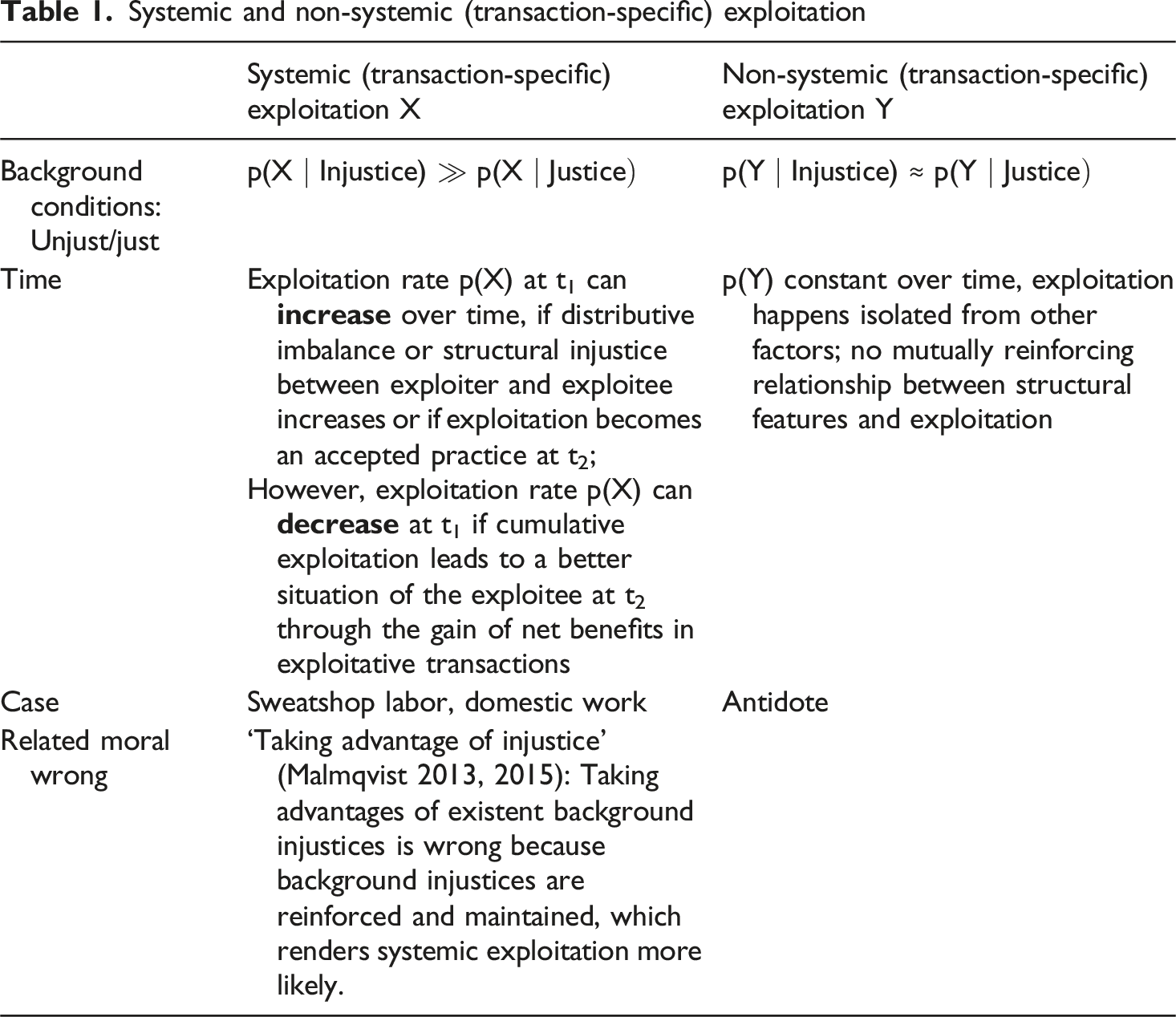
Systemic and non-systemic (transaction-specific) exploitation
Systemic Exploitation
The probability increasing property of background injustices is decisive in systemic cases of exploitation. I will define an exploitative event X as a ‘systemic’ event if it shows the following pattern: the conditional probability of the exploitative event increases significantly under injustice, compared to the exploitation rate under just circumstances
In perfectly just contexts in which regulations, the jurisdiction and employment protection serve as safeguards to protect people from exploitative work contracts, the risk of exploitation as a structural phenomenon may be negligible. In stark contrast, the probability of exploitation in a low and middle-income context or in contexts of structural discrimination is often very high when lacking regulations and poor jurisdictions enable exploitative work contracts.
Importantly, the conditional probability of exploitation or exploitation rate is conditioned by the counterfactual comparison of a specific point in time. The exploitation rate underlying injustice may, however, (but does not necessarily) increase over time, when structural injustices are not remedied. On the one hand, the ‘distributive gap’ between exploiter and exploitee grows over time, as the exploiter gains proportionally more, which makes the exploiter more powerful relative to the exploited. On the other hand, exploitation can become more easily an accepted practice, where exploiters are less willing to adapt to fair rules because it is tempting not to do so, as they are not socially or economically sanctioned.
However, note that this linear connection between the pervasiveness of systemic exploitation and background injustice does not necessarily hold. It may be logically possible that a higher frequency of mutually consented and beneficial exploitative events can ameliorate the conditions of the worst off. To give an example, it is often argued that sweat shop labor, even though exploitative (Zwolinski 2012, 161f), is relatively well paid and can help individuals to get out of absolute poverty. This, in turn, may make them less susceptible to being exploited by others. 8
Non-Systemic Exploitation
I will define a ‘non-systemic’ event Y of exploitation as an event with the following pattern: the conditional probability of an event Y is roughly the same under unjust background conditions compared to a just context
‘Non-systemic’ shall indicate that an exploitative transaction is not primarily owed to, enabled or conditioned by unjust background conditions and (almost) independent of structural factors. Therefore, the exploitation rate of non-systemic exploitation is approximately the same in just and unjust societies, as background injustice does not pose a significative factor to the occurrence of these cases. The most striking example of non-systemic exploitation may be Antidote, where the probability of occurrence of Y seems to be a feature of malevolence or greed of the exploiter’s character, which remains unrelated to the status of background injustice. 9 Note that in Antidote, the exploiter may even be in a more disadvantaged social position than the exploited, as we have no information about the characteristics of the agents.
Now, there may be several objections to this framework. First, some may argue that my account of systemic exploitation collapses with the structural position. To reply to this objection, my strategy is to accept the transaction-specific account, as I conceptualize systemic exploitation as an agent-relative moral wrong, where the exploiter commits a prima facie moral wrong independent of the background conditions, which means that structural factors are neither sufficient nor necessary to make systemic exploitation wrong. Thus, a single and isolated act of systemic exploitation is pre-structural in the sense that the fairness of a transaction can be evaluated independently of the institutional background (see Wertheimer 1999). Unjust structures do not revoke the exploiter’s wrongdoing, but make exploitation easier, which is reflected in an augmented exploitation rate and pervasiveness for systemic exploitation.
It seems that the structural position would not follow up on this: For instance, Roemer (1996) assumes that unfairness of a transaction hinges on the illegitimacy of the initial asset distribution. Young (2013) also seems to suggest that thinking about structural injustice should lead us to identify as ‘exploitative’ those actions that would be considered morally innocent in the absence of injustice. Different to this view, we may think that structural injustice is the ‘wrong making feature’ of exploitative transactions. Rather, in my account, background injustice is the ‘wrong-making feature’ of the systemic persistence or pervasiveness of exploitation, expressed in terms of its relative expected frequency. In other words, the conceptual connection between background injustice and the additional taxonomy of ‘systemic’ and ‘non-systemic’ exploitation concerns the pattern with which exploitation occurs, not the wrong-making feature of exploitative act by itself. Unlike purely structural and non-agential theories of exploitation, this new taxonomy is neutral about the ‘wrong-making features’ of exploitation. In this sense, this taxonomy is compatible with framing exploitation as a transaction-specific account, meaning that exploitation is more than a symptom of the moral illegitimacy of background structures.
However, my own account admittedly puts forward that our moral discontent in cases such as Domestic work or Sweatshop labor does not only concern the transaction-specific unfairness isolated from the societal context of justice; rather, we lament that structural background conditions make this transactional unfairness happen in a long-lasting and structural way. In this regard, concerns articulated in structural theories of exploitation (Cohen 1988, 1989, 1995; Roemer 1988, 1996, 2009; Sample 2003, 2018; Snyder, 2008; Young 2013) indeed find expression in the concept of systemic exploitation.
This brings me to a second objection, namely that other moral wrongs beyond exploitation already sufficiently address the dimension of structural injustice. For example, Malmqvist’s (2013, 2015) account of ‘taking advantage of injustice’ sustains that it is morally illegitimate not only because agents wrongfully benefit from the plight of others, but also because they maintain and perpetuate structural deficiencies when they exploit. In this sense, ‘exploiting injustice’ is a moral wrong that captures the structural feature of what I call systemic exploitation. My response to this possible objection is that Malmqvist (2013, 2015) rightly formulates a moral wrong that is deeply connected to systemic exploitation and describes the mechanism of how exploiters influence the system while exploiting in transactions (see Table 1). However, Malmqvist’s account does not establish a conceptual link between structural injustice and exploitation, as I do through a theory of probabilistic causation.
To anticipate some of my arguments of the next section, a conceptual connection has important consequences for the distribution of responsibilities: if structures are causal factors that bring about exploitation, remedial responsibility for exploitation can be shared across the group that is responsible for addressing structural injustice and the exploiting agent, depending on the exploitative (systemic or non-systemic) character of the transaction. Yet, ‘taking advantage of injustice’ merely focuses on the moral wrong committed by the exploiter and leaves out the causal contributions of other actors who primarily perpetuate and maintain structural injustice. My account is certainly in line with Malmqvist’s, but makes a more far-reaching claim about the role of the system.
Third, I so far presented a framework of exploitation that takes structural concerns into account by distinguishing between systemic and non-systemic exploitation. This distinction is descriptive and seems to rely on empirical input to further determine the levels of ‘significant’ and ‘non-significant’ causal relations between exploitation and background injustice. However, the comparison I make between ‘just background conditions’ and ‘unjust background conditions’ is counterfactual, which means that there is probably no sound and empirically supported principle for distinguishing significant from insignificant correlations. Thus, someone may object that my classification is to no avail if we lack an epistemic criterion for distinguishing systemic from non-systemic unreciprocated takings. It is true that we need to come up with a sound criterion for assessing whether a specific type of exploitation (sweatshop labor, domestic work, antidote etc.) and its pervasiveness are causally dependent or independent of the background conditions. However, conceptually speaking, we enter into the same epistemic challenges as with historical accounts of exploitation considering that previous injustices have led to exploitation. Irrespective of the epistemic certainty about what prior injustices may have historically led to exploitation, we can argue that in cases such as Sweatshop Labor or Domestic Work, there may be sufficient evidence that the rate of exploitation of exploitative labor contracts is significantly higher in unjust conditions of poor regulation than in contexts with just labor standards. It wouldn’t be exaggerated to say that such cases almost exclusively occur in unjust settings. Hence, Sweatshop labor and Domestic work are clear-cut cases of systemic exploitation.
Nevertheless, there are other, more complex cases in which it remains difficult to determine if and what kind of background injustice induces exploitation. For instance, emotional exploitation in partnerships may be a borderline case. While emotional exploitation is surely enhanced by structural discrimination, such as misogyny or gender violence (Manne 2017; McKeown 2016), it is possible that formally ‘just’ societies with non-discriminatory and equitable institutions in the wider sense leave room for a considerably high exploitation rate based on personal greed, revenge, and malevolence unrelated to structural deficits. Here, a more comprehensive account is needed to explain how unjust structures impact on personal relationships (see e.g., McKeown 2016; Wollner 2019; Young 2011, 2013). In consequence, I would like to stipulate that I so far aimed to capture the difference between rather extreme types of exploitation: cases that are clearly caused by structural factors and cases that are construed in a way that they are (intentionally) unrelated to background injustice, such as Antidote.
Also, it is true that ‘just’ and ‘unjust’ background conditions are relative concepts and hinge on a more substantive clarification. This is true; my account does not specify a normative theory of background injustice because that would be beyond the scope of this paper. A theory of background injustice is, however, necessary because it offers us the scope of the categories ‘systemic’ and ‘non-systemic’ exploitation. Such theory would also provide us with a sound orientation of whether background conditions justly or unjustly impinge upon the occurrence of systemic exploitation.
The structural accounts of exploitation I introduced (Cohen 1988, 1989, 1995; McKeown 2016; Roemer 1988, 1996, 2009; Sample 2003, 2018; Wollner 2019; Young 2011, 2013) mostly draw on different versions of egalitarianism to determine whether structures are just or unjust. Thus, when the authors of these accounts address structural concerns within the exploitation debate, they actually introduce concerns of egalitarian justice. Egalitarians usually account for just societal and institutional conditions in terms of an institutional architecture that would best realize their particular interpretation of egalitarian values (Arneson 2013). However, egalitarianism is one plausible background theory, but not the only possible one. Future works may map out in more detail the precise content of a theory of background justice. For the purposes of my classification, it is sufficient to introduce the categories of structural ‘justice’ and ‘injustice’, as I focus solely on the conceptual relationship of these categories to exploitative transactions, rather than on the concept of background justice itself.
As a fourth objection, some might say that a new taxonomy of ‘systemic’ and ‘non-systemic’ exploitation may coincide with historical (procedural) and non-historical (substantive) accounts of exploitation, rather than adding a substantive new taxonomy. I argue here that my account does not address the ‘wrong making’ feature of exploitation but constitutes a categorically different approach. Historical accounts suggest that the morally problematic aspect of exploitation originates from past injustices that set the stage for exploitative transactions. Alternatively, non-agential accounts view exploitation as a collective phenomenon rather than something easily attributed to individual transactions.
But historical accounts of exploitation do not give us evidence of the pervasiveness of exploitation, that is, the link between structures that cause transactional injustices. On the other hand, substantive transactional and ahistorical accounts of exploitation would abstract from historical considerations and claim that the cause of a disadvantage is either irrelevant or, in certain contexts, irrelevant to the determination of whether the altered terms of the transaction are unfair, defending various degrees of ahistoricism (see Goodin 1987; Sample 2003; Wertheimer 1999). Defenders of such a merely transactional theory would say that both Sweatshop Labor and Domestic Work are substantively wrong, not because of prior injustices. Again, my taxonomy of ‘systemic’ and ‘non-systemic’ will not take a position on the rightness of the theory. However, my taxonomy will still distinguish between these cases and Antidote in terms of whether or not there is a systemic prevalence of an exploitative pattern.
In the final session, my argument will focus on demonstrating the significance of the new taxonomy. Rather than advocating for a specific theory of exploitation, I will emphasize the importance of reintegrating structural considerations into the debate. My approach seeks to reconcile transactional and ahistorical accounts with the moral concerns of structuralists. Specifically, it acknowledges that exploitation can stem from both, historical injustices as well as from individuals motivated by greed, malice, or other morally blameworthy motives.
Part III: Taking Structures Seriously in the Exploitation Debate
To take structural injustice seriously, we must return to the concerns of structural theories of exploitation, while moving beyond the common critiques directed at transactional and ahistorical theorists. Non-historical and transactional perspectives have often been criticized for lacking a framework that links individual exploitative transactions to wider structural dynamics. The proposed framework distinguishes between systemic and non-systemic forms of exploitation and shows how transactions where A exploits B for morally blameworthy motives can either conform to systemic patterns or occur in isolation.
In the previous section, I tried to establish a clear link between background injustice and its impact on the moral wrongness of systemic exploitation when considered as a transaction-specific concept. According to the arguments of most structural theories of exploitation, agents other than the exploiters can be held responsible for unjust background structures and have duties to help remedy injustice and to create and maintain just institutions (Roemer 1998, Young 2011, chapter 3 on social responsibility, Rawls 1971 on the duty of justice). This reasoning presupposes that remedial responsibilities are general held by causally relevant agents. Yet, this generalization may not hold for all agents that are causally involved in the perpetuation of background injustice. The causal principle taken by itself cannot explain all of our remedial responsibilities (see Miller 2001, 458). 10 In what follows I nevertheless simplify a theory of responsibility and assume that, for example, consumers of cheap fashion in the Sweatshop case and people maintaining racism as a social institution in the Domestic Work case can be held causally responsible in the sense that they may bear duties to remedy unjust background conditions. This section maps out the possible implications of a theory of systemic exploitation in relation with the attribution of responsibilities.
So far, I argued the following. Structural injustice gains normative weight through its conceptual connection with the systemic persistence or pervasiveness of exploitation. In my account, it is still possible to hold that ‘structures’ do not bear moral liability and responsibility for the wrong done in exploitative transactions, as proponents of structural exploitation seem to argue. When defending the transactional paradigm, whether framed as historical or non-historical moral injustice, individual agents are morally responsible and liable for their acts of mutually beneficial transactional exploitation. Unjust structures only facilitate exploitative transactions by providing the ‘right’ circumstances for wrongdoers, as captured by the concept of pervasiveness. However, they are not determinative of such transactions.
So, why is the distinction between systemic and non-systemic exploitation of importance? First, if we do not distinguish between instances of systemic and non-systemic transactional exploitation, we will get to an incomplete explanans of how transactional exploitation (the explanadum) is enabled. We may implicitly and unintendedly tend to generalize that transaction-specific exploitation is generally ahistorical and unrelated to background conditions – as criticized by structuralists like Zwolinski (2012). However, this leaves out that a specific class of incidences of exploitation, systemic exploitation, shows patterns of repeated and perpetuated unfairness enabled and induced by an unjust system.
This leads us to a revised stance: rather than focusing on the wrong-making feature of exploitation, we should focus on the relationship between causal contribution and responsibility for a wrong. Here, the new taxonomy of ‘systemic’ and ‘non-systemic’ exploitation can be useful. Not only exploiters, but also other agents play a decisive causal role in fostering and maintaining structural injustice and thus bear moral responsibility for preventing systemic exploitation. It is not only exploiters who have a decisive causal role in fostering, maintaining and causing structural injustice; other agents also bear a moral responsibility to prevent systemic exploitation. This is a concern shared by structural accounts. 11 We will only prevent systemic exploitation induced by injustices, if we reform and remediate the institutional background (Cohen 1989, 1995; Roemer 1996; Young 2011). Thus, moral agency may even be attributed to the exploited. We may argue that even the potentially exploited should refrain from participating in exploitative actions that foster and maintain unjust background institutions (Rivera López 2017). Admittedly, such reasons can be trumped by other weightier reasons, such as personal subsistence.
At this point, it is necessary to clarify the specific role of structural injustices, not only in explaining why exploited parties – when facing conditions such as poverty or racial discrimination – are more likely to accept exploitative terms of a transaction. Structural injustices also explain why exploiters are more likely to offer unfavorable terms because they sometimes have no choice (Mayer 2007). To return to one of the paradigmatic cases of systemic exploitation, the sweatshop case, it may be true that the sweatshop manager is highly constrained in his ability to offer more favorable terms without running out of business. In this particular case, it may be true that consumers or governments bear much of the responsibility for why ‘fast fashion’ is produced cheaply in sweatshops. This is only a structural explanation of what goes on in sweatshop exploitation (Mayer 2007; Snyder 2012). However, it may be true that the sweatshop manager has some leverage to offer better working conditions, to sell garments under a ‘fair’ fashion label, or to withhold part of his salary for the benefit of the workers. This is what we would call the discretionary feature of exploitation: the exploiter has room to manoeuvre (Mayer 2007, 610). While discretionary exploitation typically occurs in contexts where there is no competition, systemic exploitation is conditioned by the structural background (see Mayer 2007, 611). According to Gray (2020, 545), this is expressed in the bargaining asymmetry rooted in the basic structure of the background; that is, ‘(…) the more structured and constrained the agents’ range of actions will be, and the more we should favor the structural approach’. Translated into the new taxonomy, the structural viewpoint plays a greater role in systemic exploitation.
My impression is that both, structuralists and transactional theorists, highlight valuable aspects of exploitation, but the problem is that these aspects are not salient in all types of exploitation: while the former emphasize the unjust system, the unchangeable rules of the ‘game’, as determinative factor of exploitation, the latter underemphasize the responsibilities of other very important agents that in some way also restrict the action space of the exploiter and the exploited. As mentioned above, we may want to share the point with transactional theorists that the exploiter as a free and autonomous agent is at the end the primarily responsible and liable person, if it is in her power to take unfair advantage of another person. Indeed, as Meyers (2004, 331) shows, most manufacturers in the apparel industry exploit in a discretionary way, as they could afford to increase wages of workers, but chose to maximize profits, and deliberately violate labor laws (Mayer 2007, 616). However, unjust background conditions, and this included structures of competition and pressure on the apparel market, I characterized as (probabilistic) ‘causal’ factors can easily limit the action space of potential exploiters, making systemic exploitation more likely. At the end, the pervasiveness of exploitation, expressed in the observable exploitation rate reflects the degree of freedom with respect to the action possibilities of the exploiter.
Thus, addressing the question of what agents ought to do, and what responsibilities they share, requires an analysis of the causal impact of structural injustices on exploitative transactions. This analysis remains attentive to the alternative courses of action available to agents. Taking structures as causal factors seriously means that responsibility for exploitation is broadly held, certainly by the exploiter, but in part also by other agents that stand outside the exploitative transaction – which is, again, defended by most structural accounts (Gray 2020; McKeown 2016; Wollner 2019; Young 2011, 2013). But structures are not always causally constitutive of exploitation, as in cases of non-systemic exploitation. However, when it comes to systemic exploitation, as represented by Sweatshop work and Domestic work, those ones who restrict action possibilities of exploiters and exploitees bear responsibilities, as they consolidate the pattern with which exploitative transactions occur.
Part IV: Conclusion
Defenders of a transaction-specific theory of exploitation argue that wrongful exploitation can occur even without background injustices, and we need to explain why. The aim of this paper has been to link this insight to recent scholarship that has sought to revive the concerns of the structural theory of exploitation. Whether defending agential or non-agential structural exploitation, they see structural injustices as the fundamental moral problem when it comes to exploitation. I argued that we cannot leave the structural position intact without acknowledging the transactional and ahistorical critique that, first, exploitation can occur independently of structural background injustice and, second, that the exploiter is morally liable and responsible for her exploitative act. I have suggested that a new taxonomy of exploitation, and in particular systemic exploitation, sheds light on the debate. Here we can hold two ideas at once: structural injustices can have a causal influence on the exploitative terms of systemic transactions, without the structural injustice itself necessarily being the wrongful feature and sufficient condition of exploitation. This may ultimately reconcile the purely ahistorical and transactional theory with the importance and intuitions of structural concerns. Furthermore, the causal contributions to exploitation are a crucial factor in determining who is responsible for addressing the problem of exploitation; and so, in many cases the exploiter is not the only responsible agent.
Footnotes
Acknowledgments
I would like to express my sincere gratitude to everyone who discussed the paper with me. Special thanks are due to the political philosophy group in Buenos Aires, particularly my mentors, Ignacio Mastroleo and Florencia Luna, from the bioethics programme at FLACSO Argentina. I would also like to thank Francisco García Gibson, Julio Montero, Eduardo Rivera López and all the members of the SADAF and CIF research groups for their invaluable contributions to the discussion of this paper. My appreciation also goes to Sara Goff, Cristian Rettig, Saladin Meckled-Garcia and the participants of the UK-Latin American Network of Political Philosophy at UCL London in 2019. Finally, I would like to thank Stéphane Chauvier and Céline Spector for their thoughtful feedback on earlier drafts of this work.

Funding
The author disclosed receipt of the following financial support for the research, authorship, and/or publication of this article: This research has been funded by CONICET Argentina and the German Academic Research Service (DAAD).
Declaration of Conflicting Interests
The author declared no potential conflicts of interest with respect to the research, authorship, and/or publication of this article.