




Abstract
In this contribution, we argue that critical theories of the public sphere (in Habermas, but also in Negt and Kluge as well as Fraser) leave out the socially central field of labour and labour-political disputes, and that a reactualization and refocusing becomes necessary: We define the dynamics of globalization, commodification and digitalization as sequences of a renewed structural transformation of both social self-understanding and gainful employment. With the help of a multi-level model of labour-political publics and counter-publics, class mobilizations can be examined with a public-theoretical lens and important moments of labour-political disputes can also be reflected on their communicative conditions. This is exemplified by two vignettes.
Keywords
1. Introduction
The public is the central sphere of collective action and class politics. In order to grasp how dynamics of mobilization emerge, class theories must capture moments of collective learning. In this context, concepts of political public spheres have been mostly neglected. Accordingly, theories of the public sphere operate without class and class theories without public sphere.
In his book ‘Structural transformation of the Public Sphere’, Jürgen Habermas has pointed out the significance of the public for processes of collective learning. Oskar Negt and Alexander Kluge take up this initiative in their text on ‘Public Sphere and Experience' and expand it with a class-theoretical focus that allows for the identification of counter-publics. In both works, however, the significance of labour as a determining moment of class-political mobilization recedes into the background. The result is a theory of the public sphere that leaves out the field of labour.
Against this background, we aim to update and re-focus their argument: By considering globalization, commodification and digitalization as sequences of a third structural transformation of the public sphere and labour policy. Following Habermas, Negt and Kluge, as well as Nancy Fraser, we develop a concept of labour-political publics and counter-publics that allows us to analyze class-political learning and mobilizations.
2. The public sphere without work: With and against Habermas
Habermas identifies the public sphere as the pivotal arena in which reason can be realized collectively. Questions of general interest are discussed without restriction (objectively and in relation to the circle of participants), thereby triggering educational processes among the participants. This way, a public opinion is formed as the result of and reference point for further public debates and informed political decisions (cf. Habermas 2022). The public sphere is thus conceived as a critical concept that serves to evaluate social change.
In The Structural Transformation (1990), the bourgeois public provides this normative horizon for Habermas. As an idea and practice of exchange free of domination, in which only the power of the better argument matters, bourgeois public sphere is ideology and more than ideology at the same time. Participation in the public sphere and the habitual, socioeconomic prerequisites and skills for engaging in public discourses were reserved for citizens, but as a socially institutionalized concept, it simultaneously goes beyond its class bias by practicing ‘the idea of the dissolution of domination into that easygoing constraint that prevailed on no other ground than the compelling insight of a public opinion’ (Habermas and Kruger 1989: 88). As broader social classes also gained relative economic independence, so this idea gained relevance for them. Conceived in this way, society and the public sphere can be measured against their bourgeois ideal: Whenever access to the public sphere is restricted for some groups due to (too) unequal levels of education and material resources (Habermas 1990: 331), or when (too) powerful political and economic organizations restrict the ‘publicistically effective and politically relevant formation of assembly and association’ (Habermas and Kruger 1989: 228) through oligopoly formation and strategically use of communication.
In his study, Habermas presents the public sphere as an independent institutional sphere with a key significance for the functioning of democratic communities and elaborates its process character. Habermas develops the parameters of this structural transformation within three dimensions of analysis – which he does not explicitly name as such (cf. Seeliger and Sevignani 2022): 1. Within the (socio-)spatial frame of reference, a structural transformation takes place in the differentiation of the private sphere (civil society and family) and the (national) state as well as a mediating public sphere as a sphere of its critique. The family becomes the place where a general humanity is practiced. This is followed by a renewed entanglement of the private sphere and the public sphere through a welfare state that intervenes in the private sphere and the instrumentalization of the public sphere by private and state interests (Habermas will later define this as an excess of strategic action in place of communicative action). 2. Secondly, Habermas considers the influence of the economic framework conditions. Here, the feudal economy is transformed into a competitive capitalism with free movement of goods. Private cultural production takes place above all for the resonating audiences of the coffee houses and salons, which Habermas understands as an ideal type of bourgeois public. This stage is followed by the transition from competitive capitalism to oligopoly capitalism supported by state redistribution. Here, cultural production is carried out both by the state and privately as public relations and under conditions of continued class polarization. 3. In a third dimension, the technical media of dissemination changed, and the citizens as the addressees of public authority were replaced by a group of private citizens who gathered to form an audience by means of journals and newspapers. These are later replaced by electronic mass media, which generalized the potential of communicative action but also have a restrictive effect as they hierarchize public communication. In the process, assembly publics are transformed into manufactured publics under the influence of PR media. Today, globalization, commodification and digitalization are discussed as the decisive drivers of a renewed structural transformation of the public sphere (Seeliger and Sevignani 2021a, 2021b).
Habermas analyzes a decay of the bourgeois public sphere, which is characterized by the increasing entanglement of state and society and the growing relevance of strategic forms of communication (e.g. in the context of lobbying). The public sphere is then populated by antagonistic interests, media and ‘actors who merely use forums that already exist’ (Habermas 1996: 370). He analyzes this under the topos of the ‘refeudalization’ of the public sphere as the displacement of rational communication, i.e. public communication in which the claims of intelligibility, truth, veracity and correctness (no longer) apply.
2.1. Habermas’ departure from the concept of work
In later years, Habermas re-articulated the ideal of the bourgeois public sphere into the concept of communicative reason (cf. Cooke 2012: 818) and located it in the ‘lifeworld’. Now the foundation of the critical concept of the public sphere is ‘deepened’ and it moves from an effective and performative idea of the bourgeoisie to anthropology, more precisely the linguistic capacity of human beings. Instead of recurring to a historical movement such as the bourgeoisie, Habermas finds in the structure of language inherent validity claims of truth, truthfulness and correctness against which public debate can be measured. Communicative rationality can now be found outside the bourgeois public sphere, for example, in the publics of different social movements (cf. Habermas 1996: 370). The lifeworld provides the necessary background for any advantages in instrumental rationality in politics and economy as here the cultural transmission of meaning, the social election of solidary relations and the socialization of ego-strong personalities takes place. The ideal (formerly bourgeois) public sphere is characterized by the dominance of communicative action; its decay indicates the dominance of strategic action. Habermas now discusses this as the ‘colonization’ of the public sphere by systemic constraints (coming from politics and the economy).
Crucially, both the concepts of communicative reason and the lifeworld, which reproduces itself through communication-oriented action, are based on an influential distinction between work and interaction or communication, which Habermas gains in demarcation from Marxist currents of thought. This is accompanied by a social-theoretical rejection of work as the primary place of emancipation.
In terms of social theory, Habermas argues that social analyses following Marx overemphasize the concept of work and the importance of the sphere of production. Accordingly, a fundamental shift away from the traditional focus on labour runs through Habermas's work, as it is no longer a priority in modern societies, it contains no normative potential, and it would be too narrow for social theoretical analysis (Elbe 2014; Habermas 1985: 99). This neglect of work and, in contrast, the overemphasis on communicative rationality is already evident in his text on ‘Work and Interaction’ in which he discusses Hegel's early writings and in which his later theory of communicative action already emerges (Dubiel 1988: 95). Here Habermas (1968: 45f.) argues that Marx traces communicative action back to instrumental action. The former, he argues, appears in Marx as the central paradigm from which all other categories emerge. Following Hegel, he emphasizes that interaction is based on recognition, whereas work is characterized by the cunning appropriation of nature.
At the core of his considerations is instead a dichotomization into, on the one hand, communicative and, on the other hand, instrumental actions (Habermas 1968: 63ff; Ganßmann 1990). Work is thus understood as an instrumental rationality that takes place monologically, in contrast, communication is intersubjective. While communicative action is conceived by Habermas in a differentiated and explanatory way, instrumental action lacks an equivalent elaboration (Honneth 1980: 222). The dualism of instrumental work and communicative interaction, which leaves out the interactive elements of work, has been criticized many times (Elbe 2014; Ganßmann 1990). Accordingly, it is interaction and communication in which Habermas recognizes rationality, whereas work identified as instrumental reason cannot be a starting point for emancipation.
This is accompanied by the neglect of specific public spheres in the field of work. As explained before, the public sphere is the sphere of a rational form of communication that forces domination to legitimize itself. For Habermas, work falls into the sphere of the private and, as an exclusively instrumental action, is not suitable for self-understanding. With this understanding of work, he neglects the anthropological meaning of work (Heller 1982: 41) in contrast to labour and, as Honneth (1980: 213) points out, this is accompanied by ‘categorical disregard of the forms of resistance and emancipation anchored in the structure of the capitalist labour process itself’. Thus, while Habermas's critical concept of the public sphere is worth to be retained, this does not apply to his assessment of labour. Therefore, it is necessary to consider further theoretical perspectives to develop a sound theory of labour-political publics.
3. The proletarian public sphere as a (solely) negative concept: On Negt’s und Kluge’s ‘public sphere and experience’
As a direct reaction to Habermas' conception of the public sphere, Oskar Negt and Alexander Kluge (1972) reflect on the relationship between ‘public sphere and experience’, which leads them to a class-sensitive theory of the public sphere. Their work also reacts to the differentiation and particularization of the political left at the beginning of the 1970s, which prevents it from effective success (Negt 1973; Negt/Kluge 1972: 150–162). In light of this, Negt and Kluge's emphatic notion of the proletarian counter-public provides a theoretical framework for a fragmented left (Schlüpmann 1990: 70). In an original way, the authors analyze the public sphere as potentially politicizing and also take labour into account. Analogous to Habermas, the public sphere is central for Negt and Kluge to realize an emancipation of individuals (Negt 1975: 465; Negt/Kluge 1972: 13). The individuals, who are solely privately connected in capitalism, are then united through the public sphere by discussion of topics of general relevance (Negt/Kluge 1972: 18). Nevertheless, it is precisely this emancipatory potential that is undermined in the existing limited forms of the public sphere.
Negt and Kluge understand the public sphere broadly as the organization of experience. Accordingly, they aim at the ‘use value’ of the public sphere, which becomes effective ‘when social experience organizes itself within it’ (Negt/Kluge 1993: 3). The use value of the public sphere is thereby not understood as universal, but rather shaped by the interests of respective social groups and classes. The public sphere is only emancipatory if it organizes the experiences of the proletariat. Public Sphere and Experience thereby implies a prior existence of classes that, however, has to be brought into light through the unifying organization of experience. The public sphere can also work as an ‘illusory synthesis of society as a whole’ (Negt/Kluge 1193: 63), which then puts this organization of experience on hold and conveys an only supposedly general political will.
In contrast to Habermas, Negt and Kluge argue that the public sphere in its bourgeois form prevents a comprehensive political emancipation of individuals as it prevents the formation of the proletarian class. It is the ‘Dorado of the Citoyen’ (Negt 1975: 462), a ‘dictatorship of the bourgeoisie’ and the ‘organized obstacle to the material public sphere and politics’ that ensures that a ‘collective will’ (Negt/Kluge 1993: 55; see also Sevignani 2022). Negt and Kluge assume that the enlightening ideal of a bourgeois public sphere does not erode later within its structural transformation, as Habermas states, but never existed as such. Moreover, Negt and Kluge understand the public sphere as a cumulative concept (Gundel 1977: 130f.) as only existing in the plural.
According to Negt and Kluge, three types of public spheres can be differentiated: bourgeois, produced and proletarian. The bourgeois public sphere corresponds to Habermas’ ideal of the public sphere. It aims at universally valid decisions and excludes private interests and experiences in the sense of this universality. In the present, it is overlaid by produced public spheres (Negt/Kluge 1972: 12, 35). These are the result of an advanced structural transformation, but do not denote a process of refeudalization as stated by Habermas. They do not close public spheres, but open and expand them by incorporating the real experiences and desires of the masses. The experiences of the oppressed are taken up directly, but in doing so, according to Negt and Kluge (1972: 116, 135), they are held in their immediacy and privacy, leading to ‘pseudo-publics’. Only a part of the experiences of the proletarians is incorporated and experience is thereby simultaneously re-inforced as partial, so that these produced publics act as ‘palliatives’ that leave the status quo unchanged (Negt/Kluge 1993: 17).
Negt and Kluge's examination of ‘public sphere and experience’ proves to be an innovative follow-up and at the same time a powerful counter-proposal to Habermas' theory of the public sphere. However, – and this may come as a surprise in view of all the talk about the proletariat – Negt and Kluge neglect the field of labour as well. In general, the two authors miss their goal of formulating alternative public spheres and instead specify bourgeois variants of the public sphere and their limitations (Jameson 1988: 157; Negt and Kluge 1981: 87–88). According to Negt and Kluge (1972: 143 FN 39, 14), the proletarian public sphere cannot be concretized because it is ‘a thing of the future’ and accordingly it is formulated only negatively as the other of bourgeois public sphere (Negt/Kluge 1972: 108 FN 9; Koivisto/Väliverronen 1993: 26 ff.): ‘“Proletarian public sphere” becomes an exclusively negative term that encompasses all the possibilities that exclude all previous conceptualizations’ (Strum 2000: 112).
For Negt and Kluge, the sphere of actually existing work is only of marginal relevance. In addition to the field of socialization, production in particular is part of the private sphere (cf. Negt/Kluge 1972: 10; Gundel 1977: 130f.), which in turn is the ‘substantial foundation and at the same time the soil from whose negation and exclusion the public sphere draws all its power’ (Negt 1975: 461f.). As a result, Negt and Kluge state that no public sphere exists in labour, so that proletarian public spheres appear as the only way out to articulate the life contexts and experiences of the proletariat and its interests. With the demanding concept of the proletarian public sphere, ‘the empirical working-class public sphere often appears as a variant of the bourgeois public sphere’, which is only modelled on its structures, since the working people do not have the instruments to produce independent public spheres (Negt/Kluge 1993: 58). According to them, the ‘“public sphere of the factory” is only a “so-called” one, which can no longer be portrayed as “public”’ (Negt/Kluge 1993: 50). Although they emphasize that work processes are inevitably based on cooperation and interaction between workers, the only object of their analysis of workplace public spheres is the employees meeting as defined by the German Works Constitution Act. They identify the narrow guidelines for the conduct and content of employee’s meetings as ‘absolutist’ (Negt/Kluge 1993: 50f.). This is not wrong with regard to the constitution of companies as ‘private governments’ (Anderson 2019), and yet it ignores the limited but existing co-determination and, above all, the everyday practices of employees, which are indeed a form of specific public spheres (Brinkmann et al., 2022).
4. Bringing work back in: On the analysis of labour-political publics
As an analytical framework, which is at the same time critical and normative, it is valuable to apply the concept of the public sphere to the field of work. As explained, Habermas' study is an appropriate starting point for this, but one that needs to be supplemented. Here, the public sphere appears as a process that rationalizes domination and wrings from it the need to legitimize itself. While Habermas also examines social elements – such as the question of ownership in the media industry – in addition to republican (procedural correctness of political procedures) and liberal (free development of responsible citizens) elements, aspects of the legitimation of corporate domination in the labour process as well as its distributional issues remain largely unaddressed. And as shown before, Habermas abandons work as a central or even only partial site of emancipation and focuses on the communication of the lifeworld, which is contrasted with instrumental work as a counterpart. This separation relieves the economy – and with it, labour – from the claim of democratic representation (Beerhorst 2011: 239f.).
Habermas' nevertheless valuable social theoretical analysis was developed by Negt and Kluge (1972) into a concept of the proletarian public sphere in order to analyze the emergence and possibility of counterpower. From an empirically informed perspective, Negt and Kluge reconstruct the context of ‘proletarian life’ (1972: 10) as a context of reception and production of the public sphere. In doing so, they transgress the model of the representative public sphere towards more direct dorms of democracy and they combine Habermas' discursive approach with a model of a politicizing (counter) public sphere based on ‘experiences’ in the lifeworld. But as explained, first, the point of reference for the proletarian public sphere remains undetermined, and second, they also neglect the actual labour process and the interactions and specific publics that accompany it. Third, with the proletarian experience they introduce an alternative standard of critique; it should organize publicly but does not have to prove itself in the democratic public sphere.
4.1. Class theories sensitive to the public sphere
In the field of class theories, the preoccupation with labour traditionally plays a decisive role. In turn, an explicit preoccupation with public spheres, as spaces in which class experiences can be organized, is usually missing here. Accordingly, there is a need for class-sensitive public sphere theories as well as public sphere-sensitive class theories (cf. Sevignani 2020).
The starting point for such thinking is that an understanding of politico-economically determined class positions in society, positional interests and objective mechanisms of class formation (such as exploitation), that is, class structure analysis, is only a necessary but not a sufficient condition for understanding empirical class dynamics. On many occasions, it has therefore been emphasized that, in addition to the ‘empty seats’ to be allocated in capitalist social structures in the first place, a number of other determinants must also be taken into account in sociological class analysis.
Differently organized public spheres, for example, the existence of exclusive social circles, certain communicative relations, or the mediation of political convictions, play an often underestimated role in the formation of mentalities, alliances between political camps and finally social class dynamics. The emergence of classes, the transition from latent socio-structural to manifest class interests, requires not only the confrontation with other classes but also a unifying practice of the ‘Herstellung der Kommunikationen’ (MEW 3: 53) [‘the production of communications’; the authors].
Following Antonio Gramsci, public-sensitive class theories can be found especially in British Cultural Studies, for example, in E.P. Thompson and Stuart Hall. Experiences grounded in (dependent, externally determined and exploited) labour, as an initially unspecific polarized ‘societal “field-of-force”’ (Thompson 1978: 151), have to be interpreted and this organization has to be organized. In this process, class consciousness is not something that is discovered, but a particular, and for structural reasons of power inequality, improbable possibility of organizing labour experiences (cf. Hall 1989: 34f.). Class struggle is twofold prior to class: First, the relations of production lead to objective clashes of interests, which are experienced as conflicts. And then it is the consequent contested processes of formation that are prior to a discovery of any class consciousness. The guiding idea here is to explore how people act in a class-like manner even though they do not yet form a class. This is expressed in Thompson's famous dictum of ‘class struggle without class’.
In terms of class theory, public spheres are places where experiences with conflicts rooted in the capitalist social structure can be articulated, shared, shaped, interpreted and possibly organized in a class-conscious, emancipatory perspective. Work experiences are central to this, but in their interpretation, they always connect to other axes of social inequality (see, for example, Fraser 2022; Hall 1994). Understanding this, requires an understanding of how different forms of publics function in interaction and how antagonistic social relations affect the institutionalization of different publics (see, for example, Sevignani 2022). Publics, however, not only have a cultural-political mediating function, but also their own political economy, which sets the framework for the organization of experience they provide. The production of the public sphere requires communication work with means of communication, whose distribution and level of development determines the organization of experience. Both the state of the ‘productive force of communication’ (Habermas and Krüger 1989) and the social communication relations have to be examined in order to be able to understand class formation processes adequately.
4.2. Labour-political publics for parity of participation: Nancy Fraser's attempt to synthesize
Although Nancy Fraser's reflections on public sphere theory do not explicitly address labour (see however Fraser 2023), they are interesting because she takes a mediating position between Negt/Kluge and Habermas. Reading Habermas as a public sphere theorist and Negt and Kluge as counter-public sphere theorists arguing from the standpoint of the proletariat, Fraser connects the critical concept of the public sphere with the democratic function of counter-publics serving this purpose.
Fraser's critical social theory centres around the principle of ‘parity of participation’. It sets out how evaluative decisions should come about in a society but does not theoretically anticipate their content. In this sense, Fraser, following Habermas, connects to discourse theories of justice. These are concerned with the just process of negotiating a fundamentally open answer, under the conditions of the modern pluralism of values, to the question of what exactly is to be understood by justice. With this shift to (political) procedures, the question of justice is for Fraser necessarily linked to the institutionalization of functioning democratic public spheres (Fraser 2007a, 2007b: 318). Those who demand economic equality must publicly show that the distribution of material resources hinders equal participation in social life. Those who demand recognition must publicly show that intersubjective relations prevent certain individuals or groups from participating in social life. And those who demand political equality must publicly demonstrate that certain persons or groups are not represented in political procedures and institutions. Guiding this is the image of a dynamic spiral, where the conditions of deliberation are ‘good and just enough’ that their outcome simultaneously form the conditions for better and more just future deliberations.
Habermas (refeudalization) as well as Negt and Kluge (blocking of experiences) give impressive indications of deficient conditions for deliberation. Fraser makes clear that specific forms of publicity and rationality of deliberation can attribute themselves to strategies of distinction between social groups. Conceiving of the public sphere in singular terms goes hand in hand with the exclusion and suppression of alternative publics, which are, however, needed for a society on its way to equal participation. Under such conditions, ‘members of subordinated groups would have no arenas for deliberation among themselves about their needs, objectives and strategies. They would have no venues in which to undertake communicative processes that were not, as it were, under the supervision of dominant groups’ (Fraser 1992: 123).
For Fraser, suppressed public spheres do not automatically produce emancipatory content. And, contrary to Negt and Kluge, she nevertheless assumes that the possibility of being able to discuss previously excluded issues in public is to be assessed as positive in a stratified class society. Counter-publics have a dual function in unequal societies: on the one hand, they promote withdrawal and regrouping, thus enabling people to find their own voice and identity. On the other hand, they are also training grounds for agitation and generalization and promote learning processes on how to make one's own voice heard. In her view, even in egalitarian societies, diverse public spheres are needed to form and articulate identity, because diversity should not be suppressed there either.
At the same time, Fraser states (and in this she follows Habermas) that counter-publics have an inherent tendency towards generalization and universalization; they strive for ever larger arenas. It is a prerequisite of her theory that publics interact in some form, that is, that the principle of publicity applies in principle. Thus, there must be something in common (publicity and comprehensibility) between the publics. It is here, where Habermas assumes a shared lifeworld. Its possible absence, for example, in the context of the currently much debated ‘filter bubbles’ in online communication, would be a serious problem. Fraser assumes that structures of domination place people or specific groups in similar situations and that these, as ‘modern subjects’ are not willing to accept this subjection to a structure of domination (cf. Fraser 2014).
Publics within the liberal model, which is based on a strict separation of state and society, can only be ‘weak publics’, deprived of any decision-making competence. In contrast, parliaments are forms of ‘strong publics’, that is, publics within the state. In Fraser's view (cf. Fraser 2014), hybrid institutionalizations of strong and weak publics are needed: Strong publics with political regulatory and enforcement powers must continuously justify themselves to the weak ones. Having this in mind, the labour-political public sphere is not only to be theorized as a counter public; in it, labour-political or proletarian (counter) publics can exercise a democratizing function, and this could – following Fraser and Negt/Kluge- also institutionalize as strong public spheres within an economic democracy.
4.3. A multi-level model of the labour-political public sphere
Labour-political publics can be both emancipatory and affirmative. This depends on their content and design. In Habermas, Negt and Kluge, as well as Fraser, criteria for the conditions of public deliberation can be found. If one wants to do justice to the empirical diversity and complexity of the public sphere, a multi-level model is needed. The organization of social experiences takes place in the public sphere (singular), however, understood as ‘a network for communicating information and points of view’ that ‘coalesce into bundles of topically specified public opinions’ (Habermas 1996: 360).
With the aim of elaborating a concept of the labour-political public sphere, we first define publics neutrally as the organization of communication on different levels (by means of technical and social media, differentiated roles of communicators and recipients). Publics emerge from publics, which together form a topically structured communication process: In simple publics of interpersonal and immediate communication, that is, on the ‘encounter level’ (Neidhart 1994), the functional roles between speakers and listeners are not yet differentiated and alter continuously. In issue specific and associational publics (ibid.), the first functional role assignments are formed: There are significant speakers and explicit communication rules emerge. These prototypical middle-range publics form around associations, citizens' initiatives and social movements. In complex publics, such as those created by the modern mass media, speaker roles are largely professionalized and relationships to certain sub-publics are well-rehearsed, whereby the audience becomes ever more abstract and has itself restricted communicative agency.
Levels and dimensions of the structural transformation of the labour-political public sphere.
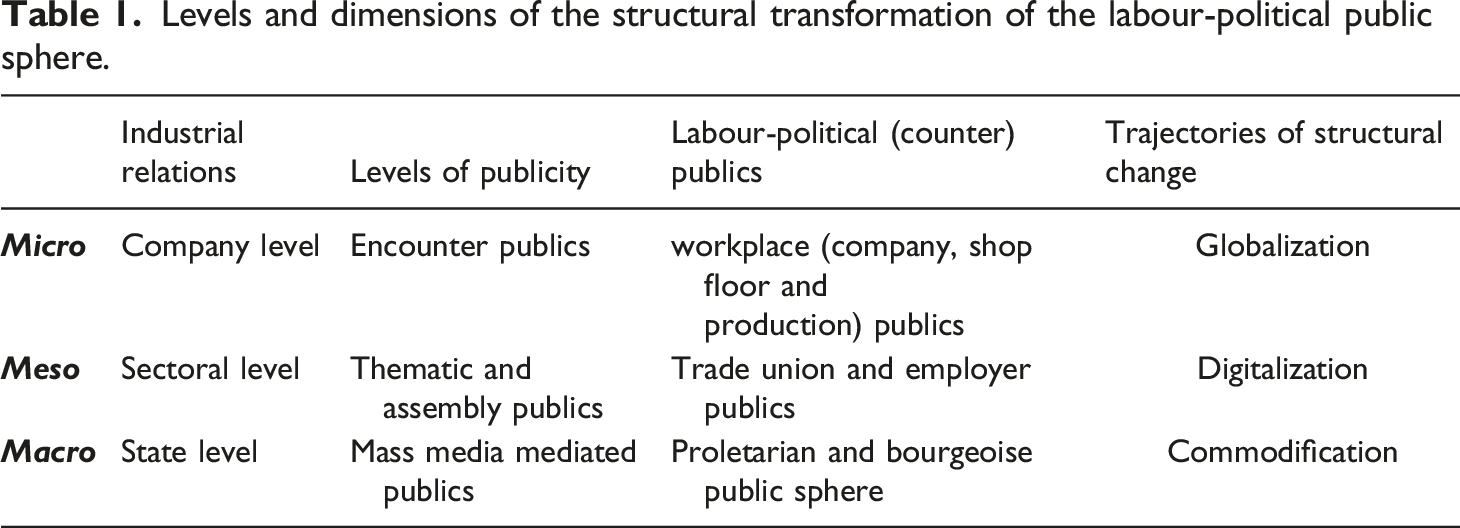
The micro level of industrial relations is the enterprise. Here it is determined whether work experiences can be organized as corporate publics and to what extent experiences from other publics outside the enterprise can be drawn upon. Early on, it was outlined that the ‘fixed system of workplaces’ in a company restricts the workers’ opportunities for interaction (Popitz et al., 1957: 65, own translation). Following this, Thomas (1964) shows that workers are at best in contact with their direct colleagues: ‘What lies beyond the small department is in the general fog’ (ibid., 61, own translation). In contrast, Schmidt and Weick (1975) demonstrate how workers in and beyond the workplace articulate their interests in company newspapers, leaflets, union publications and demonstrations. Brinkmann, Heiland and Seeliger (2022) update this concept of workplace publics and show that, especially in this context, the dichotomization of instrumental work on the one hand and communicative interaction on the other cannot be maintained. Workplace publics are thus also relevant in organizations, such as corporations, that are by definition undemocratic and they serve both to establish and secure workplace domination and to undermine it.
At the supra-firm and meso level, both unions and employers organize (counter)publics. On the macro level of state-organized industrial relations, the proletarian counter-public has a democratizing effect on the bourgeois public sphere (see Table 1). In addition to these three interacting levels of the labour-political public sphere, we propose three dimensions of its structural transformation. Drawing on Habermas's original analysis, we identify the spatial frame of reference, the economic contextual conditions and the developing technical means of communication, which all affect labour-political publics. Against this background, a renewed structural transformation of the labour-political public sphere can be identified since the 1970s. Since then, social change in the three dimensions can be summarized as three megatrends: globalization, commodification and digitalization (see above; Seeliger/Sevignani 2021).
5. Analysis of labour-political publics
In the following, we briefly illustrate this research program and the relevance of an integrative view of work and the public sphere by means of two vignettes. This necessarily remains selective (also for reasons of space) and thus an invitation for future research, insofar as only two public sphere levels and not all dimensions of structural transformation are addressed here in each case and, moreover, the evaluation criteria of democratic public spheres gained from critical theory still need to be systematically taken into account.
5.1. The digitization of shop-floor publics
The digitization of the social encompasses the restructuring of communication, production and distribution through the use of computer technology. In addition to the development of productive forces and the increase in economic performance, digital technologies expand the reach and degree of inclusion of the political public sphere and, at the same time, its ability to be shaped and monitored (Brinkmann et al. 2022). On the one hand, digitization lowers communication barriers and enables the emergence of online publics that can initiate collective action (Beyer 2014; Tufekci 2017). This is also relevant in work contexts. For example, Facebook groups serve to exchange and organize workers in retail (Wood 2015), and TikTok videos recently spread strikes in various Amazon logistics centres in the United Kingdom (Anonymous 2022).
On the other hand, digitization undermines encounter publics by replacing them with face-to-face communication. As previously shown by Popitz et al. (1957) and Thomas (1964) (see 4.3), the organization of work prevents interactions between employees. Digitization is able to amplify this effect because, first, communication is mediatized by digital technologies and thus simultaneously channeled and controlled. For example, a chat app for Amazon employees in the United States prohibits the use of words such as ‘union’ ‘living wage’ or ‘grievance’ (Klippenstein 2022). Secondly, interactions between workers become superfluous, as the necessary agreements in the work process can be taken over by algorithmic forms of management. Information, communication and work processes are thus formalized and human interactions minimized (Heiland 2018). Originally instrumental communication in work contexts, which are indispensable for maintaining and coordinating work processes, can also be reduced as a result. Since the possibility of initiating critical discussions is inevitably inherent in such functional interactions, the result is the emergence of (counter-)public spheres (Brinkmann et al. 2022).
This outlined and ambivalent digital structural transformation in the public sphere of labour policy is exemplified by platform work. Platform work is a technosocial structure that allows for the coordination of work services between (mostly independent) providers and demanders (Woodcock and Graham, 2019). With regard to the construction of labour public sphere, two characteristics of platform work are relevant. First, platform work is delocalized. It is either performed purely digitally and is globally distributed (crowdwork) or it stretches across limited but large-scale urban spaces (mostly service activities), so that no single workplace exists. As a result, social relations among workers are reduced and public spheres cannot emerge. Second, platform work is the central field for the previously outlined work process control by means of algorithmic management (Heiland, 2018; Kellogg et al., 2020).
However, despite the pronounced fragmentation of the workers (Heiland, 2022), there is often a lively exchange among them in various online forums outside the platforms (Brawley and Pury, 2016; Lehdonvirta, 2016; Brinkmann et al. 2022). In this way, it is possible, at least in part, to overcome the fragmentation of platform workers through the construction of digital publics and to establish counter-publics, which sometimes even results in collective action (Herr et al., 2021). However, this development of critical labour-political counter-publics is not an automatism. Not infrequently, the corresponding spheres of communication are fragmented along national borders (Lehdonvirta, 2016; Wood et al., 2018; Yin et al., 2016), making the establishment of transnational public spheres difficult. Moreover, these specific corporate public spheres are only used instrumentally by many workers, for example, to understand the workings of the platforms and their algorithms (Bucher et al., 2021; Lehdonvirta, 2016; Wood et al., 2018). However, they do not always fulfil the normative claim of a critical public sphere or even a counter-public sphere.
5.2. Globalization and commodification of working publics between meso- and macro-level
In the most general sense, globalization can be understood with Anthony Giddens (1990) as an increase in the interdependence of events in places far away from each other. 1 In contrast to Habermas' focus on the formation of national public spheres, in the course of globalization, social relations and moments of political order formation beyond the nation state move into the centre of interest. With regard to the market-driven structuring of gainful employment, two types of mobility-related effects can be distinguished in this context. The first is the mobility of capital. Especially since the 1970s, new communication and transport technologies have made it possible to make investments on a global scale. This development put national and (macro-)regional governments as well as local working classes in direct competition for capital investment in their respective ‘locations’. Since the 1990s, the news magazine ‘Der Spiegel’ has emerged as a media authority for broadly effective mediation. The head of the economics department, Gabor Steingart, fuelled the ‘location debate’ in non-fiction books with titles such as ‘World War for Prosperity’ (2006) or ‘Germany. The Decline of a Superstar’ (2004). Within companies, too, management initiatives from the 1970s onwards aimed at being able to manufacture the same products at different sites in order to play them off against each other in negotiations over local costs. The cross-border fragmentation of value chains within and between companies in the same industry increases the difficulty of representing interests for trade unions and works councils (Seeliger, 2019).
A second form of mobility, besides that of capital, concerns that of labour. If the basic collective bargaining problem of trade union organization consists in the formation of wage cartels, the difficulty of establishing corresponding mechanisms increases in the ‘age of migration’ (Castles and Miller, 1998). The increasing cultural heterogeneity of the workforce is only one of the problems. Furthermore, class political mobilization complicates the socioeconomic heterogeneity between countries of origin and destination. In addition to language barriers and cultural differences, wage differentials often make it attractive for migrant workers from low-wage countries to offer their labour more cheaply than locally established workers (Carstensen et al., 2022). An example of the public thematization of corresponding heterogenities in the context of labour policy publicity is represented by a push by economist Hans-Werner Sinn, the former director of the Munich-based Ifo Institute. In order to be able to integrate the refugees from the Syrian conflict into the labour market, Sinn said in an interview with the Tagesspiegel, the minimum wage should be lowered. In contrast to the corresponding strategies of the capital side (or its intellectual supporters), efforts can be noted among the interest organizations of wage earners that aim at an internationalization of labour-political public sphere. The fact that local or national trade unions aim at the cross-border networking of their – revolutionary or reformist – intentions goes back to the workers' movement of the 19th century. Especially since the 1970s, the burgeoning globalization of the world economy has been complemented by initiatives of trade union political structure-building on a cross-border scale. The construction of an international public sphere by trade unions is particularly pronounced in the multi-level system of the European Union. The European Trade Union Confederation and the European industry federations play a central role here, offering their national member organizations a framework for debate and thus a resonance chamber for transnational impulses for labour policy mobilization (cf. Seeliger, 2017).
In the recent history of the EU, various cases of mobilization of international political public opinion by trade unions can be noted. Most notable are the demonstrations against the Services Directive in Strasbourg and Berlin in 2006, with 15,000 and 40,000 participants, respectively (cf. Seeliger, 2018), and the protests against the austerity policies of the Troika in the context of the euro crisis (della Porta, 2015).
At the corporate level, too, trade unions and works councils have been working since the 1970s to establish collective representative bodies that can contribute to the social construction of labour-political public spheres in an international context. The directive on European Works Councils adopted in 1994 represents a milestone in this process. These are interest organizations in multinational companies that hold information, consultation and co-determination rights guaranteed by EU directive. Volkswagen, for example, has also succeeded in setting up global group works councils. In their handling of company-specific problems in the context of different locations, these organizations make it possible to create international discourse spaces that link stakeholders from different regions of the world with one another (Seeliger, 2012).
It can be said that the globalization of the economy and society has influenced the structure of the labour public sphere in various ways. While international competition intensified in the course of the introduction of new transport and communication technologies from the 1970s onward, the focus and tendency of debates in the national public sphere also shifted. Under the concept of safeguarding locations, moments of wage policy disciplining moved to the centre of the labour policy debate. At the same time, trade unions have reacted by strengthening existing and establishing new representative bodies such as European Works Councils or international corporate networks. By creating an international public sphere, these organizations want to help organize the regulation of international labour market relations through wage bargaining and other labour policy regulations.
In addition to progressive globalization, labour-political public spheres are also undergoing structural transformation as a result of commodification. The process of capitalist modernization was described by the British-Hungarian historian Karl Polanyi (1944) as a struggle over the commodity character of social intercourse. The more the production and distribution of the ‘fictitious commodities’ of labour, land and money are subject to a market-based logic, the more the fictitious commodities threaten to lose their use value through excessive use. While society tries to protect itself from such consequences by the emergence of political ‘counter-movements’, these can themselves produce great distortions, as Polanyi shows with reference to Hitler's fascism and Stalinism. Both developments – the commodification of labour, land and money as well as the political construction of counter-movements – are directly related to the dynamics of the labour-political public sphere.
Besides the globalization of the economy and the associated intensification of international competition, a major cause of the commodification of labour stems from the financialization of the economy. As capital accumulated by funds had to tap profitable investment opportunities, the management logic of companies shifted in line with a shareholder value orientation (Höpner, 2003). As a consequence, the restructuring of corporate organizations (cf. Brinkmann, 2011) and the flexibilization of employment relationships in the form of temporary work or contracts for work and services (Nachtwey, 2016) also changed the construction modes of labour policy publics.
In the context of the German economic model, Agenda 2010, which was implemented under the second Schröder government and is also known colloquially as Hartz IV, is considered a far-reaching project of labour market and social policy restructuring. In order to secure Germany's international competitiveness – the ‘sick man of Europe’ as Hans-Werner Sinn (2003) also attested – the basic income support was lowered to an initial 345 euros per month and its maintenance was tied to numerous conditions of an ‘activating labour market policy’ (Lessenich, 2008). Political rationality is guaranteed here not by the debate in the demos, but by the market. In this context, the symbolic forms of economic, social and labour market policy reflect the large-scale reinterpretation of the social and political order. Terms such as ‘debt brake’, ‘human capital’, ‘high achievers’ or ‘euro bailout fund’ function here as ciphers of a democracy that – as Angela Merkel put it – is also in conformity with the market.
The pressure of international competition, the restructuring of the welfare state and the reorganization of companies were accompanied by a tendency toward precarious work and employment relationships. The strongest impact in this context has probably been the increasing prevalence of temporary employment. In general, the term temporary work describes an employment relationship in which employees perform their work for a limited period of time in another company. In this way, companies are enabled to cover short-term peaks in demand without having to expand their permanent workforce. Since the turn of the millennium in particular, the strategic use of temporary employment has gone beyond this type of use, with the aim of replacing parts of the core workforce with temporary workers and thus keeping the liabilities for the employees as low as possible. For the temporary workers themselves, the consequences are wage pressure, loss of status and recognition and the withholding of co-determination rights.
With regards to the social construction of the public sphere of labour policy, two central moments of the increasing spread of temporary employment relationships can be distinguished. Short-cycle employment in temporary work makes it difficult to build social relationships among employees. Against this background, the emotional effort required for personal investment in acquaintances often appears to be unrewarding or even burdensome. On the other hand, temporary workers are generally less integrated into the processes of company representation of interests. This is mainly due to the multiple restrictions on voting rights in the user company: Temporary workers do not have passive voting rights and are only given the right to vote after 3 months of employment. Against this background, political involvement in the company often appears unattractive (Brinkmann and Nachtwey, 2017). However, the presence of temporary workers can also have a disciplinary effect on regular employees. By embodying the possibility of precarious employment, lower entitlements in terms of wages and co-determination, as well as the temporary nature of the job, they often remind the regular workforce of their own fears of relegation. In addition to reducing wage costs and employment policy liabilities, the strategic use of temporary work also aims at limiting the democratizing power of labour policy public sphere in the company and the enterprise.
Among the interest organizations of wage earners, the commodification of work in the form of the deregulation of employment relations and the neoliberal restructuring of the welfare state has given rise to various initiatives since the turn of the millennium. The Monday demonstrations against social cuts as well as the founding of the Election Alternative for Social Justice and its merger with the Party of Democratic Socialism to form the Left Party can be interpreted as immediate reactions aimed at influencing the public sphere of labour policy. One effect of labour-political publics in the structural transformation of gainful employment could be observed most recently in the dispute over the remuneration of 'system-relevant' professions in the corona crisis. Because work in the care and logistics sector was very important in the pandemic on the one hand, but poorly paid and precarious in terms of health protection on the other, many people went to the window at 9 p.m. in the evening to applaud. In the political sociology of industrial relations, such initiatives pose the hitherto insufficiently researched question of the extent to which discourse phenomena of this kind translate into the dynamics and outcomes of wage determination.
6. Conclusion and outlook
From our theoretical discussion, the model of the labour-political public sphere, and the vignettes, it should be clear that it is interesting and important to examine labour and class politics through a lens of public sphere theory. Such a research program, in recourse to critical sociological public sphere theory, allows us to understand important moments of labour-political contestation and class mobilization while reflecting on the conditions of these processes. The interplay of social conditions of a general structural transformation (digitalization, globalization and commodification, both of work and of the public sphere) and concrete conditions of the organization of experience on the different levels, such as the disposal of the relevant means of communication and the respective framework of a political economy of the media, is central here.
Labour publics can be both emancipatory and affirmative. Specifically, this depends on the dynamics between existing and counter-publics, their content and their (more or less democratic) form. Certainly, emancipation lies in a sustainable decommodification of work. Here it is crucial – under globalized and digitalized conditions of increasingly interdependent structures, which subject work and thus are a matter of concern for workers – that not only company, sectoral or nation-state ‘islands’ of decommodification emerge, which are only possible because costs of commodification are externalized to other companies, industrial sectors and global territories (cf. fundamentally on the problem Lessenich 2016).
In addition to a much needed (empirical) concretization of the briefly described structural transformations in all dimensions and all levels, as well as their interactions in particular, we would like to mention three central theoretical problem complexes in retrospect, which follow on from our considerations: • As a social theoretical basis for a critical public sphere theory (of labour politics), the strict separation of work and interaction seems to us to be obstructive, as has become clear. But what is the alternative? An integrative concept of the human productive forces of communication and labour also seems more promising as a foundation for a critical public sphere theory. The concept of activity, which has so far been neglected in sociology, following cultural-historical approaches in psychology by Vygotsky, Leontyev and Galperin, could open up perspectives here (cf. Sevignani, 2018; Sevignani 2024). • The inclusion and integration of a (rather action-theoretical) concept of the public sphere, as found in pragmatism (see Dewey, 1927), is one important desideratum in this context. • For the realm of the state, next to the economy a realm dominated by instrumental rather than communicative reason, Habermas, following Bernhard Peters, has undertaken a ‘sociological translation’ (Habermas, 1996: 315) of his public sphere theory by means of a complex ‘sluice model’ in which peripheral publics besiege the various organs of the state. Nancy Fraser, also focussing on political institutions, makes a more radical democratic case for strong and hybrid publics with executive powers. This translation does not exist for the realm of labour or the economic power of ‘private governments’ (Anderson), and the question arises as to what exactly the institutional fabric of a democratic labour-political public sphere might look like.
We intend to translate these and other considerations into empirical research over the next years. We suggest that a perspective on the social construction of the labour-political public sphere in the structural transformation of globalization, commodification and digitalization can be investigated first isolated and industry-specific in order to integrate research results in the broader picture of the multi-level model described above, in the medium term.
