




Abstract
In our text, we follow the traces of a (1) paradox, (2) an ambivalence and (3) a dialectic that constitute digitalized public spheres and discuss the resulting tensions in discourse-ethical and political-theoretical perspectives using the blocking of Donald J. Trump’s Twitter account as an example. Starting from this, we determine the conditions of constitution of the digital public sphere and locate the dynamics of its development in the dialectical tension between private and public: The fact that the two other relations of autonomy and heteronomy, intensification and polarization come to such a head is based on an insufficient socialization of all those means of production that produce the current digital public sphere. Using the example of Donald J. Trump’s recently suspended Twitter account and with a view to Habermas’s discourse ethics, we illustrate the extent to which Trump’s partly racist and conspiracy-theoretical post violates discourse ethics standards and is also highly problematic with regard to the political; however, banishment from a part of the digital public sphere is certainly not an act that should be incumbent on a private company. From this, we conclude that the normative potentials of digital public spheres can only be vol.
1. Introduction
From a liberal point of view, the fact that Donald Trump became president of the United States of America in the 21st century must seem astonishing. Not only has discriminatory language characterized the political style of the former head of state since the election campaign in 2016, moreover, with his efforts to re-nationalize the economy and his administration’s xenophobic immigration policy, Trump has violated two central values of the cosmopolitan-liberal creed.
As current disputes about civil rights and equality – for example, those around the Black Lives Matter movement and the #MeToo movement – show, society in the United States is undergoing cultural and political upheaval during the early part of the 21st century (Reckwitz 2017; Reckwitz 2019). The close victories by Donald Trump in 2016 and Joe Biden in 2020 can be interpreted as an expression of the social conflicts surrounding these upheavals. As illustrated in January 2021 not only by bizarre television images of a buffalo-horned man with red, white and blue make-up but also by subsequent reports of an attempted coup d’état with seven fatalities, this cultural conflict – at least on the part of the radical right – has translated into a brutalization of political debate.
To interpret these developments – that is, the rise and fall of Donald Trump in the context of social and cultural conflicts – from a social-scientific perspective, Jürgen Habermas’s Structural Transformation of the Public Sphere provides the appropriate framework. In his study, first published in 1962 (Habermas 1990), Habermas reconstructs – from a perspective that would most likely be referred to as historical institutionalism today – the emergence and decline of the bourgeois public sphere from the end of the 18th to the 20th century. The invention of the printing press made it possible for a relatively small and homogeneous group of well-off private citizens to observe the political events of a modernizing society and to critically accompany them, for example, in coffee houses or in mutual correspondence. With the organization of powerful interests of the private sector in parties and associations and the establishment of the mass media as a central instance of social communication, the public sphere, according to Habermas, lost its bourgeois character. In the structural change of media representation and social order, a culture-reasoning public is transformed from a culture-advocating public into a culture-consuming public, and the public undergoes a refeudalization in the course of which capitalist modernity loses those structural moments that made it possible in the first place. Basically, as we will argue in what follows, Habermas is making an economic and political sociological argument about the role of the market in the process of democratic modernization or, to put it even more generally, about the relationship between capitalism and democracy. Through the institutionalization of the industrial-capitalist world market, the market was thus not only to sever the ‘variegated feudal bonds’ (Marx and Engels 1972, 464) of the pre-modern system of rule, as Marx and Engels had predicted in The Communist Manifesto with almost brilliant intuition and foresight. Through the formation of organized private interests and the cultural-industrial framing of political debate in the mass media, it is precisely the same market mechanism that influences the second structural transformation of the bourgeois public sphere into a refeudalized public sphere.
In a third sequence, which can be understood as the interplay of three megatrends of institutional change – globalization, commodification and the digitalization of society (see Seeliger and Sevignani 2021) – specific paradoxes, ambivalences and dialectical tensions are now emerging, according to our thesis. Following Hartmann (2002), we conceive of digitalization in particular as a process by means of which the contradictory characteristics of the market, culminating in the suppression of public communication, can be reconstructed in a particularly vivid way. Subsequent to the description of digitalization (section 2) and its significance for the social construction of the political public sphere (section 3), we discuss said contradictions using the example of the blocking of Donald Trump’s Twitter account (section 4). Our conclusion summarizes the findings with a view to the resulting questions.
2. The infrastructure of digitalization and its social function
The term ‘digitalization’ originates from information technology, where it refers to the transformation of analogue data into digital data formats. However, according to a common thesis, world, social and self-relations are also increasingly digitalized. The concept of digitalization has become a key term in the social sciences, especially since the 2010s (Passig and Scholz 2015, 75). Therefore, the concept of digitalization will be explicated in the following, which is able to name the structural features of the transformation process under discussion.
Due to the enormous increase in the influence of digital communication and information technologies in the last quarter of the 20th century, these can be considered the leading sectors of digitalization (Schiller 2000). The spread of Internet connections since the turn of the last millennium, but especially the expansion of broadband connections and the establishment of the smartphone as a central communication technology since the 2010s, represent milestones in the digital penetration of many areas of society. In addition, the influence of cloud architectures, which have been the dominant service model of IT infrastructures since 2007, cannot be overestimated. The coupling of huge server units combined with distributed software systems makes it possible to make platforms and applications permanently available to an immensely fast-growing number of users, but without prescribing regular use (Boes and Kämpf 2020, 147).
At the same time, the rise of the Internet since the 1990s, the accompanying institutionalization of the platform economy and the intensive use of social media (especially) since the 2010s cannot be understood solely as conditions for permanently producing exorbitant amounts of data. In addition, the Internet has become the central place where the public sphere is generated, insofar as it provides an almost unmanageable amount of information that can be accessed regardless of time and place. Thus, the Internet is more than just an information system that serves to pass on and materialize knowledge; it must be understood as an open information space in which society reproduces itself (Boes and Kämpf 2020, 143). Within this framework, social media currently plays a role in the constitution of the digital public sphere that can hardly be overestimated. As ‘[t]echnically extended sociality’ (Dolata 2017), they feature ‘rule-setting, action-oriented and opinion-shaping structural elements’ (Dolata 2017, 273) in the form of various feedback possibilities. Since Snapchat, Instagram and Facebook in particular, but also YouTube or other streaming services (for podcasts, etc.) are used intensively by younger generations to obtain information and knowledge (Müller-Brehm, Otto and Puntschuh 2020), they in particular represent ‘social spaces [in which] users set themselves up, establish specific search, communication and consumption patterns and develop reproducible behavioral and usage routines’ (Dolata 2015, 511).
The intensive use of the Internet generates a vast amount of data. In addition to the technological infrastructure, this data represents another element of the basis of the digitalization process, an element whose constant aggregation leads to enormous volumes of data. When this data becomes enormously diverse, ample and at the same time unstructured and permanently updatable, so that it can no longer be processed using established statistical methods, it is referred to as Big Data. In digitalized societies, Big Data is not only fed by the usual statistics but also by the use of digital devices, some of which communicate with each other (Internet of Things), corresponding online services and platforms and self-measurement practices using smart wearables. Furthermore, intelligent personal assistants such as Amazon’s Alexa, Google’s Home or Apple’s HomePod provide data on habits and interests to large corporations. The individual systems are also able to communicate with each other in an Internet-like structure and in this way they generate information about their environment in data form.
In digitalized societies – in contrast to non-digital societies – the data generated in this way are constitutive of social self-observations and self-descriptions. By means of these data, the social can be captured in binary form, that is, in a form that reduces complexity, can be archived and can be networked and combined multiple times (Baecker 2018; Nassehi 2019). In this sense, digitalization serves to capture different social domains, such as politics, the world of work, the economy or the (objects of) science in digital data form, to network heterogeneous data sets, to generate Big Data and to evaluate them by means of algorithms (Borgwardt 2018; Prietl and Houben 2018; Reichert 2014; Süssenguth 2015). The goal of this approach is to decipher secret mechanisms and functions and subsequently to map behavioral patterns, make diagnoses, predict voting behavior, optimize production processes, develop marketing strategies and address advertising or content in a person-specific way. This process thus encompasses not only one social (sub)system (according to Baecker 2018; Nassehi 2019), but society as a whole (according to Lindemann 2020, 307).
Based on this, the core of that process can be understood as a new way of generating social reality: Digital data generate descriptions of society in the form of social orders and, with these descriptions, produce social expectations as well as decision-making and action perspectives. In this way, they flow into social realities and interconnect with social processes, ‘so that these realities undergo a fundamental transformation’ (Häußling et al. 2017, 2). Insofar as the results, produced by algorithmic computing operations, can be understood as part of cultural knowledge, they likewise work to constitute social reality and in this way acquire the power to generate liabilities in dealing with it (Barlösius 2001, 183). Digitalization therefore does not merely mean a steady increase in the volume of social data, but a qualitative change in the constitutional processes of social reality. In this perspective, Big Data and algorithms are to be understood as analytical techniques and technological possibilities to generate, interpret and model certain social realities (Bächle 2016, 17, 120–134; Boyd and Crawford 2013, 188f.; Lanier 2015). Insofar as digital societies (in contrast to non-digital societies) constitutively use digital technologies for the purpose of self-observations and self-descriptions, the notion of the public sphere is likewise transformed in a quantitative and qualitative sense. Especially in European, North American or East Asian societies, digital technologies are to be understood as a constitutive moment of the public sphere.
3. The digitalized public sphere
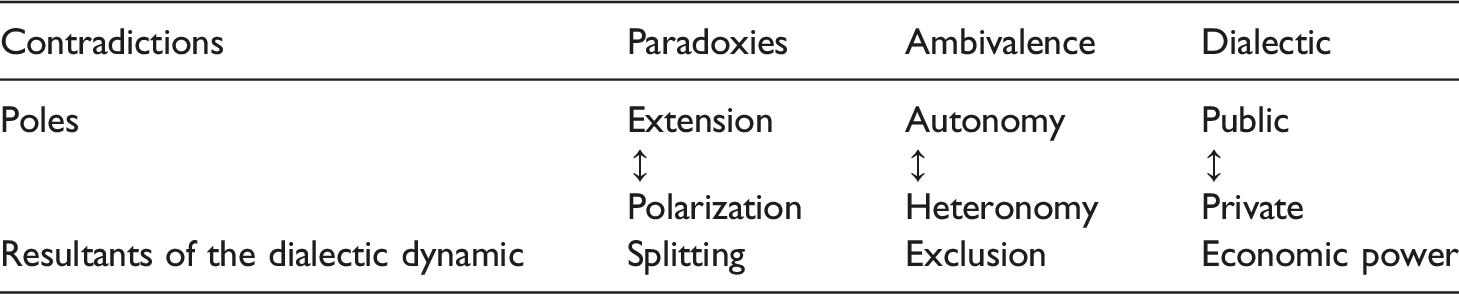
In democratic societies, the public sphere serves to define and order collective problems according to their perceived relevance and solvability. As a link between parliament and administrative bureaucracy on the one hand and civil society on the other, the public sphere is historically constituted through the market. This ambivalent significance of the market for democratic modernity is also at the heart of Jürgen Habermas’s argument on the structural transformation of the public sphere. After the free newspaper system had enabled the emergence of a bourgeois public sphere in the 18th and 19th centuries, the political organization of private interests in industrial and Fordist capitalism and their mediation via the commercial mass media condition led to a refeudalization of the democratic public sphere. In the course of digitalization, the public sphere is undergoing a further change of form. Of central importance here, according to Thiel (2020, 3), are three aspects of digital patterns of many-to-many communication. First, the communicative reach of Internet platforms opens up new possibilities for long-range collective coordination of action. Second, the largely unregulated platforms open up a space for new formats and thus also ‘entirely new self-promotion strategies of political no names’ (Manow 2020, 112). And third, their central position in the process of public communication ultimately conditions the allocation of political power to the platforms, which now function here as gatekeepers. In the following, we are going to explore the structural elements of digital public spheres that can be summarized in the social theoretical terms of paradox, ambivalence, and dialectics, in order to open a critical discussion of the blocking of Donald Trump’s Twitter account.
3.1. The Paradox of the digitalized public sphere: Increased and polarized
By a paradox we understand a specifically contradictory structure. This structure is, however, not paradoxical, because it can be judged differently, because it stands in the way of the development of the potentials inherent in it or because divergent interests are inscribed in it. The concept of paradox we use here is more pointed and sharper formulated. We understand a paradox to mean that the opposite of a pursued intention occurs. With regard to digital media, we can first state that they provide the potential to multiply information channels due to their low barriers. Whereas in traditional (mass) media, editorial processes and standards determine who is allowed to publish which content, such barriers are mostly absent. Anyone with Internet access and an account is technically capable not only of accessing a wide range of content but also of sharing it or even producing it themselves. Small textual inputs stand here next to more elaborate formats. The web video ‘Die Zerstörung der CDU’ (‘The Destruction of the CDU’) posted on YouTube by the Youtuber Rezo in May 2019 has so far reached around 18 million people due to these prerequisites, a figure that is around three to five times higher than the daily average number of viewers of the ARD Tagesthemen, the main news program on public television. Since digital technologies and social media have increased the possibilities of articulation for all those who were previously excluded from the traditional mass media, an enormous expansion of the public sphere can already be observed. At the same time, the offerings of Web 2.0, which is geared toward participation, can (mostly) be accessed worldwide and transcend the regional and national contexts in which radio or TV stations and daily and weekly newspapers usually operate. Certainly, the latter are available at the edges of the context, via libraries, in specialized stores or by means of appropriate receiving devices; but here, too, social media present a lower barrier, being usable from home with a few clicks and bridging geographical distances effortlessly. This facet of the digitalization of the public sphere can certainly be traced back to the intentions of the avant-garde of tech companies. The slogans ‘Don’t be evil’ or ‘Do the right thing’ (Google), ‘Making the world more open and connected’ or ‘Give people the power to build community and bring the world closer together’ (Facebook) are expressions of their philanthropic conviction to shape the world more ecologically and socially through the use of digital technologies.
However, there are downsides to this initially positive process. Strategies of political communication, for example, are specifically geared toward disinformation. Secret services operating abroad and campaigns launched there certainly existed before digitalized publics. But the current extent of fake news or social bots 1 increases disinformation immensely and is even cited as a reason for Donald Trump’s election victory in the 2015/16 US presidential campaign (Bradshaw and Howard, 2019; Nosthoff and Maschewski, 2017). The foundations for such a successful strategy became apparent when the information technology conditions of social media are brought into view. These are fundamentally designed to personalize content. One’s own interests and preferences, one’s own location and previously used search terms should form the basis for prioritizing which texts, images, videos, etc. provided by others are displayed. One’s own likes for vacation pictures of Canada and one’s own travel photos generate the tendency to primarily display staged forest hikes by friends, advertisements for nature magazines and information on climate change. These prioritizations are automated. The respective reactions and content provided are processed as data material by algorithms, which, in view of the quantity of contributions, obviously necessarily act in a sorting and evaluating manner. In contrast to traditional mass media, in which editorial teams sort and contextualize information according to relevance and are required to act in accordance with the press code, the standards of the algorithms are unknown (Müller-Brehm, Otto and Puntschuh, 2020, 11). What is certain, however, is that those posts prioritized are the ones that are intended to reflect one’s own behavior in social media and are clicked on more often. The dual system of computers accommodates the binary logic of clicks and likes.
Paradoxically, the expansion of the public sphere, which the various tech companies once initiated with the aim of improving the world, thus causes a sharpening polarization of the public sphere. Due to the technological infrastructure being used as a means of pursuing one’s own philanthropic goals, the opposite of the actual intention is achieved.
3.2. The ambivalence of digital public spheres: Autonomous and heteronomous
Another facet of the digitalization of the public sphere can be described as its ambivalence. By this, we mean a vacillation and/or uncertainty due to which a fact, a process, or an event can be subject to divergent evaluations (positive and negative, beautiful and ugly, etc.) at the same time. Moreover, ambivalent aspects, moments or elements cannot be separated from each other, so actions producing unambiguity are to be understood as violent, because the phenomenon or the like that is constituted by ambivalence is destroyed by its resolution (Bauman, 2005, 11–14).
The ambivalence to be discussed here becomes apparent against the background that digital technologies are used within post-Fordist accumulation regimes to generate a multitude of information about the secret wishes of potential customers as well as about the effectiveness and efficiency not only of (post-)industrial work processes, but also of university education, public administration, public services in general, and the needs and individual abilities of individuals (Baum, 2021). On the user’s side the interest in accessing aspects of themselves through the use of digital technologies predominates. Wearables record various activities and are used in this way as a means of optimizing one’s own performance (Schaupp, 2016). By means of these practices of self-education, the individual becomes a ‘quantified self’. Given this entanglement of self-control and external control, digitalization can be understood as a process of making information about areas – previously closed to the public (at least potentially) – collectively available. To be sure, this form of public sphere is far removed from the elaborate dissemination of information and knowledge by public media institutions – that is not the point. Rather, digital technologies produce a corresponding public sphere insofar as users willingly provide uploads of GPS-tracked jogging routes or visited vacation spots in social media profiles, among other things to increase the visibility of the self and one’s own status (Reckwitz, 2017, chap. V).
On the other hand – and this is a more important aspect of our discussion – users can independently articulate their normative claims and interests via social media without being restricted through editorial processes. With a sense for the right trends, hashtags and (pointed) formulations, they can achieve an enormous reach and in this way undergo a political subjectification, insofar as they go from being recipients to transmitters of political content. Instead of passive individuals, they are now actors in the public sphere who argue and agitate for a specific transformation of society. Thus, it is quite plausible to ascribe an autonomous facet to the digitalized public sphere since the actors (want to) use the (at least inherent) potential for self-determination. At the same time, the space used for this purpose refers to heteronomous aspects, because ultimately private tech companies decide how and to whom it is provided (more on this in the following chapter). The character of the digital public sphere is thus ambivalent in the sense that autonomy and heteronomy are constitutively intertwined in it: the genuine self-interest in self-education and a life according to one’s own rules is counteracted by external control by others. This tension between normative demands and strategic interests cannot be resolved, since the self-description (of digital societies and) of the self as well as political subjectivation are no longer successful when digital technology is no longer available.
3.3. The dialectic of digitalized public sphere: Public and private
Dialectics cannot be reduced to a method of thinking or a specific (anti-)logic. It is a tension between conflicting forces inherent in society, which is reflexively traced. This tension of two opposing moments standing in a relationship is at the same time identified as the motor of a developmental dynamic, at the end of which stands the turning of both moments into their opposite (Adorno, 2003, 13–66; Adorno, 2007, 9–24). The dialectic to be tapped here can be brought into focus if the public sphere is considered as part of contemporary capitalism. In its scholarly discussion, it is emphasized that it is especially globally operating corporations of information and communication technology and the platform economy that are at the top of value chains (Staab, 2019). The digital information space is becoming the foundation of contemporary capitalism. In addition to the well-known corporations operating in Germany, such as Amazon, Google, Facebook and Twitter, Baidu, Alibaba and Tencent should also be mentioned as players that dominate the hardware and software as well as the platform market with a view to the international market. The social media and the data acquired via these and digital smart technologies are thus owned by private companies that do not practice silence about the underlying algorithms alone. Rather, the exploitation interests of the market-leading providers of information systems still shape their technological infrastructure and the strategies of building server farms, platforms and software (Ziegler, 2020). This in turn means that digital capitalism is not completely detached from industry, which is the supplier of the hardware – the development in industry only makes the efficient design of the hardware used by the tech corporations possible, while the data generate the profit (Boes and Kämpf, 2020, 149f.).
This relationship of ownership and the exclusive knowledge of the mechanisms of polarization result in the dialectic of private and public already stated by Habermas with regard to the bourgeois public sphere, which permeates the public sphere itself and drives its development. On the one hand, not only trained editors but also a multitude of citizens participate in the provision of information and knowledge – and certainly also of the trivial or crude. Through their use of digital technologies, the public sphere is gradually expanding, so that more and more data is being generated at the same time. On the other hand, there are international corporations that can increase their profits precisely because of this process, insofar as the data are their property: With the expansion of the public sphere, a concentration of economic power is being driven forward at the same time, until a handful of companies are shaping the digital public sphere at all levels. Because of their status as a constitutive element of the digital public sphere, they are even entitled to push people out of it, so that the digital public sphere becomes dangerously skewed in terms of democratic theory. The former utopia of a power-free and independent Internet (Barlow, 1996) seems like a long-forgotten dream in view of a fully bequeathed, commodified and stratified Internet (Buchstein, 1997, 249f.; Jacob and Thomas, 2014).
It may seem as if we are merely reproducing the history of the decline of the bourgeois public sphere, which Habermas himself has already self-critically admitted. But the reference to an alleged history of decay is not already an argument against our account, especially if empiricism supports the account and we conclude by sketching an outlook on how democratic potentials of digital public spheres can be appropriated. First, however, we discuss the blocking of Donald Trump’s Twitter account, because the contradictions problematized here can be illustrated particularly vividly.
4. Trump and Twitter
In the course of his presidency, Donald Trump has addressed pressing political problems such as economic globalization, society’s approach to diversity, and the socio-ecological threat posed by climate change. In a society increasingly riddled with social divisions along economic (Piketty, 2014) and cultural (Reckwitz, 2017; Reckwitz, 2019) lines, he made an identification offer to his voters ‘both to feel like a good moral American and to feel superior to those they considered “other” or beneath them’ (Hochschild, 2017, 227). Trump’s populist political style served a fourth salient theme – the lack of credibility of the mass media as mediators and reflectors of a functionally differentiated society.
Trump complemented his criticism of the reporting of established media as ‘fake news’ (even during the run-up to his election) with media appearances interspersed with polemical and discriminatory statements. The list of transgressions is long and can be exemplified by his imitation of a disabled reporter for the New York Times, the verbalization of North Korean head of state Kim Jong Un as ‘Little Rocket Man’, the relativization of right-wing terrorism (‘There are some very fine people on both sides’), or the re-designation of Covid-19 as ‘The China Virus’ or ‘Kung Flu’.
Frequently implicit references to conspiracy theories that focus on the targeted infiltration of the US people or even the moral depravity of large parts among the political elite (keyword: Pizza Gate) (Butter, 2020, 13) serve to further obscure the public view of the political spectrum. Against this background, Silke van Dyk (van Dyk, 2017, 354) interprets Trump’s staging as a ‘mechanism of political subversion that invokes the democratic principle of freedom of expression to invalidate previous principles of truth in order to undermine a public opinion primarily based on science and expert knowledge in favour of “felt” or “heard” truths’.
A key role in this complex of discursive legitimation is taken on by the news service Twitter. With around 350 million active users, Twitter offers a platform for disseminating information on an international scale. With 88 million followers, Donald Trump controlled one of the most popular accounts. From the beginning, a central aspect of Twitter’s corporate policy was to pay less attention to the content of the information communicated than to ensuring the exchange of information. Both Trump and Twitter benefited greatly from this guiding orientation over the years. In November 2016, for example, the then-still president-elect described the platform as a ‘modern form of communication’ and ‘nothing [...] to be ashamed of’, but went on to declare that as a public official he would hold back on polemical messages (Thöne, 2016).
In order to reconcile the president’s misleading communication style with the platform’s labels, Twitter had used various diplomatic measures in the past and had already decided in January 2018 not to block posts by heads of state even if they were controversial; the company confirmed its line in October 2019 by instructing its moderators to judge posts by heads of state primarily in terms of their language. To counter Trump’s false statements, which were also increasingly targeted by public criticism, Twitter’s ‘Integrity Team’ developed the ‘Pre-Bunk’ tool in the run-up to the 2020 presidential election. The tool was used to automatically flag information identified as false statements.
After losing the election in November with 74.2 million votes to Democrat Joe Biden (81.3 million votes), the outgoing president never got tired of spreading rumours about alleged voter fraud. On January 6, more than ten thousand participants of the Save America March gathered in front of the Capitol to express their displeasure with the – possibly manipulated – election results. Incited by the ongoing spread of conspiracy theories, a group of militant Trump supporters stormed the seat of the US Parliament. Seven of the approximately 800 activists were shot and killed by security guards during the attempted coup.
In the run-up to the storming of the building, Trump had repeatedly addressed the public via his Twitter channel to declare alleged election fraud. Obviously, his vehement criticism of an (un)democratic will had made a significant contribution to mobilizing the protest. After the situation was rectified, Twitter (and with it other platform services such as Facebook or Instagram) blocked the outgoing president’s presence – also due to the fact that similar riots were feared for the inauguration of Joe Biden, scheduled for January 17 and 20.
For Trump’s many supporters, the account blocking is likely to be a further indication of the political dominance of a liberal elite. In contrast, shortly after the storming of the Capitol, Mark Zuckerberg emphasized the necessity of blocking Trump’s platform presence: ‘The shocking events of the past 12 hours clearly demonstrated that President Donald Trump intends to use his remaining time in office to undermine the peaceful and legitimate transfer of power to his chosen successor, Joe Biden’ (Otto, 2021).
At least with regard to the economic dimension of the blocking, the assessment of the tech capitalists should be more differentiated: As reported by Spiegel-Online, Twitter is calculating a loss of ten to twelve million users as a result of the ban, and Twitter shares lost twelve percent of their market value on the Monday after the storming of the Capitol – that is, January 11, 2021 (cf. Böhm, 2021). At the same time, according to the flip side of the negative calculation, Trump’s banishment could also increase the platform’s attractiveness for advertisers.
It is the profit orientation that assigns a genuinely ambivalent functional role to the operation of privately managed platforms as central elements of the political public sphere in digital capitalism. Due to their high market power, the monopoly position of the leading tech companies in the United States have been criticized by the Federal Trade Commission for years. The question of how much power over the political communication of democratic communities should be vested in the leaders of tech companies touches on the basic problem of the role of the market for democracy and of a public sphere constituted by the dialectical tension between private and public, as elaborated by Habermas in Structural Transformation of the Public Sphere.
4.1. Outlook: Participation and the development of technology
The preceding text focused on the digital structural transformation of the public sphere with particular emphasis on the contradictory significance of the market for the social construction and constitution of the public sphere – and thus indirectly also for democracy. With tech capital’s control over the digital public sphere, as revealed in the case presented of the blocking of Donald Trump’s Twitter account, the ongoing loss of bourgeois-democratic elements of political order in digital capitalism becomes apparent.
As a central moment of democratic order, ‘communicative freedom’, as Wihl (2020, 45) notes, ‘requires a sophisticated infrastructure of digital morality’. One prerequisite for establishing such a structure, it can be argued in conclusion, would be greater control of platforms like Twitter and their influence on patterns of public communication. While the idea of self-regulation of the tech industry seems unrealistic to us in this context – see also the internal views on the industry’s own logic in Daub (2020) – the follow-up question in terms of democratic politics about alternative control instances and their specific competencies practically arises by itself. In a recent article (2021), Francis Fukuyama, a historian and political scientist now teaching at Stanford, and his co-authors proposed the establishment of an authority for this purpose, ideally financed by the platforms themselves but acting independently. This idea is in line with the ‘vital interest in preserving the public sphere’ (Wihl, 2020, 44), which also motivates democratic states to subsidize public broadcasters or other media subsidies. If taken into account that the design of the digital infrastructure (algorithms, rights of use and access with regard to data, software, etc.) is itself a problem, insofar as it is the responsibility of tech companies, Fukuyama’s proposal seems short-sighted. Rather, the conditions of constitution must be publicly appropriated. There can be no talk of this at the moment, on the contrary (Dolata, 2015).
However, if social and political change is not to be degraded to a mere derivative phenomenon of technological development, the means of production and the social relations in which they are embedded must be understood as the object of political practices. According to our dialectical understanding, there is a need for this not only because digital technologies exert an immense influence on the sphere of the public sphere. Moreover, a politicization of technological development makes it possible to use the potentials of digitalization in a more comprehensive emancipative way than is currently the case. However, this idea, formulated by Marx in 1859 in ‘On the Critique of Political Economy’ (Marx and Engels, 1985, 7–160), must be detached from its classical-theoretical underpinnings and economism. Neither is it to be assumed that we are in the phase of a (final) conflict between two classes, at the end of which the liberated society will be achieved; nor are the logics of law, politics, morality and art as well as the normative claims of social actors to be misunderstood solely as expressions of a material basis. Nevertheless, the ‘obsolescence of the paradigm of production’ (Habermas, 1988, excursus of the third lecture) should not obscure the fact that the relation of means of production and relations of production exerts a decisive influence on the current constitution of the digital public sphere – this is what we have tried to prove and problematize in this text. In this sense, it is possible to argue here – more defensively than Marx, more offensively than theories that close themselves to a transformation of production relations – for arenas in which the design of digital technologies become the object of discursive understanding. For the question of the criteria according to which algorithms process data and of access rights to data cannot be left to private decisions. It should be discussed to what extent forms of participation (such as future workshops or hackathons) can be established at various levels (city, state, federal or even beyond), within which the digitalization process is democratized, insofar as its shaping is handed over into the hands of a multitude of users of those technologies. The results and agreements reached there must not be understood as mere recommendations but as binding foundations for the digital technologies that will then be used. If the usual possibilities of law are not sufficient to bind the tech companies to this, it needs to be discussed at the international level to what extent the ownership of specific means of production represents an obstacle to using digital technologies in the sense of social negotiations. The extent to which there is already potential for networking across national borders may be a question that needs to be answered empirically. However, the swarm organization of users on the social media platform Reddit shows that even digital technologies themselves can be used for social protest, which can exert considerable influence on seemingly unassailable hedge funds (Brächer, Jauernig and Knödler, 2021). Why should it not be possible to remind tech companies of their social role through such forms of protest?
ORCID iD
Martin Seeliger https://orcid.org/0000-0003-0558-0051