




Abstract
The welfare state, once seen as the best institutional response to people in need, has steadily come under pressure, as much from shrinking state capacities as from neo-liberal advocates of individual responsibility. Still, despite decline of the post-war consensus on the efficacy of the welfare state, social ‘vulnerability’ still remains the key focus of public policy. However, though much in use in contemporary political discourse, the logical and practical implications of social vulnerability remain unclear. Its essential subjectivity – it is the ‘feeling of vulnerability’ which makes one vulnerable – turns the concept into a catch-all variable, impeding rigorous theoretical and empirical analysis. I respond to this problem with a ‘vulnerability-responsibility’, model. Its parameters include a ‘responsive’ state, an active civil society and a participatory political environment, bolstered by the assertion of agency of the vulnerable. With India as an empirical exemplar, the essay shows how ‘nested’ vulnerability – a community of pro-active citizens in need of urgent and vital assistance - in the backdrop of a responsive state and competitive, robust and resilient political participation, can generate a sustainable, context-relevant process to cope with the problem of social vulnerability. The model, currently aimed at vulnerable citizens in a democratic state, has the potential of being extended to non-democracies as well as vulnerable non-citizens into its domain.
Keywords
1. Introduction
Images of people at risk, broadcast with relentless regularity from across the world, have made vulnerability a 1 constant presence in contemporary life. 2 ‘Who are the vulnerable’, ‘who should take responsibility for them’ and ‘how best this can be done’ are questions that sting our conscience. However, even as vulnerable folks evoke pity, empathy, guilt and compassion, vivid images of the suffering humanity do not automatically move people to act. (Rondeau 2019) Many factors interpose between individual vulnerability and those in a position to help, and prevent them from acting. (Goodin 1984, 1985; Moran 1988).
The notion that human suffering, howsoever remote, affects us all finds its articulation more often in poetry 3 , fiction and learned texts of theology than in political analysis of social vulnerability. Research on vulnerability entails problems of theory and method. Vulnerability implies the feeling of being ‘weary and burdened’ on the part of the individual sufferer. 4 This essential subjectivity turns ‘vulnerability’ into a catch-all variable, not amenable to rigorous measurement and analysis.
As for institutions and policies to cope with vulnerability, the welfare state, long thought of as the panacea for all those who are helpless – has run out of steam in the face of the neo-liberal challenge which argues that individuals need to take responsibility for their own welfare. Besides, state capacity has increasingly fallen below the level of expectations for succor. However, factors leading to vulnerability are on the increase. Natural catastrophes, climate change, pandemic threats, depleting natural resources affecting specific groups of people, egregious failures of politics that lead to devastating wars and globalization which endangers the living space and livelihood of specific groups have made social vulnerability the new frontier of research on social justice.
As things stand, two connected questions emerge as the most pressing. Looking beyond the welfare state, might there be any room to manoeuvre for the vulnerable themselves to generate sustainable help? And, while vulnerability is spread out across the Global North and South, why does coping with it successfully vary across time and space? 5 I respond to these questions with a model which specifies ‘dignified’ transactions in a participatory political environment, as the missing link between vulnerability and responsibility. The parameters that constitute this model include a ‘responsive’ state whose leaders are conscious of the potential danger of legitimacy deficit caused by lingering vulnerability, the presence of disaffected citizens willing to use ‘life as a weapon’ to secure justice (Hassan 2010), an active civil society acutely conscious of the problems of the vulnerable, political institutions and process that tap into the agency of the vulnerable, and a political culture able to put up with the ‘discomfort of democracy’ (Srinivasan 2021: XV), and most important of all – a participatory environment that promotes political action and tolerates the assertion of agency by vulnerable citizens (Scott 1985).
The model that I propose has two boundary conditions. It is focused on vulnerable citizens with a constitutionally guaranteed right to participation, and excludes non-citizens such as clandestine migrants. Secondly, the empirical evidence comes from India, a formal democracy, and as such, the model, at this stage of its development, is not applicable to non-democracies. The conclusion sums up the findings and points towards unresolved problems that require further research. Based on Ramussen (2017), I signpost the scope for extending the model further, in order to bring non-citizens and non-democracies into its domain.
1.1. The welfare state: its moral locus standi and its limits
Face-to-face with the vulnerable, most people tend to be free-riders, and to transfer the burden of responsibility to the state. The welfare state, by providing comprehensive assistance to the destitute, was meant to be a secure form of support for those in dire need. However, once seen as the all-purpose provider for ‘basic human needs’ (Wilensky 1975; Moran 1988), thanks to the rise of neo-conservative criticism of welfare-dependency, the welfare state has been losing its legitimacy. This has been exacerbated by budgetary deficits coming at the end of the ‘long boom’ that lasted for three post-war decades, and has hardened attitudes towards recipients of public assistance.
However, even as one is ready to write the obituary of the welfare state, one has to admit simultaneously that the spectre of fellow citizens in desperate need continues to haunt our conscience. Nor is vulnerability just a problem that ‘other people’ face. Those who feel perfectly anchored and resilient today might find themselves in dire straits the next day, or see their loved ones staring at the abyss. Thus, in a sense, we are all potentially vulnerable, and in equal measure, we are all responsible. One can thus argue that ‘the moral egoist of the neo-liberal persuasion would eventually be left yearning for some larger-than-life presence’ as a potential source of support.
This is exactly the kind of ‘untutored intuition’ on which Goodin (1984: 775), a fierce defender of the welfare state, comes down heavily with philosophical disdain. As he reminds us, everybody’s responsibility might end up being the responsibility of nobody in particular. As he argues, one needs a stable institution to take responsibility, or face the dire prospect that one might be left high and dry at the crunch time. Goodin’s argument cuts through the emotional fog around sentimental views of our fellow citizens in distress. Crucial to the formulation of the solution that Goodin proposes is the identification of the ‘special responsibilities to the peculiar vulnerabilities of specific others, and to our actions and choices’ (Goodin 1984: 777). Following Goodin, one does not feel the same way for the distress in which all our siblings are, nor do all those whom we consider our close friends step in when we are in need. He puts the analytical focus on a binary relationship between A, the benefactor B and the vulnerable for whom A takes responsibility. The trigger to activate responsibility lies with B. For Goodin, ‘it is the beneficiary’s vulnerability rather than any voluntary commitment as such on the part of the benefactor that generates these special responsibilities’. (p. 775)
Having established the link between vulnerability and responsibility, Goodin moves beyond the simple binary of A and B, and develops his argument in favour of a guaranteed, collective, institutional and impersonal solution by the way of the welfare state. He argues that it is much too risky to assume that the responsible A will appear to rescue the vulnerable B at the nick of time. As such, Goodin takes the initiative out of the hands of potential benefactors altogether and puts it squarely in the impersonal, bureaucratic hands of the welfare state. ‘The welfare state, defined as an institution which meets people’s basic needs as a matter of right, is therefore a morally necessary adjunct to other more individualistic responses to the problem of vulnerability and dependency in our larger community’. (Goodin 1984: 785–786)
2. Four ripostes to Goodin (1984)
Four arguments indicate the inadequacy of Goodin’s model of the welfare state as an appropriate institutional response to social vulnerability. 6
2.1 Agency of the vulnerable
Goodin’s model casts the vulnerable B as a passive recipient and to that extent underestimates the agency of the vulnerable. 7 For example, galore particularly in fiction and films. Stefan Zweig, in his Beware of Pity, gives us a thumb-nail-sketch of the complexity of the transaction between the giver and the taker. 8 A comparable but much more devastating demonstration of the agency of the vulnerable can be seen in Viridiana, a 1961 Spanish–Mexican film directed by Luis Buñuel in which the indigent beggars, sheltered by the novice Viridiana who has been coaching them in the Christian way of life, turn on her in a drunken orgy, giving vent to their pent-up lust.
2.2 Giving as a strategic act
What moves the ‘Good Samaritan’ to reach out to the vulnerable? Goodin depicts giving as a voluntary, limited, ad hoc, episodic act, based entirely on a sense of legal/moral obligation. This assumption grossly oversimplifies the complexity and ambiguity that mark the transaction between the vulnerable and the responsible. Goodin reduces the complexity of the emotions that go into the act of giving to a conditioned reflex, a spontaneous act of benevolence without any premeditation or any afterthoughts. In reality, the giver might sense a conflict between altruism and his strategic interest in investing his kindness in the receiver of his munificence. Behind a noble sentiment, there may be a hidden interest. To paraphrase a famous book on the significance of giving (Raheja & Goodwin 1988), there may be ‘poison in the gift’! 9
Giving and accepting the gift are not necessarily ad hoc or spontaneous acts, and both parties to the transaction are aware that there is a tomorrow, that today’s taker might become tomorrow’s giver. So, giving may also be seen as an investment in future gratification, a form of insurance against an uncertain future. The apparent spontaneity and voluntary character might be part of more sophisticated and strategic thinking. Under the façade of charitable acts, there lie chains of networking, party-building and campaigning, even in affluent and stable democracies.
2.3 Trusting the Leviathan? State as an organization
The riposte to Goodin’s absolute trust in the state comes from Charles Tilly, the doyen of historical sociology of the state. Goodin does not make a distinction between the state as an institution and the state as an organization. In everyday life, the individual is more likely to encounter the latter for whom self-interest might come in the way of the abstract values that the state stands for. In his iconic article ‘War Making and State Making as Organized Crime’. 10 Tilly issues a ‘warning’ that deserves to be quoted in full for the benefit of defenders of the welfare state and its bureaucracy: ‘If protection rackets represent organized crime at its smoothest, then war making and state making – quintessential protection rackets with the advantage of legitimacy – qualify as our largest examples of organized crime’. (p. 169) 11
2.4 Locating the vulnerable
Means-testing based on income is the main basis of the allocation of resources to the needy in the welfare state model. However, poverty is not all that goes into the making of vulnerability. A rich Muslim in a Hindu-majority neighbourhood might feel much more vulnerable than poor Hindus living next to him. As I shall argue later in this essay, the sense of security of the rich Muslim in this case goes beyond the ambit of the welfare state and belongs properly to the institutional and political mechanisms of governance. Agency of the vulnerable and effective participation to link votes and redressive action are the key to their security.
3. Empowering the vulnerable: The vulnerability–responsibility model
The arguments made above make the case for jettisoning Goodin’s welfare state model and construct an institutional solution based on the agency of the vulnerable. For this, one needs to ask: why should egoistic men and women be interested in looking beyond their narrow, immediate self-interest, and provide succor to the vulnerable? While the manifest suffering of the vulnerable is a fact, the moral obligation to help them is a value. Does the latter follow from the former? (Rondeau 2019) Is there a conceptual/institutional bridge that connects vulnerability and responsibility? (Kaul 2017)
Five preliminary arguments set the stage for the construction of a vulnerability–responsibility model, set in the context of a responsive state and a participatory political environment.
3.1. The egoist’s dilemma: bringing community and cooperation back in again
A long line of rational choice theorists and specialists of zero-sum games have explained why rational, expected utility-maximizing individuals eventually move beyond egoism, and reach out to some form of collective welfare. A standard illustration of this phenomenon is the ‘Prisoner’s dilemma’ – a two-person, zero-sum game where it can be shown that two individuals with conflicting interests, seeking to maximize their interests and making their choices without any communication with one another, can actually end up with less than the best outcome they could have had, if they had cooperated. This shows how self-interest should drive the individual towards cooperation. Just as on a busy road everyone trying to overtake everyone else leads to a traffic jam where nobody can move anymore, so is the case of a situation where the failure to arrive at a consensus leads to no one getting anything at all. The challenge for the egoist is thus to realize the need to cooperate, and for the state to come up with rules and institutions – analogous to traffic rules and traffic wardens – to make this possible. 12
3.2. Symmetric and asymmetric vulnerability
The very asking of the question ‘who are the vulnerable’ – thanks to its essential subjectivity – makes it disappear and reappear in a complex cluster of emotions that go into the making of the human mind. For the sake of precision, we need to make a distinction between types of vulnerability, based on power. At one extreme is symmetric vulnerability that two lovers – each equally placed in terms of power to hurt the other - might feel towards one another. At the other extreme are situations that are marked by asymmetric vulnerability, brought about by structural inequality and imbalance of power – a woman cowering in front of a knife-wielding assailant with obvious intentions, a family of Dalits (an Indian vernacular concept to describe former low caste untouchables) when a gang of upper-caste men barge into their hut at night, or people living in low-lying land, watching flood waters in a fast-rising river. The model of social vulnerability is aimed at asymmetric vulnerability.
3.3. Social networks and ‘nested’ vulnerability
As a social phenomenon, vulnerability has an existential stretch – s/he who feels vulnerable is vulnerable - and an ontological edge, open to measurement. In terms of social policy and administration, one needs to have some recognizable criteria to identify the vulnerable. (The Commonwealth (2021)). As such, empirical identification of the vulnerable presents a methodological problem. Faced with such intricate problems of definition and measurement, attempts have been made by human geographers to come up with a unified definition and measurement. Paul (2013), who provides a comprehensive list of definitions culled out of several disciplines, defines vulnerability through objective measurements based on risks, the probability of which can be externally assessed. 13 Based on the insight we get from Paul (2013), I have developed the concept of ‘nested vulnerability’ whereby a social group of vulnerable people – with their collective, shared sense of vulnerability and social visibility – become identifiable for redressive action. The reasoning behind their convergence and coherence is as follows.
Vulnerable individuals are social actors. They may not be as isolated as one thinks. They tend to take advantage of the local opportunity structure, pool their political resources and start social and political movements. Based on this insight, Paul supplements this objective definition with a phenomenological dimension which takes the actor’s assessment into account. In his efforts to combine both measures, he formulates vulnerability as a ‘locationally driven phenomenon’. (Paul 2013: 2). This helps transform social vulnerability into a category of social science – an interpersonally meaningful concept in the context of a political arena. (Berger and Luckmann 1966: 20).
Nested vulnerability emerges from a ‘lock-in’ of the actor’s categories and those of the observer. It pins the diffuse and catch-all concept of vulnerability into actual practice, such as a group of people who see themselves as vulnerable and are seen as such by those in a position to take responsibility. 14 This social construction of ‘nested’ vulnerability is possible only within a community, ensconced in a bounded space. It solves the difficulty of tracking vulnerability down to the ground level, where one can talk about vulnerable citizens meaningfully, and identify them effectively. We get a similar formulation from Walzer’s Spheres of Justice (Walzer 1983, p. 31): ‘The idea of distributive justice presupposes a bounded world, a community within which distributions take place, a group of people committed to dividing, exchanging and sharing, first of all, among themselves’.
3.4. ‘Dignified transactions’ between the vulnerable and the responsible
The concept of ‘dignified transactions’ that we get from Hicks (2011) is based on her considerable experience of peace negotiations around the world. It provides an appropriate theoretical-empirical bridge across the North-South Divide. For Hicks, human dignity is a cardinal value. It is ‘an internal state of peace that comes with the recognition and acceptance of the value and vulnerability of all living things’. (p. 1). Further, dignity ‘is a birthright’. (p. 4) In any transaction, giving and getting dignity creates ‘the feeling of inherent value and worth’ (p. 6, italicized in original). She adds, ‘When we feel worthy, when our value is recognized, we are content. When a mutual sense of worth is recognized and honoured in our relationships, we are connected. A mutual sense of worth also provides the safety necessary for both parties to extend themselves, making continued growth and development possible’. (Hicks, ibid)
On the basis of her participation in peace negotiations in many different cultural contexts, Hicks has derived ten ‘essential elements of dignity’, to serve as core norms of the transaction between the state and those who claim to represent vulnerable social groups. (Hicks 25–26). Pared down to their essentials, the rules of good practice that Hicks recommends resemble the maxims of ‘principled negotiation’ (Fisher, Ury and Patton: 1981 [1991]), with the added element of empathy and compassion. There is a striking similarity in the language of peace-building and negotiation. We thus get from Fisher, Ury and Patton (1991: p 19): ‘A basic fact about negotiation, easy to forget in corporate and international transactions, is that you are dealing not with abstract representatives of the “other side,” but with human beings. They have emotions, deeply held values, and different backgrounds and viewpoints; and they are unpredictable. And so are you’.
3.5. Vulnerability as a political resource
Democratic participation and the concept of the ‘political community of citizens’ 15 are core constituents of my vulnerability–responsibility model. The community connects rights-oriented, egoistic individuals and the succor-needing vulnerable folks in mutual dependency. Spreading the concepts of entitlement, enfranchisement, empowerment and participation to all the nooks and crannies of society, seeking out the vulnerable and giving them a voice that simultaneously empowers and spreads the message of accountability, is the best solution that the modern state can adopt to meet the challenge of vulnerability. Democracy accelerates the centripetal process which leads competing political forces, including the players in the shadows stuck at the margins into the vortex of political competition (Mitra and Jaramillo 2022). The process of democratization, the relentless argumentation, the campaign rhetoric and vote-grabbing, promote trust, agency, efficacy and a sense of accountability.
Elections – with the heat and dust of the electoral rhetoric, campaign cash, (Mitra and Pohlmann 2021) polling agents seeking out support and turning vulnerable supplicants into citizen-partners - matter. The electoral process – a self-anchoring mechanism – shifts the mix of allocation and entitlements in a contingent manner, depending on the state of the economy. This, I argue, is a more appropriate coping mechanism than either mechanical reliance on the over-stretched capacity of the welfare state, or for that matter, the neo-liberal faith in market allocations. Based on the concept of human ‘dignity’ (Hicks 2011), the logic of recursive zero-sum games (Axelrod 1984) and empirical evidence from historical sociology of the state (Moore 1966, Tilly 1975, 1985), ‘dignified transactions’ between the state and the vulnerable, set in the context of deepening democratization, are the best way to cope with social vulnerability.
The ideal type structural-functional model (Powell et al. 2018) of a responsive state (Figure 1) indicates the institutional arrangement for actualization of the vulnerability-responsibility model. At the level of political culture, a collective mind-set that showcases human dignity and entitlement, leads to a locally defined minimum of human welfare. These demands are processed by organizations such as political parties and movements that articulate and aggregate them. At the deeper level of the political system are values and enforceable constitutional norms. Coping with vulnerability: A structural-functional model of the state.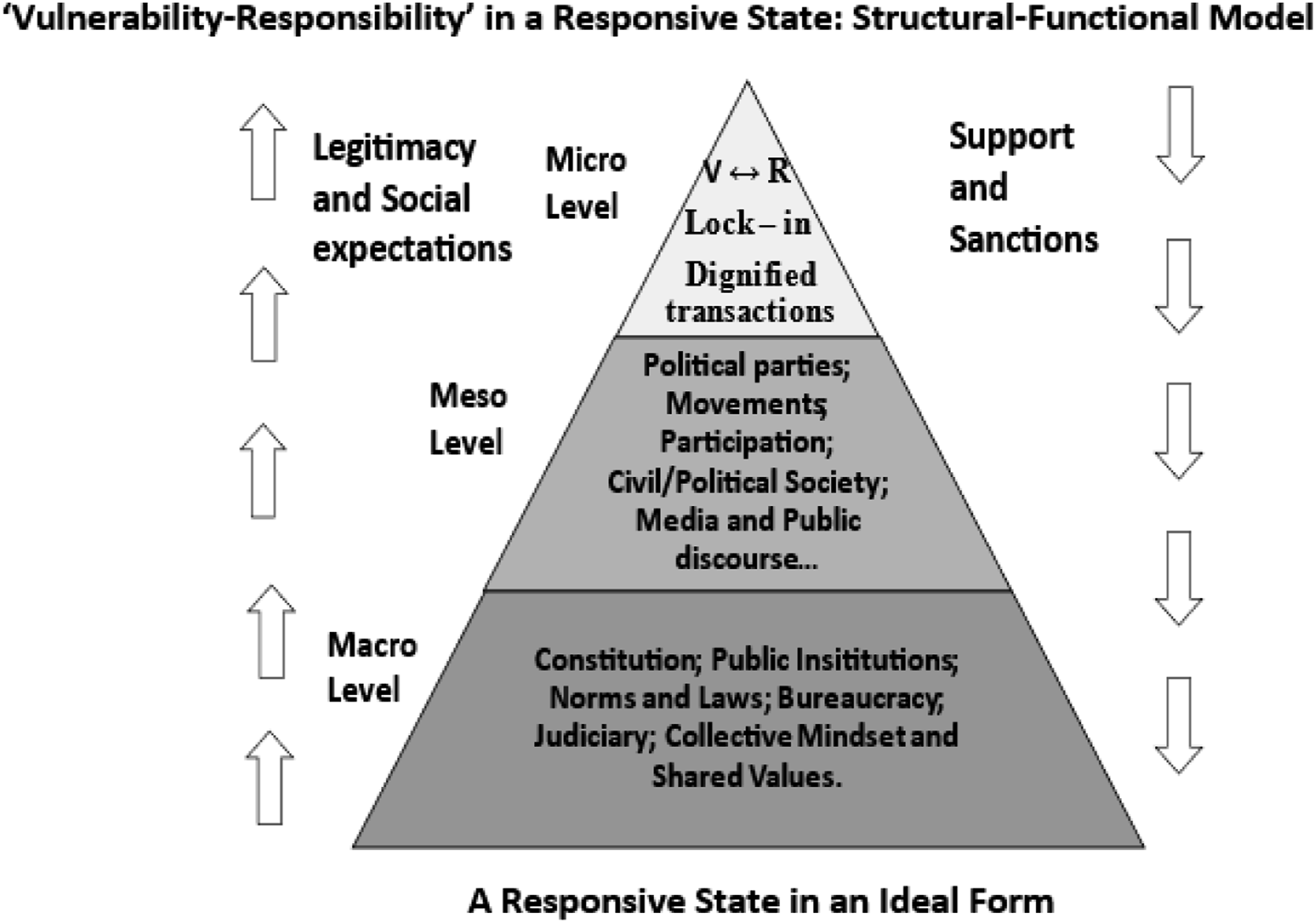
4. Democracy and vulnerability in India
India selected as an empirical exemplar of the model, emerged from close to two centuries of British colonial rule in 1947 as an independent state, with its society steeped in mass poverty, illiteracy and rigid social hierarchy based on the caste system pretty much intact. Seventy-five years on, the country has successfully transformed a subject population into citizens, pulled millions above the poverty line, assured minimum welfare to the entire population, all the while sustaining democratic governance. A dynamic, neo-institutional model of governance (Figure 2 ), helps explain this achievement, exceptional among post-colonial states (Mitra 2005). A neo-institutional dynamic model of transition from Colonial rule to responsible governance.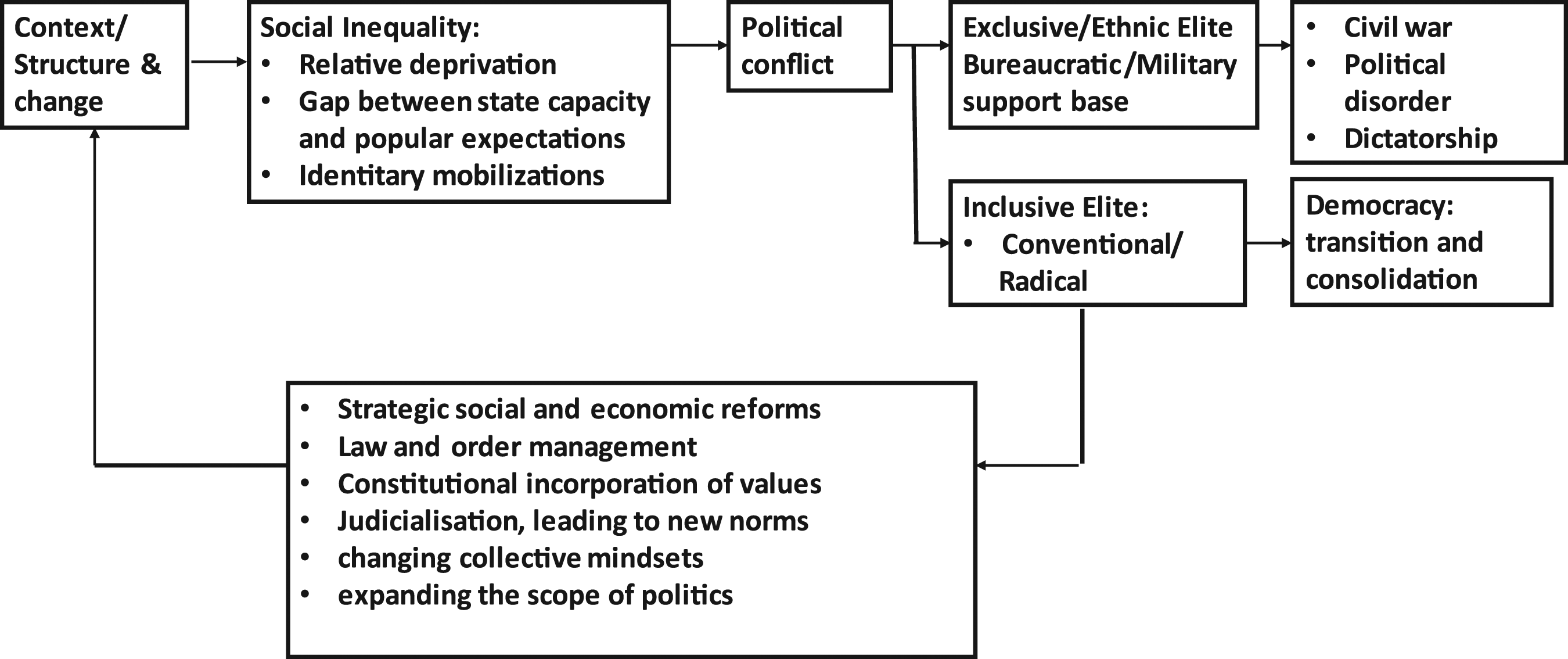
At the end of colonial rule, power was transferred by the departing British rulers to the Indian National Congress – a broad-based anticolonial movement led by British trained legal/political actors who derived their power not from the army nor a revolutionary movement but political representation of a cross-section of social and economic interests. This inclusive elite continued to mobilize new social interests through social and economic reform (Parekh and Mitra 1990) which cut the ground from under the feet of violent revolutionary movements that had wrecked liberal democracy in most post-colonial states. An inclusive elite, drawing on human ingenuity driven by self-interest, the innovation of appropriate rules and procedures, and electoral agency, one can explain how policies, institutions and processes that respond to popular demands can both empower the vulnerable and enhance governance. In contrast, an exclusive elite leads to the decline of political order (Figure 2).
The model derives its strength from the logic of rational choice and game theory. Radical demands emerge as zero-sum games where the state and radical movements face each other as adversaries. However, a mid-point, jointly devised by politicians aware of both sides of the argument, and civil servants, adept at transforming such compromises into appropriate policy can bring satisfaction to both sides. (Mitra 2021) In a social context, where individuals face each other daily and can expect to do so over the foreseeable future, their proximity to one another and knowledge of each other might induce them to what Axelrod (1984) calls ‘tit for tat’, which is to say, people learn to reciprocate like with like.
The incorporation of new social elites and the creation of new political arenas enhances governance. Power-sharing – turning rebels into stakeholders (Mitra and Singh 2009) – makes compliance attractive and reduces the need or temptation of non-compliance. Governance can be improved by converting potential rule-breakers into legislators, provided they enjoy political support within the community. Successful and credible electoral democracy turns poachers into gamekeepers. Institutional arrangements based on the logic of federalism and consociational forms of power-sharing promote governance.
Factors such as effective initiation and implementation of reform and law and order management which enhance governance can be specified in terms of the model presented in Figure 2. Political institutions, as interfaces of society and state, can play a crucial role in this context. 16 This concept alerts us to the crucial room to manoeuvre that the new elites have (Mitra 1990). Further dynamism is added to the model by leaving open the criteria of legitimate political action to political actors at the local and regional levels. The response of the decision-making elites to crises acts as a feedback loop that affects the perception of the crucial variables by people at the local and regional levels. (Figure 2)
Democratic India has developed a ‘tolerant’ political culture (Rigopoulos 2019) of ‘transactional radicalism’ in which radical movements with take recourse to the whole span of forms of political participation ranging between voting to insurgency, eventually achieving a substantial part of their objectives, enough, for them to stay within the broad tent of the democratic system. (Figure 3) The methods of radical politics span between system-tolerated forms of protest action such as gherao, dharna, boycott, all the way to collective violence and suicide terrorism. A plethora of political parties, elections, pressure groups, judicial interventions and public commissions, security forces, civil service at federal, regional and local levels jostle for space and influence in the public sphere and generate and implement public policies. Alongside normal political process, there is still space for radical politics as a complementary process. Transactional radicalism: Multiple routes to responsible governance.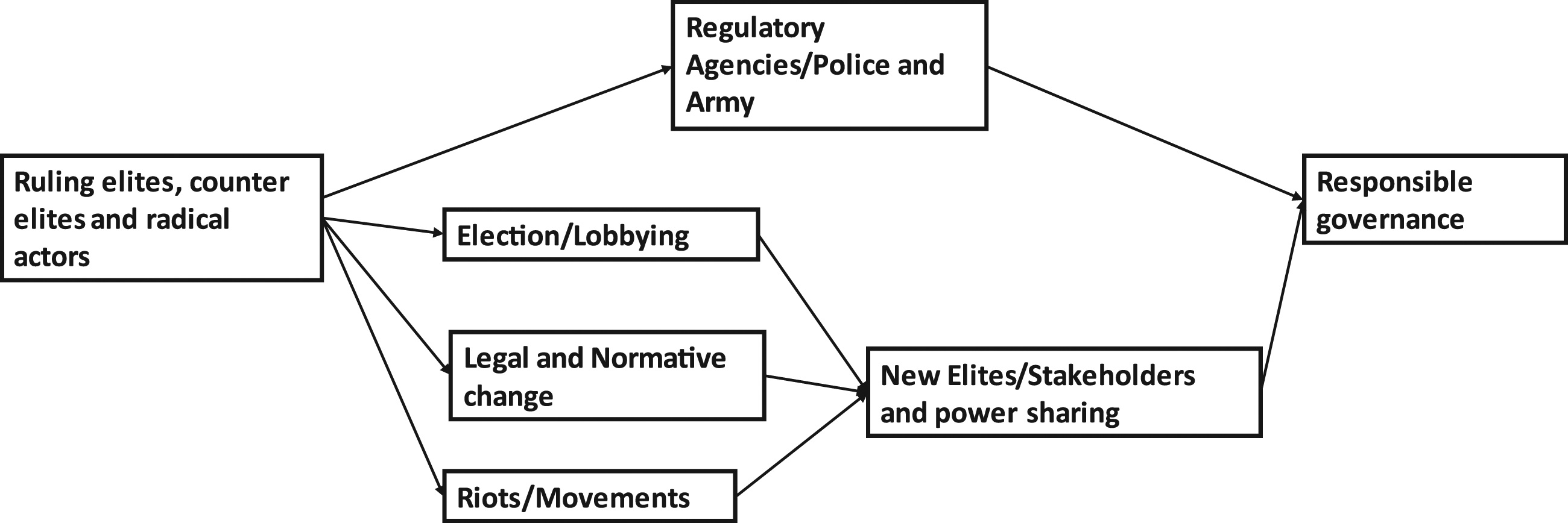
The existence of multiple modes of interest articulation and aggregation, combining conventional methods of campaign participation, voting, lobbying and contacting leaders and administrators with indigenous forms of protest has become an effective basis for governance, and transition to democracy and its consolidation in India. The paths indicated in Figure 3 show the multiple routes that are available to radical activists in India (Figure 3).
5. Majoritarian democracy and ethnic minorities
The achievements of Indian democracy in coping with vulnerability are not idiosyncratic but are the outcome of general systemic features such as power-sharing, path dependency, intra-elite competition and a deep culture of accountability, going back all the way to Kautilya’s Arthashastra, written in fourth century BCE! (Mitra 2013, Mitra and Liebig ). However, the rise of hindutva – the steady diffusion of Hindu ethos and a nativist culture across India, buoyed by the electoral success of the Hindu nationalist Bharatiya Janata Party, is seen by some as a sign of democracy backsliding in this.
This raises a general question. Must democracy deny the dominant culture of a society a leading role in the public life of the country? (Ramussen 2017). Competitive electoral democracy transmits widely shared values in society to the high politics of the state. Legitimacy is the key to political order. This, then, is a liberal dilemma: how to incorporate concepts such as Hindutva or Confucianism into a liberal political order?
Ramussen proposes the following model: First, there must be an accommodation to pluralism even if the claims of the culture are comprehensive. … Second, there must be some account of the relationship between the moral, the religious (if culture claims to be religious as in the case of certain Islamic societies) and the political. Third, there must be an account of unity within a society … in belief in a constitution. Fourth, there must be some way to account for a public political discourse … (Ramussen 2017: 436).
Chinese society, deeply steeped in the ethos of Confucianism and ruled by the Communist Party of China with its central command structure is an important test case for the model that Ramussen proposes. Based on two important contributions of Sungmoon Kim, his article ‘A Pluralist Reconstruction of Confucian Democracy’ and Kim’s new book Public Reason Confucianism: Democratic-Perfectionism and Constitutionalism in East Asia, Ramussen suggests that a Confucian democracy is feasible on the basis of three cardinal principles: (1) unity in a Confucian constitutional democracy should be understood not as a moral unity but as a constitutional unity; (2) Confucian values should be differentiated (or pluralized) between moral virtues and civic virtues; (3) in Confucian democracy minorities have the constitutional right to contest public norms in civil society, (Ramussen 2017: 436–437)
This, then, is a challenge for liberal-communitarianism. It needs to accept multiculturalism in principle and engage in a dialogue between cultures, religions and constitutional norms within the framework of a public sphere, civil society and electoral democracy, rather than raising the cri de coeur of democracy backsliding at the slightest sign of the use of religious symbols in the public arena. One can then avoid the trap of conceptualizing liberal democracy in the form of ‘one size fits all’ and bravely venture in the direction of unknown. Just as one can see European societies with a dominant culture, coexisting with dignified minority cultures, engaged in negotiation in terms of shared, constitutional norms, so can one imagine changing societies of the Global South, conflating endogenous cultures and imported norms of liberal democracy. 17
6. Conclusion
The vulnerability–responsibility model presented in this essay responds to multiple constituencies that include the egoist, the cynic, the skeptic and the altruist, and bridges the North–South divide. It addresses the problem of embedding human dignity into transactions between givers and takers of assistance. It shows how entitlement, enfranchisement and empowerment which turns subjects into citizens, vulnerable sufferers into active agents of their destiny and rebels into stakeholders. It balances empowerment with the citizen accountability (Mitra and Singh 2009; Mitra and Liebig 2017), and can generate the counter-force to withstand the onslaught of the global market economy, dominant castes, religion and ethnic groups and indigenous votaries of ethno-nationalism, which are among the leading global causes of vulnerability.
Based on the case of India, the essay offers an empirical example of a general mechanism that can cope with the structural causes of vulnerability. It has embedded the concept of ‘nested’ vulnerability within the institutional structure of a resilient democracy in the South. It shows how the relentless argumentation of democracy can stand by the vulnerable, and yield norms that are both good and right.
The scope of this model can be augmented through further research, to incorporate non-citizens in the model by instituting power-sharing and participation. This is possible in societies like China that have adopted political systems that are not formally democratic (Voskressenski 2017). Finally, a cross-national analysis of the applicability of the concepts of ‘nested vulnerability’ and ‘vulnerability as a political resource’ might bring new insights into how old and new democracies cope with those in urgent need of succor. That, perhaps, can be an effective antidote against the intolerance of minorities, increasingly visible in both the North and the South.
Footnotes
Declaration of conflicting interests
The author(s) declared no potential conflicts of interest with respect to the research, authorship, and/or publication of this article.
Funding
The author(s) received no financial support for the research, authorship, and/or publication of this article.
