




Abstract
At the centre of Adorno’s critical theory of society lies the problem of Bann or Bannkreis: why do individuals systematically act in ways that reinforce conditions that are obviously incompatible with their freedom and pursuit of happiness? Despite criticism of Dewey’s experimentalism by several Frankfurt School critical theorists claiming that the American pragmatist fails to account for systematic blockages to critique, Dewey does in fact formulate his approach to social critique as a response to the problem that social life might be made immune to transformative claims. In Human Nature and Conduct, thirty years prior to Adorno’s Bannkreis, he conceptualizes a ‘vicious circle’ in which attempts to transform social life seem to be caught and points to a way out. This article shows that Adorno and Dewey share in a project at the heart of critical theory, the project of a disclosing critique of society. In different and mutually completing ways, the Frankfurt School critical theorist and the American pragmatist point out the extent to which their contemporary societies are caught in antagonistic and painful vicious circles and thereby point to the objective possibility of another form of social life. The article is historical, but it is animated by the intent to brush a fruitful path for disclosing critique today. From Adorno, this critical practice gains the idea that theory of society can be a disclosing gesture, which presents an important corrective to Dewey’s failure to trace the eclipse of the public. From Dewey, it gets a reminder that these theories must find ways to continue into ordinary life experience through group action for their disclosure to come full circle.
Keywords
‘… These mechanisms of identification have stamped themselves on people’s characters to such a degree that they are quite incapable of the spontaneity and the conscious actions that would be required to bring about the necessary changes’. Theodor W. Adorno ‘All of the actions of an individual bear the stamp of his community… Difficulty in reading the stamp is due to variety of impressions in consequence of membership in many groups’. John Dewey
1. Introduction
There are many ways to frame a question that could orient through the landscape of such a polycentric philosophical project as that of Frankfurt School Critical Theory. A candidate that would both seem timely in our current age of umpteen catastrophes and, historically, date all the way back to its earliest program, Max Horkheimer’s ‘Traditional and Critical Theory’ (Horkheimer 1937), is: why do social crises and catastrophes not lead to social transformation? At the heart of Theodor W. Adorno’s response to that question lies the concept of Bannkreis, the idea that social life is caught in an self-perpetuating vicious circle. In particular, it seeks to show how and why individuals act in ways which stabilize social conditions that restrict their experience.
A long line of criticism of American pragmatism by Frankfurt School critical theorists has, despite sympathies, targeted John Dewey’s social philosophy at precisely this point: An experimental method cannot be transferred to social critique, because the criticized form of life can be made immune to transformative claims from within (see Särkelä 2020a). Already Herbert Marcuse, in his review of Dewey’s Logic, concluded contra Deweyan experimentalism that a truly critical theory must be capable of transcending given experience by reference to reason, freedom, and similar ‘metaphysical instances’ (Marcuse 1940, 226). Similarly, Rahel Jaeggi, a contemporary critical theorist who besides Hegel takes Dewey as the most important inspiration for her model of a ‘critique of forms of life’, claims that there is no potential in Dewey’s work for the conceptualization of ‘systematic learning blockages’ (Jaeggi 2018, ch. 9).
However, Dewey does in fact formulate his approach to social critique as a response to the problem that social life might be made immune to transformative claims. In Human Nature and Conduct, 30 years prior to Adorno’s Bannkreis, he conceptualizes a ‘vicious circle’ in which attempts to transform social life seem to be caught and points to a way out (MW 14, 88).
In this article, I seek to show that Adorno and Dewey share in a project at the heart of critical theory, the project of a disclosing critique of society. In different and mutually completing ways, the Frankfurt School critical theorist and the American pragmatist point out the extent to which their contemporary societies are caught in antagonistic and painful vicious circles and thereby point to the objective possibility of another form of social life. I will first characterize the idea of a vicious circle in Dewey and Adorno. I will identify two differences between them: the first pertains to the gesture of pointing out the vicious circle, the other to that of pointing to another form of life. The first difference is a disagreement about the role of theory of society in critical disclosure. The second difference is different; it consists not in a disagreement but in diverging attitudes towards disclosing reason. The article ends with concluding remarks. All of this is animated by the intent to brush a fruitful path for philosophical social critique today.
2. Pointing out the vicious circle: adaptation and exemplarity
At the centre of Adorno’s critical theory of society lies the problem of Bann or Bannkreis: why do individuals systematically act in ways that reinforce conditions that are obviously incompatible with their freedom and pursuit of happiness? Philosophically, the term Bannkreis is something of a protologism. Adorno picks it up from ordinary language where it denotes the sphere (Kreis) of influence of a person or a thing under whose spell (Bann) one might fall. However, in Adorno’s usage Bannkreis also becomes closely associated with Täufelskreis (circulus vitiosus), meaning ‘vicious circle’. Here’s a passage from his lectures History and Freedom where he explains Negative Dialectic’s Bann (Adorno 1966, part 3, ch. 2) to his students as the catastrophic vicious circle in which human beings have an objective interest in changing the world and in which this change is quite impossible without their participation. However, these mechanisms of identification have stamped themselves on people’s characters to such a degree that they are quite incapable of the spontaneity and the conscious actions that would be required to bring about the necessary changes. This is because, by identifying with the course of the world, they do so in an unhappy, neurotically damaged way, which effectively leads them to reinforce the world as it is. (Adorno 2006, 76)
Bannkreis has a predominantly gestural character. It is a conceptual gesture; it points at something. To understand it one must turn one’s attention to what is pointed at, one must look and ask what it shows. In this article, I want to take a closer look at what Adorno shows by it in his sociological essays and lectures.
By Bannkreis Adorno points at a circle of asymmetrical adaptation. Take, for example, this passage from his essay ‘Society’: That adaptation of men to social relationships and processes which constitutes history and without which it would have been difficult for the human race to survive has left its mark on them such that the very possibility of breaking free without terrible instinctual conflicts… has come to seem a feeble and a distant one. Men have come to be… identified in their innermost behavior patterns with their fate in modern society. […] The process is fed by the fact that men owe their life to what is being done to them. (Adorno 1965, 152, italics added).
This passage reveals four crucial features of the vicious circle: Adaptation, captivity, identification and antagonism. First, in contrast to the primarily metaphorical Bannkreis, ‘adaptation’ is a scientific concept that Adorno derives from evolutionary biology. The history he points at is natural history: ‘The well adapted society is, as its historical concept urges: mere Darwinian natural history’ (Adorno 1959, 96, trans. A.S.). Bannkreis points at a non-intentional process of an asymmetrical interaction between organism and environment selecting for certain intentional acts by individuals and social groups as well as certain pre- and subconscious dispositions for its persistence.
The term posits society as an overpowering environment that puts these individuals and their groups under overwhelming adaptive pressure: ‘If they want to live, then no other avenue remains but to adapt, submit themselves to the given conditions; they must negate precisely that autonomous subjectivity to which the idea of democracy appeals; they can preserve themselves only if they renounce their self’ (Adorno 2005, 98). The second feature is then clear enough: The vicious circle makes the individuals and groups captive in its reproduction. The adaptative pressure is overwhelming to the point of making the possibility of social transformation seem helplessly distant. In another social-theoretical essay, ‘Theorie der Halbbildung’, Adorno picks up an old polemic term of the German pedagogical tradition and calls this form of captivating adaptation ‘half education’ (Adorno 1959). Instead of producing individuals capable of autonomously participating in transformative practice, action that would adjust the social environment, contemporary society educates only halfway: it merely adapts the individuals to the environment.
The third feature is that this peculiarly social form of adaptation involves identification: The social environment continues into the innermost layers of the individuals, reinforces itself within them by conditioning an agency which perpetuates it. This is the spell-like aspect of the vicious circle: it tends to make the individuals identify with the environment; the overwhelming adaptive pressure on them is internalized to the extent that they surrender their quest for freedom. Society reproduces itself within and against the individual.
The fourth feature is that such an identification with the violent adaptive pressure of the environment involves painful conflicts. The vicious circle is a process of adaptation where an overpowering environment continues into the most intimate facets of the individual and preserves itself there by means of antagonisms (Adorno 2006, 14f). Adorno believes that these antagonisms can be traced through the entire social fabric (Blili-Hamelin and Särkelä 2021). But he also believes that there is a basic antagonism, which is that between ‘social power and social powerlessness’ (Adorno 1957, 218f; 2019, 67), namely between the overpowering social environment and the individuals and social groups surviving to its benefit and at its mercy.
In Secs. 3, I will take a closer look at how, in Adorno’s social theory, this form of asymmetrical adaptation operates through captivity, identification and antagonism. For now, it is enough to retain that Bannkreis represents the circular process of an overpowering social environment which persists by putting such an extreme adaptive pressure on individuals and social groups that they renounce their happiness and freedom for a painful form of self-preservation with which they come to identify. Sometimes Adorno uses the traditional philosophical metaphors of first and second nature to express this process: ‘the present social structure… has the character of… a monstrously agglomerated “second nature”’ (Adorno 2000, 28). Bannkreis then involves a societal second nature which maintains itself in and through individual second nature and individual first nature (e.g. Adorno 1932; 1966, pt. 3, ch. 2; Adorno 2006, ch. 13 and 14; see also Särkelä 2022 and Testa 2007 and 2016) (Figure 1). The vicious circle as first and second nature.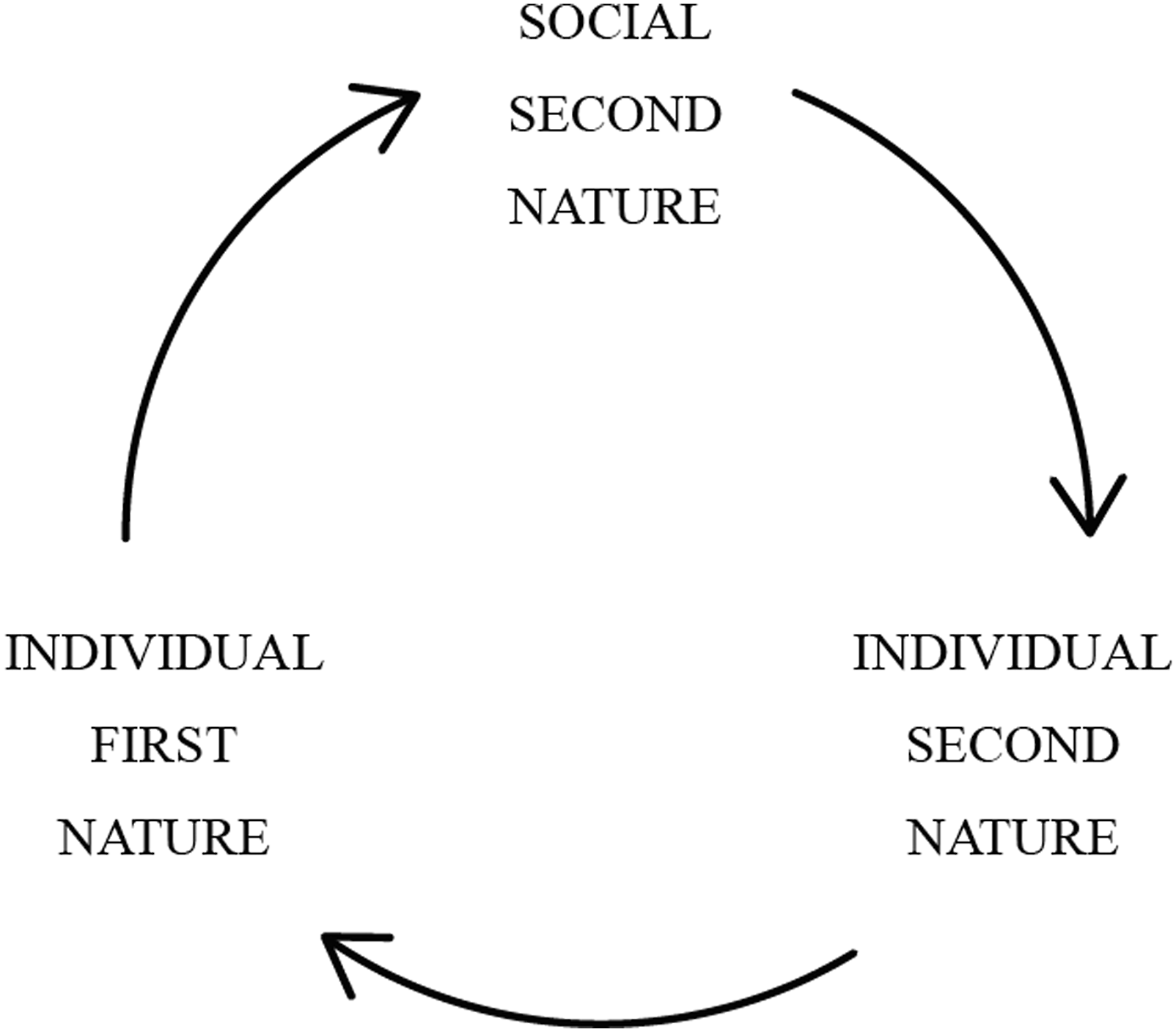
Does Adorno offer any way out? To demonstrate the extent to which society reproduces itself as a vicious circle is, he argues, already a crucial step to breaking it: ‘to point the vicious circle out breaks a taboo of the integral society’ (Adorno 1965, 153). Disclosing it is a critical gesture. The demonstration of its extent shows both how the current form of societal reproduction contradicts our dearest values, causing senseless suffering in all its phases, and that a different form of life is objectively possible. I will call the first aspect, pointing out our current society as objectively false, a decentering disclosure. Conversely, I shall call the second aspect, that of pointing to objective possibilities of another form of life, a recentering disclosure (Särkelä 2020b; cf. Kompridis 2006).
This is an educative gesture. By pointing the vicious circle out, Adorno distances himself in an exemplary way from the prevailing form of life to provoke individual variation among his recipients. Such variation is a condition for them to overcome socially caused unhappiness and unfreedom. The disclosing gesture is educative by virtue of showing an example of critical distance to society. The critical social theorist points out the extent to which society constitutes a vicious circle and points to the objective possibilities of social transformations that remain. It leaves, as it were, the door ajar so that the recipients might break out. Social theory, Adorno tells his students, ‘revolves essentially around the question how we are finally to break out of the vicious circle’ (Adorno 2000, 14).
Like Adorno, Dewey worries that in an overpowering social environment ‘life would petrify, society stagnate’ (MW 14, 72). In Human Nature and Conduct, 30 years prior to Adorno’s Bannkreis, he calls such a stagnation of social life a ‘vicious circle’ (ibid. 88) and, like Adorno, thematizes it in terms of a social environment’s ‘stamping’ (Adorno 2006, 76) the individual’s most intimate layers: [I]t seems… that every attempt to… secure fundamental reorganizations is caught in a vicious circle. For the direction of native activity depends upon acquired habits, and yet acquired habits can be modified only by redirection of impulses. Existing institutions impose their stamp, their superscription, upon impulse and instinct. They embody the modifications the latter have undergone. How then can we get leverage for changing institutions? (MW 14, p. 88).
Again, an overpowering institutional environment maintains itself in and against the individual. Dewey’s vicious circle shares the same four crucial features as Adorno’s: adaptation, captivity, identification and antagonism.
The vicious circle presents, first of all, a process of asymmetrical adaptation of organism to environment. Already in the introduction to Human Nature and Conduct, Dewey explains that ‘… all conduct is interaction between elements of human nature and the environment’ (MW 14, 9). Dewey goes on to give a rich account of social reproduction as a circle of custom, impulse and habit: (a) Customs are social second nature, our collective habits, acquired collective dispositions, through which (b) individual first nature, our impulses, acquire social meaning; such impulses can, however, be acted upon only through (c) habits, which all individuals form as they are socialized into a form of life by customary response to their impulses (ibid. Part II). Social life persists as a non-intentional process, which selects for acts and dispositions among individuals and social groups. Rather than the current social environment being the result of intentional action, Dewey claims, ‘social institutions and expectations shape and crystallize impulses into dominant habits’ (MW 14, 86). No matter how accidental and irrational the circumstances of its origin, no matter how different the conditions which now exist to those under which habit was formed, the latter persists until the environment obstinately rejects it. Habits once formed perpetuate themselves by acting unremittingly upon the native stock of activities. They stimulate, inhibit, intensify, weaken, select, concentrate and organize the latter into their own likeness. They create out of the formless void of impulses a world made in their own image. (MW 14, 88)
The vicious circle can then be traced through the adaptive pressures from the social environment on habituation, which conditions action by giving direction to impulses sparked by the social environment (MW 14, 43). Whereas ‘habits reflect[…] social customs’ (LW 2, 336), impulses are ‘reflections into the singular human being of customs’ (LW 2, 299).
Like Adorno’s Bannkreis, Dewey’s vicious circle is indebted to Darwinian evolutionary theory. Both Adorno and Dewey are critical of Herbert Spencer’s adaptationist application of evolutionary theory to social theory (Adorno 2011, 42f; LW 4, 52f). However, unlike Adorno who maintains a certain ironic adaptationism (Adorno 1959, 96), Dewey develops a competing interpretation of Darwin that claims to be, and indeed is (MW 4, 3ff; Särkelä 2015; Pearce 2020), superior to the adaptationist one. Dewey completes the concept of adaptation (of organism to environment) by that of adjustment (of the environment by the organism), and links it intrinsically with play, experimentation and experience (Stiegler 2019) – notions crucial for the critical projects of Adorno too. 1 In fact, during the positivism dispute in German sociology, Adorno refers to the playful and experimental character of Dewey’s conception of experience: Dewey ‘appeals for open, unfixed, unreified thought. An experimental, not to say a playful, moment is unavoidable in such thought’ (Adorno 1962, 113). Again, in Negative Dialectics, Adorno similarly applauds Deweyan experimentalism: ‘In principle, philosophy can always go astray, which is the sole reason why it can go forward. This has been recognized in skepticism and in pragmatism, most recently in Dewey’s wholly humane version of the latter… As a corrective to the total rule of method, philosophy contains a playful element’ (Adorno 1966, 14). In both philosophers, the disclosure of the vicious circle is motivated by a worry about our degenerating capacity to truly have experiences, a power that any form of criticism presupposes (Adorno 1966, 28 ff.; LW 10, ch. III).
Also the Deweyan captivity in the vicious circle is to a large extent an educational problem. What keeps us captive are bad habits. Yet according to Dewey, all action is habitual. And all habit is based on mechanism, although mechanism does not exhaust habit. Now, bad habits are characterized by a rigid, closed mechanism that forces action into narrow repetitive pathways. Their rigidity may then trigger the individual to try to act outside habit. But because action is only possible through enabling habits, the individual is destined, without educational effort, to be thrown back into the old habit. Good, more creative habits, by contrast, prove to be sovereign by enduring and expressing a great variety of diverse impulses (MW 14, 50–1; see also Levine 2015) (Figure 2). The vicious circle as custom, habit and impulse.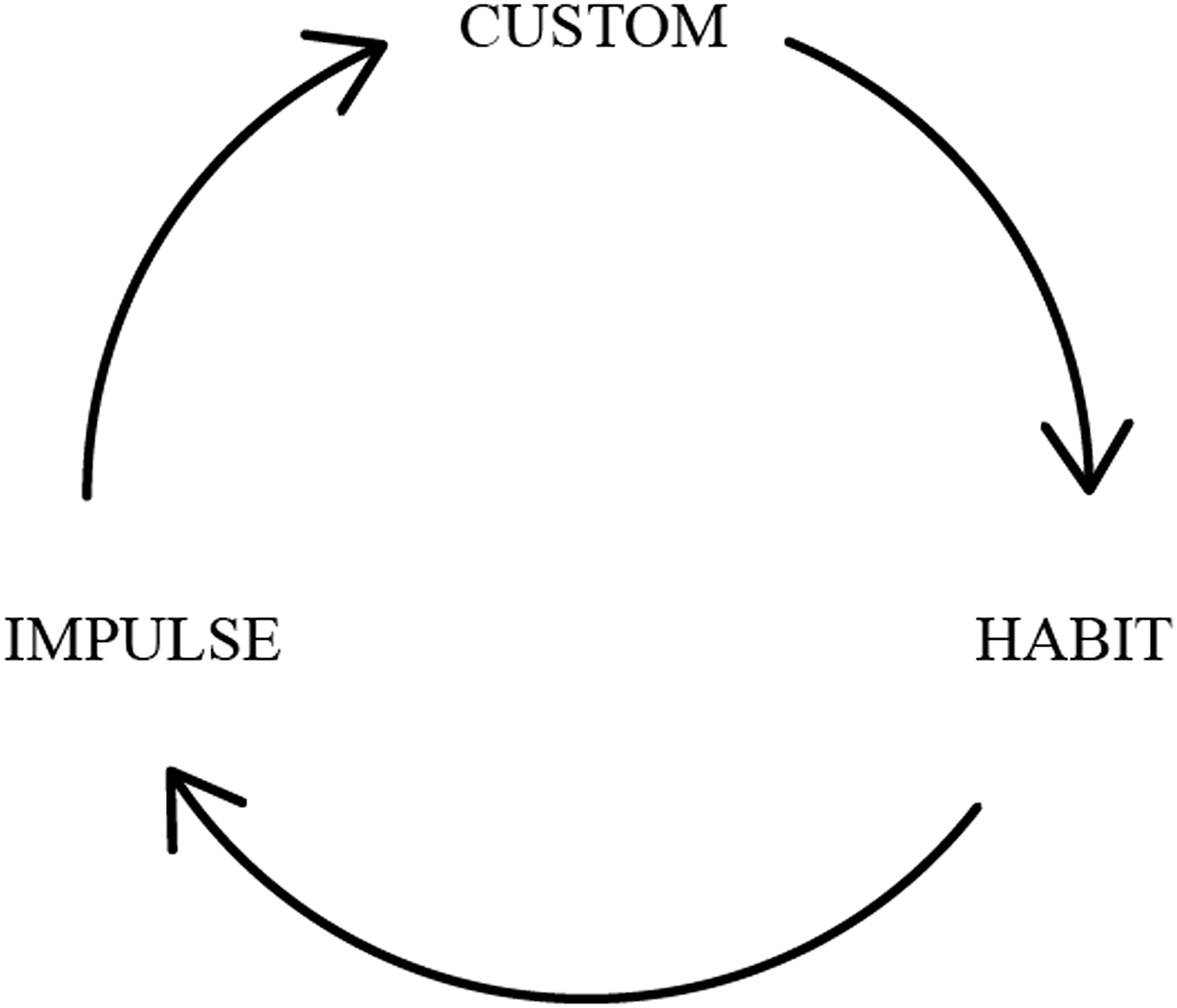
In explaining how society maintains itself as a vicious circle, Dewey too refers to mechanisms of identification. In Liberalism and Social Action, Dewey claims that people have reacted to the overwhelming pressure from the social environment by ‘resorting to what psycho-analysis has taught us to call rationalizations’ (LW 10, 41 f.). In Public and Its Problems, the viciously circular ‘Great Society’ rests, among other things, on an identification with ‘established institutions’ springing from ‘an underlying fear of which the subject is not aware, but which leads to withdrawal from reality and to unwillingness to think things through’ (LW 2, 341 f.). And finally, also in Dewey the vicious circle involves a fundamentally unstable social environment; it displays an uncontrolled antagonistic flux whose reproduction is ‘characterized chiefly by uneasiness, discontent and blind antagonistic struggles’ (MW 14, 90).
Also Dewey asks: ‘Is there any way out of the vicious circle?’ (ibid. 89). Initially, his way out might seem to differ radically from Adorno’s. He starts by pointing out that no social environment is ‘all of one piece’ (MW 14, 90). We are not simply socialized into a form of life or into the society. Dewey conceives social life in a fractal way (Särkelä 2021). Society presents a form of life, which consists of many associating and overlapping forms of life, social groups. Social groups again constitute the loci of customs and consist of associating individuals with their habits and impulses. Individuals then do not stand in an immediate relationship with the society. Their relationship with society is essentially mediated by social groups. And each of us is socialized as a member of many social groups. These groups have varying interests, they spark varying impulses in us and instill varying habits onto us (Dewey 1973, ch. 4; cf. Honneth and Särkelä 2019). They stamp us in diverse ways: ‘the environment is many not one; hence, will, disposition, is plural’ (MW 14, 38). As we are all members of many groups, we can criticize each by resources from another. If one social group starts to reproduce as a vicious circle, we can critically disclose it with help of the example of a more democratically organized group. By socialization into many groups with varying customs, we are, as it were, naturally educated to criticize. By this gesture, Dewey shows his readers that exemplary critical disclosure is present in ordinary life experience. Disclosing critique is immanent to social life.
This idea of an irreducible diversity of the social environment allows Dewey to offer an explicit concept of disclosing reason. Reason, he claims, is a collective creative and critical habit that arises out of the plurality and moral variability of social groups: Reason […] becomes a custom of expectation and outlook, an active demand for reasonableness in other customs. […] It arises in some exceptional circumstance out of social customs […]. But when it has been generated it establishes a new custom, which is capable of exercising the most revolutionary influence upon other customs (ibid., 55 f.).
As a reflective custom, creative collective habit, reason emerges as an arbitrary variation in the natural history of an irreducibly diverse form of life, and then serves as a means of its disclosure and adjustment.
However, Dewey’s gesture of pointing to the moral variability of the many social groups in ordinary life, displays also an important similarity with Adorno’s proposal: According to both, it is the exemplarity of another way to live and a critical distance to the form of life that enables individuals to deviate from rigid habits and develop more creative ones, habits that can encompass and direct a greater amount of impulses, and therefore actualize more of their individual potential. Dewey’s pedagogy attempts to map the path to such an empowerment of the individual to ‘adjustment’, that is, to a transformative reshaping of the social environment (MW 9, ch, 7). The gesture of drawing the vicious circle is then also in Dewey linked with the disclosure of the horizon of meaning and the induction of greater individual variation to resist society’s pressure towards adaptation.
3. Tracing the vicious circle: theory as a disclosing gesture
Let’s recapitulate this much: Adorno demonstrates the vicious circle with a theory of a basic antagonism of social power and social powerlessness, the antagonism between an overpowering society and the individuals who must adapt. Dewey, by contrast, develops a naturalized conception of reason based on an account of the moral variability of social groups due to the plurality of loci of socialization. Now, Dewey is a harsh critic of any social theorizing that postulates a conflict between individual and society. The individual, he claims, acts within social groups, and only the interactions between social groups make up a society. The individual does not stand in a direct relationship with society.
Dewey’s account of the vicious circle is consequently group-based: some group interest monopolizes the social environment, which puts other groups with other interests under an overwhelming adaptive pressure. The dominating interest becomes recognized as the interest of the ‘social whole’, whereas other group interests are taken as merely ‘individual’ (Dewey 1973, 74–81). The dominating group is ‘publicly recognized’, whereas the other groups have ‘not yet achieved such recognition’ (Dewey 1973, 76; Särkelä 2013). Its interest then comes to dominate the reproduction of society by monopolizing the power to shape the associations between social groups. In his Lectures in China 1919-1920, Dewey treats men of the capitalist class as this type of hegemonic group and gives women and the working classes as examples of dominated groups that struggle to ‘be recognized as an operating component of the larger society’ (Dewey 1973, 76). The interest of capital accumulation has then come to dominate the reproduction of society, whereas other social groups have been degraded to mere means of the accumulation of capital (Särkelä 2018, 372–6; Gregoratto and Särkelä 2020). This institutes a mode of association, antagonistic struggle for scarce resources, to which the other social groups must adapt their modes of association. Dewey believes such a group-based social ontology to account sufficiently for a disclosure of the vicious circle: Individuals find themselves cramped and depressed by absorption of their potentialities in some mode of association which has been institutionalized and become dominant. They may think they are clamoring for a purely personal liberty, but what they are doing is to bring into being a greater liberty to share in other associations, so that more of their individual potentialities will be released and their personal experience enriched. Life has been impoverished, not by a predominance of ‘society’ in general over individuality, but by a domination of one form of association… over other actual and possible forms. (LW 2, 356).
Adorno does, of course, not postulate an immediate relationship between two entities, ‘society’ and ‘the individual’; ‘society’ is a category of mediation (Adorno 1965, 145 f.). In fact, he arrives at the antagonism between social power and social powerlessness through a careful tracing of the vicious circle as an asymmetrical adaptive process mediated by many types of antagonisms. And indeed, first on the list are the antagonisms between social groups (Adorno 1957, 192f, 2019, 65–66). Second, Adorno theorizes antagonistic interactions between sectors of society (Adorno 2019, 81). A part of Adorno’s story about the co-existence of rationality and irrationality is that, while social groups are capable of acting intentionally and rationally and sectors can be loci of rational planning, the society made up of their antagonistic interactions remains largely irrational. Third, society can involve antagonisms within individuals (Adorno 2019, 67). Society’s antagonisms continue into the interactions of the individual’s drives, impulses and habits. Finally, there emerges a picture of the antagonism between social power and social powerlessness (Adorno 1957, 218f; 2019, 67).
Like Dewey, Adorno distinguishes society as a non-intentional functional context from social groups that can also act intentionally (Adorno 2019, 22). While he considers a ‘pluralism’ of morally varying, self-organizing social groups to be a sign of a less wrong society, and to some extent even ascribes it to the prevailing one (he points to the trade unions as an example), he claims that this diversity is not at all irreducible; it can very well be reduced, and this tends even to be the case (Adorno 2019, 127 f.). Under the current adaptive pressures, antagonistic interactions between social groups result in an equalization of their moral structure: as their moral variability is eliminated, the disclosing potential of the different groups eroded (Adorno 2000, 29 f.; Adorno 2019, 66). According to Adorno, to disclose this connection, a ‘total theory of society’ (Theorie der Gesamtgesellschaft) is required: a theory of the superiority of the social environment (Adorno 2000, 27).
Adorno traces this superiority of the social environment along the limits of criticism experienced in the ordinary action context of social groups: If one criticizes an existing social system and proposes particular improvements on the basis of this criticism, such proposals inevitably and very soon come up against a limit which cannot be understood in terms of the individual points of criticism. It can only be understood in terms of the pre-established order of society, which is extremely sensitive to changes… (Adorno 2000, 49)
So what defines society as an overpowering environment can be experienced from the inconsequentiality of the criticism expressed in ordinary life experience within the context of social groups. Adorno calls the experience of this limit ‘society as experience’ (Adorno 2000, 51). He believes that making this limit tangible as an object of experience demands a critical theory of society (Adorno 2000, 50 f.). In other words, Adorno’s argument in favour of a total theory of society is that disclosing critique needs it to make the limits of critical experience in social groups experienceable.
Adorno traces the vicious circle by means of empirically informed speculative ‘models’, each of which presents a particular phase of the adaptive process but also discloses it as a damaged whole. To illustrate concretely what is at stake here, I will now give examples of three such models, examples which I believe to be closely linked: ‘tendency’, ‘concretism’ and ‘identification with the aggressor’.
(a) Tendency. On a macro-sociological level, Adorno models the vicious circle as ‘tendency’ (Adorno 2019, 19–20). Tendencies are expressed as sets of propositions, based on social facts, about the direction in which society is evolving. Stating a tendency is an empirically informed speculative judgement: it is about the state of affairs in society and their qualitatively different outcome yet to occur. Although the assertion of a tendency necessarily goes beyond a mere assembling of social facts, it proceeds from the analysis of those facts: ‘[R]ecognizing a tendency means recognizing, within the theoretical analysis of a given state, that element which qualitatively differs from this state itself, … which means that it is not simply an extension of how the current state presents itself’ (Adorno 2019, 24).
The speculative aspect of stating a tendency involves the recognition of a non-identical element: the movement of the adaptive process in a direction, which is different from its current form. Adorno gives the example of the socially effective principle of free and equal exchange: what is it supposed to lead to and where does it, based on a rigorous analysis of social facts, really lead? (Adorno 2019: 20) The model of tendency discloses how the maintenance of the social environment will, in fact, modify it.
What is the role of ‘tendency’ in tracing the vicious circle? Judgements of tendency give an account of the dynamic of societal second nature (Adorno 2019, 24). It provides social theorists with a tool for making speculative judgements about the dynamics of a social environment, which exerts an adaptive pressure on individuals by means of customs, institutions and functional connections. It attempts to grasp the dynamic social environment as a movement towards what it is not: it allows to speak of a social system as ‘not fully realized’ (Adorno 2019, 27). Therefore, the judgement of tendency is, as it were, always already critical: it presents society as ‘not the system that, according to its own concept, it should be’ (Adorno 2019, 27).
(b) Concretism. Adorno borrows the term ‘concretism’ from psychology, where it refers to an incapacity for abstraction: it marks a psychopathology of compulsively clinging to the very next task ahead, to the ‘concrete’, as it were. By analogy, Adorno’s sociological model of concretism refers to the socially caused inability of individuals ‘to resist their immediate interests’ (Adorno 2019, 40), which averts them from socially transformative action. Concretism describes the everyday social phenomenon ‘that the people who are given the burden, and consequently walk bent over with their heads bowed, that it has always been very hard for them to hold those heads up high… and see more than their immediate interests’ (Adorno 2019, 41).
Concretism is the social pathology, in which the consciousness of individuals is tied so firmly to the immediately given conditions of action that any critical reflection on them, and following action that would seek to adjust them, becomes nearly unimaginable. More specifically, concretism operates by binding the consciousness of individuals to commodities that occupy their attention. Adorno traces this back to ‘the necessity for the system, in order to survive, to exert an additional pressure in every conceivable way in order to shackle people to these very consumer goods’ (Adorno 2019, 42).
Concretism traces a specific phase of the vicious circle: the way it shapes the conditions of action to dispose individuals to react affirmatively to the functional requirements of their social environment. In other words, it describes social second nature molding individual second nature. It illustrates, from the perspective of the individuals, how the overpowering social environment maintains itself by putting a restricting adaptive pressure on individual habituation to the point of suffocating the capacity to take critical distance to it. It gives a tangible description of the basic antagonism as an ordinary experience of society: ‘the true origin (Grund) of this phenomenon of concretism lies much deeper .... [B]ecause of the incredible disproportion between all individuals, every individual… and the concentrated power of society, the notion of resisting this agglomerated power seems illusory’ (Adorno 2019, 43).
Concretism provides a partial explanation of the ‘inability to have (machen) genuine experiences’ (Adorno 2019, 48): ‘[T]his inability … and the fixation on the mere objects of immediate exchange, which are affectively charged, idolized and fetishized by people, are essentially the same thing’ (ibid.). The inability to really experience hollows out the kind of ‘experiments in living’ (Mill 2003: 122, 144), which Dewey and Adorno believe to be essential for individuals in participating and maintaining a democratic society open to critical challenges. Importantly, Adorno does not claim that the phenomenon of concretism makes socially transformative practice impossible. Instead, its way of disposing individuals to become resistant to genuine experiences makes social transformation seem illusory. For such adjustment of an overpowering environment to get off the ground, individuals need not only critical distance to their social group but some degree of theoretical consciousness, that is, the ability to make speculative judgements that point beyond the given circumstances, beyond ‘the concrete’. Rather than eliminating such consciousness, concretism shapes the conditions of action so that the object of critique seems cognitively unattainable: ‘[t]he phenomenon of concretism… does not prevent the objective possibility of theory formation, the incredibly complex and ramified context makes it seem opaque’ (Adorno 2019: 43).
Concretism strengthens half education (Adorno 1959: 116). It restrains the sort of education that takes place outside the school gates in all institutional environments of culture and Dewey never seizes to emphasize. Without concretism’s half-educating effects, Adorno claims, even the most powerless and uneducated member of society could today recognize the vicious circle: ‘things are genuinely no longer so terribly complicated’ (Adorno 2019: 43). [T]he reason (Vernunft) of every single individual would suffice to perform the rather simple thought operations for which I have developed for you some models. That people still do not accomplish this… does not depend on their inability to think but on the fact that they forgo thought, because the increasing insight into those contradictions… makes their life difficult and inflicts on them an additional suffering. (Adorno 1957: 214 - translation A.S.)
Concretism makes the individual, who in principle is already educated enough to properly grasp the vicious circle to degenerate from that given level of critical consciousness to functioning as a mere organ of the suffocating environment. It does so by shaping the conditions of ordinary life to make any socially transformative action seem illusory because of the social environment’s ostensibly opaque character. The acceptance of the illusion of opacity is so hard to resist, because it alleviates the individuals’ pain of surrendering their freedom in adapting. Adorno calls this the ‘affective power’ of Bannkreis (Adorno 2019, 35). Adaptive pressure from the social environment affects the individuals with a ‘feeling of powerlessness’ (Gefühl der Ohnmacht), the feeling of finding oneself confronted with overwhelming social powers, vis-á-vis which one’s own decisions go poof (Adorno 1957: 213).
Adorno underlines that this affective power awakens the feeling of powerlessness not only in those relatively disadvantaged but in every individual. Concretism affects the entire social fabric. That all individuals, across their varying functions in social reproduction, are affected by the immense adaptive pressure of the social environment in roughly the same way makes an emancipatory potential explicit. Concretism is a source of solidarity: as a ‘phenomenon that has spread throughout society as a whole… this restriction to the immediate, and the decision to clench one’s teeth and avoid looking beyond what is closest at all costs… is where we find something resembling solidarity in society as a whole’ (Adorno 2019, 41).
The model of concretism then also discloses a non-identical moment in the social environment, namely that of a solidarity of all individuals damaged by its overwhelming power. The model shifts the attention of its addressees from the next particular thing (‘the concrete’) to the objective possibility of a universal solidarity against the alleged universality of the false society. Recognition of this solidarity is a pre-condition of the sort of organization that it would take to break the vicious circle. In his theory of organization, Adorno claims that the problem in the socialized society is not too much organization, but too little; organizing has the potential to adjust the social environment according to the needs and desires of the individuals and their groups; it can constitute a mode of second nature, social objectivity, which is not reified (Adorno 1953).
(c) Identification with the aggressor. The vicious circle conditions individuals by systematically producing needs that are likewise systematically frustrated; the frustration, then, produces drive-conflicts, which, in turn, cause an agency that eventually maintains the current shape of the environment (Adorno 1965, 148–149). This conditioning of individuals works through a psychic mechanism of identification. When describing this destructive dynamic, Adorno often alludes to Anna Freud’s work on an ‘identification with the aggressor’ (IWA), where it refers to a specific defense mechanism, namely one by which children overcome fear through imitation: they identify with the person who violates them (Freud and Baines 1993, 109–121). Now, Adorno argues that the aggressor need not always be a person, but can also be the social environment whose violent adaptive pressure the individual internalizes (Adorno 2006, 76).
With this modification of the idea of IWA, Adorno wishes to turn our attention to the fact that the adaptation required of people today apparently demands so much from them that they cannot anymore satisfy those requirements. The consequence is a certain overidentification with the state of the world, a degeneration of their critical capacity, … , they do what in psychoanalysis once was called ‘identification with the aggressor,’ that is, instead of trying to change what blindly befalls them, they make themselves its advocates, and this is so because they do not experience the consciousness of possible change anymore, because the perspective in them, that there could be change at all, has already perished. (Adorno 1957, 217 - translation A.S.)
The model explains how the basic antagonism between social power and social powerlessness maintains itself in and through the individual psyche by means of a defense mechanism (Adorno 1966, 87). To stay with the picture of second and first nature, IWA works to bring forth a painful identification of individual first nature with social second nature. It models the continuation of the social environment into the psychic structure of the individuals because it molds their drives and impulses, makes them ‘voluntarily affirm and even seek the forms of repression that are forced on them from without’ (Adorno 2019, 68). The social environment besets the psychic economy by making individuals desire their own helplessness: The superego, the locus of conscience, not merely represents what is socially tabooed as being intrinsically evil but also irrationally combines the ancient dread of physical annihilation with the much later fear of being expelled from the social community which has come to encircle us in the place of nature…. (Adorno 1955a, 71)
Like concretism, IWA provides a partial description of the vicious circle from the perspective of individuals under the pressure to adapt to an excessively powerful social environment. But unlike concretism, it proceeds from the effects of the adaptive pressures not on habituation, but on their archaic psychic structure. It also describes a more severe pathology: the individuals suffering from IWA have completely lost their capacity to resist the social environment. But the pathology is less general too: whereas Adorno holds that we all are affected by concretism, he never claims that everyone is subject to IWA. For the persistence of the vicious circle, it is enough that many of us are (Adorno 2019, 68).
In this identification with the social environment, the adaptive pressure of concretism has already become insufferable for the individual psyche. Therefore, it is repressed. Again, Adorno alludes to the affective power of Bannkreis: as soon as the experience [of powerlessness] is turned into the ‘feeling of powerlessness’ (Gefühl der Ohnmacht) the specifically psychological element has entered in, the fact that individuals, precisely, cannot experience or confront their powerlessness… This repression of their powerlessness points not merely to the disproportion between the individual and his powers within the whole but still more to injured narcissism and the fear of realizing that they themselves go to make up the false forces of domination before which they have every reason to cringe. They have to convert the experience of helplessness into a ‘feeling’ and let it settle psychologically in order not to think beyond it. (Adorno 1955b: 6, 89, translation modified)
IWA results from the repression of the feeling of powerlessness affected by concretism: it completes half education (Adorno 1959, 119–120). The individual has now lost her capacity to genuinely experience. The adaptation to the social environment is knitted so tightly that experiments in living may no longer be undertaken. But again, the model also points to something non-identical in the vicious circle. It discloses individual spontaneity as the boundary of socialization within the individual (Adorno 1966, 92). Social reproduction relies on it as its medium; even IWA must be enacted by concrete living beings. The individual resists the overpowering social environment with the same type of force through which the latter established its domination, that is, education: a circle of social environment, habituation and socialization. Critical recalcitrance is a question of an education, which would strengthen the ego against the power of the social environment, whether that circle will remain the vicious one of a merely adaptive half education or the liberating one of genuine experience where the individuals use their spontaneity to adjust, or reshape (gestalten) (Adorno 1959 121–122), their social environment (Figure 3). Tracing the vicious circle through models.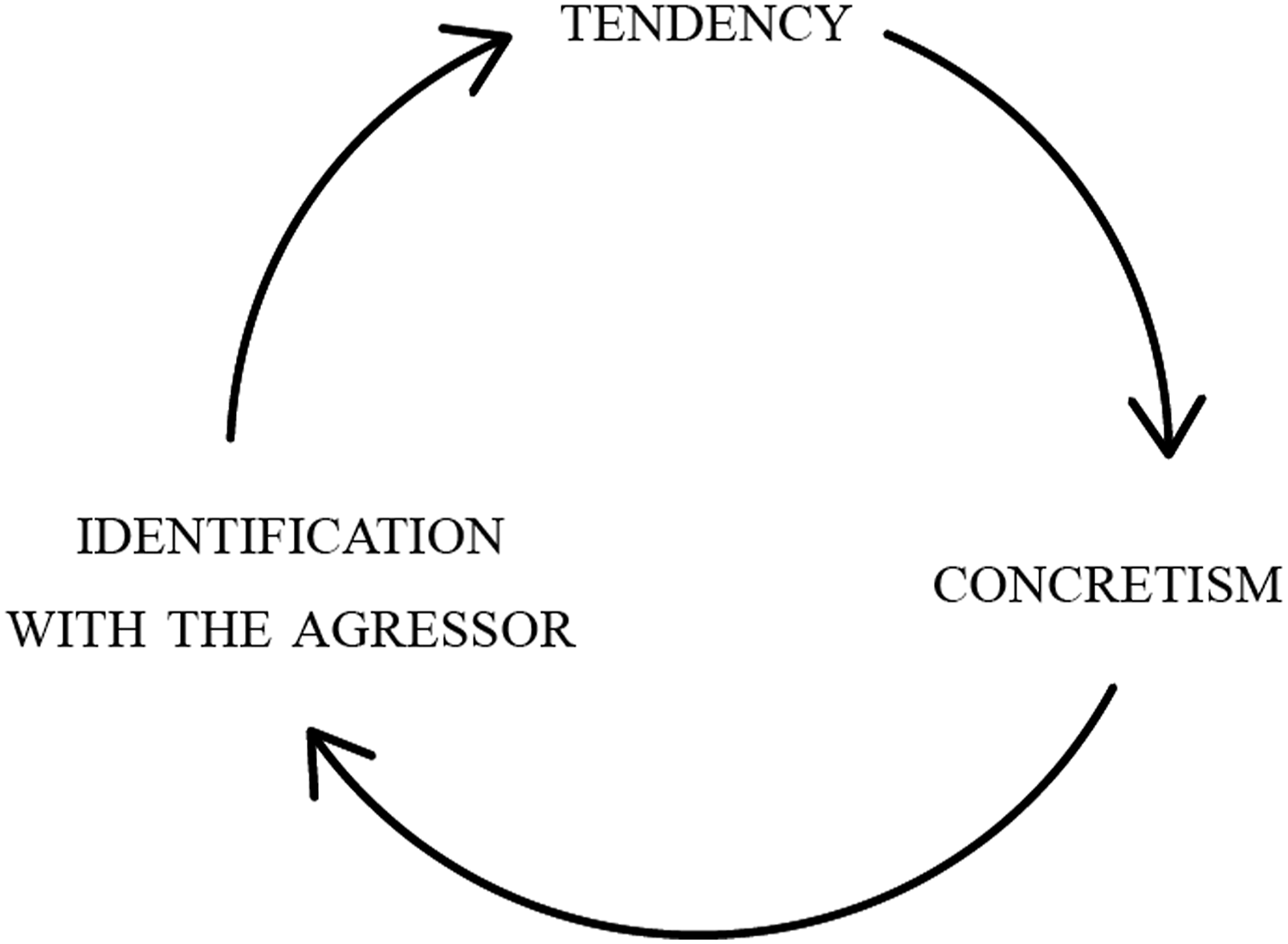
Adorno’s theory of society points out limits of social experience, particularly limits of the efficacy of social criticism in ordinary action contexts within social groups. It traces how functional connections of an antagonistically structured social environment restrict social experience to the point of making adjustment seem impossible. As part of a disclosing gesture, theory helps to grasp the conditions of alienation and so render the overcoming of those conditions possible (Adorno 2011, 236). This tracing of the vicious circle leaves the door ajar to step with one foot outside: it enables society as experience.
It is a disconcerting experience on the side of the receiver. It violates our narcissism, hurts our self-conception as autonomous agents, to experience the extent to which our action is conditioned, and selected for, by an overpowering, irrational social environment. The theory’s critical disclosure decentres our form of life: Adorno’s lectures on society can then be read as a performative theory of the vicious circle of society, a highly elaborate gesture of critical disclosure, aimed at helping his readers to alienate themselves from the alienated society. But it is also an empowering experience. Every model discloses a non-identical moment in the vicious circle. Tendency shows that, by staying the same, the social environment will, in fact, change. Concretism shows that the solidarity needed for the self-organizing readjustment of the social environment is anchored in our shared restricted experience. IWA shows that the vicious circle persists by operating as that type of molding of habits and drives which education works on too and can therefore also be reversed by educational measures. The theory’s critical disclosure then also recenters our form of life: Adorno’s lectures on society can be read as tracing the objective possibilities of adjusting the social environment (Adorno 2006, 67 f.).
Importantly, Adorno’s social theory is not absolutist in the sense that Dewey criticizes: it does not postulate society as a monocausal force opposite to the individual. On the contrary, it reassembles society as a false universal by means of speculative judgments starting from the study of its effects on social experience. Such judgments arise from empirical inquiry and should be tested empirically, as Dewey demands (Adorno 1962; LW 2, 362).
In The Public and Its Problems, Dewey does recognize such functional connections: ‘the Great Society’ that causes the diagnosed ‘eclipse of the public’ is namely constituted by ‘[i]ndirect, extensive, enduring, and serious consequences of conjoint and interacting behavior’ and has ‘formed such immense and consolidated unions in action… that the resultant public cannot identify and distinguish itself’ (LW 2, 314; see also Stiegler 2019, 133–140). However, the way in which experience is restricted in a form of life need not be the consequence of a dominating ‘mode of association which has been institutionalized’ (LW 2, 356). Adorno shows how the restriction can also be non-institutional yet embodied. It can be the consequence of a functional connection selected for in the natural history of our form of life.
Dewey observes that an inchoate public is capable of organization only when indirect consequences are perceived, and when it is possible to project agencies which order their occurrence. At present, many consequences are felt rather than perceived; they are suffered, but they cannot be said to be known, for they are not, by those who experience them, referred to their origins. (LW 2, 317)
But he never develops a theory addressing the various ways in which social domination can be embodied beyond customs and institutions. His decentring disclosure seems to lack a crucial tool for showing how indirect consequences of action can bundle up to swallow up claims to readjustment. This can only be achieved by conceiving a second nature which is neither institutional nor merely customary, but indeed an antagonistically structured interconnected societal power over individuals and groups alike. By mapping liminal spaces of social experience, 2 pointing at where it is systematically restricted by current social antagonisms, Adorno’s lectures on social theory develops models for precisely that type of decentring theorizing.
4. Breaking out of the vicious circle: education and organization
Despite this disagreement, which needed be none, regarding the status of theory in disclosing critique of society, the closer look at Adorno’s social theory also revealed a strong agreement between the two social philosophers: The way out of the vicious circle is paved by education and organization. Whereas the shared experience of the adaptive pressure in concretism pointed to the objective possibility of a society-wide solidarity that would enable organization of group agency to adjust the social environment, IWA showed that the vicious circle can be resisted by an education which strengthens the ego against the adaptive pressures. Tendency again disclosed the social system as fundamentally unstable and therefore susceptible to adjustment by organized effort.
What the experience of society then discloses is the extent to which the antagonistic structure of the social environment is maintained by the activities of social groups. The suffering caused by the captivity is supported by institutions, customs and educational measures and can also be reversed by them. To put it in the language of social contract theorizing: Leviathan breaks its promise of peace and safety by maintaining a state of nature within itself. It is nothing less than the hypostasis of scarcity, which in its social form has now been made obviously obsolete by the very technological development to which […] human beings are supposed to adapt (anpassen)… The only adequate response to the present technical situation, which holds out the promise of wealth and abundance to men, is to organize it according to the needs of a humanity which no longer needs violence because it is its own master. (Adorno 1997, 92)
The Dewey of Liberalism and Social Action concurs: The system that goes by the name of capitalism is a systematic manifestation of desires and purposes built up in an age of ever threatening want and now carried over into a time of ever increasing potential plenty. The conditions that generate insecurity for the many no longer spring from nature. They are found in institutions and arrangements that are within deliberate human control. (LW 11, 43)
Liberation from the captivity means adjustment of the social environment to what is already objectively possible: ‘Today, adaptation (Anpassung) to what is possible no longer means adaptation; it means making the possible real’ (Adorno 1997, 92, translation modified). According to both Dewey’s group ontology and Adorno’s social theory, society can only be adjusted, if social groups are capable of transformative action. Transformative group agency again requires that individuals are able to organize themselves as social groups. Such groups can be critically transformative, if they themselves constitute recalcitrant and exemplary social environments that serve as moral alternatives to the prevailing structure of customs in society. This means to organize social groups, particular social environments, that can adjust the larger societal environment according to the needs and desires of individuals and social groups. Or, as Dewey puts it, liberation means to adjust it to ‘an environment in which human desire and choice count for something’ (MW 14, 9).
Whereas Adorno in his sociology formulates a performative theory of the overpowering societal environment, Dewey in his pedagogy develops a performative theory of critical social environments. Such recalcitrant and exemplary group environments present plastic second natures, educative forms of life that live through, and learn from, individual variation. They ‘foster[s] conditions that widen the horizon of others and give them command of their own powers, so that they can find their own happiness in their own fashion’ (MW 14, 203).
The disclosing reason that Dewey derives out of the moral diversity of the social environment is also to him all but a given. It demands care: it must be embodied and cultivated in democratically organized communities of education that constitute exemplary social environments in a society that has not yet experienced actual democracy (MW 9, 24ff). Dewey understands education as ‘all the ways in which communities attempt to shape the disposition… of their members’ (LW 2, 360). In the circle of social reproduction, these exemplary environments can shift the path from individual second nature to individual first nature: in such groups, habitual dispositions can become sensitive to a larger amount of impulses by interaction with alternative social environments of reflective custom.
Organization, again, can shift the path from individual first nature to societal second nature. Organizing group action mobilizes varying and unpredictable impulses of individuals for the adjustment of customs and institutions. Dewey believes that, to break out of the vicious circle, experiments in organization are necessary but not sufficient (LW 11, 44), material conditions of societal reproduction must be transformed on a society-wide scale. (LW 11, 62). Education and organization are then mutually conditioning: the ‘educational task cannot be accomplished… without action that effects actual change in institutions’ (LW 11, 44). In ‘Education after Auschwitz’, Adorno makes the same point: as long as the material conditions which produced fascism continue to persist, education alone will not suffice, even if it is a necessary element its eradication (Adorno 2005, 192f).
Adorno and Dewey are, as I would like to call it, radical gradualists. The vicious circle can be broken neither by a violent revolution nor by piecemeal reform. It will take tremendous educational and organizational efforts to actualize what is already objectively possible: as Dewey observes, ‘… the gulf between what the actual situation makes possible and the actual state is so great that it cannot be bridged by piecemeal policies ad hoc. The process of producing the changes will be, in any case, a gradual one’ (LW 11, 45). But such educational and organizational efforts can be successful: as ‘tendency’ disclosed, the antagonistically structured social environment is susceptible to adjustment by organized and educated recalcitrance from below. In his Introduction to Sociology, Adorno tells his students that just because the present social structure… has the character of a monstrously agglomerated ‘second nature’, even the most pitiful interventions into the existing reality can have a far greater importance… than they might seem intrinsically to possess. I think, therefore, that we should be more sparing with the accusation of so-called reformism…. (Adorno 2000, 28)
To some critical theorists and pragmatists, the result of disclosing critique of society, pointing out the extent to which contemporary social life is caught in a vicious circle and pointing to education and organization as the way out, might appear meagre. Indeed, neither Dewey nor Adorno formulate sophisticated theories of justice or the democratic constitutional state à la Rawls or Habermas. The reason is their observation that any constructive criticism or positive proposal, no matter how radical, can be turned into a vehicle of the perpetuation of the catastrophe which is contemporary society. Under a vicious circle, it cannot be the task of social philosophy to formulate the principles and programs of a well-ordered society. Under a vicious circle, the task of social philosophy must be primarily negative: to point out the extent of the falsehood of what is and to show what it would take to create what still can be. Under a vicious circle, critique means care for the lump of reason that still remains in the thin cracks shattered habit.
5. Conclusions
A disclosing critique alienates us from the alienated society and shows that another form of life is objectively possible. It does so by tracing the limits of current social experience, which enables an experience of society, pointing to education and organization as the rational means left for breaking out. The very possibility of such critical gestures is itself at stake. Disclosing reason must be cared for. The moral variability of our social groups it depends on is not a given. Adorno’s theory of society points out its greatest threats, Dewey’s theory of education shows what the care demands.
It is curious that Adorno places such a gestural concept as Bannkreis at the very centre of his critical theory of society. What does it say about this theory that its central issue, indeed the question defining it as a critical theory in the sense derived from Horkheimer’s program, is cast rather in a gesture of showing than in assertive claims of normative justification? Theories are traditionally understood to constitute normatively structured systems of propositional claims. Critical theories are, however, not meant to constitute traditional theories. Is the gestural, showing, character of Bannkreis then part of what makes Adorno’s social theory a critical theory of society? I have suggested to show that this is indeed so, because it shows an example of a critical distance to our form of life and the possibility of another way to live.
Such critical experiences can ignite an intentional modification of our language games, which might even continue into our habits and go on to adjust our customs and institutions (which of course requires education and organization). Importantly, critical disclosure does not modify language games by arguments alone. They are unsettled by a non-assertive means of communication too: by displaying the exemplary attitude of alienating oneself from the alienated state of current society. This communication is non-assertive in the sense that it seeks, as a showing gesture, to provoke a liminal experience, the experience of society as the limit of critical experience in ordinary life. The provocation of such an experience requires theory of society, a tracing of the liminal experiences through the social fabric. It unsettles our language games, as it were, from within and below.
Dewey offers an explicit concept of disclosing reason. Such rationality arises from the diversity and moral variability of social groups, a precarious social fact that demands care. This concept of reason is more inclusive than the instrumental reason of contemporary half education, which reduces rationality to self-preservation without the preservation of self, and the alternative concept of communicative reason, which reduces rationality to the practice of exchange of assertive claims in language games (Habermas 1985, Part III). It also avoids their duality. It makes space for radical critique by the kind of creative social recalcitrance that works against our forms of life by means of exemplary critical disclosure. There is, however, no reason for a negative theory of society as experience to be excluded from the exercise of that capacity of reason.
Dewey’s pedagogy and Adorno’s sociology can thus be read as presenting highly articulated gestures of philosophical social critique. They partly conflict and partly complement each other. The hypothesis emerging from this article is that both their agreements and disagreements are valuable for the practice of disclosing critique of society today. From Adorno, this practice gains the idea that theory of society can be a disclosing gesture, which presents an important corrective to Dewey’s failure to trace the eclipse of the public. From Dewey, it gets a reminder that these theories must find ways to continue into ordinary life experience through group action for their disclosure to come full circle.
Footnotes
Declaration of conflicting interests
The author(s) declared no potential conflicts of interest with respect to the research, authorship, and/or publication of this article.
Funding
The author(s) received no financial support for the research, authorship, and/or publication of this article.
