




Abstract
Abdolkarim Soroush’s theory of ‘The Theoretical Contraction and Expansion of Religious Knowledge’ is arguably one of the most controversial theories of religion in post-revolutionary Iran. Soroush’s theory paves the way for recognising a pluralist interpretation of religion (Islam) by merging the epistemological and hermeneutical theory of religion. However, he later adds another approach to his reformist framework to explain the phenomenon of revelation. In this paper, after carefully laying out Soroush’s contraction and expansion theory, I will discuss his three approaches, that is, epistemological, hermeneutical and phenomenological approaches to religion, through presenting Kantian and Quinian interpretations of contraction and expansion of religious knowledge, addressing the epistemology of contraction and expansion and the phenomenology of revelation, and pointing out some issues about error recognition within contraction and expansion of religious knowledge. I argue that the role of error recognition is crucial in understanding Soroush’s reformist project since it links his epistemology and hermeneutics of religious knowledge to the way he theorises about revelation phenomenologically.
1. Introduction
Abdolkarim Soroush, one of the prominent representatives of the religious intellectualism movement 1 after Iran’s Islamic Revolution, over a series of articles from 1988 to 1990, proposed the Theory of the Evolution of Religious Knowledge published by Keyhān-e Farhangī Magazine during the fourth decade of Soroush's life, and later published as The Theoretical Contraction and Expansion of Religious Knowledge (henceforth Contraction and Expansion). 2 From the beginning of the theory's proposal, conflicting views were expressed, and objections were raised. Some opponents called it sceptical, and some called it relative in a positivistic way. Those who were advocates of the theory responded to opposing scholars. Some proponents made summaries of the main tenets, and some provided constructive criticisms of the theory. 3
Arguably Contraction and Expansion is one of the most controversial books examined and criticised by clergymen – those studying and teaching at ḥawzah ilmīyah seminaries – and academics after Iran’s Islamic Revolution. Among other clergymen, Ayatollahs Makarem Shirazi, Jafar Sobhani, Mohammad Hossein Tehrani, Sadegh Larijani and Javadi Amoli attempted to criticise the book, and Mostafa Malekian, Hossein Ghaffari and Hamid Vahid Dastjerdi are among the criticising figures who were not clergymen. 4
2. The theoretical contraction and expansion of religious knowledge
Through developing his epistemological-hermeneutical theory of religion, ‘the theoretical contraction and expansion of religious knowledge’ (Qabz va Bast-i Ti’urik-i Shari’at), which has significantly influenced the religious thought of post-revolutionary Iran, 5 Soroush intends to demonstrate two interrelated things: first, there are many diverse interpretations of Islam throughout history, and second, there should be an irreducibly diverse number of interpretations of Islam. As a philosopher of science, Soroush theorises about the growth of religious knowledge. He describes the historical change and evolution in religious thought, particularly Islamic thought, explains the causes behind the evolution of religious thought, and finally prescribes how to improve religious knowledge. For instance, Soroush refers to the ‘seven skies’ example to qualify his point. In the Qur’an, there are several verses about God having created saba’ samawat (seven skies). 6 Soroush argues that it was a common idea among many exegetes in the past that these seven skies were actually seven planets of the Ptolemaic system of astronomy. However, in modern times, in light of advancements in natural sciences, modern exegetes interpret such verses differently in a fashion to be compatible with scientific findings. The result, according to Soroush, is that the idea of ‘seven skies’ in the Qur’an does not necessarily correspond to the Ptolemaic system. 7
The theory of contraction and expansion of religious knowledge hinges on several assumptions. Soroush makes a distinction between religious knowledge and religion in order to interpret religious knowledge as human, historical, provisional, collective (jam’i), fallible and revisable, while religion per se as divine and unchangeable. This distinction allows Soroush to comfortably sit religious knowledge beside other branches of human knowledge in such a way that religious knowledge can be deeply influenced by other branches of human knowledge (such as natural sciences) and any fundamental evolutionary change (contraction and expansion) in other branches of knowledge can bring a significant influence on religious knowledge and lead to evolutionary contraction and expansion of religious knowledge. 8
Soroush argues that we cannot have proper religious knowledge detached from considering the latest developments in other branches of human knowledge. Since natural sciences, as well as humanities and social sciences, have drastically evolved and changed throughout history, notably since the rise of the modern world, Soroush concludes that our understanding of religion requires a fundamental reconsideration and reconstruction in the light of modern natural humanities and social sciences to accommodate such changes.
Soroush’s theory paves the way for recognising a pluralist interpretation of religion (Islam) by merging the epistemological and hermeneutical theory of religion. Later in his other works, Soroush added another approach to his reformist framework to explain the phenomenon of revelation, which can be called the phenomenological approach to religion. Below, I will discuss these three approaches, that is, epistemological, hermeneutical and phenomenological approaches to religion, by examining Soroush’s different works.
3. The hermeneutics of the evolution of religious knowledge
The introduction of Contraction and Expansion starts with a saying of Muhammad Iqbal: [Islam] demands loyalty to God, not to thrones. And since God is the ultimate spiritual basis of all life, loyalty to God virtually amounts to man’s loyalty to his own ideal nature. The ultimate spiritual basis of all life, as conceived by Islam, is eternal and reveals itself in variety and change. A society based on such a conception of Reality must reconcile, in its life, the categories of permanence and change.
9
Inserting this saying at the beginning of the book indicates its importance for the author. The main preoccupation of Soroush in Contraction and Expansion is to provide a mechanism to reconcile ‘eternity’ with ‘change’. In order to show how Soroush reconciles these two, I will explain the basic principles and central argument of the theory of the evolution of religious knowledge. At first, I will lay out the Kantian interpretation of Contraction and Expansion – the common interpretation of Contraction and Expansion expressed. Secondly, I will provide another interpretation that can be called the Quinian interpretation of Contraction and Expansion. Then I will address the epistemology of Contraction and Expansion and the phenomenology of revelation. In the end, I will also point out some issues of error recognition within Contraction and Expansion.
3.1. The Kantian interpretation of the evolution of religious knowledge
The fundamental assumption of Contraction and Expansion is that ‘religion’ is distinct from ‘religious knowledge’. The point is that we, as earthly human beings, do not access the real truth as if the truth is somewhere in the shade looking at us. The truth is quiet and silent and does not have any words of itself, and whatever we say about it is nothing but its manifestation in our minds. In other words, it is nothing but our interpretation of it. The critical point is that each person’s interpretation conforms to the extent of their mental power as human beings. Anything in the world is related to human beings, and the most prominent property of being related to human beings is the ‘limitation’ and ‘error’. No one is omniscient. All humans enjoy the same source of knowledge and take right or wrong actions using the treasury of knowledge bestowed upon them. However, this treasury is always contaminated with errors.
However, such an assumption that religion is separate from religious knowledge has a Kantian taste and can be interpreted as the Kantian foundation of Contraction and Expansion, according to which it is possible to segregate the noumenal world from the phenomenal world in an epistemological way. In the Kantian view, we as earthly humans do not have any epistemic access to the noumenal world because the noumenon is silent and does not possess any words of its own. We put our words’ into the noumenon’s mouth when we speak about the noumenon in terms of knowledge. On the contrary, many voices are heard in the phenomenal world. These voices belong to human beings, and the access of every human being to knowledge depends on their mental power as human beings. Whatever is observed in the phenomenal world is humanistic, and they are destined by the destinies determined for human beings. 10 Through this Kantian assumption, Soroush implicitly shows his advocacy of ‘critical realism’ or ‘indirect realism’, which some philosophers from John Locke to Karl Popper try to propagate. 11
According to this Kantian interpretation of Contraction and Expansion, Soroush’s point of view is that religion, per se, should be considered one of the entities that do not reveal its true character. Religion is an element of the noumenal world that has crept quietly into a corner, and it is impossible to have complete epistemic access to it. Instead, what we gain is the properties of the religion in the mirror of our inner-self and our knowledge of the religion. The religion (which is Islam in this case) equals the holy book, actions and sayings of the prophet (of Islam), all of which belong to the realm of ‘first-order knowledge’. However, the religious knowledge that consists of our understanding of religion (like the interpretation, exegesis and annotations to the holy scriptures) belongs to the phenomenal world. It is humanistic like our other knowledge with all the same human properties. That is to say, it is not silent and talks using religion as the medium of its discourse. Since religious knowledge is about some particular issue, it can be considered as ‘second-order knowledge’. It can be verified or refuted while having the potential of raising conflicts and being subject to ‘errors’.
The first principle of Contraction and Expansion, that is, ‘principle of coherence and correspondence’, states that there is an ongoing relationship, give-and-take and dialogue between the religious knowledge on the one hand and the non-religious knowledge on the other hand. In other words, these two types of knowledge are fuelled by each other. Soroush resorts to many historical, philosophical, Kalami and Fiqhi (Islamic jurisprudence) instances to justify his claim. 12 He uses a type of induction to establish his view; however, the way to apply it should be explained so as not to lead to a misconception.
The induction addressed by Soroush in Contraction and Expansion should not be deemed equivalent to the empirical induction where, for example, by seeing one hundred thousand and five hundred and fifty white swans, we can conclude that the next swan should also be a white one. This type of induction was nullified by the devastating criticisms of David Hume, the Scottish philosopher. 13 Karl Popper, the Austrian philosopher of science, tried to mention another subject while accepting the criticisms made by Hume in order to save the scientific theories from the affliction of induction and revive the induction that is generally known as ‘falsificationism’. 14 However, the induction addressed by Soroush can be called rational or intuitive induction and is of a different type. This induction deals with no counting since adding up further instances does not necessarily help justify the claim better, and additional evidence does not strengthen the claim. The intuitive induction bears a strong relationship with what is known in phenomenology as ‘bracketing’ or attributing irrelevant descriptions. 15 This perception of induction was first proposed in Aristotle’s Metaphysics named ‘Apagoge’. It was later known as the ‘intuitive induction’ in the works of David Ross, an intuitionist in the field of ethics and the commentator of the views of Aristotle. 16 This kind of induction implies that various evidence and instances help humans make a rational-intuitive leap and formulate a rule. For example, while explaining how to prove that the sum of the angles of a triangle is 180, Bertrand Russell states that we form the belief that this theorem holds true for triangularity, that is, for all triangles based on proving this theorem for several instances of a triangle. 17
Although Soroush has not mentioned inductive induction independently in Contraction and Expansion, it can be realised that what Soroush meant by induction is intuitive and rational induction. He even explicitly applies the phrase ‘Fard Bi-al-dhāt’ (Representative Essence) 18 somewhere to suggest that the historical instances have a punitive role in establishing the ‘principle of coherence and correspondence’, and they do not merely serve to provide the preliminary to the reasoning. In other words, the number of these instances is not essential, but the critical point is that they lead us to the truth and essence of the principle. 19
The second principle mentioned by Soroush is the ‘principle of evolution’: the fact that non-religious human knowledge is subject to historical evolution. In other words, Soroush argues that since non-religious sciences like physics, chemistry, economics, psychology and the like are limited to their era and depend on a particular style where they develop, all of them evolve. This claim of Soroush is of a historical essence and implies that we can discover how these sciences have changed suddenly from one period to another by searching through history, and all the assumptions that seemed to be correct over one period turn out to be incorrect in another period. This fact does not only apply to experimental sciences; they also hold true for non-experimental sciences like mathematics and philosophy. For example, Euclidean geometry was once known as a prominent field of study, and its five principles with different interpretations were the most salient ones at the time. However, this geometry was discredited around 1830, and non-Euclidean geometry arose as to its rival and substitute. These instances suggest that the experimental and non-experimental sciences are continually evolving since they are created by humans and are limited to a particular era, and their evolution does not stop.
Now, it is possible to reconstruct the argument of Soroush and put it in modus ponens format. So far, Soroush has asserted that religion is separate from religious knowledge, and secondly, religion in the sense of a noumenon is a silent word. However, religious knowledge, considered part of human knowledge, is loud and expressive, belonging to the phenomenal world. Thirdly there is an ongoing give-and-take and dialogue between the religious and non-religious human knowledge, and these two types of knowledge are fuelled by each other. Finally, since non-religious human knowledge is evolving, religious knowledge has to undergo contraction and expansion. The argument of Soroush in the establishment of the theory of the evolution of religious knowledge consists of two principles called the principle of coherence and correspondence and the principle of evolution: First premise (The principle of coherence and correspondence): there is an ongoing give-and-take and dialogue between religious knowledge and non-religious knowledge. Second premise (The principle of evolution): non-religious human knowledge, science and philosophy, are subject to evolution and historical contraction and expansion. Conclusion: human religious knowledge or our understanding of religion also evolves.
If non-religious human knowledge is represented by P and human religious knowledge is represented by Q, it can be stated that the argument of Soroush is the correct form of the following logical instance
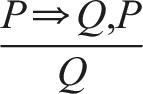
This implies that if non-religious human knowledge evolves, human religious knowledge will evolve too. The non-religious human knowledge evolves; therefore, the human religious knowledge will evolve too. The argument of Soroush is a type of valid argument. In addition, as I have mentioned previously, the contents of the preambles are also justified. Therefore, the above argument is also sound.
Although Soroush’s argument seems to be justified according to the Kantian interpretation, the Kantian presupposition lying within this argument may not seem tenable to many. 20 Below, I will provide another stronger interpretation of Contraction and Expansion, that is, the Quinian Interpretation.
3.2. The Quinian Interpretation of the evolution of the religious knowledge
Although the Kantian interpretation of Contraction and Expansion seems popular and common, it is possible to provide another interpretation of Contraction and Expansion, which is more loyal to Soroush’s framework. In this essay, I do not intend to set aside an interpretation favouring another one and postpone the judgement until another time. For this reason, I will only try to provide an alternative interpretation, that is, the Quinian interpretation of Contraction and Expansion. I believe that the Quinian interpretation of the evolution of religious knowledge is more compatible with other works of Soroush, and it can provide more cohesion. 21
In his book, The Web of Belief, Willard Quine, a contemporary American philosopher, states a range of subjects in the philosophy of science that have been effective in the discussion of epistemology and semantics. 22 According to his views, what is of greatest importance in the justification of scientific beliefs is a web of connected and interrelated beliefs. In other words, what is of greater importance is firstly the existence of such a web that is assumed by Quine and secondly, the fact that the beliefs interact with each other and modify each other to make a dynamic web.
Further to that, in ‘Two Dogmas of Empiricism’, Quine refuted the famous view of the classic and modern philosophers. 23 Many philosophers such as Hume, Leibniz, Kant and Vienna Circle believed that propositions could be divided into two categories, namely ‘analytic’ and ‘synthetic’ propositions. The analytic propositions contain their own sense and instances within them so that experience cannot help find their truth. For example, the proposition ‘all bachelors are unmarried’ is an analytic proposition. However, synthetic propositions have a strain on the real world, and experience can change the truth of the proposition. Quine asserted against these philosophers that there are no boundaries among the synthetic and analytic propositions, and this belief of the empiricists is a dogmatic belief. However, the second dogmatic order relates to the possibility of translation of the sensory and experiential data. According to the views of empiricists, especially those of the Vienna Circle, meaningful propositions are the ones that can be translated into the language of the senses. Quine’s argument explained that propositions are not solely felt by the senses. Every proposition contains other different propositions that are so interwoven that it is necessary to study other propositions meticulously to understand one. Therefore, there are no further analytical issues apart from experience that remain unchangeable. Experience affects, and it leaves its trace on all propositions. As Quine puts it, science, as a whole, should be considered as a unit for examining meaningfulness. Since Quine considers the non-empirical propositions to be meaningful, his view about the empirical propositions can be considered to be obvious. He believes that the empirical propositions about the real world do not appear before the mind singly, but they appear together with a chain of other propositions. Thus, in his view, we should not ignore the propositions of other sciences to understand the scientific theories in a particular science because a single proposition can be problematic. This view of Quine, influenced by Pierre Duhem, is generally called ‘holism’. 24 Interestingly, although Soroush does not mention Quine in his Contraction and Expansion, he mentions Duhem on several points to support his claims. 25
The other point of Quine’s works is ‘indeterminacy of translation’. In Word and Object, Quine asserts that there is no ultimate and definitely correct translation. 26 This does not mean that it is impossible to translate but that the definite meanings of the words and propositions are not fixed. For this reason, it should be said that there is always more than one correct translation. If the translation is considered as the equivalent of interpretation, then it is possible to rewrite Quine’s view as such: what is before us is multiple interpretations, and a singular interpretation does not seem to be justified.
Having the main points of Quine’s claims in mind, let me now explain how Contraction and Expansion can be interpreted differently. It seems that it is possible to understand and interpret Contraction and Expansion under the teachings of Quine. This means that the Kantian separation of religion from religious knowledge as noumenon and phenomena does not seem to be justifiable anymore, and what is considered to be dominant is our ‘religious interpretation’. This implies that religion is nothing but our interpretation of religion, and for the same reason, we face different beliefs, teachings and interpretations when dealing with religion, which constitutes a web of beliefs. We should also ponder other religious and non-religious propositions to understand each religious proposition. The subject that becomes prominent in this interpretation and perception is the whole religion or the whole of religious knowledge. In this web of beliefs, the beliefs compete and expel each other, and all this depends on the period and era in which other sciences have developed. This holistic view of religion certainly influences our semantic interpretation of it.
So understood, it seems possible to provide another interpretation of the Contraction and Expansion from a semantic viewpoint, meaning that we are faced with a web of multiple interpretations of the religious texts that really form a web of religious beliefs. These multiple interpretations influence each other and create a new issue. If the interpretations of the religious texts are deemed and called hermeneutics, the theory of Theoretical Contraction and Expansion of Religious Knowledge can be called the theory of Hermeneutical Contraction and Expansion of Religious Knowledge and all this is obtained from the Quinian perspective. Soroush himself acknowledges in the introduction of his book that the reconciliation mechanism between ‘eternity’ and the ‘change’ becomes possible from the hermeneutic and epistemological point of view. He writes that: This means that the contraction and expansion… is in fact an interpretive-epistemological theory… the reason for the inevitable insertion of Muḥkam and Mutashābih in the holy book and Sunnah becomes known well in the light of this interpretive theory …
27
He mentions the English equivalent ‘Hermeneutics’ for the phrase ‘interpretive-epistemological theory’. It is evident that the hermeneutic interpretation of the theory of the evolution of religion blurs the boundary between religion and religious knowledge, and what it places before us is the interpretation of religion. Naturally, religious interpretation varies according to the era in which people live. The interpretive perspective can show the evolution of religion more conveniently than the Kantian epistemological perspective; however, this does not mean that there is no need for religious epistemology. Epistemology is needed because all interpretations of religion cannot be considered to be justified. The interpretive perspective of the evolution of religious knowledge should also contain an epistemology so as to be able to extricate itself from the devastating criticism of relativism.
4. The epistemology of the evolution of religious knowledge
There are different interpretations in the literature which have been proposed concerning which theory of justification in epistemology is used by Soroush in Contraction and Expansion. Soroush himself has not stated anything in his book about his favoured theory of justification, and it can even be said that he found it unnecessary to mention it. For this reason, one might consider the contraction and expansion theory as a foundationalist theory, yet another might consider it a coherentist theory. 28 Classic foundationalism is a theory in contemporary epistemology that provides a model to justify beliefs. According to this model, there are two types of beliefs: basic and non-basic. Basic beliefs are justified non-inferentially without being inferred from anything else; however, non-basic beliefs are the beliefs that are inferred from basic beliefs. It is rational to think that, according to this model, basic beliefs are in an established state while non-basic beliefs change frequently, and they may derive from an argument. Non-basic beliefs are fuelled by basic beliefs – not the other way around.
The coherentism model, used for justification, does not resort to basic beliefs to justify beliefs, and it considers all beliefs to be of the same type and one rank. This model insists that beliefs should be coherent in the form of an interconnected web where there is no contradiction or paradoxes among them.
The contraction and expansion theory can be explained through both these theories of justification. Considering the Kantian interpretation, since Contraction and Expansion separates two types of beliefs and considers one of them to be fixed and the other one variable, it could be said that the justification model selected by the author is classic foundationalism. In fact, in Contraction and Expansion, religion is fixed, and there are a set of religious beliefs accordingly, such as the belief in God, prophecy and the like. However, some religious beliefs are of different types that are changing and in progress because they are limited to a particular era and are in specific relation to other sciences and teachings. These non-basic beliefs are fuelled by the basic beliefs, but the basic beliefs are fixed and are not fuelled by any other resource.
Considering the Quinian interpretation, Contraction and Expansion can be understood under the coherentist model, meaning that the emphasis that the author places on the evolution and the relationship between coherence and correspondence of the religious and non-religious sciences can be considered as an indication of the coherentist model. In the coherentist model, the focus is on religious knowledge, which is separated from religion. In addition, the religious knowledge that is limited to an era is evolving, and it has an ongoing relationship and dialogue with other sciences, making a web of beliefs that must be coherent and proportional. According to this model, great importance is attributed to the compatibility between religious knowledge and other human knowledge.
In my view, upon a holistic look into the works of Soroush, especially The Expansion of Prophetic Experience, 29 it can be argued that none of these two justifications is valid, and we should look for another justification model that can explain better the interpretive evolutionist view of religion despite some seemingly fixed and constant elements that exist within it. The justification model I propose in the present essay is based on two books, namely Contraction and Expansion and The Expansion of Prophetic Experience and is called the ‘modest-foundationalism’ model, which has been proposed for a while in contemporary epistemological theory. Among the proponents of this model are Susan Haack and Robert Audi. 30 They have attempted to forge a relationship between foundationalism and coherentism. However, some indications of this type of epistemology can be found in the works of Rawls before Haack’s and Audi’s writings on it.
John Rawls defends a type of intuitionist epistemology in his book A Theory of Justice; that is, it is possible to raise the justification of the propositions that are understood directly or non-inferentially. 31 It is evident that the propositions that do not need other propositions for their justification form the basis of human knowledge. However, it is not the case that other propositions do not influence these basic propositions. Sometimes, it is possible that some of the basic propositions that used to be considered axiomatic or self-evident are known to be incorrect upon further reflection. 32 Rawls proposes the ‘reflective equilibrium’ method by which we rationally require to revise our perception of the basic propositions. According to this method, the basic propositions are adjusted and modified through contention with other propositions until a balance is struck between the basic beliefs and non-basic beliefs through reflection.
This method is implicitly used in Contraction and Expansion: in the fact that religious beliefs think of a way to extricate themselves from contradictions when faced with the beliefs of other sciences. Although Soroush has not mentioned Rawls, Haack or Audi in Contraction and Expansion, he was probably familiar with Lakatos epistemology due to his background in philosophy of science. In Lakatosian epistemology, ‘scientific research programs’ introduce the scientific theories as structures with a hard core. This hard core is protected by a protective belt. 33 According to Lakatos, the basic beliefs are metaphorically considered as the hard core that are placed inside the protective belt of non-basic beliefs. When a theory faces an anomaly, counterexample or defeater, the whole theory is not refuted, but the protective belt of the theory is replaced by another one. 34 In this regard, it can be assumed that other assumptions have been added to the hard core to improve the theory. This Lakatosian perspective is very close to that of modest-foundationalism that exists in both basic and non-basic beliefs. In both Lakatos’s and modest-foundationalist epistemology, beliefs are both updated and revised due to the effect of basic and non-basic dialogues and criticisms. 35
It has been attempted in modest-foundationalism to maintain the advantages of both previous models, namely classic foundationalism and coherentism, and to avoid their shortcomings. According to modest-foundationalism, it is still possible to mention two types of beliefs: basic and non-basic. The basic beliefs do not necessarily possess the feature of fixed justification, but these beliefs have pro tanto justification, that is, they have been justified as much as possible. In fact, according to this assumption, these beliefs are not always true, and they will be falsified sometime in the future, but how is this possible if these types of beliefs are fixed and constant? According to this model, the answer is that there is a give-and-take between the basic and non-basic beliefs, and both these beliefs mutually fuel each other. It is not the case that only non-basic beliefs are inferred from basic beliefs, but basic beliefs can also change due to the influence of non-basic beliefs. This justification model can be better understood by considering The Expansion of Prophetic Experience. Although Soroush considers religious knowledge as the only subject influenced by history in Contraction and Expansion, he gradually intensifies his claims and considers religion to be the subject of history in The Expansion of Prophetic Experience. Not only is religious knowledge historical in nature and evolves, but religion also becomes historical and evolves. Therefore, it can be understood that, while according to the Kantian interpretation of Contraction and Expansion, religion has stood up as the stable basic belief that cannot be modified by anyone because there is no relationship between religions and other human knowledge, in The Expansion of Prophetic Experience, the religion itself has a dialogue with other human knowledge and evolves in the sense that dialogue is formed between the basic beliefs and non-basic beliefs, and they are mutually fuelled.
The discussion of ‘Essentials and Accidentals in Religions’ presented in The Expansion of Prophetic Experience applies the epistemological model of modest-foundationalism well. It should be said that the discussion of the essence here does not confirm Aristotle’s essentialism at all. It is not the case that religion possesses a fixed and invariable essence that is not to be altered. On the contrary, Soroush believes that religion does not have an essence, and the historical perspective dominates the religious analyses. 36 What Soroush possibly means by essence is the legislator’s purposes (maqāṣid al-shar’). The terms essential and accidental in this regard can be explained by the Lakatos’ view. The essence of religion is the same hard core recorded over history as assumptions. What essence means here is the realisation of a set of conjectures passed down to us through history. It is similar to what Popper labelled ‘the conjectural character of human knowledge’, which brings out conjectural essence for us to work with. 37 However, these assumptions are protected by a set of protective belts. When the history of religion faces an abnormality, the protective belt is unfastened, and the accidentals change and are updated. In this regard, the religion’s essence and hard core evolve too to adapt to the new accidentals. One of the essentials which has evolved and modified over time through contention with other human knowledge is the concept of revelation and its necessities. In the following, I will show how Soroush resorts to phenomenology in his investigation to identify what revelation is.
5. The phenomenological contraction and expansion of revelation
As mentioned above, in The Expansion of Prophetic Experience, religion itself (instead of religious knowledge) starts to interact with other human knowledge. One of the essential and fundamental elements in the Abrahamic religions which can evolve in this interaction is the concept of revelation. What is the revelation in essence? And how can other sciences help to explain revelation further? If the phenomenology of A is equated with the understanding of the experience of finding what A is similar to, 38 the question of ‘what is the revelation similar to?’ can be considered as the phenomenology of revelation. In different places, Soroush addresses the question of ‘what is the revelation similar to?’ and forms a connection between epistemology and phenomenology in many of his works. This means that understanding the nature of revelation influences its phenomenological justification. For example, if someone equates revelation with superstition, naturally, s/he will not consider it justified epistemically.
In The Expansion of Prophetic Experience, Soroush considers the nature of revelation as a religious or mystical experience. If so, as much as the content of religious or mystical experience can be justified, the content of revelation can be justified. Soroush later changes his view about religious experience and considers the nature of revelation as a poem over discussions with Ayatollah Sobhani. 39 This implies that just as a poem and its content can be justified, the content of revelation can also be justified. However, this was not his last attempt to phenomenologically analyse the nature of revelation.
The last and most recent attempt by Soroush in the field of the phenomenology of revelation relates to his controversial articles on the dreams of Muhammad titled ‘Muhammad: The Narrator of Prophetic Dreams’. 40 In this series of articles, he mentions that the revelation is similar to experiencing a dream. The dream-like nature of revelation gives more weight to the biological-psychobiological nature of revelation. Such an understanding of revelation shows that not only the recognition of the phenomenon of revelation requires interaction with other human sciences, and it contracts and expands, but also it informs us of the inherent contraction and expansion in the inner structure of the revelation. That is, the revelation contracts and expands depending on the personal moods of the prophet, and it is not the case that whatever Qur’an presents in different surahs has the same persuasive and epistemic power. In addition, the dream-like nature of revelation reveals that the revelation is not an exclusive privilege granted to the prophets, but in Rumi’s words, ‘everyone can ascend to the heavens if they are the descendants of the prophet’. Such an understanding of the revelation requires a critical requirement, and that is the fallible nature of revelation. The fallible revelation can accompany other fallible human sciences. Fallibility is one of the firm elements of modern life, which is primarily addressed in the works of Soroush. In the following, I will explain further.
6. Error recognition within the evolution of religious knowledge
Rightness and wrongness are two sides of the same coin; any attempt to find a theory about knowledge can somehow be an attempt to detect the error or error recognition. Hence, epistemology corresponds to error recognition. For this reason, the theory of contraction and expansion can be considered a type of error recognition in religious knowledge, and this is what Soroush believes in and acknowledges explicitly. Emphasising the fact that we as humans are sinful and ignorant and should confess like Hafez that we are sinful and wrongdoer implies that our knowledge is incomplete. As Soroush puts it, Now, we as human beings have been expelled from the heaven and deprived from revelation. We are sinful and ignorant. We lead a life subject to satanic deceptions and have a fallible knowledge.
41
Our epistemic task in this world, for the same reason, is to remedy and modify different teachings. Those believing in religion are only supposed to solve the problems created by the errors in religious knowledge. These errors should be repaired by other sciences as a collective task that cannot be performed by a single person. 42
The hidden foundation of Contraction and Expansion should be considered as a thorough epistemological defence of religious pluralism and political liberalism. The right of humans to commit wrongdoings are recognised and confirmed in religion, knowledge and politics. Epistemic pluralism and political liberalism call all humans to get along with each other kindly, not based on transient practical interests but the firm foundations of theoretical knowledge. 43
The theory of contraction and expansion provides favourable results for modern life. The first result is that it makes Fiqhi-based religion more modest (or ‘thinner’ as Soroush phrases it) and makes other teachings such as moral knowledge stand out. 44 Secondly, it paves the way for modern epistemic components like liberalism, democracy, political secularism and religious pluralism (recognising different interpretations) and facilitates maintaining religious thought and practice in modern times. 45
7. The practical contraction and expansion of religious knowledge
Although the contraction and expansion theory was originally hermeneutic, it has been described as theoretical. Soroush promises at the end of the first article of Contraction and Expansion that there is another contraction and expansion underway, that is, the practical contraction and expansion of religious knowledge, where he means the contraction and expansion of Fiqh. Although the written polemics after the publication of Contraction and Expansion robbed the author of the opportunity to fulfil his promise, he somehow fulfilled his promise later on and tried over the years to extend ‘practical contraction and expansion of religious knowledge’. For example, in his letter to Ayatollah Montazeri, Soroush mentioned the idea of updating Fiqh and Ijtihad by updating the main principles of religion and considered it necessary to change the epistemological foundations of Ijtihad. 46 In the same letter, he revealed his view about the rights of humans to convert to atheism (apostasy). He wrote about the relationship between violence and Fiqh and asserted in an interview with Kiyan Magazine that human rights should be discussed in the duty-based Fiqh.
In his correspondence with Mohammad Saeed Bahmanpour, Soroush announced that Muslims’ Fiqh is favourable owing to the fact that it makes their minds rule-oriented, but since it is duty-based, the concept of right should be inserted into it so the balance is struck between right and duty and this is what people ignored during the constitutional era while drawing up the constitution which brought about many difficulties then. 47 Also, Soroush mentioned in his correspondence that the fatwas of all fuqaha, including both Sunni and Shia fuqahaa, could be followed.
In Toleration and Governance, Soroush has also borrowed the view of Abu Hamid Al-Ghazali, stating that Fiqh is an earthly science and not a heavenly one. He considered Fiqh as a ‘consuming science’ (which makes use of theoretical sciences in practical issues) and not a ‘producing’ one, and he further explained that Fiqh is not the science of planning but it is merely the knowledge of religious rules. For this reason, Fiqhi-based management is not feasible, and it is only scientific management that is plausible. Soroush considers the science of Fiqh as the science of tricks, just like Kalam which is the science of polemics.
In Ethics of Gods and Manner of Power, Manner of Justice, Soroush revealed the relationship between Fiqh and ethics and considered it necessary for the fuqahaa and religious intellectuals to criticise Fiqh ethically, and he did not consider the unethical Fiqh worthy of being followed. In his The Expansion of Prophetic Experience, he considers Fiqh as one of the accidentals meaning that the majority of Fiqh could have been otherwise and contingent. He announced prayers as the only constant and timeless subjects in Fiqh and considered the remaining parts of the Fiqh, namely business and political issues, to be changeable. The sum of these investigations can be considered to be the practical contraction and expansion of religious knowledge.
8. Conclusion
In this essay, I tried to focus on three philosophical approaches in Soroush’s different works: epistemological, hermeneutical and phenomenological approaches to religion, to show that they are interrelated and should be understood together. To do that, I started by giving two interpretations of ‘The Theoretical Contraction and Expansion of Religious Knowledge’ concerning a Kantian interpretation and a Quinian one. I argued that the Quinian interpretation might have greater epistemic justification compared to the common Kantian interpretation of contraction and expansion since it is much more in line with Soroush’s reformist project holistically. The Kantian interpretation divides Contraction and Expansion into two parts, namely religion and religious knowledge; and also prevents the religion from expressing ideas and makes it isolated and considers religious knowledge as one of the limited human teachings. However, in a Quinian interpretation, the clear-cut distinction between religion and religious knowledge is blurred; they are integrated as a whole, emphasising the dialogue and evolution of different human knowledge together.
Having understood how the Quinian interpretation brings on the religion itself to speak up, I focused on the epistemology of contraction and expansion to prepare the ground for the intervention of error recognition in religion. The role of error recognition is crucial in understanding Soroush’s reformist project since it links his epistemology and hermeneutics of religious knowledge to the way he theorises about revelation phenomenologically. The presence of error in religious knowledge can influence the phenomenology of revelation and understanding of its nature and give it another look to offer a solution for modern life. For this reason, epistemology, hermeneutics and phenomenology of religion should be understood along with the concept of error.
