




Abstract
While people are generally considered as having primary rights to know and describe themselves, in parent–child interaction, young children are not always treated as having primary access to and sole authority over matters within their own domain. Drawing on naturally occurring parent–child interactional data, this conversation analytic study shows how parents claim epistemic primacy over young children with respect to matters that, based on norms of adult interaction, should be unequivocally presupposed within children's primary epistemic domain. Two forms of evidence are provided: (1) parents confirm or disconfirm children's asserted claims about their own sensations, thoughts, or experiences; and (2) parents use test questions to request information within children's domain and then evaluate their answers as correct or incorrect. These practices indicate an orientation to young children's reduced rights to claim epistemic autonomy. I argue that this is one way through which childhood is constructed in social interaction.
Childhood is conceptualized as a social construct in contemporary research on the sociology of childhood (Corsaro 2018; James & Prout 1997; Jenks 1996; Qvortrup, Corsaro, and Honig 2009). While the immaturity of children is a biological fact, how such immaturity in this particular period of human life is understood is a structural and cultural component of a society. For instance, in modern society, childhood is predominately viewed as a time of innocence (Jenks 1996), during which children are seen as “lacking responsibility, having rights to protection and training but not to autonomy” (Ennew 1986:21). While prior research has investigated the rights, constraints, and expectations associated with childhood, little empirical work has been done on the construction of childhood in social interaction—that is, how children are treated as children in their everyday encounters. Drawing on naturally occurring parent–child interactional data, this conversation analytic study provides empirical evidence of how parents orient to young children's restricted rights to epistemic autonomy as a particular contingency of early childhood on a moment-by-moment basis in the course of everyday interaction.
People are generally considered as having primary rights to know and describe their own sensations, thoughts, and experiences (Heritage 2011; Labov and Fanshel 1977; Lerner 1996; Pomerantz 1980; Sacks 1992). In parent–child interaction, however, young children are not always treated as having primary access to and sole authority over these matters. Focusing on epistemic primacy in parent–child interaction, that is, the relative rights of parents and children to access, assert, or assess something (Heritage and Raymond 2005; Stivers, Mondada, and Steensig 2011), this study shows that parents regularly claim epistemic primacy over children under the age of six with respect to matters that, based on adult norms of social interaction, should be unequivocally presupposed within children’s primary epistemic domain. I argue that this is one way through which parents construct childhood in social interaction—through treating children as having reduced epistemic primacy over matters normally within a speaker’s primary epistemic domain.
In what follows, I review prior work on epistemics in the organization of social interaction. After a description of the data and method of this study, I provide two forms of evidence in support of the argument that parents claim epistemic primacy over matters related to their children. First, parents often confirm or disconfirm children’s asserted claims about their own sensations, thoughts, or experiences. Second, parents often use test questions to request information within children’s domain and then evaluate their answers as correct or incorrect. The asymmetrical reliance on these practices, which are deemed highly marked in ordinary adult conversation, indexes an orientation to young children as having reduced rights to epistemic autonomy.
An assertion of epistemic rights, however, is not necessarily an assertion of power or control. In the current data set, parents typically use these practices to show affiliation and scaffold young children’s expressions of preferences, emotions, or memories. The analysis thus illustrates the tension between parents facilitating children’s development on the one hand and the assertion of epistemic primacy that is necessary to accomplish such goals on the other. This can be conceptualized as a cost-benefit treatment—in interaction with young children, the benefits of scaffolding their developing competencies outweigh the costs of undermining their interactional rights. However, this pattern is likely to shift when children grow older and become more autonomous about their own views, voices, and experiences, and parents are likely to perceive the cost of asserting epistemic primacy as rising relative to the benefits.
Knowledge in Social Interaction
The sociology of knowledge is concerned with the social processes through which the representations of the world are created given that “society’s influence extends into the structures of human experience in the form of ideas, concepts, and systems of thought” (McCarthy 1996:1). The root proposition of the sociology of knowledge was initially derived from Marx (2007) that human consciousness is determined by their social being. In this tradition, knowledge was conceptualized as determined by social conditions (Mannheim 1936). Yet, drawing on his analysis of the structure of the commonsense world of everyday life, Schutz (1962) argued that knowledge is socially constructed and distributed. Since each type of social actor receives a certain stock of knowledge, our commonsense knowledge must be communicated in order to become reality. This social constructionist approach was further developed by Berger and Luckmann (1966), who argued that knowledge is acquired through socialization and institutionalization as a tacit foundation for the way the world is organized. In these processes, interaction plays a vital role.
Garfinkel (1967) formalized the importance of interaction in the formulation of commonsense knowledge. Using breaching experiments and the ethnomethodological (EM) approach, he identified the procedures on which people rely to make sense of their everyday life and showed that ordinary social behavior is a matter of accountable moral choice. To sustain social order, social actors mobilize assumptions and contextual considerations to account for the actions of others and treat transgressions as morally sanctionable and thus norm guided.
While Garfinkel focused on the accountability of individual conduct, Goffman (1971) identified knowledge as a territorial preserve over which people claim primary rights to possess, control, or use, whose “boundaries of the field are ordinarily patrolled and defended by the claimant” (Goffman 1971:29). In particular, personal knowledge within information preserves contains “the sets of facts about himself to which an individual expects to control access while in the presence of others” (Goffman 1971:38–39).
Building a link between the work of Schutz, Garfinkel, and Goffman, Sacks formulated a conception of both knowledge and its social distribution as accountable matters. For instance, Sacks (1992) observed that, in storytelling episodes, storytellers routinely situate themselves as witnesses or as participants within the stories so as to make visible the epistemic basis of their telling. This distinction taps into the issue of epistemic access—what is knowable to whom, which involves the source of knowledge, directness of access, and degree of certainty and recency (Stivers et al. 2011).
Sacks’s (1992) seminal work established the interactional approach to the sociology of knowledge and guided subsequent research in conversation analysis (CA). Building on Sacks’s observation, Pomerantz (1980) formalized the distinction between type 1 knowledge, “those that subject-actors as subject-actors have rights and obligations to know” by virtue of firsthand experience, and type 2 knowledge, “those that subject-actors are assumed to have access to” by virtue of indirect means (Pomerantz 1980:187). Therefore, people who have direct or primary epistemic access to a given matter are oriented to as having epistemic primacy, that is, the greater epistemic rights to know and describe that matter (Heritage and Raymond 2005).
These dimensions of knowledge and its social distribution are central to how speakers design and understand social actions in talk-in-interaction. For instance, epistemic status consistently trumps linguistic form when determining whether an utterance is recognized as a request for information or an assertion (Heritage 2012). Turn allocation and repair organization are also oriented to by reference to speakers’ epistemic primacy (Bolden 2013; Lerner 2003; Robinson 2013). The management of epistemic primacy is particularly manifested in assessment sequences given that being the first to assess some state of affairs implicitly claims epistemic primacy over that matter (Heritage 2002b; Heritage and Raymond 2005). When the first assessor, in relation to the second assessor, does not have primary epistemic access to the claim, both parties modify their claims to “cancel the epistemic implications of the first and second positioned status of their contributions” (Heritage and Raymond 2005:34). For instance, second speakers may upgrade their claims by offering confirmation in second position (Heritage and Raymond 2005; Schegloff 1996; Stivers 2005).
While CA research on epistemics has primarily focused on epistemic primacy derived locally from interactional roles, epistemic primacy is also derivable from social categories (Raymond and Heritage 2006; Stivers et al. 2011). As Drew (1991) suggested, speakers’ asymmetrical positions vis-à-vis certain knowledge are not simply governed by their cognitive states of knowing or not knowing what the other knows. Rather, they orient to “the normatively organized social distributions of authoritative access to bodies or types of knowledge” (Drew 1991:45), of which social distribution indexes the structural identities by which participants are categorized (e.g., adult/child) and authoritative access refers to the conventionally warrantable rights ascribed to members who are categorized by one of a set of paired relational categories (adult) but not to the other paired identity (child).
This assumption of the asymmetry of knowledge between the adult/child categories is consistent with the contemporary social construction of childhood—children are deemed innocent with restricted rights and responsibilities. However, since epistemic primacy derived from social categories is underexamined in empirical CA research, it remains unclear how epistemic primacy is managed in and through adult–child interaction and hence what role this might play in the way adults work to construct childhood.
Epistemic Primacy in Parent–Child Interaction
In conceptualizing childhood, previous EM/CA research has focused on the rights, obligations, and accountability associated with membership. On the notion of member, Garfinkel and Sacks (1986) argued that it does not refer to individuals but rather “mastery of natural language,” that is, being understood by others as “engaged in the objective production and objective display of commonsense knowledge of everyday activities as observable and reportable phenomena” (Garfinkel and Sacks 1986:160). The boundary of the observable-reportable phenomena related to membership can be made visible through the concept of imitation. As Sacks (1992) pointed out, behaviors are seen as imitations when they are performed by individuals who do not have the right to perform such behaviors. Therefore, without full membership rights, children can imitate what adults do, but they cannot do these things in the sense that adults do, and accounts that are normally applied to adults are not always applicable to children.
Children’s restricted membership rights are manifested in their interaction with adults. For instance, Sacks (1992) noted that young children regularly use preannouncements, that is, the question “You know what?” and its variants, as a practice to gain a turn in conversations with adults. By eliciting a go-ahead (Schegloff 2007) in the form of “What?” from adults, children are reciprocally given the opportunity to say what they planned to say in the first place, “not on [their] own say-so, but under obligation” (Sacks 1992:256). Although children’s use of “You know what?” suggests that they can and do develop strategies to overcome interactional constraints, this practice highlights their status as having restricted rights to talk. In this regard, the construction of childhood is associated with restricted rights, obligations, and accountability in interaction with adults.
This construction applies to epistemic domains as well. While epistemic primacy is normally warranted by what people know, as Drew’s (1991) example of adult/child categories in epistemic asymmetry suggests, people tend to treat adults as having epistemic primacy over children, which does not necessarily correspond with what they actually know or do not know. In interaction with children, adults also orient to their expertise (Heritage 2013), namely, their fully developed cognitive and interactional competence, when asserting epistemic primacy—adults are generally able to correctly know something and properly communicate what they know, whereas children are not always competent in doing so.
This asymmetry is even more distinct in parent–child interaction. Whereas adults generally possess full membership rights and responsibilities as opposed to children, parents are oriented to as possessing a special status with respect to their children, including the rights and responsibilities to know, describe, and evaluate them. For instance, Raymond and Heritage (2006) examined an assessment sequence regarding two children and illustrated how a grandparent works to police the boundaries of knowledge to which she claims special rights by virtue of her status as a grandparent. While her interlocutor also has direct access to the children, the interlocutor defers to the grandparent’s primary rights in making assessments about her grandchildren.
The puzzle, then, is whether such special rights pertaining to parents trump the primary epistemic rights of children when children make claims about their own sensations, thoughts, and experiences—matters that they, according to adult norms of social interaction, should be unquestionably presupposed to have primary rights to know, describe, and evaluate. Analyzing everyday parent–child interaction, the present study provides empirical evidence of the ways in which parents assert epistemic primacy over matters within their children’s primary domain and sheds light on how childhood is constructed in social interaction.
Data and Method
The data set consists of 33 hours of naturally occurring parent–child interactions from eight families with at least one child under the age of six. The interactions were video recorded when the families were engaged in everyday activities at home, such as having meals and playing games. Participants include children, their parents, and on some occasions, other adults (e.g., family friends and grandparents). All data were collected with participants’ informed consent. For child participants, their legal guardians’ informed consent was obtained.
Among the eight families, four resided in the United States and were either monolingual English speaking or bilingual English/Mandarin speaking. The other four families resided in Taiwan and were all monolingual Mandarin speaking. Prior cross-cultural research has indicated that Taiwanese parents, under the influence of Confucianism, are more likely than their U.S. counterparts to adopt an authoritarian parenting style and assert more control over their children’s behaviors (Chao 1994). Since it is unclear whether the difference in parenting styles influences the degrees to which parents place restrictions on children’s epistemic rights in interaction, I initially examined the data to look for possible cultural differences. However, I found no difference in participant orientation with respect to epistemic primacy between the data collected in the United States and that collected in Taiwan. For this reason, the data are presented together as a single set.
This study takes a conversation analytic approach (Sidnell and Stivers 2013). The video data were transcribed using the system developed by Jefferson (2004). For Mandarin data, transliterations, linguistic glosses, and idiomatic English translations are provided. The age of the child participant is listed in years and months in the extract headers of all transcripts.
Along the line of previous CA research on epistemics (Heritage 2013), this study focuses on participants’ orientations to their knowledge instead of their actual possession of knowledge. That is, the analysis does not seek to explicate participants’ cognitive status as an underlying process that guides or explains their behaviors. Rather, it examines how parents and children orient to their relative rights to access, assert, or assess knowledge in association with practices of talk-in-interaction to accomplish recognizable actions. Similarly, this study investigates not whether children actually have restricted epistemic rights but whether they are treated as having restricted epistemic rights.
While prior CA research in this field has explored other domains of knowledge (e.g., assessments of places, events, or other people), in order to highlight the asymmetry in parent–child interaction, this study specifically examines claims of private knowledge about oneself, which is typically owned primarily or even exclusively by the speaker. In the current data set, 70 instances of children making claims about their own sensations, thoughts, or experiences in both initial and responsive positions were identified and analyzed.
Analysis
Focusing on young children’s claims about matters within their own epistemic domain, this analysis identifies and examines two types of practices through which parents assert epistemic primacy over their children: (1) parents respond to children’s claims about their sensations, thoughts, and experiences by confirming or disconfirming them; and (2) parents ask test questions to request information within their children’s domain and then evaluate their answers as correct or incorrect. Parents consistently use these practices when scaffolding and affiliating with their children’s expressions of preferences, emotions, and memories, yet in so doing, they inevitably restrict children’s epistemic autonomy. This prioritization of facilitating young children’s development over their epistemic rights constitutes one way through which parents construct children as children in social interaction. The last part of the analysis addresses how this pattern shifts over time as children grow older and become more autonomous and accountable for their own views and voices.
Confirming (or Disconfirming) Children’s Claims
This section focuses on children’s first-position claims to which they have primary and sometimes exclusive epistemic access. These claims normally carry epistemic primacy, of which the firstness is oriented to by other speakers (Heritage and Raymond 2005). However, as the analysis reveals, even under circumstances that (1) children have direct, primary, or even sole access to their claims; (2) children assert the claims in first position; and (3) such claims do not make confirmation or disconfirmation a conditionally relevant next action, parents often confirm or disconfirm the claims in second position, thereby asserting epistemic primacy over children’s propositions. This is a significant departure in adult conversation norms, where first position assertions are rarely confirmed by others (Stivers 2005). When this happens, it is usually done under circumstances where, for instance, the second speaker had previously alluded to the proposition and is thus claiming ownership over it (Schegloff 1996).
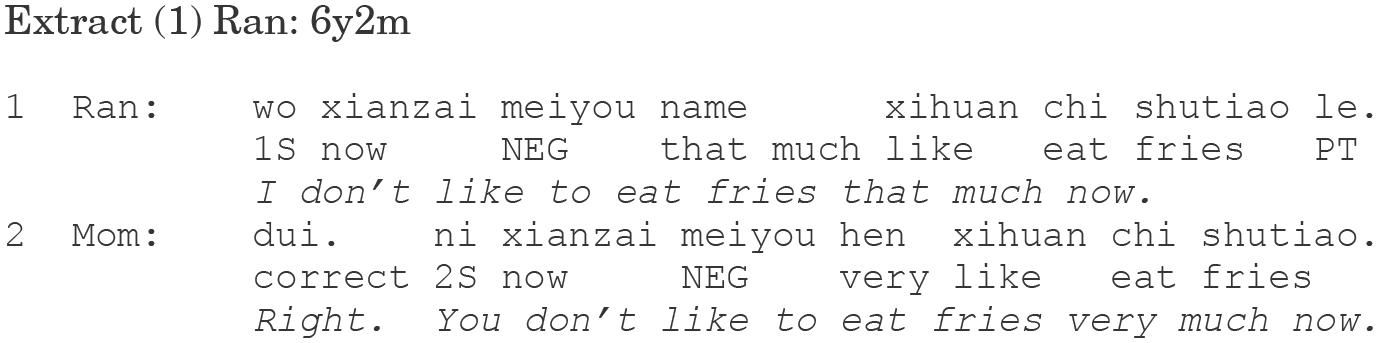
Instances in parent–child interaction do not share such context. For example, Extract 1 illustrates Ran’s assertion about her food preference in first position. Ran’s mother had not previously talked about Ran’s preference, and the preference is certainly Ran’s to own. Nonetheless, instead of acknowledging Ran’s claim, Mom asserts epistemic primacy over Ran’s claim by confirming it in second position.
Although Mom (as Ran’s primary caregiver) apparently has some knowledge of Ran’s likes and dislikes, this is through observing Ran’s past behavior, an indirect form of access to her preferences. Yet, Mom offers confirmation with dui (correct), which assesses the validity of Ran’s prior claim and displays Mom’s primary right to evaluate it (Kendrick 2010), followed by a full repeat, which also indexes Mom’s epistemic primacy (Heritage and Raymond 2005; Schegloff 1996; Stivers 2005). The only difference is that Ran emphasizes a comparison between the past and the present, indicated by name, “that much,” and the turn-final currently relevant state particle le (Li and Thompson 1981), whereas Mom’s formulation concerns the current state.
Extract 1 exemplifies a typical case of parents confirming children’s claims to which children have primary access. Considering that if an adult interlocutor makes a similar assertion, even when the recipient has some knowledge of the claim through observation, the recipient would still be accountable to display their access to the speaker’s past behaviors, not their preferences (e.g., “Yeah, you didn’t eat fries recently”). In adult conversations, the practice of confirming in second position is normally deployed only when the first speaker has in some way failed to attend to the recipient’s primary rights over the domain (Heritage and Raymond 2005; Stivers 2005). In the current data set, the parents do not have primary or even equal access to their children’s claims. The relatively common usage of this practice in parent–child interaction thus provides evidence for parents’ construction of children as having reduced rights to claim epistemic primacy and hence autonomy over their own sensations.
These parental practices, however, do not necessarily index an assertion of power or control. Rather, parents typically use these practices to accomplish other interactional goals, and the assertion of epistemic rights is contingent on such goals. In Extract 1, Mom’s confirmation works to affiliate with Ran and demonstrate that she knows her child. This is essential for sustaining the congruence between her status and stance as a parent since, as Enfield (2011) argued, there is a distinction between a claim derived from parents’ official authority (that they gave birth to their children) and a demonstration enabled by their actual authority (that they know their children). To maintain their status as parents, parents need to prove with action that they are capable of carrying out their entitlements and responsibilities. A consequence of Mom’s practice, though, is treating Ran as having reduced epistemic autonomy. In this regard, this analysis examines the mechanisms through which childhood (and parenthood) are socially constructed and does not evaluate these parental practices as “good” or “bad” parenting.
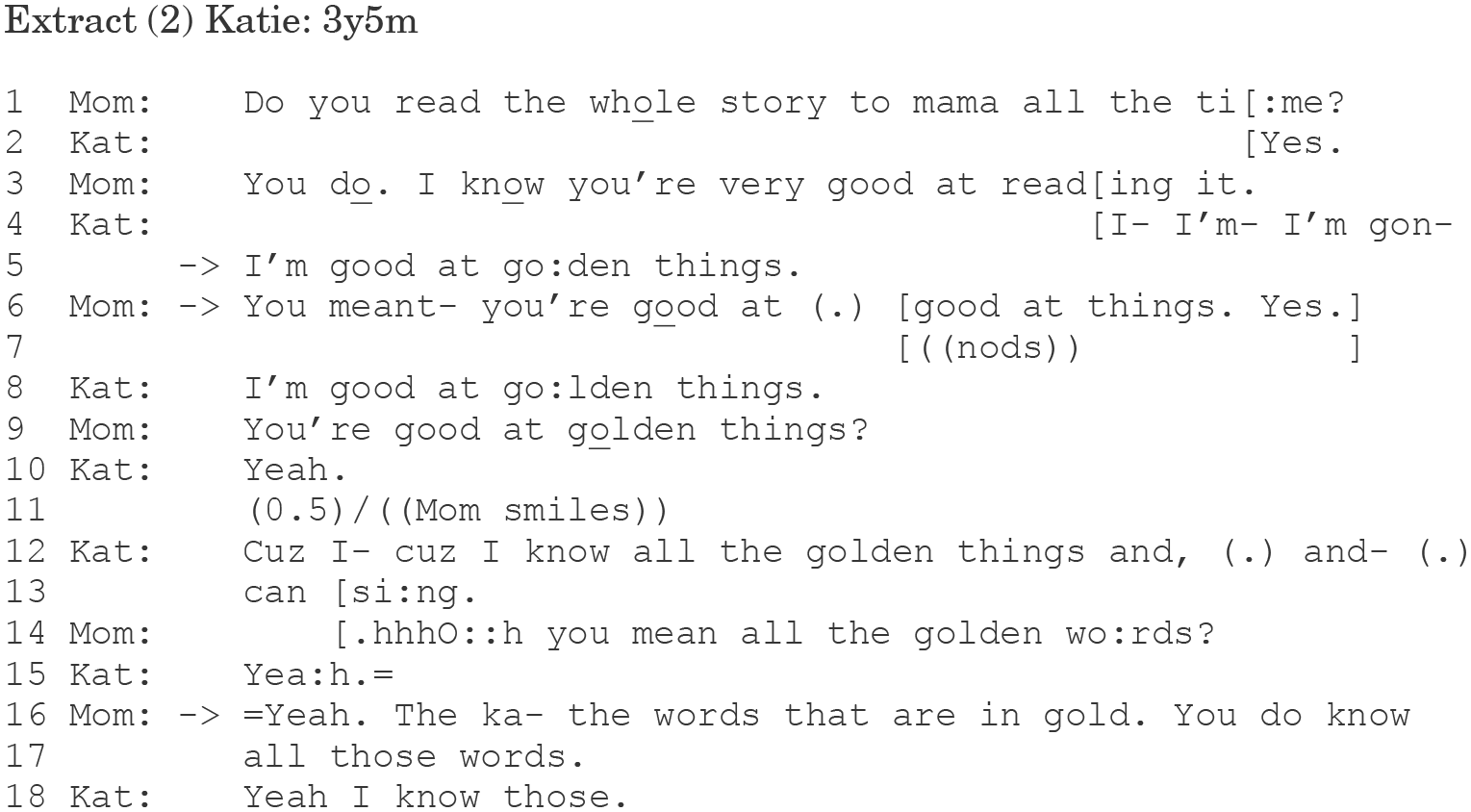
The asymmetry between parents and children is even more evident when interactional issues emerge. In Extract 2, the mother confirms the child’s claim in second position even though the referent of the claim is unclear. Here, Katie and Mom are talking about the storybook Tangled, and Mom positively evaluates Katie’s ability to read the story (line 3). Immediately following the assessment, Katie asserts that she is good at “go:den things” (line 5). Although the sequential order of Katie’s assessment would allow Mom to assume that the assessment is, at least to some extent, related to reading the story, Mom apparently does not realize what “go:den things” are until later.
Throughout the sequence, Mom orients to herself as the one to assert and assess these matters related to Katie—whether she reads the story, how good she is at reading it, that she is good at things, and ultimately, her knowledge of the golden words. In line 6, Mom initiates repair on Katie’s claim but produces an incorrect solution. Even though “g
Katie seems to recognize the miscommunication as she reasserts her claim with a clearer articulation of the “l” sound in “go:lden” (line 8). Mom then correctly identifies that “go:lden things” refer to the golden-colored words in the storybook (line 14). After Katie confirms that she is indeed referring to the golden words, Mom again validates Katie’s claim. Her full repeat with the expanded auxiliary verb (“You do know all those words” in lines 16–17) weakens Katie’s claimed primacy and reinforces Mom’s authority in second position (Raymond 2017; Stivers 2005). While Mom’s practice works to affiliate with Katie’s self-praise, her subordination of Katie’s epistemic right to assess her own ability is part of how she treats Katie as a child, even as she affiliates with her.
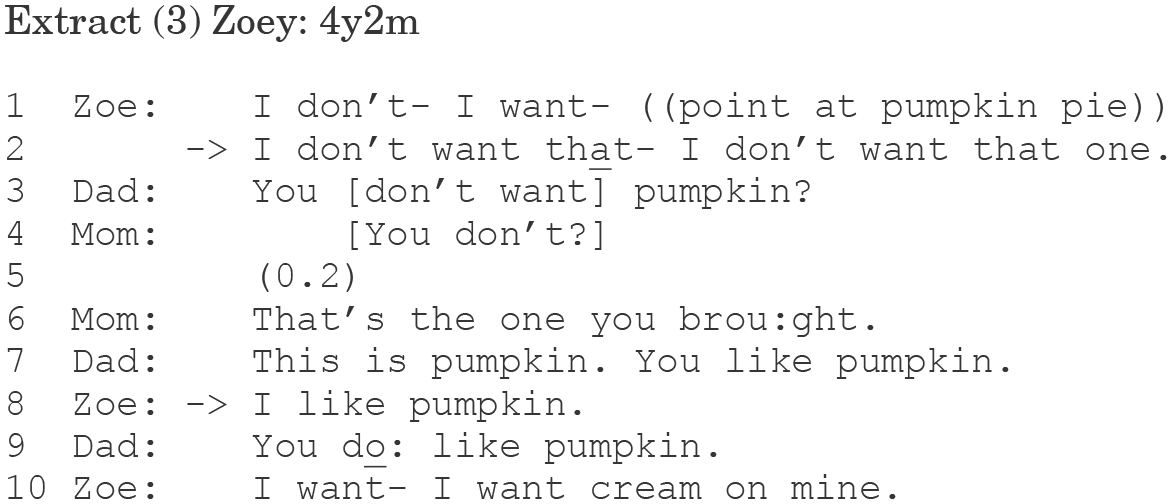
In the following cases, I show how parents tread even more into their children’s domain by explicitly challenging children’s assertions to which parents have restricted epistemic access. Extract 3 illustrates a child asserting her wants, and this becomes a site of contestation between the child and her parents. Here, Zoey is about to have dessert with her family and needs to choose between a pecan pie and a pumpkin pie. The sequence begins as Zoey points at the pumpkin pie and asserts, “I don’t want that one” (line 2). Zoey’s action can be understood as a claim of disliking the pumpkin pie and simultaneously a request for the other pie, which makes her parents’ action of getting her the pecan pie relevant. Zoey does not invite confirmation or disconfirmation of her preference for the pecan pie. Yet, even though wanting something is completely personal and is thus normally oriented to as a matter over which the speaker possesses sole authority, both Dad and Mom challenge Zoey’s claim.
While simply providing Zoey with what she requests would be to treat her as an autonomous individual whose wants are hers to own (and mistakes hers to make), Dad and Mom both initiate repair on Zoey’s claim. Their other-repetitions project a challenge to Zoey’s claim (Rossi 2020). Specifically, Dad uses a full repeat and replaces “that one” with “pumpkin” (line 3), which works to account for Zoey’s rejection of the pie: she does not realize it is pumpkin. With no immediate uptake from Zoey, Mom and Dad continue to challenge Zoey’s claim. Even though they do not have direct access to Zoey’s wants at this moment, Mom asserts her knowledge of Zoey’s past activity (“That’s the one you brou:ght” in line 6), to which she has access, whereas Dad reiterates that the pie is pumpkin (line 7).
Although the parents’ practices thus far may be similar to those of adults who work to prevent other adults from accidentally choosing something undesirable by informing them of what they are choosing (e.g., reminding a vegetarian that a dish contains meat), the subsequent sequential unfolding provides evidence for the asymmetry between parents and their children. In line 7, in addition to informing, Dad asserts Zoey’s preference without any mitigation (e.g., “I thought you liked pumpkin” or “You like pumpkin, don’t you?”). While second-position claims typically imply epistemic subordination (Heritage and Raymond 2005), Zoey’s assertion in response (line 8) is hearable as a competitive move since she has direct, primary access to what she likes and, if she were treated as an adult, should have authority over the claim. However, Dad further upgrades his epistemic primacy over Zoey’s claim using a full repeat with an expanded and stressed auxiliary (line 9), which works to undermine Zoey’s default ownership over the claim (Raymond 2017; Stivers 2005). Zoey then backs down in this competition and requests cream on her pumpkin pie (line 10), orienting to her own epistemic domain as malleable. Here, too, the treatment of Zoey as a child can be separated from affiliation with the child. Both parents work to get Zoey’s wants right, but instead of simply reminding her of the flavor of the pie, they further claim epistemic primacy over what she likes and thus what to choose.
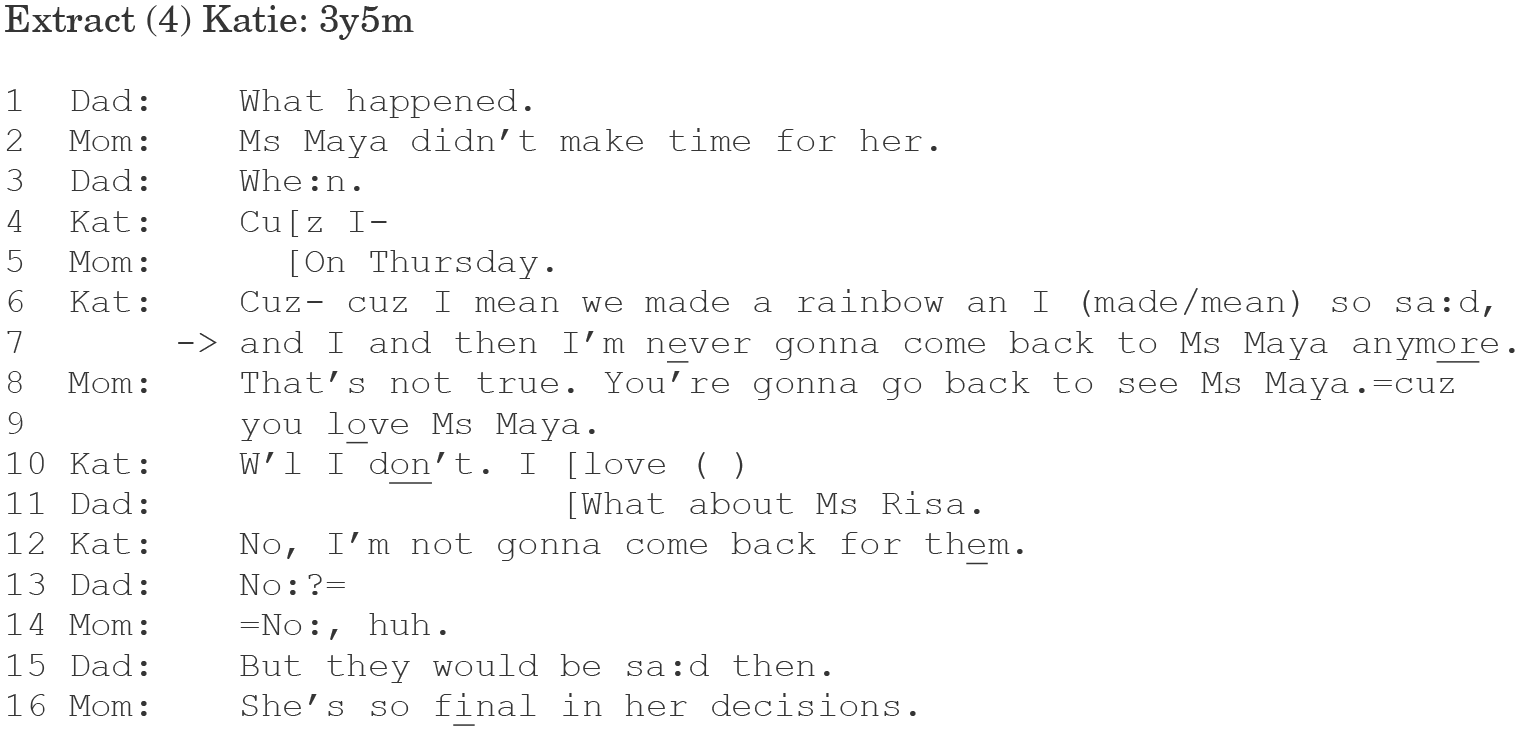
In Extract 4, the child asserts her plan for action, which is explicitly challenged by her mother. Prior to this segment, Mom prompted Katie to talk about what she had done in preschool on Thursday. Katie reported that she did not get a chance to make a rainbow because “Ms. Maya didn’t make time for me” (data not shown). Extract 4 begins as Dad enters the room in the middle of this conversation. After Mom provides the context for Dad, Katie asserts, “I’m n
Given her status as a child, Katie’s decision of not going to preschool is not hers to make. Nonetheless, from her perspective, the thought process of this decision is valid and lies entirely in her own domain. In line 8, Mom immediately disputes Katie’s decision and produces a counterclaim with absolute certainty. Although Mom’s disagreement might be hearable as asserting her deontic authority, that is, the right to determine others’ future actions (Stevanovic and Peräkylä 2012), she immediately rushes through to an account, “=cuz you l
This case illustrates another dimension of epistemic primacy not seen in prior cases: Katie resists Mom’s counterclaim and account (line 10). She then reasserts her decision when Dad nominates another teacher whom Katie presumably adores as well (line 12). This time, Mom appears to acquiesce to Katie’s position without actually ceding much authority. When Dad seeks to persuade Katie to change her mind (line 15), Mom blocks Dad’s pursuit on behalf of Katie (line 16), which again conveys her rights and authority to evaluate Katie’s decision.
In this section, I have shown that parents consistently confirm or disconfirm their children’s first-position propositions about matters within their primary epistemic domains. In so doing, parents compete with children’s primacy over the propositions even though both the epistemic access to and the sequential position of the claims would favor children. I argue that this asymmetry is partially responsible for the social construction of children and parents in interaction. Children are oriented to as children with restricted epistemic primacy over matters in their own domains, whereas parents are oriented to as parents with rights and obligations to know their children.
This asymmetry can also be understood in Goffman’s (1981) notion of the three components of speakerhood grounded in their differential rights and responsibilities to the utterance: animator, who articulates the claim; author, who composes the forms of the claim; and principal, whose positions are established by the claim and commits to the claim. While interactants tend to presuppose an alignment of these three roles in ordinary adult interaction—an animator is normally treated as author and principal unless there is evidence otherwise (Enfield 2011)—children are not consistently treated as such. Even though they animate and author their claims, their primary rights and responsibilities as principals of their claims are often undermined.
It is important to emphasize that this analysis illustrates not that children have restricted rights but rather that children are treated as having restricted rights, and such participant orientation is evidenced in the ongoing interaction in children’s everyday encounters. Moreover, it would be a misconception to argue that children’s rights are denied solely on the basis of the social category to which they belong regardless of the interactional context. As the analysis reveals, the orientation toward children’s restricted rights is contingent on other interactional goals, such as affiliating with the child’s self-assessment (Extracts 1 and 2) and helping the child make optimal decisions (Extracts 3 and 4). Therefore, rather than mistreatments that require remedy, such orientations should be viewed as contingencies of the construction of childhood in the Taiwanese and American societies from which the data are drawn.
Recipient-Side Test Questions
The second form of evidence that parents treat children as having reduced epistemic autonomy is their use of recipient-side test questions (Antaki 2013). Test questions are used to request information obviously already known to the questioner (Searle 1969) and are prevalent in environments involving asymmetrical relationships, such as educational settings (Mehan 1979). In adult–child interaction, test questions constitute a majority of all questions children encounter, even more common than genuine requests for information (Siraj-Blatchford and Manni 2008). The main purpose of test questions in adult–child interaction is to assess children’s knowledge, although they can be used to establish joint attention for younger children as well (Olsen-Fulero and Conforti 1983).
One particular variant of test questions is what Antaki (2013) termed recipient-side test questions. Drawing on interactions between adults with intellectual disabilities and care staff members at a residential service, Antaki identified how staff members issue recipient-side test questions that appear to be designed to genuinely solicit information “that is truly within the recipient’s domain, but whose answers are nevertheless assessed by the questioner as being right or wrong” (Antaki 2013:7). This practice is deployed for educational or therapeutic purposes and reflects the cognitive asymmetry between staff members and residents.
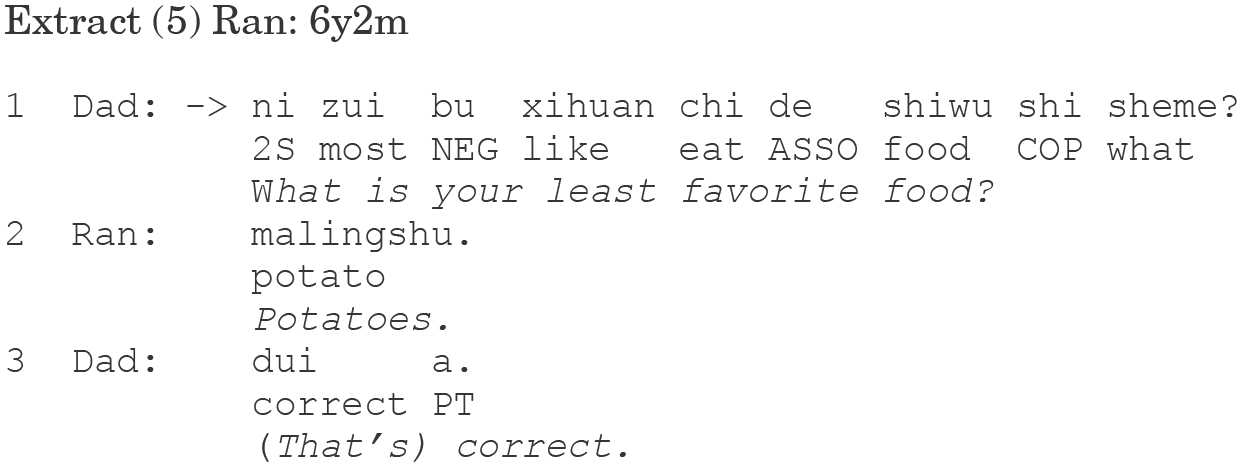
The prevalence of recipient-side test questions in everyday parent–child interaction provides another revealing window into how childhood is constructed in social interaction. Parents often ask children about sensations, thoughts, or experiences that are primarily and sometimes exclusively owned by children but then orient to their own rights to evaluate children’s answers. Extract 5 exemplifies a recipient-side test question about the child’s preference, to which Dad has only indirect access.
Dad’s question appears to seek information to which Ran has sole direct access and therefore would have epistemic primacy. However, after Ran provides an answer, Dad offers dui, “correct,” an evaluation of the validity of Ran’s answer (see Extract 1). This is followed by a turn-final particle a with a slightly high pitch, which indexes the speaker’s preexisting knowledge of the matter and thereby suggests their epistemic primacy (Wu 2004). Just as parents consistently assert epistemic primacy over children’s first-position claims, so, too, do parents claim authority to assert correctness or incorrectness of children’s answers from third position. Nonetheless, as previously noted, such practices are not designed to subordinate children’s rights but are contingent on other goals. It is likely that Dad works to demonstrate that he knows his child, which is essentially affiliative with Ran.
The special rights and entitlements ascribed to parents are even more salient when compared with Antaki’s (2013) findings in residential service, where most recipient-side test questions involved staff members asking residents about their recent activities, to which the questioners also had direct access. The staff members’ epistemic primacy is justified by their actual knowledge about the residents and their expertise as individuals with typical cognitive competence. Even with the twofold warrant, only in rare cases did the staff members ask about private experiences (e.g., residents’ meal preferences) and then imply that the answers were not what they had anticipated. This contrasts with how Dad explicitly assesses Ran’s answer as correct, orienting to his right to judge what his child likes.
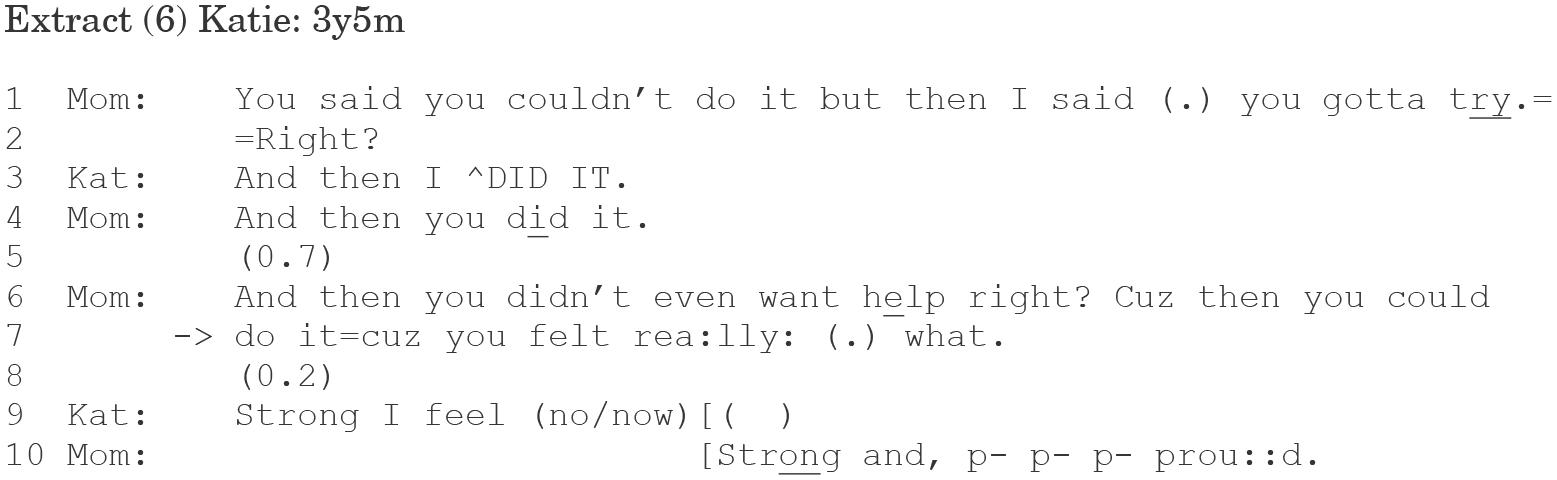
Extract 6 moves from the domain of preferences to an even more private domain: emotions. Prior to the extract, Katie mentioned that she is able to scooter fast on a ramp. Mom then brought up that Katie had scootered up a hill all by herself the other day even though she was not confident at first (line 1). In line 7, Mom asks a recipient-side test question regarding how Katie felt about this experience.
While Katie and Mom were both involved in the scootering event, Mom did not have direct access to how Katie felt inside. Nonetheless, Mom treats Katie’s answer as hers to judge as right or wrong. She first confirms Katie’s answer with a repeat (“Str
The next case further illustrates how parents deal with children’s responses to recipient-side test questions. While recipient-side test questions concern topics that recipients are accountable for knowing, young children sometimes fail to answer these questions. When this happens, although parents could directly reveal the answer or move on without further addressing the issue, they tend to provide guidance as if they are dealing with standard test questions deployed for educational purposes. In Extract 7, Mom asks Katie about something Katie said the day before (line 3), but Katie has difficulty recollecting the answer.
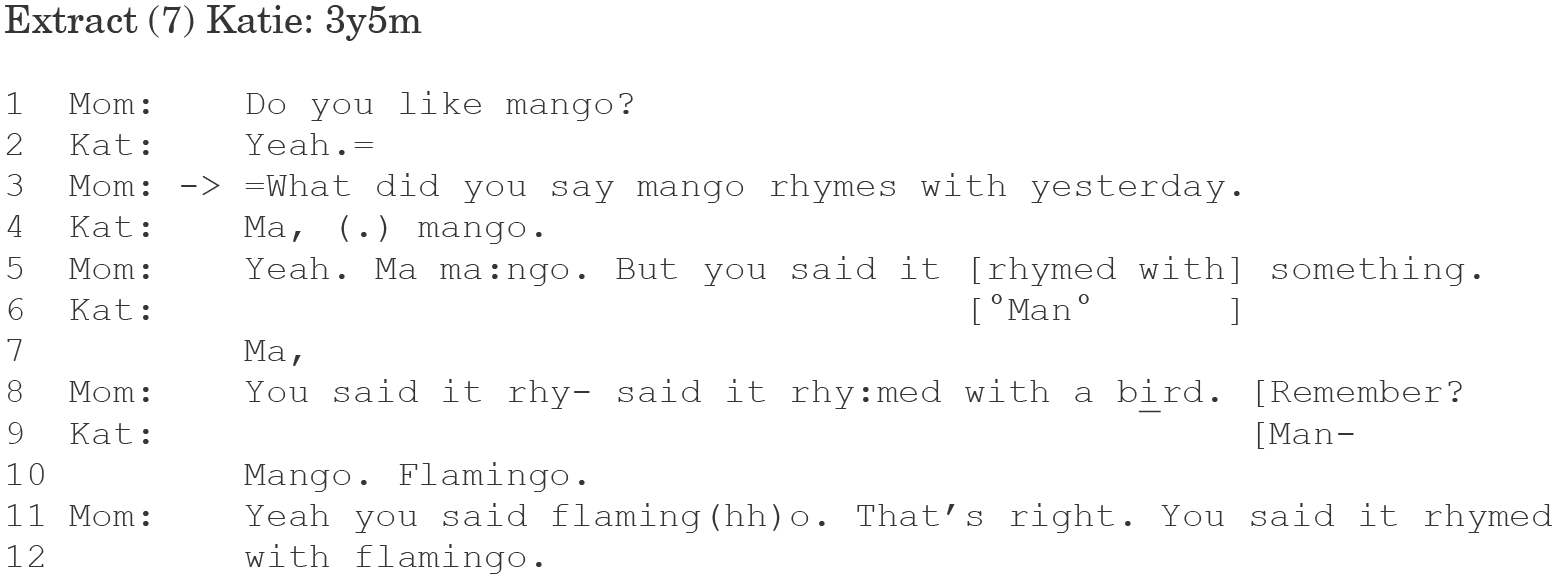
This case is similar to a standard test question sequence in educational settings as Mom shepherds Katie toward the correct answer. The hint provided by Mom (line 8) increases her epistemic primacy and successfully leads to Zoey’s correct answer (line 10). On occasion, typical adults also forget about things they have said or done, but other knowing adults are more likely to provide answers rather than guidance. In contrast, here Mom prioritizes obtaining an answer from Katie over the progress of the sequence, thus violating the normative preference for progressivity (Schegloff 2007; see Liu 2022). This departure from adult norms in social interaction again conveys an asymmetry between adults and children: Mom orients to her right to test what Katie remembers and guide her when she has difficulty, whereas in ordinary adult conversation, interlocutors are unlikely to be treated as having similar rights.
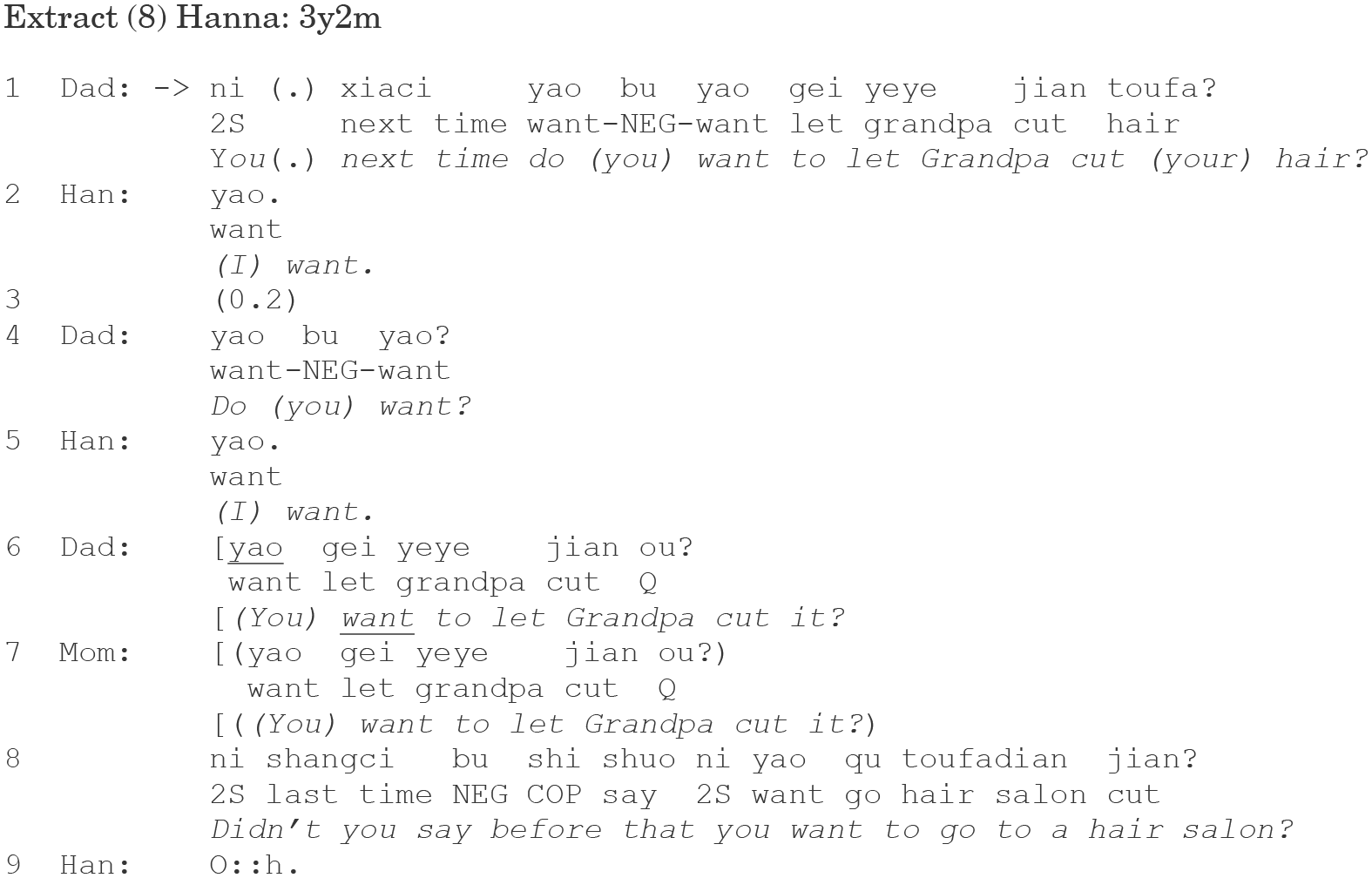
When children’s answers to recipient-side test questions depart from parents’ expectations, parents sometimes challenge these answers. Extract 8 occurs when Dad is chatting with his friend, who compliments Hanna on her new haircut. Dad told the friend that Grandpa did the haircut and then selects Hanna to answer whether she wants Grandpa to cut her hair next time (line 1). Dad’s question appears to be a genuine information-seeking question since Hanna’s wants are exclusively hers. However, after Hanna provides an affirming answer (line 2), both Dad and Mom take issue with her answer.
After a short delay, Dad initiates repair on Hanna’s answer with a partial repeat (line 4), which implies his disagreement (Schegloff 2007) and projects a challenge to Hanna’s claim (Rossi 2020). Hanna again confirms that she wants Grandpa to do her haircut. This time, Dad produces a full repeat with a stress on yao, “want” (line 6), making his disagreement clearer. Mom also challenges Hanna’s answer by invoking her previously made, inconsistent proposition (line 8). Specifically, her turn is designed as a highly assertive negative interrogative (Heritage 2002a), which invites Hanna’s confirmation. Mom’s practice is similar to those shown in Extracts 3 and 4; it is difficult to directly disprove children’s claims when they exclusively own them, but parents often undermine these claims by asserting knowledge of things they have access to, such as children’s past preferences and activities.
Given that Dad was already telling the friend that Grandpa cut Hanna’s hair, he could have directly told the friend that Hanna said she wanted to go to a hair salon. Dad’s selection of Hanna to answer this recipient-side test question not only engages Hanna in the ongoing conversation but also allows her to voice her own thoughts, which orients to and fosters her interactional autonomy and agency. However, when Hanna’s response does not fit with their expectations, Dad and Mom prioritize asserting epistemic primacy over Hanna’s claim and demonstrate to the friend and Hanna that they know their child.
This section analyzed how parents issue recipient-side test questions in conversations with children. These questions are designed as if they are genuine information-seeking questions, but once children provide answers, parents assert epistemic primacy over the answers by treating them as something they have rights to confirm or disconfirm. While parents tend to utilize these questions to accomplish affiliative interactional goals, such as expanding the child’s emotional literacy (Extract 6), scaffolding the child’s phonics recognition (Extract 7), and inviting the child to talk about herself (Extract 8), these practices display an orientation to children’s restricted epistemic autonomy. This tension between the goal of facilitating children’s development and the construction of children’s restricted rights is likely to shift as children become more autonomous over time.
Becoming Epistemically Autonomous
Thus far, this analysis has illustrated the interactional construction of childhood that creates a tension between the goal of facilitating children’s developing competencies and the construction of children’s restricted rights, that is, the “trade-off ” between parents scaffolding their children’s expressions of themselves on the one hand and the assertion of epistemic primacy that is necessary to accomplish such goals on the other. This can be conceptualized as a cost-benefit treatment: in interaction with young children, the benefits of scaffolding their developing competencies outweigh the costs of undermining their interactional rights. However, this pattern is likely to shift as children grow older and become more autonomous and accountable for their own views, voices, and experiences.
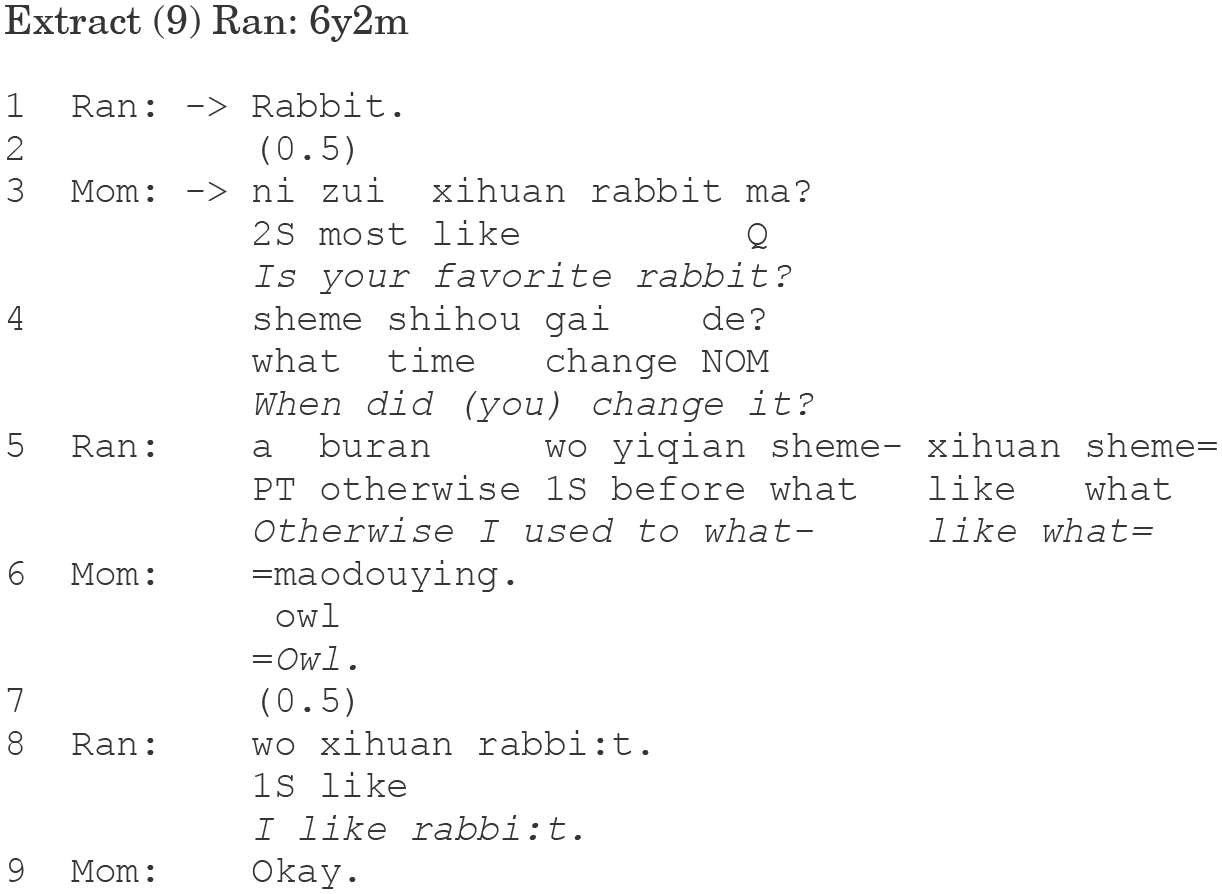
In the current data set, children at the preschool stage typically conform to parents’ asserted epistemic primacy and rarely push back possibly because they have just begun to grasp theory of mind (Astington 2006) and may not have a clear understanding of epistemic considerations in interaction. Yet, as children’s cognitive and interactional competence develops, the dynamics of epistemic primacy in parent–child interaction begin to shift. For instance, in previous analyses, we have seen that when young children’s claims are not consistent with what their parents know about them, parents usually challenge these claims (Extracts 3, 4, and 8). In the following extract, however, when the six-year-old child (who is significantly older than the children in Extracts 3, 4, and 8) makes a claim different from what Mom anticipated, Mom acknowledges rather than challenges the claim. One minute before this extract, Mom asked Ran about her favorite animal, but Ran had a hard time figuring out her answer. Extract 9 begins as Ran revisits the topic and produces “rabbit” (line 1).
Ran’s answer is significantly delayed sequentially and is produced without sufficient context to connect to Mom’s question (e.g., “My favorite animal is rabbit”). Therefore, Mom’s question “Is your favorite rabbit?” (line 3) is hearable as a genuine request for confirmation rather than a challenge. Mom’s follow-up question (“When did you change it?” in line 4) also treats Ran’s claim as true and valid. Although Mom does implicitly assert her prior access to what Ran used to like, she defers to both Ran’s initial claim (line 1) and reassertion (line 8), thereby validating Ran’s status as an autonomous individual whose preference is hers to own and claim. Mom’s practice may be accounted for by Ran’s older age and hence her higher autonomy over her claims.
This shift is also manifested in children’s orientations to their own epistemic rights. While Ran’s response in line 5 indexes some resistance to Mom’s implicit assertion of her prior knowledge, in the following case, we see a more explicit pushback against “territorial offenses” (Goffman 1971:49) from the child. Prior to the sequence, Mom was telling her friend that six-year-old Ning is now in kindergarten. She then selects Ning and asks her about a Christmas party that they both attended the day before (line 1), possibly because it was an event held by the kindergarten. However, Ning refuses to “play along” with this recipient-side test question, claiming that she does not know the answer even though she apparently does.
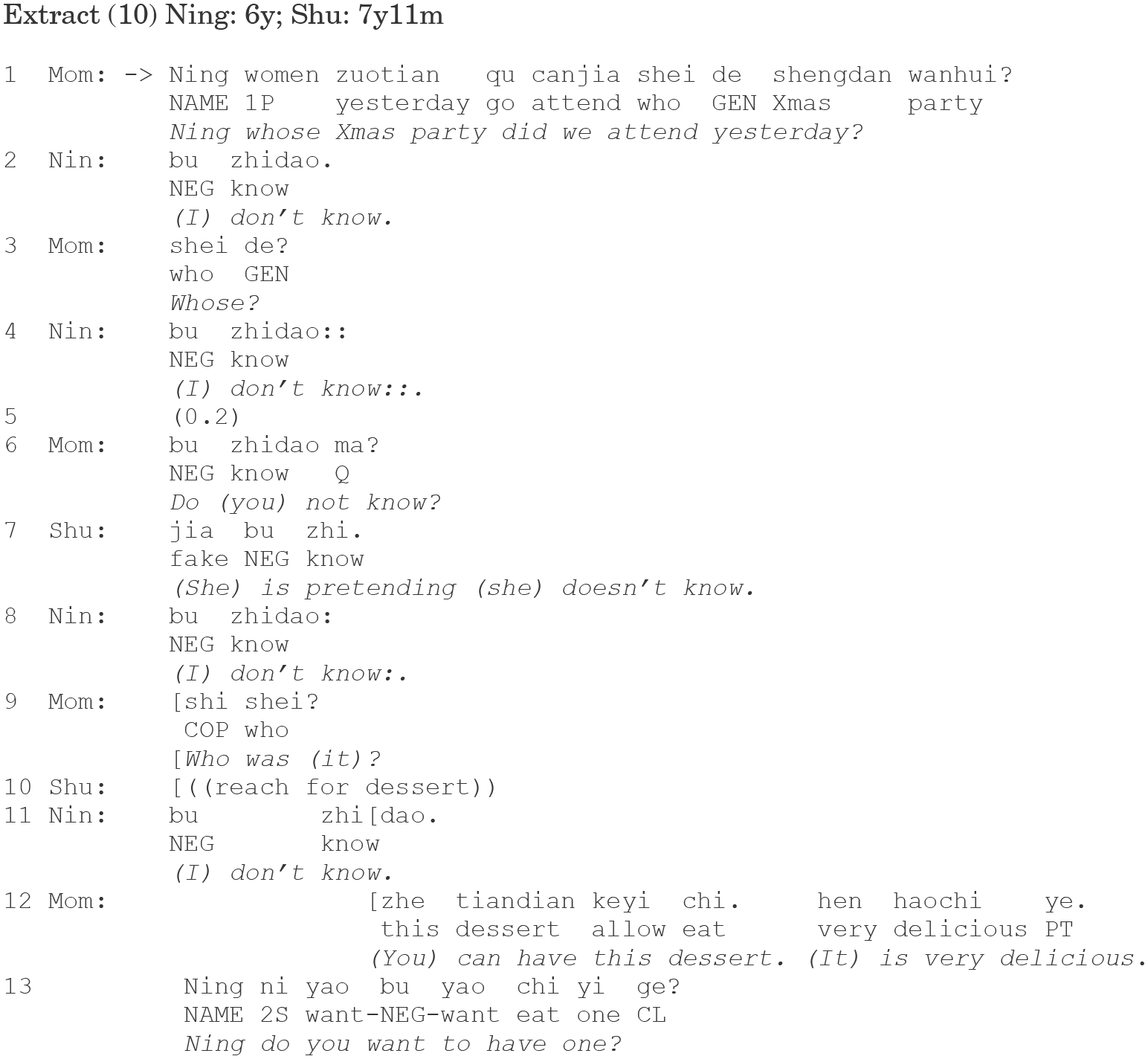
Considering the regular cognitive competence for her age as well as the recency and salience of the event, it is safe to assume that Ning knows the answer. However, she repeatedly responds to Mom’s question with a nonanswer response, “I don’t know,” in the face of Mom’s multiple pursuits (lines 3, 6, 9) and her older sibling Shu’s accusation that she is merely pretending not to know the answer (line 7). Ning’s noncompliance with Mom’s question agenda implies that she refuses to be tested for her knowledge of a recent and salient event.
Throughout the sequence, it is evident that Mom recognizes that Ning is capable of answering but unwilling to do so because when Ning indicates that she does not know the answer, Mom simply repeats the question rather than offering guidance (in contrast to Extracts 6 and 7 involving younger children). After her pursuits fail to elicit an answer from Ning, Mom shifts to the next topic (lines 12–13) without sanctioning Ning for her noncompliance, and the answer is never addressed. This case shows how Mom balances subordinating Ning’s epistemic primacy and fostering her autonomy. Mom’s practice of asking the recipient-side test question indexes her asserted authority over Ning’s experience. When Ning persistently resists the question, Mom orients to Ning’s autonomy, refraining from further claiming her authority (e.g., revealing the correct answer or disputing Ning’s claim of not knowing the answer).
This section addresses a shift in the patterns of how parents and children display, contest, and negotiate epistemic primacy as children come to be treated as more autonomous and responsible for their own sensations, thoughts, and experiences. That is, as children grow older, parents are likely to perceive the cost of assertions of epistemic primacy as rising relative to the benefits. Since the current data set mainly consists of interactions involving younger children under the age of six, future research with data on interactions with older children will be needed to draw a more conclusive argument about this developmental shift of children’s growing epistemic rights.
Discussion
The present study shows that in interaction with young children, parents consistently orient to having epistemic primacy over their children’s claims regarding their sensations, thoughts, and experiences in both initial and responsive positions. Through the use of second-position confirmations and recipient-side test questions, parents treat children as children and construct childhood as a status associated with restricted rights to claim epistemic autonomy in social interaction. While there are other socializing agents who also construct childhood in particular ways (e.g., peer interaction; see Goodwin 1990; Maynard 1985), in most cases, parents as agents of primary socialization are most influential during early childhood. This study thus contributes to identifying a general norm in the construction of early childhood in American and Taiwanese societies from which the data are drawn.
Contemporary studies of the sociology of childhood have been eager to conceptualize the social construction of childhood and theorize the ways in which children’s reality is negotiated in everyday life through their interactions with adults. The present study contributes to this line of research by offering empirical evidence for how parents orient to children’s restricted epistemic autonomy as a particular contingency of childhood on a moment-by-moment basis in social interaction. In addition, since most studies in this field rely on the ethnographic methodology to document children’s everyday interactions (Corsaro 2018), this conversation analytic study carries methodological implications by demonstrating that we are able to systematically identify and analyze how the relative rights of children and parents are made visible and consequential in the details of naturally occurring conversational data.
The present study also contributes to research on the interactional approach to the sociology of knowledge. Prior research in this field has mainly focused on epistemic primacy derived locally from interactional roles (e.g., producer of a first-position assessment). While there is a general assumption that epistemic primacy is derivable from social categories, the asymmetry between adult/child or parent/child is usually invoked merely as a theoretical example without empirical grounds. This study identifies interactional practices in everyday parent–child conversation that exemplify the norm-guided social distributions of knowledge and thereby illustrates how epistemic primacy derived from the status of parent is practiced and oriented to in everyday interaction. In particular, this analysis not only describes the fact that parents possess entitlements and responsibilities but also shows how parents exercise them as a way of demonstrating their status as parents.
Another implication of this study is that it provides insight into what it means to be a speaker. In his work on footing, Goffman (1981) conceptualized speaker as a laminated entity constituted by animator, author, and principal and discussed marked instances in which the three roles are not carried out by the same person. Most exceptions involve institutional tasks (e.g., providing an interpretation of a speech) or local interactional goals (e.g., reported speech). Yet, Goffman also mentioned that parents sometimes animate and author “baby talk” on behalf of their child but make it apparent that the baby is the principal being talked for. The present study also shows that children’s speakerhood is malleable—they are not always oriented to as the principals who have primary rights and responsibilities of their claims.
Drawing on interactions with children under the age of six, this study explicates the interactional construction of early childhood that creates a tension between fostering children’s development and asserting epistemic primacy and provides a model for longitudinal research into how this tension may shift over the life course. While the current data set affords a fairly limited illustration of older children, it is worth noting that in preparation for this research, I did collect some interactional data involving older children (ages 9–12). These data were eventually excluded from the present study because there is virtually no occurrence of the two focal practices. This is consistent with the cost-benefit argument discussed earlier: children in this age range have obtained a relatively high degree of autonomy, which allows them to push back on parental authority, and scaffolding their developing competencies is no longer a priority for parents. Yet, the construction of childhood is determined not only by children’s (in)competence but also by their social category as children. Older children are thus unlikely to acquire equal rights and obligations as their parents do by virtue of their more sophisticated “mastery of natural language” (Garfinkel and Sacks 1986:160). To further investigate how the interactional construction of childhood shifts over time, future research will need to identify other interactional practices through which participants’ orientations to the status of being an older child are made visible and consequential. This may even extend to grown children since a child is always a child in relation to their parents, and “mother knows best.”
Footnotes
Acknowledgements
I am grateful to Tanya Stivers for her guidance in developing this project as part of my dissertation research. I would also like to thank Steven Clayman, John Heritage, Giovanni Rossi, Hongyin Tao, and three anonymous reviewers for their comments on earlier versions of this article.
Funding
The author(s) disclosed receipt of the following financial support for the research, authorship, and/or publication of this article: This work was supported by J. Yang and Family Endowment for Taiwan Studies at UCLA and UCLA Asia Pacific Center.
