




Abstract
Informal segregation has been widely studied in various public settings but not on public playgrounds. Drawing on an 11-month ethnography among mothers of young children, we examine how informal segregation is (re)produced on public playgrounds in two ethnically diverse neighborhoods in Finland. Our findings reveal different normative practices. First, normative rhythms and parenting practices structure playground activities by limiting opportunities for contact between ethnic minority and majority groups and producing exclusive spaces. Second, group norms and the seeking of ethnic/racial ingroup members together regulate mothers’ interaction with outgroup mothers on playgrounds; mothers are inclined toward their ingroup while outgroup mothers are often ignored, resulting in only illusory contact. Based on our analysis, we argue that by better understanding the normative roots of segregation, more comprehensive and effective interventions can be designed to facilitate positive contact in this population.
In the past few decades, various researchers have claimed that contact studies conducted in rarefied conditions do not fully capture the meaning and nature of intergroup contact and, therefore, that contact needs to be studied as it happens in real life (Dixon, Tredoux, and Clack 2005; McKeown and Dixon 2017). Critical social psychological studies on intergroup contact in the mundane settings of everyday life have shown that people do not always avail themselves of opportunities for intergroup encounters and that various forms of structural and behavioral practices limit opportunities for contacts even in formally integrated contexts (McKeown and Dixon 2017). This informal segregation may contribute to maintaining social inequalities and intergroup prejudices; if groups do not interact even when they have the opportunity to do so, the potential for improved intergroup relations is lost (Bettencourt, Dixon, and Castro 2019; Dixon et al. 2005). Therefore, it is crucial to understand how informal segregation is (re)produced in seemingly mixed societies and contexts (Bettencourt et al. 2019). Many researchers have noted that informal segregation is best understood by studying the day-to-day practices and routines that organize the everyday life of ordinary people in their local environments (Dixon et al. 2005, 2008; Swyngedouw 2013). Still, its construction and practices across different places and population subgroups are not fully understood.
In this article, we study informal ethnic/racial segregation in the context of public playgrounds in ethnically diverse neighborhoods. Public playgrounds are open semipublic spaces where children and their parents are meant to socialize with other local families, seek company, and receive social support (City of Helsinki 2021c). Thus, public playgrounds afford more potential for intergroup contact in mixed contexts than many other public or semipublic spaces studied previously (see Bettencourt et al. 2019). Realizing this potential, however, is not straightforward; diversity on the playgrounds also means a diversity of cultural (e.g., parenting) norms, which can hamper or even inhibit intergroup encounters. Taking a color-blind approach to ethnic/racial diversity (see Bonilla-Silva 2018) may enhance cultural racism so that dominant groups and their parenting practices are considered the appropriate standard while difference is seen as deviance (see Walton 2021). Therefore, public playgrounds provide an interesting real-life context for analyzing how divisions between ethnic and racial groups are constructed and maintained. To date, however, these places have attracted little attention in the informal segregation literature.
First, we review prior research on the lack of intergroup contact and the norms relating to intergroup interaction in public places. Then we present our ethnographic case study of public playgrounds in two multiethnic neighborhoods in Helsinki, Finland, offering a “thick description” (Geertz 1973) of the informal segregation occuring there (on the “micro-ecology of segregation,” see Dixon et al. 2005). Prior social psychological research has emphasized intergroup attitudes and intraindividual factors to explain contact avoidance (e.g., Stephan 2014), but taking an “ecological” view of intergroup relations (Dixon and Durrheim 2003), we suggest that informal segregation also evolves through everyday parental, national, and interactional practices on the playgrounds.
Informal Segregation Built into Practices and Ingrained in Context
Unofficial boundaries between different groups (e.g., ethnic/racial, religious) are often reproduced collectively through everyday practices and behavior (Dixon and Durrheim 2003). Prior research on such informal segregation has focused particularly on divided or postconflict communities, such as White and Black people in South Africa (e.g., Alexander and Tredoux 2010) and Catholics and Protestants in Northern Ireland (e.g., Dixon et al. 2020), but has also looked at multiethnic contexts in the United States and elsewhere (e.g., Swyngedouw 2013). In these environments, research has analyzed informal segregation in public and semipublic spaces where contact could potentially occur but does not, for example, on beaches (Dixon and Durrheim 2003), in university lecture halls (Koen and Durrheim 2010) and cafeterias (Clack, Dixon, and Tredoux 2005), on public transport (Swyngedouw 2013), in public parks (Abdelmonem and McWhinney 2015), and in shopping malls (Priest et al. 2014).
This research has also described how segregation is maintained by various behavioral practices, such as seating patterns and visiting times (e.g., Alexander and Tredoux 2010; Koen and Durrheim 2010). In their recent review of “informal ‘micro-ecological’ practices of (re)segregation,”Bettencourt et al. (2019) identified three psychosocial processes underlying the embodied practices of microecological spatial segregation in everyday life: negative attitudes and stereotypes, ingroup identification and threat, and feelings of anxiety, fear, and insecurity. Yet not all intergroup behavior derives from these processes. For example, prior research shows a homophilic tendency to favor similar others over difference (Mackinnon, Jordan, and Wilson 2011), which can lead to seeking ingroup company at the cost of intergroup contact. Ingroup company is also preferred because it consumes less resources than intergroup interaction (Al Ramiah et al. 2015). Therefore, outgroup avoidance can result from apathy rather than hostility (Paolini et al. 2022).
In this study, we analyze how segregation is (re)produced and maintained on public playgrounds. Playgrounds are semipublic spaces that offer a potential arena for regular intergroup contact in ethnically diverse neighborhoods, unlike many previously studied public and semipublic spaces that afford only fleeting encounters and rarely provide reasons to make contact with strangers. Parents of young children often attend playgrounds to network with other local parents to fulfill their needs for company and social support (Bader, Lareau, and Evans 2019; see also Hunter 2010). Children's behavior plays an essential role in initiating contact between parents (see Cahill 1987) and thus in forming parents’ networks.
Despite this potential, recent research has illustrated the difficulties of interethnic contact on playgrounds. Perrem (2018) showed that Western immigrant parents in Japan had negative contact experiences with local parents, leading them to turn to private spaces with their children. Parents who continued using the playgrounds experienced feelings of exclusion and sadness at their child's lack of peer contacts there. To our knowledge, no other research has analyzed parents’ interethnic contact experiences on public playgrounds.
Perrem’s (2018) main explanation for negative interethnic contacts was that visible bodily differences among the children complicated the interethnic encounters and influenced the parents’ perception of belonging. Although Perrem (2018) referred to norms of bodily appearance, he did not analyze how cultural parenting norms and everyday child-care routines influenced this process of segregation. Parenting, however, is strongly shaped by culture-specific habits and norms (Bornstein 2012). Therefore, it is possible that norms influence parents’ intergroup encounters or even inhibit them—often unintentionally. Thus, to better understand informal segregation on playgrounds and generally, it is important to analyze how parenting norms and routines (re)produce it.
Norms Producing and Maintaining Informal Segregation
Norms are socially shared standards of appropriate behavior in certain contexts that define individuals’ and group members’ behavior at multiple levels (Pettigrew 2018). Research has been conducted on group norms (e.g., perceived ingroup norms on contact; Tezanos-Pinto, Bratt, and Brown 2010), societal norms (e.g., discrimination policies; Pettigrew 1998), and cultural norms (e.g., parenting norms; Bornstein 2012). In addition to being group-, society-, and culture-specific, norms can also be context-specific: norms are often associated with a certain space and organize behavior there (Alexander and Tredoux 2010).
Previous research has shown that intergroup norms play an especially important role in the reproduction of informal segregation. Alexander and Tredoux's (2010) study on a South African university campus demonstrated that segregated spaces, racial relations, and the coexistence of groups were managed carefully by a set of intergroup norms that were communicated nonverbally to others. Such unspoken rules reproduced informal segregation on the campus through “belonging” and “exclusion” as groups sought to reproduce the dominant social order through the racialization of space. Thomas (2005), in turn, showed in her ethnography of teenage girls in a U.S. high school how the girls encountered, internalized, and came to repeat racialization through their everyday spatial practices in the school lunchroom (e.g., sitting together within their racial ingroup girls). The segregation of racial groups in their school seemed “natural” to them but was in fact produced through their daily performative work. Norms are not fixed or “natural” but are actively applied by group members who negotiate, interpret, and manage them (Horne and Mollborn 2020).
Parenting norms are not fixed either (Bornstein 2012); expectations of “good parenting” can vary by ethnic group, gender, and socioeconomic class, and the intersection of these different expectations forms a web of multiple and sometimes contradictory ideals of parenting (Faircloth 2014). The now common ideal of “intensive mothering,” for example, is particularly endorsed by middle- and upper-class mothers (Hays 1996; see also Faircloth 2014). While these mothering norms can increase social order and a sense of commonality among those who follow them, they can also alienate others who either do not share such norms or are unable to follow them (see Horne and Mollborn 2020). This especially affects culturally different and other minority mothers for whom attaining the hegemonic “normality” or ideals in parenting is not similarly possible or desired due to race, class, or resources (Peltola 2016). These mothers, therefore, particularly need to negotiate and manage such ideals in their everyday lives (see Seppälä et al. 2022).
Public playgrounds are spaces of multiple and changing norms. As an institution, they endorse hegemonic cultural norms of parenting (Lareau 2011; Peltola 2016), but parents from different cultural and societal groups also visit them, bringing their own understanding of parenting ideals. It therefore follows that parenting norms need to be negotiated in everyday life on the playground (Horne and Mollborn 2020). Parents’ difficulties in following the hegemonic norms of the playground can lead to disengagement from playground activities and a subsequent avoidance of such activities. Diversity of parenting practices can also cause conflicts between parents with different interests. Thus, not only intergroup norms but also cultural norms of everyday parenting may (re)produce informal segregation. Previous analysis of this process, however, has neglected the role of these wider cultural norms. With this analytical frame in mind, we examine playgrounds because they offer an ideal setting for studying how intergroup and cultural normative practices (re)produce informal segregation in Finland.
Context of the Study: Public Playgrounds in Helsinki, Finland
We conducted an ethnographic study in two multiethnic neighborhoods in Helsinki, Finland, a country whose history of modern immigration is relatively short compared to many other European nations. Currently, 8 percent (440,000 people) of residents are first- or second-generation immigrants, one-quarter of them living in Helsinki (City of Helsinki 2021b; Official Statistics of Finland 2021). More than half (53 percent) of first-generation immigrants have European backgrounds (e.g., Russia, Estonia, etc.), 30 percent have Asian backgrounds, and 11 percent have African origins. Among second-generation immigrants, 46 percent have European, 28 percent Asian, and 22 percent African backgrounds (Official Statistics of Finland 2021). Overall, the migrant population is younger than the Finnish population; one in four children below school age in the metropolitan area of Helsinki has a migrant background (Official Statistics of Finland 2021).
In Finland, “being Finnish” is strongly associated with whiteness and Finnish ancestors. In everyday language, “immigrant” and “foreigner” are commonly used and racialized without explicit mention of race (see Lundström 2017), which increases the risks of taking a color-blind approach to ethnic/racial diversity (Bonilla-Silva 2018). The city of Helsinki, however, aims to prevent segregation between neighborhoods, having, for example, recently promoted residents’ equality through education in antiracism (City of Helsinki 2017, 2021a).
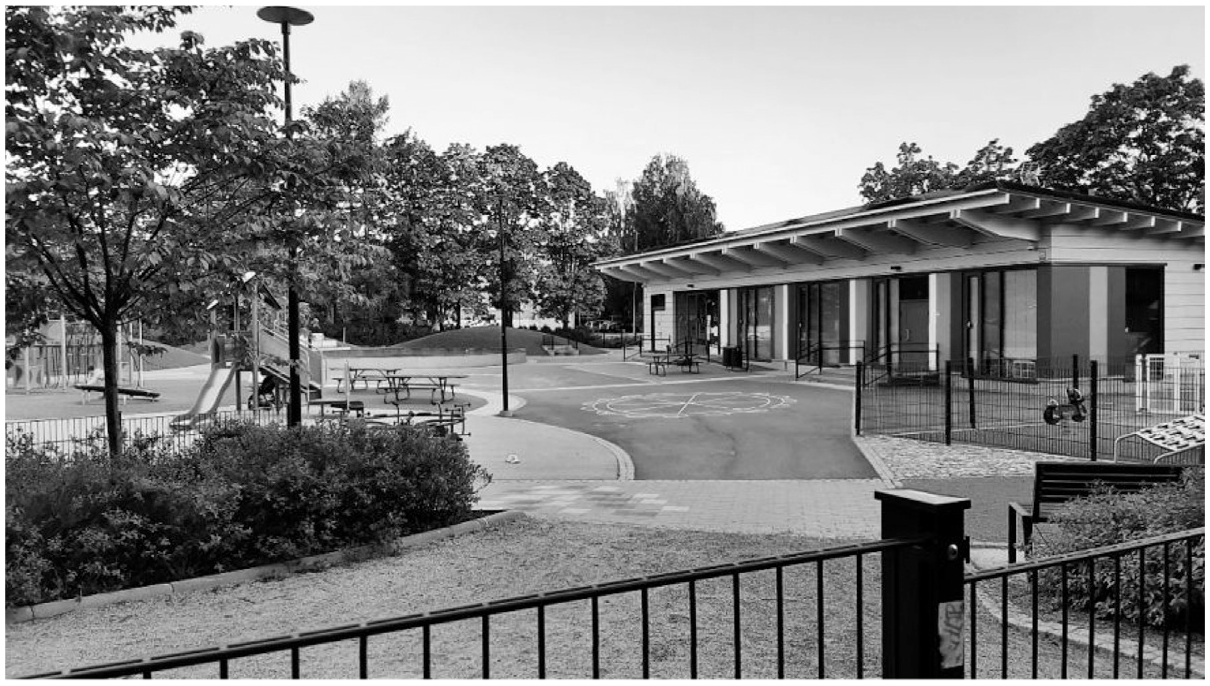
A typical public playground in Helsinki, Finland in the summer. The playground area includes an outdoor space with green areas, different play areas (e.g., climbing frames, swings, slide), a playground building that is usually open on weekdays from 9 a.m. to 4 p.m., and a wide open area where the free lunch for the children is shared in the summer. Although the playground has fences, the gates are not locked, even at night, and it is possible to visit at any time. To protect the privacy of our interlocutors, this playground is from a different neighborhood than the studied playgrounds.
Public playgrounds in Finland offer free-of-charge activity spaces for young children with their parents in every neighborhood. There are 64 municipal playgrounds around Helsinki, where full-time instructors trained in social services or education offer early childhood education and care for children, support for parents, and after-school clubs for the youngest pupils (City of Helsinki 2021c). These activities are organized mostly outdoors on the playground. The instructors work from 9 a.m. to 4 p.m., during which time the indoor building is also open for playground visitors. In the mornings, the instructors interact with young children and their families, while in the afternoon, they focus on schoolchildren. Public playgrounds form an important part of the city's services for families with children (see further King and Sills-Jones 2018; Moll and Kuusi 2021).
The home care of children under three is financially supported by the state in Finland. It is popular: in 2020, more than 99 percent of children under one, 63 percent of one-year-olds, 28 percent of two-year-olds, and 16 percent of three-year-old children were cared for at home, usually by a parent (Säkkinen and Kuoppala 2021). While Nordic countries have relatively gender-equal parenting policies, very few fathers visited the studied playgrounds (outside of summer holidays). Finnish fathers’ use of parental leaves is far behind that seen in Iceland, Norway, and Sweden, and only 5 percent of Finnish fathers share parental leave with the mother (Eerola et al. 2019). Thus, our study focuses on mothers, who formed the vast majority of the adult playground users.
A diverse neighborhood can provide a number of opportunities for inter- and intraethnic encounters for the parents of young children (e.g., Paajanen et al. forthcoming; Schaeffer 2013; Wilson 2013). Such encounters can help immigrant mothers create positive relationships with majority group mothers, thus benefiting the integration of immigrant mothers and enhancing the social cohesion of the community (see Stevenson and Sagherian-Dickey 2016). Playground encounters between mothers from migrant backgrounds and local Finnish mothers, however, were rare during our field study, which alerted us to the absence. Reflecting on this and on prior research on informal segregation and norms, our attention was drawn to the specific question of how informal segregation is built and sustained through everyday social practices and norms present on playgrounds and among mothers.
Methods
This article draws on ethnographic research including participant observation and follow-up interviews conducted in two adjacent multiethnic neighborhoods in Helsinki, which were expected on the basis of their demographic profile to offer good opportunities for intergroup contact. Selecting them, we used the following criteria: (1) at least-one third of children under four years old had a foreign mother tongue, (2) more than 100 children with a foreign mother tongue lived in the area, (3) Finnish/Swedish predominated as the mother tongue, (4) the area had good local services for families with children (e.g., a public child health care clinic, family clubs, playgrounds), and (5) the socioeconomic status of the population was as close as possible to the average across Helsinki. Playgrounds were chosen as a special site of observation because previous research has shown that they provide opportunities to socialize with and receive social support from other local families (e.g., Bader et al. 2019).
Participant observation was conducted between August 2018 and June 2019 on the public playgrounds and other public spaces used by local families. For the first three months, the first author participated sporadically in the daily life of all four playgrounds in the area and occasionally observed other places, such as streets and a local shopping mall. Then we chose one playground, centrally located in the neighborhoods, as our primary field. In August, the fieldwork started with establishing a confidential relationship with playground staff to facilitate unchallenged attendance at the playgrounds and enable relatively inconspicuous and unobtrusive data collection.
The ethnographic data were collected during 70 observation periods, of which 32 (about 90 hours; 0–7 days per month) were on the playgrounds. Playgrounds were regularly observed during their organized activities in the mornings and early afternoons, and each research visit lasted about three hours. A few field visits were also made in the evenings and weekends, and relationships with several interlocutors were further developed at other field sites and during interviews. Observations focused on mothers who, in this context, were accompanied by their young children. During the daytime, all the mothers on the playground had children younger than preschool (i.e., six years old), and many had more than one child with them. The first author observed routine playground activities (e.g., playground “Olympics,” singing, and playing), talked with visitors and instructors, and observed the mothers’ interactions on the playground.
Synchronously with participant observation, the same researcher conducted semistructured follow-up interviews with 24 local mothers of children under three (10 from migrant backgrounds) three times every six months. The interviewees were recruited in the target neighborhoods from different local activities for families (N = 17), through the public child health care clinic (N = 4), and by snowballing (N = 3). The researcher also encountered some interviewees during fieldwork, thus becoming more acquainted with them, but others she met only in the interviews. Compared to the interviews, the playground observation produced greater variety in the age, gender, and roles of interlocutors (e.g., playground instructors). While no specific questions about playgrounds or segregation were asked, interviewees spontaneously talked about their related experiences, and these data were used in this analysis.
Data were collected by the first author, a White Finnish woman. Communication in the field and interviews were conducted in Finnish, English, or Spanish, in line with the researcher's language fluency, at the participant's preference. During participant observation, the researcher jotted down notes that were later used to write up a detailed field diary. The semistructured interviews were recorded and transcribed verbatim for later analysis. This research received prior ethical statement from the Ethics Committee of the Tampere Region, Finland. To protect the privacy of our interlocutors, all names are pseudonymized. The study is part of MAMANET, a larger research project focusing on intra- and intergroup relations of mothers of children below school age in Helsinki.
The analytic process of ethnography is iterative and starts during fieldwork, although more formalized analysis often takes place after withdrawal and intellectual distancing from the field (Aull Davies 2012). At this stage, the other authors started taking a greater part in the analysis and dialogical reflection. We started by systematically selecting all sections of the field notes and interview transcripts that related to playgrounds and (lack of) contact and contextual descriptions (e.g., of the material environment) using Atlas.ti software. Our abductive analysis built on literature about intergroup contact theory and informal segregation. With this focus in mind, we analyzed the different practices and norms producing informal segregation in playground settings and identified key themes. First, we drew out the relevant phenomena by developing analytic categories (e.g., “absence of contact,”“avoiding contact,”“nonnormative behavior”), rereading the data alongside relevant literature and refining our research questions (Hammersley and Atkinson 2019). Then we organized the data under more general categories, compared them, and developed themes that responded best to our research questions (Hammersley and Atkinson 2019).
Results
We begin by presenting the findings on how normative parenting and related rhythms are (re)produced and how they serve to (re)construct informal segregation both temporally and spatially. We then turn to informal segregation as it unfolds in everyday interactions, and we illustrate how it is (re)constructed through the norms and practices of outgroup avoidance and ingroup seeking.
Asynchrony in Time Geographies
We found that normative daily schedules created differences in opportunities for meeting other mothers; when playground visits did not happen according to the normative schedule, the mothers’ sense of belonging and social recognition on the playground was affected.
The playgrounds’ schedules were built around typical office hours in Finland. Playground buildings (public, interior spaces) were open to visitors, the shared toys outside were free for families to use, and the playground instructors organized activities and talked to visitors between 9 a.m. and 4 p.m. on weekdays, except on national holidays, when the buildings were closed. The outdoor space, however, was never closed: the gates of the fenced area were never locked, and the playground area could be used also in the evenings by, say, families or youth. The highest numbers of adults with children visited between 9 a.m. and noon, although only a small proportion of the area's families visited the playground on a regular basis—the regular visitors consisted of fewer than 10 local Finnish mothers and a local Finnish father. Over the school year (mid-August to the beginning of June), indoor and outdoor activities were held for younger children with their parents in the mornings (9:30 to 11 a.m.), while afternoon activities (from 12 p.m. onward) were organized for school-age children waiting for their parents to return from work. This schedule deliberately followed the rhythm of kindergarten and school, serving to prepare families with young children for “a safe continuum” from early childhood education to school life (City of Helsinki 2019).
During the summer, the number of playground visitors was at its highest because of warmer weather, the holiday period, and because the city provided a free lunch for the children on weekdays in the summer. The number of visitors could rise to 200 people per day, unlike winter days when, typically, two to six majority Finnish mother-child dyads visited the playground. In the summer, the playground space was used more extensively, and there was greater variation in children's ages and the ethnic diversity of visitors. Despite these established schedules and the neighborhoods’ multiethnicity, however, mothers from different language and ethnic groups rarely spent time on the playground at the same time besides in the summer months.
Along with offering early childhood education, the playgrounds evidently socialized attending mothers into normative parenting. This often happened implicitly through practices such as opening hours and activities, which (re)produced standards for a desirable daily schedule. The mothers’ socialization into these norms was evident, given that their conversations often concerned the “best” ways to organize the day so they could follow “the rhythm.” Such norms were not merely (re)produced in talk; the most active playground visitors also physically (re)produced the normative schedules by coming every day at the same time to the playground (“time geographies”; Dixon et al. 2020). Even those mothers who rarely visited the playground recognized the normative schedules and often coordinated their rhythms and time management with them, for example, by following certain schedules for the child's eating and sleeping. On occasion the socialization took concrete form, with the instructors explicitly directing the mothers of infants to develop a regular daytime rhythm for their child, as in the following example from a mother-baby meeting organized in the public playground building: Next, the mothers are instructed to fill in the baby's rhythm on handouts with a clock face. . . . When everyone has finished, the handouts are collected and gone through, one by one, with the mothers named aloud. The instructors comment on them. In principle, mothers can also comment, but little debate arises. . . . The clear expectation is that, regardless of the age, babies should have a specific rhythm that recurs from day to day. Routine is emphasized and Sirkku [playground instructor] reminds mothers that they should be the ones to decide the child's sleeping hours, not the child herself. (Field notes, October 2018)
Such organized meetings were open for all families, but most neighborhood mothers did not participate and only rarely visited the playground's outdoor area except in the summertime. The regular and long-term visitors of the playground formed a small “nuclear group” who knew the “correct” time for going to the playground and meeting up with the others. Hence, participating in the playground activities and meeting other mothers required the mothers to adapt to the established schedules; in return, they could claim the status of belonging to the nuclear group, which seemed to include only local Finnish mothers and a father. Deviation from the typical daily rhythm was often associated with experiences of isolation or loneliness.
Before midday, the playground emptied as mothers headed home with their strollers and the instructors took their lunch break: There are only few parents with their children left on the playground. In poor weather at this time there would probably be no one here. Today, [there is] at least someone. Leo and Malla's [local Finnish] mother says that they are actually the last ones on the playground every day because that is how their rhythm has formed. They do not lunch before 12 o'clock, and usually around 1 p.m. (Field notes, April 2019)
This example of the empty playground illustrates how routines of eating, moving around, and playing are defined by embodied national habits, which become normative through unreflexive socialization and repetition (Edensor 2006). The 11 a.m. lunch at home and subsequent nap time for young children are good examples of “national synchronicities” (Edensor 2006) for families of young children, which eventually impact the contact of mothers and children with their peers. While everyday playground rhythms (re)produce habits that include being in the “right place” at the “right time,” being “late” or “elsewhere” is represented as deviance. The repetition of everyday time geographies makes deviation particularly visible.
Intergroup contact was affected by the normative parenting and rhythms, reducing contact between groups, as mothers and instructors on the playground recognized. The regular visitors to the playground consisted mostly of majority Finnish mothers with their children. These mothers explained that migrant women were not interested in playground activities, wanted to remain apart from other groups (e.g., “Somali women usually stay home”), and therefore did not visit the playground. This was sometimes contrasted with notions of the playground as a place where children are offered vital social and physical stimuli, highlighting the norms of “good parenting” (and implicitly criticizing those who do not participate in these activities). By referring in this way to minorities and their parenting, such explanations echo the cultural frame of color-blind racism described by Bonilla-Silva (2018).
Some local Finnish mothers were also critical of such strict ideals. Jatta, a local Finnish mother with atypical family schedules due to her husband's evening work, discussed the lack of intergroup friendships between mothers with different daily rhythms and the rigid instruction they received from the professionals: They [immigrants] have a bit of a later rhythm. . . . Finnish children wake up terribly early and lunch is already at ten o'clock. . . . Maybe it's somehow built into this society. Here, one goes (slavishly) as they say in the child health care clinic, that “this is now the timetable, and you have to live by it and implement it.” (Jatta)
Thus, at least for some of the local Finnish mothers with atypical rhythms, it was apparent that culturally specific schedules could exclude mothers with different cultural backgrounds from the playground activities. Migrant-background mothers, however, reported other reasons for their absence. Attending scheduled events was sometimes difficult because it could impede responding to the child's other needs: Then, we have this leikkipuisto [public playground] but I don't go there. Today should be leikkipuisto day but most of the time I don't make it to go, because it's [from] 10 o'clock to 12. Sometimes, those are the moments Michael is sleeping and I just promised myself I won't wake up [the] baby. . . . One thing I know about Finnish mothers [is that] they love events. They love these planned events like this leikkipuisto, these church things, they go there. But for us Africans, I think we still have to learn the culture. (Aida)
Aida, an African mother of one who has lived several years in Finland, describes how she plans to attend playground activities but is prevented by the strict time frame and her responsibility for her child's well-being. She describes the Finnish mothers as “event-loving,” noting the difference between them and “Africans” who “still have to learn the culture,” thus recognizing the local norm of going to places and attending events without conforming to it herself. Conversely, she presents this as a respectable choice because it is the result of responding to the most important norm—taking care of her child. Recognized parenting norms, such as going to the playground, thus sometimes conflict with other more pressing norms relating to the child's or the mother's own needs, and mothers need to actively select which norms to follow in each situation.
While Finnish parenting culture has traditionally emphasized the educational and health benefits of outdoor activities regardless of the weather (Moll and Kuusi 2021), many migrant interlocutors did not consider it necessary or even healthy to go out when it was freezing and snowy. Such differing interpretations of the same physical reality and its consequences influenced mothers’ contact opportunities on the playgrounds. Now the weather [is] dark and rainy. I told [my Finnish husband] “You have [to be the one] to go out in the evening” . . . wearing the rubber boots and taking the children out [to play]. Things that the Finns are very used to. Here the children go out in winter, in autumn, in spring. . . . [My children] are Finnish and are used to going out to play, more than [in my country]; for me it's still difficult. (Isabella)
Isabella found it difficult to go out in the rain and dark but emphasized that in Finland, children should go out all year around. To avoid possible criticism of her parenting, her response to this parenting norm was to ask her Finnish husband to do it. This, however, kept her away from potential encounters with other mothers on the playground during three seasons out of four. Isabella's account exemplifies how “appropriate” parenting includes embodied norms of where to be and when, sometimes producing segregation through different time geographies.
Because the norm of going outdoors in all weather was usually presented as being for the child's good, it was rarely criticized among the interlocutors. At times, local Finnish mothers or playground instructors criticized other (usually migrant) families’ divergent practices (e.g., not playing outside in the winter), and thus their adaption to norms was socially controlled (see Blackford 2004; Walton 2021). While interest in going to the playground decreased in cold or rainy weather among both migrant and Finnish mothers, migrant mothers often expressed this openly while Finnish mothers reported it with some regret, implying a strong socialization to the outdoor norm (e.g., “Well, I have to say that's not my strength [going out in winter]”). In conclusion, diverse reasons prevented or supported mothers’ visits to the playground at specific times of the day or year, which influenced their sense of belonging there and receiving recognition in that social setting.
Coming Together, Keeping Apart
As noted, the playground had much higher numbers of visitors in the summertime. More migrant families also used the playgrounds during this period, and the potential for interethnic encounters increased. This, however, only made the absence of contact even more apparent. During the school holidays, the playgrounds were observed on four separate days (12.5 hours in total), during which period intergroup contacts were observed only twice, both times in the lunch queue. In effect, simply having the groups in the same space at the same time rarely generated more than illusory contact (Clack et al. 2005).
We identified two aspects to informal segregation when families of different cultural, linguistic, and/or ethnic backgrounds were present on the playgrounds at the same time: first, attempts to avoid direct intergroup contact and conflicts and second, seeking out and favoring ingroup contacts (e.g., with other Finns/Russian-speakers/immigrants). Both resulted in mothers from different groups spending time separately without intergroup contact or, in some cases, led to negative contact situations.
Attempts to avoid direct contact and conflicts
The case of queuing. In our observations, a central opportunity for direct intergroup contact seemed to be in the summer when queuing for the children's free lunch, a moment when parents habitually accompanied their under-school-age children. Yet direct contact between unknown ethnic/racial ingroup and outgroup members was often actively avoided. This avoidance persisted even in close proximity and during side-by-side queuing; it was common to find the gaze averted from other outgroup parents in the queue. Here, we use queuing as an example of the complex practices used by visitors to circumvent contact and note that these practices served to maintain the underlying stereotypes of different ethnic groups and thus reconstructed segregation.
Playground visitors normally spent time in their social clusters (i.e., ingroup friends and family), but stepping out from these “umbrella spaces” (see Dixon and Durrheim 2003) was experienced when queuing norms were transgressed. Normally, while queuing, most parents strictly followed the normative Finnish practice of waiting their turn patiently. Layla, an African Muslim mother who had lived in Finland most of her life, described how some of her ethnic ingroup members jumped the queue. As a result of the norm transgression, previously “invisible” (Guðjónsdóttir 2014) ethnic minority members became visible to others—being easy to recognize by clothing, language, and skin color—causing a rupture in the normal racial isolation.
Layla explained that most local Finns tried to be polite and appear indifferent while silently disapproving of the behavior. This could illustrate a preference on the part of members of the majority group to be liked and seen as moral individuals by members of minority groups (Bergsieker, Shelton, and Richeson 2010) or that they experienced threat and responded with silent passivity (Kauff et al. 2015). Either way, the consequence of such a reaction was, ironically, that it could perpetuate the norm transgression. The interviewee continued that such a response could further encourage outgroup members in their nonnormative behavior: “They think that . . . if others don't say anything, they don't care if I pass [them] by.” According to Layla, while most majority mothers avoided direct interpersonal contact, some shouted more general comments at the ethnic minority group, such as, “Go back where you come from if you don't know how to obey the rules!”
While few local Finns reacted to this particular transgression, other perceived nonnormative behavior by ethnic minority mothers could result in a harsh reinforcement of ethnic boundaries between playground users: “Some people scold [us], even if I haven't made, even if my children haven't made any mistake. But still I'm being blamed, [because] we are coming from the same origin, same country, or have the same color.” Layla's description here also illustrates how norm transgression brings out the underlying group stereotypes. She stressed that only a few broke the queuing rules but all were blamed and suffered from the negative stereotypes based on their identifiable “origin”: nationality (“country”) and race (“color”). Thus, when the minority group became visible due to their deviant behavior, the majority group's negative stereotypes also became manifest.
Layla, from the same ethnic/racial and religious ingroup as the mothers who skipped the queue, emphasized the difference between herself and those other mothers during the interview: the other mothers “have just moved here,” while she had lived in Finland for many years and knew how things should be done. Because Layla found the queuing situations stressful, she tried to avoid future conflicts by explaining the playground rules to these “newcomers.” She reported, however, that they paid no attention to her advice and that she had to ask the playground instructors to set out the rules for them. Finally, she decided to avoid the playgrounds, especially during the lunch period, so as not to be lumped together with her ethnic ingroup members.
Layla’s case serves as an example of how the threat of being stereotyped can lead to playground avoidance (see Shelton 2003) and how conflicting norms can also create ingroup conflicts (Horne and Mollborn 2020). Similar behavior was reported by some other migrant mothers, with the result that they were excluded from associated services, such as free lunch and educative activities, and missed out on opportunities for potential positive interethnic contact. It is noteworthy that no such conflicting encounters were described by local Finnish mothers—this may imply either that they were not common or that talking about such situations would carry a risk of being considered prejudiced (Bergsieker et al. 2010).
Dissatisfaction with norm-breaking in a lunch queue could also be expressed more subtly, as in the following field note describing an incident where a child was used to communicate a negative opinion of a visibly minority mother and her children: In the lunch queue, my attention is drawn to a situation where a Somali mother is queuing with her four children and clearly trying to keep them in check and get them to behave themselves. The children squabble and laugh with each other, as is usual for those of that age. One of the Somali children (accidentally) shoves a Finnish child queuing in front. The Finnish mother tells her own child, “Behave yourself now, stay still!,” as if her child had done something wrong. (Field notes, June 2019)
Here, the local Finnish mother tries to avoid direct intergroup contact with the Somali mother even though they are side by side in the queue and their children are in physical contact. The Finnish mother passes on her message of disapproval indirectly by reproaching her own child, leaving the Somali mother without an opportunity for comeback or contradiction. Most of the few intergroup contact situations observed during the fieldwork presented this kind of active avoidance of confrontation. The differences in language, race, religion, and culture might have been experienced as threatening (see Stephan 2014), and contact was avoided as much as possible. Besides being an indirect hint to the immigrant mother on how to educate her child, the Finnish mother's behavior can be seen as an attempt to maintain the social order of the playground's interethnic segregation (see Cahill 1987) or as a way to manage her anxiety through social control (Walton 2021).
Seeking and favoring ingroup contacts
On the playground, the mothers socialized mostly with their children, occasionally interacting with another mother and her offspring. Most mothers did not consider playgrounds as an opportunity to make new social relationships. Instead, they sought out company in social media groups, clubs, and organizations and then went to a playground with those acquired friends, using this easy, free-of-charge meeting place for their planned encounters. Some local Finnish mothers even reported that openness about looking for new friends there would be embarrassing because it could reveal their loneliness. Thus, the playground was not typically an arena in which to make new acquaintances, but a venue to meet with old (ingroup) friends and their children. Both groups found the playground an unlikely place to make new friends, but this was especially the case for the local Finnish mothers. Milja, a socially active majority Finnish mother, said it was more common to find new acquaintances in regularly gathering clubs than on the playground: “I rarely go to a playground and start to talk with someone completely unknown to me, whether a local Finn or someone with a foreign background.” Some interlocutors reported that they even planned excursions with other mothers of their acquaintance to different playgrounds around Helsinki, further separating them from the local playground and uniting them as a closed group of friends. Mothers’ everyday socializing was thus often guided by the goals of seeking and maintaining relationships with similar others.
Creating longer-term friendships with other mothers seemed a laborious and difficult process for most, regardless of their ethnic background; it could require several rounds of looking for other mothers with children of similar age through social media, clubs, and friendship programs. Consequently, effortless socializing was sought by forming a group with existing friends or acquaintances who had given birth at around the same time (e.g., old schoolmates, colleagues, neighbors). Nearly all of these prior relationships consisted of ethnic ingroup friends. When mothers were asked in the interviews to describe their ideal mother friend, the most common answer was, “Someone with whom it's easy to spend time, that one doesn't have to struggle with.” This ideal of effortless socializing and a lack of interest in new contacts formed a boundary for interethnic contacts, whereas perceived similarity enhanced the mothers’ interest in being in contact (see Mackinnon et al. 2011). Matilda, a local Finnish mother, described the process: I guess it might have been, in my case, that I have these few mother friends, who have already been familiar to me from somewhere [before]. Then, I became acquainted with them again through motherhood. That's probably why it's been so easy. In a way, since we've had something in common already in the past, that's why I've renewed [the relationship]. (Matilda)
Seeking similarity and familiarity was rarely problematized but rather presented in talk and performed in practice as “natural” (see Bonilla-Silva 2018; Thomas 2005; Walton 2021).
On the playground, the division into small groups differentiated by ethnic background and language was visible and audible (see Guðjónsdóttir 2014). We illustrate this with the experience of Isabella from Latin America. Isabella had a Finnish spouse but preferred using English in her relationships because she was still learning Finnish. Isabella recounted in our first interview that during her firstborn's home care, she spent time on the local playground with three foreign mothers, or “girls”: In the summer we met, there was [an Asian] girl, [a European] girl. I feel like, as we are foreigners, it's easier to identify each other and start to talk. I also knew and identified the [Finnish] people from the music classes but, I don't know, they don't talk to us [laughs]. We don't talk to each other. When they are alone, they greet me at times, but otherwise not. (Isabella)
Isabella made friends with other “foreigners” and started to spend time with them on the playground even though she knew some local Finnish mothers who also visited the same playground. She emphasized the intergroup division between her “foreign” friends and these Finnish mothers by saying, “They don't talk to us,” and reaffirmed that such behavior was bidirectional. Because the familiar Finnish mothers greeted Isabella only when they were alone, Isabella felt the norm of keeping the groups apart even more strongly. The lack of contact experienced with the local Finnish mothers stayed in Isabella's mind, and she returned to the topic in our final interview 12 months later. This time, she reflected more fully on how such norms of contact were established: When we [foreign group of mothers] were out on the playground playing . . . there were three other girls [i.e., Finnish mothers] who also went to the music club [as I did], and we never interacted, even though I knew them. I greeted them, they greeted me, but there was no interaction. We joked that we're the foreigners’ gang and they were the Finnish gang. But these girls [migrant mothers] never talked with them, not in English nor in Finnish, and neither did I. (Isabella)
More than 12 months later, the experience was still so meaningful to Isabella that she wanted to share it again. Her account highlighted the delicate formulation of intergroup norms among mothers, illustrating how segregation was constructed through the repeated choices of both migrant and Finnish mothers, which consolidated the interactional pattern between the groups. Each (lack of) greeting was part of the ongoing process of defining the expectations of intergroup interaction. What might initially have been a lack of confidence or self-efficacy (e.g., Turner and Cameron 2016) in terms of making contact evolved later into norms of intergroup contact. Therefore, intergroup behavior and the consequent development of group norms reinforced the group boundaries.
Discussion
This ethnographic study has described how informal segregation persists and is (re)produced through norms and practices among mothers on the public playgrounds of ethnically diverse neighborhoods in Finland. On the one hand, the playground as an institutional space and the visiting mothers themselves (re)produced the cultural norms of “good parenting,” generating inclusion for some mothers and exclusion for others. This became apparent through the asynchrony of visiting times on the playground—across the school year, the different groups did not visit the space at the same time. This reduced opportunities for contact and maintained segregation. On the other hand, during the summer, when mothers from different ethnic/racial groups were copresent on the playground, their intergroup avoidance—which was reciprocated—and seeking of ingroup contacts (re)produced intergroup norms, which reinforced group boundaries and maintained informal segregation. These empirical findings contribute to the ongoing social psychological discussion of “informal segregation” in several ways.
First, a large body of literature has demonstrated how informal segregation is constructed by avoiding copresence with outgroup members (Clack et al. 2005; Dixon and Durrheim 2003; Priest et al. 2014). Our study demonstrated similar spatial practices but also showed how mothers used other means, like body posture or averting their eyes, to avoid contact (see Stephan 2014). Queuing, as an everyday practice during which different group members come close together and cannot navigate freely in space, made these practices visible. Our example of a mother reproaching her own child in a queue to avoid intergroup contact illustrated the lengths taken to shun an almost unavoidable intergroup contact situation to maintain the ethnic/racial order (see also Cahill 1987). In previous informal segregation literature, however, these kinds of practices have usually gone unnoticed.
Second, few studies on informal segregation have analyzed norms. The sparse literature has demonstrated how clustering in space (e.g., repeatedly sitting with ingroup members) reproduces the norms defining intergroup interactions, thus strengthening informal segregation (e.g., Alexander and Tredoux 2010; Thomas 2005). Our research contributes to this prior literature by showing in detail how the fine-tuned process of normative behavior is negotiated interactively between groups. Our analysis shows that (re)producing the norm of maintaining group boundaries required constant reciprocal work between mothers from different ethnic/racial groups on the playgrounds. To perform their part in this choreography of maintaining informal segregation, they needed to be extremely aware of each other. Thus, as Isabella explained, it was a delicate, gradual process in which the cues of normative intergroup behavior were taken from the copresent others, often unintentionally (see Ridgeway and Correll 2006). At times, this process can be influenced by pluralistic ignorance: individuals may interpret others as feeling and thinking differently from themselves even though their behavior is similar (Miller and McFarland 1987). Therefore, analyzing whether and how different groups use the same space is not enough; a more discreet analysis of the interactive nature of intergroup norms is needed for a deeper understanding of informal segregation.
Third, in addition to intergroup norms, we showed that cultural norms further fed into informal segregation. While playgrounds were officially open to all, the space was dominated by hegemonic Finnish parenting norms (see also Byrne and Wolch 2009). The parenting of minority groups was therefore often observed and adjudged deviant by majority Finnish mothers. Performing these hegemonic norms was particularly demanding for minority group mothers because of their different cultural backgrounds and resources compared to local Finnish mothers and because of the constant threat of being othered (Peltola 2016). Indeed, all members of visible minorities seemed to face the same threat, regardless of their length of residence or familiarity with local norms in Finland, as in Layla's case when queuing. Thus, our research points to the need to further consider how cultural norms may affect informal segregation as they define the expected behavior in a particular space and role (e.g., as a mother on a playground). On this basis, we advocate a more socially situated investigation of the occurrence and nonoccurrence of contact.
Fourth, our study builds on previous research on real-life segregation in social and material environments (Dixon et al. 2005) by pointing to the importance of participants’ roles and their preexisting relationships. Previous work has tended to begin from the copresence of strangers in public spaces, asking how and why segregation is reproduced. Our work takes a different approach, examining how the roles that people occupy (in this case, mothering) shape the ways in which they use a public space and hence afford or constrain opportunities for contact. Furthermore, we found that despite the playgrounds’ nature as semipublic spaces where visitors are meant to socialize with each other, their actual use often involved premeditated meetings with existing friends, offering the mothers relaxed peer contact for the relatively brief time spent on the playground (see Al Ramiah et al. 2015; Paolini et al. 2022). Thus, our results support previous research findings that outgroup avoidance derives not only from intergroup processes but also from personal preferences or passivity (Mackinnon et al. 2011; Paolini et al. 2022).
Finally, thanks to our methodological approach to the microecology of social relations (Dixon et al. 2008) of the mothers on the playgrounds, our study has many strengths. Studying intergroup contact in the temporal and spatial fluidity of real life is a demanding methodological task (Dixon et al. 2008), to which we responded with a unique combination of follow-up interviews and participant observations over almost a year. This enabled us to produce a “thick description” of informal segregation both as it happens and as it is described, understood, and experienced by those present. Because our interviews also included people who did not visit the playgrounds, we were able to include perspectives from those who were not present. Our long engagement in the field also allowed us to follow temporal changes in the playground's use and the behavioral patterns it hosted. This allowed us to take account of and incorporate the different processes influencing practices of informal segregation (i.e., cultural and intergroup norms and microecological behavior; see Bettencourt et al. 2019; Swyngedouw 2013). While playgrounds followed the city's strategy of promoting equality and most interlocutors explicitly had tolerant views of other ethnicities, such norms had evidently not become everyday practice. These insights could not have been gained using surveys and experimental methods (see McKeown and Dixon 2017).
Our analysis allows us to draw novel practical implications here. First, to facilitate contact, friendship formation, and social integration, policy makers need to consider how local social, institutional, and cultural norms and practices may prevent the participation of mothers and their children. Second, removing barriers to service use (e.g., making playground schedules more flexible) would indirectly promote accessibility for people with irregular daily routines arising from differences in culture, family situation, or other factors known to disproportionately affect ethnic minorities. Furthermore, the role of playground instructors in communicating norms of parenting and appropriate playground behavior suggests that training these professionals in diversity awareness and community inclusion could help implement more inclusive intergroup norms on the playground.
Some critical reflection on our study is necessary. First, the data were generated in collaboration between the interlocutors, interviewees, and the first author, whose gender, parenthood, and race/ethnicity could facilitate open discussion (e.g., on challenges as a mother) but also restrain it (e.g., by being perceived as a White majority member or an authority as a researcher). The researcher also participated with her being and action in the social world she was studying (see Hammersley and Atkinson 2019). The fact that the researcher visited the playground mostly during its active hours, for example, reproduced the same normative schedule that we observed the nuclear group and the instructors followed. Second, from a critical race theory perspective, our observations on cultural norms could be interpreted to represent color-blind racism (Bonilla-Silva 2018). While the normative practices on the playground had many similarities with Walton’s (2021)“habits of whiteness” maintaining the racial domination in diverse neighborhoods in the United States, our research, however, also shows that most mothers, regardless of their own and others' ethnic background, found it complicated to form new relationships on the playgrounds due to cultural norms.
Our study naturally has some potential limitations that future research should address. The data were collected from only four playgrounds (focusing on one) in two specific neighborhoods, and the interlocutors and interviewees were mostly recruited on playgrounds and in other activity spaces. Thus, the data do not represent the entire diversity of mothers in the neighborhood—they exclude, for example, mothers who rarely went out. In this study, too, we focused on ethnic groups and gathered little information on the participants’ social class. Therefore, future research should more deeply consider the intersection of class and ethnicity in relation to informal segregation. In addition, the interviews were conducted only in languages in which the first author is fluent. Although we do not believe this limited our data too much (all mothers who wished could participate in the follow-up interviews), it did rule out part of the target group on the playground in the summer. Finally, there were only a few fathers on the playgrounds, which impeded interpreting how gender shaped the interaction patterns.
To conclude, the evident informal segregation on the playground among mothers of different ethnic/racial groups was (re)produced through asynchrony in their physical presence in the space—partly derived from cultural norms—and in fine-tuned normative interactional processes of avoiding outgroup contacts and staying among other ingroup mothers when present in the same space. Thus informal segregation is not just (re)produced by discriminative behavior or avoidance but also through everyday normative practices that often lead to self-segregation by both groups.
Footnotes
Correction (October 2023):
In the 3rd paragraph of the Methods section, the term “71 observation days” has been revised to “70 observation periods” for accuracy.
Funding
The author(s) disclosed receipt of the following financial support for the research, authorship, and/or publication of this article: The research has been funded by The Finnish Cultural Foundation (Grant No. 00180809), Kone Foundation (Grant No. 201805064), and The City of Helsinki.
