




Abstract
Social psychologists focus on the microlevel features that define interaction, often attending to dyads and triads. We argue that there also is utility in studying how configurations of four actors, or tetrads, pattern our social world. The current project considers the prevalence of directed tetrads across twenty social networks representing five relationship types (friendship, legislative co-sponsorship, Twitter, advice seeking, and email). By comparing these observed networks to randomly generated conditional networks, we identify tetrads that occur more frequently than expected, or network motifs. In all twenty networks, we find evidence for six tetrad motifs that collectively highlight tendencies toward hierarchy, clustering, and bridging in social interaction. Variations across network genres also emerge, suggesting that unique tetrad structural signatures could define different types of interaction.
Social psychologists often focus on small subsets of individuals to better understand social and group processes, representing a form of “sociological miniaturism” (Stolte, Fine, and Cook 2001). For example, many studies within the broad, interpersonal relationship literature examine two-person groups, or dyads (e.g., Fagundes and Diamond 2013), and theoretical work regarding pairs of individuals, such as the norm of reciprocity (Gouldner 1960), continues to be influential today. Dating back to Simmel’s (1902) early work, groups of three people, or triads, also receive extensive attention within social scientific inquiry. Repeated research documents the tremendous power of microlevel processes within these small subsets for shaping a variety of social outcomes, such as friendship formation (Krackhardt and Handcock 2006), peer aggression (Felmlee and Faris 2016), health (Pescosolido 2006), and delinquency (Kreager, Rulison, and Moody 2011). The examination of a group’s microstructure is valuable, furthermore, because small-scale patterns have implications for hierarchy and clustering at the overall group or network level (Holland and Leinhardt 1971; Johnsen 1985), although certain configurations may fail to scale up to larger structures (Martin 2009b).
Nevertheless, social psychologists and network scholars alike often end their analysis of microlevel patterns with subgroups composed of three people. Some methodological work on the conditional dependence of network structures considers the role of slightly larger groups of four, or tetrads (e.g., Pattison and Robins 2002; Snijders et al. 2006; Yaveroğlu et al. 2015). However, these four-person groups receive less attention than dyads and triads across the theoretical and empirical literature (for exceptions, see Bearman, Moody, and Stovel 2004; Cook and Emerson 1978; Sarajlić et al. 2016; Skvoretz and Willer 1991). We maintain that this omission is unfortunate because tetrads can provide additional insight into structures of hierarchy, clustering, and bridging that are not evident from solely studying patterns of dyads and triads. Moreover, a focus on larger subgroups of four can enhance our understanding of why we occasionally observe unexpected lower-level network patterns, such as unreciprocated dyads and imbalanced triads.
Our purpose in the current project is to demonstrate the ways in which tetrad patterns in social networks can contribute to our understanding of microlevel social processes and therefore be of value to social psychology inquiry. First, we compare the prevalence of all possible directed tetrads across twenty social networks drawn from five unique types of social groups. Specifically, we look for those tetrads that occur more frequently than expected, that is, network motifs (Alon 2007; Milo et al. 2002). By taking a comparative social network approach, we identify tetrad patterns within and across five distinct genres of social connections: friendship, legislative co-sponsorship, Twitter, advice seeking, and email communication. To determine which tetrads are motifs, we use a novel approach that relies on exponential random graph models (ERGMs) to generate comparative random networks in our analyses. Our findings suggest that new theoretical insight can be gained by studying patterns of four-person subgraphs in social groups.
Dyads and Triads
Extensive research within social psychology examines patterns of dyadic interaction, including within the social exchange framework, the close-relationship literature, and other scholarship that focuses on microlevel interactions between pairs of people (e.g., Molm and Cook 1995; Fagundes and Diamond 2013). The norm of reciprocity, coined by Gouldner (1960), applies to groups of two and suggests that individuals feel obligated to return or repay favors and acts of kindness on the part of another. In social network analysis, one of the ubiquitous structural controls included in statistical models is an indicator of whether or not a tie is reciprocated, or mutual (Steglich, Snijders, and Pearson 2010; Robins et al. 2007). This body of research tends to provide widespread support for reciprocity across networks from many different types of social interaction, with mutual ties being overrepresented when compared to random graphs (e.g., Block 2015; Desmarais and Cranmer 2012; Felmlee and Faris 2016). In other words, offered friendships tend to be returned, emails are frequently responded to, legislators co-sponsor each other’s bills, advice giving can become a two-way street, and people retweet each other’s posts on Twitter (Felmlee, McMillan, et al. 2018).
Three-person groups, or triads, also form the nexus of attention for considerable scholarship within the literature on social networks. Simmel (1902) was the first to point to the triad as a constellation of importance, noting that when a social group grows from two to three actors, new social arrangements arise. Some third parties operate as mediators, or arbitrators, between the two others, for instance, while others stir up conflict between their fellow group members and attempt to drive a wedge through the group. Simmel’s theoretical developments regarding three-person subgroups continue to inspire scholarship on triads today (Krackhardt and Handcock 2006).
Another influential development that has stood the test of time is Heider’s (1946) balance theory, which spawned decades of research and debate regarding triad formation. According to Heider, attitude consistency leads people to try to maintain a balanced state in which their cognitions are internally similar. Balance theory implies that in groups of three, people will tend to like the friends of their friends. If two friends do not like each other, a state of stressful imbalance will unfold. Previous work extends the assumptions of balance to the concept of transitivity (e.g., Holland and Leinhardt 1971; Rapoport 1963). According to the principle of transitivity, or triadic closure, if actor a sends a tie to actor b and actor b sends a tie to actor c, actor a is expected to send a tie to actor c. Triples that exhibit this particular configuration of transitive relations tend to occur more frequently than by chance, as confirmed by numerous studies on various genres of social ties (e.g., An and Schramski 2015; Davis 1970; Desmarais and Cranmer 2012; Hallinan 1974; McMillan 2019). On the other hand, many intransitive triads—or groups of three that include at least one triple such that actor a sends a tie to actor b, actor b sends a tie to actor c, but actor a does not send a tie to actor c—are underrepresented in empirical networks (Holland and Leinhardt 1971; Wasserman and Faust 1994). 1
Tetrads
When compared to prior research on dyads and triads, significantly fewer studies consider patterns of four-actor subgroups, or tetrads. Previous research in social psychology, however, suggests that there is value in considering these slightly larger subgraphs. For instance, social exchange theorists argue that to study the social processes of power and negotiation effectively, researchers need to broaden their focus beyond the dyad (Cook and Emerson 1978; Schwaninger, Neuhofer, and Kittel 2019). Experimental studies of exchange networks consider small groups that frequently include four participants to compare power differences and decision-making processes within different relational configurations. Such configurations include the “four-actor line,” in which each participant can make an exchange only with those actors to whom they are adjacent, and the “three branch,” or star tetrad, in which three participants are connected to one central individual (e.g., Lewis and Willer 2017; Skvoretz and Willer 1991). Studies consistently document links between actors’ power and their positions in these types of four-person exchange networks, with central actors in the star tetrad being advantaged over those located on the branches, for example (Lawler and Yoon 1996; Skvoretz and Willer 1991). Yet it is important to note that this experimental work considers artificial tetrads that are not embedded in larger observed networks. Few studies examine tetrads in nonexperimental settings, and almost none examine directed tetrads, focusing instead on configurations where all social ties are symmetric (for an exception, see Sarajlić et al. 2016).
In spite of their relative neglect within social psychology, we argue that a detailed study of four-person groups, or tetrads, has much to offer the field. Given the noteworthy tetrads that emerge in biological and engineering networks (e.g., Schreiber and Schwöbbermeyer 2009), it is likely that social networks produce interesting tetrad patterns, as well. Furthermore, by considering the slightly larger, four-person group, we can gain new insight into when unexpected configurations of dyads and triads are apt to occur. For instance, although there are exceptions, previous work finds that many types of social networks are defined by fewer intransitive triads than would be expected by random chance (e.g., Davis 1970; Hallinan 1974; Holland and Leinhardt 1971). Analyzing those tetrads in which intransitive triads are situated can provide more context as to when these uncommon, lower-order structures are tolerated. In the current project, we maintain that relations among four actors facilitate the study of three formative structural patterns: hierarchy, clustering, and bridging. We describe these structures in further detail in the following sections.
Tetrads and Hierarchy
Hierarchy in a network typically refers to an arrangement in which some type of path asymmetry exists between actors, such that a particular path from actor a to actor b is not reciprocated. According to Harrington and Fine (2000), the small group is where individuals come directly into contact with systems of social hierarchy. In small groups of same-gender, adolescent campers, for example, hierarchy emerges in the form of dominance orderings, with special roles, such as a “top boy” or “bottom girl” (Martin 2009a). Patterns among dyads and triads provide some information about hierarchy in these very small subgraphs, where certain configurations suggest that one or two individuals are ranked above others. Transitivity, for instance, is routinely measured to document unequal status or hierarchy within broader social networks (e.g., McFarland et al. 2014). Holland and Leinhardt (1971, 1978) demonstrate that a structure of hierarchically ranked clusters of cliques emerges in networks when intransitivity is avoided, noting that tendencies toward balance and hierarchy are inherently linked in social networks. A network macromodel extends these arguments by incorporating hierarchy within, as well as between, cliques (Johnsen 1985).
Yet studying patterns of tetrads can provide additional insight regarding hierarchy and group status structure. Most notably, tetrads enable one to determine whether hierarchical triads reinforce and expand upon one another in the broader network. A common motif in biology, the “bifan” (Schreiber and Schwöbbermeyer 2009), for example, could reflect hierarchy in a social context. The bifan tetrad consists of two nodes that both send unreciprocated ties to two other nodes (see Figure 1). This configuration includes two triads that are positioned to reinforce possible differences in social status between actors, suggesting that the network could be characterized by broad patterns of hierarchy. Other tetrad configurations imply that the hierarchical structures of certain networks expand beyond the two or three levels of status that can emerge in dyads and triads. For instance, previous work considers directed versions of the “four-actor line” (Skvoretz and Willer 1991), where each actor in a group experiment is restricted to sending no more than one unreciprocated tie to a higher-status actor (see Figure 1). If such configurations occur in observed social networks, this would suggest the existence of a stratification system that consists of at least four status levels.

Tetrads of Interest
One tetrad that has received significant attention in the social sciences is known as the “box” tetrad, and through considering its prevalence—or absence—researchers can draw inferences about how status shapes the structure of social networks (see Figure 1 for an example of a box tetrad, or a “cordless 4-cycle”). For example, Bearman and colleagues (2004) found that adolescents in a romantic sexual network of a high school avoided four-cycles, or symmetric formations of the box tetrad, in which youth fail to date the former (or current) partner of their former (or current) partner. Presumably, involvement in such mutual, four-person, heterosexual connections would violate social norms and lead to a public loss of status and esteem. Other studies (Marcum, Lin, and Koehly 2016), but not all (Stadtfeld, Hollway, and Block 2017), document additional evidence of such an avoidance in certain sexual networks. In other relevant work, Coleman (1988) argues that the box tetrad facilitates status reinforcement between two higher-ranked actors, each of whom is connected to a lower-status actor, such as ties across generations of two families (e.g., parents and children). The box tetrad also may lead to a process by which two actors engage in stonewalling, that is, the creation of alliances between the two dyads at the cost of strong, nonhierarchical, positive ties among all four.
Overall, we hypothesize that across the networks in our sample, many of the tetrads that occur more frequently than expected will be characterized by hierarchical structures (Hypothesis 1). After accounting for lower-order processes, we expect to uncover overrepresented four-person groups in which patterns of asymmetric dyads and transitive triads reinforce concurrent structures of hierarchy. In other words, we suspect that transitive triads and asymmetric dyads do not occur randomly throughout individual networks. When these configurations appear, we predict that their structures will complement one another such that the same actors will continuously serve as the receivers of asymmetric ties and endpoints of transitive triads (i.e., actor c when a→b, b→c, and a→c). Note that tetrads represent the smallest subgroup of actors in which we can observe this level of reinforcement.
Tetrads and Clustering
Social psychologists and network scholars also have a continued interest in studying clustering in the form of reciprocity, network closure, and small subgroups. For instance, previous work argues that processes of tie reciprocity and the development of the completely connected triad clique contribute to network clustering (Wasserman and Faust 1994). One advantage of studying tetrads is that we can examine additional levels of clustering, such as that occurring in the “four-clique,” or subgroups of four people who are all connected to one another by reciprocated ties (see Figure 1).
Patterns of clustering relate to several group-level processes of interest. First, high levels of clustering tend to be associated with relationship stability. The three-person clique, for example, often forms an absorbing, or ending, state in the development of friendship ties over time (Hallinan and Sørensen 1983). In a longitudinal analysis of Facebook interactions, Doroud and colleagues (2011) find that the most common evolutionary trajectory for triads began with an unconnected set of three nodes and culminated in a completely connected three-person clique. Additionally, focusing on patterns of clustering can provide insight into processes of homophily, or the tendency for individuals to group together with similar peers (McPherson, Smith-Lovin, and Cook 2001). Individuals belonging to the same social group tend to report similar behavioral and demographic characteristics, because they either select to associate with similar others or are influenced to adapt others’ behaviors (McMillan, Felmlee, and Osgood 2018; Osgood et al. 2013). In sum, we hypothesize that patterns of clustering will define those tetrads that are overrepresented across our sample of social networks (Hypothesis 2). Here, we define clustering by groupings of symmetric dyads. Specifically, we expect that the fully connected four-clique will be overrepresented across our sample of networks, even after accounting for reciprocity and certain clustering patterns among triads. This is because pockets of reciprocated dyads and three-cliques should not occur sporadically throughout a network but instead cluster together to form the basis of larger, cohesive subgroups.
Note, too, that clustering can operate in tandem with structures of hierarchy. By examining four-node subgraphs, it is easier to detect the ways in which hierarchy and clustering can define network structures simultaneously. Across many networks, actors are likely to be situated at different rungs of the social ladder, with those on the same tiers clustering together. Through studying patterns of tetrads, we can gain additional insight into whether this type of clustering is more likely to connect those actors situated at high- or low-status levels. Are there more likely to be lone individuals or clusters of actors at the top versus the bottom of the interpersonal “food chain?” For instance, a tetrad that consists of one uniquely high-status individual who is chosen by all actors in a group of three connected others would suggest a pyramid-shaped status hierarchy where lower-status actors cluster together in large numbers. Alternatively, a funnel-shaped status hierarchy would be defined by tetrads where all members of a completely connected three-person clique receive social ties from a lower-status “hanger on” who is not chosen in return.
Tetrads and Bridging
A third process of interest in studying tetrads is that of bridging. According to graph theory, a bridge represents an isthmus, or an edge whose deletion separates the graph into disconnected components. Bridges between different sectors of a network tend to consist of weak, rather than strong, ties, according to Granovetter’s (1973) well-known thesis. Even though weak ties are defined by lower levels of interaction and intimacy, they often play a crucial role in connecting the broader network because these connections represent unique avenues for the spread of novel information. Strong ties are less likely to inspire this diffusion due to their insular and redundant clustering tendencies, although exceptions arise in complex contagions (Centola 2018). Burt (2004) further considers the implications of brokers, or individuals who connect distinct groups and span a social network’s “structural holes.” He argues that brokers tend to have greater levels of power than nonbrokers, such as the ability to act as a gatekeeper in transferring information from one group to the other.
Tetrads enable the examination of local network bridges in a manner that is not possible from solely considering dyads and triads. For example, the “kite” tetrad (Friedkin and Cook 1990) consists of an interconnected triad in which one of the three members reports a single tie (reciprocated or directed) to a fourth actor who is otherwise disconnected from the cluster of three (see Figure 1) and linked by a “cut edge.” It is likely that the fourth actor has other connections outside the tetrad from whom they can gather and then diffuse information and ideas to the connected triad. Extending Granovetter’s (1973) logic to this tetrad configuration, we expect that the bridging tie, or cut edge, in a kite formation would be weak in strength. For certain relationships, such as friendship and patterns of online communications, this could be reflected in an asymmetric, rather than a symmetric, bridging tie. Given the importance of bridging in social relationships, we expect that some “kite” tetrads will occur more frequently than expected by random chance (Hypothesis 3). We argue that the tetrad represents the smallest subgraph in which patterns of bridging can be observed. For example, subgroups of four allow for the examination of whether two-paths and other intransitive triads bridge together disparate groups (see Figure 1, Tetrad 142) or reinforce patterns of hierarchy (see Figure 1, Tetrad 29).
Network Motifs
In order to study tetrad configurations systematically, we focus on those subgraphs that occur more frequently than expected, or network motifs. Network motifs refer to recurring, overrepresented, small-scale patterns of interaction between sets of nodes and represent the essential building blocks of larger structures (Milo et al. 2002). Identifying network motifs, including those with four nodes, has provided insight into the functioning of biological networks (e.g., Alon 2007). Despite the difficulties in adequately capturing complex and messy patterns of interpersonal relations, previous work finds that certain dyads, triads, and symmetric tetrads are more likely to occur than expected across a variety of different types of social groups (e.g., Felmlee, McMillan, et al. 2018). These network motifs point to the importance of mutuality and transitivity in defining interpersonal relationships. In the current project, we extend upon earlier work by seeking out those directed tetrads that are network motifs across all 20 social networks in our sample. While some previous work considers the directed tetrad census in single types of social networks (e.g., Sarajlić et al. 2016), to the best of our knowledge, the current study represents the first to consider the prevalence of directed tetrad subgraphs across several genres of social ties.
Existing research on tetrad motifs tends to use univariate, conditional distributions to generate comparison random networks to identify overrepresented subgraphs (e.g., Artzy-Randrup et al. 2004; Milo et al. 2002, 2004). Here, we introduce a new technique for uncovering patterns of tetrad prevalence that uses ERGMs to generate random, comparable graphs. We compare these simulated networks to the observed data to examine the extent to which certain tetrads occur more frequently than expected. This approach builds on earlier statistical work that highlights how tetrads relate to endogenous dependencies in networks (e.g., Pattison and Robins 2002; Snijders et al. 2006) by allowing one to incorporate controls for multiple, simultaneous structural processes, such as reciprocity and transitivity.
Structural Signatures
Evaluating structural patterns across different groups can provide insight regarding fundamental social processes (Faust 2010; Faust and Skvoretz 2002). Hierarchy and status differences define many types of social interaction, such as friendship (McFarland et al. 2014) and workplace interactions (Spinuzzi 2015). However, it remains unclear how these patterns vary across different types of relationships. Thus, another purpose of this research is to compare tetrad patterns across various types of social networks. We hypothesize that tetrad patterns within specific network genres will be more alike than those between different networks genres (Hypothesis 4), suggesting that each type of social network has a unique tetrad “signature” or “fingerprint.” Such a finding would suggest that certain types of graphs could be identified by their tetrad pattern alone.
Methods
Data
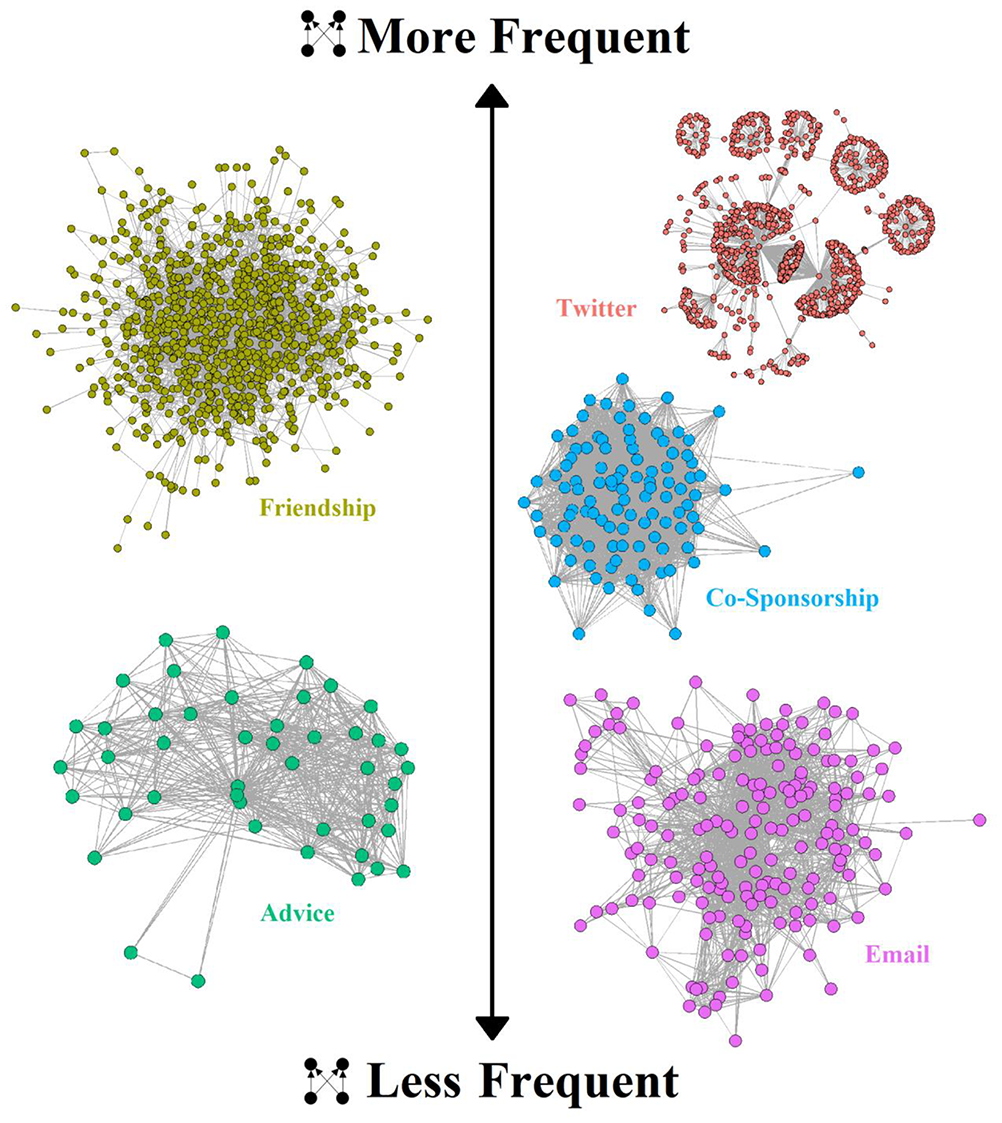
We consider tetrad patterns across five types of social networks: adolescent friendship, U.S. Senate bill co-sponsorship, Twitter online messaging, advice seeking, and email communication. We focus on these five network types because they vary on key dimensions that are likely to shape network structure, such as whether ties represent formal or informal connections and in-person or online interactions. Within each of the five social network genres, we consider four distinct networks to compare more systematically whether each of the types exhibits its own tetrad pattern or whether these patterns overlap substantially across genres. In total, our sample includes 20 social network graphs.
For our adolescent friendship data, we select four random school-based networks from the in-school survey collected during Wave 1 of the National Study of Adolescent to Adult Health (Add Health). During the first wave, Add Health surveyed the entire student bodies from over 100 U.S. middle and high schools. Respondents were asked to nominate up to 10 of their closest within-school friends. 2 We use these nominations to construct directed networks where nodes are individual adolescents and a social tie from node a to node b indicates that adolescent a nominated adolescent b as a friend.
We construct four co-sponsorship networks using data on U.S. Senate co-sponsorship patterns from the 1995, 2000, 2005, and 2010 congressional terms (Fowler 2006). Each node represents an individual senator. A directed edge from senator a to senator b indicates that during the congressional term of interest, senator a co-sponsored at least one piece of legislation for which senator b was the primary sponsor. If senators a and c both co-sponsor senator b’s bill, this action does not result in a tie between senators a and c.
We analyze Twitter data that were collected during a period of one week at the end of February 2017. Tweets were gathered from the Twitter application programming interface by using a keyword search function for aggressive, harmful terms that targeted women and minorities (i.e., curse words and racial slurs) and downloading tweets and their connected messages (Felmlee, Inara Rodis, and Francisco 2018). Nodes represent individual users who engaged with a tweet containing a keyword, and edges represent retweets, likes, and mentions. Two of our networks represent cyberbullying instances that surrounded the use of a specific slur. The other two networks consist of cyberbullying attacks that either originated from, or targeted, a celebrity. While many of the ties in our Twitter networks represent negative, harmful connections, others represent positive ties of support.
The four advice networks were collected from various types of surveys administered to employees in four different workplaces: a consulting firm (Cross and Parker 2004), an information technology department in a Fortune 500 company (Almquist 2014), a law firm (Lazega 2001), and a high-tech company (Krackhardt 1987). In each survey, participants were asked to nominate those coworkers whom they sought for professional advice. Using these nominations, we construct directed networks where nodes are individual employees and an edge between two nodes indicates that employee a seeks advice from employee b.
The four email communication networks also were collected from workplace environments. One is from the company Enron (Klimt and Yang 2004), and the remaining three are extracted from different bureaucratic departments in the European Union (EU) (Leskovec, Kleinberg, and Faloutsos 2007). All four networks include email-sending patterns over an eighteen-month period. From this information, we construct directed networks where nodes represent individual employees and directed edges indicate that employee a sent at least one email to employee b.
Plan of Analysis
The current project is an exploratory study that seeks to uncover those directed tetrads that represent key building blocks in broader network structures. To identify overrepresented tetrads in our observed networks, our analysis includes three steps. First, we estimate ERGMs on each of our observed networks that include parameters to account for a variety of structural phenomena, including certain patterns of dyads and triads. Then, we use the coefficient values from each ERGM to simulate 1,000 conditional graphs. Finally, we calculate z scores to compare the prevalence of each directed tetrad in the observed networks to their prevalence in the random graphs.
Step 1: Estimate ERGMs
In order to construct our sample of conditional graphs, we first estimate ERGMs across our 20 observed networks. ERGMs are a statistical network method that compares the patterns in an observed network to what would be expected to occur by random chance (Hunter et al. 2008; Robins et al. 2007). More specifically, we can define

Here,
In the current project, we estimate an ERGM on each of our 20 observed networks that includes four parameters to account for structural tendencies of interest. First, we include an edges term to control for the base log odds of a tie. This variable accounts for the likelihood that an edge will exist between any two actors in the network and serves a similar role as an intercept in a regression model. Next, we include a mutual term to account for the tendency toward reciprocity in social networks (e.g., actor a sends a tie to actor b and actor b sends a tie to actor a).
Finally, we include a set of two terms to account for theoretically relevant triad patterns: the geometrically weighted dyadwise shared partner (GWDSP) and geometrically weighted edgewise shared partner (GWESP). The GWDSP term measures the tendency for two nodes to be linked indirectly through one or more shared partners, regardless of whether the two nodes are tied directly. The GWESP term measures the degree to which two linked nodes have one or more partners in common (Hunter 2007). 3 Both terms are assigned decay parameters that adjust the extent to which each additional shared partner connection contributes to the measure. We include the GWESP term to capture tendencies toward triadic closure directly, while GWDSP aids in reducing bias when estimating the GWESP coefficient and facilitates interpretation of the GWESP parameter as transitivity (Goodreau 2007; Snijders et al. 2006). These triad measures are used because an established line of theoretical work focuses on the significance of transitivity in social interaction (e.g., Heider 1946) and previous empirical research finds that transitive triads are overrepresented across a variety of observed social networks (e.g., Davis 1970; Hallinan 1974). Nevertheless, the inclusion of alternative triad controls, such as those for cycles or various closure patterns, could generate different estimates and represents a task for future work.
Step 2: ERGM simulations
After each ERGM reached adequate convergence, we used the estimated coefficients to draw random, simulated networks that are conditional on the structural phenomena parameterized in the ERGM (for additional details, see Handcock et al. 2008). Given the controls included in each ERGM, the random graphs we simulate are conditioned on the observed network’s density as well as its tendencies toward reciprocity and transitivity. Note that the graphs we simulate are similar to those generated using the classic U|MAN null distribution (e.g., Faust 2010; Holland and Leinhardt 1975) but additionally control for the triadic tendencies discussed previously. Overall, we generate 1,000 random networks for each observed network, which results in a final sample of 20,000 simulated networks.
Step 3: Calculate z scores
For each tetrad, we calculate a z score to determine whether the subgraph is overrepresented in each of the observed networks. More specifically, the z score for each i tetrad is calculated as follows:

Here,
While there exist 218 possible tetrads, 19 of these subgraphs are unconnected (e.g., the null tetrad that consists of no edges). Following previous work (e.g., Kashtan and Alon 2005; Krumov et al. 2011; Schreiber and Schwöbbermeyer 2009; Shen-Orr et al. 2002), we consider only the occurrence of subgraphs that are weakly connected, resulting in a final sample of 199 directed tetrads. We assign all tetrads a numeric label according to their isomorphic class (following Csárdi and Nepusz 2006). We define motifs as those tetrads i where the average z score within each network genre is greater than 1.645. In other words, we consider a tetrad to be overrepresented significantly if it appears within each genre of observed graphs more frequently than would be expected across comparable conditional graphs (p < .05, one tailed).
Results
Motifs
We find six tetrads that appear more frequently than expected among the networks in our sample (see Figure 2 for a graphical depiction of each motif and Table 1 for a summary of average z scores by network genre). As expected, many of the asymmetric dyads that occur in these overrepresented tetrads are organized in a manner that reinforces structural patterns of hierarchy, giving some support to our first hypothesis. Many of the motifs confirm the existence of at least three status levels, and ties are patterned to support—rather than contradict—the hierarchical arrangements of their embedded dyads and triads. For example, Tetrad 89 occurs more frequently than expected across all five network genres and is defined by at least three levels of status hierarchy. This tetrad includes a pair of 030T transitive triads (i.e., actor a nominates actor b, actor b nominates actor c, and actor a nominates actor c) that complement one another’s hierarchical structure. Those actors situated at the lower rungs send ties to those actors at the higher levels, but these ties are not reciprocated. Tetrad 89 most commonly occurs in our sample of Twitter (mean z score = 35.19) and friendship networks (mean z score = 27.52)
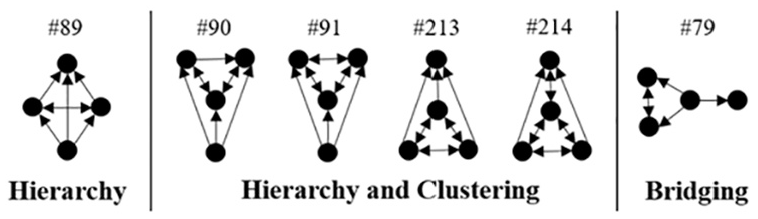
Tetrad Motifs across the Sample of Social Networks
Average z Scores for Tetrads of Interest by Network Genre
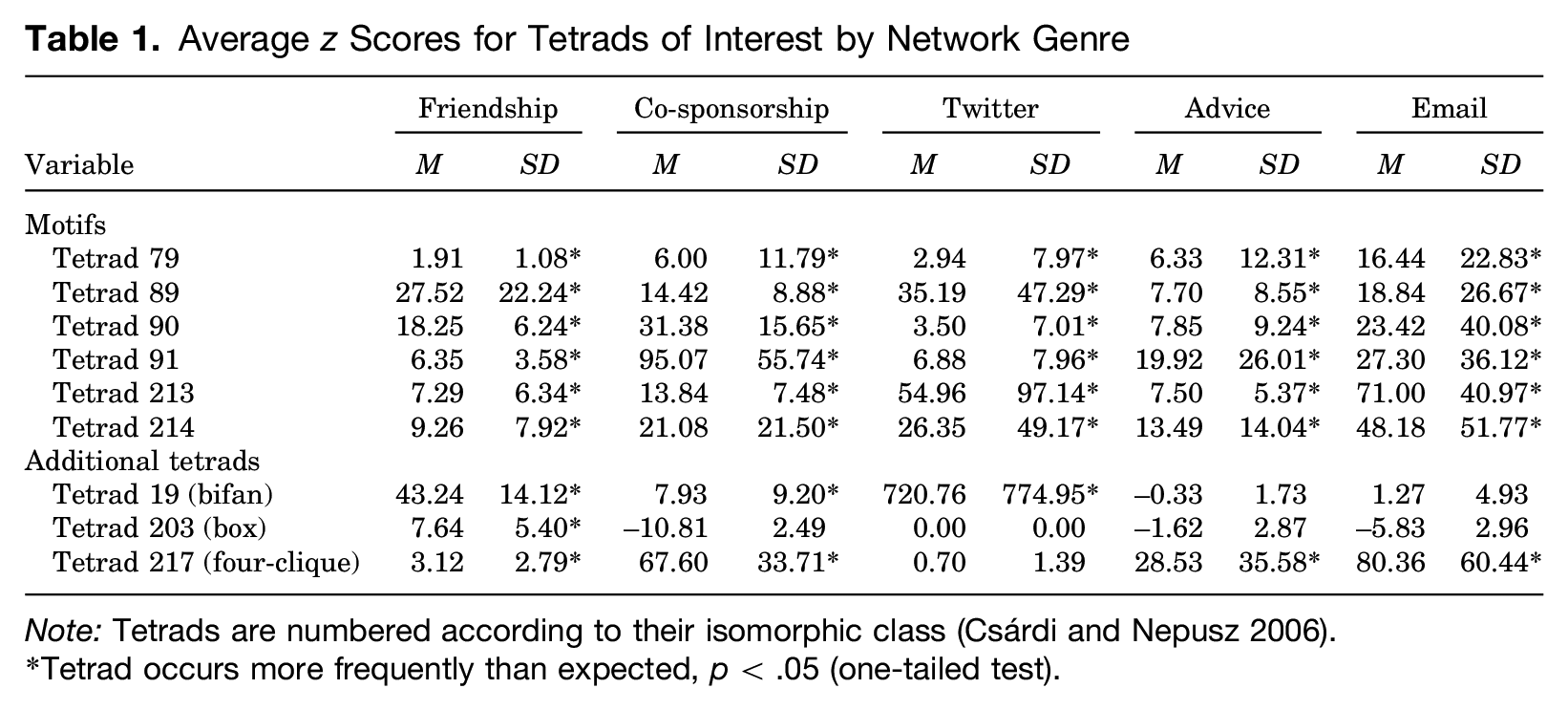
Note: Tetrads are numbered according to their isomorphic class (Csárdi and Nepusz 2006).
Tetrad occurs more frequently than expected, p < .05 (one-tailed test).
Complementing the conclusions of classic works on network structure (e.g., Holland and Leinhardt 1971; Johnsen 1985), we uncover several additional motifs that suggest the co-occurrence of clustering and hierarchy, such that those actors situated in the same status groups tend to be linked. For instance, Tetrads 90, 91, and 213 are all defined by a rigid hierarchical structure that includes two levels of status distinction. Those actors that occupy the same level of the hierarchy are clustered together through predominately reciprocated ties, which gives some support to our second hypothesis. Actors at lower strata send unreciprocated ties to those at higher levels; however, these tend to be embedded in transitive triads that complement hierarchical structures. All three of the aforementioned tetrads are especially likely to occur in networks of advice, email, and co-sponsorship.
We identify one motif (Tetrad 214) that similarly highlights the co-occurrence of clustering and hierarchy but is also defined by occasional instances of intransitivity. Analogous to the three motifs discussed in the previous paragraph, Tetrad 214 indicates a hierarchical structure consisting of two levels where clusters of nodes located on the same strata are connected by reciprocated edges. All nodes occupying levels of lower status extend ties to the individual at the higher level. While most of these cross-level ties remain asymmetric, there exists one reciprocated social tie sent from the higher-status node to a lower-status node, resulting in two intransitive triads. Tetrad 214 is most common in the networks of email (mean z score = 48.18), Twitter (mean z score = 26.35), and co-sponsorship (mean z score = 21.08) from our sample.
Our final tetrad that occurs more frequently than chance is Tetrad 79, which represents a variation of a kite tetrad and suggests that the networks in our sample exhibit certain patterns of bridging (Hypothesis 3). This subgraph is characterized by a transitive triad in which one of the three actors sends an unreciprocated tie to a fourth actor. The fourth individual has no ties to either of the other two in the transitive triad. Tetrad 79 is particularly common in our networks of email (mean z score =16.44) and advice (mean z score = 6.33).
Variations across Genres of Social Networks
By comparing the correlations between each network’s vector of z scores, it is apparent that the networks in our sample are more similar to those from their same genre than those from different genres (Hypothesis 4). As shown along the diagonal of Figure 3, correlations are highest between graphs of the same type (e.g., between friendship networks), suggesting that each variant of interaction in our sample may exhibit a unique structural signature. The average z score correlation between networks from the same genre is 0.63, while the average correlation between those of different types is 0.14. However, some network types are more alike than others. For instance, the average correlation between email and advice networks is 0.46, while the average correlation between friendship and email networks is −0.05. We further demonstrate the variation in subgraph prevalence by plotting the z scores of each network for several tetrads of interest (see Figure 4). Patterns of z scores tend to be more alike within each social network genre than they are across genres.
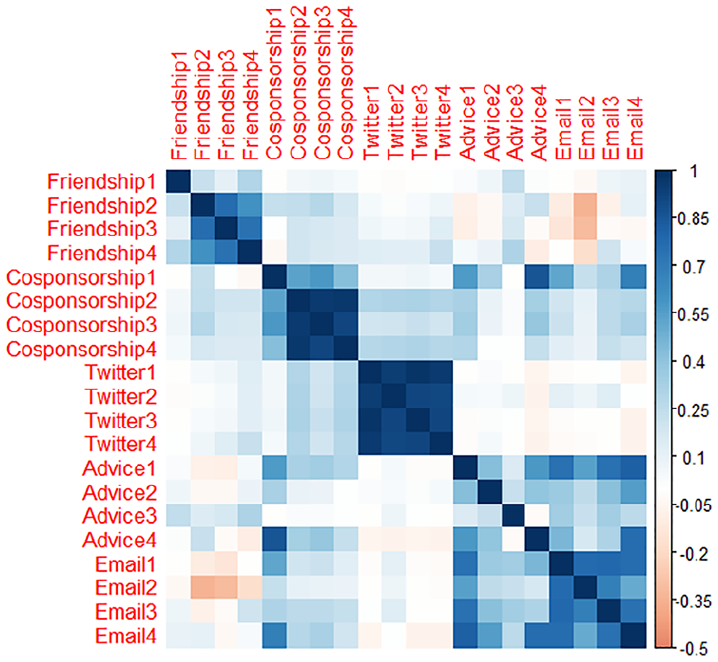
Correlation Plot for Tetrad Z Scores
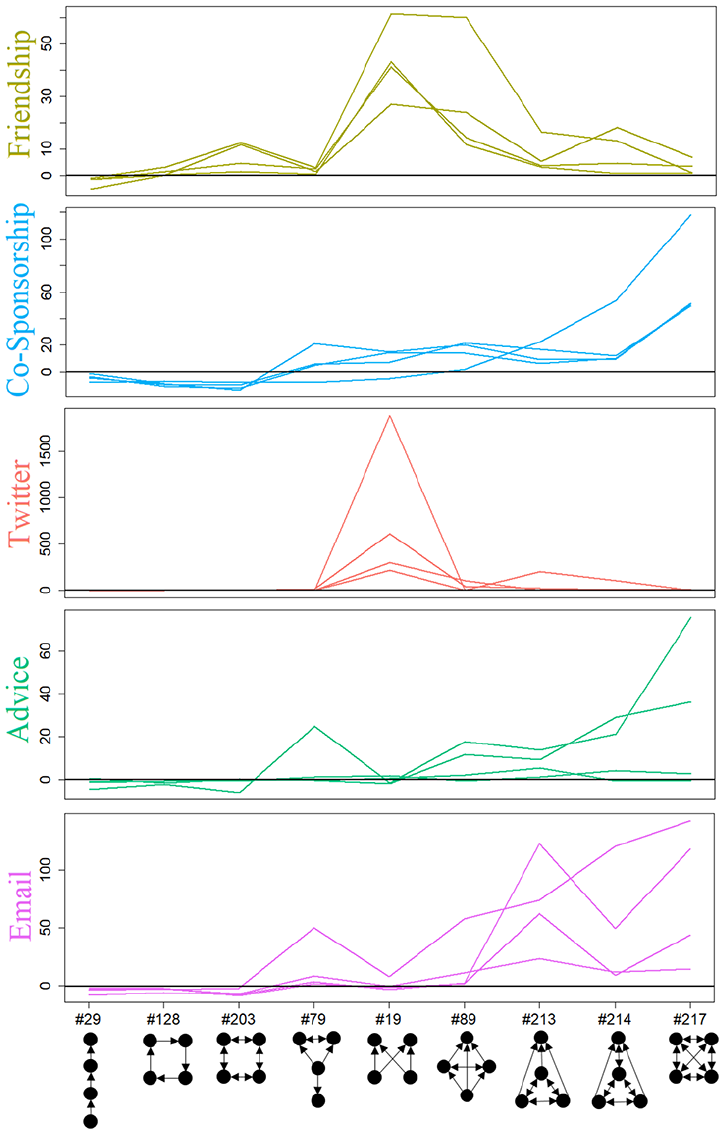
Z Scores for Select Tetrads by Network Type
It is also clear that some tetrads are more likely to occur within certain genres but not others. As hypothesized, the four-clique tetrad (i.e., Tetrad 217) is more common than we would expect by random chance across many network genres. However, contrary to our expectations, the four-clique appears about as frequently as expected in the Twitter networks. In the four-clique, all possible ties are present and all ties are reciprocated, which gives strong evidence for patterns of clustering. Tetrad 217 is especially frequent in networks of email (mean z score = 80.36) and co-sponsorship (mean z score = 67.60).
Additionally, the bifan tetrad (Tetrad 19), which is frequently observed in biological networks, varies in prevalence across the social networks in our sample. This tetrad, which includes two lower-status actors who send unreciprocated ties to two higher-status actors, appears more frequently than expected in the Twitter (mean z score = 750.76), friendship (mean z score = 43.24), and co-sponsorship networks (mean z score = 7.93). In certain advice and email networks, however, bifan tetrads occur less frequently than expected. We illustrate this variation in Figure 5 with a comparison of the relative prevalence of the bifan tetrad in each type of network. Finally, we find that the symmetric version of the box tetrad (Tetrad 203), which was mentioned previously, is significantly more likely to occur in the friendship networks (mean z score = 7.64). In this symmetric box tetrad, four individuals send reciprocated ties in a cyclical pattern, and all four embedded triads remain intransitive. However, other than the friendship networks, the symmetric box tetrad is less likely to occur across all genres in our sample.
Prevalence of the Bifan Tetrad across Network Genres
Differences in data collection strategies both between and within network genres could contribute to certain patterns we observe in our data. However, we believe it is unlikely that these variations can fully explain our results. Even though the advice data sets in our sample were all collected using different survey items and data collection techniques, for example, the average within-genre z score correlation of these networks is greater than the average cross-genre correlation (r = .31 and .19, respectively). Additionally, previous work that takes a comparative network approach to study dyadic and triadic properties of networks finds that variations in data collection technique (e.g., observed vs. self-reported) account for relatively few of the differences in network structure (Skvoretz and Faust 2002).
Discussion
Small groups represent a crucial link between individuals’ actions and large-scale processes or institutions (Harrington and Fine 2000). While previous research tends to end its analyses with groupings of two or three individuals, we argue that it is also useful to focus on larger subgroups of four, or tetrads. In our sample of twenty networks representing five diverse types of relationships—including friendship, legislative co-sponsorship, Twitter, advice seeking, and email—six tetrads occur more frequently than expected. These recurring tetrad motifs point to several fundamental interaction structures that are inherent to the social sphere, including hierarchy, clustering, and bridging. Given that social phenomena transcend our levels of analysis (Stole et al. 2001), patterns of tetrads can inform our understanding of both individual-level outcomes and broader group processes.
Many of the relational patterns highlighted by these tetrad motifs are not evident from solely analyzing configurations of two or three individuals. For instance, the hierarchical tetrad motifs suggest that distinctions by unequal status are reinforced, rather than contradicted, in our sample of social networks. Processes of network hierarchy do not limit themselves to local interactions between pairs or groups of three, in other words. Certain hierarchical interactions in the social world consist of multiple status levels; and patterns of actors’ ties, particularly their unreciprocated ties, tend to complement, rather than challenge, this system of stratification. This finding is notable because those actors who are situated on the higher levels of the status hierarchy are expected to have more influence, represent the most desirable connections, and have access to the greatest amount of information (e.g., Berger, Cohen, and Zelditch 1972; Friedkin 1986; Ridgeway 2014).
We also uncover many motifs in which processes of clustering and hierarchy operate simultaneously. In several cases, symmetric ties connect dyads or triads that are situated on the same strata of the status hierarchy, while these clusters send and receive unreciprocated ties with peers who occupy different status levels. Furthermore, we find some tetrads that evince a pyramid-shaped status hierarchy (e.g., more actors are situated on lower status levels than on higher levels) as well as others that suggest a funnel-shaped system (e.g., more actors occupy higher status levels versus lower levels). Taken together, these patterns suggest that the status hierarchy of our social networks most likely exhibits a diamond-shaped pattern, in which a small number of actors are particularly elite or of low rank but the vast majority are situated on a mid-tier level of the social system. Finally, there is evidence of motifs that preserve the rigid, stagnate structure of the social hierarchy as well as others that appear to directly challenge this system by encouraging social mobility or advancement. As a result, we conclude that the hierarchical system defining social networks is complex: the status hierarchy is being challenged in some sectors of the network while simultaneously receiving support to remain intact in other locales. Future work could benefit from investigating the explicit implications of these patterns of hierarchy and clustering in tetrads for the overall, macrolevel structure of the network. Building off prior work that relates triad patterns to network-level properties (e.g., Holland and Leinhardt 1971), the over- (or under-) abundance of certain tetrads is apt to hold consequences for the development of specific macrolevel structures.
In addition, tetrads provide unique insights into bridging processes, particularly how unreciprocated ties, which are likely to be relatively weak as compared to their reciprocated counterparts, can connect the broader network. A type of kite tetrad (Tetrad 79) that includes a highly social, but low-status, bridging actor appears in our sample of networks more frequently than would be expected. While these lower-status, bridging actors may be undervalued by their peers, the unreciprocated ties that they send play an important role in connecting the broader network. Due to their unique position, these relatively weak connections may be able to access novel types of information, which could help them advance and gain status within their social groups (Burt 2004; Granovetter 1973). Overall, findings imply that a number of social networks contain subgraphs made of both strong, reciprocal ties that lead to clustering and weaker ties that result in bridging.
Each of the five different network genres in our sample also exhibits a relatively unique structural fingerprint of directed tetrad patterns. On the basis of tetrads alone, key differences arise between the various types of social networks, and these variations indicate that the structures of hierarchy, clustering, and bridging are not always uniform across the types of social groups. For instance, the bifan tetrad (Tetrad 19), which indicates a rigid hierarchy without clustering, is likely to occur in some networks but not others. The bifan is most frequent in our Twitter networks, which is unsurprising because it is unlikely that members of such a large online community would have as many opportunities to interact, even if they are located on the same level of the status hierarchy.
Additionally, we find that the highly clustered and completely connected four-clique appears more frequently than expected across all of the networks in our sample, except for the Twitter networks. The overrepresentation of the four-clique is unsurprising since, compared to other tetrad configurations, decision making in a completely connected four-clique is more likely to result in a groupwide consensus (Friedkin 1986), and such agreement is apt to enhance the subgroup’s stability. Within the Twitter networks, completely connected four-cliques were generally nonexistent in both the observed and comparable random networks, which is likely the result of the networks’ low tie densities and perhaps the specific nature of these Twitter interactions.
Furthermore, the symmetric box tetrad (Tetrad 203) occurs less frequently than expected in all network genres, except for those consisting of high school friendship ties. This type of local structural configuration appears to be avoided in several types of social interactions, not only in adolescent sexual relationships (Bearman et al. 2004). The symmetric box tetrad is likely to occur only when structural forces and social norms produce barriers to the formation of cliques and clustering. For instance, we expect that the symmetric box tetrad arises in our sample of friendship networks because these relational webs are embedded in high schools defined by explicit grade levels. While certain friendships cross grade levels (e.g., friendships between members of clubs or teams), norms and the lack of opportunities for cross-grade interactions likely prevent those connections from developing into fully connected four-person cliques.
Several implications emerge from our work that highlight the importance of studying microlevel interactions within groups of four people. To begin with, the empirical study of directed tetrads can be intimidating due to the large sample size of possible tetrads. Here, we identify six tetrad motifs that are common, relative to comparable random graphs, across a sample of 20 observed networks, and these motifs could provide guidance as to which four-person subgraphs are especially worthy of further investigation. These motif findings could be applied to inform which tetrad measures to include in multivariate statistical network models as controls for important lower-level graph properties. If researchers are interested in studying variations across diverse types of social interaction, on the other hand, a promising avenue for research could focus on those tetrads that differ across network genres (e.g., the bifan). In addition, the fact that patterns of directed tetrads suggest that there could be a largely unique fingerprint for each type of network genre highlights the importance of this unit of study; perhaps tetrads can be used more generally to identify genres of social interaction and to uncover fundamental group-level processes.
Second, status remains a key concept of interest in past and present social science inquiry (e.g., Berger et al. 1972; Ridgeway 2014; Weber 1968), and here we see the ways in which directed tetrads facilitate the analysis of status differences in small groups. The previous work that considers relational patterns among tetrads almost always assumes that social ties are undirected or symmetric (e.g., Krumov et al. 2011). Our findings suggest that study designs involving four-person groups could benefit from the use of directed tetrads in order to gain additional information regarding the intricacies of status and power processes. Moreover, the directed tetrad motifs identified in our analyses are not theoretical arrangements of connections among four people. They represent those recurring empirical patterns of relationship ties forged in 20 social networks across five variations of behavior. Future experimental research should consider how status processes manifest in these particular small-group configurations, given their basis in empirical reality.
The results presented here also aid in accounting for the occasionally puzzling patterns that occur at lower levels of network structure, such as the presence of unreciprocated dyads and intransitive triads in friendship networks. Although reciprocated dyads are most common in our data, asymmetric dyads also occur. One explanation for their presence is that they represent instances where mutuality is expected to develop over time, a possibility that becomes apparent when examining the larger, four-person context in which dyads are embedded. Other asymmetric dyads are incorporated into the hierarchical structures of tetrads, and these unreciprocated ties appear to reinforce the stable status systems ingrained in larger networks. Moreover, intransitive triads appear occasionally in our sample of networks, despite the general tendency toward balanced, transitive triads. The tetrad motif that implies opportunities for social mobility (e.g., Tetrad 214), for example, includes two intransitive triads. Since previous theory (e.g., Heider 1958; Cartwright and Harary 1956) and empirical research (e.g., Bearman and Moody 2004; Hallinan and Kubitschek 1988) highlight the negative aspects of intransitivity, we suspect that actors do not enter these configurations randomly. Instead, they form intransitive triads only when these patterns offer the potential for particularly rewarding benefits, such as increased social status. This explanation for intransitivity becomes apparent only when considering the context of the tetrad that encapsulates the triads.
Furthermore, theoretical implications arise from our results. In his classic treatment of small groups, for example, Homans (1950) argues that two fundamental processes occur simultaneously: “standardization,” in which conformity norms emerge and group members become more alike, and “differentiation,” or the development of a status hierarchy. Tetrads represent perhaps the smallest of groups in which we can detect evidence of both processes. In a number of key tetrads, for instance, we see both the unfolding of clustering, which may emerge from conformity pressures, and the development of directed ties that imply a ranked hierarchy. Both formal and informal types of social ties, as well as those that represent face-to-face and online interaction, reproduce miniature systems of standardization and differentiation.
This research has a number of strengths but also limitations. One shortcoming is that even though our sample of social networks includes graphs that represent five distinct genres of interpersonal interaction, it does not represent all types of social networks. In addition, we use a nonrandom sample of specific networks from each genre of network, each with its own limitations. Patterns of tetrad motifs could vary depending on the specific networks in the data set being considered, and future work should analyze the occurrence of tetrads in other social network data. In addition, data collection strategies vary across the different networks in our sample, and future research will need to examine how these variations shape tetrad patterns.
Finally, our conclusions hold only for the null models applied here. While using other types of control distributions is apt to yield slightly different conclusions, we believe there is value in taking an ERGM-informed approach to generate multivariate conditional distributions for subgraph research. In the current project, we condition our graphs on observed tendencies toward reciprocity and transitivity, given their high prevalence in social interaction (Davis 1970; Diekmann 2004; Felmlee, McMillan, et al. 2018; Gouldner 1960), but our models do not account for all possible lower-order network tendencies. Future research on tetrad patterns could benefit from using an ERGM approach to measure the frequency of these four-actor configurations while simultaneously controlling for alternative triadic patterns.
In sum, intriguing microstructural processes do not end with groups of three. Configurations of connections among four people also provide insight into key social processes that unfold within larger networks, especially regarding the development of status systems, cliques of mutual ties, and weak, bridging connections. We highlight several frequently occurring four-actor subgraphs across our sample of networks, and when taken together, these tetrad motifs suggest that a variety of different social interaction types are defined by patterns of hierarchy, clustering, and bridging simultaneously. At the same time, we find that there are distinct ways that tetrad patterns vary across these particular networks of friendship, co-sponsorship, Twitter, advice, and email, lending a unique structural signature to each type. Our findings have implications for those interested in social network structure as well as for those scholars studying interaction and exchange in four-person groups. They also highlight the utility of comparing the structures of multiple social networks representing various types of social interaction. More generally, we see here the utility of branching beyond the dyad and triad to gain further traction on understanding the intriguing patterns that define structures of interpersonal ties.
Supplemental Material
Beyond_Dyads_and_Triads_Supplemental_Material_6_1_2020 – Supplemental material for Beyond Dyads and Triads: A Comparison of Tetrads in Twenty Social Networks
Supplemental material, Beyond_Dyads_and_Triads_Supplemental_Material_6_1_2020 for Beyond Dyads and Triads: A Comparison of Tetrads in Twenty Social Networks by Cassie McMillan and Diane Felmlee in Social Psychology Quarterly
Footnotes
Acknowledgements
We are grateful for suggestions and comments from David R. Hunter on earlier versions of this work. Special acknowledgment is due Ronald R. Rindfuss and Barbara Entwisle for assistance in the original design.
Authors’ Note
The views and conclusions contained in this document are those of the authors and should not be interpreted as representing the official policies, either expressed or implied, of the U.S. Army Research Laboratory, the U.S. government, the U.K. Ministry of Defense, or the U.K. government. The U.S. and U.K. governments are authorized to reproduce and distribute reprints for government purposes notwithstanding any copyright notation hereon.
Funding
The author(s) disclosed receipt of the following financial support for the research, authorship, and/or publication of this article: Research reported in this manuscript was supported by the Penn State Population Research Institute of the National Institutes of Health under award number 2P2CHD041025. This work was also supported by Pennsylvania State University and the National Science Foundation under IGERT award number DGE-1144860, Big Data Social Science. This research was sponsored in part by the U.S. Army Research Laboratory and the U.K. Ministry of Defense under agreement number W911NF-16-3-0001. This project also uses data from Add Health, a program project designed by J. Richard Udry, Peter S. Bearman, and Kathleen Mullan Harris and funded by grant P01HD31921 from the Eunice Kennedy Shriver National Institute of Child Health and Human Development, with cooperative funding from 17 other agencies. No direct support was received from grant P01HD31921 for this analysis.

Supplemental Material
Supplemental material for this article is available online.
1
2
Even though respondents were limited in the number of friends they could nominate on the Add Health survey, previous work finds that most students nominated fewer friends than the maximum (Goodreau, Kitts, and Morris 2009). However, it is important to note that truncation and out-of-design missingness remain limitations of the data set.
3
Bios
References
Supplementary Material
Please find the following supplemental material available below.
For Open Access articles published under a Creative Commons License, all supplemental material carries the same license as the article it is associated with.
For non-Open Access articles published, all supplemental material carries a non-exclusive license, and permission requests for re-use of supplemental material or any part of supplemental material shall be sent directly to the copyright owner as specified in the copyright notice associated with the article.
