



Abstract
This article explores the career of printer Joan Orwin and in particular on a playbook she was hired to print: Christopher Marlowe's Dido, Queene of Carthage (1594). Drawing on archival records of female stationers in the period, the article demonstrates that Joan Orwin was unique in her employment of her brand ‘the Widow Orwin’. The play is a rich case study, not only because the multifarious significations of widowhood and loss in early modern culture seem to consolidate in and on the playbook Orwin printed, but because Dido engages in gender dynamics created by powerful widows who populate the play.
Shipwrecked on an island, Gonzalo and Adrian in The Tempest reminisce about Claribel's wedding (2.1.61–3). 1 ‘Not since widow Dido's time’ (67), Gonzalo reflects, was Tunis blessed with ‘a paragon to their queen’ (65). Gonzalo's identification of Dido as a widow derails the conversation, as Antonio rejects this as laughable or perhaps, as Rory Loughnane comments, ‘conspicuously irrelevant’. 2 ‘Widow! a pox o’ that! How came that widow in? Widow Dido!’ (68). In this moment, Gonzalo and Antonio are disagreeing about Dido's symbolic resonance; this manifests in whether each man believes that ‘widow’ is a useful or accurate descriptor for her character. This could be because of the polysemous connotations of the designation. Fictional widows in the period were sometimes depicted as older, lusty women, such as the Nurse or even Dido in Christopher Marlowe's Dido, Queene of Carthage, first printed by Joan Orwin in 1593. But the word ‘widow’ also surely functioned positively, because Orwin used the name ‘the Widow Orwin’ repeatedly on the books she printed, which, as this article will show, may perhaps have been done purposefully as a form of self-moniker or identifiable signature. The behaviour of widow printers in the period attests to the ‘conspicuous’ nature of widowhood. While Joan Orwin may perhaps have employed her widowhood as an idiosyncratic ‘branding’ trope, other widowed printers chose not to draw attention to their widowhood, or dropped the use of it after a few years.
The widow status draws attention to itself for multiple reasons. It is both morbid, connoting loss of her deceased husband, but also suggests power and social status as the widow has inherited her previous husband's property. Considering the lusty widow trope, it might also indicate a sexually liberated woman seeking a new husband. For early modern readers, Orwin's printing of a widow-themed play could have served as a happy coincidence for those who found meaningful symbolic and thematic connections between ‘widow Dido’ and the widow Nurse in the play, as well as ‘the widow Orwin’ printer of the playbook.
Although The Tempest postdates Dido, scholarship on this exchange, as well as the play's Virgilian, Ovidian, and Chaucerian sources reveal what the mythological Dido might have meant to its early readers. Dido's story was retold in numerous late medieval and Tudor sources, including but not limited to the Aeneid: Ovid's Heroides, Chaucerian poetry such as The Legend of Good Women and The House of Fame, works like William Caxton's Eneydos and John Lydgate's Fall of Princes, as well as in academic Latin drama of the period. In the 18th century, Joseph Ritson commented on the popularity of Dido as a well-known literary figure. Thomas Percy's Reliques of Ancient English Poetry (1765) contains a ballad about Queen Dido, called ‘The Wandering Prince of Troy’, which according to Ritson was ‘at one time, a great favourite with the common people’. 3 Christopher Marsh highlights that in this ballad Dido is ‘referred to as “This silly woman”, but she is undoubtedly the central character in the story and it seems that the audience is encouraged to feel sympathy for her’. Marsh notes that the song is ‘valuable in other settings too, and A merry-conceited fortune-teller (1662) referred in passing to single mothers, abandoned by their partners and enforced to sing Queen Dido over their Cradle’. 4
The popularity of Dido stems from two opposing traditions: one, regarded as ‘more historically correct’ views Dido as a virtuous woman, applauded for founding Carthage, for venerating the memory of her husband and defending her chastity against the intended predation of Aeneas. 5 The other tradition depicts Dido as easily deceived and lusty, which may explain the scorn of Antiono and Sebastian. 6 Gail Kern Paster argues that the reference is being used to demonstrate their hard heartedness, connecting it to Montaigne: ‘even skeptics, even those who don’t believe in Dido will be moved by her grief’. 7 Loren Cressler explains that, like Chaucer, Marlowe and Nashe focus on Dido rather than Aeneas, which has the effect of ‘starkly dramatising the fissure between Dido as an idealised model of female monarchy and Dido as a casualty of empire that threatens to interrupt Aeneas’ conquest of Latium’. 8 Agnès Lafont points out that Marlowe's sympathies for Dido ‘align him rather with the pro-Dido faction led by Boccaccio’, and followed by Chaucer, who ‘even translates part of Heroides to voice Dido's complaint’. 9 These traditions demonstrate widow Dido functioning as a ‘composite figure’, 10 as Lafont puts it, as well as a cautionary tale of the dangerous power of love for early readers, rather than about Virgil's pius Aeneas. 11
Widow printers are themselves conspicuous because, as Valerie Wayne explains, women in the early book trade ‘rarely became visible in the archival records until after their husbands had died, and they frequently disappeared again when they remarried’. 12 Printers are important because they were ‘agents of textual transformation’, as A. E. B. Coldiron asserts, whose labour ‘played a tremendous role in artistic selection’. 13 Joan Orwin was printing under her own name between the years 1593–97, after the death of her third husband, Thomas Orwin. This article takes a fresh look at Dido, from the perspective of its printer: a woman who freely identified herself as ‘the Widow Orwin’ on the books she printed (Figure 1) – and apparently more often than any other widow printer.
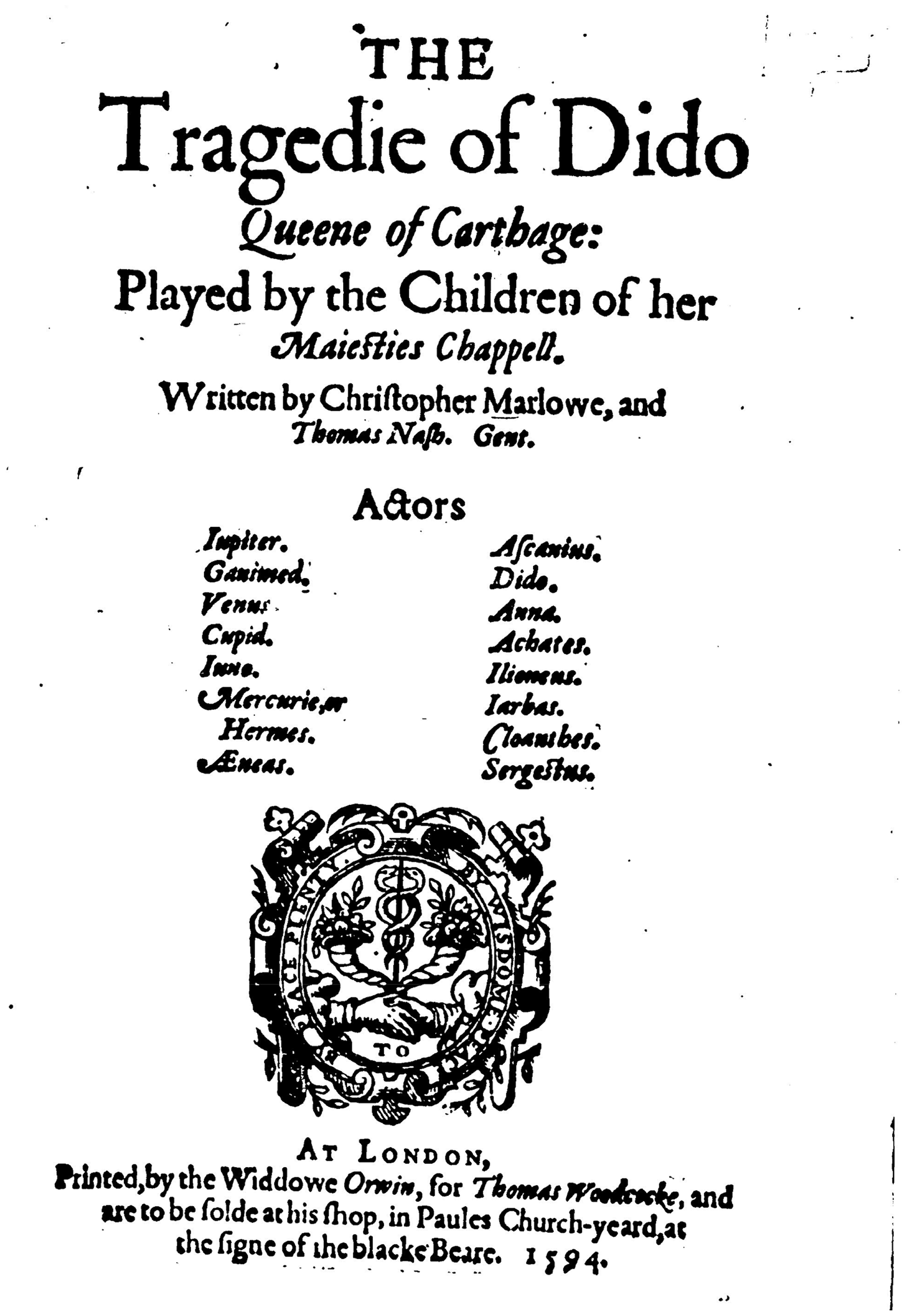
Title page to The tragedie of Dido Queene of Carthage (1594), identifying Joan Orwin as the ‘Widdowe Orwin’, and Christopher Marlowe and Thomas Nashe as authors.
Editions of Dido since its original printing in 1594 tend to focus on the play's connection to its Ovidian and Chaucerian sources, and the fact that it is a Children's company play. 14 Ovid's Heroides similarly filters the story ‘through the consciousness of Dido’. 15 A familiar modern reading is that the play presents a satirised, subverted reworking of Virgil's Aeneid, partly to comment on the female sovereignty of Queen Elizabeth I. 16 Meanwhile, the play's style has been considered ‘immature or as inadequate in construction and versification’. 17 Alongside these aspects, the most contentious issue in the debates surrounding Dido are about the authorship of the play, as the 1594 title page (Figure 1) attributes to ‘Thomas Nash. Gent.’ as an author. Ruth Lunney addresses this, using biographical details such as that of Nashe's imprisonment around the time of the play's publication to argue that he was not a co-author. 18 Emma Smith and Laurie Maguire explore evaluative attitudes to collaboration when we cannot clearly see the composition joins or fingerprints of a playwright, and the paradox of Nashe being denied collaborative authorship of a play credited to him on the title page (Dido, Queen of Carthage) and given collaborative authorship of a play that is not (1 Henry VI). 19 While these debates surrounding Dido's sources, stylistic features, and authorship may bring important context to the play, the printer's role in the creation of this playbook has yet to be thoroughly explored.
Widow Orwin's ‘brand’?
A remarkable feature about the printer Joan Orwin is that the ‘Widow Orwin’ moniker along with her printer's device on many of the books she printed, including Dido, may arguably work as a brand. Although the idea of a printer's brand is somewhat anachronistic, I employ the idea that Orwin's consistent use of the word ‘widow’ in her imprint, along with her printer's device did in fact function in a way similar to what we would now call a brand. The OED calls the figurative sense of the word ‘brand’, from 1585 onward a ‘mark or stamp indicating or imparting a particular quality or status’ (OED, 1.6). Douglas Bruster has explored early modern marketing with the ‘Lady 8’ ornament printed on the first editions of Shakespeare's Venus and Adonis and the Rape of Lucrece, offering a reading of the prominent female face in the centre of the ornament, demonstrating how it provides insight into both the poems as an ‘Elizabethan Shakespeare brand’ that both ‘reflects even as it advertises the implied classical textures of the two poems’ through its ‘antike’ style. 20 In her work on typography, Claire M. L. Bourne has established the way typographic conventions that recur across books establish a visual, recognisable identity for books to help readers navigate them, helping to achieve a ‘theatrical mode in print’. 21 Although Thomas Orwin's initials are on Orwin's edition of Dido, Joan Orwin later cuts the letters away: an assertive, perhaps ‘theatrical’ act. More specifically, Erika Mary Boeckeler has explored Joan Orwin's repeated use of the her device with two clasped hands, and states that her ‘unwavering self-identification as “the Widow Orwin” maintained brand consistency’. 22 Coincidentally for early readers of the Dido playbook, Orwin's brand served to anticipate themes within the play.
The Widow Orwin used her name consistently because it would have functioned to develop trust with her customers and booksellers. Heleen Wyffels explores petitions of printers to obtain licenses to discuss the way that widow printers in particular, ‘whose customary widows’ right was well-entrenched in artisan milieus were awarded rights through the family connection’. 23 As early as 1587, in an edition of Cicero's Di Officiis, Joan Orwin was identifying as a widow printer as ‘viduæ Georgii Robinsoni’ (STC 5266.5). She printed seven other books identifying as ‘the Widow Orwin’ around the period she was printing Dido, in 1593–4, thereby establishing her widowed status and brand immediately after her third husband's death. The symbolic fact that Joan Orwin struck out Thomas Orwin's husband's initials demonstrates that while she was seeking continuity, she was also engaging in a subtle renegotiation of the brand that asserts her own commercial identity.
While some early modern English widow-printers variously seem have found the ‘widow’ designation useful, others did not appear to use it as a branding tactic. While Orwin clearly leaned into her widowhood, not all of her contemporaries did. Orwin's brand appears in the imprint of English books 43 times: by far the most frequent usage of the word ‘widow’ on title pages by any female printer in the period. Although there were other printers who were widows, they did not consistently use the word ‘widow’ on imprints. Orwin's decision to publicly fashion herself with a modifier attached to her name was also not a norm on playbook imprints. Between 1580 and 1594, the only other stationer to present a modifier on a play imprint was the publisher – and business partner of Joan Orwin – Joan Broome, who also occasionally identified herself professionally as ‘widow’. Orwin's working relationship with her is symbolised, according to Boeckeler, through the imprint on her device featuring two cornucopias and clasped hands, under which the two widows identify themselves (Figure 2).
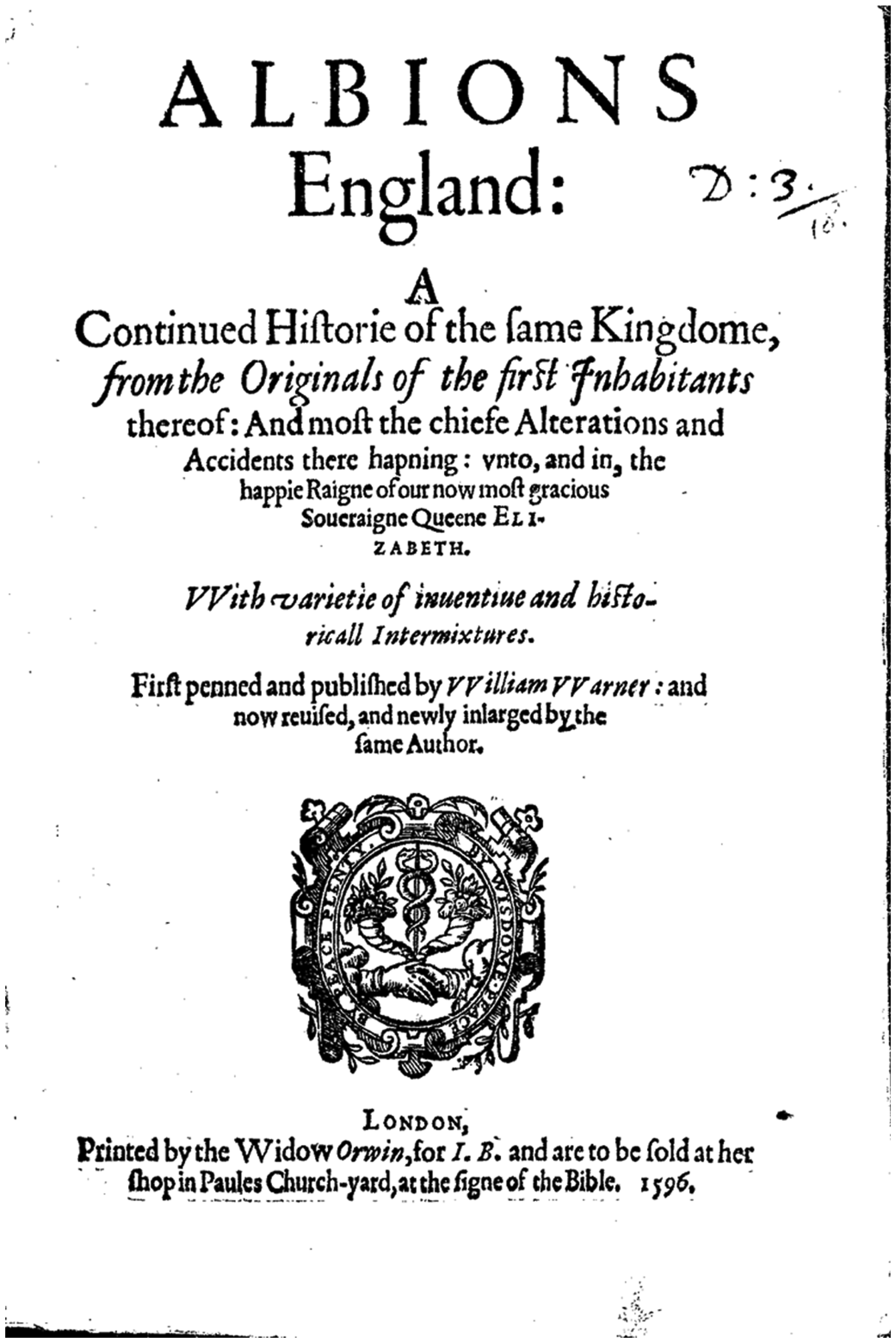
Title page to Albions England, which references ‘widow Orwin’ and ‘I.B.’ (Joan Broome).
Although Joan Broome was also identifying as a ‘widow’ on books, from her 26 publications between 1591 and 1601 – Joan Broome only featured as ‘the Widow Broome’ on four books. 24 From 1592 onward she identified herself as ‘I.B.’. Similarly, other widowed printers, such as Anne Griffin and Elizabeth Allde favoured use of their initials rather than using the word ‘widow’ to identify themselves. Elizabeth Allde shared the same initials as her husband, Edward Allde, making it sometimes difficult to distinguish between the couple. Elizabeth only used ‘the widdow of Iohn Allde’ once, in 1590 (STC 7690), and did not choose to consistently brand herself as a widow after that. 25 In the early 1590s, the Widow Charlewood was the other comparable female printer who used the word ‘widow’ to identify herself on the imprint, but she only did so on five books. Not only is Joan Orwin notable therefore for her frequency of using the term ‘widow’ on title pages in the 1590s, but over a longer period of time: 1560–1640, Orwin stands out as the printer dominating the use of the word. Orwin has the highest percentage of any female printer adopting the word ‘widow’ on title pages in that entire period: 37.4 per cent (Figures 3 and 4). The other two female printers that use the word ‘widow’ are: ‘Ioyce Macham, Widow’ (1615–1622) and the ‘widdow of Mark Wyon’ (1631–1640) – both at 8.7 per cent. 26 Each of these printers were publishing after Orwin, however, in the Jacobean period, so they arguably may have been influenced by Orwin's successful branding and use of the word. While the usage of the widow identification does not necessarily mean these printers were famous, the consistency of usage suggests reputation and a brand.
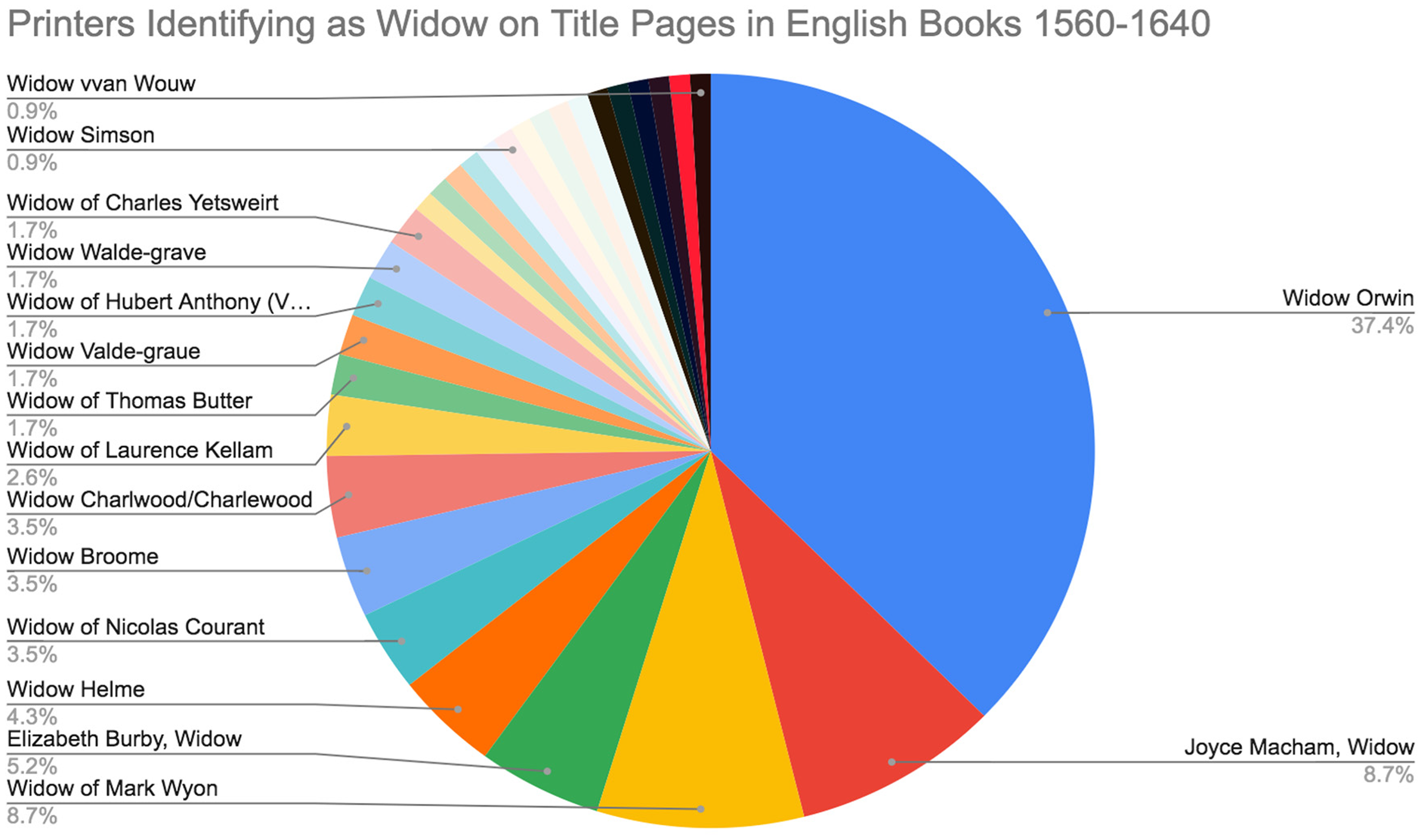
Self-identified ‘widow’ printers on title pages of English books from 1560 to 1640.
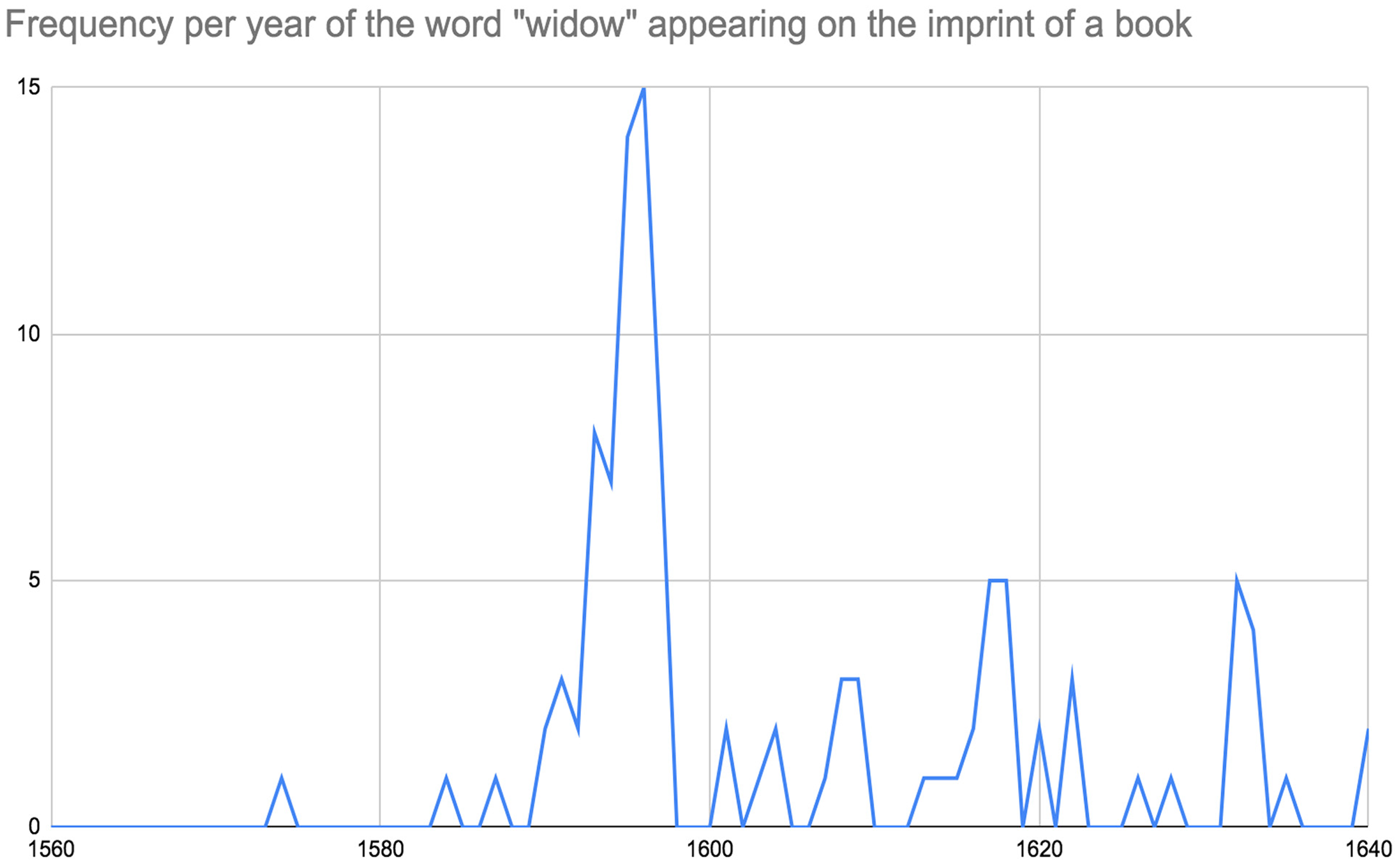
Frequency of usage of the word ‘widow’ on book imprints from 1560 to 1640.
Woodcock selects widow Orwin to print Dido
Thomas Woodcock, the bookseller and publisher of Marlowe's Dido, had a well-established relationship with Orwin's press – a business relationship Joan apparently wished to continue after her husband's death. Woodcock's alliance with Orwin's family business can be traced back to 1580, when he employed Orwin's first husband, John Kingston, to print A View of Man's Estate (STC 15005). Although nothing was printed for Woodcock during Orwin's second marriage to George Robinson, between 1589–1593 Thomas Orwin printed around 20 titles for him – the bulk of Woodcock's publications during this period. The strategy of investigating the archives of the previous husbands of a widow printer has been modelled by Sarah Neville, who examines the archives of previous husbands of widows as a tool to ‘uncover the hidden labours of female stationers whose work can be otherwise overlooked’. 27 While these approaches are admittedly speculative, they can be used to make educated guesses about the otherwise invisible and elided role of those in history we know very little about. Despite Orwin's name not featuring on the title pages of editions printed by her previous husbands, this approach encourages an assumption that there is ‘women's presence’ behind the work of their husbands and examines the ‘matrilineal line’ of widows. 28 Woodcock's choice for Joan Orwin to print Dido therefore attests to the importance of women's lineage in the early modern book trade and serves as an example of a woman printer maintaining business relations across multiple husbands.
Not only did Joan Orwin seem to have what one may call a ‘signature brand’, she was a highly competent printer who appears to have understood the trends of books in the 1580s and 1590s. This perhaps may have been a factor in Woodcock's selection of her to print Marlowe's playbook. Evidence of Orwin's competency is demonstrated when looking at a book such as Albion's England (1597) by William Warner. Joan Orwin's press had been involved in the printing of Albion's England since 1586, when it was printed under her second husband, George Robinson, and entered into the Stationers’ Register by Thomas Cadman (STC 25079). Robinson's edition was printed in blackletter, and Thomas Orwin maintained this typographical choice in both of his editions in 1589 and 1592, to which he added a table of contents at the back of the book to help orient the reader to what each volume contains. Joan Orwin and Joan Broome's two editions of Albion's England in 1596 and 1597 contain some notable differences that update and modernise the book. Firstly, the contents table is brought to the front of the book, increasing its legibility. Secondly, what is also notable is the choice of typeface: Roman font replaces blackletter, thereby bringing the book more up to date for readers and modernising the look of the edition. 29 Similarly, in Thomas Orwin's edition of A Prognostication Everlasting in 1592 by Leonard Digges (STC 435.55), Thomas Orwin uses blackletter for the words on the fourth line of the title page: ‘pleasaunt, chosen rules to iudge the weather by the sunne, moone’, whereas when Joan Orwin prints the same text in a later edition in 1596 (STC 435.57), she again modernises the typeface to Roman. These are examples of Joan Orwin's competency as a printer, and that she was in touch with the general trends in the modernisation of early texts.
The 1596 and 1597 editions of Albion's England were produced, then, by two collaborating widow business partners: Joan Orwin and Joan Broome. These editions also happen to contain significantly expanded content by Warner, which includes a section about widows. This topically notable addition is listed in the contents: ‘of the chat passed betwixt two old widows concerning new fangles now used by women’ and ‘more of their chat’ (A7r, both editions).
From the 65 or so books Joan Orwin printed, 10 were both printed and published at her own expense. Books she invested in personally may suggest something about her interests, and her readers’ interests, which might bring renewed insight into how early readers understood themes in Dido. Two of Joan Orwin's published books were medical treatises and around five were Latin school texts. 30 In addition to these, of special interest are several works Orwin printed for other publishers around the same time as she printed Dido. These books, such as An order of houshold instruction by Josias Nichols (1595; STC 18539.5), and An apologie of infants by William Hubbock (1595; STC 13898), reflect an engagement with family management, education, and child-rearing. Books Joan Orwin printed for the education of children were The French schoole-master by Claudius Hollyband (1582; STC 6749.6), and The English schoole-maister by Edmund Coote (1596; STC 5711). The only other play Woodcock published: a translation of Terence's Andria, (1588; STC 23895), contains a preface ‘To all yong Students of the Latin Tong (for whose onely help and benefit this comoedie is published)’ (A3r). Although Dido contains no prefatory matter directed at young students, the title page states it was performed by children. Like Andria's list: ‘The speakers in this Comœdie’ (B3v), Dido provides a list of ‘Actors’, which showcases the classical characters and functions as a helpful tool for any kind of reader looking to navigate the play. 31 Furthermore, the associations of Woodcock's two plays with children may have worked to forge connections for readers encountering the playbook across other of Orwin's printed works that concern children. 32 Orwin's interest in education and childrearing also helps reveal the relationship between her consistent printing of catechisms, sermons, and classical texts such as a collection of Virgil's poems in Latin in 1593 (STC 702); as well as Cicero's De officiis and The problemes of Aristotle in 1595. Cicero's work was written by him to his only son, therefore contributing to the catalogue of texts Orwin printed on parenting. Considering Dido in relation to some of these other works Orwin invested in herself can reframe Dido and open up different approaches to reading the play.
A brief examination of Woodcock's activity directly after losing his main printer, might further suggest that his selection of Joan Orwin to print Marlowe's play was an actively selective one. In 1594, Woodcock outsourced to other printers, publishing a total of four titles in that year, including Dido. 33 As well as hiring Joan Orwin to print Marlowe's play, Woodcock hired Thomas Creede to print a refutation of a Protestant theory, A mirrour of Popish subtilties (STC 52) by the Anglican Bishop Robert Abbott; and a romance pastoral dream work full of classical literary reference, Arisbas: Euphues amongst his Slumbers, or Cupid's Journey to Hell (STC 6817), by the government official, John Dickenson – an Ovidian-inspired text that might have lent itself well to be printed alongside Dido. 34 In addition to these outputs, Woodcock hired Thomas Dawson in 1594 to print a translation of Martin Luther's A methodicall preface prefixed before the Epistle of S. Paule (STC 16985). Woodcock's hiring of Creede and Dawson as well as Joan Orwin in 1594 is significant because she appears to have been chosen specifically to print Dido rather than any of the other three books. The idea Joan Orwin was tapped for Dido is strengthened when considering the fact that Woodcock chose Thomas East to print Andria in 1588 – whereas Orwin's press had experience printing children's plays, such as John Lyly's Campaspe (1591) and Sappho and Phao (1591) – so it may have been that Joan Orwin was hired because she was already familiar with printing works of a similar theme.
The year 1593 was the third and final time Joan Orwin was widowed, and became master printer of her press – coincidentally, that same year Christopher Marlowe was fatally stabbed to death in Deptford. 35 Almost immediately after Marlowe's untimely death, stationers rushed to ‘regenerate Marlowe's corpus’ in print. 36 Both parts of Tamburlaine were printed in that year, and Dido and Edward II were published in 1594. At this time, these Marlowe plays probably comprised the ‘three or four ghostly sheets’ that gave the impression to customers that they were witnessing his ghost walking in Paules Church-yard, as Adam Hooks has described. 37 It seems fitting that a three-times widowed printer, whose brand signifies loss and erasure should be the stationer to print Marlowe's play so soon after his death, and that out of the four texts Woodcock published in 1593–4 he selected a real-life recently widowed printer to print Dido: a play about widows.
Dido, Queene of Carthage: A widow play
The fact that Dido is a widow play has until now been largely overlooked, despite the fact that widows abound in the play: Queen Dido is the widow of Sychaeus; Aeneas is the widower of Creusa; even Venus has lost her lover, Aeneas’ father Anchises. The elderly Nurse, Marlowe's Elizabethan addition to Virgil's narrative, is also a widow. In Henry IV Part 2, Northumberland comments on a messenger who is arriving to deliver the news of his son's death in battle: ‘Yea, this man's brow, like to a title-leaf, / Foretells the nature of a tragic volume’ (1.1.60–1). The same idea may be true for ‘The Widow’ on Dido's title page. While it may be mere coincidence, the word ‘widow’ on the title page could also have been a subtle wink to early readers about certain figures who populate the play.
Perhaps because the Nurse is left off the list of Actors, and has such a small part, she is an often overlooked character. But this is Marlowe's Elizabethan addition to Virgil, and she seems to typify the ‘lusty widow’ trope. Martin Wiggins's description of the plot of Dido is an example of how the Nurse and any agency she has is sometimes obscured: Wiggins avoids explaining that the widow Nurse escorts Ascanius/Cupid to her country home, describing this plot point as: ‘Dido crowns him [Aeneas] King of Carthage. As further insurance, she has Ascanius’ taken into the country, and the rigging removed from Aeneas’ ships’. 38 The Nurse's role is overlooked in this reading, as is her widowed status. Yet reading the play with widowhood in mind, as signalled by the word ‘widow’ in Joan Orwin's brand on the title page, draws our attention away from the idea of a satirised anti-heroic Aeneas toward other elements such as the poor treatment of children and the tragedy of a powerful widow who sacrifices her independence for love.
The widow queen and Orwin's printer's device
Widows in early modern England had a ‘prescribed social role’, and were often cast in literature as virtuous ‘models of Christian charity, of devoted motherhood, and – above all – of fidelity to their deceased spouses, and […] it was often taken for granted that they were mothers’. 39 In the opening of the play, Queen Dido fits this mold. She is welcoming, inviting Aeneas to ‘sit in Dido's place’ (2.1.91) at the banquet table, and she invites Aeneas’ son to sit in her lap, as a mother might do. Her character is established as generous, and peaceful, and we learn this from other characters before we meet her. Venus, for example, tells Aeneas that Dido will ‘receive ye with her smiles’ (1.1.234). Iarbas vouches for Dido's welcoming good nature, assuring Sergestus, ‘your men and you shall banquet in our court, / And every Trojan be as welcome here / As Jupiter to silly Baucis’ house’ (1.2.39–41). Iarbas is able to give Sergestus these assurances without consulting Dido, demonstrating his expectation that she is consistent in her generous behaviour toward strangers. We learn further of Dido's kind heart and compassion from Ilioneus’ explanation to Aeneas of how Dido has ‘entertained us all’ (2.1.64), and supplied his friends with ‘wealthy robes’ (2.1.65). The queen has shown compassion for the refugees’ plight: ‘oft hath she asked us under whom we served, / And when we told her, she would weep for grief, / thinking the sea had swallowed up thy ships’ (2.1.66–8).
While seemingly insignificant, subtle, or even inconsequential, the printer's device Joan Orwin selected for the title page to Dido aligns well with a reading of the play's protagonist queen when we first meet her and may have helped to frame the play for early readers. The motto on Orwin's device, ‘By Peace Plenty, By Wisdom Peace’ (Figure 1), connotes an air of harmony and tranquility, coupled with the collaborative signifier of the clasped hands, symbolising collaboration; the caduceus, the scepter of Mercury, and the overflowing horn of plenty or cornucopia, symbolising abundance and feasting. This imagery compliments and illuminates the portrayal of Dido early in the play. This device was used on the majority of the texts Orwin printed. Because of the frequency with which Joan Orwin used this device, it may not be far-fetched to imagine that she saw it as a suitable paring for her brand, in contrast with, for example, the masculine Mars device favoured by Thomas Orwin and her son, Felix Kingston, as Boeckeler has noted.
Before Aeneas sets foot in Carthage, Dido has been cautious to maintain her status as a widow. We learn Dido has had many ‘urgent suitors’ (3.1.150), many of whom are ‘mightier kings’ (3.1.12) than Iarbus, yet she demonstrates reticence for a new husband, indicating she wants to maintain her solitary status and independence. Dido carefully reflects on her behaviour toward Iarbas, not wanting to give him false hope: ‘I fear me Dido hath been counted light / In being too familiar with Iarbas’ (3.1.14–15). Because Dido is established as a wise and cautious queen it is all the more problematic that she is not in her own mind when she falls in love with Aeneas. If it were not for the love dart of Cupid, Dido may have treated Aeneas as she did the other suitors, maintaining her widow status, and with it her authority and power.
In plays of the period, widows were not always treated positively. The ‘lusty widow’, was ‘popular with playwrights – she was food for satire and censure’. 40 Marlowe's portrayal of widows in his plays in particular contributed to the way that widows were sensationalised and performed on the stage in the period. Asuka Kimura notes Marlowe's departure from his sources in choosing to present the reason for Dido's suicide not as a display of mourning and constancy to her husband Sychaeus as in the Aenean tradition, but as a sensational decision that indicates the ‘extremity of her love for Aeneas, which literally consumes her in this act of despair’. 41 Shakespeare's widows appropriate their cries and gestures to manipulate male authority, pursue ambitions, cling onto power succeeded from their husbands, or overthrow male tyrants. Kimura explores Shakespeare's Senecan-style characterisation of widows who lament with gestures such as ‘lacerating the cheeks, swooning, weeping, beating the breast, and tearing the hair’. 42
The Nurse fulfils the lusty widow depiction when she desires Cupid disguised as Ascanius to be her lover. Alongside these identifications, some widows were thought to be witches and engaged in magic to combat the anxieties of running their households. 43 Dido engages in this attitude of prejudice when she turns on the Nurse after she reports losing Ascanius in the night, calling her a ‘cursed hag and false dissembling wretch’ (5.1.216). Dido's wise sensibilities quickly disintegrate when she falls in love with Aeneas and gives up her widowed status. However, this decision does not reflect Dido's own will, as it is Venus’ plot for Dido to fall in love with Aeneas, and Cupid's application of a love dart that causes Dido's downfall. Until Cupid applies the love potion, Dido ‘till now / Didst never think Aeneas beautiful’ (3.1.81–2). Without the love dart, Dido would have continued to play the role of generous hostess but nothing more. Once under the potion's power, however, her generosity exceeds itself as she bestows exotic riches on Aeneas for his ships: ‘tacklings of riveled gold’, (3.1.115) and oars of massy ivory’ (3.1.117). Marlowe emphasises Dido's lack of agency, and hones in on this as tragic, underscoring it with his additional character, the Nurse, who also receives Cupid's love dart, which serves to duplicate and draw attention to Dido's agency being denied her.
The moments from Virgil on which Marlowe elaborates similarly serve to underscore the problematic loss of agency Dido undergoes and highlight her situation as a victim to the gods. Marlowe expands on ‘the influence of Cupid, the goddesses’ conspiracy, the hunt, the storm and the encounter in the cave’. 44 These moments serve to explore the implications of the ways an established wealthy, powerful, and generous widow can be brought down by a system of power beyond her control, run by Cupid and the gods. Once she is under the spell of Cupid's love dart, she no longer is herself and we cannot trust any of her actions as her own, including, most disturbingly, her suicide. By emphasising the fact that Dido is under the influence of a love potion, and that the choice to fall in love with Aeneas is not her own, the tragedy we are witnessing is that of a widow whose own free will or ability to act on her own is eradicated. We witness a powerful woman being used and manipulated by the gods, and Marlowe's addition of the widow Nurse, who also is darted by Cupid's love potion, only serves to underscore what is happening to Dido. That Dido and the Nurse are never behaving with their own agency once the love dart is administered resonates somewhat with the situation of the play's printer: who was working in the male dominated system of the early modern book trade, yet who exercised considerable agency by actively asserting of herself as a widow, which also departs from the lack of control the widow characters in the play have.
The play works to establish Dido as a powerful and unobtainable widow queen. Like Shakespeare's Portia in The Merchant of Venice, Dido has many suitors, and even keeps pictures of them on her wall: ‘See where the pictures of my suitors hang, / And are not these as fair as fair may be?’ (3.1.138–9). None have been successful in their marriage proposals, however. Frustratingly for the suitor Iarbus, until Aeneas’ arrival, Dido has maintained the position of chaste and respected widow of her previous husband, Sychaeus: ‘no wanton thought / Had ever residence in Dido's breast’ (3.1.16–17). Dido has treasured inheritance from Sychaeus in the form of relics, clothing, and her kingdom, which she transfers to Aeneas upon his arrival. Aeneas is swamped in the possessions of Dido's first husband, further corroding his recognisability as Virgil's Trojan hero. Dido expresses her desire not to have Aeneas as he is, but to transform him into Sychaeus. We may assume that throughout the play Aeneas is wearing clothing that belonged to Dido's first husband, as the first thing she tells a servant to do for Aeneas is to give him clothing which belonged to her first husband: ‘Go fetch the garment which Sichaeus ware’ (2.1.80). Aeneas may be wearing Sychaeus’ clothing in the play, but the fact that he can never actually become Sychaeus points to yet another meta-comment Marlowe is making about the classics in early modern vernacular forms: once Virgil's epic is translated into the clothing of an English play script it is something new entirely.
By passing the property from her first husband Sychaeus, onto Aeneas, Dido is doing what a widow printer might do in a second marriage agreement: 45 ‘Hold, take these jewels at thy lover's hand, / These golden bracelets and this wedding ring, / Wherewith my husband wooed me yet a maid’ (3.4.60–1). The transferal of property here signifies Aeneas’ individuality being written over as Dido intends to morph him into her previous husband. His replaceability in Dido's eyes is emphasised when she says ‘'Sichaeus’ not ‘Aeneas’, be thou called; / The ‘King of Carthage’ not ‘Anchises’ son’ (3.4.58–9). The play emphasises Dido's agency as a widow in this moment: she is the one transferring her property, and she desires and even commands Aeneas to somehow turn into her previous husband.
One tragedy in Dido is the loss of her status as an independent woman. Iarbus expresses that Dido has yielded ‘up her beauty to a stranger's bed / Who, having wrought her shame, is straightway fled’ (4.2.16–17). As the tragic momentum builds, our attention is drawn back to the material objects of her inheritance from Sychaeus, which Aeneas has left behind: ‘Now Dido, with these relics burn thyself […] Here lie the garment which I clothed him in / when he first came on to shore’ (5.1.292–8). The relics that also include a sword, papers, and letters from Aeneas, which were intended to be tokens of his promise to Dido, serve as reminders of her lost status as a widow and are burned on the pyre alongside her the queen. Considering the status, honour, and material wealth Dido had in widowhood highlights the ease with which it is destroyed and lost, providing us with an insight into early modern female property ownership more broadly, and the powerful situation widows held in society.
The widow Nurse
If the brand ‘the Widow Orwin’ might have functioned to alert readers to the play's widow characters, this is complicated by the two portrayals of more than one type of widow character in the play. Marlowe contrasts the main plot of the beautiful heroine widow Dido and her lover Aeneas with the comic subplot of Cupid and the older, lustful, widow Nurse. The Nurse is reminiscent of Chaucer's Wife of Bath, who may have set literary expectations for readers. This character was a familiar one for readers of Orwin's books, serving as a comic caricature of an elderly widow of ‘fourscore’ years, with complaints of withered veins and sinews (4.5.33). Cupid asks to be carried by the Nurse in 4.5, and at this point, although no stage direction indicates it, we may intuit he has administered his love dart on her. The Nurse expresses her desire for Cupid to be her husband, who, disgusted, cries: ‘A husband and no teeth!’ (4.5.24) This anticipates Shakespeare's Nurse to Juliet for readers, who likewise has very few teeth: ‘to my teeth be it spoken, I have but four’ (Romeo and Juliet, 1.3.15–16). Queen Elizabeth I may also have sprung to mind, as visitors to the queen noted her black teeth, many of which were missing so that ‘one cannot understand her easily when she speaks quickly’. 46 The lusty widow Nurse character anticipates the newly inserted chapter 47 of the two widows in Warner's Albion's England that Joan Orwin printed for Joan Broome in 1597. These widows meet to drink ale, reminiscing about their ‘bridal beds […] to Wed my will was hot’. 47 The pair gossip about the men of their past: ‘I might haue had good Husbands, which my desteny withstood: / Of three now dead (ah, griefe is drye, Gossyp, this Ale is good)’. 48 Like Joan Orwin, the one of the women has been three times widowed and, like the Nurse in Dido, they are ‘aged foure-score now’. Widow characters in many different iterations then, feature across Orwin's catalogue, and comic widows like these stand for a certain kind of theatrical freedom, liberated from the seriousness of the plot of a tragic play.
The widow Nurse is the character Elizabethan readers would have been familiar with from other texts and real personas at the time, yet she is the only character omitted from the ‘Actors’ list on the title page to Dido. Perhaps this is unsurprising, as the Nurse only appears in two short scenes, and is an outlier from the other characters, as she is not from the classical tradition. However, the omission of the Nurse from the title page is also curious, when reflecting on the widows and children in Marlowe's play. The dramatic capabilities of typography were used creatively and deliberately by printers and publishers so that, when early modern readers were perusing quartos like Dido, they would have known what to expect: ‘playbooks rarely included explicit instructions for how to read them, which is perhaps why the ingenuity of a lot of typographic arrangements has gone mostly unstudied’. 49 For the browser of the London book stalls, the title page would have held implicit, passive instructions on how to read the play. The list of ‘Actors’ on Dido, along with the emphasis of the playing company, the ‘Children of her Majesties Chappell’, who first performed this play, and the names of the printer and publisher, all work together to perform a marketing purpose that invites readers interested in instructive literature about children. 50 The list of ‘Actors’ names are all italicised, which indicates their dramatic and fictional nature, also anticipating their continued italicisation across the playtext to indicate who is speaking. The 17th-century printer Joseph Moxon comments that this ‘Italicking’ is used to ‘better sympathise with … the capacity of the Reader’ and can be used to indicate a new actor's body entering the stage, or encourage the reader to imagine that these are theatrical characters. 51 A descriptive list of characters functions as a site of ‘imaginative engagement that play-readers adopt the visual habits of the playhouse spectator, associating a physical body with the textual character’. 52 Although Dido's list may not be considered descriptive, collecting all the characters together on the title page has an impact on the reader's imagination before reading the play has even begun. This means that when the reader finally meets the Nurse in Act 4, she functions as a surprise character – an anachronism that would stand out in an almost cartoonish fashion to the reader who was expecting a purely classical cast list.
The Nurse is a distinctly Elizabethan creation, considered by some editors to be a contemporary pastiche to his poem, ‘The Passionate Shepherd to his Love’. 53 The inclusion of this character implies that Marlowe is using the Nurse to make a meta-comment on the consequences of reappropriating a Latin epic into a vernacular play in the commercial theatre. The satirical subplot involving the Nurse and Cupid serves as a foil to the lofty tragedy of Dido. Curiously, the Nurse's name is missing from the list of ‘Actors’ on the title page of the play. Perhaps she was left off the list because she does not quite fit in with Virgil's classical characters, or because she has such a small part, with very few lines, and was therefore seen as disposable. The Nurse is certainly seen as disposable in the play, as Dido sends her away to prison (5.1.220). It would be ironic if the Nurse was an oversight, forgotten by the printer herself. Whatever the reason for the elision of the Nurse on the title page, as Joan Orwin features as an Elizabethan widow one might argue that Widow Orwin's brand effectively stands in for the Nurse.
While the Nurse is a toothless, elderly woman, she holds a position of power, entrusted by Dido to act as attendant to Cupid, who is disguised as Ascanius. She is also wealthy, the heiress of a country house. The compelling, fertile and wholesome description of her home, where the Nurse hopes to lure Cupid, is constructed to appeal to a child: Thou shalt go with me unto my house. I have an Orchard that hath store of plums, Brown Almonds, Services, ripe Figs and Dates, Dewberries, Apples, yellow Oranges, A garden where are Beehives full of honey, Muskroses, and a thousand sort of flowers, And in the midst doth run a silver stream, Where thou shalt see the red gilled fishes leap, White Swans, and many lovely waterfowls. (5.1.3–11)
This passage is reminiscent of Venus’ luring of her grandson. Venus kidnaps Ascanius, luring him with ‘Sugar almonds, sweet conserves, a silver girdle and a gold purse’. She drugs him to sleep, covers him with flowers in a grove and leaves him to be guarded by birds: ‘These milk white Doves shall be his Sentinels: / Who if that any seek to do him hurt, / Will quickly fly to Citheida's fist’ (2.1.320–2). With the prostitution of her son Cupid, and the abduction, manipulation and drugging of her grandson, Ascanius, Venus proves to be corrupt, evil mother figure. Marlowe echoes the earlier scene of Venus luring Ascanius, with the Nurse luring a child she believes to be Ascanius. If a common view of widows was that they should be caring and motherly, the Nurse's behaviour subverts this here.
The Nurse's vivid language in this passage betrays her rich inheritance and her powerful status as a widow. The orchard provides her with plenty of stone fruit, while her garden is full of honey and fish and fowls are in abundance. This is a wealthy country home yielding many wholesome provisions, attractive for small children. It may seem puzzling that an elderly widow with such riches remains in the employment of Queen Dido. However, Marlowe seems to have created this character to function as a distillation of all the worst qualities of Dido. The inherited property of the Nurse emphasises her lustful nature: this is a character who could easily remain at home but prefers to actively seek out young men or boys. The coupling of the Nurse with the youthful child Cupid, disguised as Ascanius, along with this fertile description align her as an agent of creation. Marlowe's recasting of Virgil's Dido-Cupid coupling as a Nurse-Cupid iteration serves here as a point of contrast between two very different widows. Marlowe's inclusion of the Nurse serves as a satirical twist on the reception of the classics into English vernacular, and points to the comic Elizabethan metamorphosis the classics undergo in new forms as plays. By bestowing all the satirical lustful stereotypes of widows onto the Nurse, Marlowe ensures that his play can be taken seriously as a tragedy. Dido is guaranteed a tragic ending, as any comic aspects of widowhood are channelled into the Nurse's character, and therefore filtered away from the play's protagonist.
The Nurse vacillates over whether to take Cupid as a husband or a lover, whilst also reminding herself of her position as a widow: ‘I’ll be no more a widow, I am young; / I’ll have a husband, or else a lover’ (4.5.22–3). Humorous commentary anticipating Dido's suicide is offered in the Nurse's lines: ‘Why do I think of love? Now I should die?’ By embodying the vices that Virgil can be said to associate with Dido in the Nurse, Dido herself becomes more purely tragic. As both widows are downcast by the end, the play further emphasises the plot of a widow's tragedy through the Nurse's story which parallels that of Dido: a widow in a strong position, in possession of a wealthy manor house, whose status is at the risk of disruption by a lover who could cause her to lose everything, even to die from lovesickness. Just as Dido is abandoned by Aeneas, the Nurse is abandoned by Cupid, who disappears altogether when we learn from the Nurse's report that he ‘lay with me last night / And in the morning he was stol’n from me; / I think some fairies have beguiled me’ (5.1.12–15). The Nurse's confusion here, with her words, ‘blush blush, for shame, why shouldst thou think of love? A grave and not a lover fits thy age!’ all feed into a typical depiction of widow in early modern plays: remarrying widows, whether ‘lusty or not […] are more liable to wed calamity than joy’. 54
Dido takes this uneasy attitude toward the swift ‘dexterity’ of widows into the beds of potential new husbands to another level with the Nurse's inappropriate lust for Cupid. Although this desire has been brought on presumably by Cupid's poisoned arrow dart, an 80-year-old woman lusting after a child would surely have made readers uneasy. As the Nurse's lustful behaviour brings on her downfall, her situation serves as a comic, exaggerated mirrored version to that of what happens to Dido when she pursues Aeneas. The Nurse's lust feeds into the play's uneasy depictions of adults abusing children, from the opening's infamously pederastic scene featuring Jupiter ‘dandling Ganymede upon his knee’, (1.1.1–2) to Venus’ insistence that her son Cupid must sit in the Carthigian Queen's lap, disguised as Ascanius, and ‘touch her white breast with this arrow head / That she may dote upon Aeneas’ love’ (2.1.326–7). 55 The Nurse also functions as a reflection on the vices of Venus, who both cares for and manipulates children. While we can never know whether Joan Orwin herself shared any of these readings of the Nurse, by attending to her agency over the play's title page, thinking about the decision to leave the Nurse off the title page has included – and what she has left out – brings a character into focus that is normally overlooked in a play that has been understand to be more about the widower Aeneas, rather than widows like Dido and the Nurse.
Conclusion
Attending to the archives of widow printers and special books of interest as case studies, such as Dido, has the potential to yield up new literary readings of texts, or to draw attention to elements that have previously been considered as unremarkable. When explored in its material form, it is apparent that Dido is doing some work both to display and efface elements for readers, and can be viewed afresh as a rich case study of possibly accidental collisions. Joan Orwin's status as a real-life widow the year after the loss of the play's writer, and her hand in creation of the physical play book adds to the weight of loss surrounding both the content of the play's fictional widows, as well as the moment of nostalgia for Marlowe himself, a year on from his sudden death. The play itself encourages us to consider the multifarious significations of widowhood and loss in early modern culture, both real and imaginary. As Joan Orwin was the printer of the period who consistently utilised the word ‘widow’ with a high frequency when compared with any other printer (37 per cent), Dido provides an opportunity to question what it means that some of these significations of widowhood consolidate in and on the playbook she printed, and how this work and association with the Marlowe canon may have established her in the book trade as an almost theatrical persona, thereby boosting the success of her business. Hopefully, this kind of work will invite of other such explorations into the archives other of female printers, who are yet to be fully researched.
Supplemental Material
sj-docx-1-cae-10.1177_01847678261427013 - Supplemental material for A widow printer makes Dido
Supplemental material, sj-docx-1-cae-10.1177_01847678261427013 for A widow printer makes Dido by Katie O’Hare in Cahiers Élisabéthains
Footnotes
Acknowledgements
I would like to thank Sean Keilen, Claire M. L. Bourne, Filippo Gianferrai, and Jody Greene for their mentorship to me when this project was in its early stages. Thank you also to Daniel Yabut and Agnès Lafont for all your kind guidance and support.
Declaration of conflicting interests
The author declared no potential conflicts of interest with respect to the research, authorship, and/or publication of this article.
Funding
The author received no financial support for the research, authorship, and/or publication of this article.

Supplemental material
Supplemental material for this article is available online.
Notes
Author biography
Supplementary Material
Please find the following supplemental material available below.
For Open Access articles published under a Creative Commons License, all supplemental material carries the same license as the article it is associated with.
For non-Open Access articles published, all supplemental material carries a non-exclusive license, and permission requests for re-use of supplemental material or any part of supplemental material shall be sent directly to the copyright owner as specified in the copyright notice associated with the article.
