




Abstract
This article studies how graphic adaptations (such as comic books and manga) of works by William Shakespeare can be used in the teaching of English literature in various contexts, including teacher education and English as a Second Language (ESL) or English as a Foreign Language (EFL). It argues that graphic adaptations of Shakespeare have particular performative, literary, and visual qualities that make them especially well-suited to address questions about medium and genre, as well as identity, race, gender, and other such issues, in their treatments of the canon.
In the mid-1980s, Alan Sinfield criticised the education system's harnessing of William Shakespeare to reinforce certain values. 1 His goal was not to remove Shakespeare from the curriculum but to demonstrate that teaching Shakespeare ‘does not have to work in a conservative manner. His plays do not have to signify in the ways they have customarily been made to’. 2 Subsequently, Nick Peim would go further and argue that to use canonical authors such as Shakespeare is unnecessary. In his view, cultural knowledge, critical literacy, and other skills might as well be learnt through studying popular media and genres such as soap operas. 3
Shakespeare is not the problem, though, and soap operas are not the solution. The question is what is meant by ‘Shakespeare’ and how one approaches the issue. In this article, I argue that graphic novel adaptations of Shakespeare can be utilised to teach, explore, and interrogate the canon, and to produce cultural knowledge and critical literacy across a range of educational contexts, including English as a Second Language (ESL) or English as a Foreign Language (EFL). It requires that the comics are scaffolded and read in a thoughtful and informed manner, but the rewards should be worth the effort. As Sinfield says, it is possible to teach the plays ‘so as to foreground their historical construction in Renaissance England and in the institutions of criticism, dismantling the metaphysical concepts in which they seem at present to be entangled, and especially the construction of gender and sexuality’. 4 More recently, amid the current increased urgency of teaching ethics and empathy, Alexa Alice Joubin and Lisa S. Starks have argued that ‘Shakespeare's oeuvre [is] a cluster of complex, transhistorical cultural texts’, which provide ‘fertile ground to build empathy and critical thinking’ and to combat all types of violence, including ‘racism, antisemitism, misogyny, transphobia and other types of bigotry’. 5 Like most modern proponents of Shakespeare in the classroom, Joubin and Starks recommend a type of ‘active-methods’ approach, taking into consideration that Shakespeare's plays are not mere ‘literary’ works, but texts written for performance. 6 Shakespeare comics simultaneously provide raw material for such activities and act as models for how to execute them.
This article follows Sinfield, Joubin, and Starks in seeing Shakespeare as a starting point for the exploration of a wide range of topics, from politics and ethics to form and genre. It argues, and demonstrates through case studies, that comic book Shakespeare adaptations offer a unique literary-dramatic-visual scope for teaching such topics in a variety of contexts, including teacher-training classrooms and the teaching of English as a second or foreign language. 7
It is easy to fall in with the notion that adaptations (in an ostensibly popular medium) are derivative and secondary to some sacrosanct primary text. Douglas Lanier is critical of the belief that adaptations ‘should be read against the “original”, that they are supplemental to or dependent upon “real” Shakespeare, and that the point of criticism is to place such works in relationship to their originary source, which stands outside them’. 8 He pins the responsibility for this phenomenon on the educational sector: ‘the powerful undertow of classroom practice, a site from which a great deal of the interest in Shakespearean adaptation has emerged’. When Shakespearean adaptations are being taught, he argues, ‘we tend to treat them as vehicles for generating interest in the Shakespearean text, the course's central touchstone’. 9 A Shakespearean adaptation, however, is more fruitfully understood as a text that embodies a Shakespeare play but which also expands, transforms, interrogates, and critiques it, all at the same time. It is precisely this dual nature, this proximity, and distance that make adapted plays such effective loci for critical learning.
Along with other scholars working in the field of Shakespearean adaptation, Lanier adheres to a rhizomatic model in which texts are understood not as originals and copies but as a network of equally valid instances or iterations. This is particularly relevant in the case of Shakespeare's works, which are theatre plays and therefore inherently liminal in terms of medium: they are performances of texts – they are texts that are designed to be performed. More so than a novel or a poem, a play is inherently flexible and not only able to transform but reliant on it. The overall picture of a play's aesthetic, thematic, moral, social, and cultural identity is formed by its performances and adaptations, which function both as reiteration and criticism of the Shakespearean text, in an ever-evolving dialectical, ‘rhizomatic’ process. 10 Cartmell and Whelehan argue that twenty-first-century students are receptive to such perspectives, 11 but this article assumes that today's learners do not necessarily grasp the full ethical, cultural, and historical consequences of the rhizomatic process nor that Shakespeare in particular has a complex aesthetic identity.
Shakespeare's plays are composite, intertextual works, whose origins lie in multiple genres and media, from emblem books and visual art to contemporary English and Italian plays, older narrative poems and novellas, classical tragedies and comedies, history books, letters, ballads, fairy tales, folklore, and much more. His plays are therefore inherently dialectical and polyphonic. Their identities are moreover shaped by their reception histories, into scholarly and popular editions, performances, and adaptations. The rhizomatic model of Shakespearean adaptation affords nuanced treatment of the plays’ complex origins and their subsequent adaptation history, and of how adaptations speak to their ‘own cultural-historical moment’; 12 the model should form a basis for how adaptation is understood and taught within teacher education. The present article suggests practical ways to achieve this.
This article investigates three issues within Shakespearean comic book adaptation and discusses how to approach each one in a classroom context and to what purpose. The first section focuses on how visual composition or mise-en-page, the placement and relationship between elements on the comic book page, is used to generate meaning in Shakespeare comics and manga; how the composite, multimodal nature of Shakespeare's plays is brought out in adaptation; and how adaptations draw attention to medium-specific attributes of comics and dramatic texts respectively. The second section outlines how comics use genre, intertextuality, and visual quotation to perform their own multimodal and polyphonic reconfigurations of Shakespeare. The third section is a reading of how Shakespeare comics address and create spaces for discussing sensitive topics, such as the representation of race and race-making in the play Othello.
Blocking and mise-en-page
A typical Shakespeare comic or manga produced for school-age readers, from the 1950s to the present day, tends to contain certain paratextual materials: a short biography of Shakespeare, a briefly sketched history of his times and his theatre, and a summary of the play (despite the fact that the text is often already abbreviated in the comic book). These phenomena are on display to various degrees; for example, in the Manga Shakespeare series published by selfmadehero and in the Classical Comics range of Shakespeare titles, both issued in the UK at the end of the 2000s, and in the American Classics Illustrated series in the 1940s, ’50s, and ’60s.
The pedagogic potential of these additions is limited. An arguably more inventive and genuinely educational strategy is employed in the Manga Classics line published between 2018 and 2021, comprising the plays A Midsummer Night's Dream, Hamlet, Macbeth, Othello, and Romeo and Juliet. Instead of the abovementioned type of material, these books contain accounts of their own interpretative strategies. Crystal S. Chan, who has adapted the playtexts into comic book manuscripts, explains, in Romeo and Juliet's back matter, how visual devices are used to express metaphors and how gestures are employed to clarify or emphasise elements of the speeches (Figure 1): I […] believe that some of the dialogue calls for including little gestures to express their implication, as well as expressing the thoughts and emotions of the characters in the moment. Take Act 2, Scene 5, as an example: when Juliet says, ‘Had she affections and warm youthful blood, she would be as swift in motion as a ball; my words would bandy her to my sweet love, and his to me’, she was [sic] waiting anxiously for her nurse to bring her word from Romeo. Juliet is complaining that her nurse was no longer young and could not possibly hurry fast enough to suit her, so Juliet vents her anxiety by flicking little pebbles around. These little pebbles are also ‘as swift in motion as a ball’, connecting the dialogue and the visual together.
13
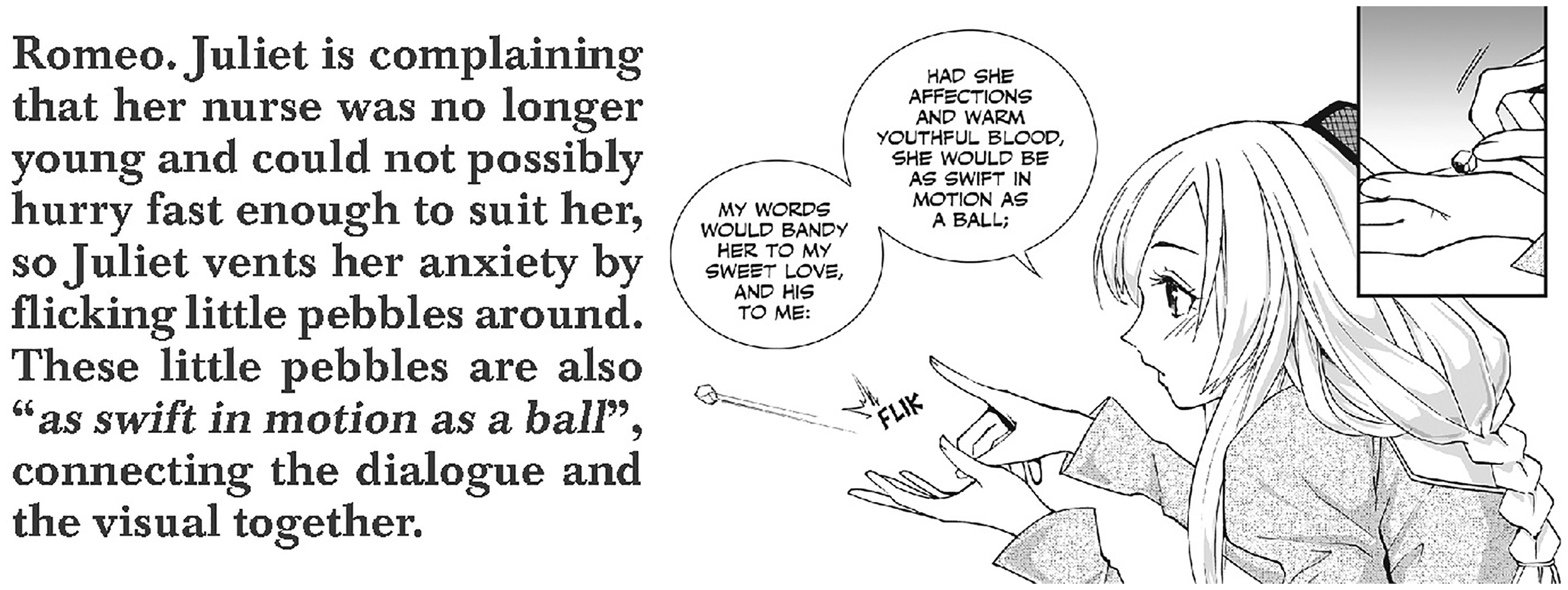
Back matter of Manga Classics Romeo and Juliet by Crystal S. Chan and Julien Choy (2021), p. 17.
The kind of ‘visual footnote’ described here exists on virtually every page of the Manga Classics titles, and each one is educational in and of itself. These visual glosses are highlighted by the commentary in the books’ paratexts, the most illuminating example being Othello, where Chan discusses the use of the ‘stage’ (as she calls it) to ‘display dominance change’ (Figure 2). Iago has promised Roderigo that Othello will perish and that Desdemona, his wife, will become Roderigo's wife instead. Iago uses the promise of Desdemona's love to manipulate Roderigo, but by Act 4 his patience has run out, requiring all Iago's rhetorical powers to turn the situation around. Chan explains: I designed the stage of this scene to be on a winding staircase when Roderigo is challenging Iago. As long as Roderigo is angry and questioning, he stands above Iago on the stairs, looking down from a position of power. But as Iago regains Roderigo's trust, he moves up to stand beside his challenging partner, then continues to mount the stairs as he regains his initial dominance over the weak-willed Roderigo.
14
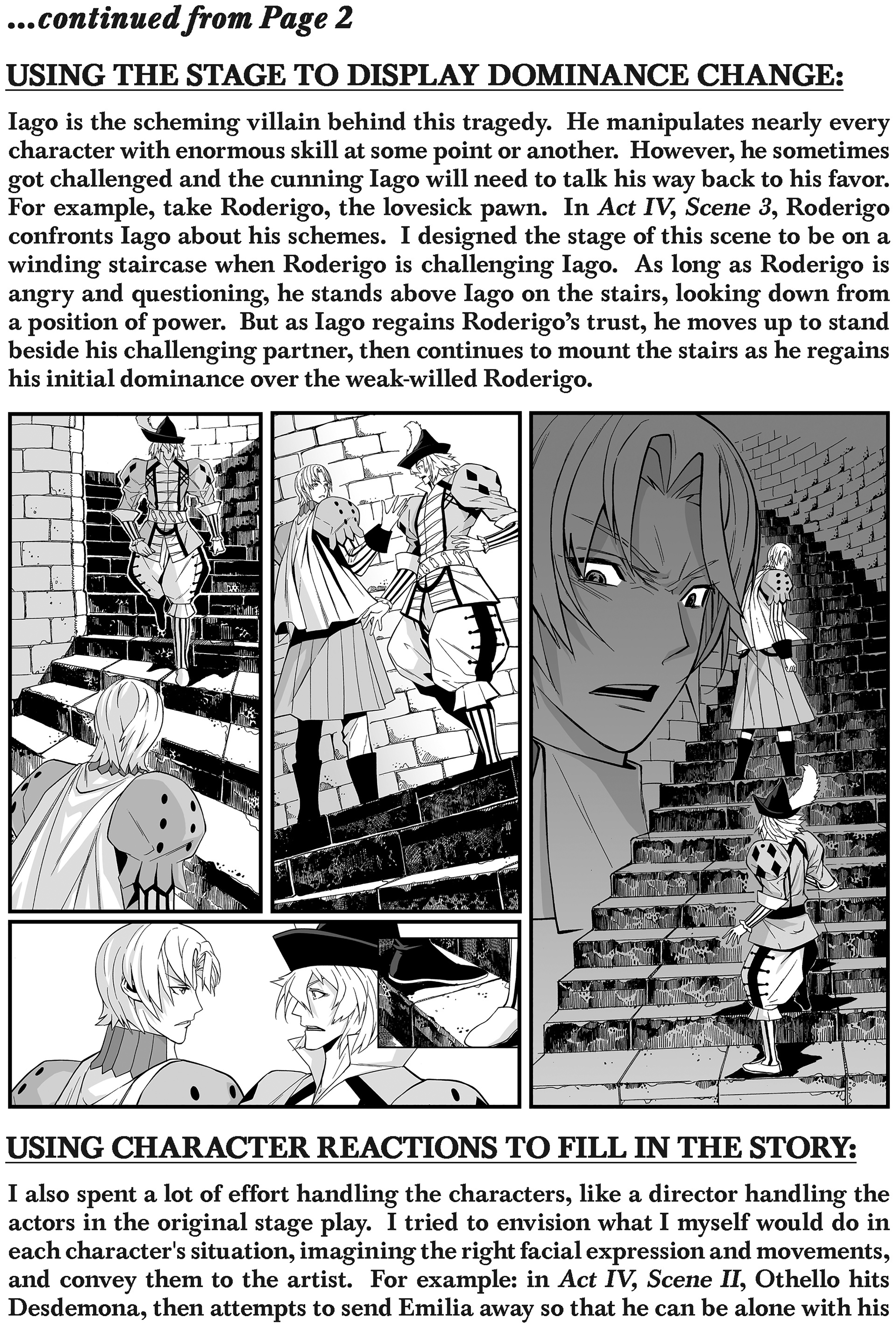
Back matter of the Manga Classics Othello by Crystal S. Chan and Julien Choy (2021), p. 4.
As can be seen in Figure 2, Chan and the illustrator, Julien Choy, use close-ups to emphasise the effect she describes: of Iago and Roderigo's feet to show that they are briefly on equal footing, and then of Iago's face looking down on Roderigo at the end of the sequence. The relative size of Iago's visage amplifies the shift in power relations. 15
The critical and educational value of these meta-manga vignettes is considerable. First, they draw attention to how visual forms generate meaning in conjunction with words, and they indicate how attentive close readings of visual-verbal compositions may reap rewards. More specifically, this case serves as a jumping-off point for a discussion of ‘high’ and ‘low’ as spatio-social metaphors, for example, or how such concepts are baked into the language, where ‘up’ is almost always good and ‘down’ almost always bad. 16 Such insights into how cultural and linguistic phenomena may be utilised in an artistic or literary context is of great value in education, to the understanding of multimodality and the construction of critical literacy as well as in analyses of how social hierarchies are depicted in the arts.
A particular affordance of this sequence resides in its interrogation of what makes different media unique. As is implied by Chan's use of the word ‘stage’, the sequence where Roderigo and Iago change places exemplifies how comic books or manga might mimic what takes place on a theatre stage or in a film (i.e. blocking). At the same time, a comic book is precisely not theatre or film, and cannot show actors in movement; the temporal design of a printed medium is profoundly different. Instead of movement, comics show multiple moments in time, one next to the other. In the example discussed here, the combination of overviews and close-ups combine to produce an effect, which, in its synthesis of words, framing devices (panels, word balloons) and various forms of images, is possible only in comics, graphic novels, and manga. Drawing students’ attention to this is useful, both because it suggests how each medium works in isolation, and because it highlights what changes might take place in adaptations. It also demonstrates how both performance and adaptation are collaborative efforts that stretch across space and time.
Even though the Manga Classics series is a rare example of Shakespeare comics that draw paratextual attention to their own creative choices as adaptations, all Shakespeare comics have to make such choices, and the outcomes are dialogical; some sort of juxtaposition, between values, between worldviews, between media, or between social strata, tends to take place in all instances of Shakespearean adaptation.
In a Shakespeare comic, the perceived values and ideals of Shakespeare's England 400 years ago are contained within what is in effect, due to its modern form, a current-day artistic-dramatic-literary work. Reading Shakespeare comics, as well as other texts from the adaptation history of Shakespeare, is a good way to learn something about both Shakespeare's times and the society which responds to his works: adaptation always reflects the relevant episteme. This is made manifest both in adaptations that attempt to recreate elements of the Renaissance in the environments, costumes and other details, and in adaptations that are plainly modern, and which highlight their distance from Shakespeare's time, as I will discuss in the next two sections of this article.
Genre and intertextuality in Shakespeare comics
There are several striking examples of visual and literary allusive practices in Shakespeare comics, and while these expand the range of meanings by setting up a dialogue between Shakespeare's plays and texts in other genres and media, they also increase the density of signification whilst often demanding considerable cultural knowledge from their readers. On the one hand, the use of verbal and visual references demonstrates comic books and comic book creators’ capacity for complex and sophisticated treatments of Shakespearean themes through judicious and insightful choices of intertextual reference points. On the other hand, this heightened complexity may not always increase comprehension for the average reader. I will look at two examples: one where the visual setting (costumes, backgrounds, genre references) is used to increase familiarity and approachability; and one where a richer weave of meaning emerges, albeit whilst also generating both additional challenges and possibilities for the educator.
According to selfmadehero editor-in-chief Emma Hayley, the Manga Shakespeare Romeo and Juliet (2007) 17 is inspired by Baz Luhrmann's film adaptation Romeo + Juliet (1996), in the sense that it takes place within a contemporary setting, featuring young people using modern-day technologies such as mobile phones. 18 To wit, a major plot point in this tragedy is that on account of not having received a crucial message, Romeo mistakenly believes Juliet to be dead. In the manga, this happens because he cannot get a signal on his phone.
The most notable aspect of the manga Romeo + Juliet, however, is precisely that it is a manga, a Japanese/East Asian form of comic book (closely related to Eastern animation or anime), which already in 2007 was well-established as an extremely popular genre among young readers. 19 Strictly speaking, it is an ‘OEL’, or Original English Language manga, made in the UK and read from left to right rather than right to left; but in terms of narrative design and visual style, it is recognisably a manga.
Manga has numerous tropes and schemata that aid the reading, and these often follow gendered generic patterns. As I discuss elsewhere, the Manga Shakespeare series tends to place Shakespearean tragedies and history plays such as Macbeth, Richard III, and Othello in the boys’ manga category (shōnen), while love comedies such as A Midsummer Night's Dream, Twelfth Night, As You Like It, and The Merchant of Venice carry the hallmarks of manga for girls, so-called shōjo. 20 This latter genre tends towards androgynous character designs (recognisable from today's J-pop and K-pop fashions), a focus on clothing, make-up and decorative elements, and various signifiers denoting certain emotions. Flowers as decorative and symbolic elements are very common, as are various forms of ‘screens’, i.e. background patterns that underscore the mood and sense of each panel (Figure 3).
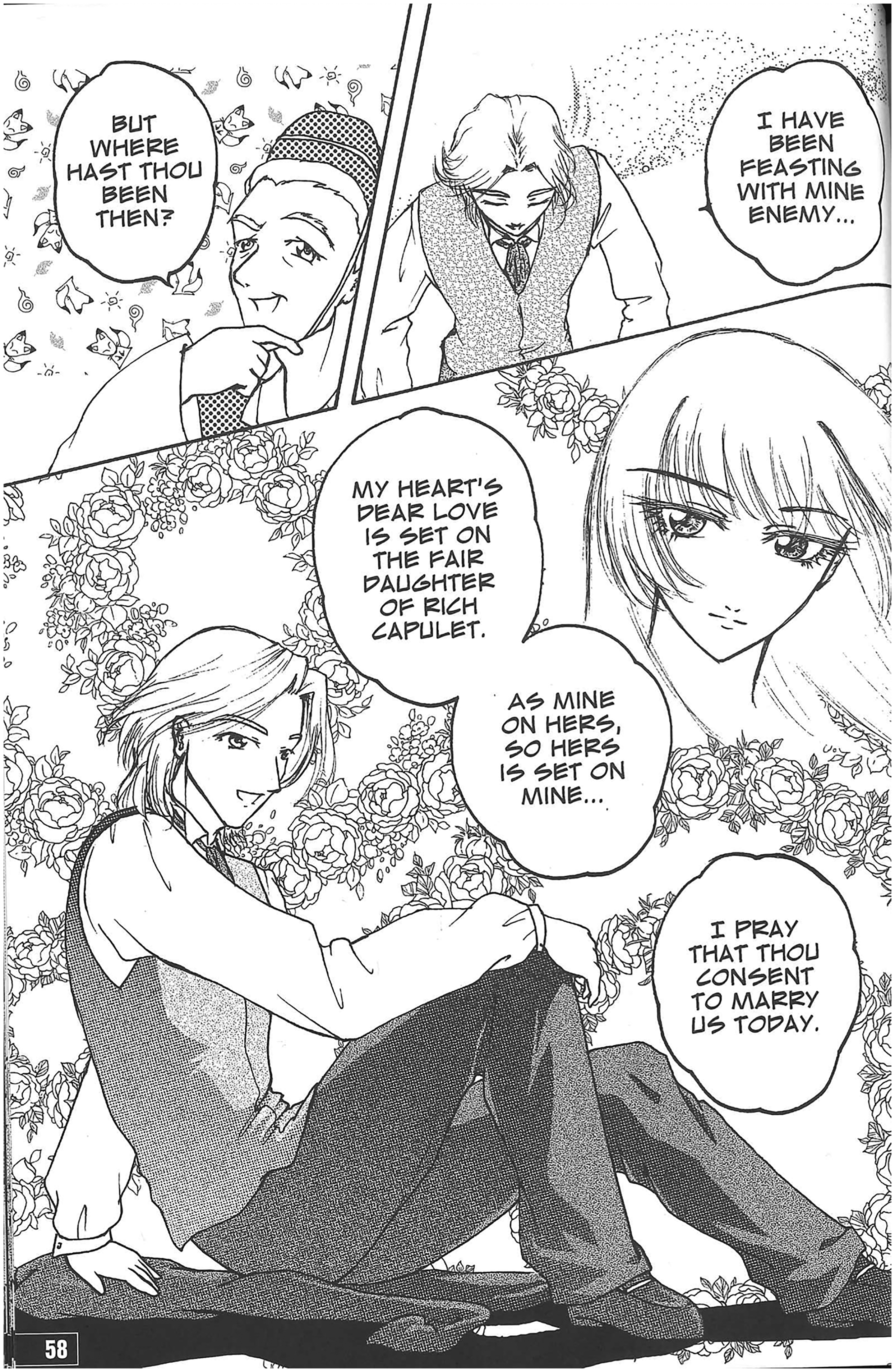
Background screenprints as genre trait in romantic girls’ manga. Appignanesi and Leong, Manga Shakespeare Romeo and Juliet, p. 58. © selfmadehero 2007. Reproduced by permission of selfmadehero.
That Romeo and Juliet has been placed in the shōjo category despite being a tragedy can be explained by the fact that it in practical terms remains a love comedy until almost the very end, at which point it changes into a tragedy or even a sort of melodrama. 21
In the context of education, it is not enough to know (or claim) that the manga style of presentation makes the play more accessible. The teacher or teacher-training student should consider how specific elements of Shakespeare's play – genre, plot characters, themes – are treated in particular ways by the manga medium, thus to assess how a contemporary medium both communicates with and embodies Shakespearean texts. But in addition to communicating with readers through employing familiar visual traits, generic markers are also used to situate the text in modern culture. Hence the teacher should ask themselves or their pupils what kinds of assumption about gender and genre form the basis for the aesthetic choices that are being made and how it influences our reading of Romeo and Juliet: modern reconfigurations are not progressive simply by virtue of being new. 22
The Manga Shakespeare King Lear (2009), 23 also published by selfmadehero, uses visual setting and visual allusions in a more radical manner to more intricate effect. The plot of this tragedy is derived from a mythical, early medieval England, but illustrator ILYA's version takes place in North America during the eighteenth-century Seven Years’ War between Great Britain, France, and their respective allies, including Native American tribes. In fact, this war is the setting of James Fenimore Cooper's novel The Last of the Mohicans (1826), a text decried by modern scholarship as complicit in the narrative that Native Americans were noble and proud people, tragically but inevitably doomed in the face of white westward expansion and manifest destiny. 24 While ILYA's manga King Lear does borrow some East Asian narrative traits, its main model is evidently the Classics Illustrated comic book adaptation of Cooper's novel, published in 1942.
Verbally, the manga King Lear contains the language (reduced by about two thirds), the characters and the plot of Shakespeare's play; visually it mimics the Classics Illustrated Mohicans comic book, so that Lear is a tribal chief, the Earl of Gloucester a trapper in a Davy Crockett hat, and the Earl of Kent a Native American warrior. Lear's three daughters seem to be mixed race, while Gloucester's illegitimate son Edmund is Black, presumably the son of an enslaved woman, although this is never stated outright.
ILYA's Lear demonstrates how a play from around 1603–06, a novel from 1826, and a comic book adaptation from 1942 can be combined in a modern-day manga-style text that sheds light on questions relating to American history, identity, and racism, and the role these issues play in today's society. 25 The mix of references culminates in the manga's final panel, which takes the form of a tableau in which the characters of the manga are posed as in an oil painting (Figure 4).
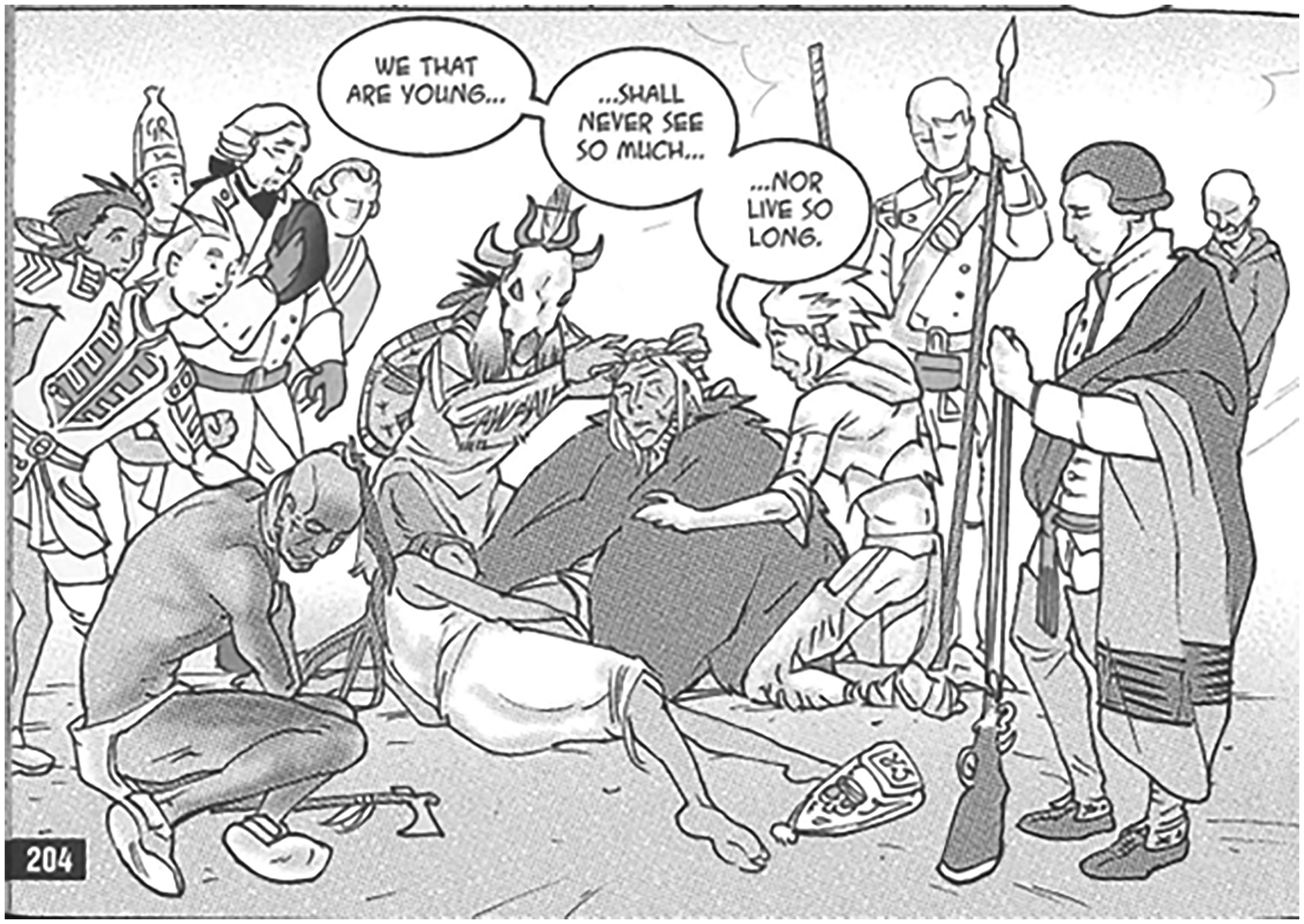
Imitation of an oil painting in Appignanesi and ILYA, Manga Shakespeare King Lear, p. 204. © selfmadehero 2009. Reproduced by permission of selfmadehero.
The model for the composition of Figure 4 is Benjamin West's history painting The Death of General Wolfe, which was exhibited in 1770, to commemorate the eponymous war hero's passing at the Battle of Quebec in 1759. 26 As this battle formed part of the same Seven Years’ War featured in The Last of the Mohicans, it is a pertinent choice of image. It does highlight problematic sides of Cooper's novel, though. As the art historian Vivien Fryd has argued, West's painting casts the Native American warrior featured in the painting in exactly the same light as ‘Indian Braves’ in Cooper's novel: in adopting the pose of Melancholy, this warrior is allegedly feminised, marginalised, and reduced to a tragic idea. 27 The general, on the other hand, is depicted in the pose of the Messiah, deposed from the cross, a composition known from church art as a lamentation painting or a Pietà.
Using an image that apparently reinforces the idea that Native Americans were tragically doomed as a reference in a manga version of a tragedy, might seem reactionary. ILYA's allusion to the West painting does however change a few central elements in ways that encourage questioning of the moral and thematic context. First and foremost, the white hero at the centre of the painting has been replaced by the Native American Lear. This could be seen to reinscribe the notion of fated doom, or it could be seen as a comment on how Lear, like Christ, dies a martyr to others’ sins and betrayal. The Native American warrior on the left-hand-side of the composition (which the reader may identify as Kent) does not rest his chin on his hand in the manner of the allegorical figure of Melancholy but rather turns away.
Ultimately, while it may be unreasonable to read ILYA's Lear as a defence of manifest destiny, it is an ambiguous and difficult text. It exemplifies how involved and challenging comic books and manga adaptations can be, especially when they create additional intermedial connections. That it uses an oil painting also suggests the wealth of cultural knowledge required to decode and understand the dialogical method for producing meaning in such texts. We cannot expect that school pupils or teacher trainees are already in possession of this knowledge (depending on their social class, age, and nationality), but there is no reason that the references should remain available to an exclusive audience only.
As the Romeo and Juliet and Lear cases makes clear, questions regarding racial, religious, or gender identity need to be treated with circumspection in the classroom; we cannot rely on comic book adaptations to boil difficult issues down to easy and simple answers. Expanding that claim, the final part of this article studies how racial identity and race-making are approached in graphic novels and manga adaptations of Shakespeare, and how we can most usefully address such issues in the context of education.
The colour black in Shakespeare comics
‘Race-making’ is a term that denotes the social processes by which the idea of ‘race’ is constructed and reconstructed: the myriad phenomena, attitudes, interactions, and texts that enable racism to exist. It is often said about Shakespeare's era that it predates scientific racism, for which reason it is allegedly misleading to describe texts produced in his era as ‘racist’. Yet, as many scholars have argued, the narratives about race created in Shakespeare's time certainly participate in the historical process of race-making on which current attitudes are based. 28 Moreover, since Shakespeare's plays are not historical artefacts, safely ensconced in museal glass boxes, but living, breathing, constantly remade pieces of dramatic art, it of interest to assess how race and race-making are reproduced in Shakespeare comics today, and how to handle this material in an educational context.
Race in Shakespeare is relevant for many reasons, but in particular because he wrote several plays where characters are Othered: the Black servant Aaron in Titus Andronicus, the Jewish money-lender Shylock in The Merchant of Venice, and the ‘moorish’ title character in the tragedy of Othello. Aaron is a straightforward villain in a play that is very rarely (if ever) adapted into a comic book. Shylock is a comedy villain built from antisemitic clichés, and although the play does contain elements that permit its own subversion, several scenes are decidedly offensive today. Othello, though, is a comparatively ambiguous play, often seen as one where society's racism rather than the protagonist's race is promoted as the cause of the titular character's tragic downfall.
Othello is a relevant case to investigate because it is often adapted into comic book form. Here, I look at three editions of the play: an unabridged graphic novel from the 1980s, an abbreviated OEL from the 2000s, and a recent, full-text manga. In all three cases, I study how dark or black colour is used, literally and symbolically.
Hugh Quarshie, who played the title character at the Royal Shakespeare Company in 2015, thinks Othello is too quickly and easily taken in by Iago's wiles, and speculates whether Shakespeare saved ‘himself the trouble of a plausible psychological profile for Othello by reverting to the convention as voiced by Iago: “These Moors are changeable in their wills”’ (1.3.346–7).
29
Quarshie, who formerly believed that the play was essentially unperformable, later changed his mind, concluding: I think it would be possible to produce a version of the play which shifts the focus away from race and onto character. It might still be impossible to avoid the conclusion that Othello behaves as he does because he's black; but it might be possible to suggest that he does so not because of a genetic disposition towards gullibility and violent jealousy, but for compelling psychological, social and political reasons; that he behaves as he does because he is a black man responding to racism, not giving a pretext for it.
30
Quarshie's solution, with director Iqbal Kahn, is to use visual markers to rephrase the questions the play raises about race. In their production, Iago too is Black (played by Lucian Msamati), a simple move away from traditional casting practices that was intended to upend some assumptions associated with race in this play. 31 As a visual medium, comic books have similar affordances, but since they do not rely on casting actual, flesh-and-blood humans in the parts, comics can go further in their reconfigurations of racial markers and reinventions of representation.
Visual representation of race is not without its pitfalls. Comics scholar Andrew J. Kunka reminds us that ‘[w]hen it comes to race and ethnicity, an artist can utilise common, neutral physical markers in order to indicate the character's racial or ethnic background, but as has often happened, the exaggeration of such markers results in problematic images.’ 32 Comics have a responsibility to avoid racial caricature, and educators who use comics adaptations need to reflect on how images perform representation.
Oscar Zárate's graphic novel Othello from 1983, unabridged and in full colour, uses ‘casting’ in a manner similar to Kahn and Quarshie's production of the play, to ensure that Othello is not the only Black character in the world of the play. 33 Bianca, Cassio's mistress on the island of Cyprus, is Black and short-haired like Othello, while Cassio is white, blond, blue-eyed, and long-haired like Desdemona: one couple mirrors the other, and both fall prey to Iago's machinations. The effect is to suggest (albeit indirectly) that Othello and Desdemona's relationship is not singular, and that racism, not race, is the problem.
Zárate's Othello is also imbued with psychological depth; sequences and soliloquies that illustrate introspection and anguish are presented in comprehensive and imaginative detail. 34 The character's African identity is highlighted, arguably without crossing the line of racial caricature, but approaching it on occasion: Othello's leopard fur collar brings to mind African American ‘pimp’ stereotypes. Yet, to an extent, Zárate seeks to evade race-making at crucial junctures. The scene where Othello strangles Desdemona on their bed is depicted in all its terror, but at this moment, Zárate changes Othello's skin colour to grey, as if he were made from stone: no longer human, no longer himself. Of note here, then, is the symbolic use of colour – an aspect that becomes even more crucial in the other two editions, which are printed in black and white.
The general attitude of Ryuta Osada's Manga Shakespeare Othello (2009) 35 towards the race question is one of avoidance rather than confrontation. As a manga it utilises the abovementioned freedom in comics to alter character designs and settings beyond what is possible (or practicable) in many other media. Its setting is a fantasy version of Venice (and later Cyprus), with some recognisable elements such as canals, but no pervading sense of verisimilitude. This impression is extended by the outlandish character designs, which combines anthropomorphism (moth wings, multiple arms, dog heads, horns, sheep ears, antennae) with human properties. A consistent trait is that the Venetians are goat- or sheep-like and often demonic in appearance, as opposed to Othello, who dresses in white, has long silver hair and white-feathered wings. His racial markers are subdued and instead he stands out due to his angelic looks.
The strangulation scene is a challenge for any theatre director or adaptor, and it is particularly problematic in an edition targeting younger readers. The Manga Shakespeare Othello tries to solve the problem by not directly showing the event. Instead of having it take place offstage, as it were, the moment is depicted as one of complete blackness, where there is no image, only words: ‘it is too late’ (Figure 5). The sequence does not attempt to hide Othello's anger or cruelty; and in the panel directly preceding the murder, we see his hands reaching towards Desdemona's throat.
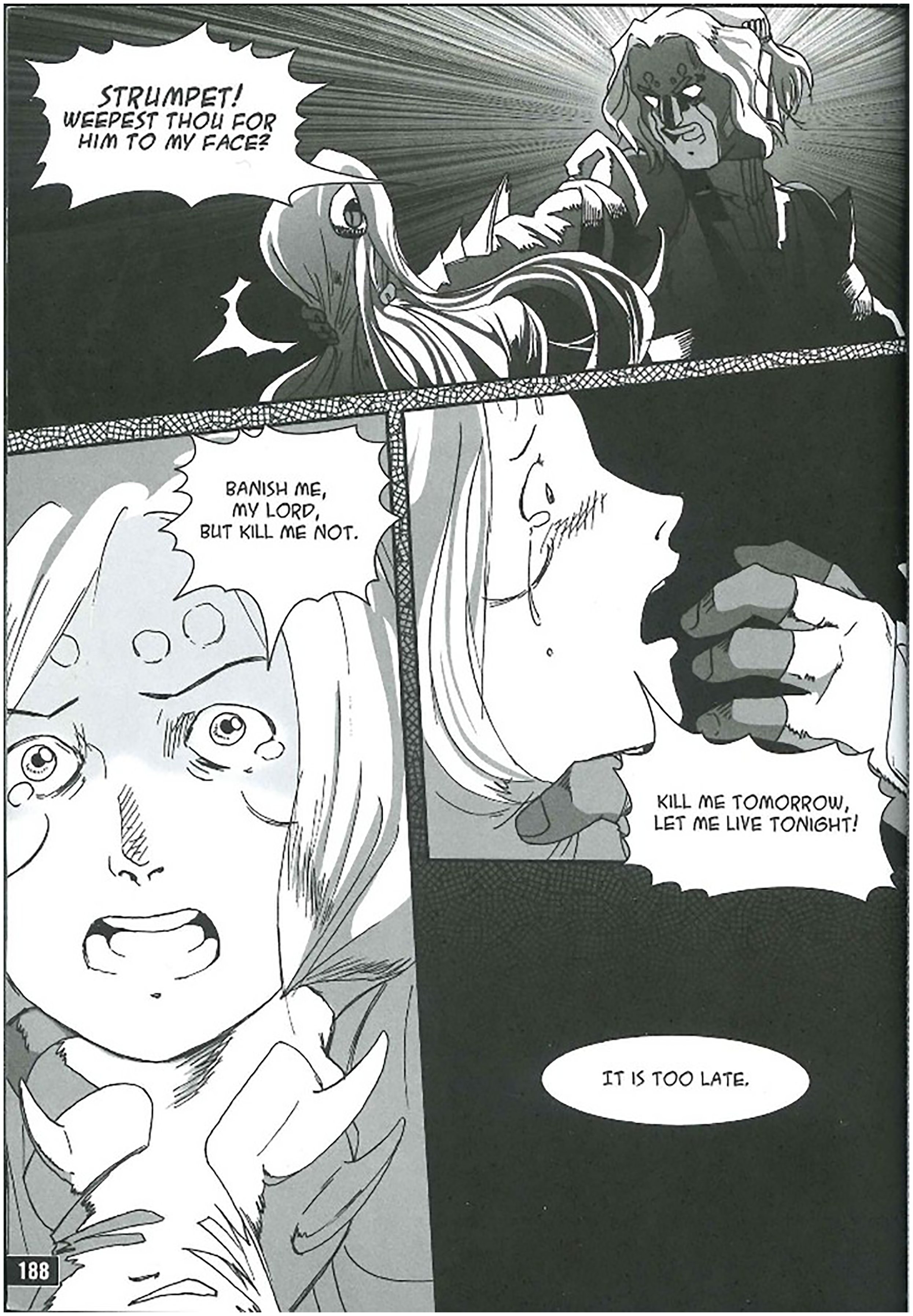
A dark moment in Appignanesi and Osada, Manga Shakespeare Othello, p. 188. © selfmadehero 2008. Reproduced by permission of selfmadehero.
Throughout the whole sequence, and especially in the final moment, darkness is used as a visual metaphor for a ‘dark deed’. As an evasive strategy it is arguably flawed, because the association it generates between blackness and evil (the Devil is commonly depicted and described as black-skinned from the Middle Ages onwards) is unfortunate: it potentially reinscribes a dichotomy that has traditionally contributed towards race-making and racism. 36 Darkness or blackness appears as a metaphor in other scenes too. As I discuss in more detail elsewhere, the shadow of a lattice window is used throughout this manga as a symbol for how Iago ensnares Othello in a net or a spider's web of his own devising. 37
In the most recent graphic version discussed here, Chan and Choy's Manga Classics Othello, darkness is employed as visual metaphor in a completely different scene to somewhat different ends (Figure 6). In a sequence that resembles the previously discussed changing of places between Iago and Roderigo, shadow is used as a metaphor whose meaning covers several nuances of deception, from deceiving to being deceived. In 3.3 – the play's exact mid-point – Iago seizes the opportunity to plant a powerful seed of doubt and suspicion in Othello. As the sequence begins, 38 Iago appears in the shade of a tree, his upper body completely inky black, reducing him to a sinister, barely human silhouette. Throughout the next several pages, as Iago gradually convinces Othello that something is afoot between Desdemona and Cassio, he equally gradually steps away from the shade into the light. Ultimately, as Iago leaves him behind standing under the trees, Othello is draped in the darkness that was formerly covering Iago.
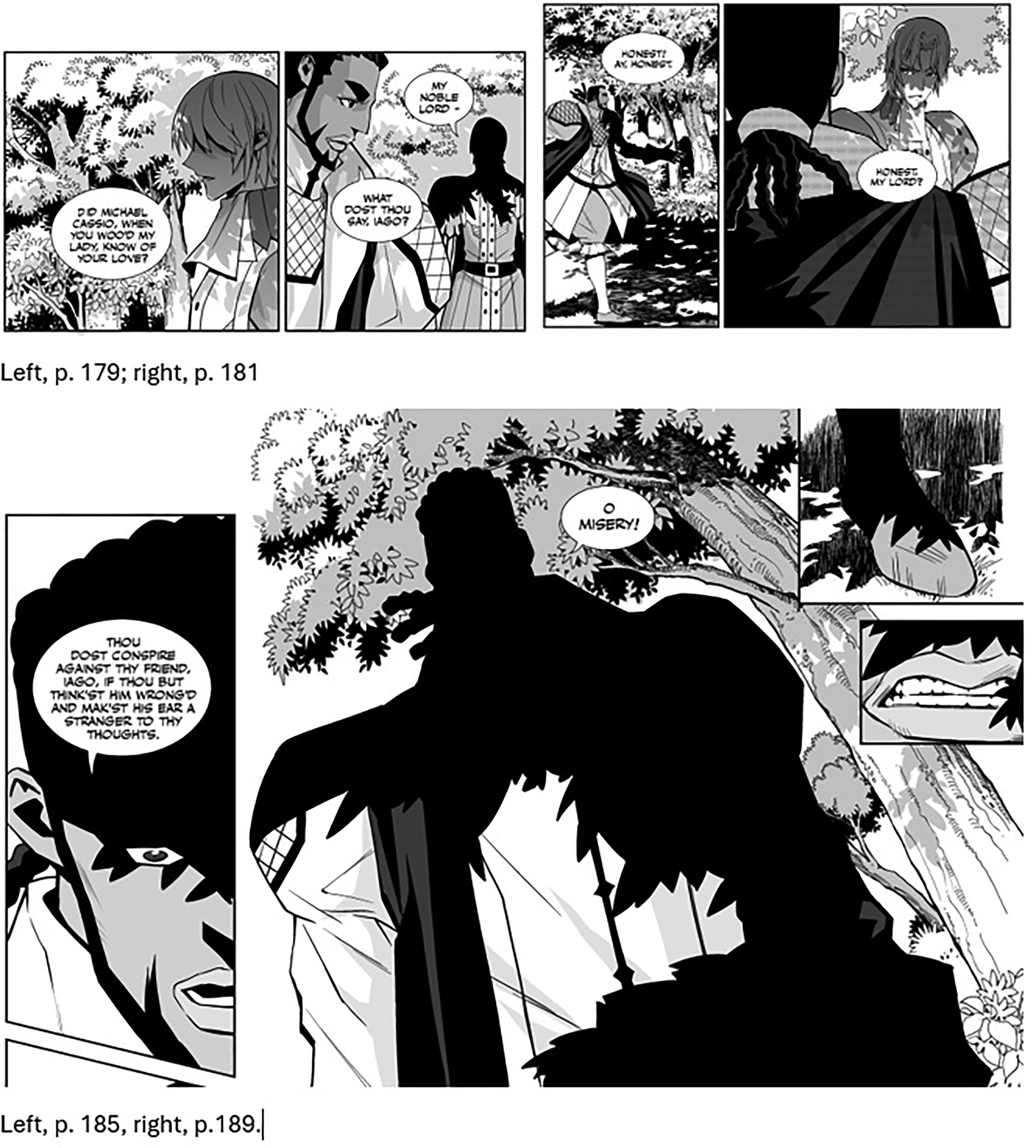
Othello is drawn into Iago's darkness, Manga Classics Othello by Crystal S. Chan and Julien Choy (2021), pp. 179, 181, 185, 189.
As in the two instances where darkness, shade and blackness are used metaphorically in the Manga Shakespeare version, the Manga Classics edition of Othello intermingles evil intent, deception, gullibility, and other traditional connotations of blackness in a manner that would require thoughtful scaffolding in the classroom, and in higher education teacher training. My point here is not to make a moral judgement about any of these editions, which are on the whole imaginative, creative, well-informed and thoughtful, but to reflect on how their visual presentation activates cultural habits and associations which need to be interrogated.
How and why use graphic adaptations?
In the light of the above analyses, which can merely hint at the wealth of possibilities and challenges offered by Shakespearean adaptation, it should be clear that to use Shakespeare comics in teaching demands a high degree of reflection, insight into topics ranging from historical attitudes to race, to how comics work as multimodal texts, as well as a comprehensive understanding of the plays as adaptations. In fact, it might almost look like using comics in the classroom is more challenging than simply teaching the plays as ‘literature’. Nevertheless, there are some clear advantages to using graphic adaptations, as I will discuss in this final section of the article.
Previously noted misgivings about canonical texts notwithstanding, Shakespeare comics are not ‘older literature’. In a very real sense, they are contemporary texts that naturally take part in an ongoing discourse on identity, culture, power, and class, and which explore these issues through inventive and dialogic uses of multimodal form. Shakespeare comics are not theatre plays but have strong performative elements that potentially evoke stage practice; they are not novels but carry generic and material hallmarks of literary texts; and they are not fine art (sculpture, oil painting) but utilise and reference techniques and motifs of long-standing art-historical provenance. This triple imitation of other media is instructive, but so is its combination into the multimodal form of the comic book itself: a medium that treats space, time, and narrative in ways very much its own.
Using graphic novels and manga to teach Shakespeare consequently make things easier for the learner, because comics bring a performative dimension to the text: characters’ stances, facial expressions, and spatial relationships can produce meaning, but also simple clarity regarding questions such as, who is speaking now, to whom and from where? And while many Shakespeare comics use the original language (often abridged), it is arguably much easier to understand that language when the speeches are combined with depicted action. In addition to this basic degree of ‘theatrical’ visual guidance, Shakespeare comics can produce conceptual clarity as well, for example, through highlighting their own artificiality or through equipping complicated metaphors with visual illustrations, which in a sense operate as explanatory footnotes.
Scholarship and textbooks on the use of adaptations in the classroom tend to highlight the fact that adaptation provides the opportunity to experience, analyse and discuss choices made in the adapting process and what may compel artists, directors and others to reconfigure the text in a certain way. 39 That this is valuable and educational is unquestionably true, especially when it comes to critical literacy, understanding literary devices, recognising visual rhetoric, and general engagement in deep reading. This only works in practice, though, if the teacher utilises examples that highlight medium-specific traits and understands how they work.
Teaching Shakespeare comic book adaptation requires a dual perspective, one that takes into account that an adaptation both is the play (as opposed to something merely ‘supplemental’) and an interpretation of the play at the same time. There is no pure or original version that we can consult to find the ‘real’ meanings or intentions of the text; the Shakespeare play is constantly remade, within certain parameters of fidelity and acceptance that are bound up with cultural and historical attitudes. This flexibility is a result both of Shakespeare's works being theatre plays and thus dependent on being repeatedly brought to life (as the cliché goes), and of their identity as composite texts, assembled from many sources, including the visual, literary, and theatrical.
Emma Smith discusses how Shakespeare's plays are especially ‘gappy’ and identifies this as a central component in their enduring relevance: Shakespeare's plays are incomplete, woven from what's said and what's unsaid, with holes in between. This is true at the most mundane level: what do Hamlet, or Viola, or Brutus look like? A novelist would probably tell us; Shakespeare the dramatist does not. […] If The Taming of the Shrew's Katherine looks vulnerable, or ballsy, or beautiful, that makes a difference to our interpretation […]
40
‘That we don’t know what characters look like’, she continues, ‘is one symptom of the absence of larger narration or commentary in a play’. We also do not know exactly how stage directions (which are sparse and often added by later editors, based on educated guesswork) should be played out, we don’t know much about costumes or backdrops, and overall, the plays tend to ‘imply rather than state’, because Shakespeare prefers showing over telling. 41
In combination, all these elements suggest insecurity and undecidability, abstract concepts that can be hard to convey. But if it is done in a thoughtful manner, teaching Shakespearean comic book adaptation has the power to demonstrate with clarity how and why decisions made in the adaptation process matter, and how they are products not just of someone reading the playtext, but of reading it within a specific cultural moment. 42 For example, a teacher could compare an illustration in a Victorian edition of the plays with a depiction of the same character or characters in comic book or manga versions, before asking students to produce their own designs and to reflect on them. With a point of departure in Smith's observation that we do not know what Shakespeare's characters look like, asking students to describe or draw, for example, Iago, Juliet, Hamlet, or Desdemona, or to assess how they are represented in graphic novels and manga, could engender debates about some central cultural assumptions. As has been demonstrated, Shakespeare comics such as the Manga Shakespeare King Lear or the Manga Classics Othello provide examples both of what can be done and how it could take place. 43
Ultimately, the teacher who uses Shakespeare comics (be it in primary, secondary or tertiary education, within the Anglophone world or through ESL/EFL), would benefit from creating a context for learning where general historical and medium-specific information is established. For example, a teacher should know that Iago is not ‘really’ white but traditionally played by white actors for historical reasons – reasons that should be questioned. Finally, a teacher should know that Shakespeare is world-famous not just because he is ‘a good writer’, but because of the history of Anglophone cultural hegemony and the British Empire, as well as the related history of adaptation and performance. As Sinfield averred, Shakespeare's position within English, EFL, and ESL curricula is itself something to reflect on. In sum, the teacher who takes on the challenge of using Shakespeare in English teaching could benefit from it on multiple levels, and, while they are not shortcuts, Shakespeare comics are eminently suited to the task.
Footnotes
Declaration of conflicting interests
The author declared no potential conflicts of interest with respect to the research, authorship, and/or publication of this article.
Funding
The author received no financial support for the research, authorship, and/or publication of this article.
Notes
Author biography
 ), and has recently published a monograph called Shakespeare Comics: Art, Time and History (Edinburgh University Press, 2025).