



Abstract
King Lear is the tragedy, which, above all others, feels as though its meaning changes as the viewer ages. The play has always been regarded as Shakespeare's meditation on ageing, and the title role as a mountain that thespian elders must scale to reach legendary status. Yet, despite its epic ambit, Lear is also a play rooted in domestic conflict where persons old and young fail to understand each other. As Edgar reflects in the play's final lines, ‘The oldest hath borne most; we that are young / Shall never see so much, nor live so long’ (5.3.324–5). This ageless theme partly explains the play's ongoing appeal for successive generations; and when this cathartic realisation is blended with Shakespeare's unforgiving exploration of man's insignificance in relation to the natural elements, it seems ripe for recontextualisation within the global climate crisis. It is a pity therefore to report that Kenneth Branagh's take on the play not only fails to bring the play into conversation with the contemporary moment but lacks any tangible reason to justify its existence besides his commendable lead performance and a few stellar supporting players.
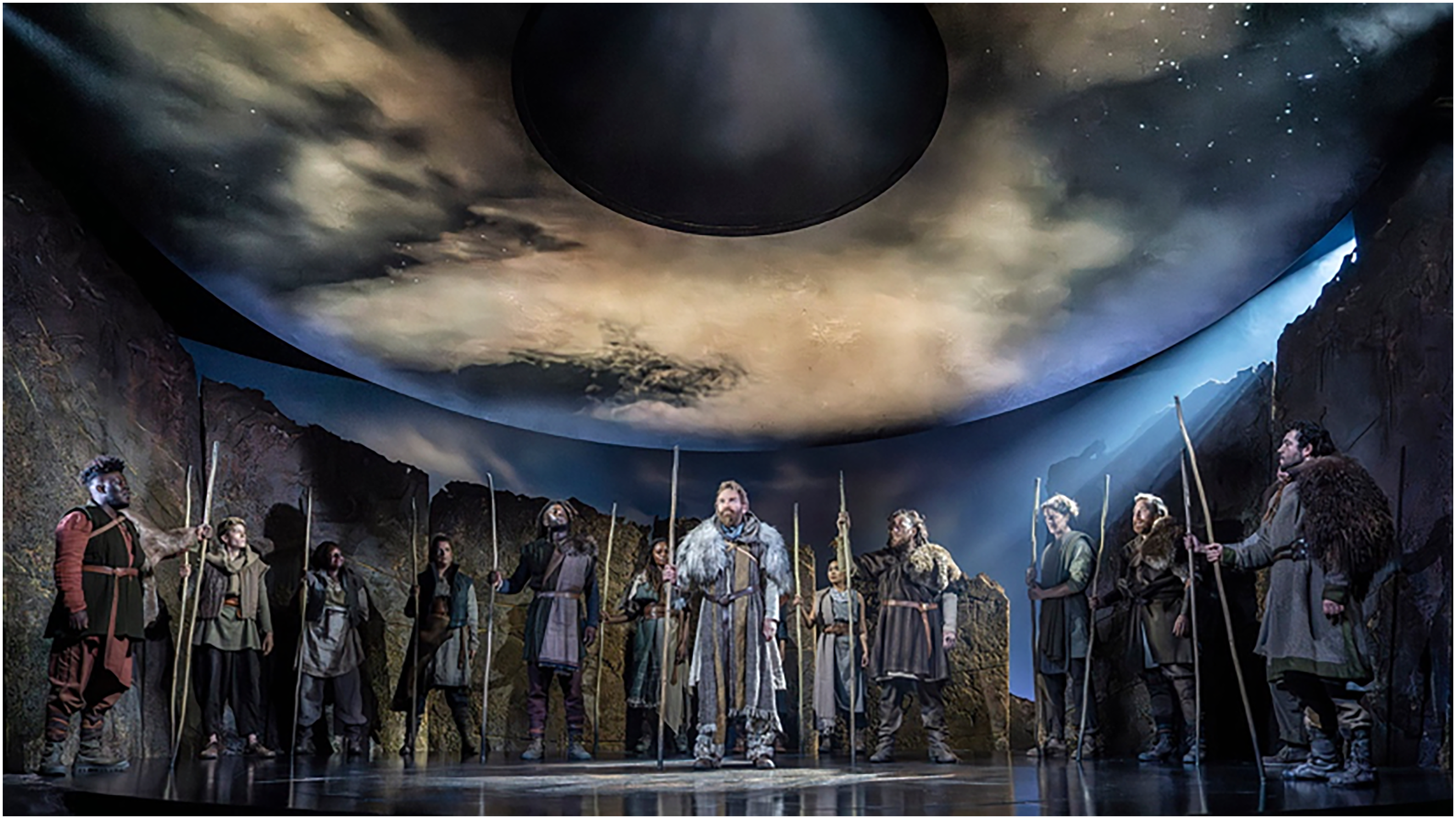
The company of King Lear, Wyndham's Theatre. Photo by Johan Persson.
At the relatively tender age of 62, Branagh might be considered somewhat youthful to tackle the role of Lear. However, Simon Russell Beale was a mere 52 when he played the role to critical acclaim at the National Theatre in 2014, and Danny Sapani, who will play the role at the Almeida Theatre in 2024, is just 53. Branagh's age is certainly not the issue in this production and his sprightliness on his feet, especially in the hovel scenes, lend his Lear a lightness and almost comic touch that is most welcome in this bleakest of plays. Branagh's approach to Lear's madness was also compelling: he appeared to suffer a stroke during the scene in which he berates Goneril and Regan for denying him his knights. In recent times, the character's mental collapse has often been portrayed as a gradual one, situated within the context of Alzheimer's disease. The relative youth of Branagh's Lear meant that he was able to cut a robust and suitably formidable figure from the start of the production, hence this sudden moment of distress, which subsequently reoccurred throughout the play's two-hour runtime, was all the more painful to witness. His performance also provided an excellent balance between the non-naturalistic bombast that makes Lear a role very much in the operatic tradition, bellowing, and berating the storm, whilst also knowing when to play scenes in a more realistic style, notably towards the end of the play in his most touching moments with Gloucester and Cordelia. This differentiation recalled one of actor's most compelling performances as the eponymous police inspector Kurt Wallander in the BBC television series Wallander (2008–16), in which Branagh similarly plays an ageing, jaded figure who suffers incalculable losses and has his authority called into question.
Unfortunately, Branagh's direction in this production is significantly less successful than his performance. His youth as Lear is partly exaggerated by the age of his castmates, the majority of whom are relative unknowns and recent RADA graduates. While it is undoubtedly commendable that Branagh has offered these actors this onstage opportunity and exposure in one of Shakespeare's classic plays, which sold well based purely on his starry reputation, almost across the board, the standard of performance is remarkably low for such a high-profile West End production. The standout actor, by some way, is Corey Mylchreest, who plays the bastard Edmund with charm, comedy and just enough bite to remind you that he is a nasty piece of work. Unlike most of his castmates, Mylchreest also decided to try to engage with the audience, rather than vaguely declaim into the middle distance of the auditorium. One such highlight came late in the play, when Edmund asked members of the front row about whether he should ‘enjoy’ (5.1.59) Goneril or Regan, with both sisters vying for his affections. The dark nature of this joke, coupled with the twinkle and malevolence that typified Mylchreest's performance, elicited rare laughter from the audience. Jessica Revell's dual turn as Cordelia and the Fool was also impressive, with her performance as Lear's youngest daughter possessing an unusual and welcome degree of steel in the face of her father's dismissal. The rapport between her Fool and Branagh's Lear was also apparent in the welcome moments of quiet intimacy when the two characters sat downstage and reminisced about the past.
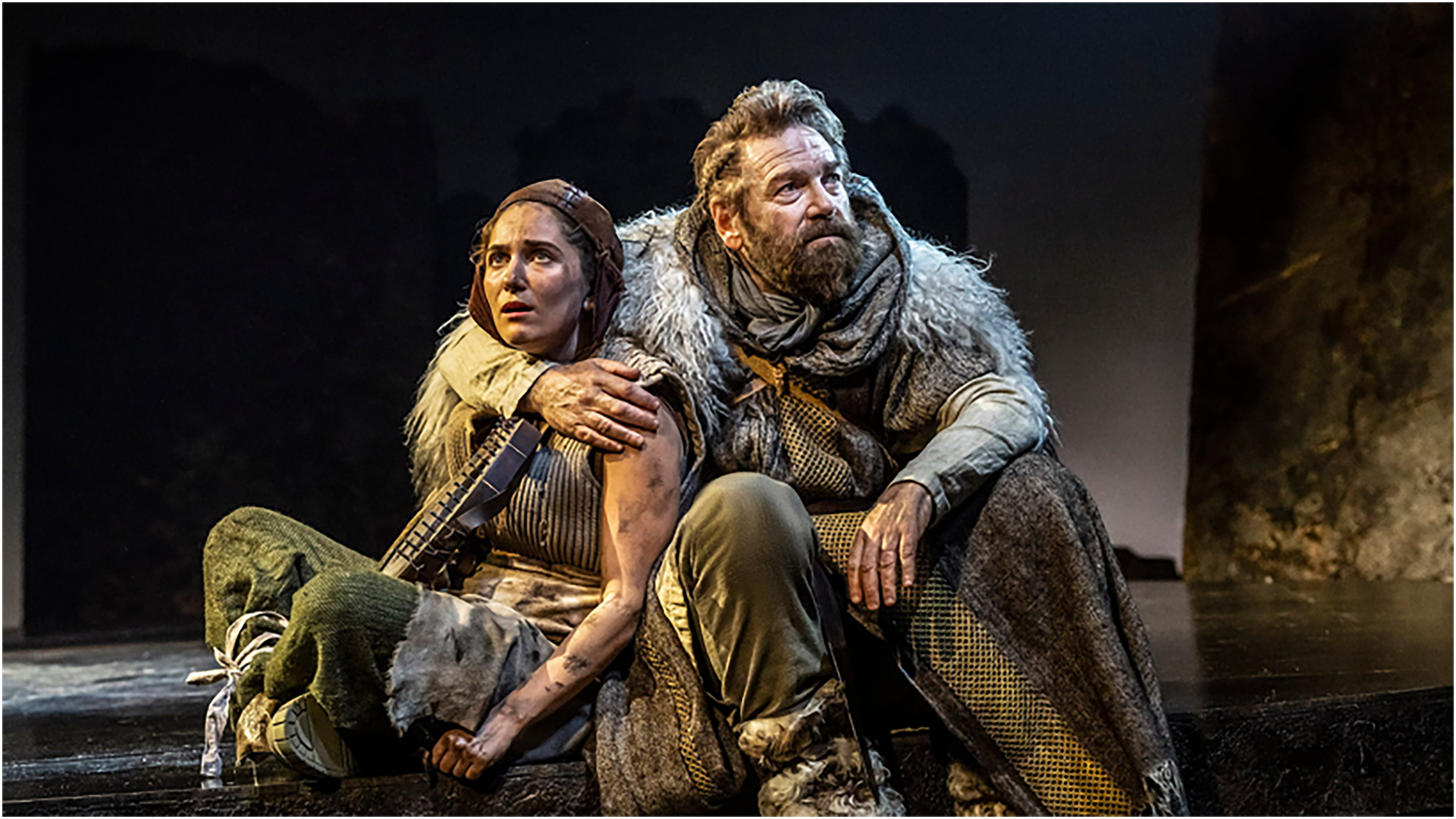
The Fool (Jessica Revell) and Lear (Kenneth Branagh) in King Lear, Wyndham's Theatre. Photo by Johan Persson.
Branagh, Mylchreest, and Revell stood out, largely due to their ability to oscillate between naturalistic and non-naturalistic acting registers. This was thrown into sharp relief by the rest of company's inability to do so, with the chief offenders being Deborah Alli's Goneril, Melanie-Joyce Bermudez's Regan, and Hughie O’Donnell's Cornwall. Inexplicably, for a play that so often deals with pain, both in body and mind, many actors delivered their lines in an identically monotone and declamatory fashion, regardless of the physical or emotional moment in which they found themselves. This was especially noticeable during the blinding of Gloucester, in which O’Donnell continued to shout his lines at the same volume as before, after being fatally stabbed, and Joseph Kloska's Gloucester only mildly modified his speech after receiving the not insignificant injury of losing both eyeballs. He even had the strength to clean up after himself, when he picked up the bloody remains as he exited for Dover. Branagh, the disciple of Laurence Olivier, is not famed as a director for his restrained, realistic approach to Shakespeare, but many of the actors in this production portrayed their characters with such bombastic non-naturalism that the play's delicate balance of light and shade was significantly undermined.
Another misguided aspect of this production was the decision to play the action straight through without an interval. The intention was clearly to lend proceedings the taut and lean narrative thrust and mood of a thriller. However, as one of the longer and more introspective plays in Shakespeare's canon, this bare-bones version limited characters’ capacity to reflect on the consequences of their actions and, by extension, impacted the audience's ability to deduce motivations and outcomes. A particularly egregious edit was Branagh's decision to remove the establishing initial part of the play: a short but crucial conversation between Gloucester, Kent, and Edmund. In this scene, Lear‘s two elder advisors share a bawdy exchange about the conception of Gloucester's bastard son, which essentially subjects Edmund to a form of verbal abuse in the Trumpian tradition of ‘locker room talk’. The scene complicates the audience's relationship with Edmund – the ostensible villain of King Lear – and perhaps explains why he resents his father and brother so deeply. It also introduces Gloucester and Kent – two characters who traditionally garner audience sympathy through their suffering and faithfulness to Lear – in a negative light, thus presenting a richer, more complex portrait of human life. Many productions move this conversation to the end of 1.1 and instead open with the more famous division of Lear's kingdom in three. Such a move makes the play unequivocally Lear's story and reduces the Gloucester family narrative to a subplot. Branagh's choice here to cut it altogether removed the essential backstory about Edmund, transforming him into a kind of one-dimensional pantomime villain, and stripped Gloucester – and to a lesser degree Kent – of valuable nuance.
Despite the Fool's presence, Lear is perhaps Shakespeare's most relentlessly melancholy tragedy. It has not been subject to the Tarantinoesque treatment that fits Titus Andronicus like a glove, and it arguably lacks the potential for comic interpretation that can be found in pockets of Hamlet and Macbeth. There are few parodic or satirical responses to Lear – unless you include Nahum Tate's 1681 version that provides an alternative happy ending – and this reflects the play's unforgiving and somewhat abrasive nature. However, in The Complete Deaths (2016), Tim Crouch and Spymonkey not only inverted the play's tone and genre but managed to anticipate the aesthetic and delivery of Branagh's production. In this production, four actors stage all 75 of Shakespeare's onstage deaths in 110 minutes. One notable moment was Lear's iconic death as he cradles Cordelia's corpse in his arms, dressed in a neolithic costume, and soundtracked by mournful horns and the other actors beating upon drums. Spymonkey's Aitor Basauri, playing Lear, has a meta-narrative running throughout The Complete Deaths whereby he longs to become a respected Shakespearean actor and is visited by Shakespeare himself in a series of private hallucinations. Shakespeare tells Basauri always to spit when he declaims, to point at the audience, and namechecks Branagh as an example of the sort actor audiences want to see. The performance of Lear affords Basauri the opportunity to spit and point, and he delivers an intentionally comic travesty of Lear's howling lament, aided and abetted by Petra Massey, who plays Cordelia with her tongue lolling and eyes open in a gross pastiche of death itself. A few days after my visit to the Wyndham's Theatre, I ran a workshop with Spymonkey Artistic Director Toby Park, and it was impossible not to be reminded of the company's parodic predecessor to Ken Lear. And not necessarily in a good way.