



Abstract

Thomas Middleton's Michaelmas Term, scholars agree, was written with a largely legal audience in mind. Those watching the play's original performance by the Children of Paul's, somewhere between 1604 and 1606, were largely men of the Inns of Court, regular playgoers across the city, but especially fond of the boy companies. Staging the Edward's Boys production in Inner Temple's Parliament Chamber put the performance's modern audience, whether Templars or not, into the position of lawyers. This city comedy, which stages few legal characters, and centres instead on a draper and his family, and on aspirant and would-be gentlemen, is nonetheless permeated with legality and legally binding agreements. Though the play's focus is on social aspiration, and on the trickery that realises or prevents it, the means of achieving that relies on the law. It is no coincidence that the main protagonist, the draper Quomodo, proudly sends his son from Cambridge to the Temple. In the early seventeenth century, an heir at one of the Inns was the means by which many a citizen hoped to improve the fortunes of his family.
Many of the original audience members must have been in similar situations themselves, yet joined in the mockery of onstage social climbing and the gambling or speculative credit required to achieve such pretensions. Typical of the boys’ company plays, Middleton's is highly self-aware, consciously theatrical and directly engaging of its spectators, and its use of metatheatre was fully exploited in Perry Mills's highly intelligent stagecraft. A virtue was made of the close proximity of audience and cast in the relatively small space of the Parliament Chamber, and those watching often felt part of the action, whether listening to the asides of proximate actors directed their way, forming a part of the mock funeral procession of Quomodo, or in the accusation thrown out at them by the draper as he exits at the end of Act 2: ‘Admire me, all you students at Inns of Cozenage’. We are being asked to make judgement: both on the quality of the acting and on the moral judgements of the characters.
It was easy to approve Mills's staging. The plot centres on Quomodo's attempts to dupe a gentleman, Master Easy, new to London, in order to acquire his land in Essex, and thereby social prestige. The means of this gulling is a bond, signed by Easy to gain cash from the draper, and for which, when it is called in and he cannot pay, he signs over his land. Quomodo's servant, Shortyard (mercurially played here by Tom Howitt), disguises himself as man-about-town Master Blastfield to befriend the aptly named Easy and engineer the signing of the bond. A key scene in the first half of the play was set by Mills in a homosocial space, part-gambling den, part-urinal, dominated by a dice game taking place centre stage, behind which Blastfield bonds with Easy as they relieve themselves. The continual rolling of dice, and men winning or losing, accompanies the key action of the scene, and accentuates the loss of money Easy is heading inevitably towards. The highly likeable gull, played affably by Enrique Burchell, led the audience to echo comments made elsewhere by Quomodo's wife, Thomasine; they ‘suffer[ed] in that gentleman's confusion’, and prepared themselves to sympathise with the draper's victim. As the trick is carried out, a young messenger boy rushes on and off, echoing the self-aware slave of classical comedy in his comments to the audience; he knows he will not be sent finally until the third time, as that is the nature of this kind of drama. In this role Adriel Vipin is evidence of the strength of Edward's Boys; even young boys playing minor characters are strong, and regular audience members know they will be central in future productions. Harry McCarthy's recent monograph, Boy Actors in Early Modern England: Skill and Stagecraft in the Theatre (Cambridge University Press, 2022), aims to offer ‘a sustained consideration of the physical demands made of boy actors in the early modern period and how those demands were realised and responded to on the early modern stage’ (p. 6), and nowhere do we get a better idea on the modern stage of what such plays looked like in practice than in a scene such as this one, with its central game playing and speedy entrances and exits.
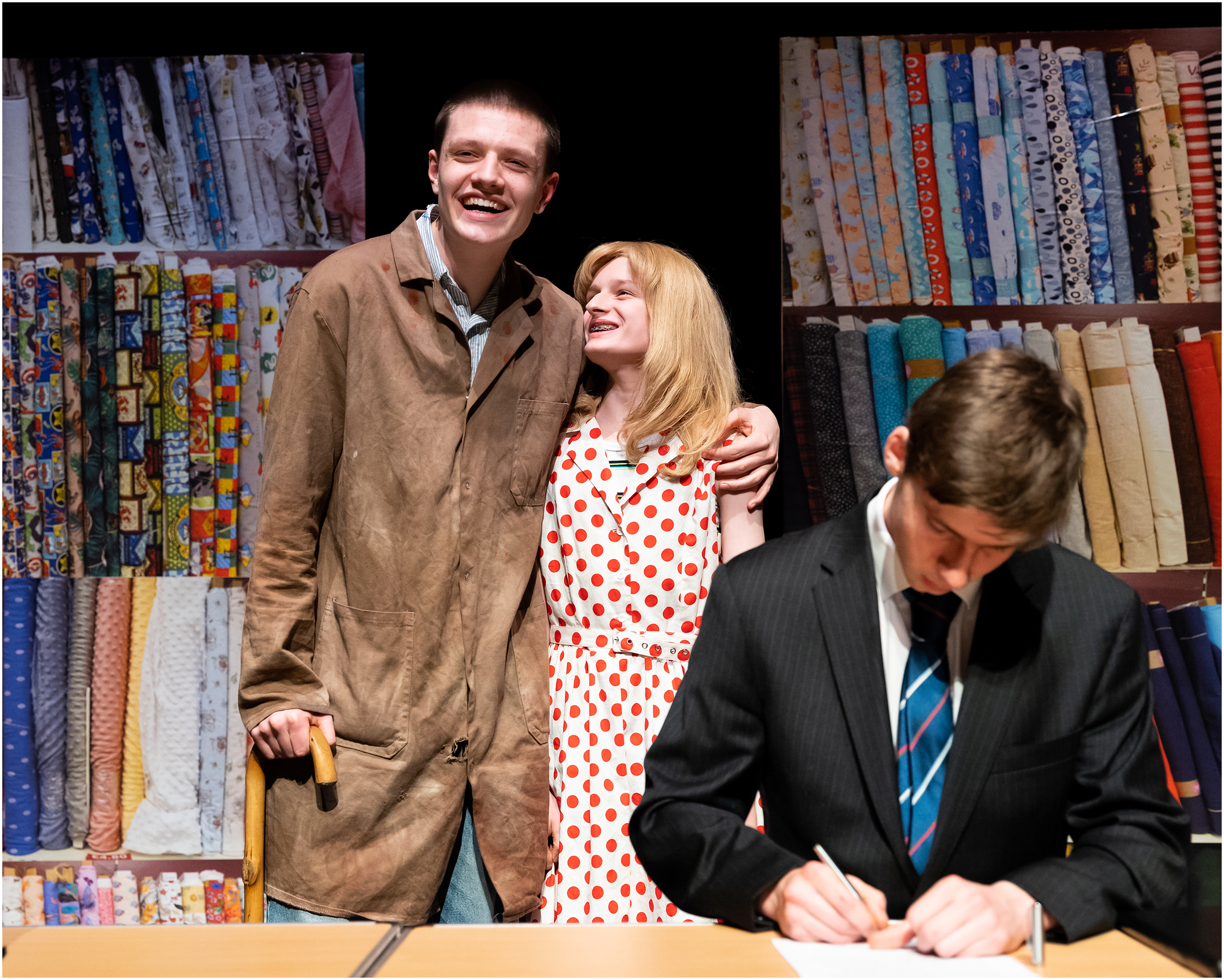
Quomodo (Will Groves), Susan (Thomas Griffin), and Dustbox (Archie Mathers), in Michaelmas Term, Edward's Boys. Photo by Nick Browning, www.nickbimages.com.
The scene weaves together plot and subplot, as the gulling of Easy takes place in the company of the Scotsman, Andrew Lethe (played by Thapelo Ray). Ray's exaggerated Scottish accent is part of the soundscape of this production, alongside West Country burrs for others new to the city, and the smooth movement between Quomodo's native Cockney and the Received Pronunciation (RP) he adopts when engaged in his trickery. It is common in the Jacobean playhouse to see satire at the expense of King James's countrymen, seen by the English as unfairly rewarded at court. The ridiculously amorous Lethe, aspiring to marry Quomodo's daughter, attempting to woo her mother, and seducing a newly arrived country girl lured into prostitution, frames the central stage action of the gambling scene with a telephone conversation to his pander, arranging that night's assignation. This imaginative direction allows the pace necessary while small groups of characters, working largely separately, fuse together into one piece.
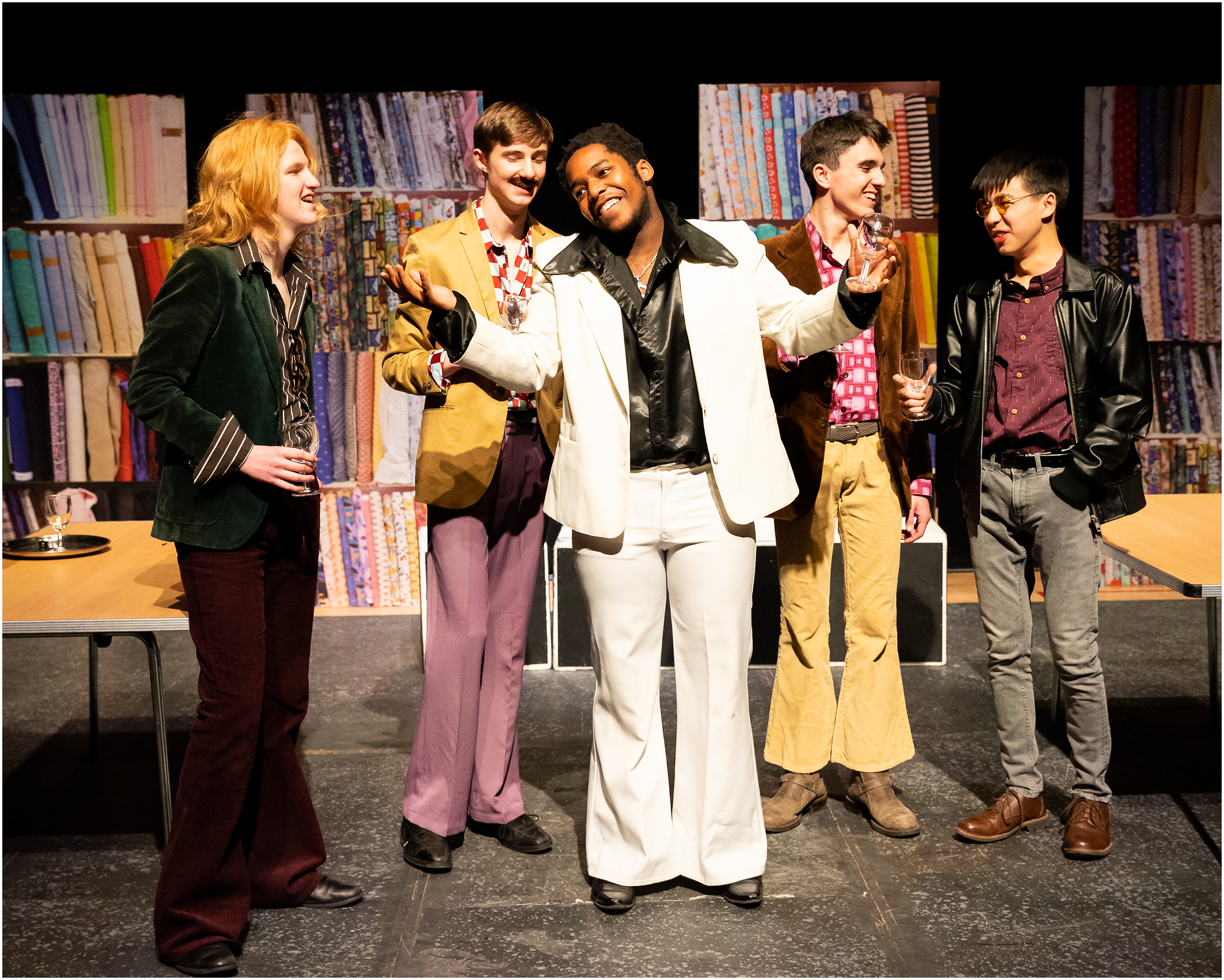
Salewood (Charlie Hutton), Rearage (Theo Richter), Lethe (Thapelo Ray), Easy (Enrique Burchell), and Shortyard (Tom Howitt), in Michaelmas Term, Edward's Boys. Photo by Nick Browning, www.nickbimages.com.
A scene shortly afterwards illustrates how Michaelmas Term plays with ideas of gender and marriage, the fluidity of which the boy company works to its fullest extent. In Quomodo's shop, the draper and Thomasine first argue over their daughter Susan's marriage. The boy actors revel in the double entendre as, ostensibly discussing supper, Susan naïvely discusses whether women prefer to take it standing; ‘I know not how all women's minds are’, (s)he comments. The key roles of Quomodo and Thomasine were played with real style by Will Groves and Joe McCormack, both veterans of the company. With Thomasine here looking on from the side, hidden to the protagonists but visible and audible to the audience, the draper tricks Master Easy. Illustrative of the homosocial bond he has built up, Shortyard, in the guise of Blastfield, claims to be married to Easy; ‘we’re man and wife’, he declares, and Easy is his ‘good, sweet bedfellow’. A little later we will find Easy sighing over the lack of his friend: ‘Methinks I have no being without his company’, he laments, while Mills has him strumming a guitar and hesitantly picking out the tune of ‘Lovin’ you is easy ’cause you’re beautiful’. Like all the interludes and accompanying music, this is exceptionally well-chosen in terms of mood and verbal play, both evoking the musicality of the original boys’ companies and showcasing the enormous musical talent of this company. It also accentuates the metatheatre that is such a joy to their audience, whether that be McCormack walking from one of Thomasine's lines to join the musicians and play electric guitar, or Callum Maughan's hilariously seamless movement from his caricatured bent old-woman posture as Lethe's mother to the upright lead singer of the band. Throughout the production, in the fluid movement of gender and body posture, the actors embody the queer ambiguity that characterises early modern boys’ company plays.
The scene in the draper's shop not only demonstrates this, and the ubiquity of early modern homosociality, it also suggests the unhappiness that can lie in heteronormative marriage. ‘Why am I wife to him that is no man’ cries the onlooking Thomasine, showing her distaste for her husband as her attraction to the gulled gentleman begins. The position of the draper's wife as onstage audience here accentuates her closeness to those watching. Her judgements are ours: disapproving of the gulling of Easy, disliking the man she is married to and wanting to protect her daughter from the duplicitous Lethe. Yet in his ending of the play with her deceiving her husband and marrying Easy, Middleton has sympathy for her, which steers us to a tricky moral position. In our support of Thomasine (inevitable in the engaging characterisation of McCormack), we are led to approve of a wife's pleasure at the death of her husband and her almost instant remarriage.
The final scene brings us back to the law. One of the few legal characters in the play is the judge, appearing at the end to bring about the justice that the audience applaud, literally and morally: the downfall of the tricksters, the restoration of his lands to Easy, and Lethe getting what he deserves in marriage to the woman he has turned into a prostitute. The audience at Inner Temple approved the verdict with their applause, and the boy actors ended in joyous dance, accompanied by their musical peers in a tribute to Saturday Night Fever. Another triumph for Perry Mills and the inimitable Edward's Boys!