



Abstract
The present article follows the editorial vicissitudes of Erasmus of Rotterdam's Julius within England's boundaries, where it was translated in 1533–34, in 1673, and in 1719. By interweaving the publishing history of these three English editions with their cultural milieu, it will appear evident that they were ideologically motivated products whose circulation directly coincided with an upheaval in Catholic matters in the country. The final purpose of this article is to demonstrate how Erasmus’ Julius, with its negative protagonist, was too compelling a weapon not to be used to stigmatise Catholicism and to prevent it from returning to the British Isles.
Where by divers sundry old authentick Histories and Chronicles, it is manifestly declared and expressed, that this Realm of England is an Empire, and so hath been accepted in the World. […] And whereas the King his most noble Progenitors, and the Nobility and Commons of this said Realm, at divers and sundry Parliaments, as well in the Time of King Edward the first Edward the third, Richard the second, Henry the fourth, and other noble Kings of this Realm, made sundry Ordinances, Laws, Statutes, and Provisions […] to keep it from the Annoyance as well of the See of Rome, as from the Authority of other foreign Potentates, attempting the Diminution or Violation thereof. (Preamble to the 1533 Act in Restraint of Appeals)
‘ I trust you will like the translation’
In a letter dated 1 April 1534 and addressed to his friend and chief minister Thomas Cromwell, the London publisher William Marshall wrote: I send you two books now finished of the Gift of Constantine. I think there was none ever better set forth for defacing of the pope of Rome. Erasmus lately wrote a work on our common creed and Ten Commandments dedicated to my lord of Wiltshire, which I will have from the printers as soon as God sends me money, and send a couple of them bound to you. I trust you will like the translation. It cost me labor and money.
1
Though brief and concise, this quotation throws revealing light on what was going on in England in the early 1530s: the spiritual agenda was of primary importance and the presses of the capital had to serve it by promoting and subsidising works able to further the cause of the Reformation within the island's borders. Such an ambitious project could be accomplished by commissioning new books, but also by translating into English those already existing in other languages, whose contents could be appropriated, subverted, and employed to pursue specific purposes in a different pedagogical context. 2 As Marshall's epistle highlights, within the propaganda literature fabricated in this period, a central role was played by some of Erasmus of Rotterdam's writings – whose caustic views on the sliding towards worldliness of the ecclesiastical institutions – perfectly fit the bill to fuel and underpin the ongoing clash between Henry VIII and the Bishop of Rome.
This was the fate encountered by the short treatise known as Julius exclusus e coelis, a divertissement structured in the form of a colloquy, composed by the Dutch humanist in a prima stesura between 1513 and 1514 during his stay in Cambridge, subsequently remoulded in a new version when the author had left the British Isles to settle in Basel, and finally printed in 1517 in Mainz under the title Libellus de obitu Iulii Pontificis Maximi. 3
The story the pamphlet recounts is hilarious: a defunct Pope Julius II reaches the gate of heaven accompanied by his guardian angel Genius and a horde of phantom warriors and becomes terribly irritated to find the entrance locked, with no solemn preparation made for his reception. After a while, St Peter appears and explains to him that the passage is not going to be opened and that there is no room in the celestial kingdom for individuals like Giuliano della Rovere, preceded by a wake of earthly sins: luxury, filthiness, and unchristian belligerency. From the dialectic quarrel that ensues, a vivid picture emerges of a Church devoid of its pristine purity and irremediably projected into a domain of immorality, depravity, and pagan splendour. 4
Materialising the same year in which Martin Luther posted his 95 theses on the door of the Wittenberg Cathedral, the booklet constituted a sort of narrative counterpoint to that event and had an extraordinary resonance. Editions of the libel immediately multiplied and circulated all over Europe, until translations of it in the nascent vernaculars were felt necessary to allow even some of the non-literati to understand and enjoy it. 5 Beyond the Channel, where Erasmus had long been hosted in Thomas More's house and was a highly appreciated figure in the learned university circles, his Julius was ‘Englished’ thrice: at the turn of 1533–1534 (with a reprint in 1535); in 1673; and in 1719. 6
The pages that follow aim at illuminating an aspect that has been so far quite neglected by critics: that is, to show how the dates in which these translations were undertaken were anything but incidental. By intertwining the publishing history of these three English editions with their cultural milieu, it will appear evident that they were ideologically motivated products, whose appearance directly coincided with an upheaval in anti-Catholic matters in the country. The final goal of this article is to demonstrate how – precisely for its powerful j’accuse against the whole papal institution – Erasmus’ Julius, with its negative protagonist par excellence, was too compelling a weapon not to be used to stigmatise and mock Catholicism and its hierarchies and to avert their return to the British Isles.
‘ [He] gaue his blessyng to encyte one to kyll another’
At the end of the 1520s, Henry VIII's obsession with Anne Boleyn prompted him to file a separation suit in Rome to obtain the annulment of his marriage to Katherine of Aragon. The pope's hesitation – and his subsequent refusal to proceed with a dispensation – exacerbated and progressively damaged international relations. The tensions present in the air during these years are captured with vividness in a missive sent by the envoy Eustache Chapuys to Emperor Charles V on 16 December 1528: It is not to be thought that the King will be brought to the point by mild treatment, for his sin carries him away, and he is bewitched by this cursed woman in such a manner that he dares neither say nor do except as she commands him. And thus there is another evil, that the more they dissemble with him the more boldness he will take to do the worse, and will only stop from lack of power from causing you, whom he regards as his enemy, many troubles […]. Certain Lutheran preachers are disseminating their tenets and preaching against the Pope by command of the King.
7
Beyond the unflattering comments regarding Anne Boleyn, explicitly described as a witch and a charmer, the Spanish ambassador's concerns are clearly directed to some concessions the sovereign was making to Lutheran preachers. His fears were not unfounded: in 1533, resolved not to give in to any blackmail advanced by a foreign power, Henry VIII decided to authorise the dissemination of anti-papal material and threatened to break with Rome if he did not obtain a favourable decision on his divorce. 8 The pontiff's blessing never arrived, but the leading figures of the London printing industry responded enthusiastically to the monarch's plea, determined to support him with a twofold action: by bringing to the public's attention the relationship between Church and State and redefining it, and by appealing to the nationalistic emotions and anticlericalism of the populace by means of personal attacks on individual popes. 9
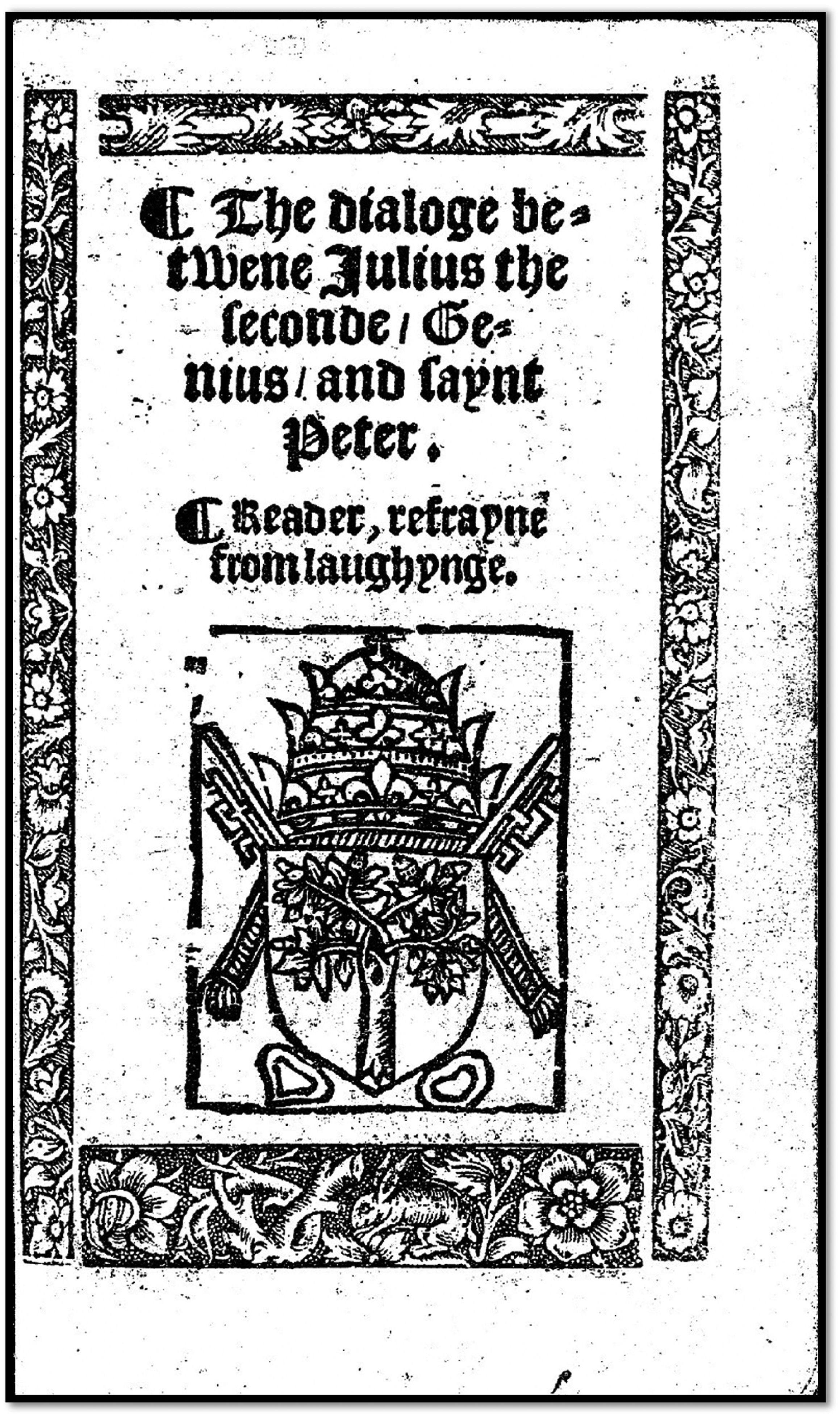
Title page, [Desiderius Erasmus], The dialoge betwene Julius the seconde / Genius / and saynt Peter. Reader, refrayne from laughynge (London: Robert Copla[n]de, for Johan Byddell, [1534?]), sig. A1r. © The British Library Board, London, General Reference Collection C.31.b.16.
It was within this melting pot of national commitment and social turmoil that the first English translation of Erasmus’ Julius was envisaged. An octavo of 104 pages, entitled The dialoge betwene Julius the seconde/Genius/and saynt Peter, it resulted from the partnership between Robert Copland and John Byddell (Figure 1). 10 With its title page representing a papal tiara framed by floral and animal elements, the translation reached its public undated; it might have been made in 1533, when the break with Rome was imminent, but most likely it was completed in the autumn of 1534 to intercept – and thus corroborate – the issuing of the Act of Supremacy, approved on 3 November. This can be better conjectured by scrutinising the colophon of the Dialoge, where there is enclosed Byddell's device of Our Lady of Pity, the sign under which he worked in Fleet Bridge, with his name and mark (Figure 2). 11
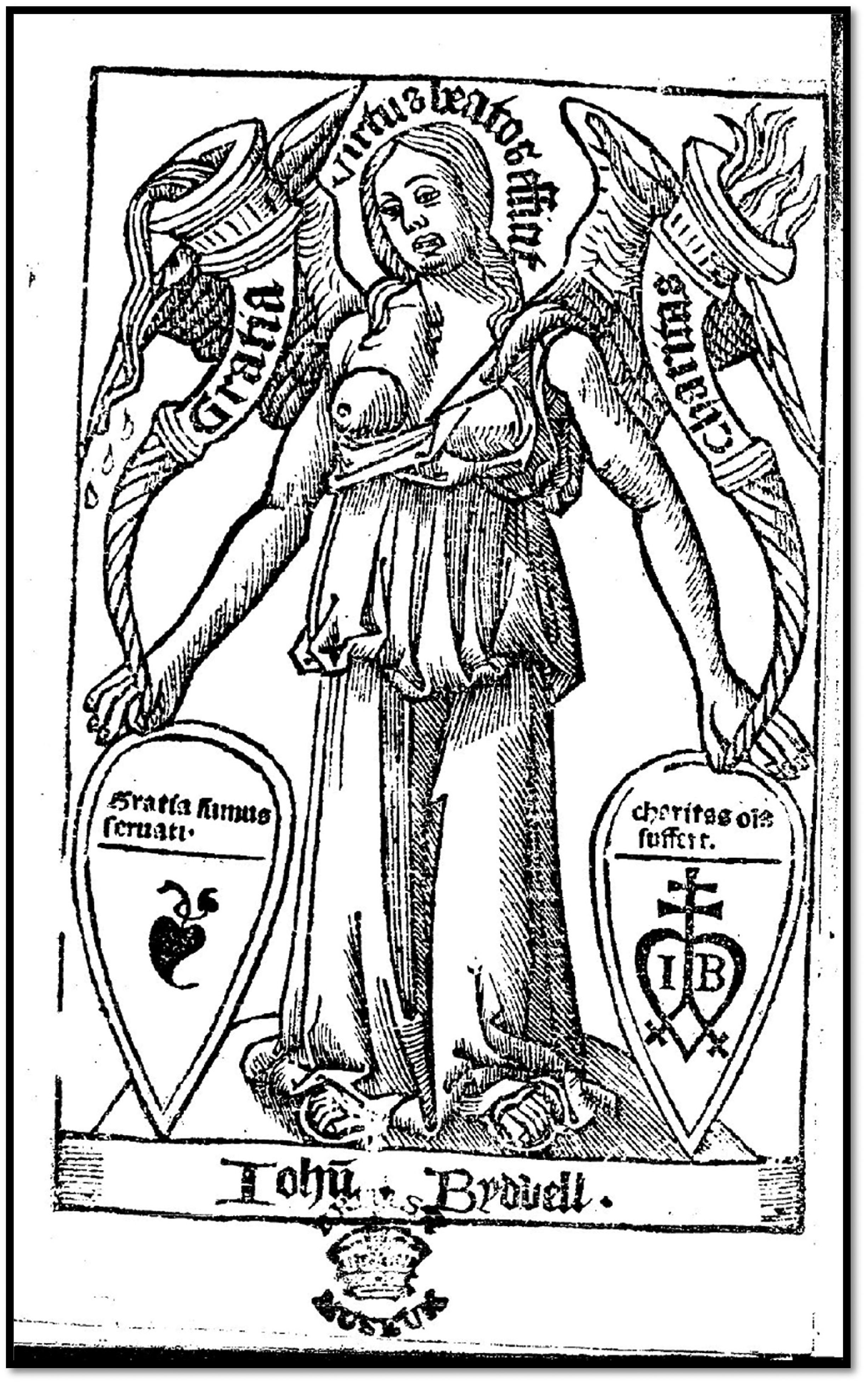
[Desiderius Erasmus], The dialoge betwene Julius the seconde / Genius / and saynt Peter. Reader, refrayne from laughynge (London: Robert Copla[n]de, for Johan Byddell, nexte to flete brydge, [1534?]), sig. [A1r]. © The British Library Board, London, General Reference Collection C.31.b.16.
Byddell is known to have dwelt at this address from 1533 until the beginning of 1535, when he moved to Fleet Street to take over printer Wynkyn de Worde's properties and activities, on the latter's death. If these biographical details are correct, it may be assumed that the Dialoge was published before Byddell changed his place of residence, that is, at the end of 1534. Chronological subtleties aside, it is clear that the translation was meant for utilitarian motives and not for contributing to that process by which, to quote Francis Otto Matthiessen's seminal study, ‘the Renaissance came to England’. 12 Undertaken in a spirit of educational advertising, the Dialoge had to reach a somewhat uninstructed and uncritical audience and renovate its intellectual stance about the new paths of the country's destiny. 13 Accordingly, the anonymous translator of Julius responded to these enthralling didactic premises by converging his most significant efforts on publicising and negotiating the reason of state by and through the exposure of the corruptions of that Julius II, who in 1509 had given the allowance under which Henry VIII wedded Katherine of Aragon. 14 A ‘sore scourge’, a ‘venimous Natrix infect[ing] with her poyson’ and a subverter of Christian law – one who ‘gaue his blessyng to encyte one to kyll another’ – the Roman pontiff depicted in the Dialoge is a man of the antichrist. 15 As a consequence, the institution he exemplifies is the manifestation of hell and as such it must be feared, kept at a distance, and disavowed.
In the uncertain historical juncture like the 1530s, in which the Act of Supremacy was passed, translating Erasmus’ Julius into English, and making its obscure protagonist even more diabolical and malignant, meant giving the Tudor king and his government programme of religious and political indoctrination the prestigious endorsement of the most celebrated ‘preceptor of Europe’. 16
The publishing enterprise directed by John Byddell and Robert Copland at the end of 1534 – when public opinion had to be educated on the need to get rid of papal tyranny – must have proved a great editorial success if only a few months later, at the beginning of 1535, the royal censors awarded their ‘cvm privilegio regali’ to Byddell's typography for a reprint of the same translation: The Dyaloge bytwene Iullius the seconde / Genius / and saynt Peter (Figure 3).
17
In the meanwhile, however, the necessities of the English nation had slightly changed: with the schism with Rome finally consummated, Erasmus’ Julius did not need to be taken ideologically further. Now that England had become a country suffering no more from foreign interference, it was enough that the pamphlet would remind its readers what an infamous pope Julius II had been and how, by extension, all his Petrine successors would no less be: THis Iulius (good reder) reygned frome the yere of our lorde .M.CCCCC. & .iij. to the ende of .ix. yeres and more, in suche wyse as appereth in this dyaloge. Which thynge causeth me often to marueyle at them that saye, the Pope of Rome (as they call hym) can not erre. For compare his lyfe to the lyuynge of Timothe, or Paule / and I suppose thou shalte fynde very lytell agreynge. But Alas, in howe myserable case were they whiche sate in the carte, when suche a pheaton had it to gouerne at his pleasure.
18
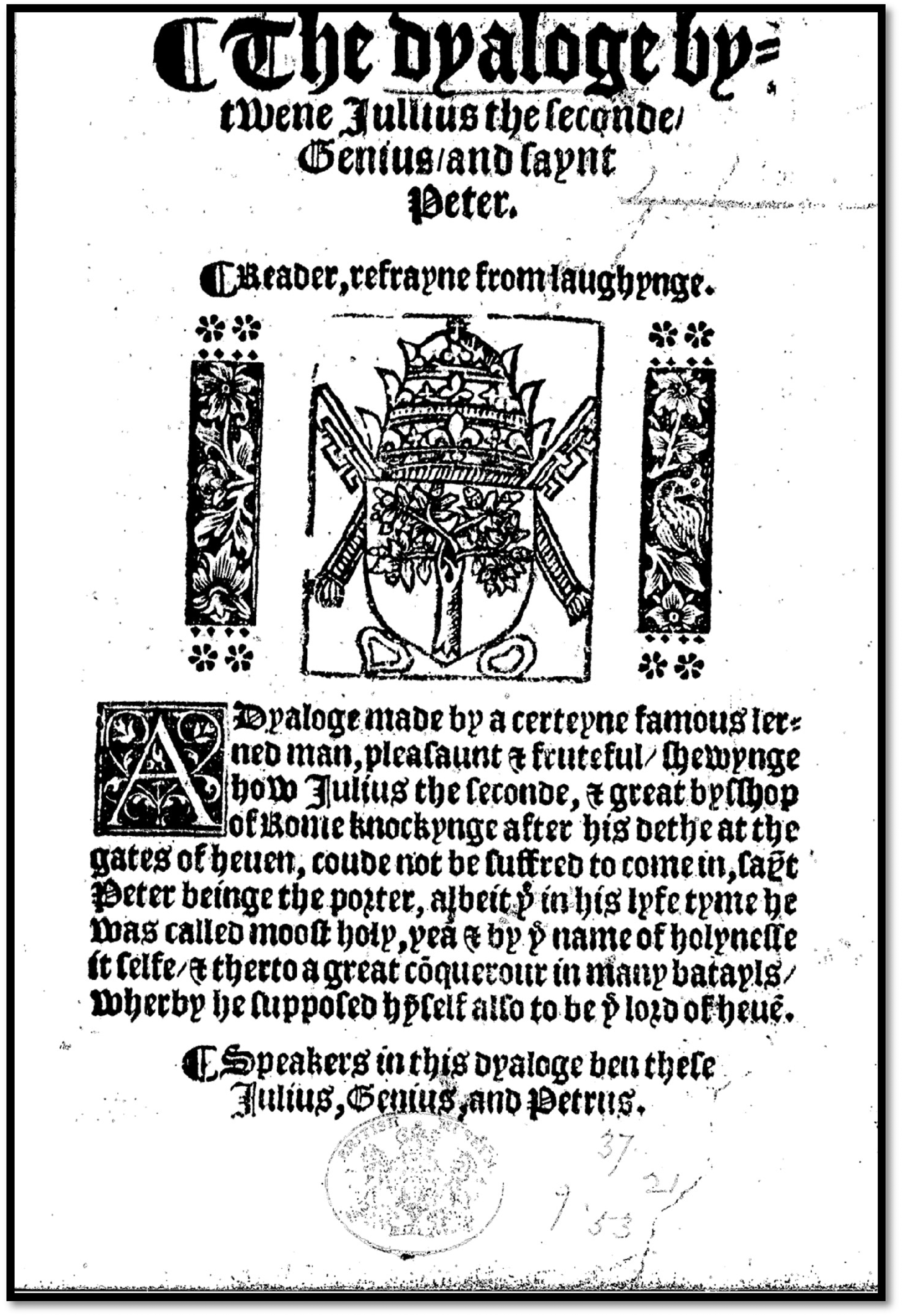
Title page [Desiderius Erasmus], The dyaloge bytwene Iullius the seconde / Genius / and saynt Peter. Reader, refrayne from laughynge (London: Iohn[n] Byddell, 1535), sig. A1r. © The British Library Board, London, General Reference Collection C.31.b.16.
‘Dost see, Great Julius, heav’n to thee deny’d?’
The second translation of Erasmus’ Julius was published in 1673. If the English version of the text produced in 1534 had been eminently intended to sponsor Henry VIII's politics of force and his ascension as England's new spiritual guide, the translation that appeared in 1673 was designed for a reverse procedure: to oppose the personal plans of a king. This was the case of The Pope Shut out of Heaven Gates: Or, A Dialogue between Pope Julius the 2d., His Genius, and Saint Peter, a 48-page quarto that was no doubt thought to corroborate the Test Act of that year and to pillory Charles II's repeal of the Declaration of Indulgence (Figure 4). 19
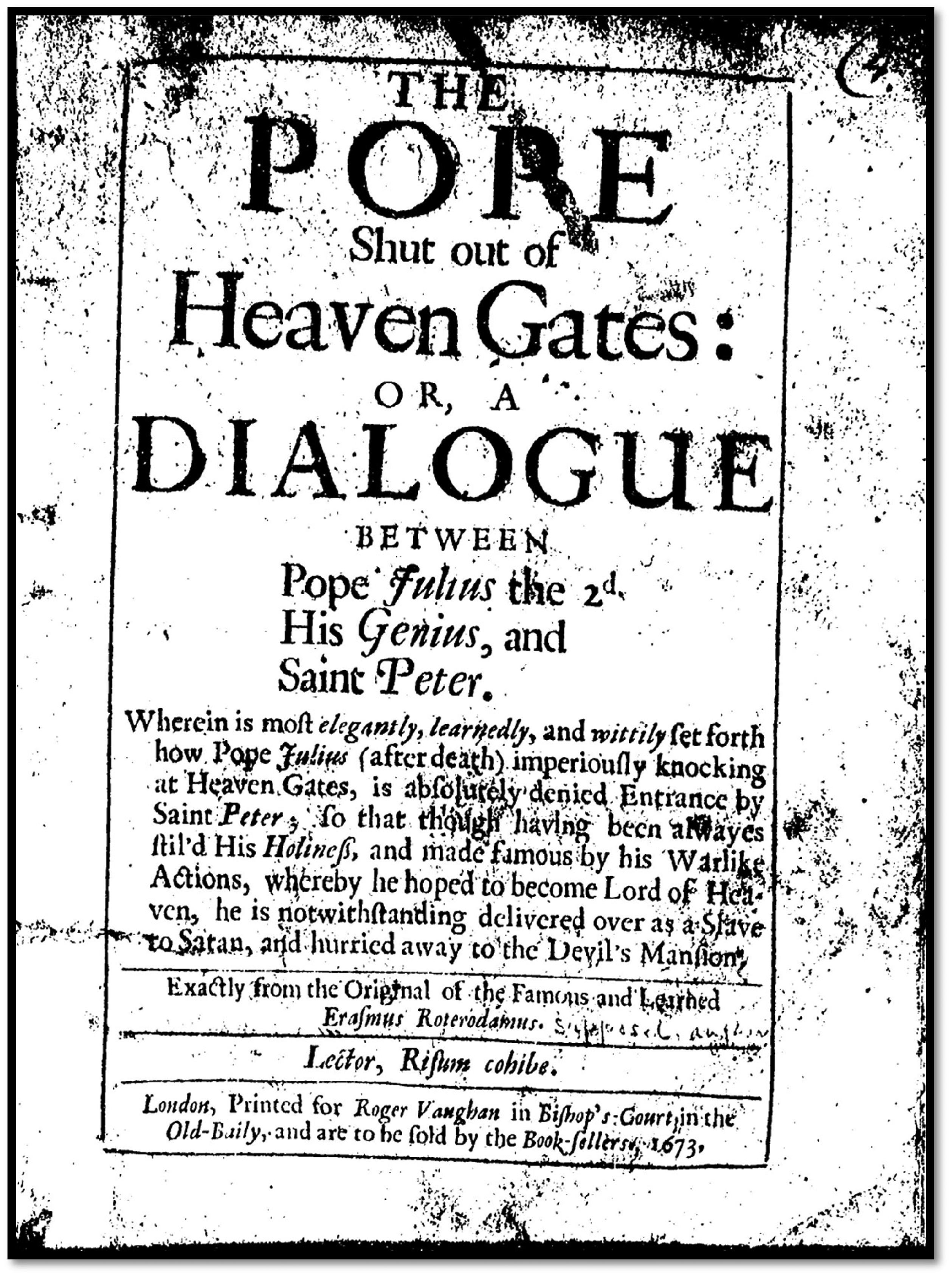
Title page, [Desiderius Erasmus], The pope shut out of heaven hates: or, a dialogue between Pope Julius the 2d., his Genius, and Saint Peter. Lector, Risum cohibe (London: Printed for Roger Vaughan, 1673), sig. A1r. © The British Library Board, London, General Reference Collection 3902.bb.13.
The matter raised immediately after the 1660 Restoration and was again of a religious nature. There was a tendency at this time throughout the Continent for Protestants to return voluntarily within the Catholic world, an inclination naturally abhorred by the Protestant churches. 20 In England, the sentiment was decidedly anti-Catholic and the prominent squires in Parliament, stiffly loyal to the established Church, dreaded papists even more than rebels and common criminals. This was a feeling, however, not entirely shared by Charles II, who in the 1670s took an increasingly ambiguous position: he was personally disposed to Roman Catholicism and admired Louis XIV's leadership. At odds with his statesmen and administrative managers, Charles II secretly sealed the Treaty of Dover (1670) and promised to support French policy in Europe in return for a subsidy that would free him from financial dependence on State coffers. 21 Finally, in a clumsy attempt to find a plausible excuse to justify the conversion to Catholicism of his brother – and heir – James, Duke of York, Charles II announced the nonenforcement of laws against dissenters and publicly avowed that he favoured general toleration. The fear that his real intention was slowly to legitimise Roman Catholicism within the kingdom led the Parliament to react in 1673 by passing a series of penal provisions (the so-called ‘Test Acts’), which imposed various civil disabilities on Roman Catholics and nonconformists. The underlying principle was that only people taking communion in the established Church of England were eligible for public office. 22
The 1673 English translation of the Julius – deriving ‘from the Original of the Famous and Learned Erasmus Roterodamus’ – reflects this situation of general and domestic tumult as a mirror, whose glittering images may be glimpsed once again in the excitement that characterised the London publishing market, where printers, stationers, and booksellers did not shy away from upholding this or that public affair with their own businesses. 23
To enter the debate, strengthen the efficacy of the Test Act and allay any rising impetus in higher court spheres to popery, the translator of The Pope Shut out of Heaven Gates absorbed Erasmus’ sharp irony against Julius II and aggravated it by adding explicit evil features. This is particularly evident in a short paratext placed on the title page of the translation (a kind of epigraph alien to Erasmus’ project), where two different conceptions of the church confront each other and then inevitably collide: on the one hand, there is Julius who seeks to enter heaven – claiming his merits as head of a popedom of domination, finance, war, shrewd diplomacy and a spiritual power used, through bulls, admonitions, excommunications, interdictions, as a political weapon; on the other hand stands St Peter who – placing the primitive church as a touchstone, that is, the church of suffering, miracles, poverty, persecution, martyrdom – denies him entry into Paradise and sends him directly to the Devil's dominions: Wherein is most elegantly, learnedly, and wittily set forth how Pope Julius (after death) imperiously knocking at Heaven Gates, is absolutely denied Entrance by Saint Peter; so that though having been alwayes stil’d His Holiness, and made famous by his Warlike Actions, whereby he hoped to become Lord of Heaven, he is notwithstanding delivered over as a Slave to Satan, and hurried away to the Devil's Mansion.
24
Sarcastically derided on the frontispiece of the pamphlet – where he is discharged as a villain only deserving hell's burning flames – the highest representative of the Catholic hierarchies circularly receives the same treatment in the translation epilogue (again a paratextual portion especially fine-tuned by the translator and not present in Erasmus’ Latin original): Dost see, Great Julius, Heav’n to thee deny’d?
Whilst Tiburs waves thy slighted Keys do's hide.
How would those Keys now more then Swords avail;
And a poor Fisher's Cloak, then Coats of Maile?’.
25
Twice denied welcome into the celestial kingdom (whose slighted keys lie in the turbid waters of the Tiber), Julius II remains – in the translator's view and verses – the emblem of a warlike church embellished with chainmail garments and not with simple fisher's cloaks (the latter a clear reference to St Peter's simplicity and profession before becoming an apostle). Thus scorned, scoffed, scolded, and at last silenced, the Renaissance pope with the armour would not cross the threshold of heaven physically or metaphorically, as Charles II would not succeed in making Catholicism penetrate within the geographical boundaries of Restoration England. The keys to open both the lock of paradise and of the English nation are no longer at their disposal.
Four decades later, other attempts would be made on the part of the Catholic side to reconquer the country and it would be at this very moment that a third translation of Erasmus’ Julius would be necessary to meet the needs of new national scenarios.
‘Our Great Physician, George’
The 1688 Glorious Revolution witnessed the deposal of James II and VII and the replacement by his Protestant daughter Mary II and her Dutch husband William of Orange, who ruled as joint royals. Since neither Mary nor her sister Anne had surviving offspring, the 1701 Act of Settlement ensured a Protestant successor by excluding Catholics from the English and Irish thrones, and that of Great Britain after the 1707 Act of Union. When Anne became the last Stuart monarch in 1702, her heir was the distantly related Protestant Sophia of Hanover, rather than her Catholic half-brother James Francis Edward (called ‘James III and VIII’ by his devotees and ‘the Pretender’ by his opponents). Sophia died two months before Queen Anne, in August 1714, and her second cousin George, Duke of Brunswick-Lüneburg, became King of England. French support had been crucial for the Stuart exiles, but their acceptance of the Protestant succession in Britain was part of the terms that ended the 1701–14 War of the Spanish Succession.
On 14 March 1715, James Francis Edward appealed to Pope Clement XI for help with a Jacobite rising, which became known as ‘The Fifteen’; concurrently, his cohorts, led by Lord Mar – an embittered Scottish nobleman who had previously served as a secretary of state – instigated Scotland to back up Jacobitism. Parliament did not delay in taking a stand: with the Habeas Corpus Suspension Act, it passed a law that ordered the confiscation of the land of campaigning Jacobite landlords in favour of those tenants who had supported the Whig-controlled government. By the end of the year the revolt had all but collapsed: in February 1716, facing defeat, James and Lord Mar fled to France. The Indemnity Act of July 1717 pardoned all those who had taken part in the rebellion: although there were some executions, George I showed leniency and invested the income from the forfeited estates to finance charity works throughout the kingdom.
On 10 June 1719, despite the royal magnanimity, James Francis Edward made one more attempt at the British throne. Spain put its paw into it, but without reaping any benefit: the now-nicknamed ‘Old Pretender’ was again overpowered in the Battle of Glen Shiel. 26 His recidivity, however, had not gone unnoticed, enraging the domestic press and prompting a plethora of sarcastic writings against him and his Jacobite allies, the most notable of which are for sure some of Daniel Defoe's political pamphlets. 27 And if the point was to disparage and tease the Catholic world that had once more dared to interfere with England's internal vicissitudes, why not do it by exploiting a character – that Pope Julius II already reviled several times – who by his nature perfectly incarnated the quintessence of malevolent forces?
In the immediate aftermath of the lacerating occurrences that struck the early Augustan age, the London printer Thomas Warner and the Dublin bookseller Joseph Leathley published on both shores of the Irish Sea an octavo of 88 pages entitled Pope Julius the Second. A Comical and Facetious Dialogue between Julius II, Evil Genius, and St. Peter (Figure 5). 28 By resorting once again to Erasmus’ Julius, a work eminently outspoken against the papal institution, they would synergically contribute to the praise of the English monarchy that had protected its people from the recent Catholic incursions.
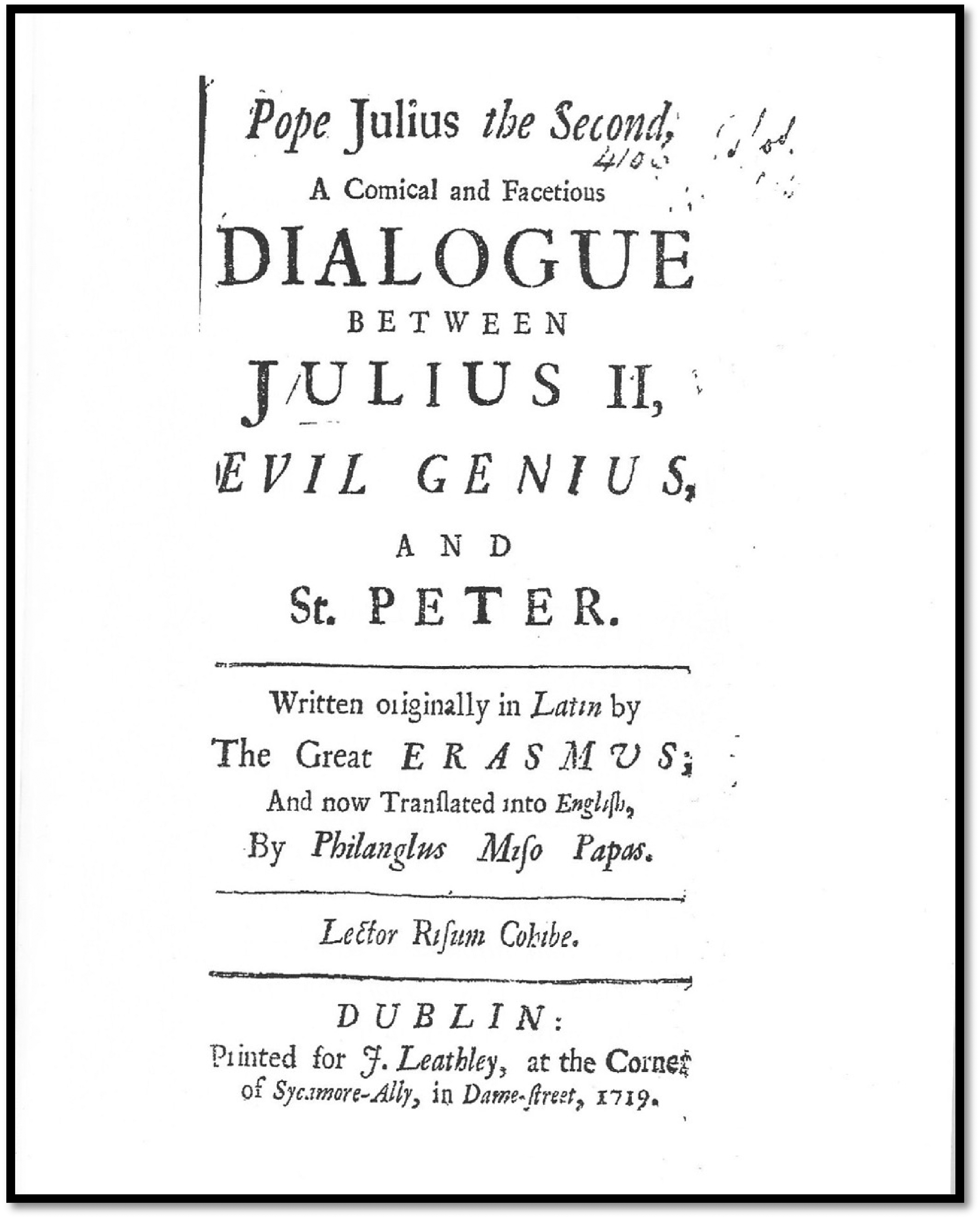
Title page, [Desiderius Erasmus], Pope Julius the Second. A comical and facetious dialogue between Julius II, Evil Genius, and St Peter. Written originally in Latin by the Great Erasmus; and now translated into English, by Philanglus Miso Papas. Lector Risum Cohibe (Dublin: Printed for J. Leathley, 1719), sig. [A1r]. © The British Library Board, London, General Reference Collection 4106.a.71.(13.).
Compared to its sixteenth-century counterparts, which remain vaguer as to questions of paternity, the 1719 translation of Erasmus’ Julius – retracing the model of The Pope Shut out of Heaven Gates – identifies the Dutch humanist as the author of the text on its title page: ‘By the Great ERASMUS’, one sees in capital letters. 29 In a similar manner, the frontispiece states that the work was ‘[w]ritten originally in Latin … And [is] now Translated into English’ 30 ; the venture has been made by an enigmatic ‘Philanglus Miso Papas’ (literally, ‘a friend of England and a hater of the pope’), 31 whose name – born of a polished pun – is elegantly sorted out to suggest its readers the ideological perspective in which Pope Julius the Second must be framed.
In the preface that follows, Erasmus is once again mentioned and referred to as ‘that inimitable Master of Dialogizing’, while the supposed recipients of the translation – with poignant references to the contemporary political context – are informed that ‘the Scarcity of this Book proceeds from the indefatigable Pains of the Jesuits, who engroß’d ‘em all to themselves, not for Love, but Fear; not out of Veneration for them, but on purpose to suppreß and demolish them’. 32
This short introductory section ends by overtly declaring the aim of the work in some fine invective: The Translation of this Dialogue, I acknowledge wants much of that Vivacity and Poignancy for which the Original is so remarkable: Neither has it any thing else to recommend it, more than the good Design of diverting the English Readers, as also at the same time, of exploding the Superbe Pontiff of Rome, and all his Adherents, and raising a just Aversion against their detestable Religion; which they wou’d fain introduce and plant in our Realm, and from which, by the benign Providence of the Almighty Protector, we have very lately been so gloriously delivere’d.
33
Choosing the colourful language of nature, through which England is depicted like a sheltered land/garden where Catholicism was prevented from insinuating its infesting roots, the mysterious Philanglus makes clear once and for all the tasks of his cultural and artistic operation: on the one hand, to unleash in his compatriots a sincere aversion to the Bishop of Rome, always counterpoising – thanks to Erasmus’ treatise as a watermark – the negative example of Giuliano della Rovere and the church he represented; on the other hand, to celebrate and publicly extol George I, his government's manoeuvres and the whole Hanoverian court. In this respect, the epilogue of Pope Julius the Second is a glorious piece of vituperation in rhyming couplets, where the early modern history of England is poetically recounted in the light of the attempts Catholics made to reconquer the island after the separation from Rome. It is worth noting here that the translator points out that the ‘Dragon’, that is, a Catholicism compared to the Beast of the Apocalypse, struggled thrice to re-enter the country; the following three passages are the English translations of the Protestant propaganda produced of Erasmus’ Julius in response to these attacks: […]
Thrice happy Natives of the British Isle!
Whom, free from Papal Usurpation vile,
No longer Rome's Corruptions now defile.
With Shame be’t spoke, long to this Baal did we,
Wrapt up in misty Errors, bow the knee;
Long time Great Britain's Monarchs were content,
To rule as seconds in their Government: […]
Thus was our glorious Isle the Pontiff's Ass,
Gull’d with the Shows and Trinkets of the Maß:
‘Till the great Wheel of Fate did kindly run,
And the Eighth Henry, like a Rising Sun,
Dispell’d the Fogs; by him the Work was first begun.
He first from England show’d to Pope the way,
Where he ne’er absolutely since bore Sway.
Yet thrice this Dragon to reenter try’d,
As oft kind Heav’n did his Attempts deride;
And by a mighty strech’d-out Arm secure,
The purest Church from disgorg’d Floods impure. The first Repulse the fam’d Eliza gave,
Next a Ninth Henry, most timely brave,
Our sinking State the second time did save.
Nor was our last Deliverance leß strange,
When George, the once-more black’ning Scene did change.
Scarce was this Monarch of his Throne possest,
And by the Good most heartly carest,
When, lo’ again the papal Locusts swarm’d,
And with a third Attempt our Realms alarm’d
Some (such as all Mankind must needs explode
Who, Viper like, their Native Bed corrode)
Internal Foes did their Arrival court
And aid them in this third and last Effort.
Their last, I say, for now all Dangers past;
Our Great Physician, George, says ‘tis their last. […]
This well-concluding Stroke, this final Blow,
To thee, next to the King of Kings, we owe:
To Thee, Great George, by Heaven sent for this,
Like Moses, to conduct us into Bliß.
34
After beginning with Henry VIII, the epitome of a perfect Apollo (‘a Rising Sun’) called to disperse the miasmas of popery in England with his luminosity and integrity, Philanglus moves on to Elizabeth I (‘the fam’d Eliza’), manly defined a ‘Ninth Henry’ for how temerariously and timely she saved the nation from plummeting. The monarchical triptych is completed by showing how all has been progressing towards the ultimate ‘cure’ to be administered by the ‘Great Physician, George’. George I of Hanover is the beneficiary of the translator's most flattering words: both a healer (if one maintains the medical metaphor) and a sort of holy figure (a ‘Moses’ who breaks the chains of slavery and emancipates his people),
35
it is to him that England owes its freedom. A liberty that the isle has now deserved to enjoy, but that as an asset of extreme value must be protected for dangers are always lurking – this is the implication that Philanglus seems to want to leave us with in the last three verses of his composition: May'st Thou, and Thy Renow’d Posterity,
These Realms enjoy, and them for ever see
From Popery, and due Domestick Factions free.
36
Apparently rhetoric in 1719 when his translation of Erasmus’ Julius circulated and created a stir in London journalistic circles, Philanglus's intuitions could not prove to be more prophetic. In 1745, James's son, Charles Edward Stuart, the Young Pretender, endeavoured to win the throne for his repeatedly beaten father. There was, however, a humiliating downfall awaiting him in the fields of Culloden, in the Scottish Highlands.
‘ A syphre in awgrym’
From the brief excursus outlined in these pages, it is apparent to what extent the three translations of Erasmus’ Julius can be seen as aiding the anti-papal cause in early modern England and how deeply their publication was intermingled with the country's most revolutionary political and religious changings. Focusing all their attention on naturalising the virtues and potentials of the original and bringing them out forcefully for the English reader, the three authors of the translations made the Julius (as a propaganda piece) a pregnant presence in polemical and political circles. 37
Expressions of the time in which they were prescribed and executed, the three English editions of the Julius were evidently aimed to deal with peculiar historical contingencies. The dialoge betwene Julius the seconde / Genius / and saynt Peter (1534) – with its augmented vivacity, sustained dramatic energy and patriotic tautness – was meant to uncover the culpabilities of Pope Julius II, considered the instigator of the Holy League against France and the one responsible for driving the army of Louis XII out of Italy in 1512 – and to reverberate and amplify the rightness of Henry VIII's Act of Supremacy. In a similar way, The Pope Shut out of Heaven Gates: Or, A Dialogue between Pope Julius the 2d., His Genius, and Saint Peter (1673) – marked by a musicality and cadence of phrase all its own and with an extravagant and picturesque way of conveying ideas and images – was intended to support the Test Acts, to give simultaneous added ammunition for Charles II's repeal of the Declaration of Indulgence and to quell the growing tendency to popery in higher court circles. Finally, Pope Julius the Second. A Comical and Facetious Dialogue between Julius II, Evil Genius, and St. Peter (1719) – almost a first-rate satire, with its intrepid adroitness devoid of artificial elegance and mannerisms – was concocted to denounce and condemn the numerous Catholic plots that had upset England at the dawn of the Enlightenment and to acclaim King George I of Hanover for unearthing and repelling them successfully.
The emblematic point of incidence of these translations – which have their own stylistic and textual particularities and echo the anxieties of the age in which they were fashioned – is to assure that the story they narrate faithfully ends with the fictional device invented by Erasmus: a bolted door. This is the huge iron gate of heaven in front of which the hateful Julius II will be locked out three times. With him, behind him, exiled outside the celestial kingdom – and of course from the borders of England – there will also be Catholicism.
An undesirable model of church, the archetype of a church which was inacceptable, Julius II embodied in England, after Erasmus consecrated him in art, the Catholic bugbear hidden behind the separation from Rome and the advent of the Reformation, the Glorious Revolution, and the Jacobite Risings. ‘A syphre in awgrym’ (‘a zero in an equation’), 38 he deserved to be minimised, shelved as an object of ridicule, and especially laughed at out loud. Not by chance, all three translations have one last fil rouge in common. They preserved on their title pages the Latin injunction of Erasmus’ Libellus de obitu Iulii Pontificis Maximi: ‘Lector, risum cohibe’ (‘Reader, refrayne from laughynge’). More than a prohibition, the formula elaborated by the Dutch humanist and adopted by the English translators of his booklet seems to be an invitation to guffaw. Of Julius II, certainly, as the undisputed protagonist of the text from which everything originated in the early sixteenth century, but also of that Catholic world that would survive him, and that the English State would continue – undauntedly – to repudiate and reject.
Footnotes
Declaration of conflicting interests
The author declared no potential conflicts of interest with respect to the research, authorship, and/or publication of this article.
Funding
The author received no financial support for the research, authorship, and/or publication of this article.
