




Abstract
This article discusses The Hollow Crown (2012, 2016) adaptations of William Shakespeare’s histories in the light of broader changes that have overtaken television. Contextualising the series in terms of technical, industrial, cultural, and critical transformations, the article highlights the Shakespearean significance of debates in television studies around quality, complexity, and aesthetics. To illustrate this thesis, the article analyses the opening of Richard II (dir. Rupert Goold, 2012), unpacking the ways in which the first 60 seconds merge markers of prestige with a distinctive cinematic style and a dense imagistic and acoustic register in order to achieve narrative intricacy and poetic responsiveness.
In the medium of television, there have traditionally been two models of Shakespearean programme-making. The first, the ‘telefilm’, is when a successful stage play is ‘reconfigured’ for the small screen. 1 Generally, the conceptual spirit of the production is retained, with some allowance made for the television idiom, such as voiceover, use of close-up, and visual immediacy. Well-known examples include the Royal Shakespeare Company (RSC) Macbeth directed by Trevor Nunn (1976) reconfigured for Thames Television in 1979 and, more recently, the RSC Hamlet, starring David Tennant: the original production (2008) was filmed as television adaptation broadcasts on the BBC (2009) and PBS (2010), respectively. The telefilm is the most obvious illustration of what Jeremy Ridgman describes as the multivalent and historically enfolded ‘relationship between theatre or dramatic performance and the medium of television’. 2 John Wyver’s recent discussion of the RSC onscreen identifies many such telefilms emerging from the company repertoire. 3 And other theatre companies have made similar moves into television, as telefilms by the National Theatre (e.g. a production of The Merchant of Venice directed by Trevor Nunn that was broadcast on the BBC and PBS in 2001) attest. Typically, these productions depend on several funding bodies and dissemination channels, the imprimatur of a ‘British’ Shakespeare often enabling a wider distribution.
The second model of Shakespearean programme-making is the ‘studio production’, which is ‘specifically mounted for television and traditionally […] shot on video rather than film’. 4 Historically, the ‘studio production’ tends to be transmitted on a Saturday or Sunday evening, or on a national occasion, and is characterised by a modest budget, a studio set, few changes of location, and a static shooting style. Here, connections with theatre are less obvious, although the use of established British thespians, often with an explicit Shakespearean pedigree, and the deployment of a contemporary conceptual ‘hook’, suggest areas of intertextual crossover. The CBC production of Macbeth with Sean Connery in the title role first aired in 1961 and is typical in its approach to filming and studio-bound action as suggested in the abstract castle environment (consisting of grey stairs and block-like architecture), close-cropped images, an emphasis on delivery and limited physical movement. In a later incarnation, the studio production abandons original language in favour of modern vernacular and invests in contemporary settings and locations. Othello (dir. Geoffrey Sax, 2001), for example, first screened on the commercial channel, ITV, eschews Shakespearean verse and transposes the action of the play to a troubled London metropolitan police milieu. Similarly, the BBC ‘Shakespeare (Re)-Told’ (2005) adaptations of Much Ado About Nothing (dir. Brian Percival, 2005), Macbeth (dir. Mark Brozel, 2005), The Taming of the Shrew (dir. David Richards, 2005), and A Midsummer Night’s Dream (dir. Ed Fraiman, 2005) push the plays into a range of contemporary environs, including an exclusive restaurant and a popular holiday camp, with the aim of broadening the Shakespeare on television audience base.
So far, so predictable. But in 2012, Shakespearean television took a markedly different turn with The Hollow Crown, which featured seven film versions of the history plays – Richard II (dir. Rupert Goold, 2012), Henry IV, Part One (dir. Richard Eyre, 2012), Henry IV, Part Two (dir. Richard Eyre, 2012), Henry V (dir. Thea Sharrock, 2012), Henry VI, Part One (dir. Dominic Cooke, 2016), Henry VI, Part Two (dir. Dominic Cooke, 2016), and Richard III (dir. Dominic Cooke, 2016). Although often erroneously tagged as a BBC production, The Hollow Crown is typical of most contemporary television drama in that it is a collaborative venture involving the BBC, NBC Universal, Neal Street Productions, and WNET Thirteen. It is characterised by a feature-film appearance (shot to suggest a high-definition sheen), a ‘high per-episode cost’, ambitious production values, extended location shooting, and considerable technical verve. Deploying Shakespeare’s original language in a revisionist mise en scène, The Hollow Crown is conceptualised as a series made up of two seasons (The Hollow Crown and The Hollow Crown: The Wars of the Roses). Cutting a swathe through ‘the uncertainty which surrounds [Shakespeare’s] plays as a series’, publicity materials emphasise ‘a continuous story of monarchy […] during sixteen years of dynastic and political power play’ (my italics). 5 Indicative of the standards that contemporary television can attain in terms of achievement, The Hollow Crown has been nominated for and won many prestigious awards. The series has been widely critically appreciated and lauded for its performances, costume, music, direction, sound, and cinematography. 6 Popular commentary draws attention to the series’ cinematic qualities. Hence, Michael Billington notes that the series is directed ‘with […] sweep […] there are so many tremendous performances […] sharp, intelligent’, while Tim Auld agrees that it ‘captures […] the daring and the savage headlong rush of the poet’s imagination’. 7 In the words of Ben Stephenson, Controller of BBC Drama at the time of its release, The Hollow Crown is Shakespeare on ‘a scale never before attempted on TV’. 8
This sea-change in Shakespearean television is symptomatic of the broader changes that have overtaken the medium of television in the last 20 years. In general, Shakespeare critics have been slow to absorb television’s technological transformation. Despite the fact that television productions outnumber cinematic releases, television has always been the poor cousin of ‘Shakespeare on film’. 9 With some notable exceptions, television Shakespeare – of all types – is rarely viewed seriously or consistently. 10 It is perhaps unsurprising, then, that, within Shakespeare studies, there is little sense of the unprecedented imprint of The Hollow Crown project or how it might be evaluated. Insofar as The Hollow Crown has received attention, it has been largely in familiar terms, with critics responding to the series as they did to earlier forms of Shakespeare on television. In particular, critics have envisioned the series almost exclusively in national terms – that is, in relation to its Olympic genesis and surrounding commemorative paradigms. The meanings The Hollow Crown disseminates have been tied closely to a UK sphere of interpretation and audience, with attendant reference to Brexit and the lack of a European imaginary. 11 While this work has greatly increased knowledge of the immediate celebratory aspects and attendant ideologies of The Hollow Crown, the narrow contextual focus has obscured the series’ singularity, elevating what is essentially a scheduling strategy (a cultural tie-in with the Olympics or festivities accompanying Shakespeare’s 400th anniversary) to centre stage. In contradistinction, I want to argue here that the model of television Shakespeare exemplified by The Hollow Crown emerges from – and needs to be read inside – the technical, industrial, cultural, and critical transformations that have overtaken television in the early 21st century. The first part of this article attends to developments inside television studies – particularly around discourses of quality, complexity, and aesthetics – and argues that these have urgent implications for Shakespeare. The second part analyses the opening 60 seconds of Richard II, the first film in The Hollow Crown series. Working at pace, the film’s opening wields markers of prestige alongside a distinctive style and a dense imagistic and acoustic register to achieve narrative intricacy and poetic responsiveness. At the same time, this inaugural sequence establishes the series’ emotional tenor and playfully engages audiences in the adaptive process. Through a close reading of how the opening minute works, I hope to illustrate the value of reading Shakespeare’s history plays inside the new discourses of television.
Contexts
As Trisha Dunleavy notes, over the last 20 years, the ‘television landscape’ has been ‘transformed […] by the combined impacts of digitization and convergence […] and continuing inter-network competition’. 12 The ‘international expansion of […] digital subscription services such as Netflix, Amazon Prime, and HBO’, and their provision of something more akin ‘to a library than to a broadcast service’, Michele Hilmes, Roberta Pearson, and Matt Hills add, has ‘radically rearranged relationships between audiences’ and between ‘traditional terrestrial and cable broadcasters’. 13 The result has been not only a transformation in the ways in which television viewing takes place but also a significant adjustment in how programmes are put together, publicised, and syndicated. At a fundamental level, the economics of television have altered: the broadcaster is no longer obliged to depend only on the revenues attached to the original transmission but, instead, can enjoy profits connected to multi-platform screen afterlives. Hence, Sam Mendes, an executive producer of The Hollow Crown, was able to convince his US (NBC Universal) backers that the Shakespeare films making up the two seasons ‘would be commercially viable, not overnight, but in the long run’ and across global territories. 14 The strategy encapsulates the ways in which networks have ceased to be centred on bolstering national culture and consciousness; rather, they work to secure global consumers and spectators. In turn, this has meant that television studies’ traditional emphasis on the importance of national programming has ceded place to a ‘“third wave” of scholarship’ that prioritises ‘transnational’ approaches. 15 Such a development allows for discussion of the double manoeuvre required of broadcasters – an engagement with the global marketplace that, at one and the same time, involves the mobilisation of ‘national meanings and brandings that can circulate successfully on a transatlantic and a global stage’. 16 When Pippa Harris, an executive producer of The Hollow Crown and a founder of Neal Street Productions, states that the series is ‘Shakespeare for a worldwide audience’, she is working in a register beyond that of the Shakespearean platitude and inside an economic system premised on global sales and demand. 17 Rather than pointing up Shakespearean universality, Harris here signals content with the potential to move across borders and the global hinterland in which The Hollow Crown ideally participates.
Inside this new understanding, rather than categorise The Hollow Crown as ‘British’ (the tendency in critical work so far), we might do better to describe it as drawing purposefully on ‘national meanings and brandings’ as part of its international appeal. The strategy is indicative of the ways in which, rather than belonging to a tradition of Shakespeare on television, The Hollow Crown is closer to a grouping of dramatic texts that has become the single most precious product in television today. As Jason Mittell writes, ‘[C]ontemporary television is marked by the rise of prestige drama’, and there is increasing agreement that television is the contemporary medium within which the most creative, serious, and compelling kinds of storytelling can unfold. 18 The Hollow Crown joins contemporary ‘high end’ shows such as The Sopranos (1999–2007), Mad Men (2007–15), and House of Cards (2013–18) as ‘must see TV’, shows that are not ‘simply part of a habitual flow of television programming but […] “essential viewing” […] distinguished by the compulsive viewing practices of dedicated audiences’. 19 Such dramas are generally self-conscious in approach, and, as befits their elite audiences, often have literary or historical adaptation at their heart. Purposefully marshalling the author as a guarantor and expression of kudos and status, dramas in this category take forward fresh cinematic and literary agendas which, as Robert J. Thompson has noted, extend to ‘sophisticated serialised narratives and inter-series “mythologies”’. 20 Various monikers have been invoked to label these dramatic texts, including ‘quality’, ‘complex’, or ‘cinematic’, all of which confirm a new commitment in television studies to questions of value. In particular, the use of ‘cinematic’ to describe television drama indicates, to cite Jason Jacobs and Steven Peacock, ‘an aspirational drive to promote some kinds of preferred television from a “lower” broadcast medium to the “higher” one of cinema’. 21 Thus, Brett Martin concludes that contemporary drama series are akin to ‘movies in their own right’: they boast sophisticated technologies, including an extensive use of ‘shadows and darkness; hypnotic depth of field; beautiful, endless wide-shots; [and] handheld pyrotechnics’. 22 Television, then, has come to be innovatively appraised as a multivalent visual idiom, a development facilitated by the rise of high-definition flat screen television sets and a DVD/Blu-ray or online experience that does not simply approximate but actually rivals the cineplex. Indeed, many now argue that these new television creations go beyond standard cinema in aspiration, length, depth, and character realisation. Critical discourse is increasingly marked by ‘Golden Age’ and ‘Renaissance’ references, these coded constructions of accomplishment taking energy from a broadly held assessment of television drama as ‘the signature […] art form of […] the twenty-first century’. 23
As serialised television drama has become ‘invested with aesthetic and other prized values’, the traditional long-held view of television as a lesser representational idiom, confined in affect, lacking visual-acoustic authority and short on cultural heft, has begun to seem woefully out of date. 24 In response, a very different television criticism, one aimed at recognising and celebrating the aesthetic reach and interpretive invention of quality drama, has emerged and proliferated. Crucially, work over the past decade affirms, in the words of Janet McCabe and Kim Akass, that television texts ‘require close scrutiny not only as “artefacts of popular culture” but also as “rich, complex artworks”’. 25 One of the first to recognise the complexity of contemporary television drama was Robin Nelson, who in 2007 identified a process of ‘complex seeing’ as indivisible from ‘quality television’ programming. 26 Mittell moved Nelson’s theories forward, noting that contemporary television ‘grows richer through sustained […] consideration […] the consumer of complexity needs to engage fully and attentively, and such engagement will yield an experience distinct from more casual or partial attention’. 27 Or, to put the point another way, new forms of television drama ask of viewers alternative and arguably more sustained and intense kinds of involvement.
The effect on the discipline of television studies has been profound. The goal of close watching has entailed a shift away from the general assessments that were previously dominant. In their place, a ‘focus on the particular’ has emerged – that is, argument oriented towards acknowledging and situating the complexions of specific dramatic texts in all their stylistic and visual verve. 28 Along the way, television studies have largely abandoned traditional preoccupations such as formats, flow, genres, and cultural forces. Instead, the aesthetic dimensions of television are being increasingly foregrounded as areas for enquiry. A new attention to form, which, in the words of Ethan Thompson and Jason Mittell, requires ‘analysing visual and sound style, production techniques, and narrative structure, and showing how television style is crucial to understanding television content’, is promoted as the reading strategy through which the intricacies of contemporary television might be illuminated and explained. 29 A work such as Complex TV: The Poetics of Contemporary Television Storytelling, for example, homes in on ‘poetics’, which is unpacked as the ‘specific ways that texts make meaning’. 30 For critics engaged in research on quality drama, a text might be a single episode or a couple of interlinked episodes; alternatively, it might extend to an entire series or a constellation of shows in conversation with each other via a common theme. Ideally, the critic of quality drama is concerned with all these simultaneously. Hence, close engagement, commentators on television aesthetics suggest, demands not only a sensitivity to the sweep of an episode and a series but also – and at the same time – a moment-by-moment openness to local effects. To cite Jacobs and Peacock, to experience ‘quality television’ drama is both to be exposed to ‘moments that strike us as compelling, extraordinary, haunting or distinctive’ and to be made aware that such moments are constitutive of a ‘series’ particularities and TV’s possibilities’. 31 It is just such a constitutive moment-by-moment experience that opens Richard II, the first film in The Hollow Crown series, to which I now turn. As I suggest in the following pages, Richard II commences by mobilising the complexities of discrete local poetics while announcing the distinctive agendas animating the series as a whole.
Openings
Typical of the practice in The Hollow Crown of favouring shooting locations that underscore a period-specific sense of setting, the film unfolds in the nave of St David’s Cathedral, Pembrokeshire, Wales (the cathedral standing in for Windsor Castle where the first scene of the play takes place). Bringing to mind the openings of Henry V (dir. Laurence Olivier, 1944) and Romeo and Juliet (dir. Franco Zeffirelli, 1968), which also commence in the skies, Richard II begins on high, in the cathedral’s roof, with camera work suggesting a singular, if not isolated, point of view. A purposeful invocation of the artistic achievements of medievalism combines with a nod to Shakespearean auteurs to announce the film as a ‘quality’ adaptation. This is affirmed in the introduction, halfway through the opening minute, of the film’s title – ‘Richard II By William Shakespeare’ – which, even before we see Richard himself, adds a further quality marker via the specification of Shakespearean authorship. We are assured of both the content and its origin: this is Shakespeare’s realisation of the medieval monarch, it is established, and it will be through Shakespeare that the historical past is apprehended.
The sense of isolation conveyed by the camera work is matched by a nervous and grimly proleptic score (a plaintive harpsichord and cornets sounding a downwards-tending minor scale). Haunting notes privilege an impression of adversity and threat while aligning sound and image in keeping with the period imperative. Consistent with the adaptation’s ethos, the cathedral’s upper, higher spaces are framed in widescreen format, with the intricately arranged ‘heavens’ lensed in all of their elaborate glory and the carved wooden roof (constructed of Irish oak in the 16th century) shown in centre frame. Thanks to carefully targeted lighting and the use of yellow filters, the nave roof appears bathed in a refulgent, golden glow (while the centre of the widescreen shot is illuminated, the rest is dim, dark, and shadowy), the implication being that the light source emanates from below and that Richard is its origin (he has the power to illuminate). The visual detail of the 12 floating pendants (decorated with masks and dolphins) looks forwards both to the play’s absorption in coastal and maritime themes and to the protagonist’s own revelling in pageantry.
Taking its emotional contours from the camera work and the score is the voiceover, which is delivered in ponderous, almost regretful, melancholy tones. It is this, in consort with the tenebrous appearances at the edge of the frame, that lends the opening a gloom-infused heritage feel symptomatic of a glut of recent television programmes set in the medieval/Renaissance periods. While The Hollow Crown is generally judged by Shakespeare critics as showcasing a ‘naturalistic aesthetic […] indebted to […] Branagh’, its look and mood are in fact much closer to highly successful shows such as The Tudors (2007–10), The Borgias (2011–13), and Wolf Hall (2015). 32 The film’s opening, then, while placing on display and foregrounding the grandeur of English and Welsh history and the pleasures of heritage for aesthetic effect, orients itself to a more sombre, and less comfortable, envisioning of the past. Inside the opening’s construction of melancholia, the intimate, conversational character of the voiceover (a truncated version of Richard’s impassioned peroration on the ‘death of kings’ [3.2.156]), with its insistent and artful repetition of ‘Let’s’ and ‘let us’, draws in its television audience. 33 Not unlike a Shakespearean prologue (one thinks here of Henry V, also part of The Hollow Crown series), the first minute of Richard II invites and receives its own interpretive community, making us shapers of and co-conspirators in the adaptive process. 34 The injunction to sit on the ground introduces an informal note (at odds with the splendour of the setting), while Richard’s hushed tone and the directive to share sad stories establish the audience as confidants. That televisual audience, watching in private homes, enters an arrangement – and a mode of participation – that insists on heightened and continuous interpretive activity.
From its opening focus on the nave roof, the camera descends self-consciously (à la Olivier, an abrupt change of direction makes us suddenly aware of the camera’s studied glissade down the vertical plane) to light on further period symbols and signifiers. Hence, an audience is treated, in order, to a view of the suspended wooden rood (a later copy of a medieval original comprising the crucified Christ, in loincloth and crown of thorns, bordered by Mary and Mary Magdalene on either side), then a hanging tapestry showing curling patterns and tendrils, then a painting (flanked by golden drapery) of a family tree and, finally, the gilded throne itself. The camera movement caters to what Rebecca Colton Josephson describes in a different context as our ‘delight in seeing lost artefacts of an earlier time’: clearly, there is sensual satisfaction to be had in the extent to which the sequence materialises the past at the level of warm colours, eye-appealing patterns, sinuous forms, carved structures, and medieval artistry. 35 But if the tracery of the woodwork compels the eye to explore inner recesses, meanings accrue, too, from what the camera selects for spectator involvement – the rood invites a process of complex seeing whereby we are encouraged to recall the play’s figurative construction of Richard as Christ-like (he likens himself to Christ in allusions to Judas and Pilate and quotations from the Gospels [4.1.171–2, 4.1.239–42, 5.5.16–17]). The film will build upon these identifications in the final images of the protagonist in a loincloth, a costuming detail that brings the connection full circle. For now, the descent of the camera from the ‘heavens’ via the tapestry and the family tree functions to put into circulation theories of divine right (referenced in John of Gaunt’s defence of the ‘anointed’ (1.2.38) Richard and the Bishop of Carlisle’s evocation of the king as ‘God’s […] deputy elect’ [4.1.126–7]). Crucially, the sequence begins with a Christ who metaphorically authorises a bloodline, and this is affirmed in a pedestal movement that concatenates the downwards-pointing feet of Christ, the pendant ends that look downwards, the natural patterns on the tapestry that push downwards, and the family tree whose roots are miniatures of seven sons. 36 Each of these, quickly caught in the camera’s sweep, is intimately associated, the movement of the sequence simultaneously equating the two monarchs, mortal and divine. (The equation is further reinforced by the unwavering concentration on the vertical plane that keeps all the screen’s elements in a direct relation to each other.) Conjuring, as it does, martyrological allusions and divine right connections, the film rewards viewers with prior knowledge of Shakespeare’s history plays at the same time as it compensates viewers not-in-the-know with beautiful objects and attractive aesthetics.
The descent slows, steadies, and ultimately ends with a pause on Richard II (Ben Whishaw) seated on his throne. It is at this point that the score swells to the first of the sequence’s climaxes, underlining the escalating momentum and suggesting clarification and import. It is a magnificent spectacle, worth waiting for, replete with elaborate finery, embroidered richness, architectural busyness, and burnished extravagance, and capped by the physical beauty of Richard himself. Distinctively, Richard is shot front-on (he looks straight to camera) in mimicry of his ‘audacious’ positioning in the unique 14th-century Westminster Abbey portrait. 37 With a background of stamped gold, the medieval portrait discovers Richard enthroned, crowned, and bearing the symbols of his office; commenting on its composition, historian Nigel Saul notes ‘Richard is shown […] as in an iconic close-up of the face of Christ – a position which […] was intended to suggest a conception of the king in Christ-like terms’. 38 In this regard, it is striking that the accoutrements and paraphernalia with which Richard is surrounded – from the fleur-de-lys end of the mace and the arrow point of the sceptre to the rising angle of the drapery cords and the erect direction of the throne arms – reach upwards towards Christ and the cathedral ‘heavens’, extending both the Christ–Richard alliance and a two-way traffic of spiritual energy.
L. Monique Pittman confirms that the ‘stylised initial tableau’ of the film and the final pause on Richard seated royally on his throne are ‘reminiscent of the panel image in Westminster Abbey’. 39 But I would go further to suggest that the composition of the filmic image of Richard is a strategic recreation of that portrait. His golden appearance, seated posture, placing of the mace and sceptre, crown, hairstyle, throne with castellated detailing and flecks of red and white evidence that Whishaw and the portrait are constructed mimetically. Nigel Saul notes the medieval portrait’s depiction of Richard as ‘youthful-looking but slightly feminine […] a long nose, large eyelids and a short goatee beard […] [an] impression […] reinforced by the descriptions of the chroniclers […] who […] were agreed on what they call his “beauty”’. 40 And the self-consciously styled looks of Whishaw in this sequence suggest that the plan to ‘reproduce’ the portrait may have pre-dated decisions on casting. ‘Offered up for the viewing pleasure of [the] audience’, to cite a recent discussion of masculinity in television, Richard is envisioned as portrait, as exhibiting a historical ‘to-be-looked-at-ness’ in his bearing and demeanour. 41 As Pittman notes – and as befits a portrait-sitter – the filmic Richard ‘sits with absolute stillness’. 42 Moreover, the assembled court is placed in the position of spectators in a gallery: the courtiers, when we see them, are standing in an arc of contemplation. The king’s spectators, of course, contemplate not so much a portrait as a performance of a portrait (executing a role also obliged of us as members of the audience). This in a film in which Renaissance art and artists are prominent features and players – the fact that two extended scenes later in the film are staged around artists painting portraits suggests that portrait-making, or performances of painting, operate not only as period-freighted indicators but also as reminders of Richard’s cultivation of acting as power (Figures 1 and 2).
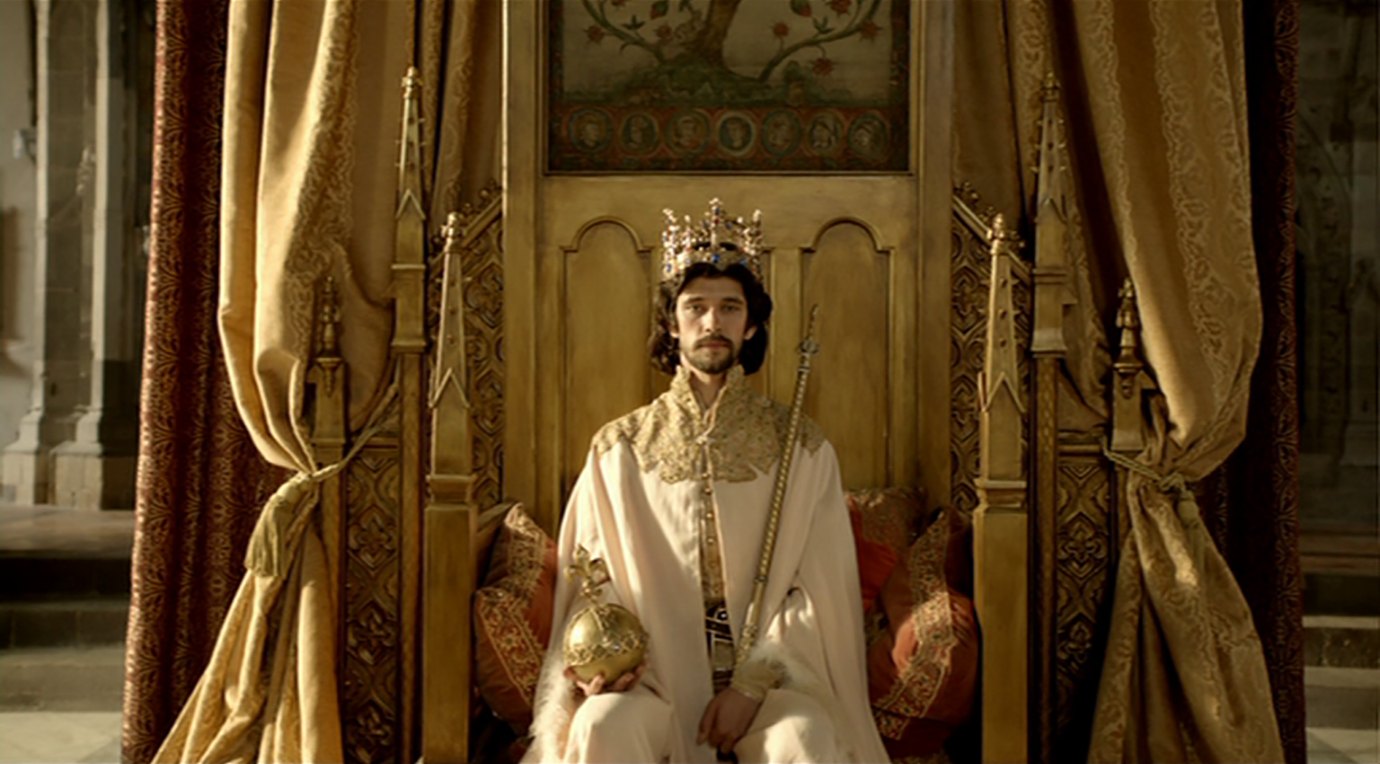
Screen capture from the opening of The Hollow Crown: Richard II (Neal Street Productions/NBC Universal, 2012), directed by Rupert Goold.
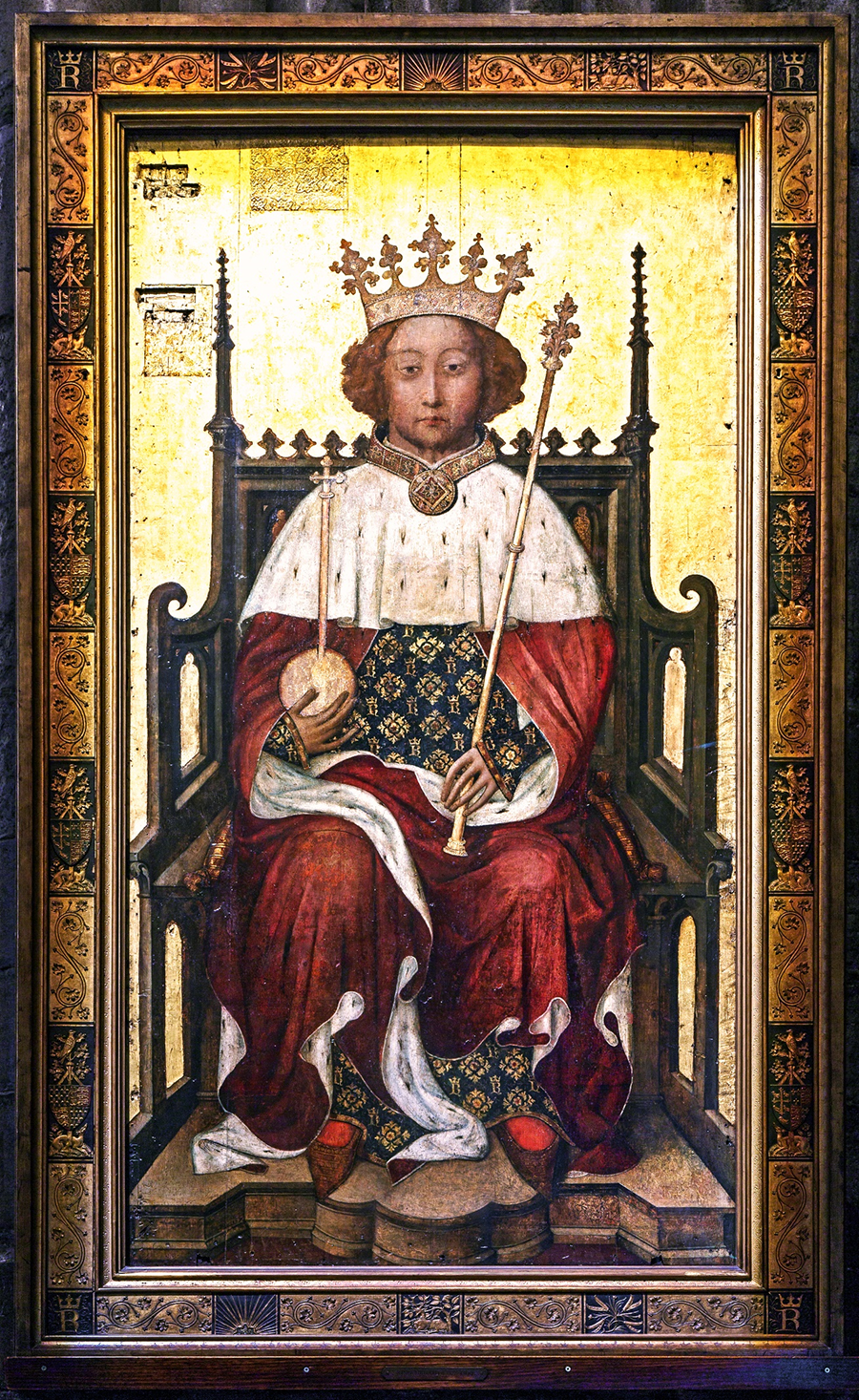
Portrait of Richard II, 14th-century wood panel painting. Courtesy of the Dean and Chapter of Westminster.
As an actor, of course, Whishaw is known for both period and literary roles. Earlier period undertakings, such as Jean-Baptiste Grenouille in Perfume: The Story of a Murderer (dir. Tom Tykwer, 2006) and John Keats in Bright Star (dir. Jane Campion, 2009), suggest a succession of quality parts, and an association with art-house cinema, congruent with an aesthetics of historically situated masculinity ‘designed’, in the words of Katherine Byrne, James Leggott, and Julie Anne Taddeo, ‘to appeal to the female or homoerotic gaze’. 43 In addition, Whishaw’s previous queer film and television roles, such as Sebastian Flyte in Brideshead Revisited (dir. Julian Jarrold, 2008) and Danny in The London Spy (dir. Jakob Verbruggen, 2015), offer a context within which to unpack the implications of a homoerotically envisaged protagonist. In medieval/Renaissance television shows, queerness and periodicity keep company, often through representations of artists and musicians; typical of this trend, Bushy (Ferdinand Kingsley), in The Hollow Crown, is reimagined as an artist. But as part of the melancholic timbre of such television, the queer historical subject is invariably tragically imagined. In Richard II, the king’s loneliness is both accentuated and entangled with his sexuality. Those around him appear in pairs, groups, or crowds; only Richard is lensed singularly, and in a way that mimics again the psychic construction of the portrait. As Saul writes, ‘There are signs that [Richard] was by nature introspective: in the […] portrait in Westminster Abbey he comes across as a lonely, even a bitter, man’. 44 And it is just such a condition of lonely solitariness that is conjured not only in the spatial arrangement of the court but also in the sentiments of the voiceover itself.
The downwards glissade identifies Richard as the origin of the voiceover – that amputated rendering of his peroration on the ‘death of kings’ (3.2.156) that has been sounding as the camera proceeds on its journey. The matching of this speech to the interpolated opening is the single most significant textual reordering in an adaptation that otherwise follows the course of Shakespeare’s play almost exactly. The speech is the sole repetition, the only time a segment of Shakespearean text appears twice (it will play later in full and in its expected textual place). In keeping with the sequence’s strategic identifications, the lines are purposefully filleted (references to Bolingbroke are taken out as are specifications of ‘our’/‘my’). The voiceover sounds: Let’s talk of graves, of worms and epitaphs… Write sorrow on the bosom of the earth… …let us sit upon the ground And tell sad stories of the death of kings – How some have been deposed, some slain in war, Some haunted by the ghosts they have deposed, Some poisoned by their wives, some sleeping killed All murdered. (3.2.145, 147, 155–60)
The voiceover sensitises us to the fact that the protagonist’s ‘story’ – the one we are about to hear and see enacted – is only the first in a series of ‘sad stories’. In this way, it establishes the tone for the whole series (a melancholic reflectiveness) while also, through a privileging of male subjects (the voiceover explicitly recognises kingship as male), ratifying its conceptual equation between masculinity and suffering. Characteristically, the mise en scène of The Hollow Crown is centrally concerned with male bodies in situations of vulnerability or weakness. While particular ‘stories’ commence with male bodies vital, caparisoned and erect, they invariably close with those very same anatomies stripped, ravaged, and – as in Richard II – on coffined display. The opening to Richard II reverberates in terms of the action to ensue, and, thanks to the interpolated opening, we know that Richard will not survive his own story. Just as for an early modern audience, more familiar with political history, for Richard II’s modern television audience, a tragic outcome is never in doubt. The modus operandi reminds us that, in quality television drama, a narrative ruthlessness often prevails; in the words of one commentator, there is little in the way of the ‘catharsis or […] easy resolution in which television had traditionally traded’. 47 In Richard II, the disconnect between the spectacle we see (the triumph of monarchy) and the Shakespearean language we hear (the death of kings) exposes the despair beneath the pageantry and, by extension, the necessity and costs of performance. 48 Tomas Elliott notes that while ‘Richard’s awareness of himself as an actor […] has long been identified as a central component [of Shakespeare’s text] […] The Hollow Crown points to it from the very start’. 49 The opening of Richard II finds its rationale in disjuncture, in the gap that separates, on one hand, resplendent interiors, gorgeous monarchical trappings, and enraptured looks and, on the other hand, the verbal assurance that only homicide lies ahead.
As if to remind us of a common denominator of guilt and complicity, at the climatic ‘All murdered’ conclusion, the music swells, the use of greater instrumentation, the steady accumulation of higher registers and the acceleration in tempo announcing the first of two climaxes. In tandem, the camera flips, reversing point of view so that we contemplate the court (i.e. rather than gaze at Richard, we see what he sees). So it is that Richard II now appraises identically dressed (dull browns and faded oranges) courtiers from Richard’s vantage point. Any one of the assembled courtiers, it is implied, could be the monarch’s would-be or potential executioner. The camera persists in its quest for conspiracy, shifting again, almost without a beat, from court to monarch. Still coloured with the interpretive thrust of its switch in focus, and still in search of a murderer, the camera’s gaze now alights on a wider composition: that of Richard blocked by two women, on one side (set back) Queen Isabel and on the other side (set back even further) her female attendant. The women on either side are plainly and soberly attired (coloured like the courtiers) and, because recessed, appear smaller in their physical proportions. The self-conscious widening of perspective mirrors the earlier shot of the suspended wooden effigy of Christ flanked by two Marys: the analogy is extended, yet the earlier reference to murder ‘by […] wives’ complicates any easy parallel between the divine and mortal women actants. The message is clear – given the assertion that a wife may just as easily be a poisoner, there is no comfort for Richard in the women who, with him, form a triptych-like configuration.
The music continues to build as the still unsatisfied camera goes out to the court again, continuing in its search. The shot is like an on-speed version of the famous opening to Olivier’s Hamlet (1948) in which the camera searches restlessly over walls, corridors, archways, and beds before settling on the drinking Claudius as the one who can be held responsible for what is ‘rotten’ in the state. In Richard II, the camera settles on the figures of Bolingbroke (Rory Kinnear) and Mowbray (James Purefoy). Behind a screen and waiting to be called, and pointing up a moving opposition between bodies, the two are seen first as body parts – boots, knees, armoured arms, and studded gauntlets (in contrast to Richard’s ungloved, unprotected, and vulnerable hands). A subsequent side-on close-up of the faces of Bolingbroke and Mowbray emphasises, in its deployment of a value-laden angle familiar from contemporary television drama, their masculinity as much as their militarism. Music once again is directive, rising to a second crescendo (full instrumentation followed by a stringed wail) to match the identification of Bolingbroke as Richard’s nemesis – it is he the camera has been looking for and it is he who is finally singled out in response to the quest the voiceover initiates. Yet such an identification is open to the audience only (i.e. the camera’s close-up is not available to Richard’s gaze). We are privy, and the camera is privy, to the knowledge of who is the most dangerous courtier-assailant, a perspective denied to Richard, the effect of which is to complicate the construction of confidant-ship and the make-up of the audience’s awareness.
In this process of identification, the distinctions that separate out Richard, Bolingbroke, and Mowbray (the latter’s costuming ties them to the low-key russets and browns of the court) once again enforce masculinity as subject. Already, in the power contests that will infuse Richard II, the battleground is being drawn according to the parameters and expression of sexuality. At the same time, the anticipated entrance of Bolingbroke and Mowbray discovers them as actors waiting in the wings to take their place on the court stage. The close-up on Bolingbroke and Mowbray gives way to a close-up on Richard: his full face is lensed, with eyes closed (the performer is anticipating his cue). Once the court audience sits, and Richard opens his eyes, the performance (i.e. the start of 1.1, the beginning of the play proper) can commence. (If only through inference, Richard operates as internal actor-director here, absorbing in one body the roles of prologue, protagonist, and dramaturge). In a later iteration in the series, Henry V (dir. Thea Sharrock, 2012), the action is inaugurated with just such a movement, as a coffined Henry opens his eyes in a miraculous but retrospective resurrection that authorises and allows the play we know to start.
Many among the watching audience will, of course, know that the play does not begin like this. Thus, like the visual references to divine right discussed earlier, the opening operates playfully, introducing the knowing liberties the series will take with the Shakespearean text. Moreover, because the voiceover stops just short of the infamous allusion to ‘the hollow crown’ (3.2.160), we are denied the satisfaction of its instancing the series’ title. Shorn of metaphor thus, the film asks us to fill in the ‘hollow’ of the absent ‘hollow crown’, the effect of which is to make us look ahead to the moment when the speech will be delivered in full. To participate in the film and in the series, then, an audience responds with knowledge and immediacy even as it waits and anticipates. In the absence of the complete ‘the death of kings’ peroration, we turn back to Richard’s execution of his own performance, to his assent to the play’s commencement, and to the film’s adaptation of the language through which it is constituted.
The self-conscious opening fits with the ways in which Richard II is fired by, and takes its rationale from, its self-consciousness as an adaptation of Shakespeare. Its multiple instances of aesthetics and complexity unfold not leisurely (as the foregoing discussion might suggest), but with economic rapidity and a quickened and accelerating narrative pace. The opening moment deploys a spectrum of communications, released across a space of seconds, in order to own a complexity of effect and an aesthetics of affect as constitutive elements of televisual engagement. These inaugural experiences concentrate sensibilities not just on the act of telling a ‘story’ but also on, more precisely, what it means to tell a story that is already known and familiar. Richard II is self-conscious about what is involved in accessing history and, accordingly, steers viewers through a series of ‘access points’ to the past, including architecture, structures/carvings, material objects, artefacts, portraits, and ‘stories’ (which themselves encompass biblical narratives and Shakespearean dramas).
Embracing its status as adaptation, Richard II celebrates its claims to quality, its association with literary and cultural kudos in a new age of television drama. The opening glances ahead to the connected, and simultaneously free-standing, ‘stories’ to come, and here the family tree functions metaphorically not only to memorialise Richard’s bloodline but also to suggest a genealogy of other Shakespearean adaptations, past, present, and future. In so doing, Richard II declares its membership of a series that showcases evolving forms of technology, takes on board changing industrial contexts, and pursues opportunities that have been made available by the digital universe. In common with the series of which it forms so integral a part, this film adaptation represents an unprecedented form of television Shakespeare, one that needs to be treated differently from the television Shakespeares of the past. As such, Richard II insists that it be understood in the light of alternative technologies and via the application of television methodologies that appreciate its significance as a quality drama that incorporates even as it exceeds the cinematic. Affirming the value of aesthetics, and a complexity of concept and approach, Richard II proclaims the global discourses of television as the preeminent site for contemporary Shakespearean reanimation.
Footnotes
Declaration of conflicting interests
The author(s) declared no potential conflicts of interest with respect to the research, authorship, and/or publication of this article.
Funding
The author(s) received no financial support for the research, authorship, and/or publication of this article.