




Abstract
Corporate social responsibility research often emphasizes the commissive effects of corporate discourse, ignoring silence or considering it a deliberate strategy to evade stakeholder pressure. From this perspective, only corporate discourse commits, and silence is the absence of discourse. This paper challenges this approach. Drawing on ventriloquial theory (Cooren, 2010) and the notion of metaventriloquism (Castor, 2020), this paper develops the concept of corporate commissive silence (CCS) to theorize how corporate silence on commitments operates as a malleable sign and a contested semiotic space. Specifically, it interprets CCS as an absence of message that different agents identify, attribute to a company, and imbue with meaning to promote their own opinions about what animates and/or should animate that company. As this concept highlights, not only words but also silence can generate commissive dynamics for corporations. The communicative force of this type of silence does not depend on corporate intentionality, but rather on the operations of appropriation and reinterpretation executed by other agents. To illustrate the utility of this concept, I describe several metaventriloquial practices executed by various agents in a recent controversy surrounding Disney’s silence on Florida’s HB 1557 law.
Keywords
Introduction
Today, many companies operate in environments where other agents expect them to declare their commitments regarding an issue. This occurs in public spaces where controversial topics are debated, such as sustainability, gender rights, or racial conflicts, among many others, but also in contexts where there is public concern linked to a company. In these contexts, it is common for one or more companies to become the subject of controversy, with many agents debating what their specific commitments are, or should be (Greco & De Cock, 2021). In corporate social responsibility (CSR) research, scholars have explored how companies manage discourse in these contexts (Christensen et al., 2022). In a productive line of research, a group of scholars emphasizes that corporate discourse is not empty talk, but rather commits the company to act in a certain way, as other agents can pressure it to ensure that its actions live up to its words (Lauriano et al., 2022; Winkler et al., 2020). In Austinian terms, this line of inquiry uses the notion of aspirational talk to highlight the commissive force of corporate discourse (Austin, 1962) in polyphonic contexts. From this perspective, polyphony (interpreted as a multiplicity of voices expressing diverse perspectives not integrated into a unified narrative) is the context where corporate commitment emerges and acquires its meaning.
The aspirational approach highlights the self-commissive consequences of corporate discourse in polyphonic contexts. However, by focusing on the verbal elements of communication, it has not theorized how corporate silence on commitments operates communicatively. In CSR research, a group of scholars have addressed corporate silence, explaining that companies often remain silent about their commitments to avoid scrutiny and pressure from stakeholders (Carlos & Lewis, 2018; Wang et al., 2021). From this perspective, known as strategic silence, silence is considered a deliberate attitude that companies often adopt to avoid the commissive effects of discourse, in contexts where there is a strong expectation that one or more companies will openly declare their commitments (e.g., Font et al., 2017, p. 1008).
Both approaches (aspirational talk and strategic silence) complement each other to account for an observable pattern: Companies commit when they speak, and in some cases, they remain silent to avoid commitment. To explain this pattern, both approaches assume that corporate discourse commits, and silence –as an absence of discourse– does not commit. However, this premise has prevented scholars from theorizing how silence can generate commissive dynamics for companies analogous to those of discourse. In other words, when stakeholders expect a company to declare its position on an issue, its silence (whether deliberate or not) can become the subject of controversy, where many stakeholders take that silence as a sign to express their opinions on the commitments that animate or should animate the company, and ultimately, to pressure it to commit in some way. Applying Scott’s (2019) terminology, this type of silence can occur as an act of commission (a company decides not to speak about its commitments) or as an act of omission (the firm simply does not speak, without any conscious decision). Crucially, the commissive force of this type of silence does not depend on the company’s intention (i.e., whether it is an act of commission or omission), but rather on the operations of resignification executed by other agents. In these situations, corporate silence does not operate as a deliberate and performatively neutral absence of message (as the strategic silence approach describes), but as a sign that many agents resignify in different ways to construct persuasive narratives about a firm’s commitments (see, for example, Masters, 2024).
These dynamics are common in today’s business world. For example, Amazon faced pressure in 2019 when it remained silent during the controversy over facial recognition technologies sold by some technology companies (including Amazon) to U.S. law enforcement agencies. Civil rights activists took this silence as evidence of complicity in discriminatory practices, while other agents interpreted it as an attitude of neutrality in a polarized debate (Kelion, 2019). Meta experienced a similar dynamic following the release of the Facebook Files in 2021. Although internal documents showed that Meta was aware of Instagram’s negative effects on adolescents’ mental health, corporate silence was interpreted in different ways: Mental health organizations, journalists, and politicians took it as a sign of the company’s commitment to profits over users’ mental health, while some corporate spokespersons interpreted it as an attitude of caution given the lack of conclusive evidence from an internal investigation (Roose, 2021). More recently, BlackRock experienced reinterpretations of its silence during the 2024 climate change debate. Given the firm’s precedents as a climate activist, various agents identified a significant silence regarding its climate commitments in its official statements, which they evaluated in different ways (Posner, 2024). In these and many other similar cases, corporate silence generates strongly commissive dynamics toward companies.
This paper develops a theoretical lens to explain how corporate silence on commitments can generate commissive dynamics. Specifically, it develops the concept of corporate commissive silence (CCS) to theorize those cases in which an absence of message, after being identified and attributed to a company, operates as a sign that other agents imbue with meaning to reintroduce it into communication, persuasively expressing their own opinion about the commitments that animate and/or should animate that firm. To develop this concept, the paper proceeds in several steps. First, it reviews the CSR literature on polyphony, discourse/silence, and corporate commitment. In particular, it explores how the relationship between these terms has been interpreted in two well-developed lines of research: the performative approach and the literature on strategic silence. Second, it presents some key elements of ventriloquial theory of organizational communication, specifically explaining the notion of metaventriloquism (Castor, 2020). Third, it uses these elements to construct a semiotics of silence. Ventriloquial theory emphasizes that communication always occurs through chains of agency (Cooren, 2010, p. 23), where human beings use signs and simultaneously act as media for other entities to materialize in a situation. Building on this premise, this paper outlines a semiotics to explain how various agents identify another’s silence, taking it as a sign for further communication. In essence, this semiotics explains that silence, like words, can operate as a sign that other agents make speak, generating a potentially commissive dynamic for the silent agent. Fourth, the paper takes this semiotics as a basis to develop the concept of CCS. This type of silence does not operate as an absence of communication (a non-sign), but as an active element (a sign) that, when identified and reinterpreted by others, can generate strongly commissive dynamics for the company. Fifth, this paper illustrates the utility of this concept by describing several rhetorical strategies applied by various agents to resignify Disney’s silence on Florida’s HB 1557 law.
Corporate Commitment, Polyphony and Silence
In CSR research, corporate commitment is often interpreted as the bond that a company accepts toward something it considers important and that will drive it to act in a certain way (Maak, 2008). This term complements that of corporate responsibility. Although often considered equivalent, they imply different nuances. Corporate responsibility typically expresses a reactive obligation for the company based on legal norms and social expectations. In contrast, corporate commitment suggests a reflexive attitude by the company to self-impose certain efforts (Haack et al., 2012). From a communication perspective, corporate commitment is interpreted as a self-referential narrative that enables the company to give meaning to its policies and decisions. CSR literature has developed this intuition, often considered one of the strong meanings of responsibility (Christensen et al., 2013). Thus, when a firm publicly declares its commitment to certain agents, principles, or values, it communicates the self-imposed bonds that will animate it to act and will serve others to evaluate its efforts. This section explores how CSR research has characterized corporate commitment in polyphonic contexts, focusing on the interpretation of the discourse/silence binomial.
Corporate commitment, polyphony and performative discourse
Today, there is a strong expectation that many companies publicly declare what animates them to operate in business (Schoeneborn & Girschik, 2021). In such contexts, defining corporate commitments is not an autonomous task for managers and often involves the participation of other agents. This fact is not yet widely accepted by CSR scholars. Christensen et al. (2022) illustrate this point in their review of the CSR literature, where they identify two main perspectives. On the one hand, the representational approach –still dominant in the field– assumes that companies address an undifferentiated audience to explain what they plan to do or have achieved regarding social and environmental issues (e.g., Lewin & Warren, 2025). In terms of vocality, these scholars conceive communication as the practice of an official voice controlled by the company’s management team. In contrast, Christensen and colleagues identify a recent line of research that explores the polyphony associated with corporate commitment and responsibility. This performative approach highlights that CSR policies are constructed through ongoing negotiations and debates between the company’s managers and its stakeholders, where multiple voices participate to question, support, or contradict the official CSR discourse.
Within the performative approach, several works provide empirical evidence on how polyphony shapes a company’s commitments. For example, Livesey and Graham (2007) demonstrated how Shell’s ecological aspirations during the 1990s did not emerge as a monovocal practice, but were progressively constructed as the company articulated its positions in forums where many agents questioned the essential content of its commitments. Girschik (2020) explored how employees of a pharmaceutical company acted as internal activists to reframe the company’s commitments, operating as translators and amplifiers of external stakeholders’ expectations (see also Lauriano et al., 2022). More recently, Poroli and Cooren (2024) explain how human and non-human voices influence CSR debates within an organization, creating tensions that lead CSR professionals to silence certain voices and amplify others, in a process necessary for decision-making (see also Winkler et al., 2020).
Christensen et al. (2013, 2017, 2021) provide a theoretical foundation for this approach. Specifically, they propose the notion of aspirational talk to illustrate the mechanisms through which internal and external polyphony shapes a company’s discourse on commitment. Building on the communication constitutes organizations (CCO) approach, these scholars argue that a company’s statements about commitment are neither irrelevant nor hypocritical, but rather speech acts with performative consequences, as they become self-normative for the company. In particular, they identify two mechanisms for these performative consequences: (1) externally, aspirational discourse mobilizes the expectations of external audiences; and (2) internally, this discourse encourages corporate members to make decisions that materialize those aspirations (Christensen et al., 2013, p. 383). From this perspective, polyphony (both internal and external) operates as a necessary condition for the performativity of corporate discourse on commitment.
The performative approach to CSR highlights the inherent complexity of corporate commitment when many actors have different opinions about what a company does/says and should do/say. However, this approach presents a relevant limitation regarding a company’s silence when other agents expect it to declare its commitments. Specifically, scholars of this approach tend to ignore silence (Lauriano et al., 2022; Penttilä, 2020; Winkler et al., 2020) or to interpret it as a result of exclusion and marginalization dynamics that occur during the collective negotiation process. For example, Poroli and Cooren (2024) interpret silence as the result of a tendency to exclude certain voices and privilege others in the CSR decision-making process. At another level, Christensen et al. (2021) attribute silence to organizations, interpreting it as a deliberate attitude to avoid the commissive dynamics associated with discourse (see also Schoeneborn & Girschik, 2021, p. 450). In short, proponents of the performative approach assume that only discourse commits and, based on this premise, ignore silence or interpret it as an attitude irrelevant to commitment.
Corporate commitment, polyphony and non-performative silence
In CSR research, a group of scholars conceptualizes corporate silence as the attitude of not speaking applied by a company after rationally evaluating the costs and benefits associated with publicly speaking about commitments and responsibilities (Carlos & Lewis, 2018, p. 135). According to this approach –usually known as strategic silence– companies decide to remain silent to avoid the commissive consequences of discourse in contexts where there is a strong expectation that they openly declare their commitments.
A growing body of empirical evidence documents this silence across various industrial contexts. For example, Delmas and Grant (2014) argue that many wineries that obtain organic certifications do not communicate them on their labels to avoid bias or confusion among their customers. Kim and Lyon (2015) illustrate that several electric utilities understate their achievements when communicating about pollutant emissions. Similarly, Font et al. (2017) identify green-hushing practices in the tourism sector, where several companies report fewer sustainability actions than they actually implement. Gualtieri and Lurati (2024) illustrate that companies, when operating in polarized contexts –where diverse conversations about a CSR issue delegitimize each other– tend to actively participate in conversations on one side, while silencing their goals and achievements in conversations on the other. These works highlight a relevant trend: Companies often adopt a low profile in their commitment declarations to avoid scrutiny from their main stakeholders or accusations of hypocrisy (see also Hollander et al., 2010; Le et al., 2019).
The strategic silence literature and the performative approach to CSR share a premise: Corporate discourse commits when it occurs in polyphonic contexts. At this point, both perspectives are complementary: For both, the multiplicity of voices exposes the company to discursive tensions that can lead to positive changes in the medium term (as the performative approach highlights), but also entails a short-term risk to its reputation and performance (as the strategic silence literature suggests). Both approaches expand our understanding of commitment in polyphonic contexts. However, they commit a relevant omission: By focusing on the performative effects of discourse, they ignore the communicative function that silence often plays in polyphonic situations. Analogously to discourse, when a company remains silent about its commitments, other agents can interpret that absence according to their own perspectives and interests. The following section presents some ideas from ventriloquial theory that I will later use to theorize this dynamic.
A Ventriloquial Approach to Communication
The notion of polyphony has attracted the attention of many scholars in the field of organization studies (Trittin & Schoeneborn, 2017). Within the CCO approach, a broad group of scholars use the metaphor of ventriloquism, proposed by Cooren (2010), to explore how polyphony operates in organizational contexts (e.g., Nathues et al., 2023; Poroli & Cooren, 2024). In general terms, the ventriloquial approach argues that communicative agency (who/what communicates) is always a shared attribute. In the popular spectacle, we can say that the human being (or ventriloquist) assumes an active role in making the dummy (or figure) speak, but we can also say that the dummy actively operates to make the ventriloquist say things they would not have said without its mediation (Cooren, 2010, p. 85). Communicative agency is thus distributed beyond the human agent on whom we initially focus our attention. Specifically, ventriloquial researchers identify two directions for exploring the distribution of agency in communication: upstream and downstream (Cooren, 2010, 2020a; Nathues et al., 2024), which I describe below.
Ventriloquism as an essential practice for communication
Upstream ventriloquism decenters humans from their position as senders to also take them as “the media through which other figures manage to speak” (Cooren et al., 2021, p. 245). To enhance the analytical rigor of this idea, Nathues et al. (2021) identify two modes of upstream ventriloquism, depending on the position the human agent adopts in relation to the referred entity. Thus, a human being practices an invocation when they assume an active role, analogous to the ventriloquist who makes another entity speak. In contrast, a human agent practices an animation when they assume a passive role, similar to the dummy that another entity makes speak in a certain way (p. 1461). During a meeting with journalists, for example, a CEO may invoke some market data to describe the business context during the past year, but at another moment may argue that the company’s commitment to its customers animated the management team to make certain decisions affecting employees. In both cases, the CEO positions themselves as an intermediary that operates actively or passively so that other entities (market trends and commitment to customers) materialize in the situation.
Complementarily, downstream ventriloquism emphasizes that human beings always express themselves through other entities—or signs—that represent them. In the above example, the CEO uses a broad repertoire of signs (words, gestures, body movements, figures on a screen. . .) to bring other entities to their meeting with journalists. As ventriloquial theory highlights, signs operate as a medium for us to bring other entities into the situation. But this materialization does not occur without interference. Following Derrida, Cooren (2010, p. 31) explains that delegation through signs always implies a “betrayal” of our intentions. For example, a CEO’s comment about the appearance of one of their collaborators may be interpreted as a humorous remark or a neutral description, but may also be offensive to some journalists. According to Cooren, this betrayal is not a communicative failure, but an inherent attribute of semiotic delegation (see also Brummans et al., 2014; Nathues et al., 2024).
Ventriloquial theory combines both directions to emphasize that humans always communicate through long chains of agency where we can move upstream or downstream when we express, but also when we interpret or analyze the expressions of others. Communication always occurs through long bidirectional “chains of agency” (Cooren, 2010, p. 4), where various agents link together to materialize entities not present in a specific situation. For example, when a CEO explains the sustainability goals of their company to journalists, we can trace the chain of agency in an upward direction to attribute authorship of what is said to the material author of the text, the CEO, their management team, the company, industry standards, applicable legislation, or social expectations about environmental responsibility. But we can also explore that agency chain in a downward direction to attribute a representative function to the words the CEO utters, the sound waves moving through the air, the figures appearing on the screen, the device projecting them. . . Communicative agency is distributed throughout this chain, where no agent acts in a completely isolated or autonomous way (Cooren & Sandler, 2014, p. 231). Ventriloquism thus operates in two complementary dimensions. In its expressive dimension, we communicate with signs to materialize non-present entities. In its interpretative dimension, we take signs to attribute authorship to other entities. This complementarity justifies considering ventriloquism not as a metaphor or an analytical lens, but as an essential practice that we continuously implement to materialize things in our world.
Ventriloquism as a mode of existence and authority
Up to this point, I have characterized ventriloquism as an essential practice for communication. However, Cooren (2010, 2015, 2020b) has extensively argued that ventriloquism is not simply a mode of expression or interpretation, but a mode of existence. From an ontological perspective, any entity only comes into existence when it is expressed by other entities (Cooren, 2015, p. 5). Existence is not an attribute that entities possess independently and prior to communication, but rather an attribute that emerges through materialization processes that involve other agents. This idea helps us appreciate a relevant fact: the existence of any organizational attribute (a firm’s identity, its labor policies, its history. . .) materializes through official channels controlled by the company, and also through the communications of external agents, contributing to materialize those entities from different perspectives (Winkler et al., 2020). For example, a company’s commitment to sustainability does not exist as an autonomous entity—one that first exists and then is communicated—but rather comes into existence when various agents materialize it: a manager explains it at a press conference, an activist questions it on social media, a corporate report attributes certain goals to it, or an employee invokes it before a client (several empirical works, such as those by Livesey and Graham (2007) and Girschik (2020) confirm the distributed nature of organizational phenomena). Each of these speech acts brings corporate commitment into existence in specific contexts, and its absence—when no agent makes it present—amounts to its non-existence in that situation.
Analogously to existence, the authority of an entity (i.e., its capacity to make a difference in a situation) operates as an additive attribute that depends on the network of agents that sustain it (Cooren, 2020b, p. 183). Far from traditional organizational conceptions that locate authority and power in predefined hierarchical structures, Cooren emphasizes that an entity’s capacity to make a difference in a situation results from the convergence and alignment of the agents that participate in its materialization. For example, when a CEO speaks during a meeting with their management team, the authority of what they say depends not only on their formal position in the organizational chart, but also on their individual skills, the meeting agenda, the reports requested, their symbolic position at the head of the table, and even the gestures and tones they use to communicate. From a ventriloquial perspective, authority is not connected to individuals or formal structures, but emerges through the accumulation of connections between human and non-human agents that contribute to materialize an entity in a specific situation (Nathues et al., 2023, 2025). The dynamic and relational nature of authority reveals that struggles to make a difference in a situation are fundamentally struggles among communicating agents to mobilize agency networks that strengthen their position and weaken that of opponents (Poroli & Cooren, 2024).
Metaventriloquism: Resignifying other agents’ signs
Conventional ventriloquial theory helps us understand situations in which various human agents interact, even in dynamics of disagreement and conflict (Poroli & Cooren, 2024). However, this approach does not adequately capture dynamics in which some human agents debate about what entities have been materialized through the signs used by others. Castor (2020) makes a key contribution to understanding these dynamics. She proposes the term metaventriloquism to describe a practice—frequent in polyphonic disputes—in which agents strategically appropriate and resignify signs previously used by others. Thus, she defines metaventriloquism as “a form of metacommunication where one communicates about the ventriloquial acts of another or even of one’s self” (p. 30). This occurs, for example, when two colleagues argue and one tells the other: “Your way of speaking makes your arrogance clear.” By communicating this way, the speaking agent (A) expresses that the other agent (B) was moved by arrogance (C) to speak in a certain way. In other words, A appropriates the signs mobilized by B (words, intonation. . .) to bring into the situation an entity (B’s arrogance) that had not previously been materialized through signs. If the conventional ventriloquial approach emphasizes how an agent uses signs to bring other entities into the situation, the notion of metaventriloquism explains how an agent appropriates the signs previously mobilized by another to declare which entities animated them to communicate in that way.
In her analysis of the public hearing on the Lake Michigan water diversion, Castor illustrates how supporters and opponents of the project practiced metaventriloquism to resignify the city of Racine’s official request. At the hearing, Racine representatives demanded the diversion, arguing that this decision contributed to the “common good” of the Mount Pleasant community. In ventriloquial terms, Racine representatives used spoken words as signs to request a decision, presenting themselves as animated by Mount Pleasant’s interests. However, other agents resignified those signs to expose that what really animated the city representatives’ discourse were Foxconn’s interests, a company planning to build a factory and technology campus. In this debate, project critics did not limit themselves to mobilizing new signs to express their opinions about the proposal—using conventional invocation/animation methods—but rather practiced metaventriloquial operations to resignify the signs initially attributed to Racine and construct persuasive narratives about the commitments that animated its representatives to speak as they did.
The notion of metaventriloquism has fundamental implications for authority and existence. Cooren (2010, 2018, 2020b) conceptualizes authority as a relational and additive attribute, where an entity’s capacity to make a difference in a situation depends on the network of agents that materialize it. In contrast, the notion of metaventriloquism highlights that, in contentious situations, authority also depends on competitive operations to resignify others’ signs. From this perspective, the authority of a position is an unstable attribute in a double sense: agents compete to materialize certain entities with the signs they mobilize (as conventional ventriloquial theory recognizes), but also compete to alter or deny the referentialities (i.e., entities brought into the situation) proposed by other agents (Castor, 2020, p. 45). In other words, the authority of a position will depend on the entities that agents mobilize through their signs, but also on the alterations or displacements that those agents execute on the signs proposed by others.
An analogous reflection applies to existence. Unlike the conventional ventriloquial approach, the notion of metaventriloquism implies that the existence of an entity depends not only on its linear materialization through signs, but also on more sophisticated resignification operations. If conventional ventriloquism suggests that entities emerge when other agents materialize them through signs, the notion of metaventriloquism reveals that the referentiality associated with a sign can be questioned or subverted by others (Castor, 2020, p. 41). From this perspective, entities do not emerge and operate in our world simply when they are materialized through signs. Instead, their very mode of existence becomes unstable and competitive: the existence of an entity—and its commissive consequences—is subject, at least potentially, to an endless dynamic of validation, revision, and questioning. In the case analyzed by Castor, the expression “public good” (taken as a sign) gave rise to the materialization of diverse entities: for Racine spokespersons, that expression operated as a medium for Mount Pleasant’s interests, while for opponents, it materialized Foxconn’s commercial interests (2020, pp. 41–42). As this case illustrates, the referentiality of signs becomes a semiotic battlefield, where various agents compete to impose their own narratives about the entities that are, or should be, brought into the situation.
A Ventriloquial Semiotics of Silence
This section presents a semiotics that applies and extends some essential ideas of ventriloquial theory to theorize absences of expression. The following section applies this semiotics to conceptualize corporate silence on commitments.
Semiotic structure of silence: Observer, silent agent, and referred entity
The term silence is usually interpreted as the absence of verbal signs. In this sense, we can use it to refer to things as diverse as an internal reflective state, the quietness of a space, or the pause a person makes when speaking. From this perspective, the world is full of silences. But this definition is hardly operational. More concretely, we often observe that individuals use silence as a sign to communicate (Ephratt, 2008). When we interact, for example, we use others’ silence to infer their ignorance about an issue, their attitude of respect, or their acceptance of guilt. 1 From a ventriloquial perspective, we can explain this practice by stating that silence operates as a sign when an observer (A) identifies a communicative absence they consider relevant, attributes it to another agent (B), and uses it as a medium to bring a non-present entity (C) into the situation. 2 Thus, silence operates as a sign through the interpretative practices that an observer executes to delimit what they consider a relevant communicative absence, to whom it should be attributed, and what entity is brought into the situation by that absence.
The notion of silence as a sign operates through a triadic structure that involves: (1) the observer who identifies an absence; (2) the agent to whom that absence is attributed; and (3) the absent entity that is materialized by the observer through that absence. Additionally, for this structure to operate semiotically, the observer must execute three operations. First, the observer has to delimit a communicative absence within the wide range of potential silences that occur in any situation. When some agents interact, multiple absences concur, related to unmentioned issues, undeveloped consequences, unexpressed emotions. . . Expression is never exhaustive and always occurs against a background of absences. In such contexts, any observer (whether or not participating in the interaction) can execute an interpretative cut (or selection) in the unordered field of their perceptions that leads them to differentiate an absence they consider relevant from others they do not perceive or interpret as irrelevant (on the task of drawing constitutive distinctions when observing, see Luhmann, 1995, 2006).
Second, the observer has to attribute the selected absence to an agent among multiple possible alternatives, thus assigning an authorship relation to the identified silence. Ventriloquial theory helps us appreciate that this attribution is not obvious, since any communicative absence can be assigned to multiple agents located at different levels of an agency chain through which we can move upstream and downstream (Cooren & Sandler, 2014; Nathues et al., 2021). For example, when a CEO avoids publicly commenting on a controversial issue, any observer could attribute that silence to the CEO, the management team, the company, a group of companies within an industry, or a specific interpretation of capitalism (for recent examples of the diversity of interpretations about the silent agent, see Egan, 2022; Morrow & Mattingly, 2025; Treisman, 2025). This flexibility confirms a relevant fact: Silence is not an ontologically predetermined entity, but rather emerges into existence through locally situated interpretative operations that each observer executes according to their own perspective and interests. In other words, the operations of delimiting silence and attributing its authorship to an agent are constitutive of silence as a sign: The observer does not “discover” or “unveil” a pre-existing silence, but rather “constitutes” it as a sign through their operations of identification and attribution (for a similar argument, see Wilhoit & Kisselburgh, 2019).
Third, the observer has to take that silence as a sign to materialize a non-present entity. Once delimited and attributed to an agent, the observer can ventriloquize the silence (literally, make it speak) to bring an absent entity into the situation. Silence—like any other sign—lacks inherent meaning, and only acquires its referential value within specific configurations of relations that the observer establishes according to their local perspective and interests (Saintot & Lehtonen, 2024). Silence only signifies through the connections the observer establishes with other situational elements (previous statements by the silent agent, gestures, attitudes of other agents. . .). In some situations, cultural conventions guide the observer to interpret silence. This occurs, for example, when the absence of objections in formal meetings is conventionally interpreted as the attendees’ approval of what the company spokespersons have expressed. However, in non-ritualized situations, the observer has greater freedom to draw connections and make silence speak.
In organizational studies, some recent research illustrates the relational nature and semiotic openness of silence. For example, Vu and Fan (2022) describe how Buddhist managers in a Vietnamese company use their own silence to manage their teams of non-Buddhist employees. In this work, the authors characterize silence as a communicative resource (i.e., a sign) that is inherently ambiguous and thus can generate oppressive or emancipatory effects, depending on the people interacting and the context in which it occurs. Dupret (2019) highlights more clearly the relational and situational nature of silence. Based on an empirical study of a group project in adult psychiatry, she describes silence as a communicative resource (i.e., a sign) that becomes loaded with meaning when participants connect it with other situational elements (words, gestures, objects. . .), influencing their individual behaviors and, as a result, the interaction patterns.
Interpretative disputes about silence
Humans often use silence as a sign to communicate with others. In ventriloquial terms, we can say that humans frequently employ the modes of invocation and animation applied to silence. Thus, an individual may remain silent to invoke an absent entity. This occurs, for example, when a manager remains silent for several seconds to highlight the fact that a subordinate has arrived late to the meeting. But an individual can also use silence to express what animates them to act in a certain way. This occurs, for example, when a manager expresses their concern to others by remaining silent after explaining the company’s financial problems. However, an agent’s silence can also be the object of resignification practices analogous to those that Castor (2020) characterizes as metaventriloquism.
According to Castor (2020), human agents often strive to explain what, from their perspective, animates others to speak in a certain way. In such situations, previously uttered words function as a sign, but also as a semiotic field for controversy: Various agents may focus on the words previously enunciated by another agent to express their interpretation about the entities that animated that agent to speak. Similarly, interacting agents may perform metaventriloquial operations to explain the motives that, from their perspective, motivated another agent to remain silent. This happens, for example, when some employees later comment on the manager’s silent reaction to the subordinate’s delay. In that situation, those employees can resignify the manager’s silence to materialize an attitude of professional disappointment, differential treatment, or a lack of leadership to eradicate inadequate behaviors. Each employee will construct their own narrative about that silence by connecting it with other situational entities (their previous experiences with that manager, their prejudices, rumors recently heard. . .). In such a situation, those agents will agree on the identified silence and its attributed authorship, but will intensely debate the entities that animated the silent agent.
From an ontological perspective, this competitive dynamic implies that silence does not exist as a stable and predefined entity that agents can unveil or discover. In argumentative polylogues, silence does not emerge as an easily appreciable entity, but rather is constituted as a sign through interpretative debate, thus existing in a state of ontological multiplicity, where its specific delimitation (what are the limits of that silence?), its authorship (who or what remained silent?), and its referentiality (what entities are materialized through that silence?) depend on the interpretative practices executed by the agents communicating about that silence. For example, when the CEO of a pharmaceutical company avoids publicly explaining the company’s position regarding a recent controversy about access to medicines in developing countries, many agents can delineate, attribute, and interpret that silence in different ways: Some may attribute it to the CEO and link it to that specific controversy to interpret it as a sign of managerial prudence in a complex situation, while other agents could attribute that silence to the group of pharmaceutical companies located in developed countries, linking it to the recurring conflict between corporate objectives and human rights to materialize a stark orientation of those companies toward profits. As is easy to appreciate, silence emerges as a sign and materializes different entities depending on the observers’ interpretative operations.
The malleability of silence also has implications for authority. Unlike Cooren’s (2010, 2018, 2020c) proposal, where authority operates as an additive attribute, the simultaneous practice of metaventriloquial operations reveals that, in argumentative polylogues, the authority of a position emerges and evolves through interpretative disputes where multiple agents construct persuasive narratives about what entities animate the silent agent and with what implications. For example, a manager may gain authority by remaining silent about an internal controversy (materializing their reflexive and neutral character), but that authority can be quickly subverted when a group of employees resignify that silence as a sign of lack of moral leadership. In such a case, the authority of a position based on silence does not accumulate with other expressions, but rather oscillates unstably according to the metaventriloquial operations that various agents execute to appropriate that absence and make it signify different things. In these dynamics, the authority of a position operates as an unstable attribute, where any advantage can be subverted through operations of appropriation and redefinition that alter its original referentiality.
Corporate Commissive Silence
The previous section revealed that silence operates as a malleable sign and a semiotic battlefield when multiple agents execute metaventriloquial operations to resignify it according to their own interpretative frameworks and persuasive objectives. Building on this characterization, I now define corporate commissive silence (CCS) as the absence of oral or written discourse that, when identified by one or more agents and attributed to a company, is interpreted as a symbolic reference to its commitments. This type of silence is not commissive due to the silent agent’s intention (the company does not necessarily intend to commit or avoid commitment through its lack of discourse), but rather due to its capacity to generate commissive dynamics toward the company through the resignification process executed by others. Unlike other cases of corporate silence that may go unnoticed or be taken as irrelevant, this type of silence typically emerges in contexts where there is a strong expectation that one or more companies will publicly take a position on an issue. When this expectation is not met, the absence of corporate communication becomes an object of attention and debate, being interpreted by various agents as a sign of the commitments that, from their perspectives, animate the company. In other words, CCS does not simply describe an absence of corporate communication, but an absence that acquires performative force by being constituted and mobilized by others as a sign of what a company prioritizes. This constitution of corporate silence as a sign that stimulates a polyphonic debate with potentially commissive consequences for the company is what distinguishes CCS from mere communicative omissions that generate neither scrutiny nor public debate.
The commissive dynamics associated with CCS illustrate what Scott (2019) calls “the social life of nothing.” According to Scott (2018, 2019), absences are not merely passive or negative phenomena, but acquire active presence and performative force when they are constituted as signs (or “symbolic social objects,” in Scott’s terminology) by social agents who imbue them with meaning and mobilize them in their communicative practices (2018, p. 5). In the case of CCS, the “nothing” of corporate silence emerges into social life when stakeholders identify it, attribute it to a company, and convert it into a sign to construct persuasive narratives about the commitments that, from their perspectives, animate and/or should animate the company. In Scott’s terms, it is irrelevant whether that silence occurs as an act of commission (the company deliberately decides not to speak) or as an act of omission (the company has no intention or awareness of being silent). The commissive dynamics linked to CCS do not depend on the company’s intentionality or awareness, but rather on the metaventriloquial operations that other agents execute to make silence speak and, ultimately, to pressure the company to publicly assume, abandon, or alter certain commitments. It is irrelevant whether the company intends to express something through its silence, and it is also irrelevant whether its managers are initially aware that the company remains silent regarding an issue on which some stakeholders expect it to take a position. The existence of corporate silence and its commissive force therefore emerge from the metaventriloquial operations of those who make it speak.
This conceptualization of CCS shares a fundamental point with the aspirational approach: corporate communication—through what is said or not said—can generate commissive dynamics that pressure the company (Christensen et al., 2013, 2017; Winkler et al., 2020). However, there is a key difference between both cases: Aspirational discourse materializes through explicit verbal signs (included in reports, announcements, open letters. . .) whose semantic content offers a relatively stable reference point that stakeholders must paraphrase or contrast with corporate actions. In contrast, this type of silence lacks specific verbal content, which radically amplifies its semiotic malleability. This fact has key implications for corporate control over commissive dynamics. In the case of aspirational discourse, the company maintains some initial control over the content of its statements, choosing which commitments to articulate and how to formulate them (Penttilä, 2020), although the company may later lose control over how those commitments are interpreted and resignified by others (Christensen et al., 2021). In the case that CCS theorizes, the company has no control over the meaning initially attributable to its communicative absence. The commissive forces emerge when stakeholders appropriate and resignify that silence to materialize commitments that the company never declared nor necessarily contemplated, generating pressures based on what its silence apparently reveals about its priorities. While aspirational discourse can be strategically managed by companies to navigate contradictory expectations (choosing ambiguous formulations or long-term commitments), corporate silence escapes managerial control: Stakeholders can resignify it with greater freedom to construct narratives alien to any corporate foresight or intention, forcing companies—or more specifically, their management teams—to face pressures they did not anticipate.
This type of silence manifests in practice through three main attributes, which become more visible when many agents publicly debate a company’s commitments. First, corporate silence on commitment is a malleable sign and an open space for controversy. Unlike corporate discourse that provides specific verbal content, corporate silence offers a wide range of plausible interpretations. In multivocal spaces, corporate silence may operate as a sign and as an open semiotic space where various agents can execute sophisticated operations to appropriate and resignify that silence. By lacking a stable verbal anchor, each stakeholder can establish their own connections between the company’s silence and other contextual elements they consider relevant, stimulating competitive dynamics of resignification. This semiotic openness has consequences for authority: Far from conventional ventriloquial theory, where authority operates through an additive logic that promotes the accumulation of supporting voices, in these cases, authority operates through competitive dynamics where various agents strive to express their own opinions about corporate silence, but also to delegitimize other agents’ interpretations. In such contexts, the authority of what is said about a company’s silence becomes an unstable and contested attribute.
Second, a company’s silence about commitment is a constituted sign. It does not pre-exist as an ontologically independent entity waiting to be unveiled or discovered, but rather emerges into existence when three conditions are met: (1) one or more agents have specific expectations about what position a company should take regarding an issue; (2) the company does not communicate about that issue, creating a gap between other agents’ expectations and its communicative practices; and (3) those agents delimit that absence, attribute it to the firm, and make it speak to project their own narratives into the communicative space. Without the fulfillment of these conditions, any absence will remain semiotically irrelevant, without commissive consequences for the company.
Third, this type of silence can operate as a catalyst for organizational change. When an absence of corporate discourse about commitments is considered a sign, it can generate pressure dynamics toward the company similar to those identified in the aspirational discourse literature, but with specific characteristics. Unlike aspirational discourse, where the company maintains some control over the content of its statements, this silence escapes managerial control. This means that pressures toward the firm may arise through narratives completely alien to any corporate foresight or intention. This transformative potential is amplified by the corporate silence’s capacity to operate simultaneously in contradictory directions: Stakeholders with opposing agendas can resignify corporate silence to demand mutually exclusive commitments. This interpretative multiplicity thus generates a multidirectional pressure field where the company faces potentially contradictory demands. Managing these demands forces managers to address complex strategic decisions about which interpretations to acknowledge, which to reject, and how to reconfigure their public positioning to navigate irreconcilable expectations.
Up to this point, I have used the term “stakeholder” to maintain terminological coherence with the CSR literature. In this field, it is commonly used to refer to agents who affect or are affected in some way by a company (Freeman, 2023). Given the object of this paper, I alter its meaning. Specifically, I interpret the notion of stakeholder as any individual or collective agent who has both a specific interest in a company committing in some way regarding an issue, and the effective capacity to participate in public communication. This definition includes a wide range of agents (employees, investors, activists, and politicians, among others) who meet two conditions: (1) they expect a company to commit in a certain way; and (2) they can disseminate their own persuasive narratives about that firm. In today’s business environment, many companies may be potentially linked to multiple issues (related to responsibility areas as diverse as sustainability, labor rights, race, or geopolitical conflicts, among many others) without any company being able to officially position itself on all of them (Schoeneborn et al., 2020). In this context, this type of silence occurs when one or more stakeholders have direct expectations about the position a company should adopt regarding an issue and those expectations conflict with the corporate silence (whether deliberate or not), creating a void that those stakeholders can fill with their own interpretations about what animates and/or should animate the company. From this perspective, stakeholders are not passive observers of a firm’s activities, nor agents materially affected by its operations, but agents who can strategically transform communicative absences into semiotic resources to promote their own opinions about a company’s commitments.
Exploring Corporate Commissive Silence: The case of Disney in the HB 1557 controversy
This section applies that characterization of CCS to a recent controversy involving Disney. Its aim is not to analyze with methodological rigor the metaventriloquial practices executed by all agents involved, but rather to illustrate how the notion of CCS helps us explore resignification dynamics that are not adequately captured in the available CSR literature.
Introducing the case
The Parental Rights in Education Act (HB 1557), commonly known as the Don’t Say Gay law, was passed in Florida, generating public debate. This 2022 legislation restricted instruction on issues related to sexual orientation and gender identity in Florida public schools, prohibiting such instruction from kindergarten through third grade and establishing guidelines for higher grades. Introduced on January 11, 2022, the law quickly polarized positions: Its supporters argued that it protected parents’ right to control their children’s education, while its detractors denounced it for promoting a context of silence and discrimination in schools. The controversy soon transcended state borders, generating a national debate on parental rights, LGBTQ+ community inclusion, and the role of public schools in addressing contentious issues (Smith, 2022).
Many major corporations became involved in the controversy. Well-known companies such as Target, Mattel, and Starbucks signed the Human Rights Campaign statement in opposition to laws restricting LGBTQ+ rights. In this context, the Walt Disney Company, a major corporate actor in Florida, issued no public statements regarding a law that did not directly affect its operations. This absence triggered a strong wave of criticism from employee groups and activists, who demanded that Disney explicitly commit to supporting the interests of Florida’s LGBTQ+ community. In response to these criticisms, Disney CEO, Bob Chapek, sent an initial message to employees—immediately leaked to the media—justifying Disney’s silence. The new wave of criticism over Chapek’s justification prompted him to send a second message to employees—also leaked to the media—declaring Disney’s opposition to HB 1557. This shift triggered a new wave of criticism calling for Disney’s neutrality (Gregg, 2023). In this debate, Disney’s silence soon became a focal point for controversy. The following subsections illustrate how these dynamics unfolded in the Disney case.
Attribute 1: Corporate silence as a malleable sign and an open space for controversy
In the HB 1557 controversy, Disney adopted an initial position of neutrality, avoiding taking a stance on an issue that did not directly affect its operations. However, many agents interpreted that silence by relating it to other contextual elements, such as other companies’ opposition to the law, or Disney’s donations to politicians who promoted it. Based on these local connections, many agents metaventriloquized Disney’s silence to introduce different perspectives into the debate. Excerpt 1, published by the AIDS Healthcare Foundation (AHF, 2022), illustrates the diversity of opinions about Disney’s silence before Chapek sent his first message.
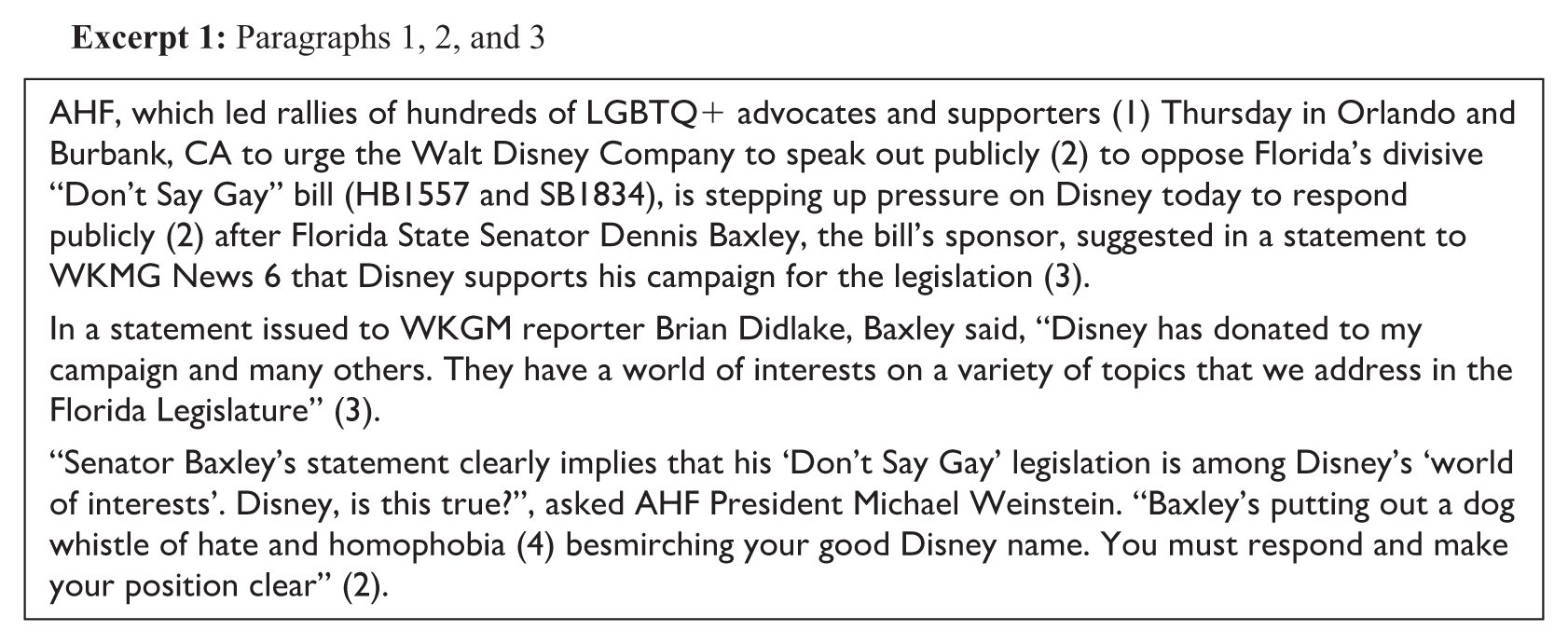
In this text, AHF urges Disney to break its silence and declare its opposition to HB 1557 (2). To support its demand, AHF executes several metaventriloquial operations. First, it appropriates the voice of conservative Senator Dennis Baxley to interpret Disney’s silence as implicit support for Baxley’s campaign in favor of the law (3). This is a sophisticated metaventriloquial operation: AHF uses Baxley’s words (or explicit signs) to expose the conservative values that, from his perspective, animate Disney’s silence. AHF employs another similar practice by appropriating the voice of Michael Weinstein (AHF President) who uses Baxley’s words to expose his underlying motivations of “hate and homophobia” (4). Through the combination of both practices, AHF resignifies Disney’s silence as harmful to the LGBTQ+ community. Thus, Excerpt 1 has a clear persuasive aim: It attempts to pressure Disney to abandon its silence and oppose the law. In this sense, the text reinforces its authority in two ways: by accumulating supporting voices (1) and by employing sophisticated operations to resignify the voices of other agents and Disney’s silence (3 and 4).
In response to the initial wave of criticism, Chapek sent a first message to employees justifying Disney’s silence (Faughnder, 2022). Excerpt 2 includes several paragraphs from that text.
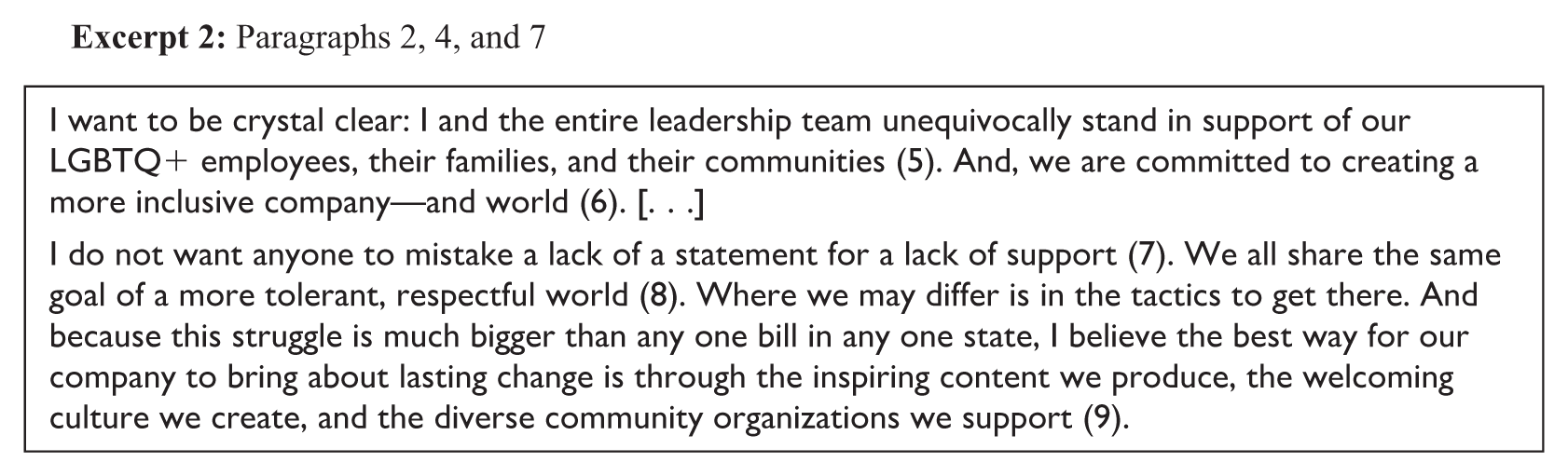
Chapek speaks on behalf of himself and Disney’s management team to highlight their support for Disney’s LGBTQ+ employees, their families, and communities (5). He also declares their commitment to creating a more inclusive company and world (6). Interestingly, he admits that Disney’s silence operates as a sign subject to multiple interpretations, implicitly recognizing the metaventriloquial operations that others might execute to resignify the company’s position (7). In response to that possibility, he speaks on behalf of Disney’s senior executives and all its LGBTQ+ employees to express a shared commitment: creating a tolerant and respectful world (8). From that premise, he advocates for shifting the public debate from Disney’s silence to its perceptible policies. Through a semiotic lens, he argues that the appropriate sign to materialize Disney’s commitments should not be its silence regarding the law, but rather the strategy it applies in its operations (9).
Despite Chapek’s attempt to neutralize the alternative of taking Disney’s silence as a sign, many agents interpreted both elements (corporate silence and Chapek’s message) as signs of Disney’s commitments. Excerpt 3, published by the Animation Guild (White, 2022), highlights the semiotic relevance of both signs (10) and their divergent meanings: While Chapek’s words suggest a commitment to the LGBTQ+ community, Disney’s silence expresses an incompatible commitment. This double metaventriloquial operation (resignifying Disney’s silence and Chapek’s message) concludes its commissive logic when Disney is asked to align its actions with its words (12).
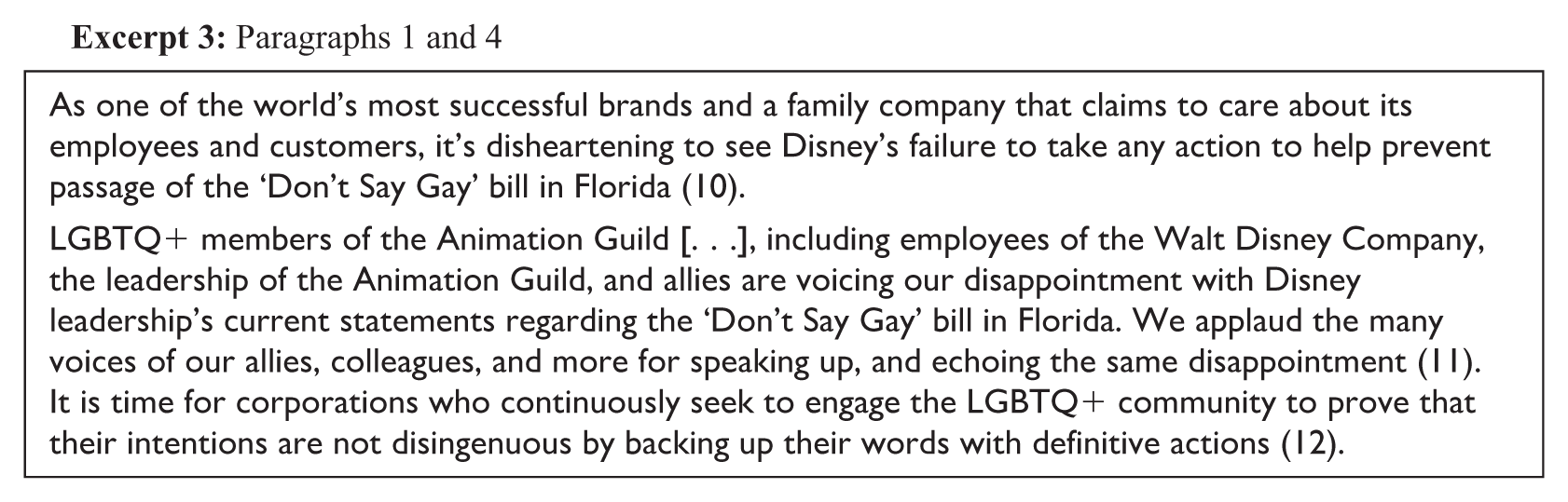
In conventional ventriloquial theory, authority operates through additive logic. The notion of metaventriloquism reveals a more complex dynamic, which includes the resignification of available signs. Excerpt 3 applies this logic by appropriating the voices (11) and silences (10) of other agents.
Excerpt 4, signed by two conservative family associations (Family Policy Alliance [FPA], 2022), illustrates that Disney’s new explicit commitment (expressed in Chapek’s second message) did not close the controversy over corporate silence. Specifically, this text reinterprets Disney’s initial silence as a sign of respect toward families (13) and political neutrality (17). Additionally, it criticizes Disney’s opposition to the law (14), interpreting this shift as a sign of manipulation by left-leaning employees (15). Employing an accumulation strategy, this text invokes the co-founders of the company (Walt Disney and Roy Disney) as authoritative voices to criticize its policy change (16). The text thus highlights the dissonance between Disney’s new position and the values that, from those associations’ perspective, should continue to animate the company.
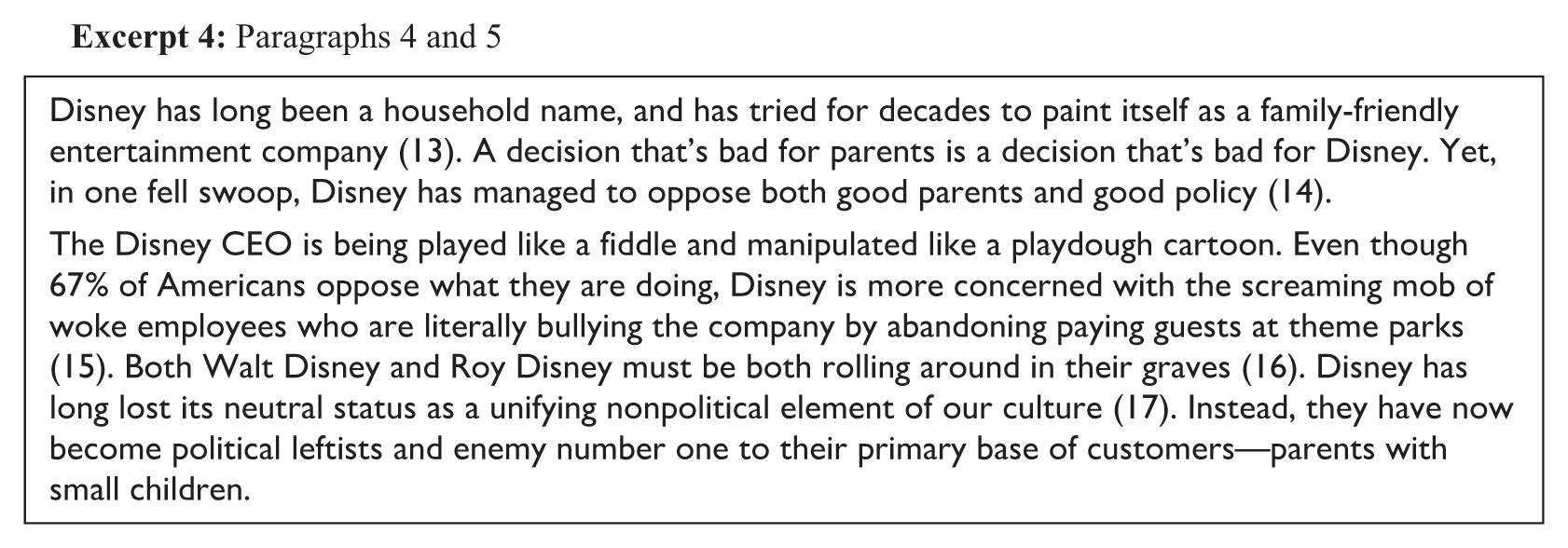
In summary, Disney’s silence operated as a malleable sign that many stakeholders resignified to construct divergent narratives about the company’s commitments. These narratives persisted and evolved even after Disney abandoned its silent stance, which confirms the limited control the company had over the meaning of its silence.
Attribute 2: Corporate silence as a constituted sign
In argumentative polylogues, each text expresses the constitutive operations of an observer who selects a segment of reality, attributes it to an agent, and assigns it a meaning. In the Disney case, each text reviewed makes silence and its referentiality emerge in a particular way. Excerpt 5—signed by business columnist M. Hiltzik and published in the Los Angeles Times the day after Chapek’s first message (Hiltzik, 2022)—illustrates well this constituted nature of corporate silence.
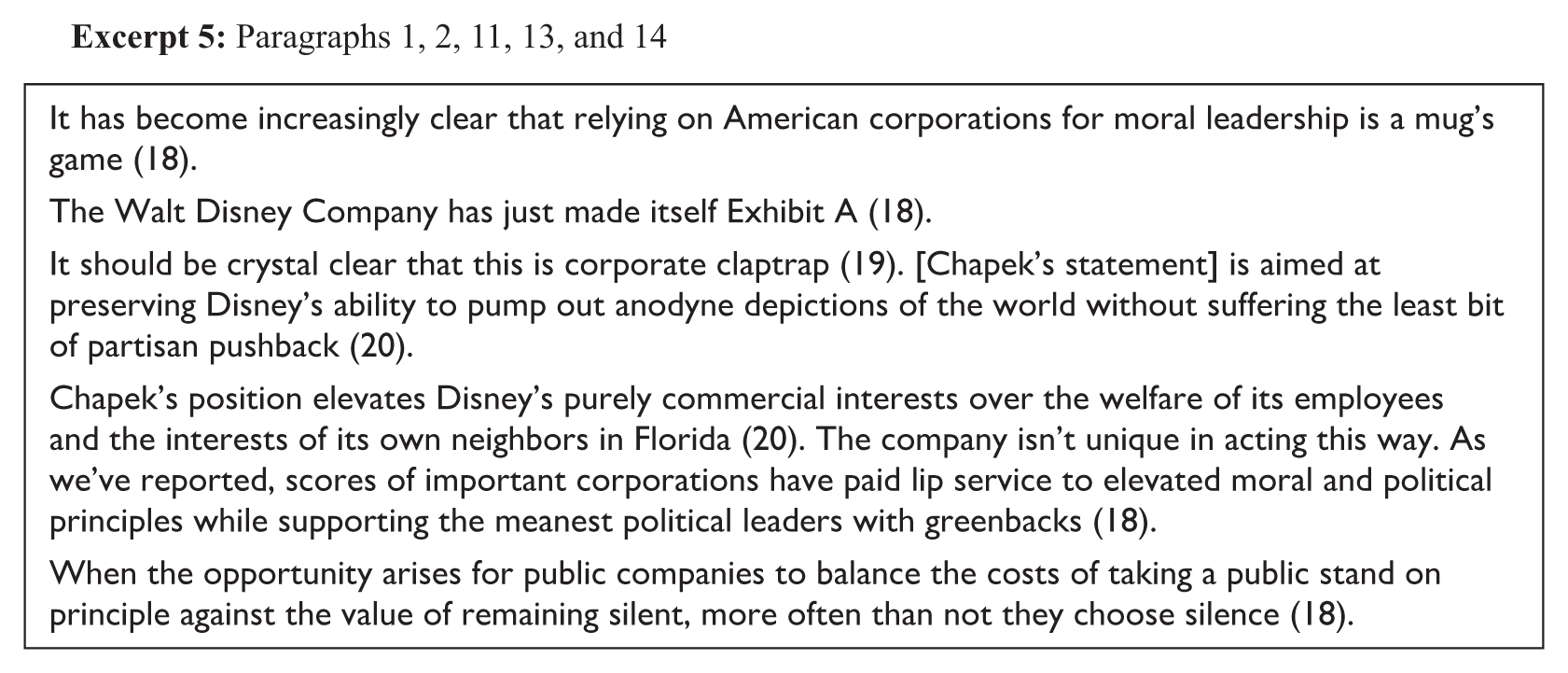
This text offers an alternative interpretation of Disney’s silence. Following the critical line of other texts (see Excerpts 1 and 3), Hiltzik resignifies Chapek’s words (19) to point to Disney’s commercial interests as the main reason for its silence (20). However, Hiltzik’s interpretative framework is broader than that of other actors, connecting Disney’s attitude with that of other American corporations (18). Within that relational framework, Disney’s silence operates not only as a sign of the company’s commercial priorities, but also—and primarily—as a sign of the commercial aims and cynicism of large American corporations. In summary, Hiltzik interprets Disney’s silence differently from other agents, attributing that silent and cynical attitude to a wide range of companies to materialize their commercial interests.
Attribute 3: Corporate silence as a catalyst for organizational change
A company’s commitment does not depend entirely on its senior management. On the contrary, explicit commitments emerge as a result of an open dynamic, where multiple agents attempt to impose their interpretations and expectations (Christensen et al., 2013, 2021; Winkler et al., 2020). This dynamic, widely documented in corporate discourse by the performative approach to CSR, is applicable to silence. In Disney’s case, its silence did not protect the company from criticism and pressure. On the contrary, that silence operated as a sign that many agents took as a reference to construct their narratives and, ultimately, pressure the company. As a result of this dynamic, Disney changed its position regarding the law. Excerpt 6, signed by Chapek four days after the first message to employees, expressed this shift.
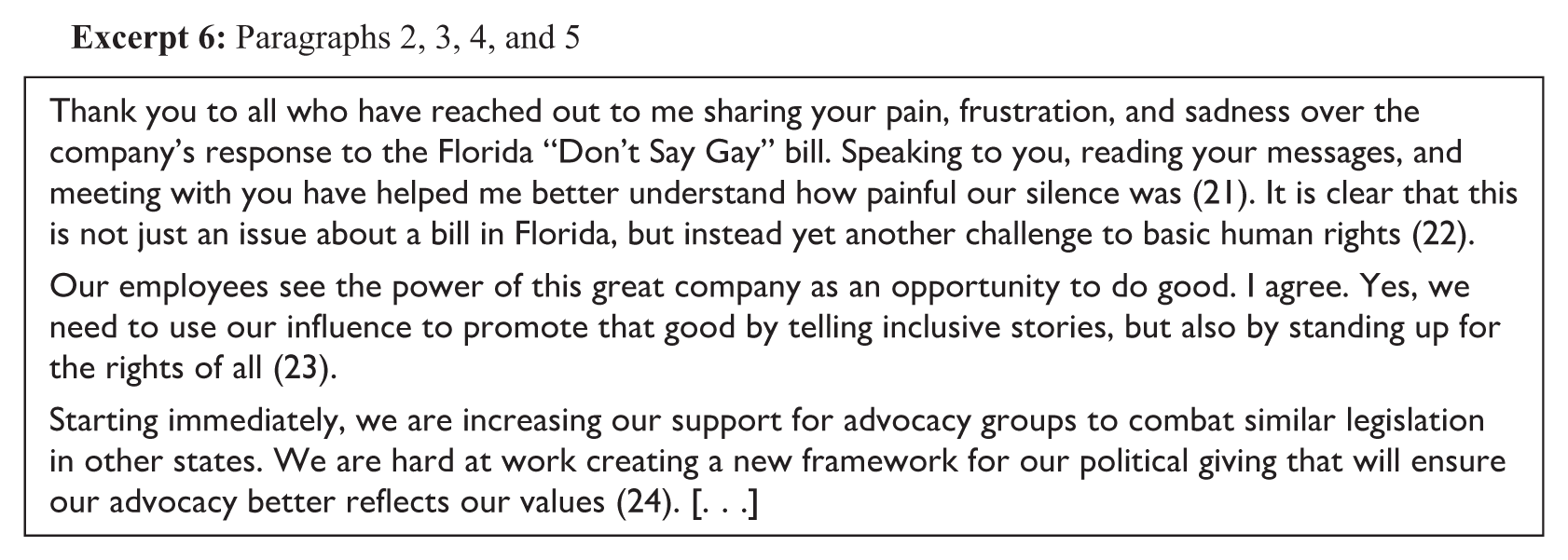
Excerpt 6 documents a substantial shift in Disney’s position regarding HB 1557. Specifically, Chapek speaks in the first person singular to express his regret over Disney’s silence (21). He then assumes the company’s voice to announce several measures aimed at combating similar laws in other states and reforming Disney’s model for political donations (24). To justify this shift, he employs a double strategy: (a) he invokes the pain that the law is causing many people (21) and (b) he resignifies HB 1557 in Florida as a “challenge to fundamental human rights” (22). This rhetorical combination justifies the new explicit corporate commitment: “standing up for the rights of all” (23). Consequently, Chapek presents the changes in Disney’s policies as evidence (or a sign) of the company’s renewed commitment to human rights (24). Thus, Excerpt 6 describes a dynamic in which Disney’s initial silence stimulated many agents to publicly express their discontent, pressuring the company to take a public stance on the issue.
Final Discussion
This paper characterizes corporate commissive silence as an absence of discourse that various agents attribute to a company, taking that absence as a sign to persuasively express their own opinions about the commitments that animate and/or should animate that company. This proposal is connected to two well-established approaches in CSR research. On the one hand, the performative approach—based on the notion of aspirational talk—emphasizes that corporate discourse commits, as other agents can pressure the company to align its actions with its words (Christensen et al., 2013, 2021; Lauriano et al., 2022; Winkler et al., 2020). On the other hand, the strategic silence literature highlights that companies often do not communicate about their commitments to evade stakeholder scrutiny (Carlos & Lewis, 2018; Font et al., 2017; Wang et al., 2021). Despite their differences, both approaches assume a common idea: When companies operate in polyphonic contexts, only corporate discourse commits and, consequently, corporate silence does not commit. This paper challenges this premise, arguing that corporate silence does not necessarily eliminate stakeholder scrutiny and can generate strong pressure toward the firm. The Disney case illustrates this fact: When the company remained silent about HB 1557, it did not avoid stakeholder scrutiny but rather amplified pressures by offering (whether deliberately or not) a communicative resource that many agents took as a sign to construct competitive narratives about what principles animated or should animate Disney. These narratives did not emerge from what Disney said, but rather from what other agents made its silence say through sophisticated metaventriloquial operations.
Corporate silence on commitment has remained unconceptualized in CSR research until now, despite its relevance in contemporary business contexts. Neither the aspirational discourse approach nor the strategic silence literature offers conceptual tools to explain it properly. This paper therefore contributes to CSR research by developing a concept to theorize this phenomenon and identifying three of its attributes. First, corporate silence on commitment operates as a radically malleable sign and an open space for controversy. Unlike aspirational discourse that links the range of plausible interpretations to one or more texts published by the company, corporate silence lacks any stable semantic anchor, allowing stakeholders with opposing perspectives to appropriate the same absence to construct different narratives, generating controversy dynamics more difficult to navigate for a company than those associated with explicit talk. Second, corporate silence on commitment is constituted as a sign through stakeholders’ interpretative practices. This constitutive function of the observer has not been recognized by either the strategic silence literature or the aspirational discourse approach. The strategic silence literature conceptualizes silence as a managerial decision that exists objectively before any agent interprets it (Carlos & Lewis, 2018; Font et al., 2017). The aspirational approach treats corporate discourse as a set of materially existing texts whose semantic content is relatively stable, regardless of how stakeholders interpret it (Christensen et al., 2021; Winkler et al., 2020). In contrast, my proposal argues that this type of silence does not pre-exist stakeholders’ interpretative operations, but emerges only when those agents execute the tasks of delimitation, attribution, and metaventriloquization. Third, corporate silence can operate as a catalyst for unanticipated organizational change. Due to its interpretative openness, this silence can generate multidirectional pressures that escape managerial control, as they do not arise from what the company said or could have said strategically, but from what multiple stakeholders make silence say by establishing connections that the company did not foresee and cannot control. These attributes reveal that corporate silence on commitment is not a subcategory of strategic silence, nor a mere absence of aspirational discourse, but a distinctive dynamic that requires specific tools for its description and analysis.
Additionally, the concept of CCS makes several relevant contributions to research on organizational communication. The CCO literature emphasizes that organizations and their attributes (identity, strategy, responsibility. . .) do not pre-exist communication, but rather emerge and evolve through communicative practices (Nathues et al., 2023; Schoeneborn & Girschik, 2021). Within this tradition, ventriloquial theory has developed analytical tools to explain how absent entities materialize in situated interactions (Cooren, 2010, 2012, 2015). However, most of the ventriloquial literature has focused on analyzing how human beings mobilize signs and non-present entities whose existence is unproblematic. The conceptualization of CCS therefore extends the ventriloquial program by demonstrating that an absence of verbal signs can be taken as a sign to materialize different interpretations of a company’s commitments.
This characterization of corporate silence on commitment has at least two ontological implications for ventriloquial thinking. First (and in relation to signs), my proposal argues that observers do not simply interpret pre-existing signs, but actively constitute them through operations of delimitation and attribution. While conventional ventriloquial theory focuses on how humans mobilize signs whose material existence is relatively unproblematic, such as notes, documents or objects (Cooren, 2010, p. 10, 2020b, p. 183; see also Costantini & Wolfe, 2022; Cooren & Sandler, 2014; Nathues et al., 2021, 2023, 2025), the semiotics I propose reveals that a sign emerges to existence when an observer delimits a fragment within the undifferentiated flow of their perceptions, attributes it to an agent, and ventriloquizes it to materialize a non-present entity. The constitutive function of the observer radicalizes the notions of “sign autonomy” and “semiotic betrayal” articulated by Cooren (2010, p. 31): If signs betray the intentions of those who mobilize them, it is because receivers (observers) must ventriloquize them from their own epistemic positions. This betrayal intensifies radically when the sign itself is constituted differently by each observer, as occurs in the case of argumentative polylogues. Crucially, this extension reveals that corporate silence is not a phenomenon that observers (including researchers) simply “discover,” “unveil,” or “register” (see critically Costantini & Wolfe, 2022; Nathues et al., 2021, 2023; Poroli & Cooren, 2024), but a sign that observers actively “constitute” through interpretative operations that select an absence within the unlimited range of potential silences, attribute it to a company, and literally make it speak to express their own opinions about what commits and/or should commit a firm. The Disney case illustrates well the constitutive multiplicity of signs. In that context, a wide range of agents (LGBTQ+ activists, professional and civic associations, among others) attributed an absence to Disney. Other agents, in contrast, attributed it to Bob Chapek or even to structural market logics. These divergent—and often compatible—interpretations reveal that silence did not pre-exist as a single, well-delimited sign, but rather emerged as multiple signs constituted in fundamentally different ways, according to the observers’ epistemic positions and persuasive intentions.
Second (and in relation to entities referred to through signs), this characterization of corporate silence on commitment reveals that the existence of materialized entities—and, with it, their authority—is a radically unstable, precarious, and contested attribute. In conventional ventriloquial theory, when various agents mobilize signs to materialize an absent entity, those agents may disagree about the attributes or implications of that entity, but share a certain agreement about its existence, as it is anchored in the material content of signs (Nathues et al., 2021, 2023; Poroli & Cooren, 2024). In contrast, when various stakeholders constitute silence as a sign, they may disagree about the limits and subject of that silence, but also—and fundamentally—about the entities materialized through that silence. From this perspective, silence can be metaventriloquized by various agents to materialize completely divergent and even mutually exclusive entities. In Disney’s case, its initial silence about HB 1557 simultaneously materialized an attitude of appropriate neutrality (for conservative associations), complicity with discrimination policies (for LGBTQ+ activists), and structural corporate cynicism (for some critical commentators). These referred entities were not simply divergent interpretations of “one” corporate commitment, but ontologically different entities (or commitments) that coexisted precariously in the polylogue, and could be subverted through metaventriloquial operations.
Recently, some ventriloquial researchers have developed a similar awareness of the constitutive function played by the observer. Wilhoit and Kisselburgh (2019), in their study of bicycle commuters, argue that these agents’ resistance to conventional transportation practices does not pre-exist as an objective phenomenon that they, as researchers, discover, but rather emerges when they identify and ventriloquize certain practices to express a collective yet uncoordinated opposition to dominant patterns (p. 888). Nathues et al. (2024), in developing a methodological framework for ventriloquial analysis, extend this argument by recognizing that, “as researchers, we are not uninvolved bystanders, watching streams of our own and others’ work, data, thoughts, ideas, and so forth flow by. On the contrary, we stand right in the middle of these streams” (p. 466). According to this view, ventriloquial analysts do not merely discover pre-existing entities, but actively participate in their constitution. This shift from representational relations toward constitutive relations has profound implications for how we conceptualize research and the phenomena studied. The concept of CCS is located within this epistemological transition: just as Wilhoit and Kisselburgh showed that urban cycling becomes a practice of resistance when it is constituted as such by researchers, and just as Nathues et al. explained that organizational phenomena emerge through the interpretative operations of those analyzing them, corporate silence emerges as a sign when stakeholders execute the constitutive tasks of delimiting an absence, attributing it to an agent, and making it speak. This constitutive perspective challenges the representationalist premise that underpins both the strategic silence literature and the aspirational discourse approach.
This paper has several limitations that open promising lines for future research. First, the utility of the concept of CCS is illustrated with a single case, situated in a specific cultural context (the United States) and in a particular industry (entertainment). Future research could examine how corporate silence on commitment operates in different industrial and geographic contexts, investigating the structural conditions under which corporate silence generates greater or lesser scrutiny and pressure toward companies. For example, it would be interesting to investigate whether publicly visible industries experience more intense resignification dynamics than less exposed ones, or whether organizational attributes (such as size, ownership structure or reputation) influence the ways in which stakeholders resignify corporate silence. Second, the concept of CCS describes silences that occur in high-visibility controversies with many agents involved. Future research could examine corporate silence in lower-profile controversies, with few agents involved or in internal organizational contexts. This research could help us understand whether the metaventriloquial dynamics of silence require the presence of a broad public debate or also emerge in more restricted spaces such as negotiations with specific stakeholders or internal communication spaces. Third, this paper argues that different stakeholders constitute corporate silence in different ways, but does not examine the organizational consequences of this multiplicity. Future research could explore under what conditions corporate silence on commitment generates sufficient pressure to force companies to break their silence, or what factors determine whether a company can remain silent without relevant damage to its reputation. Fourth, this paper focuses on the metaventriloquial operations practiced by stakeholders. Complementing this perspective, future research could examine the specific strategies that firms implement to manage the polysemy of silence, including ambiguous communication, selective signaling, or metacommunication about the reasons for their silence. It would also be useful to investigate the metaventriloquial strategies applied by stakeholders to make their narratives about silence more persuasive and effective. Fifth, the ventriloquial semiotics constructed explains how silence is resignified, but does not address the power dynamics that determine which stakeholders have greater capacity to impose their interpretations as dominant or legitimate. Future research could integrate perspectives on power and discursive hegemony to examine how certain stakeholders manage to make their interpretations of silence prevail over others in the public space. Finally, this paper invites researchers to explore the similarities and differences between corporate silence and other forms of ambiguous or evasive corporate communication, such as greenwashing, vague statements, or contradictory communication toward different audiences. These comparisons would enrich our general knowledge of how companies manage—or fail to manage—the inherent malleability of communication in contexts of multiple stakeholders with divergent agendas. These lines of research would help us develop a more nuanced understanding of corporate silence on commitment as a phenomenon of growing relevance in contemporary capitalism.
Footnotes
Acknowledgements
The author is grateful to Dennis Jancsary, senior editor at Organization Studies, and three anonymous reviewers for their feedback and patience throughout multiple rounds of review. Their rigorous critique and thoughtful guidance were essential to transforming an initial intuition about the communicative force of corporate silence into a well-defined contribution.

Funding
The author received no financial support for the research, authorship, and/or publication of this article.
Declaration of Conflicting Interests
The author declared no potential conflicts of interest with respect to the research, authorship, and/or publication of this article.