




Abstract
This special issue introduction explores dialogic organizing centred on affirming public engagement for hope and solidarity. We propose ways of retheorizing and revitalizing dialogic perspectives and practices. In so doing we take our cue from a Bakhtinian understanding of dialogue; however, we suggest that it is necessary to move beyond this foundational understanding. Instead, it needs to be read in conjunction and connection with scholarship on dialogue that highlights its complexity as affective and embodied processes. After sketching how theorizing the dialogic has evolved, we set out three innovations and contributions: (1) the reconceptualization of dialogic organizing in its affective, material and embodied dimensions, which implies (2) a necessary alternative consideration of dialogic practices and relations beyond the human, and (3) how this can be realized through a turn to an affirmative politics of dialogic organizing. In keeping with this dialogic spirit, we conclude by offering an opening for continued dialogue as a community of organization studies scholars, resisting the urge to arrive at the neat certainty of conclusion, and rather colluding with the reader to end on a note of openness and anticipation.
Keywords
Waiting, Still Waiting for Dialogue
Dialogue, which we tentatively and generically propose to frame as a form of multi-voiced exchange and expression based on avoiding monologization (Bakhtin, 1981), is something we can wish for and hope for but not order by command. Dialogic practice often involves periods of waiting, and, equally, moments of silence, hesitation, listening and patience. This special issue on ‘Dialogic organizing’ evolved from the 16th Organization Studies Summer Workshop that took place in May 2022, postponed from 2021 due to the Covid-19 pandemic. In hindsight we were relieved to wait a year, as it reignited our imagination for re-launching and practising the dialogic beyond the confines of a virtual Zoom meeting, which collectively as a community we were not fully familiar with. Over time, however, we learned that virtual settings can form an incisive intervention that has much to offer for rethinking and applying the concept of dialogue (Pallesen, Resch & Hoyer, 2025), and engaging with transformative social change more broadly (Vachhani, 2024).
It is in this paradoxical situation that the special issue aims to intervene by examining conceptually, empirically and politically ‘the imperative and impossibilities’ (Czarniawska, 1999) of dialogue, as the world increasingly undermines the conditions for organizing dialogue or rejects its possibilities altogether. Already, in the original call for papers for the workshop (Hjorth et al., 2022), written before the outbreak of the pandemic, we acknowledged the gathering dark clouds of depression and despair manifested in rising divisive populist discourse and discriminatory speech, which seemed to make impossible any kind of dialogic collaboration to tackle the urgent problems of our times. The Covid-19 crisis provided an additional example that acutely coloured the affects and atmospheres of our times, as everyone in the world was immersed in it day and night. On the other hand, responses to the pandemic strongly underlined what we already had suggested in our original call (and which is more important than ever in the current socio-political climate), namely, that becoming active is needed.
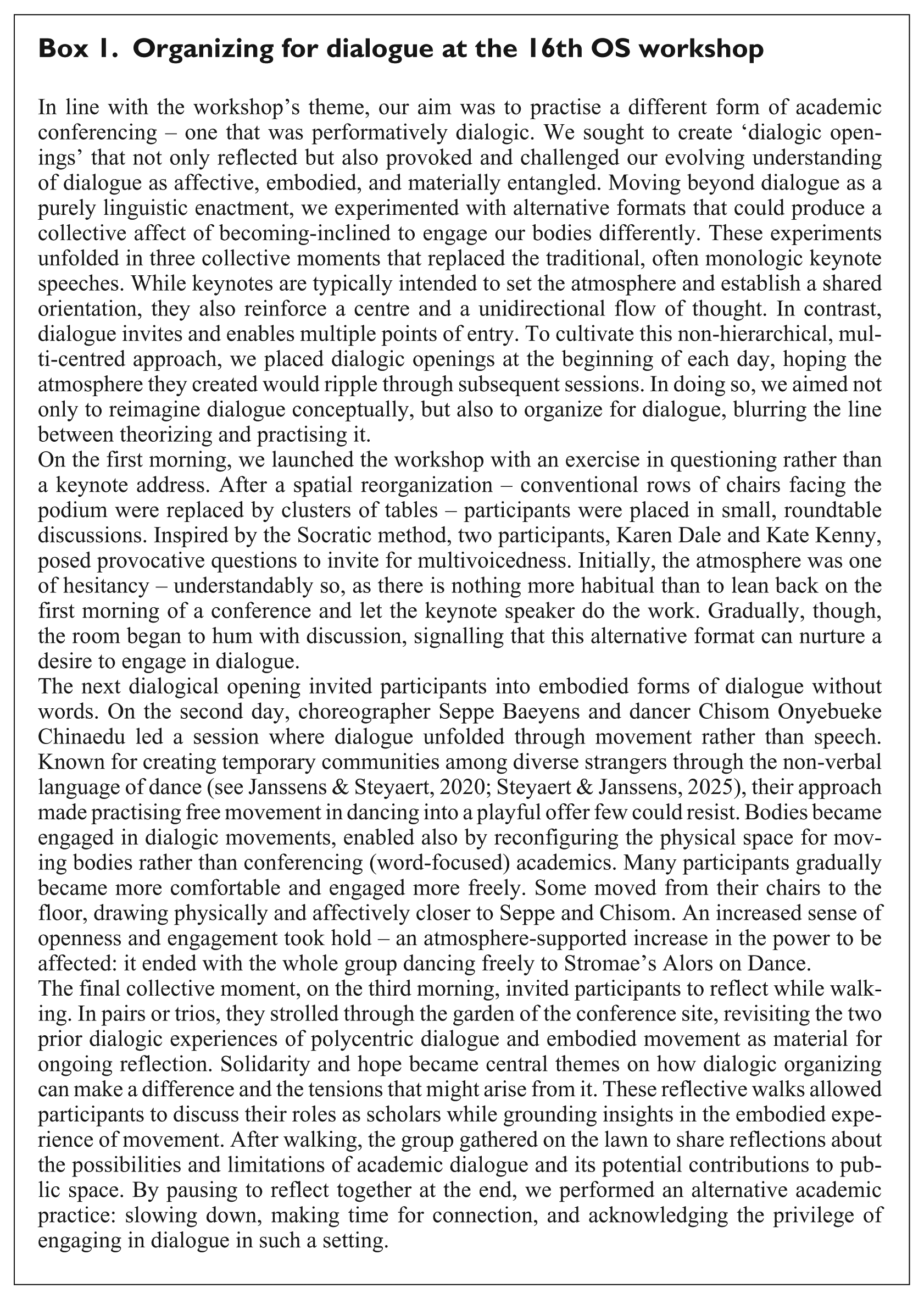
Postponement, anticipation and waiting describe features of both the workshop and the resulting special issue. The workshop – which we planned as an attempt at dialogic intervention (see Box 1) – presented a live and very alive event after a long period of waiting and staying closed in. At the evening reception preceding the workshop, participants shared how this was the first travel they had undertaken after more than two years of lockdowns and isolation; it all felt very ambiguous (Paasonen, 2023) to, on the one hand, feel joy in encountering colleagues in this embodied way where we felt changed in numerous and diverse ways, but, on the other hand, perhaps being more vulnerable, fragile and somehow relieved. All five papers of this special issue echo these feelings, goosebump moments and intense affects, whether expressed in encounters between homeless people and volunteers (Cortambert & Dale, 2025), showing solidarity in paying for coffee or other goods for a stranger (D’Antone, Geiger & Fuschillo, 2025), experiencing the ambivalence of attuning to and caring for a public sauna (Wickström, Kangas-Müller, Lafaire & Soini, 2025), feeling discomfort and vulnerability during an online workshop on ‘entangled bodies’ (Pallesen et al., 2025), or reflecting back on the rage and outrage that fueled the Occupy movement (Pullen & Rhodes, 2025).
Organizing for dialogue at the 16th OS workshop
Even as our feelings of gratitude and relief enlivened the conditions for a dialogic event, they were equally, if not more, overshadowed by the war in Ukraine that had broken out a few months prior to the workshop and which imbued us with intense feelings and ambivalent affect (Steyaert, 2025). In hindsight, this war seemed foreboding of a world where dialogue has almost been erased from the political menu: the war in Ukraine not only endures but other military conflicts (such as in the Middle East and North Africa) and civil wars (such as in Myanmar and Sudan) have broken out or reignited. These grim situations exist alongside and in conjunction with even more political populism, trade wars and the usual behind-the-scenes forms of diplomacy based on authoritarian leadership that endanger democratic and dialogic practices of pursuing conflict-handling and peace-making. Therefore, the affective horizon has further expanded and intensified, calling for new levels of solidarity and other affective signs of a democratic politics of difference (Pallesen et al., 2025; Vachhani, 2020), as the streets become ‘occupied’ with citizens assembling in countries such as Serbia and Turkey to protest political corruption (Pullen & Rhodes, 2025; Tyler, 2019). At the same time, many other problematic contexts that move us emotionally demand societal change and action, from intransigent social problems such as poverty (Cortambert & Dale, 2025) and other forms of urban degeneration (Wickström et al., 2025) to apocalyptic scenes of environmental and social destruction, such as wildfires in North and South America and Southern Europe, and earthquakes in Myanmar, Vietnam and Thailand. These have been followed, often in selective ways, by an outpouring of generosity and solidarity for victims and displaced families (Baumard, 2025). Thus, practising dialogue is often initiated by affective impulses to injustice and its aim for change thrives on and resonates with these affects, such as vulnerability, hope or solidarity, to which all five papers in the special issue subscribe.
Finally, instigated by such affective impulses, dialogic organizing is always specifically located and contextualized from where it aims to change a certain situation. Even when not staying within its original context, dialogic organizing aims to become affirmative so that other possibilities can emerge elsewhere. This is what we call for as an affirmative politics (Braidotti, 2019), one that keeps its attraction and potential, especially in the context of the paradoxical and ambivalent affective times we have sketched. Therefore, the special issue in various forms takes up an affirmative politics of organizing dialogue, whether in terms of hopeful organizing (D’Antone et al., 2025), alternative organizing (Wickström et al., 2025) or socially just organizing (Pullen & Rhodes, 2025).
In what follows, we first zoom in on the question of how dialogue can be theorized differently, taking as our point of reference the themed section on Bakhtinian polyphony in Organization Studies from 2008 (Belova, King & Śliwa, 2008). We suggest that Bakhtin’s thinking on dialogue is no longer a foundational element but one that needs to be read in conjunction and connection with other scholars of dialogue, highlighting its further complexity and embodied processes. After sketching how theorizing the dialogic has evolved, we set out three innovations and contributions of this special issue: namely (1) the reconceptualization of dialogic organizing in its affective, material and embodied dimensions, which implies (2) an alternative consideration of dialogic practices and relations is necessary, and (3) this is realized through a turn to an affirmative politics of dialogic organizing. In keeping with the dialogic spirit, we end on a playful, open note with a con-luding (con ludere, for the playful) rather than a concluding (for closing) section. Readers interested in how we designed the workshop to form a thought-provoking and practical experiment at dialogic organizing might first consult Box 1.
The Need to Retheorize Dialogue
Bakhtin’s (1981, 1984) dialogic view on language made its entry into management and organization studies through its influential inscription in social constructionism that emerged as a meta-theoretical, conversational turn in the 1990s (Gergen, 1999; Shotter; 1993a, 1993b), and that, rapidly, became translated into a social constructionist view of organization (Hosking & McNamee, 2006) and of organization science itself (Gergen & Tatchenkery, 2004). It is thus not surprising that Bakhtin’s dialogic view – often called ‘dialogism’ (Holquist, 2002) – even if it originated from the literary-critical analysis of novels – became so broadly adopted. For one, dialogism seemed to align easily with the linguistic turn that in that period materialized as one of the most influential theoretical frameworks in Organization Studies (Iedema, Degeling, Braithwaite & White, 2004; Shotter, 2008). Furthermore, the vocabulary of Bakhtin’s thinking was not limited to analysing dialogue and language, but also aimed at engaging with social experiences and lived worlds, and addressing and theorizing carnival and culture in new ways (Cunliffe, Helin & Luhman, 2017). As a consequence, a wide variety of themes and areas within management and organization studies – often drawing upon ‘isolated’ notions from this rich vocabulary – were analysed such as change agency (Jabri, 2010), start-up entrepreneuring (Steyaert, 2004), family business succession (Helin & Jabri, 2016), knowing and learning (Cunliffe, 2008), new knowledge creation (Tsoukas, 2009), the managerial role of health professionals (Iedema et al., 2004), diversity training (Swan, 2009) and strategy-making (Vaara & Rantakari, 2024).
The notion of polyphony that Bakhtin had generated from analysing the novels by Dostoevsky to point out how a ‘multiplicity of independent and unmerged voices and consciousnesses’ (Bakhtin, 1984, p. 208) formed a polyphonically based structure of these novels, and captured the imagination to think of organization and organizing as a polyphonic interplay of voices, views and perspectives (Cunliffe et al., 2017; Hazen, 1993). Polyphony or multivoicedness (Janssens & Steyaert, 2001) not only refers to an ontological condition but is often drawn upon in a metaphorical sense. For instance, Bouwen and Steyaert (1999) referred to the musical version of ‘polyphony’, a musical repertoire that had its momentum between the 13th and 16th centuries (Bouwen & Steyaert, 1999), and was sung during the opening session of the conference entitled ‘Organizing in a multi-voiced world’ in 1997 in Leuven to illustrate how each voice can be independent and singular, yet interwoven and interdependent, resonant and contrapuntal (Steyaert & Van Looy, 2010). In her later published conference keynote, Barbara Czarniawska (1999) recalls the story of the tower of Babel to refer to the many languages that are at play in organizations, whether in the form of polyglossia (national languages or dialects) or heteroglossia (social languages, jargon or slang), which risks being drowned out in search of an universal language, a language Barbara ironically called ‘managerialese’ (p. 108) in the context of organizations.
In a similar vein, Kornberger, Clegg and Carter (2006) also refer to the metaphor of the tower of Babel to rethink how to understand the polyphonic organization: polyphony is the ‘normal’ state of organization because as one voice aims to become dominant, other counter-voices will appear to resist through which disorder is constantly (re)produced and the tower (or the idea of a consensual organization) will eventually implode and the language of ‘managerialese’ will be countered with other organizational languages. Therefore, a polyphonic analysis should zoom in on the constant tension between centripetal and centrifugal forces that collide linguistically. It is important to avoid understanding polyphony ‘as a simple unthreatening celebration of diversity’ by setting up the interconnection between different languages or voices within one single regime or episteme, and, therefore, flattening their differences (Letiche, 2010, p. 272).
Illustrative of this interest and significance of the notion of polyphony is the themed section in Organization Studies (Belova et al., 2008, p. 494) that distinguished between two related streams, namely the use of polyphony as a tool to analyse organizational practice as ‘a multi-centred, non-linear, and intersubjective activity’ and the use of polyphony as a textual strategy to ‘question modes of authorship and representation in the context of research writing’. As a tool to analyse organizational practice, polyphonic analysis understands organizations as ‘discursive spaces which are shaped by a multiplicity of voices, dominant and peripheral, which together make up a contested and ever-changing arena of human action’ (Belova et al., 2008, p. 495). Notwithstanding this emphasis on contestation, conflict and tensions, the idea of polyphony is often taken as a normative ideal that not only underplays centripetal and monological tendencies (Izak, Case & Ybema, 2022) but also reifies voices with rather fixed identities (Belova, 2010) instead of evoking a form of open and free truth-speaking that is provocative and questioning of organizational truths (Sullivan & McCarthy, 2008).
Therefore, to undertake a multi-voiced analysis, the idea of polyphony is often importantly interwoven with the notion of carnival (Ramsey, 2008; Sullivan & McCarthy, 2008). For instance, Caroline Ramsey (2008), in an attempt to nurture a polyphonic classroom, developed a provocative pedagogy that understands learning as a performance of becoming which interrupts the power relationship between tutor and learner. A polyphonic classroom can only become carnivalesque when participants learn to adopt new roles and perform new practices. Learning is therefore ‘an embodied, improvised performance where roles [are] adopted and co-created in interplay between participants’ (Ramsey, 2008, p. 545). In recent years, the legacy of Bakhtin’s thinking has been strongly instigated by the communicative constitution of organizations school, that not only focuses further on polyphony – for instance in understanding diversity (Trittin & Schoeneborn, 2017) but also in proposing ventriloquial analyses (Cooren, 2020; Cooren & Sandler, 2014; Nathues, van Vuuren & Cooren, 2020). Acknowledging the polyphony of organizing, the notion of ventriloquism describes how people talk and write the organization into existence as they give voice to – and thus ‘ventriloquize’ – other beings such as policies, administrative rules, missions, news and so on, thus implying that many voices are involved when someone says or does something.
However, the possibilities of such polyphonic, ventriloquial and, more generally, dialogic analysis of organizing are intrinsically related to the impossibilities of the organizational analyst to study, represent and write about the heteroglossic nature of organizations. Barbara Czarniawska (1999, p. 96) was particularly skeptical as she saw the work of organizational analysis as one of translation between field and text, where researchers are obvious in their attempts to write and publish a coherent story, quickly creating centripetal effects unable to ‘speak for the practitioners’, let alone giving voice to non-humans (Wickström et al., 2025) or the dispossessed (Letiche, 2010). Thus, the ‘other’ legacy of Bakhtin’s thinking was the reflection on how to write and publish in multi-voiced forms of narrating and how to communicate our work creatively in the public arena (Steyaert & Hjorth, 2002). Czarniawska points out how the view of organizational researchers goes back to anthropology and scholars such as Stephen Tyler (1986) and George Marcus (1992) who referred to Bakhtin’s work on dialogue and polyphony to reconsider and problematize the role of anthropologists as authors (Geertz, 1988). Over the years, the possibilities and impossibilities of representing the voices of others have been critically discussed and deepened by feminist, decolonial and queer perspectives, often drawing on a relational ontology (Janssens & Steyaert, 2025) or, specifically, a polyphonic relational epistemology (Sidorkin, 2025). Consequently, there has been an unforeseen urge for and surge of rethinking how we tell stories and represent organizational lives by reconsidering our own roles as researchers in relation to human and more-than-human others (Barad, 2003; Latour, 2005; St. Pierre, 2020).
Therefore, to retheorize dialogue for this special issue, Bakhtin’s thinking is no longer used as our main conceptual inspiration for theoretical development, and the separation between analysing and writing can no longer be maintained. While we value the ways in which selective Bakhtinian concepts have been creatively adapted and experimented with in numerous contexts of organizing, in this introduction we do not aim to relaunch or reconfigure Bakhtinian concepts but to see how they can co-constitute approaches to dialogic organizing that enable expanding the theorical horizon of dialogic organizing and its more-than-representational evocation (Beyes & Steyaert, 2012). Instead, Bakhtin’s work is itself in dialogue with other philosophical thinkers, such as Emmanuel Levinas (Cortambert & Dale, 2025), Judith Butler (Pullen & Rhodes, 2025), Jean-Luc Nancy and Rosalyn Diprose (Pallesen et al., 2025), and also passes the baton to new thinkers and philosophers who theorize the process of dialogic organizing differently, such as Anna Tsing and Hartmut Rosa (D’Antone et al., 2025) and Maria Puig de la Bellacasa (Wickström et al., 2025).
Dialogue as Affectively, Bodily and Materially Enacted
Given these different theoretical connections and inspirations, our introduction focuses attention on how to retheorize dialogue beyond verbal utterances or textual practice, and how this path offers new perspectives and dispositions through different forms and practices the dialogic might take. In this frame, dialogue can therefore be understood as an open-ended relational intra-action assembled by a desire to belong, where navigating mutual recognition and difference is key. When this difference is dialogic, it has emerged from within the ‘free movement’ or play that the relationship(s) enabled and practised. This allows us to turn attention towards how it is enacted through multiple forms of affective, embodied and material engagement and how dialogic practices can change to create new ethico-political spaces. As developments in affective organization show us, Affect holds the promise of destabilizing and unsettling us, as organizational subjects, into new states of being. . . The critical theorization of affect is concerned with what occurs when bodies encounter each other; affect is what hits us when we walk into a room and inexplicably sense an atmosphere (Brennan, 2004). It is what is evoked by bodily experiences as they pass from person to person, in a way that is contagious but remains unspoken. (Fotaki, Kenny & Vachhani, 2017, pp. 3–4)
Discomfort, vulnerabilities, atmospheres and ephemeral flows of feeling typify dialogic organizing, aspects that are often neglected or silenced but nonetheless find ways to (re-)surface.
These intricate relationships between the symbolic, material and bodily require us, as researchers, to develop sensitivities and attunement to new or different ways of knowing (Fotaki, Metcalfe & Harding, 2014; Steyaert & Janssens, 2025). Some of these perspectives have become more established in organization studies over recent years, such as the turn to valuing embodied and affective modes of knowledge. Experimenting leans into a sense of bodily discomfort and vulnerability and the need to face our fears or identities which become out of place when asked to engage in different activities or actions than we are used to. This can be hard, not always pleasant work, as illustrated by Pallesen et al. (2025) who show the tensions and messiness of resonant listening. These are openings and ambivalences we need to keep alive, and they offer potential for new modes of learning that, despite pressures to do so, should not be closed down.
In so saying, dialogue can take us into the unknown (or at least the lesser known) that is affectively and materially marked. By this, we mean that deeply embodied dialogic encounters can take us into unfamiliar territory where we make sense of new differences and ethical, embodied relations (Pullen & Rhodes, 2015; Vachhani & Pullen, 2019). For example, we are collectively attuned to particular interactions and dialogue at academic conferences. We tend to reproduce habitual ways of behaving and acting in these collective settings. However, experimenting with these spaces is when this habitual attunement is tested and where we engage with different modes of comfort and discomfort. More broadly, what comes with dialogic experimentation and the affective responses it creates might prompt us to leave the space or cause flows of disquiet, unease or other negative affects.
This is especially evident when we seek new resonance with which to understand matter and its capacities. By exploring a posthuman approach to care and vibrant matter, Wickström et al. (2025) unfold the interdependent relations and force of materiality through the ‘calls’ and ‘responses’ between bodies, affects and artifacts. Turning to embodiment and materiality addresses two key concerns of the special issue: first, it marks how we seek to understand aspects of dialogic organizing that are not symbolized (only) in spoken and written language, or in conscious or explicit forms of dialogue. For Bakhtin, this is expressed as the battleground for meaning in language and discourse between monoglossic and heteroglossic forces. However, as we affirm, the dialogic is also enacted in ways not necessarily symbolized in the visible, observable or conscious aspects of organization. Second, a turn to affective and embodied dialogue shows us how the body provides a way of exploring embodied relationships between researcher and researched, including the assumptions that underpin the study of these relations. Post-qualitative and posthumanist methodologies put this into practice to question what is permissible as acceptable knowledge and to critique the various disembodied ways of engaging the empirical world (St. Pierre, 2020; St. Pierre, Jackson & Mazzei, 2016). The bodily and material aspects of dialogue thus help us to further theorize methodological assumptions and representation of different forms of knowledge, our writing and how best we can put gendered, racialized and queer difference into practice. What we might continue to learn more from is how we affirm dialogic organizing in the very ways we engage with our research and to suspend romanticization when theorizing embodiment.
We are entangled through different modes of embodiment that are organizationally reproduced through oppression and discrimination (Dale & Latham, 2015; Tyler, 2019) and lead to various forms of vulnerability. Several papers in the special issue turn to the role of vulnerability to understand the productive, and sometimes contradictory, possibilities of dialogic relations. Mobilizing vulnerability in theory and practice is helpful to better understand the role of dialogic organizing, the opportunities and challenges that arise and the possibilities for enacting collective agency (see Cortambert & Dale, 2025; Pallesen et al., 2025; Pullen & Rhodes, 2025). The relationship between subjectivity, vulnerability and agency is highlighted by Butler, Gambetti and Sabsay (2016) who show how vulnerability is an irreducible dimension of human sociality and affective relation from which new forms of community can arise (Scheibmayr, 2024; Vachhani, 2024). As Butler’s (2016, p. 25) contribution highlights, Vulnerability is not a subjective disposition. Rather, it characterizes a relation to a field of objects, forces, and passions that impinge on or affect us in some way. As a way of being related to what is not me and not fully masterable, vulnerability is a kind of relationship that belongs to that ambiguous region in which receptivity and responsiveness are not clearly separable from one another, and not distinguished as separate moments in a sequence; indeed, where receptivity and responsiveness become the basis for mobilizing vulnerability rather than engaging in its destructive denial.
This constitutes an ontological condition where vulnerability is an effective mobilizing force, especially when bodies come into contact in face-to-face encounters (Cortambert & Dale, 2025; Pullen & Rhodes, 2025).
The role of listening is of particular interest when it comes to dialogic organizing. As Pallesen et al. (2025) demonstrate, listening as an embodied practice has received sparse attention and by turning attention to the potential of vulnerability as generative for listening, we can develop resonant listening. In addition, recognition of the situatedness of bodies and their differences is central to this endeavour and enables fertile ground for vulnerable embodied action in dialogic organizing (Diprose, 2012; Pullen & Rhodes, 2025). This becomes clearer when bodies are mobilized collectively, for example through the power of assembly when it serves a dialogic purpose that invoke radical politics and solidarity (D’Antone et al., 2025; Pullen & Rhodes, 2025). Together, these studies foreground the idea that ‘Vulnerability becomes a potentially effective mobilizing force . . . a demand for a certain kind of inhabitable ground, and its meaning and force arise precisely when the ground gives way’ (Butler, 2016, p. 14). Inherent in these demands are ways of doing and ways of relating to others as dialogic practices, which we will next consider in light of the contributions in the special issue.
Expanding Dialogic Practices and Relations
In expanding the meaning of dialogue beyond exchanges between human sense-makers grounded in linguistic processes, and considering embodiment and affect as discussed in the previous section, we can conceive of a dialogic approach as an orientation, with actors ‘relating themselves both to the others around them as well as to the rest of their surroundings’ (Shotter, 2010, p. 272). The move beyond a linguistic communicative model may be facilitated by changing the misleadingly static quality of the concept of ‘dialogue’ for notions such as dialogicity (Wickström et al., 2025), dialogism (Cortambert & Dale, 2025) and dialogizing (Pullen & Rhodes, 2025) to capture the extralinguistic, affective quality of dialogic encounters which may comprise human and more-than-human entities. To briefly return to Bakhtin, if ‘to live means to participate in dialogue’ (Bakhtin, 1884/1961, p. 293) then one might ask how those different forms of participation might be conceptualized in terms of practices and relations. The papers in this special issue point towards a number of ways in which to theorize and empirically examine how these practices become different relational responses (Cunliffe, 2008).
D’Antone et al. (2025) show a potential way in, as they bring Hartmut Rosa’s sociological writing on resonance into dialogue with Anna Tsing’s ecofeminist approach to relationality and co-becoming, to formulate ‘an affirmative non-binary conceptual basis for rethinking the growth/post-growth dichotomy’ (p. 1589). While Tsing (2015) offers a view of the ‘sticky’ relations surrounding growth, Rosa (2016) provides an approach for subsequent transformative organizing. The authors call the resulting notion resonant organizing. Following Rosa, D’Antone et al. (2025, p. 1593) frame resonance as ‘a mutually responsive interaction, which results in an unpredictable transformation of both the subject and the world’. Unpredictability and transformation point to a generative, open-ended process which does not strive for concordance but involves tensions and contradictions. The practice which encapsulates the resonant spirit is that of thriving, ‘a shape-shifting and patchy becoming enabled by situated entanglements and transformative relations’ (D’Antone et al., 2025, p. 1589)). Thriving is emergent, reconfigurative and entangled; anathema to scaling, linearity and growth.
Also turning to resonance, Pallesen et al. (2025) in their paper draw on Jean-Luc Nancy (2007) to view being as emerging through resonance. This emphasizes that there are no ready-made subjects that engage in interaction, but that they are instead constituted in and through interaction. The authors examine this openness and being-with through listening as an orientation towards the other and the world. Listening in this context is not active listening, which implies putting oneself in the position of the other, nor is it listening as arriving at consensus. Instead, it is a straining towards possible meaning which is not necessarily readily accessible but has to be coaxed into being. This process is characterized by discomfort and hesitation, and a refraining from rushing towards neat interpretation. Instead, it is a practice that demands a resistance to immediately homing in on consensus and a common ‘language’ so as not to run the risk of closing down alternative ways of being and organizing. Instead, we must be prepared to find ourselves ‘grasping for what is lingering at the edge of meaning’ (Pallesen et al., 2025, p. 1572).
Tellingly, these papers speak of entanglement and enmeshment, pointing to a knotty weave of relations. Such entanglements and enmeshments are not exclusively human, as Wickström et al. (2025) show in taking up a posthuman approach which centres on care. By engaging with Maria Puig de la Bellacasa’s (2017) feminist posthumanist approach to care, the authors examine the interdependencies of humans and more-than-humans in building a liveable world. Specifically, Wickström et al. frame an iterative practice of call-and-response where care is embedded in the response, which is premised on the ‘call’ of particular conditions, resulting in processes of maintenance, continuation and repair. Here, again, the dialogic relation is one of responsiveness, openness and emergence as humans and non-humans are inextricably twined in generative world-making.
The notion of care introduces an ethical dimension to dialogue, which is also explored by Pullen and Rhodes (2025) who conceive of an embodied connectedness to others as the site of an ethical endeavour. A ‘dialogizing’ of a corporeal approach to ethics draws into focus an open-endedness and multiplicity; a ‘mobilization of diverse bodies that are both unified and different, without trying to resolve that difference’ (Pullen & Rhodes, 2025, p. 1549)). This mobilization is conceptualized through Judith Butler’s notion of assembly as a form of organizing for recognition. As Butler (2015, p. 26) writes, ‘when bodies gather they are demanding to be recognized, to be valued, they are exercising a right to appear, to exercise freedom, and they are demanding a livable life’. These politics spill out into the streets and public spaces to make their demands seen and heard but as other contributions in this special issue show, we might also think of a ‘quiet politics – an unassuming praxis of engaging with others, in which new social relationships are built in/through everyday places’ (Askins, 2014, p. 354).
The dialogic, responsive and responsible ethical relation to an other is also explored by Cortambert and Dale (2025) through Levinas, with a focus on what is constituted in encounters between self and other, specifically the mutually affirmative in-between space where subjectivity is constituted. Recognition precludes the objectification of the other who, while ethically recognized as implicated in oneself, also remains distinct from oneself. This includes being open to the ‘stranger’ without resorting to (mis)recognizing the figure of the stranger as one with attendant connotations of danger or as being out of place (Ahmed, 2000).
The above examples of practices show various ways in which a dialogic approach helps conceptualize the forging and maintaining of a multiplicity of relations between actors of different kinds. Izak, Case and Ybema (2022, p. 1508) warn that by ‘evoking an essentially romanticized social landscape, the dialogic perspective inadvertently presumes that every act of organizing involves actors who are actively engaging in an interchange of ideas’. However, conceptualizing dialogic relations through resonance, listening, care and recognition also shows that not all subjects are ‘legible’ or heard, care resources are not evenly distributed and not all bodies are equal. We do not need to succumb to a ‘romanticized’ notion of dialogue as a form of ideal speech situation but can instead conceive of a political landscape that is marked by multiplicity, contestation and differential power relations. The dialogic can thus be understood as an ethico-political orientation that helps draw into focus different ways of relating, and articulating unequal distributions of resources in order to, as we said in our call for papers, re-imagine (re-think, re-write and re-embody) the possibilities of dialogically-affirmative organizing (Hjorth et al., 2022), and which we will now stipulate further as an affirmative politics of dialogic organizing.
An Affirmative Politics of Dialogic Organizing
It is precisely the relentless critique of the tendency of the political in organizational contexts to ossify into politics-for-management rather than the political-for-life that dialogic organizing addresses (Deleuze & Foucault, 1977). Dance as a generic and generative metaphor for keeping a movement that prevents such ossification is therefore central and becomes a form of the transformative experimentations with new arts of existence and ethical relations that Braidotti (2016, 2019) sees – with Deleuze and Foucault – as central to the political (see also Rancière, 2004). However, besides ossification, there is a second ‘Babel problem’ to tackle here: the question of dance is a question of moving away from representationalism to performativity. In this sense dance is not a metaphor for a linguistic practice of dialogical-political organizing. The heteroglossia that awaits a move away from Babel-tower dreams (see Czarniawska, 1999; Kornberger et al., 2006), is one where the materiality of the body matters as playing an active role in showing what a relational belongingness to the other – that dancing performs – does to opening us to an affirmative politics of organizing dialogically (Barad, 2003). By dancing, we offered a fragment of experiencing dialogic organizing at the workshop (see Box 1), and it showed us what is possible when the organizational politics of positions and roles are temporarily relaxed.
There is an economy of control that makes power as potestas (position and guarding positions) into an attractive option for those in positions which afford them the right to decide over people, resources and materials. In contrast, the economy of ‘prorol’ (pro + rotulus, to be for rolling/movement; Hjorth, 2012) is one that has to bet on power as potential, affirming its productive force in actualizations of the emergent, of incipient change. For this to happen, for the virtual – that which is ‘only’ sensed because it is not yet clear enough to be articulated in descriptions (Buchanan, 2021) – to become actual (that is, possible to think such that it can guide action) and then actualized (created), the force of the potential has itself to be affirmed (Deleuze, 2006). In organizations, this affirmation is often dependent on solidarity (Cortambert & Dale, 2025).
Therefore, dance provides a precise example of such a process: (1) incipient change, potential, or the virtual is first sensed, before it is thought, meaning the body is the ‘site’ where this affect is registered and starts to grasp us; (2) as powers to be affected, our bodies and minds are always in relationships of dominating and dominated, always in relationships to others – human, nonhuman, more-than-human – that are affected by us or that affect us, and it is through these relationships that our capacity increases or decreases; (3) these dynamics of power to be affected and powers to affect are performed in dance in the dialogical ‘to and fro’ of forces affecting bodies; and (4) it is this relation of forces and powers that form the primary condition for the ethical as my respons(e)-ability (Painter-Morland, 2006) to the other as we move in, for example, dance. Thinking with dance as metaphor for dialogical organizing, we can understand the Deleuzo-Foucauldian emphasis on the distinction between politics as centralized-majoritarian (molar) and the political as peripheral-minoritarian (molecular; Deleuze, 1988, 1997, 1998). The latter being an experimental-dynamic movement, affirmative of the political, and resulting in what Pullen and Rhodes (2025) refer to as a more radical politics, and that D’Antone et al. (2025) show is resonant with a hopeful and solidarity-centred organizing.
The point is that affirmation (i.e. becoming active) itself has to be affirmed (Deleuze, 2006). Concretely – if we can be solidaric, we have to make that capacity into an object of affirmation, Deleuze (2006) would say. This is a Nietzschean idea that Deleuze picks up and that dancing, again, allows us to understand: ‘To dance is to affirm becoming and the being of becoming’ (Deleuze, 2006, p. 170). Most of us know, have felt, the difference between being moved by music and adjusting to the other body on the dance floor, and moving with music and the other. The former is the result of having affirmed the capacity of bringing our body into a mode of movement called dance, whereas the latter is the additional affirmation of that first choice so as to also affect the other with our movements and experiment with what the music suggests is doable. The experimental-dynamic movement, affirmation of entry into movement, is described by Braidotti (2016) as nomadic, as a transformative form of becoming. An affirmative political practice of dialogic organizing is therefore bringing organizations into event-time or the time of relational affectivity. This is in tension with the institutionalized order that relies on chronological continuity and application of protocols, templates, roles and norms for interaction (the institutional). That time is the time of politics, which may change the balance of power (as potestas) but leaves the structure undisturbed (Pullen & Rhodes, 2025).
The organizational subject, as embodied matter, is often the result of these majoritarian forces and regulations (Wickström et al., 2025). Desire for movement, however, will always be a potential that produces its subject (of creation) when the event comes and when affirming or negating is still a possibility. The political, as result, requires and makes such centrifugal-minoritarian movement, and will thus upset or disrupt what has ossified into stable structures. It reveals bare life, zoē as material vitalism, and affirmation thereof will always be experimental in the sense that it cannot be fully pre-figured and operate according to a plan or follow a preset structure (Lüthy & Steyaert, 2019). It has to move with the other (Pallesen et al., 2025), sense what is possible (Cortambert & Dale, 2025), and affirm potential. This is thus where alternative forms of organizing might emerge (D’Antone et al., 2025). This is what organizational dialogism is about as one central idea of this special issue.
The condition in which we find the subject of organization (of work) is therefore an ethical one, where a relational potential to become various subjects makes us vulnerable to ‘strategic’-majoritarian forces offering positions of power at the cost of discursive and material control. Seldom have such forms of power been so bluntly demonstrated on media scenes of politics as they are currently unfolding and becoming visible. Affirming dialogic organizing – not just being OK with being moved by music but actually doing music through how your body becomes a dancing one with and through the other – means taking a risk (D’Antone et al., 2025; Pullen & Rhodes, 2025). Politics can strike back and insist on the centripetal, on paying homage to structure and what is already – monologically – organized (Hjorth & Reay, 2022). Affirming dialogic organizing, beyond language, however, is the start of the political and operates centrifugally, from the fringe, as a minorizing move that desires to know what might become the alternative. That desire, we propose, produces the dialogical subject of organizing. From provocation, dancing and walking, we can learn how bodies, space, affect and language matter for dialogue. This would suggest that we now have an experimental-empirical basis for developing a performative definition of dialogue as embodied, situated expression of a care for the other, reaching the other as an invitation to join a communicative act for which language as spoken is but one of the media.
We move on now to speculate, playfully and joyfully, about how dialogic organizing might be performed given what we have learnt from the workshop, the papers in this special issue and our thematized elaborations above. We think of this not as a closing of this opening, not a con-cludere, a conclusion, but as an opening toward play – a con-ludere, a conlusion. It is a joyful speculation, which in process philosophical terms equals a becoming-active, that is, an affirmation of what we have learnt so as to try this out as knowledge of dialogic organizing.
Con(c)luding
In order to avoid stumbling over performative contradiction, we sense that the dialogic style of reasoning we have sought to clarify as an approach and ethical relationality to organizing urges us to avoid concluding. The point of concluding is to shut, to close what we have done or said together, to move back into monologization. The organizational politics of dialogical change we have tried to renew through this special issue would suggest another act to be performed here rather than shutting or closing. Con-luding is still con- as in together, but ludere as in playing. You might think this is merely a play with words, the shifting of a few letters, and in this sense ‘merely playing’. This would indeed make us inattentive readers as we have tried to move beyond the language-centred conceptualization of dialogue, as our definition above shows. The workshop (see Box 1) experimented with trying to achieve this move beyond Bakhtin in the three organizational practices that were part of organizing for dialogue, as much as organizing dialogue: provocative questions initiating roundtable conversations, dancing, and walking.
Maybe what we do here as we con-lude is to extend this wonder we sensed at the workshop: that the experiment, the joyful speculation that affirming dialogic organizing can emerge from these practices – conversing, dancing, walking. Avoiding an opening keynote on dialogue and the dialogic, we rather sought to perform dialogic organizing beyond its definitional confinement to language (Barad, 2003), and to do so by exploring how bodies, matter, space and affect mattered in helping us experience dialogue as an organizational practice. The wonder belongs to the ‘eventness’ of the workshop and the way in which it shone or glowed for us (Bennett, 2010; MacLure, 2013) as an example of people joining dialogue. Referring to our experience of the wonder for the event, this can be described in Greenblatt’s (1990, p. 20) somewhat shining words: ‘By “wonder” I mean the power of the object displayed to stop the viewer in his [sic] tracks, to convey an arresting sense of uniqueness, to evoke an exalted attention.’ What stopped us in our tracks of knowing dialogue and gave us an exalted sense of attention? We will try to grasp this by proposing that dialogic organizing: (1) intensifies relationships (affective); (2) increases connectivity (i.e. opens up); (3) adds temporal multiplicity (wait, hurry, rhythm); (4) invites experimentation (learning to play); (5) requires and emerges from movement (the political); and (6) calls upon reflection as response to the other (the ethical).
Dialogue intensifies relationships as it cannot be completely controlled or planned or anticipated. It emerges in correspondence to its own movement or force of becoming and is therefore generating and generated by affect. This is also why dialogue is vulnerable as well as difficult to end. Organizing does not come naturally to dialogic becoming. Dialogic organizing can therefore be a challenge, as it easily gets foreclosed by plans or goals that reduce the dialogue to a target, preempting the process. In the opening section we suggested that dialogue sometimes requires waiting; a time, which is not always the time of organization.
Dialogue increases connectivity by requiring openness to the Other to ‘survive’. Processual momentum, the force behind dia- (across, between) in dialogue requires from us to remain open to the Other, and even the Other’s Other (the third) as Levinas (2003; see also Cortambert & Dale, 2025) would remind us. What does this mean? Openness means connective capacity and this can be further clarified as a trust in and responsibility for the Other. Dialogue trusts that the Other will extend a connective capacity to ‘me’ as ‘I’ venture into dialogue. If the Other initiates a dialogue, my connective capacity suggests that I have a responsibility towards the Other and that I need to care for the gift of openness extended to me. The simple ‘hello’ that is not met with a ‘hello’ in return is a micro case of failed dialogue which we have all experienced and had a bodily response to. A response intensifies and sets the co-creation in motion. Organization, as we know it, is not built to support this. Hierarchy, structures and domination are all examples of de-intensifications of dialogue. Intensifications do not equal agreement, as the practice of provocation that we used in the workshop illustrated.
Dialogue also adds temporal multiplicity in that waiting, hurrying and a sense of rhythm is required. Musical metaphors – as we have learnt from this special issue – apply here as they ‘pedagogically’ point to the importance of being sensitive to the intensity of the relationship, staying open to the Other, and thereby knowing when to wait, when to hurry and when to ‘do’ together following the same rhythm. This is difficult, as dancing teaches us. Because we often think that we already might know, or because we think we know more about the matter at hand, we simply do not wait. Indeed, the world of organizations suggests both division of labour and competitive advantages as principles for when not to wait for the Other. The pause is often the most intense or intensifying time in music, and organizing it is also a problematic time. At the same time, as an in-between time, it is in itself a time for the creative and the surprising, for the otherwise rather than habit, for the outside rather than the pale of routine.
This is why dialogic organizing has a lot to teach us about when and how to experiment. Dialogue invites experimentation, which often means to let go. A builder is not looking for room to play around but instead wants things to fit tightly, without play. As dancing showed us, however, there is no dance outside play. When Nietzsche says of ‘higher men’ that they cannot dance, laugh, and play, he is commenting on the lack of affirming life, chance and becoming (Deleuze, 2006, p. 170), which is simultaneously a critique of forms of domination and a programme for experimentation. Such time and place for experimentation is perhaps ‘professionalized’ in organizations today: incubators, accelerators, fablabs, maker-spaces and traditional R&D departments. We might think of them as heterotopias, other spaces, where the organization-to-come is emerging. We learnt from the workshop that an invitation to experiment is to be found also in the walk and in the pause, not only in the dance. The walk too intensifies the relationship, and increases connectivity. It forces us to find the rhythm with the other and can thus open paths to experimentation. While not a panacea, taking a walk more often as part of organizational life would likely prevent the need for taking a break from work by exhaustion.
That dialogue requires and emerges from movement means that it asks us to give up space. This is a political act, difficult to separate from the dialogic call upon reflection to know our knowledge through how the Other responds. Organizational scholars have emphasized ethics as a response-ability to/for the Other (Hofman, 2023; Pérezts, Russon & Painter, 2020). Learning to know our knowledge is Foucault’s description of critique as a work that ‘gives impetus, as far and wide as possible, to the undefined work of freedom’ (Foucault, 1997, p. 316). With the added sensibility before the performative power of assembling that the workshop also brought (Butler, 2015), and the vibrancy of bodies moving in space (Barad, 2003; Bennett, 2010), we need also to reflect upon the observation that not everyone embraced the invitation to experiment at the OS-workshop. Any invitation to become active in new ways can either be negated or affirmed. The experiment provoked a range of reactions, from enthusiasm to discomfort, reflecting the challenges inherent in disrupting entrenched academic norms and questioning the continuity of institutionalized places. Nevertheless, this experience reinforced our belief that theorizing and practising dialogic organizing offers a way for thinking beyond conventional boundaries of academic life, exploring new ways of learning, connecting and engaging with knowledge, especially when dialogue is more expansive than simply speaking. Our experiment, though imperfect, opened up new questions about how academic gatherings might evolve, and proposing what they – as alternatives – could become. Such becomings, we have speculated in this con-luding, might happen along the lines of dialogic intensification, increased connectivity, temporal multiplicity, experimenting, giving/creating space and responsible care to/for the Other. Let us not end it there.
Footnotes

Funding
The authors received no financial support for the research, authorship, and/or publication of this article.
Declaration of Conflicting Interests
The authors declared no potential conflicts of interest with respect to the research, authorship, and/or publication of this article.