



Abstract
Identified as the world’s biggest carbon polluter, the oil and gas industry has increasingly engaged in corporate environmentalism to bolster its legitimisation and mitigate negative public perceptions. Discourses surrounding corporate environmentalism frequently position the sector and its workforce as integral to advancing the greater good. However, employees within the oil and gas industry find themselves at the centre of a paradox: society increasingly expects their organisations to transition away from the fossil fuels that have, historically, sustained their profitability. This paper explores how oil and gas employees form themselves as subjects under their industry’s discourse and practices of corporate environmentalism, and examines what implications these processes may have for the future of corporate environmentalism. Based on an analysis of annual reports and CEO speeches from major oil companies and 30 interviews with employees working in the industry, we apply a Foucauldian lens to identify corporate discourses crafted by the industry, and deploy Foucault’s model of ethical self-formation – particularly, the notion of Telos – to explore the processes of subject formation that employees engage in, their influences, and implications for corporate environmentalism. We develop a conceptual model showing the societal and relational influences feeding into employees’ construction as subject, and the central role of their aspirational modes of being, their Telos. The diversity of these aspirational modes of being, and their dynamic and performative nature, bring to life a picture of environmental aspirations within the oil and gas industry much wider ranging than corporate discourses suggest, and create possibilities for alternative approaches to corporate environmentalism.
Introduction
Climate change, one of the grand societal challenges (George, Howard-Grenville, Joshi, & Tihanyi., 2016), has developed over the past decades from being a scientific subject to becoming a ubiquitous societal issue and a new world order within which organisations need to operate (Campbell, McHugh, & Dylan-Ennis, 2019). According to the Intergovernmental Panel on Climate Change, ‘there is a rapidly closing window of opportunity to secure a liveable and sustainable future for all’ (2023, p. 88), instilling a sense of urgency for all to act. Reacting to this growing call for radical change, the private sector gradually embedded this problematic in its strategies, seeking to control and counter threats to private corporations’ own commercial sustainability (Kaplan, 2024), thereby safeguarding their interests through engaging in practices of corporate environmentalism (Banerjee, Iyer, & Kashyap, 2003). Such practices became particularly significant in areas most responsible for greenhouse gas emissions, such as the oil and gas industry, where actions have been evidenced through which the industry maintained its power and influence in order to exercise control over the pace and nature of change (Ferns & Amaeshi, 2021; Ferns, Amaeshi, & Lambert, 2019; Wright & Nyberg, 2017; Wright, Nyberg, & Bowden, 2021).
Taking into account that organisations, as large systems, are in a constant dynamic of contending with the individual subjectivities of their members (Leclercq-Vandelannoitte, 2011), the position of oil and gas industry employees has started to attract some scholarly attention. This includes studies of how sustainability professionals in this sector navigate their own identities (Wright, Nyberg, & Grant, 2012), how employees’ moral values feed into their justification work (Demers & Gond, 2020), or how employees engage in small acts of internal activism (Skoglund & Böhm, 2020). While these provide valuable insights into employee behaviours in this context, our understanding of the process of subject formation within the industry and its implications for corporate environmentalism practices remains hitherto lacking. This paper seeks to contribute to this area of knowledge. Based on the analysis of climate change discourses within oil and gas major corporates’ annual reports and CEO speeches, and the perspectives and experiences of industry employees gained via 30 semi-structured interviews, this paper addresses the following core research question: How do employees form themselves as ethical subjects within an industry drawing controversy over its practices of corporate environmentalism?
Following calls to adopt a more critical, relational and engaged approach to sustainability in organisation studies (Ergene, Banerjee, & Hoffman, 2021), this paper seeks to give voice to employees at the heart of a potentially conflicting system, while critically evaluating the sector’s managerialist and centralised approach to corporate environmentalism. To support our inquiry into individual subject formation within strongly established structures of power, we found a relevant theoretical foundation in the work of Michel Foucault. This includes his work on discursive power (Foucault, 2007) applied to corporate environmentalism, as well as Foucault’s later work on ethical self-formation and Telos (Foucault, 1985, 1997). In the next sections, we position our study in the existing literature, developing our knowledge of subject formation under corporate environmentalism before envisaging how Foucault’s model of ethical self-formation and Telos can help to unearth new insights and advance our knowledge and practice.
Employees’ Subject Formation under Corporate Environmentalism
‘Corporate environmentalism’ was defined by Banerjee et al. (2003) as ‘the recognition of the importance of environmental issues facing the firm and the integration of those issues into the firm’s strategic plans’ (p. 106). An important nuance from Banerjee et al.’s definition concerns the emphasis on the environmental issues facing the firm, rather than the broader society or planet. These concerns around how economic growth and profitability could be compromised as a result of environmental matters led organisations to seek a more active involvement in their governance (Wittneben, Okereke, Banerjee, & Levy, 2012). This shared interest and competitive survival instinct led the private sector towards initiatives fostering a market-led governance of the environment (Kaplan, 2024), and practices cementing private companies’ legitimacy despite their and their activities’ potential detrimental impact on the planet and incongruence with a sustainable future (Ferns & Amaeshi, 2021; Nyberg & Wright, 2012, 2013). This prevalence of the market and reliance on the private sector highlight the clear neoliberal anchor of corporate environmentalism (Swaffield, 2016), where the ‘homo oeconomicus’ – the ‘man of enterprise and production’ (Foucault, Davidson, & Burchell, 2008, p. 147) – is radically responsibilised (Fleming, 2017; Picard, Durocher, & Gendron, 2021), and nature becomes a matter of private enterprise (Foucault et al., 2008).
Efforts to develop a favourable perception from the public and policy makers, supporting the perpetuation of this model, are intimately connected with the discourses deployed by corporations (Breeze, 2012; Wright et al., 2021). Considering the ongoing tensions involved in the generation and dissemination of discourse in this context, we approach the concept from a postmodern perspective (Cooper & Burrell, 1988), specifically a Foucauldian lens, whereby discourse does not just serve to articulate strategies and struggles for power but is an integral part of these struggles and the materiality of exercising and controlling power (Foucault, 2007).
Studying discourses helps to build our understanding of corporate environmentalism, exposing, for example, how climate change has been reframed as a business risk (Nyberg & Wright, 2016), or has been integrated into operational practices to minimise its urgent nature and make it a matter of business as usual (Wright & Nyberg, 2017). With the ubiquity of fossil fuels in the climate change debate, efforts to shape discourses and maintain control over power and the construction of knowledge have been particularly prominent in the case of the oil and gas industry (Breeze, 2012; Eaton & Day, 2020; Ferns & Amaeshi, 2021; Ferns et al., 2019; LeQuesne, 2019; Levy & Spicer, 2013; Wright et al., 2021), legitimising its position in the development of responses to climate change, influencing its pace, and crafting its own role within it. Doing so, the industry plays its part in perpetuating, rather than reconsidering, a neoliberal approach to environmentalism, protecting private interests and responsibilising individual citizens instead of fundamentally revisiting its perilous relationship with nature and the planet (Swaffield, 2016). We suggest that adopting a Foucauldian perspective to the study of corporate environmentalism in the oil and gas industry would provide valuable contributions to the existing literature by giving more attention to its immanent and performative characteristics and to the possibilities that these create (Curtis, 2014).
Studies of corporate environmentalism have, to date, mainly positioned its discourses as seeking to target and influence external actors, be they shareholders, policy makers or the general public (Breeze, 2012; Ferns & Amaeshi, 2021; Wright et al., 2021). While widely considered as insiders integrated within the systems generating those discourses, it would, nevertheless, be short-sighted to picture individual employees as blinkered subjects of these same discourses. Foucault’s perspective and influence on organisation studies is particularly relevant here (Raffnsøe, Mennicken, & Miller, 2019). It supports a conceptualisation of organisations as entities dynamically managing knowledge, power and legitimacy, constantly interacting with the negotiated subjectivities of their members (Leclercq-Vandelannoitte, 2011). Understanding the processes of subject formation under neoliberal governmentality has generated much interest from Foucauldian organisation scholars, with emphases on areas such as the limitations of subject subjugation (Clegg, Pitsis, Rura-Polley, & Marosszeky, 2002), the use of cynicism as a distanciation technique (Fleming & Spicer, 2003), the role of reflexivity in challenging power (Chan, 2000), or the formation and impact of Foucault’s perspective on organisational studies (Newton, 1998, 2004). While Foucauldian literature is less prevalent in the study of subject formation under corporate environmentalism, it has still been approached through various other lenses. Rhetorical strategies of association and dissociation with polluting companies and environmental values were identified as a way for employees of a Finnish financial services organisation to either adopt or reject corporate environmentalism in their organisation (Onkila, 2017). The assumption underpinning Onkila’s (2017) study is, however, one of corporate environmentalism seen as an essential force for good, therefore requiring employee adoption, lacking the nuance observed in more critical studies. Where practices of corporate environmentalism are acknowledged to be fraught with complexity and competing interests, like the oil and gas industry (Du & Vieira, 2012), adoption or rejection by employees is less straightforwardly positioned as a help or a hindrance (Halttunen, Slade, & Staffell, 2022). For Halttunen et al. (2022), oil and gas industry employees find themselves at the heart of a paradox, whereby their organisations need to transition away from the very fossil fuels which have, to date, guaranteed their profitability. This paradox is at the heart of employees’ subject formation, whether they accept or refute its existence, calling for a change in corporate environmentalism practices in the former, and perpetuating its status quo in the latter.
With questions arising around its real intentions or driving force, an industry like oil and gas can become highly controversial in the public eye (Du & Vieira, 2012) and experience acts of resistance against its operations (LeQuesne, 2019). Less intuitively, the process of subject formation that its own workforce goes through in response to this context can materialise through phenomena akin to acts of resistance coming from the industry’s own employees (Mumby, Thomas, Martí, & Seidl, 2017). Through what Mumby et al. (2017) class as ‘infrapolitics’, or practices that are ‘hidden, covert, anonymous or non-attributable and/or ambiguous in their oppositional intent’ (p. 1163), Skoglund and Böhm (2020) identified a series of environmental actions taken up by employees of an energy firm. They positioned these as internal activism aimed at driving positive change towards sustainable practices, termed ‘prefigurative partaking’. Indeed, these are typically micro-actions, which may be ambiguous in their intention to overtly express resistance towards their organisation – yet depict a picture of employees positioning themselves as subjects counteracting their company’s environmental practices somehow.
For Demers and Gond (2020), such counteraction is born from the enactment of individual moral judgement towards an organisation’s sustainability strategy implementation, which they consider to be a core element of an employee’s process of subject formation. At an individual level, Demers and Gond also characterised these responses as resistance – specifically, moral resistance – whereby employees position themselves in relation to moral systems prioritising either sustainable development or responses to market dynamics. While they call for a much-needed consideration of individual moral judgement in sustainability strategies, their focus on justification and compromise with practices of corporate environmentalism falls short of exploring the nuances and wide range of subject formation at play, which is of interest in the present paper. A similar potential for dissonance is particularly present for sustainability practitioners, lying at the heart of the tension between business and environmental interests. This tension leads them to negotiate complex identities, ranging from agents of change working within the constraints of commercial operations to internal activists pushing against these boundaries (Wright et al., 2012). These narrative identities, focusing on constructing an image of the self, form an insightful level of analysis on which the present paper wishes to build and expand by seeking to understand the dynamic subject formation processes and what fuels the aspirations behind these identities.
Bringing the Foucauldian lens applied to the study of subject formation under neoliberal governmentality to the area of corporate environmentalism provides the opportunity to shed new light on individual moral processes within this system, their nuances, and the potential that they hold (Hanna, 2013; Raffnsøe et al., 2019).
Employees’ Ethical Self-formation and Telos
Following his large and influential body of work on technologies of power, in his later years, Foucault set the development of the self within these systems of power at the heart of his work, in what is characterised as the fourth wave of his career and influence on organisational studies (Raffnsøe et al., 2019). After a period during which he started to consider personal freedoms and governing power as closely intertwined through his concept of ‘biopower’ (Fleming, 2022), Foucault acknowledged his shift in interest towards ‘the mode of action that an individual exercises upon himself by means of the technologies of the self’ (Foucault, 1988, p. 18).
Expanding on subjectivity towards individual practices instills in Foucault’s work a great potential to contribute to organisational studies, acknowledging the ‘messy’ nature of organisations (Chan & Garrick, 2002). It provides a rich lens to explore the relationship between the organisation as the embodiment of power and the organised and their individual subjectivity (Kenny, Fotaki, & Vandekerckhove, 2020; Lee, 2017; McMurray, Pullen, & Rhodes, 2011). Foucault’s postmodernist contribution has been a rich source of debate in organisation studies over the past decades (Raffnsøe et al., 2019), with scholars adopting and critiquing his stance on subjectivity, power, discourse and the very nature of organisations (Chan, 2000; Cooper & Burrell, 1988; Curtis, 2014; Knights, 2002; Newton, 1998). This paper seeks to respond to the early calls from Knights (2002) and, more recently, Raffnsøe et al. (2019), to engage meaningfully with Foucault’s theories and move beyond ‘the dualisms of discipline and autonomy, compliance and resistance’ (Raffnsøe et al., 2019, p. 174).
To that effect, we consider Foucault’s work on technologies of the self and ‘care of the self’ (Foucault, 1985, 1986a), which emphasises individual practices of self-formation as an ‘ethical subject’, a process in which the individual delimits that part of himself that will form the object of his moral practice, defines his position relative to the precept he will follow, and decides on a certain mode of being that will serve as his moral goal. (Foucault, 1985, p. 28)
While this work represents an evolution in Foucault’s thinking, we approach it in relation, rather than opposition, to his earlier work on systems of power and discipline, to fulfil its rich potential (Raffnsøe et al., 2019).
Foucault names four components of this self-formation process: ethical substance, mode of subjection, ethical work and Telos (Foucault, 1985). These four components are key to understanding Foucault’s vision of ethics beyond normative moral codes and introducing human agency and subjectivity to the construction of organisational dynamics (Hanna, 2013; Villadsen, 2023). Yet, while these have been referenced in the development of Foucauldian theory, they have only rarely been applied in empirical contexts (Jacobs, Claringbould, & Knoppers, 2016; Lee, 2017).
Particularly relevant to the study of employees’ subject formation relative to corporate discourses is the mode of subjection, described by Foucault as ‘the way in which the individual establishes his relation to the rule and recognises himself as obliged to put it into practice’ (Foucault, 1985, p. 27). To counter potential critiques that this may be read as a process leading to compliance with the rule, it is important to bear in mind Foucault’s broader perspective, where ‘technologies of individual domination’ (Foucault, 1988, p. 19) contrast the influence of neoliberal power with the power coming from within individuals to ‘make their life into an oeuvre that carries certain aesthetic values’ (Foucault, 1985, p. 10), and develop practices of transformation of the self ‘in order to attain a certain state of happiness, purity, wisdom, perfection, or immortality’ (Foucault, 1988, p. 18). This opens a broader set of possibilities that acknowledge the influence and restrictions imposed on people by various sets of rules and established dynamics of knowledge and power (Villadsen, 2021), yet envisage a variety of self-negotiated modes of subjection (Hanna, 2013). Thus, ethics in the context of Foucault’s view of self-formation emphasise the enactment of power from within, in contrast to formation of the self solely driven by the influence of normative external moral systems, while remaining situated within an organisational structure as an active member (Newton, 1998). Power from within was the basis of a study grounded on Foucault’s ‘Technologies of the Self’ to explore people’s ‘inner transition’ towards climate-friendly corporate practices within a neoliberal context (Carvalho & Ferreira, 2022). While the self-transformation described by Carvalho and Ferreira (2022) mostly drove the adoption of neoliberal-influenced principles, other Foucauldian studies stressed its potential to feed into ethical subjectivities challenging the forms of power that they fall under (Kenny et al., 2020; McMurray et al., 2011).
By naming ‘ethical work’ as another component of ethical self-formation, Foucault (1985, 1997) included in his model the performative nature of subject formation. Performativity has been recognised by feminist Foucauldian scholars such as Judith Butler as a key, yet hidden, characteristic of Foucault’s contribution (Fouweather & Bosma, 2021; Raffnsøe et al., 2019; Spicer, Alvesson, & Kärreman, 2009). Associated primarily with discourse in her work on gender, Butler considers that ‘performativity must be understood not as a singular or deliberate “act,” but, rather, as the reiterative and citational practice by which discourse produces the effects that it names’ (Butler, 2011, p. xii). Beyond this, Foucault’s and Butler’s views on performativity have also fed into work on construction of the self (Gond, Cabantous, Harding, & Learmonth, 2016) – directly relevant to this paper. In the ethical self-formation process, what remains to be determined are ‘the effects’ that Butler talks about, or what ‘comes into being’ through this performativity. This is where the final point that Foucault lists in the components of ethical self-formation fits in, the Telos, ‘. . .which is the kind of being to which we aspire when we behave in a moral way’ (Foucault, 1997, p. 267). Rooted in Aristotelian philosophy, Telos represents our ultimate purpose, an aspiration never to be fully met, acting as a guiding light (Barker, 2002). Framed by MacIntyre as a condition to drive a quest for individual virtue (Beadle & Moore, 2006), Telos has, historically, been attached to an idea of greater purpose existing as part of shared belief systems, including religious beliefs (Barker, 2002; Beadle & Moore, 2006). As with other post-structuralists, Foucault considers this view as restricted, emphasising people’s agency in developing their own aspirational view of themselves beyond these normative systems (Foucault, 1985, 1997), connecting it to the idea of ethical immanence (Foucault, 2005) as an ongoing process. Telos enables the ‘circumstantial integration’ of people’s actions, which, assembled together, constitute the ‘mode of being’ of the ethical subject (Foucault, 1985, p. 28). Yet, the Telos – i.e. the aspirational self that guides people towards who they wish to become and drives their ethical subjection and actions (Foucault, 1985, 1997) – remains absent from the literature which has sought to develop an understanding of employees’ subject formation under corporate environmentalism. This is particularly the case in the energy and oil and gas sectors (Demers & Gond, 2020; Halttunen et al., 2022; Lefsrud & Meyer, 2012; Skoglund & Böhm, 2020; Wright et al., 2012).
Methods
This study sought to address the following research question: How do employees develop and enact their own ethical positions related to climate change within an industry facing controversy towards its engagement with corporate environmentalism? It uses the oil and gas industry as a case study, given its prime position in the world economy despite its problematisation in public, media and political discourse (Du & Vieira, 2012). Below, we specify the research design, data collection and analysis of our study.
Research design
The scope of what is referred to as ‘the industry’ includes as its main component what are commonly referred to as the ‘big 5’ energy majors: BP, Chevron, ExxonMobil, Shell and TotalEnergies. As the largest private companies within the sector, they are the most visible actors in the global production of oil and gas and the object of most media attention (Comyns, 2016).
The tension between industry discourses and individual subjectivity derived from Foucault’s work (Leclercq-Vandelannoitte, 2011) drove the design of the study and its intention to gather and analyse the discourses emanating from the oil and gas industry, and individual perspectives from its employees. The positioning of discourses as the materialisation of corporate power, and their tension with individual subjectivities (Leclercq-Vandelannoitte, 2011), led to the adoption of a Foucauldian lens, congruent with earlier work conducted in relation to corporate discourses (Steensen & Villadsen, 2020), individual subjectivity (Kenny et al., 2020; Zaeemdar, 2024), and their relationship (Brewis, 2019; Randall & Munro, 2010).
The research process also embedded reflexive practices, given the lead author’s positionality as a former employee of a global oil and gas company, even though this employment relationship ended five years prior to this study being conducted, and that environmental considerations were not the prime driver for this departure.
Data sourcing: Corporate documents and participants
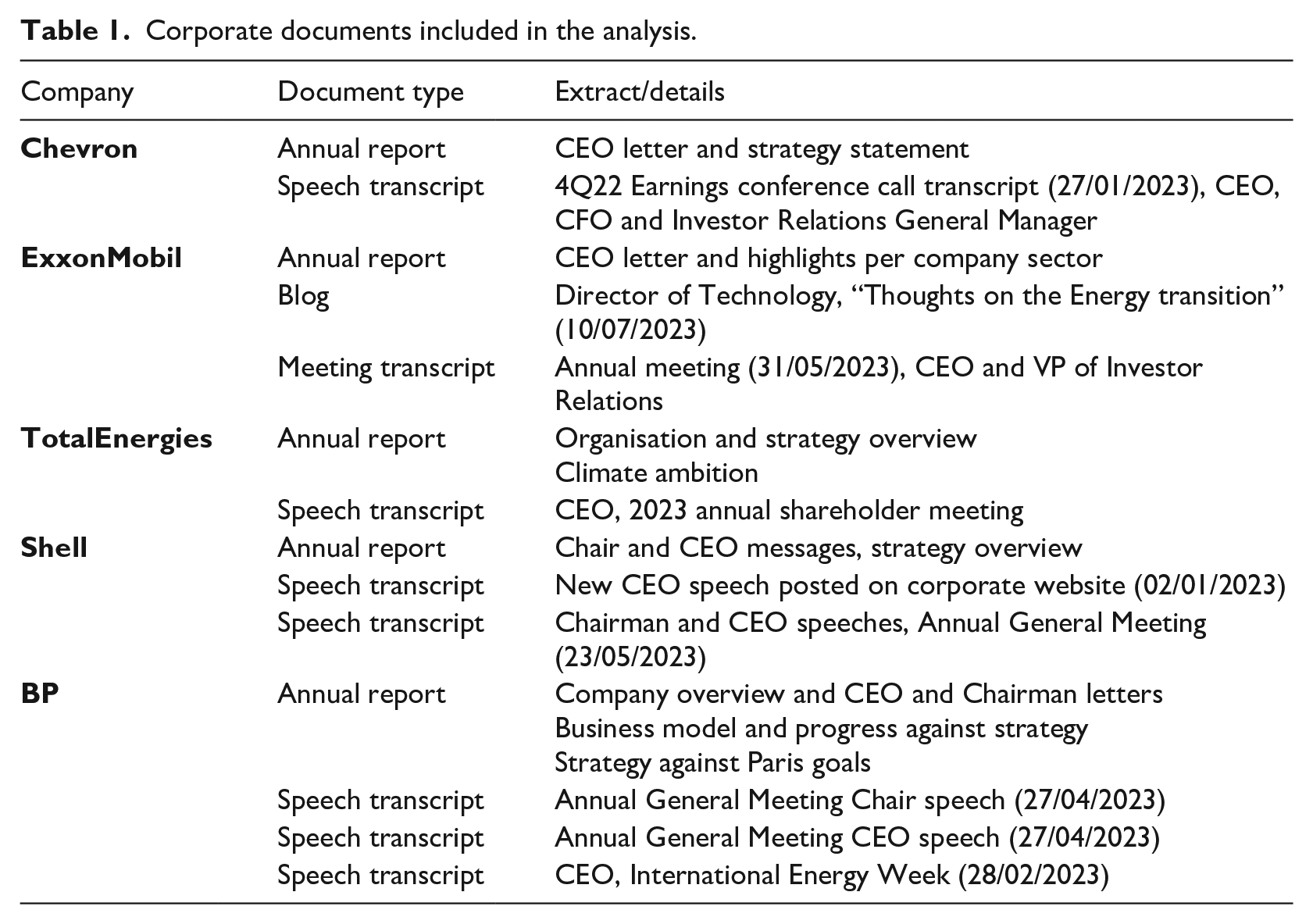
To identify and analyse the ‘big 5’ organisations’ discourses related to climate change, this study relied on materials considered as being widely representative of their public image and position on the topic (Ferns et al., 2019). These included extracts from these five companies’ annual reports issued in Spring 2023, comprising letters or introductions from CEOs and Chairpersons, and sections detailing the organisations’ strategies. These were supplemented with transcripts of speeches given by CEOs or senior representatives of the same organisations. See Table 1 for the full list of documents included.
Corporate documents included in the analysis.
To gather data on employees’ subject formation, participants were recruited mainly from within these same organisations, with a few additional employees from smaller private companies, national oil companies and industry service providers (see breakdown in Table 2). Potential participants were identified and approached using a purposive sampling method (Palys, 2008) through the lead author’s personal network and social media connections on platforms such as LinkedIn.
Research participants’ characteristics.
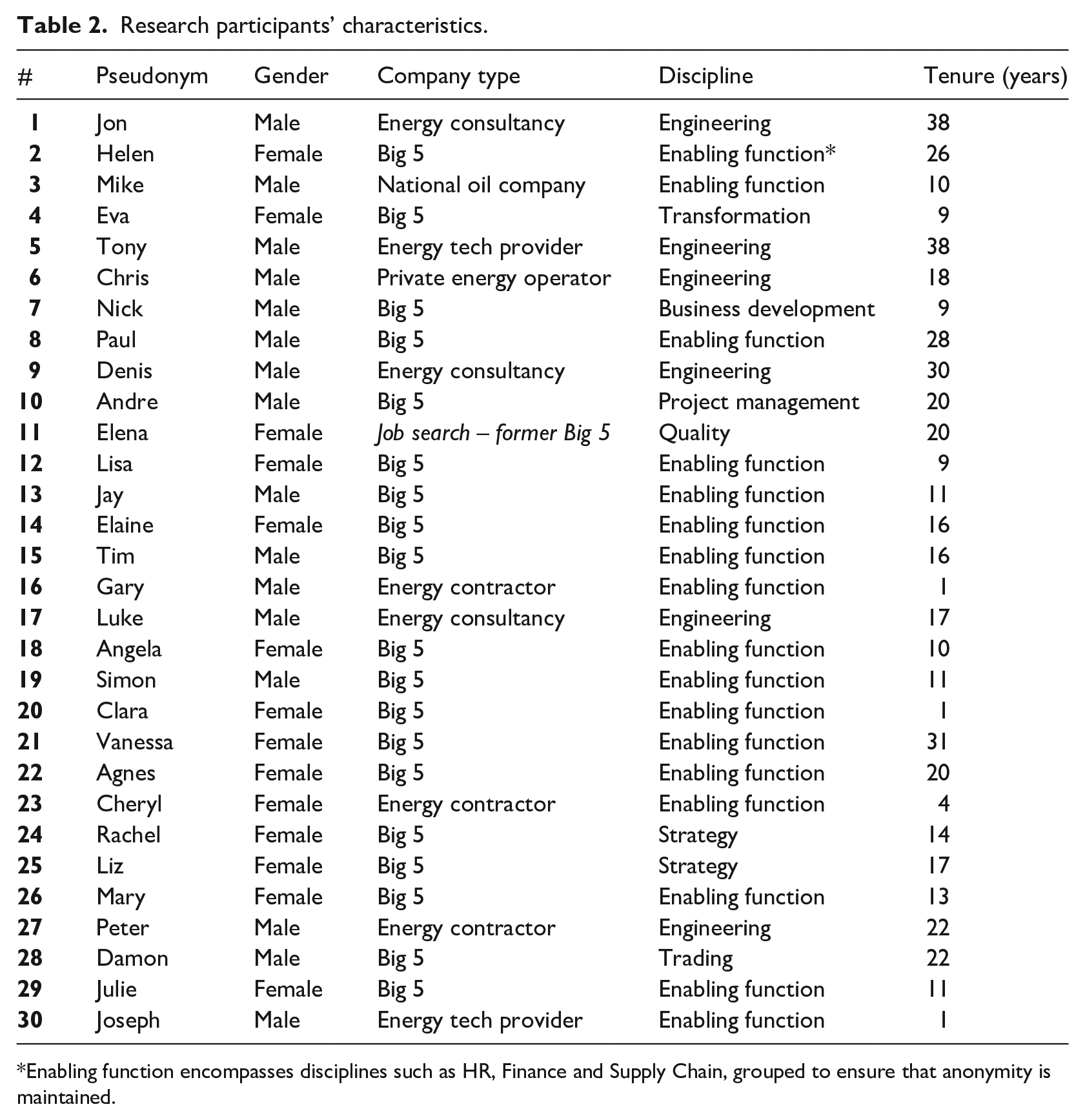
Enabling function encompasses disciplines such as HR, Finance and Supply Chain, grouped to ensure that anonymity is maintained.
Some participants were known to the lead author from past working relationships, although neither the lead author’s nor these participants’ perspectives on environmental matters and climate change had been exchanged in the past. The sample was supplemented by snowball sampling, seeking support from existing participants to establish connections with other individuals meeting the criteria (Noy, 2008), followed by validation of eligibility and active selection to achieve a balanced sample (Biernacki & Waldorf, 1981). In total, 30 participants agreed to take part in the study. This sample size was deemed appropriate to this study given the in-depth analysis of these experiences. It remains in line with past studies investigating employees’ positionalities in relation to climate change such as Halttunen et al. (2022) and Wright et al. (2012) involving, respectively, 12 and 36 participants, and studies on corporate environmentalism employing a Foucauldian approach, such as Carvalho and Ferreira (2022), where 20 participants were interviewed. The 30 participants of this study were geographically spread, or had worked for a substantial amount of time, across Europe, Asia, the Middle East, Africa and America; 14 identified as female and 16 as male, and their tenure in the oil and gas industry ranged from one to 38 years. Table 2 provides their key characteristics.
Data collection and coding
Semi-structured interviews were used to gather personal accounts of the participants’ lived experiences. An interview guide was developed to ensure that consistent themes were covered, while giving the opportunity for the interviewer to follow up specific points and for the participants to expand on parts of their accounts and engage in self-reflection (Kvale, 1996). Regular reviews were undertaken by the interviewer to evolve the line of questioning and optimise its impact and effectiveness to generate insights serving the research questions. The lead author’s position as a former employee of an oil and gas company was made known to all participants at the start of the interview, without expressing judgement on the industry, to enable participants to comfortably use industry terminology and references and explore certain topics in greater depth. The 30 interviews took place over a six-week period. Given the geographically dispersed nature of the participants, the interviews were conducted online using MS Teams. The interviews were recorded using the facility available on MS Teams. The duration of the recordings ranged from 41 to 81 minutes.
Automated transcripts were generated through MS Teams and, subsequently, reviewed in depth while watching the interview recordings to correct errors, improve readability, anonymise, and serve as an initial period of data immersion (Green et al., 2007). The interview transcripts, alongside the corporate documents detailed above, were subsequently uploaded onto the NVivo qualitative data analysis software.
Data analysis
A first round of coding was conducted on all documents to help categorise themes, experiences and practices present in the data. Simultaneous coding (Saldaña, 2013, p. 80) was used to attach different codes to the same piece of text to enable a richer and more contrasted analysis, combining different types of codes such as process, emotions and values (Saldaña, 2013, p. 59).
The analysis then moved on to two subsequent steps, the first concerned with identifying and defining the discourses deployed by the industry in relation to climate change and the second focusing on the employees’ perspectives gathered through the interviews. First, the coding of 183 pages of corporate documents generated a total of 96 first-level codes. A coding matrix was generated on NVivo to enable the review of coding frequency and references as part of a second round of axial coding (Saldaña, 2013, p. 218) where dominant codes were identified and grouped with other similar or closely related ones. This led to a set of 16 second-level codes which were, subsequently, reviewed and analysed focusing on their articulation of environmental practices, supporting the development of three core discourses for climate change deployed by the industry, detailed in the ensuing section.
The subsequent part of the analysis focused on the interviews with industry employees and their ethical self-formation, following a Foucault-inspired approach. Although Foucauldian discourse analysis has been defined as a method in its own right, with attempts by scholars to develop set methods for others to follow (Arribas-Ayllon & Walkerdine, 2017; Willig, 2013), the method used for this analysis is underpinned by Foucault’s later work on the care of the self (Foucault, 1985, 1997), and his definition of the four aspects of one’s relationship to oneself, or rapport à soi, to become the ethical subject of one’s own actions (1985, 1997). These four aspects are ‘ethical substance’ – what aspect of the self is concerned by a particular conduct; ‘mode of subjection’ – how the individual is situated in relation to rules, norms and expectations imposed on them and chooses which to put into practice or not; ‘ethical work’ – the actual practice put into place to achieve the rule or standard set for oneself; and ‘Telos’ – the overall way of being which people seek and which this conduct feeds into (Foucault, 1985, pp. 26–28).
The first round of interview coding generated a total of 236 first-level codes. To retain a focus on individual ethical self-formation, coding matrices were generated using NVivo for each interview. Focused coding (Saldaña, 2013, p. 213) was subsequently applied as a second round in order to identify the core themes invoked by each participant and to develop an individual view of their approach to ethical self-formation. To move the analysis to a group level and produce aggregate insights, these 30 individual-level analyses were reviewed through the lens of Foucault’s four components of ethical self-transformation described above. Considering the study’s research question and inquiry around oil and gas industry employees navigating their position in relation to their organisations’ discourses, two of Foucault’s components provided the most meaningful insights, which are presented in later sections: the modes of subjection and Telos.
Oil and Gas Industry Discourses of Corporate Environmentalism
The study of the ‘big 5’ oil and gas companies’ annual reports and speeches led to the identification of three core discourses pertaining to the way in which the industry operates and positions itself in relation to climate change, and not only legitimises its activities and strategies but also constructs them as essential to society’s path towards a sustainable future. Each of these feeds into a particular subjectification of the industry employees as committed and knowledgeable enablers of its strategies. These three discourses are named and defined below, and summarised in Table 3, with extracts illustrating them.
Oil and gas industry discourses of corporate environmentalism.
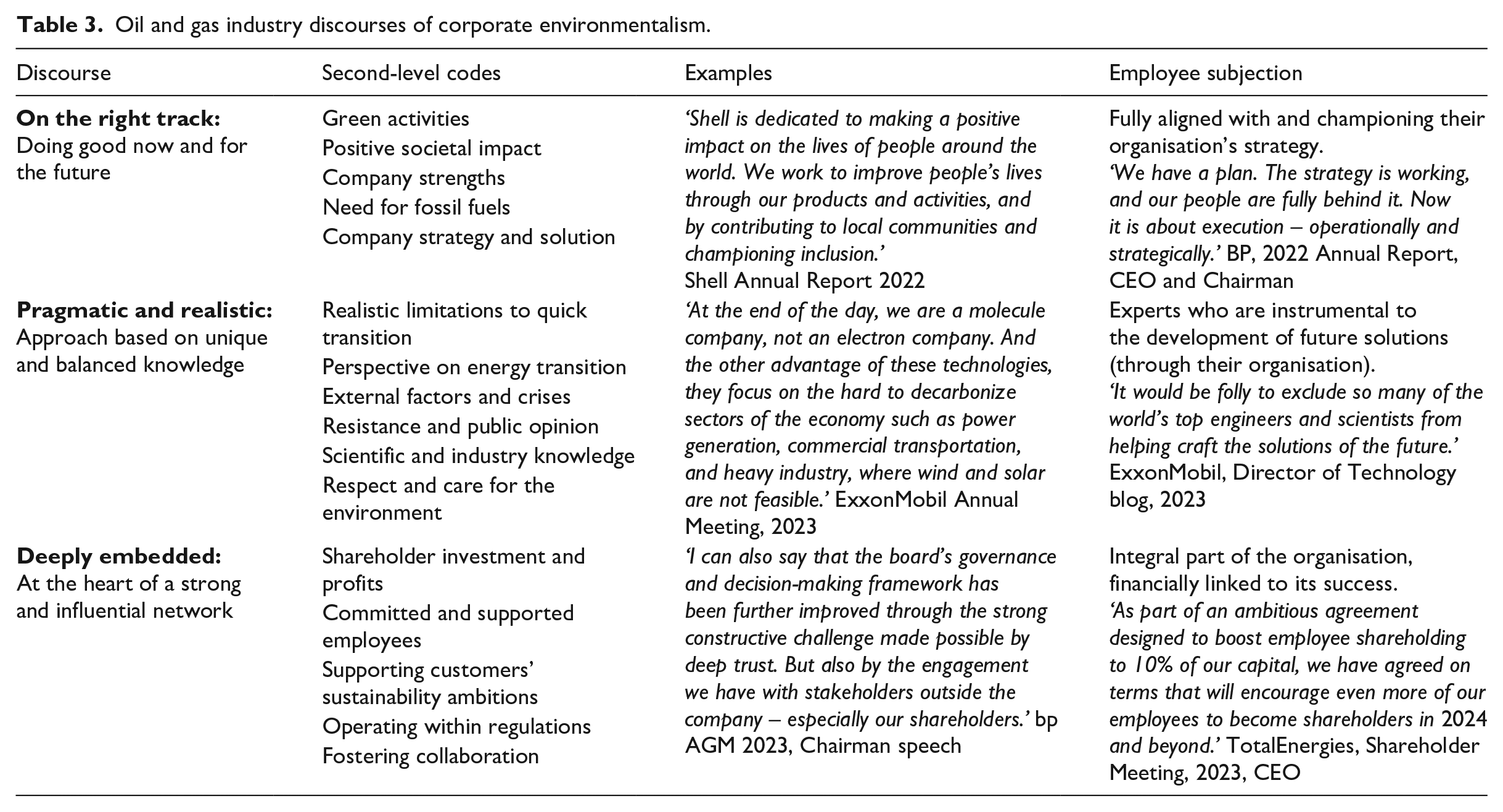
The first discourse, ‘On the right track’, emphasises each organisation’s positive activities as part of the energy transition (development of renewable and low carbon energy) and in support of energy security (through maximising traditional fossil fuels). The benefits that the company brings for society and local communities are put forward, as well as its strengths and the relevance of its strategy to address the world’s needs. All five corporations follow similar narratives around balancing the production of hydrocarbons while decarbonising their operations and, for most, growing the production of ‘clean’ energy. By emphasising the strength and righteousness of their respective strategies, this discourse positions industry employees as an integral and fully committed part of these strategies, doing good as individuals by virtue of being part of an organisation considering itself as doing good.
The second discourse, ‘pragmatic and realistic’, highlights the challenges faced by the industry and the world on the path towards energy transition, supported by using cautionary language on the appropriate way forward (‘disciplined, balanced, etc.’). Limitations and hurdles are referenced, including geopolitical instability, to provide justification for a more risk-averse view of the transition where shareholders can be reassured that profitability will not be compromised. These limitations are, however, seldom balanced with references to the actual risk and tangible consequences of climate change itself.
Companies position themselves as experts in their market, holding deep knowledge that their detractors do not have. Employees, through this discourse, are the custodians and holders of this knowledge and expertise and critical to the development of future solutions, reinforcing the need to engage with the industry as the only way to access these crucial skills.
The third discourse, ‘deeply embedded’, revolves around the strong connections between each organisation and its core network of stakeholders – shareholders, customers, employees, governments and regulators. The significant references to shareholders’ and investors’ interests and positive financial results are to be expected given the nature of these documents. Strong collaboration weaves through this discourse, albeit in different manners: the industry seeks shareholders’ input and listens to their challenges; it offers to support customers’ sustainability ambitions, yet the onus remains on customers to lead their own transitions; it complies with governments and regulators and relies on them to shape the energy transition through policies. The industry employees’ contribution is recognised, and their attachment to their organisations is reinforced by efforts to blend their identities as both employees and shareholders. Altogether, this discourse anchors the industry in a network of mutually beneficial relationships, as an influential and impactful partner.
These three discourses are deployed by all five organisations studied, although their emphasis may vary, such as a commitment to ‘doing good’ for some or deep knowledge and expertise for others. These discourses also interact with and supplement one another. By portraying itself as a force for good holding vital knowledge and at the heart of society, ‘Big oil’ puts forward a vision of corporate environmentalism that is not only legitimised but also logical and unifying.
Employees’ Performative Modes of Subjection under Corporate Environmentalism
The oil and gas industry employees’ views on climate change, personal sense of responsibility, and perception of their organisation’s environmental practices provided a rich and nuanced account of their relation to the corporate discourses detailed in the previous section. Foucault’s ‘mode of subjection’, one of the four components of ethical self-formation, focuses on this relationship. Foucault defined ‘mode of subjection’ as ‘The way in which the individual establishes his relation to the rule and recognises himself as obliged to put it into practice’ (Foucault, 1985, p. 27). Here, ‘the rule’ is formed by practices of corporate environmentalism, materialised through the three corporate discourses described above.
Five modes of subjection – dynamically deployed and negotiated by employees – were identified, summarised in Table 4 with illustrative quotes. Their names were purposefully defined using action verbs in order to convey the performative nature of these modes of subjection, which go beyond narratives or identities, to characterise how actions and behaviours bring these positions into being.
Modes of subjection.
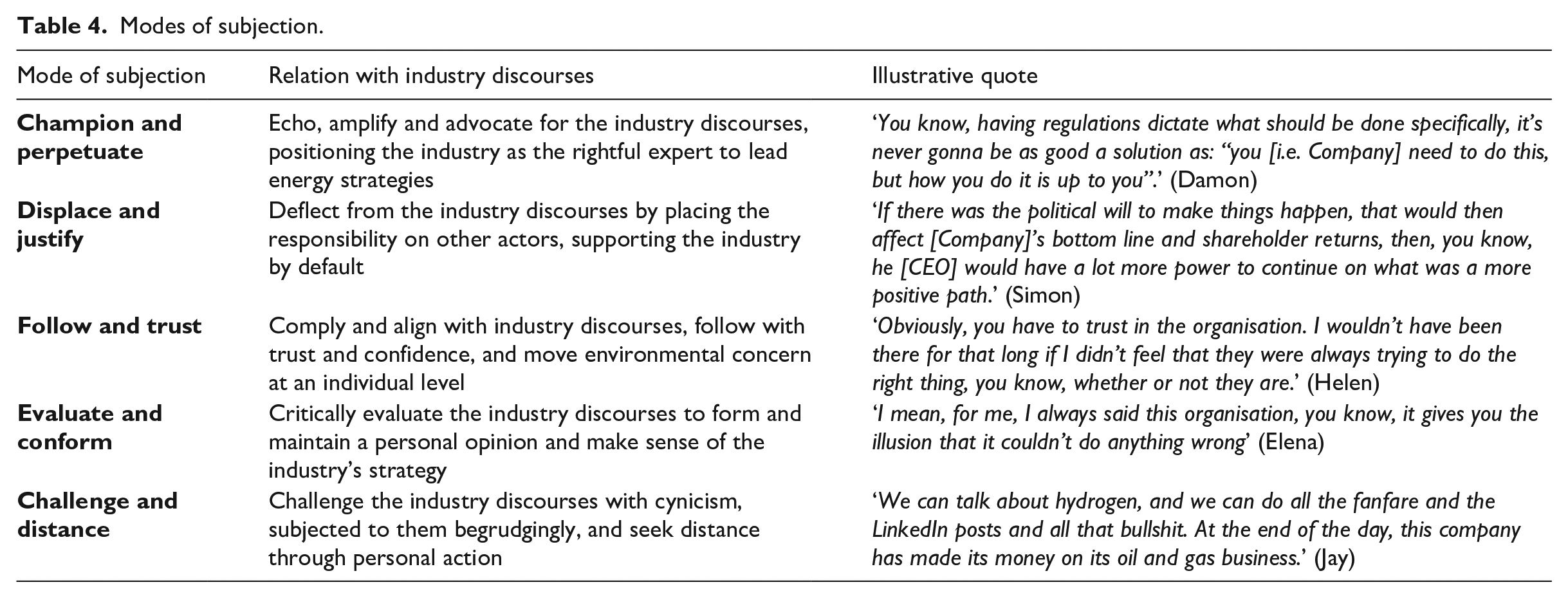
Under the first mode of subjection, ‘champion and perpetuate’, employees echo and reinforce the corporate discourses, not only approving of them, but also internalising them as theirs to defend and promote. In contrast, the mode of subjection that we named ‘displace and justify’ involves a more implicit acceptance and support of organisational discourses, considering the industry as an integral part of a much wider system towards which responsibility and judgement is deflected. The third mode of subjection, ‘follow and trust’, comes with an acceptance of the corporate discourses at face value and the belief of being part of a system which strives to do the right thing, providing the comfort and reassurance needed to contribute to it. The mode of subjection that we named ‘evaluate and inform’ involves a critical assessment of organisational discourses, with employees concerned with forming their own opinion about their accuracy and trustworthiness. Compliance with ‘the rule’ is continuously assessed and questioned, yet remains observed, albeit in a more fragile and precarious way. The final mode of subjection, ‘challenge and distance’, moves employees into an antagonistic position towards company discourses. The employee-as-subject expresses alienated and cynical views towards these discourses, firmly disagreeing with the industry considering itself ‘on the right track’ and misaligned with its claims of positive actions.
The interviews particularly brought to life the dynamic and performative nature of these modes of subjection and the factors moving people to reconsider their position towards company discourses. The following extract from Tim illustrates this characteristic in relation to changes in company strategy driven by corporate environmentalism, moving from an initial drive towards progressive sustainable measures to a major scale-down of these ambitions just two years later following rising oil prices driven by geopolitical events: It’s a pendulum which swings, you go from feeling really positive because you’re at the forefront of driving a change to integrated energy to, you’re a company that’s seemingly making vast profit off of the back of the heritage businesses of oil and gas, in a world which is actually not just dealing with climate crisis, but is also dealing with sociopolitical issues at the same time and we seem to be profiteering off of those.
To adapt the positions that people take towards corporate environmentalism and what they believe to be morally sound, modes of subjection are dynamically negotiated under fluctuating external circumstances. These include organisational strategies, socio-economic factors, and triggers from interpersonal interactions, as was the case during some of the interviews where questions and prompts shifted certain employees from champion subjects to more critical ones.
Out of our participants, Gary and Rachel provided striking examples of evolving modes of subjections in relation to organisational shift in environmental discourses. For Gary, this shift happened in the short space of time between accepting a role with an oil and gas company, to a few weeks into his new role. When considering the role, and despite initial reservations, Gary responded to the company’s discourse of being ‘on the right track’ by developing a ‘follow and trust’ mode of subjection: I did have reservations on starting, around the industry in particular, and it being a kind of dirty type of industry. And what reassured me was that their aspirations to really drive into new energy solutions were very clear and transparent.
In this case, the aspirations conveyed via the corporate discourse as materialised through the company website and external communications helped Gary to develop a sense of moral righteousness and trust. This trust, however, remained conditional on the organisation’s commitment to a transition to clean energy. Shortly after joining, Gary was faced with the reality that this commitment was not going to be upheld, as geopolitical events pushing up the oil price shifted the organisation back to prioritising fossil fuel production: A number of organisations of which this is one of them, have now taken the opportunity to lean heavily into that dirty environment again so that the oil price is high, gas prices high, let’s make money whilst we can.
Faced with initial indications of the change in strategy, Gary’s mode of subjection moved towards ‘evaluate and conform’ while gathering more information and assessing his position towards it. This, ultimately, led him to a ‘challenge and distance’ mode of subjection, having lost his initial trust in his company’s discourses, and seeing distancing himself through leaving as the only way to re-establish congruence between his work and his own moral values: I think I’m gonna be stuck in an organisation that is playing in the dirty oil market for a number of years to come now because there’s a lot of money to be made there. (. . .) From my perspective, the only option for me is to look elsewhere.
In contrast, Rachel’s mode of subjection towards the organisation and its discourses went through various shifts over a longer period, influencing actions taken in connections with changes in these discourses. Similarly to Gary, the ‘on the right track’ discourse, especially related to green energy transition strategy, led Rachel to ‘follow and trust’ – even ‘champion and perpetuate’ – in relation to climate-related initiatives: That’s why I liked [Company] because it was [renewables strategy]. I thought that was great. I thought, [Company] was much more progressive in lots of areas, but on climate, particularly, which is what I care about, one of the things, a big one.
Here, too, Rachel’s positioning, decision to trust and even champion were intimately connected with the organisation’s sustainability strategy, and its alignment with her own beliefs. Over the course of a 10-year tenure with the company, the reality behind these discourses eroded this trust: I started to talk about it with my colleagues. And again, the same thing was like well, we can’t do anything. So just get your head down and carry on with the work. And those weren’t people that I wanted to work with. I wanted to work with people that want to make things better. And so, I realized I didn’t fit anymore, and then a redundancy round came up, and I put my hand up.
The dissonance which had formed and grown between Rachel’s own view of environmental responsibility and the corporate discourses which started adopting more cautious and less ambitious language, driving slower change, fed into a shift in Rachel’s mode of subjection. At first, she was ‘evaluating and conforming’ while trying to mobilise colleagues and affect change within her own circle. However, her failure to do so led to a path of distancing and, ultimately, an exit from the organisation and industry.
Years later, however, alongside a re-launch of the organisation’s sustainability ambitions and green transition, Rachel was offered a role to play a direct part in this strategy. Repeating a past pattern, this renewed company discourse overcame her past distancing to regain a position of trust. Beyond the corporate discourse, personal relations and emotions towards the company contributed to this significant shift: I have a big emotional connection to the people there. So, there is a drawback to what feels like family. I always think the emotional connection to the company is not logical. It is emotional. So that’s just a weird thing. So, in a way, it wasn’t a difficult decision and I thought, this is such an extraordinary thing that’s happening.
Following this initial excitement and renewed feeling of belonging, the reality behind the discourses caught up once again with Rachel in the following two years. This materialised at first through the actions that Rachel was able to take in her role and the challenges that she faced in achieving these initial ambitions, leading Rachel to suspend her trust and evaluate, once again, her organisation’s intentions: I think I’ve realised, it’s not a surprise, but I think I was under the impression that we were actually going to be purpose driven and put people and planet like first. No, it’s still a profit-driven place.
Eventually, this personal experience was followed by a formal shift in organisational strategy. Similar to Gary’s experience, the change in geopolitical context leading to an increase in oil prices triggered a roll-back on the organisation’s ambitions for a green transition. The formal announcement of this change led to a strong emotional response from Rachel, and a rapid change in her position, seeking distance, even physical distance by needing to leave the company’s offices: It’s like a systemic-level problem of, if you’re always having to give investors what they want, it’s gonna hobble the pace of the transition. That is the thing that scared me and made me quite emotional. I actually had to leave the office early, [a colleague] came over and said hi, how are you doing? And I just burst into tears and said I think I’m gonna go home.
While Gary’s and Rachel’s examples have, in common, a mode of subjection moving them from trusting to distancing themselves, it is worth acknowledging that the same need to maintain congruence materialised through changes which were not all antagonistic. Reflecting on similar changes in green transition strategy, Julie, influenced by external opinions, moved from a longstanding position of trust to actively reconsider and evaluate her position, which led her back to ‘following and trusting’, even ‘championing’ under certain circumstances: Some people are saying that [CEO]’s backtracking on what he said before. But I think internally it feels much more like we’ve found the balance. (. . .) I inadvertently find myself getting on my high horse about it, which I don’t mean to, start defending the company. But often I find myself doing that and I think it goes back to it feeling personal.
Telos: Alternative Paths Leading to Aspirational Modes of Being
The modes of subjection presented in the last section enacted employees’ negotiated relationships towards ‘the rule’ as materialised through company discourses. The interviews showed the modes of subjection’s influencing factors and performative nature, through which employees’ aspirational ‘modes of being’ aim to come into being, named in Foucault’s (1985, p. 27) model as their Telos. Defining Telos, Foucault asks: ‘Which is the kind of being to which we aspire when we behave in a moral way?’ (Foucault, 1997, p. 267). While employees may rarely engage in deep reflection to try and clearly articulate the characteristics of such a kind of being, our interviews enabled us to develop an understanding of the key aspects feeding into their Telos related to environmentalism. This ‘kind of being’ is defined against an evaluation of societal moral expectations (of the self and its position within society, including its work), a (re)negotiation of interactions at a relational level, with friends and relatives sharing their own opinions, and a reflexive element based on emotions and feelings triggered through this process.
Evaluating the moral value of their and their organisations’ activities and societal impact, some – while acknowledging the position of privilege afforded by their professional situation, wealth, and the part that they play in their industry – see themselves as fulfilling a moral obligation. Tony put this in the context of supporting others who do not enjoy the lifestyle that he does: It’s in the parts of the world that I’ve worked, where people are in the sort of abject poverty that we can’t think about, let alone ever want to experience. We’ve gotta keep lifting those countries up and you lift those countries up by providing energy.
Tony establishes his privileged position and associated responsibility towards those who lack the agency and resources that he can access. In doing so, he justifies the oil and gas industry’s activities and him being a part of it. This virtuous positioning can, however, be challenged at a relational level. Many references to friends and family were made, challenging or questioning the congruence of participants’ employment with the oil and gas industry, and their relatives’ perceptions of their Telos, through asking ‘Why do you keep working for [Company] when they do what they do?’ (Paul) or stating ‘You seem like quite an ethical and a moral person. I’m surprised you go and work in oil and gas’ (Jay).
Emotions and feelings triggered by reflecting on the moral soundness of employees’ position play a substantial part in forming and reforming their Telos. Joseph not only talked about strong emotions from considering the moral aspect of his work towards his loved ones, especially his daughter; he was overcome by these emotions as he spoke: And it’s usually when I’m. . . Sorry, I am getting a bit upset. . . No, it’s just when I’m thinking about my daughter. Just one second, sorry. [Emotional/tearful]. Yes, it’s usually when I’m thinking about my daughter and her future. You know, what am I doing? From one perspective, it’s like, what will I say to her?
In Joseph’s case, an aspirational self is also one which acts to safeguard the future of his daughter, which a current involvement with oil and gas is seen as incompatible with, making the path towards this Telos one that requires a change towards an alternative direction.
This dissonance was shared by more participants, some of them viewing their position with cynicism. Referring to the salary premiums required to attract talent into the industry, Peter goes as far as explaining: ‘20% premium. That’s approximately what it costs to get people to sell their soul’. This Faustian reference implies the sacrifice of moral values which can be associated with a career in oil and gas. To redeem themselves, mitigate these feelings of unease and guilt, and get back on the path of their Telos, some employees find ways to take corrective measures, like Angela: We got an extra bonus (. . .) and I felt very, very guilty because I’m in an industry where we’ve got a huge amount of money coming in, in the cost-of-living crisis. I do very well myself. So, I ended up giving quite large sums of money to my children’s teachers as Christmas presents, and I tried to distribute some of that because there was an element of guilt sat behind that.
Such actions may help Angela to reconcile her current path and her Telos; for others, however, an aspirational mode of being is only seen as achievable in an alternative future, taking a different path. For Clara, this alternative future is inspired by a role model, helping her to picture what behaving in a moral way could look like, reconciling work in the energy sector with a contribution to society that she currently cannot achieve: There’s an NGO that I came across, run by a woman. She’s making a difference through the energy space and that kind of thing. So, I think that’s the kind of encouragement that I see as I’m like, that’s where I ultimately want to be, in a space like that.
For others, this alternative future shaped by their Telos is an active work-in-progress. Indeed, many reported making active adjustments to their lives to move towards a vision of the self as environmentally aware and contributing to a sustainable future. For many, recognising the lack of opportunities to make such a difference in the context of their company and industry, interventions were focused in their day-to-day personal lives. Echoing Angela’s earlier feelings of guilt, a similar driver is involved in the adoption of sustainable ways of living: If I didn’t do some things then I’d just feel guilty, and once you’ve had that mindset change, you can’t go back. (. . .) We won’t have our own car, take public transport as much as possible, use the train a lot. I’ve gone mainly vegetarian at home, and that’s climate change-related. (Jay)
The potential to act towards an alternative future driven by Telos in the context of work has, however, also been evidenced. Enacting this path, Liz actively seeks challenges from others outside of the industry to help her shape her aspirations in relation to her work for an oil and gas company and how to achieve them: I’m actually trying to create a little mini support network for me of people who will challenge me more. (. . .) Could I find a few people in my broader networks to have conversations with me on a, you know, on a quarterly basis and challenge me on some stuff.
Envisaging an alternative future via their Telos does not only come across for people currently experiencing a dissonance. Elaine described a mode of subjection where she would mostly ‘follow and trust’ her organisation’s discourses and strategies. Despite this, Elaine stresses how her position is conditional on her organisation fulfilling its commitment. By envisioning her inability to now work for a company taking a different direction, she suggests her potential to seek an alternative path should her current employer modify its strategy: I think if I were working for a company that didn’t have that progression to different energies, that would be different. I think it is part of my identity. I think it’s really important to me to believe that we are doing something good for the future.
These examples show how an active evaluation of the self against a moral perspective of environmentalism shaped via societal and relational influences creates possibilities for alternative futures for employees, beyond the paths carved through corporate environmentalism. Nevertheless, employees’ Telos, and the processes of subject formation surrounding it, remain seldom acknowledged or talked about outside of spaces such as the one created for these interviews. Impeding the potential for more meaningful action and change, the performativity of modes of subjection and aspirational modes of being that they lead to tend to remain within the self, leading to feelings of isolation, as Rachel expressed: I feel, I don’t know if other people think or feel this way, from all the people you’re talking to, I don’t. You know, I wonder, am I a bit like, extra? Don’t know.
Discussion
Through their discourses of corporate environmentalism, the ‘big 5’ oil and gas majors paint a picture of their employees as committed and supportive insiders holding the expertise necessary for society to advance a transition to new forms of energy. With these findings, we expand on existing research highlighting the performative nature of discourses in the oil and gas industry (Breeze, 2012; Wright et al., 2021) and show their characterisation of employees as subjects. Interviews with employees from the oil and gas industry enable us to contrast this corporate perspective with a view of the processes and experiences of subject formation at an individual level. Through our analysis and its Foucauldian framing, we offer three contributions to the existing literature in organisation studies. First, we develop a model combining Foucault’s technologies of power and technologies of the self to conceptualise the process of subject formation employees dynamically engage with under corporate environmentalism. This conceptual model emphasising the moral and relational foundations of this process is presented in the next section and visualised in Figure 1. Second, we position the concept of Telos, based on Foucauldian literature, as key to our understanding of employees’ moral construction under corporate environmentalism, offering a new level of enquiry regarding the drivers underpinning performative identities and behaviours, and a breadth of potential for different paths towards sustainable development. Third, we orientate our focus on oil and gas employees towards the exploration of new possibilities in our approach to corporate environmentalism.
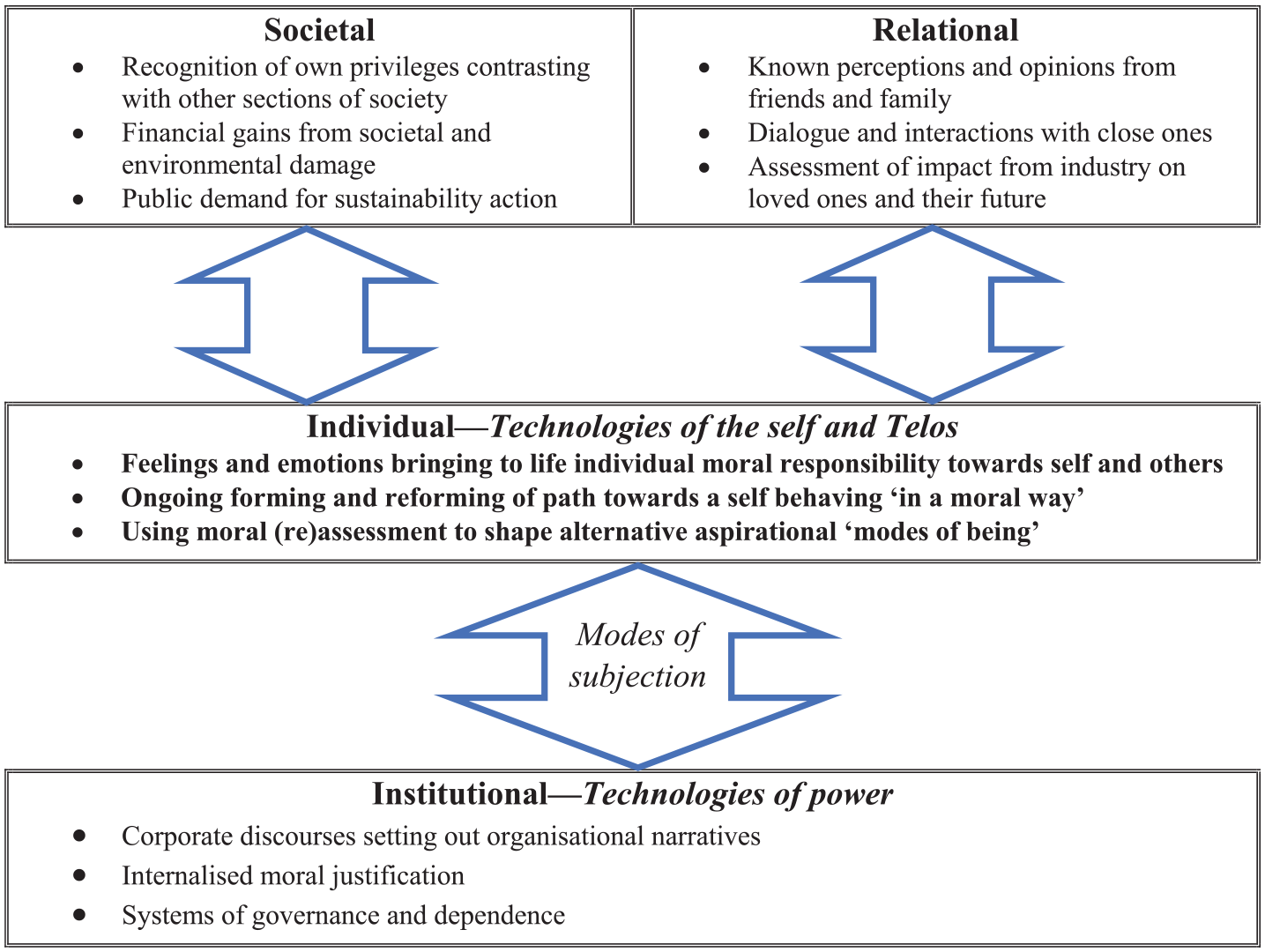
Employees’ levels of moral (re)assessment and Telos under corporate environmentalism.
Telos: Enacting Aspirational Modes of Being
Applying a Foucauldian lens based on his work on ethical self-formation (Foucault, 1985, 1997), we expand knowledge on the ethical micro-foundations of sustainable development (Demers & Gond, 2020) by developing a conceptual model showing how employees dynamically construct their moral position towards corporate environmentalism and its discourses. Figure 1 visualises the levels of moral (re)assessment forming this model including, at its heart, the individual level at which employees shape their aspirational modes of being – their Telos.
Telos is placed at the centre of this visualisation, representing an aspirational ‘mode of being’ shaped by the consideration of what ‘behaving in a moral way’ means at social, relational and institutional levels, and, in turn, guiding performative modes of subjection and interactions at these levels. The term moral (re)assessment is used here to refer to the ongoing evaluation of the self’s moral position against external perspectives. Various triggers lead employees to engage in moral (re)assessment, including exposure to stories and news via the media, organisational communications, or conversations with friends and relatives. The interviews conducted as part of this study acted in themselves as such a trigger, through the prompted reflections at these various levels, as well as constituting a relational trigger in itself, considering the interpersonal exchange with the interviewer, the paper’s first author, and his positionality as a former employee of a large oil and gas company.
Following Raffnsøe et al.’s (2019) view on the evolution of Foucauldian contribution to organisation studies, we adopt a holistic approach to Foucault’s work, integrating his components of self-formation with his earlier concepts of discourse and technologies of power, while focusing our lens onto technologies of the self and Telos. This enables us to explore – beyond narrative identities (Wright et al., 2012) or justification work (Demers & Gond, 2020) – the aspirational modes of being influencing these and their interactions with institutional power. In doing so, we evidence the breadth of their Telos and the performative ways through which employees strive for them to come into existing (Butler, 2011).
Foucault defined technologies of the self as ‘technologies of individual domination’ (Foucault, 1988, p. 19), where people effect ‘operations on their own bodies and souls, thoughts, conducts and way of being’ (1988, p. 18). This individual domination comes across in our analysis, with strong feelings and emotions, sometimes conflicting, resulting from the moral (re)assessment of the self against societal, relational and institutional factors. These lead to a realisation of the degree of congruence or dissonance between their current path and one guided by their Telos. This realisation is the catalyst for reinforcement, action, change, or performative formulation surrounding their current path towards ‘behaving in a moral way’. Considerations of alternative and aspirational paths feed back into interactions at societal and relational levels, while influencing the modes of subjection to institutional power and discourses of corporate environmentalism. For many, this process remains iterative, dynamic and fluid, fraught with uncertainties which lead to incremental actions or changes in behaviour as evidenced in this study through the modes of subjection, and including those highlighted in past studies, such as justification (Demers & Gond, 2020), distanciation (Fleming & Spicer, 2003), or small acts of resistance (Skoglund & Böhm, 2020). For some, a path towards their Telos is inconceivable, or appears unachievable under their current circumstances, creating an untenable position which can only be remediated through a substantial change – of employment, of industry, or of lifestyle more broadly – to make the aspirational feel within reach again.
Rethinking corporate environmentalism
Banerjee et al.’s (2003) definition of corporate environmentalism focused on the environmental issues facing businesses and the integration of these issues into business strategy. Our paper contributes to that understanding by showing the effect of companies’ environmental practices and moral responsibility on their own employees, via their moral evaluation of societal and relational impacts. Corporate environmentalism in industries such as oil and gas has, to date, often been concerned with actively managing public perception and policies through crafting their narratives and their direct involvement in environmental matters (Ferns & Amaeshi, 2021; Kaplan, 2024; Wright et al., 2021). These externally targeted strategies were devised under managerialist assumptions that internal mandates and careful communications would ensure unconditional followership from employees. Our study illustrates this position through the discourses emanating from the ‘big 5’ oil and gas companies. It also builds on past research (Demers & Gond, 2020; Halttunen et al., 2022; Wright et al., 2012) to challenge these assumptions. Indeed, employees process corporate discourses alongside their own experiences of societal and relational moral positionings to establish how they subject themselves to these discourses. The aspirational modes of being that they are guided by in doing so, their Telos, expresses a diverse range of visions for alternative paths in alignment, at odds with, and most often more ambiguously positioned towards, their organisations’ practices.
With this understanding, how can corporate environmentalism evolve to account for the aspirations of its own organisational members? Forging movements of resistance, more visibly present through external groups, within the organisation, is one possible way forward (LeQuesne, 2019; Mumby et al., 2017). Our nuanced and layered findings show, however, that the likelihood of mounting a scalable internal counter-power is low to non-existent. In response, we follow and reinforce calls for a Foucauldian perspective going beyond the dichotomy of compliance vs. resistance (Raffnsøe et al., 2019).
Our analysis showed how employees construct aspirational modes of being as their Telos, guiding their subject formation under corporate environmentalism. The latter, in its current form, represses many of these aspirations through narratives driven by organisations from the top down (Onkila, 2017). Building on the concept of ‘prefigurative partaking’ and discreet acts of internal activism (Skoglund & Böhm, 2020), and conceiving a more subtle counter-hegemonic resistance (Kjærgaard et al., 2024), we argue that practices of corporate environmentalism should allow for the performative expression of employees’ aspirational modes of being, including the struggles and uncertainties that these may involve. Considering that employees all engage in moral evaluations of their organisation, and their positionality within it, in relation to external expectations from society and close relatives, opportunities to actively engage with large-scale collegial thinking, reflecting perspectives within and beyond the organisation, are currently lost.
Foucault could, here again, provide a further direction for future research on this topic, through the concept of ‘heterotopia’ that he used in his work (Foucault, 1986b). He considers heterotopias in contrast to utopias as ‘counter-sites’ where all aspects of society are ‘simultaneously represented, contested and inverted’ (Foucault, 1986b, p. 24) in an unsettling space with potentialities and struggles (Kjærgaard et al., 2024). Similarly to how heterotopic spaces were considered to drive critical performativity in management studies (Spicer et al., 2009), we call for future research to explore what heterotopic spaces may be created in organisations where all aspirational modes of being can, collectively, forge different paths towards a more inclusive, participatory and compassionate approach to corporate environmentalism.
Conclusion
In this paper, we set out to explore how employees form themselves as ethical subjects in an industry facing controversy towards its practices of corporate environmentalism. We find that employees undergo a dynamic and fluid process influenced by societal and relational factors, against which they conduct an ongoing (re)assessment of their moral position. They construct aspirational modes of being, their Telos, helping them to negotiate the uncertainties and potential struggles brought about by their circumstances. By seeking to understand their subject formation in a context which may be ambiguous and complex to them, we avoid taking an antagonistic position towards an entire industry and its members, instead finding paths of hope towards a system valuing diverse perspectives more equitably. Building on this hope found at an individual level, for radical change to be effected, corporate environmentalism needs to allow and embrace interactions between institutional, societal and relational factors throughout organisations and the systems and structures that they operate within. To do so, employees need the space and conditions to nurture their aspirational modes of being, and express their ambiguities and struggles. Hearing some of them qualifying their organisations’ practices as ‘greenwashing’ or even ‘bullshit’ gives this need a sense of tangible urgency.
Footnotes
Acknowledgements
The authors wish to thank editor-in-chief Paolo Quattrone for his trust in our paper and ongoing guidance, and senior editor Peter Fleming for his instrumental role in providing clear and expert advice and recommendations throughout the revision process. We are also grateful to the three anonymous reviewers, whose input and suggestions played an important part in this paper’s evolution towards its final version. We would also like to thank Dr. Matthew Sinnicks and Prof. Mine Karatas-Ozkan for their reading and comments on earlier iterations of the paper. Finally, we convey our heartful thanks to the thirty participants of this study for giving up their time and openly sharing their experiences.
Funding
The author(s) received no financial support for the research, authorship, and/or publication of this article.
