




Abstract
How should we interpret the figure of Greta Thunberg and the leadership constituted through and around her? This question drives an inquiry that enhances knowledge of the materializing of leadership through a spatial analysis rooted conceptually in critical geography and the communicative constitution of organizations (CCO). Building from the insights of geographer Doreen Massey and CCO scholar Consuelo Vásquez, the inquiry contributes by surfacing the spatial relations and communicative practices that co-constitutively knit together bodies and their objects in leadership, enabling a rich inquiry that illuminates mobilizations around the most complex issue of the day – climate change. Building multimodally with data derived from media and speeches, we posit four communicated ‘stories-so-far’ of Thunberg, decentred and communicated figures who merge and co-exist to constitute a composite Thunberg-the-Leader: the Child, Traveller, Activist and Learner. We then offer a model theorizing the underlying spacing leadership practices that act across and between figured stories-so-far, drawing them together, making certain constitutions of leadership (im)possible: shrinking, naturalizing, struggling and clearing. Concluding, we assert that this approach holds the possibility of making abstracted aspects of leadership materially present, while drawing together conceptual resources that have to date not been placed in productive dialogue.
Introduction
A small girl in a yellow raincoat with a homemade sign sits outside the Swedish parliament alone, engulfed by open space and imposing architecture. Yet soon afterwards she is at the heart of gigantean protests in streets and public spaces, a schoolgirl barely reaching over the top of a podium, addressing the world’s most significant political leaders, a traveller crisscrossing the world in solar-powered yachts and electric trains. Such images of course communicate one of the world’s most recognized leaders – Greta Thunberg – and the material features of the world she moves within. Yet most discussion of Thunberg, and for that matter of most leaders, proceeds absent of any consideration of the materiality constitutive of such images.
The omission of materiality seems particularly confounding in relation to climate change, whereby the aim of leadership is to limit the material effects of global warming while preventing the ultimate material catastrophe, the end of life on Earth. Burgeoning climate activism, driven in part by the leadership of young people, is rich in material dynamics, of bodies occupying public spaces and subverting their norms: protesting in the street, stopping traffic or defacing buildings. Yet academic research of climate leadership is surprisingly limited, reflecting dematerialized preoccupations with individual leaders (Fotaki & Foroughi, 2022), according to a review of the literature (Case et al., 2015).
This inquiry therefore joins a leadership studies field attempting to better understand how leaders and leadership materialize (Ford, Harding, Gilmore, & Richardson, 2017), where ‘materialize’ draws attention to how they emerge and are made to matter through entanglements of multiple materialities – e.g. bodies, objects, technologies, places and texts. Such research has provided important insight into how leaders and their bodies are ‘made up’ (Meier & Carroll, 2020) materially and imaginatively in relation to technologies and texts that carry coded messages regarding who is (de)legitimized as a leader (Ford et al., 2017). Nascent research in this area tends to focus on the body of the leader and ways in which it co-constitutes leadership in relation to material objects – be they ships for naval leadership (Hawkins, 2015), the texts of organizations (Meier & Carroll, 2023) or the clothing of corporate executives (Ford et al., 2017). While these studies are useful in helping us understand how any act of leadership occurs through material entanglements – bodies overlapping with objects – they tend to miss something of the wider material landscape, relations and parameters that (re)shape the possible for leadership practice.
Our study contributes by offering a spatial and mid-range view, one that sits between and connects the intimate and embodied experiences of space with wider social, political and economic relations – therefore offering a means of conceptualizing what draws the various materialities of leadership together. Such an approach enables what tends to remain implicit in leadership studies – power, resistance and relationality – to become tangible as material accomplishments affecting spaces and the bodies that move within them. Agency becomes what is possible within geographies imbued with histories of power. Hence we explore how spatial ‘relations between’ (Massey, 2005, p. 23) produce fluid practices and constellations of leadership.
Conceptually and methodologically, we pursue this contribution by zooming out from and with the body of the leader, offering a materializing, space-orientated engagement rooted in critical geography and a communicative constitution of organizations (CCO) perspective. Helping us address the spatiality of leadership is the theorizing of geographer Doreen Massey alongside communications scholar Consuelo Vásquez. Massey’s work offers a mid-range view of how space is produced relationally, accounting for larger-scale socio-economic forces and embodied interactions. Massey (1993, 2005) prompts us to ask what effect the bodies of leaders can have in transforming spaces and, in turn, how the bodies of actors are figured in particular ways in relation to the spaces they occupy and evoke. Vásquez, who draws closely on the work of Massey, holds a similarly performative and relational view of space but more directly illuminates the micro-processes of organizing and spacing practices of heterogeneous agents – both human and beyond-human – ‘as a particular organizational mode of being’ (Vásquez, 2013, p. 144). The combined theorizing of Massey and Vásquez allows us to account for the agency of leader-figures, while at the same time decentring them as materializing (Ford et al., 2017) through the spacing practices they influence and are subjected to.
In defining leadership we follow Smircich and Morgan (1982, p. 258), who view it as ‘framing experience in a way that provides a viable basis for action . . . articulating . . . what has previously remained implicit . . . inventing images and meanings that provide a focus for new attention and by consolidating, confronting or changing prevailing wisdom’. Framing in this sense is the communication of meaning with a persuasive intent, creating parameters that delimit ways of seeing, hearing and feeling. In our inquiry, framing is simultaneously textual and spatial, a configuration and communication of the relationship between objects, bodies and geographies (Massey, 2005). In keeping with Smircich and Morgan (1982), we approach leadership as framing that shapes meaning and persuades, but go a step further in incorporating the material, tangible and constitutive role of space – and relations in space – in this process.
Approaching leadership as an accomplishment of spatial framing helps further the materializing leadership project of moving beyond binary distinctions between leadership as residing either in the essence of a heroic individual or as disembodied across a collective of people (Ford et al., 2017; Hawkins, 2015). Instead, our spatial emphasis views leadership and leader-figures as matters of ongoing constitution between geography, the materiality of bodies and objects, and the language used to persuade. It is the above that ‘do’ leadership through spatial configuration and communicative work. Rooted in such conceptualization we ask: How are leader-figures constituted spatially and how do spacing practices constitute the materializing leadership? Hence our focus is on spatializing the material process of constituting leadership and figures of leadership, rather than on identifying a ‘who’ behind the action.
This research question is addressed empirically through the study of the most prominent public figure in climate activism, Greta Thunberg. Images of Thunberg garnered wide public attention from August 2018 when, aged 15, she took strike action from school. Protesting outside the Swedish parliament, she started as a lone figure (Ernman, Ernman, Thunberg, & Thunberg, 2021), her protest growing rapidly as it was disseminated through media, transitioning into the Fridays for Future movement. Methodologically we analyse multimodal data from media and documentary sources (Höllerer, Jancsary, & Grafström, 2018), evoking Massey’s view of space as a ‘dimension of multiple trajectories’, a ‘simultaneity of “stories-so-far”’ (Massey, 2005, p. 49), with ‘stories’ in this sense meant metaphorically as the unfolding of distinctive human-spatial traces, which when described or analysed inescapably bear a storied quality. This is a spatial account open to the multiplicity of social life, as ‘distinct stories coexist, meet up, affect each other, come into conflict or cooperate’ (Massey, 1999, p. 274), constituting both space and leadership through ‘temporary constellations’ which ‘require negotiation’ (Massey, 2005, p. 249).
In this account it is not Thunberg as an entity or individual leader that draws our eye but Greta Thunberg as an ‘emerging phenomenon’ that is ‘drawn on’ as a ‘leader-symbol’ and ‘marker’ for other actors (human and material) to constitute leadership through and from (Sinha, Smolović Jones, & Carroll, 2021, p. 363). Note that we refer to Thunberg as a leader-figure rather than as a person to foreground the analytic distinction: leaders are ‘figured’ in storied ways, constituted through the spaces and spatial relations that knit together the media, objects, bodies and language that we come to know as a leader. ‘Thunberg’ is not a person we have direct access to but an emergent composite of ‘stories-so-far’ communicated to audiences, inviting a response. In our study, these stories are: (1) The small frame of the Child, emerging from intimate spaces of family, ejected from these into the spaces of government power; (2) The Traveller, foregrounding the unsustainable ways in which human beings appropriate and transgress natural boundaries; (3) The Activist, grappling with being a body ‘out of place’ (Puwar, 2004, p. 8) in spaces of political and institutional power; (4) The Learner, using her spatial power to foreground the presence and messages of scientists and activists. Together, these four figured stories merge and crystallize, constituting an emergent and legitimized Leader-figure.
Moving from storied figures to leadership, we theorize and outline, in our discussion, a model of four practices of spacing leadership that act across and between these communicated stories-so-far, drawing them together, making certain emergences (im)possible. The spacing practice of shrinking recalibrates the relationship of human body to government power, nature and family; naturalizing undermines the sense of a pre-eminent human separate from nature; struggling asserts the possibility of inverting political and corporate power; clearing backgrounds the status of the individual leader to make space for alternative voices. There is an interdependence between the storied figures and the spacing practices, which are mutually constitutive. Leading is therefore approached not as a source or attribution, as is common in leadership studies, but as an effect and accomplishment of such a co-constitution. Before outlining the figures of Thunberg and the underlying spacing practices, we first situate our study within the area of materializing leadership studies, introducing the value of the broader conceptual parameters of critical geography and CCO. We then posit a multimodal approach as appropriate for illuminating the significance of a spatial focus.
Materializing Leadership
Materializing leadership is a body of work that foregrounds what is ‘presumed’ and ‘implied’ (Ford et al., 2017, p. 1554) but ultimately overlooked by leadership studies – the material infrastructure through which leadership is accomplished (Hansen et al., 2007; Hawkins, 2015). Albeit differing in conceptual emphases, such research has in common the assumption that the material is ‘active’ (Hawkins, 2015, p. 962) in shaping the possibilities of leadership. This section reviews salient work in this area, beginning with the most intimate materiality of all – the body – before moving outwards to consider how material objects enable and restrict possibilities for leadership. We conclude by exploring the communicative dimension of materializing leadership, finally identifying a need for a spatial analysis that knits together the materiality of bodies, objects and texts in ways that help make sense of the persuasive force of leadership communicatively.
At its most immanent and intimate, the materiality of leadership presents itself through the ‘sensuous and sensing body’ (Hansen et al, 2007, p. 553; Carroll & Smolović Jones, 2018; Sinclair, 2005). As Ladkin (2013) demonstrates, much of leadership practice involves bodies responding to the signals of other bodies, ‘kinaesthetically as well as visually’ (p. 331), in ways that can generate ‘beautiful’ interactions (Ladkin, 2008). Feminist theorizing has particularly focused on the possibilities inherent in intercorporeal experiences for building egalitarian, liberating leadership (Pullen & Vachhani, 2021). This perspective is closely tied to the ethical, with potentially emancipatory relations of leadership generated as bodies connect with other ‘living, breathing bodies’ (Pullen & Vachhani, 2021, p. 234), a form of ‘pre-reflective embodied interaction’ (Pullen & Rhodes, 2014, p. 787) that responds to the needs or invitations of others, signalled through the ‘feelings and impulses’ (Rhodes, 2023, p. 500) of the body (Sinclair, 2013; Smolović Jones, Winchester, & Clarke, 2021). Close to this inquiry, Bell, Sinclair, and Vachhani (2024, p. 20) note Thunberg’s ‘stance of refusal [that] is physical’, involving facial expressions and body language which embody ‘a persistent inclination to refuse to accept established power orders and those who uphold them’ as core to her leading. In our study, we extend this insight, showing how each of the four stories-so-far to be analysed – Child, Traveller, Activist and Learner – evoke a different spatial, embodied and relational response, co-constitutive of an emerging leader and leadership.
However, feminist studies have also shown how gendered bodies become inscribed by masculinized norms, restricting who is seen and accepted as a legitimate leader (Bell & Sinclair, 2016; Fotaki, 2013), showing us how the gaze to which the body (including that of a figured ‘Thunberg’) is subjected to is far from neutral, but one that is loaded with social norms regarding who and what signifies legitimate leadership. Elliott and Stead’s (2018) study, for example, explores how media portrayals of women leaders during the global financial crisis position them as potential alternatives to the masculinized leadership that is assumed to have created the crisis, but rarely in ways that escape their stereotypically feminized presentation. Similarly, Liu, Cutcher, and Grant (2015) demonstrate how media portrayals of women leaders and their bodies during the crisis frame women as authentic only when they abide by their gendered stereotypes. Notable in such studies is the fact that the media – as materialized through still and moving pictures, as well as text – plays an active role in constituting the embodiment of leader-figures, and what is regarded as (il)legitimate leadership: a gaze functions to re-assert patriarchal norms.
Moving outwards from the body, contributions from a posthumanist perspective have sought to uncover the ‘thing-ness’ of leadership, exploring how ‘material objects play an active role in generating, transmitting, legitimizing and undoing meanings associated with leadership’ (Hawkins, 2015, p. 952) – because ‘matter is . . . immanent and lively’ (Ford et al., 2017, p. 1555). Such work has expanded knowledge of how the bodies of ‘leaders’ are assembled and legitimized. Significantly, Ford et al. (2017) explore how practising managers ‘manifest themselves’ (p. 1557) as ‘leaders’ through discussing physical appearance. They show how business clothes and other objects, such as mirrors, combine with preconceptions regarding who is legitimately embodied as a leader-figure to produce an archetypal ‘leader’. Such a figure is someone who ‘emerges within moment-to-moment intra-actions’ (Ford et al., 2017, p. 1557) with ‘clothes that are performatively constituted as “business wear”’ and ‘leaders’ own self-concept . . . against which they define “excellent” leadership’ (p. 1562). Focusing more on the power relations inherent in a materializing process, Hawkins (2015) demonstrates how objects such as ships and uniforms in the British Royal Navy come together with the bodies of humans, generating a ‘politicized effect of practices that emerge from situated, performed relationships between people and things’ (Hawkins, 2015, p. 953). While the objects Thunberg interacts with are distinct from those present in the more conservative milieus of business and the military, they need not be any less significant, with clothing, placards and modes of transport potentially viewed as important in communicating not only a legitimate climate activist but also a child becoming a leader.
Bearing the ‘lively’ (Ford et al., 2017, p. 1555) role of the material in mind, we need to explore how it is made to matter for leadership. The communicative constitution of organizations (CCO), distinct from posthumanism due to its specific focus on communication as the constitutive phenomenon, has entered the leadership studies domain, offering concepts and methodologies that draw together the texts of communication with a materializing emphasis, helping to identify, track and characterize processes through which leadership is constituted. This work is indebted to Gail Fairhurst and her co-authors in a sequence of research, showing how the task of the analyst in materializing leadership is to ‘disassemble’ the entanglement of ‘humans, technologies, materials and techniques’ from a ‘cascade of ever-simplified inscriptions’ (Fairhurst, 2007, p. 150). Hence CCO seeks to ‘include all that is literally made present or absent’ in the performance of leadership (Fairhurst & Cooren, 2009, p. 471). For example, Meier and Carroll (2020, p. 1288) explore how leadership development interventions ‘make up leaders’ through ‘identity reconfiguration’, a combination of personality profiling technologies, leadership development theory, concepts and discourses and participant/facilitator coaching conversations. Any attribution of leadership ‘is accomplished by the interaction of actors, theories and texts’ as a programme participant processes ‘the gradual authorization of the new identity’, which ‘animates and authorizes imaginations of new leadership options’ (Meier & Carroll, 2020, p. 1239). As will be detailed in the next section, this inquiry harnesses CCO as an analytical ally in unpacking the language and materiality of an emerging leadership.
In summary, studies of materializing leadership provide an important orientation. They show how the body can be considered a site of rich, sensual production through novel and productive intercorporeal connection, but also how bodies can be positioned in stereotypical ways that place limits on what they are capable of doing. Studies that incorporate material objects illuminate an infrastructure of leadership, showing how leadership and leaders materialize with the non-human, to restrict and enable the self of ‘leader’ and their capacities, while CCO offers a theorization and methodology to trace the process by which this infrastructure of leadership is made present and relevant through communicative effects. As stated by Ford et al. (2017, p. 1568), however, insufficient attention has been paid to leadership ‘between leader-selves and organizational space’, or the ‘space between’ in Ladkin’s (2013, p. 323) terms, a focus which holds the possibility for illuminating the wider relations that co-constitute and envelop the bodies, objects and language that materialize leadership.
Rethinking Space
The authors of the Oxford Dictionary of Human Geography define space as ‘the geometric container in which life takes place and matter exists’ (Castree, Kitchin, & Rogers, 2013, p. 479), proceeding to problematize its deceptive simplicity, drawing attention to ‘the social relations and practices’ that constitute a ‘spatial ordering’ of the world – ‘life and matter’ are co-constitutive of the ‘geometric container’ itself, its boundaries and contours fluid (Castree et al., 2013, p. 479). Space is thus ‘the location that constitutively emerges from organizational activities, objects, arrangements and social practices’ (Holstein & Rantakari, 2023, p. 57). Such a constructed and relational view is shared by Doreen Massey, who nevertheless reminds us that ‘geography matters’ and that ‘the social is spatially constructed too’ (Massey, 1992, p. 264) – space is a ‘social product and a generative force’ (Holstein & Rantakari, 2023, p. 57). While relations between living beings construct space through language and action, they also leave behind material traces – buildings, technologies, infrastructures that influence how space is experienced by those who follow. Spatial studies are thus inherently topographical (Ratner, 2020), emphasizing the constitutive and contested nature of boundaries, distance and movement (Weinfurtner & Seidl, 2019). This inquiry joins and extends ‘the spatial turn’, where multiple disciplines began to take seriously that ‘where things happen is critical to knowing how and why they happen’ (Warf & Arias, 2009, p. 1).
To date, spatial perspectives on leadership have been lacking, with some exceptions. Ropo and Salovaara (2019) elaborate on an embodied process of ‘spacing leadership’, whereby ‘people are being led by their felt experiences of . . . physical spaces’ (p. 463). Such a view situates space as acting upon what is possible for leadership, but also acknowledges how feeling bodies can re-draw space through leadership practice (Crevani, 2018; Ropo, Sauer, & Salovaara, 2013). Despite establishing important parameters for this study, existing research on the spatial in leadership tends to overlook harder edges of materiality: uneven relations of socio-economic power as materialized through space. An exception is the study of Smolović Jones, Briley, and Woodcock (2022), who show how through leadership, workers can repurpose spaces designed by the powerful. However, that study is restricted by its specificity to antagonistic workplaces. This inquiry builds on contributions from spatial views of leadership through offering insights from critical geography and CCO, as will now be explored.
This study draws on two of the main preoccupations within critical geography – how economic and embodied relations constitute and challenge the production of space. Economic approaches provide a foundation to the extent that they acknowledge that space is produced in relation to human economic relations. Such spatial constructions are productive and destructive, with ‘the world’s geography . . . constantly made, remade and sometimes even destroyed . . . to absorb rapidly accumulating surpluses of capital’ (Harvey, 2016, p. 5). An outcome and ongoing dynamic of this imprinting of economic relations on space is that what we come to know as nature is to a great extent filtered through the processes and technologies of capital. Hence Smith (2010) goes as far as distinguishing between a ‘first’ and ‘second’ nature, whereby first nature is how things naturally exist, but second nature is space produced by ‘those social institutions which facilitate and regulate the exchange of commodities’ (Smith, 2010, p. 64). These produced spaces become naturalized because we come to rely on nature mediated through capital to sustain our lives – to the point where the produced nature of space is no longer noticed, with similarities to the tendency of authors to dematerialize leadership (Ford et al., 2017). In common with the larger dynamics of capital, second nature is continuously expanding, as ‘elements of the first nature, previously unaltered by human activity, are subjected to the labour process and re-emerge to be social matter of the second nature’ (Smith, 2010, p. 68). Studying how leadership around a figured ‘Thunberg’ materializes from the perspective of economic geography means acknowledging that the spaces she and her colleagues inhabit, traverse and negotiate are usually not of their making, but strongly shaped by the flow of capital and its commodification of everyday life and nature.
However, economic approaches to geography miss something of the nuance of how spatial dynamics work on the ground. Embodied views illustrate the richness of relational experiences in (re)producing space (Daskalaki & Kokkinidis, 2017). Doreen Massey’s work is important here, helping to identify space as an ongoing project that requires human bodies to create spatial meaning through multiple ‘relations between’ (Massey, 2005, p. 23). Political-economic power needs human bodies to continuously act together in certain ways and spaces to re-produce its force. In this way, a ‘power geometry’ is created (Massey, 1993, p. 151), ordering bodies spatially. Power within such geometries can be exercised and felt through the capacities for ‘control’ and ‘initiation’ of ‘movement and communication’ (Massey, 1993, p. 152). The movements, interactions and capacities of people are hemmed in by the spatial confines allocated to them through location of birth, social status and/or occupation, meaning that they navigate spaces that are limited – what Massey (1992, 1995) refers to as a ‘spatiality’. The spatialities of schoolchildren such as Greta Thunberg and fellow campaigners are shaped by social norms and rules that dictate their attendance at school, as well as where and how they can express themselves, for example.
Yet as space is produced relationally, it is only ever, in Massey’s terms, a ‘simultaneity of stories-so-far’ (Massey, 2005, p. 23). This phrase implies the presence of ‘happenstance’ (Massey, 1992, p. 276) within spatial production, allowing for the possibility that power geometries can be reshaped, enriching understanding of how the appearance of child activists such as Thunberg can disrupt and re-orientate spatial configurations. As bodies stray outside their spatialities, coming into contact with bodies and spaces they do not typically engage with, novel interactions are generated. Nirmal Puwar (2004) introduces the term ‘space invaders’ to make sense of how people who are ‘embodied differently’ (p. 141) through racialized and gendered processes experience such spatial blurring. ‘Bodies out of place’, however, can also generate a disruptive, ‘queer effect’ (Ahmed, 2006, p. 61) on the spaces they enter. Such effects are initiated in Massey’s (2005) terms by a ‘throwntogetherness’, a term evoking the corporeal and relational force of bodies unexpectedly colliding (Daskalaki & Fotaki, 2024). The figure of a child entering spaces of global political-economic power may be a case in point.
While critical geography offers a rich account of how space may be produced through socio-economic relations, missing is a fine-grained view of how spatial practices can be traced and interpreted. In this inquiry, space is approached as constituted through communication, understood in the broadest sense as the ‘establishment of a link, connection or relationship through something’ (Cooren, 2000, p. 367) within ‘historically situated, always-political, always-material, and always-contingent social practice’ (Kuhn, 2012, p. 549). Therefore the human body-becoming-actor is posited ‘as media by which other beings communicate’ (Cooren, 2018, p. 279), allowing a more radical de-centring of the leader-actor (such as Thunberg) and hence more potential to explore the materiality of leadership.
Wilhoit (2016) outlines three ways in which CCO not only builds on but expands the thinking of critical geography. The first is that, beyond the interactional and constitutive power of space, CCO allows a ‘scaling up of agency’ to the extent that the capacity of spaces to ‘become agents and subjects’ is recognized (Wilhoit, 2016, p. 262). Second, CCO extends Massey’s (2005) theorization of space as a ‘multiplicity of trajectories’ (p. 18) brought into a ‘spatial configuration’ (p. 161) by highlighting the heterogeneous human and beyond-human agents at work as space is constituted and constitutive of other phenomena (such as leadership). Finally, CCO’s emphasis is on the ‘becoming’ of space ‘under construction’ (Wilhoit, 2016, p. 263), showing how the stabilities and instabilities of space (including spatialities and power geometries in Massey’s terms) are made present through in-the-moment communicative acts. Included within the orbit of such acts in CCO is ‘the constitutive nature of online and/or mediated spaces’ (Wilhoit, 2016, p. 265) such as the media through which Thunberg-figures are assembled.
The most prominent theorist associated with a CCO theorization of space, Consuelo Vásquez (2016), offers a conceptualization of ‘the interpretive, material and political dimensions of space’ (p. 352) as ‘collective, situated and hybrid accomplishments’ that ‘constitute/materialise/embody . . . spaces communicatively’ (2016, p. 356). Building on Massey’s relational emphasis, Vásquez (2013) and Vásquez and Cooren (2013) refer to ‘spacing practices’ that mobilize space to materialize phenomena such as leadership. In their study of a government-based science project, Vásquez and Cooren (2013) identify three spacing practices. Ordering is the distribution of actors across space and time; presentifying is making someone or something present through human and beyond-human agents; accounting/storytelling is the making of ‘(right) accounts and (good) stories’ (Vásquez & Cooren, 2013, p. 38) – through which ‘the spatial contiguity, the alignments, and orderings, as well as the negotiations accomplish organizing’. These spacing practices cumulatively materialize the project, making its ‘becoming’ visible, distributing ‘actors, actions, means, and goals in time and space’ (Vásquez & Cooren, 2013, p. 41), creating continuity and coherence across different trajectories.
Materializing Greta Thunberg
The study adopts a multimodal approach to explore the spatial constitution of leadership, interpreting how ‘visual text provides spatial . . . representations of social reality’ in contrast to the more ‘linear, additive and sequential representations’ of linguistic text (Höllerer et al., 2018, p. 621). As such, the communicatively constituted figures of ‘Thunberg’ are enacted with and through the spatial, as represented in media and text. The spatial is thus approached as social and relational, but also communicated through visual and textual representations, whereby aspects of linguistic grammar reflect and are reflected in visual ‘grammar’ (Kress & van Leeuwen, 1996). What the world encounters as ‘Thunberg’ is a mediated presentification by a number of actors (Cooren, 2018). Figuring in this way prevents inadvertently evoking a normative person Greta Thunberg, who neither we nor the world at large has access to.
Data selection
Choice of data sources are driven by Massey’s ‘simultaneity of stories-so-far’ (Massey, 2005, p. 23), with stories meant by her in a loose sense to evoke the notion of episodes and trajectories within various spatialities, each with their own socio-economic histories. All data is secondary, tracking the materializing of ‘Thunberg’ between 2018 and 2021 (her pre-adult phase), with sources chosen that could offer a sense of immersion and a view of the spacing practices (Vásquez & Cooren, 2013). Our engagement with Thunberg started through consuming early news stories, struck by the clarity and style of her message, intrigued by what it was that was leading us to identify with this figure. We started collecting social media posts and speeches from Thunberg, unsure what they would be used for, as, although evocative, they lacked a wider narrative arc.
The connective tissue emerged upon the release of two film projects of Thunberg (Grossman, 2020; Myerscough, 2021), providing spatial movement lacking in other sources. Both filmmakers had privileged access to Thunberg, following her in a fly-on-the-wall format. Focusing on communications of leadership directly in Thunberg’s spatial orbit meant excluding voices who had expressed views on Thunberg, antagonistic or otherwise. Our aim was to move away from an analysis of Greta Thunberg and instead offer sight of a spatial becoming ‘Thunberg-the-Leader’ figure, a composite of spaces, technologies (e.g. filming equipment), other people (e.g. film crews, politicians) and objects (e.g. podiums, buildings, clothes) (Cunliffe & Coupland, 2012), actors communicated as constituting the emergent leadership (Elliott & Stead, 2018). Table 1 presents the range of sources analysed.
Summary of data sources.
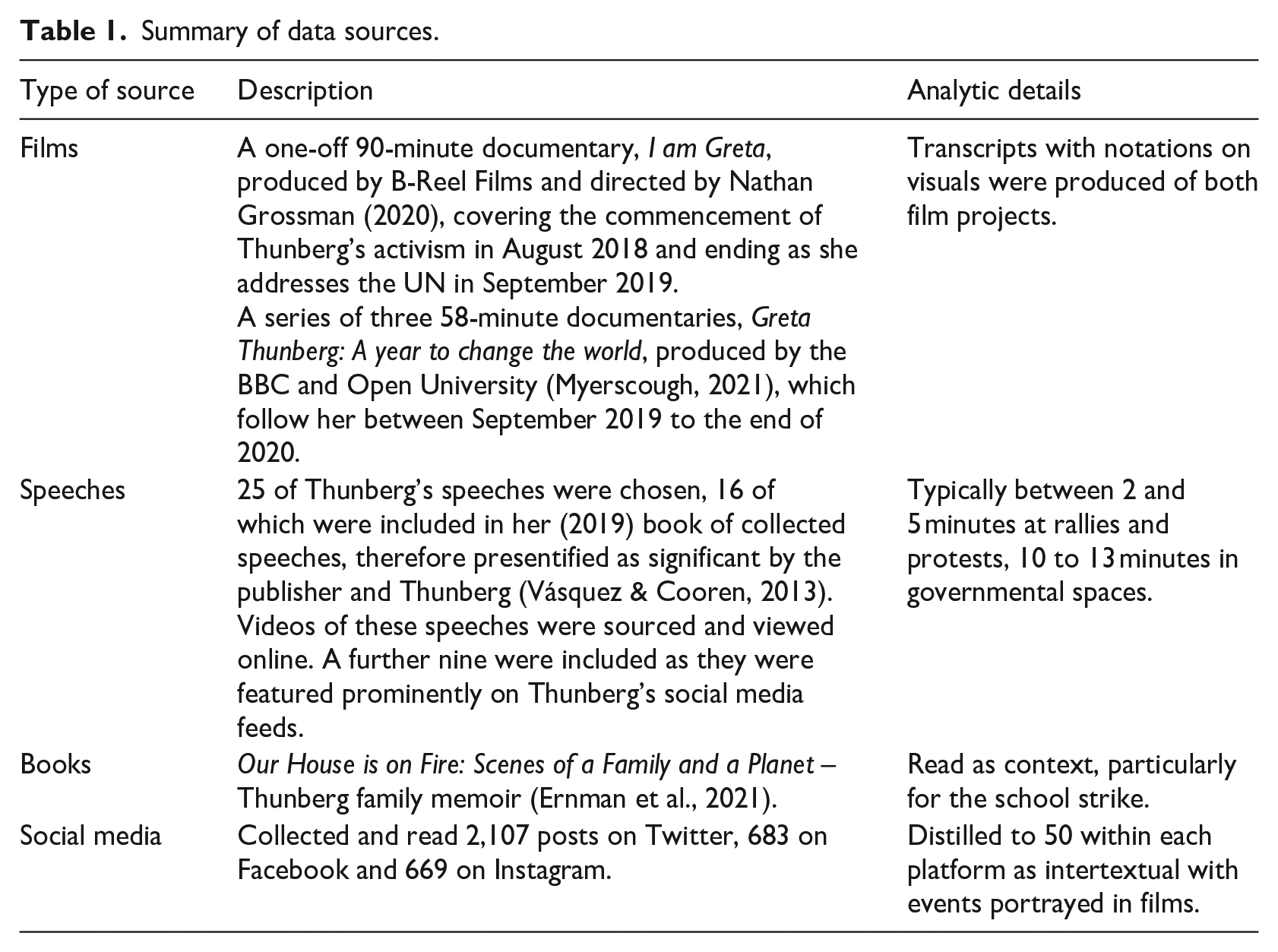
Although the book and social media did not feature prominently in the eventual write-up of the findings, the images and accompanying texts provided insight into which moments within the moving images of the films ‘Thunberg’ deemed significant. Having followed the process of coding, thematizing and analysis outlined below, data were included in the presentation of the four stories-so-far and associated practices due to their ‘evocative power’ (Smolović Jones et al., 2021, p. 924) to situate the reader within the spaces and spacing practices of an emerging Thunberg-the-Leader. Together, these sources offer ‘particular constructions . . . social protocols of knowledge and institutionalized practice’ (Cunliffe & Coupland, 2012, p. 71).
Data analysis
Figure 1 summarizes our analytic process:
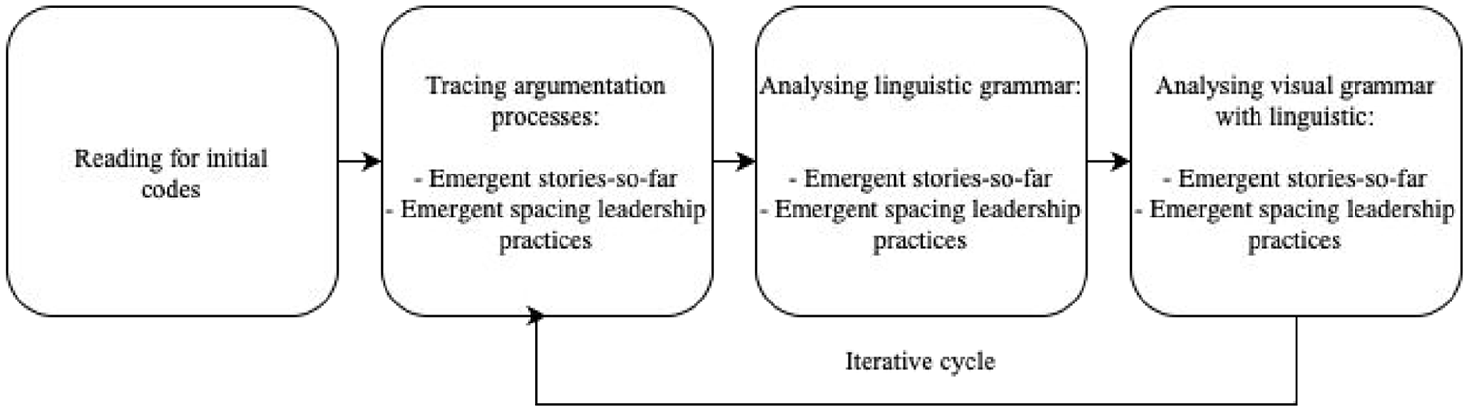
Analysing for stories-so-far and spacing leadership practices.
First, we watched the video footage multiple times, assigning provisional codes, sharing interpretations between viewings, making notes of the language used and imagery on display (Shao & Janssens, 2022). Examples of provisional codes were: ‘imposing buildings’; ‘embracing animals’; ‘small body contrast’; ‘arduous travel’; ‘laughter/fun’; ‘followers in crowds’. For the second and third steps, we ‘artificially separated’ language and visuals, prior to ‘reassembl[ing] them to reconstruct’ stories-so-far of the materializing Thunberg-figures and spacing practices of leadership (Höllerer et al., 2018, p. 624) in our final step. For Step 2, we traced argumentation process, important for understanding frames of reference significant for Thunberg-figures and those interacted with, paying attention to the resources drawn on to fortify or problematize arguments (Smolović Jones et al., 2021). Step 3 involved studying grammar units and their performativity within the argumentation process. It was important to analyse transitivity (Wodak, Kwon, & Clarke, 2011), how a verb bears on an object in a sentence, denoting a type of relation. For example, in the ‘how dare you’ speech, the Activist inverts the power dynamics within the room (masses of political leaders bearing down upon her) through the transitivity effect within the sentence ‘My message is that we’ll be watching you’. Pronoun use was also significant (Harding, Ford, & Lee, 2017), as it can indicate a collective or individual sense of agency.
The fourth and most substantial step involved exploring how the ‘visual overlapped and co-constituted the linguistic’ (Smolović Jones et al., 2021, p. 923) and the associations they evoke in particular contexts (Elliott & Stead, 2018). Of importance was to explore elements CCO considers ventriloquized (giving voice or being animated by figures (Meier & Carroll, 2020)), such as settings, objects and people, the relationship between these and how they enact meaning (Machin & Mayr, 2012). In analysing video, it was therefore important to observe how objects and people were staged and authorized, as such choices confer claims of legitimacy and power. Objects were analysed, in relation to the ‘Thunberg’-figures and their colour, size, focus, location (their ‘grammar’) (Crawford, Toubiana, & Coslor, 2024). The positioning of people in terms of their agency, transitivity and angle of shot was also analysed (Machin & Mayr, 2012). Agency can be perceived through the visual positioning of people, while transitivity focuses attention on how people or objects are acting on others (Smolović Jones et al., 2021), surfacing who or what appears active or passive. For example, focusing on angle provided insight into the level of engagement the communication demanded – whether the viewer was addressed directly or positioned as an observer to unfolding action. To conclude Step 4, we incorporated social media posts and the family memoir, using these to add further texture, before repeating the cycle of Steps 2 to 4 until we settled on the four stories-so-far and their co-constitutive practices. This process was iterative. We surfaced provisional Thunberg-figures and practices as we proceeded through the stages of analysis, refining them by working through the analytical cycles. For example, an initially posited ‘Social-Actor’ became ‘Activist’ to highlight the significance of the spaces through which the figure was communicated.
Four Stories-so-far
We now present analysis of four figures of ‘Thunberg’, storied spatially in ways that together crystallize into a viable and legitimate Leader-figure. While these figures cannot be said to constitute the leadership practice at work, they are figures through and into which spatial forms of leadership practice pass, as will be elaborated upon in the discussion.
Story-so-far One: The Child
The figure of the Child is presentified (Vásquez & Cooren, 2013) in embodied ways (Pullen & Vachhani, 2021; Ropo & Salovaara, 2019), her small frame materializing within what are communicated as the nurturing spaces of family. Moving away from such spaces, the Child interacts with the spaces and objects of institutionalized power to constitute the potential agency of ordinary people. In materializing the Leader, the smallness of the Child-figure is made into a virtue.
The Child’s communication on climate often involves shrinking the size of the problem to something comprehensible. Speeches are awash in references to her size and the modest place from which she is constituting leadership across global space. In her speech to the UN Climate Change Conference on 12 December 2018, for example, she is communicated as small against the large stage and assembled audience, stating that ‘Sweden is just a small country’ but that ‘no one is too small to make a difference’ (Thunberg, 2019, p. 12). The spatial source of this materializing is constituted through presentifying the Child within the spaces, and amid the objects, of the family unit. The Thunberg family is presented, in the documentaries and in the stories within the pages of the Thunberg family memoir (Ernman et al., 2021), as a relational source of agency – of intercorporeal connection (Pullen & Rhodes, 2014; Pullen & Vachhani, 2021). Norms of the patriarchal family unit are challenged, as adults learn the importance of sustainability from children within domestic spaces. As both the book and documentaries proceed, home spaces are communicated as therapeutic, centres of convalescence, recovery and sustenance. The Child gains strength and connection intercorporeally as she strokes her horse, hugs her dog and makes food with her mother – the visual transitivity is of an active verb (hugging, stroking, making) playing out upon the nouns (child, animals, mother, food) to generate an ambience of tranquillity. What is presentified through communicating the Child are the necessary dependencies between people, animals and home spaces, which, when the family unit is made more egalitarian, nurture and sustain the materializing of the Leader (Massey, 2005).
Yet these are also spaces from which the becoming-leader of the Child is ejected – into new spaces that make her appear small. Power is evoked early in Thunberg’s speeches as residing in government spaces (rather than corporate spaces). Throughout the documentaries, her small size is contrasted to spaces of political governance – large, grand and domineering. In the early scenes of I am Greta (Grossman, 2020), the Child is presentified with plain, comfortable clothes and a DIY sign, against the enduring and imposing spaces of government. Filming her first, lone protest outside the Swedish parliament, the camera presents the Child from behind, a small figure framed by a stone arch opening into a large compound and another grand arch (Figure 2).
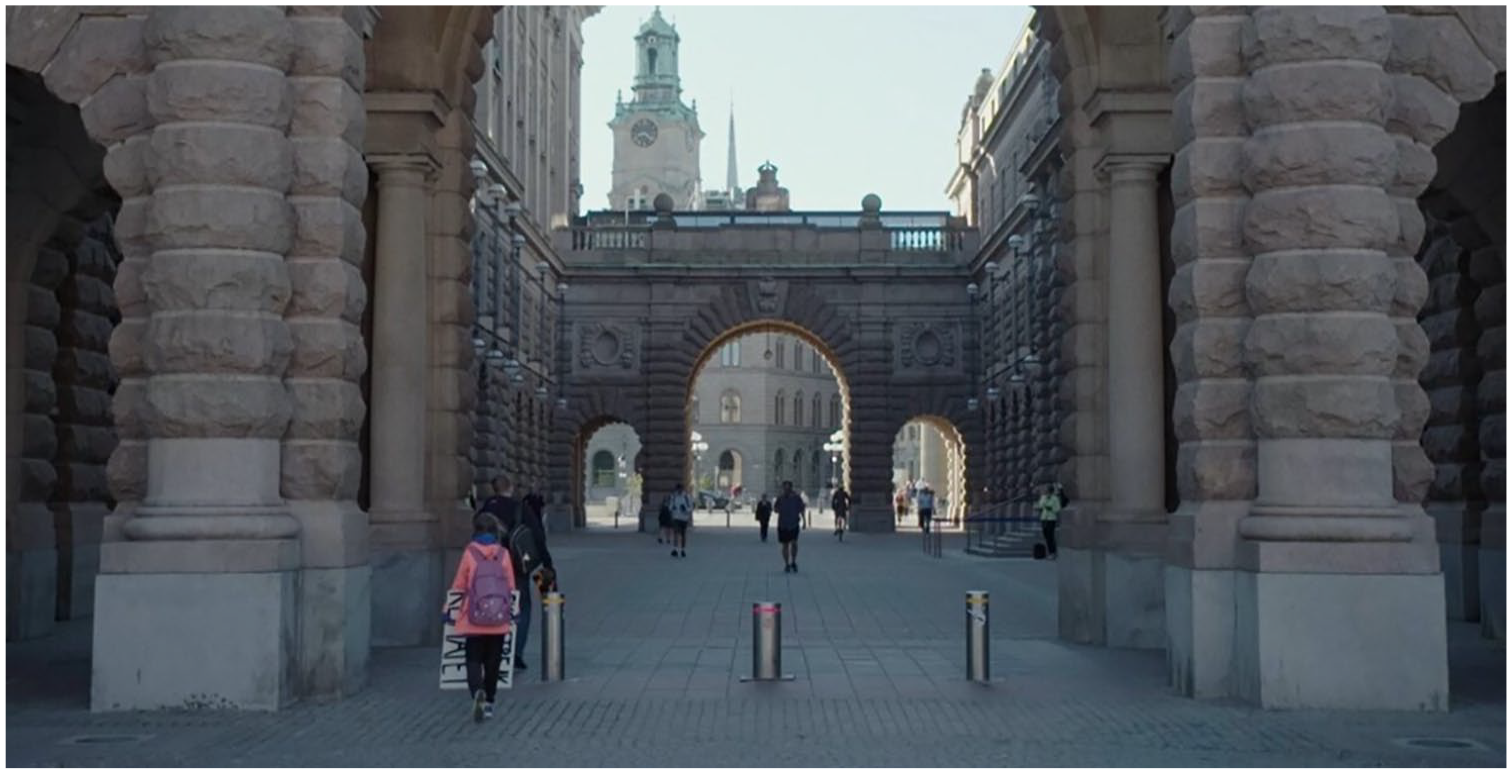
The Child steps into governmental space (Grossman, 2020).
The Child is small, left of centre with a pink coat and backpack. The presentification is of someone removed from her normal spaces: she places her small pile of plain home-made leaflets on the floor and her placard against a wall, sitting back against it, knees up, crossed arms. In a post on Facebook on 2 February 2019 (Figure 3), the photograph stages the Child as a body ‘out of place’ (Puwar, 2004, p. 8), sat in front of the parliament, looking directly at us.
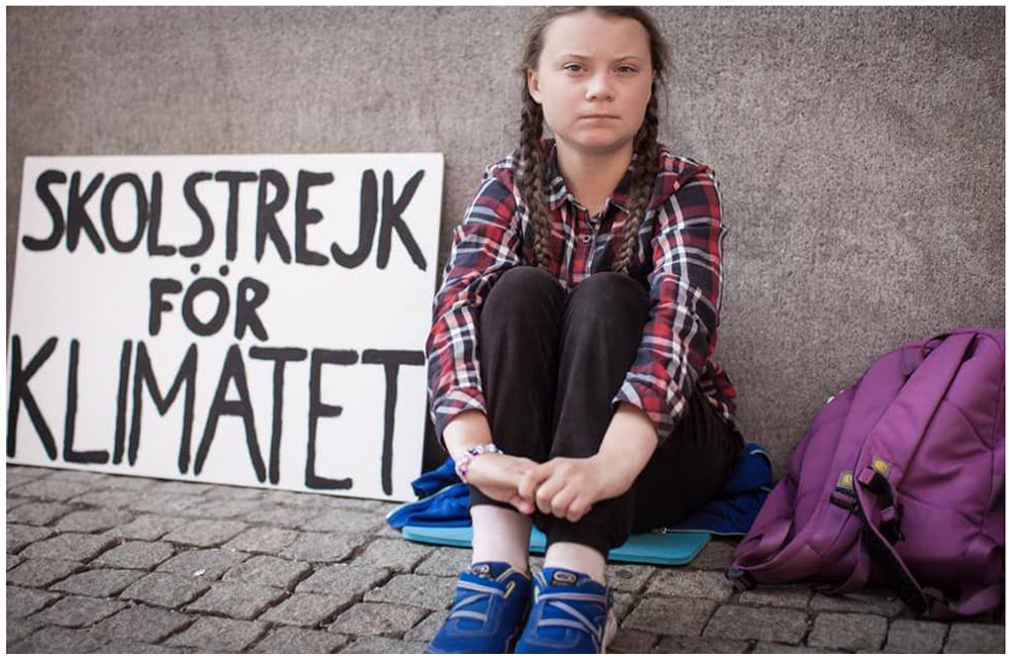
The Child demands a response.
The visual presents the Child at the same level as the viewer, her body filling the centre of the frame, demanding a response. The text of the post enriches the sense of a child-out-of-place: ‘I’m too young to do this. We children shouldn’t have to do this. But since no one is doing anything . . . we feel like we have to continue.’ The incongruity of the small, child-like body misplaced is enlivened by the simple use of pronouns (Harding et al., 2017) – the first person denoting her taking responsibility for a problem that is too big for her alone, and the collective ‘we’ of ‘children’ contrasting with the generalized mass of ‘no one’ ‘doing anything’.
Back in the film of her first protest, the Child is alone in shot, filmed straight on, but looks away to the side, as if troubled by something outside the immediate scene. A stream of people walk past without engaging. The Child is one small body among many. A voiceover of the Child cuts in over the top: ‘Adults always say one thing and then do something completely different.’ The transitivity of adults ‘saying’ one thing but doing another, is brought to bear visually by the parade of people ignoring the Child. However, in a wide shot, an older woman does stop (Figure 4).
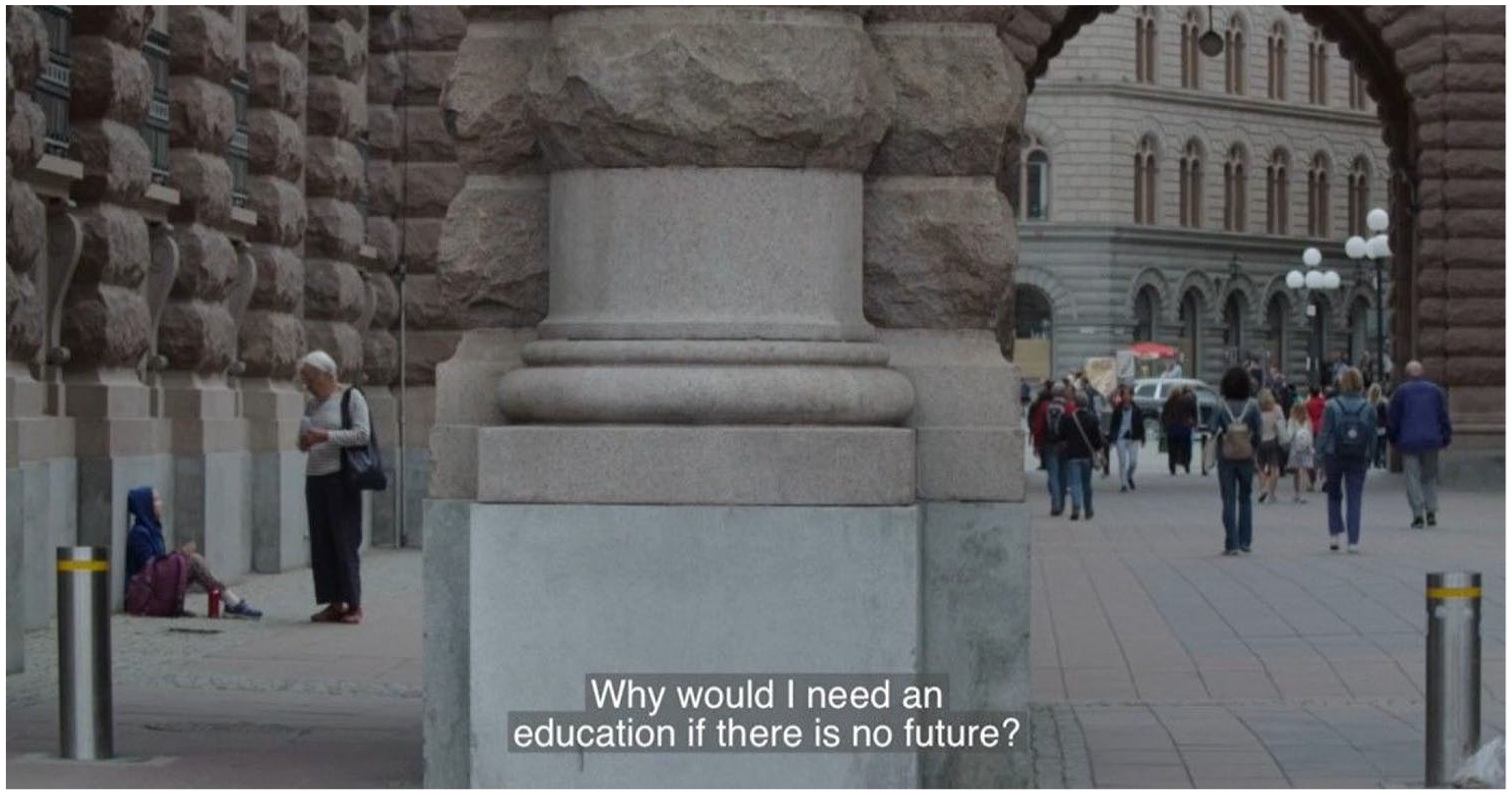
The Child’s first encounter (Grossman, 2020).
They are filmed on the left of the screen, with around 80 per cent of the frame taken up by pedestrian traffic, disconnected from the Child. The woman sounds caring but concerned:
For us old people it’s too late.
It’s not too late.
I agree with you that we’re not doing enough. I don’t think a strike is the right thing.
Ok.
But you think it is. I don’t. For how long are you on strike?
Until the election.
[looking downwards] Yeah. [she leaves]
This scene is a ‘throwingtogether’ of the trajectories of intergenerational bodies in a ‘happenstance’ way, a spatial dynamic Massey (2005) holds as engendering the capacity for enlivening democratic encounters. Yet here the encounter reaffirms their separate spatialities – as the woman walks away, the Child looks in her direction, frowning, an intercorporeal materializing of a central trope of the story-so-far of the Child, a child feeling compelled to leave their spatiality (Massey, 1992, 1995) to become a body-out-of-place, while the adult body is immovable in its spatiality (‘it’s too late’).
Eventually a voice of a younger woman looking over the Child, asks in a gentle tone if she can sit with her – an intercorporeal effect of happenstance as two spatial trajectories collide. Other younger people start to stop, asking questions and telling the Child that what she is doing is ‘cool’. There is now a huddle of people around the Child, her child-like naivety presentified through a simple request that they read her leaflet, which is a ‘fact sheet, there are sources’ (Figure 5).
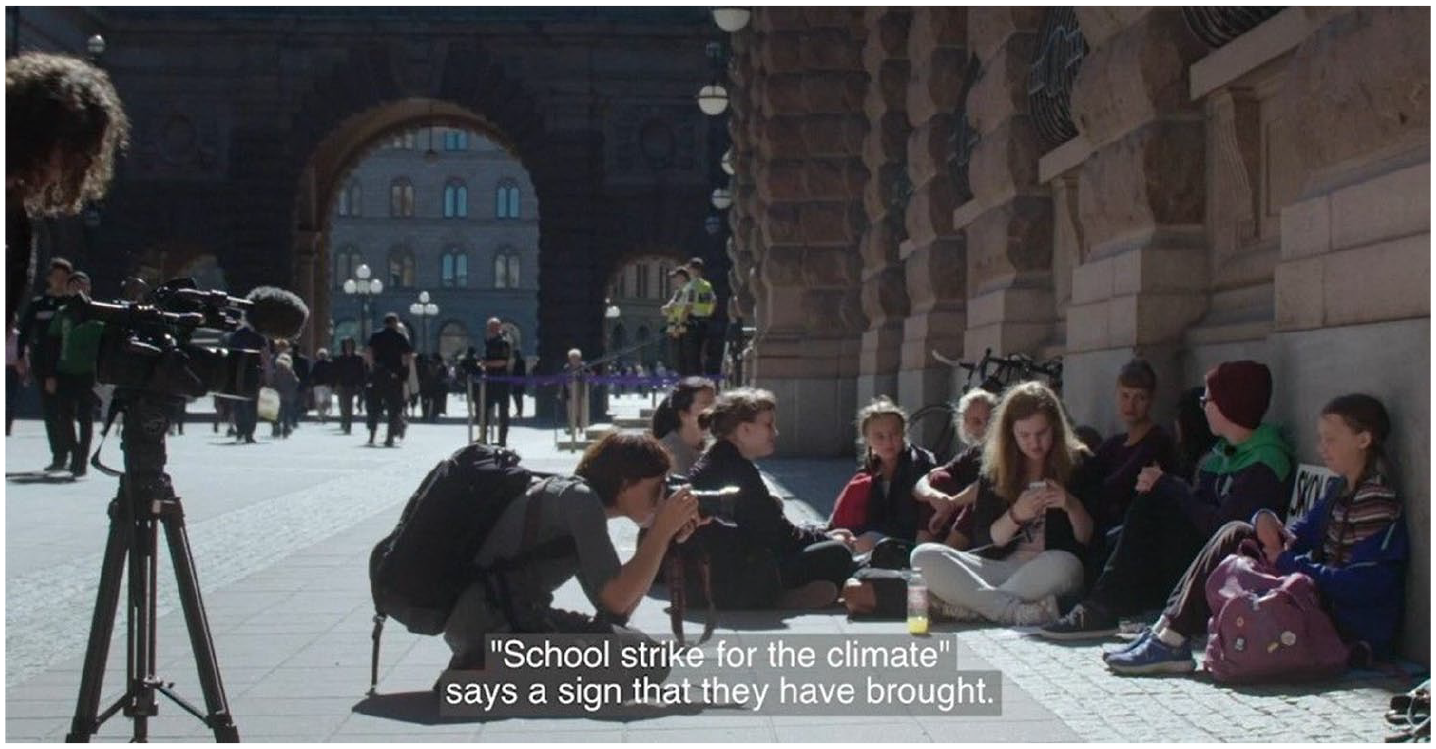
‘Thunberg’s’ leadership gains momentum (Grossman, 2020).
This is still a small group, contrasted on the right of the frame against the imposing square. Yet also in shot are a video camera and photographer, indicating a nascent materializing of an alternative spatiality of activism. On social media, the movement from lone figure to community of striking young people is reflected in the dynamic of Thunberg’s Instagram wall – early posts of her solitary acts transiting to pictures of ever greater clusters of people. The Child starts to materialize into the Activist.
Story-so-far Two: The Traveller
The Traveller is a figure constituted in ways that communicate the power and gift of a first, primal nature, in contrast to the synthetic, capitalized second nature (Smith, 2010). Underlying this constitution is the message that humans have overstepped their boundaries within nature. In this communication, the Traveller’s (small) body is presentified (Vásquez & Cooren, 2013) as being subjected to long, arduous journeys by rail and boat, in defiance of the carbon-emitting technologies of second nature.
In constituting the brute reality of natural space, the Traveller is figured by filmmakers in vulnerable terms, the presentifying of her body – with trains, boats, waves, storms and cameras – as exposed to arduous journeys, communicating the unreality of the proposition that space can be folded in on itself without consequence. Early in the story-so-far, travel seems playful – the Traveller and her father shown laughing in the car, playing in the wind (Grossman, 2020). As time passes, the absoluteness of space is introduced by filmmakers as a series of ordeals. As the Traveller leaves home for a boat to New York, she is surrounded by passengers standing on a train, crying because she will miss months with her family. Over the top of the images, her voiceover states that she travels this way ‘because by taking a boat, it shows that it’s basically impossible to live sustainably today’. The transitivity underlines the gruelling nature of leadership on the body – to ‘take’ the long way is ‘impossible’.
Aboard the boat, we see the Traveller’s exposure to first nature in a visceral way. She feels sick, going outside for relief. The camera shakes, water splashing up. She sits, crying. On day six of the journey, we hear via a close-up sequence of an awed Traveller that ‘it’s the middle of the night and the lightning was unbelievable. I’ve never seen . . . such lightning.’ Later, the film communicates the Traveller looking out to sea, the camera rocking with the waves, the positioning of her body, back turned to camera, signalling contemplation of the human relation to ‘first’ nature (Smith, 2010) (Figure 6).
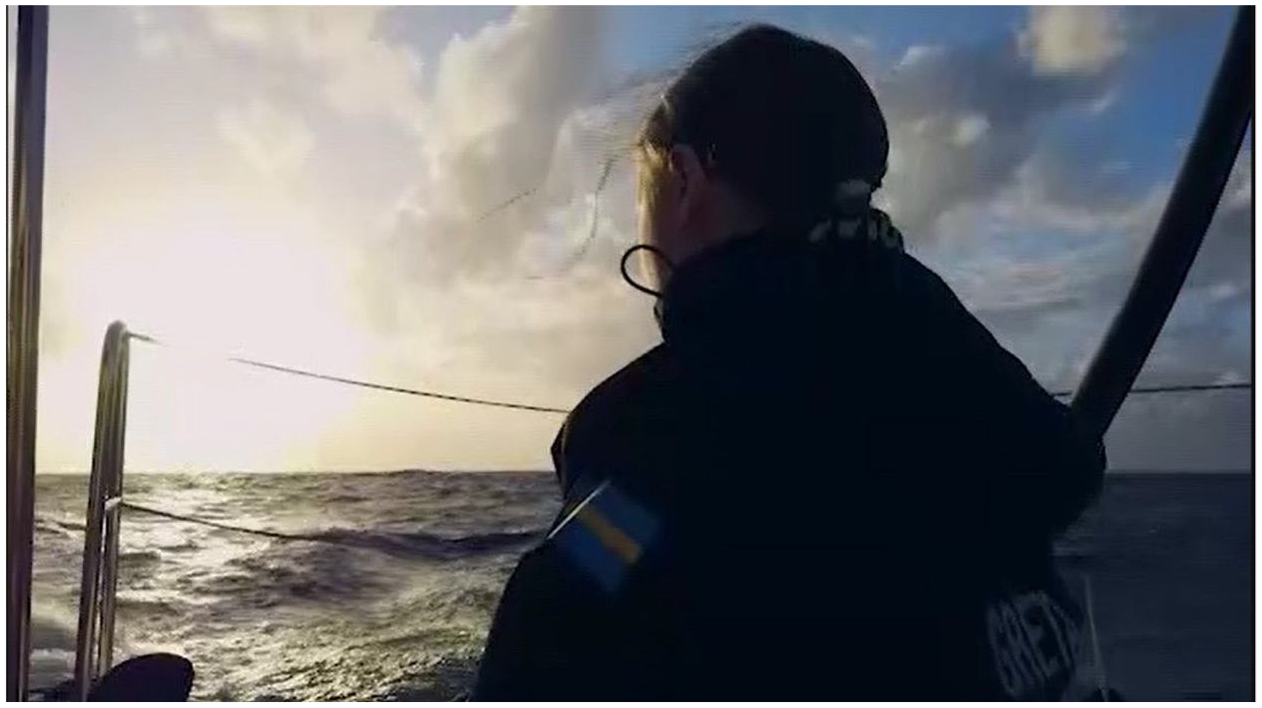
The Traveller contemplates first nature (Grossman, 2020).
Thunberg’s voiceover signals that such insights are mediated by spatial contrast: ‘You see how big the world actually is . . . You come from nothing, just you and the ocean, and then suddenly land, and all that comes with that. Pollution, all the noises.’ The ‘vastness’ of nature is constituted by a coming together of a panoramic visual and a contemplative, meandering sentence construction. That her figuration as a leader who travels is a privileged one is communicated through transitivity – she has been able to ‘see’ nature’s truths and can therefore understand their significance. This ‘seeing’ is revealed as an embodied constitution (Pullen & Vachhani, 2021; Ropo & Salovaara, 2019) – materializing through her body’s contrasting exposures to first and second nature. Even though the intrusions of first nature are potentially dangerous, it is second nature that her body repels, communicated through staccato nouns – ‘pollution’, ‘noises’. This contrasting effect is given political meaning as the Traveller approaches New York from the sea: an unreal urban space in contrast to spaces left behind. Between these spaces, the Traveller is presentified as possessing knowledge of primal truths, while political leaders are communicated as weaving ‘fairy tales’, ‘telling us bedtime stories that soothe us, that make us go back to sleep’ (Thunberg, 2019, p. 86). The politicians offer a story-so-far in opposition to the Traveller’s emergent leadership, which seeks to communicate authority through the body’s exposure to often uncomfortable, sometimes threatening and occasionally inspiring space.
Story-so-far Three: The Activist
The Activist is presentified in three movements. First, as an inversion and destabilizing of power geometries. Second, the distribution of bodies in space is re-constituted in throwingtogether (Massey, 2005) through a storying by political actors that seeks to co-opt the Activist within powerful spaces. Third, as the Activist rejects such re-ordering and the spatial novelty of ‘Thunberg’s’ body-out-of-place (Puwar, 2004) wanes, the power geometry reasserts itself through restricting access and movement.
Within weeks of beginning her protest, the Activist is invited into powerful political spaces. Arriving at her first engagement with the UN in 2018, at COP 24 in Poland, she is immediately presentified as unimpressed (Grossman, 2020). Walking through a giant hall, she notices the objects of meat and dairy on offer from big corporations, dismissing the disjuncture between the rhetoric and actions of political power. In an institutional space, around a meeting table, Niclas Svenningsen, a UN official, reproduces the power geometry, explaining to the Activist that she is ‘lucky’ to share space with the Secretary General. The Activist is presentified in this institutional space as passive. Yet, in the ensuing meeting, seated around a circular table of delegates and the Secretary General, evenly spaced out, there is a throwntogetherness, as the Activist asserts the presence of her body-out-of-place, stating that the politicians ‘are behaving like children’ (Grossman, 2020).
Communicatively constituted at the UN’s Climate Action Summit in New York, the Activist’s materializing is asserted through her ‘how dare you’ speech. The speech was delivered in a large hall containing the world’s most powerful, mostly male political leaders, who are shown by the camera mingling in laughter, shaking hands (Grossman, 2020), acts of intercorporeal, mutual congratulation that communicate the power geometry of the space. Nevertheless, the Activist forces a throwntogetherness, saying: My message is that we'll be watching you [audience applause, followed by laughter, more clapping and some cheers] . . . You all come to us young people for hope. How dare you! You have stolen my dreams and my childhood with your empty words . . . All you can talk about is money and fairy tales of eternal economic growth. How dare you! [audience gasps of ‘Woah, ooh’, followed by scattered applause, cheering and sustained applause]. (NPR, 2019, abridged)
It is unusual to see such a direct and angry materializing of leadership. Here is the figure of a teenage girl – a body-out-of-place – throwntogether in space with political leaders, telling them directly that they have betrayed her – an inversion of the power geometry. Yet this is also a space of ambiguity, signalled by the emergence of co-opting, constituted through audience applause and cheers. Perhaps the audience laughs when the Activist tells them she is watching because it is a brazen – and likely inaccurate – inversion of the power dynamic – it is states that operate surveillance. There could also be a sense of unease, as audience members experience the geometry shifting. From here, the audience applauds and cheers, even as the teenage-Activist condemns them. This could be an attempt to re-stablish the geometry, communicating the event as consensual through clapping hands and vocalizing agreement – an attempted co-opting. Audience responses within the space are not uniform, however:
The then German Chancellor Angela Merkel is shown looking on with a concerned expression, the Brazilian and Saudi Arabian delegations listen impassively and, of the two people shown in the China delegation, one displays no emotion and the other is absorbed in her tablet (Figure 7). The power the Activist struggles against is communicated as heterogeneously and unevenly spaced within the geometry, inviting speculation from the viewer: many leaders need the pressure of the larger movement to gain traction; some are cynical; or genuinely concerned; others remain unmoved.
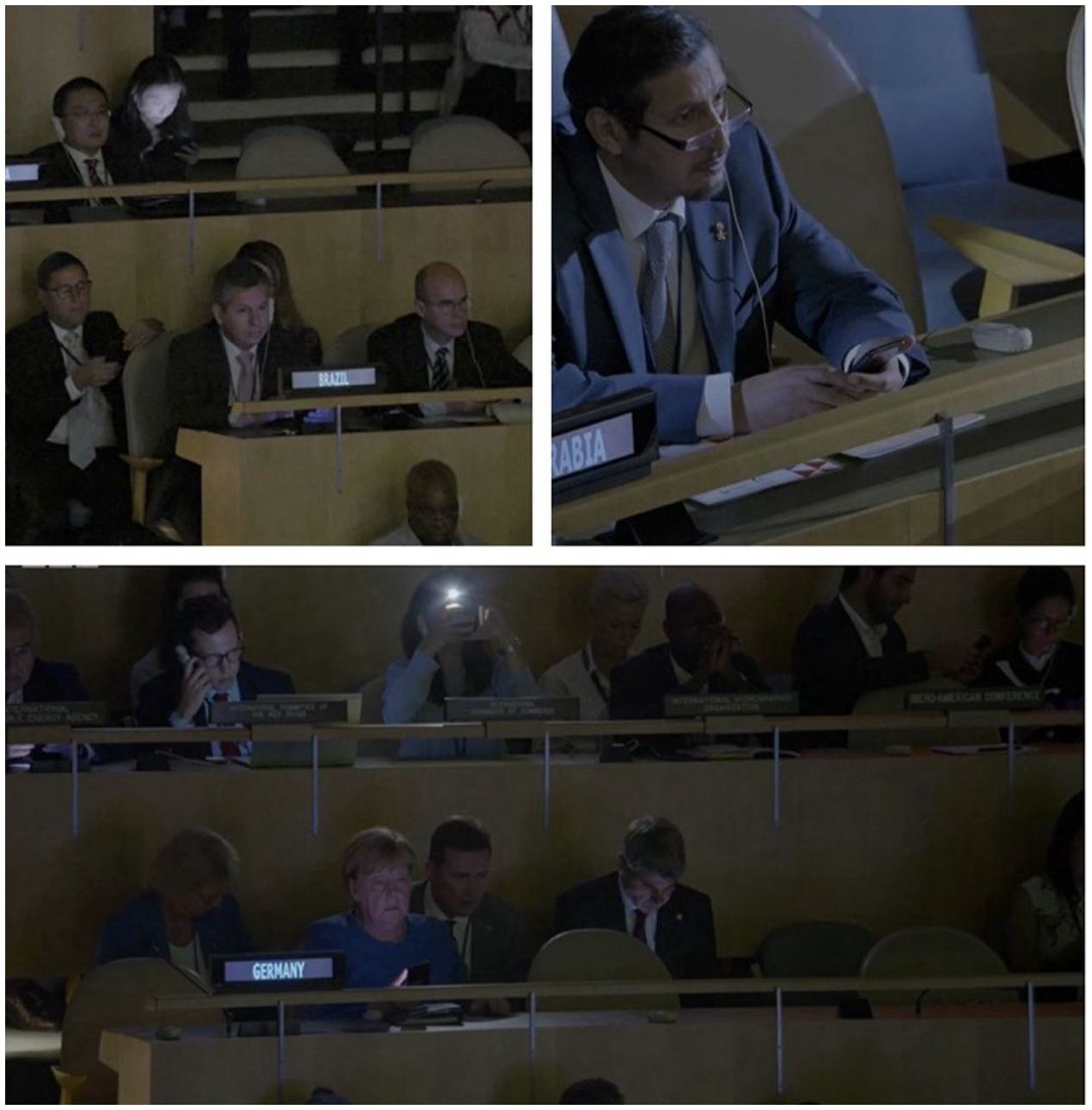
Responses to the Activist’s speech vary (Grossman, 2020).
The Activist’s isolation as a body-out-of-place is communicated by the filmmakers, who pan out, a small body shot from above on the far right of the frame, while most of the space is consumed by representatives of political power, bearing down upon her (Figure 8). However, such power – and the top-down camera angle – are soon inverted by the phrase: ‘The eyes of all future generations are upon you.’ This is a communication that re-spaces the scene. It is no longer a power geometry of political leaders bearing down on the Activist, but the masses of television viewers outside the frame in their own spaces looking in and down at the unfolding scene. The Activist is presentified as a materializing Leader through a discursive-visual communication of a mass power geometry of ‘all future generations’, re-ordering (Vásquez & Cooren, 2013) the agency of actors.
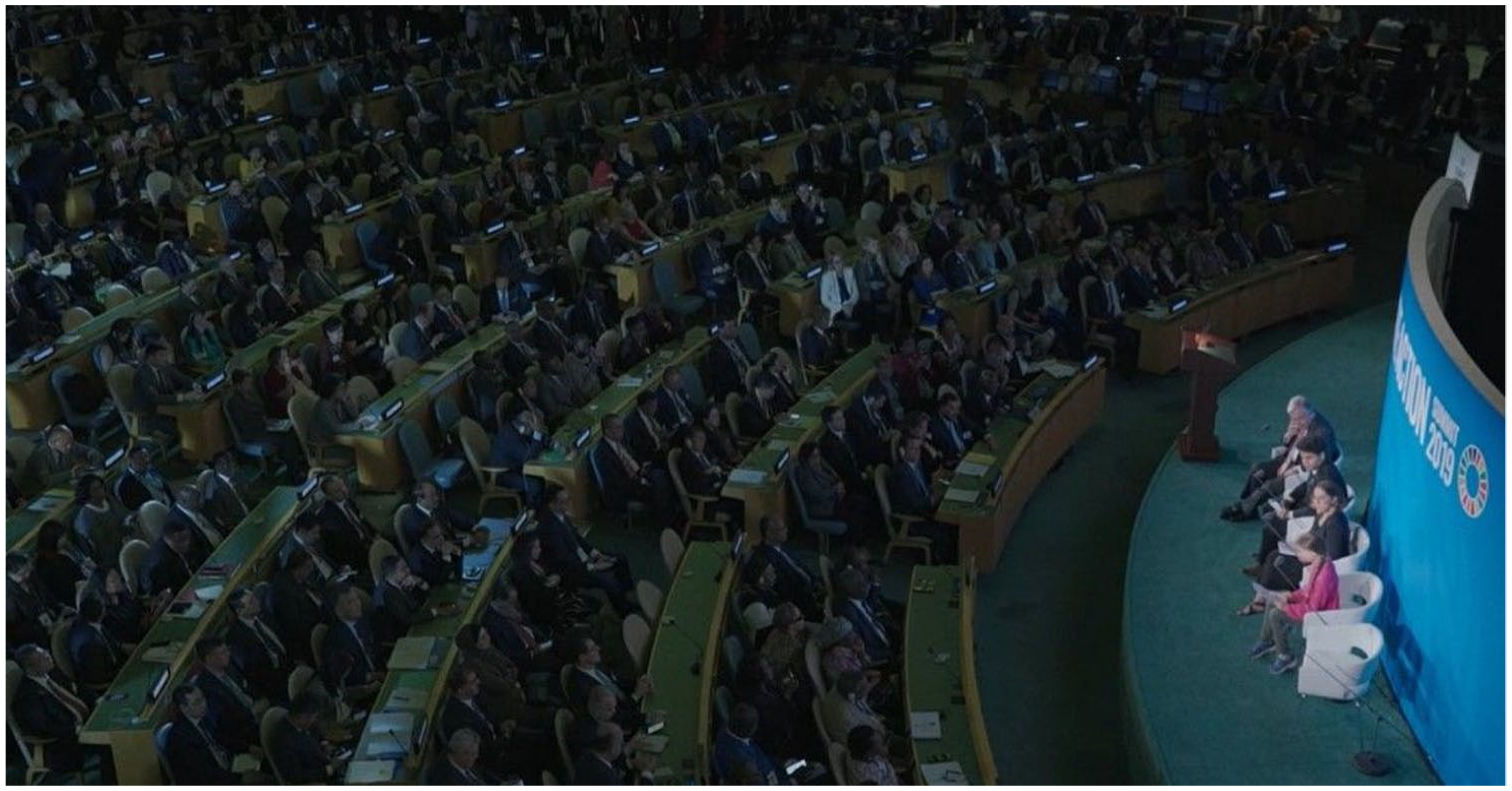
Gazing down on power (Grossman, 2020).
Despite such communicative re-spacing, it is notable that the Activist largely materializes in centres of national and international governance. There is a co-opting in play, as those in positions of power extend the boundaries of their power geometry. As time passes, the co-opting dynamics seem to test the Activist’s patience, as she transits from one governmental space to another. The Activist states in a voiceover to a meeting with Angela Merkel on 20 August 2020, over footage of the familiar greeting-and-handshake in government space (Myerscough, 2021): [Politicians] have a long monologue about everything they do . . . ‘Yeah, that’s great but it’s not in line with the Paris Agreement that you have signed’ . . . ‘Yeah, we know you think that this is not enough but at least it’s something’ . . . ‘No. Like scientifically, is this in line with what you have promised to do? And the fact is, no.’
The formulaic nature of co-opting – as well as the constitution of the Activist as a body-out-of-place, is communicated through a sarcastic adjectival representation (‘long monologue’; ‘everything they do’; ‘that’s great’) contrasted with the common sense of children represented in a repeated simple declarative assertion – ‘no’. Yet despite deflating rhetoric, the geometry locks in stasis, governing spaces communicated as ones of stalemate.
Gradually, however, such spaces begin to be closed off to the Activist. She was not invited to address COP 26 in the UK. Politicians do not flock to her for photographs and she no longer visits their spaces of power. A spatial view allows sight of the possibility that any reordering of power geometries was temporary – with the Activist being led by the spatial flows of global political and economic power, forced to adapt her body to their spaces. This following is evident in the BBC/OU documentary series (Myerscough, 2021). The Activist travels through North America, highlighting climate change events. Her trip is meant to include a programme of visits in Latin America, including campaigning and a speech at the UN’s COP 25 in Chile. The Chilean government, however, cancels COP following a period of protests against economic inequality, deprivation and privatization, the summit moving to Spain. Political leaders apply a ‘spatial fix’ to the problem (Harvey, 2018, p. 427). While the change appears unremarkable for political, business and NGO leaders – a flight to one location rather than another – for the Activist, the consequences on body are significant.
Story-so-far Four: The Learner
The premise of the BBC/OU series (Myerscough, 2021) is that insights from science intersperse with Thunberg visiting climate hotspots. The Learner is a figure whose communicative constitution makes space for scientists – figured as having little voice prior to their encounters with the Learner – to articulate problems and solutions, a strategy adopted later for her edited The Climate Book (Thunberg, 2022). Hence, mixed in with the Learner’s visit with coal miners in Poland is a section with scientists explaining why fossil consumption is damaging. A materializing is generated through montage – movement from scarred landscape to dialogue with energy researcher Hanna Brauers, as they look down upon a vast mine; the film cutting to other scientists who address viewers directly, using declarative verbs: ‘We need a very rapid but carefully managed transition’.
The Learner communicates from the beginning that her purpose is to occupy space in order to give it away to science. For example, she tells an EU committee in February 2019: ‘We know that most politicians don’t want to talk to us. Good, we don’t want to talk to them either. We want them to talk to the scientists instead’ (Thunberg, 2019, p. 33). At play in the Learner’s argumentation is perhaps a child-like trustfulness of the motives and capacities of people at large. Her speeches are awash in assumptions that if only people ‘knew’ about the seriousness of climate change, they would take it more seriously. She is positioned as using her profile to reach new spaces, increasing awareness of facts. It is a logical argumentation, yet also one that downplays the economics at play. For example, in the sequence of mining visuals depicted in Figure 9, notable by its absence is a discussion of the interplay between economic and political interests.
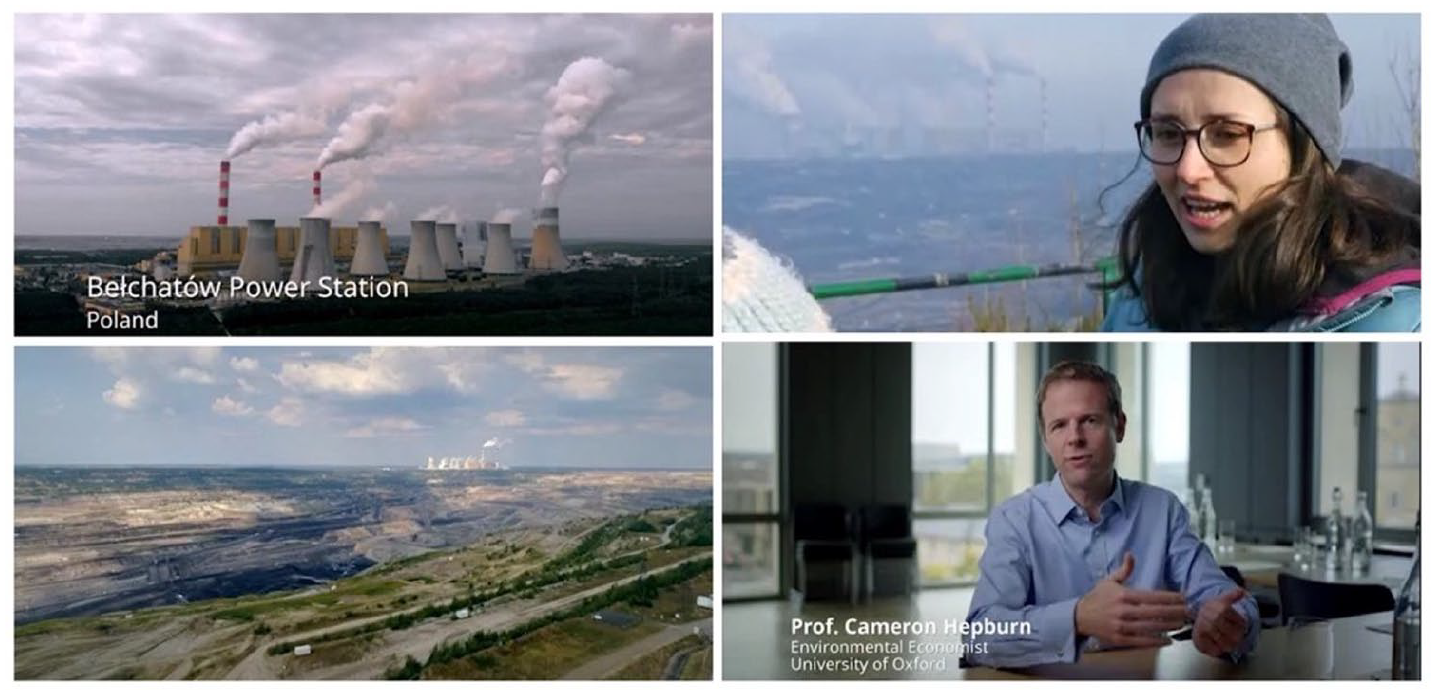
The Learner makes space for science (Myerscough, 2021).
The Learner also materializes through her relationship to the crowds that form part of the climate movement. In constituting the Learner, ‘Thunberg’ is vacated from her position of prominence, making space for activists – her automated email response around COP 26, for example, communicating that journalists and academics should ‘interview the other activists’ (personal email, 2021). Opening space for activists comes at a price of needing to navigate the discomforts of second nature (Smith, 2010). In both documentaries, she is surrounded by camera clacks and flashes: mobbed, berated, threatened, adored, cheered, applauded. Such spatial immersion in second nature reminds us of its unnatural tolls on the body – re-materializing the Child who is being constituted as a Leader in spaces of politics and activism.
Discussion: Theorizing Spacing Leadership Practices
In this section we offer a model that theorizes the underlying spacing practices (Vásquez & Cooren, 2013) that cut across and move through the figured stories-so-far. We underpin the model with relevant theory in critical geography, CCO and leadership studies. In doing so, we elaborate on our key contribution, showing how zooming out with a spatial analysis enables a decentring of materializing leadership, taking account of bodies and objects but also paying heed to what surrounds and brings these together – the spatial ‘relations between’ (Massey, 2005, p. 23). Doing so surfaces some of the spatially constitutive and contested social, political and economic relations that might otherwise have remained implicit. The four spacing practices will now be discussed.
Shrinking
Shrinking constitutes leaders and leadership in decentred, embodied and non-patriarchal terms (Table 2).
Shrinking practice summary.
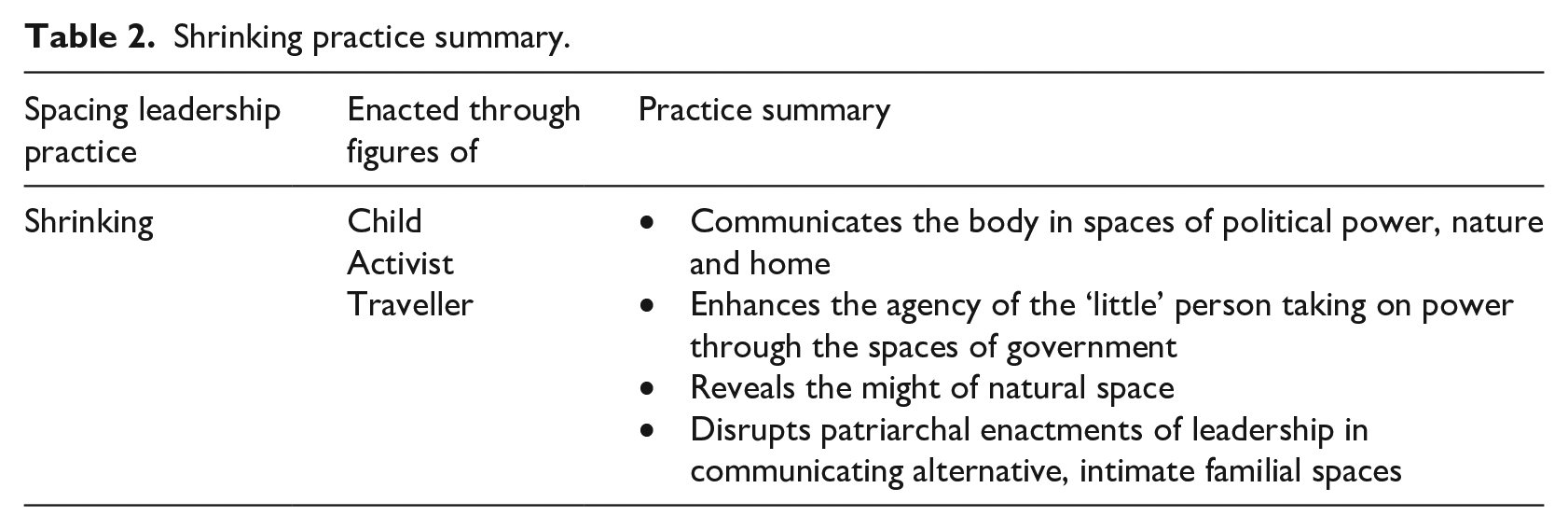
Shrinking is communicated in two ways. First, through the presentification (Vásquez & Cooren, 2013) of the body in spaces of power. For example, the Activist is constituted rhetorically through being made ‘small’, evoking the integrity and honesty of the ‘normal person’. Such a presentification is co-constituted through the objects upon and surrounding the Activist and Traveller (Ford et al., 2017; Hawkins, 2015) – practical clothes, handmade placards and leaflets – materializing a leader in ways that make a virtue of her size. Looking beyond bodies and objects, however, enables a view of the spatial structures that bodies and objects work within and through – e.g. the materializing leader and leadership constituted through the small frame of the figures in relation to imposing spaces of governmental power. Political leaders in rows of seats, corporations in summit halls, government buildings, ocean waves, coal-mined landscapes, scientific evidence and storms – bear down spatially on this shrinking body ‘out of place’ (Puwar, 2004, p. 8).
The second way in which shrinking operates communicatively is through re-constituting the leader and leadership in egalitarian terms. Leadership studies, in common with organization studies in general, tends to elide the reproductive spaces that sustain leaders and followers. These spaces and the actors who tend to them are made invisible, with significant gendered implications – the usually male leader employed by an organization is centred as a grounding figure, around whom a supporting cast of barely visible people and objects turn (Fotaki, 2013; Pullen & Vachhani, 2021). Shrinking practice challenges such constructions by drawing in spaces, actors and objects overlooked by the patriarchal gaze. The Child is communicated as shrinking space, with the spaces that nurture her evoked as intimate – where she gains sustenance from intercorporeal engagement (Pullen & Vachhani, 2021; Smolović Jones et al., 2021). Here the body itself may be thought of as a space, with skin as its boundary (Adams-Hutcheson, 2017), enhancing a sensuous view of the relationship between body and space (Ropo & Salovaara, 2019).
Naturalizing
Naturalizing communicates the pre-eminence of primal, ‘first nature’ (Smith, 2010). It also communicates the destruction that the politics and economics of human-made second nature affects first (Smith, 2010) (Table 3).
Naturalizing practice summary.
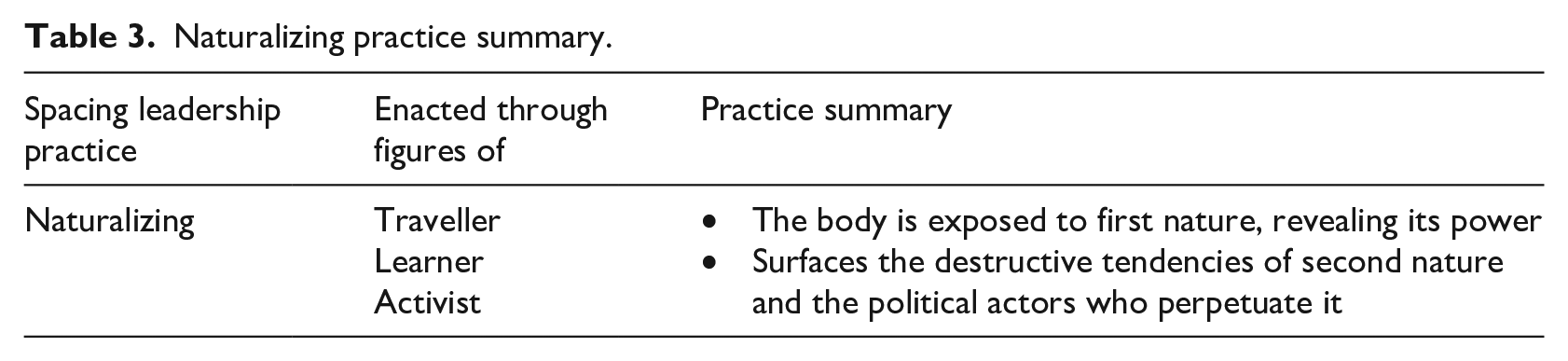
The powers of natural space are constituted through the body’s interactions with it, communicating an embodied authority of an emergent leader. Conceptually, leadership can be constituted by figures stepping outside their regular spatialities (Massey, 1992, 1995), into naturalized spaces of happenstance and throwntogetherness (Massey, 2005) – e.g. thrown around and gently rocked by nature’s waves, blown playfully by its winds, drenched by its rains. The communicative effect is showing that human beings are part of nature, so can never truly control it from an outside space. Such a tangible, embodied emergence of leadership communicates a material decentring that escapes the preoccupation of environmental leadership studies (Case et al., 2015) and sometimes practice (Fotaki & Foroughi, 2022) with the individual–collective leadership binary.
The leadership that is constituted materializes through moments of bodily discomfort, even at times of danger to the self, e.g. as bodies exposed to storms, pressing crowds, and so on. Leadership is thus an effect of the spatial-material communication of many actors rather than being the property of an individual human, collective or cluster of objects. The theorizing of naturalizing also contrasts with the spatial and embodied leadership literature to date, which tends to emphasize embodied relations in space in positive terms as generative, even beautiful, opening new possibilities for discovery and affect (e.g. Carroll & Smolović Jones, 2018; Ladkin, 2008; Ropo & Salovaara, 2019). This study therefore highlights the danger of backgrounding embodied discomforts of leadership, as well as the benefits of pursuing such lines of inquiry. It is possible to make sense of the constitutive role of bodily discomfort for leadership through the notion of bodies ‘leaking’ into space, and vice versa (Longhurst, 2001). Leadership may be communicated through bodies leaking fluids (tears, blood, etc.) or emotions in ways that reconstitute space, but also through space leaking back at bodies – noise, pollution, wind, water, heat, cold – in ways that reconstitute the relationship of humans to their objects, spaces and one another. Such a process destabilizes boundaries of bodies-spaces, and thus potentially also some foundational assumptions about what bodies-spaces can do.
However, a contradiction is evident, namely, that in constituting leadership that ‘naturalizes’ space, there will inevitably be a reliance on the technologies (video, social media, urban spaces) of second nature. This contradiction is inescapable – no leader or leadership can arrive to us materially unmediated, as they are always presentified in space (Vásquez & Cooren, 2013). A spatial view widens the analysis to include not only mediating objects but also spaces – ‘natural’ and human-made – that envelop and materialize leaders and leadership.
Struggling
Struggling foregrounds power and contest in a way not usually addressed in spatial accounts of leadership (Smolović Jones et al., 2022) (Table 4).
Struggling practice summary.
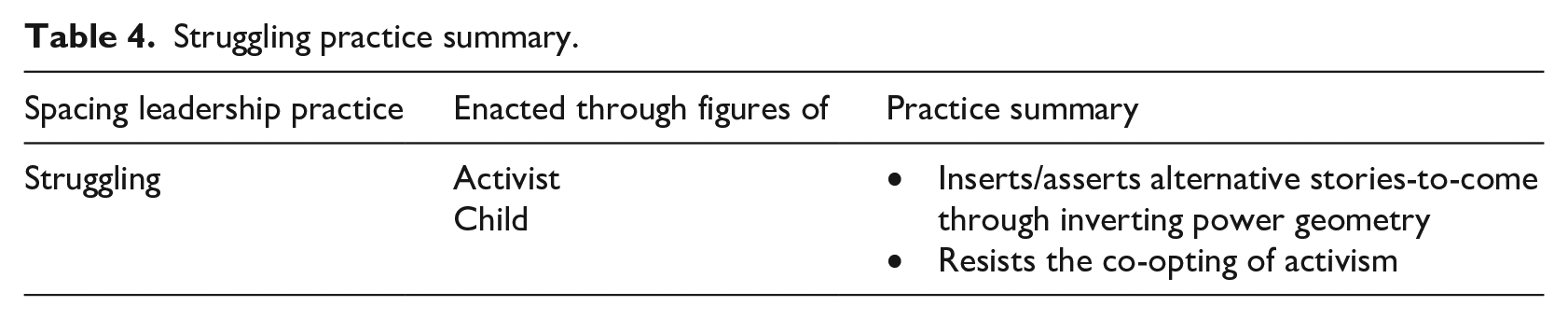
That what is theorized is spatial struggle rather than spatial power, or even resistance (Fleming & Spicer, 2007), is evident by the problematizing of categories of powerful and resister as bodies move in and around space. Particularly relevant in theorizing spatial struggling is Massey’s (1993) concept of a power geometry, a useful way of tracking movement in struggle, prompted by the insertion of space-invading bodies (Puwar, 2004), a throwntogetherness (Massey, 2005). Struggling can thus be conceptualized as a framing and reframing in or of space, a dynamic shifting of constellations of actors and their trajectories as they attempt to fix meaning in relation to space, to define what this space, and this collection of bodies in space, are for. Struggle seeks to crystallize where power resides, and such fixing is constituted by which bodies are able to initiate and move freely in space, and how (Massey, 1993). Struggling practice therefore encompasses qualities of embodiment, multiplicity and scale.
In embodied terms, activists entering spaces of political-economic power – and refusing to abide by certain conventions of etiquette (Bell et al., 2024) – can force a throwntogetherness, creating ripples in the geometry. ‘Leaking’ emotion into the sterile space of international political deliberation forces other bodies to respond, in the moment (Longhurst, 2001). Forced improvisation indicates a shifting in the geometry, an ordering of bodies (Vásquez & Cooren, 2013) that has gained its assumed power from the regularity of spatial rituals (Fairhurst & Cooren, 2009) – e.g. of politicians, businesses and NGOs inhabiting their designated spaces at assigned intervals of time. What is generated by the insertion of bodies-out-of-place is a spatial ‘disorientation’ (Ahmed, 2006, p. 107; Puwar, 2004, pp. 17–18), a ‘queer effect’ (Ahmed, 2006, p. 61; Muhr & Sullivan, 2013) – those who fit the spatial-somatic norm (Puwar, 2004) must respond because of their proximity to the one who transgresses. Power to define space moves through the spatial flows of bodies responding to other bodies in, with and through space.
Multiplicity is evident in struggling practice, a spatial reading drawing attention to the ambiguity and dynamism of who is resisting which power. Spatializing struggle helps identify a multiplicity of embodied responses to being throwntogether (Massey, 2005) from those we might assume are ‘in power’ – e.g. in our study many political leaders engaged, others seemed concerned, some checked out. As the then Prime Minister of Italy, Mario Draghi, responding in an unexpected way to Thunberg’s infamous ‘blah-blah-blah’ speech, stated: ‘Sometimes the blah-blah-blah is just a way to hide our inability to take action’ (United Nations, 2021). This statement is a communication of heterogeneous power – some actors wanting to thwart the Leader, others needing her in their spaces to strengthen their capacities.
Finally, a spatial view allows sight of the scale of struggle, which can extend globally. Struggling is played out across continents, with questions of who is exercising spatial powers of initiation and movement being key (Massey, 1993). A push–pull across space shapes the topology through which leadership must contend. In our study, the Learner seeks to reframe the site of leadership as unfolding with spaces of climate crises and fossil fuel extraction, yet political leaders assert spaces of national and international politics, a framing that ultimately prevails – e.g. shifting the location of COP 25. Such a ‘spatial fix’ (Harvey, 2018, p. 427) has the effect of being a ‘straightening device’ (Ahmed, 2006, p. 72) on the emergence and movement of leadership. The Learner is figured back to Activist, who must work within spaces of political power, such a positioning prompted by an expectant media, fellow activists and those watching on their screens. Eventually, the Activist is closed out of spaces of political-economic power entirely, a blunt assertion of powers of initiation and movement, yet one that does not equate to a finalizing of struggle: leadership of, with and through ‘Thunberg’ continues in other spaces and times, beyond the boundaries of this study.
A final point relating to the scale of struggling is that it enables sight of the differently located spatial networks that sustain leadership. Notable in the struggles of the Activist was the spatial reframing of the film crew – in the very moment when the Activist seemed most spatially isolated, with an auditorium of the powerful bearing down on her – she was communicated as tied to other spaces, where assemblies of supporters thronged. Such an insight underlines the importance of spatial interdependencies in studies of leadership and organizations – spaces are never constituted in isolation. Yet viewers ultimately only see what is presentified. As with most political-corporate spaces, the viewer in our study is unable to see how actors position and plan with or against the Activist. A spatial view, zooming out to the ‘between’ (Ladkin, 2013, p. 323; Massey, 2005, p. 23) and around, however, enhances critical capacities to query which spaces of power (and struggle) the researcher does not see.
Clearing
Clearing uses the bodily presence of a leader to vacate space for others to gain exposure (Table 5).
Clearing practice summary.
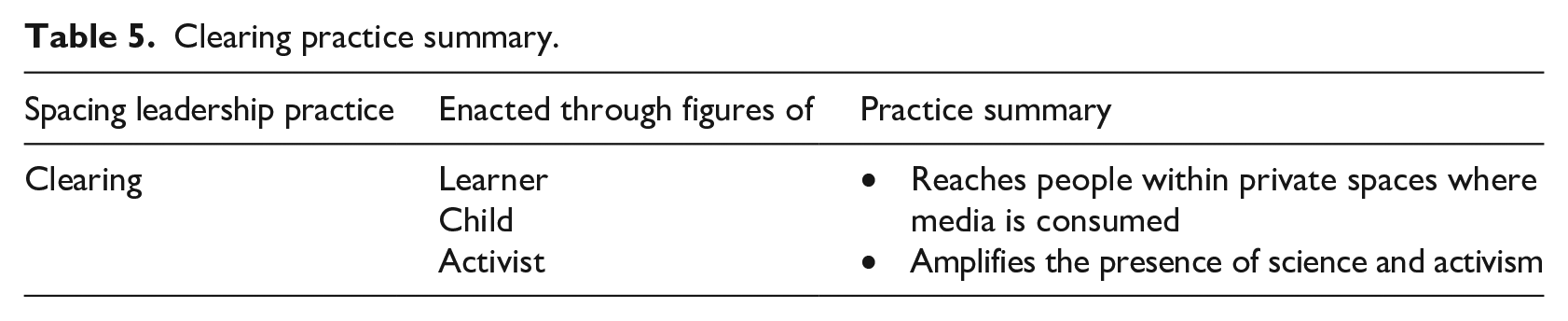
The Leader-figure appears, only to merge into the spatial background, clearing the way for others (e.g. people, animals, objects and spaces) – a form of re-ordering (Vásquez & Cooren, 2013). Conceptually significant is how clearing places certain objects in the background while foregrounding others. Analysing such choices spatially draws attention to agency in leadership, providing insight into what it is possible to include in space. It also enables sight of spatial structures that limit agency. Massey (1992, 1995) helps us see clearing choices of inclusion or exclusion as ones of building spatialities, ecosystems that incorporate distinct spatial flows while necessarily excluding others.
Such spatial clearing is similar but distinct to the significance that actors invest in objects when materializing leadership and leaders (Fairhurst & Cooren, 2009; Ford et al., 2017; Hawkins, 2015). Clearing with the Learner is similar in the sense that certain objects are chosen over others, and placed together in space – scientists, victims of climate change and coal pits preferred to politicians and their spaces of work. The practice is distinct in the wider spaces it operates upon – whole regions of the planet are its canvas. While studies of more everyday materializations of leadership occurring in mundane spaces, such as offices (Ford et al., 2017), or even ships (Hawkins, 2015), will by definition incorporate a narrower spatial vista, applying a spacing practice of clearing does allow sight of where the spatial boundaries are placed by research participants and researchers.
The utility of clearing is visible in an emergent, composite Leader-figure, communicated in ways that draw boundaries around space, creating a spatiality (Massey, 1992, 1995) through orientation (Ahmed, 2006). For example, the Learner brings scientists and their research into private spaces, where people watch television and read books. Significant but previously obscured scientists are presentified (Vásquez & Cooren, 2013) as important, either by attaching their names to hers within a Climate Book (Thunberg, 2022) or through a montage in film, where the Learner exercises the power of initiation in space (Massey, 1993) but then fades into the background, allowing people’s experiences with climate catastrophe and the presence of scientists to occupy space. The Child also clears modest, small spaces within imposing civic spaces, building outwards, occupying more territory as activists join her protest, to the point where the mass of young people becomes more salient than the originating Child. The Activist draws boundaries around spaces of political power, which affords multimodal scenes of high drama (Bell et al., 2024) but necessarily excludes more intimate forms of solidarity building and generative moments of learning.
Surfacing and questioning choices made by a composite Leader-figure, finally, draws questions of ethics to the foreground. Namely, is it ethical to consider such judgements, or even to research without consent, someone who, ultimately, at the time of the materializing studied, was a child? Decentring Thunberg, into communicated and storied figures who constitute a materializing Leader, means that the person – Greta Thunberg – is part of the spatial canvas rather than its focal point. Our concern has been to show how a leader and leadership are constituted spatially, a view we hope will help others make judgements as to how ethical or otherwise a spatial formation of leadership can be. Conceptually and practically in relation to climate leadership, such a perspective may help in overcoming the individual–collective binary that has emerged (Case et al., 2015; Fotaki & Foroughi, 2022). A spatial view, rather, enables sight of individual leaders as collective and emergent material communications, affected by and affecting space (Massey, 2005; Vásquez, 2016).
Conclusion
This inquiry has explored the materializing of leadership from, with and through Greta Thunberg. Although studies of materializing leadership have drawn our attention to the constitutive role of materiality – particularly in relation to bodies, objects and texts – in shaping possibilities for leadership, missing to date has been a view that draws in the various materialities of leadership, showing how they are knitted together over a topography of practice, a task that we argue can be undertaken with a spatial approach rich in contested social, political and economic relationality. Spacing leadership through critical geography and CCO in a manner that decentres practice offers sight of what envelopes humans and their objects. It therefore offers the possibility through a mid-range ‘between’ (Ladkin, 2013, p. 323; Massey, 2005, p. 23) view, of seeing how a process of leadership comes together communicatively and spatially. However, we acknowledge that this inquiry focused on a leader and leadership in activism, abutting and temporarily entering the spaces of organizations without being contained by them. Future research might explore how a spatial approach similar to ours could knit together the objects, spaces, bodies and language of leadership within the employment relationship, coalescing into distinctive spatial relations. Beyond organizations, a spatial focus may also help to enhance knowledge of how climate leadership can work to confer personhood, in terms of rights, on the environment. Our study approached this theme when exploring the porousness between the bodies of nature and the Traveller in gaining legitimacy for an emergent leader and leadership. However, this was not the primary focus of our study and future research may seek to explore this important topic in more depth.
A further strength of the spatial approach adopted here is that it makes abstractions that normally sit in the background of leadership studies more tangible and open to empirical inquiry. Notions such as power, voice, resistance, identity and relationality may become visible through a spatial view that shows, visually, how they materialize or fail to do so. Similarly, the slippery idea of structure–agency becomes more tangible. ‘Structures’ become spaces, with their own geometries of power (Massey, 1993), of bodies, objects and technologies ordered (Vásquez & Cooren, 2013) in ways that include certain bodies while excluding others (Ahmed, 2006; Puwar, 2004), while agency becomes the extent to which bodies ‘extend’ into space (Ahmed, 2006, p. 11). While we do not claim our spatial approach as a silver bullet for such difficult topics, it may prompt further reflection and theorizing, leading to inquiries-to-come: for example, by exploring more directly the emergences of leaders and leadership in relation to economics and finance – asking who funds which (de)materializations and how.
Two further areas for future research are suggested by our study. First, the decentring of our spatial approach signals – but does not directly interrogate – the complicity in the materializing of leadership of those who are usually not named and who reside silently in the background. Namely, the consumers of images and texts. A spatial approach may help to make spectators more visible – they look through, straight at, down on, up to and askance from a materializing leadership, becoming co-constitutive in the process. Future research may more explicitly draw out the materiality of the gaze and who gazes. Second, while our inquiry explored an emergent Thunberg-the-Leader, future research may trace Thunbergs-yet-to-come. Evoking the fleeting nature of the leadership communicated, the BBC/OU documentary concludes with Thunberg walking away, back turned (Figure 10):
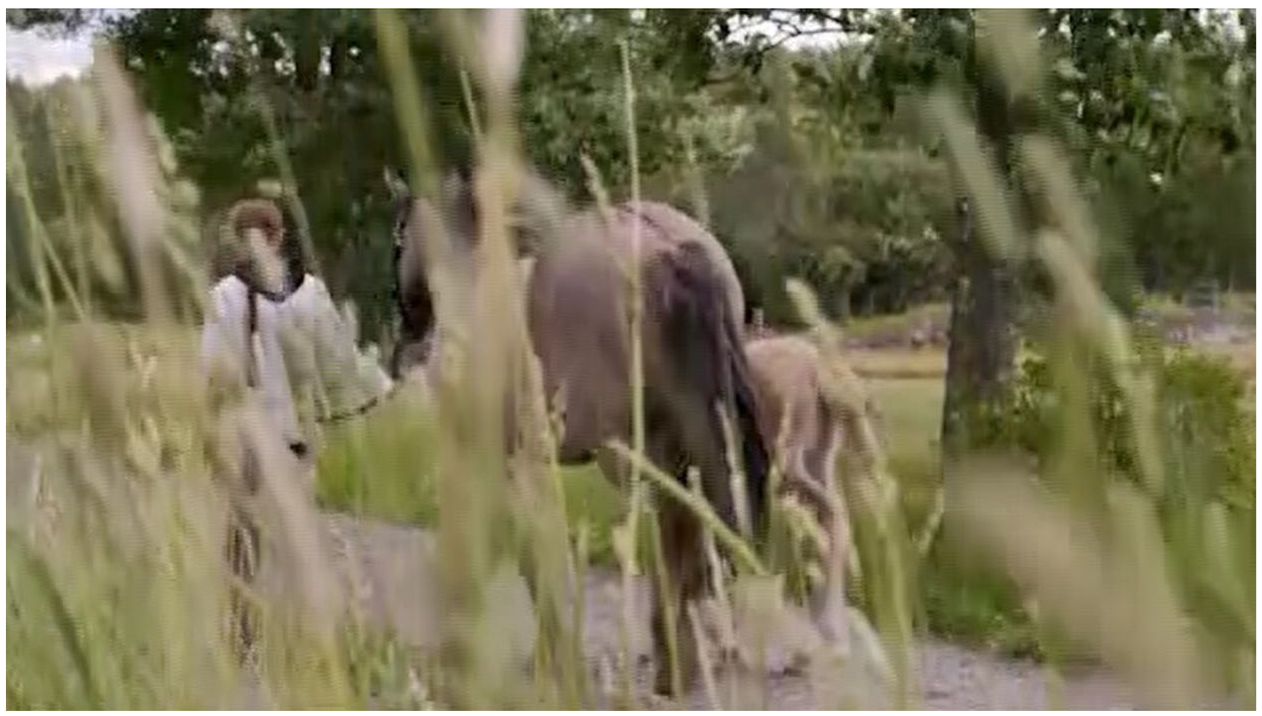
Departing space (Myerscough, 2021).
The sequence communicates a dream-like quality, a figure obscured by long grass, with her horse and foal, disappearing into nature. The Activist’s voice communicates her transitory leadership: ‘I know soon people will lose interest in me. That’s only natural.’ Since the programme was made, Thunberg has become an adult, excoriating misogyny, taking direct action against fossil fuel extraction and speaking up for peace. Such reinventions offer possibilities for future research that explores what happens to leaders and leadership when they enter new, more radical terrain. The stories-so-far of Child-Traveller-Activist-Learner have closed but there remain intriguing stories-yet-to-come.
Footnotes
Acknowledgements
The authors thank senior editor Nancy Harding and the three anonymous reviewers for their care, patience and incisive comments.
Funding
The author(s) received no financial support for the research, authorship, and/or publication of this article.
