



Abstract
How do numbers and calculations relate to organizing? This paper draws on a selection of articles published in Organization Studies to discuss why and how counting counts, navigating the domains of the ordered, evident, and known, as well as those of the disordered, ambiguous, and unknown. In these domains, we identify different perspectives on calculative practices in organization studies: from datafication and the making of categories, to calculative infrastructures and the making of collective things, to the aesthetics of numbers and the making of affects. These perspectives reveal that while numbers reduce, simplify, and clarify, they also offer insights into the complexity, obscurity, and ambiguity of our world through their inherent incompleteness and gaps. Such insights suggest opportunities for organization scholars to employ numbers and calculations as lenses to research phenomena both in the domain of cognition and senses, as well as in that of the mysterious and unsensed. This shift highlights a renewed interest in a phenomenology of quantification, inviting organization scholars to engage with calculations—embracing their ambiguity, limitations, and even magical qualities—as cues to explore what eludes the senses.
Keywords
Introduction
1, 2, 3, 4. . . These are not mere black marks on a white background. It could be a jazz band about to begin playing, the tempo of a military march or the number of students that are missing from class this morning. 4, 3, 2, 1. . . and here we switch to the countdown prior to the launch of a space ship or the explosion of a bomb. So innocent, and yet so meaningful, so diffuse and yet so unquestioned.
As Pérezts et al. (2021) highlight in their editorial for the Book Review Symposium on Numbers and Organization Studies, numbers allow for organizing, and therefore are central for organization scholars. In the same editorial, they also provoke deeper reflection on ‘why is that so?’. In other words, why are numbers central to organizing, and why are they ‘yet so unquestioned’?
Prior research in organization studies demonstrates that numbers and calculations 1 pervade all fundamental aspects of businesses, markets, and society. Numbers exert powerful organizing effects on governance (Michaud, 2014), strategy and control (Denis, Langley, & Rouleau, 2006; Lowe & Jones, 2004), accountability (Keevers, Treleaven, Sykes, & Darcy, 2012), temporal structures (Kunzl & Messner, 2023), operations, and organizational change (Ezzamel, 1994). They also dominate discursive spaces, influencing public debates (Townley, Cooper, & Oakes, 2003), political agendas (Desrosières, 1998; Graham, 2014; Mennicken & Salais, 2022), and society in general (Everett, 2017; Pérezts et al., 2021).
Numbers certainly can be used to order ‘things’ in space or time (Miller & Power, 2013; Power, 2004). They enable and regulate human behavior (Espeland & Stevens, 2008) while lending an aura of objectivity and certainty to complex phenomena (Mazmanian & Beckman, 2018). For instance, as part of the climate change debate, governing bodies, institutional leaders, and society at large make sense of ‘climate’ through measurements taken from various localities, relying on calculative infrastructures that collect, combine, relate, and share those measurements (Edwards, 2010; Kornberger et al., 2019; Wissman, Levy, & Nyberg, 2024). Similarly, numbers and calculations help make sense of other phenomena such as ‘sustainable development’ or ‘social impact’. We come to ‘see’ them, or even experience, feel, or be impressed by them, through numbers and calculations, which serve as powerful tools to mobilize collective imagination and action. They are instrumental for organizing. As Peter Miller states, ‘This is not to say that the single figure provided by diverse calculating machines answers the specifics of the problem it is called on to solve, or that it is always or even typically up to the task. But what is counted usually counts.’ (Miller, 2001, p. 382).
However, numbers and calculations often fall short on their promises. They struggle to fully capture the complexity of the phenomena they attempt to represent (Arjaliès & Bansal, 2018; Huault & Rainelli-Weiss, 2011) and fail to provide the objectivity they appear to offer (Lampland, 2010). Indeed, numbers are rarely as innocent as they seem (Espeland, 2022, p. viii), and tend to become ‘what they are not’ (Hopwood, 1987). They are inherently ambiguous and incomplete (Meyer, 1986), and, as we argue, function precisely because of this ambiguity (Yu & Mouritsen, 2020), which is often linked to their aesthetic properties and the beliefs they foster (Quattrone, 2009).
A growing body of literature emphasizes that calculative practices provide pragmatic solutions to organizing. This is as much due to their invisibilities and incompleteness (Denis et al., 2006; Quattrone, Ronzani, Jancsary, & Höllerer, 2021), as well as their affective (Boedker & Chua, 2013, drawing on Thrift, 2004, 2008) and enchanting prompts (Backsell & Schwarzkopf, 2023), rather than merely because of the order they promise. Their invisibility and incompleteness not only allow calculations to work in complex and ambiguous situations but also offer clues for interrogating and investigating the mysterious and opaque dimensions of the world, particularly those the calculations themselves evoke.
These clues are particularly significant given the growing interest among organization scholars in studies on spirituality and mysticism in the workplace (Ganzin, Islam, & Suddaby, 2020; Suddaby, Ganzin, & Minkus, 2017), not to mention research on new organizing forms and approaches that engage with the ghostly (Hunter & Baxter, 2021), the magical (Backsell & Schwarzkopf, 2023), the felt, the expressed, and the sensed (Gagliardi, 2007; Gherardi, Nicolini, & Strati, 2007), the mysterious and unseen (Bento da Silva, Quattrone, & Llewellyn, 2022), and the imaginary (Thompson & Byrne, 2022). New digital technologies and platforms, which conceal the underlying work of calculative infrastructures (Begkos & Antonopoulou, 2020; Kornberger, Pflueger, & Mouritsen, 2017), further amplify these invisible and unseen dimensions. Such studies have noted that even seemingly evident and ordered phenomena can spark ambiguity, create shadows, or make things disappear (Giovannoni & Quattrone, 2018; Orr, 2014). Indeed, the mysterious and the magical do not oppose the rational and the instrumental (Backsell & Schwarzkopf, 2023; Bento da Silva et al., 2022), particularly when infused with numbers.
This raises an important question: How can organization scholars explore these obscure and mysterious phenomena given their ambiguous dimensions, which relate to cognition but often escape the senses, and which never stand still? The term ‘phenomenon’ shares a similar etymology with the word ‘phantasma’ (ghost), hinting at an extraordinary appearance that somehow manifests for the senses. But how can we research ‘something’ that remains obscure and unsensed, yet is powerful because of its mystery? How can we study a ‘phenomenon’ that resists being fully sensed or known? We argue that calculative practices, with their own incomplete, ambiguous, and enchanting traits, offer organization scholars a valuable tool for exploring both the obscure and ambiguous dimensions of phenomena and their more evident and logical aspects.
For this paper, we used the blurred space between order and disorder, the evident and opaque, the sensed and unsensed, as our analytical starting point. Building on this, we reviewed all articles on calculative practices published in Organization Studies over the past 20 years, beginning with a keyword search and then focusing on articles that offer perspectives into how or why counting counts for organizing. We identified three perspectives within the organization studies community: making things categorical through datafication, making things collective through calculative infrastructures, and making things affective through aesthetic-emotional properties (see Appendix 1 for an example of our strategy for selection and analysis). 2 From this review, we selected two exemplary articles for each perspective to illustrate their contributions. Appendix 2 summarizes our analysis: while calculations can make phenomena more accessible through cognition, infrastructures, or affects, calculations also offer a clue into the ambiguity and incompleteness of phenomena, leaving them disordered, ambiguous, and mysterious.
Our approach invites new phenomenological investigations (Holt & Sandberg, 2011; Meyer, 2019), researching not only the world of the evident, sensed, and felt in organizing, but also the world of the unsensed, unexperienced, and unknown. We propose that the perspectives on calculative practices can be taken further, towards a renewed interest in the phenomenology of quantification, offering insights into the evident and opaque, ordered and disordered, sensed and unsensed dimensions of organizing, whose relations are often overlooked in organizational research. This renewed interest entails a leap into the mysterious and unsensed aspects of phenomena through the gaps and lacks left by numbers, as they can both relate to and detach from the senses.
Perspectives on calculative practices in organizing
Making things categorical through datafication
Calculative practices are pervasive. The etymology of the word ‘calculation’, from ‘calculus’, reminds us of the pebble once used in antiquity as a reckoning counter, pointing to the means for summarizing and storing phenomena as ‘quantified facts.’ With the spread of informatization and new technologies, even phenomena previously unquantified (e.g. tastes, habits, preferences—see Alaimo & Kallinikos, 2019) are now becoming powerful sources for organizing when quantified. In today’s digital era, such calculative practices underpin the complex connections through which events are inscribed and stored as ‘data’ (Kallinikos, 1999), as well as how they relate to algorithms, data objects, platforms, and data-driven processes (Alaimo & Kallinikos, 2022; Orlikowski & Scott, 2016; Zuboff, 2019). This process, recently termed as ‘datafication’, establishes a strong connection between the production of data and the calculative technologies that translate phenomena into ‘a quantified format so that it can be tabulated and analyzed’ (Mayer-Schönberger & Cukier, 2013, p. 78). This also points to new forms of visibility and presence, enabled by calculative practices through representation and algorithmic ordering. However, as new visibilities are produced through datafication, invisibilities also emerge from a process of exclusion driven by the algorithms themselves (Kallinikos, 1995; Leonardi & Treem, 2020).
So, how and why does counting count for organization? Through which means do calculative practices deploy their power, and what are their effects? Two of our selected papers (Alaimo & Kallinikos, 2021; Ratner & Plotnikof, 2022) suggest that these questions can be answered by pointing to the ‘data’ and their assemblages as means for calculative practices to inscribe, construct, and make sense of the world, rendering it evident, known, ordered, and therefore manageable, while also detaching from the world and even disorganizing it.
In their paper Managing by data: Algorithmic categories and organizing, Alaimo and Kallinikos (2021) discuss the conceptual passages that explain ‘the construction of facts and organizational objects via the medium of algorithmic categories and the data they encode’ (p. 1386), revealing how organizational facts ‘emerge’ and are classified as they become calculable. They link the making of data to processes of categorization, achieved through algorithms and other calculative devices. They draw inspiration from the work of Rosch (Rosch, Mervis, Gray, Johnson, & Boyes-Braem, 1976) on how categorizations and classifications manifest through social activity that develops discrete and disparate objects (Karpik, 2010) and transforms them into commensurable assemblages.
Algorithms and data systems transform ‘data’, rather than community-based knowledge, into basic organizing objects (Alaimo, 2022), thereby blurring the boundaries between organizations and calculative technologies. These basic objects enable making higher-order categories by triggering boundary work, sorting non-identical things into similar groups, and providing cognitive schemes that help make sense of reality through abstraction, selection, and simplification. According to Alaimo and Kallinikos (2021, p. 1387; Rosch et al., 1976), ‘the more inclusive a category, the higher its level of abstraction and the fewer the properties or attributes on the basis of which it is derived’.
Therefore, algorithmic categories provide cognitive schemes that enable ordering, knowing, and making sense of phenomena by abstracting their particularities and complexities. Such categorization implies not only abstraction but also concreteness: it excludes the particularities of the world, seeking similarities while remaining connected to it through the ‘basic objects’ that inform the categorization process. In the digital world, these processes are underpinned by calculative technologies orchestrated through platform organizations obscuring the categorization process and its calculative frames (Alaimo & Kallinikos, 2019), which leads to tensions during the datafication stages.
For example, in their analysis of a digital music discovery platform, Alaimo and Kallinikos (2021) show how the reductionist, rule-based homogenization of data—categorizing artists, genres, listening moods, suggestions, and personalized charts—excludes various artists and music genres, causing tensions with the platform’s user base. They conclude that this pervasive calculative apparatus, which connects data, technology, and algorithms, reshapes ‘categories of the world on the basis of which final services are extracted and delivered’ (ibid, p. 1403), creating tensions through new calculative, algorithmic ordering. It follows that the ordering capacity of calculative practices retains a disconfirming and transformative power due to the tensions they trigger through reduction and exclusion, as well as emerging technological functionalities that challenge existing ordering categories. These tensions highlight that while calculative practices help us make sense of the complexity of the world through abstraction, they also detach from the world by obscuring its particularities. However, these particularities do not vanish; the calculations remain connected to the world precisely through the tensions they provoke by hiding its complexity.
Our selected paper, Technology and dis/organization: Digital data infrastructures as partial connections by Ratner and Plotnikof (2022), expands this argument by discussing the organizing and disorganizing potential of transforming numbers and quantifications into digitalized data systems. They examine the implementation of a mandated well-being survey in Danish public schools and how it enables both connecting and disconnecting social relations in open-ended, digitally mediated ways. While the well-being survey aims to organize students, schools, and local governments into commensurable and ordered structures, this datafication practice creates disorder, gaps, and partial connections.
For instance, various schools and local governments administer this survey through their own diverse digital means, ensuring consistency only with ministry-mandated questions and answer categories. Despite promising anonymity, the partially connected digital infrastructures allow identifiable sensitive data to circulate among schools and local governments without the consent of students or their parents. Such controversies prompt the Ministry to take iterative organizing and disorganizing actions to which local governments subsequently conformed and circumvented via partial connections to the original survey instrument. Although datafication was meant to facilitate order through the categorization of students’ well-being, it also promoted disorder through parents’ loss of control over their children’s sensitive data.
The examples of the music platform (Alaimo & Kallinikos, 2021) and the well-being survey (Ratner & Plotnikof, 2022) indicate that datafication and the making of categories may lead to tensions among actors across all datafication stages. In this vein, the pursuit of machine-driven calculative practices that are ‘optimal’ may legitimize cautionary notions of real-time tracking, surveillance, and predictive analysis (Van Dijck, 2014). Hansen (2015) argues that: As organizations gain easier access to masses of data and specialized expertise to analyze the rapidly expanding ‘datafication’ of human actions [. . .] we might come to see that traditional numerical operations become aggregated with, if not subsumed under, the machine-driven form and its predictive pretentions (p. 205).
Hence, calculative practices may aim to transform discrete and disparate entities into commensurable categories (Espeland & Sauder, 2007; Karpik, 2010), offering order and making things evident to the senses. However, in doing so, they create tensions: they obscure, detach, partially connect, and disorganize. In both cases, datafication and categorization are disrupted by what is left out, unseen, or at times misinterpreted, such as missing metadata (Alaimo & Kallinikos, 2021) and diverse interpretations of what constitutes anonymity in data gathering (Ratner & Plotnikof, 2022). Such constellations of far-from-uniform data carry antithetical implications for organizing: calculative practices remain obscured yet omnipresent. They form categorical clusters that enable prediction, facilitate the quantification of cognitive patterns and enable local responses while also disorganizing, hiding from the senses, mandating human intervention, and discouraging diversity.
For Ratner and Plotnikof (2022), datafication seeks to connect and organize actors through meaningful tracing and categorizing of well-being constructs, but in doing so, it disconnects and disorganizes, persistently encouraging further (dis)organizing in a disorderly and relational vicious circle. Similarly, Alaimo and Kallinikos (2021) demonstrate how a basic organizing object, such as an artist’s name, is not linked to the arguably uncontested entity, nor does it stem from meaningful socio-cultural interactions, experiences, or knowledge. Instead, it is constructed through traces, summations, and categorizations that make sense only to obscured algorithmic computations. By studying this calculative work, the incompleteness of data-driven processes, and the disorganizing effects of numbers, delving into the messy, ambiguous, and unstable dimensions of organizations becomes possible.
In this context, calculations of raw data lack value and meaning until they are combined, interrogated, and interpreted with other select data to collectively inform organizing. It is through the myriad hidden calculative practices inherent in datafication processes that new perceptions, meanings, and social interactions emerge. While making things calculable, both with ordering and disordering effects, calculative practices generate intersubjective meaning and a new ‘sense’ of the world through their infrastructural work, while leaving this world always lacking, incomplete, and opaque. Below, we discuss such calculative infrastructures, i.e. the dynamic networks of calculative practices that enable organizing and highlight how they can make ‘things’ collective through abstraction, commensuration, and simplification.
Making things collective through calculative infrastructures
As noted by Alaimo and Kallinikos (2021), the making of categories extends beyond the boundaries of single organizations and permeates the field through their ‘infrastructural presence.’ Markets, hierarchies, corporations, and other entities central to organizational inquiry would not ‘exist’ or function as such without calculation. These emerge from and are valued through calculation. The following two papers (Callon & Muniesa, 2005; Giamporcaro & Gond, 2016) provide examples of how and why calculations count in the interplay between evidence and penumbras while pointing to the power of calculative practices in the formation of markets as loci for collective and ambiguous compromise, as well as micro-level and macro-level politics. While making things collective, numbers and calculations also render such things simultaneously ubiquitous, asymmetrical, and mundane.
In their paper on Peripheral Vision: economic markets as calculative collective devices, Callon and Muniesa (2005) propose that for a market to exist, products or services must be constructed and framed as objects that can be ‘calculated’ collectively and, as such, transacted. This is a process of objectification that makes a reality calculable, contractible, and interventionable at the collective level, preparing for a series of later transformations. Callon and Muniesa (2005) argue: In order to construct objectified — and thus detachable — goods, a wide variety of social connections need to take place: first, upstream from the actual transaction, during the design and qualification of the good, then when market participants meet together, and afterwards, when, for instance, the seller. . . tries to grasp the reactions of the consumer with a view to taking them into account in the future (p. 1233).
Objectification requires negotiation because the distinctions made are revisable propositions that must be qualified by the producer and the consumer dynamically. The object that is extracted from the flow of reality may be resisted and then reformed to fit arrangements in the market through a singularization process that gradually qualifies and defines its properties. The market is not interested in the product as an object, even if that is the thing being transacted, but in its singularization and its associated co-production that makes the object collectively useful in the buyers’ context. Callon and Muniesa (2005) thus highlight a problem: it is not easy to stabilize the object of calculation. Solving this problem requires not only a comprehensive infrastructure of instruments that distributes calculation within a collectivity of humans and non-humans but also assumes that political processes, starting from ambiguous situations with multiple and often conflicting perspectives, lead to compromises about what counts as a relevant object. There is no single logic of calculation, nor one way to achieve compromise. Political processes are at the heart of the calculative infrastructures that make ‘goods’ collective, leaving markets and their organization mundane and debatable while making them function through compromises.
To understand the role of power structures in constituting markets through calculative infrastructures and in the making of calculative agencies, Giamporcaro and Gond’s (2016) paper on Calculability as Politics in the Construction of Markets: The Case of Socially Responsible Investment in France reveals the nature of calculability as politics in the formation of a socially responsible investment market. The paper focuses on coercing, manipulating, and dominating actors that shift others’ positions within what they term the ‘calculative supply chain.’ Their point is that calculative practices are rarely substances of an intuitive world, such as products emerging from a production process. Instead, constructing an object like Responsible Investment entails negotiations of power within a collective space where (proposed) calculations serve as means of battle. The object—Responsible Investment—is in progress through (proposed) systems of calculation mobilized by differently oriented and interested agencies in the market to arrive at a settlement regarding the object’s properties. The proposed calculations are ammunition, and the settlement is not merely achieved through the force of a superior calculative methodology. The settlement also reflects that actors can be coerced, manipulated, and dominated into accepting compromises and coalitions differentiated by opposing ideas and interests.
As shown above, through their infrastructures, calculative practices are immanent and fluid. They may concern objectification to facilitate the transfer of goods in the market (Callon & Muniesa, 2005). They may also represent an intellectual technology defining the object that will later emerge as Responsible Investment in a calculative supply chain (Giamporcaro & Gond, 2016). They may be a settlement in a transferable good or a settlement in inscription devices (Responsible Investment). Their infrastructural work does not function solely through order, similarity, evidence, and abstraction, but also through subtle asymmetry and unbalanced power/knowledge distribution.
As things are made collective through calculative infrastructures, the political processes (Callon & Muniesa, 2005), asymmetries, and tensions in power/knowledge structures (Giamporcaro & Gond, 2016) operate as collective invisibilities, difficult to fully explain, sense, or experience. Here, calculative practices may further elucidate institutionalization processes as they provide ‘invisible forms of power that people exercise over themselves, freely’ (Hayes, Introna, & Kelly, 2018, p. 1223). Their mundane nature explains not only power structures but also more ambiguous and mysterious mechanisms that speak to the world of the cognitive, ordered, and evident, as well as to that of the senses, affects, and emotions, which we further explore below.
Making things affective through the aesthetics of numbers
The history of numbers and calculations has often been tied to notions of ‘objectivity’ (Porter, 1996), particularly in conjunction with the rise of ‘Western rationality’ (Crosby, 1997) and ‘modern’ institutions, including capitalism, markets, and ‘scientific managerialism’ (Sombart, 1979 [1919]; Weber, 1978 [1956]). These institutions were conceived in opposition to craft and spirituality (Porter, 1996; Suddaby et al., 2017). However, from the era of Pythagoras through the medieval age and late Renaissance, calculative practices were also seen as infused with more illogical, spiritual, and even magical dimensions, which empowered numbers and calculations in the marketplace and everyday life (De Romilly, 1975; Ward, 1988). Numbers did not, and do not, work only for the ‘cold’ order they bring, but also through the mystery of the calculations behind them (Bento da Silva et al., 2022), the enchantment provoked by practices of concealment and revelation (Backsell & Schwarzkopf, 2023), and their aesthetic and affective prompts (Boedker & Chua, 2013). This entanglement explains why numbers wield such strong mobilizing powers. Two of our selected articles (Saifer & Dacin, 2022; Puyou & Quattrone, 2018) demonstrate how calculations shift from the realm of the ‘cold rational’ and the seemingly logical and ‘known’, to the realm of emotions, mystery, and the ‘unknown,’ prompted by their aesthetic dimension.
In their article on Data and Organization Studies: Aesthetics, Emotions, Discourse, and Our Everyday Encounters with Data, Saifer and Dacin (2022) explore the aesthetic, emotional, and discursive features that shape the way we encounter and engage with data in everyday life. They challenge the assumption that numbers are produced and consumed solely as articulations of ‘cold facts.’ Instead, the authors suggest that numbers help us make sense of ‘things’ in several ways, such as by producing motivation, emotion, and even passion through quantifications. They argue that the aesthetization of data—through visuals or ‘the mere suggestion of “datafication”’ (Saifer & Dacin, 2022, p. 632)—can inspire trust in organizations. Simultaneously, data can provoke affective responses such as hope or distress, generating both engagement with and submissiveness to our data-oriented culture.
In The Visual and Material Dimensions of Legitimacy: Accounting and the Search for Societies, Puyou and Quattrone (2018) reflect on the aesthetic (visual and material) properties of numbers as ‘figures.’ They argue that legitimacy is constructed through material and visual effects of accounting inscriptions and calculative practices. This implies that legitimacy relies, at least partially, on social actors’ ability to harness the aesthetic properties of calculative practices, such as symmetry and balance, in interrogating the status quo, justifying action, and navigating actors’ roles in society. Here, legitimacy is not solely a matter of words (e.g. storytelling or social relations in legitimizing collective action, as discussed by Kornberger, 2022) but also emerges from the material and visual rhetorical dimensions of numbers, resulting in what the authors call ‘a process of moral judgment’ (Puyou & Quattrone, 2018, p. 739). In this process, what is believed to be right, just, and good is partly framed by how these categories are questioned—and figured out—through numbers.
As Puyou and Quattrone (2018) suggest, numbers allow actors to engage with the known while interrogating, legitimizing, and embracing the unknown and invisible. The aesthetic aspects of accounts help actors ‘deal with the problem of the intrinsic ambiguity and complexity of criteria of legitimacy’ (Puyou & Quattrone, 2018, p. 739) by enabling them to explore their community roles and reflect on their social, economic, political, and religious standing. Thus, numbers often act as ‘instruments of interrogation’ that encourage individuals to question their societal position and contribution. However, as much as these calculative practices facilitate exploration of the ambiguity surrounding moral judgment and legitimacy, they can also trigger uncertainty, manifesting as ignorance, equivocality, complexity, ambiguity, or risk (Schwarzkopf, 2020; Townsend, Hunt, McMullen, & Sarasvathy, 2018).
Our selected papers reveal that calculative practices and quantifications, through their aesthetic prompts and the insights they generate, relate to uncertainty and the ‘unknown’ by interrogating and exploring it rather than suppressing it. They highlight the power of calculations in addressing how they engage with the unknown and ambiguous, rather than the known and clarified. This nexus has significant implications for understanding highly contested and politicized debates in contemporary organizations. As Saifer and Dacin (2022) explain: By attending to the multiple, complex, and nuanced entanglements of data and organization, organizational scholars will be better equipped to navigate the increasingly fraught terrain between technocratic data worship and antiscience politics that characterize the current political moment (p. 625).
While numbers seemingly represent ‘facts,’ they are also drawn upon to make implicit decisions about what to count, how to count, and how to make what counts visible. Therefore, numbers function like magic tricks, oscillating between concealment and discovery, as they capture phenomena that often defy full definition, whether because these phenomena are impossible to pin down (Bento da Silva et al., 2022) or because they are controversial (Backsell & Schwarzkopf, 2023). Yet, we can interrogate these phenomena in their evident and cognitive aspects as well as in their affective and ambiguous dimensions.
Exploring ambiguous phenomena through calculative practices
So, why do calculative practices count for organizations and organizing? Our selection and analysis of articles highlight three perspectives on calculative practices that are helpful for exploring organizing through the work of calculations. While categorical things simplify organizing through abstraction and concreteness, they also disorganize, obscure, and remain inherently invisible. Collective things enabled and concealed by the infrastructural work of calculative practices, become omnipresent and ubiquitous within markets and fields, yet often remain mundane and asymmetrical, with gaps and discontinuities in power-knowledge structures. Furthermore, the aestheticized dimension of calculations, appealing to both cognition and senses, can render things affective as it reintroduces uncertainty and ambiguity, prompting moral judgement and reshaping a sense of the world.
These insights suggest opportunities for looking further into organization through the work of calculative practices, beyond individuals’ cognition and perceptions, and towards a collective and affective interpretation of phenomena in their visible and hidden, ubiquitous and ambiguous dimensions. So, what comes next? As things are concealed, discovered, or lived through the categorical, collective, and affective work of numbers, do the numbers inherently frame what is omitted, limiting the possibility for this ‘omission’ to expand? As much as numbers and calculations can be produced and drawn upon to reveal ambiguity, can they also reduce it to what is merely incomplete by the numbers?
Certainly not. The diverse perspectives on calculative practices encourage exploration of the world of the disorganized, the concealed, and the ambiguous, while recognizing that this world does not stand still. So, what happens next when this world expands, moves, or evolves as incomplete and ambiguous calculations continue to be produced and used?
Consider the example of a curriculum vitae (CV). Latour, Jensen, Venturini, Grauwin, and Boullier (2012) describe how this genre of document brings together a plethora of elements such as places, numbers, and achievements to ‘figure out’ a person. This ‘figuring out’ can be analyzed through the perspectives highlighted above, as calculative practices make the CV categorical, collective, and affective. Indeed, a CV adheres to fixed conventions, presenting a persona through standardized categories—such as a PhD from a prestigious university, publications in top journals, positive student evaluations, or measures of research impact—that collectively construct an academic profile. Furthermore, calculative practices and digitization transforms the CV into a collective and dynamic artifact by integrating additional data categories and infrastructures. For example, university websites now include diverse indicators such as contributions to Sustainable Development Goals (SDGs), a global network of collaborators, and visualized impact factors, which collectively construct a new, more multi-faceted persona. Here, calculative practices classify, relate, and abstract through datafication and infrastructures, expanding the realm of possibilities for constructing a new persona. By aggregating data, such as teaching evaluations, impact factors, and social media attributions, these practices can be used to categorize and reconfigure this persona in infinite ways, creating a new sense of the world precisely by detaching it from the senses.
Indeed, digitalization enables calculative practices to perform things that go well beyond established ideas of an academic persona. Through datafying, abstracting, categorizing, and relating, based on data itself, calculative practices make up a new persona that did not exist before. Here, calculative practices, empowered by digital infrastructures, permeate multiple places and achievements, rendering a persona collective and ubiquitous, and enabling it to be experienced without a time-space bound counterpart. Additionally, the aesthetic dimension of numbers, including visualizations and images as related to the digital, triggers a collective perception of reputation, fame, and legitimacy, further pointing to what cannot be visualized (Quattrone, 2017). In this light, the shifting perspectives on calculative practices, oscillating between the categorical, the collective, and the affective, can illuminate how a new persona is ‘figured out’ through calculative work.
However, the journey does not end here, or possibly anywhere, as the new persona continues to unfold in invisible and mysterious dimensions through the constant production of numbers and calculations. Consider the obscure, diffused owners of encrypted data codes underpinning cryptocurrency, or the mystery surrounding blockchain and the spread of its governance into multiple secret subjects. All of them act as keepers of essential, and chained, information, forming one ubiquitous persona—an ‘unidentifiable owner’ who should be trusted precisely because we do not know them (Pflueger, Kornberger, & Mouritsen, 2024). This enigmatic new persona reflects the hidden influence and ambiguous authority that holds profound implications for how organizations navigate identity, trust, and power in the digital age.
Examples like these illustrate that it is possible to continually add to representations through the categorical, infrastructural, and aestheticized work of calculative practices, linking a person to different time-space contexts and creating a persona that is potentially more confusing, hidden, and mysterious than what it was before being ‘figured out’. As ambiguity moves with calculative work, this persona is far from standing still, perpetually escaping the senses and generating a new sense of itself.
But other movements are also possible, unlike those reinforcing existing structures. Some representations resonate with people’s anxieties and mobilize their engagement. Take climate change, for example. The perspectives on calculative practices can be drawn upon to reveal how climate becomes categorical, collective, and affective through the production and use of numbers and calculations. Calculative categories and infrastructures in climate science can be crafted and employed to align with existing economic and political structures, which tends to marginalize more radical voices and scenarios in the process (Wissman et al., 2024). While most people cannot fully grasp the complexities of climate science calculations (Edwards, 2010), predictions and reports distill climate phenomena into accessible narratives, triggering a collective sense of fear, urgency, and drama. These affective responses catalyze collective action, even though we can only experience weather and not climate itself. This is illustrated, for example, in Davis Guggenheim’s film, An Inconvenient Truth, which visually connects climate change to melting icebergs and human survival. It illustrates how calculations move into various spaces and spark political and social movements through categories, infrastructures, and affects. By linking known and unknown aspects of climate phenomena, these calculations instill a dual sense of fear and hope—fear of the unsolvable mysteries of climate change and hope in the possibility of solutions, derived precisely from its enigmatic, unfolding dimensions. This emotional provocation underpins and often explains collective actions toward climate change, as well as new forms of organizing.
These examples—academic persona and climate change—demonstrate how calculative practices can amplify phenomena’s ubiquity and ambiguity, connect to people’s anxieties and hopes, and, in turn, affect organizations and organizing. Calculations are produced to make phenomena communicable, lived, and political, demonstrating that an inquiry into the work of calculations can help organization scholars delve into the lived experiences and ambiguities of phenomena, some of which cannot be fully experienced. Thus, exploring calculations in organizational analysis is crucial, particularly when what is excluded by the numbers continues to unfold. As illustrated by the aforementioned examples, this exploration can also lead to new forms of organizing. For instance, Backsell and Schwarzkopf (2023) discuss the ‘magical’ organization of freeports, and the dynamics of revelation and concealment sustained by the hiding and revealing work of numbers, providing for an unfolding, opaque, ubiquitous, and affective ‘value’ of those things, such as artworks, which can never be fully valued.
Overall, the perspectives highlighted above offer organization scholars a useful approach for delving into ambiguity and organizing through numbers, and for exploring what happens when ambiguity evolves as phenomena become collective, experienced, or even disappear. Calculative practices enable understanding how mystery, absences, and disorder unfold alongside clarity, order, and cognition, emphasizing the role of organizations and collectives in their production and continual reconfiguration.
So, how can we research this moving ambiguity as calculative work continues? As noted by Meyer (2019), to be valued and appreciated aesthetically and emotionally, institutions and organization research require phenomenological perspectives to delve into the act of ‘encounters’ with institutions, their felt and lived experience. As such, we draw attention to a renewed phenomenology of quantification, one that emphasizes how calculations are not mere representations but lived experiences that shape perceptions, elicit emotions, and invite both clarity and obscurity in organizational life. Phenomenology also emphasizes the role of organizations and collectives in producing calculative practices and numbers, advancing calculation towards a ‘sense’ of the world that cannot be fully sensed, and as an ongoing mode for exploring organizing. It asks questions about the experience of the world through numbers, including not only meaning-making and sense-making, but also the doubting, hiding, and ignoring associated with this performance.
We conclude our analysis by suggesting opportunities for organization scholars to phenomenologically explore unfolding ambiguity through the lived and collective experiences triggered by calculative practices, as well as through their gaps and lacks, as a way to interrogate what cannot be fully seen or sensed. As much as calculative practices enable us to ‘see’ the world from afar and make it ‘known,’ their ambiguities and invisibilities also offer clues to understanding the world in all its multiplicity and complexity, including its more mysterious dimensions.
Towards a phenomenology of quantification
Phenomenology involves ‘the study of the processes through which phenomena appear to conscious awareness’ (Yanow & Tsoukas, 2009, p. 1342). However, as Heidegger notes, ‘there is no such thing as the one phenomenology’ (Heidegger, 1988, p. 328); instead, it exists both as a philosophical movement and a diverse family of qualitative methodological approaches (Gill, 2014). These traditions include Husserl’s transcendental and constitutive phenomenology, which focuses on structures of consciousness, and Heidegger’s existential and hermeneutic phenomenology, which emphasizes being-in-the-world and the interconnections between individuals and their environment (de Vaujany, Aroles, & Pérezts, 2023; Holt & Sandberg, 2011), among others.
Previous organizational research that adopts such a lens explores the lived experiences and embodied practices through which individuals perceive, make sense of, and engage with organizational realities (Hadjimichael, Ribiero, & Tsoukas, 2024; Sandberg & Tsoukas, 2020). Despite that, gaps remain in capturing the collective, ambiguous, and affective dimensions of phenomena, as these aspects often go unsensed and never stand still. Addressing these gaps aligns with organization scholars’ growing interest in mysterious and ambiguous forms of organizing (Meyer & Quattrone, 2021), signaling renewed attention toward what escapes the senses as a way to make new sense of phenomena, leaving them mysterious.
Making new sense of phenomena through the categorical, collective, and affective work of calculations
A phenomenological approach through the lens of quantification would enable organization scholars to make new sense of phenomena by focusing on the categorical, collective, and affective work of calculations. For example, such a lens could help scholars investigate how algorithmic categorizations may affect the lived experiences of organizational members, leading to both clarity and tensions in understanding organizational realities (Alaimo & Kallinikos, 2021). It could also help them examine how the embodied experience of navigating disjointed calculative infrastructures relates to organizational (in)coherence (Ratner & Plotnikof, 2022), or how data excess fosters organizational ignorance rather than clarity (Schwarzkopf, 2020), leading to new forms of organizing. Addressing such aspects involves focusing on how ambiguous understandings of new phenomena emerge while bearing in mind ‘the social stocks of knowledge that the acting subjects draw on when constituting subjective meaning’ (Meyer, 2008, p. 552; Schütz & Luckmann, 1973).
Furthermore, a phenomenological approach through the lens of calculations may also reveal what happens when the lived experience of phenomena becomes collective and ubiquitous, or when it collectively disappears through organizing. It suggests new ways for delving into both multiplicity and diversity as phenomena become collective by exploring, rather than suppressing, tensions and gaps. For example, exploring the gaps between different Sustainable Development Goals (SDGs), as they are understood and felt through the numbers (e.g. aspirations for ensuring economic growth and decarbonization of energy systems to address climate change), can be a way to find pragmatic solutions within those gaps without filling them (Quattrone, 2022), as this would mean drifting toward one goal to the detriment of another.
This also entails making new sense of phenomena through the affective experiences provoked by numbers—what they make evident through quantification and what they conceal yet still relate to. Consider the example of money: a construct that appears as one, commensurate thing through quantified values, but upon inspection, turns out to be many things in different relations, from gift-giving and restaurant tipping to charitable activities and performance-based bonuses (Zelizer, 1994, 1996). A phenomenological approach to such activities will show how quantified values can be earmarked for particular meanings, acquire symbolic significance, and thereby trigger emotional responses and attachments as part of everyday lived experiences (Faÿ, Introna, & Puyou, 2010). Therefore, one dollar is not always the same dollar (Zelizer, 1994). It might be experienced differently, depending on whether it has been borrowed from a friend, won in a lottery, or earned independently through hard work, signifying social emancipation and freedom (see, for example, the work of Zelizer on women’s earnings). Here, a renewed phenomenological approach to quantification would entail an inquiry into how the quantified values of money are produced, felt, and experienced differently. It would also offer insights into what cannot be sensed through numbers (e.g. women’s emancipation and the organizing work around it, in Zelizer’s example), precisely by delving into their lacks and ambiguities.
Exploring such gaps invites taking these perspectives further, towards a new phenomenological investigation of organizations and organizing, one that examines the ‘not fully’ or ‘not yet’ known, happened, or experienced, the absences and mysteries, through the cues of numbers and calculations. Researchers can explore how and when calculations are ‘felt’ to categorize or represent ‘something’ as worthy of care in an organization. They can also analyze how these numbers become both reliable and ambiguous enough to transform this ‘something’ from being ‘out there,’ ready to be known, sensed, and lived, to not being quite there yet (Quattrone et al., 2021).
Making no sense: Researching phenomena by embracing mystery and ignorance
Additionally, renewed attention to a phenomenology of quantification suggests researching the numbers, along with their lacking, transcendental, or even magical traits, as clues to explore organizing phenomena through mystery (Bento da Silva et al., 2022) and ignorance (Schwarzkopf, 2020). This suggests researching how (dis)enchantment intertwines with organizing phenomena (Suddaby et al., 2017), as in magic tricks, through the work of calculative practices that conceal and multiply precisely as they reveal and simplify. A phenomenology of quantification may also uncover how gaps and absences in calculations and data encourage questioning beyond the numbers, relating to organizational (in)coherence (Ratner & Plotnikof, 2022). For instance, researchers could investigate organizational responses to removing a key performance indicator long used to gauge productivity, exploring how this affects organizational processes. For example, it might instigate a sense of loss (e.g. of organizational identity, culture, or power) while engendering practical coping strategies to manage ambiguity.
This involves paying attention to the incompleteness of numbers as a cue to exploring absences and lacks, with their temporal and spatial dimensions (Giovannoni & Quattrone, 2018). As the past and future may act as absences that can be interrogated through the numbers to trigger remembering and forgetting, such spaces can also be filled with imagination (Gümüsay & Reinecke, 2022). In this vein, a phenomenological investigation through the lens of calculations could highlight practices that are not only immanent and non-deliberate but also embodied and sensory-driven (Sandberg & Tsoukas, 2020), as well as incomplete and lacking. Here, the past, present, and future may be simultaneously experienced (Heidegger, 1988; Schatzki, 2010), intuition may bridge the physical and the material (Meziani & Cabantous, 2020), and practical rationality may take hold (Sandberg & Tsoukas, 2011).
Concluding reflections on research methods
The considerations above call for nuanced research methods to delve into a phenomenological approach that explores unfolding ambiguities in organizations and organizing, pointing to the senses as much as to the unsensed or the not fully experienced. Here, there is a need for more participatory methodologies to examine what happens when collectives construct numbers and calculations, observing or imagining feelings and emotions, particularly as individuals encounter more ambiguous aspects of phenomena. Further methodological considerations are needed to understand how organizing unfolds when calculations traverse different contexts, interacting with sensory experiences and evoking different emotional responses, thereby becoming different calculations. For instance, video-based participatory ethnography can reflect ‘qualities of the existential processes with which we are involved, and above all the intimate, affective, and embodied feelings that can be lost in descriptions “from the outside”’ (Hassard, Burns, Hyde, & Burns, 2018, p. 1413), while collective autobiographical methods ‘engage with language’s materiality, its force and entanglements in bodies and matter’ (Harding, Gilmore, & Ford, 2022, p. 655).
There is a need for more methodological reflection on how scholars can capture the vulnerability of certain aspects of organizing—the obscure elements left out of calculations, only partially sensed or experienced, and shrouded in ambiguity. Here, multimodal or multisensory methods that examine multiple semiotic modes of communication, such as linking the presence or absence of numbers and visual or material modes to other senses (Giovannoni & Napier, 2023; Meyer, Jancsary, Hollerer, & Boxenbaum, 2018), can help explore how gaps and absences shape organizing. Additionally, rhetorical enquiries into the mystery of numbers (Bento Da Silva et al., 2022) or their incompleteness (Puyou & Quattrone, 2018) can help scholars interrogate absences, invisibilities, and ambiguities within numbers, particularly as these lacks are revealed and concealed within material and visual forms or develop through patterns of memory and forgetting. Finally, this requires nuanced methodological approaches that embed imagination and mystery into the research process (Alvesson & Kärreman, 2007; Bento da Silva et al., 2022), not as a solution but as a means of inquiry into unfolding ambiguities.
In conclusion, after exploring why and how counting counts for organizations and organization scholars, we now pose another question: Where could the study of calculation and its practices lead organization research next? Will it lead to an inquiry into a dystopian, Orwellian future through potentially deceptive and exploitative practices, or pursue a re-enchanted, utopian world that accounts for invisibilities and irrationality? We encourage organization scholars to undertake new investigations through the cues offered by the different perspectives on calculative practices, in order to further problematize, and shape what the future holds or hides, and how we experience, imagine, doubt, or interrogate it.
Footnotes
Appendix
Analysis of selected papers and potential phenomenological ways forward.
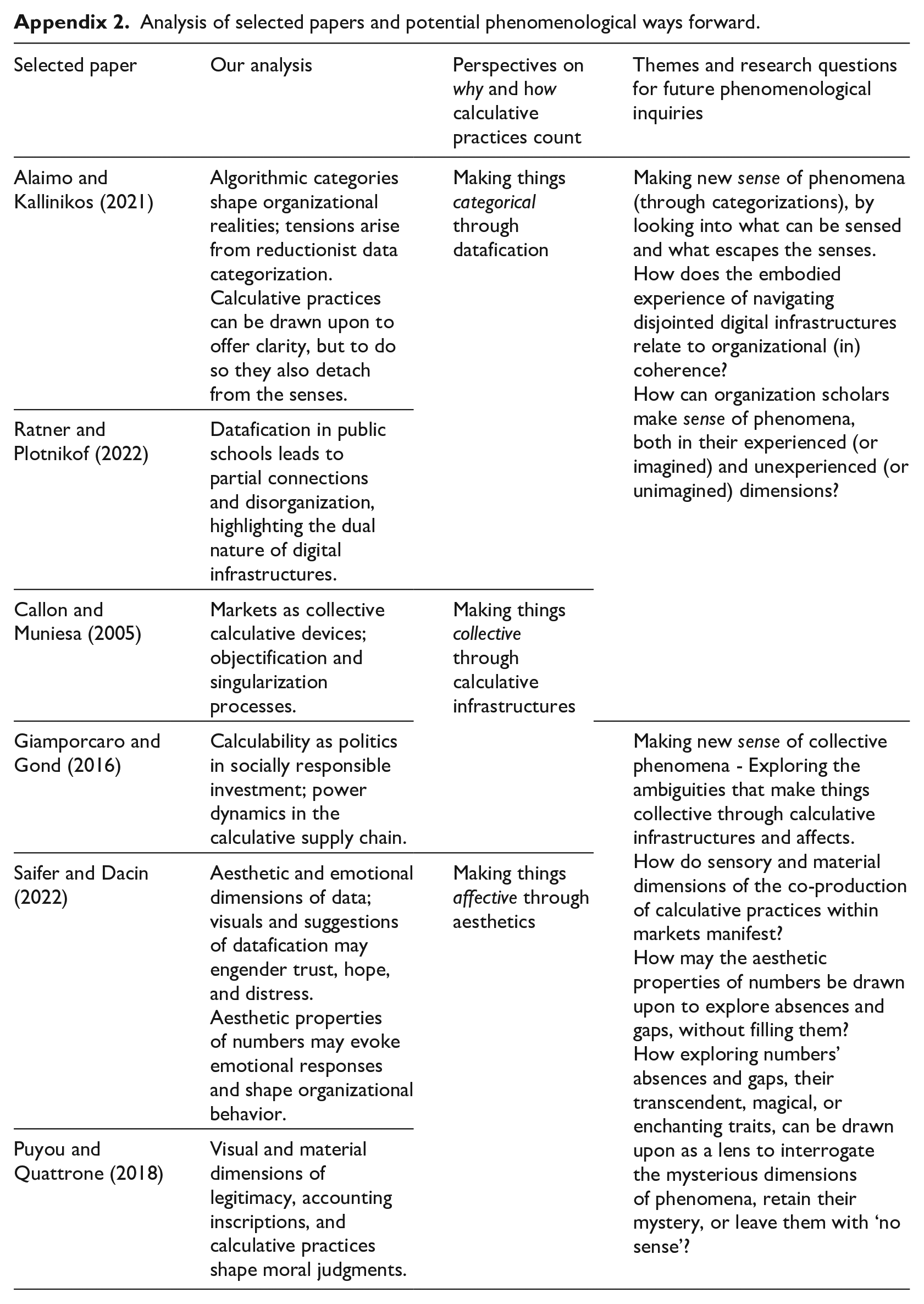
| Selected paper | Our analysis | Perspectives on |
Themes and research questions for future phenomenological inquiries |
|---|---|---|---|
| Alaimo and Kallinikos (2021) | Algorithmic categories shape organizational realities; tensions arise from reductionist data categorization. Calculative practices can be drawn upon to offer clarity, but to do so they also detach from the senses. |
Making things categorical through datafication |
Making new sense of phenomena (through categorizations), by looking into what can be sensed and what escapes the senses. How does the embodied experience of navigating disjointed digital infrastructures relate to organizational (in)coherence? How can organization scholars make sense of phenomena, both in their experienced (or imagined) and unexperienced (or unimagined) dimensions? |
| Ratner and Plotnikof (2022) | Datafication in public schools leads to partial connections and disorganization, highlighting the dual nature of digital infrastructures. | ||
| Callon and Muniesa (2005) | Markets as collective calculative devices; objectification and singularization processes. | Making things collective
through calculative infrastructures |
|
| Giamporcaro and Gond (2016) | Calculability as politics in socially responsible investment; power dynamics in the calculative supply chain. | Making new sense of collective phenomena - Exploring the ambiguities that make things collective through calculative infrastructures and affects. How do sensory and material dimensions of the co-production of calculative practices within markets manifest? How may the aesthetic properties of numbers be drawn upon to explore absences and gaps, without filling them? How exploring numbers’ absences and gaps, their transcendent, magical, or enchanting traits, can be drawn upon as a lens to interrogate the mysterious dimensions of phenomena, retain their mystery, or leave them with ‘no sense’? |
|
| Saifer and Dacin (2022) | Aesthetic and emotional dimensions of data; visuals and suggestions of datafication may engender trust, hope, and distress. Aesthetic properties of numbers may evoke emotional responses and shape organizational behavior. |
Making things affective through aesthetics | |
| Puyou and Quattrone (2018) | Visual and material dimensions of legitimacy, accounting inscriptions, and calculative practices shape moral judgments. |
Funding
The author(s) received no financial support for the research, authorship, and/or publication of this article.
