




Abstract
The current literature on meaningful work has attempted to capture the dynamic interplay between individuals’ subjective perception of the meaningfulness of their work and the broader societal and cultural context, employing tensional and temporal approaches. Yet, understanding of how individuals develop their justifications for the worthiness of their work by transcending subjective and social accounts of meaningful work remains limited. To enrich the justification approach to individuals’ tensional and dynamic experiences of meaningful work, we rely on the economies of worth (EW) framework to explore how individuals engage in meaning-making within their work when its worthiness is challenged. Focusing on the experiences and meaning-making of 46 practitioners working in the corporate social responsibility (CSR) field in Vietnam, we identified three meaning-making mechanisms (prospective deferring, localizing and diverging) enacted in three morally challenging situations experienced by CSR practitioners (self vs belonging, self vs societal perceptions, and self vs external stakeholders’ changing interests). The study makes three contributions: (1) it enriches the meaning-making literature by advancing a justification approach via the EW framework; (2) it clarifies the micro-dynamics of compromise-building mechanisms at different career stages within organizational studies of the EW framework; and (3) it expands micro-CSR research by unpacking the relational tensions and meaning-making experiences of CSR practitioners.
Keywords
Introduction
Meaningful work is often defined as ‘personally significant, worthwhile, and valued’ (Lysova, Fletcher, & El Baroudi, 2023, p. 1227). However, meaningful work is also inherently complex and tensional (Bailey et al., 2019; Buzzanell & D’Enbeau, 2013; Vu & Fan, 2024). To understand the intricate constitution of meaningful work, Mitra and Buzzanell (2017) suggest a tensional approach that highlights the dynamic and contested nature of meaningful work, whereby workers’ subjective meaning-making shifts as professional and organizational contexts change. From a different perspective, Bailey and Madden (2017) propose a temporal approach to show how the meaningfulness of work is neither consistent nor personal, but emerges episodically based on individuals’ changing social and collective contexts. Both approaches note the dynamic interplay between individuals’ subjective perception of the meaningfulness of their work and the perceptions of others regarding what they consider worthwhile (Bailey et al., 2019; Lepisto & Pratt, 2017; Lysova et al., 2023; Mitra & Buzzanell, 2017). This complex interplay in constituting meaningful work is argued to arise from the need to navigate meaningfulness through accounts of worthiness (Lepisto & Pratt, 2017) as meaningful work arises when individuals judge their work worthiness – the ability to contribute to personally or socially valued goals (Beer, Micheli, & Besharov, 2022) – in juxtaposition to how others and society perceive and evaluate work.
Lepisto and Pratt (2017) argue that the sense of work worthiness can be subject to interpretation through a process of account-making, whereby individuals develop their own justification accounts to affirm the worth of their work within the dynamic interplay of socio-cultural values surrounding meaningful work. Therefore, exploring how individuals justify the worthiness of their work by reconciling different forms of worth – stemming from the incompatibilities between subjective views and others’ and societal perceptions of meaningful work – is important for understanding what drives individuals’ judgements of worth, which is central to experiences of meaningful work (Bailey, Madden, & Lips-Wiersma, 2024).
To enrich the justification approach (Lepisto & Pratt, 2017) to meaning-making, we draw upon the economies of worth (EW) framework (Boltanski & Thévenot, 2006 [1991]) to further explore the dynamic and tensional nature of meaningful work. This framework demonstrates different forms of moral justification that individuals refer to when justifying the worthiness of behaviours and decisions (Boltanski & Thévenot, 2006 [1991]; Cloutier & Langley, 2017). It has been used to analyse the various moral foundations – ‘worlds’ or ‘orders of worth’, underlying actors’ discourses when justifying their opinions and actions in the context of dispute. The EW framework is suitable to explore the moral aspects of individuals’ meaning-making mechanisms for two main reasons. First, the framework’s focus on reflexive and moral dynamics (Gond & Leca, 2012) allows us to capture individuals’ reflexive and subjective experiences of the meaningfulness of work (Lepisto & Pratt, 2017; Symons, 2021). Second, it specifies how actors judge and navigate tensions that arise between competing moral foundations (Demers & Gond, 2020; Shin, Cho, Brivot, & Gond, 2022) when subjective experiences are not consistent with others’ understandings of work worthiness (Mitra & Buzzanell, 2017).
To empirically explore the justification approach to individuals’ meaning-making at work when their work worthiness is challenged, we focus on corporate social responsibility (CSR) practitioners – in particular the people who design and implement CSR projects in small and medium-sized enterprises (SMEs) in Vietnam. We have chosen this context for two main reasons. First, multiple moral grounds coexist and compete with each other in the field of CSR (e.g. Demers & Gond, 2020; Patriotta, Gond, & Schultz, 2011; Shin, Cho, et al., 2022), where practitioners are expected to work in line with meaningful values (Iatridis, Gond, & Kesidou, 2022). In fact, CSR is often depicted as essentially contested (Gond & Moon, 2011; Okoye, 2009) due to its morally pluralistic nature (Shin, Cho, et al., 2022). Second, in transitional economies such as Vietnam, the prevalence of weak institutions (Vu & Trang, 2021) often results in SMEs lacking effective and systematic control over voluntary CSR (Peng, 2001). As a result, individuals can encounter conflicts between their personal values and broader cultural norms when implementing CSR, particularly within Vietnam’s strong local collectivist and socialist culture (Shin, Vu, & Burton, 2022).
Our theoretical contribution is threefold. First, we conceptualize a justification approach to meaning-making as an ongoing tensional process whereby individuals constantly (re)construct and (re)negotiate their accounts of the worthiness of work in a dynamic interplay between the self and others. Our conceptualization utilizes the EW framework to show the mobilization of various moral principles associated with the process of meaning-making over time. The EW lens also underpins our second contribution to organizational research (Anesa, Spee, Gillespie, & Petani, 2024; Patriotta et al., 2011; Reinecke, van Bommel, & Spicer, 2017) in the field of CSR (Demers & Gond, 2020; Finch, Geiger, & Harkness, 2017; Roquebert & Gond, 2024; Shin, Cho, et al., 2022). Specifically, we unpack the micro-level dynamics of compromise-building mechanisms (Cloutier, Desjardins, & Rouleau, 2024; Grattarola, Gond, & Haefliger, 2024) across CSR practitioners’ career stages. We demonstrate the inter-subjective nature of compromise-building in securing work worthiness as individuals rearrange their evaluation of their work worthiness through temporary compromises, with each temporary compromise at different career stages at the micro level (Demers & Gond, 2020; Reinecke et al., 2017). Lastly, our focus on individuals’ experiences in CSR advances micro-CSR research (Girschik et al., 2022; Gond & Moser, 2021). We show that practitioners’ intra-individual moral engagement with meaning-making mechanisms in CSR work is constantly challenged by other sociological and institutional moral principles beyond the well-known tension between the business and social goals of CSR (e.g. Carollo & Guerci, 2018; Fontana, Frandsen, & Morsing, 2023; Ghadiri, Gond, & Brès, 2015).
Meaningful Work as a Process of Constant Negotiation and Justification
Meaningful work is ‘the degree to which the employee experiences the job as one which is generally meaningful, valuable, and worthwhile’ (Hackman & Oldham, 1975, p.162). This is distinct from the ‘meaning of work’, which refers to the type of meaning employees derive from their work or the amount of significance/meaningfulness they attach to it (Baumeister & Vohs, 2002; Rosso, Dekas, & Wrzesniewski, 2010). Studies on meaningful work on one hand argue that a sense of meaningful work is subjective – the value and purpose of work is judged based on individuals’ personal ideals and standards (Michaelson, 2021), and characteristics such as beliefs, attitudes and values (Ros, Schwartz, & Surkiss, 1999; Rosso et al., 2010). On the other hand, judgements of meaningful work can be influenced by work conditions such as organizational design (Cartwright & Holmes, 2006), as well as its dynamic nature within socio-political and cultural contexts and changes that shape how work is perceived (Laaser & Karlsson, 2022; Vu, 2022).
A growing number of studies have explored the dynamic interplay between individuals’ subjective interpretations and their situations when assessing the worthiness of work (Bailey et al., 2024; Mitra & Buzzanell, 2017) to unpack the messiness and complexity surrounding meaningful work (Buzzanell & D’Enbeau, 2013). Zookeepers, for instance, often struggle with the inherent tension between the moral dedication associated with their work as a calling, and the fact they sacrifice pay, personal time and comfort because of this ongoing moral commitment to animals and the nature of the work they are doing (Bunderson & Thompson, 2009). Individuals’ subjective perceptions of the meaning and worth of work can also be governed by their wider societal and cultural context (Lepisto & Pratt, 2017; Mitra & Buzzanell, 2017). This can create a contested situation where moral commitments generate a need to act as if work is meaningful, leading individuals to negotiate harmful working conditions or develop high levels of adaptive preference (Nussbaum, 1997), revising down their expectations regarding the worth and meaningfulness of work as a result (Vu, 2022).
Because of the fluctuating and tensional nature of meaningful work (Vu & Fan, 2024), meaningfulness becomes a product of ongoing and dynamic negotiations in meaning-making where judgements of worth (Bailey et al., 2024) and worthy contributions (Martela, 2023) are fundamental to the experience of meaningfulness. Meaning-making is a cognitive process where people constantly construct and deconstruct their positive, negative or neutral experiences (Lepisto & Pratt, 2017; Wrzesniewski, Dutton, & Debebe, 2003). In this process, when the value of their work is questioned by ‘others’, individuals often ‘integrate challenging or ambiguous situations into a framework of personal meaning using value-based reflection’ (van den Heuvel, Demerouti, Schreurs, Bakker, & Schaufeli, 2009, p. 509). The inability to justify the worth of one’s work is a key factor contributing to a lack of meaningfulness (Lepisto & Pratt, 2017). Thus, the worth of work is neither inherent to the nature of the task one performs nor predetermined, known or easily accounted for. Instead, it is an outcome of complex and constant negotiations between subjective perceptions and others’ and social evaluations, stemming from shifting socio-cultural, organizational and occupational landscapes (Laaser & Karlsson, 2022; Vu, 2022) that can challenge personal value-based perceptions of meaning. Therefore, what is considered meaningful is often (re)interpreted, (re)constructed and (re)negotiated through judgements of worth in different circumstances and as changes happen over time.
Lepisto and Pratt (2017) highlight the importance of understanding how individuals develop an account of the worthiness of their work in given socio-cultural and institutional contexts – an approach to meaning-making where the evaluations of worth centre on the perceived legitimacy of different moral foundations (Reinecke et al., 2017) constituting experiences of meaningful work. As individuals are inherently influenced by their socio-political and cultural contexts, their perceptions and choices regarding what they deem worthwhile and valuable are manifested through and within the perceptions and evaluations of ‘others’ regarding the worthiness of their work. During their meaning-making process, individuals therefore navigate through diverse expectations and values beyond their own, seeking justification for their choices and actions in the broader social and cultural context. As a result, the ‘self’ embedded in meaningful work is constituted relationally with others in the process of ‘othering’ (O’Mahoney, 2012). Hence, sense of work worthiness involves constant interpretation through an account-making process, wherein individuals assess and justify the value of their work based on social, cultural and institutional contexts. This process involves a well-recognized tensional interplay between the self (the need to meet the needs of the self) and others (the need to meet the needs of others) (Lips-Wiersma & Wright, 2012). However, how such interplay is justified within individuals’ meaning-making process remains an underexplored aspect of meaningful work (Bailey et al., 2024; Lysova et al., 2023). Below, we conceptualize this process as a justification approach to meaning-making through the economies of worth (EW) framework.
Towards a Justification Approach to Meaning-Making at Work: Economies of Worth
A justification approach to meaning-making at work delves into the reasons and justifications behind why an individual engages in work and the moral foundations upon which they base the worthiness of their work (Lepisto & Pratt, 2017). In other words, individuals develop a certain account to justify what makes their work legitimately worthwhile. This occurs in an ongoing tensional meaning-making process that involves an interplay between their own subjective interpretations and prevailing socio-cultural understandings of work worthiness. Moreover, a justification perspective can reveal how individuals adapt their accounts of their work’s worthiness when their subjective evaluation of the work is challenged by social evaluation, which may also evolve and change over time. Tensional and temporal approaches to individual accounts of meaningful work offer only partial insights into the justification aspect of meaning-making. These two approaches have been applied to the ongoing negotiations in individuals’ meaning-making regarding what is deemed worthwhile. This meaning-making can be challenged in contested situations, for example by the tensional influence of the politico-economic structure of work (e.g. Mitra & Buzzanell, 2017), as well as in episodic experiences shaped by personally meaningful symbols and social relevance within a collective context (e.g. Bailey & Madden, 2017). However, these approaches have yet to explore how individuals mobilize particular forms of worth associated with both the subjective and socio-cultural aspects constituting meaningful work, at any given time and over time, to maintain, reinforce, construct or negotiate work meaningfulness when their work worthiness is challenged by social validation (Reinecke et al., 2017).
We rely on the economies of worth (EW) framework (Boltanski & Chiapello, 2005; Boltanski & Thévenot, 2006 [1991]; Lafaye & Thévenot, 2017) to enrich the justification approach to meaning-making at work as a dynamic, episodic and tensional process of navigating the interplay between self and others’ evaluations of work worthiness. The EW framework helps unpack the underlying justifications individuals rely upon in the processes of meaning-making at work. The terms ‘orders of worth’ or ‘common worlds’ reflect the moral foundations actors engage with when evaluating situations and to justify their opinions and actions in contexts of dispute (Cloutier & Langley, 2013; Demers & Gond, 2020; Shin, Cho, et al., 2022; Shin, Vu, & Burton, 2022). Boltanski and Thévenot (2006 [1991]) originally identified six moral principles of evaluation that form the logics of justification: market, industrial, domestic, fame, civic and inspired. The market order values the concepts of profit and competition; the industrial order values practical performance and efficiency; the domestic order values tradition and belonging; the fame order highlights public reputation and recognition; the civic order values societal welfare; and the inspired order highlights individuals’ own passion and the inner self. Two other orders were added: the project order, which emphasizes flexibility and adaptability (Boltanski & Chiapello, 2005); and the green order, which highlights environmental friendliness and ecological balance (Lafaye & Thévenot, 2017).
While the EW framework has not been explicitly utilized in the meaningful work literature, we argue that it is a good fit for two reasons. First, the framework focuses on individuals’ reflexive and moral justifications (Gond & Leca, 2012) in their subjective negotiations of the meaning of particular situations (Boltanski & Thévenot, 2006 [1991]). It is often integrated to examine justification work by individuals as they engage with moral and value-infused discursive and practical resources (Cloutier & Langley, 2017). Individual judgements on what counts as meaningful are associated with their reflexive and subjective experiences (Lepisto & Pratt, 2017; Symons, 2021). The meaningfulness of work centres around subjective justification of value, namely what holds personal moral resonance or significance (Lepisto & Pratt, 2017) and involves moral considerations (Michaelson, 2021), elements that form the essence of the EW framework. Actors justify the moral worthiness of their claims and actions (Cloutier & Langley, 2017; Roquebert & Gond, 2024). For instance, managers give meaning and value to green chemistry projects by drawing on the green, the industrial and the market orders of worth (Finch et al., 2017). Similarly, individuals establish their moral justification in response to a major change in their organization’s sustainability strategy (Demers & Gond, 2020). Hence, this framework offers a universal, operational tool to analyse the moral aspect of actors’ meaning system (Roquebert & Gond, 2024).
Second, the EW framework offers a grammar to investigate moral tensions and (re)combinations of moral orders through the lens of moral justification (Cloutier & Langley, 2013; Demers & Gond, 2020; Patriotta et al., 2011). It captures how individuals mobilize different moral principles (i.e. orders of worth) to establish, challenge or reach compromise (Boltanski & Thévenot, 2006 [1991]). When individuals encounter contested situations, they reveal their moral foundations in discourses justifying their viewpoints (e.g. Demers & Gond, 2020; Roquebert & Gond, 2024; Shin, Cho, et al., 2022; Shin, Vu, & Burton, 2022). Such situations allow individuals to assess what they deem worthy or unworthy, reinforce their moral positioning by engaging with various moral foundations (Shin, Vu, & Burton, 2022). Moreover, actors suspend and stabilize tensions involving more than one moral world through ‘compromise-making’, albeit temporarily (Boltanski & Thévenot, 2006 [1991]; Demers & Gond, 2020; Reinecke et al., 2017). Through using the EW framework, organizational scholars have analysed how actors conciliate and/or balance competing moral orders (Roquebert & Gond, 2024). Given the inherently tensional nature and moral complexity of meaningful work (Bailey et al., 2019; Mitra & Buzzanell, 2017), the EW framework provides a useful analytical tool to explore how individuals uphold the meaningfulness of their work when their subjective values towards work are disrupted by others’ understandings of work’s worthiness. In this paper, we employ the EW framework to investigate the moral dynamics of individuals’ meaning-making in contested situations at work, in the context of CSR in Vietnam.
Research Context: Meaning-Making by CSR Practitioners in Vietnam
To analyse the dynamic tensional process of meaning-making from a justification perspective, we explored how CSR practitioners negotiate the meaningfulness of their work in contested situations where different and conflicting meanings are at play. The CSR field offers a suitable setting due to its meaning-driven, morally multi-layered and inherently tensional nature (Reinecke et al., 2017; Shin, Cho, et al., 2022). CSR practitioners are expected to follow meaningful values (Iatridis et al., 2022) and their work requires them to maintain a constant balance between the organizational search for profit and socially and environmentally meaningful practices (Ghadiri et al., 2015; Fontana et al., 2023; Iatridis et al., 2022). The meaningfulness of their work is subjectively based, arising from their ideals and passion for social issues (Carollo & Guerci, 2018; Fontana et al., 2023). However, finding a sense of meaningfulness is complex due to the inherently tensional nature of CSR work (Mitra & Buzzanell, 2017; Girschik et al., 2022). The CSR field is morally pluralistic, with multiple values coexisting and competing at the individual, organizational and broader levels (Shin, Cho, et al., 2022).
Studies have documented the various tensions experienced by CSR practitioners, primarily between their own values and purpose, and the financial goals of their organizations (Fontana et al., 2023; Mitra & Buzzanell, 2017), but also in relation to their contributions to society (Iatridis et al., 2022). These tensions influence how they shape the purpose of their work to include activistic, win–win and corporate ends (Fontana et al., 2023). It is by navigating these tensions that they find meaning in their work (Mitra & Buzzanell, 2017). Thus, CSR practitioners’ meaning-making process becomes a dynamic journey of justification as they grapple with tensions between values from their inner and outer lives.
Our geographical focus is Vietnam, a country whose collectivist and socialist cultural background (Nguyen, 2016) make it an ideal setting given the objective of the study: to explore how the values and meaningfulness of ‘others’ can significantly influence individuals’ judgement of what counts as meaningful to them. The notion of CSR was first introduced in Vietnam in the 2000s in an effort to promote its transition to a socialist-oriented market economy. CSR gained momentum following Vietnam’s accession to the World Trade Organization in 2007. However, a recent study reports that CSR approaches in Vietnam lack direction, remaining largely symbolic and failing to make a substantial contribution to society (Nguyen, Khan, & Bensemann, 2022). CSR in Vietnam also exhibits instrumental aspects, with the government using it to uphold socialist values through various initiatives, including the dissemination and propagandization of socialist ideological thoughts by social organizations and associations (Gillespie & Nicholson, 2005).
We explored CSR in relation to SMEs in Vietnam because they play a vital role in the Vietnamese economy, accounting for 97% of the country’s enterprises and contributing 45% of its GDP (Ministry of Planning & Investment, 2021). Since the introduction of CSR in the 2000s, most SMEs have been drawn to CSR practices as a means to gain competitive advantage. Nevertheless, SMEs in transition economies such as Vietnam often operate under weak market institutions and infrastructure (Peng, 2001). As a result, CSR is relatively less institutionalized, providing opportunities for individual CSR practitioners to exercise discretion based on their personal judgement and assessment of the value of CSR work. As explained by Le, Ngo, Tran, and Tran (2021) in their study of CSR and firm performance: (1) compared to larger organizations, SMEs in Vietnam face difficulties in relation to accessing capital and resources, as well as achieving access to and influence in the market, posing difficulties in synchronously considering economic, social and environmental benefits as a whole; (2) SMEs lack knowledge of CSR and interest in issues related to environmental degradation or climate change; and (3) CSR is not being implemented properly, with SMEs treating CSR as a form of charity with the aim of polishing the firm’s brand reputation.
Exploring this specific context of CSR work in SMEs in Vietnam can potentially shed light on the different moral worlds at play in individuals’ meaning-making. In addition, the EW framework provides a platform for showcasing the local cultural nuances that characterize Vietnam, from the social dynamics of the era of French colonization that spanned the 1880s to the 1950s, commonly referred to as ‘camaraderie’, to enduring specific local cultural values such as collectivism and respect for seniority, local communities and colleagues, underlined in particular by the domestic order. We posit that these intricacies highlight the relevance of the EW framework to the dynamic interactions between government entities, businesses and local communities in the context of Vietnam.
Methodology
Research approach
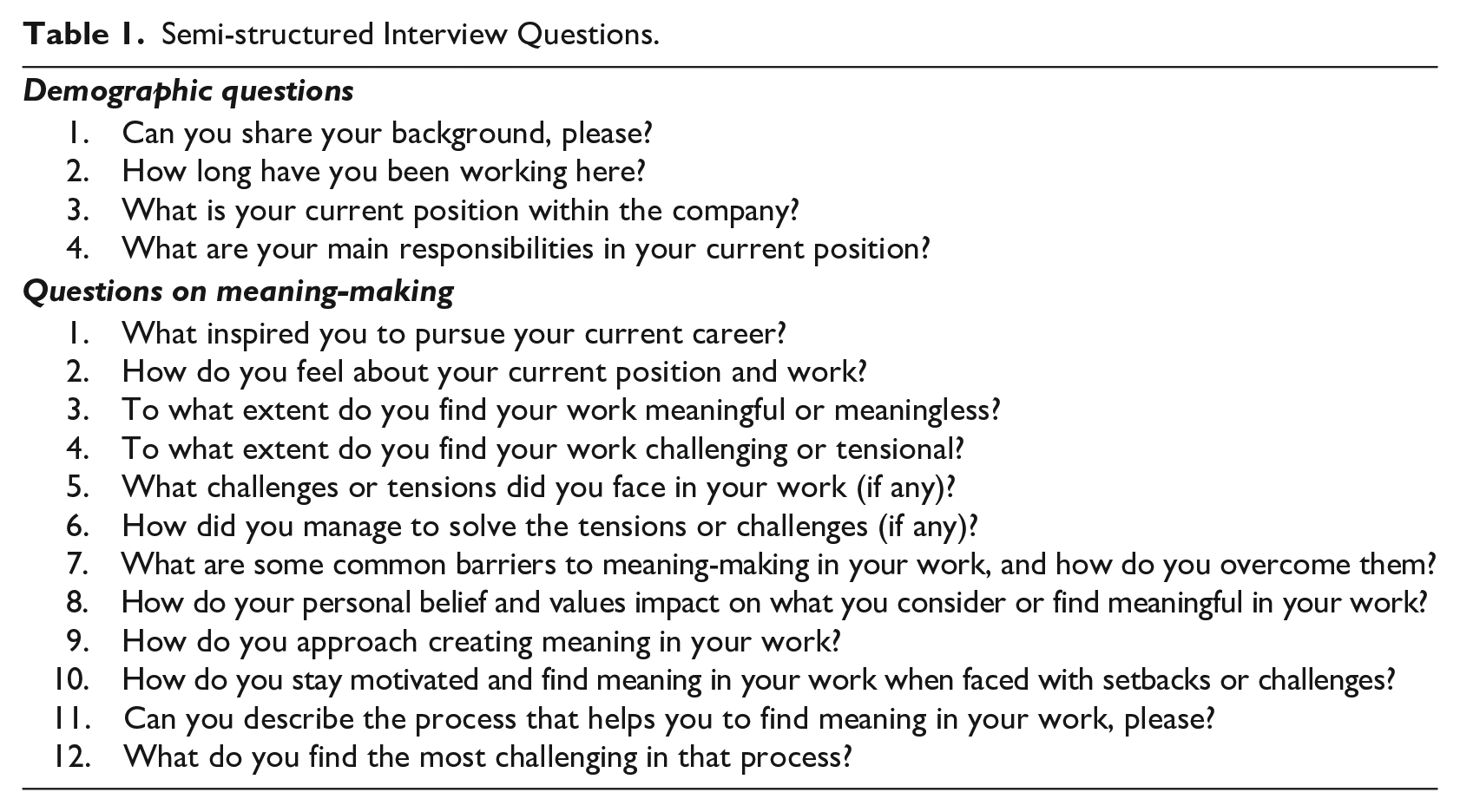
Adopting an exploratory qualitative approach, we mainly relied on semi-structured interviews to elicit respondents’ narratives of meaning-making in CSR work. We used questions that encouraged a form of account analysis, where participants shared meanings and reasons for individual choices and behaviours (Frey, Botan, & Kreps, 2000) in relation to their work. We asked about their aspirations for their work, the meaning the work held for them, the tensions they faced as CSR practitioners and how they overcame such tensions (see Table 1 for the list of questions). We relied on open-ended and follow-up questions to facilitate in-depth exploration of the practitioners’ complex meaning-making processes.
Semi-structured Interview Questions.
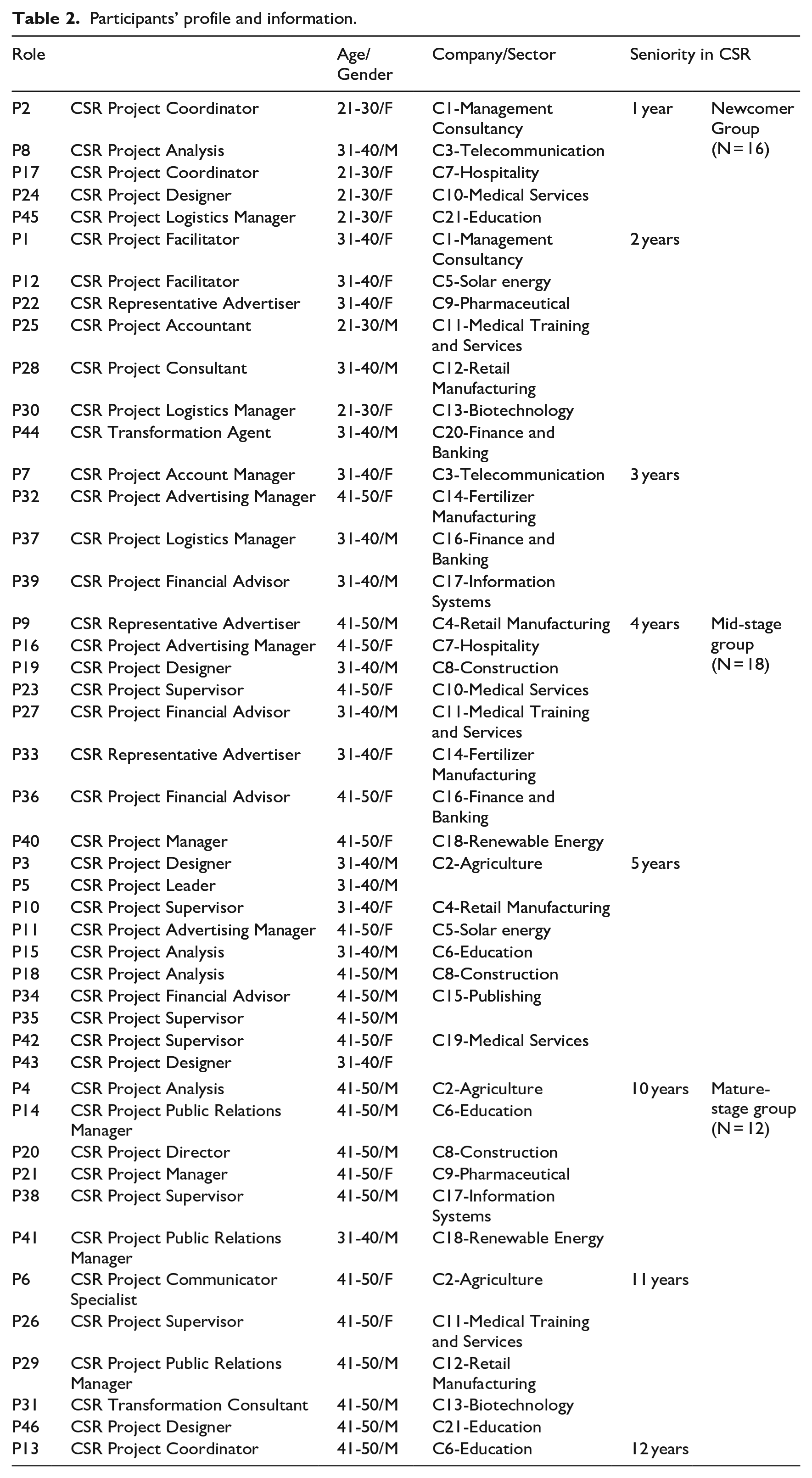
The interviews were conducted in 2019 with 46 CSR practitioners from 21 Vietnamese SMEs located in Hanoi and Ho Chi Minh City (see Table 2 for the participants’ details). We first contacted companies from the Hanoi Association of SMEs (HANOISME) and the Association of SMEs in Southern Vietnam (AMES), and then expanded our sample through the snowballing technique. The interviews were conducted in Vietnamese by the native Vietnamese author, then audio-recorded, transcribed and translated into English. The interviews ranged between 45 and 60 minutes in duration. Due to the limited capacity of SMEs in Vietnam, apart from their primary role in CSR, our interviewees also held other functional roles such as PR, marketing or HR. However, they were all directly involved in designing and implementing CSR projects for their firms. They also had a clear CSR occupational identity, with their CSR role stated on their business cards. In addition to the interviews, we triangulated our data with company CSR reports and internal CSR project documents to familiarize ourselves with the context and further comprehend underlying assumptions influencing the interviewees’ meaning-making as CSR practitioners. Each author independently coded and analysed the data. When discrepancies remained, we revisited the data, discussed different interpretations and coded the data collectively until a consensus is reached. We also cross-checked our coding and interpretation with the interviewees to ensure that the data interpretation was unbiased.
Participants’ profile and information.
Data analysis
Our four-stage analytical strategy followed the abductive approach (Behfar & Okhuysen, 2018). We first inductively analysed our interview data. After reviewing the data several times to identify emerging theoretical arguments and develop first-order concepts, we used open coding with initial codes such as ‘social expectations’, ‘questioning meaning’, ‘prioritizing others’, and so on. We then grouped similar codes together, adjusting and combining them to best capture the nuances of the data and ensure consistency in broader themes, such as tensions – referring to the conflicts and challenges CSR practitioners experienced, and meaning-making – referring to how individuals interpret and make sense of their experiences. We focused on these two key themes, the tensions experienced by the interviewees and their meaning-making processes. We explored how they navigated these tensions, perceived their work, and what made them consider their work meaningful.
The second stage of the analysis was deductive in nature. Focusing on the tensions experienced by CSR practitioners as revealed in their narratives about contested situations at work, which emerged from the first analytical stage, we explored how they interpreted and justified these disputes when their initial moral foundations of work worthiness were disrupted by others’ values. In line with previous EW studies (Demers & Gond, 2020; Patriotta et al., 2011; Roquebert & Gond, 2024; Shin, Cho, et al., 2022), we used semantic indicators 1 from the original EW texts to analyse these justifications and understand the complexities of their experiences. Drawing on the eight orders of worth (i.e. the market, industrial, domestic, fame, civic, green and inspiration orders) identified by Boltanski and Thévenot (2006 [1991]), Boltanski and Chiapello (2005) and Lafaye and Thévenot (2017), we coded any references conveying distinct contested situations experienced by CSR practitioners in relation to their perception of the meaningfulness of work. We identified particular accounts of tensional moments at work when interviewees expressed that something had gone wrong or seemed unfair (Boltanski & Thévenot, 2006 [1991]; Gond & Leca, 2012). These ‘critical moments’ occurred when their routines of work and subjective values of work were challenged.
In this stage, we found three distinct critical moments where subjective moral foundations constituting the initial sense of work worthiness (the self) clashed with and were challenged by others’ moral principles within a socio-cultural context, leading individuals to navigate and reconcile these different perspectives to sustain their sense of meaningful work. We refer to these as others’ socio-cultural moral foundations as they came from others’ views (colleagues at work, societal values and external stakeholders’ values). For instance, the quote ‘I always wanted to be a CSR professional [. . .], I was inspired by how I can make a social impact in this job,’ reveals two moral principles – the civic and the inspired orders. These two principles were key sources of the subjective perception of work worthiness held by the CSR practitioners in our study. However, these subjective moral foundations were challenged by the values of a sense of belonging and respecting colleagues as part of team culture. We categorized this as others’ socio-cultural moral foundation grounded in the domestic order. Supplemental Appendix Table 1 provides a summarized description of the consolidated EW framework used in our study. For the categorization process, we focused on which orders of worth were genuinely embedded or valued in the value-related discourses. For instance, while environment-related CSR projects could be considered to highlight the green order at first glance, our analytical process identified the civic order as more prominent in that their key values and purposes were philanthropic or social contribution activities for local communities, rather than harmonious relationships between humans and nature (Thévenot, Moody, & Lafaye, 2000). Thus, we decided not to consider the green order in our analysis. Supplemental Appendix Table 2 present illustrations from our coding analysis.
In the third stage of analysis, we focused on the meaning-making processes identified in the first stage of our analysis. Specifically, we explored how participants secured the meaningfulness of their work in the tensional situations. We found that they attempted to suspend these tensions through various meaning-making narratives, which involved building compromises by mobilizing different moral grounds. In this compromise-making process, they still found a way to secure their work worthiness in the face of others’ contesting moral grammars through three distinct meaning-making mechanisms: prospective deferring, localizing and diverging. We then focused on how these mechanisms of meaning-making were morally justified, using orders of worth coding. We found the domestic order featured in all the mechanisms as an underlying moral principle. Supplemental Appendix Table 3 presents the conceptual definitions emerging from our analysis and illustrative examples for each mechanism.
The fourth stage of the analysis involved inductive identification of variations across CSR practitioners regarding sources of moral contestation at work, and their moral justification to secure the meaningfulness of work in response to these contestations (as established in the previous analytical steps). We recognized that CSR practitioners’ rhetoric and discourses of contestation and meaning-making experiences diverged based on the number of years working in the CSR field. This finding aligns with previous studies (e.g. Arthur & Rousseau, 2001; Fontana et al., 2023). Thus, by focusing on the predominant moral foundations underlying each interviewee’s narratives on what made them consider their work meaningful and difficult, we categorized CSR practitioners with 3 years or less experience in CSR work as the newcomer group (N = 16). Those with 4 years or more experience in CSR work were placed in the mid-stage group (N = 18), while individuals with over 10 years’ experience were classified as the mature-stage group (N = 12).
In the analysis of the moral contestations faced by CSR practitioners at three different career stages, we counted the occurrences 2 of an order of worth in the interviewees’ narratives to see which order(s) of worth were most salient in their narratives. We identified the majority of both the newcomer and mid-stage groups consistently referred to their professional aspirations and social purpose [inspired and civic] to articulate their initial intentions for developing and implementing CSR projects, with 56 instances in the newcomer group and 48 instances in the mid-stage groups. However, among the 12 mature-stage CSR practitioners, only three mentioned ‘the inspired order’, and this was noted just once, while ‘the civic order’ was mentioned 48 times. We then examined each group’s distinct coping strategies for securing a sense of meaningfulness of work in key contested situations by investigating how interviewees justified their meaning-making mechanisms based on the orders of worth. Newcomers referenced the domestic order 68 times in relation to navigating tensions with colleagues and other stakeholders. In contrast, mid-stage participants mentioned a combination of the industrial order and the domestic order (68 times and 52 times respectively across N = 16) with regard to managing the public pressure and scepticism underpinned by the fame order (79 times across N = 16). The mature group referenced a combination of the project order and the domestic order (61 times and 49 times respectively across N = 12) to navigate market competition emphasized by the market order (38 times across N = 12), with all mentioning such combinations at least twice.
Findings
Contestation #1: Self vs. belonging
Newcomers to the field – those who had been doing CSR work for three years or less – had aspirations to create a significant impact on society through CSR activities. They highlighted the importance of the social impact of CSR [civic] as a key motivation for entering this field and fulfilling their mission-driven ‘dream’ of becoming a CSR professional [inspired]. They wanted to make substantial social changes and believed they could. As a result, they were enthusiastic about trying new things at work: I always wanted to be a CSR professional because since I studied Business Ethics and Sustainability at university, I was inspired by how I can make a social impact through this job. (P44)
However, the newcomer CSR practitioners emphasized that such aspirations required extra effort and commitment from other colleagues at work, which created tensions: . . .if I propose something which is a bit demanding for others to expand the impact on our beneficiaries, they tend not to be happy . . . For me, making the most of what we can [for social well-being] is inspiring, but for some of my colleagues, meaningfulness is just that they can go home early and being able to complete the project effectively [. . .] (P17)
A CSR project coordinator for a hotel chain, P17, acknowledged the difference between her own perception of the meaningfulness of work as a CSR practitioner (i.e. her aspiration to create substantial social impacts for the local disabled people) and that of her colleagues. This discrepancy highlights the clash between her sense of work worthiness as grounded in the inspired and the civic orders, and the value of working harmoniously with her colleagues, grounded in the domestic order. However, due to Vietnam’s collectivist culture, which emphasizes mutual support and respect, the tradition of prioritizing harmonious belonging at work remains crucial for the successful implementation of future CSR projects. This reflects how the self is constituted relationally in the process of ‘othering’ (O’Mahoney, 2011) – in a reflexive interrelating with others and contextual factors.
Maintaining harmonious relationships with colleagues and showing respect to senior colleagues were especially essential for newcomers, who had not yet built trust with local communities and local authorities to implement CSR projects: I had to restrain certain initiatives even though I am the project facilitator. Our beneficiaries (local schools) wanted to discuss with my colleagues whom they know personally, rather than with me [. . .] Some of them, in fact, started to exclude me from some work. (P12)
P12 could not progress her CSR project on her own because the beneficiaries – local schools – demanded assurances from her senior colleagues, who had an established relationship with them from previous projects. A CSR project consultant, P28, also emphasized the significance of collegial support for the continuity of successful CSR projects, stating that his passion and dream to make positive social impacts through this work could not be realized without it: Without collegial support and approval, it will be very hard to continue to work on future CSR projects [. . .] which would not be good for the society in the future. (P28)
Meaning-making mechanism #1: Prospective deferring
In response to the tensions between the moral foundations of the newcomer group’s work worthiness [inspired and civic] and the moral foundations embedded in work traditions in the context of Vietnam [domestic], the newcomer group adopted the meaning-making mechanism of prospective deferring. In his context, prospective deferring refers to temporarily accommodating the tradition of respecting (senior) colleagues and harmonious belonging [domestic] to gain long-term support for future CSR aspirations [inspired and civic]: . . . regardless of how my CSR ideas would maximize the societal well-being, I certainly cannot work alone and ignore others . . . for me [as a newcomer] showing respect to more experienced colleagues is important to receive their support later on. (P8)
P8, a CSR project manager in a telecommunication firm with one year’s experience, believed that accommodating senior colleagues’ wishes for CSR projects should come first as a way of showing respect, thereby aligning with the collectivist working culture [domestic] where relationships with local officials are protected and shared among more senior colleagues. He believed that while this might temporarily hold back his CSR ambitions, it would serve as a steppingstone towards achieving his personal goal of creating social impacts as a CSR professional [inspired and civic] in the long run.
This experience was also shared by the mature-stage group, as represented in the following quote from P14, a CSR manager in an education firm. Based on his experience, P14 emphasized that neglecting colleagues’ needs in implementing CSR initiatives would not serve to advance CSR projects in Vietnam, especially for newcomers. This is because CSR projects are founded on personal relationships between contractors and senior colleagues: There are so many hidden channels and agreements in CSR work that were established within closed networks and relationships based on personal trust with some of my colleagues. Without being a member of the system, the project could never be advanced. (P14)
The strong Vietnamese cultural heritage of respecting (senior) colleagues and harmonious relationships at work [domestic] was seen by interviewees as essential in the context of SMEs in Vietnam due to their ‘like families’ culture.
While this meaning-making mechanism led newcomers to defer the actualization of their current work worthiness until they earned trust from their colleagues and built capacities through experience, such delays often reinforced their career passion and goals as CSR professionals: . . . by showing respect, I hope that I can and will have to do more impactful things once I am accepted as a trustful member of our CSR team. (P8)
However, delaying the realization of work worthiness could potentially lead to unresolved tensions in later stages of CSR professionals’ careers, as their anticipation and dedication to their aspiration as a CSR practitioner were intensified: I was hoping that I could do big things when I was being part of the team but then the public pressure (due to scepticism) and expectation placed on us as CSR practitioners just added more challenges for me to do what I really want to. (P14)
As exemplified by P14, interviewees in this career stage set aside what made them feel meaningful through CSR, hoping that their career passion for making social impacts [inspired and civic] could be realized when they eventually become integrated into their team as trusted and harmonious members. However, this meaning-making mechanism could exacerbate tensions, compelling individuals to exert greater effort to fulfil their CSR aspirations once they gained more experience and become integrated into their CSR team.
Contestation #2: Self vs. societal perceptions
CSR practitioners’ aspirations for the values of CSR work [inspired and civic] were disrupted by the instrumental and symbolic view of CSR [fame] ingrained in public opinion. Since the Vedan corporate scandal of 2008, when the company discharged a large amount of untreated sewage into the Thị Vải River in Vietnam (Nguyen & Pham, 2012), the Vietnamese public has tended to see companies’ CSR activities as merely a part of their public relations efforts, a perception that challenges CSR practitioners’ original work worthiness. Therefore, even after gaining the trust of their team members and accumulating experiences, and while holding ever higher career hopes to make their CSR work more meaningful to themselves [inspired and civic], the mid-stage CSR practitioners confessed encountering another challenging situation they had to deal with: public doubts about the ‘real’ value of ‘grand’ CSR projects [fame].
People see CSR as window dressing . . . I have to constantly explain myself and fight against this prejudice . . . our CSR is nothing like symbolic charity. . . (P35)
P35, a CSR project supervisor from a publishing firm, complained about the general public perceiving CSR as merely symbolic [fame], undermining his genuine efforts to promote social well-being [inspired and civic]. He was dissatisfied with the perception of CSR as merely a marketing tool or one-time charitable event held during the lunar new year period, primarily for media coverage. As he pointed out, he had been working on various CSR initiatives for his company throughout the year (e.g. reading week for kids in rural areas; fund raising campaign through reality shows, and so on).
I had high expectations [of how I can make social changes with CSR] . . . I always believed that having the right network and right team to work with could be enough to make CSR work . . . nobody took me seriously when I said I was doing CSR. . . . After five years of being a CSR practitioner . . . I am still struggling to position myself and my ambition in the field. (P40)
P40, a project manager in a renewable energy firm, shared similar struggles. Her narratives emphasized the meaningfulness of her work – creating social impacts in CSR as a CSR practitioner [civic and inspired] – which she willingly delayed by integrating herself into the collectivist working environment [domestic] while awaiting the right opportunities to realize her CSR aspirations. Yet, these accumulated career aspirations intensified her struggles when confronted with the public’s perception of the value of CSR [fame], demonstrating the ongoing tensional dynamics embedded in CSR work in Vietnam.
Meaning-making mechanism #2: Localizing
To deal with this contestation between the general public’s view of CSR as symbolic and instrumental [fame] and the values placed on it by CSR practitioners [civic and inspired], the mid-stage CSR practitioners deployed the meaning-making mechanism of localizing. Localizing refers to reframing CSR projects to emphasize the values of practicality and effectiveness through focusing projects on smaller and more targeted local communities where they operate. Our interviewees believed that this could avoid the public scepticism. Such revised CSR projects often led CSR practitioners to scale down their initial ambitions and the value of the work [civic and inspired]. They justified smaller CSR projects by emphasizing their effectiveness and efficient management, which was meaningful not only to themselves but also to the beneficiaries, and these small projects did not encounter public scepticism.
We offered a paid internship for agricultural students by financially supporting local farmers to host students for the summer internship . . . living among farmers can help agricultural students to identify start-up initiatives for organic farming in local communities for their projects . . . [and] farmers can gradually ‘đón nhận’ (accept) modern organic farming methods through building trust with everyday interactions with students which is a local culture of “tinh thần đoàn kết và hòa mình” (spirit of solidarity and integration) . . . with the help of agricultural engineering students residing in the field with hands-on experience on local farms, we have streamlined our automatic irrigation system (hệ thống tưới tự động) to reduce manpower and minimize water usage . . . I would have wanted to engage with the Vietnam National Union of Students (VNUS) but this might have been perceived as us wanting public recognition. (P5)
P5, a project leader at an agricultural company, shared how he was willing to adjust his ambition for a CSR project [inspired and civic] in terms of both scale and scope. In doing so, he believed that his re-focused CSR project created distance from the social scepticism surrounding national-scale CSR projects in Vietnam [fame]. As he noted, the project also became more useful for farmers and students as the beneficiaries, and more efficient for him to manage as a result of training and collaborating with the agricultural engineering students. These students eventually became helpful in effectively managing the irrigation system, leveraging the expertise and experience gained from living within the local community. Thus, while the project was scaled down to focus on a closer local community and initially appeared less ambitious, this approach proved to be more productive and efficient because it created a durable and reliable environment for the beneficiaries [industrial]. It also accommodated targeted local culture and expectations [domestic] while avoiding unwelcoming prejudice from the public.
Similarly, P26, a project supervisor with over 10 years’ experience in CSR work, recalled a CSR project during his mid-career stage as his most meaningful and memorable experience. The project was successfully tailored to maximize effectiveness and efficiency for the target community despite its relatively modest scope.
Based on that [the training of basic first aid and elderly care techniques to local women], they [local women] set up local support groups where they bring their elderly parents who need attention and take turns caring for them each week . . . our project was turned into an effective self-sustained operation by them, some decided to make it a profession and took further certified training . . . [and] helped us operating and expanding the care groups . . . they even recruited and trained young women for this profession . . . now there are more than 6 groups like this, all maintained and monitored by locals . . . What I initially wanted was no longer as important as ensuring that my CSR project have a positive impact on the community. (P26)
P26 scaled down his initial CSR project to address public scepticism. Nevertheless, he was able to make his modified project more practical and valuable to local beneficiaries and his team by establishing a self-sustaining, supporting infrastructure run by local women who had received certified training and acquired specialized skills. Recalling this modified project, P26 highlighted its operational practicality and usefulness [industrial], as well as its successful commitment to meeting the expectations and needs of the target local community. The project thus emphasized familial responsibility, particularly towards elderly family members [domestic].
These experiences reinforced the importance of CSR practitioners reevaluating and revising their CSR projects and career aspirations [inspired], especially when they realized that making CSR projects meaningful is not solely about fulfilling their own aspirations. Instead, it is about delivering ‘a positive impact on the community’ [P26]. To do so, it was crucial for CSR practitioners to localize their approach by seeking practical and tailored ways of operating CSR projects that could benefit smaller targeted local communities [industrial and domestic], without appearing merely symbolic and thereby triggering public scepticism. Therefore, mid-stage CSR practitioners maintained their sense of meaningfulness at work by gradually adjusting their initial aspirations. Their primary focus shifted from the personal aspiration of delivering ‘big’ CSR projects to ensuring that their CSR initiatives could practically benefit the community and their team.
Contestation #3: Self vs. external stakeholders’ changing interests
The mature-stage CSR practitioners faced tensions between the intended values of CSR projects grounded in the civic order and the values of market competition and self-interest of major stakeholders (i.e. the management, funders and local authorities). Acknowledging the tensions moving them to scale down in localizing approaches to CSR, we no longer saw the inspired order in their narratives of the work worthiness. They mainly highlighted the value of social welfare through CSR projects without linking them to their personal career aspirations and passion.
We need to think about how to develop more competitive CSR projects compared to those of other firms . . . it’s meaningless that I have to deal with all these . . . the project changed more than three times to accommodate the director’s wish to compete with other projects in the region . . . (P26)
P26 highlighted that her CSR project initially designed to help the disabled [civic] was disrupted by her organization’s top management, who prioritized the competitive advantage to be gained by the firm through the CSR project [market], rather than focusing on the project’s societal impact. As other companies were engaged in similar CSR projects for the disabled, the top management requested her to find a niche way to generate competitive advantage for her company by establishing a distinctive CSR approach in their project. Consequently, she felt pressured to reposition the project to satisfy the top management of her firm by redirecting the project to focus only on the deaf community. However, she believed that such a modified version of the project would not be sufficient to achieve the larger impact she had originally envisioned.
P13, a project coordinator at an education firm, also shared how the initial target for his CSR project could not be maintained due to the demands and interests of key market partners, particularly the local authorities.
I had a very meaningful CSR project that helped improve elementary education in Northern provinces 4 years ago . . . The system we had built up was ruined by local officials’ interests because they wanted to expand the facility without considering the quality of teachers they hire to compete with other provinces . . . (P13)
Local authorities viewed the CSR project as a means of competing against other nearby provinces that also had CSR projects for schools and therefore wanted P13 to change his original CSR project. Since local authorities in Vietnam can influence regulatory matters that affect CSR projects, such as licensing and permits or access to resources (Phuong, Biesbroek, & Wals, 2018), P13 had to respond to their request. The revised CSR project offered internship programmes for urban teachers from prestigious universities. While recruiting teachers from prestigious universities might look compelling in terms of the competition among provinces, these urban teachers may not necessarily know how to localize their teaching skills to the needs of local pupils. Furthermore, the job security of local teachers was threatened. As a result of the local authorities’ interest in competing against other provinces through CSR projects [market], P13 could not implement his CSR project as he planned.
Meaning-making mechanism #3: Diverging
The mature-stage group used a diverging mechanism to navigate the pressures of the market values held by major stakeholder groups and secure the meaningfulness of their work. Diverging refers to using flexible adaptation to local ways of doing things [project and domestic] to find space for an optimal action between the intended values of CSR projects [civic] and key stakeholders’ self-interest in enhancing competition through such projects [market]. In our study, the mature-stage CSR practitioners highlighted such flexibility in handling CSR projects to sustain the meaningfulness of their work in challenging situations. With experience, more skilful CSR practitioners found ways to preserve the core meaning of their work [civic], even when the initial meaning and intent of CSR projects were disrupted by market demands [market]: Local authorities’ prioritization of urban teachers’ internship in rural schools affected the quality of teaching because urban teachers are just ticking the boxes to fulfil their required services to attain their certificates to go back to big cities. And this also left many rural teachers jobless . . . Our initial CSR project was to provide more educational facilities [but] . . . we decided to offer a training programme [to local teachers]as one of our CSR services in local areas . . . which enhanced local teachers’ competitiveness in the job market and would also help maintain quality teaching in local schools. (P20)
P20, a CSR project director of a construction company with more than 10 years of experience, shared how he could always find an alternative way to preserve the core meaning of his project – improving local education – through constant adaptation to the changing market situation. He flexibly revised his CSR project to both accommodate local authorities’ interest in fostering educational competitiveness within the community and fulfil his intention to benefit his target community. In his view, his flexible adaptation responded meaningfully to real local problems by developing local teachers’ skills. He thought that complying with the local authorities’ initial request for building more schools and facilities to attract urban teachers would lead to a deterioration in the sustainable quality and culture of the local education. Thus, he revised his initial CSR plan to provide local teachers with certified in-house training to give them an opportunity to be more competitive in response to the influx of urban teachers. He felt that his approach was meaningful because he was able to find a flexible solution to meet both key market stakeholders’ demands and the needs of local beneficiaries [project and domestic]. He also highlighted how maintaining the core value of CSR while having to constantly divert the project’s initiatives to meet the changing expectations of key market stakeholders in response to market dynamics presented him with a series of constantly evolving challenges to tackle: Our competitors saw how training local teachers was more cost-effective and received greater support from the local community so they initiated some similar programmes. We had to add more initiatives to our campaign by introducing short training field trips and internship opportunities in different cities . . . it’s part of the job, we always have to adjust . . . when responding to the market, our competitors, or local authorities. (P20)
The mechanism of diverging therefore underscores the ongoing process of practitioners navigating and negotiating with various stakeholders in a flexible manner while preserving the benefits for local beneficiaries and the meaningfulness of CSR work.
Discussion
In this paper, we have elaborated on a justification approach to meaning-making, showing how CSR practitioners in Vietnam use meaning-making mechanisms as compromises to secure and recreate their work worthiness in morally contested situations. Their subjective evaluations of work worthiness that were grounded in the civic and inspired orders often clashed with others’ evaluations based on the domestic, fame and market orders. We demonstrated CSR practitioners’ struggles and meaning-making mechanisms at each career stage where they faced ongoing post-compromise situations and how they mobilized the domestic order in combination with other moral grounds such as the industrial or project orders. Our study revealed how moral engagement in CSR is continually challenged by social and institutional moral principles in post-compromise situations, extending beyond the commonly acknowledged tension between business and social goals in CSR. Figure 1 demonstrates the study’s theoretical contribution through a justification approach to meaning-making, illustrating the micro-dynamics of compromise-building mechanisms at different career stages of CSR practitioners.
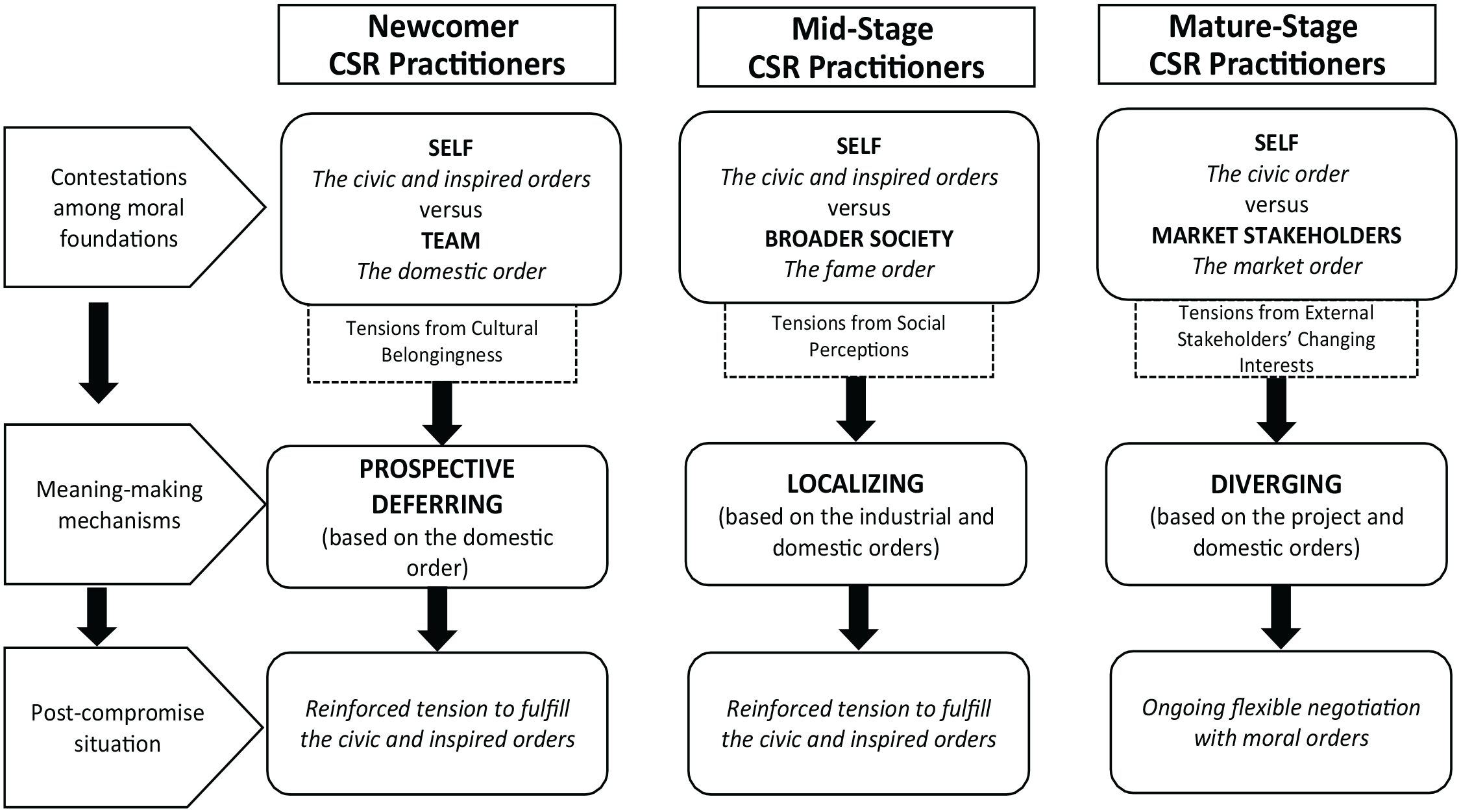
A Justification approach to meaning-making: The micro-dynamics of compromise-building mechanisms at different career stages of CSR practitioners.
Conceptualizing a justification approach to meaning-making through the EW lens
The primary theoretical contribution of our study lies in illuminating the dynamic interplay between the self and others in the constitution of meaningful work using a justification approach (Lepisto & Pratt, 2017). The study introduces meaning-making mechanisms in conflicting situations within CSR work, where the meaningfulness of work for the self is disrupted by others’ assessments of CSR work (see Figure 1). By employing the EW framework, we have conceptualized a justification approach to meaning-making as a continuous tensional process, in which individuals constantly (re)construct and (re)negotiate their understanding of the worthiness of work by engaging with different moral principles at different career stages. These principles are brought into play to resolve contested situations where their initial work worthiness (the self) is challenged by others’ moral grounds towards CSR work. This process ultimately brings together both subjective and social accounts of meaningful work (Michaelson, Pratt, Grant, & Dunn, 2014; Michaelson, 2021), reflecting the inherently tensional and changing nature of work worthiness.
We identified three meaning-making mechanisms in the form of moral compromises that constitute individuals’ experience and interpretation of their work worthiness at different career stages. First, prospective deferring refers to temporarily accommodating the tradition of respecting (senior) colleagues and fostering harmonious belonging to establish long-term support for future work aspirations, thereby upholding the worthiness of work. Prospective deferring thus compromises the balance between the domestic order and the inspired and civic orders. Early career CSR practitioners – the newcomer group – engaged with this mechanism when they encountered conflict between their own aspirations for CSR projects (a sense of meaningfulness for the self) and the need to adhere to work traditions to be part of their team (a sense of meaningfulness for others, colleagues). In this mechanism, the values of respecting colleagues – especially senior ones – and fostering belonging grounded in the domestic order appeared to be dominant. CSR practitioners in the study strategically prioritized the collective and relationship-dependent culture of Vietnam (Vu & Trang, 2021), with the expectation that this would help them secure work worthiness in the long term. This mechanism reveals how the subjective aspect of the meaningfulness of work – how individuals subjectively perceive what constitutes meaningful work – is influenced by others’ perceptions within a socio-cultural context – the values, beliefs and priorities of where they belong. It also highlights the assimilation process of CSR practitioners through socialization (Kramer, 2011). In this process they interact with and assimilate into senior teams to understand the expectations and norms of CSR work (Miller, 1996; Morrison, 1993), and manage the uncertainty regarding the nature of their roles, job performance and relationships with others at work (Miller, 1996; Waldeck & Myers, 2008), thereby ensuring the future and long-term success of CSR initiatives. The willingness of individuals to postpone fulfilment of the meaningfulness of work for them illustrates the subjective temporal experience of meaningfulness through intertemporal comparison (Albert, 1977) between individuals’ actual selves in the present and the desired selves they aspire to become in the future (De Boeck, Meyers, & Dries, 2018). This reinforces the tensions of having to fulfil one’s aspirations for work worthiness by postponing the execution of work.
Second, the localizing mechanism involves reframing CSR projects to emphasize practicality and effectiveness within smaller and more targeted local communities where they are implemented and address public scepticism about the motives behind CSR work. This mechanism is grounded in the industrial and domestic orders. This may require scaling down practitioners’ initial ambitions and the value of work underpinned by the civic and the inspired orders in our case. The mid-stage CSR practitioners engaged with this meaning-making mechanism to address negative societal perceptions of the value of CSR as grounded in the fame order. CSR practitioners revised their subjective view of work worthiness (a sense of meaningfulness for the self) by embedding themselves within broader social relations (others) (Hancock, 2016), in our case, the local communities and beneficiaries. This illustrates how CSR practitioners negotiate and situate the ‘self’ (De Boeck et al., 2018) within societal and cultural discourses (Meisenbach & Kramer, 2014). In doing so, CSR practitioners reassess the initial intentions of projects rooted in the civic and inspired orders, undergoing a gradual adjustment of their grander aspirations for CSR. This shift aims to secure the meaningfulness of CSR work by making CSR projects more practical and feasible, not only for local beneficiaries but also for CSR practitioners themselves.
Third, diverging refers to finding leeway for an optimal action between the intended values of CSR work and key stakeholders’ interest in enhancing competition through this work via flexible adaptation that caters to local customs and culture around doing things. This mechanism navigates the tensions between the civic and the market orders through the combination of the project and the domestic orders. The mature-stage CSR practitioners with more than 10 years’ experience tended to adopt this mechanism when their own sense of work worthiness (the self) grounded in the civic order was challenged by the interests of market stakeholders (others). This signifies that individuals’ understanding of the core moral grounds of work worthiness is crucial in addressing the central question of how to sustain meaningfulness, or conversely, avoid meaninglessness (Reinecke et al., 2017) in work. Diverging as a meaning-making mechanism suggests that the sense of subjective meaningfulness may have to be (re)interpreted, (re)negotiated and (re)constructed in circumstances that offer restricted opportunities for meaning (Lepisto & Pratt, 2017). As such, diverging requires constant flexible adaptations to the surrounding local institutional and cultural contexts and the changing nature of others (the dynamics of market and major stakeholders) (Sharma, 2014).
We tackled the fundamental question of how individuals negotiate meaningfulness in situations of moral multiplexity (Reinecke et al., 2017) by specifying how multiple moral principles interact in individuals’ meaning-making mechanisms (Bailey et al., 2019; Michaelson, 2021) when their inherent understanding of work worthiness grounded in the inspired and civic orders is disrupted. We showed that experiences of meaningful work, grounded in different orders of worth, is constantly (re)created through moral justification. All CSR practitioners at different career stages in our study managed to strategically (re)create and (re)construct the meaningfulness of work for themselves. This process entailed constant justification to navigate the reinforced tensions (e.g. the need to implement more impactful CSR projects when work worthiness is delayed for newcomers) or newly created dynamics with others (e.g. meeting local authorities’ changing expectations due to the evolving market competition), under the ever present and prominent influence of local norms and culture.
This study advances recent scholarly considerations of a justification approach to meaning-making that embraces the interplay between what is meaningful to the self and what is meaningful to others (Lepisto & Pratt, 2017; Lysova et al., 2023), moving beyond the self-oriented mechanisms characterizing the majority of research on meaning-making at work (Rosso et al., 2010). Mitra and Buzzanell (2017) acknowledge that individuals communicatively negotiate their experiences of meaningful work according to their circumstances. Their exploration of individuals’ negotiation of meaning is grounded in sociological and communication perspectives (Gond & Moser, 2021). However, using the EW framework, we demonstrate the underpinning personal moral grounds and values by which individuals justify their choices regarding what they consider worthwhile and what they do not – a previously underdeveloped aspect in the literature (Bailey et al., 2019). Moreover, our case showed co-occurrence between changes in justifications and changes in substantive discursive actions. This extends the scholarly discussion beyond a focus on the communicative nature of meaning-making (Mitra & Buzzanell, 2017), responding to the call for more research into the role of relationality in understanding meaningful work as a fluctuating experience (Lysova et al., 2023; Vu & Fan, 2024).
Unpacking the micro-dynamics of individuals’ compromise-making in the field of CSR
This study extends organizational studies of the EW framework (Anesa et al., 2024; Patriotta et al., 2011; Reinecke et al., 2017) by specifying how actors mobilize and combine different moral principles to reconcile the tensions associated with CSR–compromise-building (Demers & Gond, 2020; Finch et al., 2017; Shin, Vu, & Burton, 2022). The study unpacks the dynamics of compromise-building mechanisms, which have been largely understudied (Cloutier et al., 2024; Demers & Gond, 2020; Reinecke et al., 2017). Beyond showing how compromise is constructed (Demers & Gond, 2020), we conceptualize the mechanisms of compromise as situated, fragile and temporary (Boltanski & Thévenot, 2006 [1991]; Grattarola et al., 2024; Patriotta et al., 2011; Reinecke et al., 2017), based on individuals’ career experiences. Our study offers insights into compromise-building mechanisms within each career stage. For instance, CSR practitioners engaged in meaning-making as compromises when others’ assessments of the worthiness of their work conflicted with their initial evaluations. To suspend these clashes, they drew upon diverse moral foundations to secure and recreate the meaningfulness of their work at different career stages. Our case also exemplifies post-compromise situations. For instance, the newcomer group’s compromise mechanism was conditional and time-bound. Consequently, the compromise was subject to challenge when these conditions were not met, as the sacrifices involved became more salient (Anesa et al., 2024). The mid-career CSR practitioners were more vulnerable to struggles when they realized that their evaluation of work worthiness was still being disrupted by others’ values. Hence, the mid-career group engaged with a different compromising-building mechanism by drawing on moral worlds that enabled them to maintain some degree of the initial meaningfulness of their work.
Moreover, our study challenges prior EW studies that have highlighted the market order as a common denominator connecting coexisting or contradicting moral principles of CSR (Finch et al., 2017; Shin, Cho, et al., 2022). It was the domestic order that played a central role in the meaning-making mechanisms as compromises enacted by CSR practitioners in our study. The CSR practitioners in our case strategically integrated the domestic order with other moral principles in their meaning-making mechanisms. These temporary compromises remain in place only as each career stage group deals with the differing moral values of others, which leads each group to develop a peculiar situated judgement (Anesa et al., 2024; Grattarola et al., 2024). By underscoring the significance of the domestic order in these compromises, this study addresses the question of which moral grounds are mobilized across composite situations (Grattarola et al., 2024) in the case of CSR in Vietnam. By revealing the domestic order-based meaning-making mechanisms of CSR practitioners, our study resonates with prior CSR studies documenting strong domestic traditions of social contribution in Asian contexts (Chapple & Moon, 2005; Shin, Cho, et al., 2022). It thus offers new insight for current studies of the EW framework in the context of CSR by shedding light on the often-overlooked moral drive for CSR amid the current ascendancy of the business case for CSR, evidencing the moral pluralism of CSR (Roquebert & Gond, 2024; Shin, Cho, et al., 2022).
Unpacking the relational tensions and meaning-making of CSR practitioners at work
The study also advances micro-CSR research (Girschik et al., 2022; Gond & Moser, 2021), particularly explorations of CSR practitioners’ day-to-day struggles at work (Iatridis et al., 2022; Mitra & Buzzanell, 2017; Fontana, Shin, Oka, & Gamble, 2022; Fontana et al., 2023). While prior micro-CSR studies have mainly focused on tensions between the business and social goals of CSR (e.g. Carollo & Guerci, 2018; Fontana et al., 2023; Ghadiri et al., 2015), our case demonstrates tensions derived from the various relationships in which CSR practitioners engage. We specifically demonstrated that CSR practitioners’ micro-level experiences and practices are influenced by and interact with the macro-social normative principles surrounding them (Gond & Moser, 2021) – as embodied by their colleagues, society and market stakeholders. This extends the self-versus-other view of CSR practitioners (Iatridis et al., 2022) to provide a more complex picture of the relational tensions in CSR work, delineating the interplay between the contestations and meaning-making experienced by CSR practitioners.
Uncovering the various relational tensions experienced by CSR practitioners throughout their career cycle, our study also highlights individual disparities in meaning-making in CSR work (Aguinis & Glavas, 2019; Iatridis et al., 2022). It emphasizes the significance of ‘shifts in meaning-making’ within CSR work (Mitra & Buzzanell, 2017, p. 595), furthering prior studies that have delineated a recalibration process of meaning-making by CSR practitioners in response to their contextual situations (e.g. Fontana et al., 2023; Mitra & Buzzanell, 2017). In particular, Fontana et al. (2023) demonstrate how CSR practitioners’ social aspirations can be reconfigured as they come to embody the commercial values of their companies through their occupational stages. Our case enriches this reconfiguration process by showing how CSR practitioners morally negotiate between their own professional social aspirations and the moral values of ‘others’ that influence their CSR work. It also examines the different justifications across three different career stages regarding their meaning-making mechanisms via the EW framework. Moreover, while Fontana et al. (2023) show that CSR practitioners’ social aspirations might wane over time in the process of aligning with corporate commercial objectives, our findings indicate that this is not always the case. The CSR practitioners strategically recalibrated their professional social aspirations to uphold them in the longer term, thereby sustaining meaning in their work at different career stages. The study shows how CSR professionals navigate tensions to reconfigure their work worthiness in a more positive manner, that is not confined within the hegemony of the business case for CSR (Girschik et al., 2022).
The study informs several practical implications for SMEs involved in CSR activities in similar contexts where resources and systematic organizational management for CSR are limited compared to large corporations (Oduro, Bruno, & Maccario, 2024). Since the CSR activities and agendas of SMEs are often influenced by government policies (Oduro et al., 2024), and CSR practitioners frequently navigate tensions at work through informal meetings and discussions with peers outside their organizations (Fontana et al., 2022), governments can facilitate and encourage such dialogues within the field. This can enable CSR practitioners to share their challenges and collectively secure the meaning of their work.
Conclusions and Future Research
We conclude our paper by highlighting our key contributions and offering some avenues for future research. Drawing on Boltanski and Thévenot’s (2006 [1991]) EW framework, we contribute a justification approach to meaning-making. We show how CSR practitioners employ meaning-making processes through mobilizing different orders of worth in a constant process of justification to secure their work worthiness, especially when subjective experiences of the values of work are challenged by others’ viewpoints within socio-cultural shifting landscapes regarding the value of work that are grounded in various moral foundations. Furthermore, we advance organizational research incorporating the EW lens, shedding light on CSR through a micro-analysis of compromise-making and the interconnectedness of compromises at different occupational stages of individual practitioners. Lastly, we offer a valuable insight for micro-CSR research by presenting a more nuanced perspective on the relational tensions in CSR work that delineates the interplay between contestations and meaning-making experienced by CSR practitioners.
Future research could further investigate the justification approach to meaningful work. One avenue would be examining the extent to which justifications can sustain meaningfulness when individuals lower their expectations without realizing that they risk devaluing their work worthiness along the way, potentially resulting in practitioners quitting their jobs due to the need for constant justification. Even though the EW framework offers a universal grid for analysing the moral dimension of actors’ decisions and actions (Roquebert & Gond, 2024), they may engage with different moral grammars, leading to varying moral dynamics (Shin, Cho, et al., 2022). Therefore, we call for comparative studies of CSR practitioners in other countries to build a consolidated picture of meaning-making in contested situations in CSR work. Future studies might also benefit from adopting the EW framework to unpack meaning-making as compromise-building in other professional fields with a higher level of professionalization, such as medicine, law or accountancy (Shin, Cho, et al., 2022), or professions that are also known to be value- and meaning-driven, such as journalism or social services (Martin, 2000).
Supplemental Material
sj-docx-1-oss-10.1177_01708406241300251 – Supplemental material for Securing Meaningfulness in Corporate Social Responsibility: Exploring meaning-making mechanisms via economies of worth
Supplemental material, sj-docx-1-oss-10.1177_01708406241300251 for Securing Meaningfulness in Corporate Social Responsibility: Exploring meaning-making mechanisms via economies of worth by Mai C. Vu and Hyemi Shin in Organization Studies
Footnotes
Acknowledgements
We would like to extend our heartfelt gratitude to Laure Cabantous for her unwavering dedication, guidance and support. We also sincerely thank the three anonymous reviewers for their invaluable insights, which greatly contributed to the development of this paper. Additionally, we express our appreciation to the CSR practitioners in Vietnam who generously shared their insights and experiences, enriching our understanding of the complexities of CSR work in the country. This work would not have been possible without their willingness to engage in meaningful dialogue. We hope that our findings contribute to the ongoing conversation about responsible and meaningful practices in non-Western contexts and beyond.
Funding
The author(s) received no financial support for the research, authorship, and/or publication of this article.

Notes
Author biographies
References
Supplementary Material
Please find the following supplemental material available below.
For Open Access articles published under a Creative Commons License, all supplemental material carries the same license as the article it is associated with.
For non-Open Access articles published, all supplemental material carries a non-exclusive license, and permission requests for re-use of supplemental material or any part of supplemental material shall be sent directly to the copyright owner as specified in the copyright notice associated with the article.
