




Abstract
Why do some privileged insiders take action to transform institutions for broader societal benefit, while others do not? Privileged insiders are those who, because of their education, socio-economic background, formal position, citizenship, gender and/or race, derive advantages from existing institutional arrangements. While their relative privilege places them in a better position to influence institutions, prior research would suggest that they are unlikely to do so without the prospect of personal gain. We find that privileged insiders feel compelled to engage in prosocial institutional transformation when they situate the problem not with others but with themselves, acknowledging their own complicity in structural injustice. They can navigate the emotional discomfort triggered by moral emotions by taking small pragmatic actions that lower their emotional distress and initiate a cycle of experimentation with change. Finally, we show that the practical evaluative dimension of agency plays a central role in shaping institutional change agency. Foregrounding the role of emotions in practical evaluation, we reveal how transformative templates for action emerge from a deliberative engagement with the self.
Introduction
To address the global crises of wealth inequality and environmental degradation, privileged insiders, those who currently derive advantages from social systems and sustain them through their everyday actions (Berger & Luckmann, 1966), will need to engage in institutional change for broader societal benefit (Amis, Mair, & Munir, 2020; Oxfam, 2023). These individuals are privileged because they derive relative advantages from existing institutional arrangements as a result of their education, socio-economic status, formal position, citizenship, gender and/or race. They are insiders because they are ‘enabled by savvy insider knowledge of levers, resources, networks, and allies that could propel social change’ (Heucher, Alt, Soderstrom, Scully, & Glavas, 2024, p. 296). Privileged insiders are therefore not necessarily dominant actors (Hardy & Maguire, 2017) or expert elites (Scott, 2008; Zald & Lounsbury, 2010), but belong to social groups who benefit from current institutional arrangements and hence gain some form of legitimacy and access to various types of capital, be it cultural, social, material or symbolic (Bourdieu, 1989).
While these privileged insiders have greater power and choice to advance the type of social change that is needed to help address key social and environmental challenges (Amis et al., 2020; Oxfam, 2023), prior literature might lead us to believe that only outsiders or institutionally marginalized actors would be motivated to challenge the institutional status quo (Creed, DeJordy, & Lok, 2010; Martí & Mair, 2009) and that those with more power to change institutions from within will only do so to serve their own interests (Battilana, 2006; DiMaggio, 1988; Hardy & Maguire, 2017). While some studies have suggested that people may engage in change for more altruistic reasons (Miller, Grimes, McMullen, & Vogus, 2012; Nilsson, 2015), scholars often assume that those who do not stand to gain from change are likely to resist it (Delmestri & Goodrick, 2016). Since institutions ‘shape patterns of interests and privilege’ (Micelotta, Lounsbury, & Greenwood, 2017, p. 1886), prosocial institutional change implies a rebalancing of benefits that may negatively impact some people’s material or social interests. It is therefore unclear why some privileged insiders might engage in prosocial institutional change, i.e. purposeful efforts directed at changing institutional arrangements for the welfare of others or society at large rather than gaining material or social rewards for themselves (Brief & Motowidlo, 1986).
In this article, we ask: Why do some privileged insiders engage in prosocial institutional change, transforming the very institutions that currently benefit them, while others do not? There is evidence to suggest that conflicting moral emotions (Emirbayer & Goldberg, 2005; Haidt, 2003), emotional dynamics (Barberá-Tomás, Castelló, de Bakker, & Zietsma, 2019; Ruebottom & Auster, 2018) or mindset stages (Voronov & Yorks, 2015) may influence whether people engage in institutional change. Yet, we still do not understand what leads some privileged insiders to engage when, under similar circumstances, others will not. Building on Emirbayer and Mische’s (1998) work, core to our investigation is understanding why some people shift their agentic orientation from maintaining past routines (iterative agency) to actively engaging in prosocial change (projective agency), and exploring the role that deliberating over problematic situations in the present (practical evaluative agency) may play in this process.
Our study was initiated in South Africa, a country that is one of the most unequal in the world (Sulla, Zikhali, & Cuevas, 2022). In this context, the legacy of apartheid continues to influence who benefits from social systems, creating a visible contrast between privilege and underprivilege, and perpetuating social and environmental injustices. We then expanded our data collection to other jurisdictions to understand whether our findings found resonance in a broader Western industrialized context. Our grounded inquiry (Charmaz, 2011) sought out individuals who were relative beneficiaries of institutional arrangements and yet were recognized by others as engaged in some form of change effort to promote social and/or environmental justice beyond their formal organizational or institutional role. Between 2017 and 2020, we explored the varied journeys of 54 research participants through interviews, observations and group discussions.
While our participants’ stories all began with noticing injustices, only some went on to engage in prosocial institutional change. One group justified institutions and engaged in change aimed at institutional compliance. A second group went on to question institutions but became overwhelmed by an upsurge of emotional discomfort and engaged in change aimed at institutional repair, making small fixes to limit some of the most egregious effects without fundamentally challenging current institutional arrangements. In contrast, what differentiated those who ultimately became engaged in prosocial institutional transformation was that they managed to grapple with their growing emotional discomfort and shifted from questioning the system to questioning themselves, leading them to both confront their own privilege and acknowledge their complicity in upholding the systems that perpetuate injustices.
Our findings help us to explain why some privileged insiders do engage in prosocial institutional change, and we make three key contributions. First, enriching our understanding of the reasons leading people to engage in institutional change (Battilana, Leca, & Boxenbaum, 2009; Creed et al., 2010; Heucher et al., 2024), we find that acknowledging their complicity in structural injustice – moral complicity that arises from ordinary participation in social structures (Aragon & Jaggar, 2018; Young, 2010) – is what compels privileged insiders to engage in prosocial institutional change. Second, contributing to our understanding of the role of emotions in change agency (Barberá-Tomás et al., 2019; Haidt, 2003; Ruebottom & Auster, 2018; Voronov & Yorks, 2015), we suggest that people can navigate the emotional discomfort triggered by moral emotions by taking small pragmatic actions, a process that keeps their emotional distress within manageable bounds and initiates a cycle of experimentation with change. Finally, while the practical evaluative dimension of agency has been given relatively less attention in prior studies of institutional change (Emirbayer & Mische, 1998; Smets, Greenwood, & Lounsbury, 2015; Smets & Jarzabkowski, 2013), we highlight its central role in shaping prosocial institutional change agency, revealing how transformative templates for action emerge from a cognitive and emotional deliberative engagement with the self. In so doing, we also foreground and elaborate the important role of emotions in the practical evaluative dimension of agency.
Theoretical Background
To explore the literature relevant to our research question, we begin by discussing how people’s agentic orientations contribute to institutional stability or change and then focus on the role of practical evaluative agency and its potential to shape future action. Next, we consider how people’s emotions may influence a shift in their agentic orientation and how personal differences may impact their capacity to challenge institutional arrangements. Finally, we examine the influence of people’s social positions and relative privilege on their likelihood to engage in prosocial institutional change.
Agentic orientation and the role of practical evaluative agency
Emirbayer and Mische’s (1998) work helps to explain how different dimensions of agency contribute to institutional stability or change. Articulating the constitutive dimensions of agency, Emirbayer and Mische (1998) emphasized the temporal nature of agentic orientation, which can be directed towards maintaining past routines (iterative), conceptualizing future trajectories of action (projective), or deliberating present ambiguous demands (practical evaluative). They describe how conceiving of future trajectories through the projective dimension of agency serves as the agentic link between an iterative orientation anchored in the past and a practical evaluative response to present problems. In subsequent work by other authors, the iterative dimension has been used to explain the patterns of thought and action that lead to institutional stability and reproduction (Battilana & D’Aunno, 2009; Lawrence & Suddaby, 2006), and the projective dimension has been used to explain how actors engage in institutional disruptions and transformation (Battilana et al., 2009; Hardy & Maguire, 2017; Seo & Creed, 2002). Meanwhile, the practical evaluative dimension has received less attention in discussions of institutional stability or change (Klemsdal & Wittusen, 2023; Smets & Jarzabkowski, 2013). Yet, we propose that the practical evaluative dimension of agency – focused on ‘addressing the dilemmas and ambiguities of presently evolving situations’ (Emirbayer & Mische, 1998, p. 971) – warrants further examination as it may be relevant to understanding why people start perceiving the need for change and potentially shift their agentic orientation.
Emirbayer and Mische (1998) suggest that the process of practical evaluation includes recognizing a particular situation as problematic and difficult to characterize, and consciously deliberating (with others or with themselves) among competing possibilities for how best to respond. Building on pragmatist philosophy, the authors argue that any resulting judgements or decisions are likely to be provisional and attached to unclear or emergent objectives. When these judgements also lead to loss or sacrifice, they may initiate feedback effects that require adjustments or adaptation. Importantly, the authors emphasize the emotional and moral underpinnings of such evaluations and judgements, associating the notion of practical evaluation with deliberations ‘over the collective good’ (Emirbayer & Mische, 1998, p. 999).
Thus, Emirbayer and Mische’s (1998) conceptualization of practical evaluation provides insights into what happens when people encounter situations that they perceive as problematic or contradictory. Building on these insights, Seo and Creed (2002) suggest that people may shift their agentic orientation and engage in institutional change as the result of a lived experience of institutional contradictions, when people sense ‘ruptures and inconsistencies both among and within the established social arrangements’ (Seo & Creed, 2002, p. 225). The experience of contradictions can then trigger a reflective shift, which they describe as a reshaping of people’s consciousness ‘involving the critique of existing social patterns and the search for alternatives’ (p. 230). Seo and Creed (2002) then suggest that a possible outcome of a reflective shift is a process of institutional dis-embedding, through which people come to question institutional arrangements and develop alternative templates for action. Yet, context alone cannot explain why people experience a reflective shift. Faced with the same contradictions, only some people will question institutional arrangements and engage in change (Emirbayer & Goldberg, 2005). Thus, we now turn to what we know about individual differences shaping agentic orientations.
How emotions affect shifts in agentic orientation
Scholars have suggested that emotions may help explain differences in how people respond to institutional contradictions (Barberá-Tomás et al., 2019; Voronov & Vince, 2012; Voronov & Yorks, 2015). Emotions are a type of intelligence, a way of knowing, telling us something about ‘how we are doing’ in relation to certain inner needs or external situations that serve to direct people’s agency (Emirbayer & Goldberg, 2005; Haidt, 2003; Voronov & Vince, 2012). People may need to apprehend contradictions emotionally to be able to critique institutional arrangements and initiate a process of institutional dis-embedding (Voronov & Yorks, 2015).
Research also suggests that emotions are often experienced in relation to other people, expressing the emotional linkages people feel towards others or social objects (Emirbayer & Goldberg, 2005). Experiencing moral emotions – those linked to the welfare of society or others (Haidt, 2003) – has been evidenced to increase the likelihood of people engaging in change, either to benefit others or to improve the functioning of institutions (Barberá-Tomás et al., 2019; Haidt, 2003; Miller et al., 2012). Scholars show that the experience of certain negative or painful moral emotions, such as guilt, sadness, rage or despair, may energize people to support a cause on behalf of others (Barberá-Tomás et al., 2019). Miller et al. (2012) have suggested that compassion – the feeling of being emotionally connected to others’ suffering – may encourage people to engage in efforts that benefit others ‘even at a cost to oneself’ (p. 621). Hearing others share personal narratives of injustice can also generate emotional dynamics that stimulate a reflective process, energizing people to challenge their worldviews and embedding them in new social bonds (Ruebottom & Auster, 2018).
Yet, scholars remind us that people filter and make sense of emotions through a subjective process of interpretation and evaluation, which is influenced by their cultural, moral or social references (de Waal, 2019). As de Waal (2019) explains, ‘What one person experiences as pain, another may feel as pleasure’ (p. 257). Thus, sophisticated moral emotions, such as indignation, guilt or shame, may arise in and affect people differently, depending on the meaning they attribute to their subjective experience. Moreover, negative or painful moral emotions can trigger a variety of defensive mechanisms, such as denial or avoidance (Barberá-Tomás et al., 2019; Creed, Hudson, Okhuysen, & Smith-Crowe, 2014; Delmestri & Goodrick, 2016). This may be particularly the case for people who are being confronted with their own privilege (Vince, 2010). These people may thus engage in efforts to regulate or repress their emotions (trying to control or ignore them), rather than engage in change (Creed et al., 2014; Voronov & Vince, 2012). Even when negative or painful moral emotions do not trigger defensive mechanisms, they do not transform automatically into a ‘personal responsibility for the problem’ (Barberá-Tomás et al., 2019, p. 1807).
Voronov and Yorks (2015) explain that people may be differently able to both rationally and emotionally ‘apprehend’ institutional contradictions depending on their ‘mindset stage’. Building on research exploring turning points in the life cycle of people, Voronov and Yorks (2015) suggest that each mindset stage is associated with a different ability to make meaning out of contextual situations, wrestle with emotions, recognize the limit of one’s knowledge,and perceive the potential for shaping the social context. While the progression from one mindset stage to others unfolds over a person’s life, that progression may stop at any stage, and these authors suggest that only people reaching a self-transforming mindset (the rarest kind) have developed the capacity to deliberate among competing value systems, use emotions to direct their self-reflection and orient their efforts towards institutional change.
The influence of social position and privilege on institutional change agency
Beyond individual differences shaping agentic orientations, studies suggest that people’s social position – ‘their position in the structure of social networks’ (Battilana, 2006, p. 659) – will affect their likelihood and motivation to engage in institutional change (Battilana, 2006; Delmestri & Goodrick, 2016). For instance, individuals who are marginalized or not favoured by dominant institutional arrangements have more incentives to try and modify them, even when they lack resources or the necessary capital to engage in institutional change (Battilana, 2006). Research investigating why and how institutionally marginalized actors engage in change tells us that they may do so to claim roles, resources, rights or privileges that have been denied to them (Creed et al., 2010; Martí & Mair, 2009). For instance, Creed et al.’s (2010) study of GLBT ministers points to the importance of identity work in enabling marginalized insiders to become change agents. By progressively accepting their marginalized identity and engaging in efforts to reconcile it with their commitment to the church’s institutions, these actors were able to claim roles that were denied to them ‘in ways that challenge institutional prescriptions’ (p. 1356).
In contrast, the most powerful actors are generally thought less likely to engage in institutional change, being instead inclined to defend their privileges (Battilana, 2006). Research suggests that they will only engage in change if it aligns with their interests and/or reinforces their power (Battilana et al., 2009; Beckert, 1999; DiMaggio, 1988), if it will provide them with new opportunities (Micelotta et al., 2017), or if it will reinforce their social acceptability or legitimacy (Rao, Monin, & Durand, 2003; Zietsma & Lawrence, 2010). Yet, this body of research on powerful actors has predominantly focused on explaining the ‘opportunity for action’ and the ‘enabling conditions’ that exist at the organizational level or at the field level (Dorado, 2005; Zietsma & Lawrence, 2010), rather than the individual-level motivational processes leading these people to engage in institutional change (Battilana & D’Aunno, 2009).
Meanwhile, people who are beneficiaries of institutional arrangements but may not be part of the most powerful elite are thought to be least likely to engage in change because they have less to gain and instead risk being shunned or marginalized if they rise up against dominant templates for action (Creed et al., 2014; Delmestri & Goodrick, 2016). They are also considered most likely to refuse to acknowledge the impact of social structures and instead ‘absolve themselves of blame by transferring it to the even more privileged elite’ (Gray & Kish-Gephart, 2013, p. 680, emphasis in original). While studies argue that moral emotions may motivate even relatively privileged people to engage in prosocial change, scholars acknowledge that these emotions do not predict change-oriented agency; they only increase the likelihood or tendency to take action (Barberá-Tomás et al., 2019; Haidt, 2003; Miller et al., 2012).
Part of the challenge is that privilege tends to be invisible to those who benefit from it (Lund Dean & Forray, 2021; McIntosh, 1989; Wu, 2021). Privileged social groups are often blind to their own privilege, having ‘little working knowledge of the advantages they enjoy or the disadvantages other groups endure’ (Wu, 2021, p. 1). McIntosh (1989) describes privilege as an ‘invisible weightless knapsack of provisions, maps, passports, codebooks, visas, clothes, tools and blank checks’ (p. 30), which remains unacknowledged because people are not trained to recognize it or to see themselves as part of a system oppressing others. This unseen dimension of privilege leads to its denial and helps to perpetuate the silence that accompanies it (Lund Dean & Forray, 2021).
Adding to its complexity, privilege is intersectional, with factors such as skin color, socio-economic class, education, gender, religion, ethnic identity, language abilities, accents or geographic location intertwined to create a nuanced and to some extent ‘mitigated’ experience of privilege. Thus privilege cannot be ‘cleanly delimited’ and resists any singular identity (Lund Dean & Forray, 2021), emphasizing the need to consider privilege as a relative rather than objective state. A person may be privileged in one context, but not in another.
In sum, the process that would lead some privileged insiders to engage in prosocial institutional change remains unclear. While we have some insight into factors that may affect these people’s capacity and willingness to challenge institutional arrangements, it remains unclear why some privileged insiders will engage in prosocial institutional change while others, facing similar contradictions, will not.
Methods
To gain insights into why privileged insiders may engage in prosocial institutional change, we grounded our research in relational (Abbott, 2007; Emirbayer, 1997) and symbolic interactionist (Blumer, 2004; Mead, 1934) ontological and epistemological assumptions. Building on these assumptions, we did not presume that individuals were conceptual entities with stable and predictable properties. On the contrary, we assumed that people could be ‘continuously recreated in the flow of interactions’ and that they were inseparable from the context and set of relationships in which they were embedded (Abbott, 2007, p. 7). We thus paid particular attention to how people negotiated meanings through conversations they had with themselves and others (Emirbayer, 1997, p. 290) and how they acted towards themselves or others in a situated context. This shifted our analysis away from identifying characteristics that a person has, towards understanding how patterns of feelings, meanings and action emerge from relational dynamics (Blumer, 2004).
We adopted a grounded theory approach (Charmaz, 2011), and moved from an inductive through to an abductive reasoning process to develop our theoretical understanding of how this reflective process was experienced by privileged insiders. Following Charmaz (2011), surprising findings that emerged from our data collection were analysed in light of possible theoretical accounts, and formed the basis of theoretical hunches (Locke, Golden-Biddle, & Feldman, 2008), which we subjected to further data collection and analysis.
Research setting
Our study was primarily set in South Africa, a setting with highly entrenched inequality and strong institutional norms that create frequent opportunities for exposure to injustices and institutional contradictions. Participants were identified through a mixture of purposeful and snowball sampling (Robinson, 2014). As our interest was in a range of actors who reaped advantages through their participation in social structures, we sought out individuals who benefited from current institutional arrangements either because of their education (expert elites), their socio-economic status (people with relatively significant income or wealth) or their formal position (managers, directors, executives, and so on). Importantly, we sought out individuals who were recognized by others as engaged in intentional efforts to promote social and/or environmental justice, whether within their organizations or their professions. Moreover, we sought out people who were engaged in ways that did not appear to serve their own interests and instead might put at risk their career, income, wellbeing or their social legitimacy. In the end, our analysis showed that our participants ranged in the extent to which they engaged in prosocial institutional change, and this turned out to be important in our theorizing.
While our study was primarily set in South Africa, we decided to also interview people from additional countries to see whether what we were uncovering was unique to the socio-economic and political context of South Africa or whether the experiences we were capturing might also resonate in a broader Western industrialized context. Thus, a third of our sample lived in other countries, including the United States, Canada, Australia, Switzerland, the United Kingdom, Finland and the Netherlands.
To help improve the theoretical scope of our findings (M. B. Miles, Huberman, & Saldaña, 2014) and capture potentially important differences, we reached out to individuals embedded in five different institutional contexts: finance, law, business, education and agriculture. We selected institutional contexts that share similar properties: they have a significant impact on the functioning and welfare of society, and they are regulated by dominant institutional beliefs, norms and practices that guide the behaviour and the choices of most actors. In each of these settings, we identified efforts aimed at challenging the dominant institutional order to promote social and/or environmental justice.
For instance, in finance, we interviewed professionals who were involved – to various extents – in actions aimed at changing financial systems to address environmental or social issues. In law, we interviewed professionals working outside of their job descriptions or mandate to promote new legal frameworks that supported social or environmental justice efforts, such as formulating Earth Rights. In education, we interviewed education professionals, academics and students who were involved either in the decolonization of knowledge, the promotion of Indigenous peoples’ rights and/or the promotion of an ecological systems approach in curricula. In agriculture, we reached out to farmers or other professionals (such as agri-business executives) involved in promoting social justice measures or implementing a variety of alternative agricultural approaches, such as regenerative farming, often at the expense of their market competitiveness. In business, we interviewed people, such as social entrepreneurs or corporate sustainability champions, challenging current economic orthodoxy or experimenting with new business models to promote social and environmental justice.
Data collection
Data for this study span from 2017 to 2020. Altogether, we conducted 73 semi-structured interviews with 54 different research participants. Of these, 26 were female and 28 were male, and all participants except for seven were white. We interviewed 48 participants once, while six participants became key respondents and were interviewed several times. Key respondents were people whose experience revealed particularly interesting insights about the evolution of their agentic orientation, and who were willing to engage in multiple and deeper conversations about their experiences. In total, we conducted 19 follow-up interviews with our six key respondents. Interviews lasted between 60 and 80 minutes, and all except one were recorded and transcribed. We also engaged in four group discussions with about 30 change agents and potential change agents who were outside of our group of interview participants. Two group discussions included postgraduate sustainability students while the other two included change agents working in a broad range of sectors. These workshops provided an opportunity to discuss and gather feedback on our emerging model. We also conducted observations on five occasions, each time watching a research participant for about three hours as they engaged with change processes in their context.
We iterated between data collection and data analysis, adapting our line of inquiry in line with our emerging understanding of the phenomenon. Using M. B. Miles et al.’s (2014, p. 14) concept of an ‘interactive, cyclical process,’ our cycles of data collection activities were woven into cycles of data condensation (coding), data display and (re)connection with theory to draw (often visual) preliminary conclusions. Our research process was structured around four phases: a preliminary investigation, a theory exploration phase, a theory development phase and a theory refinement phase. As our research progressed and we identified differences in the extent to which participants engaged in change efforts, we increasingly focused our sampling and data collection towards individuals who were engaged in more transformative forms of action. The data gathered during each phase of our research, and our associated motivations, are summarized in Table 1.
Summary of data.
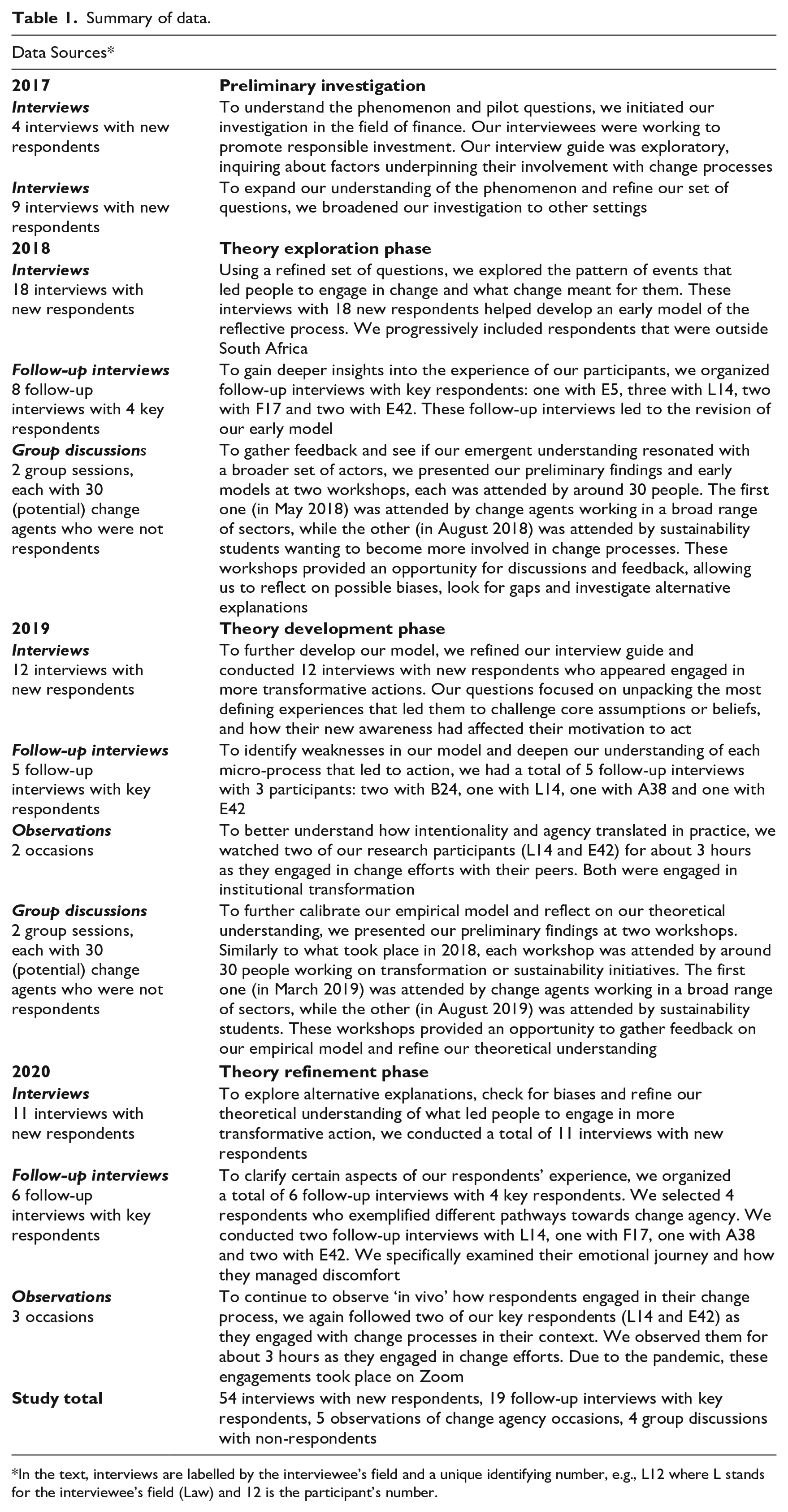
In the text, interviews are labelled by the interviewee’s field and a unique identifying number, e.g., L12 where L stands for the interviewee’s field (Law) and 12 is the participant’s number.
Data analysis
Our iterative data collection and data analysis, together with our constant comparison of codes and categories, sharpened our ideas and supported a dialectical process towards a refined theoretical understanding (Klag & Langley, 2013). During this process, we reviewed the names of certain codes and reassessed how we had grouped them to improve construct clarity. For instance, we collapsed the codes ‘small changes matter’ and ‘muddling through’ into ‘engage in small actions’. We looked for variations in our data, notably in relation to the geographic locations from which our participants operated. Interestingly, we found no noticeable differences emanating from geographic locations on the evolution of these participants’ journeys and their outcomes.
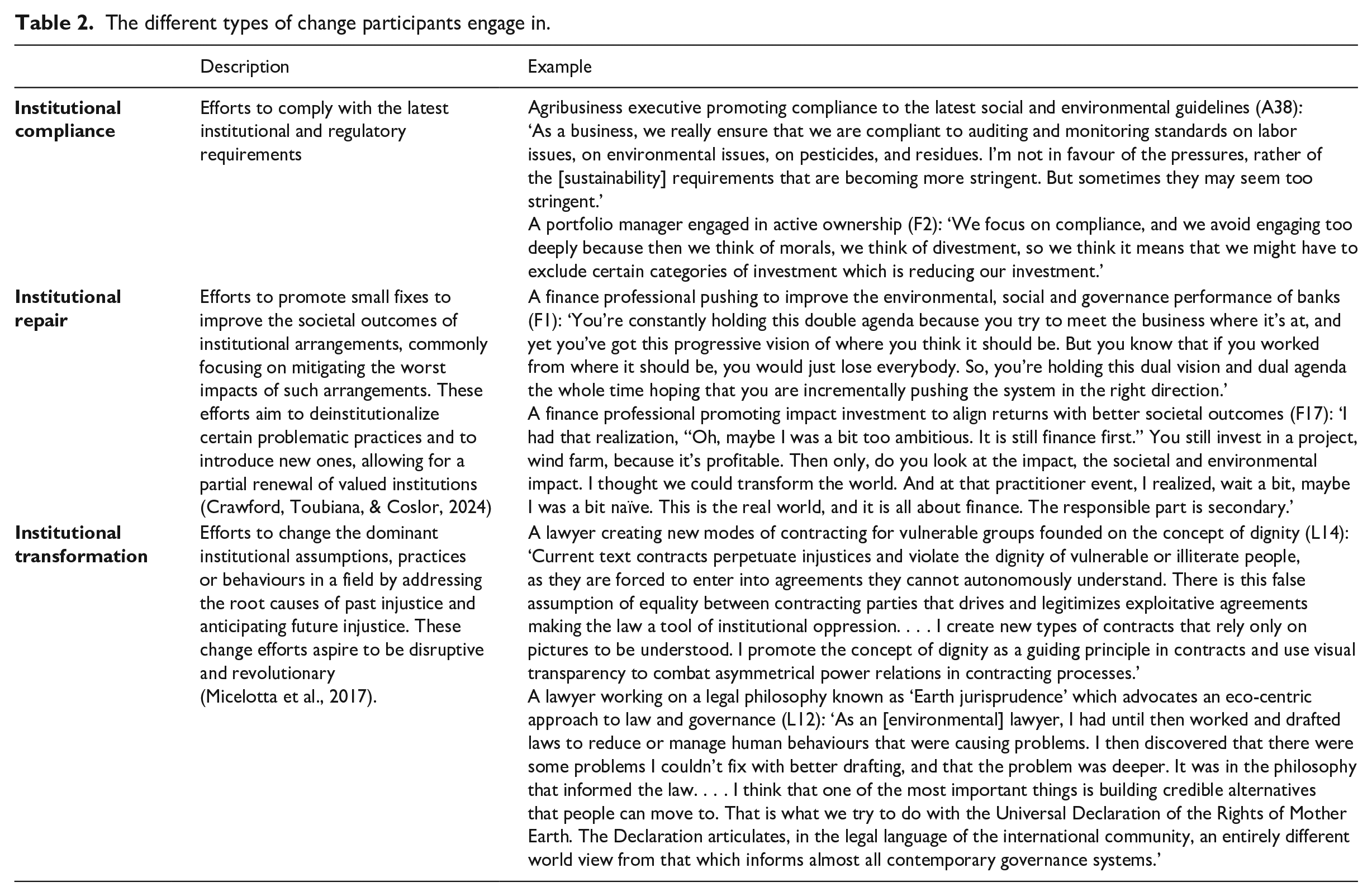
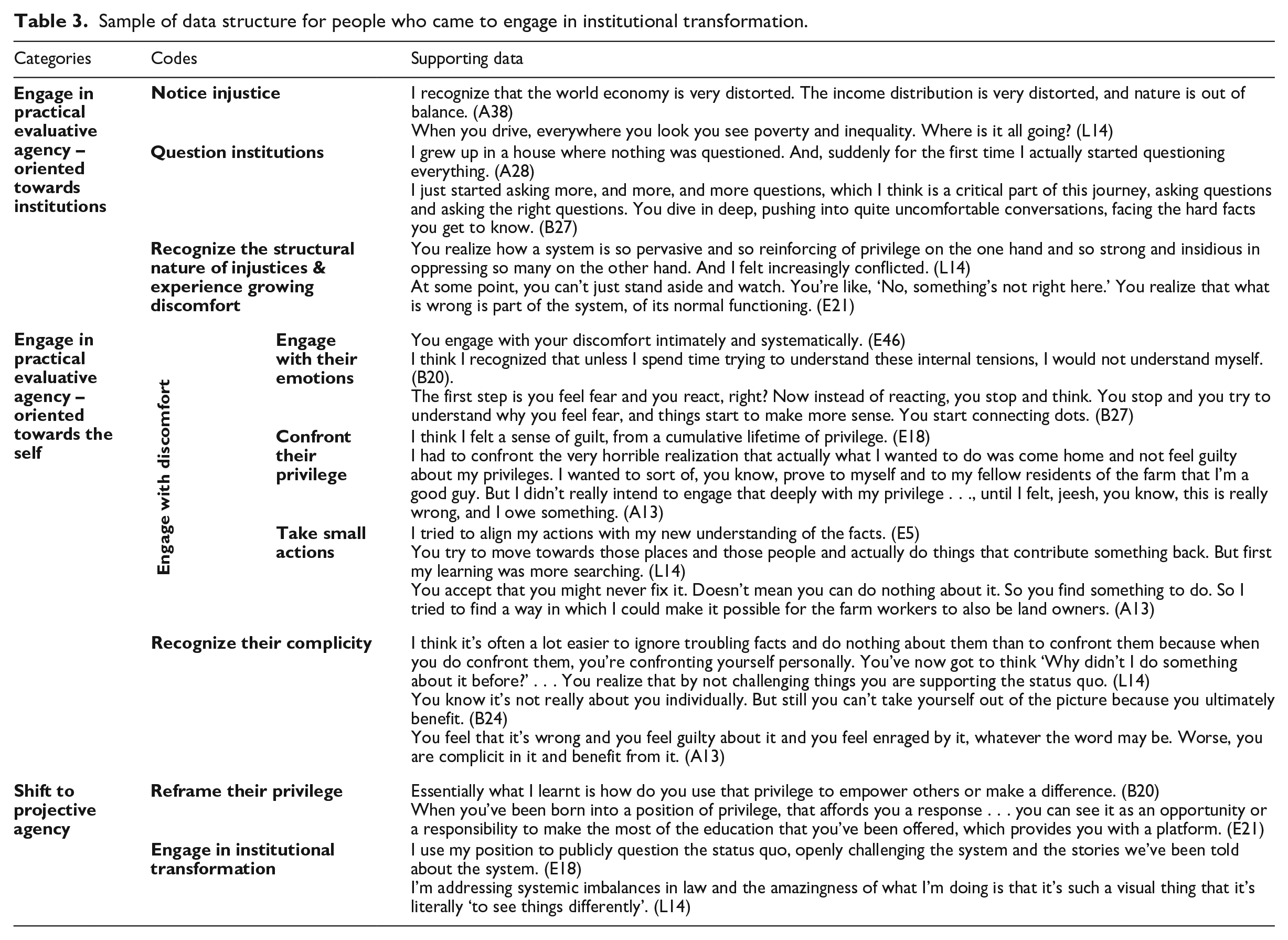
We then analysed our codes again in the context of the existing literature, looking for alternative theoretical explanations. For instance, we realized that in our data there were two different dimensions to people’s practical evaluative engagement (one oriented towards institutions and the other oriented towards the self) leading to two different outcomes. This led us to distinguish between ‘Recognize structural injustices’ and ‘Acknowledge complicity’ and as a result, expand the scope of the literature initially considered. We needed to understand how people with no intention of causing harm could feel complicit in the perpetuation of injustices, and how this experience might explain why they engaged in action. Comparing our participants’ journeys, it became clear that there were major differences in the path that they took and the outcome it led to. Table 2 provides the definitions we used to categorize the different types of change our participants engaged in, namely institutional compliance, institutional repair or institutional transformation. Table 3 provides a sample of our data structure for participants who became involved in institutional transformation.
The different types of change participants engage in.
Sample of data structure for people who came to engage in institutional transformation.
To gain further insights into the nuances of our participants’ journeys, we then mapped how their journeys unfolded once they experienced institutional contradictions. As we worked iteratively between our data and the literature, we noticed that there were crucial differences in the paths that our participants took and the institutional engagement that resulted from those paths. As outlined in Table 4, our mapping and analysis revealed that four respondents engaged in institutional compliance, eight respondents engaged in institutional repair, seven respondents (who had previously been involved in institutional repair) were somewhere in the process of engaging with their discomfort, and 35 respondents engaged in institutional transformation (this larger number being primarily the result of our progressive sampling and data collection strategy).
Map of participants’ journeys.
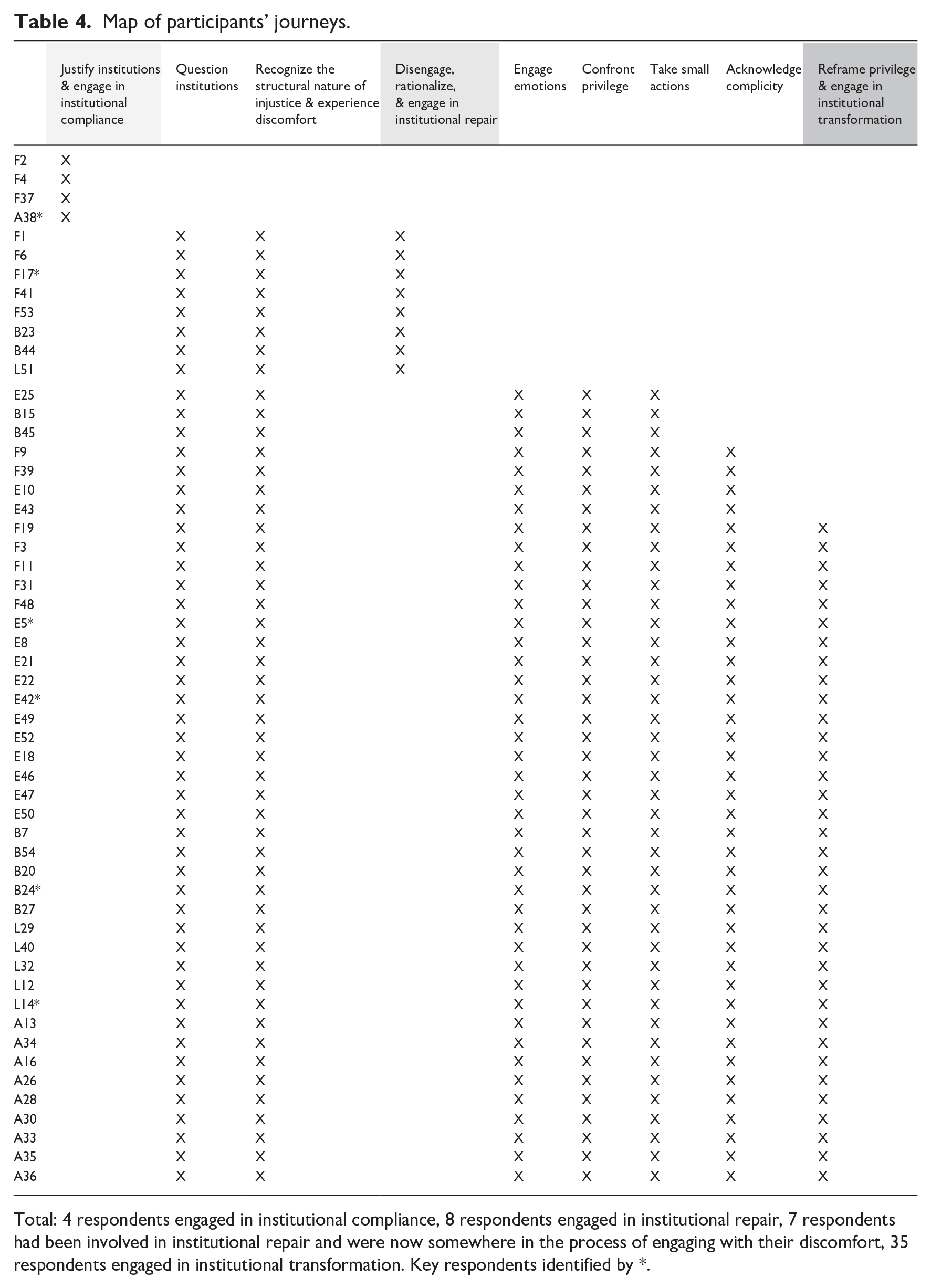
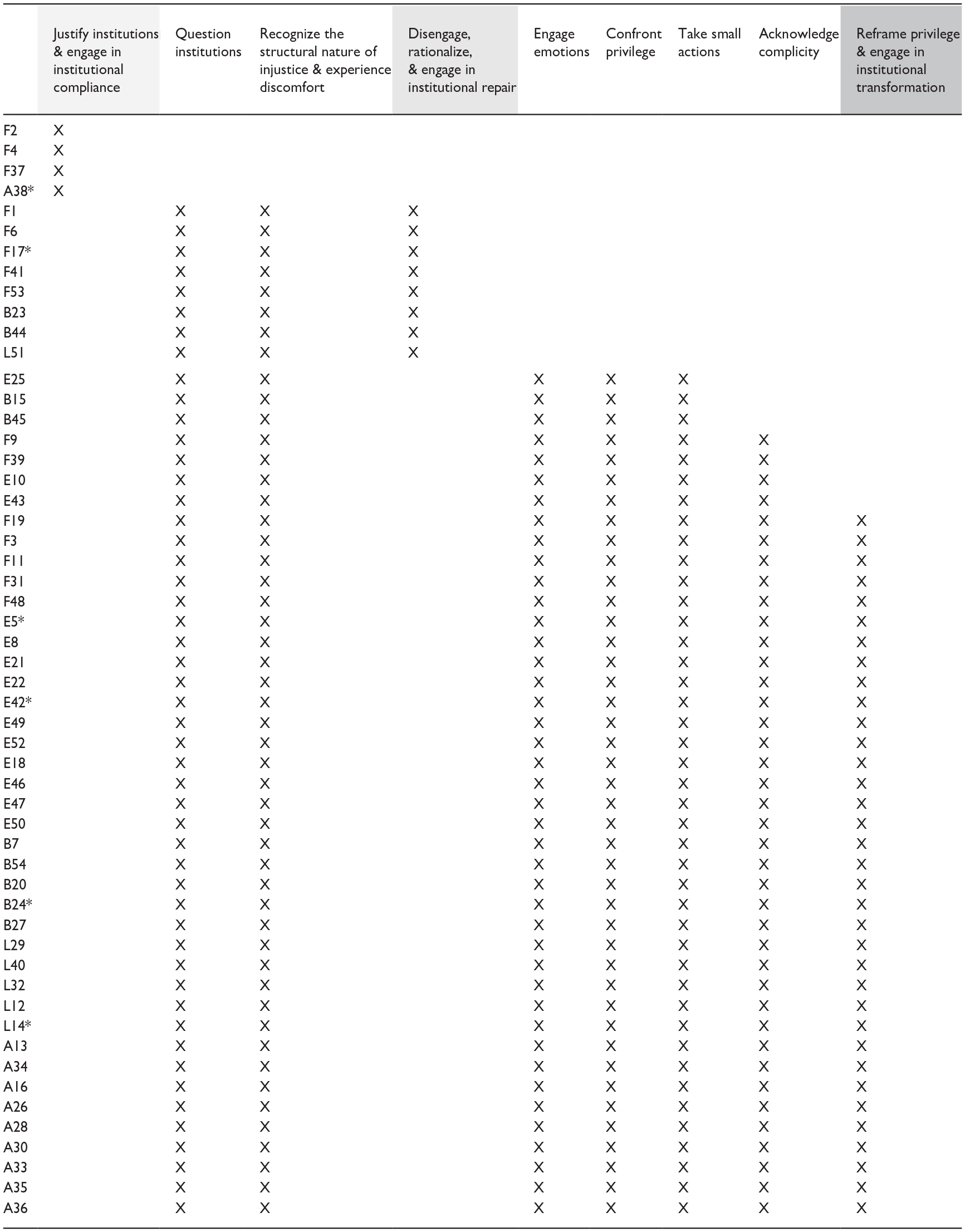
Total: 4 respondents engaged in institutional compliance, 8 respondents engaged in institutional repair, 7 respondents had been involved in institutional repair and were now somewhere in the process of engaging with their discomfort, 35 respondents engaged in institutional transformation. Key respondents identified by *.
From our analysis, we inductively generated a model that depicted the processes and pivotal moments that shaped our participants’ agentic orientation, and the three different outcomes that we ultimately observed. This model was further refined through a final round of coding where we adjusted, merged and elaborated earlier codes, and by returning to our data to examine the adequacy of our model in depicting our participants’ journeys.
Findings
We first present our model depicting the evolution of our participants’ agentic orientation and the different outcomes that we observed. We then unpack how our participants’ journeys unfolded, focusing on the processes and pivotal moments that shaped why some engaged in prosocial institutional change, while others did not. It is important to note that while our descriptions of our participants’ journeys may convey a linear process, the lived reality is a messier experience, often involving multiple iterations.
Overview of our participants’ journeys and their respective outcomes
While all of our participants’ stories began with noticing injustices, they differed in how they engaged with these injustices, leading them to engage in either institutional compliance, in institutional repair, or institutional transformation. As illustrated in Figure 1, a first set of participants engaged in institutional compliance. They resisted questioning institutions, instead justifying current institutions as inevitable. This led them to focus their change work on improving their organization’s compliance to what would be perceived as evolving ‘best practice’ in their current institutional context, rather than changing those institutions. These participants remained engaged in an iterative form of agency anchored in the past.
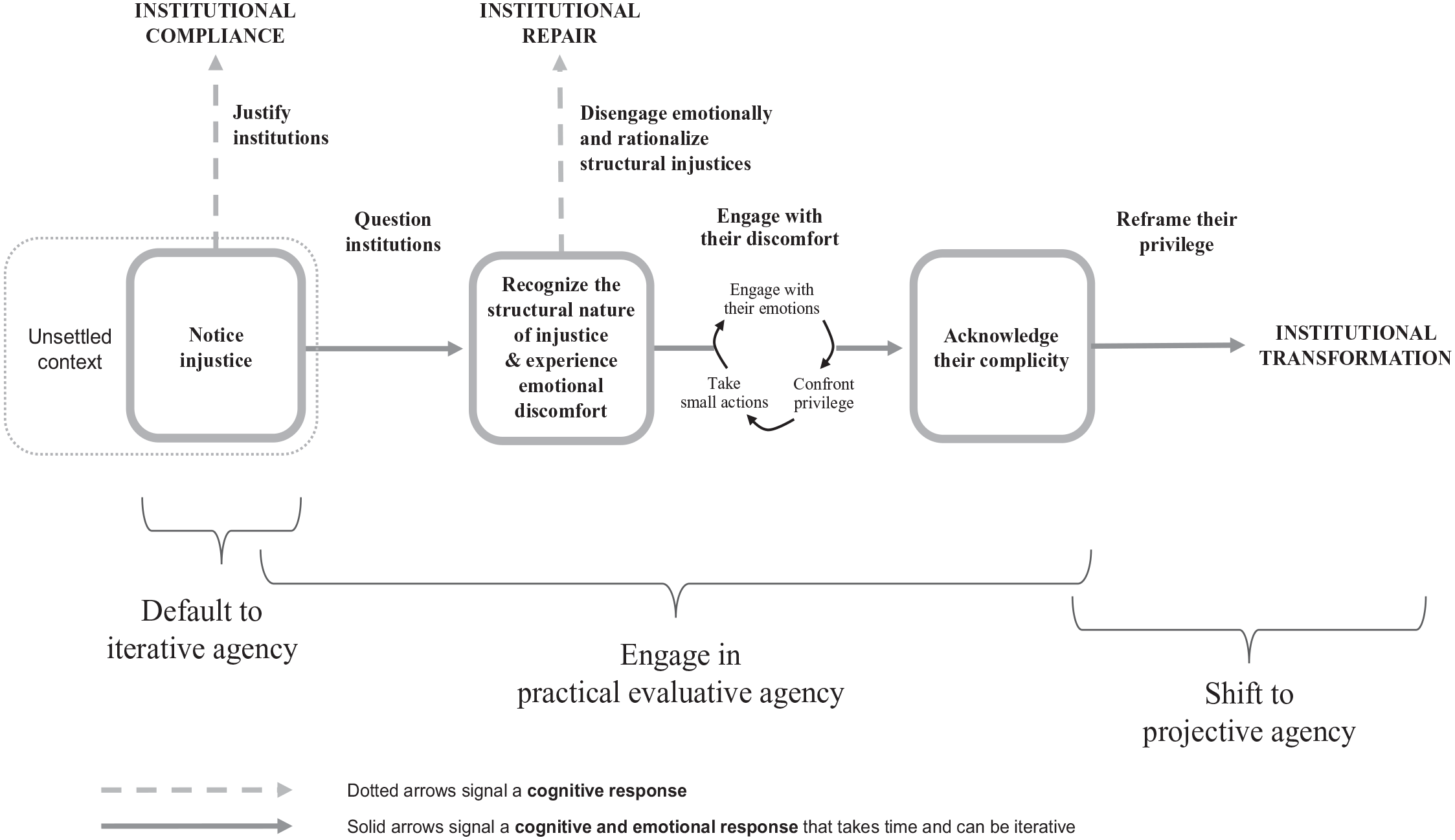
The process shaping why some privileged insiders engage in prosocial institutional change.
In contrast, the rest of our participants described engaging cognitively and emotionally with their unease and questioning institutions. This cognitive and emotional engagement appeared to mark the beginning of a practical evaluative process consisting of intentional efforts in the moment to problematize and make moral judgements about their experience. It led them to recognize the structural nature of these injustices and to feel growing emotional discomfort.
Of these participants, those who became involved in institutional repair became emotionally overwhelmed and defaulted back to a cognitive response by suppressing their emotions and rationalizing the structural nature of the injustice. In doing so, they seemed to cut short the practical evaluative process and engage in a projective form of agency that fell short of transformation. They engaged in making small fixes that limited some of the negative impacts of current institutional structures but did not fundamentally challenge the status quo.
Finally, those participants who did become involved in institutional transformation continued along their practical evaluative journey, engaging cognitively and emotionally with their growing emotional discomfort. This initiated a difficult introspective journey during which they engaged with their emotions, confronted their privilege and engaged in small pragmatic actions that offered some relief to their emotional distress. Through this process, they came to acknowledge their own complicity in the maintenance of structural injustices. This marked a turning point in how these participants engaged in the world. From this point, they progressively found ways to reframe their privilege as a tool to help transform institutions.
Below we unpack how these different journeys unfolded, focusing on the processes and pivotal moments that shaped their outcomes.
It all starts with noticing injustice
All of our participants explained that their journeys began when they were confronted with social inequalities or environmental degradation and experienced a nagging sensation that ‘something is wrong’ and ‘unfair’. While all participants described the noticing of injustice as ‘a process that builds up over time’ (F31), most could recall specific moments, events or situations that made them more acutely aware of injustices, such as while travelling to a different country, or when working on a project that brought them into physical proximity to certain societal issues. When confronted with the suffering of others or the degradation of the planet, participants described experiencing a deep tension. For instance, a finance professional (F19) explained: ‘On our watch so many people are just falling completely off any radar and the value of their life experience is shocking.’ Similarly, a supply chain professional in a large corporation (B7) explained, Things struck me when I travelled to China and to India. I saw what was going on there, it’s just producing more and more, and cities around factories, and people coming out of the rural area working under extreme pressure in a hostile environment. Really, it’s a standard of life which is just cruel. It’s not the way anybody should live.
Another participant working in the financial industry (F6) commented, I like wildlife and nature. But I hadn’t really questioned anything. And then, with my husband, we went to an island off the coast of Tanzania to see a green turtle hatching project. As we arrived, the organizers gave us these big bags to collect plastic because the beach fills up with so much plastic that the baby turtles can no longer get to the water. It’s anecdotal, but it kind of hit home how much we’re messing up the planet.
Most participants explained how they initially tried to deny the ‘nagging feeling inside [their] heart’ (E46). A business owner (B24) described initially trying to ‘block [her] emotions or repress or rationalize them instead of actually just feeling them’. Similarly, a finance professional (F41) explained how ‘For a long while, I didn’t quite capitalize on that emotional surge, to fit it into my journey. I tried to leave emotions pretty much out.’ Yet, while all our participants experienced this surge of uneasiness, they did not react uniformly to it.
The path to institutional compliance
Justify the system
Some informants acknowledged that the current system ‘may not be sustainable’ (A38) but felt there was little they could do about it. For instance, a portfolio manager (F37) commented, ‘Seeing poverty . . . It never sits well with me. But then you would have to question the way society is structured. I guess that’s just how things are always going to be.’ Others argued that ‘it has worked for the last couple of hundred year[s]’ (F4) or that ‘there is no point throwing the baby out with the bathwater’ (F2). These participants saw existing institutional arrangements as non-negotiable, with any substantial changes being dependent on top-down regulatory intervention. For example, a sustainability professional at a financial firm (F2) explained that it was the responsibility of governments ‘to level the playing field’ in his industry, and his responsibility lay in complying with the latest regulatory expectations. He commented, ‘We recognize that it’s an unfortunate behavioural weakness of investors to focus on short-term returns . . . But there is only so much we can do.’
People who resisted questioning the system appeared to justify social or environmental injustices as part of the normal functioning of institutions, and they limited their engagement to complying with the latest institutional and regulatory requirements. While these participants were perceived by others in their field as change agents, their actions were limited to organizational change instead of working to change institutional arrangements. These participants described their efforts as ‘lead[ing] through compliance’ (A38), ‘implement[ing] what we can, where we can, in line with regulatory requirements’ (F2), or ‘working to be the best among our peers’ (F4).
The shift into practical evaluation agency
Question institutions
In contrast, participants who ended up engaging in institutional repair or in institutional transformation engaged more deeply with their uneasiness, leaning into the emotional tensions that they felt and questioning the system around them. For instance, a finance professional (F31) explained how her uneasiness about injustices led her to go back to studying. She explained, There was a lot of exploration that year. From the Marikana incident to people for and against SRI, or leadership in South Africa, racial issues around leadership: I was beginning to learn how the system worked, and I wanted to know how I could start thinking and contribute to some of the critical thinking around the system.
Participants reported feeling increasingly ‘triggered’ by certain discussions, people or events that challenged their comfort levels or made them feel angry, uneasy, frustrated or sad. They attributed their growing uneasiness less to the increasing presence of injustices, but rather to something inside them, a questioning disposition, that ‘let whatever was manifesting become more and more’ (E47) until it could no longer be ignored. Participants used evocative descriptions to explain how they were noticing and allowing tensions to grow. For instance, an academic (E46) observed, Perhaps subconsciously we’re choosing the things that allow the niggling to become an explosion inside of us. It’s a series of choices and I think the first choice is, are you going to pay attention to the niggling or are you going to ignore it?
A regenerative farmer (A28) explained that for him this process ‘was not just an intellectual process. It was a series of really anguished decisions that exposed me to feeling more.’
For these participants, questioning their sense of discomfort triggered a process of deep reflection about society and their profession. A professional in the legal field (L14) explained, ‘It’s an iterative and partly subconscious process. You seek out answers to your feelings, you get new information and you kind of hold on to your old ideas. And so on.’ He added, ‘It’s realizing you’re wrong over time. You notice, you question, but you move along . . . until you can’t hold on any longer to your old understanding and it hits you.’
Recognize the structural nature of injustice and experience emotional discomfort
Through this process of deep reflection, participants progressively recognized what many described as the ‘systemic nature of issues’ (E5). For instance, a business professional (B20) commented, ‘Things started to really shift for me when it became clear that some systemic mechanism was at play.’ Similarly, a finance professional (F17) explained, ‘I progressively realized that we are all part of a system that just strengthens injustices,’ while an educational professional (E25) explained how they came to acknowledge that ‘we live in a broken system whose normal functioning generates these insane levels of privilege and unacceptable levels of poverty’.
Recognizing the structural nature of an issue led to profound changes in how these participants perceived the world and their context. As explained by an education professional (E5), ‘The narrative unravelled.’ They became aware that their taken-for-granted beliefs were flawed and experienced a deep crisis that affected how they saw their profession or context and left them feeling deeply emotional. Illustrating this point, an education professional (E46) commented, What does it mean when the theatre that we call life starts to change dramatically all around us? What questions do we ask when all that we have known to be true and sufficient no longer is, when our ideas about progress, development, governance, systems, institutions are being challenged?
Participants described experiencing an upsurge in emotional discomfort. They shared how their growing discomfort progressively transformed into a surge of negative feelings, conveyed as being ‘shaken’ (L14) or even ‘broken’ (A13). For example, a communication professional (B20) observed, ‘I remember being so physically and emotionally broken [from this experience], that I just cried.’ Similarly, an academic (E46) explained, ‘It turned into physical symptoms. I was unhappy, I was unsettled.’ She added, ‘I would literally go to bed at night feeling like I was going to get punished by some universal force.’
The path to institutional repair: Disengage emotionally and rationalize
For some participants, the discomfort of recognizing system failures appeared to be more than they could cope with emotionally. For instance, a sustainability professional (B44) described, ‘Going deeper is too scary. I don’t have the capacity. There is only so much I can do.’ Similarly, a person working in the financial industry (F1) commented, ‘There’s that internal tension. An internal wanting to question more but then being scared, scared to really step into it.’ These participants disengaged from the emotional turmoil and, instead, rationalized the system. They explained their decision as stemming from having somehow ‘come to their senses’ (F17) or needing ‘to stay realist’ (B44). Pointing to her experience, a finance professional (F6) commented, At first, I was a bit despondent because here I’ve been busy for two years on responsible investment, so yeah, I was a bit deflated to be honest. But since then, I’ve become older and wiser, and I’ve come to accept the reality of things: Okay, this is big money, and it is a finance first. We live in a capitalist environment; you need to make money.
While they disengaged emotionally, they still recognized that current beliefs or practices were not ideal. They became focused on promoting changes that aimed to fix some of the most apparent problems in their field. For instance, a finance professional (F17) talked about how ‘Impact investing can help create social change. It’s got that very strong human element, although it also aligns with financial and economic imperatives.’ Similarly, a supply chain professional in a large corporation (B7) explained, ‘I am fully involved in doing my job for the business, but at the same time I am working with the [company’s] foundation on small business development, as well as trying to source organic cotton.’ This group of participants focused on working to make small fixes to the current system, pushing initiatives that limited some of its most damaging impacts. While their efforts aimed to improve the functioning or outcomes of institutions, they stopped short of fundamentally challenging the status quo.
The path to institutional transformation
Engage with their discomfort
In contrast to those who reacted to their growing discomfort by rationalizing structural injustices, our third group of participants felt compelled to engage with their discomfort. They did so by engaging with their emotions and ‘re-evaluat[ing] everything’ (L12), in a process described by all participants as emotionally intense. A farmer (A13) notes, ‘There’s a feeling, an inchoate dimension to what’s happening, and you decide to burrow into that and understand what this is about and to raise it to the level of self-awareness, of proper analytical understanding.’ A lawyer (L14) explained, ‘The emotions that you feel push you to face the facts,’ adding that ‘at the same time, you accept that the more you understand, the more you risk having to confront your own responsibility in the situation’. Talking about how she engaged with difficult emotions, an academic (E5) mentioned ‘letting go of the myth that I could set aside the guilt, and instead allowing myself to feel and understand it’. A business owner (B24) observed how she had to engage emotionally with rational, intellectual ideas while at the same time engaging intellectually with her feelings. She explained: ‘I’ve worked really hard at opening the conversation and the dialogue between [these] two aspects of myself and trying more and more to operate less from one or the other, but to be more integrated.’
Participants described how they experienced a ‘mind shift’ about privilege. Most had not initially perceived themselves as privileged. For instance, a communication professional (B20) described, I grew up in what I perceived as a non-privileged family and when I realized I was privileged, I couldn’t place it at first. But it shifted my mindset, realizing we have this huge capitalist mentality, where a very small percentage of people get to spend quality time with their kids. They’re driving their fancy car, they don’t deal with the weather, they don’t worry about food. And so it completely hit me that we are beneficiaries of the system.
Similarly, an education professional (E25) explained that she realized having ‘been born into a position of privilege, and that . . . you can see it as an opportunity or a responsibility. I feel a sense of responsibility, from a cumulative lifetime of privilege. It just doesn’t seem right.’ A farmer (A13) further noted how it affected not only his self-image but his relationship to others, ‘You then have a much less idealized view of who you are.’
While they engaged with their emotions and confronted their privilege, participants described that they also started taking small practical actions. They explained that doing something, ‘no matter how small’ (L14), allowed them to cope with the feeling of being overwhelmed and get some relief from the tensions they were experiencing. What mattered was the process, rather than the immediate outcome or magnitude of the actions themselves. An education professional explained, ‘I realized I needed to live out what I preach in a sense. Even with small actions. And I think by doing that, internally, I then started feeling more at ease and at peace with myself’ (E25). A student (E42) explained how taking part in climate strikes gave her a channel ‘to express [her] self and avoid just having to block it all in’. A lawyer (L14) explained that When you realize that things are wrong, you want to do something about it, but it’s not easy to do something about it. You first give money to organizations, you can give of your time, and it helps you to feel better about yourself, but you also know that it doesn’t really make a difference. There’s nothing scalable about it.
A farmer (A36) also explained that ‘doing something small just helped [me] figure out what it is that we should be trying to do’. Relieving tensions, taking small actions also helped people progressively answer questions such as: ‘Where do I go from here?’ (A26) and ‘Will I need to betray others in order to be true to myself?’ (E46).
Acknowledge their complicity
Engaging with their discomfort progressively led people to acknowledge their own complicity in the perpetuation of injustices. A lawyer (L14) commented, ‘Living in South Africa, this just made so much sense. You realize that you’re a beneficiary of a system that works for you, but which works against most.’ This realization was a ‘sobering’ experience. He explained: ‘At first you are amazed by your new insight. But then the implications of what you have just understood dawn on you and unsettle you to your core.’ He also described ‘seeing clearly the relationship between [my] work and the system that perpetuates injustice.’ A farmer (A33) explained, ‘I knew that I was complicit in some way in the whole thing . . . I felt the burden of this knowledge.’ Another farmer (A13) commented, ‘Part of it was recognizing that I’m part of the mess. It was taking responsibility for my own part in it rather than finding some external object that I could blame.’ Similarly, an educator (E5) shared, ‘It was horrifying. I felt guilt, shame, confusion, injustice. Not for me, but for others. I felt complicitness.’ She added, ‘I realized that if I didn’t actively oppose it, it wouldn’t be enough. I’d still be complicit.’ For more illustrative quotes on acknowledging complicity, please see online supplemental material to this article.
Participants described this acknowledgement as a moment of insight about their personal role and responsibility. Like facing a mirror that did not reflect what they expected, participants realized that they were ‘personally involved but in an abstract kind of way’ (L14) in the perpetuation of injustices. This created a dissonance between who they were in the world and who they wanted to be. An academic (E5) explained, ‘My personal narrative about “who I was” was undermined in a way that I couldn’t easily repair.’ Some participants asked themselves ‘What if the story was that I had abandoned my responsibility? What if the story was that I was also to blame?’ (E46).
There appeared to be no turning back from this moment of personal insight. Participants describe being unable to ‘unsee’ what they had seen: ‘In that moment, once you know . . . once you’ve seen behind the curtain, you can’t unsee it’ (E5). Similarly, a marketing professional (B27) commented, ‘When you realize that you stepped through the door, then, that’s it. There’s no way you could step backwards.’ A business owner (B24) observed, ‘It’s much easier to be asleep than it is to be awake. Yeah. But if you’re awake, you’re awake. Nothing can put you to sleep again.’
The emergent outcome of this process was a near compulsive need to act to shift institutions. An academic (E5) commented, ‘You realize that actually the only way to counteract that feeling of being complicit is to engage in actions that make you feel less complicit.’ Similarly, a farmer (A30) described realizing that ‘Until you go forward and do something, you are complicit in some way in the whole thing,’ while another farmer (A36) observed, ‘You know that if you go back now [to the farm] with this knowledge and you don’t change the way you do things, you will go crazy.’ Pondering on what this realization meant, a lawyer engaged in work on Earth Rights (L12) explained, Well, you realize that you’ll need to bring about fundamental change. It means you’re likely to be up against society as a whole. You’ll be, almost by definition, in the minority. A lot of people will disagree with you . . . And most likely for a long time, it’s going to be very difficult.
Reframe their privilege and engage in institutional transformation
How people came to engage in transformative action was shaped by their awareness of their privilege and how it could be used to facilitate change. Identifying or naming their privilege allowed participants to progressively give some shape to their actions. Reflecting on this, a participant (L14) described his privilege as an asset that could help to settle his perceived social debt. He commented, ‘I felt that it was my opportunity to employ my privilege and pay it forward.’ An academic (E5) commented, ‘Because I have privilege, I can convene, I can help shape or shift a conversation. I have credibility in that space.’ Similarly, a lawyer (L14) explained, ‘I can do this because I can dedicate half my time to experiment with new models.’
Ultimately, these participants described using their privilege to transform institutions around them. Some described their work as ‘ontological work’ (E47), ‘publicly questioning the status quo’ (E25), ‘openly challenging the system and the stories we’ve been told’ (B27) and ‘shifting ideas and perception in a transformative direction’ (A13). Others described it as radically redefining what it meant to be a lawyer, a farmer, or an educator, and how they situated themselves in respect to their field or context. The lawyer engaged in work on Earth Rights (L12) explained, ‘When I realized that the legal system was fundamentally part of the problem, I felt my role was to set out an entirely different vision of what law could be.’
The participants who engaged in transformative change were involved in a range of actions that challenged existing institutions or created new ones. Participants who exemplify this type of engagement include the above-mentioned lawyer (L12) involved in Earth Rights, creating legal structures and frameworks (tribunals, declarations, constitutions) anchored in an ecological and relational understanding of law that challenged the anthropocentric worldview of legal institutions and recognized the interests of nonhuman beings as equal to human interests. He explained, So for example, with the Global Alliance for the Rights of Nature, we’ve got a universal declaration for the rights of Mother Earth, which is intended to complement the universal declaration of human rights. And then we’ve set up an international tribunal, which decides cases as if that were law. So it’s setting a prototype showing that you could apply this practically and it would work.
Another example is a farmer (A35) engaged in regenerative farming and experimenting with new models of community-based cooperation that prioritized restorative justice and local socio-ecological resilience. He explained, We experiment, we improvise, and we prove to other people that it’s possible . . . like, we have a huge unemployment in our area. So we immediately started looking at ways to do stuff that’s more labour intensive. We went completely organic, we do no till, and we don’t plant just one thing, we plant legumes between maize rows and we are putting our animals in the orchard. But our biggest change is that we cut out the middle men. We go straight into people’s kitchens.
Expanding further he added, Other farmers are so competitive, nobody wants to give away their plans or their fertilizer programmes or whatever makes them successful. But in our business model, we don’t mind sharing. We say to other farmers, ‘It took me ten years to learn this. Here’s my plans. Don’t take so long, just start tomorrow.’ It’s not a competitive worldview, it’s a synergy worldview.
All participants in this group emphasized that engaging in transformative change often came at significant personal cost, yet it also brought a sense of meaning and purpose. For instance, a lawyer (L14) creating visual contracts to empower and include illiterate people explained, The legal system is very hierarchical and conservative. There are precedents, ways of doing [things]. It is not easy to work against the grain because my peers are dismissive and unsupportive. I am using my own resources and time to build alternative agreements and advocate for their legitimacy.
Yet he added, ‘But at the same time I have this amazing opportunity to make a meaningful difference in this unequal society.’ Thus, despite the difficulty of ‘working counter current’ (A13), these participants commented about feeling positively ‘privileged’ (B27) or ‘aligned’ (E47). A lawyer (L40) summarized her emotional state saying, ‘I’m questioned and misunderstood. Yet, I’m proud, I feel privileged and happy to be able to do what I do.’
Discussion
Our findings help us to explain why some privileged insiders do engage in prosocial institutional change. While we know what motivates institutionally marginalized individuals to challenge the status quo (Creed et al., 2010; Martí & Mair, 2009), it is less clear why people who are advantaged by current institutional arrangements would engage in change that does not benefit them and may even disadvantage them. Enriching our understanding of the reasons leading people to engage in institutional change (Battilana et al., 2009; Creed et al., 2010; Heucher et al., 2024), we first show that the acknowledgement of one’s own complicity in structural injustice can compel privileged insiders to engage in prosocial institutional change. Second, we contribute to our understanding of the role of emotions in change agency (Barberá-Tomás et al., 2019; Haidt, 2003; Ruebottom & Auster, 2018; Voronov & Yorks, 2015) by revealing that people can navigate the emotional discomfort triggered by moral emotions by taking small pragmatic actions, a process that keeps their emotional distress within manageable bounds and initiates a cycle of experimentation with change. Finally, while the practical evaluative dimension of agency has been given relatively less attention in prior studies of institutional change (Emirbayer & Mische, 1998; Smets et al., 2015; Smets & Jarzabkowski, 2013), we highlight its central role in shaping prosocial institutional change agency, revealing how transformative templates for action emerge from a cognitive and emotional deliberative engagement with the self. In so doing, we also foreground the central role of emotions in the practical evaluative dimension of agency.
Acknowledging complicity compels privileged insiders to engage in prosocial institutional change
Contributing to our understanding of why people engage in institutional change (Battilana et al., 2009; Creed et al., 2010; Hardy & Maguire, 2017; Micelotta et al., 2017), our study points to privileged insiders’ acknowledgement of their own complicity as a trigger leading them to engage in prosocial institutional change, even when it may be to the detriment of their own interests or power. Whereas marginalized insiders challenge institutions when they recognize that they are not the problem and that instead it is ‘those perpetuating [unjust] institutional claims’ who are in the wrong (Creed et al., 2010, p. 1353), we found that privileged insiders engage in prosocial institutional change when they situate the problem not with others but with themselves. Privileged insiders engage in institutional change when they acknowledge their moral complicity in injustices.
Complicity in injustices is not meant in the legal sense of a direct causality or contribution to a wrongful act, but rather in the moral sense of an indirect or secondary contribution through participation in taken-for-granted templates for action that perpetuate injustices in a systemic way. Our participants’ complicity arose from ordinary, unintended and often unconscious actions, as they contributed to the maintenance of social structures – what some scholars have called complicity in structural injustice (Young, 2010; Zembylas, 2020). This type of complicity leaves people feeling ‘morally compromised’ (Aragon & Jaggar, 2018) and ‘implicated’ in the perpetuation of injustices (J. Miles, 2024). It provides a moral grounding for action and an impetus for people to take responsibility to restore their moral integrity.
In our study, our participants’ acknowledgement of complicity was a conscious realization that emerged from an emotionally laden reflective process. While the experience of strong moral emotions was necessary to trigger a reflective process (Barberá-Tomás et al., 2019; Haidt, 2003; Ruebottom & Auster, 2018), it was the subsequent conscious realization of complicity that shifted people’s agentic orientation from practical evaluation to projectivity. Engaging in institutional transformation represented the only way for them to feel less complicit in the perpetuation of injustices and reduce their social connection to structural harm.
Navigating emotional discomfort: Small actions provide relief and build confidence
Studies have shown that engaging with moral emotions such as guilt, anger or compassion and grappling with emotional discomfort may be necessary to apprehend institutional contradictions both cognitively and emotionally (Barberá-Tomás et al., 2019; Voronov & Yorks, 2015). Yet, scholars have also highlighted that, for a majority of people, the experience of emotional discomfort is likely to trigger defensive mechanisms, such as denial or avoidance, causing them to disengage from change processes and rationalize their experience (Barberá-Tomás et al., 2019; Creed et al., 2014; Delmestri & Goodrick, 2016; Voronov & Yorks, 2015). Shining a light on the mechanisms helping people to navigate their emotional discomfort, we suggest that people may need to connect engaging with their emotions with taking small pragmatic actions. In our study, those privileged insiders who managed to navigate their emotional discomfort did so by taking small pragmatic actions that appeared to generate enough short-term benefits to their wellbeing (Phelps, Lempert, & Sokol-Hessner, 2014; Vuori & Huy, 2016) to keep the discomfort within manageable bounds.
Indeed, doing something, no matter how small, seemed to help people to cope with the difficult emotional process by providing some immediate relief to their discomfort. While, over time, these people came to see these actions as insufficient, at early stages, such actions functioned as an emotional relief valve. Taking small actions prevented their emotional discomfort from becoming overwhelming and preserved the space to continue to wrestle with emotions and confront their privilege. This is consistent with research on the role of discomfort in social justice education (Boler & Zembylas, 2003) indicating that while emotional discomfort ‘might not be enough’ to challenge established beliefs, it should be carefully channelled and associated with constructive forms of engagement (Zembylas & Papamichael, 2017, p. 14).
In addition to providing relief, taking small actions also initiated a cycle of discovery and experimentation with change. Like helping to peel an onion layer by layer, small pragmatic actions allowed privileged insiders to progressively gain insights into the nature and the scope of the changes required. It helped them to overcome the feeling of being paralysed by not knowing what to do or where to start, creating some momentum for action and building their confidence as change agents. It also helped them realize the limitations of ‘ready-made’ fixes, creating a learning feedback mechanism that progressively opened new perspectives on action and expanded the range of responses available to them. These insights provide important guidance on how to encourage and support privileged insiders to grapple with their emotions. To be generative, emotional discomfort needs to be paired with opportunities to take small pragmatic actions that help to lower people’s emotional distress while supporting and progressively shaping their change-oriented agency.
Future studies could explore how individuals identify or prioritize such small actions, and whether there are different kinds of action with varying effects on the individuals’ agentic process. Researchers could also investigate how these insights apply to different development mindset stages (Voronov & Yorks, 2015). While this study did not attempt to identify the development mindset stage of participants, it would be valuable to understand whether the mechanism of taking small actions can help a broad range of actors engage with their emotional discomfort, or if it is only relevant to people who already have a self-transforming mindset.
Foregrounding the role of practical evaluation and emotions in transformative agency
In their seminal work, Emirbayer and Mische (1998) positioned the projective (future-oriented) dimension of agency as the ‘mediating juncture’ (p. 984) between the iterative (past-oriented) and the practical evaluative (present-oriented) dimensions of agency. This may have led subsequent research exploring institutional change to emphasize the role of projective agency in enabling people to imagine and shape future trajectories (Battilana et al., 2009; Hardy & Maguire, 2017). In contrast, the practical evaluative dimension agency has been mostly ignored or associated with its execution component: implementing in the present the projects and ideas that result from projective agency. Through paying more attention to the practical evaluative dimension, we observed a different sequencing whereby the practical evaluative dimension of agency can function as the mediating juncture between the iterative and the projective. This finding aligns with prior suggestions that institutional change is unlikely to emerge from ready-to-wear strategies and that pragmatic micro-acts of agency may progressively develop into institutional change (Smets & Jarzabkowski, 2013; Smets et al., 2015).
We also found that practical evaluation can have different focal objects (Lawrence & Phillips, 2019). As previously suggested by Smets et al. (2015), it is important to consider the object of intentionality when examining processes leading people to engage in institutional change. While our participants’ practical evaluative process was first oriented towards institutions, some people shifted the focus of their engagement to be oriented towards themselves and their emotions. Only the people who managed to turn their deliberative process towards themselves and their emotions ultimately went on to engage in institutional transformation, while those who remained in a deliberative process oriented towards institutions ended up engaging in institutional repair.
Importantly, this self-oriented practical evaluative process was not a purely cognitive process. Rather, people relied on emotional engagement to direct their attention and negotiate their agentic orientation. It was this emotional engagement with the self that enabled people to reconstruct their self-understanding in relation to others and to seek out ways to engage in transformative institutional change. While previous studies had pointed to the emotional and moral underpinnings of evaluations and judgements (Emirbayer & Goldberg, 2005; Emirbayer & Mische, 1998; Haidt, 2001), our study shows how emotional engagement helps to surface morally problematic situations to a person’s conscious reasoning process and triggers a deliberation over the best way forward.
By focusing on why some people shift their agentic orientation when they become aware of injustices, our study helps to elevate the role of the practical evaluative dimension of agency in institutional change and provides insights into the intentionality and emotional underpinning of transformative agency. These insights invite renewed attention to the inter-relationship between the three dimensions of agency identified by Emirbayer and Mische (1998), as well as the role of both cognitive and emotional processes in their unfolding. By foregrounding the significance of the social-symbolic target of practical evaluation, we also encourage future research to explore how the dimensions of agency intersect with varying forms of social-symbolic work targeting different objects (Lawrence & Phillips, 2019).
Conclusion
Considering the urgency and the magnitude of the changes needed to address pressing societal issues, it is crucial to understand why those who benefit from current institutional arrangements come to question what is ‘normal’ and develop the willingness to engage in prosocial institutional change. While the idea of transformative change might be unsettling to some, the crises we face require a significant departure from the status quo. It is time that we each critically reflect on our role and our transformative potential and then play our part in shifting current systems to address the pressing issues of our time. Most of us have a vision of ourselves as good people, and recognizing our own privilege and potential complicity can challenge our sense of identity. Yet, if we forgo grappling with our discomfort, instead focusing only on projective agency and positive visions of the future, we risk prioritizing solutions that are incremental at best.
As scholars and educators of management, we can help to establish the conditions that would support students, business practitioners and colleagues to initiate and navigate a practical evaluation process towards transformative change agency. We can help expose them to injustices and institutional contradictions, invite them to consider how they may be implicated in upholding structures that perpetuate injustice and endanger our planetary survival, and create opportunities for them to take small actions as they wrestle with their emotional discomfort and acknowledge their complicity. Inviting and creating space for self-oriented practical evaluation in others is one small way that we can leverage our own privilege towards transformational change.
Supplemental Material
sj-docx-1-oss-10.1177_01708406241298392 – Supplemental material for With Privilege Comes Responsibility: Why some privileged insiders transform institutions for societal benefit
Supplemental material, sj-docx-1-oss-10.1177_01708406241298392 for With Privilege Comes Responsibility: Why some privileged insiders transform institutions for societal benefit by Cecile Feront, Stephanie Bertels and Ralph Hamann in Organization Studies
Footnotes
Acknowledgements
We would like to thank Maxim Voronov and three anonymous reviewers for their valuable insights and helpful guidance throughout the review process. Their thoughtful comments have helped to shape and significantly improve this article. We would also like to thank our interviewees and key respondents for their time, trust and willingness to share their experience. Finally, we are very grateful for the support and encouragements provided by the conveners of EGOS 2021 Sub-theme 16, Douglas Creed, Samer Abdelnour and Craig Pritchard, as well as all those who participated and generously gave us feedback during this track.
Funding
The author(s) received no financial support for the research, authorship, and/or publication of this article.
Supplemental material
Supplemental material for this article is available online.
Author biographies
 ), a global public-benefit research project collaborating with companies across a range of sectors to develop free, practical tools that help them embed sustainability into their decision-making.
References
Supplementary Material
Please find the following supplemental material available below.
For Open Access articles published under a Creative Commons License, all supplemental material carries the same license as the article it is associated with.
For non-Open Access articles published, all supplemental material carries a non-exclusive license, and permission requests for re-use of supplemental material or any part of supplemental material shall be sent directly to the copyright owner as specified in the copyright notice associated with the article.
