




Abstract
This study develops a religious practice(s) approach to explore the tensional nature and process of meaningful work. We first problematize existing workplace spirituality approaches to management and organization studies (MOS) generally and meaningful work specifically. Our focus is the individual-organizational and positive-critical divides and overlooked tensions and in-betweenness within these divides. We propose a religious practice(s) approach as an alternative lens to address this in-betweenness, drawing on the theory and practices of Buddhist emptiness to theorize meaningful work as a tensional process unfolding at the intersection between the gaining and losing of meaningfulness. We explore this tensional in-betweenness empirically through 51 in-depth, semi-structured interviews with Buddhist practitioners on their lived experiences of meaningful work during the Covid-19 pandemic. Our findings reveal two realization processes that manifest the tensional in-betweenness of meaningful work during the Covid-19 pandemic, and which entrap and emancipate individuals in their pursuit of meaningful work. Our contribution is threefold. First, we develop a religious practice(s) approach to MOS by addressing the existing divides in workplace spirituality perspectives and the resulting overlooked tensions inherent in experiencing meaningful work. In doing so, we also extend the existing understanding of ‘tension’ in meaningful work, which has predominantly been treated as self-evidential and not yet fully integrated into the theorization of meaningful work. Third, we move away from the over-reliance on Western-centred theories through contextualized theory-building. This, we hope, will develop non-Western theorization in MOS and in turn prompt a more enriched, multidimensional understanding of meaningful work.
Keywords
Introduction
Spirituality and religion have recently come back into favour in the social sciences, in turn showing a growing influence in management and organization studies (MOS) (Fotaki, Altman, & Koning, 2020). However, the earlier negation of spirituality and religiosity (King, 2008; Tracey, 2012) by management researchers has only eased to a limited extent (Neal, Altman, & Mayrhofer, 2022), particularly in mainstream academic outlets (Fotaki et al., 2020), hindering the accumulation of knowledge needed to bolster the academic credibility and theoretical development of this topic (Alshehri, Fotaki, & Kauser, 2021). MOS scholars are being increasingly urged to take religion and spirituality seriously (Neal et al., 2022; Tracey, 2012), by recognizing them as the cornerstone of organizations and exploring their relevance in understanding a diverse workforce in a global world (Fotaki et al., 2020).
One manifestation of the return of spirituality and religion to MOS is the rise of workplace spirituality perspectives in the formation of value-based organizations (Vu & Fan, 2022) and mission-based decisions (Cunha, Martins, Rego, & Zózimo, 2022), where a sense of meaningfulness plays a fundamental role. This is exemplified in the growing literature on meaningful work (Bailey, Yeoman, Madden, Thompson, & Kerridge, 2019). The literature shows that isolated individuals are increasingly ‘searching for something more’ in their work (Lysova et al., 2023) in pursuit of the profound feeling of satisfaction that comes from making a difference (Gill, 2022), and which connects individuals to something or someone greater than the self and a single organization.
While we value these efforts, we question the theoretical positioning of approaches to MOS generally, and to meaningful work in particular, in three respects. First, workplace spirituality approaches are often positioned from an organizational perspective (Case & Gosling, 2010; Tracey, 2012). This positioning largely overlooks individual differences in religious practices (Vu & Gill, 2018) and how such varied practices, in turn, influence individual interpretations of and approaches to organizational phenomena (Bento da Silva & Quattrone, 2021; Friedland, 2021) such as meaningful work (Vu & Burton, 2022). Second, such ‘organizational’ positioning reflects the positive-critical divide within the workplace spirituality literature, where the positive and critical streams of research, despite their interconnectedness, have largely grown in parallel to one another. On the one hand, the critical stream questions this organizational emphasis as glorifying and masking its instrumentality in manipulating individuals (Case & Gosling, 2010; Lips-Wiersma, Lund Dean, & Fornaciari, 2009). On the other hand, work continues to be positively re-discovered as a source of spiritual growth that generates a win-win-win outcome for employees, coworkers and their organizations (Kolodinsky, Giacalone, & Jurkiewicz, 2008).
Bringing the two problematizations together, a third problematization lies in the overlooked in-betweenness, meaning the intersection of the positive and negative aspects of religious practices that have not been fully recognized in the workplace spirituality literature. This in-betweenness constitutes the tensional experiences of meaningful work as individuals navigate and reconcile their religious practices with organizational expectations. For example, the complexity arising from individuals’ differing religious practices can generate misunderstanding and interpersonal conflicts, rather than resolution, in the pursuit of a collective mission at work (Tracey, 2012). Moreover, the positive-critical and individual-organizational divides themselves are a manifestation of tensional meanings and experiences at work (Fan & Dawson, 2022; Mitra & Buzzanell, 2017). This in-betweenness of the divides speaks to the limited understanding of the tensional nature and process of meaningful work (Bailey et al., 2019). Specifically, we have yet to understand how individuals experience this sense of in-betweenness in and as meaningful work from existing workplace spirituality perspectives in the meaningful work literature.
To address the limited consideration of in-betweenness in understanding workplace spirituality from an organizational perspective, we introduce the concept of ‘religious practices’ as an alternative lens. We consider religious practice(s) a situated approach in which individuals engage with the same religious principles and philosophes in varied ways, not only among themselves, but also across different circumstances. A religious practice(s) approach is embedded in changing circumstances and can unveil the tension between positive and negative experiences of these practices. Specifically, we focus on how religious practices influence and shape the experiences of meaningful work, revealing the inherent ‘in-betweenness’ in the pursuit of such work.
For our purposes, religious practices are not narrowly rendered as dogmatic, reliant on religious creeds (Friedland, 2021), nor as beliefs rooted in supernatural and ethnocentric forms of religion (Tracey, 2012). Instead, we view them as a set of practices and guidelines for living life that individuals might find useful (Nyanaponika, 1986; Rāhula, 1974) to make sense of and organize organizations (Bento da Silva, Quattrone, & Llewellyn, 2022; Sandberg & Tsoukas, 2020). For instance, religious writings like the Jesuit spiritual exercises (Bento da Silva et al., 2022) emphasize constant interrogations of practices as connected to their social context, within which meanings around contextual behaviour emerge. This reinterpretation of religious practices serves as a method for individuals to unfold how their behaviour is conformed to or challenge the institutional order within which they operate (Quattrone, 2015).
Religious practices are particularly meaningful to explore in times of crisis, as they serve as coping mechanisms and provide a framework for understanding and responding to disruption (Mukhlis et al., 2022; Triplett, Tedeschi, Cann, Calhoun, & Reeve, 2012). However, due to the complex individual approaches and differences inherent in religious practices, there is potential for tensions. These tensions can emerge as individuals navigate their practices in a changing context that shifts individual meanings of work, while attending to the collective expectations of organizational demands. A positive quest for meaningful work through religious practice may therefore result in conflicting behavioural and material outcomes (Zhang et al., 2021).
In this paper, we explore the constitution of such tensional in-betweenness in the pursuit of meaningful work through a religious practice(s) approach. We do so in the context of the Covid-19 pandemic, where the tensional in-betweenness of experiencing meaningful work was reinforced. We ask, first, how can we understand ‘a religious practice(s) approach’ to MOS generally and to the meaningful work literature specifically? Second, using a religious practice(s) approach, how can we conceptualize meaningful work as a tensional process constituted by conflicting and interrelated forces, such as when individual spiritual development occurs at the expense of community care or when prioritizing community growth hinders an individual’s ability to survive? Third, how is such a tensional process empirically experienced and navigated by employees who identify themselves as religious practitioners, in their pursuit of meaningful work?
To answer the above questions, we draw on an empirical study based on 51 in-depth, semi-structured interviews with Buddhist practitioners in Vietnam, carried out from April 2020 to January 2021. The interviews explore how employees’ Buddhist practices of ‘emptiness’ influenced their experiences and processes of meaningful work in response to the Covid-19 pandemic.
We chose the religious practices of Buddhism in the crisis context of the Covid-19 pandemic to explore tension-centered meaningful work for three reasons. First, Buddhist practices were developed by Siddhartha Gautama, the Buddha, in response to the intellectual and religious crisis of his time. This period was characterized by a profound sense of disillusionment and a search for deeper meaning, as the traditional consolations of faith and community were being eroded due to smaller communities becoming fragmented and giving way to larger, more complex societies (Mishra, 2004). Amid this change, the rise in materialism led many to prioritize wealth and possessions over religious and communal values. Individuals were left struggling with a sense of existential anxiety and loss of direction and purpose, disconnected from supportive communities. The historical context that gave rise to Buddhist practices parallels the tensions arising from the Covid-19 pandemic, with a similar precipitate rise in anxiety and bewilderment as individuals sensed that life events were slipping beyond their personal control (Prazeres et al., 2021), leading to a profound loss of meaningfulness in their lives.
Second, among many Buddhist practices, our study draws upon the practice of Buddhist Emptiness – the intrinsic absence of a fixed existence in phenomena (Garfield, 1995). This practice is likely to be used by individuals in response to the pervasive sense of separation and isolation that accompany crises. While meaningful work often emphasizes the idea of finding purpose or significance in what one does (Rosso, Dekas, & Wrzesniewski, 2010), the absence or disruption of meaning can drive action and order as much as, if not more than, a well-established understanding of meaning (Bento da Silva & Quattrone, 2021). Exploring Buddhist emptiness practices can help unveil how meaningful work is both entangled in and attempts to move beyond predefined purposes grounded in materiality. This in turn will enrich our understanding of the tensional pursuit of meaningful work.
Third, Vietnam, renowned for its strong collectivist culture prioritizing community ties, faced considerable challenges due to stringent social distancing measures during the pandemic. These measures disrupted individuals’ work routines and engagement within community settings, exacerbating tensions stemming from the abrupt upheaval of social connections and expectations. The resulting tensions were both fuelled and countered by the heightened importance of individuals’ religious practices in navigating these disruptions to seek a sense of meaningful work.
Our findings uncover two realization processes (passive and proactive) of meaningful work through the religious practice of Buddhist emptiness. Passive realization entraps individuals in their pursuit of meaningful work. This entrapment is generated by the individuals’ attachment to emptiness, manifesting as an over-reliance on a fixated practice of Buddhist emptiness and an acontextual over-compliance with the need for adaptation during crisis. In contrast, proactive realization embraces tensions and liberates individuals, allowing meaningful work to be experienced in an ‘empty’ way, which we term holonic meaningfulness. Within this holonic state, practitioners recognize the attachment to emptiness as counterproductive, as the ‘empty’ approach evolves based on how things unfold in the present. In other words, the ‘empty’ approach is inherently empty.
Our contribution is threefold. First, we develop a religious practice(s) approach (Bento da Silva et al., 2022; Quattrone, 2015) to MOS by revealing how the emptiness in organizational phenomena and within religious practices is not a deficiency but rather an essential element that drives the continuous pursuit of (re)organizing for meaning making in times of crisis. Religious practices serve as a catalyst for the ongoing reflection, negotiation and action of meaning making within organizational routines and expectations, underscoring the tensional complexity and dynamism inherent in these processes. A religious practice(s) approach can move beyond the theoretical positioning of workplace spirituality and address the ongoing diffusion and tensions between individual practices and institutional orders (Bento da Silva & Quattrone, 2021), and between the constructive and suppressed possibilities of being (Friedland, 2021).
Second, we expand the limited understanding of tension-centred meaningful work through a religious practice(s) approach. In this way we integrate ‘tensions’ into the theorizing and study of meaningful work. We illustrate how, in pursuing meaningful work, religious practices can drive, contest, and reconstruct a formed sense of meaningfulness, thereby generating the simultaneous gaining and losing of meaningful work. We show that it is the religious practices of individuals navigating the in-betweenness of individual and collective expectations, rather than necessarily the ‘collective’ organizational attempts stressed by workplace spirituality perspectives (Lips-Wiersma et al., 2009), that can both entrap and emancipate individuals in a contested process of meaningful work.
Lastly, our theoretical construction and empirical exploration respond to rising calls for management and organization theory to move away from over-reliance on Western-centred theories and models developed in Anglo-American contexts (Wickert, Potočnik, Prashantham, Shi, & Snihur, 2024), and to account for the differences, nuances and complexities of local contexts. The significance of this project for us is twofold. Through our contextualized theory-building, this paper aims to enrich the multidimensional understanding of meaningful work. At the same time, by developing Buddhist emptiness practices, the writing process represents our (i.e. the authors’) own pursuit of academic endeavour as multidimensional meaningful work.
From Workplace Spirituality to Religious Practices in Management and Organization Studies
Spirituality is defined as ‘the individual’s subjective perception of their extended relationships, which may include their construal of “the sacred” or transcendent dimension of existence’ (individual beliefs about the self, others, the community and the world, along with the moral values stemming from these beliefs) (Fotaki et al. 2020, p. 10). It reflects a subjective interpretation and relationship with the transcendent (Gill, 2022) that may or may not derive from religious beliefs (Ashmos & Duchon, 2000). Spirituality guides individuals’ animating principle in what they seek and do, thereby leading to fulfilment (Neal et al., 2022). Religiosity, on the other hand, refers to ‘the communally held beliefs, rituals, knowledge and practices’ (Fotaki et al., 2020, p. 10) associated with a commonly accepted notion of the sacred.
Yet, when referring to an organizational approach to facilitating employee experiences of spirituality at work (e.g. Giacalone & Jurkiewicz, 2003), or nurturing individuals’ spirituality experiences in the workplace (e.g. Ashmos & Duchon, 2000), the literature uses the concept of workplace ‘spirituality’ rather than workplace ‘religion’. Most definitions do not acknowledge the role of religion as a formalized system of beliefs and traditions that serves as an important feature of socialization within a community of shared beliefs and practices (Weaver & Agle, 2002). Neither do they emphasize the differences in individual experiences of spirituality at work (e.g. Kinjerski & Skrypnek, 2004) due to different religious practices. We next unpack why such conceptualizations and approaches to workplace spirituality are problematic.
Problematizing workplace spirituality in MOS
The workplace spirituality literature has long been criticized for its lack of conceptual clarity (e.g. Tracey, 2012). We contend that prevalent approaches to workplace spirituality are largely framed from a collective/organizational perspective to advocate new meaningful business models and promote transcendent organizational visions and values (Case & Gosling, 2010). This remains a concern for three reasons.
First, ‘spirituality’ is defined as an individual approach (e.g. Fotaki et al., 2020) that is inherently personal and individual. As such, imposing a collective approach by overlooking the individual synergy and privatized pursuit of meaning and purpose in individuals’ practices of spirituality (Gill, 2022) persists as a problem. This is particularly concerning given the conceptual assumption that workplace spirituality is universally applicable (Cash & Gray, 2000), despite individuals having different approaches to religious practices based on their own value systems and individual capacities (e.g. temperament and experiences in practices) (Vu & Gill, 2018).
Second, such an organizational approach contributes to a critical-positive divide within the workplace spirituality literature, where the two streams of studies grow in parallel. This divide is exemplified in understanding the meaning of meaningful work (Lips-Wiersma & Mills, 2014). Workplace spirituality is often associated with meaningful work, where ‘work itself is being re-discovered as a source of spiritual growth and connection to others’ (Mirvis, 1997, p. 193), representing a ‘win-win-win’ outcome for employees, coworkers, and their organizations (Lips-Wiersma et al., 2009). This positioning is challenged by critical insights (Lips-Wiersma & Mills, 2014) emphasizing how workplace spirituality can be misappropriated for instrumental and oppressive purposes (Purser, 2018), to regulate and hegemonize how individuals ‘should’ experience a workplace (Driver, 2005). This critical stream of research questions the organizational approach as disregarding individuals’ spiritual journeys and choice of practices, which in turn influence how they participate in and navigate their involvement in organizational life (Wuthnow, 2003).
Third, the above issues in the conceptualization of workplace spirituality remain evident in its separation from religion, a phenomenon often attributed to secularization (Martin, 1978; Wilson, 1982). This separation has been generated by the ramification of church–state issues within government and how religion is portrayed in public life (Wuthnow, 2003). Many believe that religion variously connotes a social arrangement that reflects dogma and rituals (Rocha & Pinheiro, 2021), a subjective state of psychic extraordinariness with meta-physical meaning (Weber, 1958), or symbolic actions with performative forms of speech (Friedland, 2009) – all considered ‘too far removed from the commercial organizations’ (Tracey, 2012, p. 89).
However, religion plays a central role in understanding spirituality, as it converts collective belief into sets of principles that form the basis of a meaning system and logic structuring toward a particular way of organizing (Durkheim, 1912/1995). In its doctrines and practices, religion also reflects longstanding traditions with intellectual, moral and experiential dimensions, along with an awareness of their consequences (Stark & Glock, 1968). These have been subtly incorporated into the workplace spirituality literature (Tracey, 2012), but without the role of religion being explicitly mentioned. This divide risks turning spirituality into a commercial tool for organizational purposes by prescribing meaningful work to individuals for organizations, rather than supporting individual spiritual needs (Lips-Wiersma et al., 2009).
To address such problems, we propose the concept of ‘religious practices’ as an alternative lens to transcend the positive-critical and collective-individual divides within existing perspectives on workplace spirituality, and without marginalizing individuals’ tensions and approaches to different ways of understanding and navigating organizational life.
Religious practices as an alternative lens
Religion is considered ‘a regime of practices which assemble the unknown, the mysterious, the invisible and the silent’ (Bento da Silva & Quattrone, 2021, p. 164), encouraging individuals to embrace unexpectedness that is unexplained by common beliefs in a constant search for relevance and adaptability (Bento da Silva et al., 2022). Therefore, religious practices facilitate an unfolding of meanings in and of an unexpected context (Quattrone, 2015), reconstructing a grammar of interpretations that are both influenced by shared beliefs and reformed through individuals’ imaginary in and through their practices (Bento da Silva & Quattrone, 2021; Friedland, 2021). This reconstruction of interpretation is characterized by a continuous search for relevance and adaptability (Bento da Silva et al., 2022) as individuals experience unexpectedness unexplained by shared beliefs. They follow a procedural logic of humanist rhetoric that does not rely on a specific religious creed (Friedland, 2021). Instead, the unfolding of meaning as and through religious practices, while being grounded in a shared mission and principles, is reformed by the unexpectedness that changes over time in the absence of its substantive representation (Friedland, 2021; Giovannoni & Quattrone, 2018). Religious practices are therefore imbued with subjective experiences (Bento da Silva et al., 2022) constituted by and constituting emerging and potentially conflicting forces, evoking alternative lenses to make sense of and organize organizations (Bento da Silva et al., 2022; Sandberg & Tsoukas, 2020).
Religious practices can be tailored to individual capabilities (Vu & Gill, 2018) and yet they are not devoid of rules. In this sense, religious practices are a connection of the collective and the individual. In organizational contexts individual practices are guided by religious principles and philosophies and interpreted and reinterpreted to navigate understanding of, experience in,and response to (unexpected) events in an organizational life. Religious practices therefore offer a lens for understanding the complexity of human experience within organizations. Individuals not only navigate but also reconstruct organizational life based on diverse spiritual motivations, values, religious guidance and behaviours that influence their engagement with and (re)interpretation of work.
The importance of religious practices in times of crisis for meaningful work
As religious practices can foster alternative ways of organizing, they are particularly meaningful to consider in times of crisis when the loss of control and rise of uncertainty create a knowledge void (Upenieks, 2022). The result is an unexpected confrontation with the existing social reality that cannot be reconciled with existing meaning-making systems. Religious practices are used to give meaning to and connect with the disrupted moment and make sense of it (Triplett et al., 2012) for emotional re-stabilization and renewed sense-making (Lucchetti et al., 2021). Consequently, religious practices are often considered coping mechanisms at work during times of crisis (Triplett et al., 2012) such as the Covid-19 pandemic (Mukhlis et al., 2022).
For instance, religious practices unfolded career shocks caused by the pandemic to reinterpret material constraints (Akkermans, Richardson, & Kraimer, 2020) as value-based struggles, making the experience more meaningful and manageable (Prazeres et al., 2021). Mukhlis et al. (2022) discuss how the Islamic practices of the studied Malaysian nurses, including the practice of zakat (as a form of obligatory charity) from the Qur’an to honour and elevate others, fostered a sense of duty, hope and faith in their abilities to overcome the challenges of working in hospitals in Kuala Lumpur and Penang during the Covid-19 pandemic.
While this re-stabilizing role of religious practices on organizational life during times of crisis is often depicted positively (Mukhlis et al., 2022; Prazeres et al., 2021), only limited studies have explored the persistent struggles coexisting in individual practices. For example, medical workers underscored how religious practices strengthened their faith to continue their work amid death during the pandemic, while simultaneously grappling with personal losses and insufficient capacity to care for loved ones (Dalle Ave & Sulmasy, 2021). On the other hand, individuals may prioritize their personal development at the expense of community care and collective growth (Upenieks, 2022) in order to facilitate personal worth through religious practices (Galen, 2012).
In this sense, an overly optimistic view of religious practices in the quest for meaningful work during crises can both overlook and prompt tensions regarding the meaning of ‘meaningful’ work. Nonetheless, only limited studies have warned against the potential negative consequences of excessive focus on or misinterpretation of religious practices as coping mechanisms during crises, undermining the complex interplay, as the in-betweenness, of the positive and negative aspects of religious practices. Our central argument is that what lies within religious practices is an ongoing process of experiencing the gaining and losing of meaningful work simultaneously. In the in-betweenness of gaining and losing meaningful work, individuals might find themselves being re-stabilized amid the unpredictability of a crisis context, an experience that continually fuels their quest for meaningful work. This quest can both raise individuals’ capacity for tolerance and blindside them when their material and/or mental reality is (gradually) challenged or even jeopardized, impacting their resilience or survival (Zhang et al., 2021).
We therefore consider the complex tensions of religious practices in organizations by unveiling the in-betweenness of meaningful work. Specifically, we explore how the in-betweenness at the intersection of collective gains with individual losses, and vice versa, is constituted by and constitutes religious practices in the workplace. In the following section, we draw on the Buddhist practice of emptiness in organizations – a religious practice that embraces the impermanent and interdependent nature of organizational phenomena – to explore the tensional dynamics of gaining and, at the same time, losing meaningful work.
A Tensional Search for Meaningful Work: A Buddhist emptiness approach
Meaningful work is defined as ‘work experienced as particularly significant and holding more positive meaning for individuals’ (Rosso et al., 2010, p. 95), where their inner life both nourishes and is nourished (Ashmos & Duchon, 2000). Among the limited research on meaningful work to recognize its tensional nature, only a few studies have directly explored ‘tensions’ as the analytical focus. In their critique, Mitra and Buzzanell (2017) call for a tension-centred approach to meaningful work, noting that many studies draw on a ‘component lens’. They argue that seeking specific factors that make some work more meaningful overlooks meaning making as perpetual and constantly negotiated. Instead, they emphasize an empirical focus on practitioners’ accounts of how they derive meaning from the fragmented past and present events within which meaningful work is contested. Wright and Nyberg (2012) reveal that while sustainability practitioners experience meaningful work that translates into a sense of self as agents of transforming climate change, the institutional constraints on their agency as corporate environmentalists simultaneously constitute their sense of a hypocritic self. Bailey et al. (2019) also bring the significance of tensions to light. They identify five existing debates in the meaningful work literature that reflect current and tensional understanding of how meaningful work is constituted, such as through self-recognition or externally attained value. However, they do not address how this tensional understanding can develop the theorization of meaningful work.
We build upon the growing but still limited understanding of tensions as both the condition and consequence of the pursuit of meaningful work. We consider tensions the in-betweenness of meaningful work discussed previously, where tensions are constituted by and constitute the experience and loss of meaningfulness simultaneously. Being inherently tensional, meaningful work can itself be a crisis of meaning. While some studies recognize tensions but consider them problematic in actualizing meaningful work (e.g. Y. T. Li & Ng, 2022), we see tensions as a source and process within which meaningful work emerges and is experienced. Our study follows this line of inquiry to address the limited understanding of tension-centred meaningful work from a religious practice(s) perspective in times of crisis. We argue that meaningful work encompasses ‘practical dilemmas’ (Trethewey & Ashcraft, 2004) in and through religious practices when individuals navigate a complex terrain characterized by its precarious controllability and exacerbated by emerging shocks during a crisis (Akkermans et al., 2020).
To explore how individual experiences of meaningful work become intertwined with religious practices within a given tradition (Buddhism), we bring forward the Buddhist emptiness approach, derived from the Buddhist philosophy of emptiness.
The religious practices of Buddhist emptiness
Buddhist practices are rooted in Buddhist religious doctrines and philosophical principles (e.g. the Noble Eightfold Path). This means that Buddhist practices are both subject to individual choices regarding skilful paths/practice (upāya) as an individualized spiritual path and are accompanied by doctrines and principles. These practices embody a way of life, a state of being and a standpoint about existence (Van Gordon, Shonin, & Griffiths, 2016). Buddhist emptiness (Sunyavada) draws on Buddhist ontological non-foundationalism that considers all phenomena, including forms of meaningfulness, ‘empty’ of intrinsic existence (Garfield, 1995). ‘Being empty’ does not imply a simple state of nothingness. Instead, ‘emptiness’ is the recognition of impermanence and dependent-arising (pratitya-samutpada) of being and existence, where any phenomenon is conditioned by and conditions other phenomena in an interwoven net of relations and meanings. This interrelatedness creates a foundation for change, as phenomena do not endure indefinitely but are in a constant process of flux (Garfield, 1995). No phenomenon exists in isolation, and its relations to other phenomena can condition and constrain how it changes and the meanings of these changes.
In this sense, while Buddhist emptiness practices can generate possibilities in the search for potential ‘meaningfulness’, individuals’ lived experience of such searching can be relationally constrained and constantly in tension. Buddhist emptiness practices can therefore both constitute and be constituted by the in-betweenness of the presence and absence of meaningfulness within the fluctuating nature of meaningful work, stimulating a recursive process of understanding, investigating and pursuing (Giovannoni & Quattrone, 2018) the tensional and transitory experiences of meaningful work.
The impermanent state of meaningful work: The twofold tensions
Building upon Buddhist emptiness, we consider meaningful work impermanent in an interdependent nature, and so relationally constrained and constantly in tension. We address the limited exploration of the tension-centred aspect of meaningful work from a religious practice(s) approach and conceptualize meaningful work as a process of tensional meaning (re)creation, shaped by subjective interpretations of religious practices and contested by material reality, unfolding at the intersection between the gaining and losing of meaningfulness. This process, we contend, is tensional in two ways.
First, expectations of meaningfulness can create negative emotions rooted in craving (Bodhi, 1984). This craving, in turn, reinforces an individual’s attachment to the not-yet attained meaningfulness. The inevitable unfulfilment can become a stronger driver of attachment and lead to the pursuit of an overflow of meaningfulness (e.g. Florian, Costas, & Kärreman, 2019), where work can become both binding and ennobling (Bunderson & Thompson, 2009) and create individuals who are willing to be exploited. For instance, to pursue the meaningfulness of fulfilling the moral duty of caring for animals, zookeepers are willing to sacrifice personal time, comfort and pay despite poor working conditions and burnout (Bunderson & Thompson, 2009). Such willingness attaches individual efforts to the ideal of meaningful work, while recognizing that it cannot be fully attained. Coexisting with this recognition of the emptiness of meaningful work by individuals is their reinterpretation of the cannot-be-fulfilled meaningful work to regenerate the ideal of meaningful work, which in turn ascends to (over-)attachment. We argue that this pursuit of meaningful work, fuelled and refuelled by tensions, can generate an entrapment of meaningful work.
Second, drawing upon the idea of (over-)attachment to phenomena, religious practices such as Buddhist emptiness attempt to guide and liberate individuals from attachment through the principle and experience of impermanence and interconnectedness among phenomena. For example, Buddhist emptiness practices encourage a reflexive realization that no phenomena are permanent and have independent or unchanging essences but rely on a web of interconnected causes and conditions. In this sense, meaningfulness arises in specific circumstances connecting to specific factors. One example is individuals’ current living conditions and emotional state within a broader value system. Recognizing this interconnectedness and the impermanent nature of meaningfulness enables reflection on the pursuit of meaningful work as an ongoing journey and a means, rather than an end in and of itself, consequently liberating individuals from the refuelling of (over-)attachment.
However, the nature and experience of impermanence and interconnectedness can paradoxically prevent individuals from remaining in an empty state over time, a tension we refer to as a holonic state. A holon is a whole and a part (of other wholes) at the same time (Wilber, 2000). For example, molecules can be considered holons as they are both wholes composed of atoms and parts of larger wholes such as cells. This simultaneous wholeness–partness of holons reflects how they blur the distinction between wholes and parts, being neither whole nor part. In turn, a holonic existence is enabled and constrained by both its dependent parts and self-contained wholes.
In a holonic state, it is impossible to sustain the ‘emptiness’ of meaningful work and to practise Buddhist emptiness over time. This is because once a process and practice of emptiness is formed by its parts, it is simultaneously reshaped by its whole. In this sense, religious practices of emptiness are empty themselves: the realization of emptiness is not about excessive adherence to the formation of emptiness practice in a shifting context, but rather the capacity to let go of excessive attachment to the ‘appropriate’ practice itself when it can no longer respond to a changing context meaningfully. Thus, maintaining an empty perception of meaningful work by relying on Buddhist emptiness practices is unattainable because of the continuous movement of change.
In the following sections, we will show empirically how individuals experience and navigate the tensional pursuit of meaningful work through religious practices, specifically Buddhist emptiness practices, in the context of the Covid-19 pandemic. We now turn to the method section.
Method
Research context
The research context is constituted by the interaction between the politically transitional background of Vietnam and the uncertain setting created by the Covid-19 pandemic. The renovation policy known as ‘Đổi Mới’ adopted by the 6th Vietnamese Communist Party Congress in 1986 has cultivated significant changes in economic and social relationships in Vietnam over the past three and half decades. The policy aimed to transform the state-controlled economy toward a more open market economy to ease national isolation, attract foreign investment, and expand international trade and commercial relations (Freeman, 1996). As a result, Vietnam became ‘one of the first Soviet Bloc nations to formally take the capitalist road’ (Freeman, 1996, p. 178).
However, inconsistencies and uncertainties in implementing the renovation policy have generated a politically transitional context in Vietnam. The resulting materialism has led to spiritual yearnings, manifesting in the rising phenomenon of engaged Buddhism (Vu & Tran, 2021). Engaged Buddhism, as understood in our research, reflects the way individuals incorporate Buddhist practices into their everyday actions and interpretation of experiences. This is different to engaged Buddhism as a form of activism, as originally introduced to Vietnam by Thích Nhất Hạnh, an influential Zen master and social activist. Vietnamese Buddhism has a distinctive cultural identity, incorporating elements of Confucianism and folklore religion (Dickhardt & Lauser, 2016). The majority of Buddhists in Vietnam practise the Mahayana tradition, as opposed to the Theravada tradition followed by other nations of Southeast Asia (O’Brien, 2021). While the Theravada tradition of Buddhism emphasizes individual enlightenment, often in monastic life, the Mahayana tradition facilitates not only individual progression but also engagement with others in leading a meaningful life (Ray, 2002). The Mahayana tradition reflects upon the roles of individuals in the collective aspects of organizational life.
Buddhists make up the largest religious community in the country at 38% of the population in 2023, compared to Christians (10%) and followers of other religions (3%) (Pew Research Center, 2024). Buddhism has been practised in Vietnam for over 2,000 years, surging recently to become a dominant ideology in the transitional context of the country (O’Brien, 2021), and influencing individuals’ sense-making and ethical orientations at work. The transitional context itself constitutes a distinctive spiritual and cultural worldview with regard to the cultivation of meaningful work (Vu, 2022).
At the time of our study, this transitional context was unexpectedly impacted by the outbreak of the Covid-19 pandemic. The first nationwide lockdown was implemented for 21 days in April 2020. After this national lockdown, local lockdowns were imposed in Covid-19 hotspots, with additional 15-day lockdowns implemented on June 28, 2020. Businesses were closed, except for essential services, during these lockdowns. Although the Vietnamese government provided financial support, 1 the impact of business closures was significant, with 10,000 businesses permanently closing each month in 2021 (General Statistics Office Vietnam, 2021).
Due to the fear of public gatherings, the resulting change in individual lifestyles greatly affected businesses. Schools were closed for over a year (Reuters, 2022), resulting in a significant impact on the private education sector. The career shocks caused by the Covid-19 pandemic have influenced individual perceptions of meaningful work and altered individual meaning-making systems (e.g. Akkermans et al., 2020). The temporal context was characterized by liminal ‘betwixt and between’ positions for individuals, creating rich potential to reveal meaningful work as an inherently tensional process adopted by individuals to navigate the crisis.
Buddhist practices support resilience in adapting and responding to tensions and are considered an active rather than passive process to re-explore a sense of meaningfulness in everyday life. Nonetheless, questions remain regarding whether and how such practices are actualized when facing the multiple tensions generated by a crisis at the scale of the Covid-19 pandemic.
Data collection
The empirical study comprises 51 in-depth, semi-structured interviews (26 females and 25 males) carried out in Vietnam’s three main cities: Hanoi, Da Nang and Ho Chi Minh City, from April 2020 to January 2021. We followed a purposeful sampling strategy (Miles & Huberman, 1994) in choosing participants. Professionals and Buddhist practitioners (from the Mahayana tradition) 2 in service industries were recruited in a three-stage process. Initial contacts were established through networks within some Buddhist communities (e.g. Buddhist Business Professionals, Mindfulness Association of Professionals). Second, a request was sent out via these contacts for Buddhist practitioners who were actively working during the pandemic. Third, consent forms were sent out to prospective participants before any interviews took place. Table 1 in the Appendix provides a description of the participants.
Due to Covid-19 restrictions, all interviews were carried out online via virtual platforms such as Teams and Zoom. Interviews took place both during the first lockdown period and when restrictions were slowly being lifted, with some remaining in place (e.g. school closures, restricted gatherings of groups of under 20 people, etc.). Interviews ranged from 45 minutes to 90 minutes, with an average duration of 70 minutes. Interviews were audio-recorded and transcribed. The interview process was highly interactive. Open-ended and follow-up questions were used to facilitate exploration and ‘harness respondents’ constructive storytelling’ (Gubrium & Holstein, 1997, p. 125) about the complex phenomenon. Participants were asked to illustrate their responses with specific examples of moments when they felt that work was meaningful or lacked meaningfulness, and the impact of engaged Buddhism on their perceptions. For instance, participants were asked to demonstrate particular Buddhist philosophies or practices (if any) they relied on to make sense of what was meaningful to them in the workplace. They were also asked to discuss their experiences and illustrate the elements or reasoning influencing such experiences.
Interviews were carried out in the participants’ first language, then translated into English and reverse-translated back to the local language to ensure original meanings were not lost or distorted during translation. The transcripts and draft interpretations were sent to participants so they could make clarifications where needed and to ensure transparency and accuracy in making sense of the interviews. This step was important as many participants used complex Buddhist philosophical terms to demonstrate their practices, requiring further clarification and explanation. Our reflection of this data collection process is discussed in the following section.
Data analysis
Our analysis followed the analytic abduction approach (Behfar & Okhuysen, 2018) to iterate between empirical data and emerging and preexisting theoretical constructs and understanding. We first inductively explored our data to understand experiences potentially endowed with multiple and rich meanings and situated in the development of belief. In moving back and forth between the data and our emerging theoretical arguments, we became familiarized with and immersed in the data, allowing us to identify common threads across the data set (Braun & Clarke, 2006). We (the authors) both went through and read the data several times. This stage generated a brief outline of key statements from the interviewees’ narratives. We then conducted open coding on the statements to gain an understanding of how contextual factors (e.g. Covid-19 restrictions, new work design practices, etc.) influenced participants’ various interpretations of meaningful work. Based on these statements, we formed first-order codes that captured the most salient aspects of participants’ understanding of meaningful work. After coding all the statements, we went back to the data to ensure that the coding assignments were appropriate.
Our subsequent analytical phase followed a deductive approach. Drawing on Buddhist emptiness theory, we revised certain initial coding assignments. This adjustment was prompted by the realization that certain statements, initially coded in the early stages of the process, aligned more effectively with some other first-order codes introduced later, as grounded in our theoretical framework. For example, we started with a general first-order code of emptiness practices. However, as our coding progressed, it became apparent that delving into more nuanced facets of Buddhist emptiness practices was imperative to encapsulate their intricate implications and clarify and develop the theoretical concept embedded within our data set. For instance, nuanced details of the Buddhist emptiness practices emerge when one embraces letting go of attachments to materiality. Yet struggles of letting go also emerge, constraining the process and highlighting the conflicting and interconnected experiences of meaningful work constituted by such practices. This approach facilitated a deeper understanding of the tensional nature of meaningful work. In revising and adding first-order codes, we largely used the participants’ language to label these codes (e.g. ‘not in a position where I can just ignore everything’, ‘release myself from expectations and the demands’) and generate higher-order codes.
As we began integrating the first-order codes into higher-order codes (e.g. identifying tensions as entrapped meaningfulness), the overarching perspectives became more generalized. For example, when coding expressions of how participants experienced tensions in the process of practising emptiness that entrapped them in the search for meaningful work, we grouped the first-order codes of ‘being seen as reluctant in the eyes of others’, ‘being excluded’, ‘reluctant to question the system’ into the second-order code of ‘tensional process of meaningful work’. The various second-order codes represented theme categories. We then further combined the themes that fit together into aggregate dimensions to form a coherent narrative. To determine how the themes fit together, we iterated between brainstorming ideas, going back to the data and first-order codes, and delving into the literature. Our data structure (see Figure 1) summarizes the main findings of our study and Table 2 in the Appendix illustrates the main themes with representative quotes.
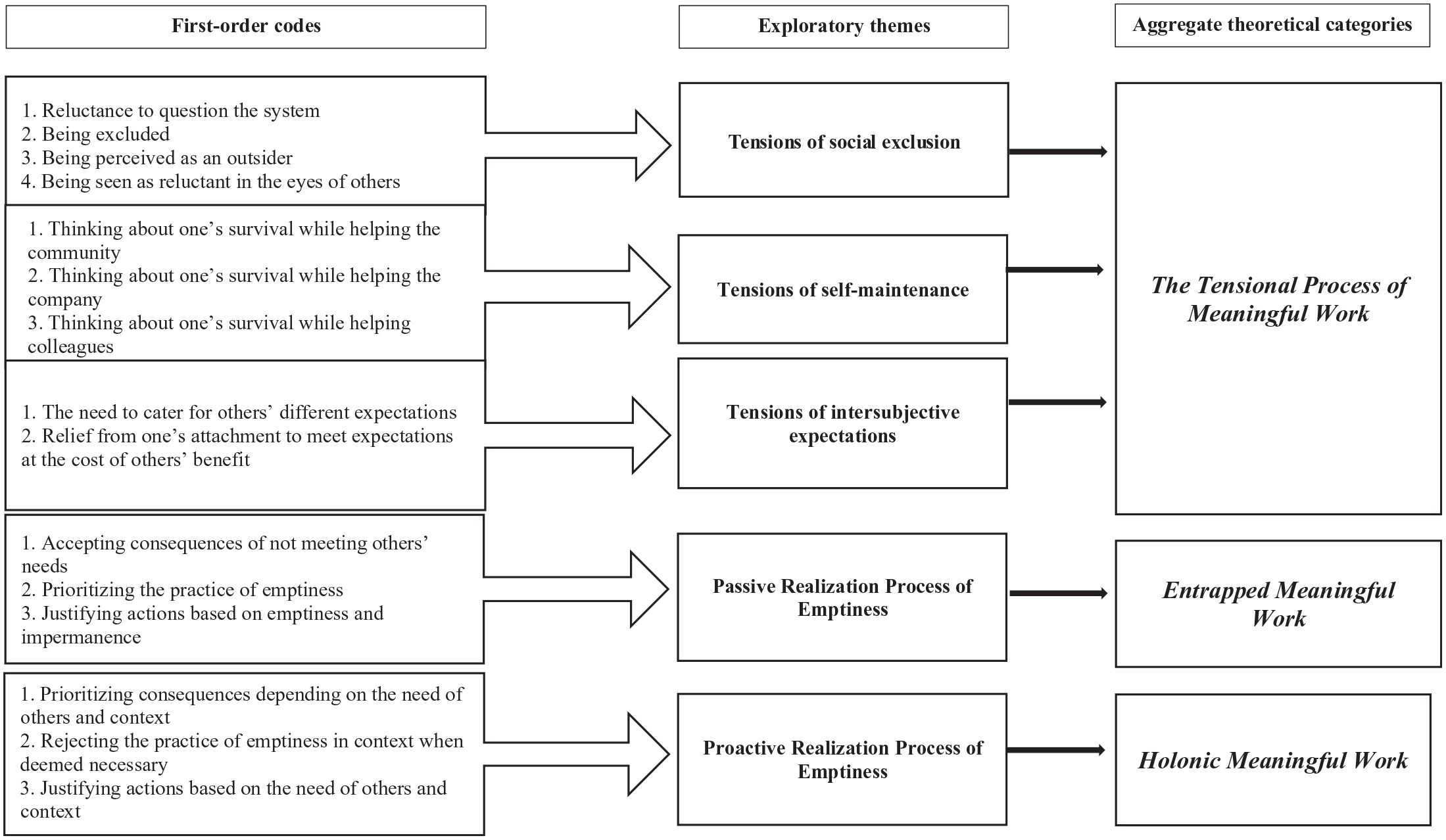
Data structure.
We recognize the importance of reflexivity in the process of data collection and in understanding how findings are constructed and reconstructed during the analysis process. The validity and reliability of the data can be impacted by the interviewer’s identity, the research question and the interview questions (Gunasekara, 2007). In this study, the first author, who conducted the interviews, is a Buddhist and fluent in Vietnamese. This potentially provided insight into important narratives on practices and interpretations of Buddhist principles that influenced the interviewees’ experience of meaningful work. Yet the first author’s knowledge of Buddhist philosophy and practices from the Mahayana school could also have significantly influenced how the data was interpreted. To mitigate this, both authors (the second author is a non-Buddhist with Buddhist research experience) coded and analysed the data independently and then compared and discussed the findings to reach agreement on the main themes. Additionally, when complex applications and interpretations of Buddhist philosophy were involved in the interviewees’ answers, we cross-checked our coding and interpretation with the interviewees.
Findings: A tension-centred approach to meaningful work in times of crisis
In the finding sections, we first illustrate the tensional process of meaningful work as experienced by participants in the crisis context of the Covid-19 pandemic. This tension prompted them to reassess how they perceived and pursued meaningful work, navigating conflicting and simultaneous expectations between others’ demands and their own practices of emptiness, which informed their understanding of meaningfulness. We then explore the processes of realization they encountered to embrace the in-betweenness of meaningful work, constituted by tensions as entrapped meaningfulness and holonic meaningfulness in the pursuit of meaningful work.
The tensional process of meaningful work
The drastic changes brought by the pandemic have impacted Khoa’s social relationships at work: Our firm started to help the community during the pandemic by deducting 10–15% of the salary of staff members. For me it’s a way of showing compassion and the meaningful side of the job that we are doing. Like our CEO, I’m a Buddhist and I get that we need to embrace the changes and respond accordingly. But many of our members got angry because 15% is a substantial amount for them, and they felt they were compelled to contribute just for the CEO’s own interest. I also got into fights with colleagues because I believe it was the right thing to do. (Khoa, accountant, retail company)
Khoa considered the initiative a meaningful and compassionate act, with the pandemic presenting opportunities for non-material meaningfulness through not clinging to material possessions. However, Khoa’s perception of meaningful work, influenced by the practice of emptiness, was put to test by colleagues. Khoa was seen as being aligned with what others saw as an organizational attempt to influence individual workplace practices.
Practising emptiness to overcome attachment to materiality was thus undermined by the deterioration of work relationships during the crisis. This resulted in a partial loss of the work meaningfulness Khoa initially attributed to the compassionate action. The professional and social decline for Khoa could have triggered his further attempts to find meaningfulness, creating further demands that could not be fulfilled and leading to an increased attachment to the ‘continuous next’ pursuit of meaningful work. In this way, while Khoa supported the company initiatives in appreciation of their material emptiness and non-material meaningfulness, this appreciation resulted in him overlooking the empty nature of meaningful work itself.
Tensions were also reflected in the struggles between attachment to self/materialism and the practice of emptiness and impermanence in interpreting phenomena: Our project came to a sudden halt. I was asked to take an unpaid leave for 3 months as support for our firm’s cash flow during the pandemic. Being a Buddhist, I know I should not strive for materiality or have expectations of what others can do for me. Meaning is in and of my doing itself, right? As much as I want to believe my practice of emptiness, how am I supposed to pay my rent and living expenses in the coming days? (Thao, engineer, construction company)
Thao faced tensions between practising emptiness and the material reality of survival during the pandemic. Her Mahayana tradition of Buddhist practice added to her struggles, as it emphasizes dedicating merit to benefit others (in this case, her company), not the self. However, through having to straddle emptiness practice and the deteriorating outcome for her survival, Thao questioned the meaning of ‘merit’ embedded in the Buddhist practice. This example highlights how struggles with the meaning of meaningfulness can result from the ‘mangle of practice’ due to the conditioned reality of agency, both actualizing and undermining perceived meaningful work. In Thao’s case, the calling and sense of meaningfulness derived from her Buddhist practice (to help others) intersected with the need for self-maintenance (materiality), constituting the tensional in-betweenness of meaningful work.
On the other hand, Quy, a university lecturer, was less concerned with losing his job as the closure of universities was compensated for by the provision of online sessions, which allowed academics to continue their work as usual. Yet he struggled in reconciling the tensions between the meaningfulness of his emptiness practice and its conflicting constitution of ‘meaningful’ work: The essence of emptiness is to release oneself from expectations. However, I found myself struggling with the thought that if I were to release myself from the expectations and demands of students and management for online learning, how could I assist students in learning and overcoming this challenging time? This has caused me to reflect extensively on the relationship between the meaningfulness from my Buddhist practice and the meaningfulness from what I do, which is to help students learn. (Quy, university lecturer)
While practising Buddhist emptiness involves tensions arising from releasing attachment to expectations, Quy increasingly struggled with whether he should release the expectations from students and university management for online teaching. This practical type of tension tends to be a crucial criterion generating suffering in Buddhism. Meaningfulness that is dependent on fulfilling others’ expectations is considered suffering, as it reflects a form of desire and is beyond one’s control. However, in critical circumstances such as the changing circumstances in teaching and learning during the lockdown period of the pandemic, fulfilling students’ expectations was deemed supportive. This seemingly irreconcilable tension provokes realization of the contested meaning of meaningful work, emerging at the intersection of gaining meaningfulness and losing it at the same time.
Our findings illustrate two such realization processes: passive realization, where the pursuit of meaningful work becomes an entrapment, and proactive realization, where such pursuit becomes a holonic process, as discussed below.
The Passive Realization of Emptiness: Entrapped meaningful work
The passive realization process can be generated by and generate tensions that entrap meaningfulness. In our study this process was detached from the social contexts and systems within which meaning occurs and reappropriated, manifesting in two ways: (1) over-reliance on a fixated practice of Buddhist emptiness, and (2) over-compliance with adaptation.
Participants in our study illustrated that they were entrapped in a continuous pursuit of meaningfulness that could not be fulfilled. At the moment of letting go of this pursuit (disregarding others’ expectations at work), they faced tensions from being excluded at work, which further facilitated the need (attachment) to attain meaningfulness. This was caused by some participants considering the emptiness of meaningful work a universal solution rather than a transitory process. This consideration detaches the practice of Buddhist emptiness from its conditioned interconnectedness, overlooking the workplace context as dependent-arising conditioning and being conditioned by an interwoven net of relations and meanings. This losing sight of the conditioned interconnectedness within Buddhist emptiness resulted in the participants’ passive and acontextual response to tensions. The process of gaining a sense of meaningfulness through religious practices constitutes the losing of meaningfulness in acontextual practice that fails to acknowledge its conditioned interconnectedness: People say, in difficult times, you would know who is a true friend. In my position, I can extend loan repayments for clients and colleagues and adjust interest rates within a certain limit. Because of this, when the pandemic hit, many of my colleagues from other departments asked for favours, seeking assistance with loans. . . Some requests were just too much for me to handle. I challenge myself with emptiness so that no attachment to expectations, like expectations from these colleagues, can govern over me. . . Refusing to help colleagues in these difficult times has soured my relationship with them . . . But I am just doing what I am supposed to do. I guess that’s the challenge I have to endure in my practice. (Cuong, finance coordinator, bank)
As a corporate finance coordinator, Cuong’s over-reliance on the practice of emptiness failed to recognize that the emptiness of meaningful work is inherently interdependent, and thus relationally constrained and constantly in tension. Specifically, in Vietnam’s collectivist culture where relationships and networks are key to an effective working environment, not considering colleagues’ needs in difficult times could adversely affect Cuong’s future career in the banking industry. This further complicated Cuong’s pursuit of meaningful work, as the practice of emptiness positioned him as an outsider at work. In this sense, letting go of the attachment to meeting others’ expectations is a form of individual agency conditioned by the emerging tension of professional reputation. Yet letting go at all costs regardless of context becomes an attachment in itself, thereby manufacturing pseudo-emptiness in meaningful work. This process of pursuing meaningful work therefore becomes a continuously experienced entrapment in and by emerging tensions.
While Cuong’s over-reliance on a fixated practice of emptiness led to a reluctance to appreciate the transitory but relationally conditioned nature of meaningful work, the following example shows how over-compliance with adaptation can also generate entrapment in the pursuit of meaningful work: Our school started to run online sessions for the children. . . I followed all instructions to conduct online sessions, but some of these instructions were not right, not effective, far away from what the children need for learning. I tried to resolve this by improving the way I delivered them. As a Buddhist, I know that I have to change myself, not the system because it is impermanent. I did not question our supervisors, because that’s how I practise emptiness, not trying to find excuses from others. But looking back, I should have raised my voice because it was the design of the online sessions, not us the teachers, that messed up the outcome of what was supposed to be a good initiative during school closures. (Hai, preschool teacher)
Hai followed his Buddhist practice to own mistakes and learn from them rather than seeking external excuses. When things went wrong, Hai tried to change the way he delivered the online sessions to maintain a sense of meaningfulness in his work, rather than questioning the design of the sessions. However, changing how the sessions were delivered did not solve the problem, as many activities designed by his supervisors were not adjusted to online scenarios. As a result, children became distracted and frustrated in the process of learning.
This over-compliance with adaptation and reluctance to question new organizational systems and practices reflects another form of passive realization of emptiness that is submissive to the transitory and tensional nature of meaningful work. Hai’s ‘reluctance’ was linked to the fear of challenging the cultural expectation of non-questioning and face-saving (Dickhardt & Lauser, 2016), as hidden but performative norms of meaningful behaviour. This example demonstrates how our subjective perception of what is meaningful (Michaelson, 2021), derived from individual religious practices embedded in a cultural reality, can both explain and confuse, and both encourage and prevent individuals from understanding the transitory nature of meaningful work.
Due to over-compliance to Buddhist emptiness in pursuit of meaningful work, individuals are entrapped in the perpetual pursuit of perceived meaningful work through their religious practices, only to experience its loss when confronted by a cultural and material reality. In our study, Buddhist emptiness embedded in meaningful work was constituted relationally beyond the individual, especially in a crisis environment where complex and conflicting expectations emerge. Participants struggled to make sense of the process of trying to gain meaningfulness and simultaneously losing it. They were preoccupied with reframing their perceived experiences of meaningful work through the lens of Buddhist emptiness, without taking contextual variability and fluidity into account in their interpretations.
The Proactive Realization of Emptiness: Holonic meaningful work
A proactive realization of meaningful work through Buddhist emptiness practices reveals that tensions and struggles drive the liberation from attachment to both meaningfulness and to religious practices themselves, which can be characterized as holonic meaningfulness. Individuals cannot maintain an empty experience, or the same empty existence of meaningful work across time as all phenomena including Buddhist practices are empty. Some participants were able to adapt to the context of the Covid-19 pandemic while practising emptiness but also rejecting the practice when circumstances deemed it unnecessary. For instance, Bich rejected the practice of abandoning attachment to expectations by rejecting her own practice of emptiness to overcome the passiveness in her practice: I could have just stayed closed and allowed my employees to explore other opportunities. I was not in the position to request them to stay with my business. But then what? I would be submitting to my own ignorance of not having expectations in the name of practising emptiness and impermanence. Many people believe that enduring the practice, whatever it takes, is practising Buddhism. No, it is not. It is about navigating the changes without clinging onto expected consequences. . . I did not expect anything when I changed the direction of my business, and for me, that was a meaningful experience to help my employees in a different way. . . but I’m aware that at some point this move will need to be changed again. (Bich, owner, family-run hotel chain)
Bich took the initiative not to comply with the situation but to proactively adapt to circumstances. She was willing to replace her traditional family hotel business with a takeaway service that helped maintain job security for her staff. Bich’s ability to transcend a reductionist understanding of the practice of emptiness within the context of impermanence reflects her recognition that the practice of emptiness is inherently empty. The sense of meaningful work here is as a transitory state that does not solely rely on one’s fulfilment of the practice of emptiness. As Bich suggests, passively accepting emptiness, such as by accepting that her hotel needed to be closed without proactively finding alternatives, can be a mental blindfold.
A mental blindfold can provide a certain level of mental release by shifting responsibility from oneself to the empty nature of phenomena, for example, by blaming new restrictions for failure. This, in turn, can increase tensions between multiple expectations, such as from staff and family members suffering due to business closures, and further reinforce attachment to the need for passive acceptance of impermanence. In this context the constructive challenges of the religious practices themselves can become a way to integrate and appreciate tensions, highlighting how a meaningful choice made at one moment can become a source of tension and loss of meaningfulness when circumstances change.
In other words, decisions and adaptations are self-contained systems and also integral components of a larger system. A decision made with the intention to contribute to a system’s meaningfulness can lead to tension within the context of a larger system of cultural and material reality. Proactive realization of the tensions of meaningful work is therefore embedded in constant contestations as and through a holonic system: The weekly on-call schedule became a constant source of conflict among staff members. I became the enemy for not accommodating requests, but had I done so, the business could not have run as usual, jeopardizing our jobs. People often blame me, saying that I was not compassionate. However, being a Buddhist is not about being compassionate all the time; that’s a form of attachment. It is more about embracing the emptiness of compassion. So we can adapt to the circumstances that are most meaningful at a particular time and be ready to accept its changing of meaning when necessary. (Chi, human resource supervisor, private healthcare service company)
When the lockdown hit, Chi was responsible for implementing new regulations for medical staff. In a challenging context where everyone was afraid of being exposed to Covid, the company had to maintain their healthcare services to clients. This meant rostering staff to be on the front line serving patients. Chi was firm in maintaining a strict on-call schedule, causing anxiety and attracting blame from her colleagues about her uncompassionate approach. Chi admits that the process was not pleasant, but it was necessary as a holonic way of practising Buddhist practices: if one chain fails, then its interconnected parts might affect or impede the system. The transitory and empty nature of a decision can constitute the uncertainty of unintended consequences in related dimensions of company operations.
To experience meaningful work is therefore to appreciate the potential to experience both meaningfulness and its loss simultaneously due to potential tensions that challenge such meaningfulness (e.g. colleagues’ blame and anger). The perceived loss of such meaningfulness can in turn trigger reflection on a decision made, transforming perceived tensions into interconnections that liberate the perception and experience of meaningful work within a holonic process.
This holonic process reflects a rejection of a definite way of experiencing and constructing meaningfulness, especially in times of crisis, which is a meaningful process in and of itself. By rejecting a categorical state of meaningfulness, one can experience the complex negotiation embedded in the tensional process of gaining and losing meaningful work at the same time, within which meaningfulness is provoked and realized. This is illustrated in Kien’s journey: There were lots of conflicts because we wanted the system to be meticulous, especially when we couldn’t check the manufacturing quality in person. But these requests annoyed the R&D team. They said I was stubborn, but when it comes to quality, certain standards need to be maintained. Like in Buddhism, emptiness trains you to be flexible, but not at all costs. Or it becomes a form of attachment and ignorance. We need to see there are different moments in time. . . Our online system was praised by the management team, and both teams learned a lot from each other at the end. I consider it a journey where the practice of emptiness was truly being tested when I was more assertive than accommodating. (Kien, quality assurance supervisor, manufacturing company)
Kien merged his department with the R&D department because his team could no longer go to factories to check manufacturing processes during Covid-19. As a result, his team were now reliant on the R&D team to design online platforms for them to operate. Kien experienced hostility and conflicts towards his ideas. Spiritual and religious practices such as the practice of emptiness are not just about accommodating to the context, but more about how, and to what extent. This is particularly significant during times of crisis as it avoids reframing experienced uncertainty at work in dysfunctional ways. Instead, it disrupts a potentially emerging distorted sense of meaningfulness (e.g. Florian et al., 2019) through accommodating everyone at all costs, even though this might not be a meaningful thing to do (in this case, skipping quality check steps that could jeopardize the quality of the final production line). Kien embraced the multiple and re-emerging tensions as a means to liberate meaningful work, allowing it to simultaneously arise and be lost through conflicts and adjustments in the workplace.
Discussion
In this section, we discuss three key contributions of the study in connection to four implications, one each at the individual, organizational and inter-organizational levels and a wider implication for organizational research. Our primary contribution lies in the development of a religious practice(s) approach (Bento da Silva et al., 2022; Quattrone, 2015) to MOS in general, and to address the tensional process of meaningful work in particular. In developing this religious practice(s) approach, we have drawn on Buddhist emptiness theory to illuminate how the inherent ‘emptiness’ in organizational phenomena, such as the conditioned interconnectedness and the absence of attainable phenomena in impermanence, can propel and contest the continuous quest to (re)organize individuals’ meaning making in organizations. We argue that a religious practice(s) approach lays an alternative foundation for organizing in dynamic contexts (Tsoukas & Chia, 2002), while catering for an increasingly diversified workforce with different spiritual/religious needs (Fotaki et al., 2020). This approach reflects the need to shift away from focusing solely on the physical presence of materiality, towards exploring its absence (e.g. Giovannoni & Quattrone, 2018). One example is the inherently empty and transitory nature of expectations in an impermanent organizational setting (e.g. during the Covid-19 pandemic), and how this absence impacts and shapes the understanding of organizations through religious practices.
A religious practice(s) approach speaks to the critical perspective of workplace spirituality in MOS and challenges its emphasis on secularization theory (King, 2008). This conceptualization suggests a decline in religion within rational (or hyper-rational) and modern societies, rendering religion seemingly irrelevant in organizational or management contexts (Tracey, 2012). We argue that religious practices guided by religious principles and philosophies are influential in how individuals navigate challenging situations or fragmented events, both enabling and contesting their agency to address a crisis of meaning in their work. From this perspective religious practices are sources of both entrapment and emancipation for individuals grappling with the intricate impermanent nature of phenomena amid cultural and material crises. There is a need to transcend the constrained conceptualization of workplace spirituality within MOS. It places emphasis on organizational attempts to manipulate individuals’ behaviours (Lips-Wiersma & Mills, 2014) rather than individual efforts, derived from and entangled in tensions, in navigating the ‘emptiness’ in the organizing and disorganizing of meaningfulness during turbulent times.
Second, we have demonstrated this approach through exploring the tensional process of meaningful work in the context of the Covid-19 pandemic. Tensions are treated as largely self-evidential in the existing studies on meaningful work and so are not yet integrated into its theoretical conceptualization. Our study addresses this limited understanding through the lens of religious practices, placing tension at the centre of the analytical focus. Meaningful work is conceptualized as a process of meaning (re)creation shaped by subjective interpretations of religious practices and contested by material reality. We argue that such tensions constitute meaningful work as a process and state of the in-betweenness of gaining and losing meaningfulness simultaneously. We unpack this process, bringing forward the Buddhist practice of emptiness within the dynamics of two realization processes.
The first, termed passive realization, involves an over-reliance on a fixated practice of Buddhist emptiness and over-compliance with the need for adaptation during crisis, leading to a state of entrapped meaningfulness. The attachment and over-compliance with religious practices can overshadow the inherently transitory and relational nature of the practices, which is part of the process of becoming. Tensions arise from the constant competing dynamics between individuals’ fixed practices and the shifting environmental or external conditions fraught with constraints and necessitating adaptation. Different from passive realization, proactive realization occurs when tensions are embraced in religious practices. In turn religious practices are recognized as being ‘empty’ in themselves, allowing them to be rejected when necessary. In this way, the emptiness of meaningful work is recognized as empty itself and is experienced in an ‘empty meaningful way’ described as holonic meaningfulness.
We consider that these two realization processes can potentially interact with one another. The entrapment of tensions can become a condition of liberation, which might in turn cultivate further tensions and struggles that entrap the pursuit of meaningful work. This process reflects the tension-centred meaningful work as a continuous and recursive process of learning. Only by acknowledging meaningful work within its tensional and transitory process, without situating it dualistically as good or bad, can this then allow the (re)emergence of organic lived experience of meaningfulness.
It is not simply the material world or purely subjective perceptions of meaningfulness and religious practices that shape how meaningful work is experienced, nor is it solely others or the self. Instead, individuals’ subjective perception of meaningful work is continually reshaped, lost and gained through their religious practices, which are simultaneously challenged and contested by emerging encounters or changing events at work. This process involves continuous tensional interaction with other organizational members, leading to a negotiation of reality in and through oneself. This, we contend, was particularly important during the Covid-19 pandemic as when certain desires are not met or expectations remain unfulfilled, the resulting craving generates negative feelings and tensions (Bodhi, 1984) in how individuals deconstruct and reconstruct what is meaningful to them.
Third, this study has broadened understanding of a religious approach to meaningful work from a non-Western viewpoint, where tensions and uncertainties are considered an inherent part of wisdom (Fang, 2010). Tensions are something to be embraced, cherished and transcended in interdependent and interactive realities (X. Li, 2021), rather something to resolve. More specifically, our engagement with the Buddhist theory of emptiness shows how a fluid and dynamic understanding of tensions can open avenues to experiencing them, and thereby contribute to understanding the ‘messiness’ of organizational life. Other Eastern philosophies and religious practices (e.g. Confucianism, Taoism, Hinduism) that consider tensions as inherent aspects of existence and evolution can be explored further in studying meaningful work. This would offer new insights into the complexity of the diverse and multiple forms of struggle and tension that are simultaneously present in pursuing and experiencing meaningful work.
Such an approach would also broaden the appreciation of Eastern perspectives in MOS. Examples include the interconnected nature of opposites and their emptiness, such as secrecy and transparency in corporate scandals (e.g. Fan & Christensen, 2024; Fan & Liu, 2022), and the creation and dissolution of transcending constraints during crises in organizations. The emptiness approach also speaks to the overlooked concept of vertical temporality (Bachelard, 1932/2013; Helin, 2023) through exploring a complex moment and disrupted instant consisting of simultaneities, rather than continuous ‘horizontal’ time. The transitory and relationally conditioned being of the self (emptiness) awakens considerations of our inherent ambivalence at moments of complexity and multitude (Helin, 2023). In the void between past and future, a vertical moment houses contradictory feeling of both satisfaction and regret, of gaining and losing meaningfulness. Such contradictory simultaneities of being oneself in vertical time, both rejecting and transitioning to the becoming of others (as in horizontal time), can be enriched by the concept and practices of emptiness.
Our study has four important implications for the application of emptiness in organizations. At the level of individual practitioners, their practices of emptiness are not without tensions (e.g. Vu & Fan, 2022). Individuals may struggle to let go of the emptiness in their practices, as this ‘letting go’ can be experienced as and through a sense of failure, especially when circumstances call for embracing the emptiness and rejecting the practice itself. This experience of ‘failure’ can in turn make it difficult for practitioners to accept this perceived lack of ability to practise emptiness, fuelling their further and instrumental attachment to emptiness (e.g. to prove themselves a capable self). Nevertheless, such emptiness can also offer ways for practitioners to (re)construct their understanding of impermanent reality and the very nature of their beliefs and practices, embracing uncertainty and adaptability in an ‘empty’ way.
For organizations, emptiness highlights a state of in-betweenness in experiencing organizational life in an ‘empty meaningful’ way, where tensions are embraced and seen as a natural part of everyday organizational experiences, rather than striving for an ideal way of organizing. Our study emphasizes the importance of meaningfully incorporating religion and spirituality into organizational practices rather than dismissing them (Tracey, 2012), as many practices like Buddhist teachings are highly relevant to the contemporary world. They are not merely esoteric beliefs but practical guidance to how to live our lives meaningfully in organizations by learning to (re)construct such meaningfulness beyond a profoundly changing world.
For multinational corporations operating in Vietnam, this discourse represents both a challenge and an asset. As an asset, practices of emptiness that embrace the ‘absence’ of any fixed phenomenon and emphasize the tensional interconnectedness of elements can drive a global strategy to (re)construct the meaning of emptiness in a localized search for relevance and adaptability (Bento da Silva et al., 2022). This will create opportunities to integrate the local workforce into their global working context and vice versa. In this sense, practices of emptiness might be employed in alignment with common business logics that promote flexibility. This includes facilitating a willingness to move away from certain roles and routines of organizational practices that might create conflicts with local cultural values.
Nonetheless, practices of emptiness can also risk being co-opted to reinforce exploitative practices and capitalist norms, presenting challenges for multinational corporations in Vietnam. For example, the practice of emptiness can be passively employed by multinationals to justify their lack of adaptability to local values and contexts (since all phenomena are considered empty), as well as by employees to rationalize their passive engagement or even wilful blindness in the workplace. This is reflected in our findings that show that individual practices of emptiness can entrap employees within their own interpretations of organizational practices. This entrapment can also manifest as compliance with organizational changes to protect oneself during turbulent periods when navigating pressures from shifting organizational demands, such as the pressure for enhanced performance with reduced workforce. This can also lead to emerging workplace phenomena like employee silence, psychological unsafety, reluctance and presenteeism in how employees approach work.
Recognizing local values and religious principles should be incorporated into organizational practices in a way that remains ‘empty’, facilitating a bridge between local and global discussions on topics such as workplace voice, employee well-being and the localized social responsibilities of corporations. For example, principles from the Noble Eightfold Path of Buddhism, such as ‘right action’ and ‘right livelihood’, which guide practitioners to engage in work that causes no harm, should be continuously examined to understand what ‘harm’ means in different contexts, such as those rooted in collectivist-oriented values. Additionally, there should be an ongoing interrogation of how the practice of emptiness might be interpreted or adapted, particularly regarding potential counterproductive or co-opted intentions that may arise when implementing or adopting this religious practice within organizations.
Lastly, emptiness provides researchers with an alternative approach to organizational research by encouraging them to shift the focus and reflexively question their reliance on rigid boundaries and static frameworks to explore the complexities of the impermanent and interconnected aspects of organizational life from different worldviews. For instance, Brummans (2014) has discussed emptiness as a means to facilitate mindful qualitative research that helps reveal how organizations are constituted by clinging to or letting go of the boundaries between self and other, human and non-human, individual and collective, and micro and macro.
Our study is not without limitations that, nevertheless, offer directions for future research. First, our conceptualization of meaningful work from a religious practice(s) approach is limited in the contexts and cultures by which these practices are influenced and in turn influence individual perspectives on life and work. This study relied on practitioners of a particular Buddhist tradition (the Mahayana tradition) in the specific context of Vietnam. The specific scope of the sample may have limited exploration of the dynamics of meaningful work embedded in other Buddhist practices, such as mindfulness or the middle way, and in other spiritual practices from different traditions and contexts. We encourage future studies to bring forward different socio-cultural-historic-philosophical contexts and approaches to meaningful work as paradox. Doing so will extend space for reflection and dialogues for collaborative and accumulative investigation, rather than adding to the already fragmented management scholarship.
Second, we only examined individual choices and preferences for enacting religious practices, which resulted in tensions generating both entrapped and holonic meaningfulness. Future studies could expand on this approach to explore how different religious practices may be employed differently in organizations, to search for new ways and approaches to ‘re-think and re-imagine’ the role of organizations and organizing (Fotaki et al., 2020). In addition, the embedded tensions of religious practices and their increasing application, for example, mindfulness workshops, in and for organizations can also be critically examined to reveal the hidden impact on employees.
Third, our focus has been examining meaningful work from a religious practice(s) perspective. We have not explored the impact of intersectionality (Collins, 2019) and the effect of different maturity levels in individual religious practices, both of which can influence experiences of meaningful work. Questions around the conditions and consequences of different forms of tensions in meaningful work remain unanswered. These could be investigated in future studies to reveal the complexity of the contradictory nature of meaningful work in its realization process.
Conclusion
By conceptualizing a religious practice(s) approach in MOS, we have highlighted how religious practices initiated and embodied by individuals can contribute to both the organizing and disorganizing of organizations, especially during times of crisis, as part of a continuous search for meaning within emptiness. This approach to meaningful work argues that tensions cannot and should not be resolved or eliminated. The Covid-19 pandemic is not an isolated case but has brought together multiple and interrelated crises to be faced by all of us. By exploring meaningful work as a realization process in and of itself, our study has unpacked a tension-centred approach to meaningful work from a religious practice(s) perspective. We hope it will facilitate the advancement of non-Western perspectives on navigating meaningful tensions in volatile environments towards developing critical scholarship in MOS.
Footnotes
Appendix
Representative interpretations of themes.
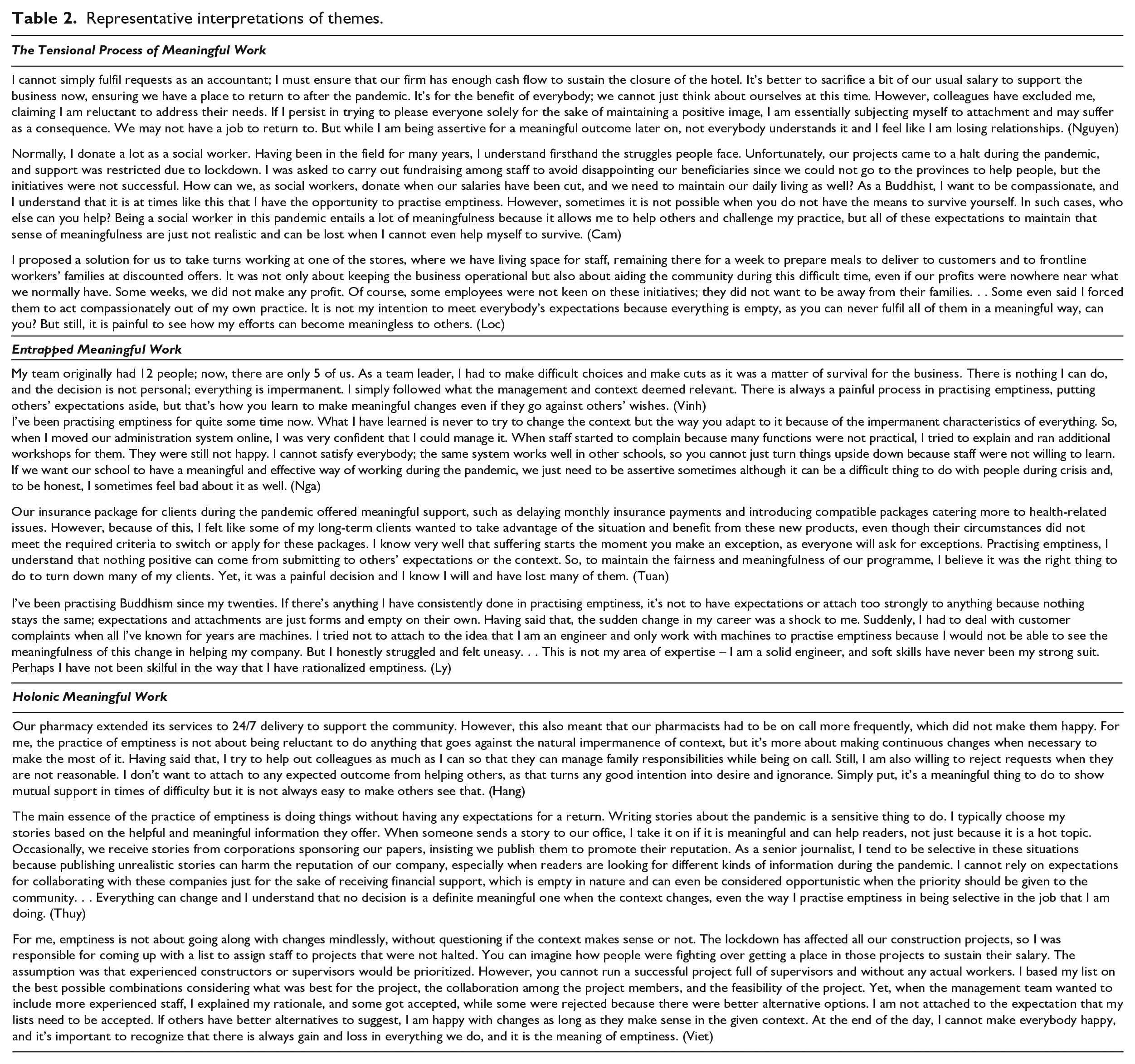
|
|
| I cannot simply fulfil requests as an accountant; I must ensure that our firm has enough cash flow to sustain the closure of the hotel. It’s better to sacrifice a bit of our usual salary to support the business now, ensuring we have a place to return to after the pandemic. It’s for the benefit of everybody; we cannot just think about ourselves at this time. However, colleagues have excluded me, claiming I am reluctant to address their needs. If I persist in trying to please everyone solely for the sake of maintaining a positive image, I am essentially subjecting myself to attachment and may suffer as a consequence. We may not have a job to return to. But while I am being assertive for a meaningful outcome later on, not everybody understands it and I feel like I am losing relationships. (Nguyen) Normally, I donate a lot as a social worker. Having been in the field for many years, I understand firsthand the struggles people face. Unfortunately, our projects came to a halt during the pandemic, and support was restricted due to lockdown. I was asked to carry out fundraising among staff to avoid disappointing our beneficiaries since we could not go to the provinces to help people, but the initiatives were not successful. How can we, as social workers, donate when our salaries have been cut, and we need to maintain our daily living as well? As a Buddhist, I want to be compassionate, and I understand that it is at times like this that I have the opportunity to practise emptiness. However, sometimes it is not possible when you do not have the means to survive yourself. In such cases, who else can you help? Being a social worker in this pandemic entails a lot of meaningfulness because it allows me to help others and challenge my practice, but all of these expectations to maintain that sense of meaningfulness are just not realistic and can be lost when I cannot even help myself to survive. (Cam) I proposed a solution for us to take turns working at one of the stores, where we have living space for staff, remaining there for a week to prepare meals to deliver to customers and to frontline workers’ families at discounted offers. It was not only about keeping the business operational but also about aiding the community during this difficult time, even if our profits were nowhere near what we normally have. Some weeks, we did not make any profit. Of course, some employees were not keen on these initiatives; they did not want to be away from their families. . . Some even said I forced them to act compassionately out of my own practice. It is not my intention to meet everybody’s expectations because everything is empty, as you can never fulfil all of them in a meaningful way, can you? But still, it is painful to see how my efforts can become meaningless to others. (Loc) |
|
|
| My team originally had 12 people; now, there are only 5 of us. As a team leader, I had to make difficult choices and make cuts as it was a matter of survival for the business. There is nothing I can do, and the decision is not personal; everything is impermanent. I simply followed what the management and context deemed relevant. There is always a painful process in practising emptiness, putting others’ expectations aside, but that’s how you learn to make meaningful changes even if they go against others’ wishes. (Vinh) I’ve been practising emptiness for quite some time now. What I have learned is never to try to change the context but the way you adapt to it because of the impermanent characteristics of everything. So, when I moved our administration system online, I was very confident that I could manage it. When staff started to complain because many functions were not practical, I tried to explain and ran additional workshops for them. They were still not happy. I cannot satisfy everybody; the same system works well in other schools, so you cannot just turn things upside down because staff were not willing to learn. If we want our school to have a meaningful and effective way of working during the pandemic, we just need to be assertive sometimes although it can be a difficult thing to do with people during crisis and, to be honest, I sometimes feel bad about it as well. (Nga) Our insurance package for clients during the pandemic offered meaningful support, such as delaying monthly insurance payments and introducing compatible packages catering more to health-related issues. However, because of this, I felt like some of my long-term clients wanted to take advantage of the situation and benefit from these new products, even though their circumstances did not meet the required criteria to switch or apply for these packages. I know very well that suffering starts the moment you make an exception, as everyone will ask for exceptions. Practising emptiness, I understand that nothing positive can come from submitting to others’ expectations or the context. So, to maintain the fairness and meaningfulness of our programme, I believe it was the right thing to do to turn down many of my clients. Yet, it was a painful decision and I know I will and have lost many of them. (Tuan) I’ve been practising Buddhism since my twenties. If there’s anything I have consistently done in practising emptiness, it’s not to have expectations or attach too strongly to anything because nothing stays the same; expectations and attachments are just forms and empty on their own. Having said that, the sudden change in my career was a shock to me. Suddenly, I had to deal with customer complaints when all I’ve known for years are machines. I tried not to attach to the idea that I am an engineer and only work with machines to practise emptiness because I would not be able to see the meaningfulness of this change in helping my company. But I honestly struggled and felt uneasy. . . This is not my area of expertise – I am a solid engineer, and soft skills have never been my strong suit. Perhaps I have not been skilful in the way that I have rationalized emptiness. (Ly) |
|
|
| Our pharmacy extended its services to 24/7 delivery to support the community. However, this also meant that our pharmacists had to be on call more frequently, which did not make them happy. For me, the practice of emptiness is not about being reluctant to do anything that goes against the natural impermanence of context, but it’s more about making continuous changes when necessary to make the most of it. Having said that, I try to help out colleagues as much as I can so that they can manage family responsibilities while being on call. Still, I am also willing to reject requests when they are not reasonable. I don’t want to attach to any expected outcome from helping others, as that turns any good intention into desire and ignorance. Simply put, it’s a meaningful thing to do to show mutual support in times of difficulty but it is not always easy to make others see that. (Hang) The main essence of the practice of emptiness is doing things without having any expectations for a return. Writing stories about the pandemic is a sensitive thing to do. I typically choose my stories based on the helpful and meaningful information they offer. When someone sends a story to our office, I take it on if it is meaningful and can help readers, not just because it is a hot topic. Occasionally, we receive stories from corporations sponsoring our papers, insisting we publish them to promote their reputation. As a senior journalist, I tend to be selective in these situations because publishing unrealistic stories can harm the reputation of our company, especially when readers are looking for different kinds of information during the pandemic. I cannot rely on expectations for collaborating with these companies just for the sake of receiving financial support, which is empty in nature and can even be considered opportunistic when the priority should be given to the community. . . Everything can change and I understand that no decision is a definite meaningful one when the context changes, even the way I practise emptiness in being selective in the job that I am doing. (Thuy) For me, emptiness is not about going along with changes mindlessly, without questioning if the context makes sense or not. The lockdown has affected all our construction projects, so I was responsible for coming up with a list to assign staff to projects that were not halted. You can imagine how people were fighting over getting a place in those projects to sustain their salary. The assumption was that experienced constructors or supervisors would be prioritized. However, you cannot run a successful project full of supervisors and without any actual workers. I based my list on the best possible combinations considering what was best for the project, the collaboration among the project members, and the feasibility of the project. Yet, when the management team wanted to include more experienced staff, I explained my rationale, and some got accepted, while some were rejected because there were better alternative options. I am not attached to the expectation that my lists need to be accepted. If others have better alternatives to suggest, I am happy with changes as long as they make sense in the given context. At the end of the day, I cannot make everybody happy, and it’s important to recognize that there is always gain and loss in everything we do, and it is the meaning of emptiness. (Viet) |
Acknowledgements
We would like to express our gratitude to Marianna Fotaki, Paolo Quattrone and the three anonymous reviewers for their guidance and support throughout the journey of this paper. We also extend our thanks to all the scholars who support and/or contribute to the development of non-Western perspectives in management and organization studies. This is a collective effort to build something that is close to both our hearts and minds.
Funding
The author(s) received no financial support for the research, authorship, and/or publication of this article.
