




Abstract
This study explores customer-centric strategizing at a digital bank utilizing a 34-month visual ethnography. We adopt a multimodal perspective to reveal three practices that presentify and thus ‘bring’ the customer into strategizing – inquiring, perspective-taking and appreciating. These practices enable strategists to understand customer contexts, empathize with their experiences and value their strategizing contributions over time. Our findings advance research on strategy-as-practice and highlight the role of external stakeholders in the strategy process. Specifically, we demonstrate how multimodal practices shape strategy by enabling managers to presentify customers through empathetic competence. By doing so, we illuminate the diverse skills needed to effectively orchestrate multimodal resources in a way that empathetically connects with customers and informs strategizing.
Keywords
Introduction
In strategy-as-practice (SAP) research, practices are defined as ‘accepted ways of doing things, embodied and materially mediated, that are shared between actors and routinized over time’ (Vaara & Whittington, 2012, p. 287). SAP scholars emphasize everyday activities, tools, norms, practitioners and interactions that are fundamental to strategizing (Jarzabkowski, Balogun, & Seidl, 2007; Vaara & Whittington, 2012; Whittington, 2006), examining the participation and consequential activities of a diverse set of actors (Jarzabkowski, Kavas, & Krull, 2021) including managers, frontline employees and external stakeholders (De Keyser, Guiette, & Vandenbempt, 2023; Rouleau & Balogun, 2011; Schneider, Bullinger, & Brandl, 2021; Splitter, Jarzabkowski, & Seidl, 2023). While the resultant SAP literature has illuminated the significant role of many actors in shaping strategy (see Jarzabkowski & Balogun, 2009; Knight, Paroutis, & Heracleous, 2018; Mantere & Whittington, 2021; Regnér, 2003), it has tended to concentrate on interactions within shared linguistic and cultural organizational contexts (see for example Ma & Seidl, 2018; Mirabeau & Maguire, 2014; Rouleau & Balogun, 2011; Samra-Fredericks, 2003). Consequently, the field has underappreciated how external stakeholders might interactively or representatively partake in strategizing. This underappreciation includes a lack of attention to the role of customers in strategizing (for rare exceptions, see Balogun, Best, & Lê, 2015; Rouleau, 2005; Schneider et al., 2021; Vargha, 2018) despite customers providing crucial insights for strategizing due to their diverse backgrounds, experiences and perspectives (Bogers, Afuah, & Bastian, 2010; Prahalad & Ramaswamy, 2004; Ranjan & Read, 2016). This oversight obstructs our understanding of how strategists might engage with, and respond to, customers’ feelings and concerns while strategizing (Knight, Daymond, & Paroutis, 2020).
Consequently, growing recognition of the customer in strategizing challenges SAP’s traditional intra-organizational focus, beckoning further exploration of the dynamics between customers and strategic practices. Relatedly, Rouleau (2005) shed light on the influence of customer interactions on strategizing by studying the discursive practices of middle managers in a high-end clothing company, revealing how these managers used tacit knowledge from customer interactions to ‘sell’ strategic change. Shifting the focus from middle managers to frontline workers, Balogun et al. (2015) studied museum tour guides and uncovered the ways in which customers contribute to realizing a company’s strategy. These examples, though infrequent, demonstrate how customers can be implicated in strategizing either interactively or representatively. Further, this work highlights that how customers feel, act and react is important to strategy work (Knight et al., 2020; Rouleau, 2005), requiring more than a focus on the discursive articulation of customer positions through market research. Accordingly, managers need to ‘acquire insights from outside the firm that can be incorporated into how they evaluate and change the organization’s strategy’ (Knight et al., 2020, p. 144). We label this form of practice-based engagement as customer-centric strategizing (Shah, Rust, Parasuraman, Staelin, & Day, 2006), which aims to bring customer needs, experiences and contexts into the strategy process.
In examining customer-centric strategizing, we build on studies illustrating how multimodality is employed to build knowledge of, and empathy with, customers by interacting with them (Balogun et al., 2015; Beckman, 2020; Liedtka, 2015). We extend this work and consider how a variety of modes can be used to make present or ‘presentify’ (Bencherki, Sergi, Cooren, & Vásquez, 2021; Cooren, Brummans, & Charrieras, 2008) customers’ feelings and concerns, where presentifying refers to ‘interactive practices by which various things and beings are made present in an ongoing interaction’ (Benoit-Barné & Cooren, 2009, p. 10). We adopt a multimodal focus accessing the affective customer experience to better understand how customer-centric strategizing occurs – presentifying the customer, or, more colloquially, seeking ‘to walk in the customer’s shoes’. Our research question is, therefore: How do multimodal practices of external engagement bring the customer into strategizing?
We conducted a 34-month visual ethnography at a digital bank to answer our research question. Our multimodal perspective uncovered the visual, verbal and embodied ways organizational actors engage in customer-centric strategizing via three practices: (1) inquiring; (2) perspective-taking; and (3) appreciating. These practices help managers understand customers’ situations and contexts, empathize with their emotional experiences, and collectively value their strategizing contributions over time. As a result, we contribute to the SAP literature in two ways. First, we advance research on customer-centric strategizing, revisiting the relevance of external stakeholders in the strategy process (see Hautz, Seidl, & Whittington, 2017; Knight et al., 2018; Whittington, 2019). In particular, we show how multimodal practices presentify and give rise to unique understandings of customers that shape strategy, enabling managers to feel, see and be as if they were the customer. Second, we advance knowledge of strategizing practices by elaborating how strategists mobilize multimodality (Balogun et al., 2015) to presentify customers as a form of empathetic competence. In doing so, we go beyond studies focusing predominantly on the discursive competence of strategists (see Bencherki et al., 2021; Hardy & Thomas, 2015; Rouleau & Balogun, 2011). Rather, we shed light on the varied competencies required to skilfully orchestrate multimodal resources (Jarzabkowski, Burke, & Spee, 2015) in ways that empathetically connect with customers and feed resultant understandings into strategizing.
Strategy-as-Practice and the Customer
SAP research conceptualizes strategy as a situated activity – something actors ‘do’ rather than something organizations ‘have’ (Jarzabkowski et al., 2007). Consequently, SAP scholarship has shifted the focus of inquiry away from strategic plans and the senior managers traditionally tasked with their formulation (Jarzabkowski, Seidl, & Balogun, 2022; Johnson, Melin, & Whittington, 2003; Vaara & Whittington, 2012) to the social practices producing consequential strategic activity (Jarzabkowski et al., 2021). This shift has led to a redefinition of ‘strategists’ (Dameron & Torset, 2014; Mantere & Whittington, 2021; Whittington, 2019) and fostered greater recognition of non-traditional actors in strategy work, including middle managers (Rouleau, Balogun, & Floyd, 2015), frontline employees (Schneider et al., 2021) and external actors like strategy consultants (Knight et al., 2018). This broadening of our theoretical understanding of strategy work has accompanied an empirical ‘opening’ of strategy (Whittington, 2019), with strategy processes becoming increasingly inclusive (Hautz et al., 2017; Splitter, Seidl, & Whittington, 2019). Nevertheless, few studies have considered customers’ roles in strategizing – despite the theoretical promise of looking outside the organization. Consequently, we have little insight into how managers bridge the interpretive gap between their organizations’ socio-cultural understandings and those emerging from customer contexts, situations and experiences, i.e. the ‘sites’ where strategies impact customers (Knight et al., 2020).
A few studies have addressed customer-oriented strategy work to respond to this interpretive gap, albeit incompletely. The work of Hutt, Reingen, and Ronchetto (1988) provides an early example. They detailed how a new strategy was developed from a sales representative’s interactions with a key customer. The sales representative introduced the idea to a marketing manager, who then initiated a series of dyadic interactions with operating and administrative personnel across the organization. At the centre of these interactions, the marketing manager acted as a conduit for the initiative, navigating upward, downward and across the organization, and between the organization and its external environment. While the manager emerged as the key champion proposing the initiative to top management, the study did not shed light on the nuances of how externally originating ideas were made to ‘fit’ the organization, particularly when those ideas were not easily aligned with the organization’s ways of thinking, values, or feelings. Understanding this bridging activity is significant because managers capable of enabling mediation between an organization, its customers and suppliers can potentially wield great strategic influence (Floyd & Wooldridge, 1997).
Rouleau (2005) added nuance to Hutt et al. (1988) by examining the practices of middle managers in a high-end clothing company, explicating how they drew on tacit knowledge in their interactions with customers to ‘sell’ strategic change. Rouleau’s research showed that middle managers used client discourse – the language of the customer – to guide the strategy process, advocating for changes in products or market positions by championing perceived customer interests. Furthermore, Rouleau (2005) pointed out how effectively client discourse conveyed new strategic directions, ensuring the organization’s reputation remained intact within existing socio-cultural codes while integrating customer insights into the organization’s strategic development process.
Turning from middle managers to the interpretive work of frontline employees, Balogun et al. (2015) studied museum tour guides. They revealed how customers implicitly contributed to realizing a company’s strategic objectives; tour guides enlisted customers to participate as a ‘working audience’ (Balogun et al., 2015, p. 1287; see also Best, 2012) in the strategy enactment process. At this point, interaction turned from discursive to multimodal. The authors’ findings demonstrate the subtle and intricate nature of the embodied work of frontline workers. They ‘bring into being’ (p. 1291) an organization’s strategic aims, while interacting with customers on the front line (Balogun et al., 2015).
Schneider et al. (2021) added an affective dimension to the relationship between organizational actors and customers in their study of how frontline employees bolster strategy realization through social practices with customers. Their study of a global fashion retail company showed how employees deftly handled resources and managed tensions when interacting with customers, striking a balance between customer needs and organizational demands. Their work sheds light on how employees can distract customers from unpleasant interactions through rhetorical and symbolic activities, giving new meaning to situations and feelings, such as providing compensatory vouchers to appease aggrieved customers.
While Schneider et al. (2021) highlighted frontline employees’ reactive interactions with frustrated customers, our understanding of how customers’ needs, desires and perspectives are represented in strategizing remains limited. Rouleau (2005) underscored the challenge managers face in gaining both tacit and explicit insights into the customer’s perspective on organizational strategy – insights that ‘are not well bounded by some shared organizational rules’ (p. 1417). Concomitantly, managers must translate these insights into symbolic resources that are comprehensible within the organization, enabling them to ‘legitimate their actions [vis-à-vis strategy] and influence others’ (Rouleau, 2005, p. 1417). Balogun et al. (2015) emphasized that, to enhance strategy research in relation to the role of the customer, we need more than an understanding of customer discourse to push strategy towards customer-centricity – rather, organizational actors need to engage multimodally in customer-centric strategizing to cultivate and leverage empathy with customers.
Multimodal Perspectives on Strategizing
While discursive activities have long been foregrounded in examining social practices constitutive of strategy (see Bencherki et al., 2021; Hardy & Thomas, 2015; Rouleau & Balogun, 2011), there is now also a well-developed appreciation that strategies are not just about words. Strategies encompass ‘situated constellations of parts of practices’ that span multiple modes (Wenzel & Knight, in press). Indeed, prior work has started examining the rich tapestry of visual, material and embodied modes implicated in strategizing (Balogun et al., 2015; Knight et al., 2018; Liu & Maitlis, 2014; Wenzel & Koch, 2018; Werle & Seidl, 2015) and organization studies more broadly (Giovannoni & Napier, 2023; Höllerer, Jancsary, & Grafström, 2018; Lefsrud, Graves, & Phillips, 2020; Nathues, van Vuuren, Endedijk, & Wenzel, 2024; Puyou & Quattrone, 2018; Quattrone, Ronzani, Jancsary, & Höllerer, 2021). Adopting a multimodal perspective helps advance strategy scholarship by providing an analytical framework to interrogate different aspects of ‘the doings’ of strategy in addition to ‘the sayings’ (see Wenzel & Knight, in press). Further, studying how strategizing is achieved with, in and through diverse modes helps illuminate the shared practical understandings central to and underpinning strategy work (Rouleau & Cloutier, 2022; Schatzki, 2001).
One of the main motivations for studying multimodality in strategy has been the realization that these modes enable different types of understanding to emerge through strategizing processes. For example, strategists interact with tools, such as PowerPoint decks, to bring managers and consultants onto the ‘same page’ (Kaplan, 2011; Knight et al., 2018). Further, artifacts, such as whiteboard visuals in workshops (Werle & Seidl, 2015) or university strategic planning documents (Spee & Jarzabkowski, 2011), are used to surface, challenge and enrich strategists’ perspectives in various contexts. These artifacts assist actors by bringing new meaning to the fore through novel forms of visualizing complexity (Eppler & Platts, 2009; Kernbach, Eppler, & Bresciani, 2015; Werle & Seidl, 2015). More recently, studies have shown that integrating an embodied understanding of material interactions into the strategy process enhances attention to emotional and embodied experiences in strategizing and related discursive activities (Küpers, Mantere, & Statler, 2013; Liu & Maitlis, 2014). Embodiment influences actors’ experiences in strategic situations through physical presence and interactions with others (Gylfe, Franck, LeBaron, & Mantere, 2016; Jarzabkowski et al., 2015; Wenzel & Koch, 2018). Multimodal studies, therefore, have deepened our theoretical understanding of how diverse ideas are surfaced, shared and understood in strategizing.
Alongside this work is a focus in the strategy literature on customers and their pivotal role in shaping strategy directions (Carlgren & BenMahmoud-Jouini, 2022; Seidel & Fixson, 2013; Wrigley, Nusem, & Straker, 2020). These studies underscore the strategic value of engaging closely with customers in an empathetic way, particularly when contextual shifts challenge the current understanding of an organization’s source of competitive advantage (de Figueiredo, Rawley, & Rider, 2015; Withers, Ireland, Miller, Harrison, & Boss, 2018), or when customer engagement opens avenues for growth in new markets or industries (Liedtka & Kaplan, 2019; Tuominen, Reijonen, Nagy, Buratti, & Laukkanen, 2023; Vetterli, Uebernickel, Brenner, Petrie, & Stermann, 2016). This customer-centric approach, facilitated by multimodality, allows strategists to break free from their organizations’ socio-cultural understandings to develop alternative and more customer-centric frames. It enables them to challenge assumptions, value different perspectives and form shared understandings (Beckman, 2020; Garbuio, Lovallo, Porac, & Dong, 2015; Liedtka, 2015). For instance, strategists employ role-playing, drawing and physical modelling techniques for multimodal support in shaping emerging understandings (Bason & Austin, 2019; Carlgren, Rauth, & Elmquist, 2016; Glen, Suciu, & Baughn, 2014). As an example, when Target foregrounded the aesthetic desires of discount shoppers, it acted counter to prevailing retail industry logic by offering brand items to this segment (De Jong & van Dijk, 2015), thus demonstrating the potential of customer-centric strategies.
Interrogating the ‘intertwinement’ of different modalities (Wenzel & Knight, in press) promises to reveal how strategists might bridge the divide between their perspectives and customer realities. Intertwinement in multimodality is a ‘strong’ perspective (Zilber, 2017), viewing modes as so tightly linked that it is difficult to distinguish them from each other (see Orlikowski, 2007). While strategizing occurs through a collective interplay of multiple modes, adeptly orchestrating multiple modes in strategizing episodes is no small feat (Jarzabkowski et al., 2015). As Balogun et al. (2015) outline, it takes ‘interactional competence’ (p. 1288) to assess and respond multimodally to one’s surroundings and the people therein, to leverage a mix of verbal and non-verbal communication, actions and gestures. Building on this, the aforementioned work suggests that strategists also need an ability to bring the customer into strategy work through embodied, imaginative, or empathetic presentifying. Although presentifying involves ‘bringing an issue to the interaction by giving it a particular material presence – specific words, graphical representations, documents, gestures, and so on’ (Bencherki et al., 2021, p. 615), we have limited understanding of how multimodality is implicated in presentifying customers for the purposes of strategizing. As a result, we examine how multimodal practices of external engagement bring the customer into strategizing.
Methods
To address our research question, we undertook a longitudinal case study (Lee, 1999; Miles & Huberman, 1994) of DigitalBank (a pseudonym). We chose video methods because of their usefulness in interrogating multimodality in strategy and organizational studies (Gylfe et al., 2016; Hindmarsh & Pilnick, 2007; LeBaron, Christianson, Garrett, & Ilan, 2016; LeBaron, Jarzabkowski, Pratt, & Fetzer, 2018). Video methods help researchers capture and analyse patterns of human behaviour (LeBaron et al., 2018). Understanding ‘who did what, when, why, and how’ (LeBaron et al., 2018, p. 240) improves understanding of the dynamics of organizational activities. For the DigitalBank case, longitudinal video data offered a means to observe multimodal practices.
Setting
DigitalBank is a digital-only subsidiary of a large retail bank. DigitalBank presented an ideal context for studying the connections between strategy and customer-centricity. DigitalBank sought to connect closely with its customers, keeping in step with rival organizations delivering innovative financial technologies competing with traditional financial services. Influenced by broader industry trends and to meet the competitive challenge, DigitalBank invested in approaches designed to help managers become more customer-centric. In the years leading up to the change, digitalization drove a shift in the banking landscape, with traditional banks grappling with the need to adapt to changing consumer preferences and the emergence of innovative digital banking solutions.
DigitalBank’s journey to becoming customer-centric involved a transformation in its organizational identity – from being a product incubator for the parent bank to a disruptor in the banking industry. To accomplish this change, DigitalBank enhanced the digital skills of existing employees through education, recruiting additional digitally skilled employees and instituting new cross-functional processes and ways of organizing dedicated to customer-focused products. During the period of our study, the digital banking team grew from 15 to 70 full-time employees and adopted agile development principles, leading to significant productivity gains and shorter delivery times.
Further, DigitalBank embraced design thinking – an approach to problem-solving involving traditional design approaches and deep engagement with customers to understand their context and needs (see Elsbach & Stigliani, 2018; Micheli, Wilner, Bhatti, Mura, & Beverland, 2019; Verganti, Dell’Era, & Swan, 2021) – as a key driver of customer-centricity. DigitalBank’s senior leaders made this decision after recognizing that customer expectations had evolved beyond traditional banking services. Rather, customers were seeking seamless digital experiences, personalized solutions and real-time responsiveness. Correspondingly, managers elevated the importance of design thinking within DigitalBank’s operations to enhance the focus on customer needs. And industry trends and a desire for competitive positioning informed this deliberate strategic move. DigitalBank operationalized this approach to design thinking through concrete steps, such as developing internal skills and expanding the digital team.
Further, DigitalBank’s adoption of design thinking was characterized by an outward-looking perspective engaging with customers to better understand their experiences and expectations. Over time, DigitalBank increasingly structured and systematized this engagement to inform product development and its alignment with customer needs. By adopting design thinking, DigitalBank managers aimed to translate customer insights into product and service innovations, reflecting a strategic commitment to customer-centricity. Therefore, DigitalBank’s use of design thinking was not just a tactical move but a strategic commitment to creating competitive advantages in the digital banking industry.
Data collection
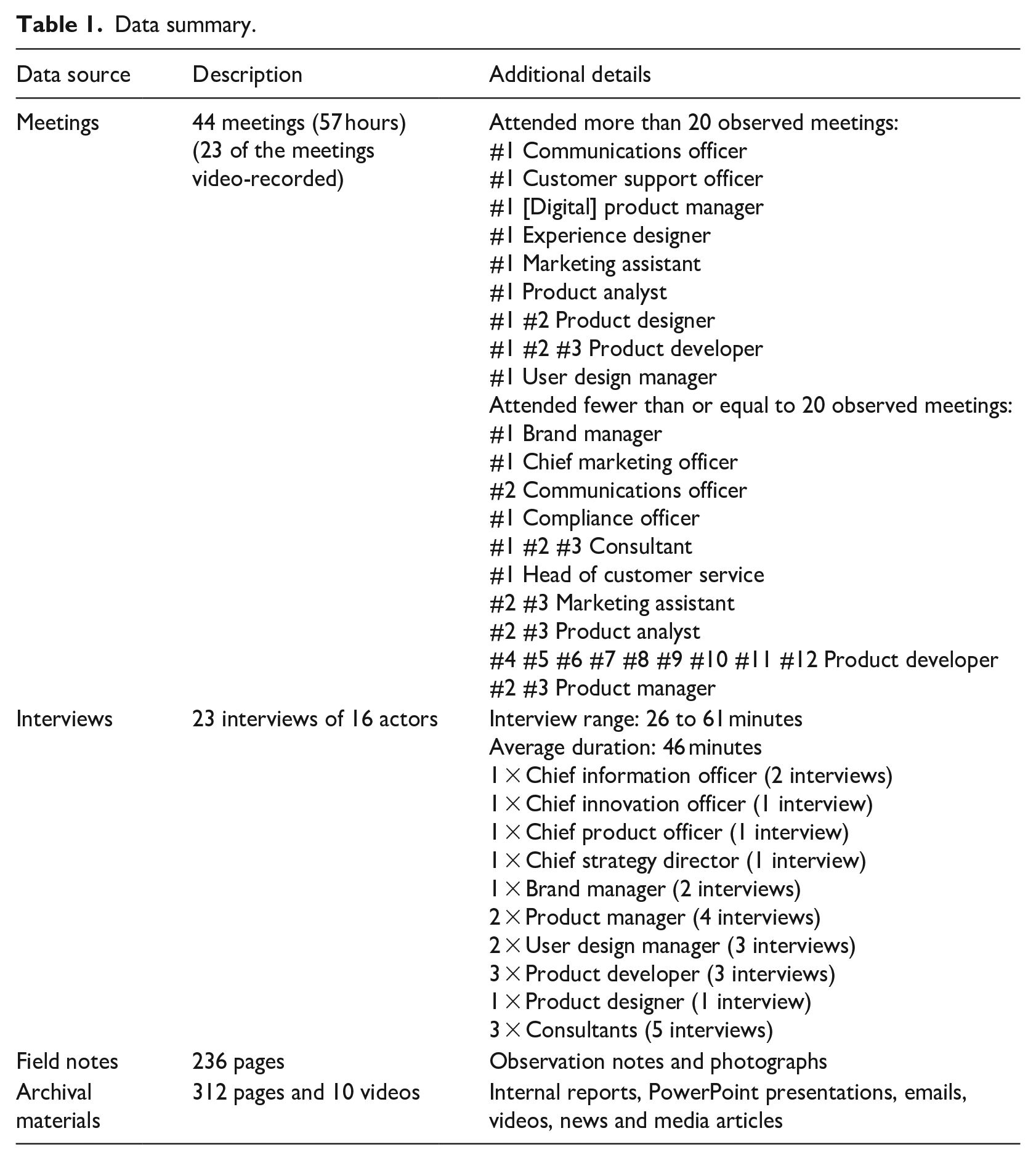
From 2016 to 2019, we observed 44 meetings and workshops dealing with various issues, including ideation, product development and testing, project management, and implementation, across multiple functions, such as marketing and communications, legal and compliance, and customer support. We were non-participant observers at these meetings. We video-recorded 23 meetings to better account for their multimodal ‘goings on’. The remaining meetings were documented with photographs and short videos recorded via a mobile phone. We took detailed notes during all meetings, which we formally documented shortly afterward (Patton, 2015). The audio recordings of the meetings were transcribed to support analysis and resulted in 898 pages of single-spaced transcripts.
We also undertook 23 semi-structured interviews with 16 interviewees. Our semi-structured interviews averaged 46 minutes in length. We interviewed senior managers, middle managers, frontline employees and consultants. The themes for discussion in the interviews covered how the priorities and strategy of DigitalBank had changed in recent years, how design-led projects featured in team-level strategies, how this was communicated and how the work of design-led teams influenced the organization more broadly. In addition to the semi-structured interviews, we recorded 46 informal discussions at the DigitalBank premises, typically directly before and after the observed meetings. Our brief notes of these discussions contextualized observed meetings and helped clarify our interpretation of associated events.
Finally, we also gathered archival materials, which deepened our understanding of the changes at DigitalBank. Including our field notes, we amassed 236 pages comprising meeting and workplace artifacts, PowerPoint slides, photographs of key materials and activities, multimedia presentations, prototypes, emails, other digital communications and external media reports. Additionally, we extended our collection of publicly available media and news reports to the beginning of 2016. When reporting quotes and DigitalBank statements from the public domain, we have modified the reported text excerpts to maintain the organization’s anonymity – but without changing the substantive meaning of the excerpts. We summarize the data collected for this study in Table 1.
Data summary.
Data analysis
Our theoretical understandings emerged from four stages of data analysis (Gioia, Corley, & Hamilton, 2013) as we moved iteratively and inductively between our case study data and prior theory (Patton, 2015). First, we detailed a chronology of the case based on our data, including our observations, interviews and documentary archives (Langley, 1999). We started drafting our description of the case while collecting data. The emerging insights from the case story shaped our subsequent data collection (Yin, 1994), alerting us to themes for discussion in interviews and sensitizing us to meeting topics. In particular, we noticed early on how teams at DigitalBank were increasingly customer-focused and how this orientation was carried over to cross-functional meetings.
During the second stage of our analysis, we reviewed our data and focused on multimodal strategizing activities. We aimed to identify how visual, verbal and embodied modes (Reckwitz, 2002; Schatzki, Knorr Cetina, & von Savigny, 2005; Streeck, Goodwin, & LeBaron, 2011) were utilized in action and what they achieved. We distilled the data into first-order descriptions (Gioia et al., 2013), capturing the essence of each data segment to lay the foundation for further analysis. Our first-order descriptions, such as ‘discussing ways to integrate customer feedback into product design’ (a verbal mode of interaction) and ‘conducting employee walkthroughs to experience customer pain points’ (an embodied mode of interaction), underscored the importance of these modes in organizational strategizing.
Next, we categorized first-order descriptions into second-order themes based on how actors mobilized visual, verbal and bodily modes. Examples of our second-order themes included ‘visualizing customer prompts’ (a visual mode example), ‘elevating customers in strategy conversations’ (a verbal mode example) and ‘manipulating customer data’ (an embodied mode example). In addition to distilling themes in the data by mode, we also formed second-order clusters relating to the effects of the multimodal interactions, such as ‘contextualizing customers’ or ‘empathizing with customers’.
Finally, guided by theory related to our research question, we aggregated the second-order themes into customer-oriented multimodal practices. We identified three aggregate dimensions: inquiring, perspective-taking and appreciating. These dimensions illustrated how DigitalBank actors drew on various combinations of visual, verbal and embodied modes to access different dimensions of the customer, develop related customer understandings and feed these into organizational strategizing. We summarize our data structure in Figure 1 and provide further examples of our empirical material in a supplementary data table (see Appendix).
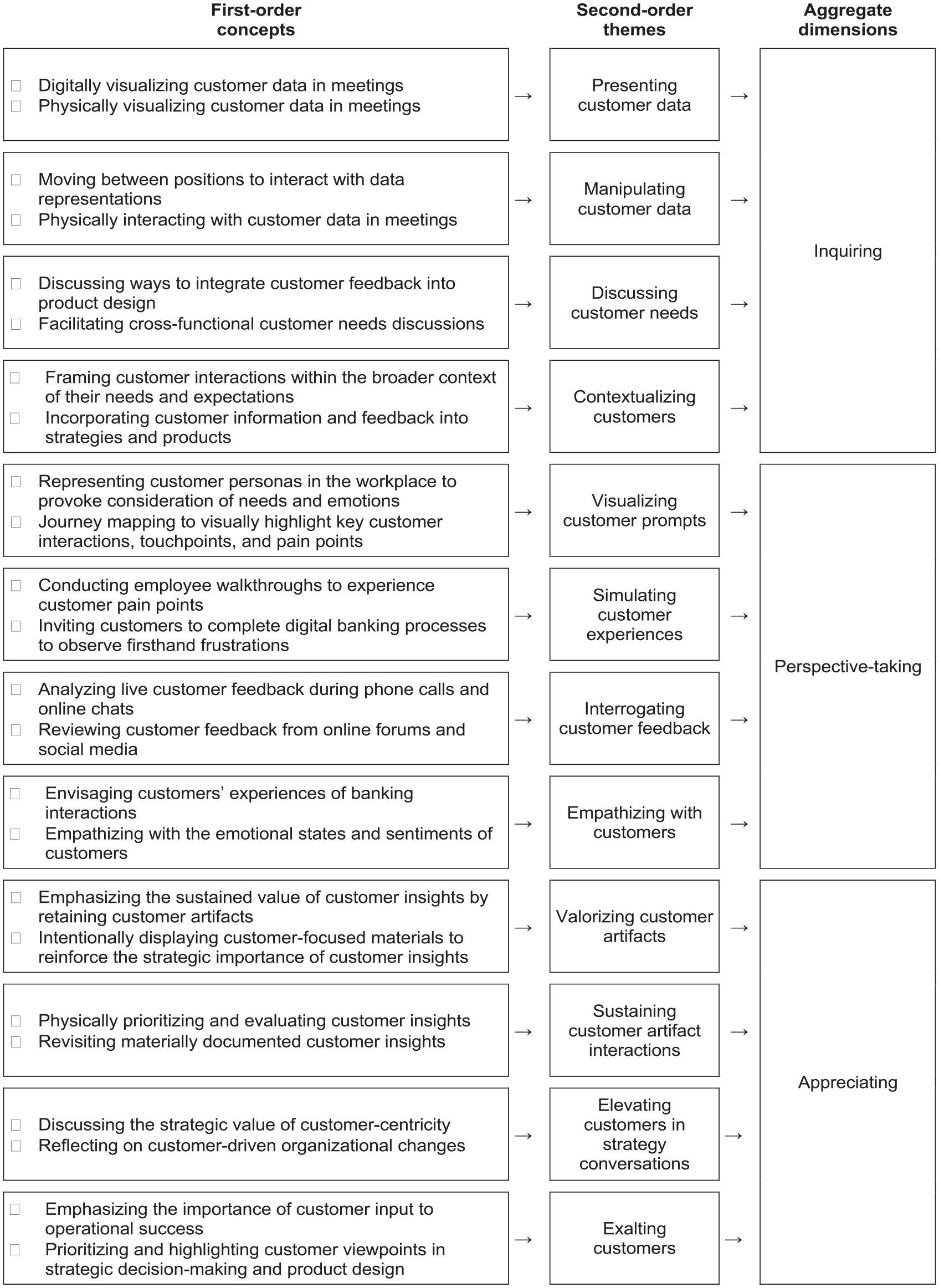
Data structure.
Findings
In our analysis of strategizing at DigitalBank, we identified three multimodal practices, each encompassing visual, verbal and embodied modes, which presentified customers in the strategy process. These multimodal practices are (1) inquiring, (2) perspective-taking and (3) appreciating. In the following sections, we describe each practice and provide empirical evidence concerning their contribution to customer-centric strategizing. Although modes are empirically intertwined in the practices, we first report our observations about the visual, verbal and embodied modes separately to tease out each practice’s multimodal foundations. Thereafter, we describe how these modes interacted within each practice and resulted in particular customer understandings, that is, contextually rich, empathetic and appreciative understandings.
Inquiring
Inquiring is a practice used to ‘bring’ the customer into the strategy process, wherein DigitalBank actors present, manipulate and discuss customer data in ways collectively enabling them to build a contextually richer understanding of the customer. Driven by curiosity to better ‘know’ the customer, inquiring entails proactively seeking to grasp the customer’s situation through a range of activities and methods of engagement. We observed inquiring enacted through visual, embodied and verbal modes, often multimodally.
First, inquiring involved visually presenting customer data to facilitate exploring customer situations, interests and concerns, thereby helping to incorporate customer-centric understandings of DigitalBank’s products and services into traditionally managerially-centric strategy considerations. For example, a data analyst presented a series of customer data visualizations in a meeting, revealing unexpected patterns in customer spending behaviour. This went beyond a technology-centric product presentation and spurred a refreshed discussion about potential new services and features to address these identified needs. As a result, the team brainstormed alternate ways to innovate and adapt their current offerings, feeding into the development of the financial planning feature. The visual, material aspect of inquiring within DigitalBank’s strategy process brought basic customer considerations into the strategy development room and laid the groundwork for further exploration.
Second, inquiring drew on embodied interactions by digitally and physically manipulating visualized customer data, which enabled DigitalBank actors to explore customers in ways that could later be drawn on during strategizing. For example, in an ideation meeting, a user design manager invited ideas on how DigitalBank’s products might meet the newly identified needs of customers. The manager then asked participants to move back and forth between their seats and the whiteboard, adding their ideas on sticky notes and sequentially mapping these on the board to reflect the various points of contact with customers, from initial contract to onboarding, through to established and mature customers (see Image 1). This physically forced managers to consider distinct subject positions between themselves and their customers, with the constant movement being symbolic of the dynamic between current organizational strategies and evolving customer-centric aspirations.
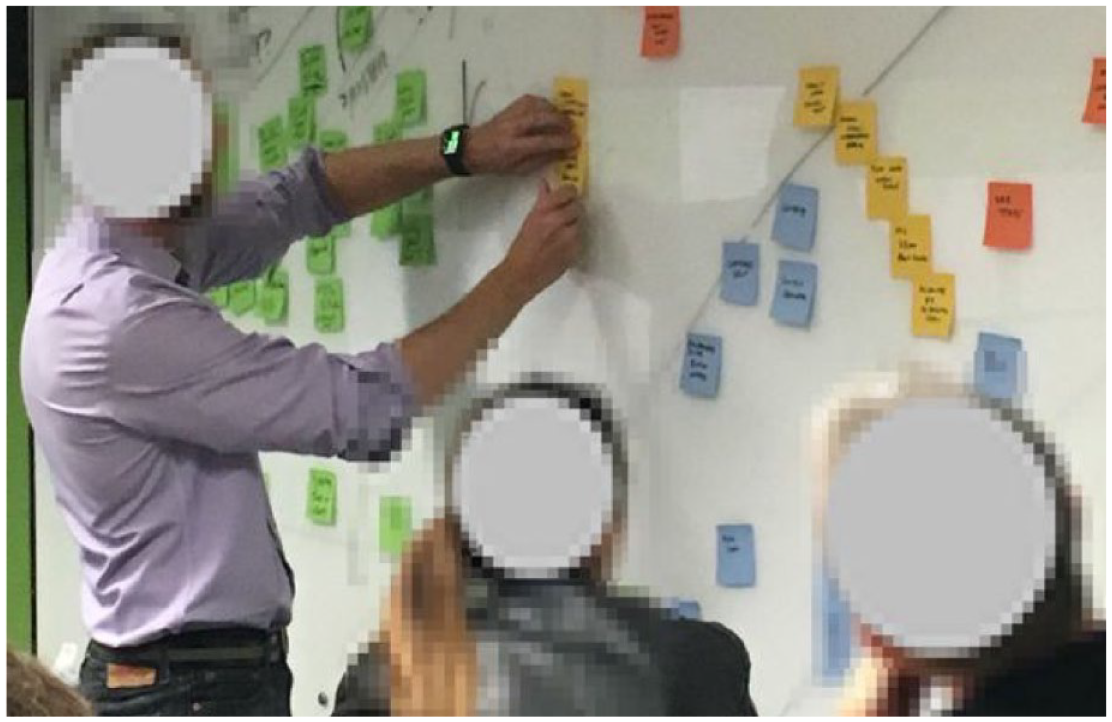
Mapping ideas relating to customer interactions (example of manipulating customer data).
Third, inquiring involved discussing customer needs, often via a reflection on visualized and manipulated customer data in ways that helped to externally orient managers. For example, in response to a prior statement that framed the issue in terms of what internal managers thought was possible, the chief product officer asked: ‘How do we combine that open banking data with data we’ve already collected. . .?’ Combining open banking data with other sources to create a unique customer proposition indicates an exploratory approach to strategizing and demonstrates a pivot from internal managerial perspectives to those prioritizing external customer-centric viewpoints. This underscored a larger movement blending internal capabilities with external demands, creating a unique value proposition for customers. In another instance, a product developer, William, explained how inquiring had reframed the way organizational actors perceived themselves in their roles: ‘We’ve stopped thinking about the fact that we are [a] bank and started thinking about ourselves as a customer service provider.’ Instead of primarily identifying as financial actors, DigitalBank managers began to perceive their core responsibilities as providing customer service. This transformation suggests that the practice of inquiring not only influenced strategy but also shaped organizational self-perceptions.
Fourth, DigitalBank actors frequently engaged in concurrent multiple modes during inquiring. Visualized data were often drawn on through embodied interactions and then verbally interpreted. For example, in Image 2, DigitalBank actors moved forward to display their ideas on materials, such as sticky notes, enabling others to discuss, build on and develop their contributions, creating shared notions of value. This was common during brainstorming sessions, which often occurred in an open-plan office space and physically embodied and enacted a re-positioning of a prior understanding into a new way of conceptualizing an issue. In this instance, using sticky notes is an example of how visual materials played a critical role in inquiring by representing individual ideas, concerns and aspirations related to customers – writing and sticking them onto a shared space provided a way to externalize and visualize those thoughts. The physical act of moving forward, choosing where to place a note and deciding its relative importance or sequence reveals the embodied nature of the practice. Once these notes were placed, they became the focal point of discussion, fostering collective sense-making. The open-plan setting encouraged informal exchanges, debates and discussions, allowing team members to delve deeper into each idea. This verbal exploration ensured that the visual and embodied insights were not isolated but integrated into a coherent, shared understanding. The act of positioning and re-positioning sticky notes is indicative of the fluid and iterative nature of the strategy process, where ideas are not fixed but evolve as they are examined and debated.
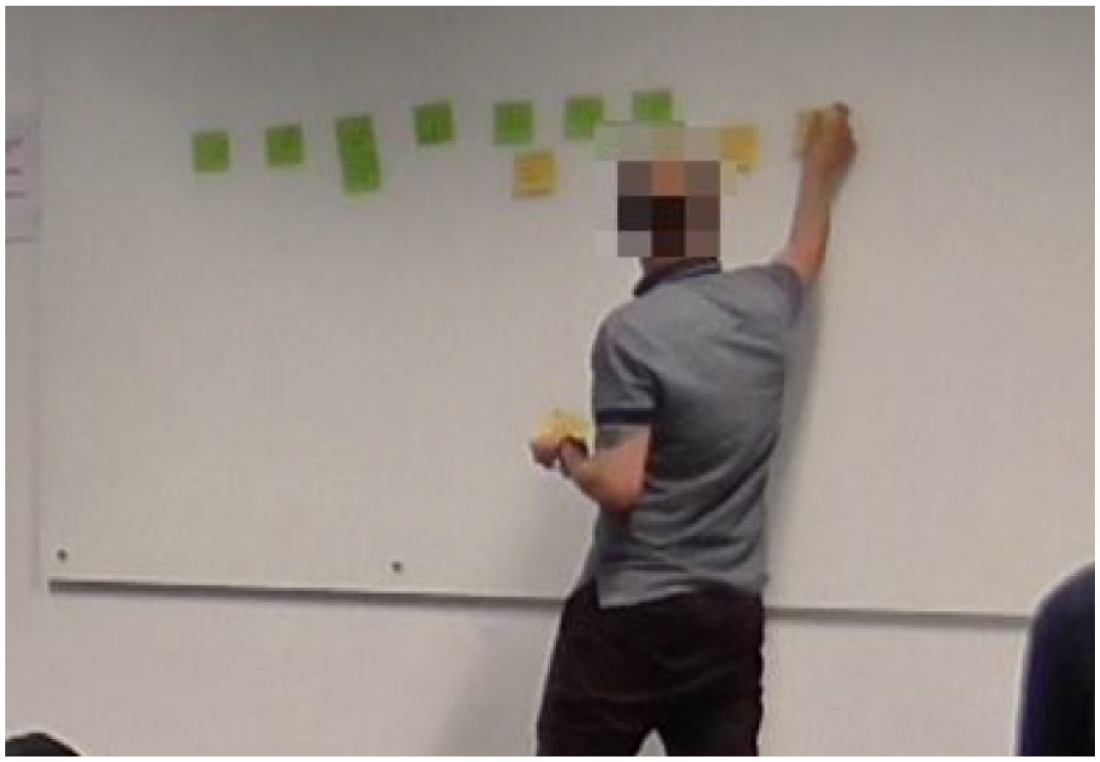
Collaborative idea sharing (example of multimodal inquiring).
Collectively, inquiring enables contextualizing of customers via activities that frame customer interactions within the broader context of their needs and expectations and incorporate customer information and feedback into strategies and products. As a result, through inquiring, DigitalBank actors developed contextually rich understandings of their customers, moving from a traditional banking viewpoint to one rooted in the customer’s setting. Contextually rich denotes a more considerate, detailed and user-centric perspective on the role and needs of customers in banking and finance. For example, DigitalBank managers hypothesized that customers prioritized immediate gratification over long-term financial goals due to the present cognitive bias. As a result, a team conducted an experiment, providing customers with future-oriented stimuli and examining their responses to various financial scenarios. The results revealed a shift in mindset, with three-quarters of participants expressing a stronger desire to save rather than spend when confronted with their ‘future selves’. This contextually rich understanding then informed how DigitalBank actors designed products, knowing that helping customers visualize their future selves encouraged them to build healthier financial habits, balancing immediate gratification with longer-term goals. This insight informed the strategy, with the digital banking experience designed so customers could actively engage with their finances through a future-focused lens. Commenting on the outcome, the CIO said the data ‘supported the development of [the new app’s] experience and reinforced our belief that incorporating a future-oriented feature was essential’. Thus, inquiring allowed DigitalBank actors to engage with data in ways that shaped how strategy was enacted, demonstrating how a detailed, user-centric approach to understanding customer needs can shape financial solutions that resonate with customers’ daily lives.
In summary, inquiry engaged verbal, visual and embodied modes to present, manipulate and discuss customer data in ways that enable DigitalBank actors to form contextually rich understandings of their customers. This underpinned pivoting from a managerial to a customer-centric perspective on products and services.
Perspective-taking
Perspective-taking is the second practice we observed. It involved activities that helped visualize, simulate and interrogate customer experiences, thereby fostering customer empathy among strategists. While inquiring brings customers into the strategy process to learn more about them, perspective-taking goes further: it involves feeling like the customer and understanding their emotive or affective reality. This practice, enacted multimodally through visual, embodied and verbal modes, allows organizational actors to figuratively step into the customer’s shoes and experience aspects of their reality.
First, perspective-taking involves visualizing customer prompts, such as representing customer personas in the workplace to provoke consideration of needs and emotions or visually displaying key customer interactions, touchpoints and pain points related to banking. For example, visual personas were employed in many meetings for emotional resonance. A DigitalBank manager explained: We also define who our personas [are] – so, who are we actually targeting the solution for? What are things like their internet habits, what’s their budgeting and finance like? Where do they sit within our customer categories? So that way, as we’re designing things we can – we printed them out as well so we can take them to meetings – remember the customer. (user design manager, meeting observation, March 2017)
Printing these personas and bringing them to meetings served as a prompt or constant visual reminder of their design target. This ensured that customers’ perspectives shaped decision-making, with customers not being abstract concepts or numbers but people with real concerns and experiences. Visual customer prompts also enabled managers to anticipate the possible frustrations customers might experience, leading managers to not just look at the functionality of their design, such as the legibility of error messages, but also to situate these designs in the context of their customers and questioning whether choices were inclusive and customer-friendly for all types of customers, especially those who might have challenges (like reduced vision). In doing so, managers felt the possible frustrations and confusion a customer might experience. They then used this empathetic understanding to guide their redesign efforts. By constantly putting the customer ‘front and centre’ in their minds, they ensured a customer-centred approach to their strategizing and design processes.
Second, simulating customer experiences is an aspect of perspective-taking, involving activities such as conducting employee walkthroughs to experience customer pain points or inviting customers to complete digital banking processes to observe firsthand frustrations. An example of this embodied mode of perspective-taking involved hosting a representative customer in the DigitalBank office and asking them to complete various banking processes, such as a new customer onboarding process (see Image 3). This physical walk-through by a customer allowed DigitalBank managers to gain an embodied understanding of customer experiences. By witnessing firsthand where a customer might become frustrated or pleased, managers could better empathize with the customer’s journey, transforming the abstract notion of ‘customer experience’ into a representation of lived reality. Such embodied activities, grounded in real-world customer interactions, helped illuminate pain points or moments of delight that might be overlooked in purely discursive or material analyses.
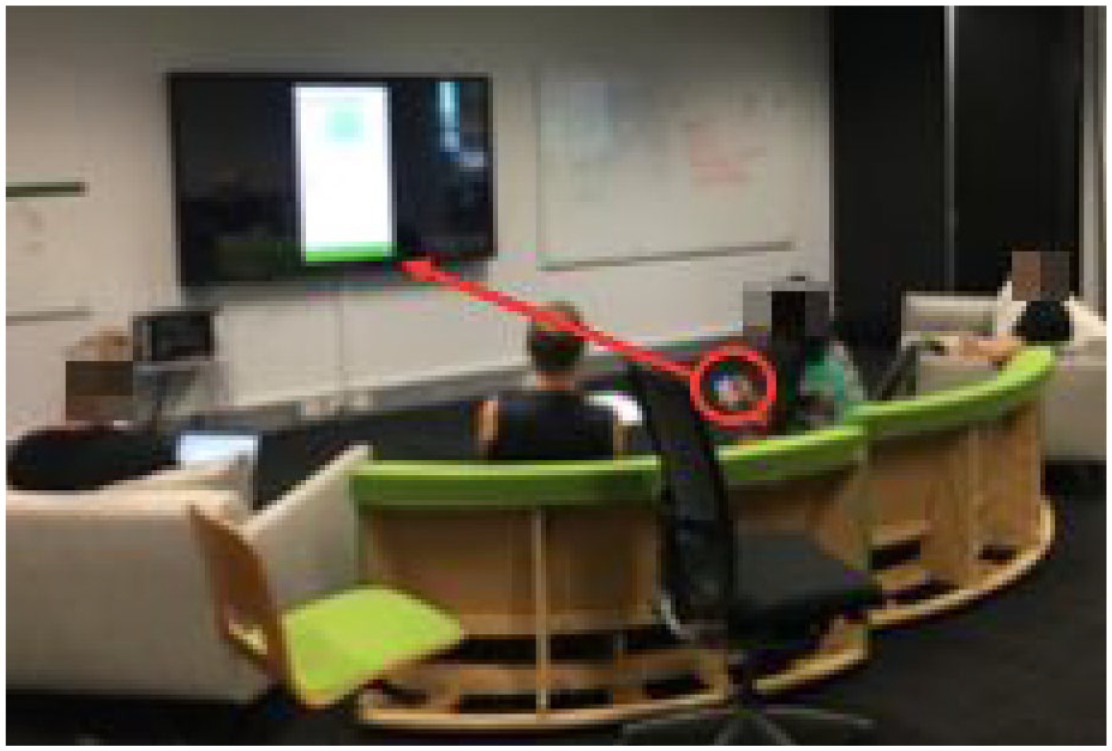
A customer ‘walk through’ of a prototype (example of simulating customer experiences).
Third, interrogating customer feedback is another part of perspective-taking that shaped strategy considerations by enabling DigitalBank actors to understand customer experiences better. This process included reviewing customer feedback from online forums and social media or analysing live customer feedback during phone calls and online chats. It yielded surprising insights, with strategy participants becoming familiar with customer concerns through a range of forums: We spend time on the phones every week. When we listen to calls from customers trying to get a home loan . . . Some of the stuff, the answers around food, you look at and think the answer is very different to what I expect for a family of four, [different from] what seems real. (chief innovation officer, interview, September 2018)
When managers encounter customer interactions firsthand, they are exposed to the raw, unedited realities confronting customers when dealing with significant issues, such as acquiring a home loan. The surprise that arises, depicted by the chief innovation officer’s reaction to answers about food expenses, underscores how personal assumptions can vastly differ from customers’ lived realities. These verbal mode interactions are powerful because they challenge preconceived ideas, bringing unexpected but important customer-centric perspectives.
Similarly, reviewing online forums and social media feedback groups is a way of experiencing customer frustrations. Unlike structured surveys or formal feedback mechanisms, these platforms capture customers’ spontaneous, real-time reactions driven by recent experiences. The feedback here is manifold: it is textual, filled with emotion, and layered with context. Managers who reviewed these digital dialogues encountered a range of sentiments, from mild irritations to significant outcries. This provided insight into the felt experience of customers, offering managers a guide to align strategy with customers’ genuine concerns.
Fourth, perspective-taking often involves drawing contemporaneously on multiple modes. For example, perspective-taking involved drawing on visual materials – props, objects and artifacts – to supplement what was said, explain their relevance, or enrich discussions relating to customer needs. For instance, cardboard cut-outs of customers were permanently kept in the room where strategizing occurred, keeping customer needs front of mind (see Image 4). Engagement with these materials shaped strategy discussions by making them more customer-centred, serving as perceptible prompts of more empathetic dialogues, and pushing strategy participants to (re)consider and question consistently customers’ perspectives. Such artifacts acted as discussion anchors, orienting focus toward customer needs and feelings. The question, ‘What would the customer think?’ was not just a rhetorical query. It was a tangible point of reference, enabling DigitalBank actors to literally point to and engage with a representation of their customer base. This made the practice of perspective-taking palpable and strategically consequential.

A cardboard customer persona (example of multimodal perspective-taking).
Finally, perspective-taking is a practice whereby organizational actors empathize with customers by immersing themselves in the customer’s emotional and experiential reality, envisaging customers’ experiences of banking interactions and seeking to identify with their emotional states and sentiments. Collectively, perspective-taking builds empathetic understanding. For example, empathetic understanding among DigitalBank actors led to recognizing the lack of transparency in the home loan process, which often led to uncertainty and stress for applicants. As a result, DigitalBank managers implemented an online solution that provided applicants and advisors with real-time information via an API-integrated portal. This digital tool tracked applications from document submission to settlement, offering clarity and alleviating customer anxiety. Empathetic understanding thus informed DigitalBank’s strategy of prioritizing transparency and customer control over financial processes. By leveraging customer-centric design, DigitalBank actors created an online banking tool focused on customer concerns and simplified experiences. Thus, perspective-taking helped align DigitalBank’s strategic decisions with customer sentiments, reinforcing a transparent, customer-centric strategy.
To summarize, perspective-taking drew on verbal, visual and embodied modes to visualize, simulate and interrogate customer experiences in ways that enabled actors to form an empathetic understanding of their customers and express genuine concerns for them and their experiences.
Appreciating
Appreciating is a practice that recognizes and elevates the strategic significance of customers by promoting customers in strategy conversations, valorizing and perpetuating interactions with customer artifacts, and elevating customer considerations more widely throughout the organization. As a result, the practice helps keep the customer top of the mind or central in strategy work. Appreciating builds on contextually rich and empathetic understandings to bring to the fore and integrate customers’ perspectives into organizational and product strategies. We again witnessed the practice enacted through visual, embodied and verbal modes.
First, appreciating incorporates valorizing customer artifacts, emphasizing the sustained value of customer insights by retaining customer artifacts in the workplace and intentionally exhibiting these customer visuals to reinforce their strategic importance. For example, old customer-focused project artifacts, including customer personas, mood boards, project steps and prototypes, were strategically placed around DigitalBank’s workspaces, even after the conclusion of respective projects (see Image 5). This deliberate retention of artifacts served as a physical representation of a commitment to valuing past customer insights, suggesting that even transient insights have lasting significance. By surrounding themselves with these visual material reminders, DigitalBank actors reinforced a culture that not only prioritized customers during a project’s lifecycle but also acknowledged the continued importance of customer insights in shaping future strategic directions.
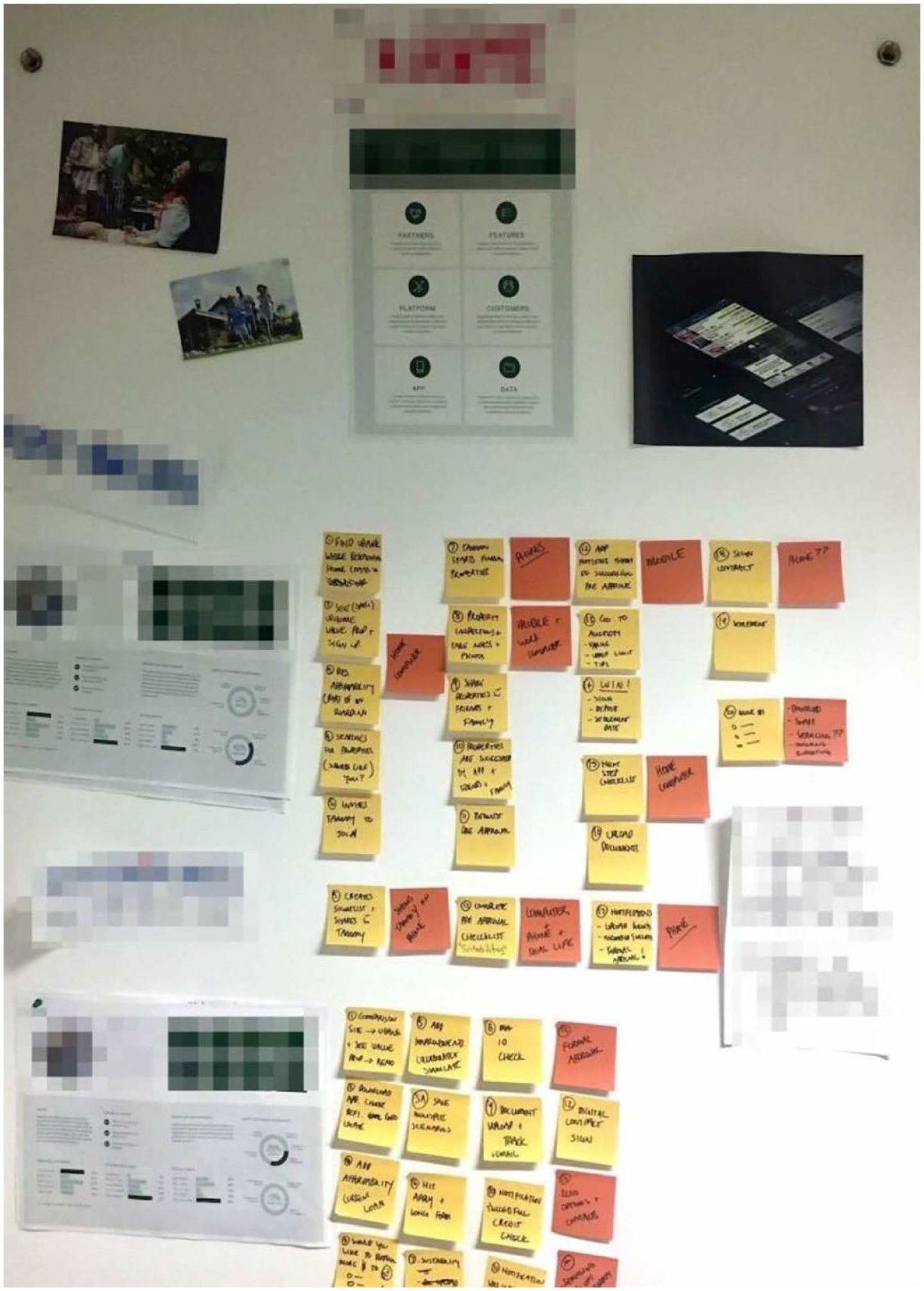
A project board display from a former initiative (example of valorizing customer artifacts).
Second, appreciating involves ongoing interactions with valorized customer artifacts, often via physical engagement, evaluating and prioritizing customer insights, or revisiting previously materially documented customer insights. For example, by prominently displaying customer materials, DigitalBank actors not only familiarized themselves with these insights but also accorded them a higher status. Visual materials served as prompts, encouraging them to utilize different spaces and manipulate artifacts to draw attention to, recognize and elevate the importance of customer-centric insights. A manager encapsulated this process: We share ideas [with the Senior Leadership Team] all the time. And we have them all [displayed] on the walls [in the office], as well, so I just grab people and take them, which is a good thing about here. So, you can just grab them and say, ‘Hey, let me share this thing. It’s pretty cool.’ And we involve everyone across the business because that’s the way that we get the best sort of outcomes. (digital product manager, interview, October 2018)
This instance of rallying colleagues to view ideas displayed on walls, and the widespread involvement of DigitalBank actors in strategic projects, illustrates how the practice of appreciating shaped an environment where customer perspectives were not merely acknowledged but fundamental to collaboration and idea generation.
Third, appreciating included elevating customers in strategy conversations by discussing the strategic value of customer-centricity and reflecting on positive customer-driven organizational changes. These verbal activities foregrounded customer needs and experiences alongside strategic imperatives, such as cost saving and competitive advantage. As the value associated with customer-centricity became more established, actors discursively referenced the strategic benefits of bringing the customer into the strategy process of DigitalBank, as indicated in an interview: [Customer-centric approaches stop us] not understanding and solving a customer’s problems, which [would] mean we’re building the wrong stuff, which means we’re investing the money in the wrong places, which means we then need to rework and [re]think what we’re potentially building. So, it has a real tangible benefit in terms of making sure that we’re spending money correctly and doing it the first time instead of having to rework things. (digital banking manager, interview, December 2018)
Appreciating was manifested in how the DigitalBank team articulated its benefits, with the manager’s observation that customer-centric approaches prevented them from ‘building the wrong stuff,’ underscoring this practice’s clear financial and operational benefits.
Fourth, appreciating, like the other practices, regularly comprised multimodal interactions. For example, in a meeting, DigitalBank actors ‘stepped forward’ (a bodily action) to privilege the physical display of customer materials, such as sticky notes capturing the customers’ voices and perspectives (see Image 6). This emerging object was then augmented using red sticky dots to prioritize ideas, allowing team members to visually appreciate the collective valuation of different aspects of the new app. The new artifact then became the focus of further discussion. In such instances, DigitalBank actors emphasized customer insights through physical actions, such as coming forward to display materials capturing the voice of the customer. The dynamic use of sticky notes and prioritization dots not only recorded insights but also encouraged team members to collectively recognize and value customer perspectives. This tangible, collective valuation process spurred deeper discussions and ensured that customer insights were captured and actively used to shape product development and strategy.
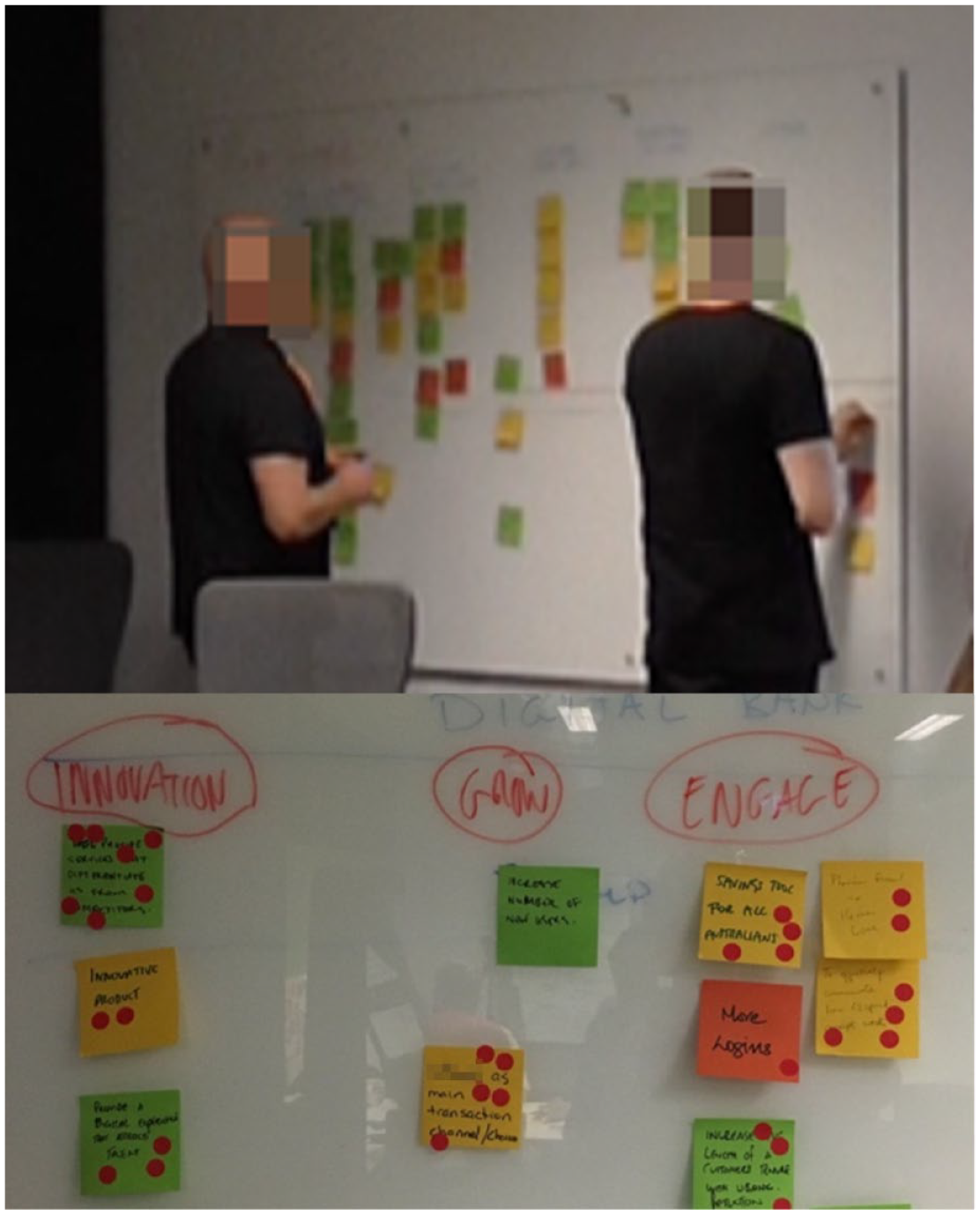
Stepping forward to display and then prioritize ideas (example of multimodal appreciating).
Finally, appreciating fosters an appreciative understanding of customers through strategizing activities that exalt customers, maintaining a continual focus on customer needs in ways that transcend any specific product development project. The visual, verbal and embodied activities of appreciating articulated the substantial benefits of a customer-centric approach, emphasizing its operational and financial merits and elevating the significance of customer insights. For instance, through appreciating, DigitalBank managers recognized the need for their customer service team to access accurate and consistent information to serve customers better. As a result, they prioritized the development of a virtual assistant to consolidate fragmented knowledge bases into a unified source. This technology enabled the customer team to answer questions more swiftly and precisely. According to the CIO, the ‘objective was to make it easier . . . to get the information need[ed] to service our customers quickly, efficiently, and accurately’. The development of the tool informed DigitalBank’s strategy by underscoring the significance of enhancing customer satisfaction through internal process improvements. Thus, appreciative understanding guided DigitalBank actors in focusing on customer-centric approaches.
In summary, appreciating exalted customers by valorizing customer artifacts, sustaining customer artifact interactions and elevating customers in strategy conversations that collectively enabled DigitalBank actors to develop an appreciative understanding of customers. Correspondingly, appreciating foregrounded and integrated customers’ insights, which enabled a pivot from a managerial to a customer-centric perspective on products and services.
Discussion
Our study demonstrates how multimodal practices of inquiring, perspective-taking and appreciating presentify customers in the strategy process. Building on the findings of our longitudinal case study, we developed a model of how the practices presentify the customer and drive customer-centric strategizing through contextually rich, empathetic and appreciative understandings of customers (see Figure 2).
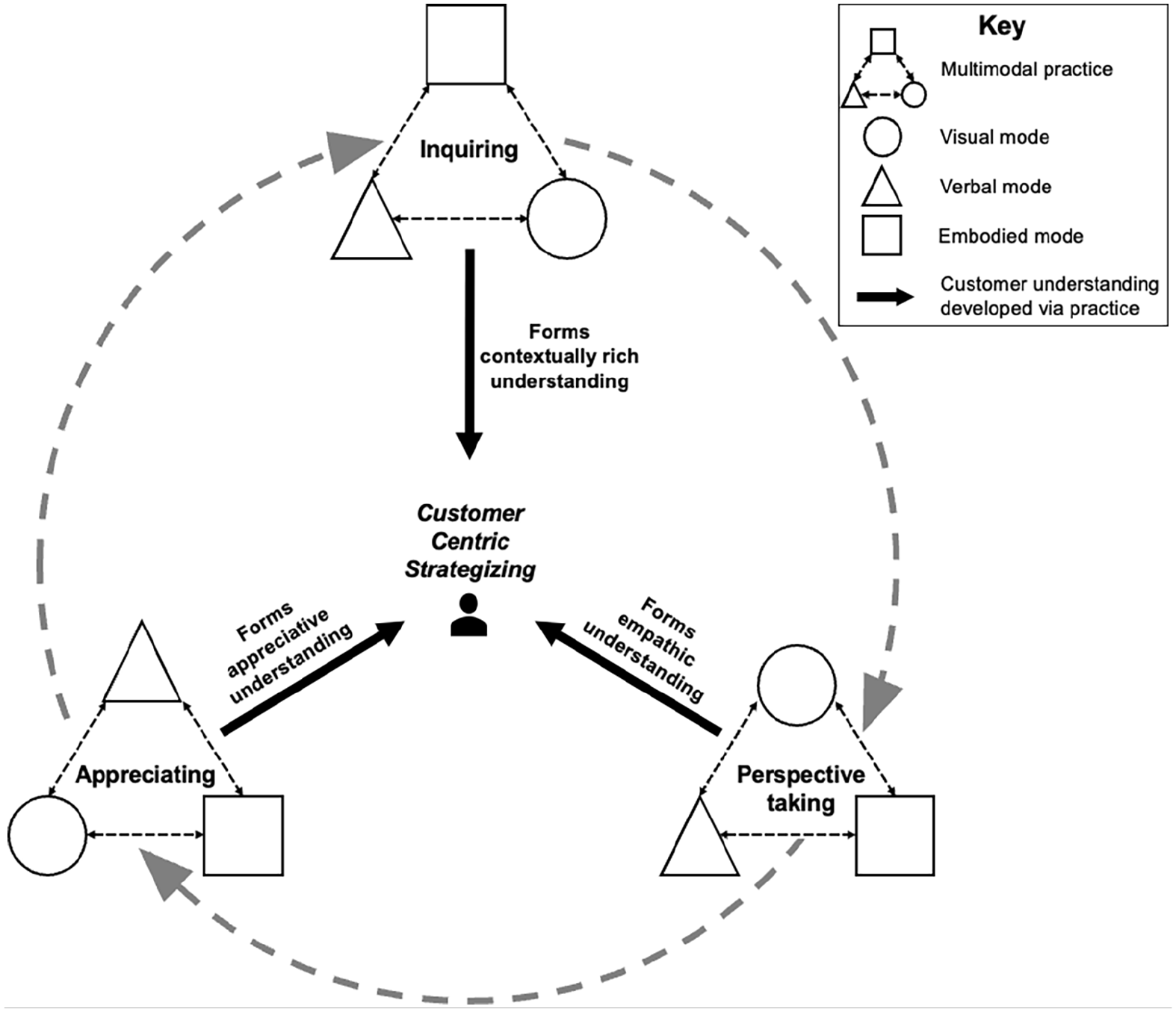
Presentifying practices driving customer-centric strategizing.
Our model depicts how each practice draws on visual, verbal and embodied modes, indicated by the bidirectional dotted arrows between the three different shapes, each representing a different mode. Further, multimodal customer interactions of each practice give rise to understandings that feed into customer-centric strategizing in various ways, indicated by the annotated solid black lines in Figure 2 leading from the practices toward the centre. Inquiring informs contextually rich customer understanding by highlighting the multifaceted nature of customer behaviours, preferences and challenges. Perspective-taking delves into the emotional aspects of customer interactions, giving rise to an empathetic understanding of the affective and psychological facets of the customer experience. Finally, appreciating reveals the intrinsic significance of customer insights by valuing those contributions and developing an appreciative understanding of the customer. The outer dashed arrows in Figure 2 suggest that the three multimodal practices build upon each other over time. However, these dashed lines indicate a more speculative relationship than we can evidence in our study, rather offering and discussing this as a theoretical possibility to inform future research.
Through empirical evidence and model development, our study makes two key contributions. First, we contribute to the literature on customer-centric strategizing by shedding light on empathetic understandings of customers, a central element shaping the strategy process. Second, based on our findings, we discuss the multimodal empathetic competence of strategists to presentify customers.
Presentifying and understanding the customer in the strategy process
With respect to our first contribution, our study narrates how customer-centric understandings emerge by presentifying the customer and incorporating this into the strategy process. The practices of inquiring, perspective-taking and appreciating enable strategy actors to presentify the customer in ways that form new understandings of customers lacking a shared organizational language code. While narrative and cognitive lenses on customer-centricity put the customer at the centre of the strategy story and focus on creating customer value in strategic decision-making (see Gupta & Ramachandran, 2021; Hemel & Rademakers, 2016; Rooney, Krolikowska, & Bruce, 2021; Tuominen et al., 2023; Vaara & Rantakari, 2024), we demonstrate how practices enable managers to feel, see and be as if they were the customer – thus presentifying the customer in ways that bring understanding of the customer to the strategy process.
Prior research has revealed how managers draw on tacit knowledge to make sense of change and communicate this to customers (Rouleau, 2005; Smets, Jarzabkowski, Burke, & Spee, 2015). Relatedly, managers communicated directly with select customers to understand their perspectives before tailoring their interactions with customers based on nuanced socio-cultural codes that resonated with the recipient. This even involved adopting the customer’s language, when necessary, to legitimate new strategic directions. We extend the observations of extant research, suggesting that organizational actors can also presentify the customer, using a range of practices simulating customers’ experiences, feeling their frustrations and challenges, and attributing worth to those experiences. While Rouleau’s (2005) findings included managers drawing on emotions, space and bodies in their interactions at the ‘organizational interface’ to influence or sell strategic change to customers, we have turned attention to the reverse relationship, namely how customer-centric practices influence managers to rethink the assumptions of their strategy process.
At the core of customer-centric strategizing lies empathetic understandings, opened up by contextually rich understandings and sustained by appreciative understandings, with these being important because customers have distinctive experiences and perspectives presenting challenges to organizational actors (Frei & Morriss, 2012). For example, inquiring urges actors to proactively seek a customer’s context by adopting a dynamic and iterative approach, which is grounded in curiosity about customer experiences, revealing the complexity confronting customers. Perspective-taking then delves into this complexity in a way that enables the building of emotionally resonant offerings. This active engagement with the customer transcends the tacit knowledge focus of Rouleau (2005). It embodies a more immersive exploration of customers’ lives, desires and frustrations, particularly about banking, in our case. This enables organizational actors to immerse themselves in the customer’s reality, ‘stepping into their shoes’ to understand their daily challenges and needs. Our approach goes beyond building relations through a customer-centric philosophy (see Rouleau, 2005). We connect the customer experience with managerial decisions.
We also extend prior strategy studies that touch on affective aspects of customer relationships, such as appeasing aggrieved customers (see Schneider et al., 2021). Our study reveals how practices draw on customer emotionality for strategically consequential outcomes, such as establishing affinity with customers and building product offerings that resonate with customers. A practical understanding of customers enhances and deepens appreciation of customers’ perspectives, building on aesthetic understandings (Nicolini, 2016; Strati, 1992, 2016). In doing so, our findings challenge traditional ‘outside-in’ approaches to strategy making, which take market trends and industry attractiveness as the drivers of strategy formulation. Instead, we show how managers bring a customer-centric dimension into organizational strategy through a deep understanding of the presentified customer, empowering managers to make strategic decisions resonating with their customers.
Placing the latter contributions into the light of practice theory leads us to speculate that the practices identified distinctly build upon one another. Providing strong evidence for this is beyond the scope of this study (see dashed arrows in Figure 1). However, we suggest that inquiry produces a contextually rich understanding of customers that invites perspective-taking and an emotional engagement with customer viewpoints. This, in turn, provides the grounds for an appreciation of engaging with customers and strategically valuing their feelings, perspectives and experiences. Appreciation thus reifies inquiry and perspective-taking as meaningful practices of customer-centric strategizing.
Empathetic competence of strategists
Our second contribution highlights and discusses the empathetic competence of strategists in making strategies that emerge from stepping into the ‘shoes’ of the customer. Prior research has focused on the important role of strategists’ discursive competence in persuading and influencing others about particular ideas (see Rouleau & Balogun, 2011). Here, the role of the strategist is to craft and share a message that compels others to act. Building upon this work, we show that the strategist’s competence also extends to their ability to empathetically presentify customers in order to give meaning to aspects of the product that are strategically important to prioritize. Our findings suggest that strategists must be skilled in probing the customer experience in different ways. For example, this may not only involve asking questions, for example, but may also involve using visuals to elicit ideas or prompt embodied actions, thereby deepening participation in strategy discussions.
This insight arises from our methodological approach, which involved examining practices multimodally rather than merely through discursive practices of the strategy actor. A strategist’s ability to construct and share meaning-making through the interplay of verbal, visual and embodied modes allows this empathetic understanding to emerge as organizational actors feel ‘as if’ they were in the customer’s shoes. We contend that the competence associated with acquiring an empathetic understanding of the customer in strategy-making goes beyond that which prior studies have considered. For example, Balogun et al. (2015) examined strategists’ competence through the lens of the interactional competence required of tour guides as they enacted strategy, wherein they adeptly used material artifacts, bodily movements and discursive interactions to guide visitors around museums. However, these interactions were entwined in the doing of the strategy rather than surfacing deeply rooted, affective understandings of the customer’s ‘journey’. We reveal that strategists are not only competent in enacting certain forms of (multimodal) practice. They are also sensitive surfacers, interpreters and influencers of customers’ contexts and feelings. By presentifying the customer in strategizing, strategists are able to shift between different modes of interaction and also different means of meaning-making (i.e. inquiring, perspective-taking, appreciating) as befits the context.
This range of competences complements and extends existing scholarly knowledge. For example, in Knight et al. (2018), strategists manipulated PowerPoint slides to tell a temporal change story via a semiotic process: strategists moved between words, visuals, understandings and adjustments to the words and visuals. We go further, revealing that empathetic competence is deeper than a mastery of tools-in-use. Instead, it is about being sensitive to responses in the moment and imagining contexts that might be quite distant from the strategists’ day-to-day life, but which are essential to making informed decisions relevant to their customers and strategy. Our insights, therefore, add to our understanding of strategy, with empathetic competence suggesting why different modalities get engaged and the underlying relevance of these practices to emergent strategy understanding between participants.
Future research and conclusion
Despite these contributions, our study has limitations. To focus on micro-dynamics, we conducted a single case study, which restricts the generalizability of our findings. While our longitudinal approach enabled us to develop a model of multimodal customer-centric practices, studying a wider range of centrally or peripherally introduced activities and their effects on customers would add to our empirical findings and theoretical contributions. Additionally, although beyond the immediate focus of our study, future research might consider how customer-centricity shapes relationships within organizations (Malhotra, Zietsma, Morris, & Smets, 2021; Soderstrom & Weber, 2020). For example, customer-centric practices could contribute to overcoming resistance to strategic initiatives in organizations, further enriching our understanding of the dynamics at play in such situations (Balogun, Jarzabkowski, & Vaara, 2011; Ezzamel, & Willmott, 2008; Harding, Ford, & Lee, 2017; McCabe, 2010).
Moreover, our research opens avenues for further investigation into the dynamics of multimodality and its impact on other organizational phenomena. For example, exploring how these intertwinements either facilitate or hinder the development of strategic practices in different contexts or industries would be valuable. Furthermore, future research could delve deeper into the factors influencing the formation and evolution of multimodal arrangements, offering a more comprehensive understanding of how they can be managed to drive organizational performance and innovation.
To conclude, our research engages with the SAP literature, focusing on integrating customers into organizational strategizing. Despite the recognition of non-traditional actors’ roles in strategy formation within the SAP literature, the role of external stakeholders, particularly customers, is underexplored. As a result, we emphasize how deeply engaging with customers through multimodality gives rise to valuable strategic understanding. The three multimodal practices we identify – inquiring, perspective-taking and appreciating – help presentify the customer and drive customer-centric strategizing through contextually rich, empathetic and appreciative understandings of customers.
Footnotes
Appendix
Supplementary data.
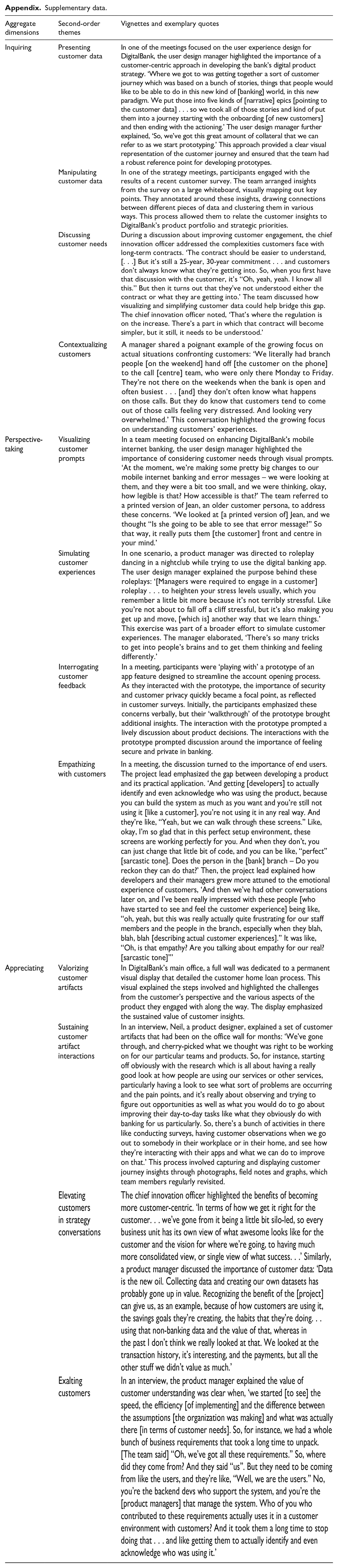
| Aggregate dimensions | Second-order themes | Vignettes and exemplary quotes |
|---|---|---|
| Inquiring | Presenting customer data | In one of the meetings focused on the user experience design for DigitalBank, the user design manager highlighted the importance of a customer-centric approach in developing the bank’s digital product strategy. ‘Where we got to was getting together a sort of customer journey which was based on a bunch of stories, things that people would like to be able to do in this new kind of [banking] world, in this new paradigm. We put those into five kinds of [narrative] epics [pointing to the customer data] . . . so we took all of those stories and kind of put them into a journey starting with the onboarding [of new customers] and then ending with the actioning.’ The user design manager further explained, ‘So, we’ve got this great amount of collateral that we can refer to as we start prototyping.’ This approach provided a clear visual representation of the customer journey and ensured that the team had a robust reference point for developing prototypes. |
| Manipulating customer data | In one of the strategy meetings, participants engaged with the results of a recent customer survey. The team arranged insights from the survey on a large whiteboard, visually mapping out key points. They annotated around these insights, drawing connections between different pieces of data and clustering them in various ways. This process allowed them to relate the customer insights to DigitalBank’s product portfolio and strategic priorities. | |
| Discussing customer needs | During a discussion about improving customer engagement, the chief innovation officer addressed the complexities customers face with long-term contracts. ‘The contract should be easier to understand, [. . .] But it’s still a 25-year, 30-year commitment . . . and customers don’t always know what they’re getting into. So, when you first have that discussion with the customer, it’s “Oh, yeah, yeah. I know all this.” But then it turns out that they’ve not understood either the contract or what they are getting into.’ The team discussed how visualizing and simplifying customer data could help bridge this gap. The chief innovation officer noted, ‘That’s where the regulation is on the increase. There’s a part in which that contract will become simpler, but it still, it needs to be understood.’ | |
| Contextualizing customers | A manager shared a poignant example of the growing focus on actual situations confronting customers: ‘We literally had branch people [on the weekend] hand off [the customer on the phone] to the call [centre] team, who were only there Monday to Friday. They’re not there on the weekends when the bank is open and often busiest . . . [and] they don’t often know what happens on those calls. But they do know that customers tend to come out of those calls feeling very distressed. And looking very overwhelmed.’ This conversation highlighted the growing focus on understanding customers’ experiences. | |
| Perspective-taking | Visualizing customer prompts | In a team meeting focused on enhancing DigitalBank’s mobile internet banking, the user design manager highlighted the importance of considering customer needs through visual prompts. ‘At the moment, we’re making some pretty big changes to our mobile internet banking and error messages – we were looking at them, and they were a bit too small, and we were thinking, okay, how legible is that? How accessible is that?’ The team referred to a printed version of Jean, an older customer persona, to address these concerns. ‘We looked at [a printed version of] Jean, and we thought “Is she going to be able to see that error message?” So that way, it really puts them [the customer] front and centre in your mind.’ |
| Simulating customer experiences | In one scenario, a product manager was directed to roleplay dancing in a nightclub while trying to use the digital banking app. The user design manager explained the purpose behind these roleplays: ‘[Managers were required to engage in a customer] roleplay . . . to heighten your stress levels usually, which you remember a little bit more because it’s not terribly stressful. Like you’re not about to fall off a cliff stressful, but it’s also making you get up and move, [which is] another way that we learn things.’ This exercise was part of a broader effort to simulate customer experiences. The manager elaborated, ‘There’s so many tricks to get into people’s brains and to get them thinking and feeling differently.’ | |
| Interrogating customer feedback | In a meeting, participants were ‘playing with’ a prototype of an app feature designed to streamline the account opening process. As they interacted with the prototype, the importance of security and customer privacy quickly became a focal point, as reflected in customer surveys. Initially, the participants emphasized these concerns verbally, but their ‘walkthrough’ of the prototype brought additional insights. The interaction with the prototype prompted a lively discussion about product decisions. The interactions with the prototype prompted discussion around the importance of feeling secure and private in banking. | |
| Empathizing with customers | In a meeting, the discussion turned to the importance of end users. The project lead emphasized the gap between developing a product and its practical application. ‘And getting [developers] to actually identify and even acknowledge who was using the product, because you can build the system as much as you want and you’re still not using it [like a customer], you’re not using it in any real way. And they’re like, “Yeah, but we can walk through these screens.” Like, okay, I’m so glad that in this perfect setup environment, these screens are working perfectly for you. And when they don’t, you can just change that little bit of code, and you can be like, “perfect” [sarcastic tone]. Does the person in the [bank] branch – Do you reckon they can do that?’ Then, the project lead explained how developers and their managers grew more attuned to the emotional experience of customers, ‘And then we’ve had other conversations later on, and I’ve been really impressed with these people [who have started to see and feel the customer experience] being like, “oh, yeah, but this was really actually quite frustrating for our staff members and the people in the branch, especially when they blah, blah, blah [describing actual customer experiences].” It was like, “Oh, is that empathy? Are you talking about empathy for our real? [sarcastic tone]”’ | |
| Appreciating | Valorizing customer artifacts | In DigitalBank’s main office, a full wall was dedicated to a permanent visual display that detailed the customer home loan process. This visual explained the steps involved and highlighted the challenges from the customer’s perspective and the various aspects of the product they engaged with along the way. The display emphasized the sustained value of customer insights. |
| Sustaining customer artifact interactions | In an interview, Neil, a product designer, explained a set of customer artifacts that had been on the office wall for months: ‘We’ve gone through, and cherry-picked what we thought was right to be working on for our particular teams and products. So, for instance, starting off obviously with the research which is all about having a really good look at how people are using our services or other services, particularly having a look to see what sort of problems are occurring and the pain points, and it’s really about observing and trying to figure out opportunities as well as what you would do to go about improving their day-to-day tasks like what they obviously do with banking for us particularly. So, there’s a bunch of activities in there like conducting surveys, having customer observations when we go out to somebody in their workplace or in their home, and see how they’re interacting with their apps and what we can do to improve on that.’ This process involved capturing and displaying customer journey insights through photographs, field notes and graphs, which team members regularly revisited. | |
| Elevating customers in strategy conversations | The chief innovation officer highlighted the benefits of becoming more customer-centric. ‘In terms of how we get it right for the customer. . . we’ve gone from it being a little bit silo-led, so every business unit has its own view of what awesome looks like for the customer and the vision for where we’re going, to having much more consolidated view, or single view of what success. . .’ Similarly, a product manager discussed the importance of customer data: ‘Data is the new oil. Collecting data and creating our own datasets has probably gone up in value. Recognizing the benefit of the [project] can give us, as an example, because of how customers are using it, the savings goals they’re creating, the habits that they’re doing. . . using that non-banking data and the value of that, whereas in the past I don’t think we really looked at that. We looked at the transaction history, it’s interesting, and the payments, but all the other stuff we didn’t value as much.’ | |
| Exalting customers | In an interview, the product manager explained the value of customer understanding was clear when, ‘we started [to see] the speed, the efficiency [of implementing] and the difference between the assumptions [the organization was making] and what was actually there [in terms of customer needs]. So, for instance, we had a whole bunch of business requirements that took a long time to unpack. [The team said] “Oh, we’ve got all these requirements.” So, where did they come from? And they said “us”. But they need to be coming from like the users, and they’re like, “Well, we are the users.” No, you’re the backend devs who support the system, and you’re the [product managers] that manage the system. Who of you who contributed to these requirements actually uses it in a customer environment with customers? And it took them a long time to stop doing that . . . and like getting them to actually identify and even acknowledge who was using it.’ |
Acknowledgements
The authors gratefully acknowledge the contributions of associate editor, Linda Rouleau, and three anonymous reviewers for their patient, thoughtful and valuable feedback on earlier versions of the manuscript. The authors also thank Jane Baxter for excellent, ongoing editorial assistance.
Funding
The author(s) disclosed receipt of the following financial support for the research, authorship, and/or publication of this article. This project was partially funded by the Strategy Research Foundation (SRF-2017DP-5379) and the University of Sydney Business School.
