




Abstract
Informal advice relations across units in an organization are beneficial for knowledge sharing and problem solving. Prior research suggests that despite their benefits, there are costs to informal advice relations across units. However, the mechanisms by which these costs are mitigated remain unclear. We theorize that this lack of clarity is because work factors have not been sufficiently considered. We examine one such work factor, specifically time pressure, and develop a cost-based explanation for how time pressure influences cross-unit advice relationships. We investigate two time-pressure levels. In the first, work is conducted under lower time pressure, and there is less likelihood of a negative outcome. In the second, work is conducted under higher time-pressure conditions, and there is a greater likelihood of a negative outcome. We theorize that under lower time-pressure conditions, the costs of advice relations across units are mitigated by reciprocal advice relationships. However, under higher time pressure, the cost of informal advice relations across units is higher owing to the need for quick coordination of advice, and these costs are mitigated by reciprocal advice relationships in conjunction with cross-unit formal workflow relationships. To test our hypotheses, we examine the informal advice network and formal workflow network in lower and higher time-pressure conditions among 118 members of the Information Technology and Systems division of a Formula One racing team. Our results indicate that under lower time-pressure conditions, reciprocal advice ties are sufficient to overcome costs. However, under higher time-pressure conditions, cross-unit advice ties are facilitated by reciprocal advice ties embedded in the workflow ties between units. Thus, our findings have implications for how knowledge is managed and how problems are solved in organizations.
Introduction
Informal advice relations across units in an organization help incorporate knowledge that can assist individuals in solving problems (Cross & Sproull, 2004; Hansen, 1999; Tsai, 2002). Advice relations and the exchange of knowledge that they entail have been linked to enhanced productivity and effectiveness of units, teams, and individuals (Argote, McEvily, & Reagans, 2003; Hansen, 1999; Reagans & Zuckerman, 2001; Tortoriello & Krackhardt, 2010), and can create competitive advantage (Eisenhardt & Martin, 2000; Grant, 1996). Despite their benefits, research suggests that informal advice relationships across units are difficult to build and maintain (Lomi, Lusher, Pattison, & Robins, 2014).
Individuals incur costs, such as time and energy, in building and maintaining advice relationships (Hansen, 1999; Nebus, 2006; Tsai, 2002). However, there is limited agreement on how these costs can be overcome, especially for advice relations across units within an organization. The numerous relational explanations include lower search costs for individuals who seek knowledge content related to their own knowledge (Hansen, 2002); reciprocal ties that reduce information asymmetry and decrease uncertainty of the value of the advice (Caimo & Lomi, 2015); strong ties such as those among individuals that interact frequently or are emotionally close, increasing the time and energy committed to advice sharing (Tortoriello, Reagans, & McEvily, 2012); and entrainment, where formal relationships between teams or units increase the likelihood of informal individual-level advice relations (Brennecke & Rank, 2017). We suggest that multiple explanations for informal advice relationships across units may be the result of previous studies not accounting for differences in work factors.
In this study, we examine how one type of work factor, specifically time pressure (Ordóñez & Benson III, 1997)—that is, the need to complete tasks by a deadline—affects the occurrence of informal advice relations across units. Time pressure is an important consideration because it can change the costs of cross-unit advice relations and, hence, the underlying explanation of why they occur. The importance of time pressure (Bronner, 1982) aligns with numerous examples in the organizational literature on how time pressure changes individuals’ work-related actions; however, this research is fairly fragmented. For example, Weick (1993) compares the actions of firefighters after they initially parachuted into the Mann Gulch region (a high time-pressure situation) with the extreme time pressure during the forest fire. The extreme time-pressure situation led to the abandonment of routines that had been developed in training (low time pressure), and the team members stopped working as a team and instead became a group of individuals whose interpersonal work-related actions differed greatly from those taken when they initially parachuted into the Mann Gulch region (high but not extreme time pressure). Other studies have examined high time-pressure situations including management team processes where planning, monitoring progress, and conflict management increased as a deadline approached (Larson, McLarnon, & O’Neill, 2020), covert improvisation processes of firefighters in time-limited situations (Macpherson, Breslin, & Akinci, 2022), and novel events in fast-response medical trauma centers, resulting in the breaking of protocols and the need for coordination practices such as joint sensemaking and cross-boundary intervention (Faraj & Xiao, 2006). These examples highlight the effects of time pressure on work practices and raise the question of whether advice relations across units are also contingent on time pressure.
In our explanation of advice relations across units under different levels of time pressure, we argue that under lower time pressure, the costs can be mitigated through ties that reduce search costs and the uncertain value of advice, notably reciprocal advice ties (Gulati, Dialdin, & Wang, 2002; Tortoriello & Krackhardt, 2010). However, under higher time pressure, the cost includes the need for immediate coordination of advice, and reciprocal ties in conjunction with the formal task structure, specifically the way in which workflow is organized across units in an organization, enable advice relations across units (Ben-Menahem, von Krogh, Erden, & Schneider, 2016; Koçak, Levinthal, & Puranam, 2023; McEvily, Soda, & Tortoriello, 2014; Puranam, 2018; Soda & Zaheer, 2012). Workflow relationships help limit the coordination costs of diverse advice from different organizational units. In summary, we suggest that under higher time pressure, the additional costs necessitated by the need for fast coordination are mitigated by reciprocal advice ties embedded in cross-unit formal workflow relationships.
To substantiate our arguments, we examine how network configurations of informal advice ties and formal workflow ties between organizational units vary across two different time-pressure conditions among members of the Information Technology and Systems (ITS) division of a prominent Formula One (F1) racing team. Specifically, we examine time pressure on non-race days and race weekends. On non-race days, the time pressure is considerably lower, as is the risk of failure. Race weekends entail higher time-pressure conditions as work is done rapidly given the limited time to make decisions, and there is a high likelihood of a negative outcome. Importantly, given our research design, the tasks of the ITS division of the F1 team are comparable across time-pressure conditions, and the formal task structure does not change. We observe workflow relations among the 25 organizational units that comprise the ITS division and informal advice relations among the 118 employees within the division. We use a multilevel exponential random graph model (MERGM) to test our theory as it allows us to control for alternate network configurations within and between levels—that is, configurations that incorporate the individual-level advice network, the affiliation network of people to units, and the unit-level workflow network (Lomi, Robins, & Tranmer, 2016; Wang, Robins, Pattison, & Lazega, 2013). We believe that our study makes a novel and significant contribution to the literature on the relationship between time pressure, formal organizational structure, and informal social networks in organizations.
Theoretical Background
Advice relations within organizations provide a clear example of a social relation that is “influential in explaining knowledge creation, transfer, and adoption” (Phelps, Heidl, & Wadhwa, 2012, p. 1155). Networks of advice relations are generally considered the main social infrastructure through which knowledge flows within organizations (Caimo & Lomi, 2015; Podolny & Baron, 1997). Networks of advice relations are important because they relate directly to fundamental and recurrent activities of organizational knowledge sharing (Cross, Borgatti, & Parker, 2001). We focus on advice relationships under different levels of time pressure. Time pressure is important because it affects the actions that individuals take as well as work processes and outcomes (e.g., Faraj & Xiao, 2006; Khedhaouria, Montani, & Thurik, 2017; Larson et al., 2020; Macpherson et al., 2022; Weick, 1993). However, time pressure has rarely been examined with respect to advice relationships, although research has examined time pressure and communication networks (Brown & Miller, 2000).
Although informal networks have been shown to facilitate the transfer of advice and knowledge (e.g., Currie & White, 2012; Hansen, 1999; Tasselli, 2015), it is usually the formal structure of an organization that impacts coordination (Lawrence & Lorsch, 1967; Thompson, 1967). Formal structures include systems designed to ensure and enforce coordinated behavior among differentiated elements of an organization and to provide organizational control (Thompson, 1967). Organizational activities are divided into smaller components that induce and sustain a system of differentiated roles, departments, and organizational units that must be coordinated to perform work activities efficiently and effectively (cf., Lawrence & Lorsch, 1967). Coordination is accomplished through the design and implementation of interdependent task structures (Ben-Menahem et al., 2016; Clement & Puranam, 2018; Koçak et al., 2023; March & Simon, 1958; Puranam, 2018; Thompson, 1967). It is important to note that organizational structure incorporates both interdependence and influence. Interdependence is the division of labor between components of the organization, whereas influence is based on the power or authority of one component over another (Puranam, 2018). We only examine the interdependence of formal structures. In our theorization, influence is accounted for by advice relations, which are part of the organization’s informal structure.
In the next section, we illustrate the role of informal networks in facilitating advice relations across units under two different time-pressure conditions. We theorize that under lower time pressure, reciprocal ties within the informal network facilitate cross-unit advice relationships. Under higher time pressure, we theorize that reciprocal ties within the informal network combine with workflow relationships within the formal task structure to facilitate cross-unit advice relationships. Figure 1 details the theoretical conceptual framework.
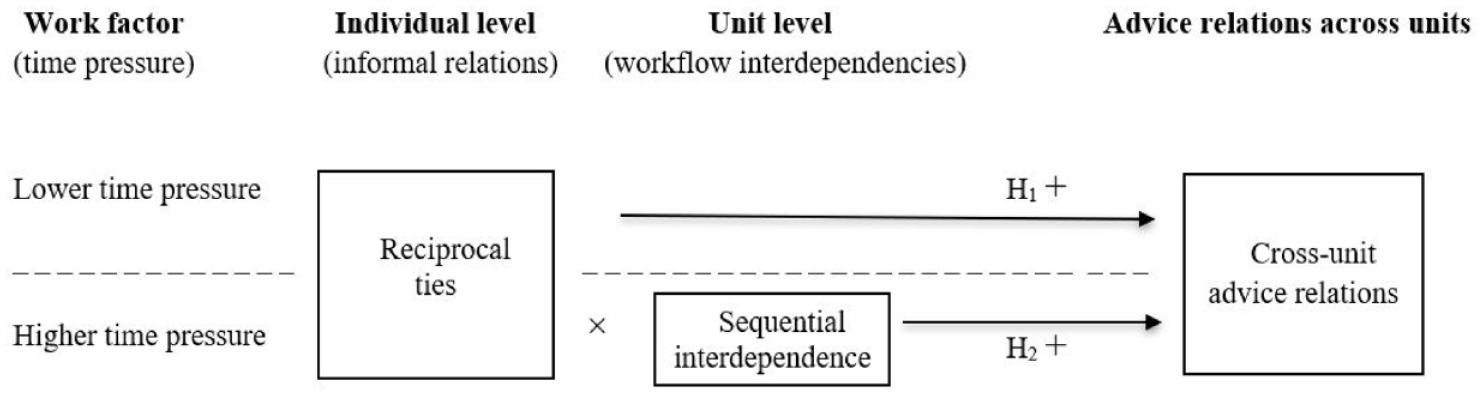
Conceptual Framework.
Lower time pressure and cross-unit ties
Individuals in organizations are often tasked with developing novel solutions to problems (Decreton, Tippmann, Nell, & Parker, 2023). Because individuals do not necessarily have all the necessary expertise to solve problems, they often draw on advice from others (Eisenhardt, 1989). Individuals in organizations tend to have relationships with people in the same unit or department (Caimo & Lomi, 2015). However, the most valuable advice—that is, advice that can promote the development of novel solutions—is frequently found in different units (Hansen, 1999, 2002; Parker, Tippmann, & Kratochvil, 2019). Accessing advice in different units entails additional costs (Nebus, 2006) due to search time, greater uncertainty in the value of the advice (Borgatti & Cross, 2003), and time taken to coordinate the advice with existing knowledge and processes (Carlile, 2004). In situations of lower time pressure, we theorize that cross-unit advice relationships occur because the benefits of the advice outweigh the search, value uncertainty, and coordination costs.
Under lower time-pressure conditions, search, value uncertainty, and coordination costs are not negligible, because time is still limited. Therefore, organizational members are selective in whom they reach out to for advice outside their own units. Building on Uzzi (1997), Caimo and Lomi (2015) highlight the role of cross-unit reciprocal ties—that is, colleagues in different units giving and taking advice. The reciprocal exchange of advice implies that the advice given by one individual will result in an obligation for the other individual to give advice in return (Blau, 1964). This expectation decreases advice search costs because an individual knows in advance that there is a high likelihood of a response to an advice request. However, this results in a future obligation that entails a time cost.
Reciprocal ties across units initially occur because an individual seeks out advice from a colleague to whom they give advice, or because the focal individual gives advice to someone from whom they seek advice. Whichever way the tie becomes reciprocal, its costs are lower for each individual because giving and taking advice creates a trust-based understanding between individuals over time (Blau, 1964; Molm, 2010). Trust results in low levels of uncertainty regarding advice quality and timeliness. In addition, reciprocal relationships have been shown to improve the likelihood of solving complex problems (Tortoriello & Krackhardt, 2010), facilitate access to critical advice (Gulati et al., 2002), and alleviate problems associated with information asymmetry (Fehr & Gächter, 2000). Knowledge embedded in advice ties has been shown to be sticky (Szulanski, 1996), especially across units (Caimo & Lomi, 2015; Hansen, 1999), and reciprocal informal relationships can help overcome this stickiness. Furthermore, because reciprocal ties incorporate a level of trust between individuals, they are likely to have greater permanency than unreciprocated ties, given that both individuals have a greater incentive to maintain the tie. This suggests that alongside the strategic cost explanation for why cross-unit ties are more likely to be reciprocal ties, there is an ecological explanation (Doehne, McFarland, & Moody, 2024).
In summary, under lower time-pressure conditions, there is a benefit in accessing diverse advice from individuals in other units, but there is a cost. Reciprocal ties between individuals are sufficient to mitigate the associated costs of advice relations across units. This leads to our first hypothesis, which specifies the tie configuration that enables cross-unit advice ties under lower time pressure conditions (Figure 2(a)).
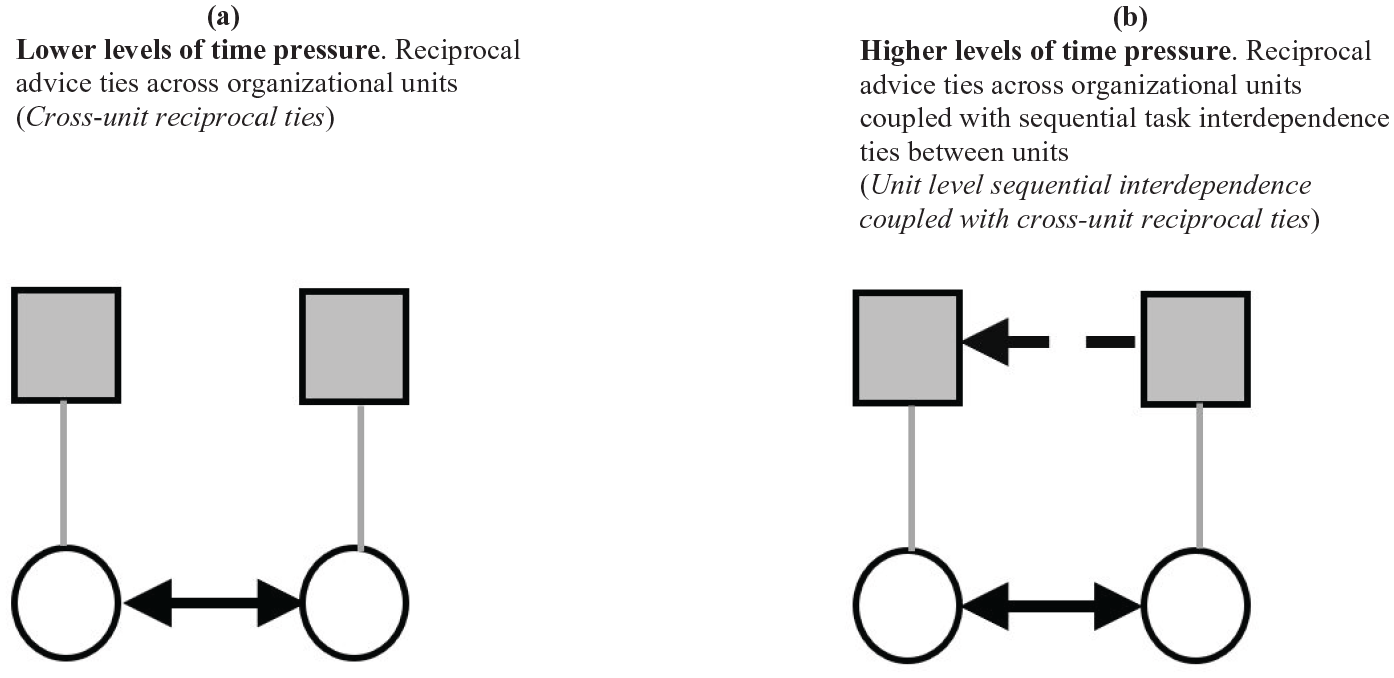
Different Forms of Cross-Unit Tiesa.
Higher time pressure and cross-unit ties
For the same reasons leading to Hypothesis 1, we expect that under conditions of higher time pressure, reciprocal ties would affect cross-unit advice relations. However, under higher time-pressure conditions, individuals face a dilemma when they address complex problems. Not only do people need diverse advice, but they also need it quickly. In addition, under higher time pressure, diverse advice from many different sources is not necessarily useful, as it can take time to integrate it into existing work practices; therefore, there is a need for advice that can be easily coordinated (Faraj & Xiao, 2006; Gittell, 2000). Formal structures have been shown to be beneficial for coordination when combined with informal ones (Ben-Menahem et al., 2016; Clement & Puranam, 2018; Koçak et al., 2023; Puranam, 2018). Therefore, we argue that under higher time pressure, reciprocal advice ties are not sufficient to offset search, uncertainty, and coordination costs; rather, support from the formal structure is also important.
We theorize that under higher time pressure, when there are benefits to acquiring diverse advice, but the costs of coordinating the diverse advice are high, people will perform a limited search outside their unit. Thus, individuals limit their cross-unit advice search to colleagues in units with existing workflow relationships. Existing research indicates that cross-unit formal workflow relationships tend to facilitate advice flow across connected organizational units (Lomi et al., 2014; Soda & Zaheer, 2012). Activities in complex organizations are characterized by sequential and reciprocal workflow interdependence (Thompson, 1967). In sequential interdependence, one unit passes the work to another, whereas in reciprocal interdependence the output of one unit is the input of another and vice versa (Soda & Zaheer, 2012). Reciprocal interdependencies require mutual adjustments and joint decision-making for tasks to be successfully executed (Soda & Zaheer, 2012), thus demanding extra attention. Moreover, reciprocal interdependencies ensure enhanced coordination and collaboration across units, and an intense exchange of information, which is unlikely to call for informal ties. Indeed, the presence of reciprocal workflow ties at the unit level may reduce the need for advice relations at the interpersonal level because they would provide redundant information (Gulati & Puranam, 2009). 1 By contrast, sequential interdependencies create task asymmetries among units and their members, whereby the members of one unit depend on members of another unit for work-related information (Raveendran, Silvestri, & Gulati, 2020). Sequential interdependence is deemed suitable for stable work contexts, but, under higher time pressure, organizations are confronted with a dilemma between the need for tight structuring and hierarchical decision-making that promotes timely action and the need for flexible structuring and on-the-spot decisions for rapid action (Mathieu, Hollenbeck, van Knippenberg, & Ilgen, 2017). This suggests the importance of unit-level sequential interdependence to supplement advice ties at the individual level (Brennecke, Sofka, Wang, & Rank, 2021; Caimo & Lomi, 2015).
Under higher time pressure, task asymmetry between members of sequentially interdependent units may prompt members of dependent units to invest time and energy into developing advice relations for access to additional knowledge (Giebels, De Dreu, & Van De Vliert, 2000). More importantly, when two units are connected by a sequential task interdependence relationship, the overall cost of the individual-level advice relationship decreases. First, search costs are lower because individuals are more likely to know each other and have greater awareness of the type of knowledge held by colleagues in interdependent units. In addition, costs are reduced because of the lower uncertainty in the quality, accessibility, and usability of advice from task-interdependent units (Borgatti & Cross, 2003). Furthermore, advice from individual relationships aligned with sequential interdependence is more easily coordinated, which can be critical under higher time pressure, where the loss of time can make the difference between success and failure. Overall, the sequential task interdependence relationship facilitates cross-unit informal advice relations because it mitigates the costs of cross-unit ties.
In summary, under higher time pressure, reciprocal advice ties are not sufficient to counter search, value uncertainty, and coordination costs; however, when they occur in conjunction with sequential interdependence between two units, they increase the likelihood of cross-unit advice ties. This leads to our second hypothesis, detailing the tie configuration that enables cross-unit advice ties under higher time-pressure conditions (Figure 2(b)).
Methods
Research setting
We tested our hypotheses by investigating informal advice relationships across units within the ITS division of an F1 racing team. The ITS division manages the information systems, electronic components, and circuitry of F1 cars; therefore, it is integral to the success of the F1 team. Overall, in F1 racing, there is emphasis on high tech, high speed, high pressure, design, and innovation. However, this emphasis varies throughout the year. Design and innovation, including that of the car’s electronic components and circuitry which is overseen by the ITS division, takes place mostly in the off-season or toward the latter half of the racing season. There are stringent rules regarding changes that can be made to cars during the race season (Francks, 2023). During the race season, particularly in the first half, the focus is on fine-tuning and maximizing the performance of the F1 car. The F1 season typically runs from March to November, consisting of approximately 20 race weekends (Friday–Sunday) per year. A race weekend consists of testing the car on the track, qualifying laps that determine the car’s starting position on the race grid, and the race itself. During race weekends, approximately 35% of the members of the ITS division are on the track, whereas the other 65% remain at the headquarters and coordinate remotely with on-track staff. There are typically 4–11 days between races, which includes the time taken to move cars from one race circuit to another, which, in some cases, requires transportation between continents.
Members of the ITS division record, process, and analyze real-time data generated by the cars (George, Haas, & Pentland, 2014). These data are included in simulation models to ensure that cars perform at their maximum capacity and that all electronic systems operate effectively. As track layouts differ from race to race, simulation models are used to develop race strategy (Aversa, Cabantous, & Haefliger, 2018). In addition, the ITS division fine-tunes the ITS system to address various issues raised by drivers and both ITS and non-ITS engineers. Overall, the tasks of the ITS division are comparable between race weekends and non-race days.
To further understand the tasks of the ITS division throughout the race season and the relevance of time pressure, we administered an anonymous online survey to 45 ITS software and electronic engineers employed in various F1 teams. Participants were selected and contacted using LinkedIn. 2 Those who responded (15.6%) 3 had an average experience of 4.3 years in F1 teams and were associated with four major teams, including the one that we examined. The online survey consisted of open-ended questions asking respondents to: (a) describe the activities performed during race weekends and on non-race days; and (b) illustrate which work characteristics (e.g., time pressure) were similar or different between race weekends and non-race days.
Our survey respondents confirmed that for the ITS division, innovation is mostly concentrated in the off-season: “Off-season is when we do all the big changes, build new tools, collect feedback, and start long-term projects” (software engineer). During the racing season examined in this study, the activities of the ITS division are punctuated by and culminate in weekend racing events. As noted by our respondents, during both race weekends and non-race days, work mostly involves implementing incremental changes upon user request. Specifically, one respondent stated: “During the entire event we get a lot of queries from the engineers to check if anything is not working properly or they would like to change any tool’s behavior.” Regarding non-race days, the software engineer stated: “[We] do small changes (usually requests from the users) and fix issues.” Furthermore, other respondents outlined the emphasis on data handling and analysis on both race weekends (“Engineers constantly enquire if they can have any available data”—software engineer) and non-race days (“On non-race days, [we] analyze data”—software reliability team leader). Another respondent who works remotely during the race weekends observed that even the time schedules are aligned: “We operate on the same time schedule as the track operations, regardless of where the race is, meaning we typically start shifting our working hours in the week leading to the event” (software reliability team leader). Overall, the online survey responses suggested that the ITS division members conducted comparable tasks on race weekends as they did on non-race days. It is worth acknowledging that the comparability of activities between race weekends and non-race days is not constant throughout the race season. F1 teams, in general, and software engineers, specifically, are mostly focused on fine-tuning the current car systems during the initial and mid-parts of the season; therefore, the activities performed during the race weekends and non-race days are largely comparable. Comparability decreases toward the end of the season, when the F1 teams intensify preparation for the following season and progressively allocate more time and resources during non-race days to design, develop, and assemble the new car (Cleeren & Chinchero, 2023). 4
Survey respondents also confirmed that the level of time pressure is the work condition that differs the most between race weekends and non-race days. One respondent stated: “Definitely time is of the essence when working on a race weekend” (software engineering manager). Another respondent noted: “I believe work under pressure is quite usual for us. Usually race weekends and the race related events on [the] software side are intense” (system engineer). During weekend racing events, testing, adjusting, fine-tuning, and improvement activities are performed at a faster pace by ITS engineers than on non-race days because of the strict timeline with which teams are required to comply, increased competitive intensity, and absence of any margin for error or delay (Aversa et al., 2018). One respondent noted: “Non-race days have deadlines obviously, but race event deadlines are far more structured and rigid. No option to be late!” (senior simulation engineer). Another respondent further clarified: “During an F1 session, decisions need to be made fast. . . In non-race events, there is usually more time to consider other things and test hypotheses” (software reliability team leader). Finally, one senior simulation engineer observed: “If time does not allow [to fix an issue] then we put it off to a post event day to include in a future race event.” Another respondent, a software engineering manager, provided a similar answer, thus underlining the difference in time pressure, as well as continuity in terms of activities, between race weekends and non-race days.
The different levels of time pressure experienced by ITS division members unambiguously highlight that the operating conditions for ITS divisions differ considerably between race weekends and non-race days (Marino, Aversa, Mesquita, & Anand, 2015; Piezunka, Lee, Haynes, & Bothner, 2018). Race weekends and non-race days represent two clearly discrete and qualitatively distinct situations characterized by different time pressures (Walker, 2019). We qualify these as lower and higher time pressures, respectively. This allows us to replicate the design proposed by Brown and Miller (2000) to measure time pressure by treating it as a “situational variable” (p. 132) and allowing us to examine lower and higher levels—hence, the non-race days and the race weekends.
Network data
We collected detailed data on advice relationships among the ITS division members of the F1 team. Data were collected in the first half of the racing season (i.e., May–June). The ITS division consists of 126 project managers, software engineers, and technicians involved in the F1 championship. The ITS division is a multi-unit organization, which is a standard practice within F1 teams. Only 11% of the members were affiliated with the corporate entity that owned the team. The other members of the ITS division were distributed across 24 partner companies and functioned as full-time consultants, mostly based at the company’s corporate headquarters, and were highly integrated and interdependent. In the remainder of this paper, when we discuss the ITS division, we refer to the corporate entity and 24 external companies as “organizational units.”
We used an online roster questionnaire (McCulloh, Armstrong, & Johnson, 2013) to collect advice relationships on non-race days and on race weekends. We surveyed all 126 members of the ITS division (response rate: 93.7%, number of respondents: 118). To test for non-response bias, we examined the differences between the respondents and non-respondents. A t-test showed no significant differences (p > .05) between the two groups based on a variety of personal and work-related characteristics.
First, we collected data on advice relations in the two time-pressure conditions. Each member of the ITS division was presented with a list of colleagues working in the ITS division and asked to name whom they typically went to for advice on non-race days, our lower time-pressure condition. The same approach was adopted for the higher time-pressure condition. We converted the answers to both questions into a network format, assuming that a tie exists between member i and j when i turns to j for advice. The resulting networks, A1 and A2, had dimensions (118 × 118).
We then collected data on the mandated workflow interdependencies connecting the units through their members. Workflow interdependencies are elements of the formal organizational structure. They relate to tasks and technology assigned to the ITS division from an organizational design perspective and capture the extent to which employees in one unit depend on employees in another unit for information, instructions, and resources to perform their work. Workflow interdependencies are centered on the technology within the car, which is the same on non-race and race days. Therefore, workflow interdependencies are expected to remain unchanged across time-pressure conditions. This was confirmed by the ITS managers who supervised the data collection. Following previous studies (Brennecke et al., 2021; Hansen, 1999), we specified workflow as a directed relationship between a unit that provides and another that receives information, instructions, and resources. Examples of workflow interdependencies include procedures that are performed in phases by two or more units. For instance, the simulated data were collected by one unit and transferred to another unit for analysis. To perform its task (i.e., analyze the simulated data), the second unit depends on the information (i.e., the simulated data) provided by the first unit. This relationship is directed because the second unit depends on the first unit, but the opposite does not hold true. This is a case of sequential interdependence. People affiliated with the same unit are likely to have access to similar information and can be perceived as interchangeable by colleagues in other units. However, it is important that individual members are able to identify the presence of this relationship. Hence, to collect data on the workflow interdependencies between pairs of units we presented each member with a list of colleagues and asked them to indicate which individuals “conducted tasks upon which their own work typically depended” (Hansen, 2002) regardless of the time pressure experienced. Network B, sized 25 × 25 and representing units and ties, has bhk = 1 if at least one member in unit h depends on one colleague in unit k to perform their tasks, and 0 otherwise (Kim & Anand, 2018). See Appendix 1 for a robustness check of the alternative calculations of bhk.
We used archival data to collect the affiliations to the units. In the member-by-unit network X, size 118 × 25, xil = 1 if member i belongs to unit l, and 0 otherwise. We complemented the survey data with secondary data sources, such as the LinkedIn public profiles of our respondents.
Measures
The methodological approach we use to test our hypotheses requires examining the extent to which the structure of the advice network that we observe is characterized by the tie configurations implied by Hypotheses 1 and 2, and by other tie configurations and characteristics of respondents and units that we control for. 5 In this methodological framework, the variables were defined as follows.
Advice tie variable
This is the probability of observing an advice tie (Aij) from ITS division member i to j. Aij = 1 if i seeks advice from j and Aij = 0 otherwise. Advice ties under conditions of lower versus higher work-specific time pressures are represented as A1ij and A2ij, respectively, and are entered into two distinct models.
Hypothesized variables
Hypothesis 1 was tested using cross-unit reciprocal ties—that is, a network configuration consisting of a reciprocal advice tie between individuals in two units (Figure 2(a)). Hypothesis 2 was specified as unit level sequential interdependence coupled with cross-unit reciprocal ties, consisting of a directed workflow tie between two units and a reciprocal advice tie between individuals in the two units (Figure 2(b)).
Control variables
We include covariates testing for alternative explanations of advice relations within and across units (Lomi et al., 2014; Sosa, Gargiulo, & Rowles, 2015). These covariates are arranged into three subgroups: (a) variables that capture advice ties; (b) variables that capture unit affiliation with regard to advice ties; and (c) variables that capture the interactions between cross-unit workflow interdependencies and cross-unit advice ties.
For the variables classified into subgroup 1, we first controlled for the tendency of advice ties between similar colleagues (McPherson, Smith-Lovin, & Cook, 2001) in relevant work-related characteristics (Gulati & Puranam, 2009; He, von Krogh, & Sirén, 2022). Educational background had three levels ranging from secondary school (38%) to postgraduate education (15.2%). Expertise records the organizational processes in which team members are involved. It had three values: software development (70%), project management (13%), and support activities (17%). Organizational role differentiates team members in higher hierarchical positions—that is, unit heads and senior managers (20.4%). Tenure has 4 levels, ranging from less than 1 year (17.8%) to more than 10 years in the organization (14.4%). For all these variables, we specified the same covariate effect, which takes the value of 1 if the respondent and their colleague have the same value for a salient characteristic, and 0 otherwise. In total, 35.6% of the ITS division members, evenly distributed across units, were on track during racing events, whereas the others were based at headquarters. The entire ITS division participates in race activities; however, members on track are likely to experience a higher level of time pressure and greater need for coordination than those working remotely. Race location was coded as 1 if a team member is on the racing track during racing weekends, and 0 otherwise. Likewise, day-to-day location was codified as 1 if a team member was based at the corporate headquarters during non-race days (85%), and 0 otherwise. For both location variables we specified the same covariate effect and for race location we specified a sender effect. Because previous contact may influence social interaction, we combined information on tenure with the publicly available curricula vitae (CVs) of ITS division members to reconstruct career paths. Same previous membership takes a value of 1 if two respondents were previously members of the same organization at the same time, and 0 otherwise. Given that organizations are of moderate size, individuals who were members of an organization at the same time have a high probability of having known each other.
Next, we included variables that capture the structure of the advice networks. Reciprocity captures the tendency to reciprocate in social relations (Blau, 1964), regardless of unit membership. Isolates captures the presence of team members who are not connected through advice ties. Tendencies toward centralization are captured by popularity, the presence of individuals who receive advice from many colleagues, and activity, the presence of individuals who seek advice from many colleagues (Barabási & Albert, 1999). Transitive closure captures the tendency of individuals connected to colleagues to be directly connected (Coleman, 1988), whereas cyclic closure is the tendency toward generalized exchange (Bearman, 1997). Multiconnectivity captures the absence of densely connected subgroups, with team members linked to one another indirectly by several others (Robins, Pattison, & Wang, 2009).
For the control variables classified in subgroup 2, cross-unit ties captured the baseline tendency toward building cross-unit ties. It equals 1 if two individuals connected by an advice tie are members of different units, and 0 if they are members of the same unit. Moreover, this variable is a prerequisite for cross-unit reciprocal ties (Hypothesis 1). Unit size difference controls for the likelihood of advice ties between members of units which differ in size (Alexiev, Volberda, Jansen, & Van Den Bosch, 2020). Unit size difference was defined as the absolute difference between the unit size of the sender and that of the receiver in each dyad of individuals who were members of different units. This variable accounts for the likelihood that the superior managerial and financial resources of larger units enable the unit to develop new knowledge (Tsai, 2002), and therefore make the unit’s members more sought after for advice from members of other units (Sosa et al., 2015). Unit task difference controls for the likelihood of advice ties between members of units that differ in the number of activities they perform; hence, it is a measure of internal work complexity (Sosa et al., 2015). We operationalized unit task difference as the absolute difference between the number of tasks of the sender and receiver units for each dyad of individuals who were members of different units.
For the control variables classified in subgroup 3, unit level sequential interdependence coupled with cross-unit aligned ties accounts for the tendency to form ties when there is a workflow tie between two units and an advice tie between individuals in the two units (Brennecke et al., 2021). Both cross-unit sequential interdependence and cross-unit advice ties are directed and in the same direction. Unit level sequential interdependence coupled with cross-unit aligned ties provides a direct control for Hypothesis 2. Finally, multilevel popularity captures the possibility that being sought for advice by many others is the result of membership in units that many others depend on—that is, units with high knowledge provision (Podolny, 2001). Multilevel activity captures the possibility that seeking many others for advice is the result of membership in units that depend on many others for provision of knowledge (Zappa & Lomi, 2016). All the variables are summarized in Table 1.
Advice and Workflow Network Variables: Qualitative Representations. a
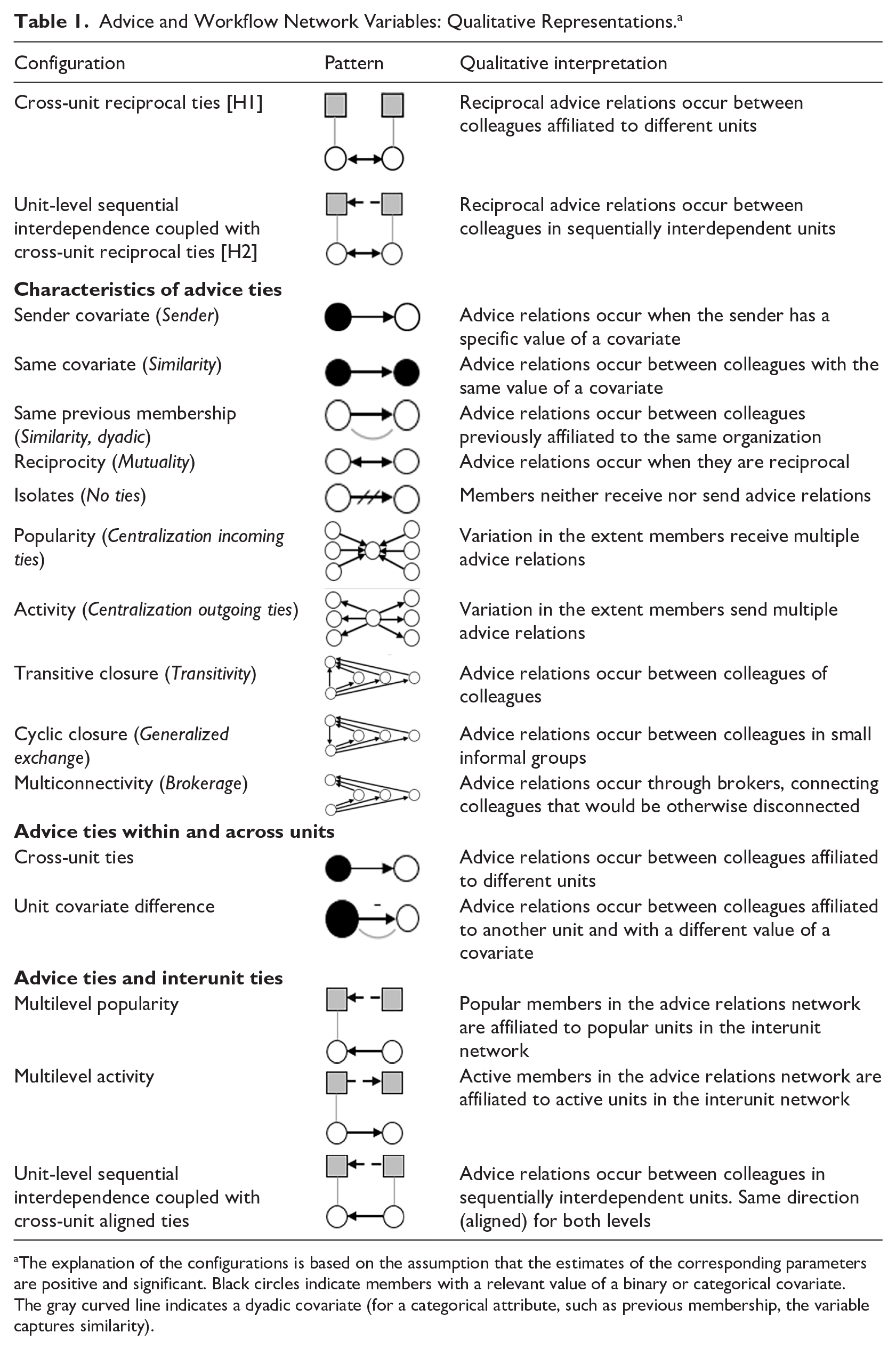
The explanation of the configurations is based on the assumption that the estimates of the corresponding parameters are positive and significant. Black circles indicate members with a relevant value of a binary or categorical covariate. The gray curved line indicates a dyadic covariate (for a categorical attribute, such as previous membership, the variable captures similarity).
Models
We tested our hypotheses using exponential random graph models (ERGMs). This framework is being increasingly used in studies on inter- and intra-organizational relations (Lomi et al., 2014; Sosa et al., 2015), where observations are not independent. Indeed, ERGMs are the only modeling framework that specifies the types of interactions between interpersonal and interunit ties that test our hypotheses. ERGMs may be understood as logit models for network data (Amati, Lomi, & Mira, 2018; Paruchuri, Goossen, & Phelps, 2019). The dependent variable is the probability of observing a binary tie between two individuals i and j—as the smallest component of the observed network—which is modeled as a linear function of the covariates computed for i and j. These covariates may include the attributes of i and j and the network variables, including i and j. The network variables are the local configurations of ties, such as those listed above, as independent and control variables. We tested our hypotheses using a specific class of ERGMs, namely MERGMs (Wang et al., 2013). Formally:

Parameter estimates may be interpreted similarly to the log odds of the presence of a tie (Amati et al., 2018). A parameter is equal to zero if the number of corresponding configurations in the observed network is equal to the number that would be expected by chance—that is, the configuration does not affect the probability of i having an advice relation with j. A positive (negative) and statistically significant parameter estimate indicates a greater (smaller) number of configurations in the observed network than expected by chance alone. The configuration positively (negatively) affects the probability that i has an advice relation with j. Following this logic, each hypothesis is supported if the corresponding configuration is positive and significant in the relevant advice network (i.e., the time-pressure condition).
We estimated the ERGM parameters using Monte Carlo Markov chain maximum likelihood estimation, a simulation-based technique implemented in MPNET (Wang, Robins, & Pattison, 2009). This was used to minimize multicollinearity among the variables included in our models. ERGMs identify the specified configuration of ties and count their instances; hence, if i and j are linked by a reciprocal tie, this tie enters the count of the reciprocity configuration but is not included in the count of the directed ties from i to j and from j to i.
Results
Descriptive statistics
The descriptive network statistics in Table 2 indicate that the workflow structure is highly connected (mean in/out degree of 6.40 ties per unit). Team members relied on fewer colleagues for advice during race weekends (M = 2.13) than on non-race days (M = 4.48). Table 3 presents the descriptive statistics and Pearson’s correlations for the variables included in the models.
Descriptive Statistics of the Advice and Workflow Networks.
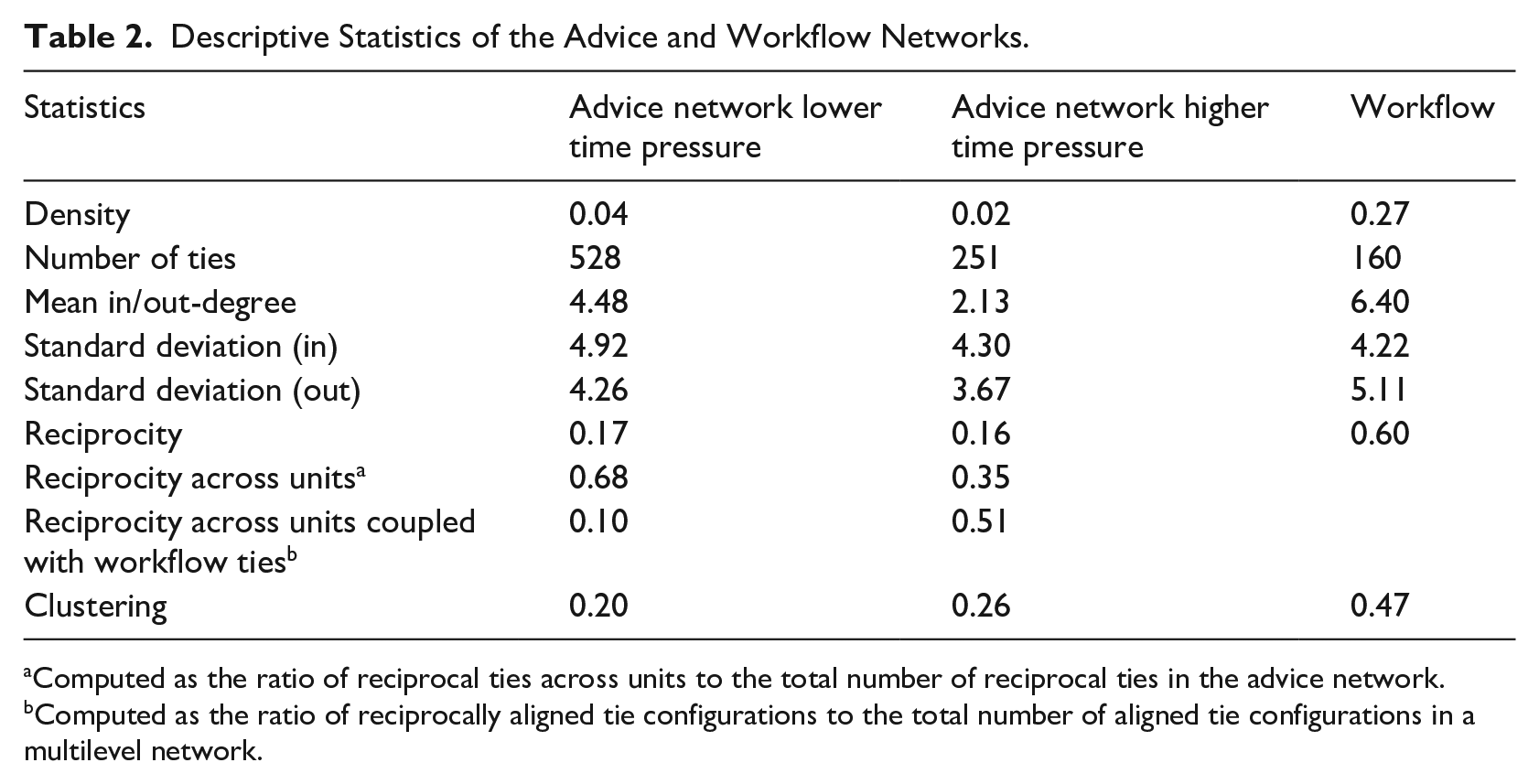
Computed as the ratio of reciprocal ties across units to the total number of reciprocal ties in the advice network.
Computed as the ratio of reciprocally aligned tie configurations to the total number of aligned tie configurations in a multilevel network.
Descriptive Statistics and Correlations. a
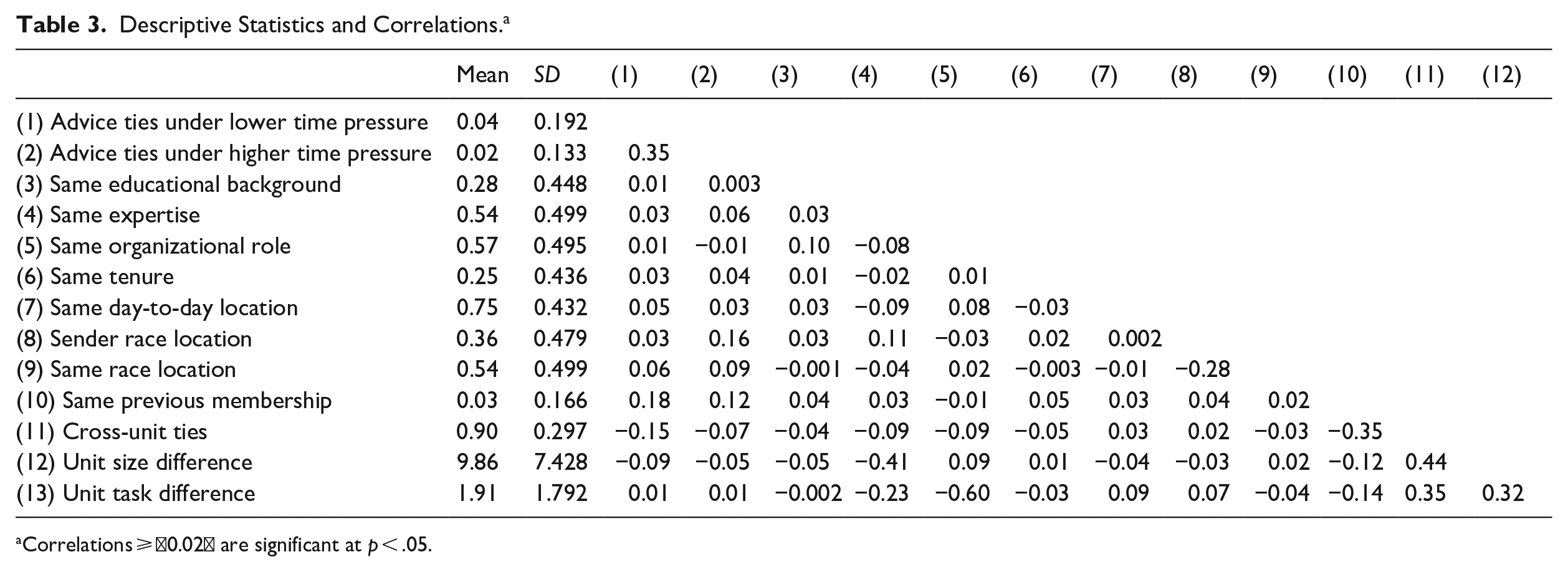
Correlations ⩾ ǀ0.02ǀ are significant at p < .05.
Hypotheses testing
In Tables 4 and 5, we present the results of lower time-pressure and higher time-pressure conditions, respectively. We estimate the same models for both conditions and include the effects in increasing order of complexity. We use the ERGM-specific goodness-of-fit procedure to fine-tune the variable specifications and verify that our final model (Model 5 in Tables 4 and 5) reproduces the features of the observed networks better than any alternate model (Hunter, Goodreau, & Handcock, 2008). Appendix 1 details the goodness-of-fit procedure and outcomes. The fit of our model ensured that we could comment on the ERGM results. The discussion of results in Tables 4 and 5 are restricted to Model 5, which is our full model.
Multilevel Exponential Random Graph Model (MERGM) Maximum Likelihood Estimates of Advice Relations under Conditions of Lower Time Pressure.
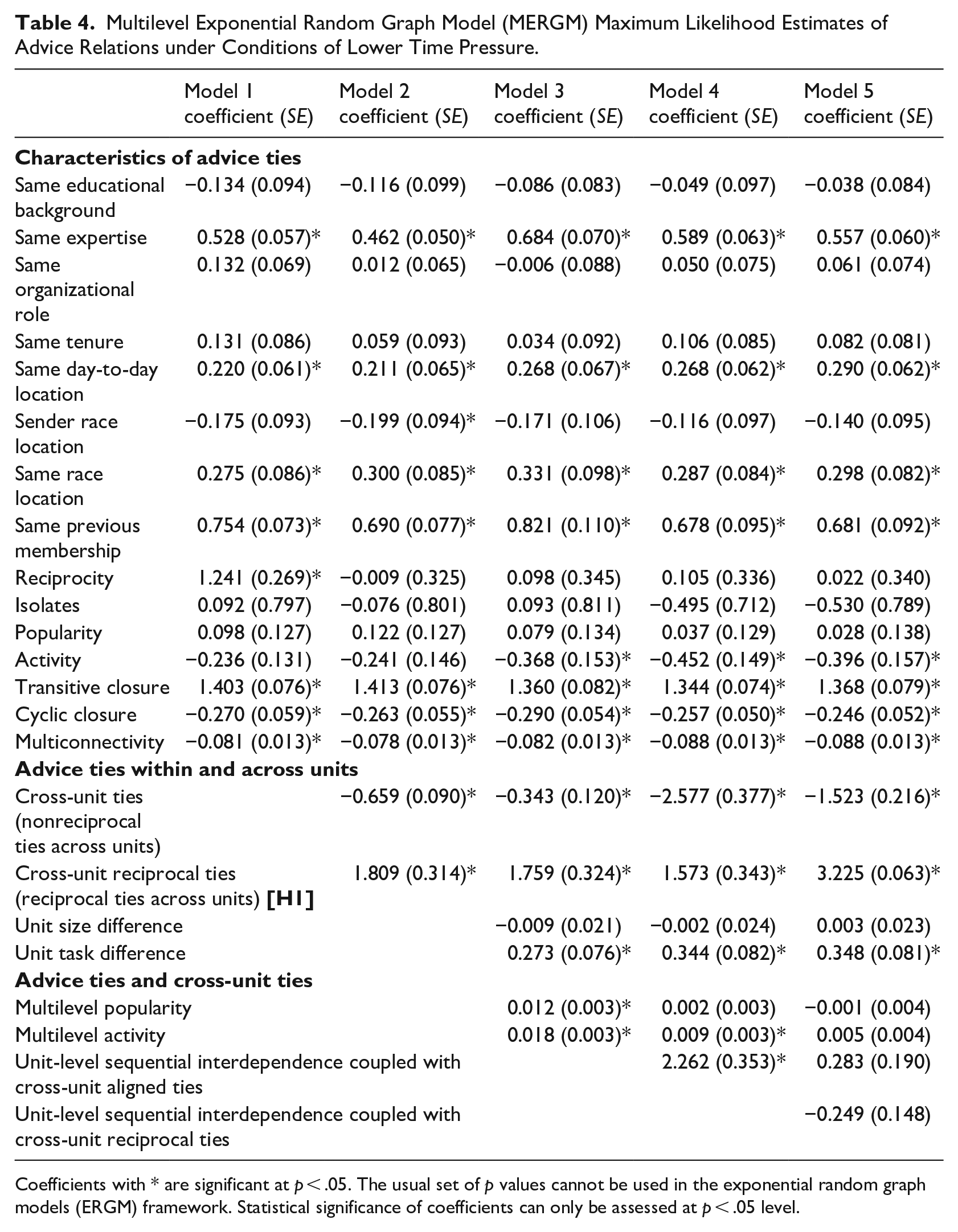
Coefficients with * are significant at p < .05. The usual set of p values cannot be used in the exponential random graph models (ERGM) framework. Statistical significance of coefficients can only be assessed at p < .05 level.
Multilevel Exponential Random Graph Model (MERGM) Maximum Likelihood Estimates of Advice Relations under Conditions of Higher Time Pressure.
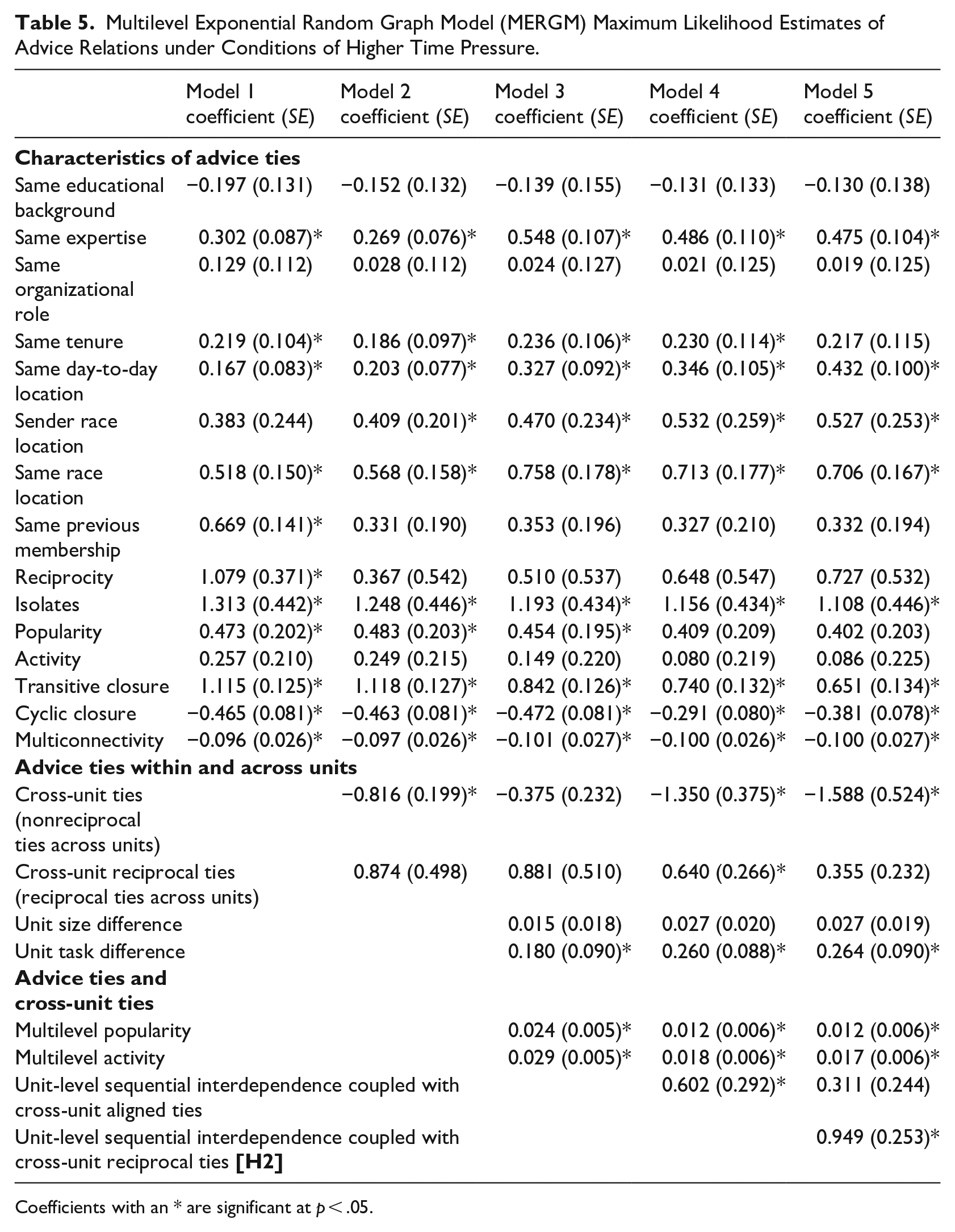
Coefficients with an * are significant at p < .05.
We begin by analyzing the advice network under conditions of lower time pressure and detail the results in Table 4. In Table 4 (Model 5), the parameter estimate of cross-unit reciprocal ties is positive and significant (3.225, p < .05). Therefore, the odds of observing reciprocal ties between members of different units are exp[3.225] = 25.154. This is much greater than predicted by chance, thus supporting Hypothesis 1 that organizational members display a significant propensity to reciprocal advice relationships across units under conditions of lower time pressure.
As explained in the Methodology section, the rationale for ERGMs implies that the configurations of interest in the observed network are compared with what we would expect by chance alone. However, it is beneficial to confirm these results (Gelman & Stern, 2006) by comparing the configuration testing Hypothesis 1 with configurations suggesting alternative, yet similar, ways of spanning units. The first configuration was cross-unit ties (non-reciprocal ties across units). This is a prerequisite for Hypothesis 1 as it captures the baseline propensity to build cross-unit advice relations. In Table 4 (Model 5), we find that the parameter estimate for cross-unit ties is negative and significant (−1.523, p < .05). This result indicates that the likelihood of observing non-reciprocal ties between units is lower than would be predicted by chance, and in line with the assumption that individuals are unlikely to build cross-unit advice ties because of cost implications (Reagans & McEvily, 2003). The coefficients for cross-unit ties and cross-unit reciprocal ties can be directly compared by computing the Wald statistic, which confirms that they are significantly different (z-score = −21.10, p < .001). The second configuration is unit-level sequential interdependence coupled with cross-unit aligned ties which controls for the likelihood of observing cross-unit directed ties, not reciprocal ones, supported by workflow ties across units. In Table 4 (Model 5), this configuration is not significant (0.283, p = .61); hence, the corresponding behavior is unlikely to be observed. Finally, the parameter estimate for unit-level sequential interdependence coupled with cross-unit reciprocal ties is negative, but not significant (−0.249, p = .60). Hence, individuals do not display a significant tendency toward reciprocal advice ties when affiliated with units connected by directed workflow ties, thus confirming our prediction that cross-unit advice relations under lower time pressure are enabled by a different tie configuration from the one we predict for higher time pressure.
We then analyzed the advice network under conditions of higher time pressure, the results of which are detailed in Table 5. In Table 5 (Model 5), the parameter estimate for unit-level sequential interdependence coupled with cross-unit reciprocal ties is positive and significant (0.949, p < .05). The odds of observing reciprocal ties between members of connected units were exp[0.949] = 2.583. In line with Hypothesis 2, under higher time-pressure conditions, ITS division members display a significant propensity toward reciprocal advice relationships across units when they are affiliated with units connected by directed workflow ties. To further confirm this result, we performed the same analyses as those for the network under lower time-pressure conditions. As mentioned above, the prerequisite for our hypotheses is that individuals are unlikely to build cross-unit advice ties because of their cost implications. In Table 5 (Model 5), we find that the parameter estimate for cross-unit ties (non-reciprocal ties across units) is negative and significant (−1.588, p < .05). This result indicates that the likelihood of observing non-reciprocal ties between units in the higher time-pressure condition is less likely than would be predicted by chance. In Table 5 (Model 5), the parameter estimate for unit-level sequential interdependence coupled with cross-unit aligned ties is non-significant, albeit positive (0.311, p = .62). Again, these coefficients can be compared by computing the Wald test statistic, which shows that there is a significant difference between this coefficient and unit-level sequential interdependence coupled with cross-unit reciprocal ties (z-score = −1.82, p < .10). This confirms that in higher time-pressure conditions workflow ties across units support reciprocal but not directed advice ties. Finally, the parameter estimate for cross-unit reciprocal ties is positive, but not significant (0.355, p = .64), indicating that reciprocity between individuals is not sufficient to create cross-unit ties under higher time pressure. This further supports our prediction that cross-unit advice relations under higher time pressure are enabled by a different tie configuration from the one we observed for lower time pressure (mirroring the evidence we reported above for Hypothesis 1).
The behavior of the other control variables in Tables 4 and 5 (Model 5) is in line with expectations. Physical proximity and similar areas of expertise promoted advice relations under both conditions. For lower time pressure, Table 4 (Model 5), long-lasting relationships owing to shared past affiliations promoted advice relations. In addition, the results in Tables 4 and 5 (Model 5), indicate that advice relations were embedded in local transitive subgroups (a combination of significantly positive transitive closure and significantly negative cyclic closure). For higher time pressure, Table 5 (Model 5), working on the track makes team members more likely to have advice relationships with colleagues during race events (i.e., a positive and significant sender race location). In Tables 4 and 5 (Model 5) cross-unit ties are more likely to occur between members of units that differ in the number of tasks performed under both time-pressure conditions (i.e., a positive and significant unit task difference), an effect that warrants further attention in a replication study. Finally, for higher time-pressure conditions, Table 5 (Model 5), multilevel activity and multilevel popularity are positive and significant, indicating that sending advice ties to many colleagues is linked to membership in units that depend on many others for the provision of knowledge, and receiving advice ties by many colleagues is linked to membership in units on which many others depend. These effects were not significant under lower time-pressure conditions in Table 4 (Model 5).
Discussion and Conclusions
We designed our study to address the specific question: how does time pressure affect advice relationships across units? Due to the costs of advice ties in organizations, informal advice relations tend to occur within units (Caimo & Lomi, 2015; Lomi et al., 2014). Our study builds on existing research on advice relations across boundaries, such as units, in organizations (Caimo & Lomi, 2015; Hansen, 1999; Lomi et al., 2014; Parker et al., 2019). We developed a cost-based explanation for advice relations (Nebus, 2006) and examined it under two different time-pressure conditions. We show that in situations of lower time pressure, reciprocal advice ties are sufficient to overcome search and value uncertainty costs across units. However, under higher time-pressure conditions, which require faster search and coordination, cross-unit advice ties are facilitated by reciprocal advice ties embedded in the workflow ties between units. We contribute to the literature by showing that when work oscillates between different time-pressure conditions, employees’ underlying network choices change because of the underlying costs. This has implications for how knowledge is managed and how problems are solved in organizations (Carlile, 2002, 2004; Parker et al., 2019).
In addition, we add to the literature on the relationship between formal and informal structures within organizations (McEvily et al., 2014)—specifically, the role that formal structures play in supporting informal structures when there is need for coordination (Ben-Menahem et al., 2016; Clement & Puranam, 2018; Koçak et al., 2023; Puranam, 2018). Furthermore, we add to the literature on multilevel networks by jointly examining formal and informal organizational networks (Brennecke & Rank, 2017; Brennecke et al., 2021; Dagnino, Levanti, & Mocciaro Li Destri, 2016; Zappa & Lomi, 2016). Our empirical analysis of the ITS division of an F1 team supports the argument that under higher time pressure, both the organizational structure of workflow relations and the social structure of advice relations are required to facilitate intra-organizational advice sharing (Zappa & Lomi, 2016). By contrast, under lower time pressure, reciprocal ties between individuals are sufficient to support the sharing of advice across units.
Finally, we contribute to the literature on time pressure within work (Day, Gordon, & Fink, 2012; Faraj & Xiao, 2006; Weick, 1993) and how this relates to social networks in organizations. Our findings indicate that employees’ network choices vary across different levels of time pressure. In doing so, we extend the explanation of coordination and advice relationships under time pressure. Our study highlights that when work oscillates between different time-pressure conditions, the structure of advice relations across units and their relationship with the formal structure are different in each condition.
The limitations of the study indicate clear opportunities for future research. One opportunity arises from the inherent drawbacks of our single-organization design. A detailed analysis of one specific, and to some extent idiosyncratic, case study is insufficient to fully generalize our theory. A growing body of research uses the sports industry as an empirical setting for organizational and management studies (Day et al., 2012; Jenkins & Floyd, 2001). F1 shares similarities with other technology-based industries—intense competition and an emphasis on change—which might facilitate extending the results of our study to teams operating in those industries (Marino et al., 2015). The empirical setting we examined may seem idiosyncratic; however, the “performative” aspects of our setting make the empirical scope of our study broader than it might seem at first. Fire fighters (Macpherson et al., 2022; Weick, 1993), medical teams (Benn, Healey, & Hollnagel, 2008; Faraj & Xiao, 2006), and management teams (Larson et al, 2020; Weick, 2007) represent adjacent empirical settings to which our results extend naturally. In all these cases, similar work was performed by the same people under widely varying time-pressure conditions.
In conclusion, we believe that our study makes a novel and significant contribution to the literature on the relationship among time pressure, formal organizational structure, and informal social networks in organizations. We propose a cost-based explanation of advice relations across units and show that when there are high costs related to advice relations—that is, in higher time-pressure situations—a combination of formal task structure and informal reciprocal ties mitigates the costs, but when costs are primarily related to search and value uncertainty—that is, in lower time-pressure situations—informal reciprocal ties are sufficient to mitigate the costs.
Footnotes
Appendix 1
Acknowledgements
We would like to thank Jasper Hotho and three anonymous reviewers for their feedback and help in developing this manuscript.
Authors’ note
The authors contributed equally to this paper.
Funding
The authors disclosed receipt of the following financial support for the research, authorship, and/or publication of this article: We acknowledge the support provided by the Swiss National Science Foundation (grant number CRSII1_147666).
