




Abstract
We draw upon the metaphor of navigation to rethink how we think about place. We highlight three extensions that dominate current place-sensitive organizational research. We draw upon a set of six important papers published in Organization Studies that showcase the diversity, multiplicity and multidimensionality of place. The studies we select highlight three important movements in the study of place – from stable to dynamic, from physical to polymorphic, and from neutral to political. In doing so, they serve as a compass to guide our thinking and research on how place is created, negotiated and experienced.
Our daily lives are filled with interactions in as well as with places. From the homes we inhabit to the places we visit, our very being is inextricably linked to places, yet we usually take them for granted. Important work in our discipline – building on ideas arising in adjacent disciplines such as geography (Cresswell, 2015; Relph, 1976; Tuan, 1977), sociology (Fine, 2010; Gieryn, 2000) and psychology (Canter, 1977; Gustafson, 2001; Twigger-Ross & Uzzell, 1996) – has already highlighted the relevance of place for organizing and organizations. There is no shortage of articles that feature rich descriptions of place throughout the organizational literature – prestigious places imbued with rich traditions (Croidieu, Soppe, & Powell, 2017; Dacin, Munir, & Tracey, 2010; Lok & de Rond, 2013), places of care (Lawrence, 2017; Wright, Meyer, Reay, & Staggs, 2021), extreme and remote places (Brown & Toyoki, 2013; Crawford, Coraiola, & Dacin, 2022; Kibler, Ginting-Szczesny, Vaara, & Heikkilä, 2022), ancient and sacred places (Jones & Massa, 2013; Kieser, 1989; Siebert, Wilson, & Hamilton, 2017), iconic places (Aversa, Bianchi, Gaio, & Nucciarelli, 2022), and many more. Indeed, research on place has exploded over the last several years.
Place has traditionally been understood as the intersection between a geographic location – that is, a stable, ‘unique spot in the universe’ in which it is positioned; a physical or material form; and a meaning structure – that is, how place is ‘interpreted, narrated, perceived, felt, understood and imagined’ (Gieryn, 2000, pp. 464–465). Tuan (1974) refers to place as space infused with meaning. For Tuan (1975, p. 151) ‘place is a center of meaning constructed by experience’. For us, as organizational scholars, this suggests that the location, materiality and/or symbolic meanings of places are shaped by, and further shape, people’s everyday social life and interactions (Collins, 1981; Gieryn, 2000; Relph, 1976). Places are the silent guardians of institutionalized traditions (Dacin et al., 2010) and guide organizational life ‘by providing templates for action, cognition, and emotion’ (Lawrence, Suddaby, & Leca, 2011, p. 53).
In this Perspective we draw upon a set of six studies published in Organization Studies that put place front and centre. These six studies exemplify three shifts in conceptualizations of place, and further extend them. Historically, the conceptualization of place moved from stable to dynamic, from physical to digital, and from neutral to political (see Figure 1). While such movements around the conceptualization of place are not new, the papers we showcase further extend them, moving from static to dynamic to both static and dynamic, from physical to digital to polymorphic, and from neutral to political to problematizing place-based power relations. Collectively, these papers serve as a guiding compass, directing us towards a more holistic and integrative understanding of place in organization studies. They open up new possibilities for enriching our comprehension of how place is crafted, experienced and negotiated. 1
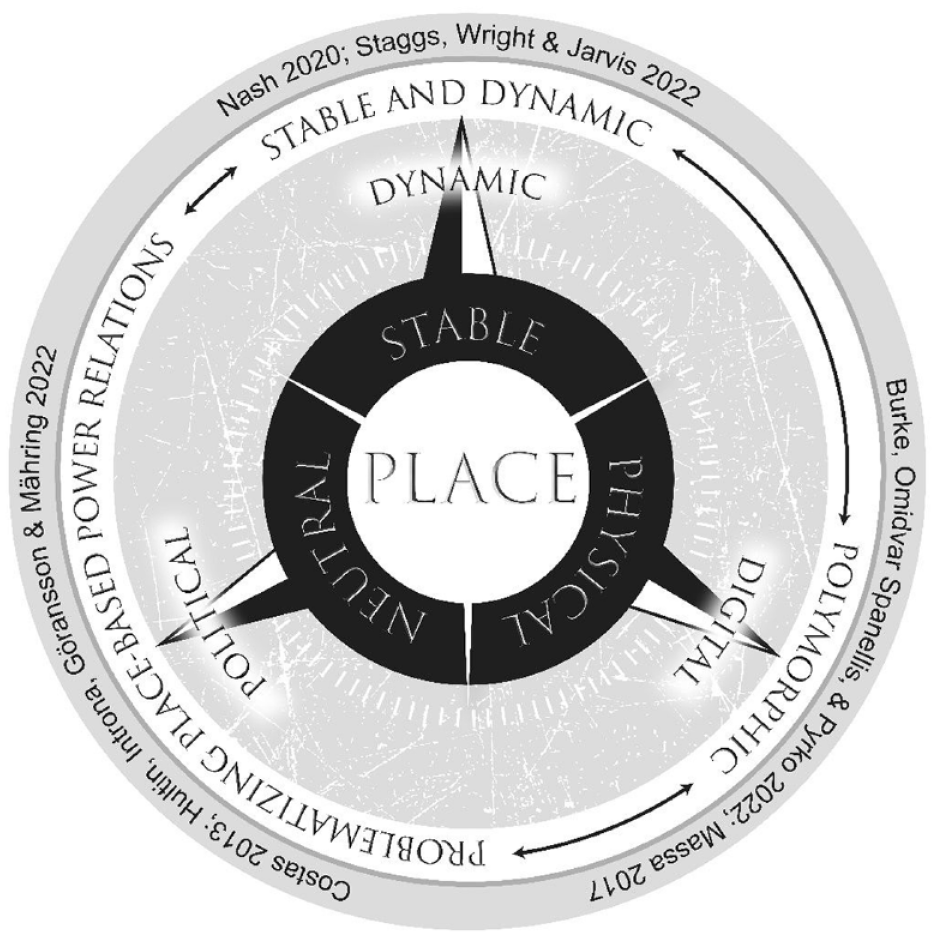
A compass pointing to three extensions of the concept of place.
The first two papers we introduce extend the understandings of place as dynamic and away from early conceptualizations thereof as stable, by highlighting that place is, at the very same time, both stable and dynamic. Staggs, Wright and Jarvis (2022) delve into the dynamics of institutional entrepreneuring within a well-established context, specifically examining the production of scientific research in Australia. Their research highlights the interplay between the enduring stability of place-based institutions and the dynamic processes of place creation, underscoring the dual nature of continuity and transformation. Similarly, Nash (2020) applies rhythmanalysis to explore the intricate socio-cultural and material dimensions of the City of London. This study reveals how the city’s everyday rhythms are both a product of and an influence on the city’s ongoing performance, embodying a balance between constancy and fluctuation. Both Burke, Omidvar, Spanellis and Pyrko (2023), as well as Massa (2017) focus upon the interplay of digital and physical spaces, and hence extend conceptualization of place as polymorphic, and away from a focus on either physical or digital places. The former focused on a Facebook group that helped bring order to a disrupted physical place, and the latter focused on a discussion forum called 4chan, that morphed into a digital place with its own digital culture, language and behavioural norms. The last two studies we highlight extend our understanding of the politicized nature of place, away from clear-cut depictions thereof, problematizing place-based power relations. Costas (2013) studied the experience of consultants who travel the globe as part of their work and the draining day-to-day experience underneath this celebrated lifestyle. Hultin, Introna, Göransson and Mähring (2022) studied Syrian refugees in Lebanon and how they managed to create a sense of place, despite their displacement or placelessness. Together, these papers further extend the movement in the conceptualization of place from stable to dynamic to simultaneously stable and dynamic, from a focus on the physical to the digital to a broader focus on polymorphic places, and from neutral or political towards a more nuanced understanding of place as politicized.
We start with an overview of the work on place in management and organizations. Using the lens of navigation, we then highlight the presence of three extensions of the definition of place that dominate current place-sensitive organizational research, building on ideas from critical geography and a set of six important papers published in Organization Studies that further extend on these newer conceptualizations. In doing so, our goal is to open up more nuanced and critical ways for thinking about place. We conclude with future directions for research on place in organization studies, aiming to enrich key discourses and constructs in organization theory, including identity, traditions, emotions, stigma and social inclusion.
Placing Place in the Study of Organizations
A number of reviews were published in the past two decades that relate, in some way, to the concept of place in organization and management studies. These largely explore the notion of place in relation to a main construct of interest. For instance, in their review of traditions in organizations, Dacin, Dacin and Kent (2019) identify a recursive relationship between place and tradition, place being both a resource for the making of tradition and the outcome of local tradition maintenance by custodians. Similarly, Lehman, O’Connor, Kovács and Newman (2019) find that among the three meanings that the notion of authenticity is most associated with in organization studies, one ‘interprets authenticity as connection between an entity and a person, place, or time’ (p. 3). Both of these reviews advocate for a better integration of place in the theorization of processes of tradition and authenticity.
In a more recent contribution, Wright, Irving, Zafar and Reay (2023) provide a systematic review examining the relationship between space, place and organizational and institutional change. They identify four perspectives: a functional approach which considers space and place as a variable that affects change outcomes; a situated perspective that treats space and place as a context for change processes; an experiential perspective that focuses on the experience of place and space during a change event; and finally, a mutually constitutive approach that highlights the mutual constitution of the experience of space, place and change.
Reviewing the organizational literature about place, we identify three streams of research that have formed around Gieryn’s (2000) original conceptualization of place as stable, ‘real’ and politically inscribed. A first stream of research treats place as being crafted (both socially and physically) by people in organizations either purposefully or not (Zilber, 2018a). Studies in this stream use concepts such as ‘boundary work’, ‘custodians of place’, ‘maintenance of place’ and ‘reconstruction of place’. Place-making can be triggered by dramatic events (Farny, Kibler, & Down, 2019) and social mobilization (Fernández, Martí, & Farchi, 2017) or by more historically situated events such as successive waves of immigration (Jones, Lee, & Lee, 2019). Custodians of place, much like professional placemakers (Schneekloth & Shibley, 1995), curate and maintain places they find meaningful and that are dear to them (Boutinot & Delacour, 2022; Crawford & Dacin, 2021; Crawford et al., 2022; Wright et al., 2021).
Second, there is an emerging body of organizational research that seeks to understand place as lived experience (Giovannoni & Quattrone, 2018; Massa, Helms, Voronov, & Wang, 2017; Schiemer, Schüßler, & Theel, 2023; Siebert et al., 2017). These studies are concerned with how people sense, imagine and remember the places that they inhabit, work in and visit. Studies in this stream use concepts regarding experiences of place such as ‘co-presence’, ‘disorientation’, ‘place belonginess’ and ‘place identity’, and highlight the cognitive, emotional and behavioural components of place. Lived experiences and memories shape meanings and attachments to and from place (Tuan, 1977). Places are experienced as relationships to a specific location, but also experienced as relationships among people in a place (Gustafson, 2001; Schneekloth & Shibley, 1993).
The third stream of literature treats place as an invariant context that shapes organizational activity and that organizational actors must negotiate (David, Jones, & Croidieu, 2023; Lawrence & Dover, 2015; Muñoz, Kibler, Mandakovic, & Amorós, 2022; Tracey, Dalpiaz, & Phillips, 2018). Here, place can be thought of as a repository of memory, narratives, categories, social evaluations and institutions. For instance, regional institutions or specific local organizations, such as museums, not only function as preservers of memory but also play a role in its reproduction. Furthermore, organizational actors must constantly negotiate the constraining meanings and materialities of the places in which they operate. For instance, wine makers in the Bordeaux region mobilize the prestigious meaning associated with the chateaux to negotiate higher prices than wines from other regions (Malter, 2014). Studies in this Perspective use notions such as ‘local legitimacy’, ‘place-based status’ and ‘situated practices’. How people and organizations occupy place, and how they associate with specific places, is highly institutional and political because it denotes and determines their social status (Zhang & Spicer, 2014).
The six papers in Organization Studies we highlight in this virtual special issue extend the original conceptualization of place in which these three streams of research are rooted. We draw upon the metaphor of ‘navigation’ and navigational ‘tools’ to aid in our exposition of key insights gleaned from the six studies pertaining to the conceptualization of place. Our choice of navigation as a guiding metaphor is motivated by several factors. First, navigation is the science of movement, of determining position, orientation and direction. As such, it fits a review that aims to take stock of past literature and offer directions for future research. Further, navigational tools are pluralistic and can take many forms from marine navigation to land, celestial and electronic means. Thus, this metaphor challenges us to be inclusive in our thinking about place. Last, the metaphor of navigation suits our goals well as we navigate the literature on place in organization studies, as well as the six papers we highlight here. While ours is more of a mental navigation challenge, we highlight new insight and meaning that will hopefully be used to better explore and understand places, situatedness and positionality in organization studies.
Extending the Conceptualization of Place
Our reading of the recent work on place published in Organization Studies highlights three extensions that cut across the three streams of research we identify in the literature. We use ‘extensions’ to denote that these conceptual developments are not new, yet the six papers we highlight significantly push and complicate these lines of thinking and point to promising ways forward. The first extension has to do with the move from treating place as stable to treating it as dynamic (Cartel, Kibler, & Dacin, 2022), and further extending the dynamic perspective by attending to rhythms of both stability and dynamism. The second extension considers the inclusion of new types of places into the study of places, from physical to digital to polymorphic places. Given digital technology and the creation of digital and hybrid places, people transit between various forms of places, which illuminates the complicated interrelations between different kinds of places (Cnossen, de Vaujany, & Haefliger, 2021). The third extension is about deepening our understanding of the interrelations between place and power relations. We already know that the making, reclaiming and remaking of place is an inherently political endeavour (Butler, 2012; Courpasson, 2017). Extending such a political perspective, the papers we showcase help complicate clear-cut notions of power and powerlessness. We discuss each of these extensions below and explore the potential in considering each more deeply as we re-direct our conversations and study of place.
Extension 1 – Atlas and almanac: Embracing place as both stable and dynamic
The first extension of the conceptualization of place we identify in organization studies revolves around enhancing the understanding of place as both stable and dynamic. The distinction of place as stable and dynamic is captured in the difference between the atlas and the almanac (Mehrotra, 2015). Both help us better understand the world and places around us, but they serve different purposes. Atlases are books that provide a series of maps with geographical details about countries, regions, cities, or roads, helping us learn and understand the geography (and related economic and population features) of different places in a given moment in time. Almanacs, on the other hand, are annual publications that provide detailed predictions on dynamic patterns (e.g. changing weather conditions) influencing a targeted place. Almanacs help us understand the rhythms and fluidity of conditions surrounding a place and they are commonly used by researchers, businesses and governments to inform decision-making such as in farming or place (re-)designing processes that consider the change of weather conditions or the potentiality of natural disaster events (Leopold, 1968).
While the atlas captures places in a single moment in time, an almanac represents the rhythms and movements of places over time. The literature on place and organization studies still primarily treats place through an atlas lens, describing it mainly as the local study context and/or as a passive container of embedded organizational action. This perspective aligns with the early research in regional studies and economic geography, which often conceptualized place as stable geographic boundaries that served as a backdrop of economic phenomena such as the concentration of industries and formation of new firms (Fritsch & Storey, 2014). The atlas view has also been instrumental in contextualizing the study of organizational processes, offering a snapshot of place as ‘immovable’ arenas or stages (Fine, 2010). However, this emphasis on place as a rather fixed local entity overlooks the dynamics of place and how they relate to organizing as a process. To address this limitation, scholars have increasingly advocated for a greater emphasis on place as dynamic in understanding organizational phenomena (Kimmitt, Kibler, Schildt, & Oinas, 2023; Wright, Irving, et al., 2023; Zilber, 2018b).
Critical research in human and social geography has already long emphasized the need to complement the view of place as a fixed geographical location with a view of place as dynamic and ever-changing (Cresswell, 2015; Dovey, 2016). Places in the almanac view serve not only as a stable backdrop for social interactions but are also experienced in different ways by people (in different points in time) and are continuously (re)created or changed by our action (Relph, 1976). This ‘progressive sense of place’ (Massey, 1993) is influenced by a variety of factors, such as personal experiences, historical and cultural contexts, and continuous social and economic change. In this section, we highlight two recent studies – the work by Staggs et al. (2022) and by Nash (2020) published in Organization Studies – that pave the way for advancing organizational research on place by fostering a more comprehensive view of place as both a constant and evolving element within organizational studies.
The study by Staggs et al. (2022) develops a new institutional understanding of entrepreneurial agency in the creation of new places. The authors draw on the notion of institutional entrepreneurship and institutional fields to examine the evolution of scientific research in Australia, with a particular focus on the creation of a new ‘Smart State’ in the city of Brisbane, Queensland. This exploration balances the stable backdrop of the scientific research institutional field with the dynamic nature of place creation. The study identifies four distinct ‘institutional entrepreneuring processes’ – namely, structural emancipation, dissociating and reimagining place meanings, bricolaging of place forms and co-evolving place identities. These processes offer insight into how the creation of new places is simultaneously shaped by, and reshaping, the established institutional field of scientific research. Thus, the study sheds light on the intricate interplay of stability and transformation in organizational placemaking within localized institutional settings, revealing how places are both products and agents of change in the institutional landscape.
The study by Nash (2020) offers new insights into how the rhythms and performances of a place play a crucial role in both shaping and maintaining the stability of organizational life in a specific locale. Drawing upon Lefebvre’s (2004) concept of rhythmanalysis, Nash (2020) examines the embodied experiences of workers within their work-related places, while also exploring the broader, long-standing socio-cultural and material aspects of the City of London. The study reveals how various place rhythms, such as the contrasting slow and fast paces experienced at different times during a workday or week, are perceived and enacted by employees. Nash (2020) further argues that the enactment of these place rhythms by workers contributes to the ongoing re-creation of performance expectations within that place. This work lays new foundations for understanding the interplay between the rhythms and performances of a place, highlighting how these elements contribute to both the stability and dynamism of within organizational settings.
Taken together, both studies reveal the intricate dynamics of place, enhancing our understanding in both theoretical and methodological terms. They bridge the traditional atlas perspective, which views places as stable entities, with the process-oriented almanac approach that highlights the dynamic nature of place. This integrated perspective enriches the discourse in place and organization studies by acknowledging that place is simultaneously stable and ever evolving.
Specifically, the work of Staggs et al. (2022) reflects two important themes that effectively combine an atlas and almanac view of place. First, the authors offer a process-orientated and multi-scalar understanding of place (re-)creation in explaining locally embedded entrepreneuring over time. Their temporal analysis unpacks how the interconnectedness between local places, institutional fields and people’s practices unfolds and helps explain why place emerges from a multiplicity of top-down and bottom-up processes. Treating place as fluid and multi-scalar allows the authors to develop both a more situated and a more dynamic understanding of place emergence ‘in an already organized world’ (Staggs et al., 2022, p. 283), capturing, at the same time, place as static (e.g. ‘organized world’) and dynamic (e.g. ‘place (re)creation’).
Second, the study by the authors lays a rich foundation for exploring and theorizing the potential dynamics and rhythms of place within specific locales. They delve into various place-based entrepreneuring processes, such as the bricolaging of place forms and the co-evolution of place identities. These processes highlight the different possibilities for place creation in institutionalized settings and explain the sequential unfolding of these embedded processes. For example, the study demonstrates that the emergence of new place meanings is contingent upon the ‘potentialities of this new local place remain[ing] fluid, shaped by the continuous rhythms of human experiences and sociomaterial interactions’ (p. 279). The notion of potentialities in place creation is valuable both methodologically and theoretically, providing a route to deepen understanding of the dynamic and stable aspects of places.
Advancing towards a more sophisticated conceptualization that merges the view of places as stable entities with a progressive sense of place (Massey, 1993), the work of Nash (2020) introduces at least two additional relevant themes. First, Nash’s study offers a detailed rhythmic view of the everyday experiences of places, elucidating how organizational life unfolds within larger locales, such as the City of London. The author offers novel insights into how places that are typically perceived as stable (e.g. office buildings, public spaces) can exhibit varied rhythms, fast or slow, during different times of the day or week. Nash explores how workers experience these rhythms and how this influences their understanding and participation in everyday organizational life within places. Thus, Nash highlights the significance of rhythms in conceptualizing places as both stable entities and ever-changing experiences (Relph, 1976) in understanding organizations.
Second, Nash (2020) further advances organizational research on places as locally embedded social practices (Relph, 1976) by explaining how places are continuously produced and simultaneously reproduced through people’s everyday actions. It shows how people’s enactment of their workplaces influences and maintains their work-based identity and how they carry out their work. Relatedly, the author’s findings emphasize the incorporation of the performativity of place when aiming to unpack the situated yet dynamic relationship between place and organizational life. For instance, Nash shows that workers ‘mentioned how you simply “mustn’t stop” in the City, or else your place will be taken. This perceived ‘cut-throat’ culture emerges onto the streets, where pausing is not encouraged; you become a physical impediment to those around you’ (p. 314). To illustrate the performative dynamics of place while acknowledging its stable features, Nash also shared her experience from walking in the City on a Sunday: ‘A sense of palpable and perpetual “readiness” for performance in the City was most noticeable [. . .]. It was easier to simply wander then, since the streets were empty, but it reinforced the sense of being in a place that is “ready and waiting” for when the doors open, figuratively, and work can begin’ (Nash, 2020, p. 313). These embodied insights into people’s everyday practice offer under-appreciated yet important ways of understanding place as both stable and dynamic in organization studies.
Looking forward, the works of Staggs et al. (2022) and Nash (2020) serve as useful models in exploring and theorizing the dynamic nature of place, while also recognizing its stability as a significant element in organizing. Their concepts of place creation, potentialities, rhythms and performativity, in conjunction with the enduring and stable elements of places, lay a crucial foundation for advancing a situated and dynamic approach to place and organizational life. These studies portray place as not only a stable foundation and a physical and symbolic context for organizational activities but also as inherently dynamic, continuously evolving through the actions, interpretations and interactions of individuals and groups. Collectively, these studies suggest that advancing place-sensitive organization studies necessitates a more holistic and a deeper understanding of the stable and dynamic aspects of place. This approach will contribute to a more nuanced comprehension of how places are constructed and enacted by organizational actors, and how, in turn, the stable features of places shape the experiences and actions of those actors.
Extension 2 – The compass, the GPS, and songlines: Reimagining place as polymorphic
The second extension of the conceptualization of place we identify in organization studies is from either physical or digital, to polymorphic. Research on physical places has formed around Gieryn’s (2000) definition of place in sociology, which foregrounds the material form of places (e.g. Lawrence & Dover, 2015; Wright et al., 2021). Instead, research on digital places focuses on the meanings of place, also foregrounded in Gieryn’s definition (e.g. Schiemer et al., 2023). More recently, however, the literature in organization studies has moved to conceptualizing places as polymorphic. The polymorphic approach recognizes that places are made of many layers. The same place can have, at the same time, a material form, a collectively narrated form, a mythologized form, one or more digital forms, and many more. It is the synergy between these different forms that gives a place its character.
To illustrate the distinction between monomorphic and polymorphic approaches to place, we rely on the metaphor of the compass, the GPS and songlines. Let us consider a trip through the Australian outback. The modern traveller will, no doubt, opt to navigate with GPS. The GPS, like its ancestor, the compass, has one single purpose: it helps travellers find their route. As such, both the compass and the GPS foster monomorphic approaches to place, with an emphasis on the physicality of a place. In contrast, Indigenous people have traditionally used oral navigational devices called songlines to find their way across country (Chatwin, 2016). Songlines are passed on from generation to generation and contain information about the location of mountains, waterholes, landmarks, boundaries, as well as mythological explanations as to why the land is shaped the way it is (Norris & Norris, 2009). Travelling through country was essential for the younger generations to learn songlines, and songlines were essential to travel through country. As such, songlines prioritize a polymorphic approach to place: they contain cultural, mythological, as well as geographical knowledge of the place.
In this second extension, we first present the movement from physical to digital places. We then extend this movement to polymorphic approaches to place. This extension acknowledges that people in organizations are simultaneously embedded in multiple places at once, such as the physical place in which their body is located, the narrated place in which they believe they operate, as well as the various digital places in which their attention is co-present. We highlight two papers published in Organization Studies (Burke et al., 2023; Massa, 2017) that exemplify the extension of the concept of place from monomorphic to polymorphic. These two papers highlight the synergies between the digital and the physical forms of a place.
In Gieryn’s (2000) foundational definition, a place is first and foremost understood as being in the physical world. According to Gieryn (2000), places have a material form; they are made of stuff that one can see, feel, smell and touch. A corollary of the physicality of places is that they are bounded geographically. A building, a neighbourhood, a mountain range, a region are all places of varying scale. This definition of places as physical has had important consequences in the conceptualization of place in organization studies (Giovannoni & Quattrone, 2018; Lawrence & Dover, 2015; Wright et al., 2021). Unless they are destroyed by humans or nature, places have been assumed to be resilient through time (Jones & Massa, 2013; Jones, Meyer, Jancsary, & Höllerer, 2017). Previous studies have emphasized how the permanence of places allows for repeated social interactions and, hence, for the emergence and maintenance of local cultures, traditions and institutions (Boutinot & Delacour, 2022; Dacin et al., 2010, 2019; Lang, Fink, & Kibler, 2014; Wright et al., 2021).
Later developments, in contrast, have backgrounded physicality in the conceptualization of place, allowing for the study of digital places. Musicians collaborate on online platforms (Schiemer et al., 2023), consultants work in virtual teams (Costas, 2013), nurses connect with patients at the phone (Hafermalz & Riemer, 2020), people meet in digital communities (Sproull, Dutton, & Kiesler, 2007). Overall social structures in digital places are seen as more transient, fluid and emergent than social structures in physical places (Stephenson, Kuismin, Putnam, & Sivunen, 2020). For instance, previous studies find that digital technologies can alter people’s sense of belonging, connectedness and trust (Webster & Wong, 2008). Meeting synchronously or asynchronously online challenges what it means to be together (Schiemer et al., 2023) and to be present at work (Sewell & Taskin, 2015). These altered patterns of social interaction in the digital world are often associated with change and renewal.
Recently organizational research on place has shifted towards a polymorphic conceptualization of place, emphasizing the many crossovers between the physical and digital realm (and others). The two articles from Organization Studies that we consider here offer fruitful avenues for the study of the polymorphic places that modern humans inhabit. Both studies take for granted that any physical place is layered with a diversity of digital places, in which the inhabitants of the physical place gather and interact in ways that amplify and inform their interactions in the physical place.
The first article we highlight, Burke et al. (2023), focuses on a Facebook group that formed at the start of the Covid-19 pandemic to help people in need in the neighbourhoods of a UK city in lockdown. The case study describes how citizens co-constructed a series of virtual sub-spaces on the social media platform to navigate ‘the disorienting world of the pandemic, with restriction on movement’ (Burke et al., 2023, p. 576). Burke et al. (2023, p. 583) build on a garbage can model of organizational choice (Cohen, March, & Olsen, 1972) to explain how emergent groups co-organized virtually to coordinate ‘arbitrary acts of kindness’ on the ground. A multitude of virtual spaces within the social media platform acted as garbage cans, as they linked people, problems and solutions together. Burke et al. (2023) further emphasize the importance of virtual spaces to activate serendipity: people with solutions and people with problems who happened to be located in the same virtual space at the same time were able to make fast decisions and coordinate offline help. More generally, then, their study suggests that digital places can help people find their way in disrupted physical places, and care for their community in these disrupted places. This parallel experience of their neighbourhoods, in the digital spaces, amplified the ability of neighbours to organize in networks and care for one another in the physical places they inhabit.
The second article we highlight here, Massa (2017), follows Anonymous, an online community which grew out of an open discussion forum, 4chan. The growing community called themselves ‘Anonymous’, after the default username that they were given on the forum. Over time, Anonymous grew to become a sustainable online community that coordinated a myriad of activism projects both online and offline. Massa (2017) identifies four characteristics of digital technologies that enabled the creation and maintenance of a resilient online community. First, online environments allowed for the design of free spaces (see also Polletta, 1999) in which members could participate anonymously. Second, free spaces enabled continuous experimentation. Massa (2017) finds that experimentation was crucial for the Anonymous community to develop their extreme libertarian culture, hacker language and prankster behavioural norms. Third, the openness of digital environments allowed more mainstream people to join, and so the growing community could welcome both pranksters and activists. Fourth, the use of virtual spaces allowed for different projects to run in parallel. More generally, the study suggests that virtual spaces can morph into digital places, infused with digital culture and meaning. People who gather in these digital places may decide to also gather in physical places and, in this specific case, organize acts of activism.
Both papers suggest that digital places can amplify the experience of a physical place. They show how digital technologies allow people to find their way in physical places. Both studies identify virtual spaces as a navigation device for physical places. Burke et al. (2023) find that ‘spatial partitioning’ and ‘spatial mapping’ were central to coordinating help into neighbourhoods in need. Spatial partitioning refers to sorting different topics in separate chats. People who were facing similar problems could be channelled into online chats regardless of the neighbourhood in which they are based. Instead, spatial mapping consisted in constituting a virtual cartography of the city online, which allowed it to identify and cover places of need. By bundling problems, solutions and citizens together, these virtual spaces helped restore order and connectedness into the disrupted city. Massa (2017) also identifies the possibility of creating unlimited virtual spaces as a fundamental feature of digital technologies that allowed for coordination of activism in physical places.
Moving forward, the works by Burke et al. (2023) and Massa (2017) lay solid foundations for a polymorphic approach to places. Their complex depiction of online and offline community dynamics goes beyond the widely established dichotomy between the physical and digital realms. Both studies offer interesting avenues, both methodologically and conceptually, to study other layers of places and the interactions between them (e.g. imagined places, mythologies of a place, collective memories of a place). Future research can further extend the polymorphic conceptualization of place by looking into how other layers of place such as imagined places (e.g. utopias, projections), narrated places interact with digital and physical layers of a place. Some work on sustainable placemaking has started to explore how a shared vision of a desirable future can motivate organizational actors to engage in place-making in the present (Fohim, Cartel, & Kella, 2024; Peter & Meyer, 2023). Recent calls to study utopias in organizations and organizing (Gümüsay & Reinecke, 2022) could provide a valuable forum for exploring aspects of situated institutionalism and place-(re)making.
Extension 3 – Cartography as a political endeavour: Problematizing power dynamics around place
The last extension we identify in the literature on place and organization studies is the move from seemingly neutral to more and more complex political understanding of place. Maps and map-making are a great example. We use (virtual) maps to find our way in the world, to identify where we are and navigate our way to other destinations. As we use maps daily, we treat them as accurate, objective representations of the world. After all, unlike inner psychological states or cognitive functions, the world is out there to be observed, measured and represented. However, with the critical turn in geography in the 1990s, the understanding of maps and map making, or the science of cartography, shifted to see them as a political endeavour (Kitchin, Dodge, & Perkins, 2011). We are shocked when discrepancies between the map and the ‘real world’ – a closed road or a shop that moved to a new location not yet indicated on the map – emerge and interfere with our smooth movement. Yet, we should be more surprised when maps actually represent ‘reality’, because maps are constructions, not representations (Crampton & Krygier, 2006; Kitchin, Perkins, & Dodge, 2009).
Critical cartography took a few turns in conceptualizing the politics of maps (Kitchin, Gleeson, & Dodge, 2012). Early on, critical cartographers (e.g. Harley, 1989) conceptualized and explored maps as socially constructed visual texts, stories about, rather than representations of, reality. Thus, maps were conceived as both the outcomes of power relations and as an object of power struggles (Kitchin et al., 2011). The creation of maps was understood as an exercise in asserting power. It involves many choices – of boundaries, scales and visual and linguistic tools that transform three-dimensional places into a two-dimensional representation. These selections are embedded within personal, cultural, social, legal and economic assumptions and interests of cartographers and the audience to which they are accountable. Maps make places both knowable and claimable (Latour, 1987), opening further opportunities for power relations and politics (e.g. Sparke, 1998; Wainwright & Bryan, 2009). Maps are a canvas upon which nations negotiate, contest and assert their nationality (Rossetto & Lo Presti, 2022). While these early critical studies of cartography moved our thinking from viewing maps as neutral to appreciating their political nature, they were also limited in assuming that maps are constructed but the reality they represent is not.
More recent critical approaches to cartography (e.g. Kitchin et al., 2012) focus on mapping – the practices involved in constructing geographical knowledge – rather than on maps, understanding mapping as a performance that makes reality rather than represents pre-existing ones (Crampton & Krygier, 2006; Kitchin et al., 2012). Thus, they destabilize both maps and the reality they presumably represent, highlighting the ongoing performance of power involved in mapping and the use of maps (Kitchin et al., 2012), which may expose more complex power dynamics relating to place, identity and social hierarchy.
Thinking of studies of place through the metaphor of maps and map-making highlights the politics of place and its performative and participatory dynamics (Crampton, 2009). Previous studies of organizing have already begun to unpack the power relations around place, yet did so, like early critical studies of cartography, only partially. For example, Brown and Humphreys (2006) treat place as a discursive resource used by different organizational groups in their struggle to dominate how its identity is understood. As part of organizational identity, the construction of place is political, as actors with different authority (e.g. senior managers versus employees) struggle to turn their interests and preferences into a hegemonic take on place and identity. Ginesta and de San Eugenio (2021) show how ‘place branding’ must work with the political order – from locals to policymakers at the local, national and international levels, to be effective and possibly sustained for the long haul. Hirst and Humphreys (2013) explore the politics of place involved when an organization moves to a new building and – to confer modernity upon it – relegate people, objects and functions that contradict this aspired image to another building on the outskirts of the town. These and other studies highlight the interface between place, power relations and politics. Yet they do so based on (often hidden) conceptualizations of place as given. In that, they assume place can be used politically, but is not itself politicized.
The two selected articles we discuss here (Costas, 2013; Hultin et al., 2022) further exemplify and complicate traditional notions of place as political. Both papers focus on mobility, but very different kinds of mobility. Costas (2013) studied the kinetic elite, employees of two consultancy firms who travel a lot as part of their job. Hultin et al. (2022) studied Syrian refugees who fled to Lebanon. These groups are situated in very different subject positions and places – the first independent, well compensated, liberated from place by travelling first class and staying in luxurious hotels. The second is rootless or placeless, away from their homes and communities, dependent on international aid, and living in temporally tented settlements. Yet both articles show how the experience or construction of place goes beyond simple conceptions of power relations.
Notably, the two selected papers offer a complex and multifaceted depiction of the experience or construction of place and power by borrowing concepts and ideas from other intellectual conversations. Costas (2013) builds on two metaphors – of stickiness, borrowed from Sartre (2003[1943]) and of the non-place, borrowed from Augé (1995). This intellectual toolkit allows her to explore the tensions, ambiguities and conflicts experienced by the kinetic elite. Costas (2013) suggests a polyphonic understanding of the experience of the kinetic elite, starting from the allure of the independence and autonomy, adventures and glamour seemingly characterizing the day-to-day lives of consultants who travel the globe to their clients, escaping the monotonous routine of office life. Yet once they actually experience the long hours of travel, the constant movement between non-places like airports, trains and standard hotel rooms, the stickiness of the dream makes way for the stickiness of non-places, loneliness and emptiness. Instead of romanticizing life on the high road, they now romanticize the home and daily office lives. They find, however, that ‘home’ no longer holds the promise of significant relations with family and friends that withered with the constant travel, and the mobile and open-plan office arrangements do not offer any meaningful stability either. The experience of the kinetic elite is that of being ‘stuck in fixed moving cycles’ (p. 1482). It is an ambiguous experience of being both in and out of place, simultaneously powerful and powerless.
Hultin et al. (2022) use Butler’s (2004, 2009a, 2009b) ideas of the relational enactment of subjectivity, and Derrida’s (1997) ideas on the guest/host relations of hospitality, to problematize conceptions of power and powerlessness of the displaced subjects. Aiming to understand how subjectivities are constructed and come to matter, Hultin and co-authors use an extreme case – of displaced refugees – to follow the mundane, material-discursive practices used by Syrian refugees living extremely precarious lives in refugee settlements in Lebanon to enact a subject that matters. These practices – decorating and designing their tents, cooking their traditional food and keeping eating and drinking traditions, and creating digital community – are boundary-making practices that mark the boundaries between the private home and the public sphere and between Syrian and Lebanese. They also allow displaced refugees to place themselves as hosts who invite guests into their home and community – thus creating the possibility for enacting a meaningful and significant subject. Displacement and placement are crucial in this process – both materially (this is home and this is not), discursively (creating community through memories and stories of Syrian food and traditions) and symbolically (being a Syrian in Lebanon). The subject position is not conferred on these displaced refugees but instead enacted through everyday practices that transcend both geographical location (Zilber, 2018a) and precarious conditions and (re)place the refugees in connection with their homeland and tradition (and see also Kodeih, Schildt, & Lawrence, 2023).
Note that both papers are able, through exploring place and power relations in depth, to destabilize the very notions of place and power. The kinetic ‘elite’ are exposed to be less powerful and privileged than they are usually conceived to be. They live the dream life, but this lifestyle turns out to be more of a nightmare. The Syrian refugees in Lebanon live in temporary settlements, which locates them with almost no formal power or protection. Still, they have the initiative to carve a meaningful place for themselves even in these dire circumstances. It is through their mundane practice and generous hospitality that they ground themselves in their new place. Place and placelessness, life as a global nomad, and the resources and power relations that constitute and are constituted through these place-related experiences and subject positions, are exposed to be more complex than what we see at first glance. It is the dual focus on place and power that allows us to see their close and partly unexpected inter-dynamics.
Exploring the complex interrelations between place and power (see also Crevani, 2019; Fernández et al., 2017) can help us deepen our understanding of organizing (e.g. mobility and precarity). Places, non-places, displacement, insiders and outsiders, and ‘dirty’ places all reflect the power relations and subject positions implicated in placing and replacing as political efforts. Not political activism on a grand scale, but rather the more mundane, yet very significant, and often counter-intuitive, daily kind of micro-politics (Foucault, 1980) and power that construct and are constructed by the dynamics of place.
Avenues for Future Organizational Research on Place
We began with a view of place as ‘real’, stable and of the politics of place as largely inscribed and – inspired by a selection of six papers published in Organization Studies – we moved to an extended conceptualization of place as much more layered, in flux and politically destabilized. While these movements in the conceptualization of place are not new, the papers we selected to include in our virtual special issue further extend them. Our virtual special issue highlights three extensions of the conceptualization of place in organization studies: from static to dynamic to both static and dynamic; from physical to digital to polymorphic; and from neutral to political to problematizing the politics of place. So far, we have used each paper to exemplify only one extension. However, most of them also engage (in different ways) with all three extensions at once, which allows them to capture the complexities of place. Collectively, these papers steer us from a limited perspective of place to a broader, more integrated approach within organization studies. This extended construct of place complicates our understanding of organizations – and the people in them – as either crafting, experiencing, or negotiating place.
In what follows, we build on this extended conceptualization of place, to discuss various (interconnected) avenues for future organizational research on place. One theme which is common to all six papers in our selection is the disruption of places, which may take a variety of forms, such as alterations in location (Hultin et al., 2022), meaning (Staggs et al., 2022) and/or materiality (Burke et al., 2023), each impacting our interactions with and within places (Nash, 2020). It can also pertain to modifications in our engagement with places, including the intensification of travelling, the normalization of changes in and of places (Costas, 2013), and activism to protect online places (Massa, 2017).
Taken together, the extended concept of place that we highlight in this Perspective and the notion of place disruption allow us to delve into and enrich key discourses and constructs in organization theory, including grand challenges, institutions, identity, traditions, emotions, stigma and social inclusion, offering significant pathways for shaping the future of place-related research in organization studies. Furthermore, we emphasize the need for heightened methodological sensitivity in the study of place, calling for a deeper engagement with multimodal explorations of place.
Moving ahead on place in organization studies
Extending the concept of place invites us to first enrich the stream of research that treats place as crafted by organizational action (e.g. Boutinot & Delacour, 2022; Crawford & Dacin, 2021; Crawford et al., 2022; Wright et al., 2021). A promising avenue in that regard relates to the study of place-work, by which placeless actors restore and rebuild a place after it has been disrupted. Studies of place-work so far have mostly focused on how custodians protect or rebuild the physical places that are dear to them (Crawford & Dacin, 2021). The notion that a place is polymorphic prompts us to consider new research questions such as which layer of that place has been disrupted, which layer(s) remain stable? What type of place-work might be required to restore digital places; or imagined places? How is such work performed?
The articles showcased in this Perspective constitute a first step in this direction and enrich the current understanding of how place-work is performed. They suggest that actors often resort to digital places to rebuild a sense of place when they can no longer access their physical place (Burke et al., 2023). Displaced actors cultivate the memory of home on a social media page where they post pictures (Hultin et al., 2022). During lockdown, placeless actors met in digital twins of their neighbourhoods to provide help to those in need – and temporarily cater for the disruption of place-based institutions. Another layer of place that is used to engage in place-making is imagined places (Kibler et al., 2022; Zilber, 2018a). Among others, imagined places have been found to be powerful drivers for sustainable placemaking (Fohim et al., 2024) and entrepreneuring (Staggs et al., 2022) in the physical world.
Going further down this road, instances of polymorphic place-work such as sustainable placemaking and entrepreneuring point to the transformation of place-based institutions. It seems that different layers of place might be playing different roles in the maintenance and change of place-based institutions. The physicality of places is commonly associated with the maintenance and resilience of place-based institutions (Boutinot & Delacour, 2022; Jones et al., 2019), while digital places are more commonly associated with opportunities for change and renewal (Cartel, Boxenbaum, & Aggeri, 2019; Massa, 2017). Indeed, being co-located in a physical place facilitates the enforcement of group norms – and the maintenance of place-based institutions – while being distributed in a digital place (people are physically located remotely) more readily encourages free-riding behaviours and the erosion of trust (Webster & Wong, 2008). We invite scholars of institutions to consider places as polymorphic when studying place-based institutions, which opens up new research questions. For instance, if places are made of multiple layers, where do place-based institutions reside and reproduce? Which layers of place-based institutions are more easily disrupted and which ones are more resilient?
Second, by highlighting the role of place-related memories and traditions, which offer stability and continuity within changing landscapes (Dacin et al., 2019), instances of place disruption can enrich the stream of study of place as lived experience. One promising avenue in this regard relates to the study of the micro-politics of identity work in organization studies, grounded in place. For instance, focusing on the experiences of individuals undergoing forced displacement can provide insights into how people and organizations reconstruct or navigate their identities in contested places both digital and physical (Alkhaled & Sasaki, 2022; Hultin et al., 2022). Similarly, when the meaning of a place is disrupted – when places lose their meaning and transform back into mere spaces – the individuals who inhabit or work in these places have to reconstruct their place-identity as well as their collective understanding of what that place means to them. We advocate for future research to more explicitly connect with the historical orientation of places, where memories and traditions play a pivotal role in shaping both old and new place-identities and experiences of belonging. This also involves investigating place as increasingly politicized, and simultaneously static and dynamic, to open up promising avenues for theoretical advancement and practical impact.
Furthermore, approaching place as polymorphic promises to deliver a more nuanced understanding of placelessness. Placelessness is often understood as the loss of place – the actual, physical place, either as a result of natural disaster (Farny et al., 2019) or war (Hultin et al., 2022). However, considering place as polymorphic invites us to delve into other causes of placelessness, such as a disruption of the meaning of place, or a sudden change in one’s engagement with the place (e.g. switch from physical to digital). Understanding place as polymorphic in organization studies in fact brings us closer to Relph’s (1976) foundational conceptualization of placelessness as the loss of meaning that arises from the monotony of modern places. Instances of place disruption such as extreme bush fires can cause a breakdown in meaning (Weick, 1993). Over time, such placelessness – the loss of meaning of place – undermines place-based organizing such as firefighting (Fourie, Höllerer, Dwyer, & Spee, 2024).
Third, the extended conceptualization of place offers opportunities for the stream of organizational research that studies places as negotiated containers of organizational life (e.g. Lawrence & Dover, 2015). An area of research that could benefit from the extended conceptualization of place presented here is place-based stigma. We need a better understanding of not only how places can become stigmatized but also how actors in organizations navigate place-based stigma (Hudson, 2008; Keene & Padilla, 2010). Instances of place disruption point to how a place can suddenly become stigmatized. Traumatic incidents can lead to the stigmatization of places, as illustrated by the aftermath of the Rana Plaza collapse (Chowdhury, 2017), as well as the attribution of the Covid-19 pandemic to a seafood market in Wuhan (Delmestri, Wezel, Goodrick, & Washington, 2020). These examples of attribution of stigma to places resonate with recent calls for research to delve into the multifaceted ways in which places become stigmatized. For instance, conceptualizing place as both stable and dynamic raises the question of how the juxtaposition of rhythms may affect the social evaluation of a place (Nash, 2020). Will regions with slow economic growth and a low intensity of business activity become stigmatized for not keeping up with the pace of globalization? Conversely, will fast-paced places (e.g. technology clusters, finance hubs) suffer backlash for imposing their frantic rhythms and cyclical economic crises on the rest of the world?
Furthermore, building on the extended concept of place presented in this Perspective piece promises a more nuanced examination of how people in organizations confront, navigate and ultimately overcome (or surrender to) place-based stigma. Approaching places as polymorphic potentially offers opportunities to examine how organizational actors navigate place-based stigma. Among others, we can envision strategies such as relying on virtual spaces to operate in a ‘clean space’ that would be free of stigma. Another strategy to cope with place-based stigma could be to collectively imagine a future place, prompting action in the present. Importantly, this area of study demands further exploration into the consequences of place-based stigma on organizational practices and the pursuit of inclusivity and employee well-being. Expanding on the recent call by Hudson, Patterson, Roulet, Helms and Elsbach (2022), it is essential for future organizational research on place to delve into these complex interconnections, with the goal of developing strategies to mitigate the negative impacts of stigma. Such studies should aim to shed light on the ways in which emotional resilience and recovery can be promoted within organizational contexts.
Methodological sensitivities
Moving forward in organizational research on place, we strongly advocate for multimodal research (Boxenbaum, Jones, Meyer, & Svejenova, 2018) that delves into the transformation of places through diverse sign systems – material, virtual, visual and rhetorical. This will allow us to comprehend the interplay between the static and dynamics aspects of place (which may each relate to different modalities); how digital and physical environments evolve and impact organizational processes and the importance of material artifacts in maintaining places (Massa, 2017); and how power relations are signalled or contested through different modalities. To understand organizations and place, this approach is critical for advancing research that aims to capture the symbolic meanings of places through various communicative modes and understands the essence of place as shaped by strategic multimodal communications. In an era dominated by digital spaces, grasping the nuances of multimodality becomes increasingly crucial, especially as digital power structures and mechanisms of exclusion grow more prevalent. The ‘metaverse’ serves as an example of how digital domains may amplify the inequalities and exclusion practices seen in physical spaces, propelled by disparities in access to technology and digital literacy (Relph, 2021; Schor, 2017). Future research should thus closely examine the roles of prominent digital entities, the subtle barriers they establish, and how digital environments both empower and marginalize, with a focused lens on the implications for social inclusion in both digital and physical spheres.
Additionally, multimodal research underscores the physical experiences of place, incorporating its visual, material and sensory dimensions (Meyer, Jancsary, Höllerer, & Boxenbaum, 2018). Place-sensitive methodologies are indispensable for cultivating ‘situated forms of scholarship’ (Cunliffe, 2018, p. 1429), enabling researchers to interact with places by seeing, moving within, touching and feeling them – an aspect that can become especially relevant and sensitive in the context of organizational research in extreme environments and settings (Wright, Kent, Hällgren, & Rouleau, 2023). Together, the six papers we featured in this virtual special issue exemplify this approach, showcasing a spectrum of innovative methodologies and modes of engagement in the field. For instance, Nash (2020) employs a novel rhythmic analysis of place to explore the dynamic experiences it offers in organizational life. Through the method of ‘walking in the City’ she captures the rhythms of workplaces and public spaces via bodily engagement, personal experiences and senses, supplementing her analysis with visual materials and mapping to elucidate the interplay between moving individuals, place rhythms and everyday organizational activities. Nash’s work, which combines observations of city workers with interviews about their sensory responses to different settings, underscores the value of multimodal research in merging and comparing embodied insights with the perspectives of others and the use of visuals, thereby enriching our understanding of place dynamics and organizational life.
Conclusion
Only once places are shattered or profoundly changed by natural or person-made disruptions – like epidemics (Wright et al., 2021), earthquakes (Farny et al., 2019), building collapses (Chowdhury, 2017) or wars (Kodeih et al., 2023) – do we come to appreciate the importance of place to our daily lives, to organizations, communities and nations. In light of such disruptions, places lose their stability and ‘placeless’ actors seek new refuge and/or rebuild disrupted places (Alkhaled & Sasaki, 2022). They also produce stories in which they seek to (re)-create places that no longer exist or do not yet exist (Kimmitt et al., 2023; Zilber, 2018a). Such efforts at placemaking, place building, replacing, narrating place and so forth are not unique to times of crisis, but are ongoing in everyday organizational life. It is with this lens that we sought to provide a perspective on place, highlighting both extensions and intersections from the six articles we selected from Organization Studies. We hope this inspires organizational scholars to embrace these sensibilities as they navigate places and organizations.
Footnotes
Acknowledgements
All of the authors would like to thank Editor Renate Meyer and three anonymous reviewers for their constructive and developmental feedback. We also acknowledge Brett Crawford for his inspiration and ideas in the very early stages of this project. Appreciation and thanks to Zinaida Melnikova for her assistance in creating the compass figure. Tammar Zilber thanks the Recanati Center in the Hebrew University Business School for its generous support.
Funding
The author(s) received no financial support for the research, authorship, and/or publication of this article.
