




Abstract

Introduction
In this media review, I look at how the curated books in the permanent exhibition “Books after Gutenberg” in the Gutenberg Museum inspire questions on organizational aesthetics. In the museum, the aesthetics of Renaissance book printing is experienced through two main exhibitions. The first section of the museum, the “Print Workshop” exhibition, describes Johannes Gutenberg’s technological printing press innovation. In this section, the museum visitor gains insight into how letterpress printing with type casting, typesetting and wood press printing worked in practice. A replica of a print workshop is on display, showing a heavy mechanical press, ink stands, and metal font stamps. Next to the print workshop is a dark room with maximum-security bank vault doors displaying the first printed bibles, including the Shuckburgh copy (1452–55) and the Laubach copy (1452–55), which were printed at Gutenberg’s printing press. The second section of the museum, the “Books after Gutenberg” exhibition, shows the multidisciplinary influence of the printing press. In this exhibition, the museum has curated books that were printed and distributed as a result of the printing press. Around 30 books are on display in the “Books after Gutenberg” exhibition, and they cover the genres of natural science, literature, music, theology, and politics. In this media review, I focus primarily on the “Books after Gutenberg” exhibition.
The exhibition is a thrilling experience for a scholar interested in questions about organizational aesthetics. A scholar may, for example, ask about the role of materiality (Strati, 2019) in the creation process of these old books. Also, questions around sensible knowing of books and printing at Gutenberg’s printing press arise. Taking a processual approach to organizational aesthetics (Beyes, 2017, p. 1469), scholars may ask how sensing, in the practice of reading and writing, was ordered and disordered through the change in 15th-century books. The exhibition addresses the important question of how ordering and disordering of aesthetic sensibilities of books are organizational political acts that shape (Holm & Beyes, 2022; Rancière, 2004) what we read and write.
The worn-out 500-year-old pages, the beautiful typography, the careful engineering of font size, the perfecting of paragraph positions and balanced margins give the viewer a sense of the power of the detail (Beyes, 2017) of the books that were distributed through Gutenberg’s printing press. While the old books in the exhibition tell one story, the contemporary museum space in Mainz conveys a space story (Yanow, 1998) of its own, framing the political historical power of the “beautiful” old books.
The influence of Gutenberg’s printing press innovation on books in Renaissance Europe
First, in the Literary Works section I am particularly struck by Sebastian Brant’s novel The Ship of Fools, one of the first mainstream literary works that was printed as a result of Gutenberg’s innovation. The book is open in the glass case and displays printed text in neat paragraphs with handwritten notes on the side. The handwritten notes and highlights are possibly traces of the experiences of the reader who carried this book along. The image on display on the page on which the book opened is a comic representation of foolish jesters playing music to a female figure who looks out of a townhouse window (Image 1). The female figure in the window seems displeased with the jesters’ music, and throws out a bucket of water towards them. The Ship of Fools is small in size and allows the exhibition visitor to imagine how the book was easy to carry around and to read whenever one wanted. The bestselling book was likely an influence on how laity conceived and conversed about personalities and relationships. For the museum visitor interested in organizational aesthetics, the book triggers important questions. What were the performative effects of the innovatively small and light book? Foucault’s use of the 500-year-old The Ship of Fools for his work Madness and Civilization is an example of how powerfully aesthetic style variations in old books echo into modern discourse, such as mental health.
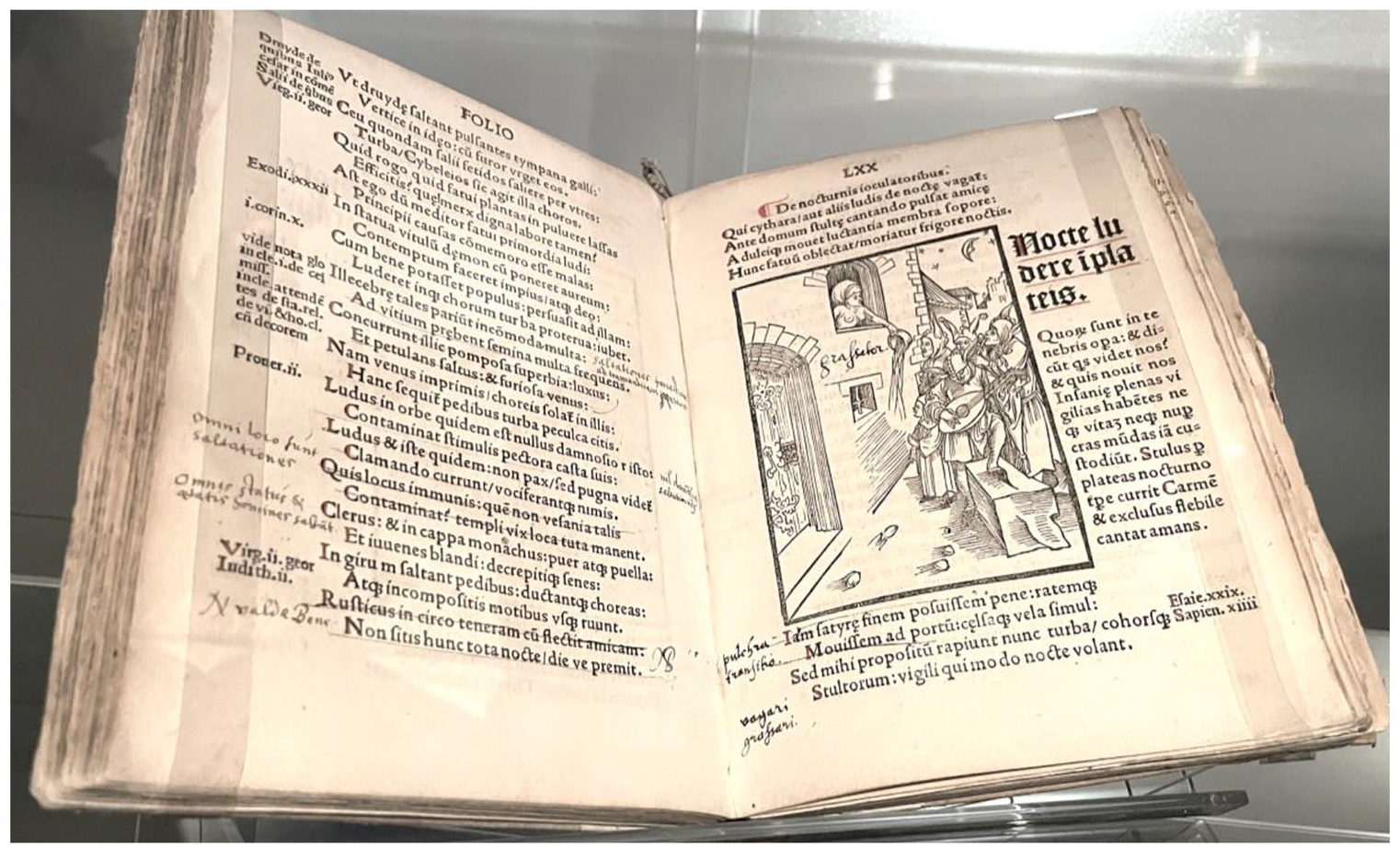
Sebastian Brant’s (1457/58–1521) The Ship of Fools – a moral satire about human behavior, printed in Basel in 1497. Photograph by author.
Second, another literary work that was popularized by Gutenberg’s printing press and that is curated in the exhibition is the Dance of Death by Jost De Necker. The Dance of Death gives the exhibition visitor an experience of how lay people in the Renaissance sensed novel perspectives on death. The book visualizes how all walks of people are led to their death by skeletons (Image 2). The popular Dance of Death book gives the museum visitor a sensory flash into how the perception of death was reordered for laypeople through the Gutenberg’s printing press. For the Renaissance reader, the book likely made a difficult topic easily accessible through large pictures and short verses next to the images. The organizational aesthetics scholar is triggered to wonder about the sensible knowing that occurred in the printing process. How were the sensory relations between the headings, the picturesque four-sentence paragraphs on the right, and the terrifying skeleton with bony fingers on the left developed at the press? Such material choices in books are inescapably aesthetic political actions that resist or police dominant understandings.
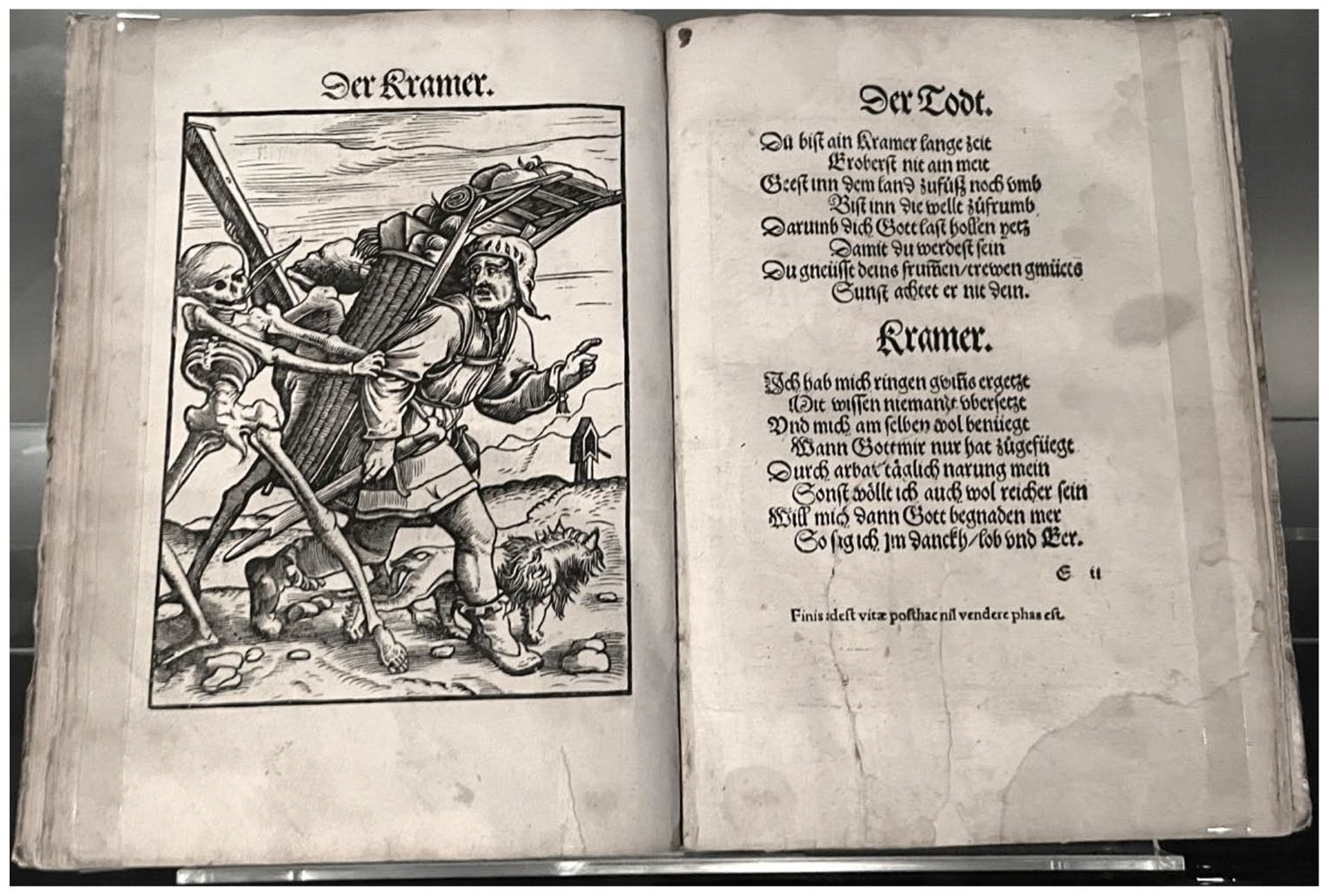
Jost De Necker’s (1485–1544) Dance of Death – allegorical presentation of the power of death based on the woodcuts by Holbein, printed in Augsburg in 1544. Photograph by author.
Third, a breathtaking book on display in the Natural Science section is the Cartographic representation of the world by Claudius Ptolemaeus (100–175). The book was a historical milestone in cartography as it mapped the parts of the world that were known in early antiquity. Ptolemaeus wrote as early as 300 AD, and such cartographic understandings of the world were at the time restricted to the literate religious clergy. Through Gutenberg’s printing press, over a thousand years later, the 1482 version of the book constructs, for the museum visitor, a perspective on early Renaissance geographical reading, where Ptolemaeus’ cartography became easily accessible in libraries. For an organizational aesthetics scholar, the political implications of the book are striking as the book on display cartographically presents the world with notable blank spaces. The page on which the book is open in the display case shows large areas of the southern hemisphere mostly blank (Image 3). The image also misses the American continent. Through the visual details of the book, the museum visitor gains a glimpse into what it must have felt like for the early Renaissance reader when they got their hands on the Cartographic representation of the world. The careful details of the represented cities, seas and continents convey the narrow geographic understanding of the Renaissance. As a scholar interested in organizational aesthetics, I am triggered to reflect on the political implications of the aesthetic choices made at the Gutenberg’s printing press. As a result, I remain curious over the voices that aesthetic style variation privileged in the early Renaissance.
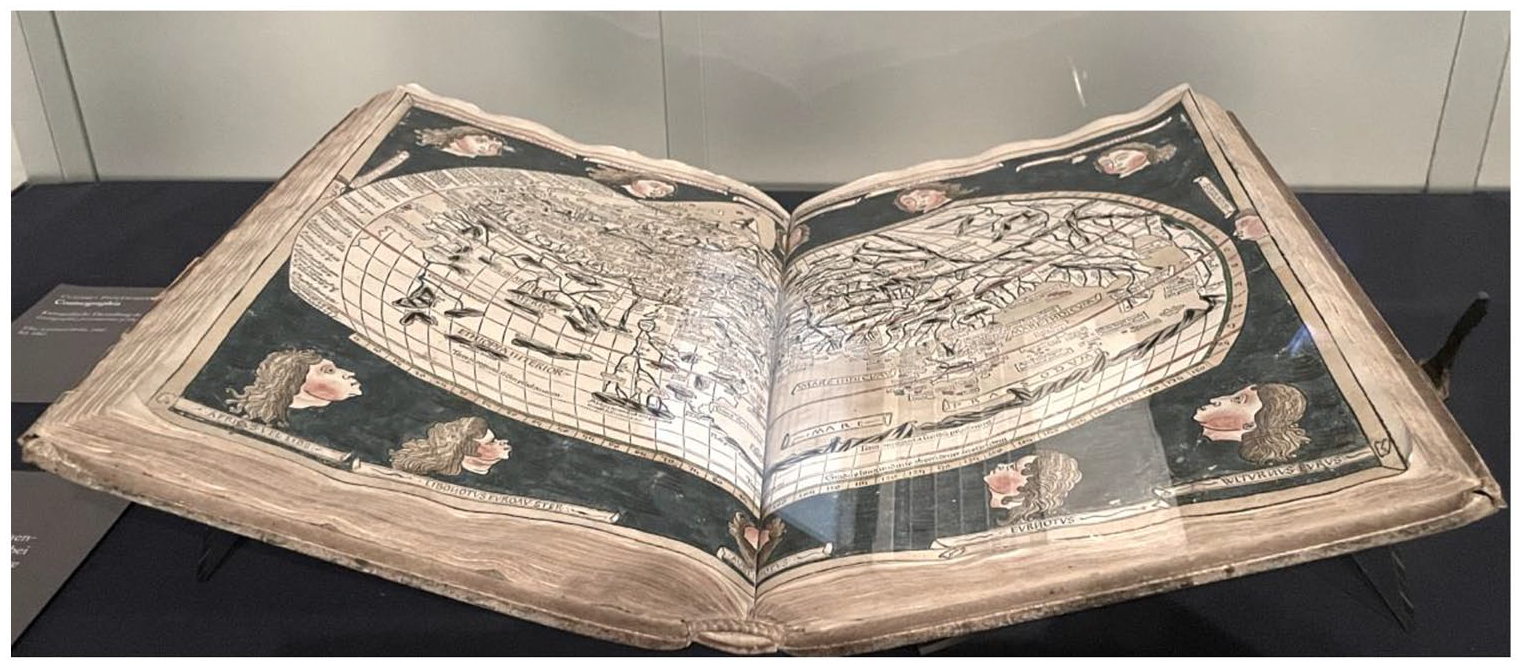
Claudius Ptolemaeus (100–175) Cosmographica – cartographic representation of the world, printed in Ulm in 1482. Photograph by author.
Fourth, in the theological section, a glass case displays how Gutenberg’s printing press produced lighter theological booklets that allowed for opinion to be spread to the public. On display are the “Polemic against the Prevailing Catholic Teachings” and “Programmatic Reformation Document” by Martin Luther, printed in 1522 and 1523, respectively. The booklets appear thin and light, consisting of around 20–30 pages. The covers are neatly decorated, and Martin Luther’s name is clearly printed (Image 4). The programmatic reformation document has the text “Dass eine Christliche Gemeinde Recht und Macht habe, alle Lehre zu beurteilen und Lehrer zu berufen” translated approximately as “That the Christian community beholds rights and powers to legitimize all teachings and teachers”. The leaflets float on thin glass, and the museum visitor gains a tactile sense of how people in the Renaissance who got their hands on Martin Luther’s pamphlet felt as they read the text printed in large font. While the use of pamphlets is widespread today and we do not react to them with surprise, the way that the Gutenberg Museum curates Luther’s Reformation booklets in connection with the organizational printing press innovation helps the visitor sense the aesthetic variation of lightweight booklets in the Renaissance. The curated booklets allow the visitor to reflect on how the sensory experiences of materiality were inescapably webbed with historical and political processes (Beyes, 2017, p. 1478). An aesthetics lens helps scholars pick up historical aesthetic traces of political processes.
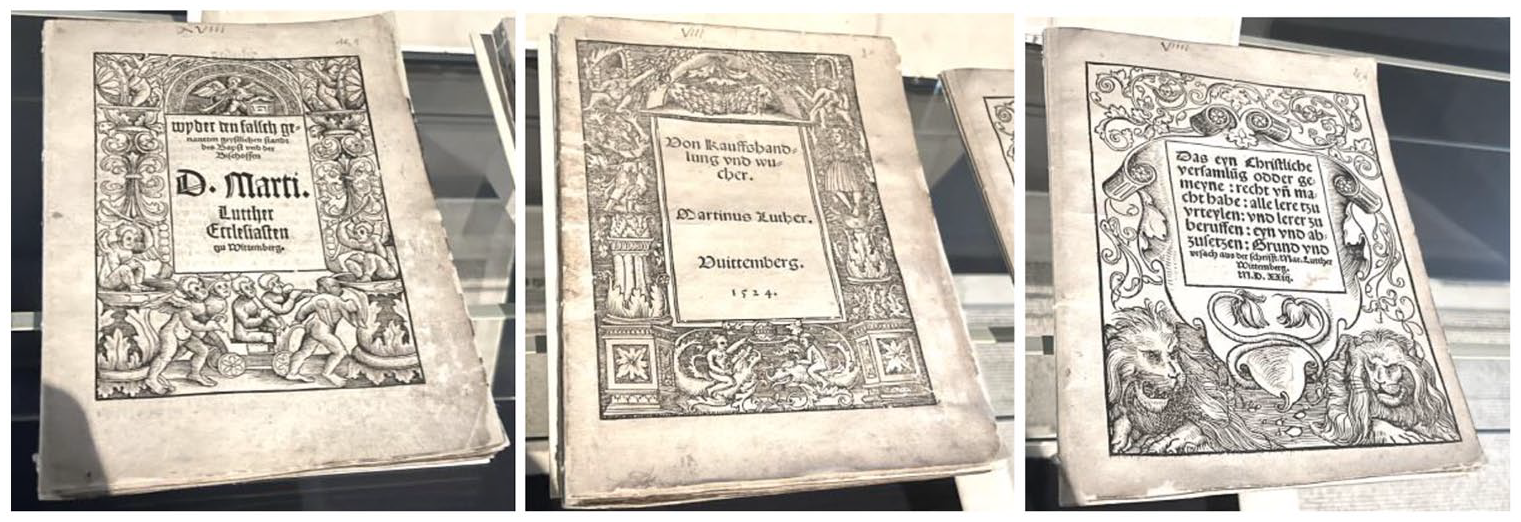
Martin Luther (1483–1546). From left: “Polemic against the Prevailing Catholic Teachings”, “Programmatic Reformation Document 1”, “Programmatic Reformation Document 2”. Printed 1522–1524 in Erfurt and Wittenberg. Photograph by author.
The politics of old books through organizational aesthetics
The Gutenberg Museum is a treasure chest for an organization scholar interested in organizational aesthetics. The visitor re-experiences carefully curated Renaissance books and the aesthetic details “redistribute the sensible” (Rancière, 2004) of how books were written and read. The exhibition becomes a powerful aesthetic ordering and disordering (Beyes, 2017, p. 1469) of shifting Renaissance knowing through books. The curated book details of fonts, paper quality, book size, scribbles, and images become affectivities that give aesthetic impressions of how the text was experienced. Light-weight theological pamphlets, pocket-size page-turners, and heavy-weight cartographic encyclopedias all convey different materialities in aesthetic processes (Strati, 2019). Such materialities provide historical contours of old books, and open research possibilities on the historically constituted regimes of perception and sensibility (Farias, Fernandez, Hjorth, & Holt, 2019).
As the old books convey the revolution of text sensing in the Renaissance, the visitor is triggered to wonder what voices Gutenberg’s innovation and the contemporary museum leave untold. The contemporary museum space articulates a specific interpretation (Yanow, 1998) of old books, even before I get a chance to sense the positioning of the books on display. During my visit, I felt that the Gutenberg Museum could have opened up for critical reflection on the spatial perpetuation of normative symbolism (Wasserman & Frenkel, 2015, p. 1501) of valuable old books. While other rooms in the museum exhibit fascinating historical developments in Islamic book art, printing in Asia, and Cuneiform script, the focus on Johannes Gutenberg and western Europe leaves organizational aesthetics-related questions open. Who had the right to speak and to be heard (Holm & Beyes, 2022, p. 238) in Renaissance book printing in Europe? The reorganizing of book sensibilities were undeniably aesthetic-political acts. The scholar interested in organizational aesthetics is left yearning for an exposition of the political and historical power of the sensible knowing that was privileged and produced at Gutenberg’s printing press. The “Books after Gutenberg” exhibition triggers a queer historical interest into the Renaissance voices left silenced. After a day or two at the “Books after Gutenberg” exhibition, the visitor leaves in wonder over what Gutenberg’s printing press did or did not do to books in Renaissance Europe and is hopefully filled with curiosity over the political power of organizational aesthetics that books and new forms of media, such as those reviewed in the media review section of this journal, enact in contemporary society.
Footnotes
Funding
The author disclosed receipt of the following financial support for the research, authorship, and/or publication of this article: The author received financial support from the Foundation for Economic Education in Finland.