




Abstract
Organizations often depend on experts to carry out complex tasks that require specialized or tacit knowledge. Yet, organizations often want to increase their control over how tasks are performed and thus reduce the autonomy of experts. In the past, scholars have argued that experts had the ability to rebuff organizational attempts to control them. However, in an era with increased digitalization and centralization in organizations, experts risk losing control. How experts react when facing this increased centralization and digitalization is not well understood. Thus, this study seeks to improve knowledge on how experts react as organizations digitalize and centralize control over tasks. To do so, we studied a large energy company, which sought to increase its control over tasks and reduce the autonomy of its expert engineers by implementing an organizational change that included centralization and digital control. Using in-depth interviews, we portray how the expert workers reclaimed control using three micro-level tactics – strategic compliance and workaround, using legacy to reclaim control and concealing expert control. Based on these findings, our paper makes three contributions to the literature on experts and control. First, we provide the concept of ‘stealth work’, outlining how experts can reclaim control when centralization and digitalization have otherwise stripped them of status and power. Second, we highlight how expert control may be nested in organizations as a legacy, which experts can use when facing centralization and digitalization, and finally, we highlight how experts can engage in small hacks that curb the usefulness of digital control systems.
There is an off-the-records agreement over who is actually responsible for technical stuff. There is an illicit list in the drawer showing who is actually in charge. (interview with engineer and union representative in ‘North Energy’)
Introduction
Organizations often depend on experts such as lawyers, doctors, engineers or scientists, who possess specialized and often tacit knowledge that the organization needs for certain tasks to be accomplished (Bechky, 2021; Huising, 2014, 2015; Noordegraaf, 2020; Waring & Currie, 2009). Although organizations need the experts to carry out key tasks, like a hospital needs its doctors to perform surgeries and other key tasks (Currie, Lockett, Finn, Martin, & Waring, 2012), organizations often want managers and not frontline experts to be in control so that the managers may decide procedures, processes and order of tasks to be completed (Burawoy, 1979; Huising, 2014). This is because the managers represent organizational interests whereas experts may represent their own or their profession’s interests (Kellogg, 2019; Muzio & Kirkpatrick, 2011; Noordegraaf, 2020). An example of this struggle is Waring and Currie’s (2009) study where they highlight how risk managers sought to wrestle away control from doctors with regard to patient safety in the hospital, thus pushing managerial control into the technical core of the organization. Experts often fight back when organizations try to take away their jurisdictional control – decision-making with regard to tasks and activities – and give it to managers (Huising, 2014; Waring & Currie, 2009), sometimes just simply by ignoring commands and policies (Kellogg, 2009). Typically, researchers have argued that the ‘balance of power’ favours the experts, suggesting that initiatives designed to transfer control to managers were largely ineffective (Alvesson, 2004; Vallas, 2006). For large parts of the 20th century, experts enjoyed a significant degree of autonomy and could control tasks within their jurisdiction (Abbott, 1988; Muzio & Kirkpatrick, 2011). However, two factors may be tipping the balance of power towards organizations and managers. First, scholars note a cultural shift towards managerial dominance in modern organizations. For example, Bromley and Meyer (2021) note the rise of ‘hyper management’, where abstract thinking and leadership skills outweigh expertise, while Muzio and Kirkpatrick (2011, p. 394) note a shift towards the ‘managerial professional business’ where bureaucracy and formalization regulate expertise. Thus, organizations are increasingly moving towards centralized control regimes where managers focus on controlling and explicating processes and knowledge (Brivot, 2011; Suddaby, Bévort, & Strandgaard Pedersen, 2019). As a result, Bechky (2021, p. 176) argues that experts are ‘captured’ inside modern organizations, referring to the fact that experts are being increasingly put under the yoke of managers, who seek to survey the experts and dictate their work (Bechky, 2021; Kellogg, 2019; Paton, Hodgson, & Muzio, 2013). Second, new technologies have further empowered managers and organizations. For instance, algorithmic management control systems have been found to disempower experts and empower organizations (Bucher, Schou, & Waldkirch, 2021; Kellogg, Valentine, & Christin, 2020). At the same time, new technologies may erode expertise (Beane, 2019) or change the profession’s status in the organization (Goto, 2021). As a result of these trends, experts have lost standing in their traditional functional hierarchy and now face managers, who find new and innovative ways of undermining expert control (Huising, 2014; Kellogg, 2019; Noordegraaf, 2020). The question then becomes whether experts can reclaim control in modern organizations where control is centralized and digitally managed (Bechky, 2021). Will experts find new tactics to reclaim control and avoid being ‘captured’ by managers? To investigate this, we ask: How can experts reclaim control in a modern organization characterized by a shift towards top-down decision-making and digital control?
We examined this through an in-depth qualitative study of expert engineers working on oil platforms in a large multinational energy company, which was undergoing organizational change. Through this organizational change, the energy company sought to centralize control over tasks and take away control from individual expert engineers, who had operated with a large degree of individual authority out on the oil platforms. Furthermore, the company implemented a digital tool that created a central overview of all tasks, which was to further disempower the expert engineers. Yet, we found that the expert engineers had found new tactics to reclaim control. We found that they used strategic compliance and working around the new control regime, that they used legacy to reclaim control and that they concealed expert control. These tactics provided them with control over tasks, which were supposed to be centrally and digitally managed. We conceptualize these tactics using the term ‘stealth work’, which delineates tactics that covertly and subtly undermine managerial control and provide experts with unofficial jurisdiction.
Our study makes three contributions to the growing literature on the interplay between experts and managerial control (Baylon & Barros, 2023; Brivot, 2011; Currie et al., 2012; Huising, 2014, 2015; Kellogg, 2019; Waring & Currie, 2009). First, we add a new set of stealthy and subtle tactics that experts use to reclaim control, which we conceptualize as ‘stealth work’. We suggest that these tactics are especially prevalent and useful in cases where experts have lost status and power, and thus are unable to maintain boundaries and institutions as before. Second, our paper illustrates that despite the cultural shift towards managerial dominance, legacies of expert control may be nested inside organizations. These legacies can assist experts in reclaiming control. Third, our study highlights how experts may exploit the gap between their knowledge and digital representation to ‘hack’ digital systems, and thus curtail their efficiency.
Theoretical Background
The negotiation of expert control in modern organizations
By their very nature, for-profit organizations desire control over the labour process (Burawoy, 1979), meaning that they want managers to control what workers are doing and how they are doing it. On the other hand, experts desire autonomy and control, meaning that the experts want freedom from managerial supervision, and they want to control the tasks and activities in functions pertaining to their expertise, their jurisdiction (Abbott, 1988). For example, doctors want control over medical procedures (Waring & Currie, 2009), lawyers over matters of the law (Zald & Lounsbury, 2010) and engineers over their field (Bechky, 2003). In his seminal work, Abbott (1988) details how experts carved out specialties ranging from medicine to law to engineering by creating professional associations that regulated who was an expert, what experts did and how they worked. For example, the American Society of Mechanical Engineers pushed for the formalization of engineering work during the late 19th century (Abbott, 1988, p. 230).
Scholars have pointed to two main ways that experts negotiate control in organizations. First, they have pointed to institutional work, which encapsulates how experts legitimize and protect practices, processes and norms, thus fashioning institutions that provide them with control (Lawrence, Leca, & Zilber, 2013; Micelotta & Washington, 2013). For example, Currie et al. (2012) illustrate how doctors sought to protect medical professionalism as an institution by reinforcing norms and practices through different forms of institutional work. According to this perspective, experts can negotiate control by legitimizing their status, jurisdiction and practices in an organizational field, such as medicine (Currie et al., 2012; Micelotta & Washington, 2013). While the institutional work can occur from the micro to the macro level (that is, being driven by individual actors), this form is precarious (Tracey, 2016). Therefore, for experts to maintain institutions, they often need support from other members of their profession (Currie et al., 2012), or a professional association (Abbott, 1988; Micelotta & Washington, 2013), meaning that institutional work is often meso level to macro level. Second, experts can engage in boundary work, defined as how they create, maintain or disrupt boundaries inside their organization (Langley et al., 2019). An example is Bechky’s (2003) study of how engineers and technicians use mastery of material objects, such as drawings and machines, to claim authority and legitimacy. In this perspective, experts negotiate control by drawing social and symbolic boundaries around tasks and decision-making authority, that is, their jurisdiction. Usually, this happens on the micro level inside the organization (e.g. Bechky, 2003). These two forms of work are connected and essentially centre around the same thing, that experts seek to make it recognized and accepted that they are in charge of a certain area (Abbott, 1988; Zietsma & Lawrence, 2010). In the past, scholars have argued that experts have been able to succeed in this and have argued that organizational attempts at taking control over experts’ work were mostly futile (Alvesson, 2004; Huising, 2014, p. 1633; Vallas, 2006).
The return of managerial control
However, trends in society and technology have caused the pendulum to swing back in favour of managerial control. The first of these trends is the cultural shift towards managerial dominance in organizations. Scholars point to different reasons for this shift. Critical management scholars refer to the dominance of neoliberalism (Picard, Durocher, & Gendron, 2021; Sanson & Courpasson, 2022), while sociologists point to the ascent of ‘hyper management’ (Bromley & Meyer, 2021). These terms largely describe the same phenomenon,. namely, a trend where organizations implement new knowledge management systems that aim to codify expert knowledge and create surveillance practices (Bechky, 2021; Brivot, 2011; Muzio & Kirkpatrick, 2011). Organizational design and managerial tactics are constantly developed to take control out of the hands of experts (Bechky, 2021; Muzio & Kirkpatrick, 2011). For example, Huising (2014) demonstrates how organizations may initiate certain censure episodes, where managers construct expert practices as being at odds with organizational goals and therefore in need of adjustment. Doing so, organizations and managers deliberately seek to delegitimize expert control (Huising, 2014). This cultural shift means that experts struggle to maintain their institutions and jurisdictions inside organizations (Bromley & Meyer, 2021; Heimstädt, Koljonen, & Elmholdt, 2023; Sandholtz, Chung, & Waisberg, 2019; Wright, Irving, & Selvan Thevatas, 2021).
The second trend is the rise of new digital technologies of control (Bailey, 2022; de Vaujany, Leclercq-Vandelannoitte, Munro, Nama, & Holt, 2021). These technologies can affect experts in two ways. They can alter expertise in organizations as the technologies are being used to augment or replace expert knowledge (Beane, 2019; Lebovitz, Lifshitz-Assaf, & Levina, 2022; Pachidi, Berends, Faraj, & Huysman, 2021; van den Broek, Sergeeva, & Huysman, 2021). For example, van den Broek et al. (2021) show how organizations may try to replace experts with machine learning in hiring, although the outcome of this is mixed. Similarly, Pachidi et al. (2021) show how sales expertise is replaced with data analytics in a large company. In Pachidi et al.’s (2021) case, experts’ symbolic resistance increased the tendency towards their judgement being replaced by algorithms. Then, technological advances in digital tools and the big-data revolution have facilitated fine-grained, high-frequency, low-cost measurement of individuals’ work (Ranganathan & Benson, 2020, p. 573). A predominant example of such new technologies is the use of algorithms to survey, track and measure work (Kellogg et al., 2020). While algorithmic management has so far mostly been found in the gig economy (Bucher et al., 2021; Rahman, 2021; Waldkirch, Bucher, Schou, & Grünwald, 2021), it is increasingly sneaking into traditional organizations (Kolb, Dery, Huysman, & Metiu, 2020). Using these technologies, organizations are able possibly to measure and predict the expertise of their workers (Kellogg et al., 2020, p. 379), thus allowing for stricter managerial control.
Due to these two trends, scholars talk of experts increasingly being ‘captured’ by organizations (Bechky, 2021; Stice-Lusvardi, Hinds, & Valentine, 2023). They argue that experts are losing autonomy, having their expertise questioned, and that control is shifted to managers (Bechky, 2021; Wright et al., 2021). As a result, scholars have started to identify new ways that experts react when their expertise is questioned and they lose status. For example, Chan and Hedden (2023) show that when facing powerful stakeholders, experts strategically modulate how, and to what degree, they display their values, while van Wieringen, Groenewegen and Broese van Groenou (2017) find that experts engage in covert tactics to protect their jurisdiction, and Huising (2015) shows that they engage in menial work to try to reclaim control over their jurisdiction. While such studies have extended our knowledge of alternative ways that experts react to managerial encroachment, some crucial gaps remain. First, while these studies show that experts generally lose their official status and position (e.g. Bechky, 2021), they hint at the possibility that experts find subtle and covert ways of reclaiming control (e.g. Huising, 2015; van Wieringen et al., 2017). But, at present, it is unclear how subtle and covert expert tactics may accomplish this (Heimstädt et al., 2023). Moreover, while this form of work relates to institutional work and boundary work, it is unclear how. Institutional work and boundary work more clearly lead to either resistance or change in the profession, but this other form of work seems to blur such lines (Chan & Hedden, 2023). For example, it is apparently more covert than institutional work and boundary work, as experts may conceal how they are actually working (e.g. van Wieringen et al., 2017).
Second, there is a debate on how much control digital systems may afford organizations. Some take a dim view and note that virtually all workers will be surveilled and controlled by ‘bossware’ (Bailey, 2022), even noting that ‘resistance is futile’ and will lead to even more surveillance (Anteby & Chan, 2018). Others are slightly more optimistic. Pakarinen and Huising (2023) argue that expertise is not just abstract, but relational and generated in interactions with other actors and with objects. Similarly, Newlands (2021) argues that digital systems struggle to capture important details and nuances, leaving an ‘epistemological gap’ between workers’ physical reality and the digital reality in the system. In other words, digital systems may struggle to capture some elements of workers’ expertise, thus leaving them with leeway to avoid digital control (Newlands, 2021; Pakarinen & Huising, 2023). Yet, there is limited knowledge regarding how experts may exploit the space left by the epistemological gap to resist digital control (Pakarinen & Huising, 2023). Moreover, there are questions as to whether this form of resistance is impactful or whether it is mostly symbolic (Newlands, 2021). Indeed, research on how experts handle the rise of new digital technologies of control is in its infancy (Benbya, Pachidi, & Jarvenpaa, 2021). Thus, we end up with the question: How can experts reclaim control in a modern organization characterized by a shift towards top-down decision-making and digital control?
Methods
Research context
The setting for our study is a unit in a large energy company undergoing companywide change. The firm, ‘North Energy’, decided to undergo this change in response to the oil price shock in 2014, where the oil price dropped 44% in the span of a few months, representing one of the most dramatic drops in history. As the lion’s share of the revenue for North Energy came from oil exploration, production and refining, this hit the company hard. Furthermore, North Energy faced increasing demands to move away from oil exploration and production and towards renewable energy. These demands created an overall impetus to reorganize oil exploration and production across the company. This reorganization included our unit, ‘Platform Maintenance’, which was responsible for maintaining the oil platforms.
‘Platform Maintenance’ had been organized in a particular way. Historically, the engineers had been hired to work on single oil fields and felt a special attachment to them, even feeling a stronger attachment to the platforms than to the organization itself. Out there on the platforms, engineers would take care of maintenance tasks as they arose. Through working with Operations, which was an independent unit, engineers in Platform Maintenance would be alerted to problems and solve them. They were essentially individual platform mechanics. As a result, engineers had a large degree of autonomy and could do pretty much what they wanted. One middle manager described his first days in North Energy as an ordinary engineer after coming from a competitor this way: ‘it was like coming to engineering heaven. No one asked how much things cost. If you wanted to do something, if you needed a long weekend, if you wished to travel offshore. You controlled everything yourself. It was absolutely amazing’ (middle manager, I 12). A common reference was that engineers were operating like ‘small kings’ out on the platforms, not taking orders from anybody. In sum, the engineers had had near full autonomy and jurisdiction over tasks, meaning they defined the nature and content of the work and how tasks were to be solved (Abbott, 1988). The reason for this large degree of autonomy and control over tasks was that the engineers were experts, possessing specialized and tacit knowledge over their domain (Abbott, 1988). The engineers were often highly trained, some even possessed doctorates in engineering, and often had decades of experience, meaning that they possessed deep and tacit knowledge of the quirks that platforms had developed over time.
Yet, management now saw this form of ‘expert rule’ over tasks to be inefficient. Thus, the reorganization sought to shift the control over tasks to managers, thereby facilitating ‘economies of scale’. As one manager described it: ‘it is a bit like an assembly line approach: if you do things over and over again you get good at them’ (manager, I 3). The reorganization in Platform Maintenance consisted of three elements: (1) the experts were reorganized from working on individual platforms to working in units based on specialization; (2) jurisdiction over tasks was taken away from the experts and given to frontline managers; and (3) tasks were now to be registered in a digital tool, managed by the frontline managers. Figure 1 outlines the change process over time:
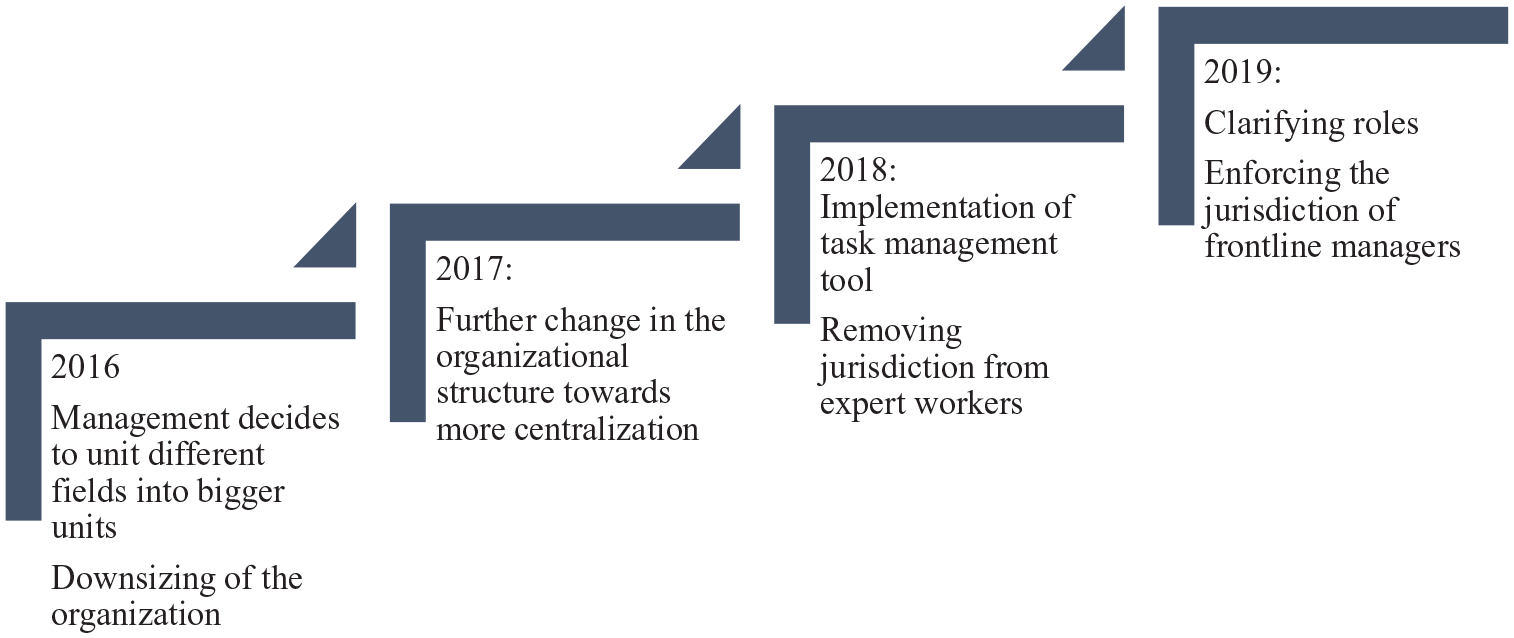
Outline of the change process in ‘North Energy’.
In practice, these three elements represented a drastic change from how Platform Maintenance had been organized previously. Now, the engineers no longer had the authority to solve tasks on their own. Instead of simply picking up the phone and doing the job when someone called with an issue, they now had to wait for a manager to delegate the tasks. Thus, the expert engineers could no longer be sure that they got their preferred tasks or be sure that they could solve the tasks the way they wanted to. The engineers were no longer in charge out on the platforms, but instead were reduced to a liaison, reporting problems and tasks into a digital tool and then waiting for the managers to make the decisions. This tool also created a sense of surveillance because it made the experts’ work visible to their superiors, who could rank the experts, review how they solved the tasks and even suggest how they should solve them. In Figure 2, we illustrate what the change meant in practice for the expert engineers.
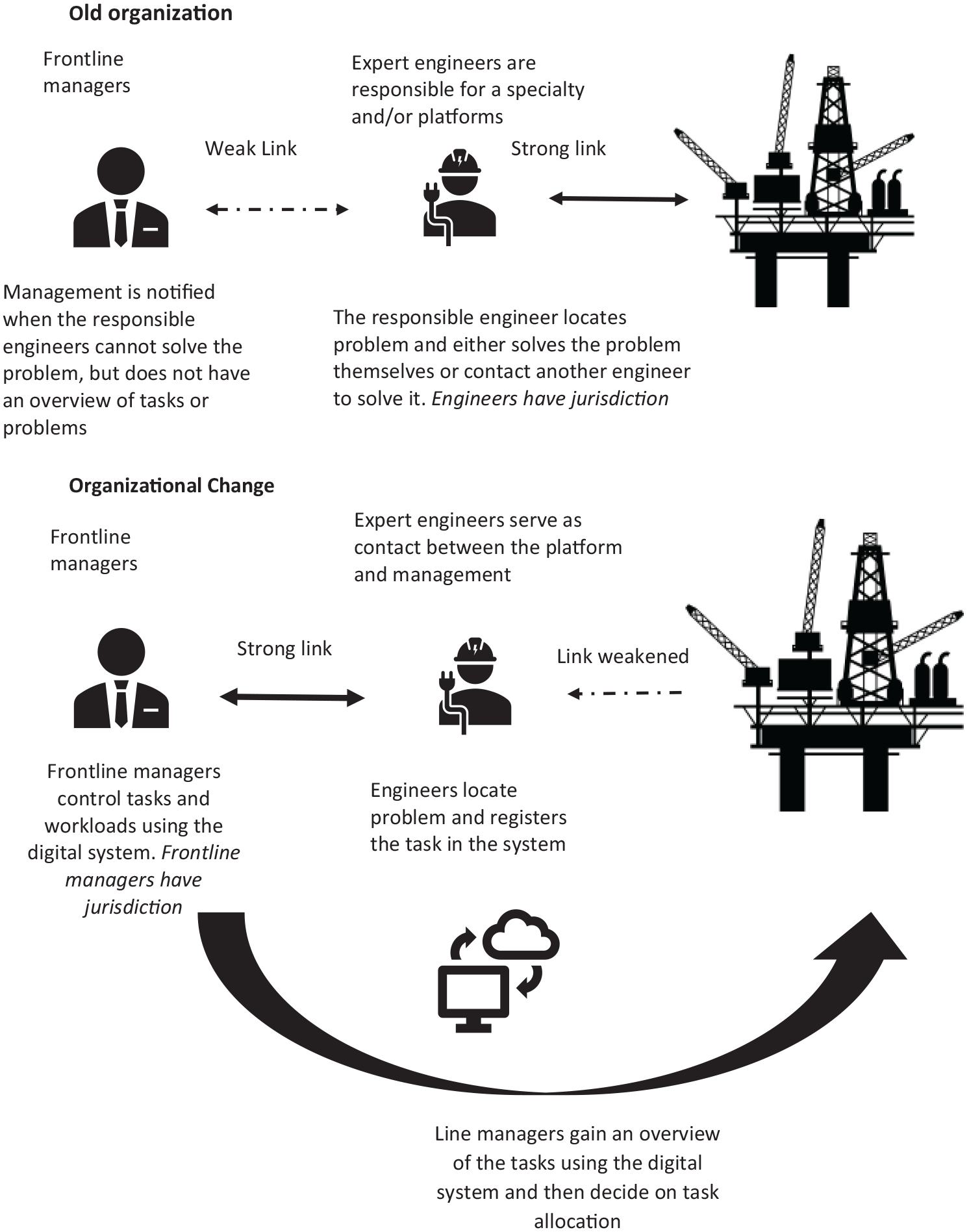
Outline of how the organizational change redistributed jurisdiction over tasks for Platform Maintenance.
This change in jurisdiction was met with fierce resistance from the engineering corps. Managers trying to enforce the change noted that engineers openly referred to them as dictators and they noted that some engineers would sit and sulk in meetings. HR noted that they experienced ‘unacceptable behaviour’ from some senior engineers. The engineers themselves felt that they had had their authority and jurisdiction ‘pulverized’, as one engineer noted.
However, all of the managers now described how they had successfully overcome resistance to change. Managers talked about the implementation in the past tense. Instead, they highlighted that the resistance had subsided, and they had managed to implement the change. ‘They are accepting the change. They understand it. I think the enthusiasm is a little bit divided, but it has become much better’ (middle manager, I 13) and ‘My impression is that the new organization of projects is a success with respect to achieving economy of scale and streamlining’ (middle manager, I 11).
Yet, we then found the experts, in this case the engineers who went out and worked on the platforms, describing how they had reclaimed control: ‘it takes a couple of years and then it is back to how it worked previously. It always happens. It is a law and I bet that it will not take long before it is back to normal here again’ (lead project engineer, I 33). Across the organization we found employees, lead project engineers and several frontline managers noting that there had been a ‘return to normal’, or ‘going back to the old way’. In other words, the expert engineers reported that in their eyes they had reclaimed control and were now back ‘being kings’ out on the platform.
This made North Energy an interesting case to understand how experts, in this case platform engineers, could reclaim control in an organization that was shifting towards a centralized and digitalized control system, where the managers felt they had taken control.
Data collection
We initiated contact with management in mid-2019. At the end of 2019, we negotiated access and conducted pilot interviews with management and HR. From March 2020 to August 2020, we collected data. To collect our data, we conducted in-depth interviews. We relied on purposeful sampling where we interviewed informants from across the organization and from multiple levels (Lincoln & Guba, 1985). We chose informants by engaging in constant comparison where we compared data across informants, analysed the data and then sought new informants based on this (Gioia, Price, Hamilton, & Thomas, 2010). For example, if we talked to a line manager who noted certain issues with implementing the change, then we would seek to interview the expert engineers working under this line manager. Overall, we ensured a wide array of informants that covered levels from top management to engineers on the front line. We also took care to cover different units in the organization.
Interviews were done in person or over videophone during the Covid-19 pandemic. Interviews focused on the informant’s role, experience, perception of the changes made since 2016, resistance to change and activities to implement change. We took care to take a historical perspective (Maclean, Harvey, & Clegg, 2016), by having informants go through their history in the organization, starting with their background, moving up to the period before the change and then during the change. Interviews lasted on average 55 minutes. In total, we collected 48 semi-structured interviews, which all were recorded and transcribed except one. We also took notes for every interview. In addition to the interviews, we also gathered strategy documents outlining the change, and the reasoning behind it, as well as the unions’ response.
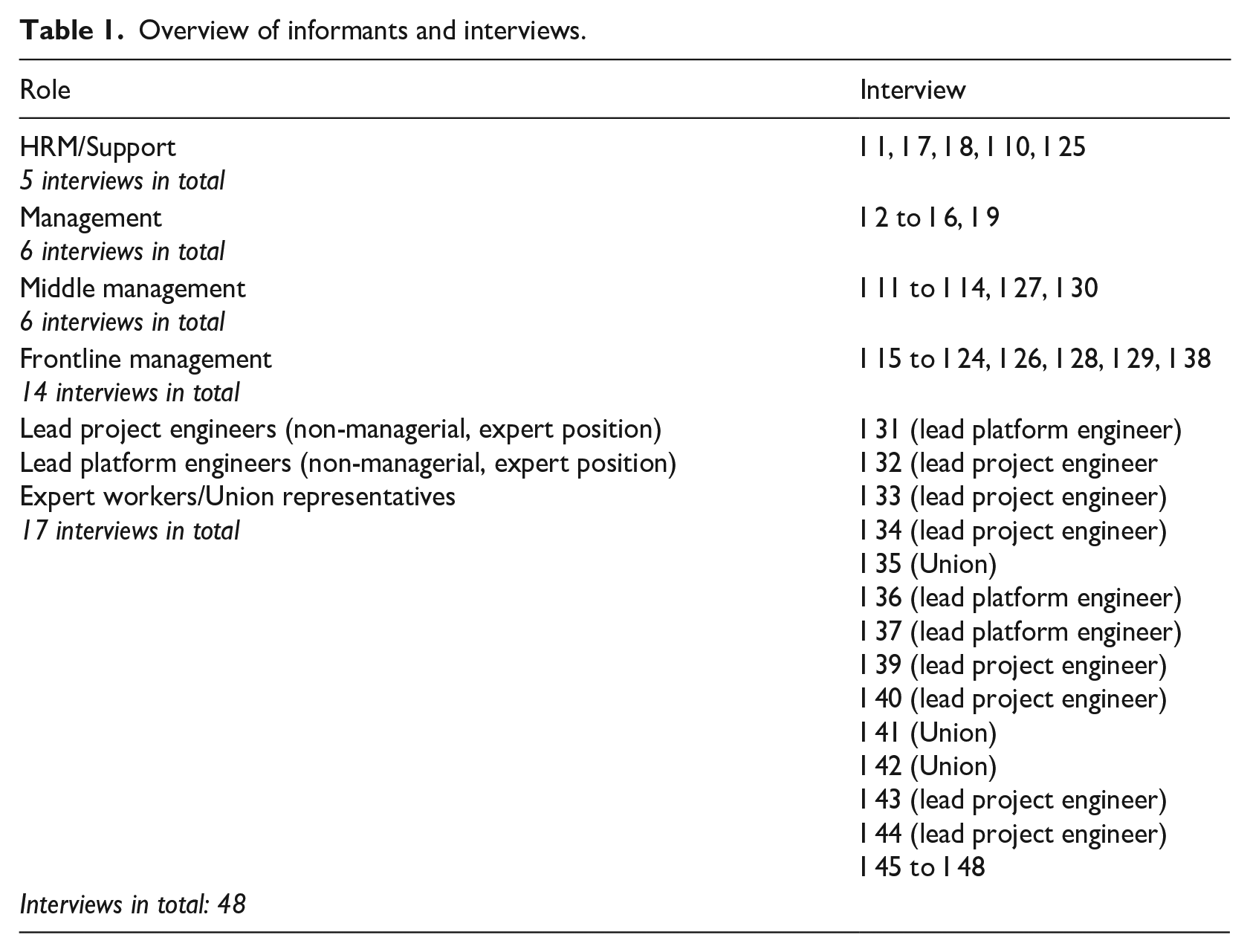
Seventeen of our interviews were with engineers who fit our definition of experts. We define experts in our study as workers who possess superior knowledge, such as tacit knowledge of the platforms, but who do not have managerial responsibilities or authority. The expert engineers we focus on reported directly to a frontline manager and had their performance evaluated by this manager. Another 14 interviews were with these frontline managers, who usually also were engineers and understood the field, but who now managed a small team of engineers and were supposed to take over control from the engineers. However, they lacked specific knowledge of the platforms. The rest of the interviews were with higher level managers and support personnel. Table 1 provides an overview of informants and interviews.
Overview of informants and interviews.
Data analysis
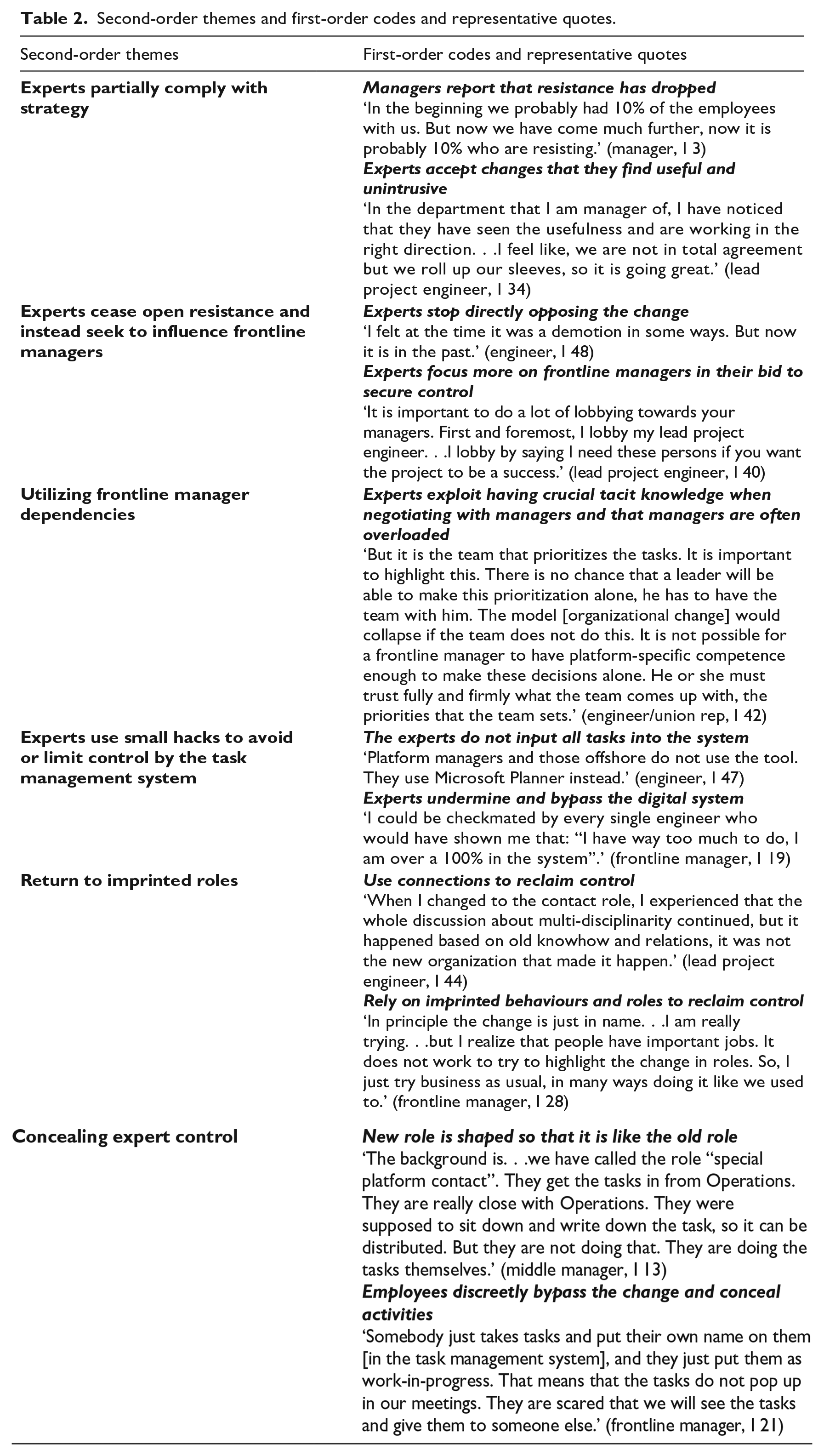
Our data analysis was conducted in three main steps following the Gioia model of coding, where we gradually move from informant-centric codes to theory-centric codes (Gioia, Corley, & Hamilton, 2013). First, we openly coded interviews and interview notes using MaxQDA. This resulted in a large number of open codes, yet we noted that the most frequent codes centred around the organizational change and how the experts reacted to it. Second, we coded these open codes together into second-order themes (Locke, Feldman, & Golden-Biddle, 2022). Doing so, we noted that during implemention of change to increase efficiency, recurring codes were: experts feeling they lost freedom, resistance to the change and tactics in dealing with the change. During this coding, we coded statements together into patterns, creating a chronology of the change process in Platform Maintenance (see Figure 1). Based on this chronology, we then investigated how the change process had unfolded and how it had affected the experts. It was here that we noted a tension in the data. While management and HR described how they had successfully implemented the change, had reduced resistance and secured jurisdiction over tasks, the expert workers told a different story of how they had reclaimed control. By now, our story was transforming from a simple organizational change story and into a story of how experts had reclaimed control despite the organizational change towards centralized, digitalized control of tasks and workers. Third, we started to code for how experts reclaimed control. To do so, we especially relied on statements from the engineers themselves and their frontline managers. We did so because the locus of control was between engineers (old organizational model) and frontline managers (new organizational model). Hence, if we wanted to understand who had control and why, we needed to understand the perspective of both sides. Moreover, evidence from the frontline managers was crucial because the engineers typically worked in isolation on the platforms, and therefore could not always inform us about what other engineers in their unit did. The frontline managers could, and thereby they verified statements from individual engineers and gave us a more holistic picture. As we identified certain patterns, we engaged in more theoretical coding where we connected our patterns to theory. It was at this point that we started connecting our emergent findings with theory, such as theory on brokerage (Kellogg, 2014). In doing so, we identified three tactics in our data that workers used to reclaim control: strategic compliance and workaround, using legacy to reclaim control and concealing expert control. We summarize this in our data structure in Figure 3 with ‘proof quotes’ in Table 2.
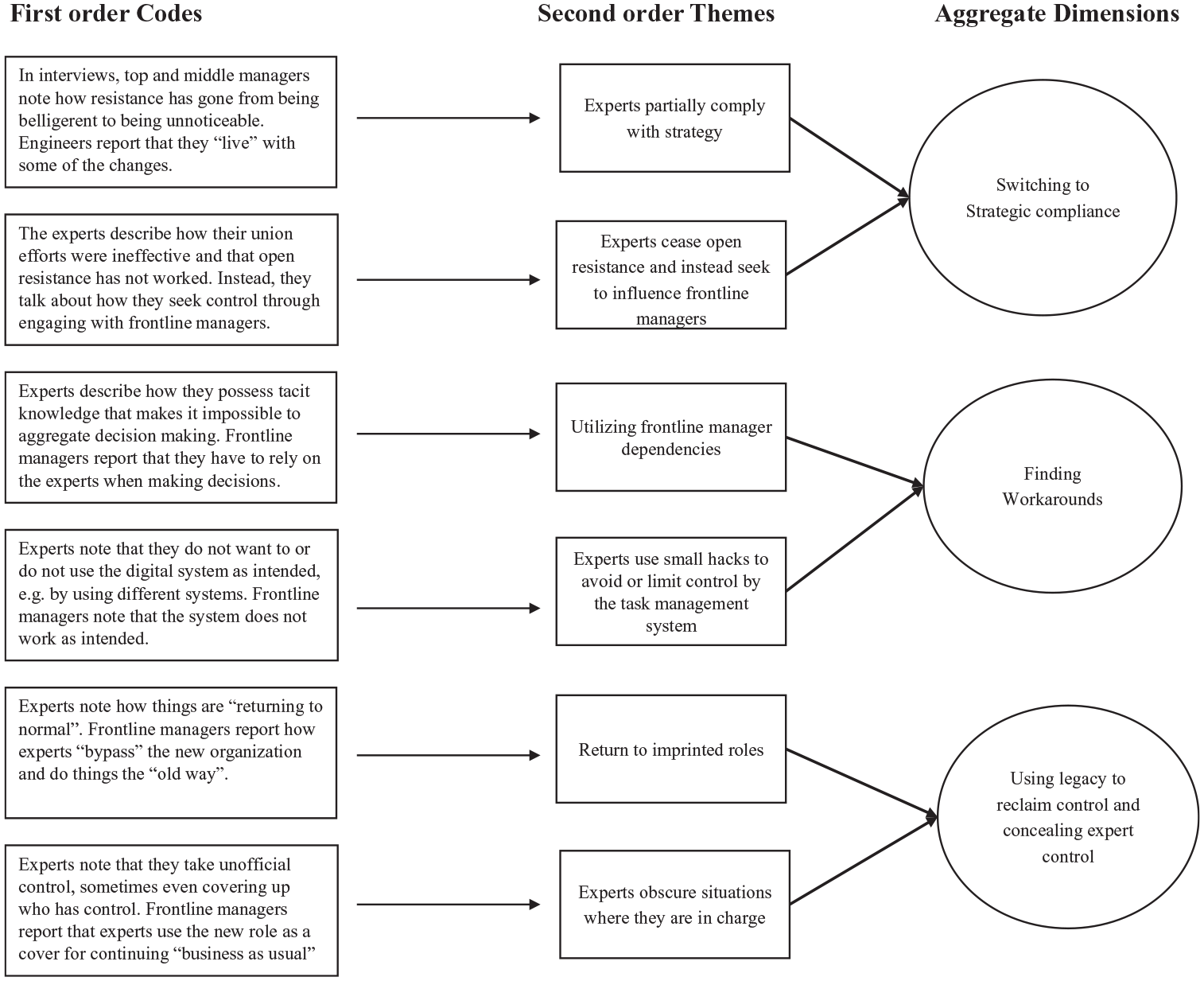
Data Structure.
Second-order themes and first-order codes and representative quotes.
To ensure the trustworthiness of our findings (Pratt, Kaplan, & Whittington, 2020), we conducted two checks. First, we applied investigator triangulation, where the second author independently read and analysed the data to form their own opinion and challenge the first author. Second, we did member checks with our case organization to secure fidelity between our interpretations and the informants’ experience.
Prelude
As we entered the organization, the first part of the battle for jurisdiction was already over. When the change had first been announced, the engineers had reacted by fighting this change through their union. This is a typical strategy for professions to protect themselves against unwanted reform (Micelotta & Washington, 2013). Yet, this attempt at buttressing the strategic change evidently failed: ‘We saw it as that the company had already decided on the strategy. There was not a single adjustment in their strategy based on suggestions from employees. Not one’ (employee, union representative, I 35). Instead, management reported that they had won the battle over who had jurisdiction over tasks, the repair work and projects out on the platform: ‘we have been on a long change journey, and now most workers have a broader set of tasks’ (middle manager, I 11).
However, then we noted that the experts reported that they had reclaimed control. This was surprising because the experts’ union had been ‘captured’, its traditional role in securing the experts’ jurisdiction being overruled (Paton et al., 2013, p. 230). Thus, we sought to unpack the paradox where management reported having won the jurisdictional battle, while the engineers noted how they had reclaimed control.
Our findings point to a crucial switch in tactics by the experts from using their union and openly resisting the change to more quietly seeking to work around the change. We refer to this as stealth work, which is the different tactics used by experts to subtly undermine the jurisdiction of managers and bypass the reorganization, thus allowing the experts to reclaim their jurisdiction. We outline three tactics that make up this concept in the findings.
Findings
Switching to strategic compliance and workaround
The first of these ‘stealth work’ tactics we call strategic compliance and workaround. This tactic consists of experts sending signals of compliance to middle and top management while finding ways to work around the change in jurisdiction out on the front line, using gaps in the system and frontline manager weaknesses. We summarize this tactic and its elements in Table 3.
Stealth work tactics: Strategic compliance and finding workarounds.
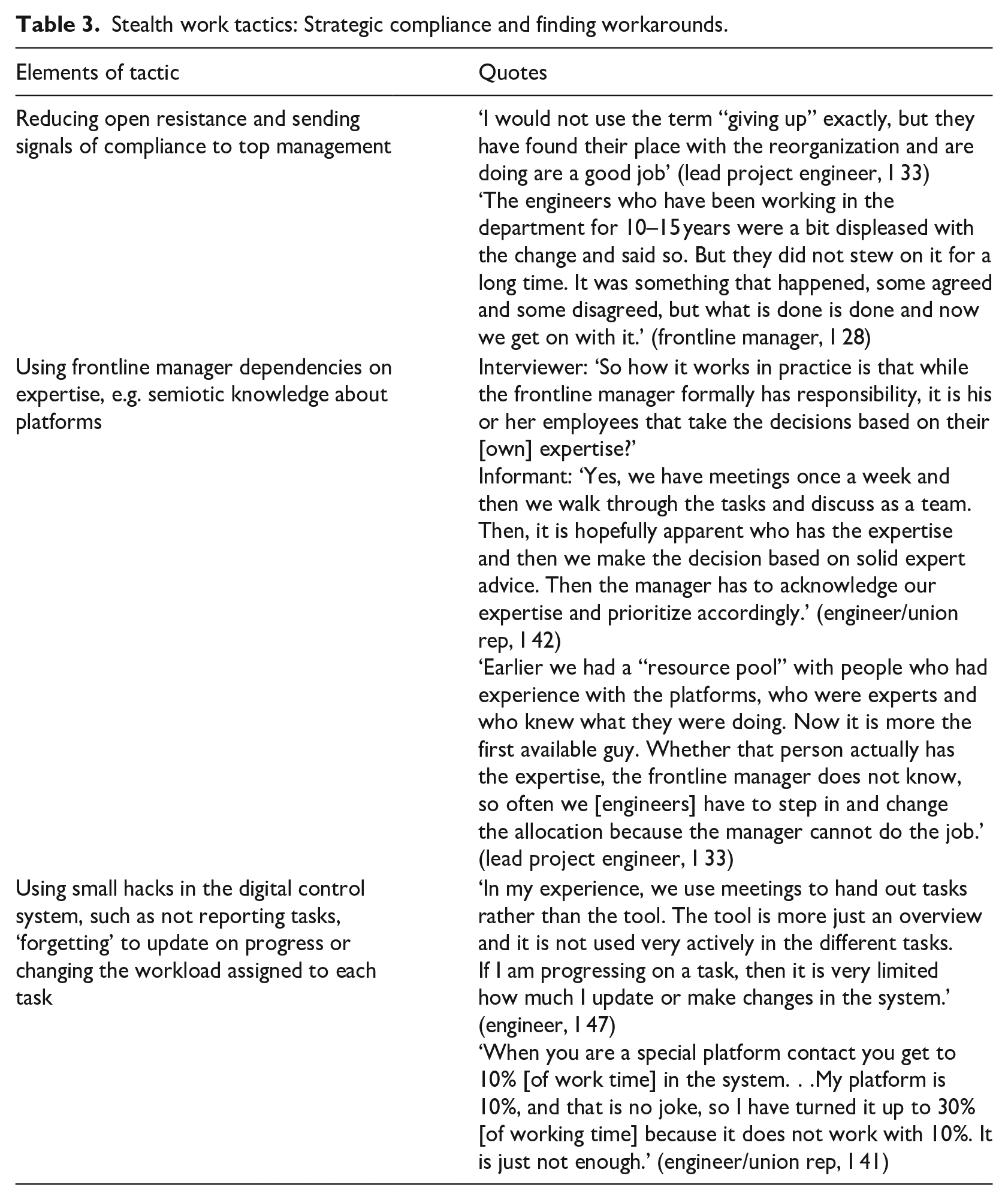
A key element of this tactic was that the engineers overall stopped openly contesting that management now had formal jurisdiction over tasks. Instead, engineers complied with the notion that they no longer had formal jurisdiction and they – at least symbolically – adopted the task management tool by registering tasks, especially larger ones, into this digital system. This led management to believe that the change was going well: ‘We are not quite there yet, but we have come much, much further than when we started’ (manager, I 3).
This led to the second element. Instead of focusing on engaging with top management through the unions, the experts now focused on the frontline managers and utilizing their dependence on the experts’ knowledge. The engineers found certain ‘pressure points’, for example, they found areas where frontline managers technically had the authority to make the engineers do something, but the frontline managers often lacked knowledge of single platforms, making them dependent on the engineers who possessed crucial tacit knowledge about the platforms. As one engineer noted: ‘I feel that management wants to believe that every single platform is the same. But they are not at all. They have very different equipment and different requirements for documentation. . .they are very different’ (engineer, I 45). Therefore, in day-to-day work, frontline managers often had to delegate task management to the engineers because the frontline managers were too far removed from the platforms and did not know how to solve the problem.
Finally, the experts employed ‘small hacks’ in the digital control system. For example, experts would refrain from inputting all the tasks into the system or use their own preferred system instead: ‘It is like people are driving left and right at the same time. . .some transfer the tasks to SAP. . . there are too many “Kingdoms” that are allowed to work on their own’ (engineer/union rep, I 42).
We found that the experts tended to work around the system, usually with the excuse that the system did not improve their work and that they might as well just send a direct email: ‘It is the same tasks that must be done. If you get them on email or through the tool, that does not really matter to the people doing the job’ (engineer, I 46). The small hacks to the system were not obstructive to the work, but they hindered managers from directly surveying who was doing what or how much each engineer was doing. As the frontline managers mostly focused on getting tasks done, they usually accepted that the tool would be compromised in practice: ‘I can’t be too focused on the rules on this type of allocation [in the tool], I have to keep it flexible and just get a kind of average representation [of tasks]’ (frontline manager, I 19).
We also found that the experts would sometimes employ more devious ways to hack the system, such as overloading the task descriptions with long, irrelevant copy-and-pasted texts that the manager then had to deal with: the challenge in relation to the tasks is that in principle we should make simple descriptions of the tasks. . .but then people start copy and pasting texts and they use more information than needed. . .and the poor sucker who must manage all the tasks, he has to read all the description and there is a lot of text that is just irrelevant. (frontline manager, I 15)
Across our interviews, we found mentions of these small hacks used by the engineers and we found evidence that this behaviour undermined the system as the small, individual transgressions were systematic: ‘There are so many who do not use the tool or who use it in their own way’ (engineer/union rep, I 41). The result was that the system did not work as intended and frontline managers would express displeasure with the system with one noting: ‘I see there is a large number of tasks that are not registered in the system. . .Instead, there is a lot of mails and chats, and that makes the tasks hard to manage’ (frontline manager, I 15). Another simply stated that: ‘to us the task management tool is just rubbish’ (frontline manager, I 22), and that to him the tool made no difference at all.
Overall, this first tactic is the foundation of stealth work as experts switch their strategy from open to stealthy resistance, and alter their target from top and middle management to frontline managers, against whom they start to employ workarounds. This tactic is useful for three reasons. First, strategic compliance signals acceptance to top management, who had been accustomed to fierce resistance and even abuse: ‘They compared “Tim” [a manager] to Stalin, me to Hitler and “Mary” [a manager] was compared to the Chinese leadership. . .in the beginning we had like 10% of the engineers with us’ (manager, I 3). Hence, when the engineers stopped calling management into meetings to sling abuse at them, and instead started going to work, management felt the change had started to work.
Second, while the frontline managers represented management’s desire to implement the change, they also had the responsibility to ensure that tasks were being completed. Here, they relied on the expert engineers’ ‘semiotic knowledge’, contextual knowledge about subtle differences in materials and machines (Barley, 1996, p. 425). The engineers had specific semiotic knowledge of the platforms, which often had unique characteristics courtesy of having been maintained at sea for decades. When shifting towards focusing on the frontline managers, the experts utilized the fact that while frontline managers had formal authority, in reality they relied on the experts’ semiotic knowledge for the completion of tasks out on the platforms. Hence, frontline managers often accepted that experts had jurisdiction and were the authority when it came to deciding on tasks. Our findings show that holding this semiotic knowledge was key for engineers to reclaim control. Engineers with long tenure on the same platforms were much more likely to report having taken back control, whereas engineers who were new in the position were less likely to. Our findings suggest that the reason for this was that these less experienced or recently transferred engineers did not have superior semiotic knowledge and therefore could not pressure frontline managers to the same degree.
Third, we found that the small hacks undermined the use of the digital system, because they allowed experts to control tasks, but were not severe enough to cause frontline management to alert top management. Top management and HR imagined that the system could ‘streamline’ workflows and the way tasks were solved. Given the tool’s machine learning capability, it was also possible that they wanted the tool to learn to manage tasks over time. But when the engineers did not feed the system correctly, this limited the system. Instead, frontline management used it more as an ‘overview’ for further discussion. Thus, we see, similar to Lebovitz et al. (2022), that systems fail to work properly in practice. The difference is that in our study, the reason that the system did not work properly was that engineers found small, apparently innocent ways of curbing the usefulness of the system. Our findings indicate that the engineers could perform these small hacks because of the epistemological gap between the experts’ semiotic knowledge and the digital representation in the system. In particular, we noticed a time gap between experts and managers. Experts knew quickly how a task was to be solved and who should solve it, and they would often arrange that before managers could. Thus, experts could present the frontline managers with a fait accompli that got the job done efficiently, but which did not really involve the system. While some engineers did seem to use the system faithfully, we found many instances across our interviews where engineers and managers described how they came to use the system more as an overview, rather than a task controlling tool, as was intended.
Using legacy to reclaim control
Having found that the expert engineers were shifting overall tactics from open resistance to ‘stealth work’, we sought to further our understanding of the tactics included in this form of work. Doing so, we identified additional tactics that were used by the engineers. Another of these tactics were using legacy to reclaim control.
Using legacy to reclaim control worked by experts utilizing customs, scripts and traditions that were embedded into the organization (Suddaby & Foster, 2017). A frontline manager summarized this in the following way: ‘It [the reorganization] is a deep cultural change on top of an organization that was there previously, and which has been allowed to dwell in many years, more or less consciously working against the change’ (frontline manager, I 38).
The legacy of the previous organization would come to the fore when the engineers were collaborating across the organization. The other elements of the organization, such as Operations, were used to that it was the engineers who had jurisdiction over tasks and still acted as if the engineers were in charge. This allowed engineers to take back jurisdiction over tasks, especially when the pressure was high. A frontline manager described his problems with the imprinted roles: He who had the technical system responsibility. . .he still has it today. But he does not have the formal title of technical system responsible anymore. . .But in our daily work, we experience that it is the engineers that have the same responsibility as before. . .and all that the people [in Operations] that we have collaborated with during the years, they see that it is really the engineers that have the responsibility. (frontline manager, I 17)
Using these imprinted roles, engineers could bypass management as the other parts of the organization saw the engineers as having legitimate jurisdiction. The other parts of the organization did not understand why the engineers, who they saw as being very capable, had to ask managers, who they did not see as capable, for permission. Hence, they worked as allies who pressured managers into letting the engineers fix the problems quickly out on the platforms.
Another related way that engineers would use legacy was by arguing that their ingrained habits were faster than the new managerial route. This was particularly effective because the organization had been downsized and managers were under pressure to perform. Frontline managers would often not seek to start a conflict given the time pressure and simply let the engineers go along the unofficial route: ‘They acquire resources directly and carry out the tasks, they do not go the managerial route. They are bypassing the whole organizational change to finish the tasks, often with the argument that they do not have time’ (frontline manager, I 38). Similarly, an engineer noted how he wanted to bypass the centralized system because it was too slow and generic: Management sets up a group centrally that takes forever to work on it, 1–2 years, and they come up with a solution. Then, we say that this does not fit. . .You cannot have a generic solution that fits everyone. We are not McDonalds. We need individual solutions. (lead platform engineer, I 37)
Finally, engineers would rely on old connections within Platform Maintenance to make sure that they worked with the same people as before and that things to a large degree stayed the same: I try to affect it as much as possible. I have a regular team that nearly always have with me. Yet, the idea was that we should use this tool to request resources and then it would be random. But I believe that this works very, very poorly. (lead project engineer, I 40)
Engineers were able to affect team allocation because they had more knowledge about the platform and the people working on it. In contrast, the managers often did not quite know what team constellations would work, forcing them to rely on the engineers and their old connections. We summarize the using legacy to reclaim control in Table 4.
Stealth work tactics: Using legacy to reclaim control.
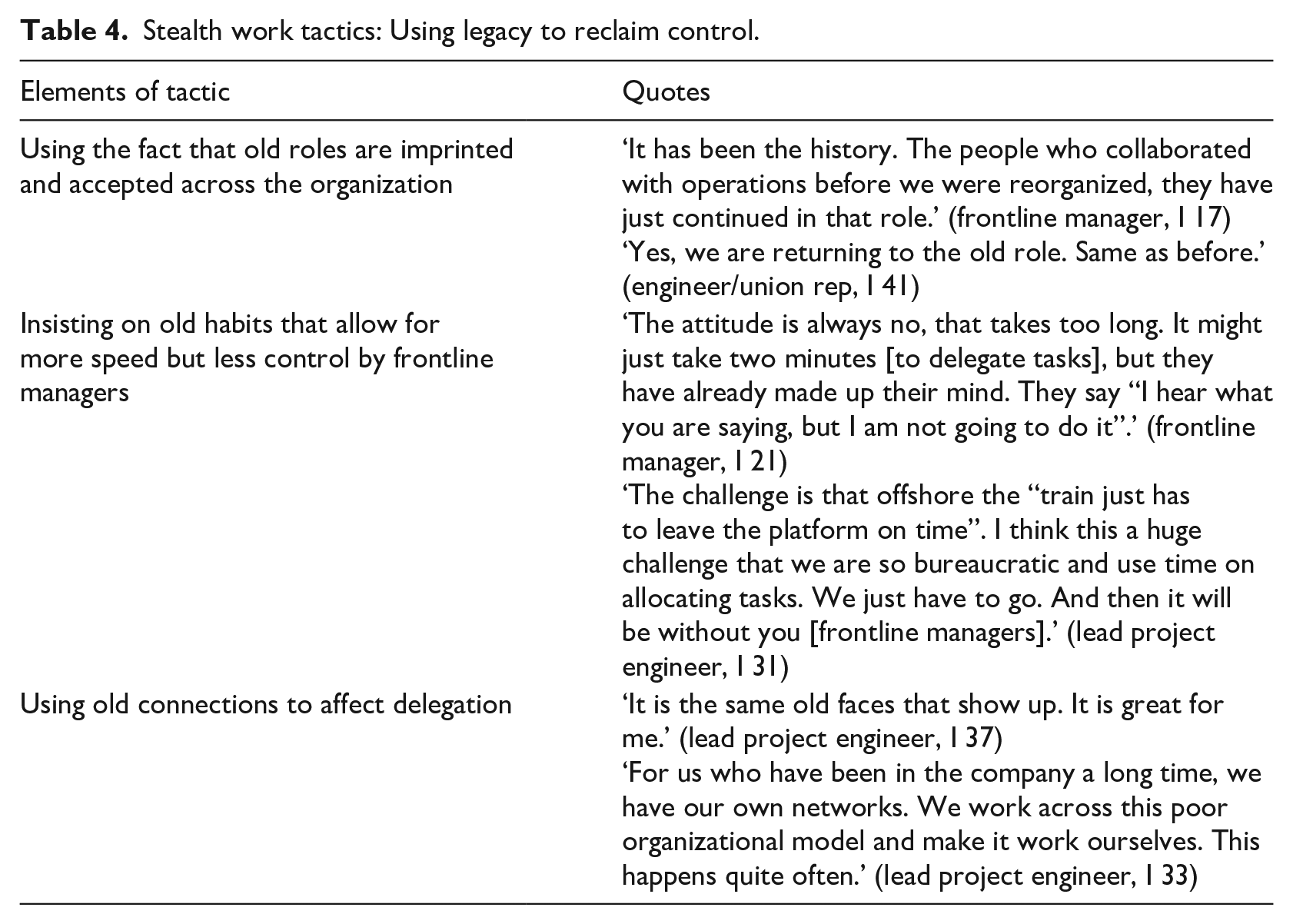
Overall, we found that this tactic of using legacy to reclaim control was effective for three reasons. First, using imprinted roles can be effective when collaborating with other parts of the organization that are unaware of the change in jurisdiction. In our case, the employees in other parts of the organization, mainly Operations, still saw the engineers as having jurisdiction and were against management taking over jurisdiction. This put the managers in a tight spot where they could choose between on the one hand pushing through the reorganization and annoying their clients in the other parts of the organization, or else they could ignore the reorganization and get on with solving tasks. Often, the managers chose the latter option. Second, using old habits can be effective under time pressure because they are seen as safe and quick, therefore frontline managers would often not enforce a change in these habits. Third, it is well established that strong social ties provide informal power in organizations (Coleman, 1988). In this case, these ties provided engineers with more knowledge on who could solve tasks, so when they suggested people for tasks, frontline managers would usually rely on that knowledge. This form of presenting solutions to other groups is known as ‘buffering’ (Kellogg, 2014). Similar to Kellogg (2014), we find that by buffering information, experts can claim control over tasks. As with using semiotic knowledge, being able to use legacy is strongly dependent on experience in a role. Engineers with long tenure in the same position would report that they ‘knew everybody’ and that frontline managers had to rely on them to ensure correct staffing and solution of tasks. In contrast, engineers who had recently been moved or employed could not engage this legacy of expert control and would be more likely to either accept managerial control or bemoan the lack of own control.
Concealing expert control
The final stealth work tactic concerned how engineers concealed expert control from the eyes of top management. This tactic consisted of employees concealing old roles under the cover of a new role, concealing how they actually did things in their daily work and getting tacit frontline manager acceptance of the engineers reclaiming control. Officially, the engineers had lost jurisdiction over tasks and were now just responsible for liaising between ‘clients’, other parts of the organization reporting a problem on the platforms, and the managers. This new role was called ‘special platform contact’. It was seen as a downgrading as engineers before had been responsible for their own engineering specialty or a technical system.
Yet, our data highlighted that for many engineers this new role had become the same as the old role. Engineers had managed to boost the new role, so it included a lot of the same power as the old. An engineer described it as follows: ‘Yes, earlier it was called technical system or specialty responsible. Now it is called special platform contact. . .But you feel the same responsibility as before. . .You do the same as you did before. . .’ (engineer, I 46).
While this layering in the old role into the new role covered up how well the change had been implemented, the engineers also took other measures to conceal that they were taking back control. One employee noted that out on the platforms: ‘there is an off-the-records agreement over who is actually responsible for technical stuff. There is an illicit list in the drawer showing who is actually in charge’ (engineer/union rep, I 41). Such concealment was not necessarily done with bad intentions, but with the intention of allowing the engineers to do their job. It was also done because sometimes regulations enforced jurisdiction going to the engineers and not to the managers. For this reason, frontline managers would often ‘silently accept’ that engineers had taken back control. Another reason for this was that several frontline managers had not felt included in the change process and therefore did not take ownership. An employee explained why: ‘My take is that they [frontline managers] were just as surprised as the unions [with respect to the change] and that some were a bit scared over the responsibility that they had been given’ (engineer/union rep, I 42). In Table 5, we outline the elements of concealment.
Stealth work tactics: Concealing expert control.
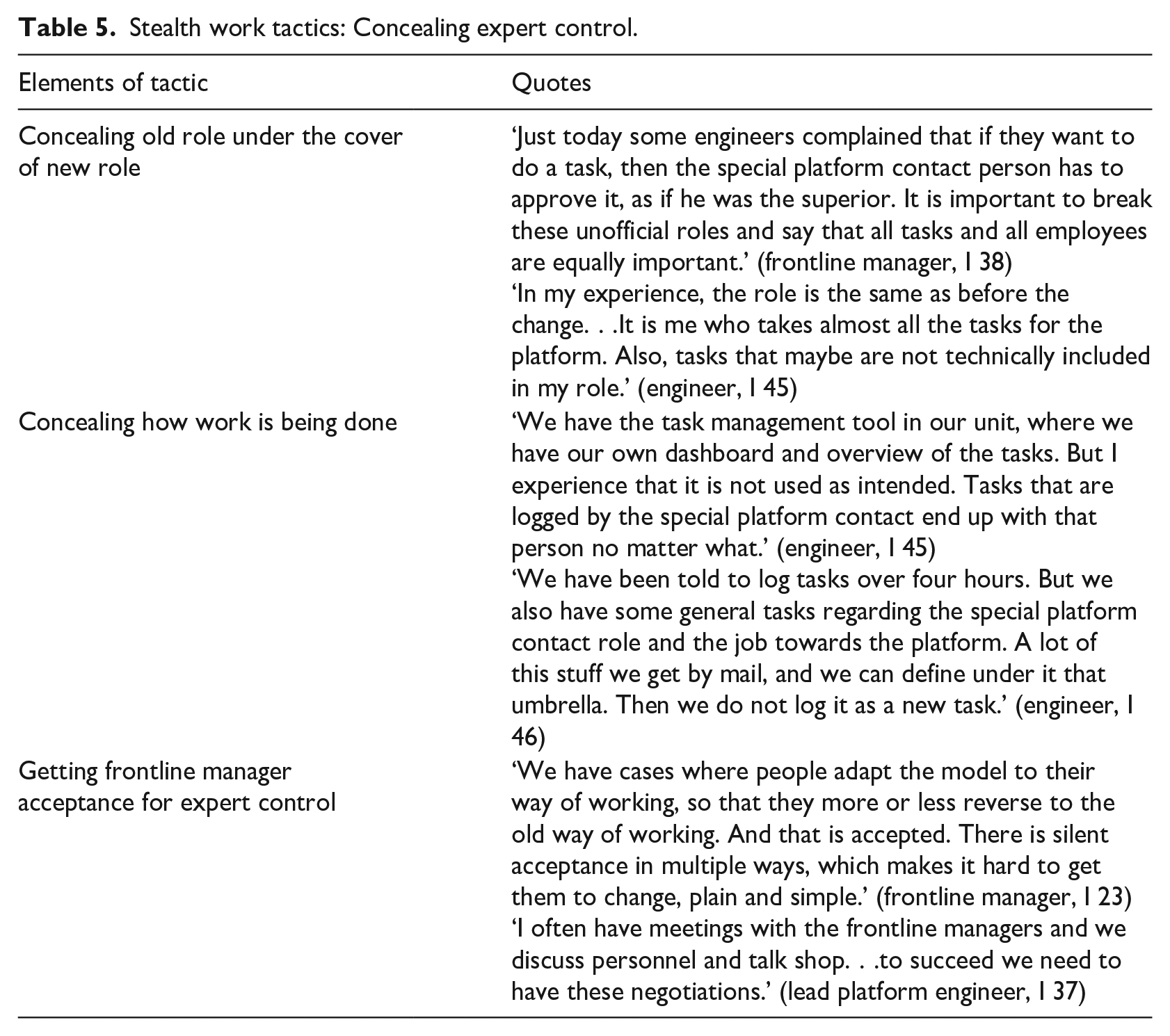
Our findings point out that concealing expert control is effective in reclaiming control because it cloaks the true state of affairs to top management. Management may have performance indicators and a formal overview of the organization, but it is hard for them to see how things are being done in the day-to-day work. When employees conceal how they are really working, meaning that they intentionally or unintentionally cover up informal ways of working under formal directives, then it is difficult for managers at higher levels to see it. Concealment may be particularly important. Recent work has shown that when managers are made aware that employees are trying to escape surveillance, then they tend to increase surveillance (Anteby & Chan, 2018). Hence, concealment is a key part of stealth work. It may protect experts from alerting top management and inspiring them to increase surveillance.
Discussion and Conclusions
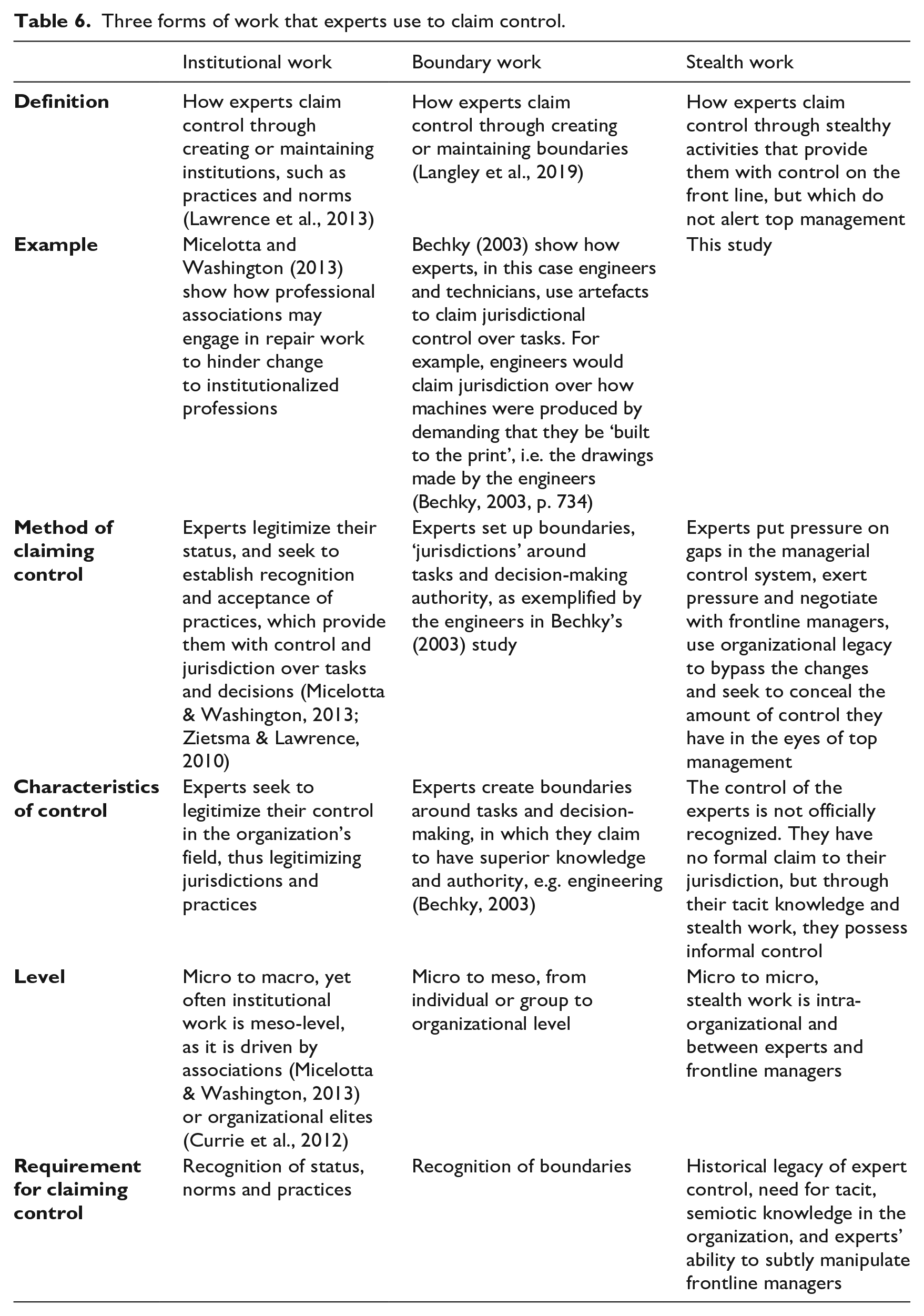
In our findings, we outline how expert engineers responded to the loss of formal jurisdiction over oil platform maintenance tasks by finding more subtle and stealthy tactics to reclaim control over those tasks. We find three different tactics, which we overall label ‘stealth work’. We find that this stealth work enables experts to reclaim control from the frontline managers, who had been given responsibility over tasks from the engineers during the organizational change. Overall, our study thus provides new insights into how experts may reclaim control when facing centralization and digitalization in their organizations. We pose that stealth work represents an alternate form of work that experts are using to claim control. This form of work is characterized by being on the intra-organizational level between experts and frontline managers, and it both contrasts and compares with previously studied forms of work, in particular boundary work and institutional work. In Table 6, we compare stealth work to institutional work and boundary work, which have been the dominant concepts in understanding how experts negotiate control in organizations so far. Consequently, we discuss three main contributions from the paper.
Three forms of work that experts use to claim control.
Conceptualizing ‘stealth work’ as a new form of expert work
In recent years, scholars have paid more attention to the more menial (Huising, 2015), relational (DiBenigno, 2020) and stealthy tactics (van Wieringen et al., 2017) by which experts may claim control. However, there has not an overarching understanding of this type of work, and scholars have not answered how the tactics reclaim control. We do so by conceptualizing stealth work as multiple sets of activities, which include strategic workarounds, using relations (DiBenigno, 2020) and concealment (Chan & Hedden, 2023; van Wieringen et al., 2017), that allow experts to claim control in organizations that are centralizing and digitalizing. The related prior work has mostly focused on how experts placate and work around stakeholders, such as clients (e.g. Chan & Hedden, 2023; van Wieringen et al., 2017), and we extend this work by showing how similar tactics can be used to negate the enforcement of managerial control. We point to three reasons why stealth work may succeed. First, when experts use stealth work, they are not advertising that they are claiming control over tasks. They may take over tasks in their daily work, but they do not signal this to top management. In fact, engineers may seek to conceal that they have control. This contrasts with the two other forms of work where experts seek to make it known and accepted that they have control (Zietsma & Lawrence, 2010). Second, when employing stealth work, actors skilfully use organizational legacy. They utilize scripts, institutionalized ways of doing things, which can be used even though these are not officially the way to do things any more. The experts in our case had to work around frontline managers and could do so by employing the fact that experts had historically been in charge, meaning that other parts of the organization still regarded them as being in charge.
Third, when employing stealth work, actors subtly avoid the most intrusive aspects of digital control. In our case, the engineers did accept elements of the task management tool, mostly in areas where they did not feel it violated their jurisdiction and autonomy. Then, they applied the hacks to instances and areas where they felt it lowered their jurisdiction and autonomy, such as working on their preferred platform or having to account for all the smaller tasks that they were doing. Experts could so because frontline managers depended on them and thus, they were open to being swayed by experts arguing for why they did not have to use the system. Moreover, experts possessed crucial semiotic knowledge that could not be adequately represented by the system (Newlands, 2021), which further limited the system’s effectiveness and frontline managers’ desire to force it through. Therefore, engineers and Frontline Managers worked together to find the best way to allocate tasks, often relying on physical meetings where the tools played a supporting role. Finally, our findings highlight that the success of stealth work is based on a strong historical legacy of expert control and semiotic expert knowledge. We show that legacy and semiotic knowledge is especially important in convincing frontline managers to silently accept that experts take back control.
We pose that stealth work represents a different way by which experts negotiate control. While it corresponds to boundary work by focusing on jurisdiction, it stands out by focusing on tacit acknowledgement and blurring lines of power rather establishing clear lines (cf. Zietsma & Lawrence, 2010). And while stealth work is also similar to institutional work in the sense that it takes the shape of seemingly unimportant day-to-day activities (Currie et al., 2012), it also differs. Whereas institutional work focuses on how actors justify their privileged position, for example by educating and policing others (Currie et al., 2012), or by moralizing their position (Lawrence et al., 2013), stealth work highlights how experts begrudgingly accept loss of a formal position, and instead unofficially reclaim key parts of their former position, in particular, control over tasks. Therefore, stealth work focuses more on how experts’ semiotic knowledge and their understanding of the organization allows them to negotiate with and pressure managers on the front line. For example, it might very well be that organizations want managers on the front line to control how doctors work (Waring & Currie, 2009), but doctors may be armed with knowledge that managers do not have, such as how to actually cure patients. As managers on the front line also need to ‘get the job done’ to please managers higher up, they face a problem: they need the doctors’ help for them to succeed. Hence, in the front line there may be a ‘trading zone’ of jurisdiction (Galison, 1997), where frontline managers trade unofficial jurisdiction so that experts ‘get on with the work’ and keep the peace. Indeed, this line of thinking fits our findings, for we seldom saw conflicts between frontline managers and experts, despite the fact that they were wrestling over control. Simply, to frontline managers ‘getting the job done’ was more important than stamping down their authority. In illustrating this ‘trading’, our study further highlights the creative and agentic behaviour that experts demonstrate when under pressure (e.g. Currie et al., 2012). Yet, we also show that this behaviour may become less about demonstrating status and values (cf. Chan & Hedden, 2023; Currie et al., 2012), and more about setting up ‘trading zones’, where managers and experts may find compromises to ‘get the job done’, despite the plans of top management regarding centralizing, streamlining and digitalizing control and processes.
The role of organizational legacy in deciding expert jurisdiction
Typically, researchers have focused on how experts legitimize their control in the organization, even when the organization seeks to enforce bureaucratic control (Suddaby et al., 2019). Yet, in our study the experts did not do so. Instead, they relied on organizational legacy in the form of embedded scripts and roles, which helped the experts maintain their reputation as the ones who had the jurisdiction over certain domains, that is, how to decide on maintenance tasks on the platforms (Bechky, 2003). For example, the other parts of the organization, who functioned as Platform Maintenance’s ‘clients’, expected that the engineers were in charge. Thus, we point to the fact that organizational legacy may provide an unspoken reputation to experts, which allows them to maintain their jurisdiction informally. Simply, the engineers have always been the ones in charge, and other parts of the organization perceived them to be, no matter the formal changes.
Our study thereby shows that expert jurisdiction is not just nested in professional associations (Abbott, 1988) or knowledge (Kellogg, 2014), but also in organizational legacy. This legacy is often deeply embedded into organizations and impervious to change (Heracleous & Bartunek, 2021). For this reason, it may be more difficult for managers to capture experts than previously thought (cf. Bechky, 2021). Managers do not just need formal authority; they also need to rid the organization of the legacy of expert control. If other parts of the organization still act in ways that enforce expert control, such as in our case where other parts of the organization would ask for the expert engineer and not the frontline manager, then it is difficult for managers in the frontline to stamp down their authority. This may be similar in other organizations with ingrained expert control. For example, managers may find themselves unable to claim traditional expert jurisdictions in places such as hospitals or universities.
Digital technology and expert autonomy
Our paper also contributes to the discussion around how actors increase agency when facing surveillance and control by new digital technologies (Anteby & Chan, 2018; Bucher et al., 2021; Kellogg et al., 2020). First, we explain how actors can avoid surveillance without provoking a vicious cycle of increased surveillance (Anteby & Chan, 2018). Actors can do so by accepting elements of surveillance, only targeting particular instances and areas that are particularly bothersome, while also securing that tasks are completed efficiently. Doing so, reduces both top managers’ and frontline management’s incentives to institute further surveillance. Second, whereas prior work has argued that actors may take more control as they get to know the system (Lebovitz et al., 2022), we find that actors can take control by knowing the human who is on the receiving end of the data produced. While the hacks we find can be considered ‘low tech’, an important reason why they work is that the engineers engage with their manager. For example, instead of reporting everything in the tool, they talk directly to the manager and settle it by oral agreement. Hence, the engineers know how much they can defy the system, and they provide an alternative route that works for the manager. Thus, we show that relational work (DiBenigno, 2020; Huising, 2015) can be used by experts to reduce the use of digital control.
Third, our findings indicate that experts can exploit the fact that their semiotic knowledge is difficult to capture in a digital system, that is, there is a ‘epistemological gap’ between relational expertise and abstract, digital representation (Newlands, 2021; Pakarinen & Huising, 2023). Because experts had semiotic knowledge, they could more quickly determine how to solve a task, providing them with a distinct advantage compared to the managers, who often had to defer to expert judgement. We noted that frontline managers often complained that they had to defer to the engineers due to their superior semiotic knowledge. Thus, our findings show how experts actively use the ‘epistemological gap’ to construct a way whereby the system is useful for both managers and experts in providing an overview of tasks, but limited in the amount of digital control it gives to managers. Whereas prior work has found similar ways that workers may undercut digital control (e.g. Curchod, Patriotta, Cohen, & Neysen, 2020; Newlands, 2021), scholars have expressed scepticism regarding the overall effectiveness of these tactics. Yet, we find that they can aggregate and undermine the system on a larger level, inducing managers to curtail their overall use of the system. This indicates that these small hacks may be more significant than previously thought. For example, our findings indicate that without precise data to train on, systems that might otherwise replace human decision-making cannot develop the right capabilities.
In conclusion, our study contributes to work on experts and control in three ways. First, our concept of stealth work highlights alternative ways that experts seek to seize control in modern organizations, in particular showing how experts may reclaim control even when they have lost status and position. While prior work has touched upon such tactics, our study is the first to conceptualize them as one form of work. We add detail and knowledge to how they take form, and we explain why they work. Second, we illustrate how expert control may be nested inside organizations as organizational legacy, which serves as a reservoir from which experts can draw authority. Third, we show how experts can avoid digital control through small hacks and by engaging with the manager responsible for managing the system. Thereby, our study enriches the understanding of how experts exploit ‘epistemological gaps’ between their knowledge and digital representations.
Limitations and future research
As an inductive qualitative case study, our study comes with the usual caveats concerning generalizability (Pratt et al., 2020). Findings from our context may not be generalizable to other contexts where there is less history of expert control, where expert knowledge is easier to quantify, or where managerial control has been enforced for such a long time that expert control has all but evaporated. Therefore, the tactics we identify might not work in all types of organizations, and tactics may vary across organizations, leaving a need for future research to investigate the diversity of tactics, their efficiency and in general how control may be ‘traded’ in organizations. Besides these classic caveats to single case studies, our study is limited by a lack of process data (that is, data collected over a longer period), and especially by a lack of ethnographic data (that is, observational data obtained through being embedded in the field. Having such data could have bolstered and deepened our findings. Yet, the Covid-19 pandemic made it impossible to gather ethnographic data. The lack of ethnographic data is critical because we cannot distinguish between the control that experts perceive themselves as having and the control they actually have in the organization. Finally, the lack of process data hinders us from theorizing on how ‘stealth work’ develops over time. Here, future research is needed to understand the evolution of clandestine expert tactics, also investigating whether they are sustainable over time. Moreover, studies could also investigate the possible interplay between stealth work, boundary work and institutional work, such as studying whether stealth work substitutes or complements institutional work and boundary work.
Footnotes
Acknowledgements
We would like to thank Elizabeth Goodrick and three anonymous reviewers for their feedback and help in developing this manuscript. We would also like to thank seminar participants at the Norwegian School of Economics (NHH), and Eliane Bucher for comments on prior versions of this manuscript. Finally, we want to thank the informants, without whom this paper would not be possible.
Funding
The author(s) received no financial support for the research, authorship, and/or publication of this article.