




Abstract
The concept of prefiguration is drawing increasing interest as a lens to study the collective dynamic and transformative potential of alternative organizing. We introduce an analytical distinction between two modes of prefiguration. Situated prefiguration emphasizes affective bonds and direct struggle taking place in bounded organizational spaces, while distributed prefiguration manifests in wider socio-spatial formations. While situated prefiguration has been studied substantially, distributed prefiguration has so far not been adequately theorized. To conceptualize more spatially dispersed forms of prefiguration, we approach prefiguration from a relational perspective, drawing especially on assemblage thinking, which reveals a different way of thinking about how prefigurative practices are spatially organized. We demonstrate different socio-spatial forms of prefiguration in action through an empirical investigation of the zero-waste phenomenon. Our empirical material is built on site visits to zero-waste stores, interviews with zero-wasters and conventional retailers and online sources related to zero-waste. We find that zero-waste stores transcend situated prefiguration by being part of a zero-waste assemblage that aims to radically transform the food and retail system through distributed prefiguration.
Introduction
The concept of prefiguration has been gaining in popularity as a lens to study the collective dynamic and transformative potential of alternative organizing (Daskalaki, Fotaki, & Sotiropoulou, 2019; Daskalaki & Kokkinidis, 2017; Farias, 2017; Kokkinidis, 2015; Reinecke, 2018; Skoglund & Böhm, 2020). Prefiguration refers to the construction of alternative or utopian social relations in the present, by which the ultimate ends of an alternative organization become manifest in its everyday means and practices (Yates, 2015). Following a trajectory of scholarship that has analysed social movements as organizational phenomena (Calhoun, 2013; Haug, 2013), studies on prefiguration have tended to emphasize embodied and situated interactions (Farias, 2017; Fotaki & Daskalaki, 2021; Schiller-Merkens, 2022), and have in particular focused on democratizing decision-making and enacting non-hegemonic governance structures (Daskalaki et al., 2019; Kokkinidis, 2015; Reinecke, 2018). Several studies, however, have pointed to the potential for prefiguration to act across space, from individual ‘prefigurative partaking’ of activist employees (Skoglund & Böhm, 2020) to the collective potential of interconnected alternative organizing practices (Casey, Lichrou, & O’Malley, 2020). As articulated by Daskalaki and Kokkinidis (2017, p. 30), prefigurative social formations can mobilize a ‘transformative force that is distributed across spaces and times’.
In this article, we introduce an analytical distinction between two modes of prefiguration discussed in the literature, describing them as situated and distributed. Situated prefiguration emphasizes affective bonds and direct struggle taking place in bounded organizational spaces (e.g. Farias, 2017; Reinecke, 2018; Schiller-Merkens, 2022). Distributed prefiguration goes beyond clearly demarcated social spaces and manifests in wider socio-spatial formations. While situated prefiguration has been studied substantially, distributed prefiguration has so far not been adequately theorized. This raises broader questions about the socio-spatial organization of prefiguration. Thus, the research question guiding our article is: How is prefiguration organized across space?
To address this question, we first review existing literature on prefiguration in organization studies to make the case for the existence of more spatially dispersed forms of the phenomenon. Prefiguration theory currently assumes or requires a situated prefigurative centre from which awareness can diffuse, meaning it does not help us think about the spatial organization of prefiguration. To conceptualize the different socio-spatial forms of prefiguration, we then retheorize prefiguration from a relational perspective (Emirbayer, 1997), drawing especially on assemblage thinking (e.g. Anderson, Kearnes, McFarlane, & Swanton, 2012; De Landa, 2006; Deleuze & Guattari, 2005/1987; Latour, 2005), which reveals a different way of thinking about how prefigurative practices are spatially organized. We demonstrate different socio-spatial forms of prefiguration in action through an empirical investigation of the zero-waste phenomenon.
Not being a typical example of either social entrepreneurship (Daskalaki, Hjorth, & Mair, 2015; Johnsen, Olaison, & Sørensen, 2018) or a social movement (Della Porta & Diani, 2006), zero-waste is, in our view, better understood as a socio-spatial formation consisting of multiple heterogeneous elements – as an assemblage, in other words. Responding to the excessive waste, especially plastic waste, generated within capitalism, this assemblage is an example of alternative organizing that is inherently political. As a multi-method qualitative case study of the zero-waste phenomenon, the empirical material is based on interviews (with owners and employees of zero-waste stores and food cooperatives, zero-waste activists and influencers, packaging experts, and representatives and consultants to the conventional retail sector), site visits (to zero-waste stores and food cooperatives) and documentary online material from blogs and social media. Our case study shows that zero-waste stores transcend situated prefiguration by being part of a zero-waste assemblage that aims to radically transform the food and retail system through distributed prefiguration. Opposed actors attempt to limit the reach of distributed prefiguration by interrupting or recasting relations within the zero-waste assemblage, exposing its limits and internal contradictions.
From Situated to Distributed Prefiguration
Over the past decade, the discussion in organization studies (OS) has been enriched by embracing topics more traditionally associated with the study of social movements, such as opposition, dissent, resistance, affective embodiment and transformative potentiality (Daskalaki & Kokkinidis, 2017; Fotaki & Daskalaki, 2021; Reinecke, 2018). By viewing social movements as complex organized spaces, and not merely as concatenations of mobilized interests, scholarship has examined internal lives of social movements, showing how relations between movement members, leaders and processes of identity-building interact with the goals and politics of social movements (Haug, 2013; Reinecke, 2018; Sutherland, Land, & Böhm, 2014). Parallel to and often in close connection to this, OS has seen a burgeoning discussion on alternative organizing (Daskalaki et al., 2019; Parker, Cheney, Fournier, & Land, 2014). Following Schiller-Merkens (2022, pp. 8–9), alternative organizing can be defined as ‘(1) the rejection of forms of organizing economic exchange that are considered as harmful for the realization of alternative moral principles, and (2) the creation of forms of organizing that embody and instantiate alternative moral principles in the present’.
Originally a core concept in anarchism (Franks, 2018), ‘prefiguration’ is prominent in these emerging streams of scholarship in OS (see, e.g., Daskalaki & Kokkinidis, 2017; Kokkinidis, 2015; Reinecke, 2018; Schiller-Merkens, 2022; Skoglund & Böhm, 2020). While sharing the two characteristics of alternative organizing, prefiguration is, in addition, characterized by ‘the ambition to contribute to a social change beyond the confines of a single organization or community’ (Schiller-Merkens, 2022, p. 9). In other words, it represents ‘a holistic approach to progressive social change’ (Monticelli, 2022, p. 17). Reflecting on the usage of the term in social movement studies, Luke Yates (2015) describes prefiguration scholarship as falling roughly into two camps: that concerned with the building of alternatives, and that which analyses how protest is performed. In OS, in turn, we find frequent blurring between the building of alternatives and the performance of protest. In fact, authors have argued that it is precisely the internal socio-spatial reconfigurations of alternative organizations that activate their prefigurative potential, for example by creating spaces that simultaneously foster exceptionality and communality (Reinecke, 2018, especially, but see also Daskalaki & Kokkinidis, 2017; Farias, 2017).
Generally, the OS work on prefiguration emphasizes that embodied and affective interaction in bounded social spaces is a crucial component of prefiguration (in addition to the above three studies, see Daskalaki et al., 2019; Fotaki & Daskalaki, 2021; Kokkinidis, 2015). For example, in a conceptual review on prefiguration in OS, Simone Schiller-Merkens (2022, p. 7, our emphasis) defines it as ‘a form of politics in the making where change happens incrementally through the everyday practices of situated actors’. While we agree that this is an essential element of prefiguration, we argue that looking at prefiguration as a distributed phenomenon fosters our understanding of prefiguration and its potential to contribute to broader social change.
This argument emerges from the recent literature that points out the spatially distributed nature of some forms of prefiguration. Mobilizing the notion of ‘prefigurative partaking’, understood as ‘dispersed political actions with direct transformational effects’, Skoglund and Böhm (2020, p. 7) argue that ‘prefigurative politics also can thrive in more impersonal and boundaryless ways’. As they point out, this is similar to the way resistance has been theorized recently in OS, not as a situated struggle but as the production of a ‘transformative force that is distributed across spaces and times’ (Daskalaki & Kokkinidis, 2017, p. 1304). Skoglund and Böhm’s (2020) model of prefigurative partaking is nevertheless restricted to processes that happen within the boundaries of a single organization. This suggests the question: what happens when we look beyond organizational boundaries?
The potential in trans-organizational forms of distributed prefiguration has been brought up elsewhere in the literature. Some authors have noted the possibility of transforming entire markets by having activists adopt prefigurative strategic orientations and working with niche market actors to displace incumbents and disrupt capitalist relations (Auld, 2020). Others argue that the collective potential of prefigurative projects such as ecovillages or other sustainability-related community initiatives can only be truly appreciated when they are viewed not as isolated instances or demonstrations but as ‘nodes in a transformational network’ (Casey et al., 2020, p. 1672). Overall, however, the distributed form of prefiguration remains an undertheorized phenomenon.
The first point we wish to contribute toward the theorization of distributed prefiguration is that the situated and distributed modes of prefiguration do not constitute a dichotomy; rather, we assume prefiguration to be expressed through a variety of activities that range across a spectrum from more situated to more distributed. All prefigurative activities express elements of both, but in varying proportions. Towards the situated end of the spectrum, we emphasize prefigurative activities that are locally bounded. At the distributed end of the spectrum, we locate activities that are spatially dispersed.
Yates (2015, pp. 13–15) defines prefiguration as a combination of five interrelated social processes, which we can place on this situated–distributed spectrum. At the situated end we find ‘experimentation’ (exploring new ways to carry out practices), ‘perspectives’ (hosting, developing and critiquing political ideas), ‘conduct’ (establishing and performing new collective codes of conduct) and ‘consolidation’ (inscribing messages in material environments or social orders). At the distributed end we can place ‘diffusion’ (the demonstration and diffusion of practices, devices and perspectives). Diffusion can take place, for example, through the circulation of alternative media; through workshops, seminars and conferences; and through informal events that allow the performance of alternatives. According to Yates (2015), what distinguishes prefiguration from counterculture is exactly this preoccupation with bringing about broader social change – ‘diffusion’ is therefore necessary for political activities to become prefigurative and not just remain countercultural.
If we ask the current literature on prefiguration the question of how prefigurative organizing spreads, diffusion would be the answer. Consider ecovillages, as covered by Casey et al. (2020). An ecovillage is an example of a situated prefigurative manifestation. Ecovillages diffuse their politics and practices through visitor centres, demonstrations, events, alternative media, or other initiatives. These initiatives allow others to visit the ecovillage and learn about how it is organized, the values it advances and how those values are expressed. Schiller-Merkens (2022, p. 7) describes diffusion as follows: ‘In prefigurative organizations and communities, people strive to be a role model for other actors, they want to inspire others to follow their alternative practices of organizing economic exchange.’ Diffusion thus assumes or requires a situated prefigurative centre (such as an ecovillage, a social centre, a protest camp, a squat, or similar) as the point of origin from which something spreads, e.g. a political programme, awareness of an issue, a new practice, and so on.
The outcomes of diffusion can vary: in some cases, what diffuses is a new value, a new perspective on an issue, a new political priority, or a new practice; in other cases, diffusion can lead to wholesale replications of the prefigurative organization in a new locale. For example, once a critical mass of visitors learns about the organization of an ecovillage, they may be inspired to create a new ecovillage in a different location. Ecovillages may also band together in larger networks such as the Transition Town Movement in order to diffuse their politics and practices even further (Casey et al., 2020). In another example, as the politics of Occupy diffused, they gave rise to occupations of other public spaces such as Occupy London or Tahrir Square (Calhoun, 2013; Reinecke, 2018). When prefiguration diffuses successfully, it often leads to the replication and reassembly of imitator prefigurative organizations that are adjusted to local needs in other spaces.
Diffusion works well to explain how situated forms of prefiguration can become more distributed. However, in all cases it assumes working with a spatial organization of prefiguration that is locally bounded by the confines of the manifestation in question, be it an occupied space, an ecovillage, or a social centre. The concept of diffusion is less helpful if we want to theorize the spatially dispersed forms of prefiguration that are hinted at by Skoglund and Böhm’s (2020) ‘prefigurative partaking’ or Daskalaki and Kokkinidis’s (2017) ‘transformative force’. In the following section, we spatialize prefiguration by retheorizing the phenomenon through assemblage thinking.
Spatializing Prefiguration
The concept of socio-spatial formation refers to how social and spatial elements are arranged to create particular configurations. Jessop, Brenner and Jones (2008) outlined four main socio-spatial formations in relation to which social scientists have developed their inquiries: territory, place, scale and network. Produced through the interplay of social and spatial processes, these formations are dynamic and constantly in a state of becoming. Such an understanding of socio-spatial formation lets us explore interconnections between places, people and things, and to analyse them in relation to one another (Thrift, 1996). The problem, however, according to Jessop et al., is that scholars have given primacy to one socio-spatial form and assumed that it subsumes all the others. They fall into the trap of conflating a part with the whole, instead of opening up a plurality of socio-spatial relations.
Jessop et al.’s (2008) warning about predetermining socio-spatial forms applies to the prefiguration literature. As we made clear in the previous section, prefiguration theory begins by assuming a spatial proximity between places, people and things. It always takes a situated locale – a protest camp or ecovillage, for example – as its point of departure. Since the prefigurative effect is a result of organization in a situated locale, the overarching political concern becomes how to diffuse prefiguration outward from situated centres. But this assumption risks artificially narrowing the imagined spatial forms that prefiguration can take. Rather than determine prefigurative socio-spatial forms a priori, we can draw on assemblage thinking (e.g. Anderson et al., 2012; De Landa, 2006; Deleuze & Guattari, 2005/1987; Latour, 2005) to reveal how different kinds of prefigurative socio-spatial forms emerge. Assemblage theory makes no assumptions about socio-spatial forms – instead, determining socio-spatial form is the goal of the analysis.
The term ‘assemblage’ emerges from a relational ontology (Emirbayer, 1997), which privileges processes and relations over entities. In their overview ‘Thinking with assemblage’ McFarlane and Anderson (2011) outline the different intellectual histories of assemblage. Instead of defining what an assemblage is, they show how it is variously used as descriptor, concept, or ethos in contemporary scholarship. What we find important is that an assemblage-based analysis of the social focuses on assembling as a process of forming and sustaining associations between diverse constituents (Anderson et al., 2012). Tania Murray Li (2007, p. 266) defines assemblage as a ‘gathering of heterogeneous elements consistently drawn together as an identifiable terrain of action and debate’. Assemblage thinking thus foregrounds the active composition of the social – the ‘fitting, connecting, combining, and aligning [of] relations between heterogeneous elements within and across space’ (Baker & McGuirk, 2017, p. 428). Since assemblage thinking reveals processes of composition across diverse entities and spaces, the instability of social orders also comes to the fore. Assemblages are precarious achievements: ‘hard work [is] required to draw heterogeneous elements together, forge connections between them and sustain these connections’ (Li, 2007, p. 264). They are ‘contingent achievements that require ongoing work’ (Anderson et al., 2012, p. 186). The politics of assemblages is not predetermined but emerges through the process of assembling.
Assemblage thinking allows us to view the whole spectrum of prefiguration in relational terms. Prefiguration is achieved when relations are forged and held together between heterogeneous elements in such a way that the criteria described by Yates (2015) or Schiller-Merkens (2022) are fulfilled. Social centres, ecovillages, or occupied spaces from existing prefiguration literature are thus reframed as assemblages that create connections between, for example, occupied buildings or parks, activists and protesters, communal bonds of friendship and solidarity, flat organizational hierarchies, pamphlets, speeches and viral videos. These heterogeneous elements do not come together easily but must be held together through the ‘hard work’ of human participants (Li, 2007, p. 264). Insisting on a relational perspective, assemblage thinking does not change the threshold for what constitutes prefiguration, but it shifts our attention from entities to relations. If prefiguration arises out of assembled relations, we can think of this as an example of the distributed causality described by Jane Bennett (2010). It is the act of bringing together disparate elements that creates prefiguration, not those elements themselves. An occupied urban park is not prefigurative if it is not simultaneously assembled with certain other elements, such as a community structure, a political message and a way of spreading it.
As we shift focus from entities to relations, it becomes clear that the relations of interest to prefigurative organizing have diverse spatial characteristics. Some are more spatially proximate; others are more spatially distant. What we have labelled situated prefiguration can be described as the assembling of spatially proximate relations by a locally situated entity for prefigurative effect. Conversely, distributed prefiguration allows us to conceive of the assembling of spatially distant relations for prefigurative effect. Even if OS literature has found that many situated and spatially proximate elements (embodiment, affect) have a synergistic relationship with prefiguration, that does not preclude spatially distant forms of prefigurative assemblages from existing. This retheorization imagines all prefigurative activities as assemblages with varying spatial distributions.
Figure 1 summarizes the spatial organization of prefiguration along a situated–distributed spectrum, visualizing both diffusion processes from existing prefiguration scholarship (top half) and the assemblage thinking that we are introducing here (bottom half). Circles represent situated locales of prefigurative organizing, lines represent awareness-raising (dotted) or network connections (solid), and the different shapes in the assemblage half of the diagram represent the heterogeneous elements that must be brought together for prefigurative organizing to occur. As discussed above, the diffusion processes depict the spatial organization of prefiguration as predicated on awareness spreading from a situated locale (1a), by which new situated prefigurative activities may occur in new locales (2a). In some instances, groups of situated prefigurative manifestations may view themselves as part of the same network or movement (3a), but in all cases a situated and bounded locale is assumed at the centre of prefigurative organizing. In the assemblage view, the prefigurative situated locale is viewed as simply one possible socio-spatial form, characterized by an assemblage of connections between heterogeneous elements that happen to be spatially proximate (1b). These network connections can also reach further across space and lead to the multiplication of similarly proximate socio-spatial forms in other locales (2b). However, there is nothing precluding the relations of an assemblage from being forged between heterogeneous elements that are more spatially distant from one another (3b), thereby assembling prefigurative socio-spatial formations of different sizes and distributions. The key point is that prefiguration can still be activated by assemblages that fulfil the criteria we otherwise recognize for prefiguration, even if those assemblages are organized over greater distances.
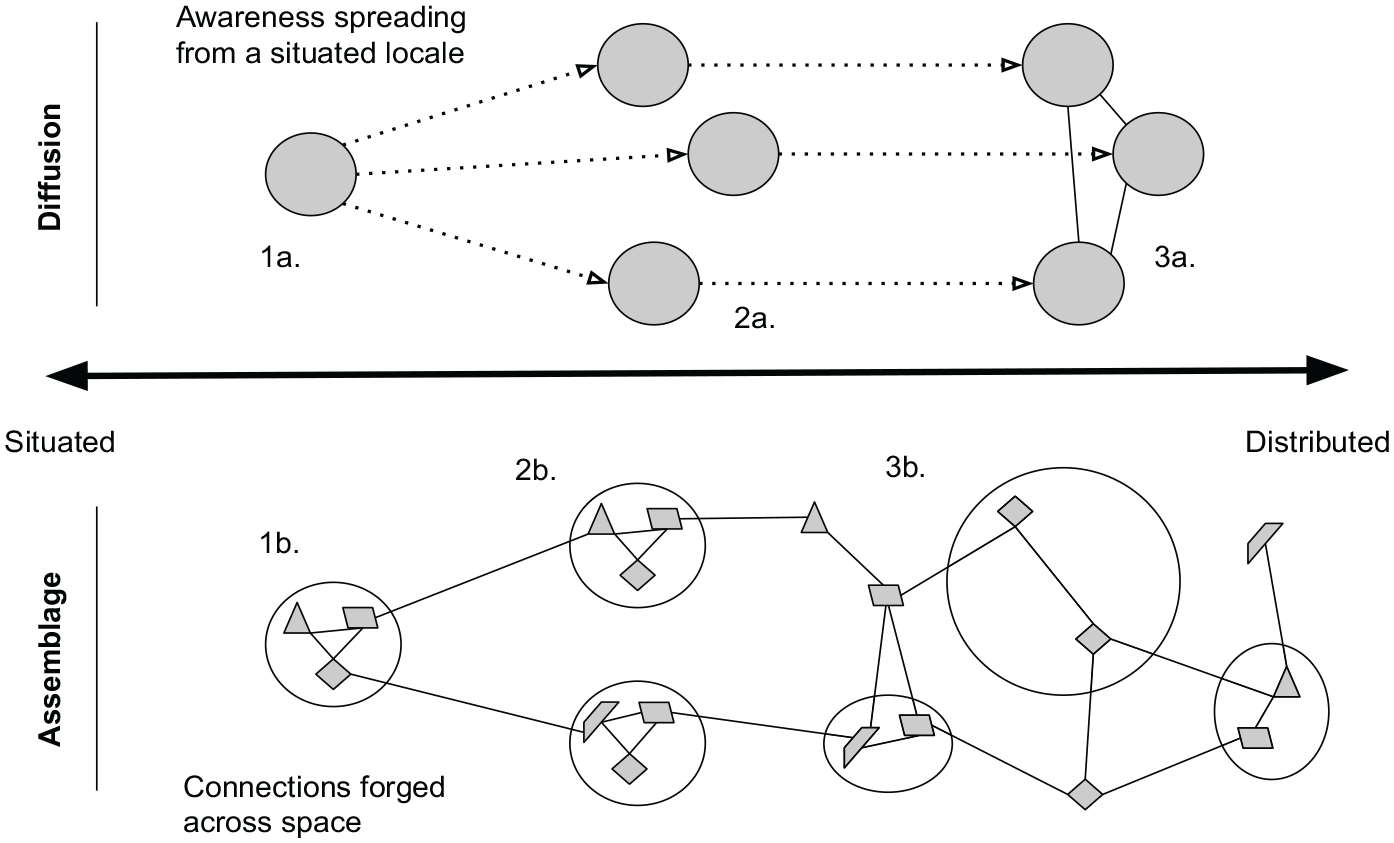
The spatial organization of prefiguration according to diffusion and assemblage.
Because prefiguration is political, as prefiguration becomes organized across wider spaces, it can meet contestation or co-optation by opposed actors. Recent work in OS has called attention to the interaction between prefigurative and contentious politics (De Coster & Zanoni, 2023). Opposed actors will seek to limit the reach of prefigurative politics by interrupting or recasting relations within the assemblage, exposing its limits and internal contradictions (Dinerstein, 2015; Zanoni, 2020). Such interruptions highlight the precarity of assemblage and the necessity of dedicating labour to maintaining the stability of its relations (Li, 2007, p. 264). A full account of the politics of retail assemblages would require us to attend not only to the precarity of zero-waste, but also to the stability and endurance of powerful assembled forms, such as mainstream retail (Anderson et al., 2012, p. 186; Cochoy, 2016). Our analysis will explore the entire spectrum of prefiguration’s spatial organization as well as its politics.
Methods
This research study did not start as an investigation into the assemblage of zero-waste, but was initially one case study out of many on low-carbon innovations for a larger research project. As we progressed through the research process, we increasingly began ‘thinking with assemblages’ (McFarlane & Anderson, 2011) in orienting and reorienting data and theory. To best explain the analytical strategy and research process, we begin this section by providing details on the original pilot study on zero-waste as a low-carbon innovation, after which we turn to the later stages of the process in which the research materials were gradually re-assembled in order to drive the present analysis.
Pilot study
The pilot study was designed to investigate the potential of zero-waste to contribute to decarbonizing different aspects of the food and retail system. It was conceived as a multi-method qualitative case study, mobilizing three different types of qualitative data to improve robustness and rhetorical power (Lamont & Swidler, 2014): site visits, research interviews and documentary analysis of online material. Data collection took place between April 2018 and February 2019. It was built on (1) five site visits to zero-waste stores and interviews with their owners and employees; (2) documentary analysis of online material, complemented by interviews with zero-waste influencers; and (3) interviews with agents representing different parts of the conventional retail system.
In choosing zero-waste grocery stores for site visits and interviews, we followed a convenience sampling strategy, aiming at a sample that would combine expediency and coverage (Clarke, Foster, Sloan, & Bryman, 2021). As a result, our sample includes store locations from southern to northern Europe and different forms of ownership and extent of the zero-waste model (see Table 1).
Site visits.
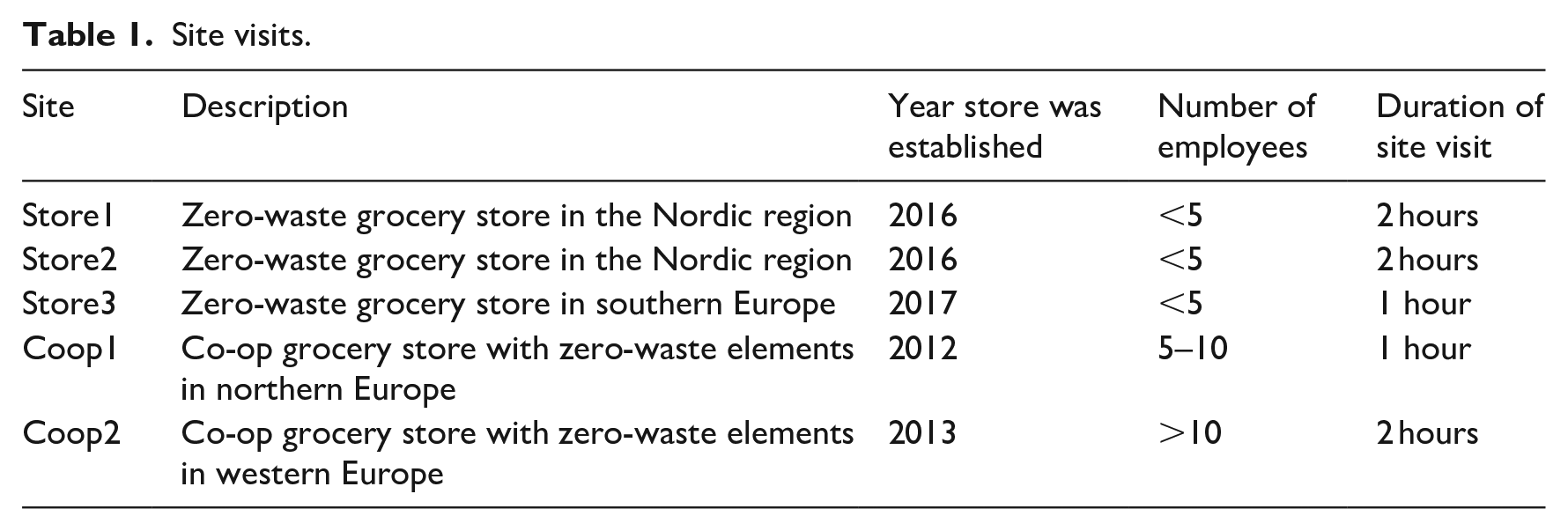
During site visits, we observed interactions between customers and employees, had informal conversations with owners and employees, and took photographs. Observations and reflections were recorded in field notes (Clarke et al., 2021). For each of the site visits, the researchers shared photographs, field memos and reflections, both in writing and in person. The site visits were complemented by multiple informal visits to the three zero-waste stores, to familiarize ourselves with their environment and routines. Apart from site visits, interviews with owners and employees of all stores were conducted. To align our questions while allowing interview participants to speak freely, we followed a semi-structured format guided by a common list of key questions on the following themes: history, governance, transformative capacity, assessment and uptake of the innovation. These categories were dictated by the overarching project needs. As we were broadly interested in both recovering interviewees’ expert knowledge about the zero-waste world, as well as accessing their ‘inner worlds’ – the sentiments and attitudes they might attach to the phenomenon – our interview strategy draws on both neo-positivist and romanticist elements (Alvesson, 2003).
Site visits and interviews at zero-waste stores revealed their strong association with the broader transnational discussion around zero-waste. To gather more information on this aspect, we identified and studied the web pages and social media channels of bloggers and influencers with the greatest reach (in terms of number of followers and years of experience) – Béa Johnson, Kathryn Kellogg and Lauren Singer – all of whom were also mentioned by our interviewees. In addition, we conducted two interviews with zero-waste influencers active in the geographical contexts covered in our study.
In the course of preliminary interviews with zero-waste store owners, it quickly became apparent that there existed a strong opposition between zero-wasters and the conventional retail system. This opposition was important to shed light on, especially seeing as zero-waste seemed to offer little material challenge to conventional retail, owing to their massive differences in size. To better account for the opposition to zero-waste among large market players, we aimed for a mixture of participants from conventional retail, waste management and packaging, with both practical and theoretical expertise on the matter, for a total of eight interviews. We also included two interviews with EU-level actors to get a macro-regional picture of plastic pollution initiatives and the retail industry. Inclusion of these participants was driven by a theoretical sampling strategy (Clarke et al., 2021), but the actual choices of whom to approach were driven by a convenience sampling strategy, capturing relevant actors in the same geographic contexts as the zero-waste stores.
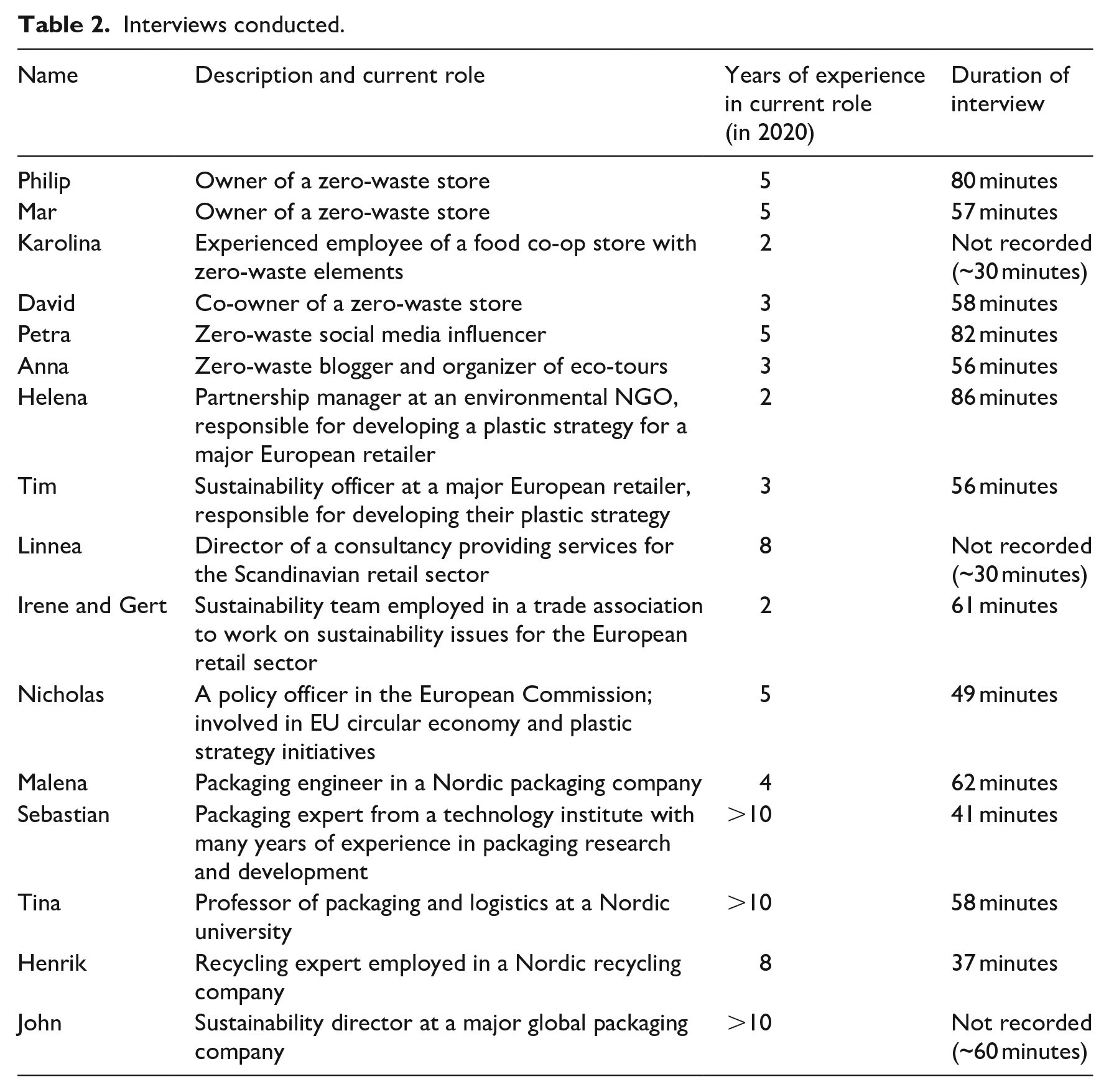
In total, we conducted sixteen interviews, of which thirteen were recorded. For those interviews that could not be recorded, we relied on extensive hand-written notes (which were taken for all the interviews). Recent research suggests that there is no significant difference in data quality between recorded and non-recorded interviews (Rutakumwa et al., 2020). The interviews averaged around one hour in length, varying from around 40 to 80 minutes (see Table 2), and they were conducted by the authors with support from other project participants.
Interviews conducted.
The interviews and site visits were analysed according to the predetermined needs of the preliminary project. Therefore, the initial round of thematic analysis (Braun & Clarke, 2019) reflected the broader aims of the research project, which was to identify and analyse low-carbon innovations. All interview recordings were listened to by more than one researcher, and we extracted key quotes from recordings and field notes into a common spreadsheet that was thematically organized into the same categories of data that structured our interview guide. The organization of data was checked internally in conversations between the researchers, and revisions took place to ensure coherence (Roulston, 2010). In mixed-methods projects such as ours, research has demonstrated that working directly from tapes and extracting key quotes can be a theoretically sound approach, as compared to transcribing full interviews, especially when working with a combination of data sources (Tessier, 2012). Based on this preliminary analysis, an internal case study report of 57 pages (22,557 words) was written by one of the authors. This report was for internal project use only and was kept unpublished in a secure repository to respect data protection requirements.
Thinking with assemblage
A pilot study can boost analytical power and serve as an important guarantor of quality in qualitative inquiry (Kim, 2011; Roulston, 2010). In our case, the pilot study also represented our starting point for the recursive process of double-fitting data and theories (Timmermans & Tavory, 2012) towards more general questions in OS, as we embarked on the process of generating a research article. The most prominent theoretical theme that emerged from our pilot study of zero-waste grocery stores was the tension between the stated aims and purposes of zero-wasters (to transform food systems) and the means that were pursued towards those ends (local, small-scale, sustainable operations). How can the focus on the ‘here and now’ be implicated in broader processes of social transformation?
We viewed this tension with increasing doubt, allowing a theoretical anomaly to ‘crystallize’ (Locke, Golden-Biddle, & Feldman, 2008) in the ostensible disparity between the means and ends of the zero-waste movement, which allowed one of the co-authors to make the ‘conceptual leap’ (Klag & Langley, 2013) to prefiguration as our core ‘sensitizing concept’ (Blumer, 1954, p. 7). This ‘re-theorizing’ and ‘alternative casing’ (Timmermans & Tavory, 2012, pp. 177–179) allowed us to revisit zero-waste in a different light. As prefiguration moved closer to the centre of our analysis, it became apparent that the prefigurative elements of the zero-waste phenomenon were more widely distributed between grocery stores, suppliers, shoppers and influencers in a way that suggested a theoretical anomaly and, in turn, opened up an opportunity to develop the concept of prefiguration by making a further conceptual leap towards a distributed, more spatially dispersed form of prefiguration. Our interest in assemblages originated in the hunch that it was an apt ‘heuristic’ (Abbott, 2004) for making sense of the organization of zero-waste as a prefigurative phenomenon.
Ananya Roy (2012) stresses that it is important to distinguish between assemblage as an object and assemblage as a methodology. We employ both modes of thinking with assemblages in this article: we refer to ‘the zero-waste assemblage’ as an object, but methodologically, we trace how its heterogeneous elements are brought together in a way that becomes prefigurative. Assemblage methodology entails taking a number of ‘epistemological commitments that signify a certain interrogative orientation toward the world’ (Baker & McGuirk, 2017, p. 430). These commitments include an emphasis on the processes and labour that go into organizing and arranging the elements of an assemblage; resisting the temptation of single causal explanations (instead stressing interaction and contingency); and viewing assembled forms as always conditional, uncertain and evolving (Baker & McGuirk, 2017). Similarly, Anderson et al. (2012, p. 175) argue for the importance of experimentation ‘as an ethos for understanding the durability of orderings . . . by tracing the relations between heterogeneous elements that compose them’. To experiment with assemblage means to ‘describe, but also to interrupt and recast relations’ and to resist their closure by viewing both the emergent and the already-formed as open-ended processes.
To trace relations in an assemblage, a first step involves reconceptualizing ‘the field’ not as a ‘discrete local community or bounded geographical area, but as a social and political space articulated through relations’ (Shore & Wright, 1997, p. 14). Our approach to data collection described above coheres with this inductive and iterative logic in following zero-waste from the store to other sites and people who connect to the assemblage in various ways. We resist closing relations, instead tracing their constant formation and re-formation by observing how entities such as straws, turtles, packaging and food safety laws all interrupt and recast the relations of the assemblage. Relations and their spatialities thus emerged empirically and were not predetermined from the outset (Baker & McGuirk, 2017, pp. 435–436). In this regard it is important to consider the relations between zero-wasters and mainstream retailers, as it helps to navigate another key tension – that of contestation or co-optation of zero-waste by mainstream actors.
Rather than follow a strict coding protocol to re-code the initial analysis from the pilot study, we persisted in ‘thinking with assemblages’ (McFarlane & Anderson, 2011) as we began to pull together the various components of our research into a coherent analysis. Field notes, memos, interview quotes and photographs became yoked together into a ‘research-assemblage’ (Fox & Aldred, 2015) along with the pilot study, books and journal articles, the researchers, reviewers and journal editors, our innumerable doodles and scribblings on whiteboards, and so on. The research assemblage is a machine, a ‘machinic assemblage’ (Deleuze & Guattari, 2005/1987, p. 4), that links together the stages, techniques and materials of the research process to produce findings. This machine does not follow protocols strictly to produce findings in a routine or linear process – rather, research-assemblages are ‘thought-enabling’ by allowing for experimentation through the iterative assembling and re-assembling of its constituent parts (Anderson et al., 2012, p. 173). Sharon M. Augustine (2014) emphasizes the importance of focused reading and writing (and rewriting, rewriting, rewriting ad nauseam. . .) as analytic stances towards data in a ‘post-coding’ world, consistent with the study of assemblage. With this in mind, we proceed to the analysis, safe in the knowledge that it has been rewritten many times.
Analysis: Assembling Zero-Waste
The analysis is organized in three parts. First, we analyse zero-waste stores as situated prefigurative phenomena. Second, we show how the concept of diffusion and assemblage thinking provide different explanations of how distributed prefiguration is realized. In this section, we also show how assemblage thinking in particular sensitizes us to novel socio-spatial forms of prefigurative organizing. Third, we investigate connections and confrontations between zero-waste and conventional retail to better examine the prefigurative politics of zero-waste.
Zero-waste stores and situated prefiguration
The phenomenon of zero-waste stores emerged in the mid-2000s, with what is believed to be the first store, Unpacked, opening a stall in London in 2006. Today hundreds of zero-waste stores operate in Europe. Zero-waste stores offer both a practical and an ethical alternative to supermarkets.
In zero-waste stores, customers dispense products into containers they have brought from home. For some products, such as milk or cheese, there is also a container exchange system, provided by suppliers of these products or by the store, with customers paying a small deposit and bringing back empty containers every time they visit. They also sell a range of household items made of sustainable materials and designed to last longer. Shopping at a zero-waste store naturally prompts reflection on one’s consumption habits, because this way of shopping requires more planning and takes more time (see Figure 2).
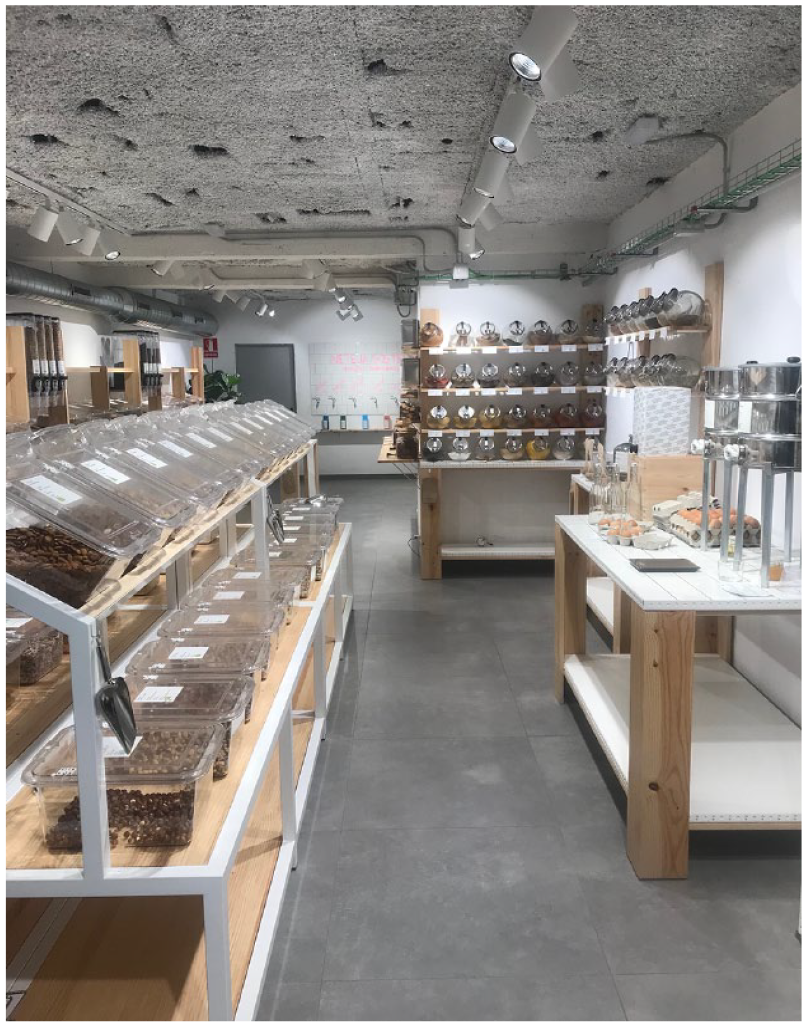
Interior of a zero-waste store.
Zero-waste stores are about more than running a business. They are material manifestations of the instinct to oppose conventional retail and its associated waste.
They [supermarkets] were a response to the lifestyle that emerged – we don’t have that much time, it needs to be fast, simple, convenient. 85% to 90% of the population work like this – also in [country], at least the urban population. Our mission is to change mindsets, change lifestyles. It cannot be reduced to plastics or packaging. (Philip, zero-waste store owner)
Supermarkets prioritize convenience in every possible way, including the reduction of cognitive load. Aisle upon aisle of familiar products in familiar materials and packaging add up to what might cynically be called the ‘don’t think, just shop’ consumer experience. Even the design language of supermarket products emphasizes abstract ideas of convenience – think of ‘three-in-one’ laundry detergent pods, with their pretty and nonsensical tripartite design. The zero-waste shopping experience is similarly rich in psychological cues, but these run directly counter to the supermarket experience. Instead of convenience, these stores promote patience and resourcefulness; instead of suppressing thought about origins and destinations, zero-waste stores remind the shopper of these at every turn. A coconut-fibre dish sponge, for example, immediately brings its plastic supermarket counterpart to mind, along with thoughts of how short the plastic item’s usable life is, and how long its afterlife in landfill.
Zero-waste stores nurture strong connections to the local. They feature the products of local, independent producers where possible; but more than this, they emphasize local political engagement, drawing store owners and shoppers together as a like-minded community. Sometimes this is achieved through loyalty schemes or crowdfunding, but the stores themselves are also spaces for deepening relations. Some of our interviewees reported that ideas and tips on how to do things in the store often came from customers. At the same time, we observed multiple instances of store owners or employees guiding the shopping practices of customers; for example, by helping to weigh items, by explaining the provenance or benefits of certain goods, or by providing tips on food storage. What conventional retail accomplishes through epic visual displays and the scanning of barcodes is achieved with more labour in zero-waste stores, but with the result that owners and shoppers are more tightly connected.
We want to help the locals here in [city neighbourhood] to come here to do their shopping and be more sustainable. We have strong relationships to our customer base through the crowdfunding and through local customers that return. We have a very loyal customer base that really believes in us. (Philip, zero-waste store owner)
These reciprocal relations created within zero-waste stores make them spaces that manifest both exceptionality (by offering alternatives to conventional retail) and communality (by fostering solidarity between store employees and shoppers) (Reinecke, 2018), demonstrating their capacity for situated prefiguration. Stores provide a space for experimenting with new ways of shopping; they circulate alternative perspectives on plastics, packaging, retail and food; and new forms of conduct (such as bringing your own containers and purchasing by weight) are stabilized and consolidated in the material environment of the store. As we will see in the following pages, they also diffuse these practices widely, leading to a multiplication of the concept and practices in new locations. Thus, zero-waste stores live up to the criteria of situated prefiguration as described by Yates (2015), with a clear political agenda of providing an alternative to the conventional food and retail systems.
Distributed prefiguration: from diffusion to assemblage
While there is no formal network or movement that unites the zero-waste phenomenon, nor a steering body that directs it, the simple presence of zero-waste stores in the world seems to inspire people to found more of them. As Philip, a zero-waste store owner, put it: I had worked in MNCs for many years, in marketing, but in 2015 I had had enough. I was tired of how everything worked – the unhealthy foods we were buying, the packaging, food waste, the lack of concern for the environment and organic agriculture. I thought things weren’t moving fast enough. I came across a zero-waste store in [city, country], where I’m from, and I thought this would work in [another country].
Mar, like Philip, gained inspiration for her store from reading about other zero-waste stores in Germany and France. She also met and communicated with Philip in the process of starting up her own shop, and they were intermittently in touch at the time of the interview. David, another zero-waste store co-owner, told us how his store was visited by a person seeking advice about starting a store in another city. Since then, several new zero-waste stores have opened in the country where David’s store is located. All these examples fit existing accounts of how prefiguration spreads through diffusion. Zero-waste stores are not just stores, but experimental spaces that simultaneously indicate sustainability problems and showcase alternatives. In line with diffusion, Mar characterizes her store as a symbolic centre for the discussion of zero-waste in her region: I’ve always seen the store as a talking point, and if I make the concept too diluted, then it stops being a talking point. It means that this concept is starting to be talked about in [country] now – the word for package-free went into the dictionary last year. It started a discussion about the issue of plastic waste, and it doesn’t do that unless you make a big statement. It’s much more than just a shop. It’s a platform to give out awareness.
Mar’s ‘talking point’ store succeeds in diffusing the zero-waste concept. This diffusion is not only directed towards other activists or other zero-waste stores. Here we also see the concept of zero-waste diffusing widely, reaching unexpected targets such as dictionaries, plastic waste policies, the mainstream media and politicians. All the stores we covered in our analysis had been variously recognized with awards, press coverage and interest from local politicians and national politicians in their respective countries.
But what we observed in the case study cannot be fully captured by the concept of diffusion. Karolina, an experienced employee at a cooperative store with zero-waste elements, cited the ‘zero-waste movement’ as a direct inspiration to start their store. A common semiotic element of zero-waste is the ‘5 Rs’: refuse, reduce, reuse, recycle, rot. These were mentioned in our interviews and during site visits and were visually present as graphics or posters in several stores (‘consolidated in the material environment’, as Yates [2015, p. 14] puts it), or even modified and extended into other relevant Rs (like refill, reconnect, resist, etc.). The concept of diffusion gives such artifacts an important role in spreading awareness of the values and practices of the prefigurative organization, but the assemblage perspective argues that these artifacts are also actively forging connections to new actors, enrolling them into the assemblage.
Zero-waste store managers often expressed a sense of being part of something greater – they felt enrolled into a larger cause, aligning with the activities and goals of other kinds of actors, such as local zero-waste activists and environmental groups, together being ‘connected’ into ‘zero-waste network[s]’, as articulated by David, a zero-waste store co-owner. Mar also highlighted the importance of internationally known zero-waste advocates, whose actions encouraged her own practices: I read an article about this woman who could fit two years’ worth of her trash in a simple jar like that size [points to a small jar], and she was this cool woman living in New York, she wasn’t a hermit living in the forest, you know, and living off the land. She was reducing her trash while living a city, normal kind of life. So I thought that if she can do it, then we can all take steps towards doing that.
Mar is referring to Béa Johnson, a zero-waste author and influencer, who has been blogging about zero-waste living since 2010, and who rose to prominence after showcasing how a family of four could fit a year’s waste in a single mason jar. With more than 350,000 social media followers and more than 100 appearances on television, and with her book on zero-waste having been translated into more than 25 languages, she has become a global agent of zero-waste. Béa Johnson and other visible zero-waste advocates (such as Lauren Singer, Kathryn Kellogg and Beth Terry), through their material actions and embodied advocacy, advance and qualify the idea of zero-waste, making it an attractive lifestyle choice. As explained by the influencers we interviewed, this involves balancing the message that ‘we cannot create trash any more’ (Anna) with showing ways to live zero-waste even on a limited budget (Petra). Working primarily through social media, they connect images of aestheticized minimalist living to concrete zero-waste practices. They inspire others not only to imitate their lifestyles, ‘prefiguratively partaking’ (Skoglund & Böhm, 2020) by engaging in zero-waste shopping, but also to engage in zero-waste and anti-plastic activism, and to open zero-waste grocery stores that facilitate the lifestyle. As such, this is not the same as diffusing awareness of a situated prefigurative example that can then be replicated in other spaces. Here we see a spatially distributed form of prefiguration take shape through the process of assemblage.
Zero-waste influencers are critical nodes in the assemblage of zero-waste, whose labour is required to forge connections among heterogeneous and spatially distant elements: they connect minimalist aesthetics, zero-waste shopping and conduct, zero-waste grocery stores and suppliers of zero-waste products into a common network. Each component of the network requires the others: there could be no zero-waste grocery store without zero-waste influencers. We can view these relations as connecting a zero-waste assemblage, comprising different types of actors and activities that advance zero-waste causes. This is not a case of diffusion from a situated locale, but an alignment of multiple heterogeneous elements that are distributed more distantly in space: other stores near and far; associations addressing waste and plastic pollution; influencers showcasing the achievability of zero-waste living; and the local base of customers and suppliers. The zero-waste assemblage does not act as a collective entity, having no steering body to accumulate resources or take strategic decisions. Its agents prefigure a new world where common frames and activism are dispersed (Skoglund & Böhm, 2020), producing prefiguration that is distributed across spaces and times. The assemblage is clearly dependent on the work of persons (such as the influencers and shop owners) and devices (such as the 5 Rs) whose connections must be actively maintained.
It is through the relations within and beyond assemblages that untapped potential for distributed prefiguration through assemblage can be located. A prominent example is the relations to local suppliers, who are so important for the prefigurative potential of zero-waste. By working more closely together with local suppliers, it becomes easier to keep improving practices and develop more sustainable solutions: It’s better to work with small suppliers or producers because I can talk directly with them. So I can say: how can we minimize or get rid of packaging? So when it’s a local, I can talk to them, I know who’s making the food, and I can get a really good solution for the packaging as well. The smaller the company, the more open people are to doing this. (Mar, zero-waste store owner)
This example also shows that the proximity of some relations is still important for distributed prefiguration. In one of the stores we visited, for example, the (foreign) supplier of liquid soaps sent them in big plastic buckets. However, they refused to take back the empty buckets for reuse, arguing that it was impractical. The store found another (local) supplier, who was willing to receive the empty buckets for refilling and reuse. Through enabling circularity with the local supplier, both found a way to prevent waste. The new supplier, in turn, integrated the practice of using refillable buckets in their own (rural) shop, and other small stores working with them followed suit. This exemplifies how a zero-waste world is assembled through distributed forms of prefiguration, where an assemblage activates prefiguration in multiple places through the alignment of practices between different agents. It is precisely the requirements placed upon other actors to transform certain practices in order to enter into the zero-waste assemblage that activates their prefigurative potential.
What we see in the examples of reusable buckets and zero-waste influencers are not just cases of situated prefiguration that spread through diffusion to another site; rather, it is a case of different kinds of practices (package-free shopping, minimalist aesthetics, waste-free supply chains) mutually requiring the alignment of the other through the social relations of the zero-waste assemblage. In doing so, they result in a distributed prefiguration qua assemblage, a prefigurative alignment of heterogeneous elements in different spaces and times. Distributed prefiguration creates the potential for actors involved in zero-waste to transform the food system at scale, whether their actions are explicitly aimed at this or not.
In sum, while zero-waste stores certainly demonstrate situated prefiguration in creating a space that allows agents of a zero-waste assemblage to engage directly in political, transformative acts, the real potential of zero-waste lies in its capacity to operate on the distributed end of the prefiguration spectrum through its arrangement of social relations. These relations incorporate a broader selection of actors (suppliers, politicians, activists, non-zero waste consumers, and so on), all of whom are enabled to address problems identified by the zero-waste assemblage. In doing so, novel and more spatially distant social forms of prefiguration appear.
Contesting zero-waste
As we have travelled outwards from zero-waste stores along relations of the assemblage, we have started to encounter, to an increasing degree, actors attached to conventional retail. While some of these engagements have been productive for the zero-waste assemblage, zero-wasters have also encountered massive resistance to their prefigurative politics from conventional actors.
In contrast with many other prefigurative alternative organizing practices, zero-waste stores are not explicitly anti-capitalist. While directly opposing conventional retail and advocating different ways of living more generally, store owners demonstrated some openness to engaging with conventional actors who would be interested in zero-waste. But there were certain lines they would not cross. Mar, for example, was not sure whether to continue as owner and wait for the store to become financially viable or turn it into a members’ cooperative. While weighing this decision, she considered a third option: a collaboration offer from a big national retailer. She ultimately rejected it because their proposal seemed like an attempt to appropriate her store’s image of sustainability without making substantial changes to their own processes. David, a zero-waste store co-owner, mused on the possibility of opening an online shop and maybe offering franchises, which could at first glance come across as an aspiration for quantitative expansion associated with conventional retail assemblages. But he is not ready to compromise a set of core values, which are key to forging alignments between the new elements: It would be nice if this could grow into a movement and stores like this spread, but if, for example, we opened it up to franchising, our philosophy and values couldn’t be compromised on and would need to be applied in every single store. People working there would need to have the same kind of passion; if not, it would not work. (our emphasis)
These testimonies show how zero-wasters recognize the tensions and contradictions of incorporating capitalist elements. They were mindful of the fragility of the assembled order, but also insistent that values are intrinsic to securing the prefigurative potential of zero-waste, allowing the assemblage to spread across space while maintaining its integrity. The core values of zero-waste might easily get lost if only some of its elements were incorporated into the dominant assemblage of conventional retail. In several instances, conventional retailers directly reached out to zero-waste store owners for inspiration and offers of collaboration. An example of this is the establishment of waste-free aisles or sections in conventional supermarkets.
Larger retailers are trying things out and seeing what works. For example, [name of supermarket] in [city] has a zero-waste section within the supermarket. They have to test and go with what works, incrementally. (Linnea, director at a consultancy for the retail sector)
Whether waste-free aisles are truly prefigurative or a more reactionary response depends on how they are aligned with other components in the conventional retail assemblage. There are strong indications that the primary concern of conventional retail is to preserve and defend its current arrangements. For example, Tim (sustainability officer at a major European retailer) described zero-waste stores as ‘extreme solutions’ while Sebastian (packaging expert at a technology institute) claimed they were ‘more about demagogy and less about factual correctness’. As John (sustainability director at a major global packaging company), articulated: Zero-waste goes against the modern trend of easing choices and decisions for consumers, creating less hassle. It is a romantic vision, but the greatest environmental impact of a packaged food product is in the food itself, not the packaging . . . Zero-waste has good intentions, but too narrow a view.
While acknowledging that consumers cared more and more about environmental issues, established retail actors perceived concerns about waste, plastic pollution and excessive packaging as highly emotional. As Nicholas (policy officer at the European Commission) put it: ‘not everyone agrees that we have to change the plastic system because of a couple of turtles with straws through their noses’. Similarly, Tim (sustainability officer at a major European retailer) described it as ‘the media and consumers . . . reinforcing each other when it comes to the awareness of plastics’ and ‘carpet bombing’ retailers with news and comments. Others, such as Helena (partnership manager at an environmental NGO collaborating with a major retailer on their plastics strategy), described the situation as one of ‘plastic panic or plastic hysteria’.
Thus, zero-waste becomes contested through the recasting of its relations. While presenting those engaged in zero-waste assemblage as emotional and uninformed, retailers and packaging companies call for more ‘nuanced’ debates with more ‘specialist’ and ‘expert’ knowledge. Unlike the emphasis on waste prevention and systemic change through direct and everyday political actions shared within the zero-waste assemblage, conventional retail actors frequently emphasize the importance of moving toward a ‘circular economy’ where packaging and plastic waste is not eliminated, as zero-waste would have it, but revalued as a recyclable, reusable resource. This strategic direction is built on the assumption that ‘getting out of plastics is impossible in packaging’ (John, sustainability director at a major global packaging company). The defence of plastic packaging involves reinstating it as a driver of sustainability, in an obvious bid to forge alignment with conventional retail assemblages – ‘God’s gift to the environment’, according to Sebastian (a packaging expert).
In contrast to the circularity of zero-waste stores, which is open-ended and oriented toward a qualitative transformation of the entire food and retail system, the ‘circular economy’ of conventional actors is assembled through the optimization of existing relationships in retail. This serves to contain the problem within the existing system, rejecting the provocation of zero-waste altogether. Agency for sustainability transitions is placed wholly within industrial structures and processes, removing it from regular shoppers, who are seen as driven only by considerations of convenience and cost.
We have in this section outlined an open-ended politics that arises between an emergent zero-waste assemblage and more established forms of assembled retail. Although there are glimpses of possibility in exploring connections that could be forged between zero-waste and conventional retail, these potential connections are quickly blocked by the contentious politics of incumbent actors, who seek to maintain the passive subjectivity they have constructed for modern shoppers (see De Coster & Zanoni, 2023, for more on this point). Even a socio-economic force as powerful as conventional retail takes great pains to project an image of unassailability – effort that would not be necessary if it truly were unassailable. The hard work with which the status quo opposes prefigurative arrangements highlights their vulnerability, but also their potential and their strength.
Conclusion
This study contributes to the emerging discussion on prefiguration in OS and the literature on alternative organizing more broadly. We have introduced and theorized the concept of distributed prefiguration – a novel way to understand prefiguration, which captures a phenomenon that has been implied in the literature, but not yet fully elaborated (see, e.g., Casey et al., 2020; Daskalaki & Kokkinidis, 2017; Skoglund & Böhm, 2020). Distributed prefiguration goes beyond situated prefiguration, which manifests alternatives in bounded organizational spaces (Farias, 2017; Kokkinidis, 2015; Reinecke, 2018), and instead takes place across organizational boundaries and across greater distances.
To conceptualize the prefigurative potential of dispersed phenomena, we approached prefiguration from a relational perspective, drawing especially on assemblage thinking. This move allowed us to recast the whole spectrum of prefiguration in relational terms, from the situated to the distributed. In our account, prefiguration thus rests on the capacity to gather heterogeneous elements consistently together, and this does not need to assume a situated and bounded locale at the centre of prefigurative organizing. The question of socio-spatial form then becomes something to be explored through empirical research and not a conceptual starting point. Note that we are not changing the threshold for what constitutes prefiguration (cf. Schiller-Merkens, 2022; Yates, 2015), but shifting the analytical focus from the entities themselves to the relations that constitute them (Bennett, 2010; Latour, 2005). It is the act of forging and sustaining relations between disparate elements that creates prefiguration, not those elements themselves. Broader transformations can be triggered through these relations, whether or not the entities in the assemblage are explicitly directing their actions towards it.
In our investigation of the zero-waste phenomenon, we demonstrated how different socio-spatial forms of prefiguration are assembled. We showed that zero-waste cannot be reduced to a situated prefigurative phenomenon. Our key finding is that prefiguration can take multiple socio-spatial forms, where social relations are assembled across varying spatial distances to prefigurative effect. We found that different kinds of practices (package-free shopping, minimalist aesthetics, waste-free supply chains) needed to align with one another through the social relations of the zero-waste assemblage. In doing so, they resulted in a distributed prefiguration qua assemblage, a prefigurative alignment of heterogeneous elements in different spaces and times. It is assemblage’s capacity to relate unlike or distant things to one another that allows prefigurative practices of different kinds to happen in multiple places and times.
Assemblage thinking has proven to be a useful theoretical lens for analysing prefigurative politics in its distributed sense. Rather than just gesturing towards the ‘transformative force’ (Daskalaki & Kokkinidis, 2017) assumed in the prefiguration literature, we can assess its shape, direction and precariousness. Moreover, assemblage thinking helps to investigate relationships between prefigurative alternative organizing actors and hegemonic actors empirically. Instead of presupposing opposition between them, we can explore the tensions in their relationship, which can also include co-optation or appropriation. In our case, however, conventional retail is very clearly pursuing a strategy of negating the prefigurative politics of zero-waste. To some extent, it is to be expected that internal tensions and contradictions within the assemblage, as well as their collisions with hegemonic actors (Dinerstein, 2015; Zanoni, 2020), shape the politics of assemblage. The hostility and contestation we observed in the zero-waste case study suggest that distributed prefiguration carries some power and capacity to challenge the status quo, especially as it becomes assembled over wider spaces. Following Reinecke (2018), Parker (2023) and De Coster and Zanoni (2023), we agree that studies of prefiguration need to pay more attention to the interaction between prefigurative and contested politics, or expressive and strategic politics. In addition to this, our study indicates a need to examine this interaction between different socio-spatial forms and acting across greater distances. Further empirical studies of distributed prefiguration are needed to support the preliminary work we have presented here. A more precise understanding of the connections, interactions and dependencies between the various elements within the assemblage, and how they can foster processes of transformation, would be a very useful addition to this emerging field of scholarship.
Overall, contemporary research on alternative organizing practices could benefit from the concept of distributed prefiguration and its theoretical framing via assemblage thinking. Of particular interest would be practices that are loosely assembled in different socio-spatial forms, but do not necessarily constitute a movement, such as renewable energy cooperatives, ecovillages (Casey et al., 2020), transition towns, alternative food networks (Böhm, Spierenburg, & Lang, 2020), community and solidarity initiatives (Daskalaki et al., 2019) and others. Attention to these forms of prefigurative organizing is also increasing within environmental politics, where they are being studied through the lens of ‘sustainable materialism’ (Schlosberg & Coles, 2016; Schlosberg & Craven, 2019). Assemblage thinking contributes to this work by providing a sensitivity to how particular socio-spatial forms emerge, transform and potentially contribute to broader processes of social change.
An important implication of our study is that prefigurative initiatives can be more ambitious in considering how connections to unexpected sites and actors can foster transformation, assembling a dispersed ‘counter-hegemonic force’ (Daskalaki & Kokkinidis, 2017). But we have also indicated the resistance this generates: dominant actors may either co-opt transformative movements or attempt to undermine them (De Coster & Zanoni, 2023; Zanoni, 2020). It may sometimes seem all too easy for opposed hegemonic actors to block the transformative potential of prefigurative projects and reproduce incumbent social relations. But the labour thus expended tells us much about the power contained, at least in potential form, in prefigurative efforts such as zero-waste. In a time of escalating poly-crises caused by destructive practices that we cannot afford to maintain, prefiguring sustainable alternatives is more important than ever.
Footnotes
Acknowledgements
We would like to thank Ludwig Bengtsson Sonesson, Karl Holmberg and Sara Ullström for providing research assistance on this study. An earlier version of the article was presented at the Organization Studies Summer Workshop 2020, and at a seminar within the OT@IOA Group, Department of Organization, Copenhagen Business School. We also received comments on an earlier draft from Annika Skoglund and Robin Holt. We are extremely grateful for all the feedback received. We also wish to thank the editors and reviewers of Organization Studies, in particular Pascal Dey. Copy-editing and proofreading was provided by Katrina Zaat. Finally, we wish to thank our interview participants for sharing their time and insights with us.
Funding
The author(s) disclosed receipt of the following financial support for the research, authorship, and/or publication of this article. This research was funded through the REINVENT project (‘Realising Innovation in Transitions for Decarbonisation’), European Commission Horizon 2020, grant number 730053; through the STEPS project (‘Sustainable Plastics and Transition Pathways’), funded by Mistra, the Swedish Foundation for Strategic Environmental Research; and through the project ‘Plastics in a circular society: Alternative organising beyond resource efficiency’, grant number 2021-02440, funded by Formas, the Swedish Research Council for Sustainable Development.
