




Abstract
The research examined the interplay between institutional logics in a multi-sectoral initiative. Taking a longitudinal approach, we tracked the first three years of an initiative that aimed to reduce social inequality by promoting science, technology, engineering and mathematics (STEM) education in Israel. We observed how the paradoxical dynamics between multiple logics unfolded over time, following the alternating dominance of business, civil and state actors. Results showed the initiative oscillated between a civil society logic, seeing STEM as a ‘springboard’ for equal opportunities and social change, and a market logic, seeing STEM as a ‘pipeline’ towards a technological workforce and economic profit. The state logic influenced this oscillation by converging with one of the two other logics, affecting both the working processes and the social impact of the initiative. We contribute to paradox theory by developing a process model of the paradoxical dynamics between multiple institutional logics in multi-sectoral initiatives. We identify three main mechanisms that drive this process: power shifts, logic divergence/convergence and turning points. We suggest implications for the management of complex organizational environments.
Introduction
The accelerated technological and global developments since the mid-20th century have altered the type of social problem societies are handling, with more problems referred to as complex (Conklin, 2006; Ferraro, Etzion, & Gehman, 2015). One such problem is the growing inequality in societies today (George, Howard-Grenville, Aparna, & Tihanyi, 2016). Technological developments can improve life quality and create new job opportunities, but disempowered populations are often left behind, unable to keep up with the demands of the job market.
Multi-sectoral actions are needed to address such complex social problems, involving multiple actors from business, the state and civil society (Agranoff, 2007). Multi-sectoral collaboration is a complicated process, rife with conflict and tensions, stemming from the different institutional logics that shape worldviews and the understanding of the work processes and the purpose of the collaboration (Bryson, Crosby, & Stone, 2006). Past studies have addressed how organizations handle multiple logics (Besharov & Smith, 2014) and how inter-organizational systems cope with polar tensions, such as market-civil logics (e.g. Sharma & Bansal, 2017) or state-market logics (Jay, 2013). Even though market, state and civil society sectors frequently work together to address complex social problems, little is known about the potential interplay between multiple logics in multi-sectoral collaborations. Some recent studies have adopted a process-oriented perspective to explore paradoxical dynamics in complex inter-organizational systems that constantly develop and change (e.g. Jarzabkowski, Bednarek, Chalkias, Konstantinos, & Cacciatori, 2021; Schad & Bansal, 2018). Following these studies, we aimed to explore how the paradoxical dynamics between multiple institutional logics develop over time, particularly in light of the alternating dominance of actors who represent different institutional logics.
To understand how the interplay between multiple institutional logics influences multi-sectoral actions, we drew on two complementary theories: institutional theory (e.g. Thornton, Ocasio, & Lounsbury, 2012), which is useful for understanding differences in logics that guide different actors, consequently shaping their view of a collaboration’s purpose, and paradox theory (e.g. Smith & Lewis, 2011), which is useful to unpack the tensions inherent in contested logics and their development over time.
Taking a longitudinal approach, we investigated the paradoxical dynamics between multiple institutional logics in a multi-sectoral initiative that aimed to reduce social inequality by promoting science, technology, engineering and mathematics (STEM) education in Israel. The initiative was established by high-tech companies and NGOs, who invited the Ministry of Education to join in. We found the initiative oscillated between a market logic, envisaging STEM education as means to strengthen the Israeli technological workforce, and a civil society logic, envisaging STEM education as means to reduce social inequality. The state logic influenced this oscillation by converging with one of the two other logics, affecting both the working processes and the social impact of the initiative.
With this work, we contribute to paradox theory by developing a process model that enhances the understanding of paradoxical dynamics between multiple institutional logics in multi-sectoral initiatives. More precisely, we identify three main mechanisms driving this process: power shifts, logic divergence/convergence and turning points. Based on our findings, we suggest implications for the management of complex organizational environments.
Literature Review
Promoting STEM education, particularly among minority groups, is considered crucial for societal economic growth and technological innovation. Therefore, investments in STEM education have expanded globally (Xie, Fang, & Shauman, 2015), including in Israel (Hurvitz & Alon, 2015), with the growing involvement of industrial actors in STEM education as part of their corporate social responsibility (CSR) to ensure the future generation of scientists and engineers (Andrée & Hansson, 2020). These investments often take the shape of multi-sectoral initiatives that include actors with different worldviews, assets and expertise to address complex social problems that all actors see as important but impossible to achieve by themselves (Agranoff, 2007; Clarke & Crane, 2018). These types of collaboration inherently encompass paradoxical tensions, defined as ‘persistent contradictions between interdependent elements that persist over time’ (Schad, Lewis, Raisch, & Smith, 2016; Smith & Lewis, 2011). These tensions often stem from the different logics of actors, including differences in their cultures and structures and differences in their management strategies and conduct (Bryson et al., 2006; Jarzabkowski et al., 2019, 2021).
According to the literature on STEM education, market logic often guides STEM initiatives and policies, thus leading to a narrative of ‘progress, innovation and global competitiveness’ (Krug & Shaw, 2016) or the aim to produce a new generation of workers for the tech industry (Carter, 2016). This creates an inherent paradox, as the aim to reduce social inequality relies on capitalist premises that created this inequality in the first place.
An alternative logic of STEM education is reflected in the concept of the accumulation of ‘scientific capital’, with critics saying that gaps based on gender, ethnicity, and class explain children’s and youths’ aspirations for learning science and thus their accumulation of this capital (Archer, Dawson, DeWitt, Seakins, & Wong, 2015). Scientific capital acquired through STEM education, like other types of capital – economic, cultural and social – promotes egalitarian access to knowledge when made accessible to underprivileged populations. In this sense, the scientific capital approach resonates with civil society logic that promotes STEM education as a means to advance students’ opportunities and freedom to fulfil themselves as people, not as a means to enhance profit.
Interestingly, the literature suggests the market logic is held not only by business actors involved in promoting STEM, but also by some actors within the educational system (e.g. teachers and school principals). The latter may even promote STEM education as ‘societal salvation’ because of its ability to reduce school failure and skill gaps (Weinstein, Blades, & Gleason, 2016; Zeidler, 2016). Thus, multi-sectoral collaboration that promotes STEM education may evoke paradoxical tensions which operate not only between but also within actors (Sharma & Bansal, 2017).
Dynamics of paradoxical tensions over time
Paradox theory offers a unique perspective on tensions in increasingly complex environments characterized by competing demands (Smith & Lewis, 2011), as well as their management (Schad et al., 2016). According to paradox theory, organizations maintain a dynamic equilibrium between opposing demands over time, rather than a specific and static balance (Lewis & Smith, 2014). Dynamic equilibrium implies an ongoing relationship between competing demands, and the long-term stability and sustainability of the organization depends on frequently shifting oscillations between each of the competing demands and/or an integrative synthesis of demands, with this ongoing process continually addressed over time (Smith & Cunha, 2020).
Past studies suggest developing organizational mechanisms that can maintain the dynamic equilibrium is crucial to develop complex thinking and organizational innovation and progress. For example, Ashforth, Rogers, Pratt and Pradies (2014) explored the dynamics of paradoxical oscillation over time, demonstrating how the polarity of organizational actors fosters functionality at the organizational level. Paradox studies typically suggest that management approaches focus on accommodating a single perceived tension (Farjoun, 2017), including organizational responses to accept, confront and transcend tensions (Lewis, 2000). For example, Van Neerijnen, Tempelaar and van de Vrande (2022) found that top management teams who embraced the exploration-exploitation paradox through reflexivity overcame this paradox by developing the capacity to cognitively differentiate and integrate exploration and exploitation. Empirical studies further suggest that the alignment of different types of pressure influences whether organizations choose to proactively manage paradoxes (e.g. Schrage & Rasche, 2022). Recent studies go beyond studying a single paradoxical tension, and explore how multiple tensions are intertwined. For example, Lempiälä, Tiitinen and Vanharanta (2023) show how performing and belonging paradoxes act as triggers, mitigators and amplifiers for each other.
The literature on paradox in inter-organizational settings further points to multiple paradoxes operating simultaneously, referred to as ‘paradox knots’ (Schad & Bansal, 2018; Sheep, Fairhurst, & Khazanchi, 2017). The concept of paradox knotting represents how growing complexity is represented by different paradoxes ‘knotting’ together and impacting each other, resulting in a complex interactive process which might support dynamic equilibrium or, contrarily, undermine it (Jarzabkowski et al., 2021). In the case of multi-sectoral initiatives, such complexities may stem from paradoxical tensions between multiple institutional logics. To better understand the interplay between multiple logics, and the work practices that help to work through paradoxical tensions between contested logics, we turn to institutional theory.
Paradoxical tensions and contested institutional logics
According to institutional theory, organizations from different sectors contain different logics in the basis of their operations, leading to different cultures, norms and ways of conduct (Thornton et al., 2012). The literature (e.g. Thornton et al., 2012; Yin & Jamali, 2021) distinguishes three main types: (1) market logic characterizes the private sector and follows rules of maximizing profit and neo-capitalist economics; (2) civil society logic is guided by value-driven missions and public service; (3) state logic is guided by political control and sanctions, provision of favourable policies, and key resources.
Organizational studies have identified mechanisms used to handle the persistent institutional complexity of coexisting logics in everyday work (Smets, Jarzabkowski, Burke, & Spee, 2015). Besharov and Smith (2014), for example, suggested that conflict will occur when multiple logics are pivotal to the organizational functioning, but the organization does not conceive these logics as compatible. Studies have also considered how tensions between logics manifest in multi-sectoral collaborations (Saz-Carranza & Longo, 2012). One such study pointed to the importance of communication and learning processes and proposed bridging gaps between logics by creating a partnership logic (Yin & Jamali, 2021).
Past research on paradoxical tensions between contested logics has addressed their dual nature. For example, Sharma and Bansal (2017) showed how leaders’ complex approach to paradox was a key element in the success of an initiative that incorporated market and civil society logics. Jay (2013) found hybrid organizations navigated tensions between state and market logics by oscillating between logics or by creating a novel synthesis of them. The potential interplay between multiple logics remains largely unexplored, however. Specifically, there is a need to ask how the entrance of actors bringing a new institutional logic or changes in the dominance of alternating actors influences the dynamics between existing logics and to consider the implications on work processes and outcomes.
We took an integrative theoretical approach to this unanswered question, viewing paradox theory and institutional theory as complementary. We reasoned that their conceptual integration could enhance our understanding of the dynamics of multiple logics within a multi-sectoral collaboration for two reasons. First, following Jarzabkowski et al. (2021), we argued that a paradox theory analysis of contested logics would provide a better understanding of the possible interplay between logics. In the case of STEM education specifically, we argued the entry of the state would affect the paradox between market and civil society logics. Specifically, there should be tensions between the state logic that aims at control and centrality, the civil society logic that aims at plurality and wide participation, and the market logic that aims at profitability. Second, following Smith and Tracey (2016), we proposed that critical events throughout the course of a multi-sectoral initiative would be experienced in different ways by actors with different logics, thus dynamically reshaping the paradox equilibrium and the outcomes of the initiative.
The current study
The research examined how paradoxical dynamics between different institutional logics changed as a result of the alternating dominance of actors in a multi-sectoral collaboration. We followed Jarzabkowski and colleagues’ (2019) analytical framework for observing inter-organizational paradoxes and paid attention to: (1) the ways broad societal processes created paradoxes in the inter-organizational dynamics; (2) moments of crisis or conflict and how they were experienced by the different actors; (3) boundaries and boundary organizations as places that potentially served as a locus for tensions. We asked the following research questions:
How did the dynamic equilibrium of multiple contested logics in a multi-sectoral collaboration shift over time?
How did paradoxical tensions between multiple logics influence the outcomes and work processes of the multi-sectoral collaboration?
Which mechanisms and practices helped to work through paradoxical tensions between contested logics?
Methodology
Research design and methods
We conducted a case study analysis of a multi-sectorial initiative to promote STEM education in Israel from its establishment in 2013 to its declaration of success in 2016. Case study analysis allowed us to track the collaboration evolution and the way goals, strategies and decisions were constructed throughout the period (Yin, 2003). We drew on qualitative data to observe how civil society, market and state logics manifested in the way actors positioned themselves and how they shaped the paradoxical dynamics that evolved in the initiative.
The case study: Background
Israel is an interesting context for studying STEM education because of the unique interplay between educational, military and high-tech sectors. Past studies point to a connection between the mandatory military service and Israel’s remarkable technological ecosystem (see, e.g., Avrahami & Lerner, 2003; Honig, Lerner, & Raban, 2006). The contribution of elite technological units, such as the Israeli Intelligence Corps unit, is particularly meaningful, as young adults trained as scientists, engineers and technicians join the high-tech industry immediately after completing their mandatory service. Since STEM education is part of a preparation process for military service in technological units, excellence in STEM is often perceived in Israel as a national challenge. Lack of excellence is frequently seen as a national threat, endangering security and economic stability (Swed & Butler, 2015).
The initiative started as a partnership between two philanthropic organizations and a business corporation. The founders discovered that despite years of investment in STEM education, the achievement of Israeli schools remained low. In 2013, the number of high-school students who took the maximal level in the mathematics matriculation test was particularly low; this was the catalyst for establishing a broad collaboration around STEM education. Relevant businesses, NGOs and the Ministry of Education were invited to take part. However, each partner perceived the purpose of the initiative differently: NGOs perceived it as a way to provide more opportunities to deprived populations, while the business sector saw it as a means to create the next generation of engineers and mathematicians for industry. Finally, state actors saw it both as promising national resilience and as means to increase scientific scholarship.
The initiative worked in three main circles. The core circle comprised the founding partners; they were considered the leaders, and they provided the infrastructure. The second circle, which served as the steering committee, comprised main actors from the three sectors; they met every month and were responsible for strategy and decision-making on the group’s focus and methods of action. The third circle comprised around 100 organizations who took part in the larger thinking processes which the initiative periodically hosted (Hurvitz & Alon, 2015; Hurvitz & Rom, 2021). Organizations from all circles were invited to take part in small work groups that evolved around specific issues in line with the broad strategic directions consolidated by the steering committee (Hurvitz & Alon, 2015).
The initiative was committed to act according to the five principles of collective impact (CI) (Kania & Kramer, 2011): (1) joint agreement and commitment to a common agenda; (2) agreement with a shared measurement system; (3) engagement of multiple actors in mutually reinforcing activities; (4) continuous and open communication over a long period of time; (5) ongoing support from a backbone organization independent of the initiative. The latter principle was fulfilled by an NGO that mediated and supported the initiative activity (see Figure 1 for the initiative’s structure).
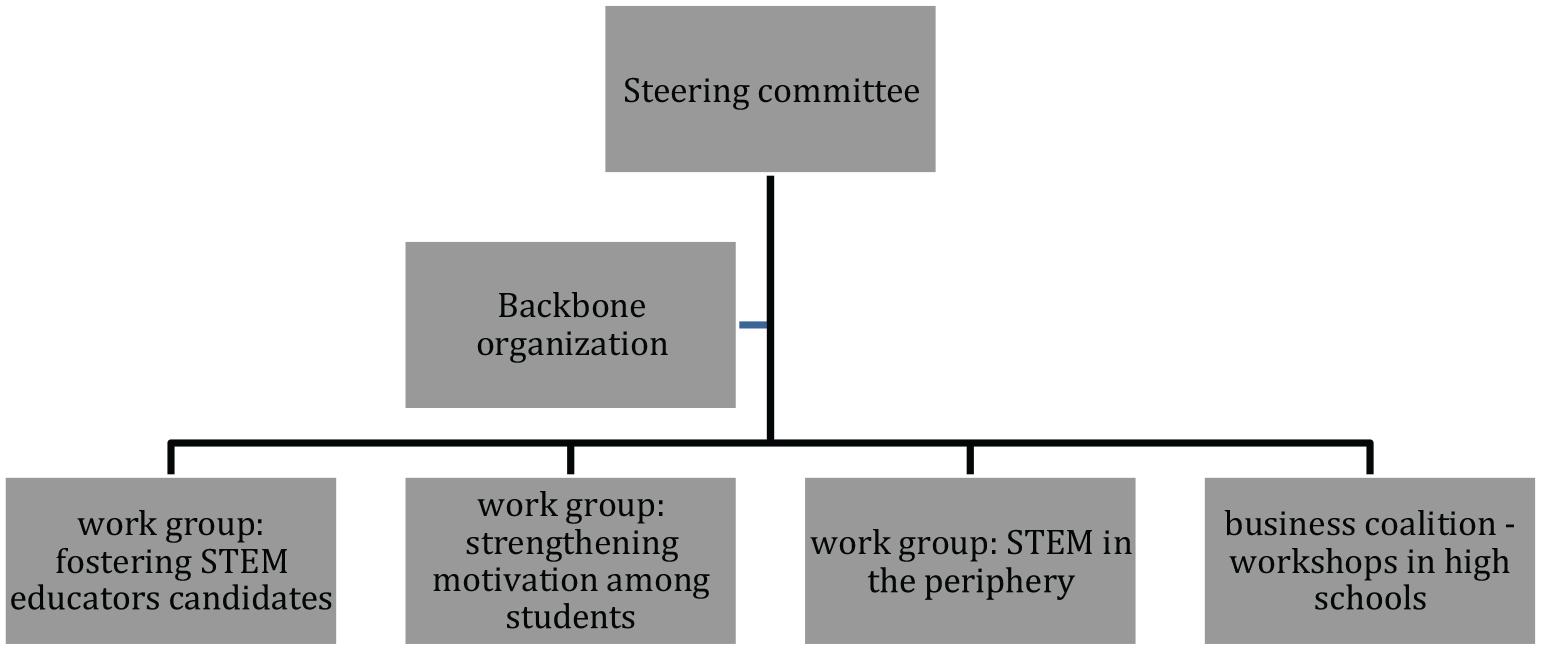
The initiative structure, including work groups.
Data collection
The research was conducted by two researchers external to the initiative who were invited to evaluate the process of work. Data collection involved the following: 35 formal documents, including the meeting summaries; public media announcements; public campaigns held by the initiative (see Table 1 in the appendix); semi-structured interviews with leaders of the initiative conducted in three waves (see section A for all interviews’ questions in the online supplementary material). A total of 31 interviews were conducted: 15 following the first year, 12 following the third year (five with people in the first wave), and 4 five years after the first round of the programme ended. Table 2 lists all interviewees.
Interviewees and their organizational role.
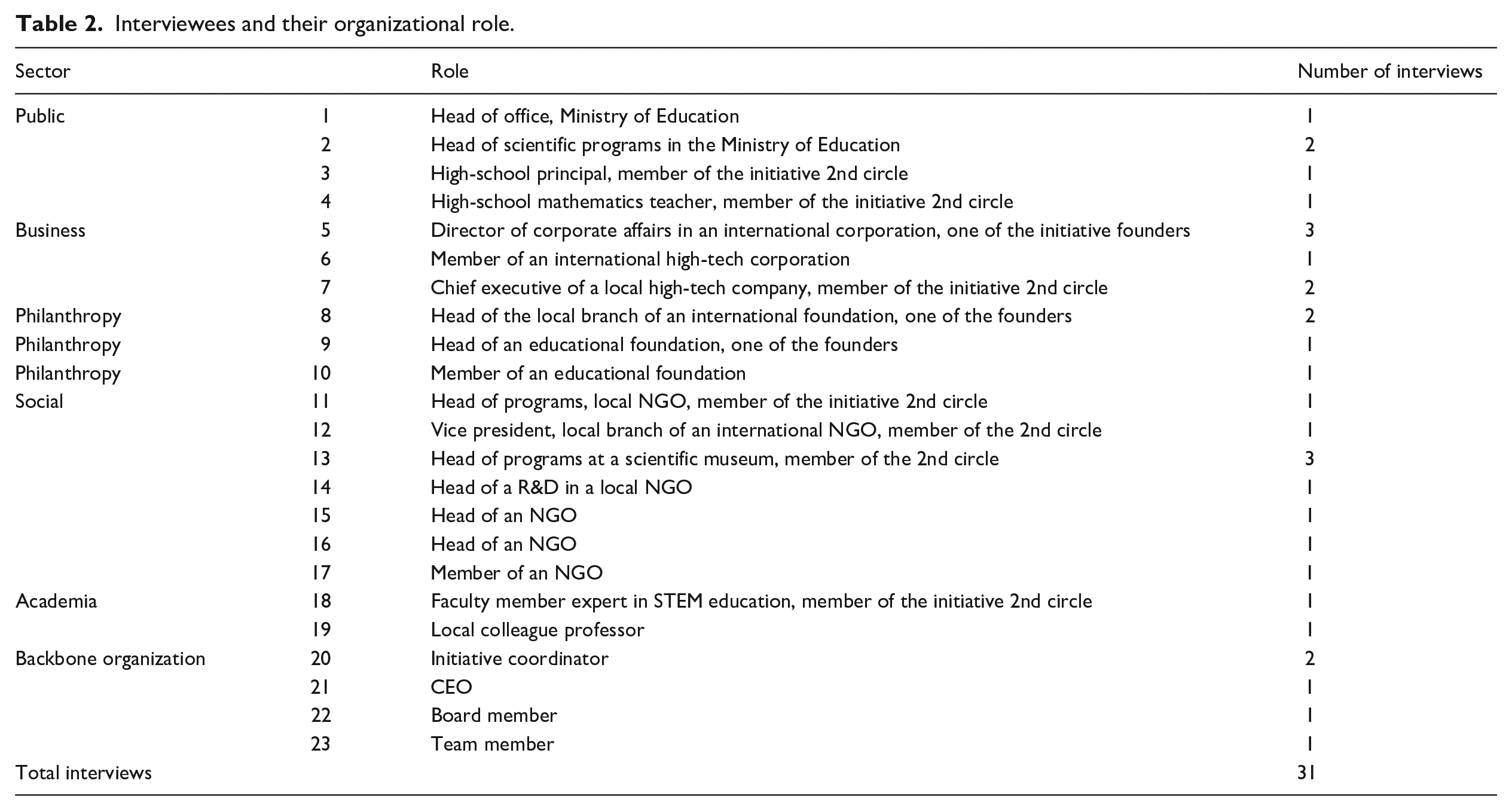
We used purposeful sampling (Glaser & Strauss, 1967), and the most relevant people were selected: all members of the core circle, all three founders of the initiative, the head of office in the educational bureau, the head of projects and other relevant actors highlighted by previously selected interviewees, including managers of local high schools, and an academic researcher who was an expert on STEM education and accompanied the initiative. The third wave of interviews was conducted with key actors from different sectors who were willing to be interviewed. All interviewees gave their consent to use their interview for research purposes. Interviews lasted 60–75 minutes.
The purpose of the first wave of interviews was to receive feedback and to refine the initiative accordingly. Consequently, we used semi-structured interviews; participants were presented with a set of questions and could answer openly according to their perspective. The purpose of the second wave was to reflect on the three years of the initiative and to narrate its story. Therefore, we used the narrative inquiry technique (Rosenthal, 1993). This allowed us to receive a subjective narration of the initiative over a specific period of time. Finally, the third wave was conducted after writing the first draft of this paper; the goal was to engage in dialogue on our findings and insights and to receive participants’ perspective on the initiative in hindsight. These final interviews were semi-structured to receive specific feedback on key findings and ideas.
Data analysis
Interview transcripts were coded by the two authors according to the stages of grounded theory (Charmaz, 2017), more specifically, the stages proposed by Pratt, Rockmann and Kaufmann (2006): open coding, axial coding and theoretical coding. To delineate our chain of evidence, we show the links between our axial and theoretical codes in Figure 2. All axial codes are highlighted in light grey. Theoretical codes are highlighted in dark grey and depicted in a larger bold font.
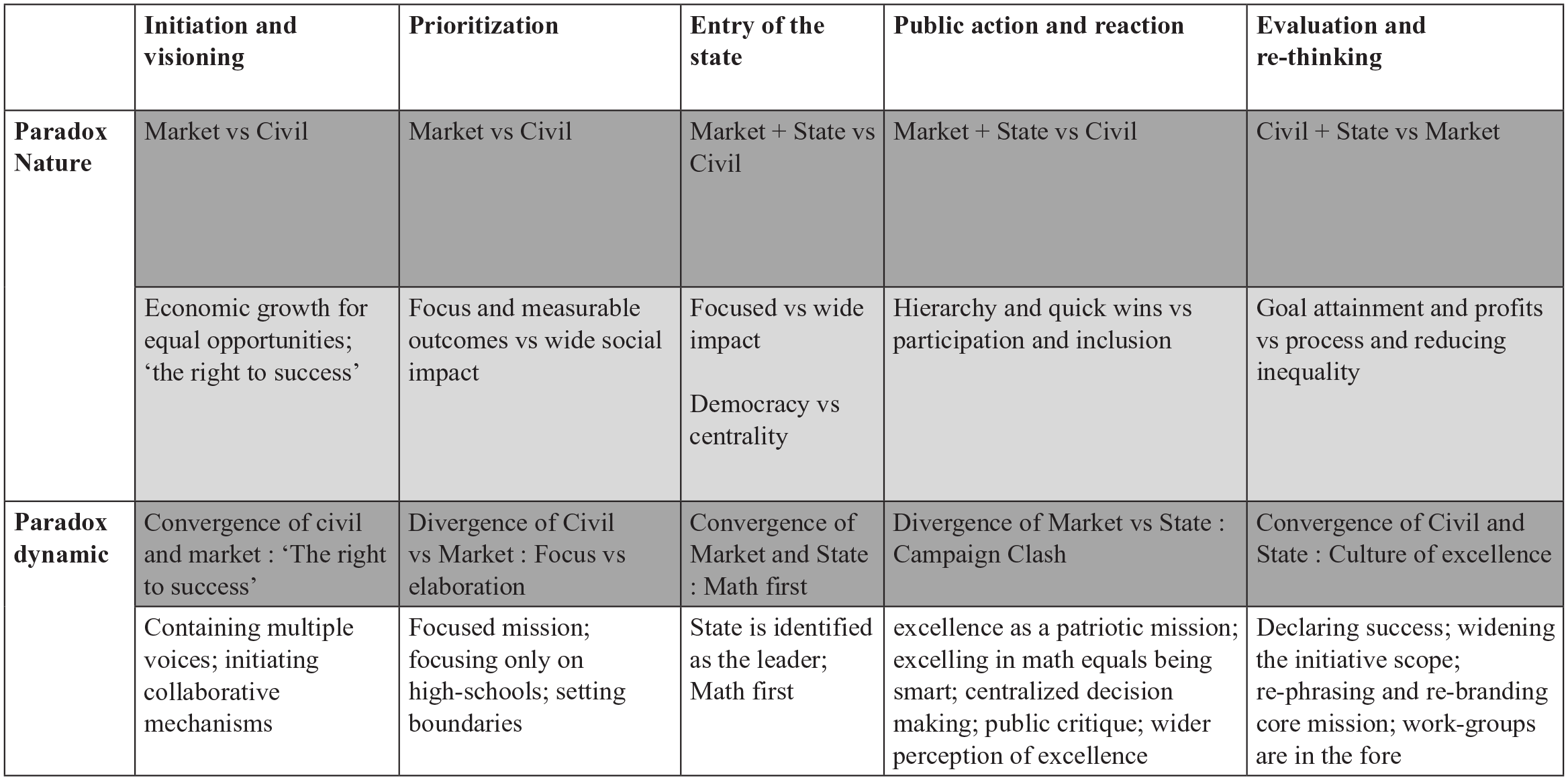
Towards a model of paradox dynamic in a multi-sectorial collaboration.
In the first stage, open coding, the interview transcripts and documents were fully coded into initial categories that were descriptive and stayed as close as possible to the words used by our informants or the original text (Charmaz, 2017). There were many codes at this stage, including the following: the children are at the centre; quick wins; focus on results; expanding the initiative to primary school; building the next generation of engineers; equal voice to everyone; the need for qualitative criteria; students need to be part of discussions; those who bring the money need to be the ones who decide.
In axial coding, we clustered our open codes into meaningful ‘chunks’ by aggregating similar open codes together under more abstract categories and started to move away from the language of the informants towards theoretical language. At this stage, a few distinctions emerged from the data. First, we distinguished between different manifestations of codes according to the stages of the initiative. We identified five main stages: initiation and visioning; prioritization; entry of the state; public action and reaction; evaluation and rethinking. Second, we identified the different institutional logics in the actors’ perceptions and narrations. For example, we combined a variety of codes in the initiation and visioning stage under two groups: one axial code was of actors who emphasized economic growth as a main motivation to take part in the initiative, and another combined codes that highlighted equal opportunities. We began to link those highlighting economic growth with market logic, and those highlighting equal opportunities with civil society and state logics. Finally, we discovered differences between codes that described the nature of the paradoxical tensions, and codes that described the dynamics of these tensions.
In theoretical coding, we explored how our axial codes fit together into a larger theoretical story (Charmaz, 2017). This process helped clarify the evolution of the paradoxical dynamics over time and the role the various institutional logics played throughout the different stages, so we could theorize a general process of paradoxical dynamics in multi-sectorial collaboration. For example, the axial codes that appeared in the first stage of initiation and visioning, namely, ‘multiple motivations’, ‘multiple voices’, ‘collaborative mechanisms’ and ‘establishing work-groups’, were assigned the theoretical code of ‘integration and inclusion’. The axial codes that appeared in the second stage of prioritization, including ‘focused mission’, ‘promotion of pipeline in high-schools’, ‘setting boundaries to the initiative’ and ‘students as a target audience’, all represent manifestations of narrowing the focus of the initiative towards measurable and specific goals and were therefore given the theoretical code of ‘oscillating towards STEM education as a pipeline’, representing the market logic.
To avoid research bias, the coders approached the data independently and subsequently agreed on themes, categories and codes. After several coding waves, we produced the final set of codes. We discussed how the various theoretical categories fit together into a cohesive framework. Before making this determination, we evaluated a range of alternative conceptual frameworks to see how our codes could relate to one another and to existing theories. After considering multiple possibilities, we decided on the interpretative framework that best captured our data and the experiences of our informants. In our theorizing of the paradox dynamics, we used visualization (see Figure 3), and considered three key antinomies suggested by Pradies et al. (2023): linear – recursive, open – bounded and equilibrium – disequilibrium.
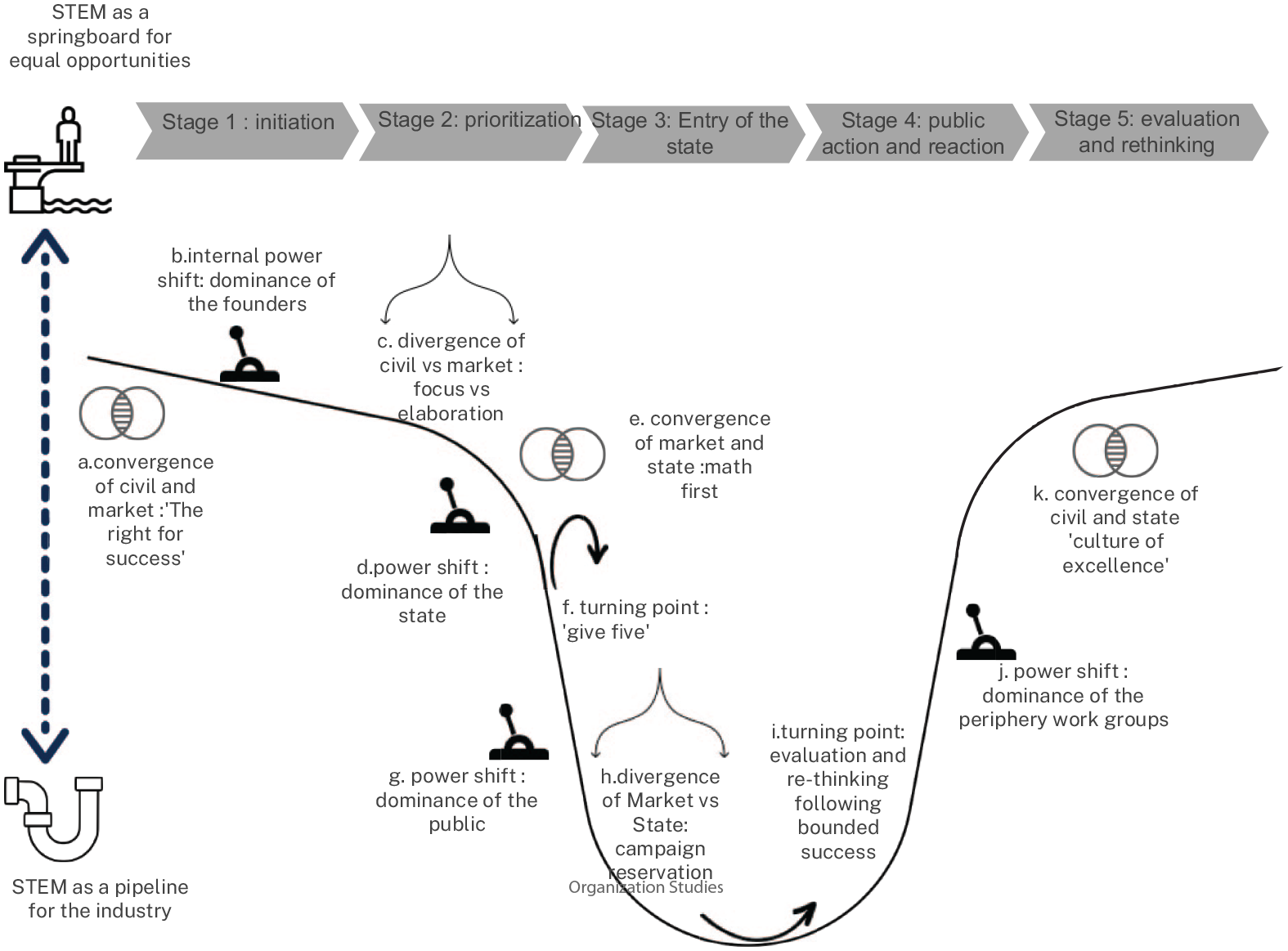
A model of oscillation between contested logics in a multi-sectoral collaboration over time.
Findings
In what follows, we present five stages in the paradoxical dynamics of the initiative and demonstrate how the initiative oscillated between a civil society logic, seeing STEM as a springboard for equal opportunities and social change, and a market logic, seeing STEM as a pipeline to a technological workforce and economic profit. We identify three mechanisms driving this process: power shifts, logic divergence or convergence and turning points (see Figure 3). We now present each of the five stages with exemplifying quotes (further examples of each stage can be found in Tables 3 to 8 in the online supplementary material).
Initiation: Contested logics around one vision
During the initiation stage, the founding partners tried to bring together different viewpoints around one vision. They gathered 100 organizations from different sectors, including schools, NGOs and businesses, all of whom differed in their motivations.
The business partners often expressed their concern with the declining numbers of engineers, as this threatened the stability and prosperity of the high-tech industry. They saw STEM education as a way to guarantee that more students were channelled into technological professions, thereby fostering economic growth. One of the partners from the business sector presented the purpose of the initiative in a public interview as follows: ‘If the educational system will release to the market thousands of excellent STEM students every year, they will guarantee their personal future, and the Israeli economy will preserve its strength and attractiveness to international investors’ (Walla News, August 2014). The partner used business phrases such as ‘release to the market’ to describe educational processes, reflecting market logic according to which STEM education is a pipeline to both personal success and business profit.
It seemed market logic also operated within the educational system; for example, a partner in education pointed to the hierarchy of fields of study: ‘If a child excels in Hebrew, they say he is good in Hebrew. But if a child excels in maths – they will say he is smart. Excelling in maths is enhancing the competence of a child.’ Although this quotation suggests belonging to a certain sector does not necessarily determine the logic that will guide an actor, partners from education and NGOs mostly drew on a civil society logic. An NGO partner said: Once the common belief was that if you don’t get into the pipeline and study in high-school you won’t get to your destinations in life, so if you study science you will work in that field. But today the perception has changed, it is more like a springboard: you study science and a whole world opens to you. Today we know that students can’t know what they will do for a living in the future, so let’s not direct them to a specific role model, let’s give them variety and choice.
The partner’s words reflect a basic tension between two perceptions of STEM education: a springboard students can use to advance their intellectual abilities versus a pipeline to specific professions.
Unsurprisingly, the different motivations and perceptions led to disagreements on the purpose and scope of the initiative. An NGO partner commented: Everyone wants to be part of the initiative. The question is why, there are many different answers which can be contradictory, and sometimes lead to conflict. . .Industry people seem to care about having enough workers. . .We want to educate kids to be good people – we are not an employment agency. . .Who said that maths is better than theatre?. . .Our role is to explain these meanings to children and parents so that they make more educated choices but not to make those choices for them.
The tension between pipeline and springboard perceptions of STEM education posed a challenge for the leaders of the initiative, especially when they tried to incorporate multiple perspectives. Interviews with the founders revealed their desire for an inclusive process, in which different actors were equally heard regardless of their institutional power. A founding partner said: ‘In the first meeting it was important for us. . .that a maths teacher and the Minister of Education will have the same amount of air time.’
In a demonstration of the collective impact model (Kania & Kramer, 2011), two mechanisms were created to promote an inclusive process. The first was holding large assemblies in which different voices could be heard. Many actors from civil society organizations perceived listening and dialogue to be key factors in the collaborative process. This perception resonated with the civic society logic of democracy and wide participation. An NGO partner told us: We became a community and I think the main gain was that we got to know each other. . .That’s how new things are born, from the place of having time to meet people, build new connections and collaborations, and build trust.
Yet the initiative’s dialogical processes were criticized by other partners, mainly from the business sector. A business partner said: In this initiative, too many decisions were made in round tables; they brought over 100 people, each had three different views, and they talked it through. . .There was a situation that actors or partners took part in the initiative for what I see as ‘mainly come to talk in meetings’, delaying progress by bringing dilemmas.
This critique suggests contesting logics shaped not only the perception of the purpose of the initiative, but also the desired work process. The market logic of effectiveness saw the meetings as a pipeline towards relevant decisions, whereas the civil society logic saw them as a springboard for dialogue, ideas, connections and relationships. Whereas the pipeline perception aimed to focus the goals and save time, the springboard perception aimed to expand the scope and the time of interaction. To tackle these differences, a second mechanism was the establishment of small work-groups around specific interests, such as enhancing STEM professionals, fostering science in the periphery, and promoting scientific projects in schools (see Figure 1).
The dialogical processes led by the leaders of the initiative resulted in a common vision articulated as follows: By 2020, Israel will be among the top 15 countries in the world in the quality of education for scientific and technological excellence, thus positioning itself in an advantageous position towards the second quarter of the 21st century. High-school students from all sectors and socio-economic backgrounds will fulfil their right for excellence in education in mathematics, science and technology, thus opening their opportunities for a life of prosperity and contribution.
In terms of paradox theory, the vision suggests an inclusive attempt to contain both logics. The market logic of STEM as a pipeline is manifested in this vision by seeing high-school students as elements of a broader mission of promoting Israel’s superiority in the global market. The civil society logic of STEM as a springboard is manifested by the aim of promoting the mobility of all social sectors. The vision presents a broad goal, related to various scientific fields of study, including technology and mathematics. The integration of the two logics manifests in the novel phrasing of excellence as a right, thus encompassing a mechanism of logic convergence, which allowed the initiative to balance the fundamental paradox between springboard and pipeline perceptions of STEM education.
Prioritization: Defining the scope of the initiative
Following the initiation, the initiative entered a new phase in which the partners engaged in translating the broad vision into specific and measurable goals, a process that intensified the tension between civil society and market logics. The initiative established a steering committee, composed of partners from all three sectors, who took upon themselves the responsibility of leading the partnership and setting its strategic guidelines and priorities. The process of decision-making at this stage was complex and replete with disputes caused by the different logics held by the partners. Key discussions revolved around limiting versus expanding the age groups and the scientific professions examined by the initiative.
Focusing on high-school students and on specific scientific fields was perceived as an excellent direction by most of the business partners, as it was seen as a catalyst for training future engineers. Moreover, it resonated with the perception of good work processes as efficient, leading to quick wins. A business partner was clear: The business sector is first and foremost driven by results, actions, and measurable outcomes. Unfortunately, it fails in getting this spirit into the initiative. The business sector adds a practical element. It is true that we want better citizens, but the bottom line is that someone needs to employ them. The business sector understands that at the end, what we need is more engineers.
These words show how the market logic was manifested in the perception of both the desired working processes and the desired outcomes, and focusing the initiative was perceived as crucial to guarantee that students would be pipelined into engineering.
Other partners were concerned that a too-specific goal would hinder the initiative’s ability to reduce social gaps. As an NGO partner explained: My concern is that the initiative will operate only in high socio-economic areas, to increase the chances of success of the program. I understand the need to demonstrate success in the first year, but the initiative must act to increase its impact in the periphery; otherwise, we will not truly reduce social gaps.
Partners who held a civil society logic suggested broadening the boundaries of the initiative to have more social impact by reaching children at younger ages in all socio-economic sectors and providing a wide spectrum of scientific education. They also expressed a wish to expand the measures, in order to evaluate long-term processes of social change: In addition to quantitative measures, I would add qualitative measures. I expect that our next meetings will focus on the long-term consequences, I don’t want us to keep track of the numerical aspect, if we went up 15 percent or 17 percent. . .we should work on the qualitative part and develop principles to cope with the more fundamental issues. (NGO partner)
Interestingly, the leading philanthropic partners endorsed the more focused goals, as this orientation aligned with their logic of being rewarded for their investment. This led to a power shift, as philanthropy and business partners were the stronger actors within the initiative. This, in turn, led to disagreements between civil society and market actors around the wording of the joint mission statement. After six months of discussions, the partners agreed on the following: The initiative mission is to double the number of students who exert successful learning and thinking skills in mathematics, physics, chemistry and engineering in Israeli high-schools. Within 10 years, at least 20 percent of the students in every cohort will fit the excellence criteria in national and international standards.
This phrasing shows a clear definition of scientific success, emphasizing the essence of the initiative as fostering excellence in scientific fields of study in a particular age group. In terms of paradox theory, it indicates the start of an oscillation towards the view of STEM education as a pipeline, expressing a market logic of focusing on specific goals and clear, measurable outcomes.
Entry of the state: ‘Math first’
During its first year, the founders of the initiative made tremendous efforts to bring the Ministry of Education to the table to promote long-term impact and sustainability: The important sector is the state because it can eventually adopt and turn programs into services. The business and third sector cannot guarantee sustainability because resources are limited, therefore only the state can. As a foundation, I am ready to give up ego and honour and to let the state sit at the head of the committee. . .the sovereign must be there, because he has unlimited resources. (philanthropy partner)
The partners agreed the Ministry should be part of the initiative, but the possibility of its inclusion also raised concerns: I really believe in the potential of doing things with the Ministry – the biggest impact is happening with the Ministry. On the other hand, I want to keep the independence of the initiative and what it can do without the Ministry. (philanthropy partner)
The possibility of including the Ministry triggered a paradox inherent in the state logic of sovereignty (Thornton, 2004), particularly in the tensions between the ability of the state to create an impact and provide resources and the state’s desire for control and centrality. Thus, the entry of the state was perceived as a power shift in which the state would become a dominant actor, and the partners were not sure what the impact would be.
The business partners did not take a clear stand on state centrality. On the one hand, they expressed the desire for a clear leadership that would take the initiative forward. On the other hand, they had reservations about the bureaucratic and unproductive conduct of the state. A business partner told us, ‘The whole conduct is unproductive. . .All the partners went to Jerusalem for a meeting and eventually we didn’t have a room – unproductive.’ The comment reflects market logic, as the main concerns are efficacy, productivity and results. Since at this stage it wasn’t clear if the entry of the state would enhance productivity, business partners were mostly ambivalent.
Less than a year after the start of the initiative, Education Minister Shai Piron declared that the Ministry was willing to join. It would provide resources, on condition that the initiative would focus on mathematics. The entry of the state represented a narrowing of the initiative’s goals, as the initial core mission was inclusive and addressed several scientific fields. The common understanding was that the initiative had to have the state on its side to move forward, so it decided to accept the Ministry’s terms, even though feelings were mixed. Some, primarily from NGOs, worried the focus on mathematics would have a negative social impact. One NGO partner said, ‘Math first makes all other scientific professions and the periphery redundant, so collective impact may lose both the collective and the impact’, but the partner immediately followed this concern by saying, ‘On the other hand, we have a great gain because the state is in there as a partner and there is hope for change.’
In fact, there was a power shift within the initiative following the entry of the Ministry. The Ministry brought resources and appointed a point-person in the office to coordinate the process: a math teacher and the former head of education for the Drouse community. In a public interview, he presented a balanced view of the initiative’s purpose, integrating pipeline and springboard approaches to STEM: ‘The plan will reduce the gaps between the Arab and the Jewish sectors. . .The lives of students in the periphery will change as a result of the program and it will give them an occupational horizon’ (Walla News, August 2014).
At the same time, a document explained the rationale of the new programme ‘Math first’ by presenting mathematics as a pipeline to personal and national success: Mathematics is ‘queen of science’ and this is why the decrease in students that take the 5-point matriculation exam is such a worrying warning sign. . .Those who take the 5-point matriculation exam are considered those who can cope with complex problems in changing environments and create novel and creative solutions and are thus more ready for the challenges and opportunities of the 21st century. (programme outline, July 2014)
The choice to position math as ‘queen of science’ and concentrate on one scientific field was a significant turning point, marking a further oscillation towards the pole of STEM as a pipeline. With this positioning, actors from the business sector aligned with the state, as the market logic of measurable goals and personal success converged with the state logic of national superiority and resilience.
Public action and reaction: The campaign clash
The convergence of market and state logics strengthened when a new Minister of Education was appointed in March 2015. Naftali Bennett, a former high-tech businessman and a military officer, felt the initiative strongly resonated with his own worldview. He embraced it and made it into the flagship project of the Ministry. He took the lead of the initiative and invested an unprecedented 75 million NIS in the ‘National program for excellence in mathematics’. In a public speech, he explained his reasons: The threat of mathematical education is a strategic threat. And a strategic threat calls for a national program. I know that many disagree with me regarding the need to massively strengthen mathematics, but the role of a leadership is to set national goals and to strive towards them relentlessly. We will double the number of students who take the highest level of matriculation exam in mathematics, within four years. In my recent past, serving in the military and high tech, there was a common perception of either/or. Either we do something for ourselves at the expense of the country or we do something for the country at the expense of ourselves. But here, we can achieve both – the child will strengthen both his own future and will help the future of the state of Israel. (Press conference launching the national program, August 30, 2015)
In effect, Bennett’s vision featured a convergence of state and market logics, with a notable absence of civil society logic addressing diversity and equal opportunities. He viewed the intervention as promoting personal achievement for both student and national interests, portraying low math achievement as a strategic threat to the Israeli state. This construction resonated with the founding partners’ perceptions of the importance of STEM: We all cherish the iron dome system, and this is the moment to remind us that behind this remarkable capability stands engineers and scientists that persisted and invested in five points studies in mathematics. . . If anyone had a doubt, today it is clear that teaching and studying mathematics is a national mission. (philanthropic partner, The Marker, August 2014)
In his words, the partner ties a direct line between five points of mathematics studies to Israeli security. In particular, he is referring to the Iron Dome, an air defence system that is serving as a protector against missiles to Israeli southern settlements near Gaza, and was developed by Israeli engineers.
The dominance of the Ministry in the initiative became stronger because of its financial investment. This, in turn, strengthened the convergence of market and state logics. This convergence was furthered by two public campaigns launched in May 2015, one by the Ministry and the other by one of the philanthropic partners. The campaigns were based on slogans such as ‘give five’ (referring to the maximal 5 units in the matriculation exam), indicating that by taking the 5-unit matriculation exam, students were contributing to national effort. In the Ministry campaign, former President Shimon Peres was seen recruiting high-tech workers, an attempt to encourage high-school students to excel in mathematics, thus reflecting the market logic whereby mathematics is a pipeline to channel students into the high-tech industry.
The Ministry campaign provoked public criticism from parents, students, and teachers who objected to dismissive statements that put mathematics above all other fields of study: The Ministry of Education created a new holy grail – five points in mathematics, and we cannot stand by. . .We hear very troubling expressions, such as a student going into a 3-point maths exam and another student approaches her saying, ‘I thought you are smart.’ Instead of unifying teenagers and clarifying that everyone can be good at what he or she chooses to do, this campaign pulls us apart. (head of the national students’ council, Walla News, May 2016)
The public critique led to a power shift, as new actors such as students and teachers became dominant in the discourse around STEM education. This influenced the state partners to re-examine their role in the initiative. Even actors who were part of the decision to launch the Ministry campaign expressed reservations. In a private interview, a senior person in the Ministry said: The campaign was too aggressive in my view. . .I don’t think that a child should take the highest level of math studies if he doesn’t want to, or that he will not have success in his life if he doesn’t. . .As an educator, I always said that my role is not to create robots for the industry; my role is to give children the experience so that they can choose their destiny.
The comment reflects a new convergence between civil society and state logics. In this particular example, the speaker identified as an educator, bringing her professional identity to the fore and expressing the internal tension within the state logic: empowering students as individuals versus strengthening the state as a whole.
Seen through paradox theory, three mechanisms helped drive the oscillation process. First, a convergence of market and state logics caused a turning point in which the initiative strongly oscillated towards the pole of STEM as a pipeline, manifested in the campaign ‘giving five’. Second, a power shift caused by the public critique altered the discourse around STEM education. Third, the power shift marked a new convergence of state and civil society logics that came into play in the next stages of the initiative.
Evaluation and re-thinking following bounded success: Bringing back civil society logic
After three years, the Ministry of Education announced the project had succeeded, as the number of students who took the 5-point matriculation test increased from 8,869 in 2012 to 12,787 in 2016 (see Table 1, item 29). All partners felt this was a tremendous achievement, and the partnership had been successful. Some partners, mainly from the business sector, felt their job was done, as the main goal was obtained: ‘As long as it concerns the 5-points mathematics, the work that the Ministry did. . .he really worked thoroughly point after point and took care of things. . .so I really think we are not needed anymore’ (business partner).
However, the data suggest the effect was limited to privileged populations and bounded in terms of gender, ethnicity, and class. More precisely, the program led to an increase of 4 percent more boys taking the exam, but the number of girls did not increase (see Table 1, item 29). Moreover, the percentage of students from high socio-economic populations taking the test increased from 13.2% to 17.2%, but the increase among low socio-economic populations was much more modest, from 6.8% to 8.6% (see Table 1, item 25). The bounded success led the initiative to engage in a strategic thinking process that lasted six months to rethink its future steps. The group working on STEM in the periphery was central to this process, as it provided crucial information explaining the limited results. An educator in the periphery work-group commented: ‘I think that the story in the periphery is much more complex because mathematics is not standing alone. . .What about mother tongue?’ According to the partner, fluency in Hebrew and English is taken for granted among privileged populations but may be a critical barrier to others.
The periphery work group’s dominance reflected a power shift within the initiative, whereby actors who were in the organizational margins became central and influential. Moreover, the role of the backbone organization that coordinated the work of the different groups was important in initiating space to widen the discourse when conditions were right, as expressed by an educator partner: The fact that they managed to bring to the room so many actors that each one of them had brought various agendas, interests, implicit and explicit motives, and managed to create an enabling atmosphere, with methodologies that helped to discuss. . . I think that in many cases we felt that we managed to put aside the places from which we come from. . .and that was very beautiful.
Ultimately, the initiative decided to re-phrase its core mission and bring back civil society logic as a guiding principle: We see our mission in promoting excellence in science and technological education, as an engine for the development of a general culture of excellence in education, and we are committed to do so while minimizing social gaps and providing equal opportunities to both female and male students in the diverse Israeli society.
The new mission statement represented a new convergence; scientific excellence was still emphasized, but was now referred to as a means to promote a wider culture of educational excellence. The mission included gender equality and an obligation to minimize social gaps.
Another support for the new convergence was evidence in the Ministry of Education’s speech in a gathering of the partners’ broad network in June 2017: In terms of resources, the first important goal for the initiative today is to address the disempowered population index. The second goal is to incorporate the initiative in the middle and elementary schools and address the problem there. The third goal is to expand to other sciences. This initiative taught me about our ability to sit together, think, assimilate, carry out and ultimately succeed. (partners’ network gathering, June 2017)
This speech expressed the convergence of civil society and state logics. Bennett presented a wider perception of STEM, evident in the aim to expand the initiative to underprivileged populations, to younger ages, and to other scientific fields. This became the central focus of the initiative in the years to follow. In terms of paradox theory, the initiative re-balanced the dynamics and adopted a more inclusive approach.
Epilogue: The Initiative in Retrospect
Our research focused on the first three years of the initiative, but the initiative kept operating, and it remains active. In the following years, it established two pilot projects in peripheral towns and broadened its activity to middle schools and other scientific fields. In more recent interviews with leading figures, we discovered the core tension between pipeline and springboard views of STEM education is ongoing. For example, an NGO partner said: It was decided that one of our success measures will be the amount of students participating in ‘excellent classes’ in middle schools, assuming that these students will proceed to five points in mathematics and study scientific subjects. . . So the pipeline doesn't get released, it just starts at a younger age. . .The initiative is pre-occupied in the employment market – what does high-tech expect of us? what does the army expect of us? and we don’t look at the civilians and this is an issue that goes with us all the way. . .It didn’t get better.
Although the initiative broadened its target audience and expanded the scientific topics, this NGO partner expressed discontent. She used the term pipeline to show the basic logic had not changed, and reaching younger ages was still a means to meet the needs of industry and the military, not to strengthen civil society. A business partner also expressed discontent, but from a different angle: After the success of the initiative, everyone came with an agenda, suddenly there was such euphoria, many companies joined. But each one pulled in their own direction and there was no focusing leading to agreement. . .going to the periphery was a good direction. . .I’m trying to think why it didn’t last. . .I think it’s that everyone goes and takes things where they see fit without any connection to something bigger. . .It’s not that things don’t happen – but there isn’t a comprehensive body that integrates and says here is the big picture.
Taken together, the two comments show that the basic tension between pipeline and springboard still exists, in both purpose and process. Paradoxical tensions did not disappear; rather, they transformed according to the development of the partnership. When we asked the business partner about our insights, she replied: It’s interesting what you are saying, and it’s also true. . .I think there was a transition in a sequence between an educational-value approach and a high-tech measurement approach. Because of this internal contradiction, we jumped all the time from one to the other. . .We are constantly moving along this continuum. . .I like the idea of moving between reduction and expansion – it is both the reduction or the expansion of the goal, and also the institutional reduction or expansion of the participation.
Discussion
Our findings demonstrate the importance of actors’ institutional logics in understanding paradoxical dynamics in a multi-sectoral collaboration. Observing the initiative over a period of three years, from its establishment to its first declaration of success, allowed us to track the paradoxical dynamics over time. We discovered it was affected not only by tensions between contested logics, but also by (1) power shifts in the dominance of alternating actors which led to (2) convergence or divergence of similar aspects of different logics, which, in turn, led to (3) turning points in the oscillation between the poles of STEM as a springboard and STEM as a pipeline. In this sense, our multiple-logics analysis contributes to the literature by going beyond polar tensions between contested logics to show how alternating dominance of actors can drive the convergence of logics and consequently, the oscillation between poles in a specific direction.
The unique nature of multi-sectoral collaboration, in which actors come and go and change their position in the network of collaborators, affects the paradoxical dynamics. In our case, the entry of the state as a powerful actor changed the way the partnership was conducted, and initiated a convergence of state and market logics around the wish to achieve measurable outcomes and visible success. This, in turn, drove the initiative towards the pole of STEM as a pipeline and hindered its ability to create equal opportunities. Consequently, instead of reducing social inequality, it reinforced existing social hierarchies, an effect documented in previous attempts to reduce social inequality while still relying on hierarchical basic assumptions (Padavic, Ely, & Reid, 2020). However, when the public became a dominant actor, this once again shifted the power balance, with state and market logics diverging, and state and civil society logics converging, thus driving the oscillation towards the springboard pole and leading to a more inclusive approach to STEM education.
Our case study contributes to the understanding of how multiplicity affects paradoxical dynamics (Jarzabkowski et al., 2021) in two ways. First, we have demonstrated how the introduction of state logic added a paradoxical dimension in which the civil society logic of social action contrasted with the state logic of centrality. This new paradox did not cancel the civil society/market paradox related to the purpose of the initiative; instead, it added another level of complexity to the already complex partnership dynamics. Second, we showed how the state’s convergence with either market or civil society logic illustrates the internal paradox of state logic as serving the public versus holding institutional power. In our case, the Ministry moved from highlighting its sovereign role to focusing on its educational role, and this influenced the oscillation process.
Interestingly, our post-research interviews revealed that the pipeline-springboard paradox still exists; its manifestation may reflect high centrality of multiple logics: STEM education cannot decrease social inequality without a strong market, and a large workforce requires inclusion of diverse populations. At the same time, the logics around the desired work processes differ, therefore causing high incompatibility between logics, and therefore conflict (Besharov & Smith, 2014). The pipeline view, based on market logic, calls for reduction and focus: specific goals and measures, clear target audiences, effective meetings and clear leadership. The springboard view, based on civil society logic, calls for expansion: wide goals, diverse target audiences, dialogical processes and equal participation of multiple partners. Thus, the basic tensions are manifested not only in the perception of the purpose but also in the desired working processes.
Our findings contribute to the literature by shedding light on how paradoxical logics are handled in a multi-sectoral initiative. In the Israeli case, the ability to balance and rebalance paradox was enabled by several important work processes and managerial practices. First, following the principles of collective impact (Kania & Kramer, 2011), the initiative included a backbone organization, and it played a crucial role in containing and integrating contested logics. Similar to intra-organizational actors who help shift cycles because they are part of the organization but not part of the paradox (Pradies, Tunarosa, Lewis, & Courtois, 2021), the backbone was part of the initiative but not part of the pipeline-springboard paradox.
Second, the existence of work-groups allowed actors from the broader circle to bring their particular agendas into a more homogeneous environment. Importantly, the thinking that evolved in the work-groups helped the initiative to rebalance and include the civil society logic after it had been neglected. Past research suggests tensions between departments can eventually promote the organization as a whole (Ashforth et al., 2014). Our research demonstrates the importance of developing organizational work processes to preserve complex thinking in the margins where the leadership cannot contain it and bring this thinking to the fore in the right conditions.
Research strengths and limitations
We followed a multi-sectorial collaboration for three years; this allowed us to detect processes of change over time and identify the mechanisms and practices that caused shifts in the paradoxical dynamics. In addition, we had access to various actors and texts, allowing us to identify how contested logics manifested in outcomes, actions and decision-making processes, as well as in subjective perceptions and experiences.
Despite its strengths, the research has some limitations. First, it was conducted in the Israeli context. Here, high-tech is a central and influential industry, with affinities to security and national goals. This specific context may have shaped the ways logics manifested in the partnership. Future research could observe similar initiatives in different cultural contexts. Second, although we had wide access as external evaluators, our analysis was limited to certain materials. We were not allowed to document some important working processes, such as meetings we observed, internal emails and WhatsApp communications. Finally, the initiative continued to operate after our research was over, so our conclusions are limited to the first three years. Nevertheless, our epilogue contains interviews that suggest the potential to examine how strategic directions continue to evolve.
Conclusion
Our research demonstrates the importance of studying paradox in a cross-organizational context, characterized by tensions between contested institutional logics. The research makes both theoretical and practical contributions. Complex social problems, such as ecological changes, pandemics and technological developments, inevitably contain tensions between the individual and society, development and preservation, and security and change (George et al., 2016), thus bringing market, civil society and state logics into play. Our theoretical integration of two bodies of literature, institutional logics and paradox theory, suggests a useful future research direction to investigate how large social problems can be addressed. On a practical level, our research suggests work processes that may enable multi-sectoral initiatives to constructively contain and transform paradoxical tensions that stem from contested logics.
Supplemental Material
sj-docx-1-oss-10.1177_01708406231185976 – Supplemental material for The Right to Success: Paradoxical tensions between contested logics in a multi-sectoral collaboration to promote scientific excellence in Israel
Supplemental material, sj-docx-1-oss-10.1177_01708406231185976 for The Right to Success: Paradoxical tensions between contested logics in a multi-sectoral collaboration to promote scientific excellence in Israel by Yael Ben David and Tammy Rubel-Lifschitz in Organization Studies
Footnotes
Appendix
List of documents and data sources.
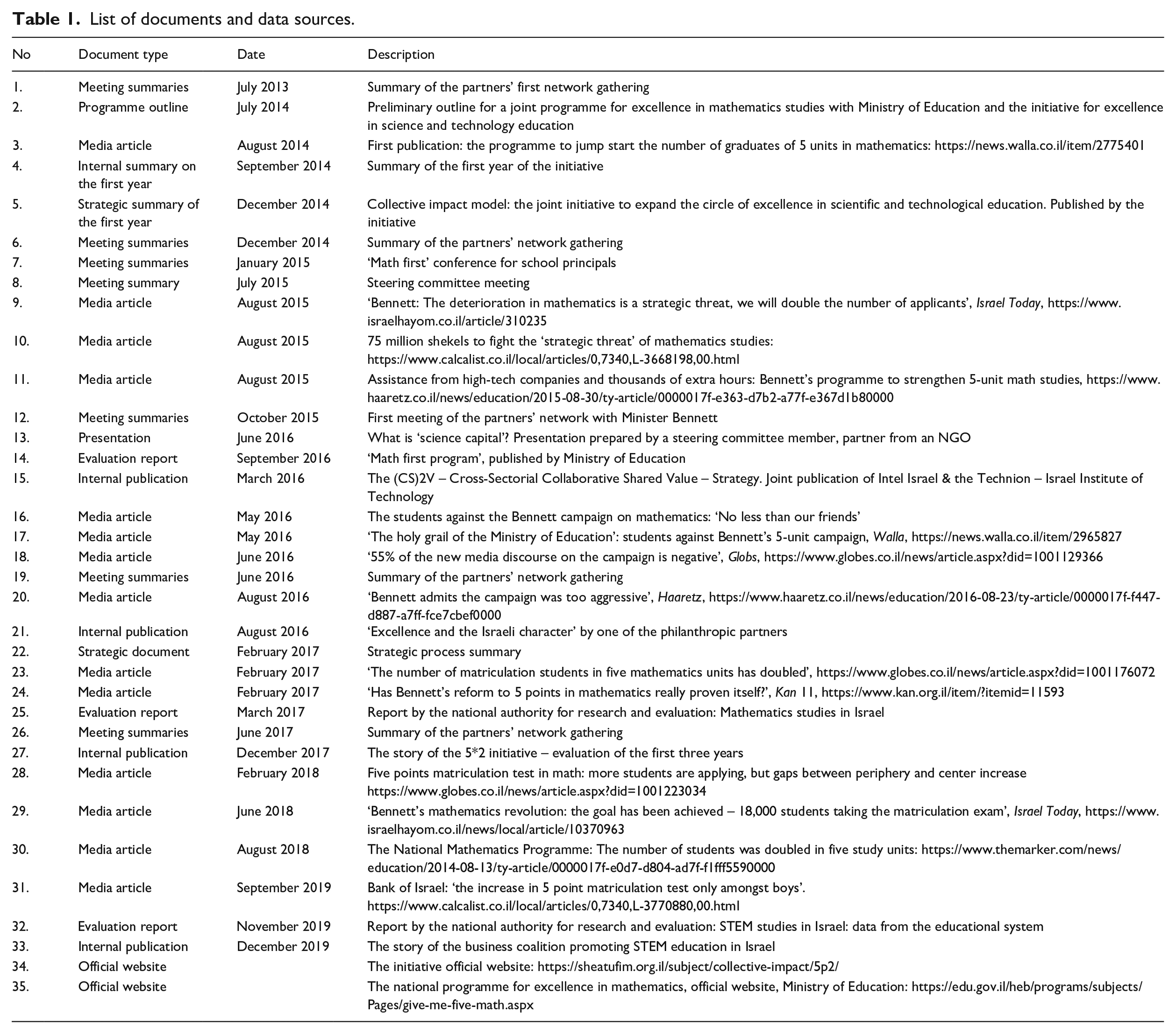
| No | Document type | Date | Description |
|---|---|---|---|
| 1. | Meeting summaries | July 2013 | Summary of the partners’ first network gathering |
| 2. | Programme outline | July 2014 | Preliminary outline for a joint programme for excellence in mathematics studies with Ministry of Education and the initiative for excellence in science and technology education |
| 3. | Media article | August 2014 | First publication: the programme to jump start the number of graduates of 5 units in mathematics: https://news.walla.co.il/item/2775401 |
| 4. | Internal summary on the first year | September 2014 | Summary of the first year of the initiative |
| 5. | Strategic summary of the first year | December 2014 | Collective impact model: the joint initiative to expand the circle of excellence in scientific and technological education. Published by the initiative |
| 6. | Meeting summaries | December 2014 | Summary of the partners’ network gathering |
| 7. | Meeting summaries | January 2015 | ‘Math first’ conference for school principals |
| 8. | Meeting summary | July 2015 | Steering committee meeting |
| 9. | Media article | August 2015 | ‘Bennett: The deterioration in mathematics is a strategic threat, we will double the number of applicants’, Israel Today, https://www.israelhayom.co.il/article/310235 |
| 10. | Media article | August 2015 | 75 million shekels to fight the ‘strategic threat’ of mathematics studies: https://www.calcalist.co.il/local/articles/0,7340,L-3668198,00.html |
| 11. | Media article | August 2015 | Assistance from high-tech companies and thousands of extra hours: Bennett’s programme to strengthen 5-unit math studies, https://www.haaretz.co.il/news/education/2015-08-30/ty-article/0000017f-e363-d7b2-a77f-e367d1b80000 |
| 12. | Meeting summaries | October 2015 | First meeting of the partners’ network with Minister Bennett |
| 13. | Presentation | June 2016 | What is ‘science capital’? Presentation prepared by a steering committee member, partner from an NGO |
| 14. | Evaluation report | September 2016 | ‘Math first program’, published by Ministry of Education |
| 15. | Internal publication | March 2016 | The (CS)2V – Cross-Sectorial Collaborative Shared Value – Strategy. Joint publication of Intel Israel & the Technion – Israel Institute of Technology |
| 16. | Media article | May 2016 | The students against the Bennett campaign on mathematics: ‘No less than our friends’ |
| 17. | Media article | May 2016 | ‘The holy grail of the Ministry of Education’: students against Bennett’s 5-unit campaign, Walla, https://news.walla.co.il/item/2965827 |
| 18. | Media article | June 2016 | ‘55% of the new media discourse on the campaign is negative’, Globs, https://www.globes.co.il/news/article.aspx?did=1001129366 |
| 19. | Meeting summaries | June 2016 | Summary of the partners’ network gathering |
| 20. | Media article | August 2016 | ‘Bennett admits the campaign was too aggressive’, Haaretz, https://www.haaretz.co.il/news/education/2016-08-23/ty-article/0000017f-f447-d887-a7ff-fce7cbef0000 |
| 21. | Internal publication | August 2016 | ‘Excellence and the Israeli character’ by one of the philanthropic partners |
| 22. | Strategic document | February 2017 | Strategic process summary |
| 23. | Media article | February 2017 | ‘The number of matriculation students in five mathematics units has doubled’, https://www.globes.co.il/news/article.aspx?did=1001176072 |
| 24. | Media article | February 2017 | ‘Has Bennett’s reform to 5 points in mathematics really proven itself?’, Kan 11, https://www.kan.org.il/item/?itemid=11593 |
| 25. | Evaluation report | March 2017 | Report by the national authority for research and evaluation: Mathematics studies in Israel |
| 26. | Meeting summaries | June 2017 | Summary of the partners’ network gathering |
| 27. | Internal publication | December 2017 | The story of the 5*2 initiative – evaluation of the first three years |
| 28. | Media article | February 2018 | Five points matriculation test in math: more students are applying, but gaps between periphery and center increase https://www.globes.co.il/news/article.aspx?did=1001223034 |
| 29. | Media article | June 2018 | ‘Bennett’s mathematics revolution: the goal has been achieved – 18,000 students taking the matriculation exam’, Israel Today, https://www.israelhayom.co.il/news/local/article/10370963 |
| 30. | Media article | August 2018 | The National Mathematics Programme: The number of students was doubled in five study units: https://www.themarker.com/news/education/2014-08-13/ty-article/0000017f-e0d7-d804-ad7f-f1fff5590000 |
| 31. | Media article | September 2019 | Bank of Israel: ‘the increase in 5 point matriculation test only amongst boys’. https://www.calcalist.co.il/local/articles/0,7340,L-3770880,00.html |
| 32. | Evaluation report | November 2019 | Report by the national authority for research and evaluation: STEM studies in Israel: data from the educational system |
| 33. | Internal publication | December 2019 | The story of the business coalition promoting STEM education in Israel |
| 34. | Official website | The initiative official website: https://sheatufim.org.il/subject/collective-impact/5p2/ | |
| 35. | Official website | The national programme for excellence in mathematics, official website, Ministry of Education: https://edu.gov.il/heb/programs/subjects/Pages/give-me-five-math.aspx |
Acknowledgements
We would like to express our sincere gratitude to the senior editor, Dror Etzion, for his valuable guidance, feedback and support throughout the review process. His insightful comments and suggestions have greatly contributed to the improvement of this paper.
We are also immensely grateful to the three anonymous reviewers who dedicated their time and expertise to thoroughly assess our work. Their constructive criticisms and thoughtful recommendations have played an instrumental role in shaping the final version of this paper
Furthermore, we would like to extend our appreciation to Shitufim and Trump Foundation, as well as all the leading partners in the Top15 Initiative, for granting us the opportunity to undertake this research. We thank Prof. Amalia Oliver and Alexander Bucevschi for their insightful feedback on earlier versions on this paper
Funding
The author(s) disclosed receipt of the following financial support for the research, authorship, and/or publication of this article. The project has received funding from Trump Foundation for the initial stages of the research.

Supplemental material
Supplemental material for this article is available online.
Author biographies
References
Supplementary Material
Please find the following supplemental material available below.
For Open Access articles published under a Creative Commons License, all supplemental material carries the same license as the article it is associated with.
For non-Open Access articles published, all supplemental material carries a non-exclusive license, and permission requests for re-use of supplemental material or any part of supplemental material shall be sent directly to the copyright owner as specified in the copyright notice associated with the article.
