




Abstract
To explain how multistakeholder groups organize democratic deliberations about complex sustainability issues, organizational scholars have focused on the key role of deliberative capacity, which encompasses the dimensions of inclusiveness, authenticity and consequentiality. However, the tensions inherent to the search of these three dimensions have been overlooked. In this paper, we argue that focusing on how spaces for deliberation are designed can help one understand how to manage such tensions. We identified the boundary work practices that shape the design of deliberative spaces and generate deliberative capacity properties in a high-level expert group (HLEG) launched by the European Commission about sustainable finance regulation. Our results show how these boundary work practices help balance deliberative tensions. We advance deliberation studies by conceptualizing deliberative boundary work, explaining how deliberative capacity is spatially generated and showing how deliberative tensions are balanced. We also contribute to boundary work theory by making explicit the deliberative nature of configuring boundary work and showing its relevancy to regulatory settings.
Keywords
Ground-breaking regulatory changes for financial markets were adopted by the European Union (EU) between 2019 and 2020, such as the Sustainable Finance Disclosure Regulation (SFDR) and the green taxonomy regulation. 1 This unprecedented EU regulatory focus on sustainable finance was initiated in 2016 when the European Commission invited a high-level expert group to deliberate on the regulation of sustainable finance (hereafter referred to as HLEG-SF). This group produced two reports with recommendations about how to embed sustainability within European financial markets, that were largely mirrored in March 2018 by a ‘Sustainable Finance Action Plan’ (European Commission, 2018) whose flagship policy recommendation was to create a green taxonomy. These policy outcomes suggest that there was a ‘before’ and an ‘after’ the HLEG-SF in the EU, which makes this group a compelling organizational context in which to investigate how experts deliberate. Deliberative dynamics are indeed key to our ability to solve grand challenges involving multiple stakeholders with diverse interests (Ferraro, Etzion, & Gehman, 2015; Marti & Scherer, 2016).
A growing number of scholars have turned to the political science concept of deliberative capacity to clarify the normative properties of democratic deliberations and their role in making deliberations successful. According to Dryzek (2009), democratic deliberations ought to be inclusive by representing a broad diversity of interests, authentic by inducing debates noncoercively, connecting claims to general principles and exhibiting reciprocity, and consequential by shaping collective decisions or social outcomes. Deliberative capacity is ‘the extent to which a political system possesses structures to host a deliberation that is inclusive, authentic and consequential’ (Dryzek, 2009, p. 1382). Prior analyses show the relevancy of these deliberative properties to evaluate multistakeholder sustainability initiatives across a range of settings (Dentoni, Bitzer, & Schouten, 2018; Schouten, Leroy, & Glasbergen, 2012) but also point to tensions inherent to achieving this three-folded normative ideal (Felicetti, Niemeyer, & Curato, 2016; Schouten et al., 2012).
In this paper, we argue that deliberative capacity-building and the tensions inherent to this process can be managed by engaging with space. Although political scientists insist on the fact that various spaces (e.g. parliaments, media outlets) play complementary roles to generate deliberative capacity and must be designed and linked accordingly (Dryzek, 2009; Fung, 2003), the configuration of spaces has not been central in prior organizational studies of deliberations. To explore how spaces are designed in ways that can generate and help balance deliberative capacity dimensions, we turn to the concept of boundary work, which captures how actors create, shape and disrupt social and symbolic organizational boundaries (Gieryn, 1983; Lamont & Molnár, 2002). Therefore, we ask: How does boundary work generate deliberative capacity?
Building from 32 interviews and multiple secondary sources, we induced three types of deliberative boundary work 2 involved in the generation of deliberative capacity: arranging – creating a bounded space for deliberation; shuffling – redistributing internal boundaries to sustain deliberation; and bridging – connecting the bounded deliberative space to other spaces. We then show how these types of boundary work help balance tensions among inclusiveness, authenticity and consequentiality.
Our study offers two contributions. First, we advance studies of deliberative capacity (Dryzek, 2009; Schouten et al., 2012; Soundararajan, Brown, & Wicks, 2019) by conceptualizing the boundary work that generates deliberative capacity and showing how the configuration of spaces is involved in deliberative capacity-building. We also theorize the deliberative tensions inherent to deliberative capacity-building and explain how they are balanced. Second, our analysis advances studies of organizational boundaries (Langley et al., 2019; Zietsma & Lawrence, 2010) by making explicit the deliberative nature of boundary work, which can explain its potential for organizational and social change, and by showing how normative reflexivity, distributed agency and purposefulness are related through deliberative boundary work. Practically, we show the relevancy of boundary work for studying regulatory settings and identify practices that can be used to shape organizational spaces in ways that enable effective deliberations.
Producing Deliberative Capacity When Dealing with Sustainability Issues
Organizational scholars are increasingly relying on the deliberative capacity concept to explore how to organize democratic deliberations involving multiple stakeholder groups dealing with complex sustainability issues (Dentoni et al., 2018; Moog, Spicer, & Böhm, 2015). Deliberative capacity theory consolidates earlier insights from studies of deliberative democracy, which refers to ‘any practice of democracy that gives deliberation its central place’ (Bächtiger, Dryzek, Mansbridge, & Warren, 2018, p. 2), a deliberation itself being defined as: [A] debate and discussion aimed at producing reasonable, well-informed opinions in which participants are willing to revise their preferences in light of discussion, new information and claims made by fellow participants. (Chambers, 2003, p. 309)
Central to studies of deliberative capacity is the work of Dryzek (2009), which adopts a talk-centric view on deliberation (Chambers, 2003) to show how communications within and across distinct spaces characterize the democratic nature of political systems. According to this normative framework, ‘the more authentic, inclusive, and consequential political deliberation is, the more democratic a political system is’ (Dryzek, 2009, p. 1380). Authenticity reflects the fact that ‘deliberation must induce reflection noncoercively, connect claims to more general principles, and exhibit reciprocity’ (Dryzek, 2009, p. 1382). Inclusiveness applies to ‘the range of interests and discourses present in a political setting’ (Dryzek, 2009, p. 1382). Consequentiality ‘means that deliberative processes must have an impact on collective decisions or social outcomes’ (Dryzek, 2009, p. 1382).
Prior organizational studies have established the usefulness of deliberative capacity to analyse the legitimacy and functioning of multistakeholder initiatives (Arenas, Albareda, & Goodman, 2020; Mena & Palazzo, 2012), such as the functioning of roundtables aimed at enhancing the sustainable production of soya (Dentoni et al., 2018) or the sustainable exploitation of forests (Moog et al., 2015). Others have built on this theory to analyse how responsible innovation can help tackle grand challenges (Voegtlin, Scherer, Stahl, & Hawn, 2022).
However, even though deliberative capacity ‘may be secured in connection with different sorts of institutions and practices’ (Dryzek, 2009, p. 1382), less attention has been given in organizational theory to the practices generating deliberative capacity. We therefore focus on deliberative capacity-building practices and contend that the concept of deliberative capacity has not yet unleashed its potential for advancing political and organizational theory for one main reason: simultaneous searches for normative properties inherently generate tensions.
Although prior research has used the properties of deliberative capacity in isolation to evaluate settings such as global supply chains (Soundararajan et al., 2019), they have overlooked the tensions – polarities between two elements (Smith & Lewis, 2011) – inherent to the simultaneous searches for authenticity, inclusiveness and consequentiality, which we refer to here as deliberative tensions.
Insights from studies of deliberative capacity (Dentoni et al., 2018; Moog et al., 2015; Schouten et al., 2012), however, suggest that a search for one property can be at odds with the search for the two others, and hence that deliberative capacity-building is a balancing act. Figure 1 presents the three deliberative tensions that we now make explicit and then illustrate with insights from prior studies.
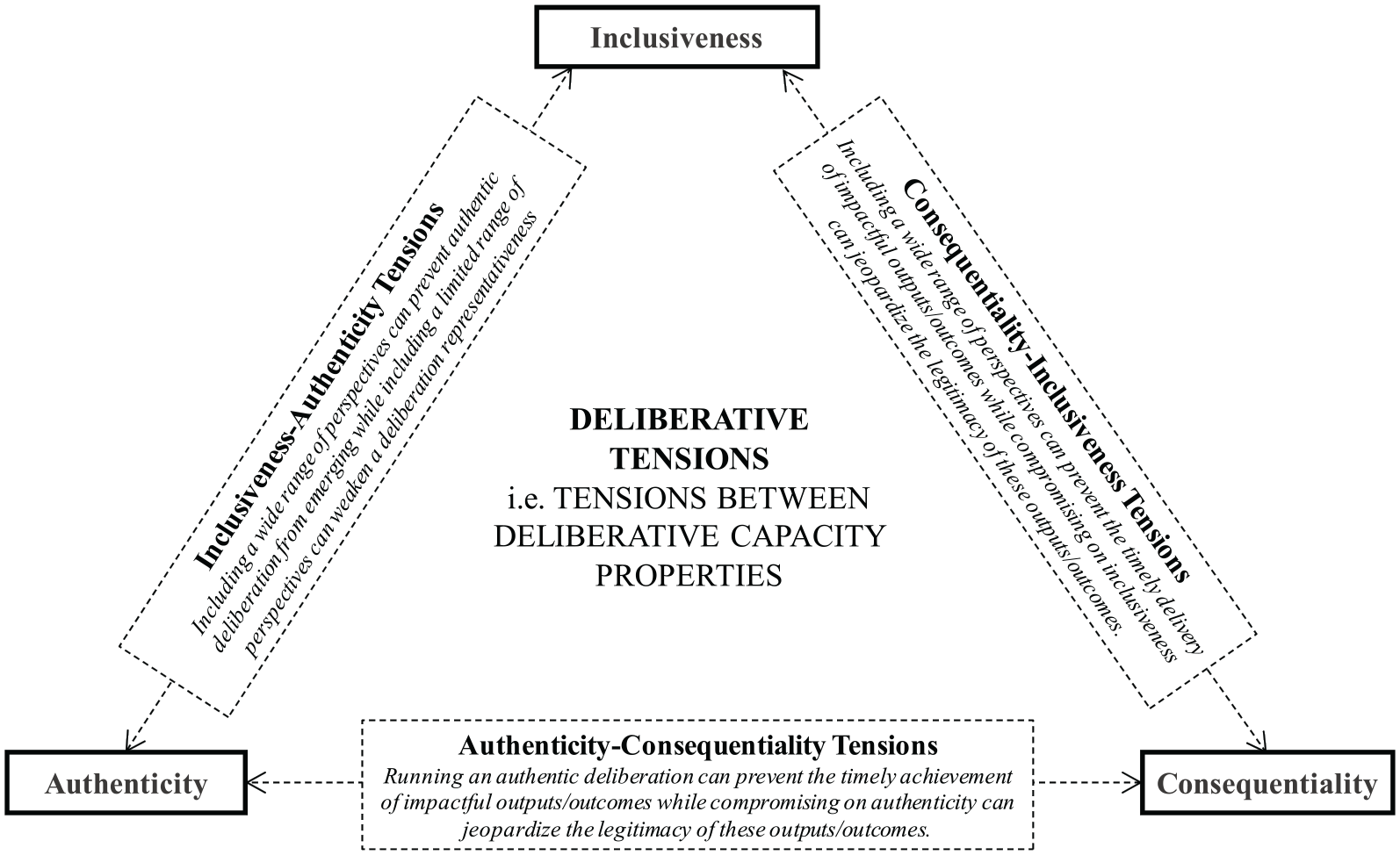
Deliberative tensions framework.
Inclusiveness–authenticity tensions
Inclusiveness–authenticity tensions relate to the fact that the wider the inclusion of diverse interests within a deliberation, the more difficult it is to develop an informed discussion necessary for producing an authentic deliberation within which reason giving, justifications and reciprocity can be sustained (Bächtiger & Parkinson, 2019). Searching for authenticity may lead to the exclusion of more radical voices, reducing de facto the inclusiveness of deliberative processes; searching for inclusion may jeopardize the capacity to organize in-depth discussions among participants. Such tensions are made visible in Schouten et al.’s (2012) analysis of the deliberative capacity exhibited by two multistakeholder roundtables on responsible production of soy and palm oil, within which the ‘relatively high authenticity of the deliberative processes can be partly explained by the exclusion of radical discourses from the debate’ (p. 49). Conversely, Felicetti et al.’s (2016) analysis of the Australian Citizens’ Parliament (ACP) experiment used to assess the strength of the system of government shows that ‘authenticity was undermined by a participant pool that was drawn from a population that is largely disengaged from politics’ (p. 433). However, for Dryzek (2009), ‘without inclusiveness, there may be deliberation but not deliberative democracy’ (p. 1382), and deliberation organizers therefore aspire for discourse and sociodemographic representativeness (Setälä & Smith, 2018), even though this may create tensions with the search for authenticity.
Authenticity–consequentiality tensions
The second set of tensions, authenticity–consequentiality tensions, stems from the contradiction between the time and resources required to build authentic exchanges among participants to a deliberation and the willingness to deliver outputs and/or achieve impactful outcomes in a timely manner. Knobloch, Gastil, Reedy and Cramer Walsh (2013), for instance, show how during the wrapping of the outputs of the Oregon Citizens’ Initiative Review, which was rushed to leave time for a public conference, one participant reflected that ‘[the] last day, when formulating the pro and con of a measure was difficult. . .The conclusions written were not as strong in wording, but I felt compelled to agree’ (p. 120). Ryfe’s (2005) analysis identifies similar tensions among policy-makers commissioning deliberations and the deliberative groups they put into motion. Deliberative groups see the outcomes of a deliberation as legitimate only to the extent that it arises from authentic discussions between equals, while for policy-makers, public decision involves compromises between the technicalities of issues and the politics of interests’ bargaining. Hence, policy-makers may push for shaping deliberations’ outcomes in ways that may cause backlash within the deliberating group and thus undermine authenticity.
Consequentiality–inclusiveness tensions
Finally, consequentiality–inclusiveness tensions point to the coercive power of space and time in the context of a deliberation (Knobloch et al., 2013). Including a wide range of perspectives in a deliberation can prevent the timely achievement of impactful outcomes, while compromising inclusiveness may accelerate the delivery of outputs – and thus enhance outcomes consequentiality – but at the price of undermining the legitimacy of these results. 3 Deliberative legitimacy is understood here as ‘the reflective acceptance of collective decisions by actors who had the chance to participate in a consequential deliberation’ (Dryzek, 2009, p. 1390). Felicetti et al.’s (2016) study illustrates such tensions in the case of the Civic Revision Initiative (CRI) in Bologna, during which they found that the low level of inclusiveness undermined the initiative’s legitimacy and its capacity to inform subsequent public discussions about the deliberated matters.
In sum, prior organizational and political studies of deliberative capacity-building remain bounded by their implicit analysis of the roles played by tensions in the generation and balancing of deliberative properties. Having made explicit the trade-offs in the search for these three normative ideas, we argue that focusing on the role and design of spaces in deliberation can be a fruitful way to understand how deliberative capacity can be generated while dealing with deliberative tensions.
Designing Deliberative Spaces: A boundary work perspective on deliberative capacity
Although prior studies on tensions have highlighted that configuring spaces can be a way of coping with tensions (Smith & Lewis, 2011), little attention has been given by organizational scholars to the role of space and boundary work in deliberation.
Engaging with space to organize deliberations
Deliberative democracy theory approaches deliberative spaces as bounded entities. On the one hand, deliberative scholars have focused on citizen mini-publics, i.e. ‘unusual institutions that create a space within which a diverse body of citizens would not interact otherwise’ (Setälä & Smith, 2018, p. 300). This research has started to consider the design of such spaces and to evaluate what makes mini-publics deliberative (Niemeyer & Jennstål, 2018). On the other hand, Dryzek (2009) regards deliberative capacity as potentially distributed across spaces. He distinguishes public spaces from empowered spaces and stresses that communication between these types of spaces is central to deliberative capacity-building (Dryzek, 2009). Public spaces are defined as deliberative spaces connected to media, the internet, or public forums – any physical locations where people can gather and talk – with few restrictions about who can participate and fewer legal restrictions about what can be said. Empowered spaces, in contrast, point to deliberative spaces for actors who are a recognizable part of institutions producing collective decisions but do not have to be formally empowered, such as the Forest Stewardship Council scheme studied by Soundararajan et al. (2019).
Dryzek (2009) discusses the transmission of deliberativeness between public and empowered spaces. For instance, the open coordination methods linking the European Commission to member states are offered as an illustration of a deliberative empowered space, decisive in producing collective outcomes but inadequate to transfer its deliberative properties to other EU public spaces. Such relationships between empowered spaces are deployed across levels of analysis, as empowered spaces may refer to a broad range of settings – typically described in organizational analysis as ‘macro’ (state institutions), ‘meso’ (stakeholder dialogue) or ‘micro’ (citizens discussing during a mini-public).
Missing from prior political analyses, however, is an attention to actors’ practices aiming at configuring deliberative spaces and their relationships with other spaces – such as the expert groups mobilized by the European Commission. Consistent with the ‘spatial turn’ in organization studies (Stephenson, Kuismin, Putnam, & Sivunen, 2020), we view space as socially constructed and enacted through practices (Lefebvre, 1991[1974]). We rely on the concept of boundary work to account for the space-focused practices involved in the production of deliberative settings.
Boundary work for deliberation
Boundary work is the ‘purposeful individual and collective effort to influence the social, symbolic, material, or temporal boundaries, demarcations, and distinctions affecting groups, occupations, and organizations’ (Langley et al., 2019, p. 704; after Lamont & Molnár [2002]). This concept offers a fitting lens for dealing simultaneously with the problems of spaces and tensions inherent to deliberative capacity-building and balancing. First, studies of boundary work ‘problematize boundaries by conceptualizing their creation, maintenance, blurring and transformation as the target of purposeful action’ (Langley et al., 2019, p. 705). Prior studies have documented a myriad of practices, such as ‘creating, expanding, undermining, or disrupting boundaries between groups, organization and fields across time periods, spatial ordering or institutional level’ (Helfen, 2015, p. 1390). Accordingly, a boundary work approach can help produce accounts of how actors are designing and connecting a variety of spaces to enhance deliberative capacity. Specifically, Langley et al. (2019) coined the notion of configurational boundary work, which refers to how actors ‘design, organize or rearrange the sets of boundaries influencing others’ behaviors’ (p. 707). This work provides an interesting perspective to explain deliberative capacity-building through spaces, given its focus on: how patterns of differentiation and integration among sets of people within or around organizations may be reconfigured to ensure that certain activities are brought together within bounded spaces, while others are at least temporarily kept apart, for the purpose of producing particular kinds of collective action. (Langley et al., 2019, p. 707)
Studies in the health care domain show how configuring boundary work practices design spaces that matter to organizational changes or collective action – such as ‘reflective spaces’, which allowed reconsideration of routines (Bucher & Langley, 2016), or ‘relational spaces’, a bounded setting that enabled medical residents to create and diffuse new practices to wider hospital settings (Kellogg, 2009). Boundary work as a concept can therefore help uncover practices involved in the design of bounded deliberative spaces.
Second, the boundary work concept is geared at explaining how to navigate tensions across boundaries. Gieryn (1983) originally coined this term to study the discursive strategies used by scientists to delineate science from nonscience and deal with tensions inherent to interactions between scientific and technical actors. By separating spatially and temporarily bounded spaces, boundary work can help with pursuing contradictory goals and thus explain how deliberative capacity properties are balanced.
In the case of the Forest Stewardship Council in Canada, Zietsma and Lawrence (2010) show the value of boundary work to clarify how to deal with tensions among stakeholders with contradictory views about how to manage forests through the creation of bounded experimental spaces that generated subsequent institutional changes. The links between the design of spaces and the management of tensions through boundary work can be further explored by focusing on the case of deliberative capacity. In addition, conceptualizing the boundary work involved in deliberative capacity-building and balancing can help specify further the normative reflexivity involved in configuring boundary work.
In what follows, we mobilize boundary work to investigate how spaces and tensions are involved together in deliberative capacity-building and the balancing of deliberative tensions.
Research Context and Methods
Context: The EU and its expert groups
Our empirical focus is a deliberation informing the regulation of sustainable finance in the context of a high-level expert group in the EU. The EU is a ‘consensus-seeking [political] system’ that ‘has deliberation written all over it’ (Eriksen & Fossum, 2018, p. 844). In the EU deliberative system, the European Commission works with hundreds of expert groups that inform EU collective decision-making on a wide array of policy topics (Metz, 2014). Although the European Commission’s heavy reliance on experts to accelerate the production of policy outcomes has been criticized for its lack of accountability and transmission to public spaces and its perceived elitism, it is also ruled by procedures that lead experts seeking to affect outcomes to frame their interests in a way that is consistent with recognized knowledge (Moore, 2014). Rules around EU expert groups are increasingly striving to increase the inclusiveness of these groups (Metz, 2014).
Within the EU deliberative system, which encompasses a network of empowered expert spaces, the HLEG-SF was launched at the end of 2016 ‘to help’ the European Commission ‘hardwire sustainability into EU financial policy’ (European Commission, 2016). Sustainability issues such as climate change have the properties of grand challenges (Ferraro et al., 2015): they are complex, uncertain and cut across different interests and areas of expertise (Wijen & Ansari, 2007). In our case – sustainable finance – these properties were amplified by the financial context. Financial regulators are not used to including nonfinancial knowledge in the design of regulation and tend to focus on the search for efficiency and financial stability rather than broad sustainability issues (Marti & Scherer, 2016). Hence, when the European Commission launched the HLEG-SF, the EU-empowered space was stepping into an uncharted territory. The HLEG-SF’s deliberative effort to come up with policy recommendations on how to regulate sustainable finance in the EU was captured by the release of two outputs: an interim report released in July 2017 and a final report in January 2018. Eventually, in March 2018, the European Commission published its Sustainable Finance Action Plan, which mirrored the HLEG-SF policy recommendations. This was followed by a wave of sweeping sustainable finance policy and regulatory actions in the EU (for an overview, see Figure 2).
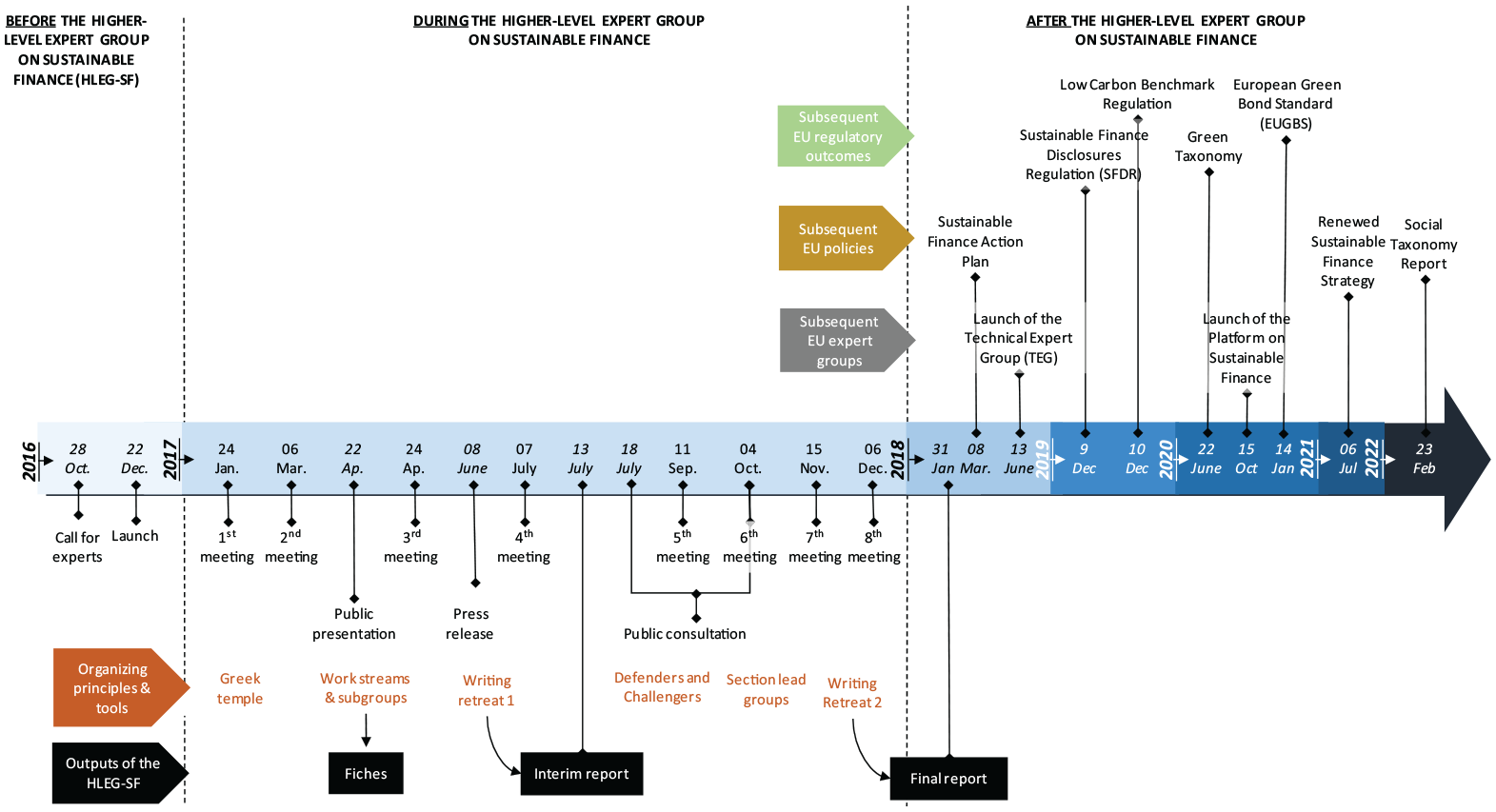
Event timeline.
Data collection
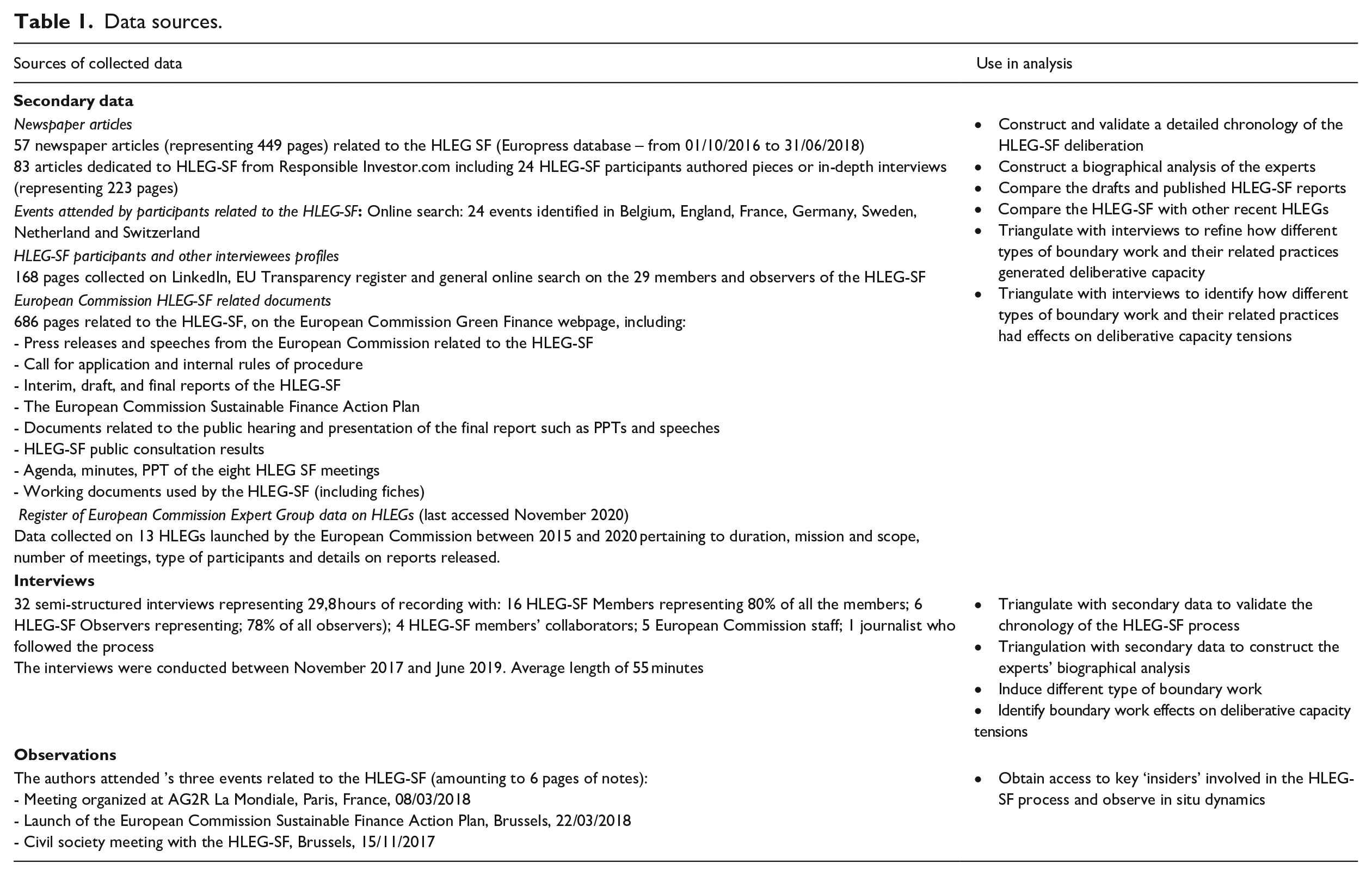
Interviewing ‘elite’ HLEG actors is a challenging task due to their competing priorities (Empson, 2018). We interviewed 32 actors relating to the HLEG-SF – 16 group members, six observers, five European Commission officials and supporting staff, four members’ or observers’ collaborators and one journalist. Data collection spanned 18 months from November 2017. The interviews lasted, on average, 55 minutes (for a total of 29.8 hours) and were transcribed. Primary data collection was complemented by various sources of secondary data listed in Table 1. First, we archived a total of 686 pages of documentation produced by the HLEG-SF and the European Commission. This included publicly available information such as press releases, reports, or meeting minutes and confidential information provided by HLEG-SF participants such as working documents, fiches, or notes. We secured access to the draft versions of the interim and final reports produced by the HLEG-SF. Second, biographical information about the educational and professional backgrounds of participants was retrieved via LinkedIn and the European Commission expert group register, representing 168 pages. Third, we gathered news articles including participant interviews and opinion pieces (representing 672 pages). This database was extended with the compilation of a list of 24 public events featuring HLEG-SF speakers, including three that we attended in person. Fourth, we collected available information on 13 other HLEGs launched between 2015 and 2020 to make sense of these groups’ functioning.
Data sources.
Data analysis
Our analytical protocol combined inductive and deductive approaches through a three-stage process. During the first exploratory stage, we triangulated our data sources to produce an event timeline that we incrementally updated with consecutive EU regulatory development (Figure 2). In parallel, two of the authors proceeded to an exploratory round of open coding focused on the interview material (Strauss & Corbin, 1998). Through this process, we observed the focus of interviewees on the joint effort of the European Commission and the group chairman to make the HLEG-SF process as deliberative as possible, given the complex challenges of regulating sustainable finance. Moving back and forth between data, theory and insights from our reviewers, we realized that the deliberative nature of the process owed a lot to the creation, maintenance and disruption of multiple boundaries. In parallel, we realized that the deliberative capacity concept (Dryzek, 2009) provided us with a conceptual anchor with which to investigate the normative properties of this process.
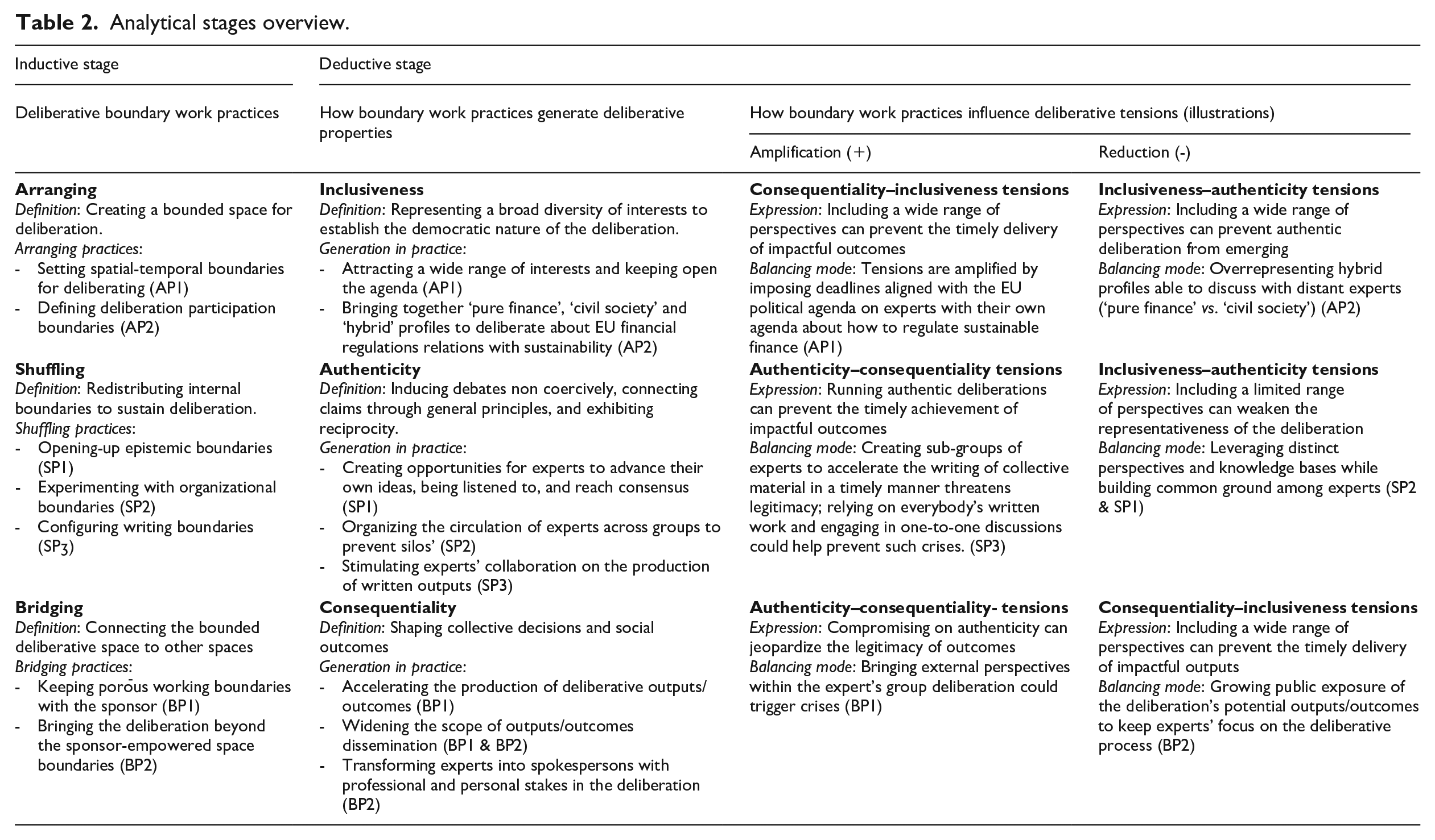
Because our second stage focused on analysing in an inductive way the boundary work involved in the HLEG-SF process as interpreted by our expert interviewees, the ‘Gioia’ approach was deemed relevant (Gioia, Corley, & Hamilton, 2013). We coded our interview data using sentences and paragraphs as our coding units and labelled them with in vivo terms. For example, expressions such as ‘lots of aspects were discussed during the group meetings’ or ‘privileging a free-flowing format’ led us to induce as a first-order concept the set of activities ‘making sure that everyone could express freely what they thought’. Eventually, after having consolidated 20 first-order concepts, we went back and forth between our interview data and the boundary work literature to induce seven practices that inform our second-order themes. These themes correspond to practices involved in the creation or change of boundaries related to space and time, epistemic or organizational aspects. For example, the activity of ‘making sure that everyone could express freely what they thought’ was clustered with ‘enabling the confrontation of arguments’ and ‘bringing people to reach consensus’ activities, leading to the induction of a second-order theme that we labelled opening epistemic boundaries. These seven boundary-related practices eventually formed three aggregate constructs corresponding to overarching types of deliberative boundary work: arranging, shuffling and bridging (Figure 3). Theorizing these dimensions further and relying on Langley et al. (2019), we defined deliberative boundary work as the purposeful individual and collective effort focused on boundaries that aims at making deliberation happen by arranging a deliberative space, shuffling boundaries to sustain deliberativeness in this space, and bridging this deliberative space to other spaces.
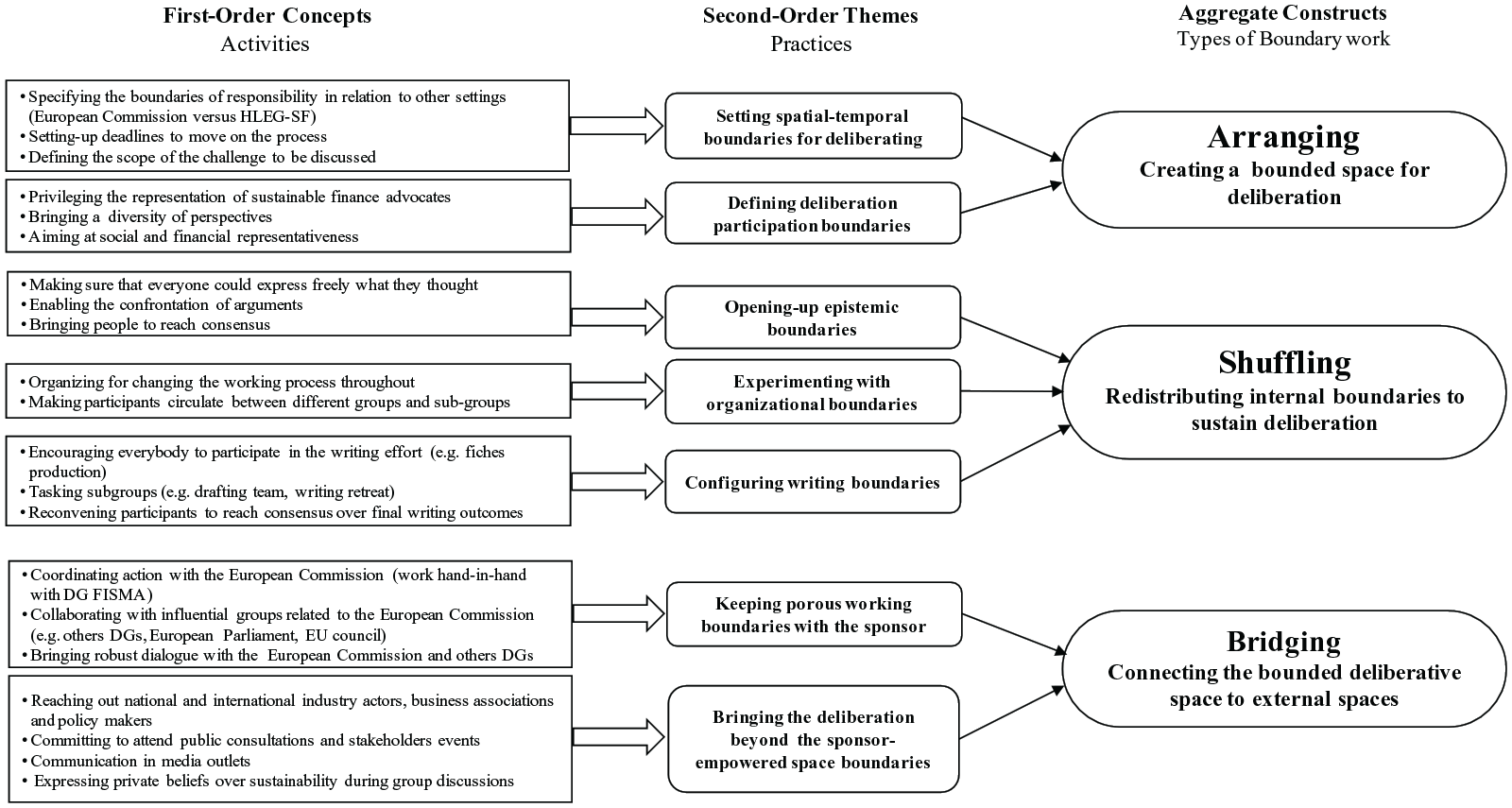
Data structure.
At a third stage, we shifted to a deductive mode of coding and operationalized the definitions of inclusiveness, authenticity and consequentiality provided by Dryzek (2009). Through a new round of constant comparison between these pre-existing concepts and our data (Glaser & Strauss, 1967), we analysed whether and how the identified types of boundary work were involved in the generation of deliberative capacity. For example, by triangulating our interview data coding and our biographical analysis, we found that arranging and its related practices setting spatial–temporal boundaries for deliberating and defining deliberation participation boundaries worked toward generating inclusiveness by creating a deliberative space with an open-ended agenda and by overrepresenting sustainable finance experts. Second, we unpacked whether and how the practices inherent to our three types of boundary work had effects on balancing deliberative tensions by focusing on ‘episodes of frictions’ (Comeau-Vallée & Langley, 2020) through the HLEG-SF process. This approach led us to find that deliberative boundary work could either reduce or amplify the deliberative tensions we consolidated from prior theory (Figure 1). For example, we could ascertain that keeping porous working boundaries with the deliberation sponsor, a practice related to bridging, amplified authenticity–consequentiality tensions by bringing perspectives coming from the European Commission to permeate the HLEG-SF. Table 2 presents an overview of our research design, specifying the different stages of our analysis.
Analytical stages overview.
Generating Deliberative Capacity Through Boundary Work
This section presents the three types of deliberative boundary work, explaining for each how it generates deliberative capacity and helps balance deliberative tensions.
Arranging work for inclusiveness
The arranging boundary work consists in creating a bounded space for deliberation. We found that practices that form arranging boundary work – setting spatial–temporal boundaries for deliberating and defining deliberation participation boundaries – were geared at generating inclusiveness. The first practice aimed at preparing the HLEG-SF deliberation in line with the EU institutional design. The EU’s public call for HLEG-SF applicants, launched in October 2016, made clear the ‘tight deadlines’ (O4) for deliverables and the rules surrounding the functioning of EU expert groups. The HLEG-SF’s role was to independently advise the EU on policy but not make policy. Conversely, the EU sponsor, who was agnostic in the matter of regulating sustainable finance, broadly defined the boundaries of the regulatory challenges for experts and attracted a diversity of expertise.
The experts came in looking at a blank piece of paper, because the mandate we gave them was to help us to develop the EU strategy on sustainable finance where there was nothing before. (EC4)
4
The European Commission says, there are these big things out: climate change, environment, and we don’t know how to integrate this in financial regulation. Can you help? So, the briefing, the steering, was clear, although the subject was not well defined. (Chairman)
The setting of spatial–temporal boundaries for deliberation by the European Commission kept the deliberation boundaries sufficiently open to attract a wide range of applicants (n = 103) willing to engage with the demanding EU application process to participate in the HLEG-SF and advocate their views on sustainable finance regulations.
Through the second practice, defining deliberation participation boundaries which involved selecting who could be part of the group, the European Commission generated inclusiveness by organizing the representation of a relatively diverse pool of perspectives: We did not want only banks, insurance companies or investors, but we also wanted NGOs [nongovernmental organizations], civil society and academia. We wanted to listen to everybody, so we used a broad approach, which is not always the case for expert groups. The second thing was that we did not want to select people only focused on their individual perspectives, their organizations or their sectors but who could also look a bit deeper and broader than what was going on in their own sector. (EC3)
Being perceived as achieving the normative ideal of inclusiveness was a challenging endeavour for the European Commission. For instance, in hindsight, some HLEG-SF participants identified a lack of academics, NGOs and banks, and the overrepresentation of UK representatives in a post-Brexit context, as a failure to represent all needed perspectives. Our secondary data analysis confirmed an unbalanced representation of NGOs: think tanks dedicated to sustainable or green finance (Novethic, E3G, 2° Investing Initiative) were better represented than more reformist NGOs focusing exclusively on the defence of environmental or human rights (e.g. World Wide Fund for Nature), and more radical NGOs such as Greenpeace and Oxfam were absent.
However, some participants, notably on the investment industry side, reflected that NGOs ‘were not too badly represented’ (M6) considering the financial regulation context at hand. Our analysis of the biographical material suggests that selected sustainable finance experts often presented ‘hybrid’ financial/sustainability educational or professional profiles. Few of these experts started their careers in the finance sector or earned degrees in economics or finance, and many were trained in environmental studies, politics, or journalism, as illustrated by the trajectory of Steve Waygood, for example. This British citizen worked for one of the largest UK asset managers, Aviva Investors, at the time of his inclusion in the group. He holds a PhD about ‘the impact of the NGO sector on capital markets’ and started his career at the WWF before obtaining sustainability positions in the finance industry.
As a result of the specific definition of participation boundaries, the 20 members and the nine observers who won their seats in December 2016 from the original pool of 103 applicants included a majority of strong-minded sustainable finance experts with heterogeneous perspectives on environmental and social challenges and the role of regulation versus market forces, together with NGO representatives with varied knowledge of capital markets but whose views often matched those of the sustainable finance experts and conventional experts of finance. 5 Such makeup was seen as inclusive, at least in the context of EU capital market regulation.
Balancing deliberative tensions through arranging
On the one hand, we found that arranging reduced inclusiveness–authenticity tensions (see Table 2 for an overview), which relates to the fact that too diverse perspectives in a deliberation may prevent the emergence of robust discussions. Overrepresenting sustainable finance experts with hybrid profiles – a result of the European Commission sponsor’s setting of an open-ended agenda and defining deliberation participation boundaries – laid the ground for discussions that were both inclusive and authentic. Although these discussions comprised diverse perspectives, experts were sufficiently informed about sustainable finance challenges to argue in a robust manner.
The group was a complete mixture. I can’t remember another group like this that would have campaigning NGOs in it, who did not understand markets and did not care about markets and probably don’t want capitalism. The market people were mostly the people from financial firms who were the sustainability advocates within these firms. They were sustainability experts and not the ones running the business. Therefore, you had the full spectrum with also dyed-in-the-wool financial market people. Then, you put all these people in one group, and you get interesting clashes. (M5)
For example, NGO participants and sustainable finance experts were able to include social perspectives in the deliberations that at first ‘were not on the radar’ of the European Commission, which initially strictly focused on environmental issues (EC2, M7).
On the other hand, arranging by setting spatial–temporal boundaries to create alignment with the European Commission political deadlines amplified consequentiality–inclusiveness tensions pertaining to the coercive roles of time and space that may hinder the perspectives of all participants from being represented in a deliberation’s outputs or outcome. In our case, the relatively wide range of ambitious experts were coerced to get their respective and sometimes opposing views to be sufficiently represented within future EU policy outputs in a strict one-year delivery timeframe that was not negotiable: At one point, we asked if we could extend the work until Easter [April 2018], but we were told no, they [European Commission] needed the recommendations now. (O4)
This diverse group of experts was geared further into authentic discussions through a second type of boundary work: shuffling.
Shuffling work for authenticity
Shuffling is about redistributing boundaries to sustain internal deliberation. Opening up epistemic boundaries, experimenting with organizational boundaries and configuring writing boundaries were the three practices forming the shuffling boundary work and generating authenticity. The first practice consisted of allowing for the expression of diverse voices to expand collective knowledge within the group. For example, during the first meeting of the HLEG-SF in January 2017, an open round was organized (HLEG-SF minutes, meeting 1), which allowed the widening of the scope of deliberated topics: There was a discussion about whether we should define boundaries and whether we needed definitions of what sustainability meant, and early on, we decided not to invest too much on that. [. . .] So the piece was left open, and then everyone could go for it on their own ideas or narratives. (O5)
Our interviewees shared the sentiment that they had the opportunity to make ‘their voices heard’ and ‘to speak their mind’ (M15). This authenticity of expression was comforted by the fact that the HLEG-SF, due to the ‘knowledge sitting in the room’ (O1), did not shy away from epistemic confrontations on debates about the weight of social versus green topics in sustainable finance or green bonds’ regulation. Interactions within the group were seen as ‘energizing’ (M7) and ‘disagreements constructive, as it helped people to think about issues in another light’ (M9). Epistemic confrontations crystallized around the necessity of reforming the entire financial industry on matters such as financial benchmarks, high-frequency trading or market short-termism.
To avoid ‘group think’ (O4) that could have prevented the production of an authentic collective outcome, a ‘champions vs. defenders’ approach was introduced after the release of the interim report (see Figure 2), through which participants were divided into teams to either defend or challenge each other.
The champions and defenders [system] worked quite well [. . .]. There was this situation in one of the workstreams where you had different views, and this was an open way to put it on the table. We have people who are drafting, but then there are people who could challenge this, and then you would try to work in a way to achieve a common view. (O3)
The second practice, experimenting with organizational boundaries, brought authenticity by facilitating interactions within the group. Through the eight HLEG-SF meetings that were held from January to December 2017, the chair and his team aimed to avoid inertia and silos to keep deliberations about how to regulate sustainable finance authentic.
We had to organize themes, so we needed to organize in subthemes. But the challenge with these subgroups is that at the end, the group becomes the experts of their field, and the collective view is the amalgamation of predefined subgroups. [. . .] What did I do to avoid this? I changed the organization all the time. You cannot have an organization where you have departments B and C. (Chairman)
This experimentation with organizational boundaries led to the active circulation of participants between large groups (plenary) and subgroups (workstreams). Our secondary data analysis allowed us to track experts’ circulation through the HLEG-SF process. For example, one of the members oversaw the ‘Expanding financial markets for sustainable assets’ subgroup together with eight other experts in March 2017; in June 2017, he worked in the subgroup on green taxonomy with four other participants, and none of them was in his previous working group; finally, as of November 2017, he was part of the champion group on ‘Mobilizing retail investors for sustainability’ with five participants with whom he had not yet worked. This practice reinforced the deliberations’ authenticity by enabling participants to have ‘candid discussions on each different part of the investment value chain’ (M4).
The third practice, configuring writing boundaries, involved an intensive collective writing exercise. As the final interim report was due for July 2017, the HLEG-SF participants focused very early on writing. During the first phase, ‘everybody was encouraged to roll their sleeves and start writing’ (M14) and participated in the writing of ‘fiches’:
6
The fiche idea was very good because everyone came with his or her ideas. [. . .] It put everyone to work; there was no way to escape it. It wasn’t that there was a small group doing the work and the other one counting. Everyone had to contribute. It was also good to understand mutually what people’s concerns were. (O4)
This collective writing effort brought participants to ‘exchange and give comments to each other’ (M12) through textual interactions (e.g. comments, track changes), which were visible in the multiple versions of the writing documents (e.g. fiches and reports).
Balancing deliberative tensions through shuffling
We found that shuffling contributed in the first place to reduce inclusiveness–authenticity tensions (see Table 2), notably because opening epistemic boundaries and experimenting with organizational boundaries made it possible to leverage different perspectives and knowledge while building common ground among experts: The whole taxonomy was seen as something obviously key [. . .] whereas for me, I thought this was something biologists talked about. I had to come a long way. (O4)
Shuffling helped to ‘partially overcome the fact that people did not have the full knowledge of the field’ (M6) thanks to the multiple debates and confrontations among members. The green taxonomy but also green bonds, financial benchmarks, and the importance of integrating retail investors were discussed at length. However, shuffling could not prevent experts specialized in specific sustainable finance topics from having an advantage. For example, opening epistemic boundaries through the challenger/defender approach, described at the time as ‘a very good kind of rebuttal and dialectic process that helped to build consensus’ (O5), did not fully reduce authenticity–inclusiveness tensions: There was asymmetry, dissymmetry between the knowledge level on a specific topic. Sometimes the champion had a quite easy journey through the meeting. (M15)
Shuffling sequentially amplified and reduced authenticity–consequentiality tensions, which points to the fact that authentic discussion takes time and can impede the timely delivery of outcomes. At first, shuffling, by configuring writing boundaries, generated authenticity by stimulating all participants to collaborate on writing. However, after this exercise, a ‘group within the group’ (M15) was created that was put in charge of trimming and accelerating the drafting of written outputs and securing future consequential outcomes. Together, this subgroup participated in two writing retreats, working with professional editors. However, when the first draft produced by this subgroup was presented to the entire group, frictions emerged.
In the interim draft, there was a negative stance on the whole financial sector [. . .]. There was a lot of heated debate about the first draft. (M10)
This clash led the group to hit a deadlock. The option to include in the final report a ‘disclaimer’ listing members who could not endorse some of the recommendations was contemplated, although it was overcome by opening epistemic boundaries: When you have a member saying that I don’t like the way you wrote Paragraph 5 [. . .]. How do you vote on this? [. . .] Some members started to say we want footnotes that say we don’t agree on this and that. At this stage, a roundtable was organized with all the group members, and what came out was that most people wanted to own the whole report and rejected this idea of creating exceptions. After this tough moment, the chairman gained the legitimacy to carry on with the process. (C1)
The chair and his team learned from their first configuring writing boundaries attempt. After this episode, they relied more closely on the written work continuously produced by the subgroups and aimed at being ‘more transparent and interactive’, a crucial step for securing ‘everybody’s buying in’ (M2). Meanwhile, the chair and his team stepped in within subgroups and engaged one-to-one side discussions to ‘negotiate’ (C1) the final wording. Our secondary data analysis confirms this overall balancing of authenticity–consequentiality tensions. For example, notions such as short-termism or high-frequency trading, which pointed to a more critical stance on the role of the financial system, vanished from the first published interim draft report but reappeared in the final draft and published report. Such an evolution illustrates the robustness of discussions within the group and its ability to modify its collective position over time. In sum, shuffling contributed to reducing both inclusiveness–authenticity and authenticity–consequentiality tensions in the sense that, despite frictions around the release of written outputs, members felt sufficiently represented and treated as equals to decide to stay in the HLEG-SF boat, while in parallel bridging helped secure an impactful policy outcome.
Bridging work for consequentiality
Bridging as a form of boundary work involves connecting the deliberative space to other spaces. Bridging encompasses two practices: keeping porous working boundaries with the sponsor and bringing the deliberation beyond the sponsor-empowered space boundaries, which both generated consequentiality. Keeping porous working boundaries with the sponsor entailed many interactions between the European Commission and the HLEG-SF members. DG-FISMA 7 oversaw the logistic and secretariat support for the HLEG-SF. One DG-FISMA staff member was tasked to ‘shadow’ (M4) the HLEG-SF and coordinate the production of the European Commission Sustainable Finance Action Plan. Not only did the HLEG-SF experts dialogue with DG-FISMA, but they also engaged with the DG-Justice, DG-Environment and DG-Energy. The European Commission brought forward staff members ‘who would be responsible to take on board’ (M4) any specific HLEG-SF’s suggestion, and a dialogue would follow about the feasibility of policy recommendations considering the ‘European institutional context’ (EC4). HLEG-SF members felt that the upper levels of the European Commission were ‘supportive’ (M1), had ‘high expectations’ (M9) and displayed the political will to act upon the outputs of their deliberation. This dialogue with the European Commission was not exempt from moments of friction. The staff from the European Commission who had discussions with HLEG-SF members were at times described as ‘very negative’, or ‘arrogant’ technocrats, who ought to be ‘challenged’ (M10, M12), but there also was a collective conviction that accepting to ‘work hand in hand’ with the policy-makers would enable the experts to achieve more in terms of impactful policy outcomes on sustainable finance than they ‘would have otherwise done’ (M4).
The second practice, bringing the deliberation beyond the sponsor-empowered spaces, required HLEG-SF experts to reach and connect with actors and spheres beyond the European Commission. They were invited to disseminate their work and collect inputs in their own national or neighboring space: From the start, we said that we need to regularly do some outreach, it is a part of the success, you need to embark the system with you. (M1)
Our secondary data analysis confirmed that HLEG-SF participants were involved in at least 24 sustainable finance-related events. In parallel to the interim report release, the European Commission supported the organization of a successful public hearing in July 2017, during which the chair and the group actively participated. This event was followed by a public consultation on the direction taken by the HLEG-SF’s interim report. In total, 250 stakeholders’ responses were analysed in September 2017 before being made publicly available in January 2018. 8
HLEG-SF participants also were encouraged to communicate their views via the press and social media. This was notably done through the Responsible Investor online media platform, which commissioned 24 opinion pieces about how to tackle sustainable challenges through financial regulations. This led the HLEG-SF group to ‘bring the debate to the public realm’ (M1) and to ‘embody’ (M12) the policy and regulation challenge. It also helped the members connect with their personal motivation for the sustainability topic at hand.
Balancing deliberative tensions through bridging
We found that bridging played a dual role regarding tensions. First, bridging reduced consequentiality–inclusiveness tensions by connecting the HLEG-SF deliberation to European Commission empowered spaces (e.g. various DGs, European Parliament) and to a larger deliberative system (e.g. media engagement). This created reputation risks for all HLEG-SF participants and encouraged even the most critical ones to secure a robust collective outcome and adapt their respective policy ambitions regarding sustainable finance.
There was a form of emulation around the HLEG-SF; it started to attract people from outside the European Commission, media, and so there was an obligation of results [. . .] we could not fail [. . .]. There were charismatic personalities in the group who were making a lot of public declarations on climate change [. . .]. How will they justify they spent so much time on this? (C2)
Second, bridging amplified authenticity–consequentiality tensions. For example, some NGO members favoured the creation of a ‘green supporting factor’ that concerned the value of releasing capital requirements for banks supporting green investment, which they assume could accelerate the greening of the economy. Authentic debates ensued within the group, during which some experts argued that such a factor could jeopardize the ‘greater good’ (M7) and harm global systemic financial stability. Reflecting these debates, the factor was discreetly mentioned with cautionary terms in the interim report (HLEG-SF Interim Report, 2017, p. 32).
However, in December 2017, European Commission Executive VP Valdis Dombrovskis, actively backed by a few insurgent HLEG-SF members, publicly suggested, during the One Planet Summit organized in France, that ‘a green supporting factor’ could be one of the policy recommendations of the forthcoming report.
If the VP did not make a speech on the topic, there would be absolutely nothing about it in the final report. Because he took a public position, the group [HLEG-SF] was obliged to take a public position. (M1)
Such a shortcutting of the group’s internal deliberations to force consequential impact was at odds with the group’s search for authenticity. A group consensus emerged on a final wording that ended not to recommend it as one of the HLEG-SF’s policy recommendations but to investigate the optimal conditions under which such a regulation should be implemented: While the HLEG debated the idea of a green supporting factor, [. . .] the Commission made an announcement at the One Planet Summit in Paris in December 2017. Vice-President Dombrovskis stated that the Commission is ‘looking positively’ at the possible introduction of a ‘green supporting factor’ in prudential rules to boost lending and investments in low-carbon assets. Therefore, the question is what aspects need to be considered when exploring the appropriateness of a green supporting factor. (HLEG-SF Final Report, 2018, p. 68)
Our secondary data analysis indicates that the European Commission kept alive the idea of ‘a green supporting factor’ in its Action Plan, a fact that shows the intricacies of running an authentic deliberation (i.e. reflecting the diversity of members’ views on sustainable finance and considered legitimate by all deliberation participants) while bringing deliberation outside its bounded space to achieve impactful outcomes. Eventually, in our case, bridging was successful in reducing consequentiality–inclusiveness tensions, at least in the sense that no expert publicly threatened to leave or left the HLEG-SF due to its lack of deliberative legitimacy. 9 Meanwhile, bridging amplified authenticity–consequentiality tensions, due to intense interactions with other spaces.
Discussion
Our study asked how deliberative capacity is generated and how deliberative tensions are balanced when dealing with complex sustainability issues through engagement with space. Rather than using the deliberative capacity concept as a normative framework to evaluate the deliberative properties of a multistakeholder initiative (Arenas et al., 2020; Soundararajan et al., 2019), we analysed the practices involved in the production of inclusiveness, authenticity and consequentiality and the effects of these practices on reducing or amplifying tensions among these three normative ideals. Focusing on the construction of space to deal with tensions and organize deliberation, we mobilized the boundary work concept to account for how actors are configuring spaces and dealing with deliberative tensions when searching to generate deliberative capacity. Through the analysis of an expert group in charge of deliberating about EU sustainable finance regulation, we inductively identified three types of deliberative boundary work – arranging, shuffling and bridging – and deductively showed how they produce inclusiveness, authenticity and consequentiality while contributing to balance tensions among these properties. Figure 4 presents a deliberative boundary work framework that integrates these insights. The deliberative boundary work co-constituted the deliberative space by continuously drawing and redrawing the boundaries both within this space and between this space and other empowered or public spaces, and, in so doing, generated deliberative capacity while balancing tensions. Our study provides insights for deliberative capacity theory and for studies of boundary work, which we discuss in the rest of this section.
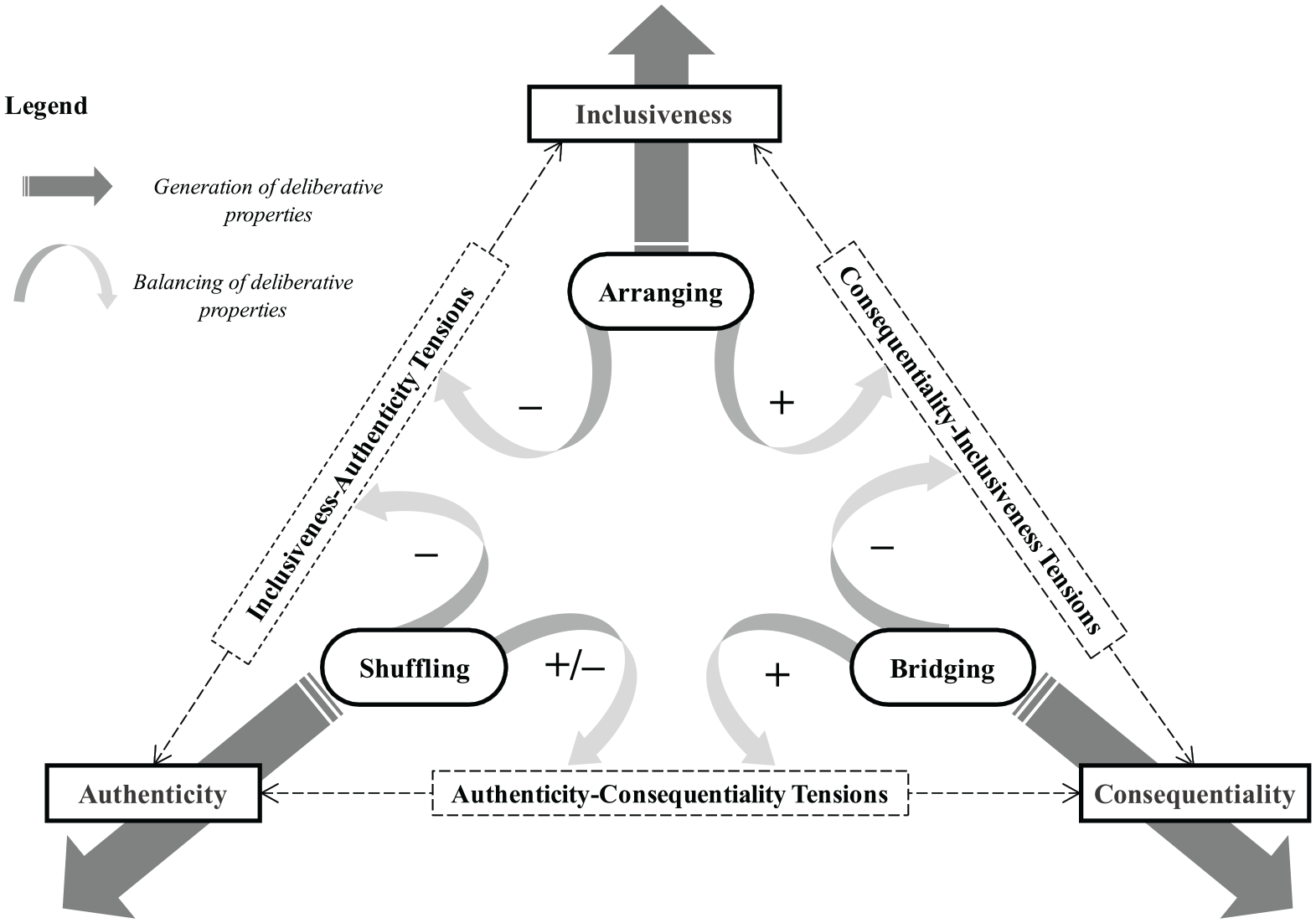
Deliberative boundary work framework.
Generating deliberative capacity by configuring space through boundary work
Our first contribution is to deliberative capacity theory (Arenas et al., 2020; Dryzek, 2009) and consists of making explicit two related aspects that were largely implicit thus far: the organizing role played by space-focused practices in the constitution of deliberative capacity and the role played by these practices in balancing deliberative tensions. Consistent with the view that deliberative capacity relies on practices (Ryfe, 2007) and involves the configuration and bridging of various spaces (Dryzek, 2009), we analytically induced three types of deliberative boundary work contributing to the generation of deliberative capacities.
Although deliberative capacity scholars have not ignored tensions (Dryzek & Pickering, 2017; Scherer & Voegtlin, 2020), they have not conceptualized the search for deliberative capacity as an intrinsically balancing act resulting from the fact that deliberative properties themselves are in tension. Our initial framework (Figure 1) addresses this blind spot, enabling us to investigate how deliberative tensions are not only produced but also balanced through boundary work. Our augmented framework (Figure 4) explains how arranging, shuffling and bridging either reduce or amplify sequentially, or simultaneously, deliberative tensions, in ways that can enable or prevent the continuous production of deliberative capacity. As a whole, our framework captures ongoing practices of actors designing and conducting deliberative processes and can be used to explore other settings, such as mini-publics, and also how deliberation is deployed at the board level of charities and corporations.
In so doing, our analysis advances deliberative capacity theory in two ways. First, it demonstrates the usefulness of analysing the generation and balancing of deliberative capacity as a consolidated repertoire of practices that work constantly alongside and in relation to each other. In our empirical case, we found that bridging amplified some authenticity–consequentiality tensions by bringing external perspectives into the deliberation and that these perspectives were balanced by shuffling work, which kept internal debates authentic, securing consensus on the report’s ultimate wording. Our analysis therefore suggests that attempts at generating multiple deliberative properties are doomed to fail if the intrinsic tensions and tradeoffs among such properties are not considered, ideally in a mindful and reflexive way, by actors designing and organizing deliberative spaces. Although our results show how some patterns of interactions among the three types of boundary work help balance tensions, more studies of distinct deliberative settings are needed to explore how deliberative tension balancing operates through deliberative boundary work.
The types of deliberative boundary work we identified also address some outstanding issues in this literature. Arranging emphasizes the relational nature of deliberation (Ryfe, 2007) by showing how inclusiveness is produced through the selection of hybrid profiles able to interact with ideologically distant stakeholders (financiers vs. NGOs). Arranging work can help study the design of settings enabling deliberation beyond the consideration of sociodemographic representativeness (Dryzek, 2009; Ryfe, 2005). Shuffling, on the other hand, addresses Bächtiger and Parkinson’s (2019) call for opening the black box of authenticity production by shifting attention away from the ex-post measure of deliberative authenticity (Bächtiger & Parkinson, 2019) or the ex-ante setting of institutional parameters (Setälä & Smith, 2018) to consider the practices organizing continuously deliberative work. This deliberative boundary work points to the importance of opening epistemic spaces in deliberations (Bächtiger & Parkinson, 2019), notably thanks to writing practices that maintain authenticity. Finally, bridging refines the idea of transmission between spaces (Dryzek, 2009) by explaining how to address the well-documented limited transmission between deliberative spaces and policy-making (Ryfe, 2005). Therefore, future studies also could leverage the three types of work separately to explore the intended and unintended effects of deliberative boundary work across settings and how actors become mindful of their effects.
Making explicit the deliberative nature of boundary work
Our analysis also advances boundary work theory (Gieryn, 1983; Langley et al., 2019), as our concept of deliberative boundary work clarifies how deliberative properties are spatially constituted through boundary work, and our results show how normative reflexivity, distributed agency and purposefulness are involved in this process. Prior studies show that configuring boundary work can create dedicated relational (Kellogg, 2009), reflective (Bucher & Langley, 2016) or experimental spaces (Zietsma & Lawrence, 2010) that enable broader social change. However, these studies overlooked that such a potential for social change could relate to deliberative properties produced by boundary work.
Our analysis makes explicit how these deliberative properties are produced through boundary work and clarifies how three types of deliberative boundary work trigger and balance these properties. Future research could revisit prior cases of configurational boundary space construction to investigate whether the type of boundary work involved implicitly triggered deliberative properties that could explain why some of these spaces could enable change at the organizational or field level. By evaluating retrospectively how ‘deliberative’ the various forms of boundary work documented in prior research were, this implicit political nature of the boundary work concept could be clarified. In parallel, our EU case context established the relevancy of the boundary work concept for studying regulatory contexts within which multiple stakeholders’ interests collide. Future studies could explore how boundary work produces deliberative properties in such settings.
Our results also reveal insights about reflexivity in relation to boundary work. We found that deliberative boundary work can produce bounded spaces enabling participants’ reflexive normativity, notably by making possible the constant evaluation of normativity about politically loaded and complex topics such as sustainable finance or, more broadly, sustainability issues. For instance, Dryzek and Pickering (2017) insist on the role that deliberation plays to enhance reflexivity – defined as ‘the ability of a structure, a process or a set of ideas to reconfigure itself in response to reflection on its performance’ (p. 1) in the context of environmental governance. Although these authors insist on the tensions inherent to such a reflexive deliberative activity, they say little about the practices used to design spaces enhancing reflexivity. Our deliberative boundary work concept complements such insights by explaining how normative reflexivity is generated and sustained in practice. Future work could explore how these boundary work practices are mobilized in a variety of national and transnational settings related to environmental governance such as the Intergovernmental Panel on Climate Change (IPCC) to governmental bodies.
Our case study finally sheds light on some interesting political features of boundary work, as it reveals connections among agency, purposiveness and reflexivity that deserve more empirical attention (Langley et al., 2019). In our case, the deliberative boundary work was distributed across multiple actors (Chairman, EU staff, specific DGs) operating at distinct levels (HLEG-SF, EU institutions), and this distributed aspect could explain part of its success. However, even though these actors’ distributed boundary work was to a large extent purposeful, in the sense that several features of the HLEG-SF were intentionally designed to achieve a regulatory output in a timely manner, we found that key deliberative boundary work practices emerged reflexively from trials and errors through the process. Future work could focus on the underlying collective and distributed learning dynamics involved in the conduct of deliberative boundary work by investigating other expert groups or regulatory settings and contrasting them with the HLEG-SF.
Boundary conditions, limitations and research perspectives
The HLEG-SF provided us with an ideal case for capturing the deliberative boundary work involved in organizing spaces and dealing with tensions when deliberating about sustainable finance. However, this focus on a unique case invites us to evaluate the transferability of our conceptual insights. We now discuss some (macro) context-, (meso) organization- and (micro) individual-related boundary conditions of our results, which could be analysed in future research. First, although the EU political and institutional context offers opportunities to evaluate how expert groups operate in deliberative ways, it could be argued that EU institutions are to some extent ‘born deliberative’, are conducive to the deployment of a high-quality deliberative discourse (Schwoon, Schoeneborn & Scherer, 2022) and display the potential to be consequential in terms of the breadth and depth of regulatory outcomes. Future studies could address this limitation by focusing on attempts at conducting similar types of expert groups on sustainable finance in other settings modelled after the HLEG-SF experience such as the Canadian government expert panel on sustainable finance. 10
Second, at the organizational level, the HLEG-SF with its 29 participants was relatively small and thus ‘manageable’, including a certain level of diversity but excluding more radical NGO perspectives that enabled them to engage in authentic deliberations. Such characteristics could explain the relative success of the HLEG-SF. In contrast, the more inclusive and larger EU Platform on Sustainable Finance consisting of 68 experts seemingly struggled to generate and balance deliberative capacity within and beyond its bounded space. 11 In March 2021, these difficulties were translated by an open letter of defiance of nine of its members addressed to a European Commission willing to force the inclusion of gas and nuclear within the green taxonomy and eventually by the resignation letter of five civil society organizations in September 2022. 12 Future research could compare the deliberative properties of expert groups of various sizes and formats in the EU and elsewhere to evaluate how these parameters influence the adoption and effectiveness of deliberative boundary work practices such as arranging, shuffling and bridging. Configurational tools such as fuzzy-set qualitative comparative analysis could help identifying how boundary work practices interact to generate specific dimensions of deliberative capacity (Furnari et al., 2021).
Third, the HLEG-SF was one of the first attempts at the EU level to regulate sustainable finance, and at the micro level, this pioneering position enabled the selection of individuals who had played a central role in the development of sustainable finance – referred to as ‘sustainable finance royalty’ by our journalist interviewee. These actors enthusiastically seized the HLEG-SF opportunity to shape their field. This time-specific condition could explain why this HLEG has been successful, in the sense that it generated two reports in a timely manner and that its outputs nurtured subsequent regulations. Subsequent expert groups on sustainable finance may be less successful than this pioneer group that could attract the ‘right’ experts. Future studies could explore this boundary condition by further investigating the trajectory of distinct generations experts involved in deliberative contexts aiming at regulating sustainable finance or technologies such as artificial intelligence or fintech.
Conclusion and Practical Implications
In this paper, we use the case of a European Union expert group deliberating about the regulation of sustainable finance to show how three types of boundary work – arranging, shuffling and bridging – helped balance deliberative tensions between the search for inclusiveness, authenticity, and consequentiality. Although the deliberative capacity concept has proved useful for studying multi-stakeholders initiatives (Pek, Mena, & Lyons, 2023) and conflicting dynamics within deliberative processes (Beccarini, Beunza, Ferraro, & Hoepner, 2023; Castelló & Lopez-Berzosa, 2023), our analysis advances this prior research by investigating the role that deliberative boundary work played when dealing with such tensions. In so doing, we respond to the call of deliberative scholars for ‘opening the black box’ of deliberations as they happened (Bächtiger & Parkinson, 2019), while enriching boundary work studies (Langley et al., 2019). Through our exploration of how a variety of actors – ranging from investment professionals to NGOs – deliberated on how to regulate finance so that it can address key sustainability challenges, we derived a framework (Figures 1 and 4) that can support the work of practitioners involved in the concrete organization of deliberations focused on sustainability issues (e.g. mini-publics consultants, policy-makers, civil society actors). Equipping actors to conduct deliberative boundary work may become more crucial given the rise of sustainable finance regulations (Giamporcaro & Gond, 2016; Giamporcaro, Gond, & O’Sullivan, 2020).
Footnotes
Acknowledgements
We would like to thank our editor Frank Wijen and our three anonymous reviewers for their developmental feedback. This article benefited from feedback at EGOS, LAEMOS, GRASFI and research seminars at Nottingham Business School, Bayes Business School, ESC Clermont Business School and Audencia. A huge thanks to all attendees for their suggestions and encouragement. A special thanks goes to George Kuk and Wafa Ben Khaled for their advice. Finally, we are more than grateful to the HLEG-SF participants, their collaborators and the EU staff who took the time to share with us their invaluable insights on what constituted a cornerstone in the regulation of sustainable finance.
Funding
The author(s) received no financial support for the research, authorship, and/or publication of this article.
