




Abstract
Research on precarity predominantly adopts a monolithic view of labour market intermediaries and ignores the differential distribution of precarity based on social group membership. This omission not only hinders a nuanced understanding of precarity but also prevents our ability to address inequalities. To address this, we examined the influence of caste on differential experiences of precarity among labour contractors (LCs) in the garment industry in Tamil Nadu, India. We find that unequal distribution of social capital along caste lines leads to Dalit LCs experiencing greater precarity than their upper caste counterparts, and being stuck in such precarity. Specifically, caste-based dynamics of social capital threaten the survival of Dalit LCs by distorting their economic wellbeing and destabilizing their leadership, and hindering their upward occupational mobility by confining their spatial mobility, limiting resourceful connections, and thwarting growth opportunities. Our study shines new light on how societal inequalities differentially distribute precarity among actors in the same occupation and underscores the intersectional nature of occupational precarity as well as the contextual nature of social capital.
Caste is so much in the blood. It will not change. (Dalit labour contractor) Caste is god’s creation. We cannot change anything. (Upper caste labour contractor)
Introduction
Labour market intermediaries (LMIs) play an important role in maintaining employment relationships, both in formal and informal markets (Meagher, 2016; Picherit, 2019). They perform a variety of roles, such as information providers, matchmakers, movers, and administrators (Barrientos, 2013; Bonet, Cappelli, & Hamori, 2013). While underscoring this central role of LMIs, scholars have also argued that these intermediaries create and maintain precarity (Barnes, 2018; Barnes, Lal Das, & Pratap, 2015; Deshingkar, 2019).
Although LMIs are seen as creators of precarity, they themselves are precarious (De Neve, 2014). Yet, not all intermediaries are equally precarious because the differential distribution of vulnerability among social groups and protection associated with social group membership produce differences in experiences and struggles concerning precarity (Butler, 2004; Strauss, 2018). Even within the informal economy, considered the epitome of precarious employment conditions, precarity can differ based on social group memberships, such as gender (Choi, 2018) and race (Wilson, Roscigno, & Huffman, 2013). Yet, we know very little about how societal inequalities render some LMIs more precarious than others. This is an unfortunate omission because a nuanced understanding of how occupational precarity varies among social groups can help to generate more suitable solutions that reduce poverty and inequality and, thus, achieve sustainable development.
To better understand the differential precarity among LMIs, we adopted a caste lens and examined how precarity is differentially distributed across the caste spectrum. Within South Asia, caste is central to social processes and affects its population of two billion people in some form or another (Alamgir, Bapuji, & Mir, 2022). The caste system places individuals in a graded hierarchy based on birth, which influences their possession of and access to financial and non-financial resources, as well as their familial, social, and civic lives (Bapuji & Chrispal, 2020). In particular, the caste system “reduces the bodies of lower caste individuals, particularly Dalits [those at the lowest position in the caste hierarchy or ‘untouchables’], to commodities that can be used in workplaces and society to perform the work of slaves, depriving them of any possibility of engaging in institutional work to disrupt and change their circumstance” (Chrispal, Bapuji, & Zietsma, 2021, p. 9). We draw from this notion of caste and precarity and ask: How does caste shape the precarity of LMIs?
To answer this question, we conducted a field study in a garment exporting cluster in Tamil Nadu, India. We focused on the informal LMIs who connect workers to employers for specific tasks (e.g., ironing garments or sewing buttons) for a fee. Based on the analysis of industry reports and 103 in-depth interviews with 83 relevant actors conducted between 2019 and 2021, we present two important findings. First, compared to upper caste contractors, Dalit labour contractors (LCs) in the same occupation were more precarious because the unequal distribution of social capital (Bourdieu, 1986) along caste lines threatened their survival by distorting their economic wellbeing and destabilizing their leadership. Second, Dalit contractors (DCs) were rendered incapable of achieving upward mobility due to caste-based social capital that confined their spatial mobility, limited resourceful connections, and thwarted growth opportunities. Together, these findings uncover how unequal distribution of social capital across social groups can lead to differential experiences of precarity for those in the same occupation.
Our study makes several contributions to precarity and social capital literatures. With respect to the precarity literature, our study problematizes a generalized understanding of precarity by demonstrating how historically entrenched systems of social inequality, such as caste, make some more precarious than others within similar occupational and contextual boundaries. Further, while the privileged groups can navigate and resist precarity and even achieve occupational mobility, those from the oppressed groups are rendered incapable of such agency due to differential distribution of social capital. As such, our findings challenge the optimism entrenched in global value chains and state policies for addressing poverty and inequality.
Regarding social capital literature, our findings challenge the individualistic and agentic understanding of social capital, which overlooks the social inequalities in which social capital is embedded. Specifically, we show that caste hierarchies trump occupational hierarchies because of (lack of) social networks, which has implications for how social capital operates in contexts of inequality and, more broadly, in contexts where social and occupational hierarchies collide. By showing that places are riddled with inequalities because some actors, such as lower caste labour intermediaries in our study, are strictly kept outside some spaces, we underscore the need to fully theorize space and spatial mobility to understand social capital in the context of inequalities. Taken together, our findings challenge the notion that social capital can alleviate precarity and improve conditions for the poor and less resourced.
Theoretical Background
Precarious Employment and LMIs
The term “precarity” was first conceived by Bourdieu in the 1960s to describe precarious employment conditions (Kalleberg, 2009; Vosko, 2010). Precarity refers to employment situations that are insecure, flexible, unpredictable, and often exploitative (Arnold & Bongiovi, 2013; Fleming, 2017). Standing (2011) broadened the concept by defining the “precariat” as a “dangerous” socioeconomic group characterized by a lack of job security and occupational identity. Although the focus remains on employment conditions, Standing’s expansion of the concept sheds light on the broader implications of precarity for individuals and society.
Butler proposed a relational approach to the concept of precarity, expanding it beyond employment conditions to encompass “a common human vulnerability” (Butler, 2004, p. 31) that emerges from the experience of life itself. While social and economic relationships expose all individuals to vulnerability, the existence of social diversity and inequality means that vulnerability is differentially distributed and context-specific (Butler, 2004). As a result, “some lives are more precarious than others” (Strauss, 2018, p. 625). This perspective, which we build on, views precarity as a dynamic, relational, and ontological experience that is shaped by context and difference, rather than a static condition related solely to employment.
Although precarity has always existed, the process of globalization in production and consumption has exacerbated it by displacing traditional employment relationships that were characterized by regulated employment status, standardized working hours, and continuous employment (Vosko, 2010). In their place, new forms of employment relationships that are infused with precarity have emerged, marked by increased informalization, contractualization, and casualization, altered power dynamics, reduced State involvement, shorter employment durations, greater subcontracting and agency work, and heightened socioeconomic, gender, racial, and other forms of inequality (Arnold & Bongiovi, 2013; Vosko, 2010). These changes have left many workers in increasingly precarious situations, with limited social protections, reduced bargaining power, and greater insecurity.
Labour market intermediaries are crucial for establishing new forms of employment relationships, and they can take various forms, from formal and regulated agencies such as recruitment agencies and government job centres, to informal and unregulated contractors and brokers. These intermediaries play a vital role in addressing poverty, promoting economic development, and making industries more agile by connecting informal markets with formal markets, providing skilled and semi-skilled workers on demand, and generating employment opportunities for historically marginalized groups (Barrientos, 2008; De Neve, 2014; Meagher, 2016; Picherit, 2019).
However, scholarly research (Barnes, 2018; Barnes et al., 2015; Deshingkar, 2019) and media reports (Prescott, 2019) suggest that intermediaries also contribute to the creation and maintenance of precarity. For instance, Barnes et al., based on their study of LCs in the automotive industry in India, show how these intermediaries help employers “to keep wages low, increase firm flexibility, offload the burden of monitoring and controlling workers, and undermine collective bargaining and trade union rights” (Barnes et al., 2015, p. 335).
While some scholars have highlighted the role of LMIs in creating precarious employment, others caution against overgeneralizing their impact (e.g., Barrientos, 2013; De Neve, 2014). Indeed, they argue that LMIs can play a vital role in supporting workers’ economic and social mobility, and that their dependence on both the supply-side (i.e., workers) and demand-side (i.e., employers) can make their own work precarious (Barrientos, 2013). De Neve (2014, p. 1302) characterizes intermediaries as “entrapped entrepreneurs” and argues that “despite their resourcefulness and resilience, intermediaries find themselves caught between management and the workforce, and in an overall situation of vulnerability as a result of the informal nature of their activities and the uncertainties of the neoliberal market.”
While previous research has acknowledged the precarity of LMIs, it has treated their precarity as uniform and primarily driven by market forces. However, our paper departs from this approach by arguing that not all LMIs are equally precarious. Social group membership and associated inequalities can result in differential vulnerability (Butler, 2004), with some intermediaries being more precarious than others. Yet, we lack in-depth research and theorization of such precarity borne out of social inequalities. Despite the fact that differential access to social capital can appear to be a benign mechanism, in reality, social capital may be unequally distributed among individuals and groups due to historically entrenched social inequalities, such as caste, in our empirical context. We turn to this issue next.
Social Capital, Caste and Precarity
Social capital can be a critical resource to insulate against precarity, particularly in the informal economy (Viswanathan, Echambadi, Venugopal, & Sridharan, 2014). Social capital is defined as the “goodwill available to individuals or groups. Its source lies in the structure and content of the actor’s social relations. Its effects flow from the information, influence, and solidarity it makes available to actors” (Adler & Kwon, 2002, p. 23).
The concept of social capital has been the subject of much research, with two main strands of thought emerging. The first perspective views social capital as a form of goodwill between actors, which enables the flow of information, influence, and solidarity (Adler & Kwon, 2002). This approach originated from the work of sociologist Coleman (1988), who overlaid the idea of social structures on the “extreme individualistic premises” of rational action (p. S95). As such, this approach is characterized by methodological individualism (Alha, 2018), which focuses on the study of social capital in terms of inward-looking ties within a community or social group, ties between diverse groups that are unequal in power, or ties between heterogenous groups. In all cases, social capital is seen as a means for individual actors to “get by,” “get ahead,” and a key factor in promoting individual success and economic development (e.g., Adler & Kwon, 2002; Lee, 2009).
Scholars have questioned the rational approach, particularly in development studies, with Alha (2018) arguing that Coleman’s views conflict with Bourdieu’s concept of social capital. Bourdieu’s understanding of social capital is largely structuralist but acknowledges the value of interactions (Emirbayer & Johnson, 2008). Bourdieu, and others building on his work, highlight several features of social capital that are pertinent to our argument. Firstly, Bourdieu emphasizes that capital takes time to accumulate and represents the immanent structure of the social world. Institutionalized structures, such as gender, race, and caste, challenge the view of social capital as an agnostically accumulable resource, as social capital flows from, and reinforces, these long-standing structures (Natrajan, 2012; Vijayabaskar & Kalaiyarasan, 2014). Secondly, a Bourdieusian perspective recognizes various types of capital, including economic and cultural capital. While social capital cannot be directly converted into other types of capital, the interactions it facilitates may be influenced by, and frequently translate into, other forms of capital, thereby reinforcing inequalities. For instance, those with higher cultural capital, such as an Ivy League education, are more likely to interact with like-minded individuals, which can lead to social capital gains that translate into economic capital, such as higher-paying jobs (Kalaiyarasan & Vijayabaskar, 2021). In summary, systemic inequalities are perpetuated by the differential allocation of and access to social capital by individuals and groups based on “aspects not inherently related to competence” (Bapuji, Ertug, & Shaw, 2020, p. 80).
The argument that social capital explains systemic inequalities is pertinent to caste-based inequalities because, as a social structure, caste is intertwined with social capital. A review of international business research on caste has noted that caste facilitates the exchange of favours, information and opportunities, and thus, can be useful in explaining social ties and networks that reinforce managerial, financial, and trading affiliations (Bapuji, Chrispal, Vissa, & Ertug, 2023). However, Natrajan (2012) reminds us that such use of social capital may be true mainly for upper castes and may not explain exchanges across all castes, particularly those involving the lower castes who have little or no access to the opportunities and resources enjoyed by those from the upper caste (Bhatt, Qureshi, & Sutter, 2022; Mosse, 2018).
Considering these ideas, we scrutinize the distinct position of LMIs by examining how caste impacts their social capital. Our focus on social capital is particularly relevant in the context of LMIs who “stand between the individual worker and the client that needs work done. They mediate between these two parties to facilitate, inform, or regulate how workers are matched to firms, how work is accomplished, and how conflicts are resolved” (Bonet et al., 2013, p. 341). There may be caste differential within the occupation of LMIs, which influences their opportunity to acquire and/or sustain social capital necessary for their performance and occupational mobility. We turn to our data to study how caste inequalities, specifically the unequal distribution of social capital along caste lines, may influence the precarity of LMIs.
Data and Methods
Empirical Context
To investigate the impact of caste on the precarity of LMIs, we conducted a study of Dalit and upper caste LCs in the knitwear garment exporting cluster located in Tirupur, Tamil Nadu, India. These intermediaries were responsible for assembling and supervising workers, with payment from the employer for their services. The contractors, in turn, paid wages to the workers, which were based on the complexity of the job and were paid upon completion. Although the terms “contractors” and “contract workers” were used by those in the field, there was no formal contract.
The Tirupur cluster is a significant contributor to India’s knitwear garment exports, accounting for almost 50% of the total exports, with a value of INR 24750 Crore (approximately 3.3 billion USD) in 2020–2021 (Tirupur Exporter’s Association, 2021). The cluster encompasses thousands of production units, estimated to be around 8350, that engage in various operations such as knitting, dyeing, and embroidering (http://www.tea-india.org/about-tea). Within these units, two types of workers are employed: regular workers; and contract workers. Regular workers are directly employed by garment manufacturers (referred to as employers) and receive a shift-based wage, with each shift being eight hours long. In contrast, contract workers are paid based on a piece rate system.
Although there are no official statistics available, our interviews, as well as anecdotal evidence and prior research, suggest that members of the Gounder caste hold a dominant position in the Tirupur knitwear garment exporting cluster, owning approximately 80–90% of the factories. Gounders belong to the Backward Castes category in Tamil Nadu and are mainly farmers and landowners (De Neve, 2014). Over time, many of them in Tirupur transitioned into garment manufacturing (Chari, 2004). Given their numerical strength, economic and political clout, and social status, Gounders have often been classified as a dominant caste in this context by scholars (Carswell & De Neve, 2014).
Workers (regular and contract) and LCs belong to diverse intermediate and lower castes across official caste categories, namely Backward Classes, Most Backward Classes, Other Backward Classes, and Scheduled Castes (also known as Dalits). Dalits in Tirupur belong to different castes, including Pallar (or Devendra Kula Vellalar), Paraiyar (or Adi Dravidar), and Chakiliyar (or Aunthathiyar). In our fieldwork, we did not find any Dalit owning high value chain activities related to the garment export industry, which aligns with what others have found (Alha, 2018; Vijayabaskar & Kalaiyarasan, 2014).
Data Collection
We collected data through semi-structured interviews, field observations and documents, using purposive sampling methods to select relevant participants. The data collection process occurred over two periods between 2019 and 2021 (June 2019 and July and August 2021). In total, 83 individuals were interviewed for 103 interviews. The 83 individuals include 14 DCs, 11 upper caste contractors, 23 Dalit contract workers, 13 upper caste contract workers, two Dalit shift workers, three upper caste shift workers, nine upper caste employers, four Dalit homeworkers, one upper caste homeworker, a trade union representative, a nongovernmental organization representative, and a reporter (caste and gender classifications available as online Supplemental material).
The interviews were conducted by the first author and three research assistants based in India, one female and two male. To ensure quality and consistency in data collection, the first author provided extensive training and guidance to the research assistants, who have worked with the first author on previous research projects since 2015 (one research assistant) and 2018 (two research assistants). The research assistants received sensitivity training to navigate any potential cultural, caste or gender-based issues that might arise during the interviews. The first author conducted 12 interviews via Skype and phone, while the research assistants conducted the remaining interviews face-to-face. The first author closely monitored and guided the assistants throughout the data collection process.
We created customized interview guides for each group of interviewees. The guides covered a range of topics, including work history, workplace interactions, experiences with supply chains, and the influence of caste on these aspects. Given that caste is often unspoken, we included caste-related probes in each guide. We conducted the interviews in comfortable spaces chosen by the participants, and never on factory premises or in the presence of others. Of the 103 interviews, 20 were repeat interviews with a revised interview guide that deeply explored the caste experiences of participants across various aspects of their work life. We conducted the interviews in Tamil, the regional language, and obtained consent for digital recording. In cases where participants did not consent to the recording, we took detailed notes instead. Finally, we ended the interview process when we achieved theoretical saturation, meaning that we had obtained enough data to fully understand each participant’s experience (Glaser & Strauss, 2009).
In addition to conducting interviews, we obtained data through field observations of contractors’ and workers’ dwellings, factories, mills, and cities and villages where the contractors resided. We selected these sites based on their relevance to the investigation and to capture contextual nuances. At the end of each day, we recorded detailed reflection notes in audio format to document our observations.
We also collected data from a variety of documents, including civil society and media reports (e.g., Crane, Soundararajan, Bloomfield, Spence, & LeBaron, 2019; Fair Wear Foundation, 2019; Nagaraj, 2016), research papers (e.g., Carswell & De Neve, 2014), and books (e.g., Chari, 2004) on the garment cluster, business association reports (e.g., http://www.tea-india.org), and regional and national government documents from the websites of Tirupur District Administration (https://www.tiruppur.nic.in/) and Tamil Nadu State Government (https://www.tn.gov.in/). This multi-faceted approach allowed us to gather a comprehensive range of data to inform our analysis.
Data Analysis
We worked with a professional transcriber to translate and transcribe the data. To ensure accuracy, the first author, who is native to the research context and fluent in Tamil, checked a random sample of 20 transcripts during the transcription process. Next, the first author manually coded the data to develop first-order codes. The entire author team then developed second-order themes and theoretical constructs through iterative discussions. To ensure the trustworthiness of our analysis (Lincoln & Guba, 1985), we employed several strategies, including data triangulation, reflexivity, constant discussion of emergent codes, iterative coding, thick description of context, and presentation of numerous examples. For example, we triangulated the interviews of LCs with interviews of workers and other actors, as well as data from field observations and documents. We also used the research assistants’ fieldwork reflections for triangulation and consulted them frequently during data analysis. To refine our interpretations, we shared our analysis with a few contractors and solicited their feedback.
We conducted a reflexive thematic analysis of the interview data, following the framework developed by Braun and Clarke (2006). First, we read the data multiple times to develop a deep understanding of the work of LCs and caste-based dynamics. Next, we open-coded the interview data, guided by simple inductive questions such as: How do LCs recruit and train their workforce? How do they receive work from employers? How do they manage their work and workforce? This resulted in various first-order codes.
Third, we engaged in data triangulation by consulting other sources of data and integrating them with our first-order codes. These codes illuminated the constant struggles faced by Dalit LCs in acquiring work, maintaining control over their workforce, and managing day-to-day operations, while also grappling with the challenges imposed by their lower caste status on their economic mobility. Our analysis highlighted the unequal distribution of social capital underlying the power dynamics that differentiated the experiences of Dalit LCs from those of others. This observation aligns with prior research that has used the social capital lens to explain how caste leads to the unequal distribution of social capital (e.g., Alha, 2018; Vijayabaskar & Kalaiyarasan, 2014), a concept that was central to our efforts to understand the differential precarity experienced by LCs in our research context.
Finally, we conducted an iterative interpretive analysis of the first-order codes, searching for relationships and patterns among the generated codes, and grouping them to develop second-order themes and theoretical constructs. After multiple rounds of team discussions, literature consultations, and re-grouping of codes and themes, we identified five mechanisms through which the unequal distribution of social capital contributed to the occupational precarity of Dalit LCs. While these mechanisms were interrelated, we identified two of them that hindered their survival as labour contractors and three that prevented them from improving their occupational status to that of employers instead of contractors (Figures 1 and 2). To provide greater theoretical clarity, we present “survival” and “upward occupational mobility” as two distinct dimensions of our theoretical framework regarding the relationship between caste, social capital, and occupational precarity.
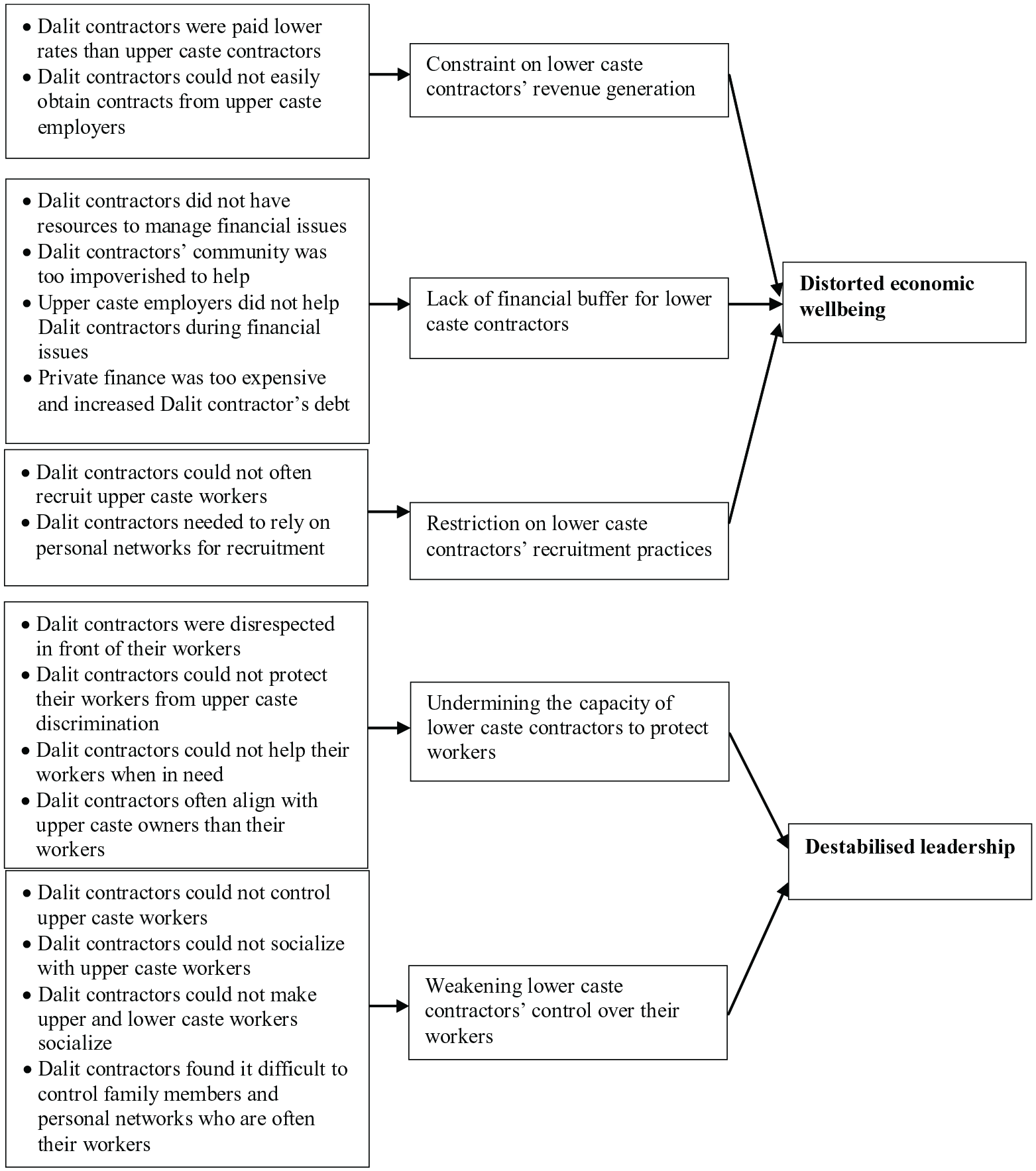
Caste, social capital and survival.
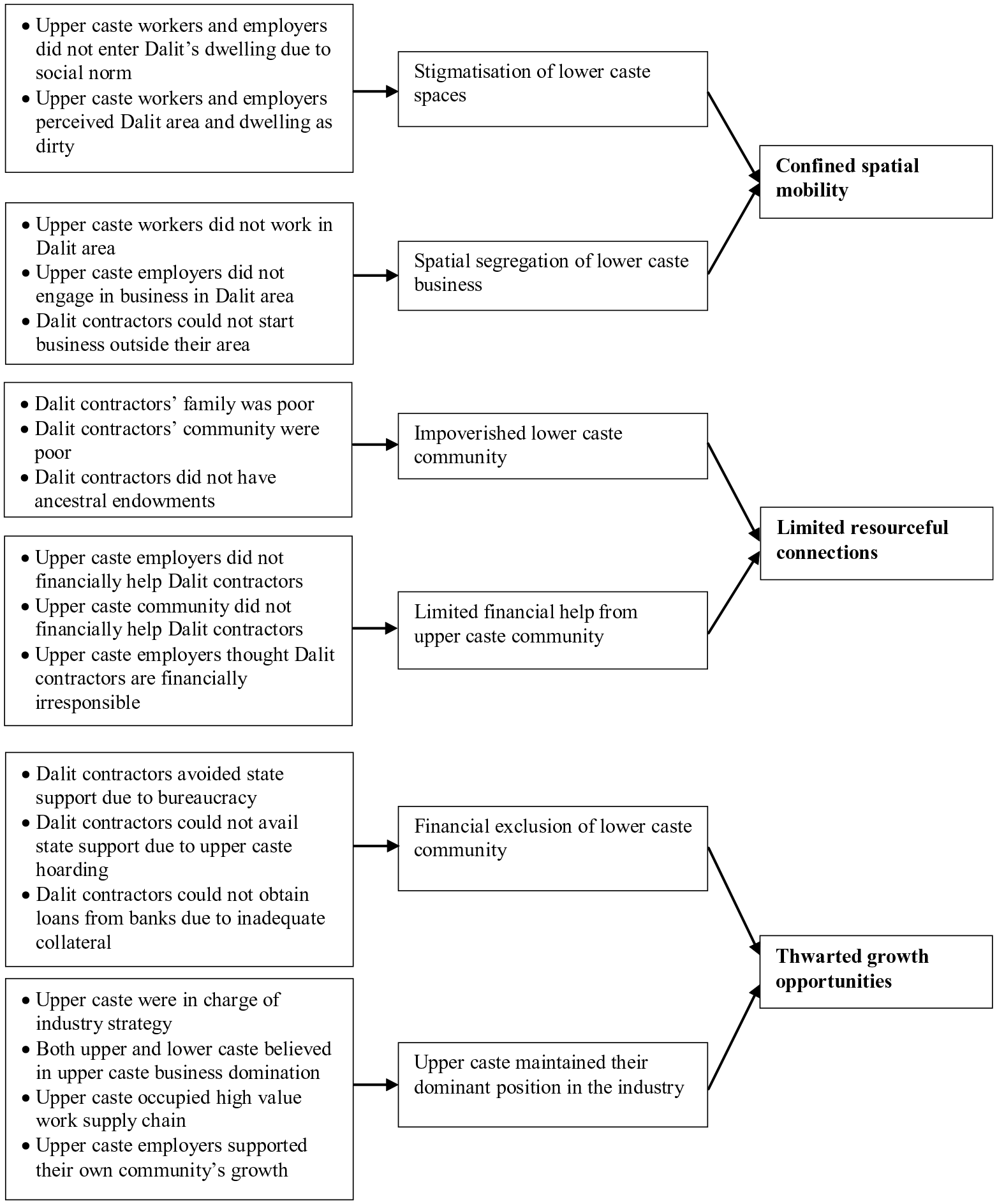
Caste, social capital and upward occupational mobility.
Caste, Social Capital and Survival
Our research revealed that the entrenched caste system, coupled with the complex interplay of social capital dynamics, posed a significant threat to the economic survival of DCs. This threat manifested in the form of distorted economic wellbeing and destabilized leadership, as illustrated in Figure 1. For more quotes, please refer to the online Supplemental material.
Distorted Economic Wellbeing
Labour market intermediaries, as a group, faced significant economic precarity. For DCs, this precarity was compounded by their caste that made it impossible to hold any useful social capital, and hence distorted their economic wellbeing in various ways. Specifically, it constrained their ability to generate revenue, limited their access to contracts with upper caste employers, and restricted their recruitment practices.
Constraint on Lower Caste Contractors’ Opportunities for Revenue Generation
Dalit contractors faced significant barriers to accessing economic opportunities, as they lacked the social connections that upper caste Gounder LCs shared with upper caste employers. As one DC stated, “They (upper caste employers) have their own network of relatives and friends, who they preferentially give work to” (LC3). In contrast, upper caste contractors highlighted the advantages they enjoyed due to their social proximity to employers. As one upper caste contractor explained: “Mostly those people [LCs] . . . 90% belong to the same community as the owner. . .My owner will trust us and give us the work” (LC24).
Obtaining contracts was just one of the challenges faced by lower caste contractors. The lack of goodwill and obligations between upper caste employers and lower caste contractors also manifested in revenue loss. DCs were often paid lower rates (i.e., piece rate) than their upper caste counterparts, with limited room for negotiation. This made it difficult for DCs to maintain their businesses and pay their workers, as they had to accept the offered rate and sacrifice their commission to survive, as one DC lamented:
I talk to the owner about the low rate. I tell him, ‘If I pay more, workers will work for me continuously. So, you increase the piece rate’. They say they will only give low rates. They won’t negotiate with us. There are four members with me. We adjust and do it. Others cannot do the work for this rate. (LC8)
Conversely, upper caste contractors often enjoyed preferential treatment from employers in their caste network, allowing them to secure better rates and commissions, as one upper caste contractor noted:
I will take 30% and give the tailors their salary. I talk directly to the owner and pass the wages to the employees. If I get 10 Rupees for a piece, I give 7 Rupees to the tailor, and if they stitch 5000 pieces, I can get about 15000 Rupees. . . Not all contractors can get it, but I get good rates since we are friends. (LC21)
Lack of Financial Buffer for Lower Caste Contractors
The garment exporting industry was characterized by seasonality and informality, which added to the uncertainty and vulnerability of contractors who relied on employers for work. In order to navigate these challenges, contractors needed to maintain a financial buffer, such as cash on hand, to deal with emergencies and pay workers on time—even if employers delayed payments—in order to retain their workforce and maintain relationships with them. One Dalit worker explained:
I have worked for a contractor from our community. He used to pay us less during the Corona times. So, I left and joined another contractor. I don’t have any issues in this company [under an upper caste contractor], there is work, and they pay us on time. (CW8)
Unlike upper caste contractors, who could rely on their families and community for financial assistance during emergencies, DCs often lacked such support networks. Many Dalit families and communities were themselves struggling with poverty, and were unable to provide meaningful help to contractors in times of need, as one DC explained: “I can’t work like that [talking about reliance on their community like upper castes]. You know about it. In my community, I can’t try that [talking about reliance on their community]. All are economically unstable, so I cannot use them” (CW6).
Conversely, some upper caste contractors boasted about their family wealth and social networks, which provided them with access to financial resources in times of need. As one upper caste contractor explained: “As I belong to the upper middle class, I have a car and a two-wheeler. I will not borrow money from anyone just like that [denoting that borrowing is a choice]. . . During the lockdown, my father gave me some money. He was a big support during that time” (LC19). This highlights the stark contrast between the economic security of upper caste contractors and the precariousness of DCs’ financial situations.
Moreover, upper caste employers often offered preferential financial arrangements to contractors from their own community, while withholding such benefits from DCs, in line with the caste-based social obligations that permeated the industry. For example, DCs reported that upper caste owners would often pay their own community contractors the entire or partial contract value even before the work was completed, while delaying payments or reducing rates for DCs.
However, DCs were not able to receive such benefits. As one DC explained: “If the contractor is from the same community as the owner, they give the entire amount or take a small percentage and give the rest to the contractor” (LC5). Meanwhile, upper caste employers expected their community members to succeed for reputational reasons, so they received the help they needed, even if it was through private and informal financial arrangements. According to another upper caste contractor: “They (owners) expect I will not disappoint them since I belong to the Gounder community” (LC24). Due to their lower economic status, which was related to their caste-based social status, DCs could not access bank loans or afford private finance with high-interest rates in emergencies. As a result, some of them left the contracting work and became workers, a step down in the occupational hierarchy. We spoke to several individuals who took this route.
Restriction on Lower Caste Contractors’ Recruitment Practices
Dalit contractors faced the challenge of finding and keeping a competent workforce to fulfil their contracts on time and with the desired level of quality. Unfortunately, their recruitment efforts were hindered by the pervasive influence of caste. They faced discrimination in their attempts to recruit workers from upper castes, so they often limited their hiring to people from their own caste, which created a homogenous and limited pool of candidates. This issue was exemplified by the testimony of a DC who described the difficulties of navigating this conundrum:
Yes. Nobody knows my caste. I have maintained it in that manner because my situation is like that. . . Some of them (workers) are like, ‘Why should we work for this person who belongs to a lower caste? How can we get wages from him?’ So, I don’t reveal my caste to anyone. . . (LC13)
Even if they succeeded in recruiting workers from upper castes, the workers abandoned them upon discovering their caste affiliation. This situation placed DCs in a difficult position as they strived to complete contracts on time while facing discrimination based on their caste. One Dalit ex-contractor shared his experience with this issue:
But those from Theni, Madurai, I don’t know which caste they are. They will come for work. Local people won’t come. The main reason others come to work is that they don’t know who I am, and I don’t know who they are. . .If they know who I am, they won’t come to work for me. (CW9)
Moreover, even if some workers from upper castes were willing to work under DCs, the broader upper caste community often stigmatized and ostracized such workers, reinforcing the insularity of caste-based social structures. One DC said: “If other community people work with me, the upper caste people tell them that they are low caste, and they ask them, ‘why [do] you go there?’. So, they work for just one week, and after getting the payment, they don’t come” (LC8).
So, DCs had to rely on their social networks within their community to find workers. One upper caste contractor commented: “I’ve seen mostly it will be Scheduled Castes [i.e., Dalits]. That is because mostly their people only will come to work under them” (LC21). However, even within their own community, DCs faced difficulties in recruiting workers who preferred working under upper caste contractors due to better pay rates. For example, one Dalit worker said: “But when I work with my caste people, the rates will not be satisfactory. So, it’s complicated” (CW7).
Destabilized Leadership
Social capital is frequently expressed through exchanges and obligations between individuals, which in our situation involved DCs taking on the role of leadership. However, the influence of caste dynamics disrupted such leadership by eroding the ability of the DCs to safeguard workers and diminishing their control over them.
Undermining the Capacity of Lower Caste Contractors to Protect Workers
In order to establish themselves as leaders and gain respect from workers, contractors had to demonstrate their ability to protect them from indignities. However, the presence of caste dynamics disrupted this equation. DCs lacked social capital when it came to bridging the caste hierarchy with upper caste employers, leaving them unable to shield their workers from mistreatment and discrimination. Even when the contractors tried to challenge such discrimination, they faced termination or physical assault, as one upper caste contractor put it:
Suppose the contractors are from Scheduled Castes, people working under him will be poorly treated. . .He can’t talk in front of them [upper caste employers] because they won’t give work then. . .they have the manpower, so if it ends up with any fight, he [DC] can’t manage. (LC19)
The absence of social capital for DCs in their dealings with upper caste employers was further underscored by their inability to shield themselves from similar mistreatment. Day in and day out, these contractors faced double standards at work, receiving harsher punishments for their mistakes compared to their upper caste counterparts. Meanwhile, employers exhibited greater leniency toward upper caste contractors, as one Dalit worker remarked:
With their community, yes [they are lenient]. That’s what I am saying. I called him [upper caste contractor] around 9.30 AM to inform him that I was sick, and he was sleeping, and our people [other low-caste workers] were working. The owner will not bother; he will say let him come late. But if it is us [low-caste workers with low-caste contractors], we must be there by 8 AM sharp. Otherwise, they will kick you out of the contract. We have to look for some other job. (CW9)
In addition, upper caste employers frequently showed disrespect toward DCs in the presence of their workers, yet faced little to no consequences for their behaviour. When recounting their experiences of witnessing how their contractors were treated, Dalit workers expressed feelings of deep sorrow and empathy:
If a low caste [contractor] gives the product late, he will be scolded. If a high caste contractor’s delivery is delayed, they (the employer) will give him time. . .I have seen the contractor’s brother being scolded. If an order is delayed, they will scold him [the contractor]. (CW21)
Weakening Lower Caste Contractors’ Control Over Their Workers
Maintaining control over workers was a crucial aspect of fulfilling contract requirements, which could be achieved not only through payment but also through the social capital of DCs, as evidenced by the respect they commanded from their workers. However, exerting control over upper caste workers posed a challenge for DCs. Some even felt the need to conceal their identity in order to maintain control. One contractor expressed this struggle, saying: “I don’t speak Telugu when I am at work or at the company, but I speak it in my own circle. . . If I speak Telugu. They (workers) get to know I am SC [Scheduled Caste]” (LC5).
Socialization was a critical strategy employed by DCs to minimize friction, build team cohesion, and establish control over workers. Unfortunately, they faced limitations in their ability to socialize with upper caste workers or encourage interaction between workers from different castes, further eroding their already limited social capital within the caste hierarchy. One DC commented on this challenge: “They (upper caste workers) look down upon people (workers) from the lower caste. They stand at a distance, and they don’t sit together. We cannot go into their homes” (LC9).
Since upper caste workers were generally unwilling to work under DCs and Dalit workers tended to prefer the economic stability offered by upper caste contractors, DCs often relied on recruiting their friends and family as workers. However, this presented a challenge for them to maintain a professional relationship and effectively manage their employees. Consequently, they frequently found themselves making compromises or “adjustments” to retain their workers and preserve their personal relationships, as one DC expressed: “Within the family, say, brothers and sisters, we put together around ten people. . .we adjust and work” (LC6).
To sum up, labour contracting was already a precarious occupation, but DCs faced even greater precarity than their upper caste counterparts due to the caste-based dynamics of social capital, which undermined their economic wellbeing and destabilized their leadership. Moreover, caste discrimination obstructed their ability to move up the occupational ladder, a point which will be further discussed in the next section.
Caste, Social Capital and Upward Occupational Mobility
Upward occupational mobility from contractor to employer was crucial for DCs to overcome their precarity. However, during our fieldwork, we were unable to identify a single Dalit employer. While there was no official data available, our interviews with various stakeholders indicated that the majority of employers were upper caste Gounders. A small fraction of employers belonged to other upper castes, while some were Muslims or individuals from other regions of India whose caste was of limited significance in this context. Despite observing a degree of social diversity among employers, only DCs were unable to advance up the occupational hierarchy due to caste-imposed limitations on their spatial mobility, resourceful connections, and growth opportunities, as illustrated in Figure 2 (additional example quotes are provided in the online Supplemental material).
Confined Spatial Mobility
Access to physical spaces is critical for upward occupational mobility since it facilitates access to people, resources, and ideas that flow through social networks. However, we found that caste-based stigma led to spatial segregation of Dalit people and their businesses. They were unable to establish themselves in areas dominated by upper castes, which served as the primary economic centres of the region. The upper castes owned most of the land and buildings and rented them exclusively to their own caste members, excluding individuals from lower castes. As a result, Dalit businesses faced severe constraints on their spatial mobility, which further hindered their growth and advancement.
Stigmatization of Lower Caste Spaces
As caste is symbolic and invisible, upper caste individuals used various markers to identify DCs and workers, including their language and residential location. While DCs and workers had the ability to change the way they spoke Tamil or avoid speaking their first language, which was often Telugu, they were unable to easily change their residential location. Therefore, the locality became a significant factor in revealing their caste identity. One DC explained that he provided the name of a neighbouring locality as his residence rather than his actual location to avoid being identified by his caste: “I say Perichipalaym. It is not just here; it is the place around it. If they see us around here, then they can identify. They will not ask but will know” (LC9).
Upper caste individuals stigmatized the residential areas and dwellings of DCs and workers, perceiving them as unclean. When asked further, some of these individuals stated that they adhered to caste-based social norms and did not enter these areas or dwellings. If they did, they risked facing a backlash from their own community. Additionally, Dalits were prohibited from entering upper caste spaces such as dwellings and temples, further restricting their spatial mobility and access to the social capital necessary for occupational mobility. For example, one Dalit worker shared that her upper caste friend was asked to leave her house because she invited a Dalit worker inside: “We cannot get into their place; they don’t come to our place” (LC9).
Spatial Segregation of Lower Caste Business
In Tirupur, access to suitable spaces to establish a production facility was a vital factor in attaining employer status. However, evidence showed that DCs and their community did not have access to such spaces and were not given access to them by upper castes. The spaces they occupied were stigmatized, making it difficult for them to establish a production facility. A Dalit worker shared their experience: “If you want to be in this area for rent and if you say you belong to our community, you won’t get a place” (CW9).
The spatial segregation of Dalits meant that they were constrained to set up their businesses within the geographic region where Dalits collectively resided. However, upper caste employers did not conduct business activities in these areas, cutting off DCs’ access to people and work opportunities. Consequently, DCs were forced to limit themselves to low-value work, such as making masks and products for the domestic market, usually for Muslim and North Indian employers. Furthermore, this segregation also made it challenging for DCs to recruit upper caste workers to work in their area, as one DC explained:
They don’t give the order within our area. If we start in any other buildings in the outside area, we may develop our status. . .They give importance to the caste. . .If we start in our area, other community people don’t work within our control. . .They will not come and work together. (LC8)
Limited Resourceful Connections
The lack of resourceful connections was another significant obstacle to DCs’ upward occupational mobility. The historical deprivation of their community of social capital meant that they had limited access to resources and resourceful connections, and they received little or no assistance from resourceful upper caste communities. Although there may be some overlap between the insights presented in the previous section on the limited financial buffer and this one, the focus here is on the specific challenge of becoming an employer, that is, achieving upward occupational mobility.
Impoverished Lower Caste Community
The historic and ongoing inequalities that DCs and their families faced resulted in limited social capital and financial resources. Dalits were often limited to occupations perceived as dirty or laborious, such as cleaning, cobbling, and manual labour at construction sites. This meant that they could not rely on their families, friends, or the wider community for resources or opportunities to advance their occupational mobility. As a result, becoming an employer was a difficult feat for DCs. One DC shared:
Our caste does things like stitching slippers, taking garbage, and cleaning the septic tanks; our caste does all these works. . . he (my father) was a municipality garbage cleaner. . .Then he did small work in the hotels; his mother went to a rice mill for work. We had economic difficulties, and then we came here. (LC14)
The accumulation of social capital takes time, and the upper caste community had ancestral resource endowments in the form of agricultural lands, houses, gold, and money. These resources allowed them to take risks and establish factories. The intergenerational transfer of wealth maintained the dominant status of Gounders and perpetuated the marginalization of lower castes, particularly Dalits. One DC shared:
Gounders only (can set up factories). Their fathers had land and money. If you have land, you can start a company. . .So, they developed, but we are still the same. Poor people remained poor. (LC6)
In addition, the upper caste community had the advantage of being able to generate funds through various means even without ancestral endowments or personal resources. They could rely on dowry, as well as informal finances from families, friends, and the wider community, as one upper caste contractor shared:
Yes, my father-in-law is wealthy enough. Then since I belong to their community, he will help us. . .My father-in-law said in the empty front area of the house, he will have his printing press, and on the first floor, he will provide a space for my company. . …(LC24)
Limited Financial Help From Upper Caste Community
Gounders possessed an abundance of social capital, which was reflected in their access to resources and opportunities, yet they did not extend help to Dalits to move up the occupational hierarchy and become employers. This can be attributed to their desire to maintain their dominant position in the industry, which reflected their position in the caste hierarchy. One DC expressed:
I would have become an owner. Caste plays a role here. But if I were from their caste, they would have supported me to become an owner. They know who to bring up and who not to. They are like, ‘He is from our community. If I get ten orders, let him do five orders’. If he has financial issues, I will help him. . . .They don’t help those who need money. They check if they are from their community. They would not help us. . .They don’t want us from the lower caste to prosper. (LC5)
The upper caste employers’ lack of support for Dalits could also be attributed to an implicit assumption that Dalits were irresponsible with money, due to their lower caste status. This stereotype may have resulted in them being perceived as likely to cheat and abscond with the money. As a result, DCs were denied access to loans and financial support necessary for upward occupational mobility. A Dalit worker shared: “They (upper caste employers) won’t believe our community people. They think that he won’t return the money. He will run away with his family” (CW9).
Thwarted Growth Opportunities
Finally, DCs were often unable to establish themselves as employers due to financial discrimination based on their caste and the entrenched dominance of upper caste employers in the industry. This reflects the limited economic opportunities available to Dalits as a result of their limited social capital.
Financial Exclusion of Lower Caste Community
To overcome their limited access to resources, DCs sometimes turned to banks or money lenders for loans. However, even these options were often closed to them, as lenders required collateral in the form of land, vehicles, or gold—assets that many DCs did not possess due to their historical lack of economic capital, as previously discussed. One DC said:
We can get a loan from the Govt. But they need documents. We have only Patta [land deeds issued by the government on long-term leases for the lower caste people to build houses and live]. How is it possible?. . . They don’t approve any loans for Patta. They need documents. (LC8)
Recognizing the issue of collateral, both central and state governments had implemented policies aimed at providing financial assistance to Dalits (see http://www.tahdco.tn.gov.in/citizen.html). But, many DCs and workers were either unaware of these programmes or hesitant to engage with them due to bureaucratic barriers. Unlike their upper caste counterparts, who could draw on social connections and resources to navigate bureaucracy, Dalits lacked similar social capital and often faced discrimination from bureaucrats. Consequently, they avoided interactions with government officials, as expressed by a Dalit worker:
As far as I know, I think there is nothing. Many people say if you go to any government office, they will exaggerate everything to threaten us. They will not even reply if we ask any questions. Even if they are simply sitting [idling], they will not treat us well. So, there is no benefit [in approaching the bureaucracy]. (CW6)
Another factor that contributed to DCs’ reluctance to seek government support was their belief that benefits intended for them, including land, were being unfairly hoarded by upper caste individuals who could use their social resources and networks to gain an advantage. This perception created a sense of mistrust and scepticism among Dalits towards state-sponsored programmes, as one DC shared:
The government is doing more for us (lower caste contractors) than for them (upper caste contractors). But we receive only half of it. The other half is not reaching us. . .See, they give priority to us for many things like ration cards. So, all the basic requirements reach us. But when it comes to land distribution, if they (upper caste) seize the vacant lands [allotted to the lower castes], we cannot go and question them. . .They are giving us one thing but taking away the other thing. We are working daily, but there is no progress. (LC9)
Upper Caste Maintained Their Dominant Position in the Industry
Gounders were able to maintain and expand their social capital through their dominant position in the garment exporting industry. They held a strategic advantage by occupying high-value activities such as garment manufacturing and exporting, which allowed for greater value capture. This social capital translated into business relationships with international brands and gave them a competitive edge. In contrast, during our fieldwork, we were unable to identify a single Dalit employer involved in high-value activities. Reflecting on this situation, one upper caste contractor noted:
They (Dalit contractors) have been working under the owners for years and are used to it. So, they don’t know how to come up beyond that level. Always financially, they had a limit. They didn’t have the capital to invest. They will do what we ask them to do. . . In the profession [exporting], they [denotes people in business, usually, upper caste] trust mainly Gounder community people. (LC24)
Even if Dalits were able to establish manufacturing facilities, they were often excluded from receiving high-value orders from upper caste employers who tended to rely on their existing networks for support. This exclusion prevented DCs from expanding their business and capitalizing on the most lucrative opportunities, as one Dalit worker observed:
I can’t become an employer just by buying machines. We need pieces for stitching. . . If you are from some other community, they will give [the work order]. But if you are my community, they (employers) won’t give orders. . .(CW10)
Moreover, Gounders maintained their dominant position by leveraging their social capital to secure positions within industry associations that represented the industry to government institutions and international brands. These positions gave them a platform to make decisions that benefited their interests. Throughout the industry’s history, no Dalit had held a position in the industry association (Chari, 2004). Consequently, Gounders received support from the association and also relied on caste-based associations to help each other. These associations, which were common in Tamil Nadu and other parts of India, were formed to support caste-based development, and some evolved into political parties. One contract worker shared: “In upper castes, they will have some committees. If a Gounder is financially underdeveloped and doesn’t have an education, they help them” (CW11).
In addition, to preserve their dominant position, upper caste employers tended to share knowledge within their own community rather than with Dalits. Upper caste employers also frequently expressed the belief that Dalits lacked the requisite knowledge, skills, and abilities to advance in the industry. For instance, one upper caste contractor explained the perception of the Dalit community’s business aspirations among upper caste businesspeople:
They are all engaged in the small-scale business because they don’t have much knowledge or don’t know they aren’t coming out of it. I don’t know what is stopping them from not coming out. We talk to them sometimes, but we cannot even understand their slang. (LC16)
To summarize, caste and its associated dynamics of social capital played a significant role in obstructing the upward occupational mobility of DCs. These factors restricted their spatial mobility, limited their access to valuable connections, and impeded their growth prospects.
Discussion
This paper examines the phenomenon of differential precarity in the context of LCs in the garment export cluster in Tirupur, India. Drawing on a Bourdieusian perspective on social capital (e.g., Alha, 2018; Bourdieu, 1986; Emirbayer & Johnson, 2008; Kalaiyarasan & Vijayabaskar, 2021) and the unique research context, we shed light on how caste-based inequalities in social capital serve as a fundamental mechanism that explains the differential experiences of precarity among LCs based on their caste status. Due to the disparity in caste-based social capital, lower caste LCs face significant challenges in surviving (due to distorted economic wellbeing and destabilized leadership) and advancing up the occupational hierarchy (due to confined spatial mobility, limited access to resourceful connections, and thwarted growth opportunities) when compared to their upper caste counterparts. Consequently, they remain stuck in occupational precarity, despite their vital role in the market (see Figure 3). Our study has important implications for the literature on precarity and social capital, as we explain below.
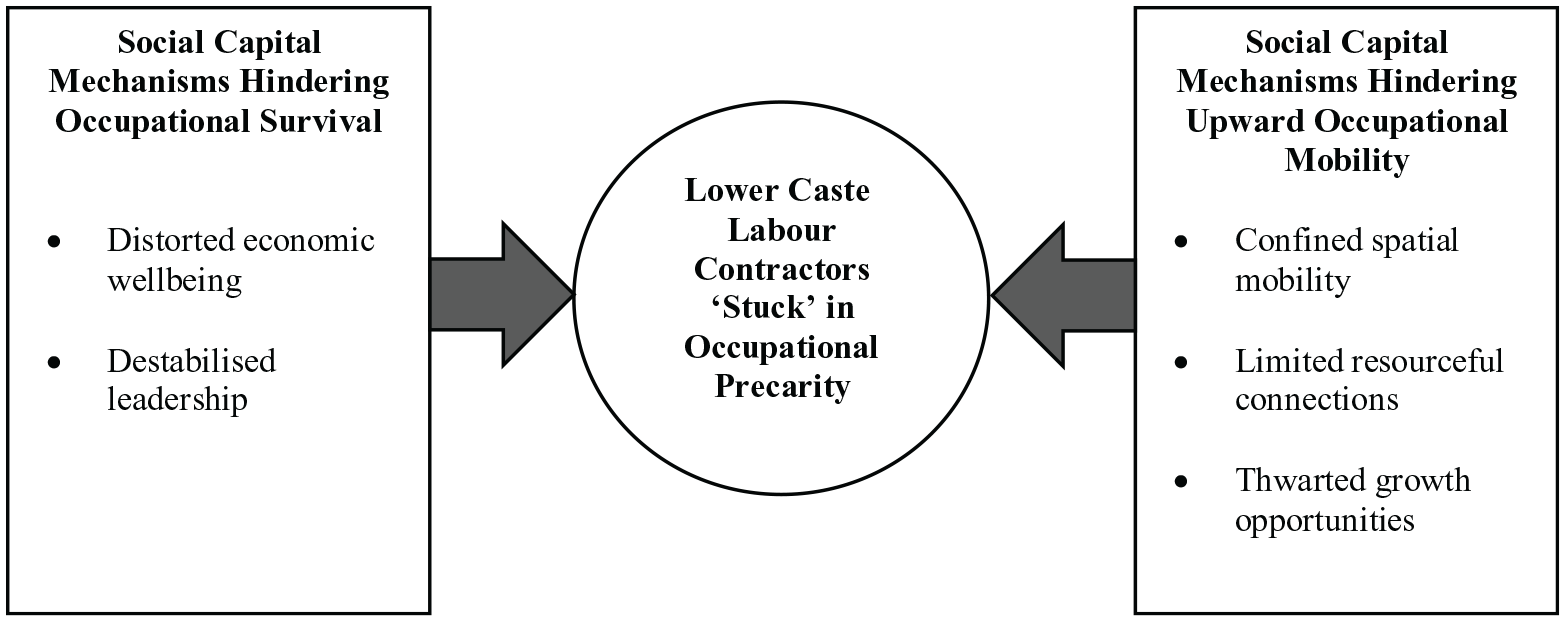
Caste, social capital and occupational precarity.
Implications for Literature on Precarity
Our study sheds light on the contextual, relational, and experiential nuances of precarity, and challenges various assumptions in the extant literature on precarity and social capital. The workers in Tirupur become LCs with the expectation of having “mobility power” (Smith, 2006, p. 389), believing that they can move from one employer to another and leverage differential terms of engagement. However, our research indicates that the benefits and limitations of self-employment are defined by the social group one is embedded in.
Despite being able to break free from traditional occupations and become entrepreneurs in Tirupur, Dalits were restricted to low-value activities, and even in those, they faced greater challenges than their upper caste counterparts in terms of survival and upward mobility. Caste-based oppression resulted in Dalit LCs being immobile both horizontally and vertically, that is, they were unable to expand their occupation or move up the value chain. In contrast, contractors from the upper caste had access to the required social capital for survival and upward mobility, and some even held influential positions in industry associations and had access to political capital. Our study highlights the need to move away from a homogenized understanding of precarious occupation and recognize the diversity of experiences within it.
Our study not only highlights the importance of considering the nuances of precarity in a specific context, but it also challenges the assumption of a generalized understanding of precarity. While existing research recognizes that the sources, manifestations, and outcomes of precarity differ between the Global South and Global North, it often assumes a single model of precarity within the Global South (Scully, 2016). However, our study shows that even within regional boundaries, there can be varieties of precarity shaped by social stratification. Therefore, it is necessary to examine and understand the context-specific forms of precarity and the underlying mechanisms that perpetuate them.
Furthermore, our study suggests that only a privileged few can effectively protect themselves from precariousness by relying on family, social bonds, or the welfare state (Alberti, Bessa, Hardy, Trappmann, & Umney, 2018). Unfortunately, for the underprivileged, such as the DCs in our case, generations of oppression and exploitation have weakened the restorative power of their family and social bonds. While identity-based (i.e., caste-based) collective action could be a viable alternative, our findings demonstrate that the precarity and powerlessness of DCs prevent them from coming together, creating a vicious cycle.
The aforementioned observations contribute to the ongoing critical debate in the precarity literature regarding whether precarity is subjective or objective (De Coster & Zanoni, 2023; Hultin, Introna, Göransson, & Mähring, 2022; Kalleberg, 2009; Standing, 2011; Wright, 2005). While it is true that humans generally experience a “subjective feeling of precarity” (Alberti et al., 2018, p. 449), the underprivileged do not experience precarity solely as a subjective feeling. Rather, it is imposed upon them by the discriminatory social structures and processes embedded by the privileged (Varman, Al-Amoudi, & Skålén, 2023). In situations like this, we find hope in grassroots organizations that help the underprivileged gain a “sense that her life matters in some important sense” (Hultin et al., 2022, p. 689) and redefine institutional frameworks through a combination of prefigurative and contentious politics (De Coster & Zanoni, 2023).
Further, our findings challenge the overly optimistic portrayal of global value chains (GVCs) as a solution to inequality. International institutions such as the United Nations and previous research (e.g., Gereffi, Humphrey, & Sturgeon, 2005) have emphasized that GVC participation can promote upward social mobility among actors in developing economies by facilitating innovation, competition, skill development, employment, and decent work. Nevertheless, our findings indicate that the benefits of GVC participation are not equally distributed (Knorringa, 1999). While the upper caste community and individuals from privileged backgrounds have experienced the greatest benefits, Dalits and other marginalized groups have continuously faced barriers to participation and upward mobility.
Finally, our findings have important implications for research on the intersection of caste and occupations. They reaffirm the notion that while caste and class are intertwined (Béteille, 1965; Mair, Wolf, & Seelos, 2016) and the link between caste and occupation has weakened (Vaid, 2014), upward occupational mobility remains more attainable for individuals from upper castes than for those from lower castes (Srinivas, 1962). This means that caste still plays a crucial role in determining an individual’s position within occupational hierarchies (Mahalingam & Selvaraj, 2022).
Nevertheless, it is important to note that our findings come with a caveat. Our research demonstrates that upward occupational mobility is contingent on context and location. In the specific context we studied, the Gounders are the dominant caste, possessing significant resources acquired through intergenerational wealth transfer, endogamy, and agrarian practices. As a result, their social capital is stronger, more robust, and more effective, allowing them to take risks and exploit new business opportunities. This enabled them to enter the garment export industry as first movers and dominate it within a short period since India’s economic liberalization in the 1990s. However, their mobility opportunities may not be the same in contexts where they are not the dominant caste. This observation highlights a critical idea in the caste literature that typically views Brahmins as the dominant caste and Vysyas as dominant in business; other castes, regardless of their ritual purity and ordained occupation, can also be dominant castes in specific contexts due to their socioeconomic, material, political, and numerical strengths (Srinivas, 1962).
Implications for Literature on Social Capital
Our study has implications for the literature on social capital, especially for scholars interested in understanding social capital from the lens of inequality. Individual agency scaffolds arguments of social capital, such that individual rationalism is overlaid with relational structures to explain how and why actors can benefit from building social capital (e.g., Adler & Kwon, 2002; Coleman, 1988; Lee, 2009). Our study shows that caste-based inequalities challenge the individualistic and agentic understanding of social capital. There are hardly any occupations, roles, or situations in which being from the lower caste could benefit an actor. Even though Gounders, like Dalits, are beneficiaries of affirmative action quotas, and have themselves experienced caste discrimination, our findings demonstrate that they also perpetuate caste inequalities by discriminating against Dalits and their practices. This illustrates how caste, as an institution, operates as a “graded inequality,” enabling the acceptance and incorporation of prejudices against certain groups, even in the absence of the creators of the institution (Ambedkar, 1987). Therefore, our findings challenge a view of social capital that fails to consider inequality and highlight how caste perpetuates extreme inequality.
Furthermore, we show that caste-based hierarchy trumps occupational hierarchy, which has implications for how we understand social capital from a network perspective, which sees social capital is in the “resources embedded in networks and accessed through social connections” (McKeever, Anderson, & Jack, 2014, p. 453), such that cohesiveness within a group “stimulates the exchange of resources to better collective action” (Lee, 2009, p. 254). As a result, caste-based networks are touted to improve efficiency and reduce transaction costs (e.g., Gurumurthy, 2019). However, Bourdieu (1986) reminds us of the historic nature of social capital, in the sense that those advantaged in a social structure continue accumulating capital, reinforcing those social structures, while those disadvantaged face the opposite situation. For DCs in our study, social capital was non-existent, to begin with. They did not hold historical endowments and could not access resources in their networks, which consisted of people similarly impoverished. They also struggled to recruit and retain workers since the workers, even if they were from the same caste, preferred to work for upper caste contractors for financial stability. So, in the case of lower caste contractors, caste-based social capital undermined efficiency and their potential to exploit social capital for survival. So, while the occupations that the LCs shared were the same, the habitus they came from (e.g., McKeever et al., 2014), in terms of caste, was different; and as a result, there was little capital available for Dalits within the same occupational role.
Our study sheds further light on the intersection of networks and caste-based inequalities, challenging the assumption that boundary spanners, such as LCs, are always in an advantageous position (Lee, 2009). While they are well positioned to connect heterogenous groups that may not be connected, our findings demonstrate that caste hierarchy overrides occupational/role hierarchy. Lower caste contractors cannot leverage their position to form relationships with upper caste employers and workers, nor can they control Dalit workers, let alone upper caste ones. This insight reveals the limitations of social capital in contexts of inequality and highlights the need to consider caste dynamics in analyses of network structures.
Finally, and most importantly, we demonstrate a “spatial” angle to social capital. Our findings suggest that physical spaces are not neutral, but rather embody embedded power relations (Taylor & Spicer, 2007). Through the stigmatization and segregation of Dalits and their spaces, the upper caste-controlled capital by restricting the lower caste’s access to privileged spaces and the upper caste’s entry into “dirty” spaces of the lower caste. While prior literature on social capital has implicitly considered space, it has been only in terms of proximity, such as social encounters in a pub (McKeever et al., 2014) or intentional opportunities for encounters in coworking spaces (Cabral, 2021). We argue that space can be exclusionary when linked to social stratification, as in the case of caste. Our study demonstrates how spatial formations, such as caste-based manufacturing clusters, serve as symbolic manifestations of power (Clegg & Kornberger, 2006). Even though the state can intervene to ease spatial restrictions, historical stigmatization, spatial ownership, and intergenerational transfer maintain spatial boundaries, making them an enduring aspect of social stratification.
The notion that spaces have no pre-given identity despite their physical presence is noteworthy. It is through interactions and negotiations that spaces acquire meaning. This emphasis on interactions aligns with the underlying concept of social capital, where social networks facilitate interactions and the accumulation of social capital within a space (Coleman, 1988; Lee, 2009). However, by excluding certain actors from certain spaces based on caste, interactions are limited. As a result, space reinforces social stratification (Harvey, 1996) and affects the opportunity to acquire social capital, as demonstrated in our study. Instead of sustaining an emergent meaning and providing an opportunity for anyone to leverage the benefits of that space, spaces become sites of inequality. Caste-based exclusion stands in contrast to what Harvey (1973) describes as the “geographical imagination” (p. 24), which recognizes the role of space and place in one’s own biography. Instead, caste-based dynamics strip away agency and the chance to acquire social capital. In summary, to fully understand social capital, we must critically examine the spatial dimensions of social interactions.
Conclusion
While we acknowledge the significance of people’s lived experiences of precarity, we argue that a more nuanced understanding of occupational precarity is necessary, one that takes into account social diversity, such as caste. By examining occupational precarity through a social diversity lens, we can uncover the subtle and often invisible differences in people’s experiences of precarity within a precarious occupation. Such an understanding can improve the development of theories and policies by making them more specific and responsive to the complexity of the issue. While our study contributes to this direction, we recognize that it is also limited by our own social and intellectual positions, which we critically reflect on in this section.
Reflexivity
The team, including the research assistants, holds both privileged and underprivileged positions from an intersectional perspective. The first author was born and grew up in Tamil Nadu and has been researching in this context for over a decade, allowing him and his team to gain access and develop an in-depth understanding of the issues at hand. Nevertheless, all three authors were born and grew up in India and currently live and work outside India. Despite our collective experience working with marginalized communities in India, we recognize our limitations in fully comprehending the experiences of DCs. Throughout our research, we remained mindful of intersectionality, recognizing how linguistic and class/caste identities may have impacted participants’ willingness to speak with us (Mahalingam & Rabelo, 2013). Like Mahalingam, Jagannathan and Selvaraj (2019), we see our study as a contribution to the conversation on the injustices and inequalities of the caste system and efforts to bring about social change by raising awareness of the misidentification and misembodiment of the marginalized individuals on account of caste and other social structures.
Limitations and Future Research Avenues
We acknowledge some limitations and suggest future avenues for research in this section. Firstly, our focus was solely on the caste dimension, but taking intersectionality into account, such as examining gender and caste together, could provide a more nuanced understanding of differential precarity. Secondly, our study was limited to LMIs in a specific context. Extending the research to other industries, regions, and countries can advance the theoretical understanding of the relationship between caste and precarity. Thirdly, our study highlighted the significance of the spatial dimension of social interactions in the caste–occupational precarity relationship. Further investigation is required to deepen the understanding of this relationship from a spatial perspective. Fourthly, the social capital mechanisms we identified are interdependent, and future research can explore the interaction between these mechanisms and their effect on precarity. Finally, our study illustrates that caste inequalities lead to unequal distribution of benefits from GVCs. Additional research is needed to examine how caste impedes GVC participation and how GVCs reinforce caste inequalities.
Supplemental Material
sj-docx-1-oss-10.1177_01708406231175319 – Supplemental material for Caste, Social Capital and Precarity of Labour Market Intermediaries: The Case of Dalit Labour Contractors in India
Supplemental material, sj-docx-1-oss-10.1177_01708406231175319 for Caste, Social Capital and Precarity of Labour Market Intermediaries: The Case of Dalit Labour Contractors in India by Vivek Soundararajan, Garima Sharma and Hari Bapuji in Organization Studies
Footnotes
Acknowledgements
We express our gratitude to the guest editors Elina Meliou, Ana Lopes, Steve Vincent, Mustafa Ozbilgin, Dimitria Groutsis, Ramaswami Mahalingam, and Linda Rouleau, as well as the review team, for their invaluable guidance throughout this study. We also extend our appreciation to Sundaresan Velliangiri, Saranya Mathivanan, and John Milton for their assistance with the fieldwork. Above all, we acknowledge and thank the participants whose voices and time were essential to the success of this study. Without their contributions, this work would not have been possible. Therefore, we dedicate this study to them with heartfelt gratitude.
Funding
The authors received no financial support for the research, authorship, and/or publication of this article.

Author biographies
References
Supplementary Material
Please find the following supplemental material available below.
For Open Access articles published under a Creative Commons License, all supplemental material carries the same license as the article it is associated with.
For non-Open Access articles published, all supplemental material carries a non-exclusive license, and permission requests for re-use of supplemental material or any part of supplemental material shall be sent directly to the copyright owner as specified in the copyright notice associated with the article.
