




Abstract
As scholars on organization, we have been confronting the challenges of a changing episteme. The arrival of a new coronavirus and its devastating pandemic compel us to ask what the virus means for organization studies. The essay contributes to this endeavour by attending to the implication of the virus in the (re)organization of meaning and by explicating the ways in which metaphor and metonymy enable one to trace challenges in this (re)organization. In doing so, it takes inspiration from, and contributes to, the theme of (in)visibility that is central to X & Organization Studies. The multifaceted approach is rendered through “spectrographies”, texts that craft haunting experiences of epistemic fragmentation into organizational knowledge. The essay unfolds through four sessions that engage with meaning across analogy, ontology, epistemology and relationality. Each session offers a double reading of its respective dynamics. The first reading outlines challenges in the (re)organization of meaning by (re)engaging with the virus metaphor and its relevance to organization studies. The second reading approaches the virus through metonymy, a trope that is often overlooked. It contributes to organization by tracing objects and subjects through metonymies of materialization and identification. It shows how humans wrestle not only with a pathogen, but also with the self and with other people. Together, the four sessions illustrate how metaphor and metonymy alert us to epistemic disruptions and instabilities associated with the virus. Altogether, the essay contributes to organization studies by turning the interest in meaning and organization to the organization of meaning. It also extends knowledge on tropes in organization by showing how the virus is rendered more powerful through metonymy than it ever was as metaphor. For organization studies to attend to the virus effectively, it must contend with its inherent undecidability. In closing, the essay frames an agenda for organizational scholarship.
Foreword
Every day is colder, shorter, darker. In the southern hemisphere, we are warily eyeing winter. A virus has been spreading through people and across the world, its effects pervading and taking lives, its image haunting screens. Both hemispheres wake up every morning to shadowy figures: on illness, on deaths, on job losses. The word ‘hibernation’ is widely used, but not in relation to wildlife. It is a metaphor for government’s response down-under to the virus SARS-CoV-2 (that causes Covid-19). Swathes of life and its industries are sheltered in place till the climate is suitable for them to venture back out. Reeling from family deaths, I grapple with nerves both raw and numb, the functional strings of a marionette. In Melbourne, unable to get home to Wellington, I wrestle with a mind both dejected and elated, its meditations on a mediated existence feverishly taking textual form. I contemplate the significance of the moment to organizational knowledge: organization through ‘hibernation’ holds a promise of safe passage to spring. It conflates the virus with the exteriority of winter as though, like the elements, it can rampage outside while we huddle indoors, waiting for it to pass. (April 2020, Figure 1)
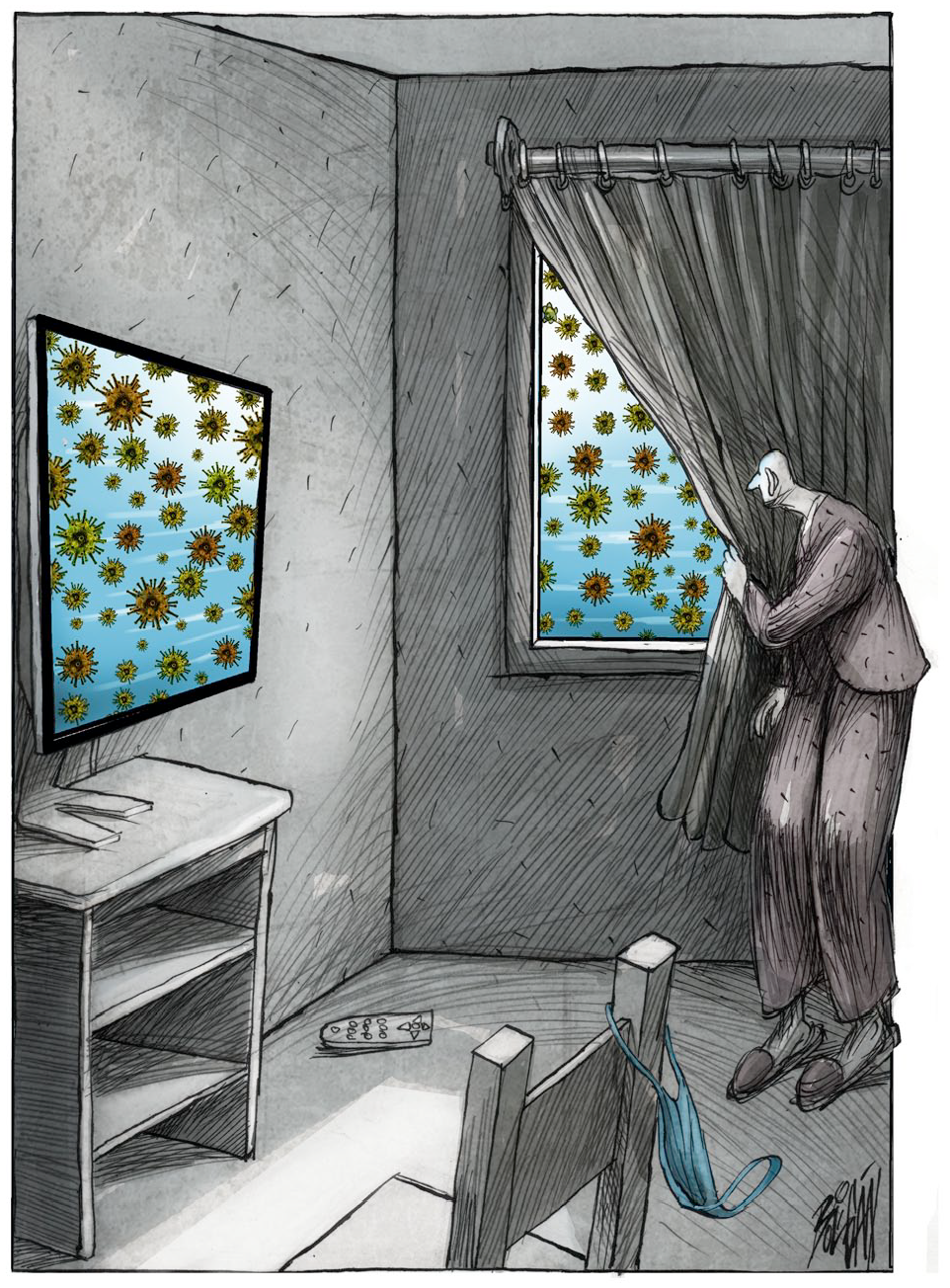
Credit: Angel Boligan, courtesy of Cagle Cartoons.
As we initially watched a new coronavirus spread, many thought of it as distant, in somebody else’s country, but then we learned otherwise. In a similar vein, the virus does not belong in someone else’s discipline. As scholars on organization, we have been experiencing a reckoning in which we have come to know the virus and understand it in different ways. The shift in understanding grounds this essay: not only does the virus matter to organization studies but it is also important that we scrutinize how it comes to matter. The essay contributes to this endeavour by mapping the dynamics of a changing episteme. In doing so, it attends to the implication of the virus in the (re)organization of meaning and explicates the ways in which metaphor and metonymy enable one to trace challenges in this (re)organization.
Episteme (from the Greek epistêmê) is most often translated as ‘knowledge’ (Parry, 2020). In its widest sense, episteme denotes ‘understanding of a matter’ (Rawlins, 1950), both in terms of ‘acquaintance’ with that matter – knowledge of it – as well as a ‘principled system of understanding’ (Liddell & Scott, 1843), knowledge on the matter. Aristotle had written about episteme as formal knowledge that grasps regularities rather than the ‘accidental’ (Parry, 2020), so it does not deal with the unusual for which there is no embedded system of understanding. The premise here is that reaching new understanding involves a (re)organization of meaning. Despite decades of scientific knowledge on the virus, the arrival of SARS-CoV-2 was not aligned with the arrival of our lived understanding, our knowledge of the virus, and its effects on everyday life. There were no established principles for the global reorganization that would follow; rather, attempts to realign the world to cope with this breach were implicated in epistemic changes characterized by disruption and instability.
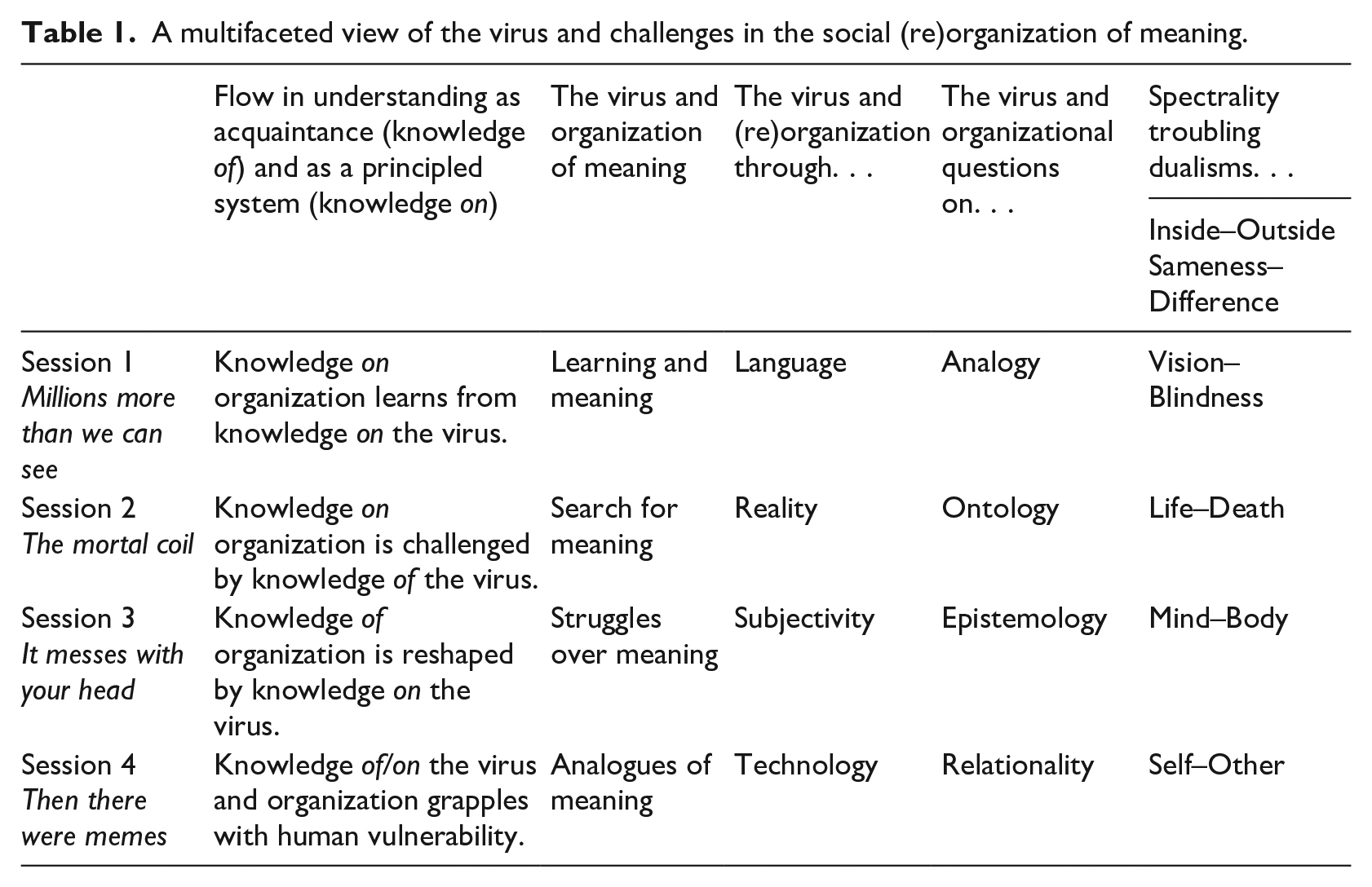
In this essay, I argue that the virus is implicated in the (re)organization of meaning in ways that matter to organization studies. The premise turns extant interest in meaning and work organization (e.g. Kent, 2019) to the organization of meaning, including that of work and its organizations. Using a multi-faceted approach, the essay outlines challenges in this (re)organization (Table 1). Across four reflective sessions, it traces changes in understanding through the interaction between knowledge of/on the virus and knowledge of/on organization. Each session takes inspiration from a different connotation of ‘episteme’. Derrida (1978) had engaged with a nuanced approach to ‘epistémé as philosophy or science’ that pertains to historia since the ancient Greeks. The work starts with inspirations from classical conceptions of episteme, then it draws on Foucault’s (1970) work in which episteme defines and sets the ‘rules of formation’ that constitute knowledge in a given period, and lastly it engages with the algorithmic episteme (Fisher & Mehozay, 2019).
A multifaceted view of the virus and challenges in the social (re)organization of meaning.
Tracing a (re)organization of meaning
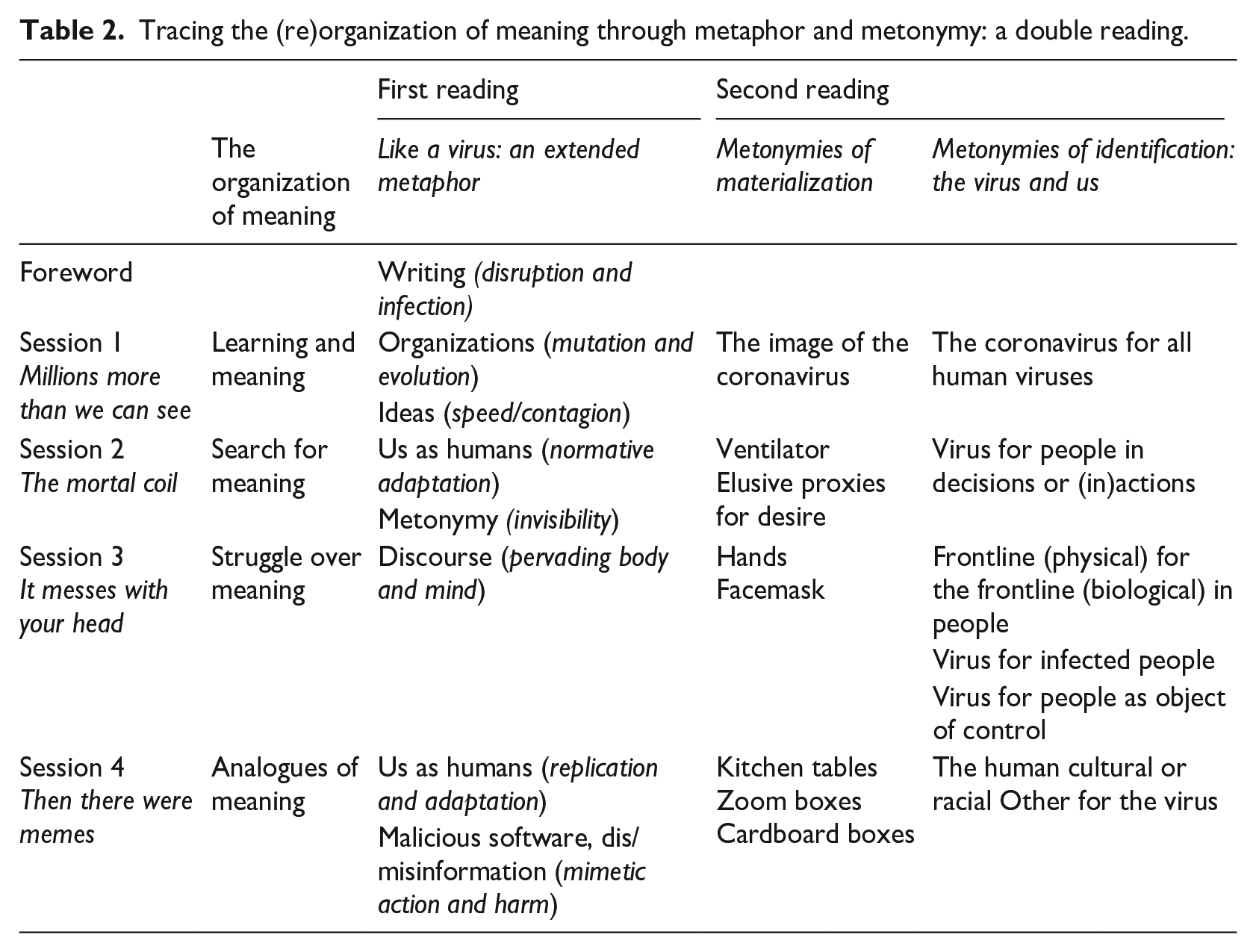
The essay draws on works that accord language a central role in the organization of meaning (e.g. Derrida, 1978, 1994; Foucault 1979, 1980; Lacan, 1977; Latour 1993). Specifically, it posits that scrutinizing metaphor and metonymy enables one to trace challenges in the (re)organization that defines our understanding of the virus. Each of the four sessions offers a double reading of its respective dynamics (Table 2): first through the virus metaphor and then through metonymy.
Tracing the (re)organization of meaning through metaphor and metonymy: a double reading.
The first reading – the virus metaphor and visibility
The editors’ aspiration is that articles under X and Organization Studies serve as ‘“viruses” that make visible the background immune system that is at work in our scholarly domain’ (Hjorth, Meyer, & Reay, 2019, p. 1444). This metaphoric deployment shaped the work’s purpose whereby the essay re-examines the virus metaphor in organization. As it critically engages with the metaphor, it simultaneously (re)uses it as a lens to view the (re)organization of meaning instigated by the arrival of a new biological virus (SARS-CoV-2).
The second reading – metonymy and (in)visibility
In tracing the dynamics of understanding, the essay also turns to metonymy, a common but hidden trope (e.g. Cornelissen, 2008; Hoedemaekers & Keegan, 2010; Riad & Vaara, 2011; Schoeneborn, Vásquez, & Cornelissen, 2016). Metonymy replaces a word or sign with another that is closely related to it (Lakoff, 1987). It can be verbal or visual (Riad, 2019). A well-known example is the pen is mightier than the sword, in which the pen stands for writing and the sword for fighting. Practically invisible, metonymy is not as evocative as metaphor and blends into the ‘mundane’ (Riad & Vaara, 2011). The essay brings it to the fore and outlines its dynamics in the (re)organization of meaning through metonymies of materialization and metonymies of identification. The former traces manifestations of the virus’s effects through everyday objects that symbolize challenges in the (re)organization of meaning; and the latter explicates the ways in which people and the virus come to stand for each other in the course of (re)organization. (For an overview of the material and visual turn in organization, see Boxenbaum, Jones, Meyer, & Svejenova, 2018; Quattrone, Ronzani, Jancsary, & Höllerer, 2021). The relationship between metaphor and metonymy also matters (Cornelissen, 2008; Riad, 2019; Riad & Vaara, 2011; Schoeneborn et al., 2016), so the essay relates them to understanding in a changing episteme.
Writing, the virus metaphor and ‘spectrographies’
The relevance of ‘writing differently’ in organization studies has been premised on how it works ‘like a subtle virus – “infecting” the body but doing so to liberate it’ from traditional academic norms of expression (Gilmore, Harding, Helin, & Pullen, 2019, p. 8). Such norms can be transgressed by reflecting on ‘multifaceted experiences’ that have the potential to disrupt the established order(s) (Kiriakos & Tienari, 2018, p. 263). The reflections in this essay draw inspiration from Derrida who had used the virus to explain the two central ‘threads’ in his life’s writing: . . .all I have done. . . is dominated by the thought of a virus. . . if you follow these two threads, that of a parasite which disrupts destination from the communicative point of view. . . and which on the other hand is neither alive nor dead, you have the matrix of all I have done since I began writing. (Derrida in Brunette & Wills, 1994, p. 12)
Derrida (1993, 1994) extended this ‘matrix’ in his work on spectrality and haunting in which he discusses ‘spectrographies’, the ghostly characteristics of writing and technologies of the image (Derrida & Stiegler, 2002). The essay pursues the two ‘threads’ – disruption and undecidability (neither-nor that is both-and) – as it reflects on the virus’s implication in the (re)organization of meaning. This approach matters to organization studies since it challenges dualisms and alerts us to both iteration and change, to the plurality of engagements with knowledge of/on the virus.
Approaching the virus and organization studies through ‘spectrographies’ resonates with Stewart’s (2007, pp. 16–17, 104) work on writing whereby the outlines of the social and natural worlds can be seen through ‘a kind of hauntedness’ that registers in ‘a spectral scene’. The outlines depict how ‘public specters have grown intimate’ as they trace a ‘private life writ large on the world’ (Stewart, 2007, pp. 104–105). My reflections on the first twelve weeks of the pandemic are rendered through four sessions. Each offers text that is metonymic of a wider experience, a part for the whole. It represents a gnawing sense of apartness conjoined with an eerie sense of oneness, the uncanny experiences of a time in which a virus rendered every instance so specific and yet so much globally shared.
‘Millions More Than We Can See’: On learning and meaning
People often learn about the abstract through analogy, which lends meaning to prior and prospective experience. For centuries, we have engaged with ‘episteme’ through the trope of vision. Its language has been used for knowledge that lends hindsight, insight and foresight. As scholars, our understanding has also been grounded in metaphor (e.g. Morgan, 2007), including the ways in which knowledge on organization learns from knowledge on the virus. But as our engagement with the virus shifts from metaphor to pervasive reorganization, we experience the mutual definition of vision-and-blindness.
♦
I catch myself parsing flashes of sharp, rarefied memories, the line drawings of a shadowy self-caricature. I could see myself in the first lecture, setting the scene. Year after year, I use analogy as I bind ‘strategy’ and ‘vision’. But the clarity of the lens had just shattered. Stunned by the day’s news, my mind swipes to the first slide: ‘Chance favours only the prepared mind.’ I ask about the quote: who said it? I ride out the silence as I look around, taking in diverse student faces. Occasionally someone is familiar with the source, but now many ask Google. Yes, Anne has it: ‘It’s Louis Pasteur,’ she says with a sideward glance from her screen.
Pasteur, the famous microbiologist, was one of the forerunners on the theory that pathogens invisible to the naked eye could lead to disease. This ‘invisibility’ drove early alarm at the coronavirus, from villages in Pakistan to the White House. A ‘prepared mind’, however, considers the germs in our milieu and facilitates a raft of measures that manage outbreaks, like vaccination – Pasteur again. Writing on the historical construction of microbes, Latour (1993, p. 35) noted that we ‘may see nothing suspect’, but ‘there are more of us’ in any given milieu, ‘millions more than we can see’. ‘Pasteurism’, he said, ‘reorganized society in a different way.’ There was a main implication: ‘We cannot form society with the social alone. We have to add the action of microbes.’
Pasteur is also credited with prefacing the discovery of the virus (Latour, 1993). He noted the potential for smaller pathogens when he developed a vaccine for rabies without being able to see its virus. We often talk of how an organization’s responsiveness to the environment involves such insight. The respective foresight drives the change essential for evolution, which ensures the survival and perpetuation of an organizational species, or an industry. In class, I use the virus’s renowned ability for mutation to illustrate dynamic capabilities in organization. But the unfolding predicament showed that we all lacked in preparedness: we did not ‘add the action of microbes’ (Latour, 1993). We are the scholars on organization, what did we do? I knew. What did I do?
Like viruses do
A prominent strand of the metaphor draws from how a virus spreads. For example, in his best-selling Tipping Point, Gladwell (2000, p. 7) states: ‘Ideas and products and messages and behaviours spread like viruses do.’ He discusses ‘the rules of epidemics’ in which viral spread has positive value, an aspiration for creative endeavour. Like a virus, I was spreading metaphors of the virus.
The notion that ideas are like viruses goes back a long way. Dawkins’ (1993) essay, ‘Viruses of the mind’, drew from earlier (1976) work in which he critiques the spread of ideas as a mimetic biological virus. His notion of viral ‘memes’ served many fields of study, including organization, through a view of viral spread that holds negative value. Other writing takes a balanced approach, notably Røvik’s (2011) application of knowledge on the virus to the organization of management ideas.
This essay began with the pandemic’s announcement and initially considered the negative effects this metaphor may have had on framing the biological virus. Writing ‘against the virus as metaphor’, Elie (2020) notes: ‘the ubiquity of virus as metaphor may have left many of us unprepared’ to recognize literal viruses and to prepare our societies against them. But the focus of the essay had shifted. On the one hand, there is the challenge of invisibility. Though we cannot see a virus with our naked eye, it matters to organization both metaphorically and practically. But the other hand holds a different problem, one of visibility: The irony haunts me. In my eagerness to promote foresight and foster learning, my use of the virus metaphor may have been blinding. I am a culprit in attenuating our vision to viral threat. Its image taunts me. Tagged to my fridge, the coronavirus looks both ominous and innocent. It appears as a spike-ridden ball suspended in space, as if it had an existence outside of ours. My black marker squeaks as it scribbles ‘Ceci n’est pas un virus’ across the photo, a mild retort to extreme provocation. (Figure 2, Homage to Magritte)

Ceci n’est pas un virus: Homage to Magritte’s The Treachery of Images.
And so to the second reading
We are now threatened by ‘ubiquity’: not of the virus as metaphor, but of a specific virus that comes to stand for all others, delimiting their meaning for organization studies. The concern here is with dynamics of materialization and identification that are facilitated by metonymy. They present two interrelated challenges.
We have all become acutely familiar with the image of this coronavirus. Considerable energy and rigor have been invested in its depiction and representation, into casting an image that offers the virus tangibility. The metonymic materialization of this coronavirus is everywhere: pasted into articles, blasted on screens, plastered on information boards and seared on our minds. Through pervasive (re)production, the image of the coronavirus stands for its pandemic. In doing so, it confronts us with challenges brought about by technologies of the image: visibility can also bring blindness (Derrida & Stiegler, 2002). As we focus on the one coronavirus, we can become hypnotized and dazzled. In fixing the sight on graphic representation, one is blinded to its ‘original’ subject (Derrida, 1993) and thereby incapable of accessing its meaning.
Turning to metonymies of identification, we find one virus for all, as a coronavirus comes to define our understanding. In the same way that the virus metaphor may have blinded us to ‘literal’ threat, pervasive signification of this specific coronavirus can blind us against a wider and deeper understanding of viruses that contends with their variety. We risk losing sight of the bigger picture, so to speak. A coronavirus is part of a genus of many genera of viruses, one of millions and not as nasty as some of them come. The irony is that the virus’s limitless diversity boils down to a single reductive view, a universal straitjacket on omnipresent representation. In effect, metonymy delimits the meaning of the most genetically diverse entity and threatens to blinker our learning from this painful experience: ‘there are millions more than we can see’ (Latour, 1993, p. 35).
Rather than subsume all our attention, the enlightenment brought about by the arrival of SARS-CoV-2 should also herald inquiry into what the virus means to societies and their organization(s). What should we make of this ‘visible invisible’ (Derrida & Stiegler, 2002)?
‘The Mortal Coil’: On the search for meaning
The virus is undecidable, ‘neither living nor dead’ (Derrida & Stiegler, 2002); rather, it is ‘perched on the edges of life and nonlife’ (Lowe, 2017, p. 96). As our lives are upended and (re)organized in response to viral activity, we are more conscious of our sense of being and our embodied reality. We confront ontological challenges both to our way of life, including its organization(s), and in certainty of death (Figure 3). Plato’s notion of episteme involved the capability for abstract distinctions, notably ‘the ability to know the real as it is’ (Parry, 2020). As provisional closures in meaning are reopened, our knowledge on organization is challenged by knowledge of the virus. And as death overwhelms us in its pace and scale, we start to realize the mutual definition of life-and-death.
♦
Once seen, they linger. Ghostly white freezer trucks waiting to be filled with human bodies as hospitals overflowed with dead people. Death’s ongoing encroachment – its increasing proximity and excess – repeatedly overwhelmed and evaded its organization. In my (in)voluntary exile, I wake up daily feeling, this can’t be real. Wrestling with loss of loved ones, I contemplate the virus and the grave, in both its meanings: in life and of death. I sense a grip with each lockdown decision, with every organizational closure. I watch as familiar firms seem to slide down a global sinkhole, draining our understanding of organization(s) with them. We are left with a hiatus, a chasm in meaning. We find ourselves perched on a precipice at which pervasive change is being touted as a mandate for existence. Politicians iterated that people and businesses ‘must adapt’. There was no ‘or else’. We knew what was implicit.
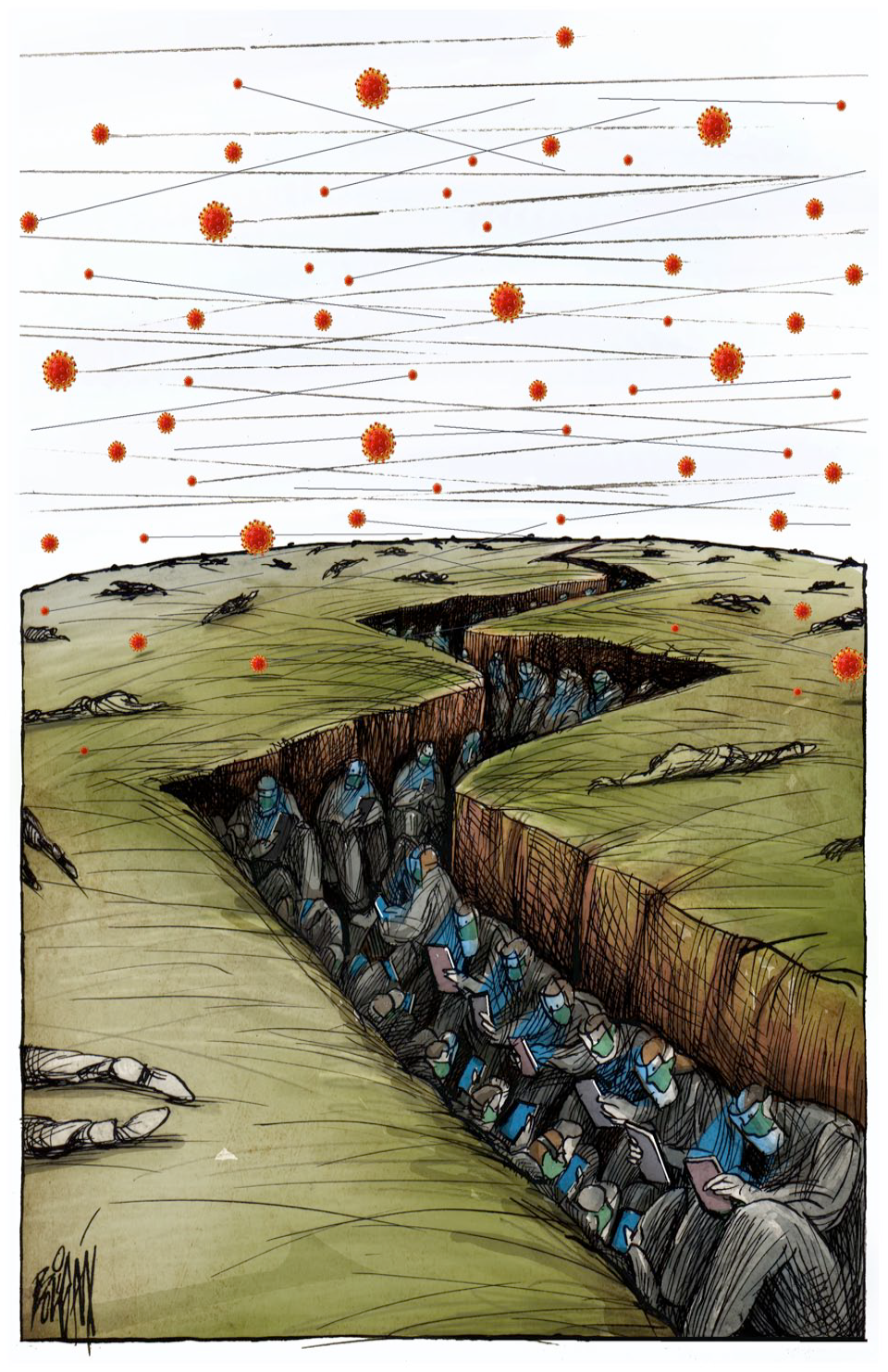
Credit: Angel Boligan, courtesy of Cagle Cartoons.
Like viruses do
We have to learn from the virus to respond to its threats. The language of ‘surviving’ attempts to bridge life and death, reconcile evolution and extinction. The Economist summed up the dominant rhetoric: organization had turned into the ‘business of survival’. Somehow, we have to outvirus the virus.
Both evolution and Derrida’s works require us to consider the margins of (non)existence, but in different ways. The former uses them in understanding the threshold that leads to variation in the adaptation of a species; and the latter works on blurring them and engaging with their tensions. Derrida’s (1994) ‘hauntology’ supplements ontology – the primacy of presence, life and being – with absence and death. Mortality also characterizes the corporate body through notions of ‘organizational death’ (e.g. Bell, Tienari, & Hansson, 2014). Over time, you relate to some organizations as you do to people. And some grieve – albeit differently – for their loss.
And so to the second reading
The coronavirus causes damage across the human body, with the most salient being acute respiratory distress syndrome. Once obscure, the ventilator became a familiar organizational apparition as it tirelessly worked to deliver oxygen to the lungs. The mechanical macabre became a metonymic materialization of the human struggle on the boundaries of living and dying. Not everyone survives. We must deal with dematerialization as well. . .
We are stricken with searing sorrow when those close to us are ventilated and yet expire their last. Expire. A term with double meaning: breathing out and ending. I realize that everything expires – businesses, but also industries, entire species. As I read of the pending ‘death of the department store’, I anxiously contemplate death and shopping in one breath. Many of us spend time in department stores, endlessly chasing after dreams. Lives are caught in whirlpools of production-consumption. Now the supplement to the superfluous excess of life is excess in death. Lacan floats through my mind: ‘Desire is a metonymy’, he says. It always seeks, refers to, ‘something else’. As all the organizational dominoes seem to fall in rapid sequence, the cascading desires we chase propel us to the edge of nothingness.
On the margins we begin to ‘see’ how life and death – of humans and firms – are intimately related to our understanding of the virus and its (re)organizing effects. Yet this understanding is still fragile, challenged by ongoing metonymies of identification.
‘One reason to care about viruses: viruses are us,’ notes Lowe (2017, p. 94) in a review of how viral genes constitute mammals. This premise is biological; however, my pursuit in this essay is social and organizational. A common verb: ‘are us’, to be. This verb of presence has been rejoined with absence, with not being, as language further reshapes our realities. . .
The clacking from my keyboard stopped. I had spotted an omission: ‘The virus is likely to end some industries as we know them’. I thought for a second, then retyped, ‘How we manage the virus is likely to end some industries. . .’ The difference hit me. I rustled through other notes to arrive at a staggering observation. We were systematically exonerating ourselves from our role in the ‘illness’ and ‘death’ of corporate bodies by rendering the virus culpable. The ‘us’ in ‘virus’ is a spectral presence that marks our relationship. We occupy the word even as it haunts our lives.
In this metonymy of identification, the virus stands for the effects of the human (in)decision and/or (in)action associated with it. Its deployment has enabled people to engage in attribution errors on a mass scale, across organizations, industries, and social bodies: the virus is pulling people into poverty the virus is testing the identity of Chinatown the virus threatens global companies coronavirus is crippling the coffee industry coronavirus threatens building projects will the coronavirus kill college admission tests? will the coronavirus kill the WHO? This is not what viruses do.
Like the virus, metonymy is characterized by its invisibility, allowing us to charge the virus with human offences. Though we harbour it biologically, ‘the virus’ comes to harbour our agency. This shift is facilitated by metonymy (Riad & Vaara, 2011). The latter enables us to externalize the virus as a first step. Thereafter, we can transfer our (in)action – along with the respective blame – onto this other ‘body’ (or to later mutations, Delta, Omicron). In our abdication, language erases terms that pin responsibility to people and enables us to resign our agency to the virus. A virus can lead to human death; how we manage firms and sectors can lead to their demise. The ‘death’ of organizations and industries is a human liability.
‘It Messes With Your Head’: On the struggles over meaning
Since it has no existence outside of us, managing the virus is about managing people. Foucault’s (1970, 1972, 1980) discussion of an episteme had addressed ‘the sets of constraints and limitations which, at a given moment, are imposed on discourse’ (Foucault, 1972). So an episteme not only defines what is included in, or excluded from, a body of knowledge in a given period (Foucault, 1970), but also what is knowable and sayable (Foucault, 1980). As knowledge of organization comes to be reshaped by knowledge on the virus, it lends the power to reorganize and manage subjects and to reshape their subjectivity. The respective struggles over meaning blur the boundaries of body-and-mind as we wrestle with others and with ourselves.
♦
The excitement ebbed. Our eyes quickly normalized the haunting images of bare squares and barren streets around the world. But they still felt eerie, a cross between idealized picture postcards and post-apocalyptic visions. Our permission to repopulate them came with limits to our spread. The liquor shop was within the permissible radius of travel that contained me. As I picked up a wine bottle to read the fine print, I heard a voice over my shoulder, ‘You touch it you buy it.’ I spun around. The shop assistant was smiling. It was early days. ‘What’s happening – this virus – it messes with your head,’ he said.
Like viruses do
The ‘head’ relates to body and mind. And discourse, like a virus, pervades and affects both. Forms of pandemic management and their respective social organization are embedded in scientific discourse (Foucault, 1972, 1980), formal knowledge on the virus that works through language and practices. In the efforts to ‘contain’ the virus, people were admonished into a range of practices, each of us carefully positioned within large-scale newly adopted organizational formations (Figure 4). The container trope is deeply engrained in human cognition and it grounds how we think of the body and/or the mind (Lakoff & Johnson, 1980, pp. 29–30, 51). Its logic is premised on having an in(side) and out(side). However, this distinction is troubled by undecidability as the discourse of viral containment contends with human struggles, both external and internal.
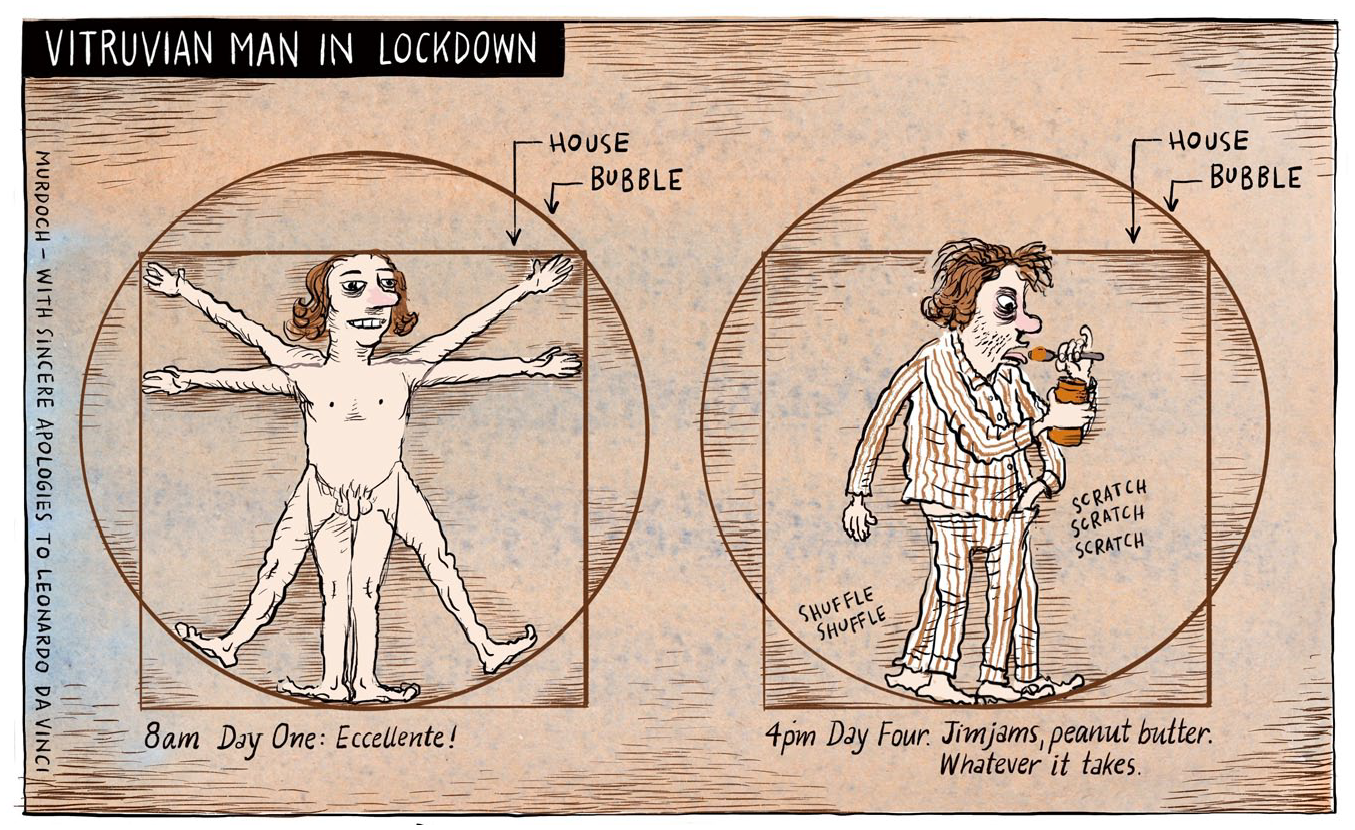
A da Vinci inspired cartoon on containment.
On the one hand, an episteme defines the limitations imposed on discourse (Foucault, 1972). It is a ‘strategic apparatus’ that separates ‘what may from what may not be characterized as scientific’ (Foucault, 1980, p. 197) and thereby calls the shots on the rules of managing a pandemic. Yet people have varied views, interests, beliefs and ideologies which might not align with science and its vision. In their attempt to wrestle with power, they enact overt struggles over meaning. They resist containment as they voice wariness of ‘big government’ or the erosion of civil liberties. This ‘battle’ is not against the virus but over claims to valid knowledge and its respective power effects as they come to define health and wealth. So the fight over ‘true knowledge’ on the virus also becomes a fight over the nature of knowledge and how it comes to be true.
And so to the second reading
Tracing the metonymic relationship between ‘the virus and us’ illustrates disruptions in the discursive boundaries of body and mind. Struggles in the (re)organization of meaning are not only external, but also internal, blurring the margins of identification and materialization.
First, the language of struggle and its respective ‘fight’ is invisibly pervasive, as can be noted from the use of ‘frontline’. Where is the enemy? The pandemic ‘frontline’ refers to people who, in the course of their essential work, face other people. The virus is not outside us: this ‘enemy’ is within, enmeshed inside us physically and biologically. However, metonymy artificially externalizes what is an internal line of defence. The ‘frontline’ is not exterior, physically between people, but cuts across their bodies. And the ‘fight’ against the biological virus is interior, the work of the body.
Second, in the course of its management, many claims of interventions done to the ‘virus’ are done to humans. The ‘virus’ is ‘monitored’ by monitoring them; its ‘spread’ is limited by limiting theirs. So ‘containment’ is implicated in metonymy of virus-for-people. Not only does the virus serve as a proxy for human action, for what they do, the virus is also a proxy for what is done to people in the course of managing a pandemic.
Yet, the discursive power of knowledge on the virus is not simply an external containment of the body. As it is entwined with knowledge, the power is internalized, stirring one’s struggles through a ‘virus of the mind’, so to speak. Since we cannot directly engage with the drivers of our concerns, we wrestle with their spectres (Derrida & Stiegler, 2002; Riad & Jack, 2021). So the hand that seeks to touch is caught out not only in public, but also in private: As I desperately try to avoid touching my face, I think of how my head repels my hands. As I lather, rinse, and dry them, I note the discipline that compels me to do it again. ‘Out damn spot,’ says Lady Macbeth, reappearing in my mind, sleepwalking and rubbing her bloodied hands to cleanse them from murder. Her guilt rubs into my possible role in contagion. I carry on washing my hands for absolution.
Hands have served as metonymy for many a signified: work, threat and control – as ‘in someone’s hands’. Now that they are metonymic of contagion, they are being controlled. The discursive power that shapes my behaviour not only contains the virus by controlling me as subject of a given state, but also restrains my body through the knowledge that moulds my subjectivity (Foucault, 1979, 1980).
By yielding to pervasive systemic control, we gain a sense of ‘doing something’ that is greater than each of us, hopefully good for all of us. We participate in meaningful action that reinforces our subjectivity as ‘good’ members of our family, workplace and society. We believe that if we ‘know’ this coronavirus, we can control it and thereby control our fear of the unknown and unknowable. This knowledge breeds recognition of oneself as informed and educated, someone with understanding. So not only does discourse define views on the pandemic, but also a self-view and its reassuring sense of insight. We are both under control and in control.
And so back to the head: both body and mind, both external and internal struggles over meaning. Given compliant subjectivities and unruly subjects, the facemask quickly became the most salient visual symbol of the pandemic, a prominent metonymic materialization of viral presence. Since the early days, it extensively engaged writers who reflected on its endless variegated meanings. Many have noted that the facemask reveals rather than conceals. Here, it is a mark of the (in)visible: not just the virus at work; rather, wearing a facemask – or not – is always the work of power. Whether a manifestation of official control or internalized self-discipline, enacted in self-interest or selfless care for others, a form of compliance or a political statement, embraced on the basis of formal knowledge or opposed in resistance to it, the facemask (or its absence) is metonymic of the various powers at work during a pandemic.
Then There Were Memes: On analogues of meaning
The measures put in place to manage a new virus involved swift and vast organizational reconfiguration that both physically separates and technologically (re)connects people. This (re)organization of relationality manifests through replication in form, memes that offer more of the same (Figure 3). The respective analogues of meaning come to define the self and the other. Their (re)productions of understanding thrust us further into the uncharted and potentially treacherous territory of the algorithmic episteme (Fisher & Mehozay, 2019) in which knowledge of/on organization and of/on the virus grapples with human vulnerability.
♦
Compelled by work, I squeeze in more shopping before new restrictions come into effect. On my list: wi-fi range extender, A4 paper, printer toner-cartridge, folding table, office chair. Officeworks was very vast, very grey, with cold light beaming between the rafters. I make my way through a maze of aisles bustling with people. I abruptly stop in my tracks. My chest had tightened. I struggled to breathe. Oh no, did I catch the virus?! Close your eyes. Slow, deep, breaths. As I open my eyes, everything is swimming. In my subsiding panic, I stare at the scene in front of me. This could not be happening. We were all there for the same reason, hurriedly shopping for the same items, each of us sourcing components to assemble a home office, elements that enable the regeneration of work organization by reconfiguring other spaces to serve its survival.
Like viruses do
We were behaving in the same way a virus spreads through the human body. Unlike living organisms, viruses do not have cells that divide. Rather, they take over other living cells, which they turn into factories to ‘assemble new viruses’ (Cann, 2015). Similarly, in response to threat from a (corona)virus, we reorganize like viruses and spread across the social body. Using somewhat similar components, we assemble (makeshift) offices. Each of our homes is a cell that we have turned into a site of production.
Propagation through ‘memes’ is analogous to how a virus spreads (Dawkins, 1976, 1993). With the swift response to a viral pandemic, we come to witness a relationship between ‘isolation’ and ‘isomorphism’, the sameness in configuration. As we diverge in location, we converge in form, congregating on a handful of technologies. Mimetic isomorphism is the tendency in organization to imitate other structures through belief in their value (DiMaggio & Powell, 1983). The configuration is considered legitimate and its copy is seen as a ‘safe’ way to survive in a challenging environment. Yet, ‘isolation’ comes from ‘island’, and no human is an island. Unlike viruses, we must relate. Given the impetus for distance, and because technology promises to reconnect and possibly resuscitate, we turn on the camera and microphone.
Enter the most common variation in this metaphor: the computer virus (Morgan, 2007). The term tends to be value negative, a program infecting another program and modifying it to include a version of itself. But the analogy is value positive when it addresses the extent of spread in content: ‘going viral’ can be an aspirational term. Sometimes the two uses are entwined into a dangerous blend: the cybersecurity of systems (or networks) and the spread of mis/disinformation, twin ingredients in epistemic instability.
As we respond to a virus by acting like one and mimetically spreading across the social body, the relational reconfiguration enabled by our technology limits our variety while increasing our exposure to other ‘viruses’. In our rush to rejoin the patterns of life and income, we might be (intentionally) blind to the tech-mediated work of malicious others, just like we were towards the (corona)virus. So the question is whether the spatial spread and replication in form leads to corruption in kind. Isomorphism is particularly ironic as a human response to the virus, whose biological diversity is greater than all ‘the rest of the bacterial, plant and animal systems put together’ (Cann, 2015, p. 1). Deficient in variety, we are more vulnerable to challenges from our environment, easier to attack or destroy.
And so to the second reading
In the effort to adapt, people enacted an explosion in mimetic isomorphism. The metaphor of an adapting organization is grounded in metonymy whereby the whole stands for the parts. In effect, the ‘survival’ adage is enacted by workers on behalf of the organization. Kitchen and dining tables quickly morphed from the mundane to the symbolic, a metonymic materialization of ‘organizational’ adaptation. . .
We must adapt: to put food on the table, we also have to use it for work. And work ushered in Zoom, allowing it to beam through our homes and haunt our laptops. The warp-speed shift to online teaching seemed to create a uni-versity – one of singular form and less diversity – on levels both macro and micro. One by one, students’ faces disappear from my screen, their variety replaced by black boxes with names, occasionally speaking epitaphs to the class I felt I’d lost. I was flying blind. As I struggle with tethering my eyes to the camera lens, I grapple with the uncanny. My mind recalls Derrida: with a ghost, one is seen but cannot see eye to eye. The experience of spectrality is acute when one cannot return gaze.
The many boxes that define us in Zoom are metonymic of how technology mediated our spatial distribution, isomorphism, and reconnection – a phenomenal triad much wider than teleconferencing. They resonate with the boxes that litter our corridors, carcasses from our online shopping as reshaped by the algorithms that define our desires, bots that know us better than we know ourselves. But there are further challenges to this triad that comes from metonymies of identification.
Our retreat into boxes and its respective isomorphism facilitate echo chambers and arenas for the keyboard warriors on the forefront of epistemic instabilities. Unlike viruses, humans multiply through division, cellular and social – the interest here in the latter. In their fear of contagion, some like to think that nothing harmful could come from those who look like them. In this blinding isomorphism, we might think we are turning our back on the virus, but once again, the virus is people, other people. The ‘us’ in the virus drives alienating practices: us versus ‘them’. The division signals how perceptions of cultural difference can quickly transform into xenophobia during a pandemic. This strand of xenophobia works through metonymy in which a social group stands for their endemic virus. Repulsion at the virus is enacted through polarizing rejections of its ‘cultural host’. The alienation is instigated by misinformation and limited understanding that shape how people come to see the virus and their fellow Homo sapiens. In our attempt to wrestle with the virus, we wrestle against other humans.
Our perception of danger is blurred by (in)visibility. We rush to embrace the algorithmic episteme (Fisher & Mehozay, 2019) to which we yield our understanding. We are organized rather than organizing; seen rather than seeing; in a gaze one cannot return, not of a treacherous human Other, but of algorithmic bots, programmed to do like viruses do.
Afterword: Framing a research agenda
We shall all recall moments when the world stood still for a virus as though to honour its dead. Visions of quietude floated against frenzied (re)organization and frenetic activity. When the second wave and its bleak tide washed over Melbourne that first winter, any mention of ‘hibernation’ was in its negation. There were more to come, each a daunting spectre of calm and harm.
The global travesty generated from the arrival of a new coronavirus compels us to ask what the virus means for organization studies (e.g. Burke, Omidvar, Spanellis, & Pyrko, 2022; Simpson, Harding, Fleming, Sergi, & Hussenot, 2021). The essay contributes to this imperative by scrutinizing the dynamics of a changing episteme. Its four sessions offer ‘spectrographies’ that depict challenges in the unfolding interaction between knowledge of and knowledge on the virus and of/on organization. But ghosts rarely offer closure (Derrida & Stiegler, 2002); rather, engaging with spectrality disrupts a range of dualisms including vision–blindness, life–death, body–mind and self–other. In doing so, the essay invites questions into the (re)organization of meaning across language, reality, subjectivity and technology. The respective sessions do not offer final words on epistemic disruption and instability; rather, they generate spaces for future inquiry into organization and the virus.
In considering how the virus matters to organization studies, this work simultaneously contributes to literature on tropes in organization by outlining how the challenges in the (re)organization of meaning can be traced through metaphor, metonymy and their undecidability. The first reading in each session offers shifting iterations of the virus metaphor that are pertinent to organization in two ways: they denaturalize the trope, and they challenge organizational patterns on ideas, discourse, communication and adaptation. The second reading contributes to organization studies by approaching the virus through metonymy. The latter, like the virus, is implicated in both visibility and invisibility, which bear relevance to organization studies through objects and subjects, discussed here in turn.
Attending to metonymy as a trope of materialization enables us to trace our intangible understanding of the virus through visible and tangible forms, objects that acquire new meaning as if possessed. Ventilators, masks and kitchen tables each represent the materialization of a struggle: for life, power and economic survival. Turning to subjects, one can note how metonymy serves as a trope of identification by tracing dynamics of (in)visibility at the intersections of virus with human.
The work outlines two pairs of identity metonymies that matter to organization and the virus. One pair addresses actions that shape a pandemic: what is done by the virus and done to the virus. Here, the virus stands for people more broadly and hides their implication in the respective action. In the other pair of metonymies, the virus specifically relates to ‘other people’. When we claim to ‘fight the virus’, it stands for infected people in whom the internal battle unfolds. Meanwhile, the cultural Other stands for the viral Other and replaces it as a target for the angst that the pathogen instigates. So the insight for organization is that the strife is not just against a virus; rather, the struggle also unfolds at a deeper level, both internally and in relation to other people. Moreover, scrutinizing metonymies of identification problematizes the organizing dualisms of the inside–outside, an overarching theme in the essay.
There is further insight to be gleaned from the interaction of metonymy with other tropes (Cornelissen, 2008; Riad, 2019; Riad & Vaara, 2011; Schoeneborn et al., 2016). The essay shows how externalizing the virus (Figures 1 and 3) is a fundamental maneuver in the (re)organization of meaning. Metonymy offers the first step whereby the virus is constructed as a separate entity with an independent existence, a ‘spectral body’ that offers a foundation on which other tropes can be mounted. This ‘external’ virus facilitates the aspiration for ‘hibernation’ and enables us to shift our responsibility to another agent. It raises an independent ‘enemy’ across a physical ‘frontline’, it makes the discussion of pandemic management more palatable through its ‘containment’, and it facilitates the dynamics of alienation.
The sessions started and ended with challenges in the power of homogeneity over variety: isomorphic ways of viewing the virus and isomorphic ways of reshaping our organization in response to it. The respective tensions in sameness–difference cut across the essay. As organizational scholars, we should be wary of possession and capture by a specific virus that stands for all others, delimiting their meaning for organization studies. Our understanding of viruses should not be constrained by SARS-CoV-2 and its management.
We should also be wary of one analogy for all human problems: e.g. a virus of hate, a virus of greed (or a ‘pandemic’ of racism, of violence, etc.) (Figure 5). This metonymically grounded attribution naturalizes our social afflictions. So we need to exercise vigilance when human accountability is loaded onto the virus and watchful of what is done to people in the name of the virus. The dynamics traversed in this essay suggest that the virus is rendered more powerful through metonymy than it ever was as metaphor. Since a ghost returns in new forms and ‘guises’ (Derrida, 1994), we must also be prepared for the arrival of other viruses that drive tensions in knowledge of/on organization. For organization studies to attend to the virus effectively, it must contend with its inherent undecidability.
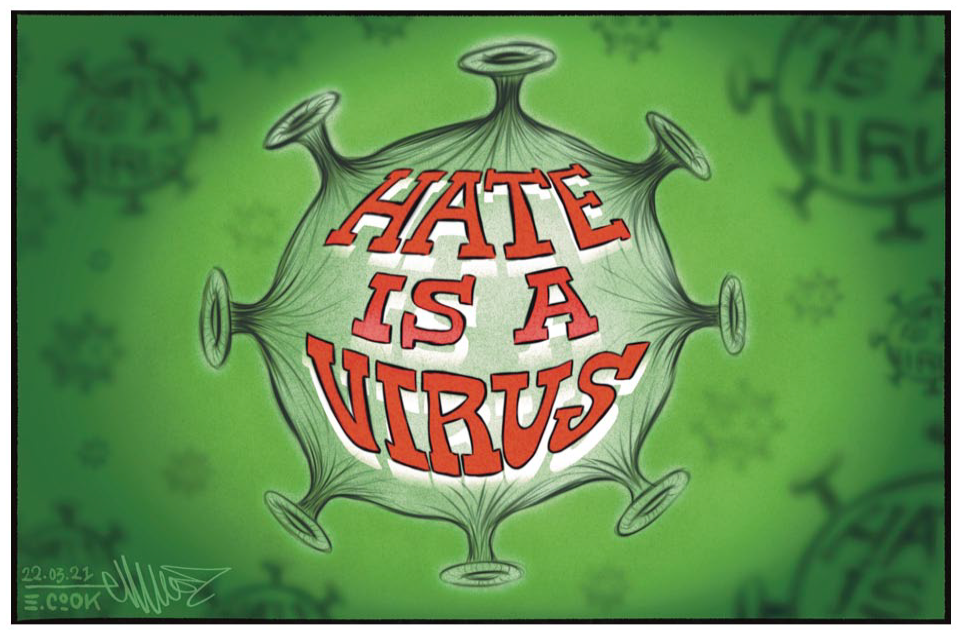
Isomorphism and the metonymically grounded metaphor.
Footnotes
Funding
The author received no financial support for the research, authorship, and/or publication of this article.