




Abstract
How do we know what we know about an organization’s history? What methodologies do historians use? I explain and adapt the historical method of source criticism for organizational scholars through the new technique of organizational source criticism. Source criticism is how historians do research in archives. The role of source criticism is to identify, analyse and use bias in historical sources to write reliable historical narratives. Organization source criticism emphasizes the plurality of organizational sources. I capture this plurality through the organizational source criticism matrix, which categorizes organizational archival sources into four types based on their category and modality. Category differentiates between narrative and documentary sources, and modality distinguishes reportative from performative sources. The matrix proposes four distinct forms of source criticism for each type of organizational source and exemplifies these through two academic articles from management and organizational history. The paper encourages researchers to adopt organizational source criticism to create robust organizational historical narratives. It also emphasizes the importance of context, triangulation and colligation in organizational historical research. Organizational source criticism is a new historical methodology adapted to researching sources in organizational archives that aims at establishing the veracity and meaning of organizational archival sources. It will benefit organizational scholars who intend to conduct historical organizational archival research.
Keywords
Introduction
Organizational scholars who are interested in using historical sources to investigate research topics relating to the past of organizations need an understanding of the historical methodology of source criticism. Source criticism is the foundational methodology of historical research, but it has received scant attention in the organization studies (OS) literature (Gill, Gill, & Roulet, 2018; Kipping, Wadhwani, & Bucheli, 2014). Source criticism is used when conducting research in archives to establish the intentionality, trustworthiness and reliability of historical sources (Alvesson & Sköldberg, 2018, pp. 134–144; Kipping et al., 2014; Ricoeur, 2006, pp. 146–181). It aims to establish evidentiary veracity in historical research by interrogating sources and placing them in a judicial dock (Ginzburg, 2002, 2013). History is by nature a discipline of suspicion (Ricoeur, 2006, p. 180). Since the latter half of the twentieth century, this search for proof has been joined by a search for meaning (Hansen, 2012; Iggers, 2005; Jordanova, 2019). Historical archival sources have an outside and an inside, reflecting both their facticity and their meaning (Collingwood, 1946, p. 118). It is only by historically situating and understanding the two that the source can be comprehended and integrated into rigorous and credible historical narratives.
Rowlinson, Hassard and Decker’s (2014) article on historical research strategies in OS underscored the centrality of source criticism to management and organizational history (MOH). In this present paper, MOH refers to the study of organizational history which is informed by concepts from management and organization theory and the wider social sciences and humanities (Booth & Rowlinson, 2006, p. 12). It aims at creating theoretically framed and empirically based historical narratives about organizations that can conceptualize, test, elaborate on and develop organizational theory (Maclean, Harvey, & Clegg, 2016, p. 609). Rowlinson et al. (2014) demonstrated an ontoepistemic divide between OS and MOH by arguing that the former is founded on a replication logic, while the latter is grounded in a verification logic. Replication logic is based on the fact that, ‘constructing the data has to be specified so that it can be replicated to test the findings in another case study’ (Rowlinson et al., 2014, p. 71). Concepts of validity and reliability foreground the replication of research findings and the establishment of universal principles. Verification logic, in contrast, is based on a process ‘whereby the exact location of sources has to be given so that they can be consulted to verify whether they support the historian’s emplotment’ (Rowlinson et al., 2014, p. 71). Verification logic is premised on a system of referentiality and an evidentiary paradigm in history whereby the source does not empirically signify the past but indirectly refers to it (Ginzburg, 2013, pp. 87–113). It attempts to create veracity, facts about the past that are based on evidence.
Maclean et al.’s (2016) concept of dual integrity further emphasizes the centrality of source criticism to MOH. Dual integrity is defined as ‘organizational research to which history is integral, where history and organizational studies are of equal status . . . as opposed to the history of a specific organization or set of organizational circumstances’ (Maclean et al., 2016, p. 610). Dual integrity achieves this by an application of organizational theory and historical methods. This results in authentic research. According to Maclean et al. (2016), authenticity is established by theory development, which makes organizational knowledge generalizable, and archival historical research, which makes it substantive (Maclean et al., 2016, p. 615). Theory, in turn, provides a framework through which historical sources can be understood and conceptualized. Dual integrity in historical organizational research attempts to achieve authenticity through a rigorous application of historical methods, including source analysis and evaluation of evidence (Maclean et al., 2016, p. 615).
In this methodology paper, I introduce and explain the methodology and concept of organizational source criticism, which adapts source criticism to the organizational archive. This will assist OS scholars when conducting historical research in organizations, and can help develop robust organizational historical narratives as envisaged by Maclean et al. (2016). Organizational source criticism is based on the historical methodology of source criticism, but is an interpretive approach that is modified to the organizational archive and its sources. In order to do this, I present the organizational source criticism (OSC) matrix which does two things. First, it distinguishes between four types of organizational historical sources commonly found in the organizational archive, based on their category and modality. Second, it explains and demonstrates through exemplar papers the principles and practice of organizational source criticism, which are applicable for each of these four types of source. The OSC matrix is important not only for its heuristic value of explaining the methodology of organizational source criticism, but also for its conceptualization of organizational historical sources. Whereas source criticism in MOH has treated sources as predominantly singular and uniform, I emphasize their plurality and provide methodological guidance for each category of organizational source.
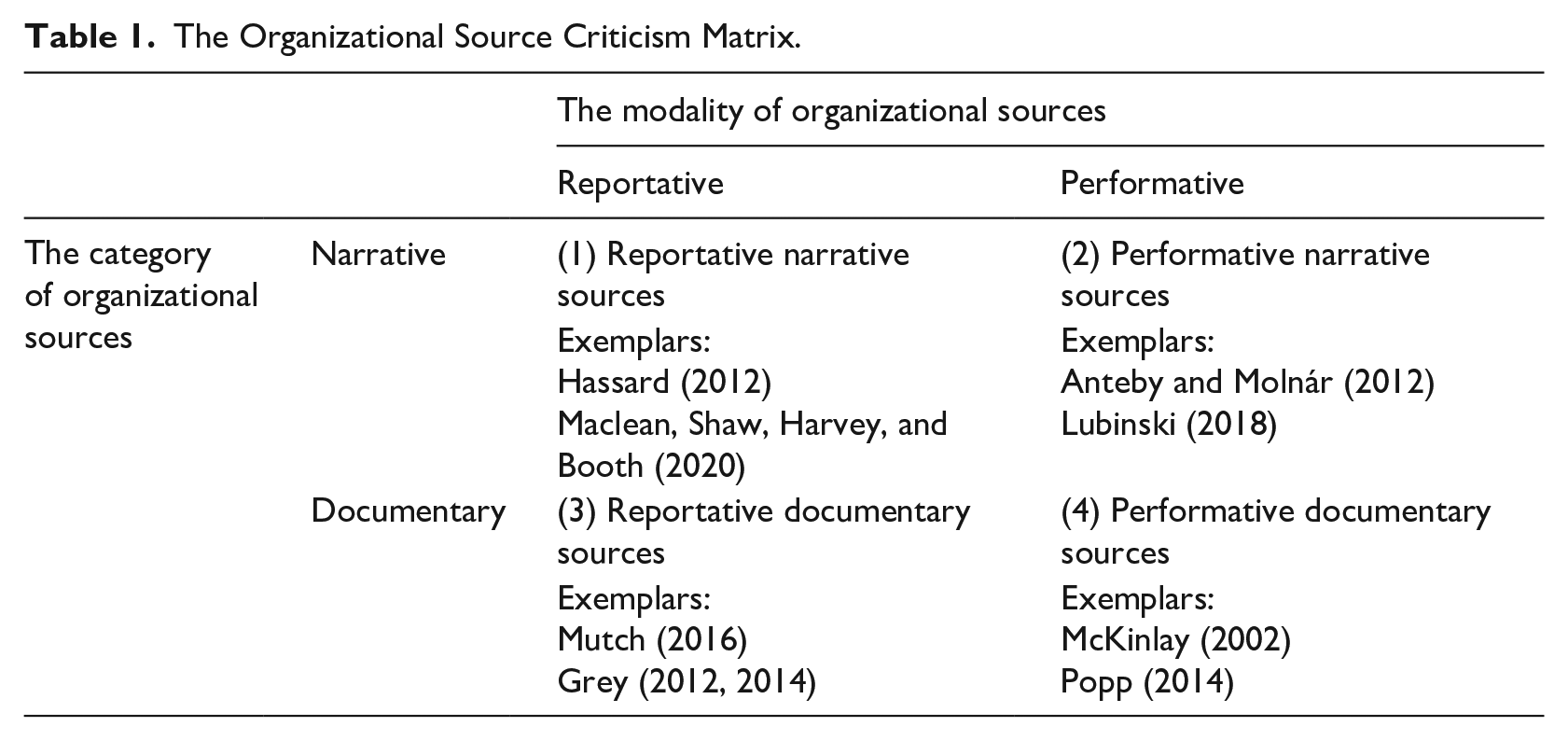
This article is divided into three parts. I first provide a history of source criticism and a review of its treatment in the OS literature, and then introduce the methodology of organizational source criticism. In the second section, I present the OSC matrix that serves as a methodological tool to conduct analysis of historical sources and data (Table 1). I first explain its two axes and then provide a detailed explication of its four quadrants, illustrated with two exemplar papers for each. The matrix provides the principles of organizational source criticism for each of its four types of organizational source. In the final section, I discuss the implementation of the matrix and conclude with a summary and discussion of its importance.
The Organizational Source Criticism Matrix.
The History of Source Criticism
Source criticism was developed as a historical method by Leopold Von Ranke in the early nineteenth century (Collingwood, 1946, pp. 130–132; Iggers, 2005, pp. 24–26). It reflected the aspiration of history to be recognized as a science. Source criticism was based on two processes (Collingwood, 1946, p. 130). The first consisted of breaking up the source into its component parts and establishing which was older and more authentic and which was more recent and less trustworthy. The second was the internal criticism of the source and the search for authorial bias. Furthermore, the principle was established that the source must speak for itself, and that the historian must not impose his or her thoughts onto it (Collingwood, 1946, pp. 131–133; Elton, 2002). By doing this, sources would reveal the past ‘as it actually was’, to quote Ranke (Iggers, 2005, p. 25; Munslow, 2006, p. 182). Historians became experts at attending to matters of detail and avoided colouring their subject matter with their opinions. This, however, prevented historians from theoretical analysis and limited them to mainly political history (Collingwood, 1946, p. 133). This slowly changed in the late nineteenth and early twentieth century with the gradual turn to historical interpretivism and critical history (Collingwood, 1946).
In the latter half of the twentieth century, historical interpretivism became more established.The object of history was no longer simply to establish historical facts, but also to understand the thoughts and intentions of historical actors (Alvesson & Sköldberg, 2018, pp. 134–145; Collingwood, 1946; Howell & Prevenier, 2001; Iggers, 2005). This resulted in source criticism no longer being solely concerned with the provenance and accuracy of sources, but also with their meaning. One can distinguish here between traditional source criticism and interpretivist source criticism. The latter follows a long tradition in historiography that can be traced to Vico, Nietzsche, Dilthey, Croce, Collingwood, Foucault, White, and Ricoeur (Collingwood, 1946; Jenkins, 2003; Munslow, 2006; Ricoeur, 2006; Wadhwani, Suddaby, Mordhorst, & Popp, 2018; White, 1973), and has drawn on the ‘new history’ of the post-1970 period that was based on the cultural and linguistic turns in history (Iggers, 2005).
Interpretive source criticism rejected the Rankean-Eltonian view of history which saw sources as lying ready-made in the archive, waiting to be discovered by the historian. Instead it posited the source as something which the historian creates through research. As Carr (1961/2001) argued, historians generate historical facts from their selection and interpretation of their sources. This approach is taken further by post-modernist scholars, who reject the concept of a universal, objective and knowable past (Jenkins, 2003; Munslow, 2006). Sources are fragments of past narratives which have no objective purchase. They are always perspectival and biased. Furthermore, historical narratives invariably represent the views and interests of powerful social actors (Jenkins, 2003; Tennent, Gillett, & Foster, 2020, p. 79) who use accounts of the past to justify discourses and practices in the present.
Discussion of source criticism in MOH has been limited. Kipping et al.’s (2014) chapter on the topic is the most comprehensive. While it provides an expert analysis of source criticism, it suffers from being based on a traditional model. Kipping et al. (2014) claim that source criticism establishes the validity and credibility of the source. This sits uncomfortably with a contemporary historiography which questions the objectivity of the source (Rowlinson et al., 2014). Jordanova (2019, pp. 125–129), for example, talks of the need to move away from the concepts of truth and objectivity in history and towards reliability. This is a conception of reliability which is not based on the social scientific insistence on replication, but one where sources can be trusted and provide evidentiary support for the historian’s arguments (Gill et al., 2018).
Drawing on interpretivist history, I introduce the concept of organizational source criticism. This refers to a hermeneutical study of organizational archival sources which aims to establish their veracity and meaning through a process of investigation and interpretation (Ginzburg, 2013; Ricoeur, 2006). Veracity here relates to the probatory value of a source in terms of its ability to support a historical narrative and/or development of organizational theory. It relates to the proof that a source furnishes, either in relation to an historical event or the historic representation of a past event (Ginzburg, 2002). Organizational source criticism also recognizes the plurality of the organizational source. Organizational archives contain a variety of sources, determined by their category and modality. Each type of source requires a different methodological form of source criticism. This will be explained and demonstrated through the OSC matrix (Table 1) which is a methodological device that can be used by OS scholars to implement organizational source criticism when conducting archival research. Before I present the matrix, I will explain its two axes based on the category and modality of organizational sources.
The category of organizational sources
Historians have traditionally distinguished narrative texts from documentary sources (Alvesson & Sköldberg, 2018, p. 137; Howell & Prevenier, 2001, pp. 20–22). Rowlinson et al. (2014, p. 70) note that, ‘As record-keeping bureaucracies, organisations produce social documents, such as board minutes and personnel records, as well as narrative texts, such as annual reports and in-house magazines, which have been used to examine culture and change in organisations.’ While some documents such as strategic reviews and committee reports are narrative texts, and some narrative texts such as routine management reports are closer to documentary evidence, the division of these two categories of sources into narrative and documentary sources is useful and reflects the content of organizational archives.
Howell and Prevenier (2001, p. 22) explain that documentary sources are the products of record-keeping by organizations. While often fragmentary and partial, their proximity to the events they signify make them valuable to organizational historians. Narrative sources are structured and usually published documents written for audiences within and outside the organization (Howell & Prevenier, 2001, p. 22). Their emplotment and intentionality distinguishes them from documentary sources. Company magazines, corporate histories, annual reports, speeches and strategic documents fill organizational archives and are routinely co-opted into the narratives of organizational historians. Rowlinson et al. (2014, p. 70) have stated that organizational historians prefer documentary sources to narrative sources due to their lack of managerial imposition. While all organizational sources suffer from managerial interference, this is more pronounced in narrative organizational sources. However, these sources offer unique insights into historical organizational cultures, logics, institutions, discourses and sense-making.
The modality of organizational sources
Grey talks of the ability of organizational history to enable the OS researcher to see the organization as both an object and temporal process: The first and perhaps most important of these is the way that historical analysis can flesh out one of the most significant insights of recent organization theory. This is the recognition that ‘organization’ is both a noun and a verb. That is, on the one hand, it is a ‘thing’ – the organization – and on the other hand, it is a process – organization (Grey, 2012, p. 15).
Seeing the organization as a dynamic and verbal process has implications for how sources are understood. Verbs, for instance, have tenses. In relation to history, they indicate actions in the past. Verbs also possess modality. This relates to their mood. Verbs in many Indo-European languages can either be in the indicative or the subjunctive. Indicative verbs describe actions which have happened or will happen. They present actions and events as facts. Subjunctive verbs indicate a speaker’s feelings, assumptions and attitudes towards an event which may or may not have happened, and which is often imagined. Subjunctive moods are highly conditional and often reflect aspiration, desire and premonitions.
In her history of the imperial administration of the Dutch East Indies, Stoler (2009) refers to history in the subjunctive and in the conditional. This is a history of the hopes and fears of colonial Dutch bureaucrats whose knowledge and power over their domains was always circumscribed and provisional. Stoler’s history is both one of actualities and events, and of imagined presents, futures and pasts, where utopias of future imperial societies were envisioned, and premonitions of revolt and subversion always bubbled beneath the surface. Her history in the subjunctive is testimony to the importance of organizational history focusing not simply on how events in the past actually were, but how their agents imagined they could be. As such, Stoler provides historians with a pioneering technique of conceptualizing and interpreting sources.
Locating modality in the archive enables OS scholars to distinguish between reportative and performative organizational sources. The former relates to organizational actions and events that occurred, or were expected to occur. These sources are descriptive and routine. Performative organizational sources figuratively enact and dramaturgically create the organization (Goffman, 1959, Wadhwani et al., 2018). They are grounded in the post-structuralist idea that language and narrative do not describe reality but construct it (Jenkins, 2003; White, 1973). They are rhetorical and symbolic in nature, and relate to a number of OS fields such as organizational legitimacy, identification and sense-making. Having defined the axes of the OSC matrix, I will now turn to each of its four quadrants.
The Organizational Source Criticism Matrix
Reportative narrative sources
The organization has been, since its inception, a publisher of content and narratives that have reported its activities. These are commonly found in its archive. A favourite reportative narrative source for the organizational historian, for example, are company magazines (Heller & Rowlinson, 2020). These accessible and comprehensive sources are popular due to their scope and depth, with many having continuous runs of journals over decades. In addition to company magazines, reportative narrative sources can include annual reports, strategy and research reports, policy documents, speeches and film and newsreel. Reportative narrative sources are descriptive and informational. They provide detailed and systematic accounts of organizational activities and strategies.
Source criticism of these documents should focus on managerial bias, imposition and questions of reliability and trustworthiness (Kipping et al., 2014; Rowlinson et al., 2014; Schwarzkopf, 2012). The danger is that these sources report managerialist accounts that are biased and propagandistic in nature, and that the OS scholar in reproducing these narratives simply perpetuates them. These sources should be historically contextualized and triangulated with other sources, reflecting different perspectives on the organizational events which they describe. Thematic analysis can be applied to systematically code their content (Braun & Clarke, 2021). Source criticism should also test the veracity of the narratives found in these sources. To what extent does historical evidence support these narratives (Ginzburg, 2002, 2013)? Whose interests did these narratives reflect; who initiated them within organizations; who authored them; and what was the subsequent organizational history of these narratives (Howell & Prevenier, 2001, p. 63)? Source criticism can help locate dominant narratives within organizational history and to reject and replace them with more accurate accounts.
Maclean et al.’s (2020) article on Seebohm Rowntree and the British Management Movement made extensive use of reportative narrative sources. These consisted of speeches from the Rowntree Lecture Series (1919–38) and Management Research Groups (1927–37) organized by Rowntree in the interwar period, and in addition, reports, publications and bulletins. Source criticism can be detected throughout the paper. Its most important use was to question the dominant historical narrative of declinism in British industry and management in the interwar period. As the authors note, ‘What this emphasizes is the need to read the texts we cite purposefully, on their own terms, to create opportunities for reframing’ (Maclean et al., 2020, p. 3). These narrative sources were thematically analysed to divulge the meanings of their sources. Yet these themes were never accepted on their own terms. For example, Maclean et al. (2020) argue that the aggregate theme found in their sources of ‘business as service’ may have been premised on a need to maintain managerialist authority over an increasingly organized working class, rather than from motivations of altruism or goodwill (p. 15). Finally, the paper is unique in its creation of an open-source online archive, containing many of its sources which is freely available to researchers. The authors note that this enhances the credibility, trust and validity of their archival research by making their sources accessible to organizational scholars and readers (Maclean et al., 2020, p. 7).
My second exemplar paper is Hassard’s (2012) revisionist article of the Hawthorne studies. Hassard used a variety of reportative narrative sources that included catalogues, manuals, company magazines, employee relations policies and contemporary academic articles and book reviews. Hassard critically used his narrative sources to deconstruct the myth of the Hawthorne studies through a historical contextual analysis of the Hawthorne Works prior to and during its research. He refers to this form of organizational historical analysis as ‘prior context’ (Hassard, 2012, pp. 1435–1436). This was used to create a historical counternarrative that debunked the myth of the discovery of ‘social man’ by the Hawthorne studies, and argued that, far from being a typical and representative organization, Western Electric was atypical in terms of its pioneering development of corporate welfare and personnel policies. Reportative narrative sources were used to reconstruct the corporate and cultural environment of the Hawthorne Works and to explain the behaviour of its employees during the study. Hassard also used contemporary articles on employee relations and reviews of Roethlisberger and Dickinson’s Management and the Worker that buttressed his argument that there was little that was innovatory about the discoveries of the Hawthorne studies. Deep historical contextual analysis of the corporate, cultural and intellectual environment of the Hawthorne Works was achieved through triangulation and colligation of sources. Triangulation refers to the historic method of researching at multiple archives and locating and comparing related archival sources so as to enhance veracity and interpretation (Bryant, 2000; Kipping et al., 2014). Colligation refers to the process of linking together disparate but connected historical sources to augment interpretation of these sources and create robust historic narratives (Bryant, 2000). Hassard did both by researching at several archives and linking together a plethora of sources from Western Electric, local history, contemporary academics and newspapers. Application of source criticism also shielded Hassard from the myth of Western Electric’s progressive labour policies. Far from promoting the interests of workers, he argued that these were instrumentally devised as anti-union devices and a means of lowering labour turnover (Hassard, 2012, p. 1453).
Performative narrative sources
The organization throughout its history has also produced a vast range of artistic, persuasive and imaginative content. I refer to the remains of these in organizational archives as performative narrative sources. These can be found in corporate histories, company magazines, speeches, annual and audit reports, branding, PR, films and marketing content. There is an overlap here with reportative narrative sources, but the difference is that these sources enact the corporation rather than report it. Performative narrative sources are heavily used in rhetorical history and uses-of-the-past in OS, which examine how organizations performatively use their history to obtain material and symbolic resources (Suddaby, Foster, & Trank, 2010). They can also be linked to a linguistic and discursive approach to MOH which stresses the entailment of performance, language and texts in the continuous creation and re-enactment of the corporation (Wadhwani et al., 2018).
Similar to reportative narrative sources, source criticism of performative narrative sources should focus on power, managerial impositionalism, selectivity and authorship. An important difference, however, is that criticism should not focus predominantly on reliability and veracity, but rather on intentionality and meaning. Analysis should not attempt to decipher how they reflected a pre-existing objective reality, but rather to understand how they constructed and imposed one through language and texts (Maclean, Harvey, Sillince, & Golant, 2018). Bias is inherent in these sources. The role of source criticism is not to remove or question it, but rather to understand how bias operated and whose interests it served (Jenkins, 2003, pp. 45–47; Munslow, 2006, pp. 70–75). Several techniques can be applied here. Hermeneutic analysis can be used to understand the meaning of these sources (Alvesson & Sköldberg, 2018, pp. 134–145; Collingwood, 1946; Ricoeur, 2006). Two popular systems of hermeneutic analysis over the last twenty years in MOH have been Anderson’s (1983/2016) concept of ‘imagined communities’ and Hobsbawm’s (1983) notion of ‘invented traditions’. Both see historical narratives as social constructions which are grounded in language, narrative and symbolism and are socially generative in nature. Semiotic and discursive analysis may also be applied to decipher how performative narrative sources historically operated (de Saussure, 1916/2011; Heller & Rowlinson, 2020; Jenkins, 2003). Thematic and content analysis is often used to codify this process and detect narrative themes (Anteby & Molnár, 2012; Maclean, Harvey, Suddaby, & O’Gorman, 2018). Contextual analysis is also crucial to understanding organizational intentionality. This can be done by historically researching minutes of meetings, strategic and operational documents, memos and letters, and triangulating these sources with performative narrative sources.
My two exemplars by Lubinski (2018) and Anteby and Molnár (2012) are highly relevant for performative narrative sources as they are both organizational narrative histories. Narrative history does not construct histories of events but rather focuses on the history of narratives, rhetoric and ideologies, and how these act as the basis for historical practice and action (Cailluet, Gorge, & Özçağlar-Toulouse, 2018; Munslow, 2006, pp. 55–60; Wadhwani et al., 2018; White, 1973). Lubinski’s article examines how German firms in late Imperial India, 1890–1939, co-opted and co-created with Indian nationalists the narrative that Germans and Indians shared a common Aryan ancestry. Lubinski’s performative narrative sources were newspaper articles and speeches which created this narrative. This was supported by documentary sources based on research at the archives of the German corporations Siemens, Bayer and Krupp, the German Federal and Foreign Office Archives and archives of the British, Indian and United States governments (Lubinski, 2018, pp. 1790–1791). Lubinski’s paper is pioneering in its analysis of an organizational narrative history. She argues that context is fundamental for understanding narratives and that this consists of audiences, prior narratives and organizational practice. Their analysis should not focus solely on the organizational rhetors that created them, but should also examine how they were received by audiences and the consequent dialogue that ensued between the two. Narratives should also be historically interpreted within the context of competing narratives, and understood by examining how organizational practices supported, maintained and also sometimes undermined them. Lubinski also highlights the importance of triangulation when historically researching these sources. Research at multiple archives overcomes the problem of selective preservations of historical documents by organizations, and enables the OS scholar to detect divergent historical interpretations of corporate narratives (Lubinski, 2018, pp. 1790–1791).
Anteby and Molnár’s (2012) article examined organizational identity endurance and collective organizational memory. Their core argument is that organizational identities endure over time by managers framing rhetorical histories that encourage employees to forget parts of their past which contradict organizational identity, and to remember elements that reinforce it. They studied the rhetorical history of the French aeronautic company Snecma, and demonstrated how an organizational identity that was grounded in a narrative of patriotism, technological prowess and sovereignty was maintained over half a century by forgetting foreign collaboration that underpinned the company’s success. The authors used Snecma’s staff magazine as their main historical source to construct their rhetorical history, and triangulated this with interviews and archival documents, such as company and labour council reports, that provided context and support. Magazine articles were thematically coded and content analysed. The authors noted the importance of company magazines as a performative source for rhetorical histories. These provide a systematic and sustained source of historical evidence of management’s efforts to create a shared organizational discourse, and ‘are crucial symbolic devices capturing a constructed identity’ (Anteby & Molnár, 2012, p. 521). Anteby and Molnár developed two conceptual techniques to criticize this narrative source: ‘structural omission’ and ‘preemptive neutralization’. The first is the removal of elements of an organization’s past that contradict preferred framings of organizational identity (Anteby & Molnár, 2012, p. 526). Preemptive neutralization is used in rhetorical histories to assuage potential contradictions to intended ways of understanding the past by providing cues that conform to these ways (Anteby & Molnár, 2012, p. 530).
Reportative documentary sources
Reportative documentary sources are produced in the running of the organization (Howell & Prevenier, 2001, p. 22; Rowlinson et al., 2014, p. 256) and can be found in the minutes of meetings, memos, internal communication, letters, committee documents, personnel records, salary data and organizational statistical data. These sources reveal the quotidian life and practice of the organization. They are particularly valuable to MOH scholars studying organizational work, management and leadership, change, innovation, culture, and systems and structure.
Source criticism of these sources should focus on why they were recorded and why they were preserved in the archive (Grey, 2012, pp. 24–25). Whose voices and interests did they represent? Questions of representativeness, reliability and power should frame their interrogation (Mills & Novicevic, 2020, pp. 9–14; Schwarzkopf, 2012; Tennent et al., 2020, p. 77). Contextual analysis, triangulation and colligation are common techniques used in this process. Source criticism for reportative documentary sources should be grounded in understanding practice in organizations from a processual perspective (Mutch, 2021). These documents reflect the everydayness of the organization, i.e. its routine practices, rather than events or the unusual. They emphasize the doing of the organization over its talking. It is the unreflecting repetitiveness of these sources which provides them with historical meaning and reliability.
My first exemplar paper is Mutch’s (2016) article on organizational routines. Mutch studied organizational routines through historically researching the practice of visitation and inspection in Christian churches. Through his study he questioned the contemporary emphasis on the individual performativity of routines in organizations, and argued that their institutional parameters, ideological aspects and broader context should be taken into account (Mutch, 2016, pp. 1172–1174). Mutch (2016) used three types of reportative documentary sources in his research: formal statements of religious belief which provided the ideological basis of the visitation, guidance documents on how visitations should be carried out, and the reports of the visitations at both central and local level (pp. 1178–1179). He used source criticism to establish the meaning of ecclesiological inspection by reading statements of belief and guidance documents, and triangulating these with visitation reports. Mutch demonstrated that visitation was ritualistic in Catholic and Anglican churches, but highly substantive in the Scottish Presbyterian Church. He also argued that the sheer survival of historical documentary evidence, which in relation to the Scottish Presbyterian Church stood at five million pages of records pertaining to visitation, demonstrated the centrality of this practice within the organization (Mutch, 2016, p. 1179). This was far higher than the other two churches and included extensive documents at the local level, indicating how embedded this practice was within the organization. While the survivability of historical sources in an organizational archive may be due to managerial bias, they are also an indication of the centrality of historical practices. Comparative historical analysis of visitation and inspection across the three different churches was also used. As Mutch (2016) noted, adopting a comparative approach brings ‘into focus that which is taken-for-granted and gives[s] us a sense of the degrees to which practices have become routines’ (p. 2).
The second exemplar is Grey’s organizational history of Bletchley Park, the British codebreaking centre in World War Two, which broke the German Enigma code. I have selected Grey’s (2012) monograph, Decoding Organization: Bletchley Park, Codebreaking and Organization Studies as the book contains an in-depth discussion of archival sources and source criticism. For a shorter study I have also included Grey’s (2014) article on organizational secrecy at Bletchley Park which reflects the historiographical themes of his monograph. Grey used a multitude of reportative documentary sources in his study of Bletchley Park. These included memoranda, minutes of meetings and routine documentary reports, such as personnel files and reports of departmental activities. The latter’s quotidian character and shorter size differentiates them from reportative narrative sources. These documentary sources were triangulated with interviews of former employees from Bletchley Park and internal histories.
These documentary sources were central to Grey’s history of the practice of codebreaking at Bletchley Park and his history of the organization. As he stated, through the maze of memos, reports, notes of meeting and so on it is possible to glimpse aspects – certainly not the entirety, not least because by definition it captures only that which was recorded and preserved – of the work of “organizing the organization” unfolding over time. (Grey, 2012, p. 262)
As can be seen in this quote, Grey was not uncritical of these sources. Organizational power was embedded in them both in terms of what they reported and what was preserved in the archive. This should remind OS scholars of the limitations of these sources and provides ‘a very strong reason for treating it [the archive] with circumspection, attentive to what it reveals but mindful of what it conceals or marginalizes’ (Grey, 2012, p. 26). Grey also noted that due to the circumscribed nature of these sources, interpretive research was fundamental. Sources should be examined for their meaning, bounded in the context in which they were produced, and not just for what they report. Grey (2012) warns organizational historians against a ‘naive and bland’ form of empirical history which simply reports and fails to interpret and understand (p. 26). Such hermeneutic analysis, analogous to the cryptologists at Bletchley Park, enables the organizational historian to decode her/his sources and reconstruct the history of the organization. Grey recommended the application of triangulation to decode historical sources, both with other reportative documentary sources and interview data, and organizational theory. The use of the latter prevents the OS scholar from falling into the trap of naive empiricism. The addition of the former, in the words of Grey (2012), ‘leaven[s] and supplement[s] archival material with other forms of data’ (p. 26).
Performative documentary sources
Similar to performative narrative sources, performative documentary sources are traces of organizational discourses and practices which constitute the organization through their enactment. These are ideological sources that make the organization look, smell and feel as it should. They tend to be highly normative in character and share common scripts, conventions, genres and vocabularies (McKinlay, 2013, p. 144). They are also routine and through their repetition and discursive formation linguistically construct knowledge, objects, subjects and practices within the organization (Foucault, 1969/1989). These can be found, for example, in personnel files, codes of practice, educational content, health and safety documents, departmental reports and inspection reports. They can also be detected in sources that were created by individual organizational members in a subjective and informal capacity. I refer to these as organizational ego-sources. The term is taken from Presser’s concept of ego-documents, which he defined as historical sources which contain an ‘I’ and occasionally a ‘he’ as the author (1958, quoted in Dekker, 2002, p. 14). Dekker’s (2002, p. 14) explication as ‘a text in which an author writes about his or her own acts, thoughts and feelings’ demonstrates the self-reflexive and affective nature of these sources. Organizational ego-sources are documents created by individual members of the organization and are deeply personal and testimonial. They can be letters, postcards, photos, cartoons, scrap books, poems, memoirs or diaries.
Hermeneutic analysis should be used in source criticism of performative documentary sources (Alvesson & Sköldberg, 2018, pp. 134–145; Collingwood, 1946; Ricoeur, 2006). This emphasizes the meaning of the source and its constitution of organizational practices and ideology. Techniques of the new historicism of the post-1970s should also be drawn upon (Iggers, 2005). These adopt a semiotic, discursive and post-structuralist approach to history, which sees language as a symbolic, generative structure (de Saussure, 1916/2011; Heller & Rowlinson, 2020; Jenkins, 2003). This can be used to decode sources and establish their meaning and purpose. Ethnography, such as the thick description of the anthropologist Geertz (1973/2000), can be applied to deconstruct the meaning of performative documentary sources so as to reconstruct systems of signification that constituted past organizations (Hansen, 2012). In relation to organizational ego-sources, a favourite method of source criticism is microhistory (Ghobrial, 2019). Microhistory is the study of the small rather than the large. With regard to MOH, the focus is often on the individual rather than the organization, the unit as opposed to the corporation. Organizational microhistory recognizes that organizational systems and structures influence their individual members, but also emphasize agency, interpretation and the potential for resistance in relation to employees (Hargadon & Wadhwani, 2022; Vaara & Lamberg, 2016).
My first exemplar paper is McKinlay’s (2002) article on the birth of the modern career among Scottish bank clerks. This is based on inspectors’ reports of clerical workers at the Bank of Scotland from 1896 to c.1914. McKinlay shows how these reports were at the heart of a new disciplinary system of power which performatively constructed the career and the clerical worker. These sources covered not just the technical efficiency of the bank clerk, but also his behaviour, attitudes and physical appearance. McKinlay’s critique of these sources is grounded in a Foucauldian framework of disciplinary power and historical discourse. He drew on these reports repeatedly throughout the paper, not to create an accurate narrative of organizational occurrences, but to depict a discursive system of labour management and relations that made the organization and the career historically possible. What made this system so effective was not only the surveillance of the clerk by the inspectors, but also the reflexive policing by clerks of themselves, which McKinlay detected in the inspectors’ reports. He observed that the reports shared a common vocabulary and set of assumptions, despite being written by multiple individuals and applied to a plethora of clerical workers (McKinlay, 2013, p. 144). They created a common sense within the organization, a system of norms of behaviour, which could be most strongly detected in the sources when organizational rules were broken. In a related paper on using Foucauldian approaches in organizational archives, McKinlay (2013) provided three guidelines to archival research: locate a common sense among these sources; search for a shift in organizational practice that may seem incongruous but can have dramatic effects; and search for analytical innovations that change the way the organization, its clients and its staff are imagined (p. 151). These are excellent guidelines for the critique and interpretation of performative documentary sources.
My second paper is Popp’s (2014) article, ‘The Broken Cotton Speculator’. Popp’s paper is noteworthy for its use of a single source, an anonymous postcard showing the [Cotton] Exchange Building in Liverpool, to provide a history of business communication, commercialization and the experience of clerical work in the late Victorian and Edwardian period (c. 1880–1914). Popp applied the techniques of microhistory to interpret the meaning of his single organizational ego-source. He drilled into his postcard and attempted to decode its clues. The article reads like a detective story, with Popp interrogating his source and investigating its evidence. The anonymity of the sender and the lack of any actual text on the back of the card (instead there is a map of Britain) made it a difficult source to crack. Popp placed his postcard on trial and examined and cross-examined it with a range of witnesses that included a novel about the cotton trade in Liverpool, contemporary commentaries on clerical work in Liverpool and secondary histories of clerical work, commerce and communication. A favourite micro and ethnographic strategy which Popp applied was reading his source ‘against the grain’ (Decker & McKinlay, 2020, pp. 25–26; Rowlinson et al., 2014, p. 256) and ‘beyond the edges of the page’ (Levi, 2019, pp. 41–42). This involves reading a source against what it actually says to detect often private and coded meaning. Popp also applied the microhistory technique of ‘jeux d’éschelles’ [playing on scales] (de Vries, 2019; Ghobrial, 2019), which enabled him to zoom in from macro historical themes to micro testimonials of personal meaning and experience. Aporia were discovered within the granularities of the card. These allowed Popp (2014) to detect several themes within his source that included the contradictory experience of work, the modern commercial cityscape as both enabling and confining, and the agentic attempt by the author-clerk to use the postcard to resist the anomie of work (pp. 148–152). Yet most of all, Popp focused on the ability of the postcard to give its writer a historical voice that demanded to be heard by historians.
Discussion and Conclusion
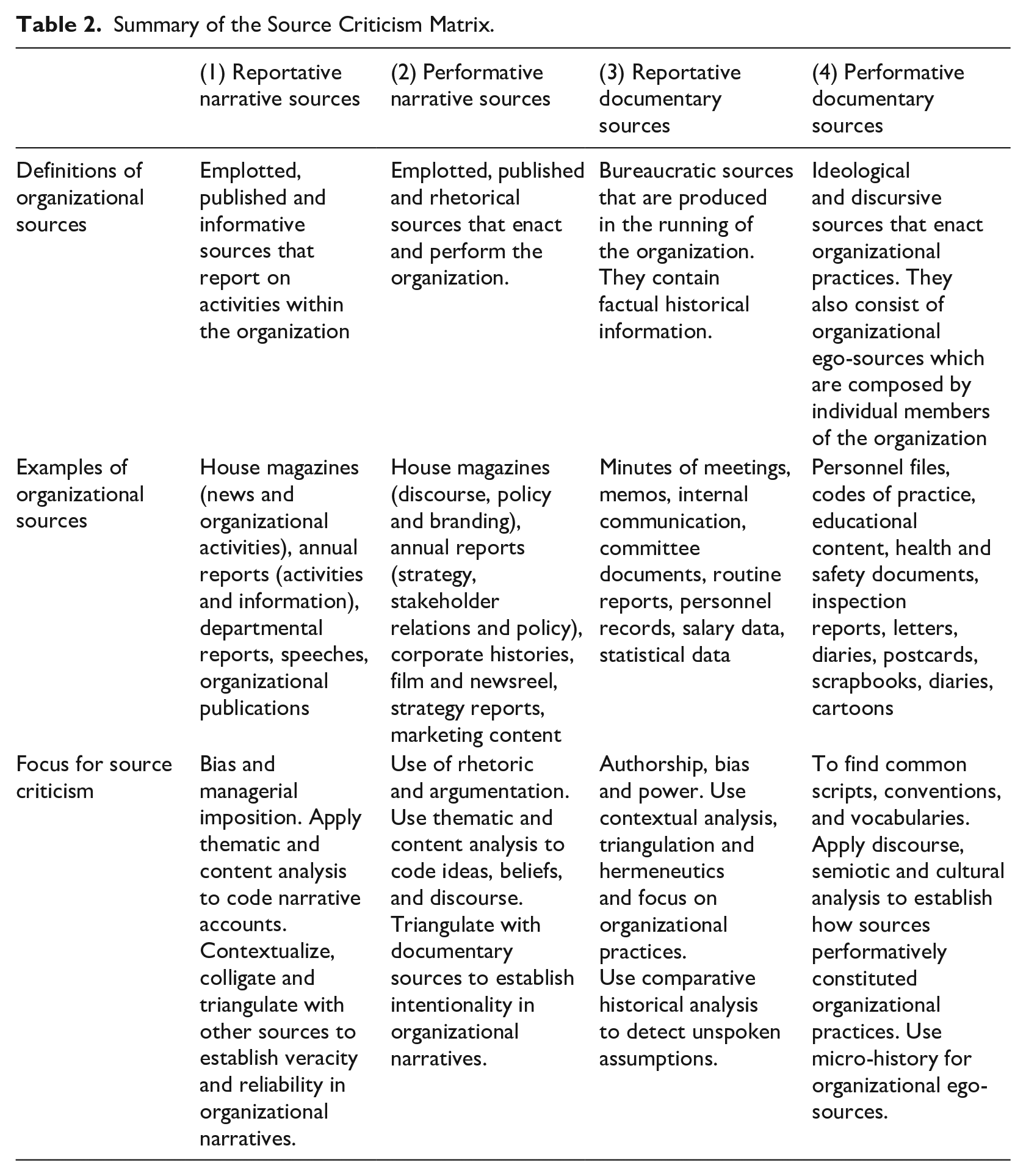
The OSC matrix (Tables 1 and 2) is a methodological model that differentiates between types of sources found in organizational archives and provides guidance on how to criticize and interpret them. I must, however, stress that these are ideal types, and that good archival research in MOH should use multiple types of sources. In relation to the first point, many organizational sources will not be fully commensurable with the four categories of the matrix, and may be an amalgam of them. Annual reports can combine the reportative with the performative. Organizational documents can contain narrative emplotment, and organizational narratives can be documentary. Yet, the matrix has methodological traction. It reflects juxtapositions in the archive, and it should be observed that organizational history has always been a messy practice that has resisted complete standardization (Grey, 2012, p. 50). As to the second caveat, historians are advised to combine these sources in their research. All of the exemplar papers blended several of the four types of sources found in the matrix. Mutch (2016), for example, used statements of theological belief (performative narratives sources) to make sense of his inspection reports. Lubinski (2018) used documentary sources from German corporations and ministries to explain her performative narrative sources.
Summary of the Source Criticism Matrix.
Furthermore, how sources are classified in the OSC matrix depends not only on the source, but on the questions that the organizational scholar asks of it, and her/his mode of interpretation. As the historiographer E. H. Carr (1961/2001) wrote, ‘. . . the facts of history never come to us “pure”, since they do not and cannot exist in a pure form: they are always refracted through the mind of the recorder’ (p. 18). Indeed, Ricoeur argued that what is found in the archive are simply fragments of written traces. It is the historian’s research and investigation that turns them into sources. As he observed, ‘The documents do not speak unless someone asks them to verify, that is, to make true, some hypothesis’ (Ricoeur, 2006, p. 177). This methodological individualism is appropriate to the modality of sources and the distinction between the reportative and the performative. The speeches, for instance, in Maclean et al.’s (2020) article could have been construed as performative narrative sources if different questions had been asked of them. Indeed, in another paper by Maclean and Harvey on political ideology and the discursive construction of the multinational hotel industry by the entrepreneur Conrad Hilton, the speeches of the latter, which are the main sources of their organizational history (Maclean, Harvey, Suddaby, & O’Gorman, 2018), are interpreted and presented in a performative rather than reportative sense.
The OSC matrix also underscores the importance of historical contextual analysis. Context is explicitly referred to in all the papers. This does not simply signify the broader environment that surrounds the source, but also the contextual elements which embed these historical traces in a web of intertextual meaning. Contextual analysis means that the organizational historian’s interpretation of sources must be found in links to other sources. This, in turn, relates to the centrality of triangulation and colligation (Bryant, 2000; Gill et al., 2018; Kipping et al., 2014) in organizational source criticism. Both methods are found in the exemplar papers. Triangulation and colligation support the evidentiary reliability of sources and the trustworthiness of historical narratives. They also facilitate the interpretation of sources by intertextualizing them with other sources. In relation to triangulation, archives outside the organizational archive are vital to counterbalancing its inherent bias and partiality. This is explicitly referred to, for example, in both Lubinski’s (2018) and Grey’s (2012) organizational histories.
I have written this methodological paper to provide guidance to OS scholars who enter the archives of organizations and attempt to interpret and decode its holdings. To achieve this, I have proposed the technique of organizational source criticism, which is grounded in logics of verification and hermeneutics, and is supported by the OSC matrix. It is one that pays equal attention to the veracity and meaning of organizational sources, and considers both their ability to report on and perform the organization. It is also one which recognizes the plurality of organizational sources. In order to do this, I have differentiated between four types of source: reportative narrative sources, performative narrative sources, reportative documentary sources and performative documentary sources. Each requires the adoption of a source criticism germane to its genre. Welker (2014) has observed, ‘If the corporation is multiple, then our analytics must be multiple as well’ (p. 218). The matrix enables organizational historians to access the alterity of the organizational source and create narratives that comprehend the complexity of historical organizations. In doing so, it contributes to an understanding of historical research in organizations and to history in organization studies.
Footnotes
Acknowledgements
I would like to thank Anders Ravn Sorensøn, Copenhagen Business School and Ellen Mølgaard Korsager, Copenhagen Business School for their invaluable contribution to this article. They originated the idea of writing an article on source criticism for MOH and the paper would not have been possible without them. I am also grateful to Trish Reay, University of Alberta, Michael Rowlinson, University of Exeter and Alan McKinlay, Newcastle University for their much appreciated time, help and guidance throughout the writing of this paper. I would also like to thank Yagmur Gunduz for her expert work on designing the article’s tables.
Funding
The author received no financial support for the research, authorship, and/or publication of this article.