



Abstract
Regardless of the enormous risks to humanity, the three-decades-long international effort to administer sustainability has seen an intensifying process of governance privatization, coupled with a failure to reduce global emissions. Bridging neo-institutional and business-class theories, I examine the mobilization of a class-wide coalition of major transnational corporations on a long-term institutional project to shape environmental governance in the mold of a private, market-based institutional logic. Drawing from analyses of the structure, discourse, and activities of the transnational business association World Business Council for Sustainable Development circa 1990–2010, I show how the WBCSD unites the CEOs of some of the largest transnational corporations into a cohesive leadership group, mobilizes the corporate resources they command, and coordinates global-scale, durable institutional creation work. The project’s purpose is to crowd out the state-based logic of environmental governance, thus restricting the development of market-incongruent sustainability organizing. The article contributes to the understanding of societal-level, large-scale institutional work by examining the key agency of business classes in such work, the organization of large-scale work through multifaceted projects, and its orientation to set institutional logics through diverse creation of institutional forms that embody the logic.
One of the striking things about the current sustainable development agenda is the extent to which it is being shaped by business. Take eco-efficiency. This was not even on the agenda until 1992, when it was first coined and promoted by the WBCSD. Now, not only is it spreading through industry as a core management philosophy, it has also been embraced by many governments, the OECD and others as a key policy tool. We are sleepwalking toward a climate catastrophe.
Introduction
The early stages of the global mobilization to tackle climate change were informed by a state-based, regulatory governance logic, of an international framework committed to a decisive reduction in global greenhouse gas (GHG) emissions—by 20% by 2005, according to one prominent blueprint (IPCC, 1990). Governments were to adapt their economies to the global target through various forms of control: planning, setting targets and standards, imposing taxes, incentivizing change, stimulating adaptation of attitudinal and social factors, as well as using market-based mechanisms (IPCC, 1990; Panjabi, 1992; Young, 1989. The first Earth Summit, held in 1992 in Rio de Janeiro, was designed to usher in “the UNFCCC logic of legally binding transnational commitments” (Schüssler, Rüling, & Wittneben, 2014, pp. 162–163). Nevertheless, the regulatory framework on climate change has never emerged, and global emissions ended up growing 62% by 2019. Today, notwithstanding that maintaining warming at the 2015 Paris Agreement levels requires a 50% cut in emissions by 2030, “systemic intervention based around central authority” is more unimaginable than ever (Wright & Nyberg, 2017, p. 1656).
The regulatory logic’s demise is attributed to a variety of factors, including international disagreement and disorganization (Schüssler et al., 2014; Wijen & Ansari, 2007). Another factor requiring consideration is the alternative that has been institutionalized over the past three decades, that is, forms of environmental governance that are privatized, market-based, and flexible: corporate environmentalism, certification frameworks, voluntary environmental reporting, carbon markets, environmental finance, and so on (Bernstein, 2001; Ferns & Amaeshi, 2021; Newell & Paterson, 2010; Wittneben, Okereke, Banerjee, & Levy, 2012). The relentless institutionalization of these private, market-based governance (PMG) forms to the point of becoming, by the 2015 Paris Agreement, largely consensual and taken for granted (Morgan, 2016; Spash, 2016), has clearly helped to enable the regulatory option’s retreat from the political-institutional horizon.
In the age of neoliberalism, private governance of business conduct has become a general trend across multiple arenas, often because governments have been incapable or unwilling to regulate cross-border economic relations (Kourula, Moon, Salles-Djelic, & Wickert, 2019; Schneider & Scherer, 2019). The case of global environmental governance is something of an exception in this regard because—considering the fully global, urgent challenge posed by global warming—the original plan had been to address it through intergovernmental oversight of the transition to clean organizing, and serious steps were initially taken in that direction. This circumstance calls for an examination not only of why governments failed to take collaborative action, but of the forces behind the global rise of PMG as an alternative logic of sustainability governance.
Scholars of global environmental politics suggest that private governance emerged, from around the year 2000, as a compromise among business corporations, the environmental movement, and global North and South governments (Bernstein, 2001; Levy & Egan, 2003; Levy & Spicer, 2013; Meckling, 2011; Newell & Paterson, 2010). However, their account underplays another political factor: the antecedent unified business advocacy of PMG, which likely helped to set the stage for the PMG compromise. This perspective was offered early on by environmental activists (Chatterjee & Finger, 1994) and class theorists at the global level, who generally argue for a “transnational capitalist class” that acts with agency and purpose to advance and defend global neoliberalism (Carroll, 2010; Gill, 1991; Murray, 2017; Robinson & Harris, 2000; Useem, 2015; cf. Salles-Djelic, 2017). Sklair (2001, ch. 7) recounts that, by the 1990s, global capitalism had “captured” environmental politics. Capture stemmed from the rise of a “global capitalist theory of sustainable development,” which prioritized “corporate environmentalism” over legislation.
I endorse this view and develop it from our current historical and theoretical perspective. In particular, I analyze the organized action of the transnational business elite underlying the venturing of the pro-business governance agenda from the margins and its institutionalization. I show how, since 1990, a worldwide coalition of leading transnational corporations (TNCs) has mobilized to shape the logic of sustainable organizing in light of neoliberal globalization. The argument draws from my historical-organizational analyses of the class structure, discourse, and operations of the transnational business association (TBA), the World Business Council for Sustainable Development (WBCSD), throughout its initial two decades of existence (1990–2010). Data are derived from an extensive array of public materials.
Conceptually, and in line with Barley’s (2010) call to advance organizational theory of how corporations shape their sociopolitical environments, I develop a bridge between neo-institutional theory in organization studies and business-class (or power elite, power structure) research in sociology and political economy (Carroll, 2010; Mills, 1956; Robinson & Harris, 2000; Useem, 1984; see Useem, 1982, for an earlier such effort). The bridge articulates the theoretical concepts of class power, formation, and mobilization in terms of inter-firm efforts at institutional work, all of which comprise a larger institutional project, in which the class seeks to shape the institutional logic of global governance (DiMaggio, 1988; Lawrence & Suddaby, 2006; Rao, Monin, & Durand, 2003). The bridge contributes to business power research an extended recognition of TBAs as mechanisms of class formation and mobilization (Carroll, 2010; Gill, 1991) and of the deployment of class power—beyond influence on governments (Barley, 2010; Mizruchi, 1992)—to promote the separation of governance and the state, relocate governance authority to the corporation, and entrust the nonbusiness society with an auxiliary role.
My contribution to neo-institutional theory is to extend the understanding of societal-level, large-scale institutional work (Hampel, Lawrence, & Tracey, 2017) in the following three ways: first, to identify the business class as a dominant societal agent of grand-scale institutional work; second, to theorize about the broader, complex institutional projects through which large-scale work is organized; and third, to identify institutional logics in societal fields as the object of large-scale work and to characterize the process by which these logics are promoted.
Historical Background: The Rise of Private, Market-Based Environmental Governance
In the late 1980s, a trending belief that anthropogenic climate change posed a threat to humankind triggered international mobilizations to address the challenge. Initially, the dominant concept of climate governance was ambitious and assumed state management (Young, 1989). The 1987 Montreal Protocol to phase out ozone-depleting substances set a precedent for international environmental regulation. Around 1992–1993, leading policy initiatives in the international and United States arenas sought GHG emissions stabilization at 1990 levels by the year 2000 (Meckling, 2011, pp. 77–78; Levy & Egan, 1998). The deliverers of such ambitious reform were commonly assumed to be states and their economic management tools, particularly carbon taxes and regulations (IPCC, 1990; Panjabi, 1992). On the inter-state level, the United Nations General Assembly authorized the pursuit of a “framework convention on climate change” that sets “concrete commitments in the light of priorities that may be authoritatively defined” (quoted in Panjabi, 1992, p. 502). The first United Nations Conference on Environment and Development, which took place in Rio de Janeiro in 1992, was expected to establish a universal intergovernmental regime.
While such a regime failed to emerge from Rio, environmentalists continued to champion the regulatory blueprint with some initial success. The first Conference of the Parties in Berlin (1995) mandated the setting of quantified reduction objectives within specified timeframes (Levy & Egan, 2003). This paved the way for the only binding global climate agreement ever signed, in Kyoto in 1997, but business and the US government successfully lobbied for “flexible” governance based on international carbon trading (Meckling, 2011). Following the failure to extend the Kyoto Protocol at the 2009 Copenhagen summit, the legacy of a regulatory regime had all but evaporated by the time of the Paris summit in 2015. The Paris agreement relies on nations’ voluntary commitment and avoids challenging the existing institutional order (Morgan, 2016; Spash, 2016). Nevertheless, it garnered nearly full consensus, including from most environmentalists (Allan, 2019).
Similar to other areas of global governance (Eberlein, 2019; Jackson & Rathert, 2016) but more strikingly, considering the initial intergovernmental regulatory thrust, the logic shaping the actual development of global climate and environmental governance has been voluntary, privatized, and market-based. This logic is reproduced through numerous PMG forms, including voluntary codes, stakeholder initiatives, certifications, rankings, environmental self-reporting and other voluntary disclosure mechanisms, carbon trading, carbon offsetting, corporations’ proclaimed commitments, market-based pressure from investors and stakeholders, and more (Bernstein, 2001; Gupta & Mason, 2014; Keohane & Victor, 2011; Levy & Spicer, 2013; MacLeod, 2010; Newell, 2008; Newell & Taylor, 2020; Waddock, 2008).
What explains the rise of PMG in the field of environmental governance? The post-1990 global neoliberal shift in economic policy has generally favored governance privatization and market-based solutions (Bartley, 2018; Djelic, 2006; Kaplan & Lohmeyer, 2021). At the same time, for PMG to become legitimate and to proliferate despite pushback from environmentalists, some agents had to introduce, promote, and build coalitions around the PMG logic. Students of business in climate politics recount that, around the time of the Kyoto summit, high-polluting corporations—initially including a few pioneers such as BP and DuPont—moved away from their initial anti-governance position and toward accepting market-based governance solutions. Business-nonbusiness carbon coalitions formed, which promoted a carbon compromise based on these solutions (Levy & Egan, 2003; Levy & Kolk, 2002; Levy & Spicer, 2013; Meckling, 2011; Newell & Paterson, 2010, ch. 3). By the 2000s, the acceptance of PMG by most TNCs marked the rise of a lasting era of climate capitalism (Newell & Paterson, 2010).
Existing accounts recognize the WBCSD’s presence on the scene, but only in passing. The enduring mobilization of that “world business council” well before and after Kyoto receives no distinct theoretical recognition. As a result, our understanding of the interest and agency of TNCs in contributing to the privatization of environmental governance is narrow and fragmented. I seek a more long-range view of the WBCSD operations, one that considers the TBA’s affinity to the class politics of globalization.
Transnational Business Associations as Class Forming and Mobilizing Mechanisms
Business-class theory refers to processes in which “corporate elites” form a “class” capable of mobilizing for collective political action to address political challenges to corporate capitalism as a whole (for overviews, see Carroll, 2018; Walker & Rea, 2014). Class theorists recognize that class formation is not universal but centers on the “inner circle” of the leaders of the largest corporations across industry sectors, who develop a shared awareness and commitment to the class interest (Mills, 1956; Mizruchi, 1992; Useem, 1984). Top business associations that syndicate cross-sector corporations (e.g., the Confederation of British Industry) or corporate elites (e.g., the Business Roundtable) are recognized as essential mechanisms of class formation and mobilization. They provide platforms for corporate elite networking, consensus building, and planning, and coordinate the deployment of inter-firm resources on lobbying, political donations, and public relations (Akard, 1992; Domhoff, 1978; Jenkins & Eckert, 2000; Walker, 2014).
By recently shifting attention to the global level, class theorists—including neo-Gramscians—have associated the rise of neoliberal globalization with the formation of a transnational business class (Carroll, 2010; Gill, 1991; Harvey, 2007; Robinson & Harris, 2000; Sklair, 2001; Useem, 2015). It is argued that the post-1950 ascendance of the TNC sector gave rise to a supra-national segment of the corporate elite, which centers on the top managers of the largest TNCs. In the 1970s, this segment increasingly coalesced to promote its “hegemonic project”: the constitution of a global market economy. This process of global restructuring positioned the large TNC as our era’s dominant form of economic organization.
Global class formation entailed the multiplication of transnational associations, including business-led policy groups such as the Trilateral Commission (TC, established 1973) and World Economic Forum (WEF, est. 1987), and business associations such as the European Round Table of Industrialists (est. 1983) and WBCSD (est. 1991). In his study of the TC, Gill (1991) developed the leading perspective on these associations as class mechanisms. First, these associations create transnational elite networks. The TC established forums in which international corporate, political, and intellectual elites could fraternize, develop collective identity, and articulate a shared “internationalized outlook.” Similarly, the WEF convenes thousands of world-leading business and nonbusiness elites, where they network and exchange views about how to manage the world (Navidi, 2017).
Second, transnational associations mobilize as collective “organic intellectuals” in order to develop and disseminate knowledge about how the world polity should be structured (Gill, 1991). Their purpose is to render these assessments and prescriptions globally dominant. The TC organizes research, consensus building, and dissemination of policy ideas and proposals by way of publications, statements, and lobbying, and by utilizing its members as emissaries in their countries (Gill, 1991). The WEF manifestly engages “leaders of society to shape global, regional and industry agendas.” Beyond Davos, it coordinates Global Agenda Councils of elites and experts, who generate neoliberal blueprints for global governance (Sharma & Soederberg, 2020).
Notwithstanding its enduring relevance, Gill’s (1991) model excludes newer forms of mobilization by which TBAs seek to create and maintain the global order. In particular, it focuses on the effort to shape state and interstate policies while saying little about the engagement of global business in the rise of non-state-based forms of global governance (Bartley, 2018; Djelic & Sahlin-Andersson, 2006). Second, the model does not recognize organized class action beyond knowledge production.
The case of the WBCSD underscores these limitations. Scholars observe that the WBCSD forwards an ideological vision of capitalist social and moral progress in which environmental and economic needs are apparently reconciled (Carroll & Carson, 2003). It clearly does more than that, however. Sklair (2001, ch. 7) recounts that, as part of the scheme to “capture” the sustainable development movement, large corporations around the world adopted corporate environmentalism practices (see also Najam, 1999). But the overall strategy of capture remains ambiguous: How does corporate sustainability advance the capture, and what are the links to other activities such as advocacy and intellectual production? Further, how do capitalists worldwide organize for collective action to advance the capture strategy, as presumed, including the global diffusion of sustainability practices? To address these problems, I turn to neo-institutional theory.
An institutional work framework for the study of business classes
Institutional work scholarship highlights the efforts of individuals and organizations to create, maintain, and disrupt institutions (Lawrence & Suddaby, 2006). Its point of focus is agents’ institutionally shaping activity, including identifying the agents, their interests and goals, their modes of organization, the tools they use, and the conditions and outcomes of the work (Hampel et al., 2017; Lawrence, Leca, & Zilber, 2013; Lawrence, Suddaby, & Leca, 2009; Zietsma & Lawrence, 2010). The investigation classifies the work of actors into forms and efforts—for example, “boundary bridging” or “theorization”—that vary in their institutionalizing functions and modes of deployment (Greenwood & Suddaby, 2006; Martí & Fernández, 2013; Mena & Suddaby, 2016). Among other topics, scholars have studied institutional work by dominants to bolster and defend their position of advantage (Currie, Lockett, Finn, Martin, & Waring, 2012; Hamann & Bertels, 2018; Raynard, Kodeih, & Greenwood, 2021). I continue by exploring business classes as collective agents of institutional work.
My analytical framework incorporates several adjustments of institutional work theory to the study of class. The first is to articulate, in institutional work terms, the three main class-theoretical concepts: class power, class formation, and class mobilization. I propose that class power can be exercised through institutional work. This occurs when, in the context of a struggle against societal rivals and their institutional change agendas, the class confronts the challenge through strategic institution-shaping activities. It exercises power by shaping the institutionalized standards, models, and mechanisms of governance and organizing. Second, in the same context, class formation is the organizational process by which the class acquires the capacity to mobilize as a unified agent of institutional work. Likely coordinated by TBAs, class formation entails the coalescence of a class-wide coalition (many corporate elites across sectors and geographies) around a shared institutional vision and moral commitment to promote it. Finally, class mobilization is the mobilization of class-wide corporate resources for complex, long-term institutional work to realize the class vision. Taken together, these premises provide an approach to the study of class formation and mobilization for, and power exercise through, institutional work.
My two other theoretical adjustments address the fact that the institutional work of business classes is oriented toward shaping large-scale, societal-level institutions. Noting the scholarly neglect of institutional work on these levels, Hampel et al. (2017) hypothesize that large-scale work has two distinctive features: its organizational complexity and its object of institutionalizing. In order to grapple with the organizational complexity of large-scale work, I seek to facilitate a more holistic perspective on the agent, purpose, and organization of large-scale work, specifically by shifting the focus from the distinct work form (into which an agent’s overall work is classified) into an agent’s full set of efforts, its overall work to pursue an institutional goal. Such a broader perspective on work communicates with the big-picture approach of class theorists. Indeed, some of them describe the rise of global neoliberalism in terms of a globally diffuse, heterogeneous, prolonged but still relatively uniform “class project” (Harvey, 2005), “hegemonic project” (Carroll, 2018), or “institutional project” (Chorev, 2005).
The concept of institutional project has its origins in the institutional work tradition. DiMaggio (1988) coined the term “institutionalization project” to designate pursuits by “organized actors with sufficient resources” to create new organizational forms. While DiMaggio’s (1988) concept can be understood as referring to the total, potentially multi-form institutional work deployed by resourceful actors, subsequent references in the literature to institutional project are sporadic and rarely distinguish between “project” and “work” (e.g., Battilana, Leca, & Boxenbaum, 2009). I define institutional project as something wider than work: a compound of mutually supportive work efforts that are deployed enduringly in order to secure a certain general institutional goal (see Lawrence et al., 2013, pp. 1025, 1028). Adopting a project approach implies that the investigation is of the overall, inter-functional deployment of an array of work efforts by a focal collective actor.
Second, as Hampel et al. (2017, pp. 34–36) hypothesized, large-scale work’s institutionalizing object may not be specific, localized institutions—such as a practice, organizational form, standard, or boundary—but institutional logics. Institutional logics are classically regarded in the literature as exterior cultural frames that shape agents’ interests and decisions (Friedland & Alford, 1991; Pansera, Marsh, Richard, Flores López, & De Alba Ulloa, 2023), including their institutional work (Gawer & Phillips, 2013; Martin, Bushfield, Siebert, & Howieson, 2021). A few studies propose an alternative conceptualization of the nexus between institutional logics and work, whereas work shapes institutional logics. Rao et al. (2003) observe that field-level logics—sets of higher-order organizing principles—are explicitly articulated, promoted, and defended by collective agents, in the context of struggles between incumbents and challengers over values and position. Schüssler, Lohmeyer, and Ashwin (2022) show how actors in the field of transnational labor standards articulate a non-market logic of management that challenges the dominant market logic. Further, both studies imply the distinct nature of logics-shaping work. Logics are promoted through the creation of a diverse “repertoire of practices that embody [an] institutional logic”; thus, cuisine logics are embodied in various institutions, practices, identities, rhetorics, artifacts, and symbols of French gastronomy (Rao et al., 2003). Similarly, the non-market logic is brought into existence through various structures and practices (Schüssler et al., 2022). I therefore expect my focal institutional workers to enact the PMG logic across institutions through the generation of multiple institutional forms that reflect the logic’s principles: market-based agreements, arrangements, policies, standards, managerial practices, and so on.
Figure 1 summarizes my theoretical model. A transnational business-class institutional project encompasses three analytically distinct stages (which in reality are more circular and interfused): (1) class formation, wherein business elites across sectors and regions coalesce around a shared vision of an institutional logic to be promoted; (2) class mobilization, in which class-wide corporate resources are mobilized in support of the various institutional work efforts and sub-efforts that comprise the project; and (3) class power exercise, wherein the project promotes an institutional logic by creating institutional forms that embody the logic, thus exerting influence on the trajectory of societal-level institutionalization. TBAs organize these complex projects.
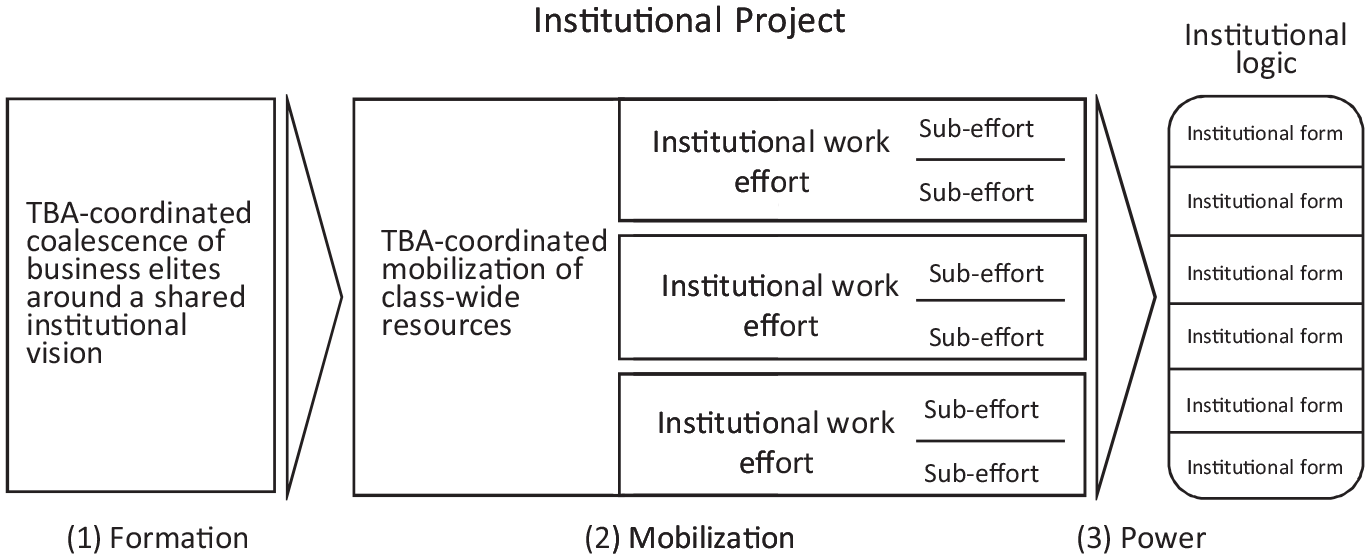
Model of transnational business-class institutional project.
Research Design
Data collection
Since I sought to cultivate a long-term perspective on the WBCSD’s activity, and considering that TBAs do not tend to reveal inside information, my investigation drew on public sources, which I could collect extensively and longitudinally. I set the time frame as 1990–2010, the period encompassing the WBCSD’s beginnings to the point at which the PMG logic became clearly dominant and institutionalized. I assembled a large volume of documentary and digital materials that had been published by the WBCSD, or about it by INGOs, NGOs, and the media. Some sources, including books published by the WBCSD during the period 1992–2006, were available from libraries. Other materials, such as reports and minutes, were obtained through web searches.
In addition, I drew extensively on the Internet Archive, a nonprofit initiative that archives “web history,” that is, webpages and linked media as they appeared across timepoints. My navigation of the archive was done through the Wayback Machine search engine (Arora, Li, Youtie, & Shapira, 2016), which facilitated access to the WBCSD’s and other websites beginning in 1997. Access was not complete, because pages and links are archived somewhat randomly in various periods. Nevertheless, the tool allowed access to extensive content, and through creative navigation I was able to reach most pages that seemed relevant to my purposes.
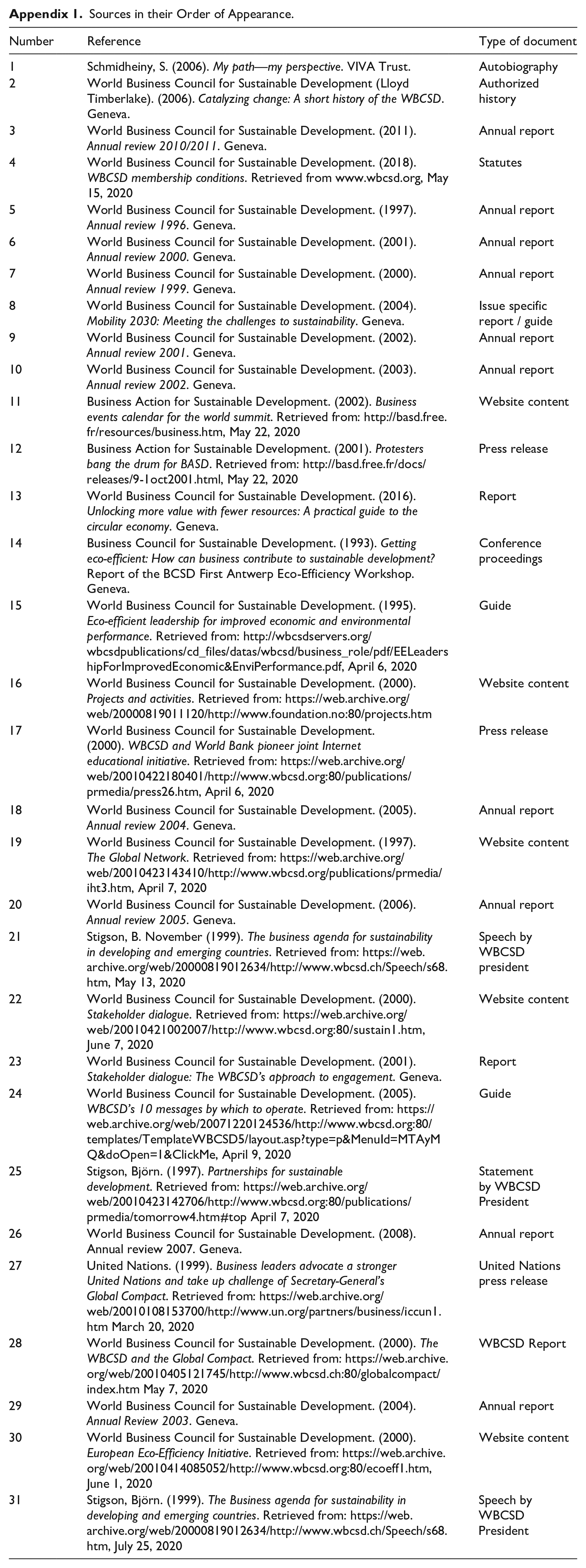
Taking a historical approach to the investigation (Rowlinson & Hassard, 2013), I immersed myself in the WBCSD’s web history, canvassing it chronologically from 1997 to 2010, with occasional forays into additional organizations’ websites. The search was informed by my theoretical objectives: to learn about the institutional work done under the WBCSD, how it was organized, what its purpose was, and which resources were mobilized. Throughout the search, theoretically relevant leads presented themselves and shaped the navigation. I explored these leads until it became apparent that the data on the focal theme had been duly assembled. To prepare for the analysis of the material and to avoid selective retention bias, I recorded relevant information through screen-shot webpages and by downloading documents. In total, the analysis covered documents containing about 2,000 pages, which was a fraction of a broader volume of text that had been perused. Appendix 1 provides a list of the sources that support the analysis, including full references and the type of each source.
Data analysis
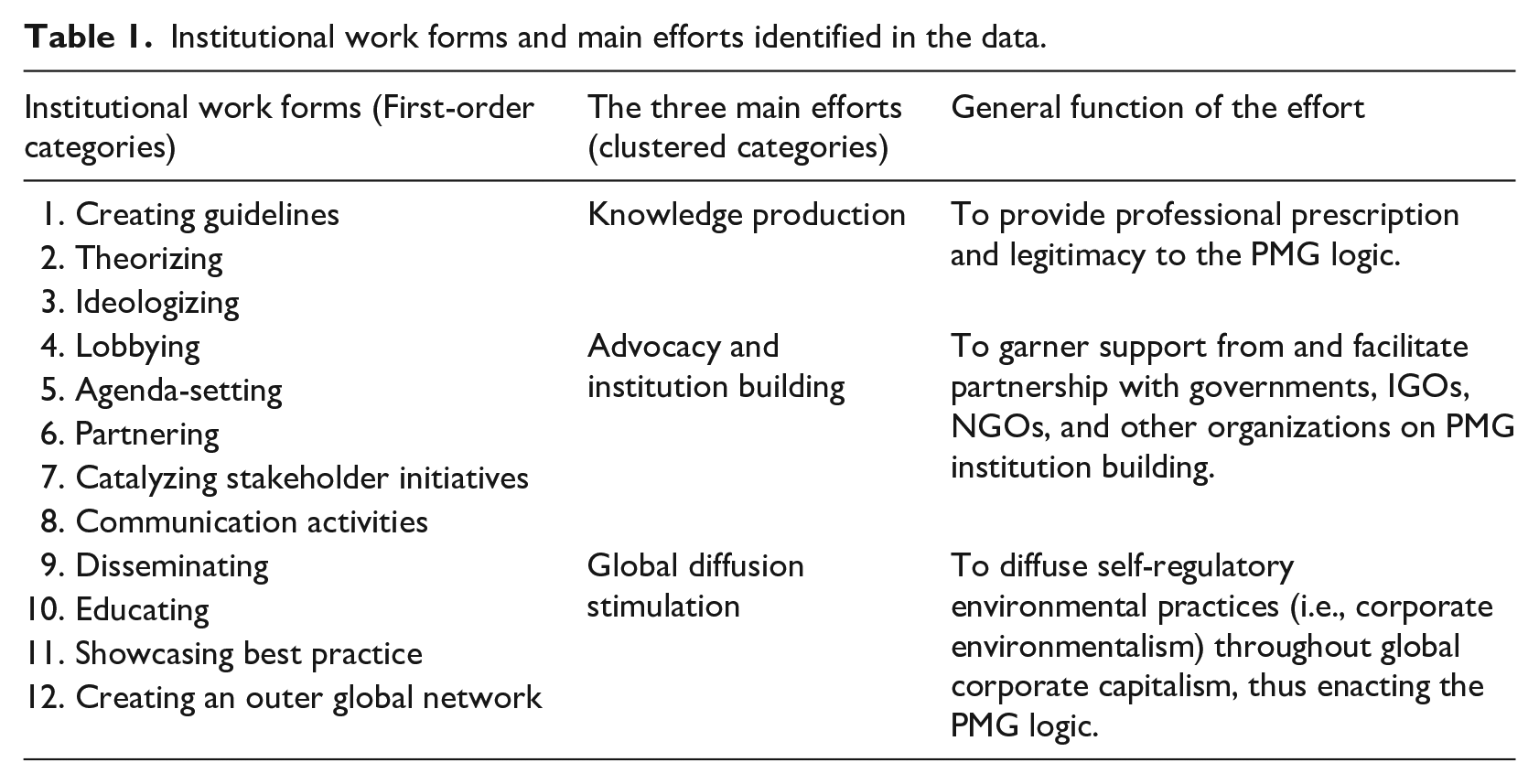
I coded the materials for the different types of institutional work indicated by them. This analysis revealed that the WBCSD had coordinated the deployment of a plethora of distinct forms of institutional work—for example, theorizing, educating, and advocacy (Lawrence & Suddaby, 2006). There were also activities that figure as institutional work, but did not match with established titles. Further, the data suggested that the work forms observed were functionally intertwined, and that all of them were deployed insofar as they were expected to serve the institutional agenda promoted by the WBCSD. This suggested that my unit of analysis should be the institutional project encompassing these lines of institutional work (DiMaggio, 1988; cf. Currie et al., 2012). Accordingly, I coded the different work forms into clusters that represented distinct components of the deflection project. This gave rise to an analysis of the WBCSD mobilization as a threefold project whose main efforts are aimed at knowledge production, advocacy and institution building, and global diffusion stimulation (Table 1).
Institutional work forms and main efforts identified in the data.
The materials allowed for two additional forms of analysis useful to my purposes. The first was of the WBCSD as an organizational mechanism of transnational class formation, possessing the capacity to facilitate class agency on institutional work (Gill, 1991; Martí & Fernández, 2013). The second analysis, stemming from the institutional logics literature, extracted from key texts published by the WBCSD in 1992, 2002, and 2010 a distilled representation of the institutional logic promoted. The presentation of findings is thus ordered: formation, logic, project.
Forming a Transnational Inner Circle to Work on Sustainability
Spawned by the International Chamber of Commerce (ICC) in the period 1990–1995, the WBCSD 1 was created in order to “represent the business voice” in the Rio summit [1; 2]. 2 The WBCSD’s main organizational feature, its CEO-based membership structure, was the brainchild of the founder, Stephan Schmidheiny, a Swiss TNC owner and pioneer of business environmentalism. By the WBCSD’s inauguration in the spring of 1991, Schmidheiny had recruited 48 member CEOs. By 1996, members numbered 120, and by 2010, 192. Membership is by invitation and follows three criteria: (1) members are transnational CEOs running TNCs; (2) selection prioritizes CEOs of prominent TNCs; in 2010, the 192 members presided over $7 trillion in revenues [3], 11.5% of that year’s global GDP; and (3) recruitment seeks diversity in terms of industry sector and geography. Among the founding TNCs, 26 were headquartered in Europe and North America and 22 across all other continents. In 2010, membership represented 23 sectors and nine regions across the five continents (Figure 2).
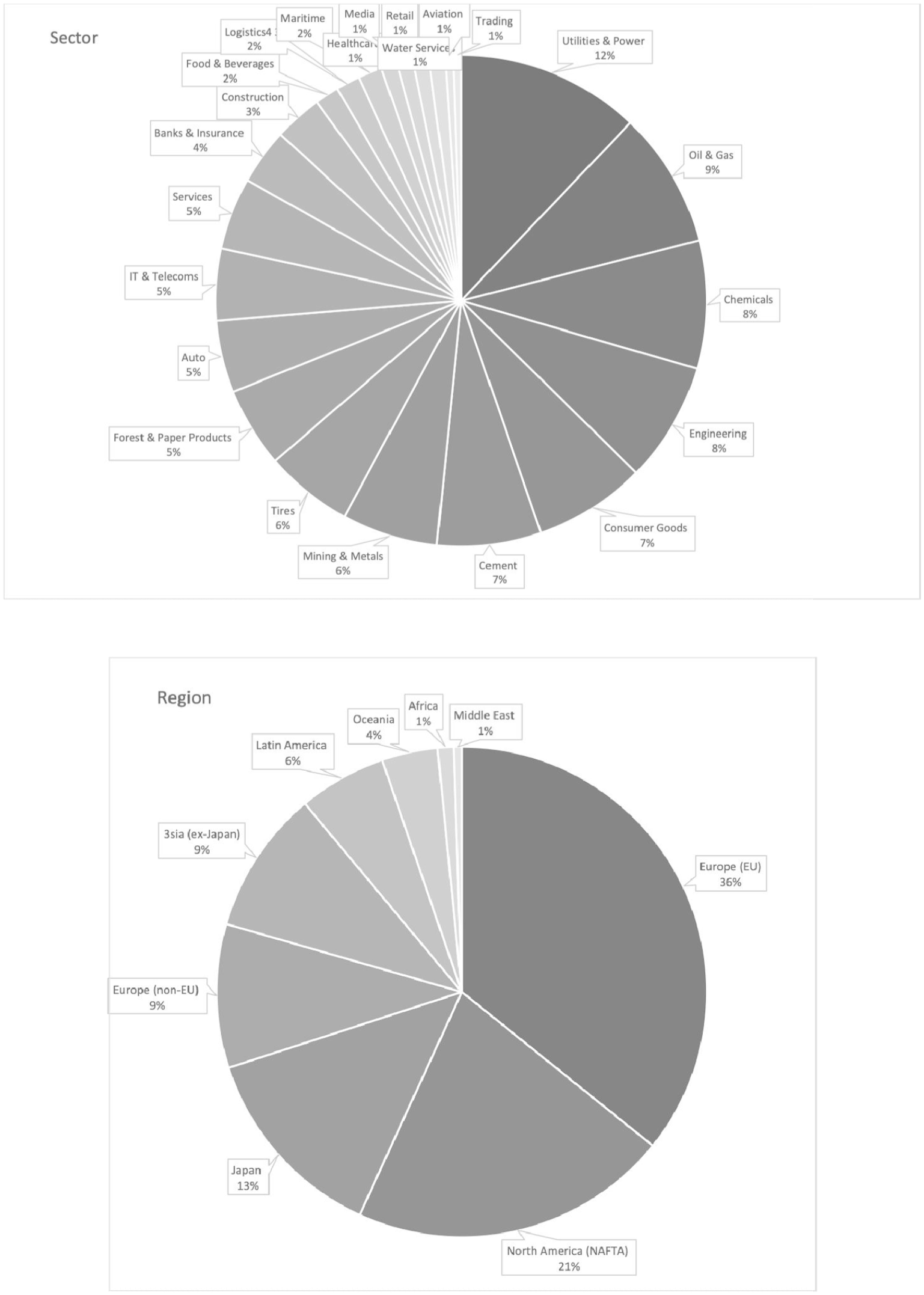
WBCSD corporate member representation, sector and region, 2010.
As an exclusive but diversified association of transnational CEOs, the WBCSD is structured as a leadership group that sets the transnational business-class agenda and spearheads mobilization in environmental politics. Like the national-level “inner circle” network (Useem, 1982; 1984, ch. 3), the WBCSD’s exclusive membership structure favors the development of social cohesion and thus the inculcation of class consciousness and solidarity. The TBA also actively promotes such unity. It convenes the full council yearly and regularly engages smaller teams of members in projects of knowledge production and advocacy. Its statutes promote commitment to the collective strategy by expecting members and their companies to be “business thought leader[s] and advocate[s] for sustainable development,” to “actively support the objectives and work plan of WBCSD,” and to ensure that their “communication and lobbying activities support the WBCSD mission” ([4]; [5]; [6]).
Through member diversification, the WBCSD facilitates global class-wide representativeness. In the national inner circle, inter-sectoral diversity distinguishes the top group from sector-specific formations and promotes class-wide consensus building, mobilization of resources, and inward and outward authority (Useem, 1984). By implication, class-wide representativeness on the transnational level requires geographical as well as sectoral diversification. The WBCSD cultivates such representativeness consciously, recruiting members from “business sectors where the WBCSD may be somewhat under-represented” and who “would help broaden still further our geographical spread”; diversification “allows us to speak for a broad coalition of business interests drawn from many industries and geographical regions” ([5], p. 3; [6], p. 26; [7]).
Uniquely, class formation is special-purpose—that is, oriented toward environmental politics. This orientation is reflected in the membership composition, where sectors with higher stakes in global environmental politics are better represented. In 2010, utilities & power, oil & gas, chemicals, engineering, cement, and mining & minerals CEOs comprised 50% of the WBCSD membership, while IT & Telecom and Banks & Insurance, for example, respectively accounted for 5% and 4% (Figure 2).
In sum, the WBCSD’s organizational structure facilitates a cohesive transnational class-wide leadership group of top CEOs, which is designed to set the global business agenda on sustainable development, act on behalf of global business on the societal level, and spearhead various forms of corporate mobilization on political and institutional action.
The Institutional Logic Promoted
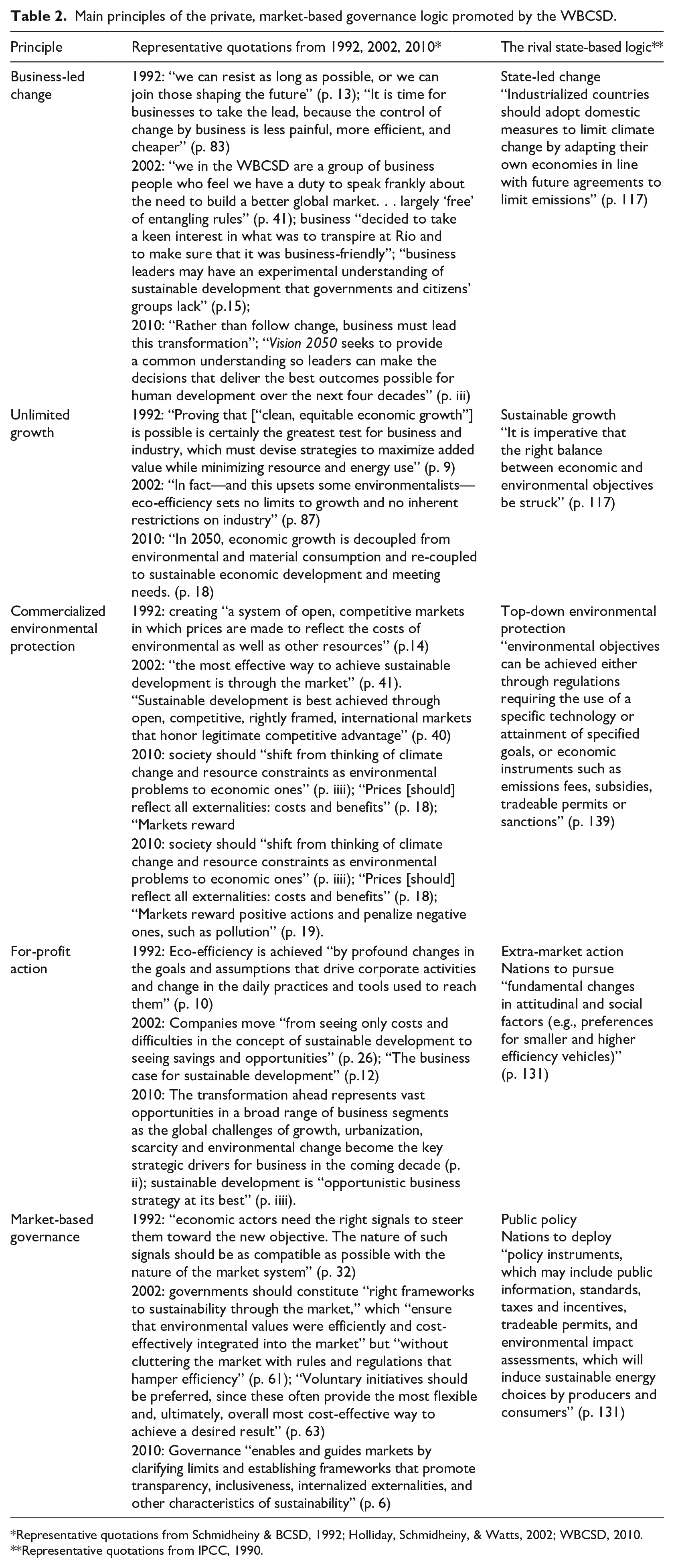
I extracted the following distilled representation of the governance logic from three prominent WBCSD publications: the debut book Changing Course: A Global Business Perspective on Development and the Environment (Schmidheiny & BCSD, 1992); the book Walking the Talk: The Business Case for Sustainable Development (Holliday, Schmidheiny, & Watts, 2002), which was co-authored by the founder and two chairmen of the WBCSD; and the 2010 report Vision 2050 (WBCSD, 2010), co-authored by 29 council members and their teams. (Text selection replicates Moussu, 2017.) As landmark texts, these sources provide exceptionally reflective articulations of the WBCSD’s overall strategy. I represent the logic as a system of five principles. Table 2 lists and demonstrates them through illustrative quotations from 1992, 2002, and 2010. For purposes of comparison, the right-hand column lists analogous principles of the state-based logic that are accompanied by illustrative excerpts from the Intergovernmental Panel on Climate Change’s First Assessment Report (IPCC, 1990).
The first principle, business-led environmental governance, posits that corporations should set the global environmental agenda by addressing the needs of the global market order. This is the class strategy that informs the project.
Second and accordingly, unlimited growth: environmental governance will not compromise growth, which is to be unleashed instead as a force of both global prosperity and environmental progress.
This reconciliation is achieved by, third, the commercialization of environmental protection, whereby environmental damage and improvement are financially punished and rewarded, respectively.
Fourth, as implied, the vehicle of environmental progress is corporate voluntary, for-profit, market-driven action. This principle is encapsulated in the WBCSD’s constitutive concept of “eco-efficiency,” as well as the trope of “the business case for sustainable development.” It posits that in order to enact the logic, business management should adopt the eco-efficient rationality; this implies a diffusion mission for the WBCSD.
The fifth and final principle is market-based governance. Here the logic assigns a role to the nonbusiness segments of society: governments, IGOs, NGOs, and business-nonbusiness partnerships provide “framework conditions” to encourage eco-efficient managerial transformation. The diffusion of corporate environmentalism practices, then, is defined in this logic as the goal of governance.
Main principles of the private, market-based governance logic promoted by the WBCSD.
Representative quotations from Schmidheiny & BCSD, 1992; Holliday, Schmidheiny, & Watts, 2002; WBCSD, 2010.
Representative quotations from IPCC, 1990.
I move to show how the operations of the WBCSD perform institutional work to promote the intellectual and material enactment of this logic. The project is pursued in countless small ways that promote institutional forms embodying the logic. Organizationally, those numerous actions can be grouped into three main efforts.
The Institutional Project: Class-Wide Resource Mobilization and Three Work Efforts
1. The knowledge production effort
The WBCSD operates a high-volume knowledge industry that produces professional and semi-professional books, reports, guides, bulletins, op-eds, research projects, and more. The knowledge industry feeds on resources mobilized from the TNCs of council members, including funds, facilities, networks, knowledge, and “senior people . . . whose task is to provide back-up to their CEO in fulfillment of his or her WBCSD responsibilities” ([5], p. 11). Teams of CEOs lead research projects, and WBCSD staff assist in coordination and production. To illustrate the scope of resources involved, the production of the Mobility 2030 report in 2004 was overseen by the CEOs of 12 major corporations, 3 187 colleagues from their firms, 24 external specialists, and 17 consulting firms and institutes [8]. Multiple projects run concurrently, based on resources from the WBCSD’s full circle of elites and firms. Knowledge production capacities probably exceed that of most other organizations in the global environmental governance arena. During the period 1996–2000, the WBCSD published 6 books and 26 lengthy reports; circa 2001–2010, the annual average increased to 16 reports, among other output.
The institutionalizing function of the knowledge industry is indirect but fundamental: to professionally articulate and elaborate the PMG logic, thereby providing a basis for its promotion through advocacy, practice diffusion, and institution building. In founding the TBA, Schmidheiny’s idea was that business had to improve its professional standing in the sustainability debate. The first order of the day was to produce a book-length articulation of the global business perspective on sustainability. This resulted in the publication, in advance of Rio, of the Changing Course volume, by MIT Press. Having this sophisticated articulation of the business sustainability agenda ready to mobilize by the Rio summit was reportedly vital to the WBCSD’s success in promoting the message that “business was not the problem but part of the solution” (Chatterjee & Finger, 1994). Propagating this slogan—in fact, an institutional myth—is an instance of institutional work to promote the PMG logic. A professionally authoritative articulation of the logic is essential if the logic is to gain traction and ultimately become taken for granted.
The WBCSD acknowledges that by producing “high caliber content” on environmental governance, it carves for itself a “position of thought leadership” )[9], p. 21; [2], p. 63) which is instrumental for effective advocacy of the logic’s principles and applications. As the TBA’s chairman stated in 1997, being “the leading business advocate on issues connected with the environment and sustainable development” requires that we first have to be clear about the policies we are advocating. Achieving that clarity of vision and purpose involves strategic thinking, thorough research, and careful consultation. . .. Our credibility as a leader of business thinking. . . depends on. . . the ideas and policies we put forward. ([5], p. 3)
Around the 2002 Johannesburg summit, mobilization on knowledge production intensified in order to support advocacy work. The summit “offered a superb opportunity for the WBCSD to display [its] intellectual capital” ([10], p. 5). The knowledge industry released a flurry of 22 reports and three books, which informed advocacy “at every stage of the run-up to the World Summit” (ibid.) At the summit, the WBCSD delegates disseminated that knowledge through 13 events, among them an entire (and controversial) Business Day designed “to promote the business case for sustainable development” ([11], [12]) The knowledge infrastructure supplies the contents and professional authority for such “thick” promotion of the logic.
As a debut product, Changing Course (Schmidheiny & BCSD, 1992) provided an exceptionally comprehensive articulation of the logic. Most other knowledge products set out more specific articulations. For example, the aforementioned Mobility 2030 report [8] develops a PMG-oriented global perspective on “sustainable mobility and ways to achieve it.” The PMG logic is embodied in the report’s approach to regulation, which is not a straight-up repudiation, but advances a rather restrictive interpretation of regulation’s role: unlimited growth is assumed, regulatory phase-out of technologies is ignored, a state-managed shift to new technologies is discouraged, fiscal incentivizing of consumer demand is accepted, and intergovernmental regulation is rejected in an exceptionally explicit manner: In general this report steers clear of value judgments about the consequences of different states or regions setting different priorities with respect to mobility-related issues. An exception is made where these choices significantly limit the freedom of other states or regions to express their own priorities. ([8], p. 17)
Knowledge products such as Mobility 2030 support well-informed, confident, and unified pro-PMG advocacy, practice diffusion, and institution building in this or that area.
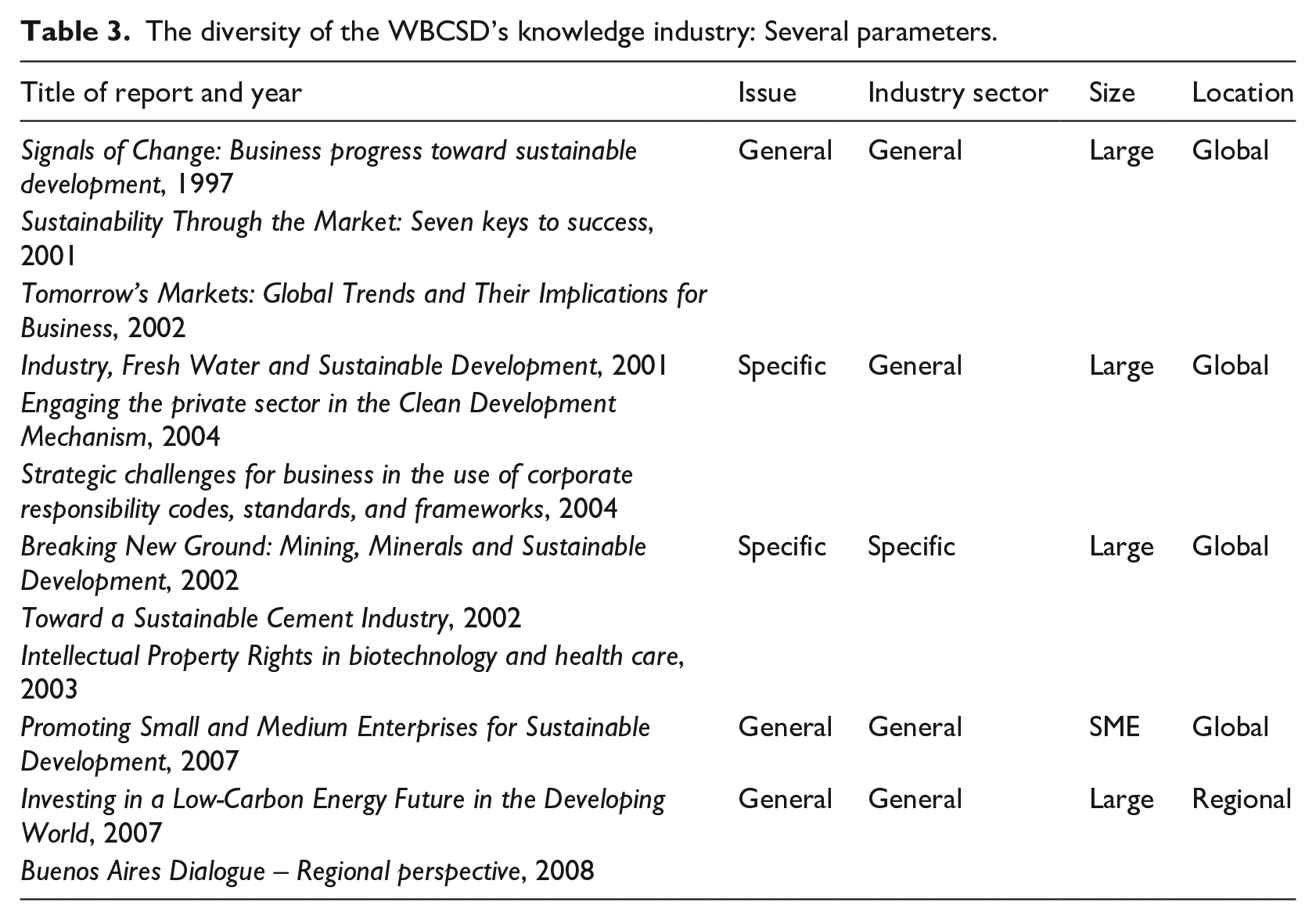
In addition, thanks to its unique comprehensiveness, the knowledge production effort has a cumulative institution-shaping effect. Many organizations advance PMG promotional knowledge, but they tend to specialize in a specific area, e.g., carbon trading or environmental finance. The WBCSD’s knowledge effort covers these, among dozens of other applications of the logic. The knowledge produced is highly diverse in terms of issues, sectors, locations, and levels of complication and specificity (Table 3). Over time it absorbs innovations, blueprints, and slogans that can be rendered compatible with PMG—as an example, from 2016, “circular economy” [13]. This interweaving of multiple ideas and blueprints into a unified whole creates a robust and incontestable belief system around PMG as a logic of governance.
The diversity of the WBCSD’s knowledge industry: Several parameters.
2. The global diffusion stimulation effort
The promotion of the focal governance logic requires that corporations move to adopt for-profit sustainability practices. The stimulation of inter-firm diffusion of corporate environmentalism is therefore a primary task. Historically, systematic engagement in the problem of how to trigger such change dates to the BCSD’s workshop Getting Eco-Efficient, held in Antwerp in 1993. The participants reckoned that eco-efficiency was not going to diffuse itself, considering that “strong inertial forces at work [are] slowing down and preventing the shift” )[14], p. 27). Diffusion required that eco-efficiency be “translated into clear criteria and operational guidelines that managers can use to reshape their day to day practices,” followed by “broad distribution into [the] business community and all interested sectors” )[14], pp. 14, 16).
Institutional work geared to stimulating corporate sustainability diffusion, whose purpose is to put into practice the role of corporations according to the PMG logic, is conducted in four interwoven sub-efforts that rest on class-wide resources. First, the knowledge industry produces managerial know-how of corporate sustainability—for example, how companies can “improve the efficiency with which they use and manage water within their operations” [7]. This “theorization” activity accelerates practice diffusion (Strang & Meyer, 1993). Second, the WBCSD coordinates international educational activities, including workshops, training programs, tutorials, internships in WBCSD companies, programs oriented to the SME sector, and many more ([15]; [16]; [17]). Third, the WBCSD instructs its members to “ensure the adoption of sustainable management practices within their companies” and disseminates “to the wider business community” knowledge about the “best practice” of these famous and highly respected firms ([5], p. 7; [18], p. 29). By using its members as models of best practice, the WBCSD mobilizes their prominence as a motor of diffusion. Finally, an outer global network of national and regional branches created by the TBA brings together thousands of corporate elites worldwide. The purpose is to “ensure balanced development of the WBCSD in all regions,” “exchange best practices,” carry “the WBCSD’s policy initiatives round the world,” and “carry out projects that convey the message of sustainable development” ([5], pp. 4, 9; [19], p. 2; [6], p. 26; [20], pp. 37–40). The parallel operation of these four mechanisms of global diffusion stimulation demonstrates the multifaceted nature and organizational complexity of the focal societal-level project.
3. The advocacy and institution-building effort
As self-reported in 2006, “Prior to every major international meeting or compact on the environment in the last 10 years, the WBCSD has steadily worked behind the scenes to raise the business voice” ([2], p. 58). Mobilization on advocacy work rests on the coordinated class-wide deployment of council members as advocacy operatives. These “prominent members of the business community. . . act as influential advocates for the policy positions developed by the WBCSD” ([5], p. 11). Mobilizing top TNC leaders as a door-opening, message-hammering task force replicates the model of the American Business Roundtable, which had been founded on the “premise that business would be more politically successful if CEOs lobbied Congress and the administration personally” (Barley, 2010, p. 785).
The transnational business class is a mighty advocate. In the run-up to Rio, delegations of the nascent BCSD met with two dozen heads of state, including US President George E. Bush, “to lobby them on our perspective” ([2], p. 16). At the Rio summit, according to activists, the BCSD delegation of 29 CEOs was highly influential, and the Changing Course logic became the dominant view (Chatterjee & Finger, 1994, ch. 8). In 1996, The WBCSD reported on “fruitful discussions with a wide assortment of bodies, including national governments, the World Bank, the OECD, the WTO, the KU, several UN agencies, the ICC, as well as a range of other leading business groups and NGOs” ([5], p. 4). By 1997, the WBCSD’s executive director claimed that the TBA had become the leading business voice on sustainable development. Our views are regularly sought, and listened to, by governments, international governmental and non-governmental organizations and special-interest groups, as well as by the business community itself. ([5], p. 2)
At the 2002 Johannesburg summit, the WBCSD “enjoyed strong leadership,” with 50 member CEOs advocating on its behalf. In addition, along with the ICC, it mustered a “thousand-person business presence in Johannesburg” ([10], p. 6; [11]). This class-wide advocacy work facilitates, first, the general acceptance of the logic among societal elites, thus setting the stage for its legitimation, normalization, and diffusion. Second, advocacy is strongly oriented toward encouraging organizations such as NGOs, IGOs, governments, financial firms, and standardization agencies to reorient their efforts along PMG lines, thus promoting societal-level institutionalization into the PMG logic. The WBCSD is a pioneer of societal “partnership” and “stakeholder dialogue” ([21]; [22]; [23]; [24]). Already Changing Course (Schmidheiny & BCSD, 1992, pp. 86–89) has urged business leaders to “mobilize the vision through stakeholder partnerships,” thus securing public acceptance, reducing risk and liability, and promoting “self-regulation rather than legislation.” In 1997, the WBCSD president recalled that “active, working partnerships with a UN agency and, perhaps particularly, an environmental NGO would have been difficult to contemplate five years ago” [25]. A decade later, the WBCSD reported on partnerships with 58 organizations, including many of the most important international organizations (e.g., the WTO, World Bank, OECD, and nine UN agencies), Environmental NGOs (e.g., WWF International, World Conservation Union), and business associations (e.g., World Economic Forum, World Energy Council) [26].
Partnership provides the basis for PMG institution building. The United Nations Global Compact, a flagship PMG initiative, originated with the historic entrance of the UN into partnership with the ICC in 1998, based on the understanding that “companies can best promote. . . environmental standards by the way they conduct their own businesses and by the spread of good corporate practices” [27]. During the year preceding the Compact’s July 2000 launch, the WBCSD was closely involved in the initiative’s organization; of the 50 founding corporate signatories, 20 were WBCSD members [28, 6, 2]. Few other organizations were as active as the WBCSD in the establishment of multistakeholder PMG frameworks of global environmental governance. The TBA influenced the development of the leading managerial system ISO 14001 (Piper, 2003), helped to found the Global Reporting Initiative, partnered with the European Commission on the European Eco-Efficiency Initiative, with UN agencies on the International Emissions Trading Association and Clean Development Mechanism, and with the World Resources Institute on the GHG Protocol—all of that by 2001 ([7], p. 13; [29], p. 8; [2], pp. 64–65; [30]; [31], p. 4; [7], p. 11; [9], p. 12). These initiatives directly actualize the logic’s fifth principle of market-based governance, whereas societal governance of corporate conduct is pursued through market-driven pressure to encourage voluntary adoption (i.e., diffusion) of for-profit corporate environmentalism.
Discussion
Figure 3 presents the focal institutional project as I have analyzed it: a system of inter-organizational networks and activities that is designed to set the PMG logic across the business and societal realms by forming a collective (transnational class) agent of institutional work, mobilizing class-wide resources, and coordinating class-wide work efforts and sub-efforts. The work efforts that comprise the project are diverse but mutually reinforcing: knowledge production provides a professional infrastructure for the other efforts; diffusion stimulation supports institution building by facilitating corporate participation in multistakeholder initiatives; advocacy work supports institution building by facilitating partnerships with societal organizations; and institution building supports diffusion by pressuring firms to align in accordance with private standards. The project is also unified through time: operating durably through the decades to pursue its lasting objective—that is, establishing a corporate-led, market-based logic of environmental governance, thereby diverting sustainable organizing from the logic of interstate standard-setting and enforcement.
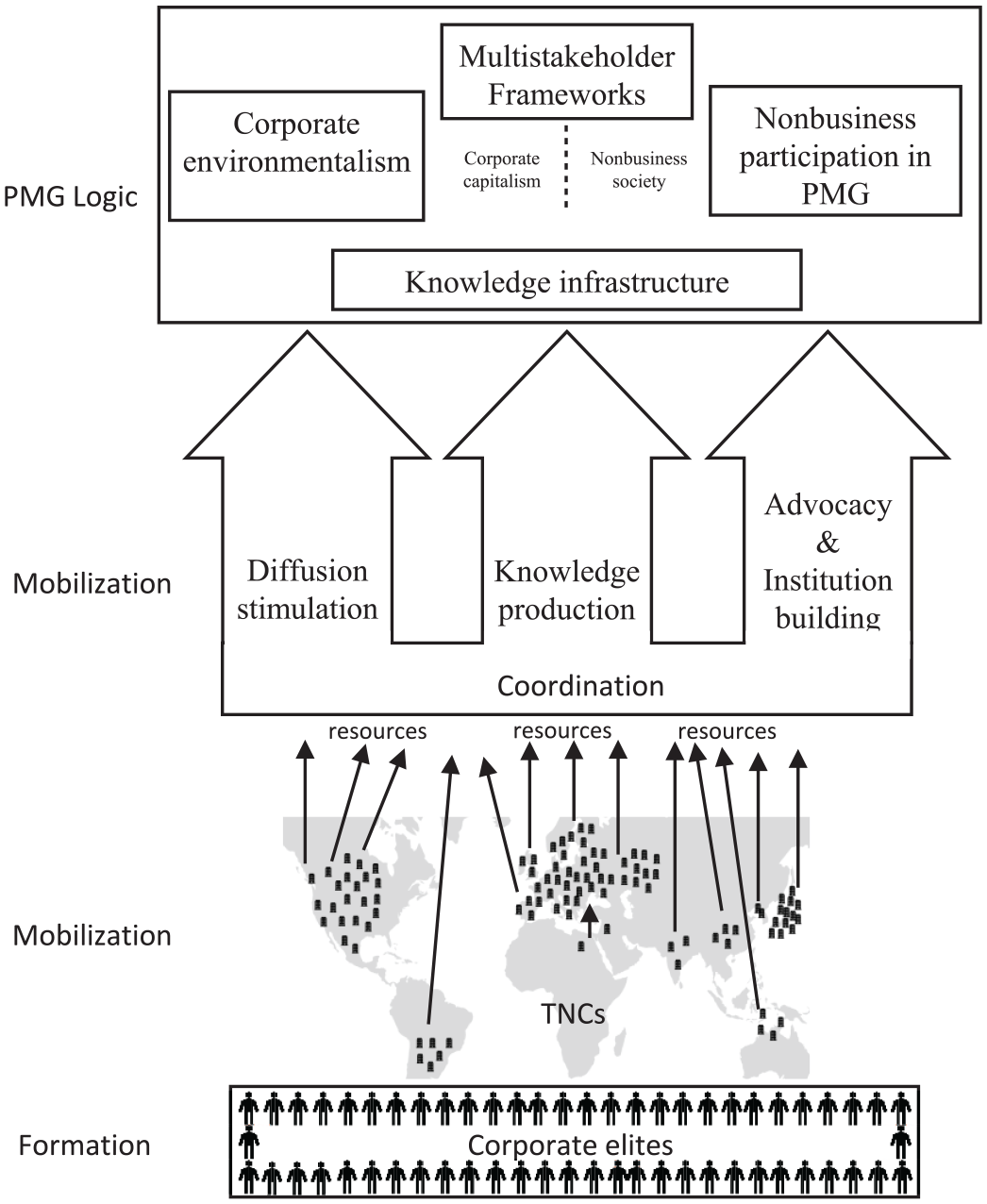
The WBCSD project.
Consistent with the project’s objectives, if only partly as its result, 4 the substitution of the market-based for the state-based logic of environmentalism has clearly influenced the pattern of sustainability organizing today by discouraging the development of more sustainable organizational forms insofar as they challenge the market logic of economic activity. When market-congruent (including market-driven) forms of governance implicitly but effectively delegitimize and crowd out market-constraining forms of public authority, the emergence of alternative organizing models is discouraged.
Contributions to business power research
My analysis illuminates a modality of business-class instrumental power that diverges from the well-analyzed instruments of corporate political activity to control the policy decisions of state leaders and officials: political donations, lobbying, think tanks, and public relations (Barley, 2010; Dreiling & Darves, 2011; Hillman, Keim, & Schuler 2004; Mizruchi, 1992; Murray, 2017; Walker, 2014). In this case, rather than harnessing the state, corporate power seeks to institutionally bypass, depress, and replace it (see also Kaplan & Kinderman, 2019). While the WBCSD project involves efforts to incorporate states and interstate organizations into governance privatization, its main thrust is to create, through various forms of institutional work, institutions that relocate governance responsibilities and functions from the state to corporations, such as corporate responsibility and multistakeholder frameworks. Exploring these state-bypassing forms of business power from a neo-institutional perspective can bolster the quest to recognize new avenues of corporate influence and ways by which corporations generate changes within their sociopolitical environments (Walker & Rea, 2014).
My findings also extend our knowledge of the role of business associations in transnational class formation, beyond the familiar functions of transnational policy groups—mainly the TC and WEF—in forming a transnational historical block of world-class business and nonbusiness elites and coordinating activity to set policy agendas (Carroll & Carson, 2003; Gill, 1991). The WBCSD activates a significantly divergent mode of class formation: a transnational, class-representative, cohesive group of major TNC leaders that sets the global class agenda and spearheads inter-firm mobilization vis-a-vis environmental governance. By being organizationally induced, this transnational application of the inner circle revises the classic view of the formation of an inner circle as the unintended consequence of multiplying interlocking directorates (Carroll & Sapinski, 2010; Useem, 1984). Thus it problematizes arguments regarding the failure of transnational class formation to occur (Burris & Staples, 2012) and, more indirectly, the fracturing of the national corporate elite (Chu & Davis, 2016; Mizruchi, 2013).
Contributions to the study of large-scale institutional work
In three important ways that correspond with the who, how, and what of institutional work, my study advances the theoretical understanding of societal-level, large-scale institutional work (Hampel et al., 2017; Lawrence et al., 2013). The first is to shed light on the institutional work agency of business classes (the aspect of “who”). We know that a few leading firms in national fields of industry can promote institutional arrangements that buttress their advantage over competitors and employees (Greenwood & Suddaby, 2006; Hamann & Bertels, 2018). My findings suggest that inter-firm institutional work can be applied on a much grander scale—ultimately on a class-wide scale—whereas large numbers of firms at the apex of corporate (national or transnational) capitalism articulate a shared political-institutional interest and mobilize to promote it through collective institution-shaping action. Class formation on institutional work occurs in the context of struggles over societal arrangements. In our case, it transpired because intergovernmental environmental constraints on global trade and economic growth threaten all TNCs, not merely the most polluting industries, and also because the WBCSD offered an articulation of the class interest and strategy that most TNCs could accept.
Once formed, class agency is structurally disposed to gain political-institutional dominance in relevant societal fields thanks to the superior resources it can command. As class theorists posit, “When unified, the resources of corporations simply crowd out the resources of all other societal interests” (Dreiling & Darves, 2011, p. 1557). My findings extend this insight to the context of institutional projects. Few endeavors documented in the institutional work literature can match the resource profusion of the focal business-class project, including mobilization of the corporate elites themselves as organizers and advocates, and of abundant human, financial, organizational, and network resources from their corporations. The special robustness of business-class institutional agency underlines the importance of its investigation.
The second contribution, which pertains to the “how” of institutional work, is an exploration of the significance of institutional projects in the organization of large-scale work. The institutional work coordinated by the WBCSD was highly multifaceted in terms of the efforts and forms of institutional work deployed. These forms of work can be studied for themselves, but studying work through its forms does not address the nature and meaning of the total work deployed by a focal collective agent, particularly if the overall effort is highly complex strategically and organizationally, as in large-scale work. Appreciating the scale, heterogeneity, and complexity of large-scale work requires a more holistic approach. The concept of institutional project (Chorev, 2005; DiMaggio, 1988) provides a unifying perspective on wide-ranging, multi-form, prolonged ensembles of work in terms of organized, enduring endeavors to pursue a large-scale institutional goal. Insofar as work out there is enmeshed in expansive projects, the project conceptualization provides a way to confront its anticipated complexity (Hampel et al., 2017) and to better contextualize it (Jackson, Helfen, Kaplan, Kirsch, & Lohmeyer, 2019).
Institutional project also shifts attention to several less-explored issues. First is the formation of a unified collective agency of institutional work among groups that exist across formal organizations in addition to classes, such as professionals and social movements. Their consolidation into a collective actor should not be taken for granted, as it is likely contingent on unexplored conditions and mechanisms. In turn, its nature and degree might factor into the work and its outcomes. Second is the issue of resource mobilization for institutional work. Resource mobilization is a critical aspect of any project. The WBCSD project calls attention to the role of business associations and other meta-organizations in pooling and coordinating the deployment of inter-organizational resources for large-scale work (Ahrne & Brunsson, 2008; Marques, 2016). This function is anticipated by Dorado’s (2005) notion of convening (see also Kaplan, 2021), but further theorization of the mechanisms by which cross-organizational institutional work is resourced would, again, further systematize our view of work’s conditions and consequences.
The third contribution is the identification of institutional logics as the object (the “what”) of large-scale institutional projects. The WBCSD does not work to shape a specific institution, practice, standard, organizational form or arrangement, but to redirect the main trend of institutionalization throughout the field, across institutions, along the lines of higher-order principles of governance and organizing—the PMG logic. Logic-shaping work emerges in the context of struggles between challengers and incumbents—in this case, a business elite that defends market globalization by mobilizing to shape the logic of global governance. In contrast to smaller-scale institutional work, here work seeks to secure for its agent a generalized control (i.e., domination) of the nature of institutionalization in a field (see also Rao et al., 2003), or to challenge the generalized control of others (Schüssler et al., 2022). It is designed to preempt or crowd out a rival logic, either fully or partially. My findings, then, point to the nexus between large-scale work, institutional logics, and institutional control and domination (Lawrence, 2008).
Further, work on logics appears to be operationally divergent from smaller-scale institutional creation. It rarely promotes the logic as such—as a set of general organizing principles 5 —but operates through numerous instances of institutional work that produce a plethora of knowledge objects, practices, and structures that are diverse but, taken together, uniformly embody the logic’s principles. Institutional logics are thus molded through the shaping of lower-level institutional forms in light of the logic. Implied here is a bidirectional model of the nexus between institutional logics and institutional work, whereas the logic still shapes—but is also constituted and shaped by—work that creates multiple institutional forms that embody the logic. Further exploration of this bidirectionality can advance the discussion about how to create a link between institutional work and institutional logics research (Hampel et al., 2017; Zilber, 2013).
Conclusion
I applied neo-institutional theory to the study of the transnational capitalist class mobilization to promote global governance privatization. By highlighting the roots of the post-1990 rise of environmental CSR and private governance in business-class anti-regulatory strategy, the analysis lends balance to accounts of the same process in terms of corporations stepping up to fill the governance gaps left by ineffective governments (Scherer & Palazzo, 2011; Stigson & Flaherty, 2012). The focal project demonstrates the first-class strategic ambition, organizational skill, resource profusion, and large-scale deployment of corporations’ institution-shaping action (Barley, 2010). The ongoing nature of this privatizing endeavor raises the question of its role in the race that awaits the reaching of sustainability by 2050.
Footnotes
Appendix
Sources in their Order of Appearance.
| Number | Reference | Type of document |
|---|---|---|
| 1 | Schmidheiny, S. (2006). My path—my perspective. VIVA Trust. | Autobiography |
| 2 | World Business Council for Sustainable Development (Lloyd Timberlake). (2006). Catalyzing change: A short history of the WBCSD. Geneva. | Authorized history |
| 3 | World Business Council for Sustainable Development. (2011). Annual review 2010/2011. Geneva. | Annual report |
| 4 | World Business Council for Sustainable Development. (2018). WBCSD membership conditions. Retrieved from www.wbcsd.org, May 15, 2020 | Statutes |
| 5 | World Business Council for Sustainable Development. (1997). Annual review 1996. Geneva. | Annual report |
| 6 | World Business Council for Sustainable Development. (2001). Annual review 2000. Geneva. | Annual report |
| 7 | World Business Council for Sustainable Development. (2000). Annual review 1999. Geneva. | Annual report |
| 8 | World Business Council for Sustainable Development. (2004). Mobility 2030: Meeting the challenges to sustainability. Geneva. | Issue specific report / guide |
| 9 | World Business Council for Sustainable Development. (2002). Annual review 2001. Geneva. | Annual report |
| 10 | World Business Council for Sustainable Development. (2003). Annual review 2002. Geneva. | Annual report |
| 11 | Business Action for Sustainable Development. (2002). Business events calendar for the world summit. Retrieved from: http://basd.free.fr/resources/business.htm, May 22, 2020 | Website content |
| 12 | Business Action for Sustainable Development. (2001). Protesters bang the drum for BASD. Retrieved from: http://basd.free.fr/docs/releases/9-1oct2001.html, May 22, 2020 | Press release |
| 13 | World Business Council for Sustainable Development. (2016). Unlocking more value with fewer resources: A practical guide to the circular economy. Geneva. | Report |
| 14 | Business Council for Sustainable Development. (1993). Getting eco-efficient: How can business contribute to sustainable development? Report of the BCSD First Antwerp Eco-Efficiency Workshop. Geneva. | Conference proceedings |
| 15 | World Business Council for Sustainable Development. (1995). Eco-efficient leadership for improved economic and environmental performance. Retrieved from: http://wbcsdservers.org/wbcsdpublications/cd_files/datas/wbcsd/business_role/pdf/EELeadershipForImprovedEconomic&EnviPerformance.pdf, April 6, 2020 | Guide |
| 16 | World Business Council for Sustainable Development. (2000). Projects and activities. Retrieved from: https://web.archive.org/web/20000819011120/http://www.foundation.no:80/projects.htm | Website content |
| 17 | World Business Council for Sustainable Development. (2000). WBCSD and World Bank pioneer joint Internet educational initiative. Retrieved from: https://web.archive.org/web/20010422180401/http://www.wbcsd.org:80/publications/prmedia/press26.htm, April 6, 2020 | Press release |
| 18 | World Business Council for Sustainable Development. (2005). Annual review 2004. Geneva. | Annual report |
| 19 | World Business Council for Sustainable Development. (1997). The Global Network. Retrieved from: https://web.archive.org/web/20010423143410/http://www.wbcsd.org/publications/prmedia/iht3.htm, April 7, 2020 | Website content |
| 20 | World Business Council for Sustainable Development. (2006). Annual review 2005. Geneva. | Annual report |
| 21 | Stigson, B. November (1999). The business agenda for sustainability in developing and emerging countries. Retrieved from: https://web.archive.org/web/20000819012634/http://www.wbcsd.ch/Speech/s68.htm, May 13, 2020 | Speech by WBCSD president |
| 22 | World Business Council for Sustainable Development. (2000). Stakeholder dialogue. Retrieved from: https://web.archive.org/web/20010421002007/http://www.wbcsd.org:80/sustain1.htm, June 7, 2020 | Website content |
| 23 | World Business Council for Sustainable Development. (2001). Stakeholder dialogue: The WBCSD’s approach to engagement. Geneva. | Report |
| 24 | World Business Council for Sustainable Development. (2005). WBCSD’s 10 messages by which to operate. Retrieved from: https://web.archive.org/web/20071220124536/http://www.wbcsd.org:80/templates/TemplateWBCSD5/layout.asp?type=p&MenuId=MTAyMQ&doOpen=1&ClickMe, April 9, 2020 | Guide |
| 25 | Stigson, Björn. (1997). Partnerships for sustainable development. Retrieved from: https://web.archive.org/web/20010423142706/http://www.wbcsd.org:80/publications/prmedia/tomorrow4.htm#top April 7, 2020 | Statement by WBCSD President |
| 26 | World Business Council for Sustainable Development. (2008). Annual review 2007. Geneva. | Annual report |
| 27 | United Nations. (1999). Business leaders advocate a stronger United Nations and take up challenge of Secretary-General’s Global Compact. Retrieved from: https://web.archive.org/web/20010108153700/http://www.un.org/partners/business/iccun1.htm March 20, 2020 | United Nations press release |
| 28 | World Business Council for Sustainable Development. (2000). The WBCSD and the Global Compact. Retrieved from: https://web.archive.org/web/20010405121745/http://www.wbcsd.ch:80/globalcompact/index.htm May 7, 2020 | WBCSD Report |
| 29 | World Business Council for Sustainable Development. (2004). Annual Review 2003. Geneva. | Annual report |
| 30 | World Business Council for Sustainable Development. (2000). European Eco-Efficiency Initiative. Retrieved from: https://web.archive.org/web/20010414085052/http://www.wbcsd.org:80/ecoeff1.htm, June 1, 2020 | Website content |
| 31 | Stigson, Björn. (1999). The Business agenda for sustainability in developing and emerging countries. Retrieved from: https://web.archive.org/web/20000819012634/http://www.wbcsd.ch/Speech/s68.htm, July 25, 2020 | Speech by WBCSD President |
Acknowledgements
I would like to thank the guest editors and the anonymous reviewers for their invaluable contribution to the development of this paper. To the friends and colleagues who gave me feedback and advice throughout the process: Pierre Eichenberger, Dafna Gelbgiser, Yossi Harpaz, Efrat Herzberg, Erez Maggor, Ronen Mandelkern, Erez Marantz, Nils Moussu, Guy Mundlak, Isaac Sasson, Talia Shiff, and Ilan Talmud. And to my indefatigable research assistant Shaylee Klinger.
Funding
The author received no financial support for the research, authorship, and/or publication of this article.